SAP2000
Integrated
Finite Element Analysis
and
Design of Structures
STEEL DESIGN MANUAL
Computers and Structures, Inc.
The computer program SAP2000 and all associated documentation are proprietary and copyrighted products. Worldwide rights of ownership rest with Computers and Structures, Inc. Unlicensed use of the program or reproduction of the documentation in any form, without prior written authorization from Computers and Structures, Inc., is explicitly prohib-ited.
Further information and copies of this documentation may be obtained from:
Computers and Structures, Inc. 1995 University Avenue Berkeley, California 94704 USA
Tel: (510) 845-2177 Fax: (510) 845-4096 E-mail: [email protected]
Web: www.csiberkeley.com
© Copyright Computers and Structures, Inc., 1978–2000.
The CSI Logo is a registered trademark of Computers and Structures, Inc. SAP2000 is a registered trademark of Computers and Structures, Inc.
CONSIDERABLE TIME, EFFORT AND EXPENSE HAVE GONE INTO THE DEVELOPMENT AND DOCUMENTATION OF SAP2000. THE PROGRAM HAS BEEN THOROUGHLY TESTED AND USED. IN USING THE PROGRAM, HOWEVER, THE USER ACCEPTS AND UNDERSTANDS THAT NO WARRANTY IS EX-PRESSED OR IMPLIED BY THE DEVELOPERS OR THE DIS-TRIBUTORS ON THE ACCURACY OR THE RELIABILITY OF THE PROGRAM.
THIS PROGRAM IS A VERY PRACTICAL TOOL FOR THE DE-SIGN/ CHECK OF STEEL STRUCTURES. HOWEVER, THE USER MUST THOROUGHLY READ THE MANUAL AND CLEARLY RECOGNIZE THE ASPECTS OF STEEL DESIGN THAT THE PRO-GRAM ALGORITHMS DO NOT ADDRESS.
THE USER MUST EXPLICITLY UNDERSTAND THE ASSUMP-TIONS OF THE PROGRAM AND MUST INDEPENDENTLY VER-IFY THE RESULTS.
CHAPTER I Introduction 1
Overview . . . 1
Organization . . . 3
Recommended Reading . . . 3
CHAPTER II Design Algorithms 5 Design Load Combinations . . . 6
Design and Check Stations . . . 7
P- Effects . . . 8
Element Unsupported Lengths . . . 9
Effective Length Factor (K) . . . 10
Choice of Input Units . . . 13
CHAPTER III Check/Design for AISC-ASD89 15 Design Loading Combinations . . . 18
Classification of Sections . . . 18
Calculation of Stresses . . . 22
Calculation of Allowable Stresses . . . 23
Allowable Stress in Tension . . . 23
Allowable Stress in Compression. . . 23
Flexural Buckling . . . 23
Flexural-Torsional Buckling . . . 25
Allowable Stress in Bending . . . 30
I-sections . . . 30
Channel sections . . . 33
T-sections and Double angles . . . 34
Box Sections and Rectangular Tubes . . . 35
Pipe Sections . . . 36
Rectangular and Square Bars . . . 36
Single-Angle Sections . . . 37
General Sections . . . 39
Allowable Stress in Shear . . . 39
Calculation of Stress Ratios . . . 40
Axial and Bending Stresses . . . 41
Shear Stresses . . . 43
CHAPTER IV Check/Design for AISC-LRFD93 45 Design Loading Combinations . . . 48
Classification of Sections . . . 48
Calculation of Factored Forces . . . 52
Calculation of Nominal Strengths . . . 54
Compression Capacity . . . 54
Flexural Buckling . . . 54
Flexural-Torsional Buckling . . . 58
Torsional and Flexural-Torsional Buckling . . . 58
Tension Capacity . . . 60
Nominal Strength in Bending . . . 61
Yielding . . . 61
Lateral-Torsional Buckling . . . 61
Flange Local Buckling . . . 65
Web Local Buckling . . . 69
Shear Capacities . . . 72
Calculation of Capacity Ratios . . . 73
Axial and Bending Stresses . . . 73
Shear Stresses . . . 74
CHAPTER V Check/Design for AASHTO 1997 75 Design Loading Combinations . . . 78
Classification of Sections . . . 79
Calculation of Factored Forces . . . 79
Calculation of Nominal Strengths . . . 82
Compression Capacity . . . 83
Tension Capacity . . . 84
Flexure Capacity . . . 84
Shear Capacities . . . 90
Calculation of Capacity Ratios . . . 91
Axial and Bending Stresses . . . 92
Shear Stresses . . . 92
CHAPTER VI Check/Design for CISC94 93 Design Loading Combinations . . . 96
Calculation of Factored Forces . . . 97
Calculation of Factored Strengths . . . 100
Compression Strength . . . 100
Tension Strength. . . 101
Bending Strengths . . . 101
I-shapes and Boxes . . . 102
Rectangular Bar. . . 103
Pipes and Circular Rods . . . 103
Channel Sections . . . 104
T-shapes and double angles. . . 104
Single Angle and General Sections . . . 105
Shear Strengths . . . 105
Calculation of Capacity Ratios . . . 107
Axial and Bending Stresses . . . 107
Shear Stresses . . . 110
CHAPTER VII Check/Design for BS 5950 111 Design Loading Combinations . . . 114
Classification of Sections . . . 115
. . . 117
Calculation of Factored Forces . . . 117
Calculation of Section Capacities . . . 119
Compression Resistance . . . 119
Tension Capacity . . . 121
Moment Capacity . . . 121
Plastic and Compact Sections . . . 121
Semi-compact Sections . . . 122
Lateral-Torsional Buckling Moment Capacity . . . 122
Shear Capacities . . . 125
Calculation of Capacity Ratios . . . 125
Local Capacity Check . . . 127
Under Axial Tension . . . 127
Under Axial Compression . . . 127
Overall Buckling Check . . . 127
Shear Capacity Check . . . 128
CHAPTER VIII Check/Design for EUROCODE 3 129 Design Loading Combinations . . . 132
Classification of Sections . . . 133
Calculation of Factored Forces . . . 137
Calculation of Section Resistances. . . 138
Tension Capacity . . . 139
Compression Resistance . . . 139
Moment Resistance . . . 142
Lateral-torsional Buckling. . . 143
Calculation of Capacity Ratios . . . 145
Bending, Axial Compression, and Low Shear . . . 145
Bending, Axial Compression, and High Shear . . . 146
Bending, Compression, and Flexural Buckling . . . 146
Bending, Compression, and Lateral-Torsional Buckling . . . 147
Bending, Axial Tension, and Low Shear . . . 148
Bending, Axial Tension, and High Shear . . . 148
Bending, Axial Tension, and Lateral-Torsional Buckling . . . . 149
Shear . . . 149
CHAPTER IX Design Output 151 Overview . . . 151
Graphical Display of Design Output . . . 152
Tabular Display of Design Output . . . 153
Member Specific Information . . . 154
References 157
Introduction
Overview
SAP2000 features powerful and completely integrated modules for design of both steel and reinforced concrete structures. The program provides the user with op-tions to create, modify, analyze and design structural models, all from within the same user interface. The program is capable of performing initial member sizing and optimization from within the same interface.
The program provides an interactive environment in which the user can study the stress conditions, make appropriate changes, such as revising member properties, and re-examine the results without the need to re-run the analysis. A single mouse click on an element brings up detailed design information. Members can be grouped together for design purposes. The output in both graphical and tabulated formats can be readily printed.
The program is structured to support a wide variety of the latest national and inter-national design codes for the automated design and check of concrete and steel frame members. The program currently supports the following steel design codes:
• U.S. AISC/ASD (1989), • U.S. AISC/LRFD (1994), • U.S. AASHTO LRFD (1997),
• Canadian CAN/CSA-S16.1-94 (1994), • British BS 5950 (1990), and
• Eurocode 3 (ENV 1993-1-1).
The design is based upon a set of user-specified loading combinations. However, the program provides a set of default load combinations for each design code sup-ported in SAP2000. If the default load combinations are acceptable, no definition of additional load combination is required.
In the design process the program picks the least weight section required for strength for each element to be designed, from a set of user specified sections. Dif-ferent sets of available sections can be specified for difDif-ferent groups of elements. Also several elements can be grouped to be designed to have the same section.
In the check process the program produces demand/capacity ratios for axial load and biaxial moment interactions and shear. The demand/capacity ratios are based on element stress and allowable stress for allowable stress design, and on factored loads (actions) and factored capacities (resistances) for limit state design.
The checks are made for each user specified (or program defaulted) load combina-tion and at several user controlled stacombina-tions along the length of the element. Maxi-mum demand/capacity ratios are then reported and/or used for design optimization.
All allowable stress values or design capacity values for axial, bending and shear actions are calculated by the program. Tedious calculations associated with evalu-ating effective length factors for columns in moment frame type structures are auto-mated in the algorithms.
The presentation of the output is clear and concise. The information is in a form that allows the designer to take appropriate remedial measures if there is member over-stress. Backup design information produced by the program is also provided for convenient verification of the results.
Special requirements for seismic design are not implemented in the current version of SAP2000.
English as well as SI and MKS metric units can be used to define the model geome-try and to specify design parameters.
Organization
This manual is organized in the following way:
Chapter II outlines various aspects of the steel design procedures of the SAP2000 program. This chapter describes the common terminology of steel design as imple-mented in SAP2000.
Each of six subsequent chapters gives a detailed description of a specific code of practice as interpreted by and implemented in SAP2000. Each chapter describes the design loading combinations to be considered; allowable stress or capacity calcula-tions for tension, compression, bending, and shear; calculacalcula-tions of demand/capac-ity ratios; and other special considerations required by the code.
• Chapter III gives a detailed description of the AISC ASD code (AISC 1989) as implemented in SAP2000.
• Chapter IV gives a detailed description of the AISC LRFD code (AISC 1994) as implemented in SAP2000.
• Chapter V gives a detailed description of the AASHTO LRFD steel code (AASHTO 1997) as implemented in SAP2000.
• Chapter VI gives a detailed description of the Canadian code (CISC 1994) as implemented in SAP2000.
• Chapter VII gives a detailed description of the British code BS 5950 (BSI 1990) as implemented in SAP2000.
• Chapter VIII gives a detailed description of the Eurocode 3 (CEN 1992) as im-plemented in SAP2000.
Chapter IX outlines various aspects of the tabular and graphical output from SAP2000 related to steel design.
Recommended Reading
It is recommended that the user read Chapter II “Design Algorithms” and one of six subsequent chapters corresponding to the code of interest to the user. Finally the user should read “Design Output” in Chapter IX for understanding and interpreting SAP2000 output related to steel design.
A steel design tutorial is presented in the chapter “Steel Design Tutorial” in the
SAP2000 Quick Tutorial manual. It is recommended that first time users follow
Design Algorithms
This chapter outlines various aspects of the steel check and design procedures that are used by the SAP2000 program. The steel design and check may be performed according to one of the following codes of practice.
• American Institute of Steel Construction’s “Allowable Stress Design and Plas-tic Design Specification for Structural Steel Buildings”, AISC-ASD (AISC 1989).
• American Institute of Steel Construction’s “Load and Resistance Factor De-sign Specification for Structural Steel Buildings”, AISC-LRFD (AISC 1994). • American Association of State Highway and Transportation Officials’ “AASHTO-LRFD Bridge Design Specifications”, AASHTO-LRFD (AASHTO 1997).
• Canadian Institute of Steel Construction’s “Limit States Design of Steel Struc-tures”, CAN/CSA-S16.1-94 (CISC 1995).
• British Standards Institution’s “Structural Use of Steelwork in Building”, BS 5950 (BSI 1990).
• European Committee for Standardization’s “Eurocode 3: Design of Steel Structures Part 1.1: General Rules and Rules for Buildings”, ENV 1993-1-1 (CEN 1992).
Details of the algorithms associated with each of these codes as implemented and interpreted in SAP2000 are described in subsequent chapters. However, this chap-ter provides a background which is common to all the design codes.
It is assumed that the user has an engineering background in the general area of structural steel design and familiarity with at least one of the above mentioned de-sign codes.
For referring to pertinent sections of the corresponding code, a unique prefix is as-signed for each code. For example, all references to the AASHTO-LRFD code carry the prefix of “AASHTO”. Similarly,
– References to the AISC-ASD89 code carry the prefix of “ASD” – References to the AISC-LRFD93 code carry the prefix of “LRFD” – References to the Canadian code carry the prefix of “CISC” – References to the British code carry the prefix of “BS” – References to the Eurocode carry the prefix of “EC3”
Design Load Combinations
The design load combinations are used for determining the various combinations of the load cases for which the structure needs to be designed/checked. The load com-bination factors to be used vary with the selected design code. The load combina-tion factors are applied to the forces and moments obtained from the associated load cases and the results are then summed to obtain the factored design forces and mo-ments for the load combination.
For multi-valued load combinations involving response spectrum, time history, moving loads and multi-valued combinations (of type enveloping, square-root of the sum of the squares or absolute) where any correspondence between interacting quantities is lost, the program automatically produces multiple sub combinations using maxima/minima permutations of interacting quantities. Separate combina-tions with negative factors for response spectrum cases are not required because the program automatically takes the minima to be the negative of the maxima for re-sponse spectrum cases and the above described permutations generate the required sub combinations.
When a design combination involves only a single multi-valued case of time his-tory or moving load, further options are available. The program has an option to re-quest that time history combinations produce sub combinations for each time step of the time history. Also an option is available to request that moving load
combina-tions produce sub combinacombina-tions using maxima and minima of each design quantity but with corresponding values of interacting quantities.
For normal loading conditions involving static dead load, live load, wind load, and earthquake load, and/or dynamic response spectrum earthquake load, the program has built-in default loading combinations for each design code. These are based on the code recommendations and are documented for each code in the corresponding chapters.
For other loading conditions involving moving load, time history, pattern live loads, separate consideration of roof live load, snow load, etc., the user must define design loading combinations either in lieu of or in addition to the default design loading combinations.
The default load combinations assume all static load cases declared as dead load to be additive. Similarly, all cases declared as live load are assumed additive. How-ever, each static load case declared as wind or earthquake, or response spectrum cases, is assumed to be non additive with each other and produces multiple lateral load combinations. Also wind and static earthquake cases produce separate loading combinations with the sense (positive or negative) reversed. If these conditions are not correct, the user must provide the appropriate design combinations.
The default load combinations are included in design if the user requests them to be included or if no other user defined combination is available for concrete design. If any default combination is included in design, then all default combinations will automatically be updated by the program any time the user changes to a different design code or if static or response spectrum load cases are modified.
Live load reduction factors can be applied to the member forces of the live load case on an element-by-element basis to reduce the contribution of the live load to the factored loading.
The user is cautioned that if moving load or time history results are not requested to be recovered in the analysis for some or all the frame members, then the effects of these loads will be assumed to be zero in any combination that includes them.
Design and Check Stations
For each load combination, each element is designed or checked at a number of lo-cations along the length of the element. The lolo-cations are based on equally spaced segments along the clear length of the element. The number of segments in an ele-ment is requested by the user before the analysis is made. The user can refine the de-sign along the length of an element by requesting more segments.
The axial-flexure interaction ratios as well as shear stress ratios are calculated for each station along the length of the member for each load combination. The actual member stress components and corresponding allowable stresses are calculated. Then, the stress ratios are evaluated according to the code. The controlling com-pression and/or tension stress ratio is then obtained, along with the corresponding identification of the station, load combination, and code-equation. A stress ratio greater than 1.0 indicates an overstress or exceeding a limit state.
P- Effects
The SAP2000 design algorithms require that the analysis results include the P- ef-fects. The P- effects are considered differently for “braced” or “nonsway” and “unbraced” or “sway” components of moments in frames. For the braced moments in frames, the effect of P- is limited to “individual member stability”. For un-braced components, “lateral drift effects” should be considered in addition to indi-vidual member stability effect. In SAP2000, it is assumed that “braced” or “non-sway” moments are contributed from the “dead” or “live” loads. Whereas, “un-braced” or “sway” moments are contributed from all other types of loads.
For the individual member stability effects, the moments are magnified with mo-ment magnification factors as in the AISC-LRFD and AASHTO-LRFD codes or are considered directly in the design equations as in the Canadian, British, and European codes. No moment magnification is applied to the AISC-ASD code.
For lateral drift effects of unbraced or sway frames, SAP2000 assumes that the am-plification is already included in the results because P- effects are considered for all but AISC-ASD code.
The users of SAP2000 should be aware that the default analysis option in SAP2000 is turned OFF for P- effect. The default number of iterations for P- analysis is 1. The user should turn the P- analysis ON and set the maximum number of it-erations for the analysis. No P- analysis is required for the AISC-ASD code. For further reference, the user is referred to SAP2000 Analysis Reference Manual (CSI 1997).
The user is also cautioned that SAP2000 currently considers P- effects due to axial loads in frame members only. Forces in other types of elements do not contribute to this effect. If significant forces are present in other types of elements, for example, large axial loads in shear walls modeled as shell elements, then the additional forces computed for P- will be inaccurate.
Element Unsupported Lengths
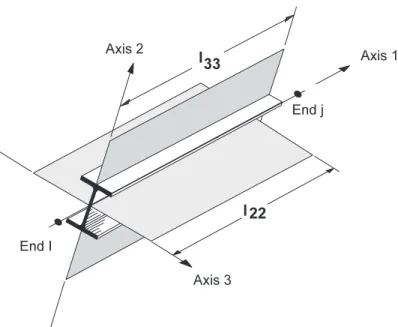
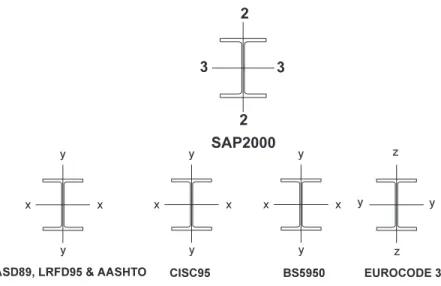
To account for column slenderness effects, the column unsupported lengths are re-quired. The two unsupported lengths are l33and l22. See Figure II-1. These are the lengths between support points of the element in the corresponding directions. The length l33 corresponds to instability about the 3-3 axis (major axis), and l22 corre-sponds to instability about the 2-2 axis (minor axis). The length l22 is also used for lateral-torsional buckling caused by major direction bending (i.e., about the 3-3 axis). See Figure II-2 for correspondence between the SAP2000 axes and the axes in the design codes.
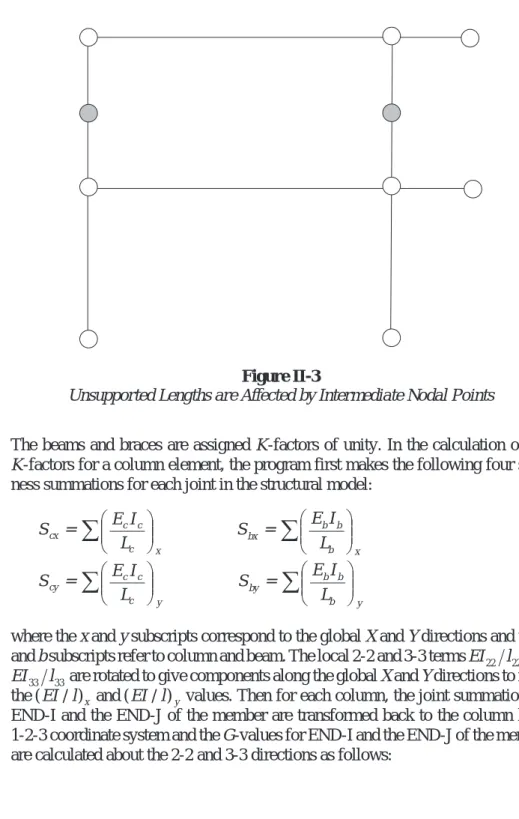
Normally, the unsupported element length is equal to the length of the element, i.e., the distance between END-I and END-J of the element. See Figure II-1. The pro-gram, however, allows users to assign several elements to be treated as a single member for design. This can be done differently for major and minor bending. Therefore, extraneous joints, as shown in Figure II-3, that affect the unsupported length of an element are automatically taken into consideration.
Figure II-1
In determining the values for l22and l33of the elements, the program recognizes various aspects of the structure that have an effect on these lengths, such as member connectivity, diaphragm constraints and support points. The program automati-cally locates the element support points and evaluates the corresponding unsup-ported element length.
Therefore, the unsupported length of a column may actually be evaluated as being greater than the corresponding element length. If the beam frames into only one di-rection of the column, the beam is assumed to give lateral support only in that direc-tion. The user has options to specify the unsupported lengths of the elements on an element-by-element basis.
Effective Length Factor (K)
The column K-factor algorithm has been developed for building-type structures, where the columns are vertical and the beams are horizontal, and the behavior is ba-sically that of a moment-resisting nature for which the K-factor calculation is rela-tively complex. For the purpose of calculating K-factors, the elements are identi-fied as columns, beams and braces. All elements parallel to the Z-axis are classiidenti-fied as columns. All elements parallel to the X-Y plane are classified as beams. The rest are braces.
Figure II-2
The beams and braces are assigned K-factors of unity. In the calculation of the
K-factors for a column element, the program first makes the following four
stiff-ness summations for each joint in the structural model:
S = E I L cx c c c x S = E I L bx b b b x S = E I L cy c c c y S = E I L by b b b y
where the x and y subscripts correspond to the global X and Y directions and the c and b subscripts refer to column and beam. The local 2-2 and 3-3 terms EI22 l22and
EI33 l33are rotated to give components along the global X and Y directions to form the (EI l/ )x and (EI l/ )y values. Then for each column, the joint summations at END-I and the END-J of the member are transformed back to the column local 1-2-3 coordinate system and the G-values for END-I and the END-J of the member are calculated about the 2-2 and 3-3 directions as follows:
Figure II-3
G = S S I I c I b 22 22 22 G = S S J J c J b 22 22 22 G = S S I I c I b 33 33 33 G = S S J J c J b 33 33 33
If a rotational release exists at a particular end (and direction) of an element, the corresponding value is set to 10.0. If all degrees of freedom for a particular joint are deleted, the G-values for all members connecting to that joint will be set to 1.0 for the end of the member connecting to that joint. Finally, if GI and GJare known for a particular direction, the column K-factor for the corresponding direction is calcu-lated by solving the following relationship forα:
2 I J I J
G G
G G
from which K . This relationship is the mathematical formulation for the
evaluation of K factors for moment-resisting frames assuming sidesway to be unin-hibited. For other structures, such as braced frame structures, trusses, space frames, transmission towers, etc., the K-factors for all members are usually unity and should be set so by the user. The following are some important aspects associated with the column K-factor algorithm:
• An element that has a pin at the joint under consideration will not enter the stiff-ness summations calculated above. An element that has a pin at the far end from the joint under consideration will contribute only 50% of the calculated EI value. Also, beam elements that have no column member at the far end from the joint under consideration, such as cantilevers, will not enter the stiffness sum-mation.
• If there are no beams framing into a particular direction of a column element, the associated G-value will be infinity. If the G-value at any one end of a col-umn for a particular direction is infinity, the K-factor corresponding to that di-rection is set equal to unity.
• If rotational releases exist at both ends of an element for a particular direction, the corresponding K-factor is set to unity.
• The automated K-factor calculation procedure can occasionally generate artifi-cially high K-factors, specifically under circumstances involving skewed beams, fixed support conditions, and under other conditions where the program may have difficulty recognizing that the members are laterally supported and
• All K-factors produced by the program can be overwritten by the user. These values should be reviewed and any unacceptable values should be replaced.
Choice of Input Units
English as well as SI and MKS metric units can be used for input. But the codes are based on a specific system of units. All equations and descriptions presented in the subsequent chapters correspond to that specific system of units unless otherwise noted. For example, AISC-ASD code is published in kip-inch-second units. By de-fault, all equations and descriptions presented in the chapter “Check/Design for AISC-ASD89” correspond to kip-inch-second units. However, any system of units can be used to define and design the structure in SAP2000.
Check/Design for AISC-ASD89
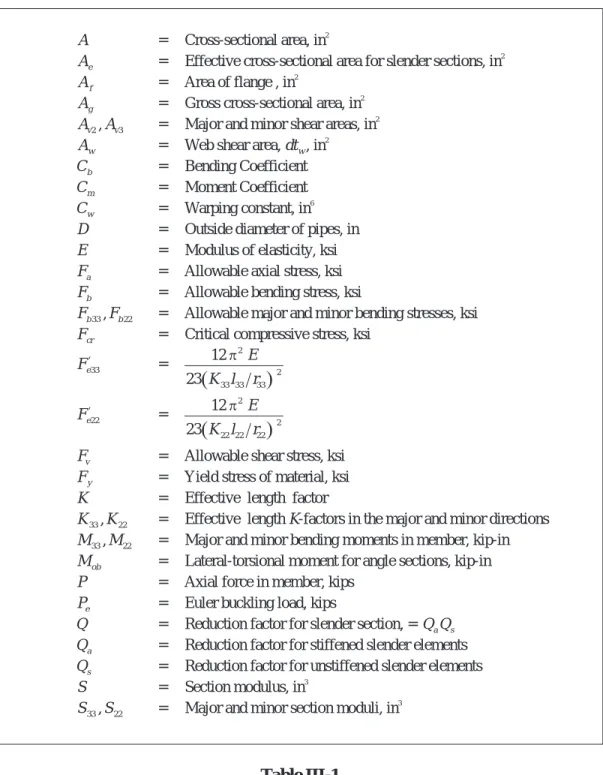
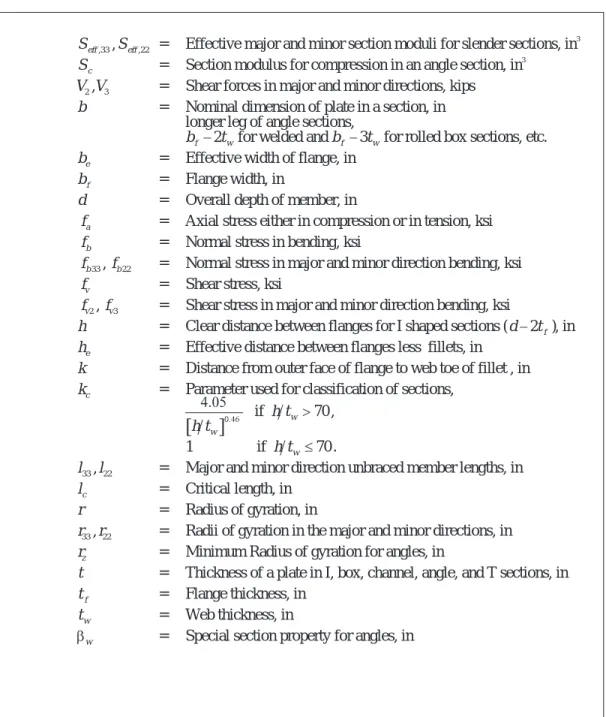
This chapter describes the details of the structural steel design and stress check al-gorithms that are used by SAP2000 when the user selects the AISC-ASD89 design code (AISC 1989). Various notations used in this chapter are described in Table III-1.
For referring to pertinent sections and equations of the original ASD code, a unique prefix “ASD” is assigned. However, all references to the “Specifications for Allow-able Stress Design of Single-Angle Members” carry the prefix of “ASD SAM”.
The design is based on user-specified loading combinations. But the program pro-vides a set of default load combinations that should satisfy requirements for the de-sign of most building type structures.
In the evaluation of the axial force/biaxial moment capacity ratios at a station along the length of the member, first the actual member force/moment components and the corresponding capacities are calculated for each load combination. Then the ca-pacity ratios are evaluated at each station under the influence of all load combina-tions using the corresponding equacombina-tions that are defined in this chapter. The con-trolling capacity ratio is then obtained. A capacity ratio greater than 1.0 indicates overstress. Similarly, a shear capacity ratio is also calculated separately.
A = Cross-sectional area, in2
Ae = Effective cross-sectional area for slender sections, in
2
Af = Area of flange , in
2
Ag = Gross cross-sectional area, in
2
Av2,Av3 = Major and minor shear areas, in
2
Aw = Web shear area, dtw, in
2
Cb = Bending Coefficient
Cm = Moment Coefficient
Cw = Warping constant, in
6
D = Outside diameter of pipes, in
E = Modulus of elasticity, ksi
Fa = Allowable axial stress, ksi
Fb = Allowable bending stress, ksi
Fb33,Fb22 = Allowable major and minor bending stresses, ksi
Fcr = Critical compressive stress, ksi
Fe33 ¢ = 12 23 2 33 33 33 2 E K l r Fe22 ¢ = 12 23 2 22 22 22 2 E K l r
Fv = Allowable shear stress, ksi
Fy = Yield stress of material, ksi
K = Effective length factor
K33,K22 = Effective length K-factors in the major and minor directions
M33,M22 = Major and minor bending moments in member, kip-in
Mob = Lateral-torsional moment for angle sections, kip-in
P = Axial force in member, kips
Pe = Euler buckling load, kips
Q = Reduction factor for slender section, = Q Qa s
Qa = Reduction factor for stiffened slender elements
Qs = Reduction factor for unstiffened slender elements
S = Section modulus, in3
S33,S22 = Major and minor section moduli, in
3
Table III-1
Seff,33,Seff,22 = Effective major and minor section moduli for slender sections, in
3
Sc = Section modulus for compression in an angle section, in
3
V V2, 3 = Shear forces in major and minor directions, kips
b = Nominal dimension of plate in a section, in longer leg of angle sections,
bf 2twfor welded and bf 3twfor rolled box sections, etc.
be = Effective width of flange, in
bf = Flange width, in
d = Overall depth of member, in
fa = Axial stress either in compression or in tension, ksi
fb = Normal stress in bending, ksi
fb33,fb22 = Normal stress in major and minor direction bending, ksi
fv = Shear stress, ksi
fv2,fv3 = Shear stress in major and minor direction bending, ksi
h = Clear distance between flanges for I shaped sections (d 2tf ), in
he = Effective distance between flanges less fillets, in
k = Distance from outer face of flange to web toe of fillet , in
kc = Parameter used for classification of sections,
0.46
h tw
if h tw 70 ,
1 if h tw 70 .
l33,l22 = Major and minor direction unbraced member lengths, in
lc = Critical length, in
r = Radius of gyration, in
r33,r22 = Radii of gyration in the major and minor directions, in
rz = Minimum Radius of gyration for angles, in
t = Thickness of a plate in I, box, channel, angle, and T sections, in
tf = Flange thickness, in
tw = Web thickness, in
w = Special section property for angles, in
Table III-1
English as well as SI and MKS metric units can be used for input. But the code is based on Kip-Inch-Second units. For simplicity, all equations and descriptions pre-sented in this chapter correspond to Kip-Inch-Second units unless otherwise noted.
Design Loading Combinations
The design load combinations are the various combinations of the load cases for which the structure needs to be checked. For the AISC-ASD89 code, if a structure is subjected to dead load (DL), live load (LL), wind load (WL), and earthquake in-duced load (EL), and considering that wind and earthquake forces are reversible, then the following load combinations may have to be defined (ASD A4):
DL (ASD A4.1) DL + LL (ASD A4.1) DL WL (ASD A4.1) DL + LL WL (ASD A4.1) DL EL (ASD A4.1) DL + LL EL (ASD A4.1)
These are also the default design load combinations in SAP2000 whenever the AISC-ASD89 code is used. The user should use other appropriate loading combi-nations if roof live load is separately treated, if other types of loads are present, or if pattern live loads are to be considered.
When designing for combinations involving earthquake and wind loads, allowable stresses are increased by a factor of 4/3 of the regular allowable value (ASD A5.2).
Live load reduction factors can be applied to the member forces of the live load case on an element-by-element basis to reduce the contribution of the live load to the factored loading.
Classification of Sections
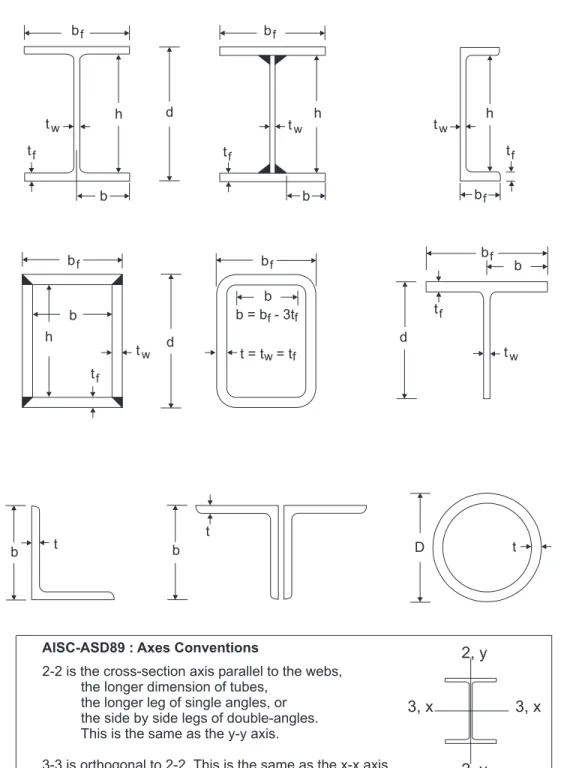
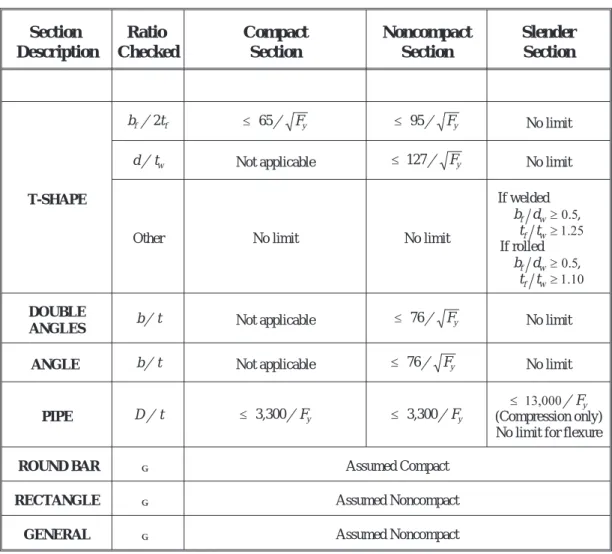
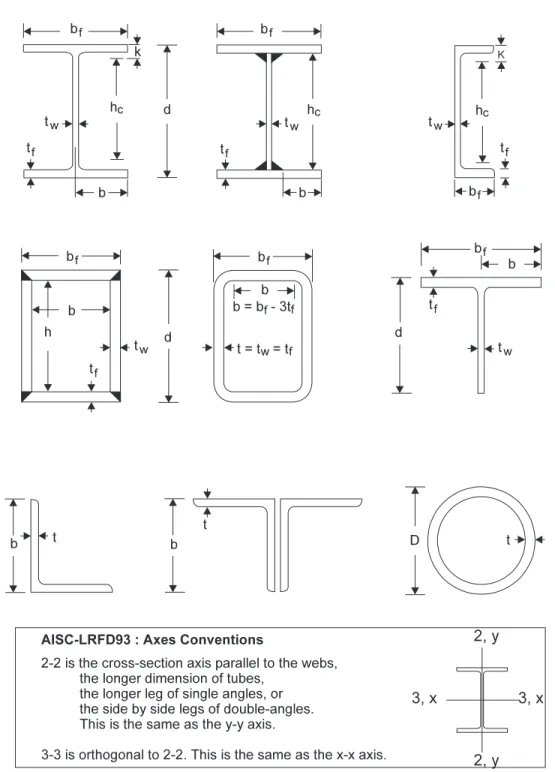
The allowable stresses for axial compression and flexure are dependent upon the classification of sections as either Compact, Noncompact, Slender, or Too Slender. SAP2000 classifies the individual members according to the limiting width/thick-ness ratios given in Table III-2 (ASD B5.1, F3.1, F5, G1, A-B5-2). The definition of the section properties required in this table is given in Figure III-1 and Table III-1.
Figure III-1
Section Description Ratio Checked Compact Section Noncompact Section Slender Section I-SHAPE bf 2tf ( rolled) 65 Fy 95 Fy No limit bf 2tf (welded) 65 Fy Fy/kc No limit d tw For fa Fy 640 1 F f F y a y ( ) , For fa/Fy 257/ Fy . No limit No limit h tw No limit If compression only, Fy 253 otherwise Fb 760 F Fy y BOX b tf 190 Fy 238 Fy No limit
d tw As for I-shapes No limit No limit
h tw No limit As for I-shapes As for I-shapes
Other tw tf 2 , dw bf None None
CHANNEL
b tf As for I-shapes As for I-shapes No limit
d tw As for I-shapes No limit No limit
h tw No limit As for I-shapes As for I-shapes
Other No limit No limit
If welded bf dw , tf tw If rolled bf dw , tf tw Table III-2
Limiting Width-Thickness Ratios for Classification of Sections Based on AISC-ASD
If the section dimensions satisfy the limits shown in the table, the section is classi-fied as either Compact, Noncompact, or Slender. If the section satisfies the criteria for Compact sections, then the section is classified as Compact section. If the sec-tion does not satisfy the criteria for Compact secsec-tions but satisfies the criteria for Noncompact sections, the section is classified as Noncompact section. If the sec-tion does not satisfy the criteria for Compact and Noncompact secsec-tions but satisfies Section Description Ratio Checked Compact Section Noncompact Section Slender Section T-SHAPE bf 2tf 65 Fy 95 Fy No limit
d tw Not applicable 127 Fy No limit
Other No limit No limit
If welded bf dw , tf tw If rolled bf dw , tf tw DOUBLE
ANGLES b t Not applicable 76 Fy No limit ANGLE b t Not applicable 76 Fy No limit
PIPE D t 3 300, Fy 3 300, Fy
Fy
(Compression only) No limit for flexure
ROUND BAR Assumed Compact
RECTANGLE Assumed Noncompact
GENERAL Assumed Noncompact
Table III-2
Limiting Width-Thickness Ratios for
the criteria for Slender sections, the section is classified as Slender section. If the limits for Slender sections are not met, the section is classified as Too Slender. Stress check of Too Slender sections is beyond the scope of SAP2000.
In classifying web slenderness of I-shapes, Box, and Channel sections, it is as-sumed that there are no intermediate stiffeners (ASD F5, G1). Double angles are conservatively assumed to be separated.
Calculation of Stresses
The stresses are calculated at each of the previously defined stations. The member stresses for non-slender sections that are calculated for each load combination are, in general, based on the gross cross-sectional properties.:
fa = P/A fb 33 = M33/S33 fb 22 = M22/S22 fv2 = V /A2 v2 fv3 = V /A3 v3
If the section is slender with slender stiffened elements, like slender web in I, Chan-nel, and Box sections or slender flanges in Box, effective section moduli based on reduced web and reduced flange dimensions are used in calculating stresses.
fa = P/A (ASD A-B5.2d)
fb33 = M33/Seff,33 (ASD A-B5.2d)
fb22 = M22/Seff,22 (ASD A-B5.2d)
fv2 = V /A2 v2 (ASD A-B5.2d)
fv3 = V /A3 v3 (ASD A-B5.2d)
The flexural stresses are calculated based on the properties about the principal axes. For I, Box, Channel, T, Double-angle, Pipe, Circular and Rectangular sections, the principal axes coincide with the geometric axes. For Single-angle sections, the de-sign considers the principal properties. For general sections it is assumed that all section properties are given in terms of the principal directions.
For Single-angle sections, the shear stresses are calculated for directions along the geometric axes. For all other sections the shear stresses are calculated along the geometric and principle axes.
Calculation of Allowable Stresses
The allowable stresses in compression, tension, bending, and shear are computed for Compact, Noncompact, and Slender sections according to the following subsec-tions. The allowable flexural stresses for all shapes of sections are calculated based on their principal axes of bending. For the I, Box, Channel, Circular, Pipe, T, Dou-ble-angle and Rectangular sections, the principal axes coincide with their geomet-ric axes. For the Angle sections, the principal axes are determined and all computa-tions related to flexural stresses are based on that.
If the user specifies nonzero allowable stresses for one or more elements in the SAP2000 “Redefine Element Design Data” form, these values will override the
above mentioned calculated values for those elements as defined in the following
subsections. The specified allowable stresses should be based on the principal axes of bending.
Allowable Stress in Tension
The allowable axial tensile stress value Fa is assumed to be Fy.
F =a Fy (ASD D1, ASD SAM 2)
It should be noted that net section checks are not made. For members in tension, if l r is greater than 300, a message to that effect is printed (ASD B7, ASD SAM 2). For single angles, the minimum radius of gyration, rz, is used instead of r22and r33 in computing l r .
Allowable Stress in Compression
The allowable axial compressive stress is the minimum value obtained from flex-ural buckling and flexflex-ural-torsional buckling. The allowable compressive stresses are determined according to the following subsections.
For members in compression, if Kl r is greater than 200, a warning message is printed (ASD B7, ASD SAM 4). For single angles, the minimum radius of gyration,
rz, is used instead of r22 and r33 in computing Kl r .
Flexural Buckling
The allowable axial compressive stress value, Fa, depends on the slenderness ratio
Kl r based on gross section properties and a corresponding critical value, Cc,
Kl r K l r K l r max 33 33 , 33 22 22 22 , and c 2 2E
Fy . (ASD E2, ASD SAM 4)
For single angles, the minimum radius of gyration, rz, is used instead of r22and r33 in computing Kl r .
For Compact or Noncompact sections Fa is evaluated as follows:
F = Kl/r C F + Kl/r C K a c y c ( )2 2 2 5 3 3 8 l/r Cc 3 3 8 , if Kl
r Cc, (ASD E2-1, SAM 4-1)
F = E Kl r a 12 23 2 2 ( ) , if Kl
r Cc. (ASD E2-2, SAM 4-2)
If Kl r is greater than 200, then the calculated value of Fa is taken not to exceed the value of Fa calculated by using the equation ASD E2-2 for Compact and Noncom-pact sections (ASD E1, B7).
For Slender sections, except slender Pipe sections, Fa is evaluated as follows:
F = Q Kl/r C F + Kl/r C a c y ¢ ( )2 2 2 5 3 3 8 c c Kl/r C ¢ ¢ 3 3 8 , if Kl r Cc
¢, (ASD A-B5-11, SAM 4-1)
F = E Kl r a 12 23 2 2 ( ) , if Kl r Cc
¢. (ASD A-B5-12, SAM 4-2)
where,
C E
Q F
c
y
For slender sections, if Kl r is greater than 200, then the calculated value of Fa is
taken not to exceed its value calculated by using the equation ASD A-B5-12 (ASD B7, E1).
For slender Pipe sections Fa is evaluated as follows:
F =
D t F
a y (ASD A-B5-9)
The reduction factor, Q, for all compact and noncompact sections is taken as 1. For slender sections, Q is computed as follows:
Q Q Qs a , where (ASD A-B5.2.c, SAM 4)
Qs = reduction factor for unstiffened slender elements, and (ASD A-B5.2.a)
Qa = reduction factor for stiffened slender elements. (ASD A-B5.2.c)
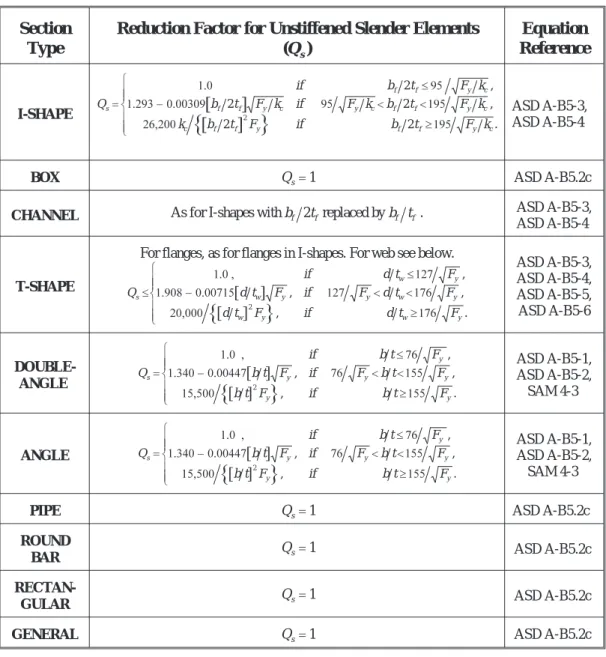
The Qs factors for slender sections are calculated as described in Table III-3 (ASD A-B5.2a, ASD SAM 4). The Qa factors for slender sections are calculated as the ratio of effective cross-sectional area and the gross cross-sectional area.
Q A A a e g (ASD A-B5-10)
The effective cross-sectional area is computed based on effective width as follows:
Ae Ag b be t
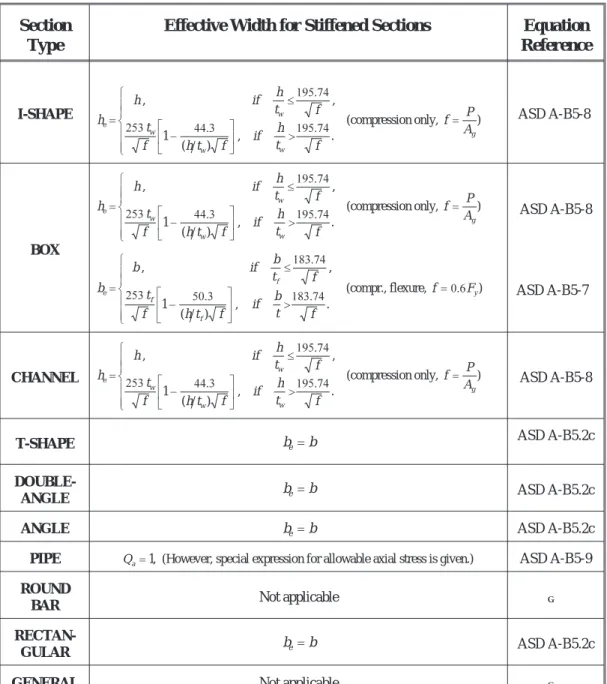
be for unstiffened elements is taken equal to b, and be for stiffened elements is taken equal to or less than b as given in Table III-4 (ASD A-B5.2b). For webs in I, box, and Channel sections, he is used as be and h is used as b in the above equation.
Flexural-Torsional Buckling
The allowable axial compressive stress value, Fa, determined by the limit states of torsional and flexural-torsional buckling is determined as follows (ASD E3, C-E3):
F = Q Kl/r C F + Kl/r C a e c y e ¢ 2 2 2 5 3 3 8 c e c Kl/r C ¢ ¢ 3 3 8 , if Kl/r C e c ¢, (E2-1, A-B5-11)
Section Type
Reduction Factor for Unstiffened Slender Elements (Qs) Equation Reference I-SHAPE Q if b t F k b t F k if F s f f y c f f y c y 2 2 , k b t F k k b t F if b t F k c f f y c c f f y f f y c 2 2 2 2 , . ASD A-B5-3, ASD A-B5-4
BOX Qs 1 ASD A-B5.2c
CHANNEL As for I-shapes with bf 2tf replaced by bf tf . ASD A-B5-3,
ASD A-B5-4
T-SHAPE
For flanges, as for flanges in I-shapes. For web see below.
Q if d t F d t F if F d t s w y w y y w , , F d t F if d t F y w y w y , , . 2 ASD A-B5-3, ASD A-B5-4, ASD A-B5-5, ASD A-B5-6 DOUBLE-ANGLE Q if b t F b t F if F b t s y y y , , F b t F if b t F y y y , , . 2 ASD A-B5-1, ASD A-B5-2, SAM 4-3 ANGLE Q if b t F b t F if F b t s y y y , , F b t F if b t F y y y , , . 2 ASD A-B5-1, ASD A-B5-2, SAM 4-3
PIPE Qs 1 ASD A-B5.2c
ROUND
BAR Qs 1 ASD A-B5.2c
RECTAN-GULAR Qs 1 ASD A-B5.2c
GENERAL Qs 1 ASD A-B5.2c
Table III-3
Section Type
Effective Width for Stiffened Sections Equation
Reference I-SHAPE h h if h t f t f h t f if h t e w w w w , , ( ) , 1 f . (compression only, f P Ag ) ASD A-B5-8 BOX h h if h t f t f h t f if h t e w w w w , , ( ) , 1 f . (compression only, f P Ag ) b b if b t f t f h t f if b t e f f f , , ( ) , 1 f . (compr., flexure, f Fy) ASD A-B5-8 ASD A-B5-7 CHANNEL h h if h t f t f h t f if h t e w w w w , , ( ) , 1 f . (compression only, f P Ag ) ASD A-B5-8
T-SHAPE be b ASD A-B5.2c
DOUBLE-ANGLE be b ASD A-B5.2c
ANGLE be b ASD A-B5.2c
PIPE Qa 1, (However, special expression for allowable axial stress is given.) ASD A-B5-9
ROUND
BAR Not applicable
RECTAN-GULAR be b ASD A-B5.2c
GENERAL Not applicable
Note: A reduction factor of 3/4 is applied on f for axial-compression-only cases and if the load combination includes any wind load or seismic load (ASD A-B5.2b).
Table III-4
F = E Kl/r a e 12 23 2 2 , if Kl/r e Cc ¢. (E2-2, A-B5-12) where, C E Q F c y
¢ 2 2 , and (ASD E2, A-B5.2c, SAM 4)
Kl/r E
F
e
e
2
. (ASD C-E2-2, SAM 4-4)
ASD Commentary (ASD C-E3) refers to the 1986 version of the AISC-LRFD code for the calculation of Fe. The 1993 version of the AISC-LRFD code is the same as
the 1986 version in this respect. Fe is calculated in SAP2000 as follows: • For Rectangular, I, Box, and Pipe sections:
F EC K l GJ I I e w z z 2 2 22 33 1 (LRFD A-E3-5)
• For T-sections and Double-angles:
F = F F H F F H F F e e ez e ez e ez 22 22 22 2 2 1 1 4 (LRFD A-E3-6) • For Channels: F = F F H F F H F F e e ez e ez e ez 33 33 33 2 2 1 1 4 (LRFD A-E3-6)
• For Single-angle sections with equal legs:
F = F F H F F H F F e e ez e ez e ez 33 33 33 2 2 1 1 4 (ASD SAM C-C4-1)
• For Single-angle sections with unequal legs, Fe is calculated as the minimum real root of the following cubic equation (ASD SAM C-C4-2, LRFD A-E3-7):
(F F )(F F )(F F ) F (F F )x ( r F e e33 e e22 e ez e e e e 2 22 0 2 0 2 2 F F y r e e 33 0 2 0 2 0 ) , where,
x0,y0 are the coordinates of the shear center with respect to the centroid,
x0 0 for double-angle and T-shaped members (y-axis of symmetry),
r x y I I
Ag
0 0
2 0
2 22 33 = polar radius of gyration about the shear center,
H x y r 1 0 2 0 2 0 2 , (LRFD A-E3-9) F E K l r e 33 2 33 33 33 2 , (LRFD A-E3-10) F E K l r e 22 2 22 22 22 2 , (LRFD A-E3-11) F EC K l GJ Ar ez w z z 2 2 0 2 1 , (LRFD A-E3-12)
K22,K33 are effective length factors in minor and major directions,
Kz is the effective length factor for torsional buckling, and it is taken equal to K22 in SAP2000,
l22,l33 are effective lengths in the minor and major directions,
lz is the effective length for torsional buckling, and it is taken equal to l22. For angle sections, the principal moment of inertia and radii of gyration are used for
computing Fe (ASD SAM 4). Also, the maximum value of Kl, i.e,
max(K l22 22,K l33 33), is used in place of K l22 22or K l33 33in calculating Fe 22and Fe 33 in this case.
Allowable Stress in Bending
The allowable bending stress depends on the following criteria: the geometric shape of the cross-section, the axis of bending, the compactness of the section, and a length parameter.
I-sections
For I-sections the length parameter is taken as the laterally unbraced length, l22, which is compared to a critical length, lc. The critical length is defined as
l b F A d F c f y f y
min 76 ,20 000, , where (ASD F1-2)
Af is the area of compression flange, Major Axis of Bending
If l22 is less than lc, the major allowable bending stress for Compact and Noncompact sections is taken depending on whether the section is welded or rolled and whether fy is greater than 65 ksi or not.
For Compact sections:
Fb33 = Fy if fy , (ASD F1-1)
Fb33 = Fy if fy , (ASD F1-5)
For Noncompact sections:
F = b t F F b f f y y 33
2 , if rolled and fy , (ASD F1-3)
F = b t F k F b f f y c y 33
2 , if welded and fy , (ASDF1-4)
Fb33 = Fy if fy .. (ASD F1-5)
If the unbraced length l22 is greater than lc, then for both Compact and Non-compact I-sections the allowable bending stress depends on the l22 rT ratio.
For l r C F T b y 22 102 000, , Fb33 Fy , (ASD F1-6) for 102 000, C 22 510 000, F l r C F b y T b y , F F l r C F F b y T b y y 33 22 2 2 3 1530 000 ( / ) , , and (ASD F1-6) for l r C F T b y 22 510 000, , F C l r F b b T y 33 22 2 170 000 0 , ( / ) , (ASD F1-7)
and Fb 33 is taken not to be less than that given by the following formula:
F C l d A F b b f y 33 22 12 000, / (ASD F1-8) where,
rT is the radius of gyration of a section comprising the compression flange and 1 3 the compression web taken about an axis in the plane of the web,
C = + M M + M M b a b a b 2 , where (ASD F1.3)
MaandMb are the end moments of any unbraced segment of the member and
Ma is numerically less than Mb; Ma Mbbeing positive for double curvature
bending and negative for single curvature bending. Also, if any moment within the segment is greater than Mb, Cbis taken as 1.0. Also, Cb is taken as 1.0 for cantilevers and frames braced against joint translation (ASD F1.3). SAP2000 defaults Cbto 1.0 if the unbraced length, l22, of the member is redefined by the user (i.e. it is not equal to the length of the member). The user can overwrite the value of Cb for any member by specifying it.
The allowable bending stress for Slender sections bent about their major axis is determined in the same way as for a Noncompact section. Then the following additional considerations are taken into account.
If the web is slender, then the previously computed allowable bending stress is reduced as follows: Fb¢33 RPGR Fe b33 , where (ASD G2-1) R A A h t F PG w f b 760 33 , (ASD G2) R A A A A e w f w f 3 3
, (hybrid girders) (ASD G2)
Re , (non-hybrid girders) (ASD G2)
Aw = Area of web, in2,
Af = Area of compression flange, in2,
F F
y b 33
(ASD G2)
Fb 33 = Allowable bending stress assuming the section is non-compact, and
Fb 33¢ = Allowable bending stress after considering web slenderness. In the above expressions, Re is taken as 1, because currently SAP2000 deals with only non-hybrid girders.
If the flange is slender, then the previously computed allowable bending stress is taken to be limited as follows.
Fb¢33 Qs Fy , where (ASD A-B5.2a, A-B5.2d)
Minor Axis of Bending
The minor direction allowable bending stress Fb 22 is taken as follows: For Compact sections:
Fb22= Fy if fy , (ASD F2-1)
Fb22= Fy if fy , (ASD F2-2)
For Noncompact and Slender sections:
F = b t F F b f f y y 22 2 , if fy , (ASD F2-3) Fb22= Fy if fy .. (ASD F2-2)
Channel sections
For Channel sections the length parameter is taken as the laterally unbraced length, l22, which is compared to a critical length, lc. The critical length is de-fined as l b F A d F c f y f y
min 76 ,20 000, , where (ASD F1-2)
Af is the area of compression flange, Major Axis of Bending
If l22 is less than lc, the major allowable bending stress for Compact and Noncompact sections is taken depending on whether the section is welded or rolled and whether fy is greater than 65 ksi or not.
For Compact sections:
Fb33= Fy if fy , (ASD F1-1)
Fb33= Fy if fy , (ASD F1-5)
For Noncompact sections:
F = b t F F b f f y y
F = b t F k F b f f y c y
33 , if welded and fy ,(ASD F1-4)
Fb33 = Fy if fy .. (ASD F1-5)
If the unbraced length l22 is greater than lc, then for both Compact and Noncompact Channel sections the allowable bending stress is taken as follows:
F C l d A F b b f y 33 22 12 000, / (ASD F1-8)
The allowable bending stress for Slender sections bent about their major axis is determined in the same way as for a Noncompact section. Then the following additional considerations are taken into account.
If the web is slender, then the previously computed allowable bending stress is reduced as follows:
Fb¢33 R Re PG Fb33 (ASD G2-1)
If the flange is slender, the previously computed allowable bending stress is taken to be limited as follows:
Fb¢33 Qs Fy (ASD A-B5.2a, A-B5.2d)
The definition for rT, Cb, Af, Aw, Re, RPG, Qs, Fb 33, and Fb 33¢ are given earlier. Minor Axis of Bending
The minor direction allowable bending stress Fb 22 is taken as follows:
Fb22 = Fy (ASD F2-2)
T-sections and Double angles
For T sections and Double angles, the allowable bending stress for both major and minor axes bending is taken as,
Box Sections and Rectangular Tubes
For all Box sections and Rectangular tubes, the length parameter is taken as the laterally unbraced length, l22, measured compared to a critical length, lc. The critical length is defined as
l M /M b F , b F c a b y y max (1950 1200 ) 1200 (ASD F3-2)
where Maand Mb have the same definition as noted earlier in the formula for
Cb. If l22is specified by the user, lc is taken as 1200 b
Fy in SAP2000.
Major Axis of Bending
If l22 is less than lc, the allowable bending stress in the major direction of bending is taken as:
Fb33= Fy (for Compact sections) (ASD F3-1)
Fb33= Fy (for Noncompact sections) (ASD F3-3)
If l22 exceeds lc, the allowable bending stress in the major direction of bend-ing for both Compact and Noncompact sections is taken as:
Fb33= Fy (ASD F3-3)
The major direction allowable bending stress for Slender sections is deter-mined in the same way as for a Noncompact section. Then the following addi-tional consideration is taken into account. If the web is slender, then the previ-ously computed allowable bending stress is reduced as follows:
Fb¢33 R Re PG Fb33 (ASD G2-1)
The definition for Re, RPG, Fb 33, and Fb 33¢ are given earlier.
If the flange is slender, no additional consideration is needed in computing al-lowable bending stress. However, effective section dimensions are calculated and the section modulus is modified according to its slenderness.
Minor Axis of Bending
If l22is less than lc, the allowable bending stress in the minor direction of bend-ing is taken as:
Fb22= Fy (for Compact sections) (ASD F3-1)
Fb22 = Fy (for Noncompact and Slender sections) (ASD F3-3)
If l22 exceeds lc, the allowable bending stress in the minor direction of bend-ing is taken, irrespective of compactness, as:
Fb22 = Fy (ASD F3-3)
Pipe Sections
For Pipe sections, the allowable bending stress for both major and minor axes of bending is taken as
F =b Fy (for Compact sections), and (ASD F3-1)
F =b Fy (for Noncompact and Slender sections). (ASD F3-3)
Round Bars
The allowable stress for both the major and minor axis of bending of round bars is taken as,
F =b Fy . (ASD F2-1)
Rectangular and Square Bars
The allowable stress for both the major and minor axis of bending of solid square bars is taken as,
F =b Fy . (ASD F2-1)
For solid rectangular bars bent about their major axes, the allowable stress is given by
F =b Fy, And
the allowable stress for minor axis bending of rectangular bars is taken as,
Single-Angle Sections
The allowable flexural stresses for Single-angles are calculated based on their prin-cipal axes of bending (ASD SAM 5.3).
Major Axis of Bending
The allowable stress for major axis bending is the minimum considering the limit state of lateral-torsional buckling and local buckling (ASD SAM 5.1).
The allowable major bending stress for Single-angles for the limit state of lateral-torsional buckling is given as follows (ASD SAM 5.1.3):
F = F F F b major ob y ob
, , if Fob Fy (ASD SAM 5-3a)
F = F F F F b major y ob y y , , if Fob Fy (ASD SAM 5-3b)
where, Fob is the elastic lateral-torsional buckling stress as calculated below. The elastic lateral-torsional buckling stress, Fob, for equal-leg angles is taken as
F C
l t
ob b , (ASD SAM 5-5)
and for unequal-leg angles Fobis calculated as
F C I S l lt r ob b major w w min min 2 2 2 ( ) , (ASD SAM 5-6) where, t min tw,tf , l max l22,l33 ,
Imin= minor principal moment of inertia,
Imax= major principal moment of inertia,
Smajor= major section modulus for compression at the tip of one leg,
w A I z w z dA z 1 2 2 2 0 max ( ) , (ASD SAM 5.3.2)
z = coordinate along the major principal axis, w = coordinate along the minor principal axis, and
z0= coordinate of the shear center along the major principal axis with respect to the centroid.
w is a special section property for angles. It is positive for short leg in compression,
negative for long leg in compression, and zero for equal-leg angles (ASD SAM 5.3.2). However, for conservative design in SAP2000, it is always taken as negative for unequal-leg angles.
In the above expressions Cbis calculated in the same way as is done for I sections with the exception that the upper limit of Cb is taken here as 1.5 instead of 2.3.
C = + M M + M M b a b a b 2 (ASD F1.3, SAM 5.2.2)
The allowable major bending stress for Single-angles for the limit state of local buckling is given as follows (ASD SAM 5.1.1):
Fb major, = Fy , if b
t Fy , (ASD SAM 5-1a)
Fb major, = Fy , if F b t F y y , (ASD SAM 5-1b) Fb major, = Q Fy , if b t Fy , (ASD SAM 5-1c) where,
t = thickness of the leg under consideration, b = length of the leg under consideration, and
Q = slenderness reduction factor for local buckling. (ASD A-B5-2, SAM 4)
In calculating the allowable bending stress for Single-angles for the limit state of lo-cal buckling, the allowable stresses are lo-calculated considering the fact that either of
the two tips can be under compression. The minimum allowable stress is consid-ered.
Minor Axis of Bending
The allowable minor bending stress for Single-angles is given as follows (ASD SAM 5.1.1, 5.3.1b, 5.3.2b):
Fb,minor = Fy , if b
t Fy , (ASD SAM 5-1a)
Fb,minor = Fy , if F b t F y y , (ASD SAM 5-1b) Fb,minor = Q Fy , if b t Fy , (ASD SAM 5-1c)
In calculating the allowable bending stress for Single-angles it is assumed that the sign of the moment is such that both the tips are under compression. The minimum allowable stress is considered.
General Sections
For General sections the allowable bending stress for both major and minor axes bending is taken as,
F =b Fy .
Allowable Stress in Shear
The shear stress is calculated along the geometric axes for all sections. For I, Box, Channel, T, Double angle, Pipe, Circular and Rectangular sections, the principal axes coincide with their geometric axes. For Single-angle sections, principal axes do not coincide with the geometric axes.
Major Axis of Bending
The allowable shear stress for all sections except I, Box and Channel sections is taken in SAP2000 as:
The allowable shear stress for major direction shears in I-shapes, boxes and chan-nels is evaluated as follows:
Fv Fy , if h tw Fy 380 , and (ASD F4-1) Fv C F F v y y , if F h t y w . (ASD F4-2) where, C k F h t if h t k F h t k F if h t v v y w w v y w v y 45 000 2 , , , , w v y k F , (ASD F4) k a h if a h a h if a h v 2 2 1 1 , , , , (ASD F4)
tw = Thickness of the web,
a = Clear distance between transverse stiffeners, in. Currently it is taken conservatively as the length, l22, of the member in SAP2000,
h = Clear distance between flanges at the section, in.
Minor Axis of Bending
The allowable shear stress for minor direction shears is taken as:
Fv Fy (ASD F4-1, SAM 3-1)
Calculation of Stress Ratios
In the calculation of the axial and bending stress capacity ratios, first, for each sta-tion along the length of the member, the actual stresses are calculated for each load combination. Then the corresponding allowable stresses are calculated. Then, the capacity ratios are calculated at each station for each member under the influence of
each of the design load combinations. The controlling capacity ratio is then ob-tained, along with the associated station and load combination. A capacity ratio greater than 1.0 indicates an overstress.
During the design, the effect of the presence of bolts or welds is not considered. Also, the joints are not designed.
Axial and Bending Stresses
With the computed allowable axial and bending stress values and the factored axial and bending member stresses at each station, an interaction stress ratio is produced for each of the load combinations as follows (ASD H1, H2, SAM 6):
• If fa is