School of Built Environment
An Investigation of the Influence of Social CRM on Brand
Reputation and Brand Loyalty In Developing Country:
Evidence from the Nigerian Telecoms Industry
BY
WAGDI HADIDAN
SUPERVISED BY
FLEMING ANDREW
DECLARATION
This thesis is presented as on original contribution based on Doctor of Philosophy Research at the university of Salford, Salford, United Kingdom and has not been previously submitted to meet requirements for an award at any higher education institution under my name or that of any other individuals. To the best of my knowledge and belief, the thesis contains no materials previously published or another person except where due reference is made.
DEDICATION
I dedicate my humble work to my MUM`S soul (YASMINA) her spirit were the energy that pushed me to complete my thesis work. To her I would like to say that “I LOVE YOU MUM”.
ACKNOWLEDGEMENT
In the name of Allah, the Most Gracious and Most Merciful Praise is given to Him and peace is upon His beloved prophet Muhammad (SAW). It must recognize that there is no ease in our deeds except only one that Allah made it easy, So I seek help from Allah to ease all difficulties in the way to finish this. Nevertheless, I would like to address my great appreciations to many people for contribution to do this work successful.
Firstly, I would like to thank my supervisor. (FLEMING ANDREW) for his patience, kindness, guidance and uncountable hours he spent with me to complete this thesis. From my heart, I appreciate for all hard efforts presented for me. Your critical thinking, value of knowledge and faithful commitment made this work to be achieved. Once again, I appreciate you guiding my research effort and offering words of encouragement and support throughout, hopefully that may ALLAH bless you.
Secondly, I present my unlimited thanks to my family, my father, my wife and my friend Wilson in Nigeria in term of their supports and advices during my study period and my daughters and son as well; I never would have been complete this study without the support of you all, I LOVE ALL OF YOU, and acknowledge that your prayer for me was accepted by ALLAH.
TABLE OF CONTENT
DECLARATION ... 2 DEDICATION ... 3 ACKNOWLEDGEMENT ... 4 TABLE OF CONTENT ... 5 LIST OF FIGURES ... 10 LIST OF TABLES ... 12 ABSTRACT ... 14 CHAPTER ONE ... 16 INTRODUCTION ... 161.0 Introduction to Chapter ... Error! Bookmark not defined. 1.1 Background to Study ... 17
1.2 The Research Problem ... 20
1.3 Research Aim and Objectives ... 22
1.3.1 Aim ... 22
1.3.2 Objectives ... 23
1.4 Significance of Study ... 23
1.5 Research Methodology: An Overview ... 24
1.6 Thesis Outline ... 25
CHAPTER TWO ... 27
THE RESEARCH CONTEXT AND JUSTIFICATION OF RESEARCH ... 27
2.1 The Study Context: The Nigerian Telecom Industry ... 27
2.1.1 Historical Development of the Nigerian Telecom Industry ... 28
2.1.2 Structure of the Nigeria Telecommunications Industry... 28
2.2 Challenges with Customer Relationship Management Faced by the Telecom Industry ... 35
2.3 Justification for Research ... 39
2.4 Contribution to Practice and Knowledge ... 39
2.5 Beneficiaries of the Study ... 40
2.6 Research Hypotheses ... 40
2.7 Scope of the Study ... 41
2.8 Summary of the Chapter ... 41
LITERATURE REVIEW ... 43
3.0 Introduction ... 43
3.1 Relationship Marketing (RM): Theory and Principle ... 44
3.2 Customer Relationship Management (CRM) ... 47
3.3 The Different Perspectives to CRM ... 52
3.3.1 CRM as a Business Process ... 53 3.3.2 CRM as a Business Strategy ... 54 3.3.3 CRM as a Philosophy ... 58 3.3.4 CRM as a Business Capability ... 59 3.3.5 CRM as a Technology ... 60 3.4 Adopted CRM definition ... 61 3.5 Components (Types) of CRM ... 62 3.5.1 Strategic CRM ... 62 3.5.2 Operational CRM ... 64 3.5.3 Analytical CRM ... 66 3.5.4 Collaborative CRM ... 66
3.6 Examples of Traditional CRM Models ... 67
3.6.1 The Customer Lifecycle Frameworks ... 67
3.6.2 Kelly’s 7-key analytical application Model ... 69
3.6.3 THE IDIC Model ... 69
3.6.4 The QCi Model ... 71
3.6.5 The CRM Value Chain Model ... 72
3.6.6 The Five-Process CRM Model ... 74
3.6.7 The Gartner Competency Model ... 76
3.7 Criticism of the traditional CRM systems ... 79
3.8 Incorporating Social Media in Traditional CRM: The Social CRM strategy ... 81
3.8.1 Comparing Social CRM with Traditional CRM ... 84
3.8.2 Social CRM Implementation Models ... 87
3.9 Renowned Social CRM Vendors: Telecom Industry Specific ... 98
3.9.1 Oracle Siebel Customer Relationship Management (CRM) ... 98
3.9.2 Salesforce Cloud ... 104
3.10 Case Examples of Companies Implementing Social CRM ... 105
3.10.1 BT Group - EE... 106
3.10.3 IDT Telecom... 108
3.10.4 TDS Telecommunications LLC ... 109
3.10.5 American Broadcasting Company (ABC) ... 110
3.11 Benefits of Social CRM Applications ... 111
3.11.1 Enables long lasting firm-customer relationship ... 112
3.11.2 A medium for gaining customer insights ... 113
3.11.3 A means for monitoring service usage and patronage ... 113
3.11.4 An Enabler of Customer-Centric Approach to Business ... 114
3.11.5 Facilitates Omnichannel Experience ... 115
3.11.6 It enables Brand Reputation (Resonance) ... 115
3.11.7 It Improves Customer Loyalty ... 116
3.12 Review of Previous Studies ... 120
3.12.1 Social CRM Implementation on Organisational Level ... 120
3.12.2 Impact of Social CRM on Business Outcomes ... 125
3.13 Identified Research Gaps ... 129
3.14 Summary of Chapter ... 130
CHAPTER FOUR ... 132
RESEARCH METHODOLOGY ... 132
4.0 Introduction ... 132
4.1 Re-statement of the Research Context ... 132
4.2 Research Philosophy ... 133
4.2.1 Ontology ... 134
4.2.2 Epistemology ... 135
4.2.3 The Philosophical Assumption Guiding this Research ... 141
4.3 Research Approach ... 142
4.3.1 Quantitative Research Approach ... 142
4.3.2 Qualitative Research Approach ... 143
4.3.3 Mixed Method Research Approach ... 143
4.3.4 Adopted Research Approach and Justification ... 144
4.4 Research Design ... 146
4.4.1 Qualitative Research Design ... 148
4.4.2 Quantitative Research Design ... 156
4.5 Ethical Consideration ... 167
CHAPTER FIVE ... 168
ANALYSIS OF THE QUALITATIVE DATA AND DISCUSSION ... 168
5.0 Introduction ... 168
5.1 Characteristics of the Respondents ... 168
5.2 Findings from the Interview Data ... 169
5.2.1 MTN Nigeria ... 170
5.2.2 Globacom Nigeria ... 176
5.2.3 9Mobile ... 181
5.3 Discussion of Findings: Towards the development of the Conceptual Framework for Quantitative Study ... 185
5.4 Conceptual Model for the Quantitative Research Phase ... 195
5.5 Summary of Chapter ... 196
CHAPTER SIX ... 197
RESEARCH FINDINGS FROM QUANTITATIVE DATA ... 197
6.0 Introduction to Chapter ... 197
6.1 Response Rate ... 197
6.2 Findings from the Descriptive Statistics ... 198
6.2.1 Demographic Profile of Sample ... 198
6.2.2 General Usage of Social Media by the Participants ... 202
6.2.3 Consumers’ Perceived Value of SMM and Social CRM ... 202
6.2.4 Perceived Usefulness of the Customer-Oriented Service Delivery by the Telecom Firms 210 6.2.5 Measure of Customer-Firm Interaction and Engagement ... 213
6.2.6 Measure of Brand Resonance ... 216
6.3 Test and Validation of Research Hypotheses... 219
6.3.1 Test and validation of Hypothesis 1 ... 219
6.3.2 Test and validation of Hypothesis 2 ... 223
6.3.3 Test and validation of Hypothesis 3 ... 224
6.3.4 Test and validation of Hypothesis 4 ... 226
6.3.4 Test and validation of Hypothesis 5 ... 227
6.3.5 Test and validation of Hypothesis 6 ... 229
6.3.6 Test and validation of Hypothesis 7 ... 230
6.4 Summary of the Chapter ... 231
CONCLUSION AND RECOMMENDATION ... 233
7.1 Introduction to Chapter ... 233
7.2 Summary of Findings ... 233
7.2.1 Objective 1: To explore the extent of implementation of social CRM by telecom firms in Nigeria 235 7.2.2 Objective 2: To identify the Social CRM tools and Strategies currently adopted by the Nigeria telecom firms ... 236
7.2.3 Objective 3: To investigate the impact of Social CRM on the consumer behavioural outcomes such as brand resonance and customer loyalty ... 238
7.2.4 Objective 4: to develop and validated a framework that will kind the telecoms firms in Nigeria in the delivery of consistent high-quality customer services through Social CRM ... 239
7.3 Implications of the Study ... 240
7.3.1 Practical Implications of the Study... 240
7.3.2 Theoretical Implication of the Study ... 241
7.4 Research Limitations ... 243
7.5 Recommendation for Future Research ... 243
7.6 Conclusion ... Error! Bookmark not defined. REFERENCE ... 244
Appendix 1: Sample of Email Sent to the Interviewees ... 276
Appendix 2: Sample Interviewee Guide ... 277
Appendix 3: Transcribed Interviewees ... 279
MTN Nigeria ... 279
GLOBACOM Nigeria ... 291
9Mobile ... 301
Appendix 4: Consent/Introduction Letter for the Wave 2 Survey: Questionnaire ... 312
Appendix 5: Sample Survey Questionnaire ... 313
Appendix 6: Ethical Form from the University ... 320
Appendix 7: The Impact of Demographic Differences on Favourite Social Media Channels ... 321
Appendix 8: Chi-Tests of the Relationship between Demographics and Perceived Value of SMM and social CRM ... 323
Appendix 9: Chi-Tests of the Relationship between Demographics and Duration of Use of Social Media ... 327
Appendix 10: First Paper ... 331
LIST OF FIGURES
Figure 1: Thesis Outline 14 Figure 2.1: Market Share by Telecom Technology in Nigeria 18 Figure 2.2: Market Share by GSM Operator 19
Figure 2.3: Market Share by Internet Subscriber Data (GSM) 20
Figure 2.4: Market Share by Internet Subscriber Data (CDMA) 21
Figure 2.5: Market Share by Internet Subscriber Data (VoIP) 22
Figure 2.6: Porting Data – Incoming 23
Figure 2.6: Porting Data – Outgoing 24
Figure 3.1: CRM Diamond 52
Figure 3.2: Types of CRM 60
Figure 3.3: 5-stage Customer Lifecycle Framework 68
Figure 3.4: 3-stage Customer Lifecycle Framework 69
Figure 3.5: IDIC CRM Framework 70
Figure 3.6: The QCi Customer Management Model 72
Figure 3.7: The CRM Value Chain Model 74
Figure 3.8: The Five-Process Model 75
Figure 3.9: The Eight-Building Block of CRM 81
Figure 3.10: Use cases for the 5M Model 99
Figure 3.11: Social CRM House 100
Figure 3.12: The MASOCIAL CRM Framework 104
Figure 3.13: Relative Attitude-Behaviour Relationship 133
Figure 4.1: Research Design 171
Figure 4.2: Map of Lagos State 188
Figure 6:1 Gender Distribution of the Wave 2 Sample 235
Figure 6.2: Age Distribution of the Wave 2 Sample 236
Figure 6.3: Level of Education of the Wave 2 Sample 237
Figure 6.4: Sample Distribution Based on Location (Strata) 238
Figure 6.5: Favourite Social Media Channels 240
Figure 6.6: Duration of Using Social Media 241
Figure 6.7: Frequency of use of Social Media 243
Figure 6:8: Consumers’ perceived value of SMM and Social CRM 246
Figure 6.9: Evaluation of Firm’s Customer-Oriented Service Delivery 248 Figure 6.10: Measure of Customer-Firm Interaction and Engagement 251
LIST OF TABLES
Table 3.1: Definitions of CRM 42
Table 3.2: Differences between CRM and SOCIAL CRM 90
Table 3.3: The 5M’s Social Insight Model 93
Table 4.1: Comparison between Objectivism and Subjectivism 155
Table 4.2: Comparison of the Research Paradigms 163
Table 4.3: Research Themes and investigated Topics 180
Table 4.5: Sample Sizes for different sizes of population at a 95 percent confident level 189
Table 4.6: Stratification of the Sample Area 190
Table 4.7: Pattern Matrix 193
Table 4.8: Reliability Test of the Quantitative Data 196
Table 5.1: The Main Themes 198
Table 5.2: Background Information of the Interviewees 199
Table 5.3: Comparative Analysis of Social Media Performance based on Followership 221 Table 6.1: Impact of Gender Differences on Favourite Social Media Choice 240 Table 6.2: Cross Tabulation Analysis between
Demography/Duration of Using Social Media 241
Table 6.3: Reason for Using Social Media 244
Table 6.4: Demographic Differen ce on the Perceived Value of SMM and Social CRM 247 Table 6.5: Correlation Analysis between Demographic Factors and
Perceived Customer-Oriented Service Delivery 249 Table 6.6: Correlation analysis between demographic factors and
customer-firm interaction and engagement 252
Table 6.7: Correlation analysis between demographic factors and brand resonance 256
Table 6.8a: Hypothesis 1: Model Summary 259
Table 6.8b: Coefficients Table for Hypothesis 1 260
Table 6.9a: Hypothesis 2: Model Summary 262
Table 6.10b: Table 6.8b: Coefficients Table for Hypothesis 3 264
Table 6.11: Model Summary for Hypothesis 4 266
Table 6.12: Model Summary for Hypothesis 5 268
Table 6.12: Model Summary for Hypothesis 6 270
ABSTRACT
The modern business environment has undergone fundamental changes – shifting from being production-inclined to being service driven; a situation that has resulted in a shift from the traditional ways of conducting organisational and marketing processes to a new strategy that is technology-enabled and customer-centric. Particularly, the advancement of Information and Communication Technology (ICT) has created new channels for organisations like never before for exploiting customer relationship management tailored towards enhancing customer satisfaction, enhancing customer loyalty, increasing sales, and improving profitability. The internet and social media especially have enabled the flourishing of customer relationship management (CRM) practices. Business organisations can now incorporate the functionalities of the internet and social media into the traditional CRM systems to provide a platform where firms can interact and engage with consumers (both existing and prospective) in view of providing customised and personalised services. However, there have been major concerns raised on the fruition of these Social CRM systems in delivering value to both business organisations and its different stakeholders. Specifically, questions have been raised on whether these organisations claiming to implement Social CRM are fully exploiting its capabilities and are embracing the full possibilities such systems offer to businesses. Evidence in both the practitioner and academic literature has suggested that for the telecommunication industry, the transition and re-engineering of telecom operations and processes into being customer-centric has not been generally smooth. In the centre of the argument and criticism is that the needs and expectations of the customers are constantly evolving faster than the offerings and products offered by the many telecom firms and therefore needs a robust system like social CRM to manage customer relationships. In this contextual understanding, this doctorate research was embarked upon to explore the implementation of Social CRM by telecom companies in emerging markets as well as examine how such Social CRM strategies translates to customer outcomes such as brand reputation and customer loyalty. The country of Nigeria was chosen for this research given the huge potential it provides as an emerging market for the telecom firms with over 190 million people. The mixed methodology research was adopted in this research in order to gain a deeper insight of the situation both from the companies and customers’ perspectives. In other words, the qualitative research approach has been used to gain insight on the implementation of social CRM by telecom firms in Nigeria and quantitative research approach was used in examining how the social CRM strategies
translates to customers’ brand awareness and loyalty. Three out of the four multinational companies who are the industry leaders participated in the study whereas, 491 customer responses were empirically analysed to reflect the customer outcomes from the implementation of the social CRM strategies. The study findings indicate Nigerian telecom firms are adopting the customer-centric approach to business and are using social CRM systems as a means of gaining competitive advantage; as well as establishing a beneficial relationship with their customers and in value co-creation. On the other hand, customers were found to hold high value of the usefulness of social media marketing and social CRM in driving customer-oriented service delivery and as well influencing the brand resonance among customers. The implication of the findings and practical recommendation is provided in the thesis.
16
CHAPTER ONE
INTRODUCTION
The modern business environment has undergone fundamental changes – shifting from being production-inclined to being service driven; a situation that has resulted in a shift from the traditional ways of conducting organisational and marketing processes to a new strategy that is technology-enabled and customer-centric (Brooks et al. 2011; Patil & Bhakkad, 2014). Today, businesses are structured beyond the simple development, supply and sales of goods or services, to the continuous development of after sales services that is focused on developing long lasting relationship with customers (Peppers & Rogers, 2011; Rai, 2013; Elbedweihy et al. 2016). Particularly, the advancement of Information and Communication Technology (ICT) has created new channels for organisations like never for exploiting customer relationship management tailored towards enhancing customer satisfaction, enhancing customer loyalty, increasing sales, and improving profitability (Phan & Vogel, 2010; Shriedesh & Abd. Ghani, 2017; Singhal et al. 2018).
The internet and social media especially have enabled the flourishing of customer relationship management (CRM) practices. Business organisations can now incorporate the functionalities of the internet and social media into the traditional CRM systems to provide a platform where the firms can interact and engage with the consumers (both existing and prospective) in view of providing customised and personalised services (Greenberg, 2009; Quinton & Harridge-March 2010; Singhal et al. 2018). Although the application of Social CRM systems has been well documented across different business industries including the aviation industry (Morgan et al. 2011; Gajic et al. 2016; Gnanprakash & Kulkarni, 2016), the hospitality industry (Milovic, 2012; Mohammed, 2012; Rosman & Stuhura, 2013; Thryambakam & Bethapudi, 2013; Klutse, 2016), and telecommunication industry(Cottman, 2013;Saleh, 2016) to mention but a few; there are still major concerns raised on the fruition of these Social CRM systems in delivering value to both business organisations and its different stakeholders (Cottman, 2007; 2013; Alamgir & Shamsuddoha, 2015). On the other hand, questions have been raised on whether these
17
organisations claiming to implement Social CRM are fully exploiting its capabilities and are embracing the full possibilities such systems offer to businesses (Alamgir & Shamsuddoha, 201).
Particularly for the telecommunication industry, the transition and re-engineering of telecom operations and processes into being customer-centric has not been generally smooth (Wu et al. 2009; Alamgir & Shamsuddoha, 2015). In the centre of the argument and criticism is that the needs and expectations of the customers are constantly evolving faster than the offerings and products offered by the many telecom firms and therefore needs a robust system like social CRM to manage customer relationships. being offered by many of the telecom firms. The aim of this research is to explore the implementation of Social CRM in telecom companies in Nigeria and examine how such Social CRM strategies translates to customer outcomes such as brand reputation and customer loyalty. This being the introductory chapter of the thesis is divided into six sections. The following section (1.1) provides the background to the study (i.e. background to CRM and Social CRM), followed by the discussion of the research problem in section (1.2). Section (1.3) highlights the research aim and objectives and in section (1.4) the significance of the study is presented. Section (1.5) provides an overview of the research methodology and the concluding section (1.6) provides a summary of the overall structure of the thesis.
1.1
Background to Study
The main objective of many business organisations is to maximise profit, and this is obtainable by ensuring optimal consumer satisfaction. Social Customer Relationship Management (CRM) has been advanced from the relationship marketing literature as a prominent technique for enhancing customer satisfaction and subsequent customer retention (Reinartz et al., 2004; Reimann et al. 2010; Baird & Parasnis, 2011; Nguyen & Mutum, 2012; Wang & Feng, 2012; Nwankwo & Ajemunigbohun, 2013). Simply put, CRM can be described as a technology-based solution designed to support the building process and management of the organisation-customer relationship (Jayachandran et al. 2005:177). According to Reimann et al. (2010:329) CRM is a “business strategy focused on infusing into the organisational process and culture the mind-set that customers are manageable strategic assets”.
18
CRM systems therefore represents an avenue for businesses to identify and connect with the customers at the right time and create differentiable value by delivering satisfaction for each customer’s needs and requirements and with the view of stimulating positive customer outcomes such as repeat purchase and brand loyalty (Nguyen & Mutum, 2012:401). CRM therefore requires the restructuring or re-engineering of organisational process; including the orientation of the internal staff in delivering services to customers (Nguyen & Mutum, 2012). This include the re-orientation of processes that involve the identification, acquisition and retention of customers through customer interaction management capabilities (Hansotia, 2002; Reinartz et al., 2004; Ernst et al. 2011). Hansotia (2002:121) argue that at the “heart of CRM is the organisation’s ability to leverage customer data creatively, effectively and efficiently to design and implement customer-focused strategies that increases the breadth, depth and length of the relationship between the organisation and customers”.
Similarly, Ernst et al. (2011:291) describe CRM to involve the “evolution and integration of marketing ideas and newly available data, technologies and organisational forms into establishing, developing and maintaining successful long-term learning relationships with well-chosen customers”. Put differently, CRM refers to a process that demands the systematic and proactive management of the relationship between the organisation and the customers, right from the initiating stage when the customer first contacts the organisation, to the maintenance stage (that is post purchase) and climaxing at the termination phase (the end of the relationship) if need be (Reinartz et al., 2004:294). Hence the essence of CRM is to align business processes in such a way as it promotes the development of a quality relationship with the customers characterised by open dialogues and interactions; providing a situation where the organisation can learn about the needs and requirements of both existing and prospective customers and use the information in delivering customised, personalised and innovative products (Payne & Frow, 2006; Payne et al. 2009; Peppers & Roger, 2011).
Further, developing and sustaining a long-term customer relationship provides a lot of benefits to the organisation including fostering upselling, cross-selling, increased and repeat purchasing, customer retention, word-of-mouth advertisements, reduced costs, etc. (Payne & Frow, 2006; Lusch et al. 2010; Nguyen & Mutum, 2012); which have been considered as an effective marketing strategy for enhancing organisational performance, productivity and profitability (Boulding et al.
19
2005; Kransnikov et al. 2009). CRM systems achieve this by providing a framework for coordinating the process between marketing, customer services and quality programs geared towards improving organisational performance (Boulding et al. 2005:157). Morgan et al. (2009) insinuates that the successful implementation of CRM reflects the organisation’s performance in terms of the strategic identification of prospective and attractive customers, initiating and maintaining relationships with ex-customers and leveraging the relationship into customer level profits.
Evidence in marketing literature indicates that CRM since its inception in the 1990s has evolved to become a widely embraced concept in both the corridors of academic research and in managerial practices (Grönroos, 1994; Morgan & Hunt, 1994; Reinartz, 2004; Askool & Nakata, 2011; Choudhury & Harrigan, 2014). Regrettably, evidence from these studies reported a high rate of failure of most CRMs systems in actual practice (Greenberg, 2004; Bohling et al. 2006; Osarenkhoe & Bennani, 2007; Becker et al., 2009; Piskar & Faganel, 2009). Several reasons have been highlighted for such failures of most CRM systems. First, the lack of proper understanding of CRM systems and its capabilities has been mentioned as a major setback (Payne & Frow, 2005). Secondly, organisations have been criticised for considering CRM in the short-term rather than as a long-term strategy that requires fundamental changes to organisational behaviour and culture (Greenberg, 2004; Wu & Wu, 2005). Thirdly, and what is considered in this study as the most significant factor for the failure of the traditional CRM system is the advent of the internet and Social media as a communicative tool.
The birth of social media shifted the power of marketing from the organisation and marketers to the consumers as the propellers of product innovation and delivery. Social media tools such as Twitter, Facebook, LinkedIn, Pinterest, YouTube, Google+ and a host of peer-to-per websites like the wikis, blogs, microblogs, podcasts, etc. brought a new dimension to CRM (Kim & Ko, 2012; Giannakis-Bompolis & Boutsouki, 2014). These social media tools now placed the customers at the helm of proceedings in the way business transactions are now conducted. Hence there was a need to incorporate social media into the traditional CRM systems and this birthed what is now popularly known as Social Customer Relationship Management (or Social CRM for short). Social CRM has been defined as a “business philosophy and strategy designed to engage the customer in a collaborative interaction that provides mutually beneficial value in a trusted and transparent
20
business environment” (Greenberg, 2010:414). The strength of this definition is that it builds upon of the traditional CRM – which is focused on the transactional relationship between the organisation and the customer, and advances it to include the social functions, processes and capabilities that are involved in the interactions between the organisation and the customers as well as among the relatives, friends and peers of the customer supported in the social media platform (Greenberg, 2010; Trainor, 2012).
In addition, Rodriguez et al. (2012:85) describe Social CRM as a business tool in the modern era for sharing contents and creating conversations that is geared towards greater customer engagement, which in turn is expected to create deeper and meaningful relationships with customers (both for existing and prospective customers) and other business partners. For customer-oriented organisations such as the telecom firms, Social CRM provides a suitable platform for enhancing customer service and satisfaction; which is a major source of competitive advantage (Pires et al. 2006; Smith, 2009; Kaplan & Haenlein, 2010; Rai, 2013; Harrigan & Miles, 2014). To this end, social CRM is focused on fostering strong relationships between organisations and the customers through interactions that allows for strategic investment decisions on the products and/or services. In addition, Social CRM also has the function of helping business firms in market segmentation – that is helping in identifying and engage with the customers that provides the most value to the organisation (Pires et al. 2006; Harridge-March & Quinton, 2009; Zeng et al. 2010). In addition, with Social CRM, firms can identify sales trend which is needed for improving decision making and planning in the product design process, increase upselling by capturing, tracking and proffering solutions to issues within a unified system, increase the accuracy in tracking orders and customer queries, and provides the firms with a thorough understanding of the market by gathering customer insights as well as those of the competitors (Neff, 2010; Baird & Parasnis, 2011).
1.2
The Research Problem
Since the introduction of CRM in the 1990s, its framework has evolved through diverse set of identities – resulting in a highly fragmented and inconsistent conceptual domain (Zablah, et al., 2005:475). Up to the current date, the research on CRM though vast but varied has failed to address
21
the emerging role of customer data and customer engagement and value co-creation as advanced by the definitively emerging service-oriented business landscape and the new Social CRM perspective, which has left the tenets of the traditional CRM in question (Vargo & Lusch, 2004; Grönroos, 2008; Vargo, Maglio & Akaka, 2008; Greenberg, 2010; Grönroos & Helle, 2010; Grönroos & Ravald, 2011). Recently, there has been an increasing research interest in Social CRM (Payne & Frow, 2005; Nguyen & Mutum, 2012; Wang & Feng, 2012; Khodakarami & Chan, 2014); however, the development of this research domain remains at an early stage.
According to Trainor (2012:317) one of the significant problems faced by most organisations trying to adopt Social CRM arises from the confusion on how Social CRM can be effectively implemented to influence organisational performance. Khodakarami & Chan, (2014:39) also pointing out the same issue in Social CRM research called for future studies to comprehensively explore the opportunities in customer relationship management mediated by Social media using different research methods (such as the combination of the qualitative and quantitative research methods) in developing wider knowledge and understanding of the concepts. Research studies are required to investigate the patterns of Social CRM systems and their uses across different industries and countries to explore how the characteristics of the business environment (such as national culture, level of competitiveness, industry turbulence, etc.) affect the application and support of Social CRM systems in the customer relationship management processes.
Nonetheless, Social CRM has a lot of benefits for service organisations such as those in the telecommunications industry which is arguably one of the most competitive consumer markets, characterised by high rate of innovations (Wu et al. 2009;Heidemann et al. 2012;Saleh, 2016). The very competitive nature of the telecom industry poses serious challenge for firms that are now required to commodify innovative services to suit the particular demands of the customers, who are very quick to take their SIM cards and go elsewhere once they notice a better service elsewhere (Shi et al., 2006; Oyeniyi & Abiodun, 2009; Zhu et al. 2011). Thus, for the telecom service providers, the enhancement of customer experience provides a critical means of differentiation from competitors (Wang et al. 2004; Askool & Nakata, 2011), especially in this modern era where consumers have become more social, and firms are needed to now look to Social CRM to deliver the type of differentiated experiences that translates to long-term relationship and customer loyalty.
22
Yet Social CRM remains a new and complex landscape – with business operators still questioning its impact on overall customer experience – everything from “what is it”, to “who should own it” to “how should it be measured” (Askool & Nakata, 2011:205-206). Furthermore, the constantly evolving nature of Social media provides a unique challenge to modern business as they are required to explore the various technologies, channels and use cases to develop a sustaining investment on Social CRM strategy that is effective. An understanding of how to effectively manage customer relationship and customers’ opinion of their customer relationship management in this era of Social media has therefore become an important research interest for both academicians and practitioners (Bala, 2014; Alamgir & Shamsuddoha, 2015). Finally, organisation must realise that the customers provide different economic values and the findings from studies of this nature will enable them to subsequently adapt their customer offerings and communication strategies accordingly in the fulfilment of the desire for customer-centric approach to business (Altimeter Group, 2010; Berisha-Shaqiri, 2015). In line with the stated research problem, the following questions are posed:
i. To what extent is the Nigerian telecom service providers embracing Social CRM as a tool for interacting and engaging with the consumers?
ii. What are the Social CRM tools and strategies being used by the telecom service providers?
iii. What effect does Social CRM have on customers’ perceived usefulness of customer-oriented service delivery of the telecom firms in Nigeria?
iv. Does Social CRM have significant effect on customer loyalty?
v. Are the identified Social media usage patterns related to the theoretically suggested typology of social media and Social CRM applications in the literature?
1.3
Research Aim and Objectives
1.3.1 Aim
In line with the gap in the literature and the research questions raised; this thesis is aimed at exploring the implementation of Social CRM in telecom companies in Nigeria and examine how
23
such Social CRM strategies translates to organisational outcomes such as brand reputation and customer loyalty.
1.3.2 Objectives
In achieving this above aim, this study will gather expert perception of both industry experts and consumers in following the following objectives:
i. to explore the extent to which Social CRM systems have been implemented by telecom organisations in Nigeria in engaging and interacting with the customers
ii. to identify Social CRM tools and strategies currently adopted by the Nigeria telecom firms.
iii. to investigate the impact of Social CRM on the consumer behavioural outcomes such as brand resonance and customer loyalty
iv. to develop and validate a framework that will kind the telecoms firms in Nigeria in the delivery of consistent high-quality customer services through Social CRM.
1.4 Significance of Study
This research study has provided a guideline for interested stakeholders in the telecom industry on the efficacy of social CRM and its potency in establishing long-term customer relationship as well as providing a platform for organisations to increase their profitability and competitive advantage. This research is of great significance given the nature of today’s telecom industry, which is characterised by the challenge of developing more effective means of interacting and engaging the customers not only for encouraging sales but also in the development of innovative products and services that can provide competitive advantage. For a highly competitive Nigerian telecom industry, creating a platform for engaging and interacting with customers provides a framework for retaining old customers as well as attracting new customers through cost-effective marketing strategies such as social media marketing supported by social CRM. It is further hoped that the findings of this study will enlighten managers and prospective firms in the Nigerian telecoms industry on the efficacy of Social CRM in improving customer insights and in enhancing overall organisational productivity. In addition, the evidence from the study advanced the current literature
24
by establishing the relationship between consumers perceived of the value and usefulness of social CRM mediated product and service offerings from the organisations. The result therefore opens up a new direction for future research.
1.5
Research Methodology: An Overview
The research methodology adopted for the current research incorporated both the descriptive and explanatory research regarding the variables and constructs of Social CRM systems, measure of firm-customer engagement or interaction on social media, perceived usefulness of social CRM, satisfaction and measure of brand resonance. In achieving the research aim and objectives, the adopted methodology involved first the review of the extant literature in gaining in-depth understanding of the Social CRM concept and the influence on organisational performance. In addition, the thesis focused on the growing body of theoretical and empirical knowledge on Social CRM, and how it should relate to organisational performance, customer engagement/interaction, satisfaction and retention. This formed the secondary data for the current study.
The primary data for the research was collected using both qualitative and quantitative research methods. The qualitative data was collected using semi-structured face-to-face interview with participants recruited from three multinational telecom firms operating in the industry. On the other hand, close-ended survey questionnaire was used in collecting information from the customers of the telecom service based on the measured variables. The interview data was analysed using content analysis from which insightful categories and theme were developed on how social CRM is being implemented in the Nigerian telecom industry. The quantitative data was analysed using both descriptive statistics and inferential statistics. Descriptive statistics was used in measuring the participants observation or measure of each of the study’s variables whereas inferential statistics was employed in testing and validating the research hypotheses. Detailed description of the research methodology is presented in chapter four of this thesis.
25
1.6
Thesis Outline
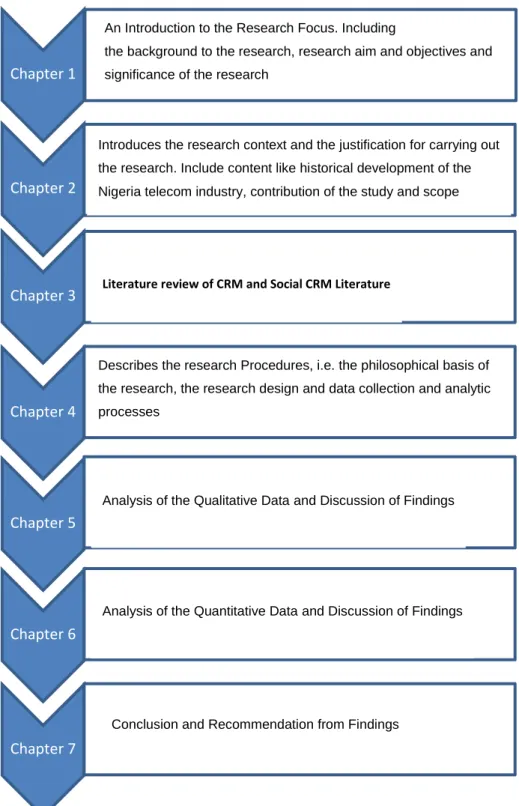
This chapter has introduced the research focus and the research objectives to be fulfilled. This thesis is divided into seven main chapters, including this background to research chapter. The outline of the thesis is represented in Fig. 1 below and it provides a summary of the main activities and the content of each of the chapters.
26
Figure 2: Thesis Outline
Chapter 1 Chapter 2 Chapter 3 Chapter 4 Chapter 5 Chapter 6 Chapter 7
An Introduction to the Research Focus. Including
the background to the research, research aim and objectives and significance of the research
Introduces the research context and the justification for carrying out the research. Include content like historical development of the Nigeria telecom industry, contribution of the study and scope
Describes the research Procedures, i.e. the philosophical basis of the research, the research design and data collection and analytic processes
Analysis of the Qualitative Data and Discussion of Findings
Literature review of CRM and Social CRM Literature
Analysis of the Quantitative Data and Discussion of Findings
27
CHAPTER TWO
THE RESEARCH CONTEXT AND JUSTIFICATION OF
RESEARCH
In this chapter, an overview of the telecom industry in Nigeria including its potentials and challenges is presented. Also presented in this chapter is the issue of customer relationship management in the telecom industry and propositions on how it could be management. From the issues discussed and in aligning with the research questions presented in Chapter (section 1.2) the research hypotheses are framed. Thereafter, the justification of the research and the contribution it will bring to both practice and the academia is presented. The scope of the study was also presented before the chapter concluded with a summary.
2.1
The Study Context: The Nigerian Telecom Industry
The Nigerian economy is one of the largest (if not the largest) in Africa (African Development Bank Group, 2017; UN, 2018). In economic terms, it is classified as an emerging market with rich reserves of natural resources (including ample fertile land, regular rainfall, and several types of mineral deposits especially crude oil), as well as abundant human resources with a population of over 150 million people within thirty-six states of the federation including the federal capital territory (Deutsche Bank Research, 2014).In addition to having one of the largest economies in Africa, Nigeria has currently the largest telecom market in Africa (Abdul et al., 2014:139), contributing 8.83% to the nation’s Gross Domestic Product (GDP) (National Bureau of Statistics, 2016). In recent years, particularly in the past two decades, the Nigerian telecommunications industry has undergone rapid change and phenomenal growth in terms of delivery of services to both residential and business consumers. This growth has been attributed to the liberalization of the sector and the resulting competition by private operators (Ogbo et al. 2012, Adi, 2015).
28
2.1.1 Historical Development of the Nigerian Telecom Industry
The history of the modern Nigerian telecom industry can be traced back to 1985, with the establishment of the Nigeria Telecommunication Ltd (NITEL) (Adebayo & Ekejiuba, 2016; Nkordeh et al. 2017). Nonetheless, in the years ensuing up till 1992, the industry was characterised by gross underdevelopment (Ogunsola & Aboyade, 2005). The deregulation of the industry in 1992, saw the formulation of the Nigerian Communication Service (NCC) which is mandated by the Nigerian Communications Act (2003) to monitor all significant matters relating to the performance of all licensed telecoms service providers. With the 1992 deregulation of the industry, telecommunication services moved from the analogue era (i.e. voicemail, paging and voice services over the analogue E-TACS network) to a digital era comprising of Global Personal Communication Systems (GMPCS), Voice Over Internet Protocol (VOIP), cable broadcasting networks and the Integrated Services Digital Network (ISGDN) (Nkordeh et al. 2017).
Prior to the deregulation of the telecommunications industry in Nigeria and before 1999, the country was ranked the lowest in the world with teledensity of 400,000 active lines as against a population of over 100 million people (Adebayo & Ekejiuba, 2016). The deregulation of the industry saw the entrance of multinational companies such as ECONET (which is now known as Airtel) and Mobile Telephone Networks (MTN) in 2001 and in 2003 operational licenses awarded Etisalat (now known as 9Mobile) and Globacom (Nig.) - the first and still the only indigenous telecom firm in Nigeria. The entry of these companies improved the development of the industry by deepening the level competition and ensuring the large subscriber base enjoyed a better-quality service as well as variety of telecom products and services being offered (Deloitte, 2015; Adebayo & Ekejiuba, 2016). In addition, initiatives like the number portability has also enriched customer experience by limiting hassles to accessing better services on a preferred network (Deloitte, 2015).
2.1.2 Structure of the Nigeria Telecommunications Industry
The Nigerian telecommunication industry has evolved over the years since 2001 to become an oligopolistic market structure – where a very few firms have the majority market share. In terms
29
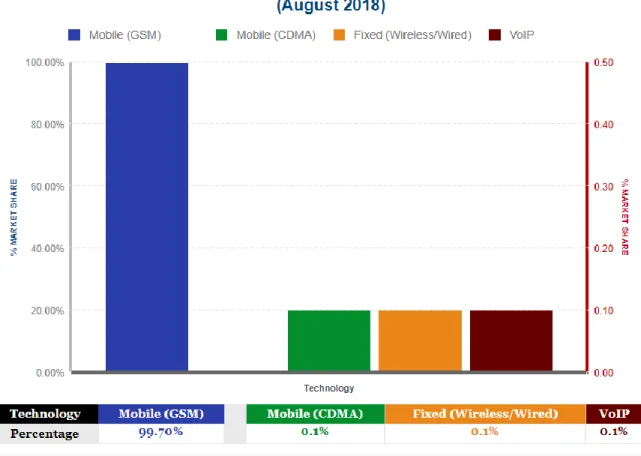
of technologies being delivered, the Nigerian telecommunication industry is currently divided into GSM, CDMA, Fixed Wired/Wireless technology and VoIP (NCC, 2018). Fig. 2.1 shows the percentages of subscribers using each of the technologies currently deployed. The majority of the market as indicated by 99.7% are using the Global System for Mobile (GSM) Communication services, while the remainder (0.3%) of the market are patronizing mobile CDMA (Code Division Multiple Access), Fixed (Wired/wireless) and Voice over Internet Protocol (VoIP) with 0.1% market share respectively. The implication is that mobile (GSM) telecommunication service provide predominately control the Nigerian telecommunication industry.
Figure 2.1: Market Share by Telecom Technology in Nigeria (Source, NCC, 2018)
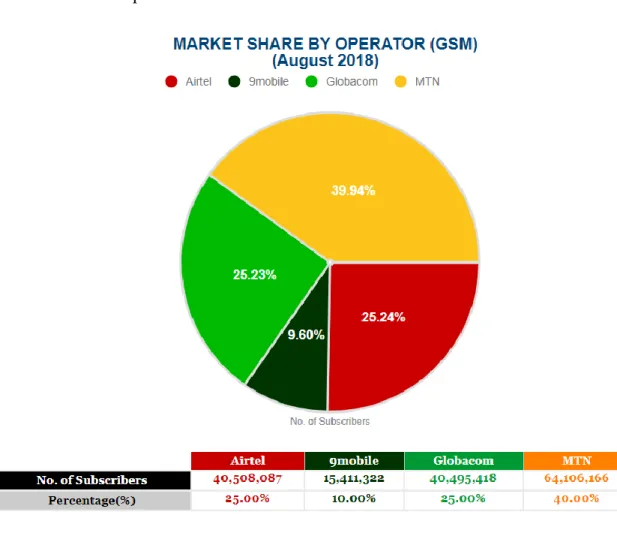
In terms of the operators of the GSM, the Nigerian telecommunication industry is currently composed for four multinational organisations, namely: MTN (Nig.), Airtel, Globacom (Nig.) and 9Mobile (formerly Etisalat). Fig. 2.2 shows the market share per operators of GSM. MTN (Nig.)
30
a South African based company currently controls the majority of the market share with 40%. The industry control is followed by both Globacom and Airtel, which respectively enjoy 25% share of the market. The least operator in terms of market share volume is 9Mobile with 10%.
Figure 2.2: Market Share by GSM Operator (Source, NCC, 2018)
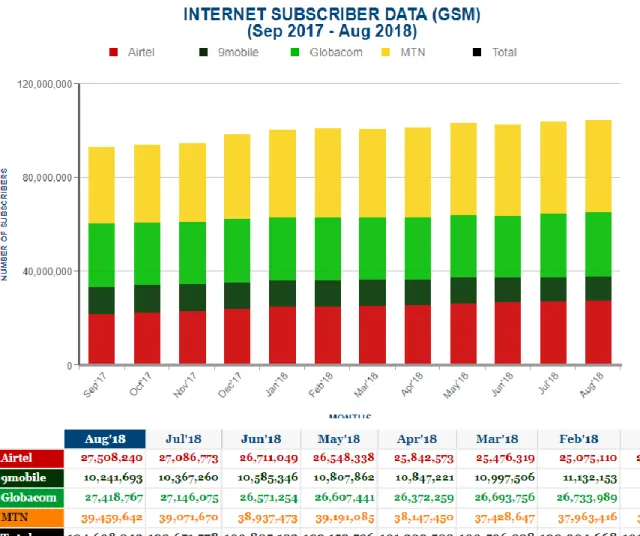
In terms of internet subscription (GSM), there are over 104 million subscribers buying internet data from the four major companies, of which MTN has the largest market share of the internet subscription with 38 % (i.e. over 39 million subscribers) as of August 2018. Airtel and Globacom also share closely the same market share of 26%; with 27,508,240 subscribers (for Airtel) and 27,418,767 subscribers (for Globacom). 9Mobile have the least market share of the big-four; with merely 10 percent of the total number of internet subscriber (GSM)
31
Figure 2.3: Market Share by Internet Subscriber Data (GSM) (Source, NCC, 2018)
Giving the potentials for further development, the telecoms sector continues to attract considerable local and foreign investments. Particularly within the personal mobile sector, which has benefited from the market competition and the wider deployment of LTE as evident by the increasing demand for mobile broadband services in recent years (Oyeniyi & Abiodun, 2009; Ojo, 2010; Oyedijo, 2012). Increasing from 30,000 subscribers at the beginning of the millennium to 9.174 million connections at the end of 2004 and current over 104 million subscribers, the personal GSM business has become a very lucrative one. The active mobile subscribers also represent about 58% of the entire population and contributing about 19 percent of the total mobile telecom subscribers
32
on the African Continent – a feat that has earned the country the first on the African continent and the 10th place in the entire world(NCC, 2018).
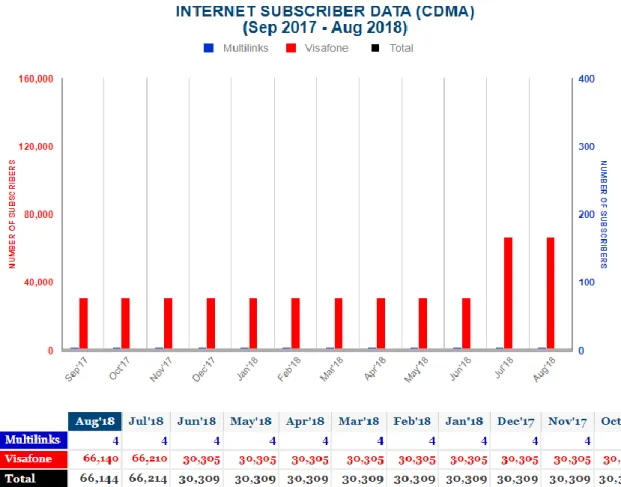
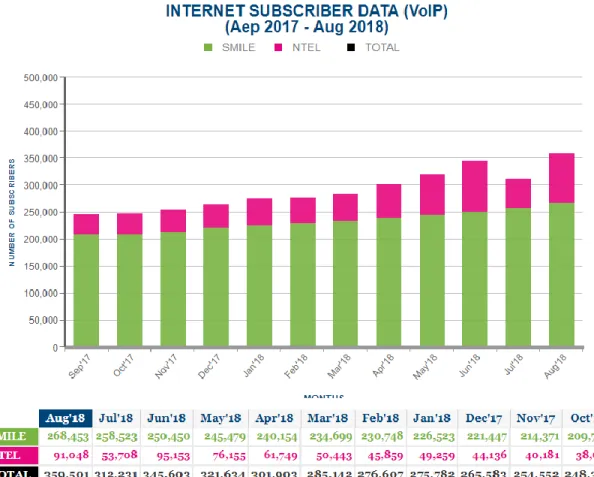
In terms of internet subscription by CDMA, the market is majorly controlled by Visafone (see Fig. 2.4) and in terms of VoIP, Smile is the market leader (see Fig. 2.5).
Figure 2.4: Market Share by Internet Subscriber Data (CDMA) (Source, NCC, 2018)
33
Figure 2.5: Market Share by Internet Subscriber Data (VoIP) (Source, NCC, 2018)
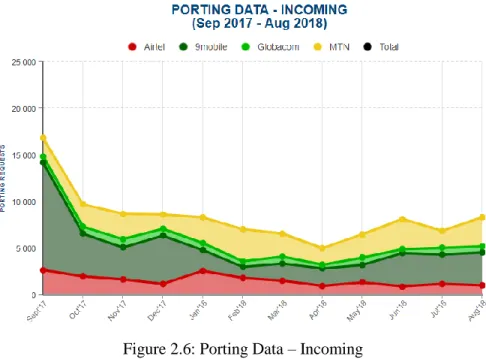
Further, Fig. 2.6 and Fig. 2.7 captures the porting activities of mobile network operators (GSM). The figures show the trend in monthly porting from one network to another by customers within the telecommunication sector per mobile. The trend captures the number of transactions per month where a subscriber request that his or her mobile number be transferred from one service operator but keeping the same number. Although between the period (September 2017 to August 2018) there have been a downtrend in both incoming and outgoing porting activities. In terms of incoming porting activities, 9Mobile enjoyed the largest of customers switching to their network except in January-March 2018 (and this coincided with the transition from Etisalat to 9Mobile).
34
Figure 2.6: Porting Data – Incoming (Source, NCC, 2018)
In terms outgoing porting activities, Globacom experienced the lowest number of customers leaving the network as indicated in Fig. 2.7.
35
(Source, NCC, 2018)
2.2
Challenges with Customer Relationship Management Faced by the
Telecom Industry
The overview of the telecommunication industry in Nigeria suggests that the telecom operators are currently in competition to gain the highest market share. This means that the telecom operators must devise means for retaining their customers and gaining new customers through innovative telecom products and services as well as establish a lasting relationship with customers. However, innovations in telecommunication technologies have turned the entire world into a single community. Telecom service providers utilise perhaps the most complete array of information technology (IT) compared to any other industry, simply because their whole business process is hinged on technology usage both software and hardware (Shakeel et al. 2012; Chivandi et al. 2014; Mansaku et al. 2016). Currently with a simple portable device (whether a mobile phone, tablet or laptop) consumers around the globe can continuously communicate with one another within a short time frame.
While innovation in information technology (IT) has facilitated improvements in the complexity, precision and quality of telecom products and services, it is the management of customer relationship that continues to provide the differentiating factor especially in the modern era of Social media growth (Hennig-Thurau et al. 2010; Giannakis-Bompolis & Boutsouki, 2014; Go & You, 2016). This is even of more importance in this era of social media; which is influencing the mode of communication and changing the dynamics of both human and business relationships.
With social media facilitating channels, consumers can now create a local community around a brand or product, sharing information that can have either a good or bad effect on the organisation (Smith, 2009; Brenan, 2010; Kaplan & Haenlein, 2010; Neff, 2010). Also, for business organisations social media has changed the dynamics and channels with which businesses are reaching and engaging with consumer sphere; rendering traditional email programs and company websites obsolete (Neff, 2010).
In addition, the popularity of the new communication channels facilitated by social media platforms has increased customer contact points and created a huge increase in the volume of customer-related data (Baird & Parasnis, 2011; Xevelonakis & Som, 2012; Nyambu, 2013; Bala,
36
2014). The rise and exponential increase in usage and reach of social media platforms over the past few years has left business corporations and telecom firms in a situation where they need to reconsider their approach to handling Social media communications in creating customer relationships (Xevelonakis & Som, 2012; Xia, 2012; Leeflang et al. 2014). Social media in essence have now altered how businesses and their consumers interact as well as how customer relationship management (CRM) policies are being implemented, with the main focus how shifting to empowering and improving customer experience (O’Brien, 2010:32).
However, while telecom products and services are being engineered to facilitate improved interpersonal communications among consumers, the telecom firms providing such service are lagging in terms of providing personalised communications with the customers (O’Brien, 2010; Thaichon et al. 2014). Even before the widespread popularity of social media, the telecom service providers were mostly in a disadvantaged position in terms of developing formidable relationships with their valued customers, resulting in the difficulty in gaining new subscribers (customers) and ensuring efficient management of the customer information (Leeflang et al. 2014; Saleh, 2016). Gaining customer insights through direct interaction and relationship building is expected to assist the telecom firms in improving the quality of service delivered by driving better product development, prioritising of service and in improving the overall customer experience (Aydin & Ozer, 2005; Lai et al. 2009; Roca et al. 2009; He & Li, 2010; Thaichon et al. 2014).For the telecom industry, the quality of network is an important factor when customers measure the overall service quality (Vlachos & Vrechopoulos, 2008:280).
Network quality relates to the clarity of the voice calls, the quality and strength of the network signal, downloading and uploading speed and the number of errors (Thaichon et al., 2014:1047). Failure to connect calls or breaking voice calls as well as poor internet connectivity can result in overall poor perception of the service quality provided in the customer’s perception. However, the level of relationship between the consumer and the organisation is expected to play determining factor in influencing the consumers’ willingness in making the necessary sacrifices in the consumer is willing to make sacrifices or entirely influence a different customer perspective of the quality of service or value attached to the brand (Askool & Nakata, 2011; Giannakis-Bompolis & Boutsouki, 2014). In addition, by providing core performances that meets or exceeds the expectations of the consumers, the service providers can establish a more trusting relationship with
37
the customers (Wang & Lo, 2002; Eisingerich & Bell, 2008). Hence, it can be inferred that increase in the quality of service quality would have a strong impact on the level of consumers’ trust and attachment to the organisation or brand.
For the telecom firms, current evidence in the literature suggest that there is the need for the provision of additional service attributes (such as superior customer engagement and after sale supports) which could enhance the customers’ perception of the quality of the delivered services (Aydin & Ozer, 2005; Tam, 2012; Wang & Wu, 2012). This is essential given that the modern consumers (so referred to as social consumers) are in constant pursuit of acceptance and cordial relationships with the businesses as well as with their fellow consumers; sharing thoughts, concerns and emptions about products and services (Eisingerich & Bell, 2008:257). The evidence from the literature further suggest that by providing considerate, caring and responsive customer services, the telecom firms can stimulate the consumers’ confidence on their brand. Nonetheless, there is also the evidence in the literature that most telecom service providers (just like most other service providing firms) are still struggling to integrate data from customer touch-points with the business solution; meaning that they often miss-out of key opportunities to analyse and improve on the customer experience (Wu et al. 2009; Saleh, 2016).
Though most business firms are now building social media presence by wanting to be at the centre of the consumer sphere, but simply monitoring and listening to consumer conversations on social media is far from implying the adoption of social CRM. Social CRM is more considered with want is being done with the customer data in improving services and creating sustained relationship with the consumer. Hence, the Social CRM strategy of business firms should involve at the minimum avenues to identifying with the critical customers, engaging with them to understanding their sentiment and leveraging on such insights in delivering innovative products and services that ensures valued service (Seims et al. 2012; Tam, 2012). Compounding the problem of effective Social CRM adoption is that most organisational structure or work processes are fragmented and as such makes it difficult to utilise the customer data in improving overall firm efficiency (Harridge-March & Quinton, 2009; Miller & Lamas, 2010). Hence, it is vital for the business firms that implementing social CRM may implying the re-engineering of organisational structures and work processes.
38
For the Nigerian telecom industry, despite the reform and deregulation of the sector, the consumers are still crying out over the poor service performance of the telecom firms (Ogbo et al. 2012; Abdul et al. 2014; Alabar et al. 2014; Adi, 2015), implying the telecom products and service are not tailored to the needs and expectations of the local market. For example, with over US$ 5.750 billion investment towards the network expansion projects by telecom operators ((Abdul et al. 2014; Samuel & Olatokun, 2014), the general consumers are reported to not benefiting from the investment with complaints of poor network quality with drop calls, unsolicited text messages, sudden tariff deductions and incoherent voice transmission still prevalent in the industry (Abdul et al. 2014; Alabar et al. 2014; Samuel & Olatokun, 2014). Famutimi (2014 cited in Samuel & Olakotun, 2014), criticised the poor performance of telecoms service providers in Nigeria, and rebuked them for seriously lagging in actualising the required performance index set by the Nigerian Communication Commission (NCC) and encouraged the consumers to take telecom service providers to court on account poor service delivery.
The consumer’ perception of the poor service quality in the telecom industry can be attributed to four major factors. Firstly, the sheer intangible nature of the telecom products/services implies that there is only a small margin for product or service differentiation, and this is mostly in terms of pricing and customer experience (Alabar et al., 2014; Adi, 2015). Secondly, the growing complexity in technological innovations implies that telecoms service providers must now diversify their services; shifting from mere voice networks to other service provision such as broadband and data services (Bender et al. 2011; Abdul et al., 2014; Obayemi, 2014). The implication of this is that the service providers are now accountable for multiple services, making the provision of customer experience a huge task. Thirdly, the low customer loyalty in the telecoms industry as highlighted by the ease portability of subscribers (show in Fig. 2.6 and Fig. 2.7), implies that the telecom firms need to diversify their product/service options as well as encourage rapid technological innovations (Aydin & Ozer, 2005; Ogbo et al. 2012; Shafei & Tabaa, 2016). And lastly, the increasing demanding nature of customers (in terms of the demand for prompt services and solutions to queries) implies that the telecoms firms need to keep abreast with the customers’ needs and expectations (Nasser et al. 2012; Oluseye et al. 2014; Rahman, et al., 2014: IBM, 2015).
39
2.3
Justification for Research
Specifying the research problem. Justifying the essence of its investigation and suggesting the importance of the study is critical for all academic research (Creswell, 2012:8). The current research is founded on the need to develop a framework that will help telecom firms in responding adequately to the needs and preferences of the social customers as well as help the firms in establishing, nurturing and sustaining long-term relationships with the customers. As earlier mentioned, the emergence of Social media has made this objective very difficult and Social CRM systems are needed to complement the personal interactions provided through salespeople, customers service representatives and call centres. As Woodcock et al. (2011:58) pointed out, Social CRM is very important for modern organisations; becoming a vital feature of the sales and marketing mix.
However, in terms of academic research, Social CRM is still at a nascent stage and remains an unexplored phenomenon (Khodakarami & Chan, 2014; Saleh, 2016). Hence, there is little known on why and how firms adopt and deploy Social CRM systems. To breach this research gap, the interest of this current thesis is to look deeper into the implementation of Social CRM by telecom firms and as well explore the customers’ evaluation of the organisations’ Social CRM initiatives. This enabled the development of a framework that is expected to support the effective implementation of social CRM strategy in the Nigeria telecom industry. The justification for this current study is supported by the claim by Baird & Parasnis (2011:36) that significant gaps “exist between what businesses think consumers care about and what consumers are saying they want from their Social media interactions with companies”. In a more recent study, it was reported that while many companies claim to be using social media for marketing purposes, it is only about 41 percent that are using social media channels for external communication and customer management (Aberdeen Group, 2012:1).
2.4
Contribution to Practice and Knowledge
This research study will provide a guideline for interested stakeholders on how Social CRM could be implemented to provide a platform for profit maximization, increasing quality of products and
40
services and achieving continuous customer relationship in the Nigerian telecoms industry. From the practitioner’s perspective, the result of this research will be vital for modern business organisations who are left with the challenges of finding more effective way to interact, engage and communicate with customers. Corporate managers of telecom firms in Nigeria will be provided with adequate suggestions on how to better implement their Social CRM strategy for gaining value for their organisations and for their customers. In terms of contribution to academic knowledge, it is hoped that the outcome from this current study will provide answer to the currently identified gap and provide a platform for future research.
2.5
Beneficiaries of the Study
The main beneficiaries of this study will be service organisations and the work will contribute to the body of knowledge. The study outcome will assist companies in the Nigerian telecoms industry in planning an effective Social CRM strategy that will enable them to become competitive and improve other primary organisational outcomes such as enhancing profitability. It aims to enlighten managers and supervisors of the importance of developing relationship with customers through Social media channels. The evidence from this work is expected to help the organizations in reassessing their Social CRM strategies in view of further improving it for competitive advantage and profitability. In addition, it is expected that the outcome of the research will assist developers of Social CRM in developing effective applications that are specific to the needs of the consumers especially those of the Nigerian telecoms industry.
2.6
Research Hypotheses
The following hypotheses were formulated for the study following the research questions presented in Chapter one:
H1: Customers’ perception of the company’s customer orientation and Social CRM strategies, is related to brand resonance
41
H2: Customer perceived value of the firm’s Social media channel mediates the relationship between organisation’s customer orientation and Social CRM strategy and brand resonance
H3: The higher the level of customer-organisation interaction/engagement on Social media, the higher will be the level of brand loyalty
H4: Brand resonance has a significant influence on customers’ brand loyalty
H5: There is no difference, at 5% level of significance, in customer’s response to Social CRM concept adoption in telecom firms in Lagos due to personal socio-demographics (age, educational attainment and standard of living)
2.7
Scope of the Study
The scope of this research will be limited to the Nigerian telecoms industry, with the focus on the telecom firms operating in Lagos State. Lagos State was chosen because of the following reasons: (i) it is the industrial hub of the country and ranked the most populated state in Nigeria, the second fastest-growing city in Africa and the seventh in the world; (ii) most (if not all) of the companies have their headquarters in Lagos state; and (iii) a very large population (over 19Million) representing an adequate customer base for this research.
2.8
Summary of the Chapter
This chapter has explored the study context with the aim of developing the research questions and justification for conducting the study. First, the chapter introduces the study context – that is the description of the Nigerian telecom industry. The Nigerian telecom industry was described as a thriving business sector in Africa and the world in general. The Nigerian telecom industry was described as a very competitive industry with four major operating firms: MTN (Nig.), Globacon, Airtel, and 9Mobile and many other smaller firms. Also discussed in this chapter in the Social CRM challenged faced by the telecom firms within the study area. The need to provide innovative
42
services in terms of precision and quality of service and also establishing a formidable relationship with the customers were highlighted as some of the challenges faced by the firms. The challenges/barriers in implementing Social CRM facilities was identified in this chapter as another significant challenge facing the telecoms firms. These challenges were used in developing the research questions that will be addressed by the study (see Section 2.3). In addition to this, the chapter presents the justification to the study, the contribution of the study to knowledge, the beneficiaries of the study, the research hypotheses and the scope of the study.
43
CHAPTER THREE
LITERATURE REVIEW
3.0
Introduction
Since the industrial revolution, the world has undergone fundamental changes in all aspects, especially the business world which has transformed from production-oriented to service-oriented (Khan, 2008; Nolan et al., 2008; Gulzar, 2015). The revolution has brought about globalisation, with it an intense competition among organisations in the business environment (Nolan et al., 2008; Phan & Vogel, 2010; Berisha-Shaqiri, 2015). This has now required marketers and managers to constantly seek techniques and strategies that will give their companies a competitive edge. Such strategies require the production and selling of highly complex activities that requires the strategic positioning of businesses to deliver improved customer service and experience by using information technology in gaining customer insight and maintaining customer loyalty (Phan & Vogel, 2010:69). Today, marketing has gone beyond the sales of developed products or services to include the rendering of after sale services and the need to develop long-term relationship with the customers (Phan & Vogel, 2010; Berisha-Shaqiri, 2015; Elbedweihy et al. 2016).
Building lasting relationship with the customers has attracted more attention in today’s business and marketing literature upon the realisation that maintaining customer loyalty has become a critical factor for business and organisational success (Oakley & Bush, 2012; So et al. 2017). Therefore, understanding how to manage lasting relationship with the profitable customers has become the focus of many research studies, both in academic and practitioner’s literature So et al. 2016a; 2016b). Business firms have now come to the realisations that different customers provide different economic value and are adapting accordingly their customer offerings and communication strategies. This chapter therefore provides a review of the literature on relationship marketing and how it has evolved into the concept of customer relationship management (CRM) and more recently Social CRM. In addition, the review of the prior studies in the literature, in establishing the necessity for this current study is presented.
44
3.1
Relationship Marketing (RM): Theory and Principle
The soul of life is in relationships – whether one is looking at it from the societal or organisational level. Recently, organisations across the globe (based on the evidence on the number of research publications) have come to embrace the idea that establishing relationships with the customers provides a means of achieving and sustaining competitive advantage (Sherry, 2000; Dann & Dann, 2001; Bolton & Tarasi, 2007; Oakley & Bush, 2012). Sherry (2000:328) referred to such relationship as the core aspect of marketing; which was described as a critical tool for establishing cultural stability within the work environment. The Chartered Institute of Marketing (CIM) define marketing as “the management process responsible for identifying, anticipating and satisfying customer requirements profitably” (CIM, 2005:3). The definitions clearly highlight the purpose of marketing being central to the performance of every business organisation; as it addresses the most important aspects of the market environment – which is reaching out to the customer with the right product at the right price, place and time, including understan