Current ablation techniques for persistent atrial
fibrillation: results of the European Heart Rhythm
Association Survey
Nikolaos Dagres
1*
, Maria Grazia Bongiorni
2, Torben Bjerregaard Larsen
3,
Antonio Hernandez-Madrid
4, Laurent Pison
5, and Carina Blomstro
¨ m-Lundqvist
6Conducted by the Scientific Initiatives Committee, European Heart Rhythm
Association
1
Second Department of Cardiology, University of Athens, Greece;2
CardioThoracic and Vascular Department, University Hospital-Pisa, Italy;3
Department of Cardiology, Aalborg University Hospital, Aalborg, Denmark;4
Cardiology Department, Ramon y Cajal Hospital, Alcala´ University, Madrid, Spain;5
Department of Cardiology, Maastricht University Medical Center, Maastricht, The Netherlands; and6
Department of Cardiology, Institution of Medical Science, Uppsala University, Uppsala 75185, Sweden
Received 26 August 2015; accepted after revision 27 August 2015
The aim of this survey was to provide insight into current practice regarding ablation of persistent atrial fibrillation (AF) among members of the European Heart Rhythm Association electrophysiology research network. Thirty centres responded to the survey. The main ablation technique for first-time ablation was stand-alone pulmonary vein isolation (PVI): in 67% of the centres for persistent but not long-standing AF and in 37% of the centres for long-standing persistent AF as well. Other applied techniques were ablation of fractionated electrograms, placement of linear lesions, stepwise approach until AF termination, and substrate mapping and isolation of low-voltage areas. However, the percentage of centres applying these techniques during first ablation did not exceed 25% for any technique. When stand-alone PVI was performed in patients with persistent but not long-standing AF, the majority (80%) of the centres used an irrigated radiofrequency ablation catheter whereas 20% of the respondents used the cryoballoon. Similar results were reported for ablation of long-standing persistent AF (radiofrequency 90%, cryoballoon 10%). Neither rotor mapping nor one-shot ablation tools were used as the main first-time ablation methods. Systematic search for non-pulmonary vein triggers was performed only in 10% of the centres. Most common 1-year success rate off antiarrhythmic drugs was 50 – 60%. Only 27% of the centres knew their 5-year results. In conclusion, patients with persistent AF represent a significant proportion of AF patients undergoing ablation. There is a shift towards stand-alone PVI being the primary choice in many centres for first-time ablation in these patients. The wide variation in the use of additional techniques and in the choice of endpoints reflects the uncertainties and lack of guidance regarding the most optimal approach. Procedural success rates are modest and long-term outcomes are unknown in most centres.
-Keywords Atrial fibrillation † Persistent † Catheter ablation † EHRA survey † EP Wire
Introduction
Catheter ablation is now well established treatment option for atrial fibrillation (AF), with rising numbers of procedures conducted worldwide.1Patients with persistent AF represent a significant pro-portion of ablation candidates. Ablation of this type of arrhythmia poses particular challenges because of the modest success rates2 which may be related to more advanced atrial remodelling. In addition to electrical isolation of the pulmonary veins (PVI), which has become the standard for ablation of all types of AF, several additional ablation strategies have been proposed for patients
with persistent AF in order to improve the outcome.2–6However, recent data question the established ablation techniques7and the optimal strategy in these patients remains unknown resulting in a wide variation of applied techniques in daily practice. The aim of this survey was to provide an insight into current ablation strategies for persistent AF across Europe.
Methods and Results
Thirty centres, which are members of the European Heart Rhythm Association (EHRA) electrophysiology (EP) research network,
*Corresponding author. Tel:+49341865252612.E-mail address: [email protected]
responded to the survey. There was a wide geographic distribution of the responding centres from 16 countries (6 centres from Italy, 4 each from Denmark and Germany, 2 each from Netherlands, Spain, and the United Kingdom, and one centre from 10 other countries). The majority (77%) of the responding centres was university hospitals.
There was a large spectrum of the responding centres from low to high volume regarding the number of ablation procedures per year: 7% of centres performed,100 catheter ablations (for all in-dications) in the last calendar year, 20% of the centres performed 100 – 199 procedures, 23% of the centres performed 200 – 399 pro-cedures, and 50% of the centres performed≥400 catheter abla-tions. The corresponding numbers for left atrial ablation were: 17% of the centres performed,50 left atrial ablations, 20% of the centres performed 50 – 99 procedures, 20% of the centres per-formed 100 – 199 procedures, and 43% of the centres perper-formed
≥200 left atrial ablations in the last calendar year. The majority of ablations (57%) was for paroxysmal AF, 32% for persistent AF, and 12% for long-standing persistent AF.
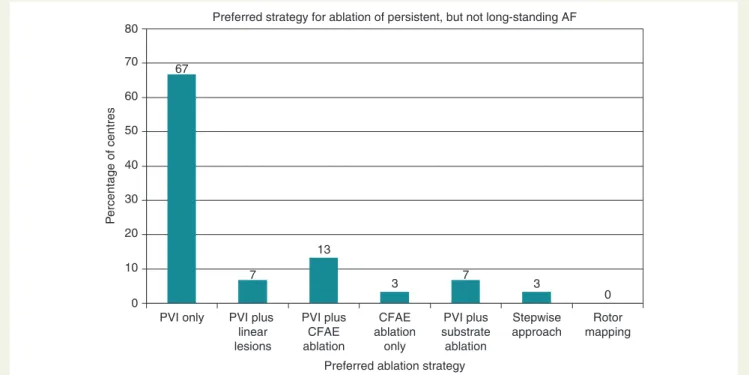
The main ablation technique in patients undergoing first-time ab-lation for persistent but not long-standing AF was stand-alone PVI in the majority of the centres (67%) (Figure1). The next most com-monly used technique was ablation of fractionated electrograms, ei-ther as an addition to PVI (13%) or as a stand-alone procedure (3%). Other techniques employed as the main ablation strategy in this pa-tient population were reported by very few centres: PVI plus sub-strate mapping and isolation of low-voltage areas by 7%, PVI plus linear lesions such as roof or mitral isthmus lines by 7%, stepwise ap-proach until AF termination by 3%, whereas no centre performed rotor mapping as the main first-time ablation strategy.
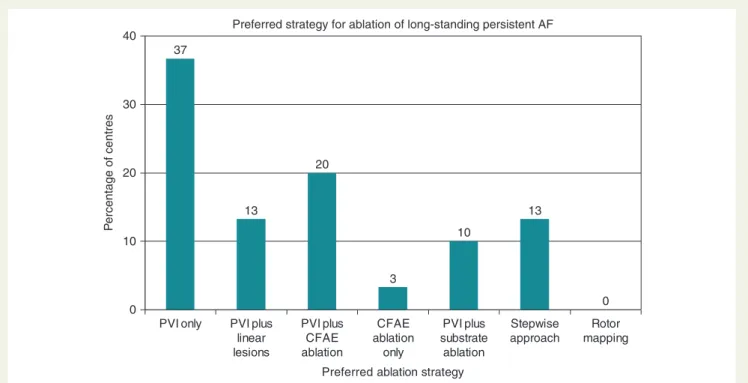
A more aggressive approach was used for first-time ablation in pa-tient with long-standing persistent AF (Figure2): stand-alone PV re-mained the most widely applied strategy, but was reported by only 37% of the respondents. The next most frequently used technique was ablation of fractionated electrograms, either as an addition to PVI (20%) or as a stand-alone procedure (3%). Other techniques were: stepwise approach until AF termination (13%), PVI plus linear lesions such as roof or mitral isthmus lines (13%), PVI plus substrate mapping and isolation of low-voltage areas (10%), whereas one centre (3%) did not perform AF ablation in such patients. Again, none of the centres reported using rotor mapping as part of the first-time ablation strategy as a stand-alone procedure or as an addition to PVI.
When stand-alone PVI was performed in patients with persistent but not long-standing AF, the majority (80%) of the centres used an irrigated radiofrequency ablation catheter and 20% of the respon-dents used the cryoballoon. The results were similar for the techni-ques applied in patients with long-standing persistent AF if stand-alone PVI was the chosen ablation method: again, the majority (90%) of the centres used an irrigated radiofrequency ablation catheter, whereas the cryoballoon was used by 10% of the centres as the main technique. The laser balloon and radiofrequency based one-shot ablation and mapping-style catheters were not used in any of the responding centres as the main ablation tool for stand-alone PVI.
We also asked whether the centre’s strategy for ablation of per-sistent AF had been affected by the recent results of the STAR-AF (Substrate and Trigger Ablation for Reduction of Atrial Fibrillation) II trial. More than half (53%) responded that they had been affected either moderately so that PVI alone was now used in most patients
Preferred strategy for ablation of persistent, but not long-standing AF
67 7 13 3 7 3 0 0 10 20 30 40 50 60 70 80
PVI only PVI plus linear lesions PVI plus CFAE ablation CFAE ablation only PVI plus substrate ablation Stepwise approach Rotor mapping Preferred ablation strategy
P
e
rcentage of centres
Figure 1 Preferred strategy for first ablation ofpersistent, but not long-standingAF. CFAE, complex fractionated atrial electrogram; PVI, pulmon-ary vein isolation; stepwise approach, stepwise approach until termination of AF; substrate ablation, substrate mapping and isolation of low-voltage areas.
without extensive atrial substrate disease (27%), or significantly so that ablation of fractionated electrograms or linear lesions was no longer applied in contrast to their frequent previous application (17%) or now performing PVI alone compared with their extensive ablation procedures prior to the trial (10%). In contrast, 47% of the centres responded that they had not been affected by the trial re-sults, either because PVI alone had already been the main ablation strategy in these patients before the publication of the STAR-AF II trial results (33%) or because there was only one trial available and the respondents still believed that more extensive ablation would be necessary for this type of AF (13%).
Equipment for rotor mapping was available in only one centre (3%). The main reasons for not using this technique were lack of belief in its value (43%) or lack of financial resources (33%).
Regarding right atrial ablation lesions including lesions in the right atrium, the superiorvena cava, the coronary sinus, etc., 53% of the respondents reported not performing them at all or only in isolated cases, and only 13% applied such ablation lesions in≥20% of the cases. Systematic detection of non-pulmonary vein triggers was also performed only by a minority: 10% of the centres reported to systematically search for such triggers with isoproterenol and then target them. A further 27% reported search attempts but only in a minority of cases.
In redo ablation procedures, if re-conduction in the pulmonary veins was detected, the main strategy was to maintain the primary ablation strategy and re-isolate the pulmonary veins in 60% of the centres. The remaining 40% of the respondents either expanded the previous strategy by adding ablation of complex fractionated at-rial electrograms or linear lesions in the left atrium (23%) or custo-mized the ablation approach depending on the patient’s response to
the previous ablation or considered thoracoscopic AF ablation in-cluding PVI and box lesion (17%).
For first-time ablation of persistent AF, 59% of the centres did not use a specific endpoint once the ablation strategy was fulfilled, whereas 24% used AF termination during the procedure as an end-point, and a further 17% used the criterion of non-inducibility of AF under provocative manoeuvres with adenosine or isoproterenol after cardioversion.
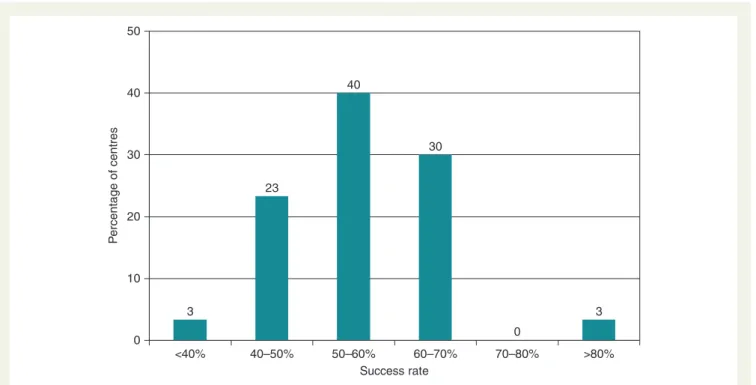
The approximate overall success rate after a single catheter abla-tion for persistent AF at 1 year, defined as the percentage of patients remaining free from recurrences off antiarrhythmic drugs, was re-ported to be 50 – 60% in 40% of the centres (Figure3). Only the mi-nority of the centres (27%) knew their 5-year results; other centres did not have such long-term follow-up in patients undergoing abla-tion. A quality registry for ablation procedures was used in 9 of the 16 countries (56%) but in only 2 of these countries the participation was compulsory.
Discussion
The main findings of this survey were a shift towards simpler abla-tion methods such as stand-alone PVI as the primary choice for per-sistent AF in many centres and a wide variation in the use of additional techniques and selection of endpoints, reflecting the un-certainty regarding the optimal ablation approach in these patients. Patients with persistent AF (long-standing and not long-standing) represent a significant portion of patients undergoing AF ablation (43%) as was evident in the present survey. These patients usually have a poorer outcome after catheter ablation compared with pa-tients with paroxysmal AF, which is generally thought to be a Preferred strategy for ablation of long-standing persistent AF
37 13 20 3 10 13 0 0 10 20 30 40
PVI only PVI plus linear lesions PVI plus CFAE ablation CFAE ablation only PVI plus substrate ablation Stepwise approach Rotor mapping Preferred ablation strategy
P
e
rcentage of centres
Figure 2 Preferred strategy for first ablation oflong-standing persistentAF. CFAE, complex fractionated atrial electrograms; PVI, pulmonary vein isolation; stepwise approach, stepwise approach until termination of AF; substrate ablation, substrate mapping and isolation of low-voltage areas.
consequence of more advanced structural changes that take place in the left atrial myocardium as AF progresses from the paroxysmal to the persistent form.8Therefore, more extensive ablation strategies have been employed in persistent AF. Thus, PVI is generally consid-ered sufficient for paroxysmal AF, whereas in the persistent form various additional ablation strategies have been proposed: linear ab-lation lesions in the left atrium with the goal to place anatomical bar-riers to the wavefront of the arrhythmia within the atrium, targeting the complex fractionated atrial electrograms, detection and target-ing the arrhythmia rotors in the atria, and additional targettarget-ing the right atrial sites, or substrate ablation by voltage mapping of the left atrium and isolation of low-voltage areas.2–6
However, recent data have questioned the value of these add-itional ablation techniques. In the multicentre, randomized STAR-AF II trial,7stand-alone PVI has been shown to produce similar results regarding the prevention of recurrences of AF or atrial tachycardia compared with PVI plus linear lesions or PVI plus targeting of frac-tionated electrograms in patients with persistent AF. Thus, not sur-prisingly, stand-alone PVI was the main ablation strategy for first-time ablation in 67% of the centres for persistent, not long-standing AF and in 37% of the centres even for long-long-standing persist-ent AF. Indeed, more than half of the cpersist-entres reported to have been influenced by the results of the STAR-AF II trial when selecting their ablation strategy and reported performing more stand-alone PVI procedures and abandoning additional techniques.
In line with this general approach to keep the ablation strategy rela-tively simple, in patients with pulmonary vein re-conduction, the ma-jority (60%) of the centres maintained the primary ablation strategy and closed the gaps of the previous ablation lesions. Nevertheless, PVI alone does not produce the satisfactory results in this subset of patients. The recurrence rates remain high, which was confirmed in
the present survey where the most frequently reported 1-year suc-cess rate after ablation for persistent AF was 50–60%.
There was a wide variation in the use of additional techniques, and none of them was applied by more than 25% of the centres during first-time ablation. Interestingly, rotor mapping was not reported to be the main ablation strategy by any centre; neither for persistent AF nor for long-standing persistent AF, and required tools or equip-ments were unavailable in the vast majority of the responding centres.
Similar variations were observed regarding the application of the right atrial ablation lesions, the detection of non-pulmonary vein triggers with pharmacological provocation, or the endpoint of the ablation procedure reflecting the uncertainties regarding the opti-mal ablation methods in these patients.
The overall success rate as reported by the centres was modest, mostly between 50 and 60% and thus in line with published reports. However, almost three quarters of the centres did not know their 5-year results of their ablation procedures for persistent AF because they did not have such a long-term follow-up after AF ablation. More extensive follow-up of patients who have undergone ablation for AF may provide additional information and contribute to more success-ful application of available methods.
Conclusions
Patients with persistent AF represent a significant proportion of pa-tients undergoing ablation for AF in Europe. There seems to be a shift towards simpler ablation methods with stand-alone PVI being the primary choice for first-time ablation in many centres. The wide dispersion in the use of additional techniques and in the choice of endpoints reflects the uncertainties regarding the optimal 3 23 40 30 0 3 0 10 20 30 40 50 <40% 40–50% 50–60% 60–70% 70–80% >80% Success rate P ercentage of centres
Figure 3 The overall success rate after a single catheter ablation for persistent AF, defined as freedom from AF recurrences whilst off antiar-rhythmic drugs.
approach. Procedural success rates are modest and long-term out-comes are unknown in most centres.
Acknowledgements
The production of this EP Wire document is under the responsibil-ity of the Scientific Initiatives Committee of the European Heart Rhythm Association: Carina Blomstro¨m-Lundqvist (chairman), Mar-ia GrazMar-ia Bongiorni (co-chair), JMar-ian Chen, Nikolaos Dagres, Heidi Estner, Antonio Hernandez-Madrid, Melece Hocini, Torben Bjerre-gaard Larsen, Laurent Pison, Tatjana Potpara, Alessandro Procle-mer, Elena Sciraffia, and Derick Todd. Document reviewer for EP-Europace: Irene Savelieva (St George’s University of London, London, UK). The authors acknowledge the EHRA Research Net-work centres participating in this EP Wire. A list of the Research Network centres can be found on the EHRA website. This docu-ment was set up thanks to the unrestricted support of Medtronic; however, it has not been influenced in any way by its sponsor. Conflict of interest:none declared.
References
1. Camm AJ, Lip GY, De Caterina R, Savelieva I, Atar D, Hohnloser SHet al.2012 fo-cused update of the ESC Guidelines for the management of atrial fibrillation: an
update of the 2010 ESC Guidelines for the management of atrial fibrillation. Devel-oped with the special contribution of the European Heart Rhythm Association. Euro-pace2012;14:1385 – 413.
2. Schreiber D, Rostock T, Fro¨hlich M, Sultan A, Servatius H, Hoffmann BAet al. Five-year follow-up after catheter ablation of persistent atrial fibrillation using the step-wise approach and prognostic factors for success.Circ Arrhythm Electrophysiol2015;8: 308 – 17.
3. Nademanee K, Oketani N. The role of complex fractionated atrial electrograms in atrial fibrillation ablation moving to the beat of a different drum.J Am Coll Cardiol
2009;53:790 – 1.
4. Narayan SM, Baykaner T, Clopton P, Schricker A, Lalani GG, Krummen DEet al.
Ablation of rotor and focal sources reduces late recurrence of atrial fibrillation compared with trigger ablation alone: extended follow-up of the CONFIRM trial (Conventional Ablation for Atrial Fibrillation With or Without Focal Impulse and Rotor Modulation).J Am Coll Cardiol2014;63:1761 – 8.
5. Calkins H, Kuck KH, Cappato R, Brugada J, Camm AJ, Chen SAet al.2012 HRS/ EHRA/ECAS Expert Consensus Statement on Catheter and Surgical Ablation of Atrial Fibrillation: recommendations for patient selection, procedural techniques, patient management and follow-up, definitions, endpoints, and research trial design.
Europace2012;14:528 – 606.
6. Rolf S, Kircher S, Arya A, Eitel C, Sommer P, Richter Set al.Tailored atrial substrate modification based on low-voltage areas in catheter ablation of atrial fibrillation.Circ Arrhythm Electrophysiol2014;7:825 – 33.
7. Verma A, Jiang CY, Betts TR, Chen J, Deisenhofer I, Mantovan Ret al.Approaches to catheter ablation for persistent atrial fibrillation.N Engl J Med2015;372: 1812 – 22.
8. Gupta DK, Shah AM, Giugliano RP, Ruff CT, Antman EM, Grip LTet al.Left atrial structure and function in atrial fibrillation: ENGAGE AF-TIMI 48.Eur Heart J2014;