Finding Application Errors and Security Flaws
Using PQL: a Program Query Language
Michael Martin
Benjamin Livshits
Monica S. Lam
Computer Science Department Stanford University
{
mcmartin,livshits,lam
}@cs.stanford.edu
ABSTRACT
A number of effective error detection tools have been built in recent years to check if a program conforms to certain design rules. An important class of design rules deals with sequences of events asso-ciated with a set of related objects. This paper presents a language called PQL (Program Query Language) that allows programmers to express such questions easily in an application-specific context. A query looks like a code excerpt corresponding to the shortest amount of code that would violate a design rule. Details of the tar-get application’s precise implementation are abstracted away. The programmer may also specify actions to perform when a match is found, such as recording relevant information or even correcting an erroneous execution on the fly.
We have developed both static and dynamic techniques to find solutions to PQL queries. Our static analyzer finds all potential matches conservatively using a context-sensitive, flow-insensitive, inclusion-based pointer alias analysis. Static results are also use-ful in reducing the number of instrumentation points for dynamic analysis. Our dynamic analyzer instruments the source program to catch all violations precisely as the program runs and to optionally perform user-specified actions.
We have implemented the techniques described in this paper and found 206 errors in 6 large real-world open-source Java applica-tions containing a total of nearly 60,000 classes. These errors are important security flaws, resource leaks, and violations of consis-tency invariants. The combination of static and dynamic analysis proves effective at addressing a wide range of debugging and pro-gram comprehension queries. We have found that dynamic analysis is especially suitable for preventing errors such as security vulner-abilities at runtime.
Categories and Subject Descriptors
D.2.5 [Software Engineering]: Testing and Debugging–Tracing
This work was supported in part by the National Science Founda-tion under Grant No. 0326227.
Permission to make digital or hard copies of all or part of this work for personal or classroom use is granted without fee provided that copies are not made or distributed for profit or commercial advantage and that copies bear this notice and the full citation on the first page. To copy otherwise, to republish, to post on servers or to redistribute to lists, requires prior specific permission and/or a fee.
OOPSLA’05, October 16–20, 2005, San Diego, California, USA.
Copyright 2005 ACM 1-59593-031-0/05/0010 ...$5.00.
General Terms
Languages, Security, Reliability
Keywords
program traces, pattern matching, web applications, SQL injection, resource leaks, bug finding
1.
INTRODUCTION
Advanced program analysis has been applied fruitfully to find large numbers of errors in software [10, 18, 20, 46, 54]. Program checkers are carefully crafted by experts and, as such, are targeted at finding patterns common to many application programs. In fact, these same techniques can also be used effectively to find error pat-terns that are specific to individual applications. To exploit the full potential of this approach, we need to make it easy for application developers to create their own custom checkers.
This paper presents Program Query Language (PQL), a lan-guage that allows developers to express a large class of application-specific code patterns. The system automatically generates from the query a pair of complementary checkers: a static checker that finds all potential matches in an application and a dynamic checker that traps all matches precisely as they occur, and can initiate user-specified logging or recovery actions upon a match. We have de-veloped a prototype based on these ideas for Java, and used it to find and repair numerous security and resource management errors in large open-source applications.
1.1
A Simple Example
PQL focuses on the important class of error patterns that deal with sequences of events associated with a set of related objects. For example, for security reasons, a password received from the user should never be written out to disk without encryption. Such patterns are hard to express using conventional techniques like pro-gram assertions. The objects of interest may be stored in or passed between local variables, passed as parameters, or even passed through generic collections. The sequence of events may be scat-tered throughout many different methods and guarded by various predicates. PQL can express these kinds of patterns as the sim-plest prototypical code that exhibits the sequence of events of in-terest. The PQL system automatically finds all the matches in a program that have the equivalent behavior by abstracting away ir-relevant control flow and disregarding how objects are named in the code.
As an example, let us consider SQL injection vulnerabilities [5, 27], ranked as one of the top five external threats to corporate IT systems [52]. Applications that use user-controlled input strings directly as database query commands are susceptible to SQL
in-jections. Consider the following code fragment in a Java servlet hosting a Web service:
con.execute(request.getParameter("query")); This code reads a parameter from an HTTP request and passes it directly to a database backend. By supplying an appropriate query, a malicious user can gain access to unauthorized data, damage the contents in the database, and in some cases, even execute arbitrary code on the server.
To catch this kind of vulnerability in applications, we wish to ask generally if there exist some
• objectrof typeHttpServletRequest, • objectcof typeConnection, and • objectpof typeString
in the code such that the result of invokinggetParameter onr yields stringp, and that stringpis eventually used as a parame-ter to the invocation ofexecuteonc. We can replace the call to executewith a custom routineUtil.CheckedSQLthat validates the query to ensure that it matches a permissible action. If the query is deemed invalid, the request is not made. Note that the two events in the application need not happen consecutively; the stringpcan be passed around as a parameter or stored on the heap before it is eventually used. We can express such a query in PQL as shown in Figure 1. The input tor.getParameteris immaterial, and is represented by the “don’t care” symbol “_”. Once the first call has been made, no additional matching is required except for trapping the final substitution. Note that SQL injections are more subtle in general and require more sophisticated patterns. The full SQL injection problem is discussed in Section 5.3.
Given an input pattern, the PQL system automatically produces a sound static checker that finds all its potential matches in a program. This checker uses a state-of-the-art context-sensitive inclusion-based points-to analysis [59]. The results are flow-insensitive with respect to the query; that is, for the query in Fig-ure 1, the static checker would report all cases where the first argu-ment of a call toexecuteis found to point to an object returned by some call togetParameter. The static checker does not ensure that the calls occur in the same order. This, combined with the in-trinsic undecidability of statically matching a query for all possible runs, means that static results will generally have false positives. Note that, unlike many currently available static techniques, our static checkers are sound and will not produce false negatives; any possible match will be reported.
Dynamic checkers, on the other hand, can only find matches that actually occur at runtime, but are precise and permit online recov-ery actions to be triggered. When used as a dynamic tool, PQL creates an instrumented version of the input program that reports a runtime match if and only if there are object instances that match the query. For the query in Example 1, PQL will instrument the code to remember all object instances returned bygetParameter and check them against the parameters supplied toexecute
rou-query simpleSQLInjection() uses object HttpServletRequest r; object Connection c; object String p; matches { p = r.getParameter(_); } replaces c.execute(p) with Util.CheckedSQL(c, p);
Figure 1: Simple SQL injection query.
tines. Should a match occur, it will intercept the call toexecute and run theUtil.CheckSQLroutine instead.
Because the static results are sound and so have no false nega-tives, any point that the static analysis decides is irrelevant cannot possibly contribute to a match. The dynamic matcher is thus free to ignore it. PQL combines the two analyses by using the results of the static analysis to remove unnecessary instrumentation. In this example, only thosegetParameterandexecutecalls returned as potential matches by the static analysis need to be instrumented.
1.2
Contributions
PQL permits easy specification of a large class of patterns re-lated to sequences of events on objects. A developer who needs to mine information from a program run can use it to produce tar-geted instrumentation. One who has just discovered a bug that he suspects also lurks elsewhere in the code can use it to quickly create a checker that will search for similar problems. To this end, PQL contributes the following:
Static checkers that leverage powerful analyses. An important result of this work is that we have placed sophisticated program analyses in the hands of developers. The developers can express simple queries and static checkers that use context-sensitive pointer alias analysis are automatically generated for them. Our analysis is sound, and as such its answer is guaranteed to include all points that may be relevant to the query. This allows its results to be used to optimize the dynamic matcher.
Optimized dynamic instrumentation. PQL automatically gen-erates a specialized matcher for a query and weaves instrumenta-tion into the target applicainstrumenta-tion to perform the match at runtime. These matchers differ from previous techniques in two ways. First, PQL transcends traditional syntax-based approaches by matching against the history of events witnessed by object instances. Sec-ond, the higher-level semantics of PQL make possible the use of static analysis to reduce the overhead of dynamic checking. Our system combines the dynamic matcher with sound static systems to produce its checkers.
Dynamic error recovery. PQL queries may specify functions to execute as a match is found, optionally replacing the last event with a user-specified function. This functionality can be used to recover from error conditions or to defend against attempts to breach appli-cation security.
Experimental evaluation of our approach. All the techniques in this paper have been implemented in a prototype system that works on Java programs. We have written tens of queries in the course of developing the tool and as part of our ongoing work. To explicitly test its ability to find bugs in large programs, we applied the tech-nique to 6 large real-life applications with nearly 60,000 classes combined and found 206 errors. We found several security vulner-abilities and object persistence errors in Web applications that can permit database corruption or denial of service attacks. We also found resource management errors that eventually lead to memory exhaustion. The queries to find these errors were derived by reading descriptions of the error patterns and APIs of Java libraries, and by exploring the application code using PQL. The runtime overhead in these experiments ranged from 9% to 125% in the most heavily in-strumented case. In the situations where overhead was the greatest, static analysis was applicable and removed between 82% to 99% of the instrumentation, and cut the overhead below 40%, and often be-low 3%. We also performed tests against standard benchmarks and found that in the extreme where nearly every event in significant, slowdown peaks at approximately 19 times.
Our experimental result suggests that the language covers an im-portant class of program error patterns. Even though we were not
familiar with the benchmarks, we were able to find errors in this large code base with relatively little effort.
1.3
Paper Organization
The rest of the paper is organized as follows. Section 2 gives an overview of the PQL language. Sections 3 and 4 describe our dynamic and static checkers, respectively. Section 5 provides a de-tailed experimental evaluation of our analysis approaches, while Section 6 discusses applications of our analyses in more general terms. Finally, Section 7 describes related work and Section 8 con-cludes.
2.
PQL LANGUAGE OVERVIEW
The focus of PQL is to track method invocations and accesses of fields and array elements in related objects. To keep the lan-guage simple, PQL currently does not allow references to variables of primitive data types such as integers, floats and characters, nor primitive operations such as additions and multiplications. This is acceptable for object-oriented languages like Java because small methods are used to encapsulate most meaningful groups of primi-tive operations. The ability to match against primiprimi-tive objects may be added to PQL as an extension in the future.
Conceptually, we model the dynamic program execution as a sequence of primitive events, in which the checkers find all sub-sequences that match the specified pattern. We first describe the abstract execution trace, then define the patterns describing subse-quences of the trace.
2.1
Abstract Execution Traces
We abstract the program execution as a trace of primitive events, each of which contains a unique event ID, an event type, and a list of attributes. Objects are named by unique identifiers. PQL focuses on objects, and so it only matches against instructions that directly dereference objects. We also need to be able to detect the end of the program in order to match queries that demand that some other event never occur. As a result, all but the following eight event types are abstracted away:
• Field loads and stores. The attributes of these event types are the source object, target object, and the field name.
• Array loads and stores. The attributes of these event types are the source and target objects. The array index is ignored. • Method calls and returns. The attributes of these event types are the method invoked, the formal objects passed in as ar-guments and the returned object. The return event parameter includes the ID of its corresponding call event.
• Object creations. The attributes of this event type are the newly returned object and its class.
• End of program. This event type has no attributes and occurs just before the Java Virtual Machine terminates.
Example 1. Abstract execution trace.
We illustrate the concept of an abstract execution trace with the code below:
1 int len = names.length; 2 for (int i = 0; i < len; i++) {
3 String s = request.getParameter(names[i]);
4 con.execute(s);
5 }
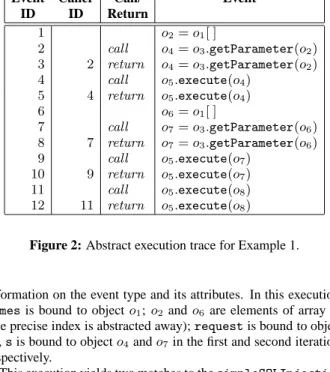
The code above runs through the arraynames; for each element, it reads in a parameter from the HTTP request and executes it. Fig-ure 2 shows an abstract execution trace for the code in the case where thenamesarray has two elements. Each event in the trace is listed with its ID, the ID of the caller in the case of a return, and
Event Caller Call/ Event
ID ID Return 1 o2=o1[ ] 2 call o4=o3.getParameter(o2) 3 2 return o4=o3.getParameter(o2) 4 call o5.execute(o4) 5 4 return o5.execute(o4) 6 o6=o1[ ] 7 call o7=o3.getParameter(o6) 8 7 return o7=o3.getParameter(o6) 9 call o5.execute(o7) 10 9 return o5.execute(o7) 11 call o5.execute(o8) 12 11 return o5.execute(o8)
Figure 2: Abstract execution trace for Example 1.
information on the event type and its attributes. In this execution, namesis bound to objecto1;o2ando6 are elements of arrayo1
(the precise index is abstracted away);requestis bound to object o3,sis bound to objecto4ando7in the first and second iteration,
respectively.
This execution yields two matches to thesimpleSQLInjection query in Figure 1. The first match is satisfied withr=o3,c=o5,
p=o4, and the second is satisfied withpmatched too7, and the
same values forrandc. 2
2.2
PQL Queries
A PQL query is a pattern to be matched on the execution trace and actions to be performed upon the match. A match to the query is a set of objects and a subsequence of the trace that together sat-isfy the pattern.
The grammar of a PQL query is shown in Figure 3. The query execution pattern is specified with a set of primitive events con-nected by a number of constructs including sequencing, partial se-quencing, and alternation. Named subqueries can be used to define recursive patterns. Primitive events are described using a Java-like syntax for readability. A query may declare typed variables, which will be matched against any values of that type and any of its sub-types. The use of the same query variable in multiple events indi-cates that the same object is used in all of the events.
Section 2.2.1 discusses variables in the context of a query, tion 2.2.2 outlines how statements are defined and combined, Sec-tion 2.2.3 describes PQL’s subquery mechanism, and SecSec-tion 2.2.4 discusses the options PQL provides for reacting to a match.
2.2.1
Query Variables
Query variables correspond to objects in the program that are relevant to a match. They are declared inside of subqueries and are local to the query they are declared in.
The most common variables represent objects, and represent in-dividual objects on the heap, Object variables have a class name that restricts the kind of object instances that they can match. If that name is prefixed with a “!”, then the object must not be castable to that type. If the same object variable appears multiple times in a query, it must be matched to the same object instance. The contents of the object need not be the same for multiple matches.
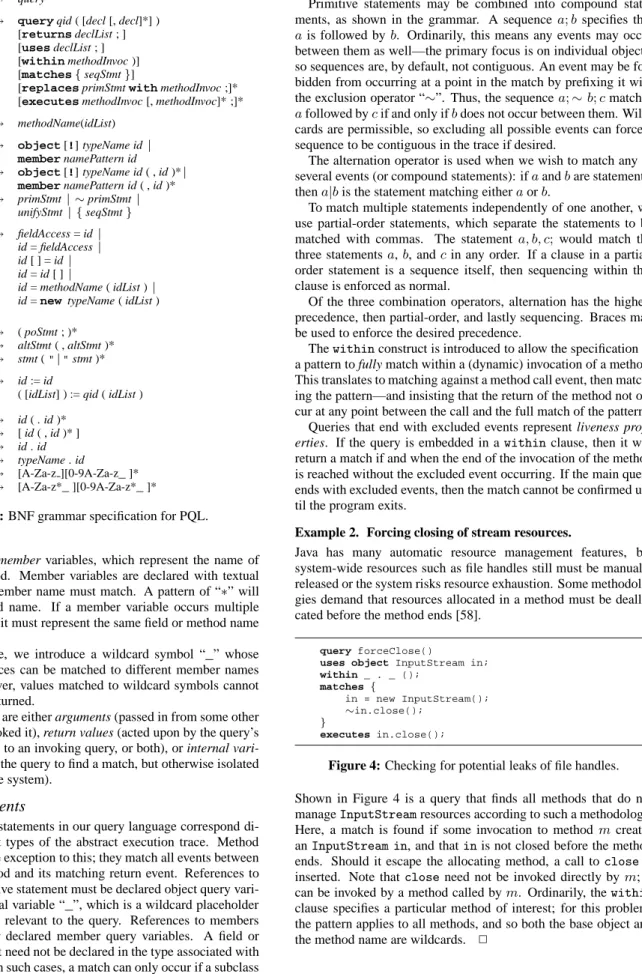
queries −→ query*
query −→ queryqid ( [decl [, decl]*] )
[returnsdeclList ; ]
[usesdeclList ; ]
[withinmethodInvoc )]
[matches{seqStmt}]
[replacesprimStmtwithmethodInvoc ;]*
[executesmethodInvoc [, methodInvoc]* ;]* methodInvoc −→ methodName(idList)
decl −→ object[!] typeName id| membernamePattern id
declList −→ object[!] typeName id ( , id )*| membernamePattern id ( , id )* stmt −→ primStmt|∼primStmt| unifyStmt|{seqStmt} primStmt −→ fieldAccess = id| id = fieldAccess| id [ ] = id| id = id [ ]| id = methodName ( idList )| id =new typeName ( idList )
seqStmt −→ ( poStmt ; )*
poStmt −→ altStmt ( , altStmt )* altStmt −→ stmt ("|"stmt )* unifyStmt −→ id := id
( [idList] ) := qid ( idList )
typeName −→ id ( . id )* idList −→ [ id ( , id )* ]
fieldAccess −→ id . id methodName −→ typeName . id
id,qid −→ [A-Za-z ][0-9A-Za-z_]*
namePattern −→ [A-Za-z*_][0-9A-Za-z*_]*
Figure 3: BNF grammar specification for PQL.
There are also member variables, which represent the name of a field or a method. Member variables are declared with textual pattern that the member name must match. A pattern of “∗” will match any method name. If a member variable occurs multiple times in a pattern, it must represent the same field or method name in each event.
For convenience, we introduce a wildcard symbol “_” whose different occurrences can be matched to different member names or objects. However, values matched to wildcard symbols cannot be examined or returned.
Query variables are either arguments (passed in from some other query that has invoked it), return values (acted upon by the query’s action, or returned to an invoking query, or both), or internal vari-ables (used inside the query to find a match, but otherwise isolated from the rest of the system).
2.2.2
Statements
Most primitive statements in our query language correspond di-rectly to the event types of the abstract execution trace. Method invocations are the exception to this; they match all events between a call to the method and its matching return event. References to objects in a primitive statement must be declared object query vari-ables, or the special variable “_”, which is a wildcard placeholder for any object not relevant to the query. References to members may be literals or declared member query variables. A field or method in an event need not be declared in the type associated with its base variable; in such cases, a match can only occur if a subclass defines it.
Primitive statements may be combined into compound state-ments, as shown in the grammar. A sequencea;bspecifies that ais followed byb. Ordinarily, this means any events may occur between them as well—the primary focus is on individual objects, so sequences are, by default, not contiguous. An event may be for-bidden from occurring at a point in the match by prefixing it with the exclusion operator “∼”. Thus, the sequencea;∼b;cmatches afollowed bycif and only ifbdoes not occur between them. Wild-cards are permissible, so excluding all possible events can force a sequence to be contiguous in the trace if desired.
The alternation operator is used when we wish to match any of several events (or compound statements): ifaandbare statements, thena|bis the statement matching eitheraorb.
To match multiple statements independently of one another, we use partial-order statements, which separate the statements to be matched with commas. The statement a, b, c; would match the three statementsa,b, andcin any order. If a clause in a partial-order statement is a sequence itself, then sequencing within that clause is enforced as normal.
Of the three combination operators, alternation has the highest precedence, then partial-order, and lastly sequencing. Braces may be used to enforce the desired precedence.
Thewithinconstruct is introduced to allow the specification of a pattern to fully match within a (dynamic) invocation of a method. This translates to matching against a method call event, then match-ing the pattern—and insistmatch-ing that the return of the method not oc-cur at any point between the call and the full match of the pattern.
Queries that end with excluded events represent liveness prop-erties. If the query is embedded in awithinclause, then it will return a match if and when the end of the invocation of the method is reached without the excluded event occurring. If the main query ends with excluded events, then the match cannot be confirmed un-til the program exits.
Example 2. Forcing closing of stream resources.
Java has many automatic resource management features, but system-wide resources such as file handles still must be manually released or the system risks resource exhaustion. Some methodolo-gies demand that resources allocated in a method must be deallo-cated before the method ends [58].
query forceClose()
uses object InputStream in; within _ . _ (); matches { in = new InputStream(); ∼in.close(); } executes in.close();
Figure 4: Checking for potential leaks of file handles.
Shown in Figure 4 is a query that finds all methods that do not manageInputStreamresources according to such a methodology. Here, a match is found if some invocation to methodm creates anInputStream in, and thatinis not closed before the method ends. Should it escape the allocating method, a call tocloseis inserted. Note thatcloseneed not be invoked directly bym; it can be invoked by a method called bym. Ordinarily, thewithin clause specifies a particular method of interest; for this problem, the pattern applies to all methods, and so both the base object and the method name are wildcards. 2
2.2.3
Subqueries
Subqueries allow users to specify recursive event sequences or recursive object relations. Subqueries are defined in a manner anal-ogous to functions in a programming language. They can return multiple values, which are bound to variables in the calling query. By recursively invoking subqueries, each with its own set of vari-ables, queries can match against an unbounded number of objects.
Values from input and return query variables are transferred across subqueries by unifying formals with actuals, and return val-ues with the caller’s variables. Unification in the context of a PQL match involves ensuring that the two unified variables are bound to the same value in any match. If one variable has been bound by a previous event but the other has not, the undefined variable is bound to the same value. If both have already been bound to different variables, then no match is possible.
When writing recursive subqueries, it is often necessary for the base case to force the return value to be equal to one of its argu-ments. PQL provides a unification statement to express this: the statementa:=b does not correspond to any program event, but instead unifies its parametersaandb.
Example 3. Recursive subqueries.
Recursion is useful for matching against the common idiom of wrappers in Java. Java exposes higher-level I/O functions by pro-viding wrappers over base input streams. These wrappers are sub-classes of the top-level interfacesReader(for character streams) andInputStream(for byte streams). For example, to read Java Objects from some sockets, one might first wrap the stream with aBufferedInputStream to cache incoming data, then with an ObjectInputStreamto parse the objects from the stream:
r1 = new BufferedInputStream(s.getInputStream())); r2 = new ObjectInputStream(r1);
obj = r2.readObject();
In general, there can be arbitrary levels of wrapping. To capture this, we need to use a recursive pattern, as shown in Figure 5. The base case in derivedStream subquery declares that any stream can be considered derived from itself; the other captures a single wrap-per and then re-invokes derivedStream recursively. 2
query derivedStream(object InputStream x) returns object InputStream d;
uses object InputStream t; matches { d := x | {t = new InputStream(x); d := derivedStream(tmp);} } query main() returns method * m; uses object Socket s; object InputStream x, y; object Object v; matches { x = s.getInputStream(); y := derivedStream(x); v = y.readObject(); v.m(); } executes Util.PrintStackTrace(*);
Figure 5: Recursive query for tracking data from sockets.
It is natural to ask how a developer should go about writing a PQL query. In some cases such as SQL injections, studying the API of relevant methods is sufficient. Sometimes it is useful to
instead locate objects of interest and see how these objects are used in the program. PQL makes such explorations easy. For example, the query shown in Figure 5 finds all methods invoked on objects read from a network socket. The query first finds all the streams derived from the input stream of a socket, then all objects read from any of the derived streams. It then matches against any method, represented by the method parameterm, invoked upon the objects read.
2.2.4
Reacting to a Match
Matches in PQL often correspond to notable or undesirable pro-gram behavior. PQL provides two facilities to log information about matches or perform recovery actions.
The simplest version of these is theexecutes clause, which names a method to run once the query matches. PQL subqueries may also have one or morereplacesclauses. These name a state-ment to watch for, and a method representing the action to be exe-cuted in its place. This method may take query variables as argu-ments. Passing the special symbol “∗” as an argument will pack-age every variable binding in the match into a collection that can be handled generically.
Some basic actions are defined as methods in a class Util as part of the base system; the two most frequently used are Util.PrintStackTrace, which takes the “∗” argument and dumps information about the variable values and the stack trace where the final event occurred, andUtil.Abort, which takes no arguments and terminates the program immediately. Both are in-tended for theexecutesclause.
When implementing actions, the method must returnvoidfor executesclauses, or a value of the same type of the replaced event forreplaces. Each argument to the action is represented as an array of Objects. Arrays are necessary because multiple matches may complete on a single event. Each index into the argument array corresponds to a single match that has completed.
2.3
Expressiveness of PQL
PQL as a pattern language is fundamentally concerned with ob-jects. It seeks to find a set of heap objects (disregarding how they are named syntactically in the code) to parameterize a context-sensitive pattern of events over the execution trace.
The events in these patterns do not refer to primitive values such as integers or individual characters, and so PQL is not capable of tracking them.
The subquery mechanism introduces a call chain that permits the matcher to match context-free grammars. Each production in such a grammar can be considered to be independently existentially quantified with respect to objects on the heap. This means that, despite the fact that any query can only refer to a finite number of variables, any number of objects may be involved in a match on a recursive query.
PQL does not directly provide a Kleene-star operator. However, this facility may be simulated with tail-recursive queries. In prac-tice, useful queries with loops need to refer to different objects or chains of objects, and in both cases, a simple Kleene star is insuffi-cient to capture the precise semantics.
The partial-order operator specifies that the execution stream must be able to match each of several clauses, which is equiv-alent to specifying the intersection of the languages specified by each clause. PQL’s class of languages is thus that of the closure of context-free languages combined with intersection; this class is a superset of context-free languages.
The default semantics of the sequencing operator in PQL would also seem to require patterns to be unduly permissive, since they
permit arbitrary blocks of statements to occur between events of interest. However, due to the object-centric focus of the language, this usually is precisely the behavior desired. For the occasions when this is not what is desired, one can use exclusion events to forbid all intervening events. This permits the language to express arbitrary patterns on the execution trace, while keeping the most generally useful patterns the simplest to express.
3.
DYNAMIC MATCHER
A direct, na¨ıve approach to finding matches to PQL queries dy-namically consists of the following three steps:
1. Translate each subquery into a non-deterministic state ma-chine which takes an input event sequence, finds subse-quences that match the query and reports the values bound to all the returned query variables for each match. If there is only amainquery, this can be a simple finite state machine. More complicated queries require additional machinery, de-scribed in Section 3.1.
2. Instrument the target application to produce the full abstract execution trace.
3. Use a query recognizer to interpret all the state machines over the execution trace to find all matches.
The procedure as described is quite inefficient. To reduce instru-mentation overhead, we perform the following optimizations. First, instrumentation code is inserted only at those program points that might generate an event of interest for the specific query. A simple type analysis excludes operations on types not related to objects in the query. We use the results of our static analysis, described in Section 4, to further reduce the instrumentation by excluding statements that cannot refer to objects involved in any match of the query. Also, instead of collecting full traces, our system tracks all the partial matches as the program executes and takes action imme-diately upon recognizing a match.
3.1
Translation From Queries To State
Machines
A state machine representing a query is composed of: a set of states, which includes a start state, a fail state, and an accept state; a set of state transitions; and a set of variable parameters. A partial match is given by a current state and a set of bindings—a map-ping from variables in a PQL query to objects in the heap at run time. A state transition specifies the event for which under which a current state and current bindings transition to the next state and a new set of bindings. Because the same event may be interpreted in different ways by different transitions, a state machine may non-deterministically transition to different states given the same input. To represent partial-order statements, states can be made to be join points: in these cases, the state machine must determine that every incoming transition has a compatible partial match. Each outgoing match from such a state is a combination of one incom-ing match from each transition; every possible consistent combina-tion is formed. A combinacombina-tion is consistent if and only if no two matches define the same variable to different values. In the extreme case where no incoming transition binds any variable bound by any other transition, the outgoing matches are the cartesian product of all incoming matches.
State transitions generally represent a single primitive statement corresponding to a single event in the execution trace. There are three special kinds of transitions:
Skip transitions. A query specifies a subsequence of events to match. Unless noted otherwise with an exclusion statement, an arbitrary number of events of any kind are allowed in between
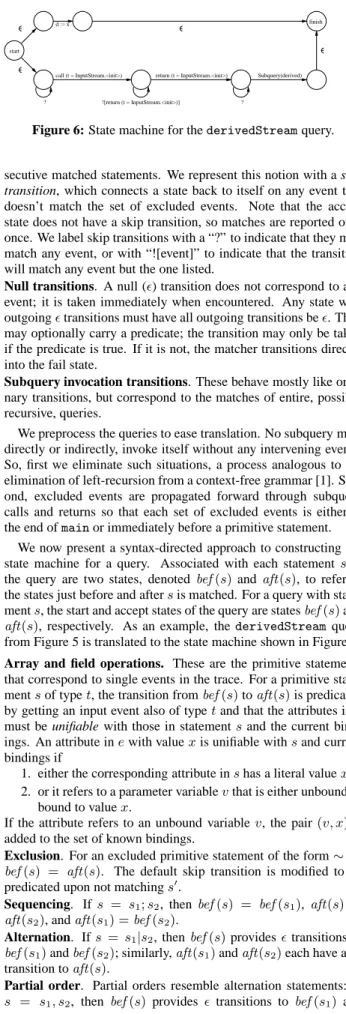
con-? ?
d := x
start
return (t = InputStream.<init>) Subquery(derived) call (t = InputStream.<init>)
![return (t = InputStream.<init>)]
finish
Figure 6: State machine for thederivedStreamquery.
secutive matched statements. We represent this notion with a skip transition, which connects a state back to itself on any event that doesn’t match the set of excluded events. Note that the accept state does not have a skip transition, so matches are reported only once. We label skip transitions with a “?” to indicate that they may match any event, or with “![event]” to indicate that the transition will match any event but the one listed.
Null transitions. A null () transition does not correspond to any event; it is taken immediately when encountered. Any state with outgoingtransitions must have all outgoing transitions be. They may optionally carry a predicate; the transition may only be taken if the predicate is true. If it is not, the matcher transitions directly into the fail state.
Subquery invocation transitions. These behave mostly like ordi-nary transitions, but correspond to the matches of entire, possibly recursive, queries.
We preprocess the queries to ease translation. No subquery may, directly or indirectly, invoke itself without any intervening events. So, first we eliminate such situations, a process analogous to the elimination of left-recursion from a context-free grammar [1]. Sec-ond, excluded events are propagated forward through subquery calls and returns so that each set of excluded events is either at the end ofmainor immediately before a primitive statement.
We now present a syntax-directed approach to constructing the state machine for a query. Associated with each statement sin the query are two states, denoted bef(s) andaft(s), to refer to the states just before and aftersis matched. For a query with state-ments, the start and accept states of the query are statesbef(s)and
aft(s), respectively. As an example, thederivedStream query from Figure 5 is translated to the state machine shown in Figure 6. Array and field operations. These are the primitive statements that correspond to single events in the trace. For a primitive state-mentsof typet, the transition frombef(s)toaft(s)is predicated by getting an input event also of typetand that the attributes ine must be unifiable with those in statementsand the current bind-ings. An attribute inewith valuexis unifiable withsand current bindings if
1. either the corresponding attribute inshas a literal valuex 2. or it refers to a parameter variablevthat is either unbound or
bound to valuex.
If the attribute refers to an unbound variablev, the pair(v, x)is added to the set of known bindings.
Exclusion. For an excluded primitive statement of the form∼s0,
bef(s) = aft(s). The default skip transition is modified to be predicated upon not matchings0.
Sequencing. Ifs = s1;s2, then bef(s) = bef(s1), aft(s) =
aft(s2), andaft(s1) =bef(s2).
Alternation. Ifs = s1|s2, thenbef(s)providestransitions to
bef(s1)andbef(s2); similarly,aft(s1)andaft(s2)each have an
transition toaft(s).
Partial order. Partial orders resemble alternation statements: if
bef(s2); similarly, aft(s1)andaft(s2)each have antransition
toaft(s). The primary difference is that theaft(s)state is a join point.
Method invocation. Ifs is a method invocation statement, we must match the call and return events for that method, as well as all events between them. To do this, we create a fresh statetand a new event variablev. We create a transition frombef(s)totthat matches thecallevent, and bindvto the ID of the event. We cre-ate another transition fromttoaft(s)that matches areturnevent with IDv. The skip transition fromtback to itself is modified to exclude the match of the return event. Call and return events are unified in a manner analogous to array and field operations. Creation points. Object creation is handled in Java by invoking the method “<init>”, and is translated like any other method invocation.
Context. The within clause is represented by nesting the automaton representing the body between a pair of matching call and return event pairs. The skip transitions are modified to not match the re-turn, forcing the failure of any match that does not complete within the call.
Unification statements. A unification statement is represented by a predicatedtransition that requires that the two variables on the left and right have the same value. If one is unbound, it will acquire the value of the other.
Subquery invocation. Subquery invocations are treated as if it the subquery match were a primitive event in its own right. The recognizer handles subquery calls and returns on its own. More details are discussed in Section 3.3.
3.2
Instrumenting the Application
The system instruments all instructions in the target application that match any primitive event or any exclusion event in the query. At an instrumentation point, the pending event and all relevant ob-jects are marshalled and sent to the query recognizer. The recog-nizer will update the state of all pending matches and then return control to the application.
The recognizer does not interfere with the behavior of the ap-plication except via completed matches; therefore, any instrumen-tation point that can be statically proven to not contribute to any match need not be instrumented. In particular, we can optimize away instrumentation where the referenced objects have statically declared types that conflict with the query. More sophisticated op-timization techniques are discussed in Section 4.
3.3
The Query Recognizer
The recognizer begins with a single partial match at the begin-ning of the main query, with no values for any variables. It receives events from the instrumented application and updates all currently active partial matches. For each partial match, each transition from its current state that can unify with the event produces a new pos-sible partial match where that transition is taken. A single event may be unifiable with multiple transitions from a state, so multiple new partial matches are possible. If a skip transition is present and its predicates pass, the match will persist unchanged. If the skip transition is present but a predicate fails the match transitions to the fail state. If the skip transition is present but a predicate’s value is unknown because the variables it refers to as are of yet unbound, then the variable is bound to a value representing “any object that does not violate the predicate.” Predicates accumulate if two such objects are unified; unification with any object that satisfies all such predicates replaces the predicates with that object.
If the new state hastransitions, they are processed immediately.
If a transition representing a subquery call is available from the new state, a new partial match based on the subquery’s state ma-chine is generated. This partial match begins in the subquery’s start state and has initial bindings corresponding to the arguments the subquery was invoked with. A unique subquery ID is generated for the subquery call and associated with the subquery caller’s partial match, with the subquery callee’s partial match, and with any par-tial match that results from taking transitions within the subquery callee.
Join points are handled by finding the latest state that dominates the join point and treating it as the split point. Each incoming tran-sition to the join point has a submachine representing all paths from the split point to that transition. When a split point is reached, each of these submachines is matched independently in a manner similar to subqueries. The join point then collects and combines matches as they complete, and propagates combined matches once all of them have completed.
Once a partial match transitions into an accept state, it begins to wait for events named inreplacesclauses. When a targeted event is encountered, the instruction is skipped and the substituted method is run instead. Anexecutesclause runs immediately once the accept state is reached.
When a subquery invocation completes, the subquery ID is used to locate the transition that triggered the subquery invocation. The variables assigned by the query invocation are then unified with the return values, and the subquery invocation transition is completed. The original calling partial match remains active to accept any ad-ditional subquery matches that may occur later.
In order for this matcher to scale over long input traces, it is critical to be able to quickly acquire all relevant partial matches to an event. We use a hash map to quickly access partial matches affected by each kind of event. This map is keyed not only on the specific transition, but also on all variables known to have values at that point in the query. For queries whose partial matches consist of at most one variable-value pair of binding, our implementation is very efficient as it needs to perform only one single hash lookup.
4.
STATIC CHECKER & OPTIMIZER
PQL makes it easy for developers to take advantage of context-sensitive points-to analysis results. We have developed an algo-rithm to automatically translate PQL queries into queries on a pointer analysis result, shielding the user from the need to directly operate on the program representation or the context-sensitive re-sults. This translation approach is very flexible: even though our checkers are currently flow-insensitive, flow sensitivity can be added in the future to improve precision without needing to modify the queries themselves.
Accurate interprocedural pointer alias analysis is critical to the precision of PQL static checkers, because events relevant for a par-ticular query may be widely separated in the program. The an-alysis for PQL must be sound, because false negatives mean the results are unusable for optimization. This is in contrast to many recently developed practical static checkers [10, 18, 62] which use unsound analyses and thus produce both negative and false-positive warnings.
Our checkers use pointer information from a sound cloning-based context-sensitive inclusion-cloning-based pointer alias analysis due to Whaley and Lam [59]. This analysis computes the points-to relations for each distinct call path for programs without recur-sion. Call paths in recursive programs are reduced by treating each strongly connected component as a single node. The points-to information is spoints-tored in a deductive database calledbddbddb. The data are compactly represented with binary decision diagrams
(BDDs), and can be accessed efficiently with queries written in the logic programming language Datalog.
4.1
The
bddbddbProgram Database
All inputs and results for the static analyzer are stored as rela-tions in thebddbddbdatabase. The domains in the database in-clude bytecodesB, variablesV, methodsM, contextsC, heap ob-jects named by their allocation siteH, and integersZ. The context domain represents the various call chains that can occur in the pro-gram, and is used to qualify pointer information. Two pointer re-lations that are true in the same calling context are associated with the same value inC. For a further treatment of this, see [59].
The source program is represented as a number of input rela-tions:actual,ret,fldld,fldst,arrayld,arrayst represent param-eter passing, method returns, field loads, field stores, array loads, and array stores, respectively. There is a one-to-one correspon-dence between attributes of primitive statements in the query lan-guage and those in the relations.
In the following, we say that predicateA(x1, . . . , xn)is true if
tuple(x1, . . . , xn)is in relationA. Below we show the definitions
of three of the relations; the remaining ones are defined similarly.
fldld:B×V×M×V.fldld(b, v1, m, v2), means that bytecode
bexecutes “v1 =v2.m”.
actual:B×Z×V.actual(b, z, v)means that variableviszth argument of the method call at bytecodeb.
ret:B×V.ret(b, v), means that variablevis the return result of the method call at bytecodeb.
The context-sensitive points-to analysis produces a numbering of the calling contexts, the invocation graph of the context-sensitive call graph, and finally the points-to results:
IE:C×B×C×M is the context-sensitive invocation relation.
IE(c1, i, c2, m)means that invocation site iin contextc1
may invoke methodmin contextc2.
vP: C×V ×H is the variable points-to relation. vP(c, v, h)
means that variablevin contextcmay point to heap object h.
A Datalog query consists of a set of rules, written in a Prolog-style notation, where a predicate is defined as a conjunction of other predicates. For example, the Datalog rule
D(w, z) : – A(w, x), B(x, y), C(y, z).
says that “D(w, z)is true ifA(w, x),B(x, y), andC(y, z)are all true.”
Example 4. Statically detecting basic SQL injections.
We can express a flow-insensitive approximation of the basic SQL injection query in Figure 1 as follows:
simpleSQLInjection(b1, b2, h) : –
IE(c1, b1,_,“getParameter”),
ret(b1, v1),vP(c1, v1, h),
IE(c2, b2,_,“execute”),
actual(b2,1, v2),vP(c2, v2, h).
The Datalog rule says that an objecthis a cause of an injection ifb1is a call togetParameter,b2 is a call ofexecute, and the
return result ofgetParameterv1in some contextc1points to the
same heap objecthasv2, the first parameter of the call toexecute
in some contextc2. 2
4.2
Translation from PQL to Datalog
We perform static analysis by translating PQL queries into Dat-alog and usingbddbddbto resolve the queries. Datalog is a highly expressive language, including the ability to recursively specify properties, meaning that PQL queries may be translated to Data-log approximation using a simple syntax-directed approach.
In the beginning of the translation process, we normalize the in-put PQL queries so that thematchespart of each query is an alter-nation of sequence statements; in other words, the top most level statement of thematchesclause is an altStmt each of which clauses is a seqStmt and altStmts mentioned in Figure 3 are used only at the top level. Any event affected by areplacesclause is treated by this process as being a possible final event in the query. This is equivalent to appending an alternation of all such statements to the end of thematchesclause before normalization.
Each PQL query becomes a Datalog relation defined over byte-codes, field/method names, and heap variables; one bytecode for every program point in the longest possible sequence of events through the query, one field or method name for each member able in the PQL query, and one heap variable for each object vari-able in the PQL query. Literals and wildcards are translated from PQL into Datalog without change. We summarize the handling of individual PQL constructs below:
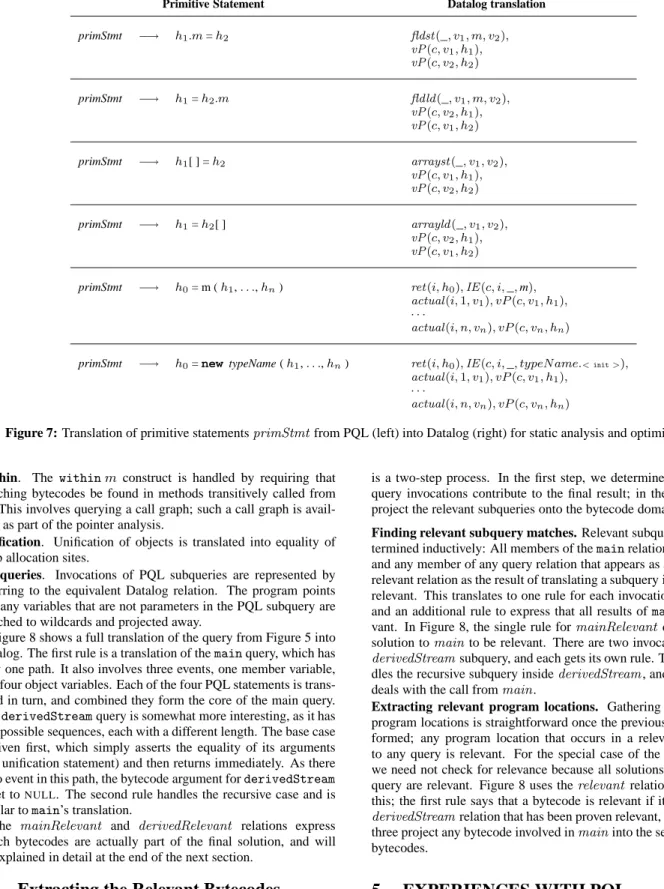
Primitive statements. Each primitive statement in the query is translated into one or more Datalog predicates. A syntax-directed translation of PQL queries into Datalog is shown in Figure 7. The left side of the table lists a PQL primitive statement and the right hand side shows its Datalog translation. All of these translations have the same basic form. The PQL statement refers to some heap objecthi. Thebddbddbsystem, however, represents instructions in terms of actual program variables. We must therefore first extract the program variables into some fresh Datalog variablevhiand then query thevPrelation to determine the possible values forhi. If a field or method name refers to a PQL member variable, it may be referenced directly in the statement.
Alternation. Since the input queries are normalized so that alter-nation statements are used only at the top level, each clause in an alternative is represented by a separate Datalog rule with the same head goal.
Sequencing. Because the static analysis is flow-insensitive, we do not track sequencing directly, and instead merely demand that all events in the sequence occur at some point. This can be done by simply replacing the sequence operator “;” with the Datalog con-junction operator “,”. Since there is no guarantee that the same program variables are used in each event in the sequence, thevx,i, andcDatalog variables must be fresh for each event. Thehxand mvariables correspond to PQL constructs and so keep the same name. Each event includes a reference to a bytecode where the event occurs, and this bytecode is bound to one of the bytecode attributes of the subquery relation. If bytecode parameters are left unbound (for example, in the base case for thederivedStream query in Figure 5, the unused bytecode parameters are set toNULL, representing no program location.
Partial order. Similarly, because the static analysis is flow-insensitive, the translation of a partial-order statement can simply treat all its clauses as part of a sequence.
Exclusion. With flow-insensitivity, no guarantees about ordering can be made. This means that we cannot deduce that an excluded event (denoted with a∼) occurs between two points in a sequence; as a result, all excluded events are ignored. This is a source of imprecision in our current analysis, but it is a conservative approx-imation that maintains soundness.
Primitive Statement Datalog translation primStmt −→ h1.m=h2 fldst(_, v1, m, v2), vP(c, v1, h1), vP(c, v2, h2) primStmt −→ h1=h2.m fldld(_, v1, m, v2), vP(c, v2, h1), vP(c, v1, h2) primStmt −→ h1[ ] =h2 arrayst(_, v1, v2), vP(c, v1, h1), vP(c, v2, h2) primStmt −→ h1=h2[ ] arrayld(_, v1, v2), vP(c, v2, h1), vP(c, v1, h2) primStmt −→ h0= m (h1,. . .,hn) ret(i, h0),IE(c, i,_,m), actual(i,1, v1), vP(c, v1, h1), · · · actual(i, n, vn), vP(c, vn, hn)
primStmt −→ h0=newtypeName (h1,. . .,hn) ret(i, h0),IE(c, i,_, typeN ame.<init>),
actual(i,1, v1), vP(c, v1, h1),
· · ·
actual(i, n, vn), vP(c, vn, hn)
Figure 7: Translation of primitive statementsprimStmtfrom PQL (left) into Datalog (right) for static analysis and optimization.
Within. The withinm construct is handled by requiring that matching bytecodes be found in methods transitively called from m. This involves querying a call graph; such a call graph is avail-able as part of the pointer analysis.
Unification. Unification of objects is translated into equality of heap allocation sites.
Subqueries. Invocations of PQL subqueries are represented by referring to the equivalent Datalog relation. The program points and any variables that are not parameters in the PQL subquery are matched to wildcards and projected away.
Figure 8 shows a full translation of the query from Figure 5 into Datalog. The first rule is a translation of themainquery, which has only one path. It also involves three events, one member variable, and four object variables. Each of the four PQL statements is trans-lated in turn, and combined they form the core of the main query. ThederivedStreamquery is somewhat more interesting, as it has two possible sequences, each with a different length. The base case is given first, which simply asserts the equality of its arguments (the unification statement) and then returns immediately. As there is no event in this path, the bytecode argument forderivedStream is set toNULL. The second rule handles the recursive case and is similar tomain’s translation.
The mainRelevant and derivedRelevant relations express which bytecodes are actually part of the final solution, and will be explained in detail at the end of the next section.
4.3
Extracting the Relevant Bytecodes
Thebddbddbsystem resolves each query more or less indepen-dently; as a result, each subquery finds program points and heap variables for any set of arguments, regardless of whether or not the subquery can be invoked with those arguments. It is thus necessary, when extracting the list of relevant bytecodes, to extract only those bytecodes that actually participate in a match of the full query. This
is a two-step process. In the first step, we determine which sub-query invocations contribute to the final result; in the second we project the relevant subqueries onto the bytecode domain. Finding relevant subquery matches. Relevant subqueries are de-termined inductively: All members of themainrelation is relevant, and any member of any query relation that appears as a clause in a relevant relation as the result of translating a subquery invocation is relevant. This translates to one rule for each invocation statement and an additional rule to express that all results ofmainare rele-vant. In Figure 8, the single rule formainRelevantdeclares any solution tomain to be relevant. There are two invocations of the
derivedStreamsubquery, and each gets its own rule. The first han-dles the recursive subquery insidederivedStream, and the second deals with the call frommain.
Extracting relevant program locations. Gathering the relevant program locations is straightforward once the previous step is per-formed; any program location that occurs in a relevant solution to any query is relevant. For the special case of the main query, we need not check for relevance because all solutions to the main query are relevant. Figure 8 uses therelevant relation to express this; the first rule says that a bytecode is relevant if it is part of a
derivedStreamrelation that has been proven relevant, and the final three project any bytecode involved inmaininto the set of relevant bytecodes.
5.
EXPERIENCES WITH PQL
Many of the error patterns found in the literature can be ex-pressed easily in PQL. We have selected four important and rep-resentative error patterns to illustrate the use of PQL.
1. Serialization errors: a data corruption bug in web servers that can be exploited to mount denial-of-service attacks.
main(b0, b1, b2, mm, hs, hv, hx, hy) : – IE(c0, b0,_,“getInputStream”), actual(b0,0, vs0), ret(b0, vx), vP(c0, vx, hx), vP(c0, vs0, hs), derivedStream(_, hx, hy,_), IE(c1, b1,,“readObject”), actual(b1,0, vy1), ret(b1, vv1), vP(c1, vv1, hv), vP(c1, vy1, hy), IE(c2, b2,_, mm), actual(b2,0, vv2), vP(c2, vv2, hv). derivedStream(b, hx, hd,_) : – hx=hd, b=NULL. derivedStream(b, hx, hd, ht) : –
IE(c, b,_,“InputStream. <init>”),
actual(b,1, vx), ret(b, vt), vP(c, vx, hx), vP(c, vt, ht), derivedStream(_, ht, hd,_). mainRelevant(mm, hs, hv, hx, hy) : – main(_,_,_, mm, hs, hv, hx, hy). derivedRelevant(ht, hd, h3) : – derivedRelevant(_, hd, ht), derivedStream(_, ht, hd, h3). derivedRelevant(hx, hy, h3) : – mainRelevant(_,_,_, hx, hy), derivedStream(_, hx, hy, h3). relevant(b) : –derivedStream(b, hx, hd, ht), derivedRelevant(hx, hd, ht). relevant(b) : –main(_,_, b,_,_,_,_,_). relevant(b) : –main(_, b,_,_,_,_,_,_). relevant(b) : –main(b,_,_,_,_,_,_,_).
Figure 8: Datalog translation of Figure 5.
These errors are instances of the simple pattern “do not store object of typeXinY” [45].
2. SQL injections: a major threat to the security of database servers, as discussed in Section 1. This is an instance of “taint” analysis where the use of data obtained in some man-ner is restricted.
3. Mismatched method pairs: some APIs require that meth-ods be invoked in a certain order. Matching pairs of methmeth-ods that follow the pattern “a call to methodAmust always be followed by a call to methodB” such as installalways followed byuninstallare common in large systems. Fail-ing to properly match method calls leads to resource leaks and data structure inconsistencies. Patterns of this kind are simple to specify, but are often difficult to check statically in large applications.
4. Lapsed listeners: a common memory leakage pattern in Java that may lead to resource exhaustion and crashes in long-running applications. Listeners follow a more complex pattern where eventA invoked on an object is required to be followed by eventB invoked on a related, but different object.
These examples considered together show the complementary na-ture of static and dynamic analysis. Static analysis can solve sim-ple problems like the serialization error query precisely, whereas dynamic analysis becomes more useful for more complex queries like matched method pairs and lapsed listeners.
5.1
Experimental Setup
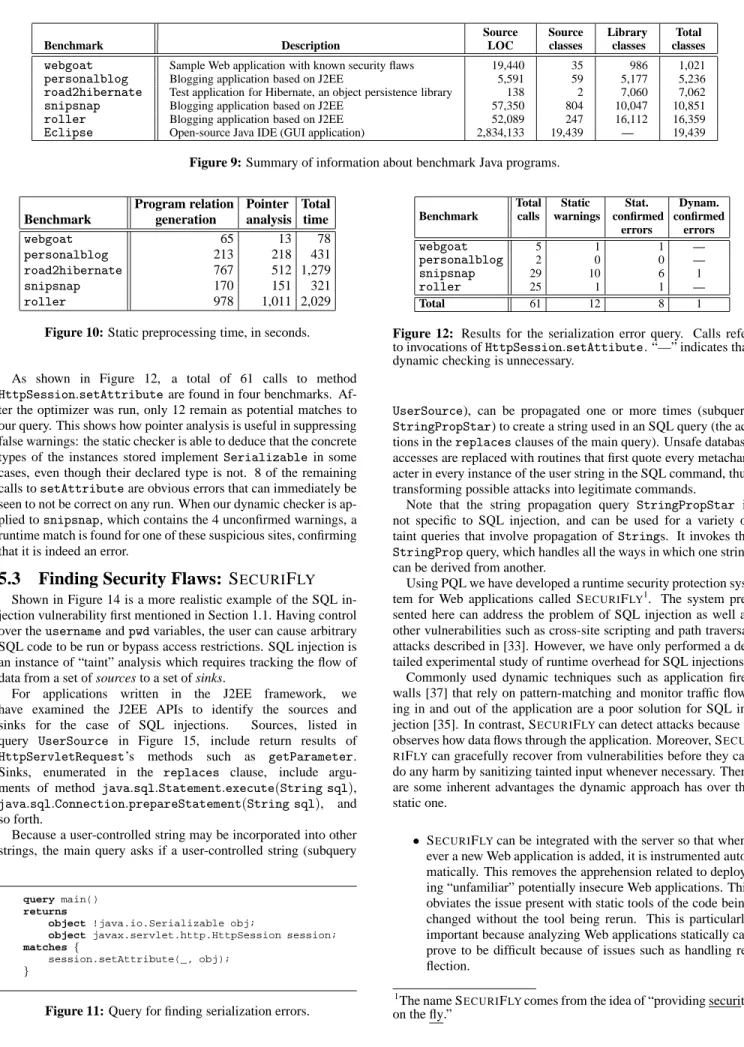
For our experiments, we use several large open-source Java applications whose characteristics are summarized in Figure 9. webgoatis a test application designed to demonstrate potential se-curity flaws in Java.road2hibernateis a test program that exer-cises the rather largehibernateobject persistence library, which is now a major component of the JBoss suite.snipsnap,roller, andpersonalblog are widely deployed weblog and wiki appli-cations. Eclipse is the current premier open-source Java IDE; all Eclipse experiments in this paper were run on version 3.0.0.
All of our static analyses were done on an AMD Opteron 150 machine with 4GB of memory running Linux. Dynamic tests were performed on a 2 GHz AMD Athlon XP with 256MB of memory running Linux. First, we apply the context-sensitive pointer an-alysis on our benchmarks. As shown in Figure 10, it takes up to 34 minutes to represent the program as BDD relations and com-pute the points-to results. Fortunately, this preprocessing step only needs to be performed once for all queries. Note that even though road2hibernate consists of only 137 lines of code, the prepro-cessing time is dominated by the analysis of large libraries it uses.
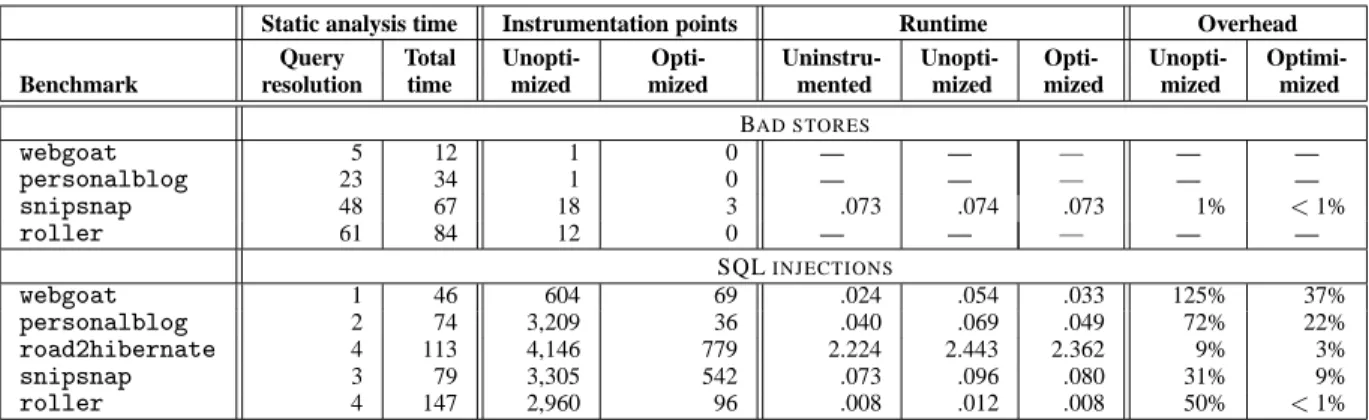
In Figure 13 we show characteristics of the checkers for the three queries in our experiment. For static analysis, we show the time taken just to resolve the Datalog query and the total time taken, which is often considerably higher, as it includes loading and sav-ing of large relations. Dynamic analysis is run only if warnsav-ings from the static analysis are not immediately obvious as errors. The times for the Web applications reflect the average amount of time required to serve a single page, as measured by the standard pro-filing tool JMeter. road2hibernateis a command-line program and its time is a simple start-to-finish timing.
Our performance numbers indicate that our approach on real ap-plications is quite efficient. Unoptimized dynamic overhead is gen-erally noticeable, but not crippling; after optimization it often be-comes no longer measurable, though may still be as high as 37% in heavily instrumented code. Likewise, our static analysis times are in line with expectations for a context-sensitive pointer analysis run over tens of thousands of classes.
5.2
Serialization Errors
In a three-year study of production software, Reimer et al. found that a large class of high-impact coding errors violate design rules of the form “only store objects of type X in objects of type Y” [45]. Such rules can be easily expressed in PQL. The serial-ization error we study is an instance of such a pattern. Specifically, HttpSession, a runtime representation of a Web session, is sup-posed to be a persistent object to allow the Web server to save and restore sessions when the load is too high. As a consequence, only objects implementing the interface Serializablecan be stored within anHttpSession, via thesetAttributemethod. The PQL query corresponding to this design rule is shown in Figure 11.
Violations of this rule will cause the persistence operation to fail, either with exceptions or via data corruption. The former may be exploited by a malicious user to mount a denial-of-service attack; the latter may cause intermittent problems that are hard to test be-cause session objects are written out only under high load. One such problem in enterprise Java code reportedly took a team of en-gineers close to two weeks to detect [45].
Source Source Library Total
Benchmark Description LOC classes classes classes
webgoat Sample Web application with known security flaws 19,440 35 986 1,021
personalblog Blogging application based on J2EE 5,591 59 5,177 5,236
road2hibernate Test application for Hibernate, an object persistence library 138 2 7,060 7,062
snipsnap Blogging application based on J2EE 57,350 804 10,047 10,851
roller Blogging application based on J2EE 52,089 247 16,112 16,359
Eclipse Open-source Java IDE (GUI application) 2,834,133 19,439 — 19,439
Figure 9: Summary of information about benchmark Java programs.
Program relation Pointer Total Benchmark generation analysis time
webgoat 65 13 78
personalblog 213 218 431
road2hibernate 767 512 1,279
snipsnap 170 151 321
roller 978 1,011 2,029
Figure 10: Static preprocessing time, in seconds.
As shown in Figure 12, a total of 61 calls to method HttpSession.setAttributeare found in four benchmarks. Af-ter the optimizer was run, only 12 remain as potential matches to our query. This shows how pointer analysis is useful in suppressing false warnings: the static checker is able to deduce that the concrete types of the instances stored implementSerializable in some cases, even though their declared type is not. 8 of the remaining calls tosetAttributeare obvious errors that can immediately be seen to not be correct on any run. When our dynamic checker is ap-plied tosnipsnap, which contains the 4 unconfirmed warnings, a runtime match is found for one of these suspicious sites, confirming that it is indeed an error.
5.3
Finding Security Flaws: S
ECURIF
LY Shown in Figure 14 is a more realistic example of the SQL in-jection vulnerability first mentioned in Section 1.1. Having control over theusernameandpwdvariables, the user can cause arbitrary SQL code to be run or bypass access restrictions. SQL injection is an instance of “taint” analysis which requires tracking the flow of data from a set of sources to a set of sinks.For applications written in the J2EE framework, we have examined the J2EE APIs to identify the sources and sinks for the case of SQL injections. Sources, listed in query UserSource in Figure 15, include return results of HttpServletRequest’s methods such as getParameter. Sinks, enumerated in the replaces clause, include argu-ments of method java.sql.Statement.execute(String sql), java.sql.Connection.prepareStatement(String sql), and so forth.
Because a user-controlled string may be incorporated into other strings, the main query asks if a user-controlled string (subquery
query main() returns
object !java.io.Serializable obj;
object javax.servlet.http.HttpSession session; matches {
session.setAttribute(_, obj); }
Figure 11: Query for finding serialization errors.
Total Static Stat. Dynam. Benchmark calls warnings confirmed confirmed
errors errors webgoat 5 1 1 — personalblog 2 0 0 — snipsnap 29 10 6 1 roller 25 1 1 — Total 61 12 8 1
Figure 12: Results for the serialization error query. Calls refer to invocations ofHttpSession.setAttibute. “—” indicates that dynamic checking is unnecessary.
UserSource), can be propagated one or more times (subquery StringPropStar) to create a string used in an SQL query (the ac-tions in thereplacesclauses of the main query). Unsafe database accesses are replaced with routines that first quote every metachar-acter in every instance of the user string in the SQL command, thus transforming possible attacks into legitimate commands.
Note that the string propagation query StringPropStar is not specific to SQL injection, and can be used for a variety of taint queries that involve propagation ofStrings. It invokes the StringPropquery, which handles all the ways in which one string can be derived from another.
Using PQL we have developed a runtime security protection sys-tem for Web applications called SECURIFLY1. The system pre-sented here can address the problem of SQL injection as well as other vulnerabilities such as cross-site scripting and path traversal attacks described in [33]. However, we have only performed a de-tailed experimental study of runtime overhead for SQL injections.
Commonly used dynamic techniques such as application fire-walls [37] that rely on pattern-matching and monitor traffic flow-ing in and out of the application are a poor solution for SQL in-jection [35]. In contrast, SECURIFLYcan detect attacks because it observes how data flows through the application. Moreover, SECU-RIFLYcan gracefully recover from vulnerabilities before they can do any harm by sanitizing tainted input whenever necessary. There are some inherent advantages the dynamic approach has over the static one.
• SECURIFLYcan be integrated with the server so that when-ever a new Web application is added, it is instrumented auto-matically. This removes the apprehension related to deploy-ing “unfamiliar” potentially insecure Web applications. This obviates the issue present with static tools of the code being changed without the tool being rerun. This is particularly important because analyzing Web applications statically can prove to be difficult because of issues such as handling re-flection.
1The name SECURIFLYcomes from the idea of “providing security
Static analysis time Instrumentation points Runtime Overhead Query Total Unopti- Opti- Uninstru- Unopti- Opti- Unopti- Optimi-Benchmark resolution time mized mized mented mized mized mized mized
BAD STORES webgoat 5 12 1 0 — — — — — personalblog 23 34 1 0 — — — — — snipsnap 48 67 18 3 .073 .074 .073 1% <1% roller 61 84 12 0 — — — — — SQLINJECTIONS webgoat 1 46 604 69 .024 .054 .033 125% 37% personalblog 2 74 3,209 36 .040 .069 .049 72% 22% road2hibernate 4 113 4,146 779 2.224 2.443 2.362 9% 3% snipsnap 3 79 3,305 542 .073 .096 .080 31% 9% roller 4 147 2,960 96 .008 .012 .008 50% <1%
Figure 13: Summary of static analysis times, runtimes, dynamic overhead, and the number of instrumentation points with and without optimizations. “—” is used to indicate that no dynamic run was necessary because a static solution was sufficient. All times are in seconds.
• SECURIFLYdoes not require changes to the original pro-gram and does not need access to anything other than the final bytecode. This can be especially advantageous when dealing with applications that rely on libraries whose source is unavailable.
The dynamic checker for the SQL injection query will match whenever a user controlled string flows in some way to a suspected sink, regardless of whether a user input is harmful in a particular execution. It will then react to replace the potentially dangerous string with a safe one.
The errors located with our tool involved the applications build-ing SQL strbuild-ings out of data either sent in from the command line or generated as parameters of an HTTP request. The former can be exploited if the program can be executed by the malicious user. The latter are vulnerable to the more common crafted-HTTP-request at-tacks.
5.3.1
Importance of Static Optimization
Without static optimization, many program locations need to be instrumented. This is because routines that cause oneStringto be derived from another are very common. Heavily processed user inputs that do not ever reach the database will also be carefully tracked at runtime, introducing significant overhead to the analysis. Fortunately, the static optimizer effectively removes instrumen-tation on calls to string processing routines that are not on a path from user input to database access. Exploiting pointer information dramatically reduces both the number of instrumentation points and the overhead of the system, as shown in Figure 13. The reduction in the number of instrumentation points due to static optimization can be as high as 97% inrollerand 99% inpersonalblog. As shown in Figure 13, reduction in the number of instrumentation points results in a smaller overhead. For instance, inwebgoat, the overhead is cut almost in half in the optimized version.
public void authenticate(HttpServletRequest request){ String username = request.getParameter("user"); java.sql.Statement stmt = con.createStatement(); String query =
"select * from users where username = ’" + username + "’and password = ’" + pwd + "’"; stmt.execute(query);
... // process the result of SELECT }
Figure 14: A classic example of SQL injection.
Note that the query does no direct checking of the value that has been provided by the user, so if harmless data is passed along a feasible injection vector, it will still trigger a match to the query. As a result of this, drastic responses such as aborting the application are not suitable outside of a debugging context.
5.3.2
Applying Input SanitizationAs seen in Figure 15, each operation that can unsafely use tainted data receives areplacesclauses in the querymain. When a pos-sibly relevant sink is reached, any matches that have completed and which are consistent with the instruction are gathered, and if such matches are present, the replacing method is executed instead.
TheSafePrepareandSafeExecutemethods themselves find all substrings in thesinkvariable that match any of the possible values forsource. They then produce a new SQL Query string identical to the old, but it quotes all the SQL metacharacters such as “0”. This forces them to be treated as literal characters instead of, for instance, a string terminator. This new, safe query is then passed toprepareStatementorexecuteQuery, respectively.
Using this technique we were able to defend against the two SQL injections for which we had derived effective attacks: the two in webgoatandroad2hibernate.
5.4
Matching Method Pairs in Eclipse
Many APIs have methods that must be invoked in pairs in order for to remain internally consistent or to prevent resource leaks. This implies a set of rules that take the form “a call toAmust always be followed by a call toB.” Developers are required to ensure that calls toAare followed by calls toBon all execution paths—a highly error-prone task, especially in the presence of exceptions. The problem is complicated further when calls toAandBoccur in different classes, or when a subclass overrides the method that calls Bbut not the one that callsA. As a result, not only is the process error-prone, it is difficult to debug with traditional techniques.
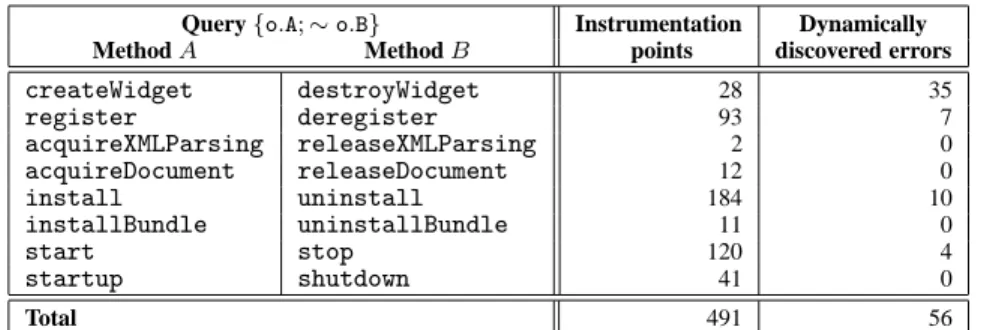
Eclipse, a large open-source Java IDE, uses a windowing toolkit called SWT [41], which has many examples of such method pairs. Programming guides and bug reports directed us to eight examples of paired initialize/uninitialize methods that were often violated. For example, calls tocreateWidgetmust always be followed to a call todestroyWidget on the same object. We instrumented Eclipse to search for instances of the first with no corresponding call to the second. This is done with a query body of the form
{o.A();∼o.B();}
As these are liveness queries that rely critically on excluding the second event, and our static analysis is flow-insensitive, we cannot
query main() returns
object Object source, sink; uses
object java.sql.Connection con; object java.sql.Statement stmt; matches {
source := UserSource();
sink := StringPropStar(source); } replaces con.prepareStatement(sink)
with SQL.SafePrepare(con, source, sink); replaces stmt.executeQuery(sink)
with SQL.SafeExecute(stmt, source, sink);
query StringProp(object Object x) returns object Object y; matches y.append(x) | y = new String(x) | y = new StringBuffer(x) | y = x.toString() | ...
query StringPropStar(object Object x) returns
object Object y; uses
object Object temp; matches y := x | { temp := StringProp(x); y := StringPropStar(temp); } query UserSource() returns
object Object tainted; uses
object ServletRequest req; matches
tainted = req.getParameter() | | tainted = req.getHeader() | ...
Figure 15: Full SQL injection query.
optimize the dynamic matcher. However, even without optimiza-tion, there are still relatively few instrumentation points because the interesting events are confined to the creation and destruction of GUI elements. Our approach is powerful because this one-line query can pick the handful of points out of nearly 64 MB of class-files that actually need to be instrumented for the query directly.
The results of running the instrumented IDE for each