Measures of Learning Effectiveness
In the SUNY Learning Network
Peter Shea Eric Fredericksen Alexandra Pickett William Pelz Karen Swan The State University of New YorkABSTRACT
This paper provides an overview of the SUNY Learning Network (SLN) and reports on research conducted to determine whether and how students are learning within this asynchronous learning environment. The three studies reported here indicate that, for the several thousand students who responded to their respective surveys, SLN was both highly satisfactory and an environment conducive to high levels of learning. These reports point to the centrality of the sense of community created and supported by faculty-to-student and faculty-to-student-to-faculty-to-student interaction in asynchronous learning networks. KEYWORDS
ALN, Online Learning, Higher Education, Evaluation
I. OVERVIEW
The SUNY Learning Network (SLN) is the on-line instructional program created for the sixty-four colleges and nearly 400,000 students of the State University of New York. The primary goals of the SUNY Learning Network are to bring SUNY's diverse and high-quality instructional programs within the reach of learners everywhere and to be the best provider of asynchronous instruction for learners in New York State and beyond.
We believe that the goals of SLN cannot be achieved unless learning effectiveness is given top priority. This paper will examine factors that have contributed to the high levels of learning and learner satisfaction that students have reported in the SUNY Learning Network. The analysis will be done on several levels.
The first section will look at the SLN at a program-wide level and will provide information regarding the systemic implementation of our asynchronous learning environment.
The second section presents results from SLN Student Satisfaction Surveys conducted in the spring of 2000. In that semester 1974 respondents completed the survey. This section reports the results of the survey and examines factors that significantly correlate with perceived learning and student satisfaction in on-line
asynchronous courses. This part of the paper also provides comparison of these most recent results with results from three previous semesters of student surveys. In all, this represents data from more than 5000 respondents. Results from these surveys have consistently highlighted the importance of interaction and the sense of online community that such interaction creates for student satisfaction and learning.
The third section presents a study conducted at the University at Albany that documents the efficacy of pedagogical approaches that foster such online community. This section looks at factors affecting the success of asynchronous online learning through an investigation of relationships between student perceptions and course design factors in the SUNY Learning Network.
The fourth section presents results from a study conducted at the Internet Academy at Herkimer County Community College, a major participant in the SUNY Learning Network. This report contains student satisfaction and perceived learning data, as well as an ongoing analysis two areas of concern to many critics of online learning - course completion rates and comparative achievement in the classroom and online.
II. SECTION I
A.
Introduction
With generous support from the Alfred P. Sloan Foundation combined with enthusiasm and resources from SUNY System Administration and participating campuses, the SLN has successfully met the challenges of the initial developmental phases that focused on “proof of concept” and “expansion/scalability”. The annual growth in courses, from eight in 1995-1996 to over 1500 in 2000-2001, and annual growth in enrollment, from 119 in 1995-1996 to over 20,000 in 2000-2001, illustrates that the project has far exceeded the original projections.
The SUNY Learning Network started as a regional project in the Mid-Hudson Valley involving eight SUNY campuses. At that time the development and delivery of asynchronous courses was a new activity for SUNY campuses and faculty.
Successful experiences led to an expanded vision and goals for the SLN and the scope and objectives of the project have grown substantially. Where we originally developed courses at the 3rd and 4th year level - which were offered by two of our institutions, we are now offering courses at all undergraduate levels as well as the graduate level and forty-two of our institutions are involved. Our initial developmental phase focused on "proof of concept" within the SUNY System. This was followed by a phase that focused on "proof of scalability" which achieved significant growth in course offerings and student enrollments. SUNY’s efforts continue to evolve the SLN from a “project status” to a fully integrated virtual learning component responsive to the needs of learners in the new millennium. Ultimately, the SUNY Learning Network will represent the entire State University of New York through the creation of one virtual campus that will be open 7 days a week, 24 hours a day to students across the globe.
The SUNY Learning Network’s primary mission is to bring SUNY’s high quality instructional programs within reach of learners anywhere. Another objective of SLN has been to take an efficient approach in supporting the SUNY campuses. Rather than each campus reinventing the wheel, SLN has developed and implemented the appropriate operational services and support yielding both cost savings as well as the sharing of experience from one campus to another.
B.
Background
Prior to the SLN program, many SUNY campuses were starting to experiment with asynchronous components to compliment their classroom-based courses. In addition, some SUNY campuses were taking regional approaches to utilizing synchronous two-way videoconference and some satellite broadcast forms
of distance learning courses. SLN has been unique in SUNY in that it has been a unifying effort for all SUNY campuses to participate in the same single-system program for ALN.
SLN is not a replacement for the classroom – it is another choice for students and is therefore open to all students. Students that participate in SLN range in age from 16 to over 70. They are both traditional students as well as returning adults. Most students have not taken an on-line course before and report that they have average or high computer skills. Students tend to share a common concern – they frequently report that they would not be able to complete their studies without the flexibility afforded by the SUNY Learning Network. Completion rates vary by course and faculty member, just like they do in classroom-based courses. The enrollments in the SLN continue to grow dramatically and we anticipate doubling every year for the next three years.
The technical infrastructure for SLN has evolved over the past five years. When SLN started there were no course management systems so we developed our own utilizing the industry standard for collaborative computing, Lotus Notes. Since we have started we have enjoyed the advances of Lotus Domino and the ability to operate on multiple Intel based Windows NT servers at the same time – a tremendous advantage over other commercial packages. When a server goes down, all of the courses are on all of the other servers so students and faculty can continue in this teaching and learning experience. This infrastructure was developed, implemented, and operated by SLN for the first four years of the program. During the past year another system wide support center has begun to provide server management support while SLN maintains application and program management. SLN has built common applications and processes so that there is consistency for students from the different campuses. For example, students can use a single username and password to gain access to all of the courses they are taking and all course share a common user interface.
The delivery of SLN Courses is through a web browser so students enjoy text, graphics, and other media depending on the course. SLN has tried to keep in mind the balance required by slower Internet access capabilities that our students may have in their home. It is also important to note that our on-line courses do not require that every learning activity is web based. Faculty may utilize other software applications, simulations, videotapes, other non-computer-based media, and other non-technology based activities. An example of such "offline" activities might be a student observing a local kindergarten classroom for a Child Psychology and Development course.
Students participate as a cohort and start and end the course according to the calendar of the campus offering the course. Participation is asynchronous throughout the course but it is not self-paced. Most courses have very strong discussion components and faculty have placed a great deal of value in this area. Faculties have been very creative in developing and adjusting their approaches to student assessment. Many instructors have implemented on-line test and quizzes but often this has been used for student self-assessment. There have not been any mandatory synchronous requirements in the courses. A few faculty have had some optional real time activities and certainly an on campus student that wants to visit a professor during office hours would not be turned away.
In SLN, the faculty member is ultimately responsible for course development. Our initial experiences have led us to believe that the person teaching the course should also develop the course so that they have a complete understanding of the course and how it functions. SLN, and now a number of campuses, provide instructional design support for the faculty member. This assistance is part of a well-organized and structured faculty development process. There are face-to-face, hands-on training workshops, remote support, and technical support seven days a week through the SLN Help Desk, as well as print and web-based resources.
In our administration of the SUNY Learning Network we have recognized the importance of interaction with our constituents. Whether they are the faculty, faculty developers, instructional designers or students accessing our helpdesk we realize that education in this form is still about people and relationships. A theme that is central to this paper is the importance of interaction and the relationships that online
interaction makes possible. Throughout the creation and ongoing administration of SLN we have always endeavored to treat each of our constituents as an individual and by this example and through our faculty development processes we have stressed to faculty the importance of “high touch” in the daily implementation of this high tech environment. The following sections will present evidence that supports this position. Ultimately it is our hope that that thisevidence will further understanding of the dynamics of learning in an ALN and make plain the critical role that faculty must play in fostering interaction with and between students. In the final analysis it is the faculty and students and the learning engendered by their interaction that makes an ALN successful.
III.
SECTION II
This section provides results of the Spring 2000 SLN Student Satisfaction Survey and longitudinal data from three previous semesters of similar surveys highlighting the centrality of faculty-student interaction and a social view of teaching and learning in an Asynchronous Learning Network (ALN).
A. Review of Literature
Frequent reports in the popular media decry the lack of hard data on questions surrounding student attitudes about Internet based distance learning. This study was designed to provide such data, to determine how students who studied online felt about their courses and to discover whether the most satisfied students shared any characteristics. These are not new questions and a large body of literature points to similar answers. Most of these studies conclude that, regardless of the technology used, distance learning courses compare favorably with classroom-based instruction and enjoy high student satisfaction. (Phipps, Merisotis, and O’Brien, 1999). It has been reported however that research in the area of distance learning suffers from several weaknesses. Phipps, Merisotis, and O'Brien (1999) summarize these:
"…the methodology of many of the research designs is weak, with regard to such factors as the populations being compared or otherwise studied; the treatments being given, the statistical techniques being applied, and the validity, reliability, and generalizability of the data on which the conclusions are based." (Phipps, Merisotis, and O'Brien, 1999; p. 28)
Other areas of weakness identified by the authors are
"A. The research has tended to emphasize student outcomes for individual courses rather than for a total academic program. B. The research does not take into account differences among students. C. The research does not adequately explain why the drop-out rates of distance learners are higher. D. The research does not take into consideration how the different learning styles of students relate to the use of particular technologies. E. The research focuses mostly on the impact of individual technologies rather than on the interaction of multiple technologies. F. The research does not include a theoretical or conceptual framework." (Phipps, Merisotis, and O'Brien, 1999; p. 11)
The authors conclude that although a great deal of research supports the notion that distance learning compares favorably to classroom based learning, the research is so weak that no clear conclusions can be made. While these criticisms cannot all be addressed by a single work, this study will attempt to account for as many of these weaknesses as possible. To address Phipps' et.al. first concern (A) this study emphasized student attitudes not for individual courses but for the entire program represented by the SUNY Learning Network. In all the data used in this and previous SLN studies represents more than 500 instructors and courses and over 5000 students. As such the data in this study represents a very large sample without the weaknesses identified by analyses of individual courses. With a sample of this size it can reasonably be expected that a wide variety of students and learning styles will be represented. Further,
this study will look specifically at student differences such as age, gender, academic level etc. in an attempt to sort out how such differences affect student satisfaction and learning thus accounting for student differences in (B) and (D). Inasmuch as these courses utilized a wide variety of technologies (computers, audio, video, the Internet) it does not focus on a single technology as in (E). This study will also present a conceptual framework for understanding student satisfaction with online learning, accounting for (F). Unfortunately dropout rates (C) are not addressed by this study.
B. Conceptual Framework
“Learning, both outside and inside school, advances through collaborative social interaction and the social construction of knowledge” (Brown, Collins & Duguid , 1989).
Learning has been defined most adequately as a social process (Vygotsky, 1962, 1978; Bruner, 1990; Brown, Collins & Duguid , 1989; Lave, 1988, 1990) and any learning environment that is meant to foster understanding must account for the social nature of the endeavor. If an overarching framework for understanding student's feelings about working in the relative isolation of a virtual classroom is to make sense, this framework must account for mechanisms that overcome such isolation. Students learning in a virtual environment can be expected to require several support mechanisms in order to feel satisfied and to learn. These include the support of the faculty, classmates, the administration of the environment, as well as the technology, and content. If faculty are trained to recognize the affordances and constraints of virtual learning environments, if students and instructors are offered a variety of support mechanisms for overcoming social isolation, if courses and course content are designed with an understanding of the requirements of learning at a distance, then it can be predicted that student satisfaction and learning will be relatively high. In the absence of these prerequisites students can be expected to experience confusion, frustration and isolation. For a detailed description of the planning and execution of the overall program of the SUNY Learning Network, which describes the strategies employed to ensure that these prerequisites were met, see Pickett, 1999. When learning is viewed primarily as a social process a number of predictions can be made about student affect in virtual learning domains. An obvious hypothesis is that interaction between student and teacher and student and student will be of great importance. From this conceptual perspective one would hypothesize significant relationships between students satisfaction with levels of interaction with the instructor and fellow students and their overall satisfaction with the learning experience. It can be predicted that not only the quantity of interaction with the instructor but also the quality of this interaction will be significantly correlated with reported learning. The same can be predicted for the quality of interaction between classmates and their reported level of participation in the course inasmuch as interaction is predicated upon participation. With an emphasis on the social nature of learning it can also be predicted that prompt feedback, quality of feedback, and the communication of clear expectations will be significantly correlated with high levels of reported learning. Finally low levels of technical difficulties and satisfaction with the helpdesk should also be correlated with reported learning and satisfaction, in as much as resources such as the helpdesk help break down technical barriers to collaborative social interaction. These predictions, stemming from a conceptual framework in which online learning is viewed primarily as a social process, were tested in this study.
C.
Method
In the spring of 2000 students enrolled in courses in the SUNY Learning Network completed a survey that asked them to comment about their satisfaction with and learning in this on-line learning environment. The survey consisted of twenty-five multiple-choice questions that utilized a Likert-type scale to assess degrees of satisfaction and learning. For this semester 1974 students answered the survey representing a return rate of approximately 31%. Demographic data were collected on variables such as student age, gender, academic level, distance from campus, and previous computer skills. These demographics were analyzed against items that assessed student attitudes about topics such as level of interaction with the instructor and classmates, level of learning compared to the traditional classroom, overall satisfaction with their specific course and with on-line learning in general. The data was analyzed for significant differences using univariate analysis of variance and bivariate correlation.
D. Results
1. Course Satisfaction
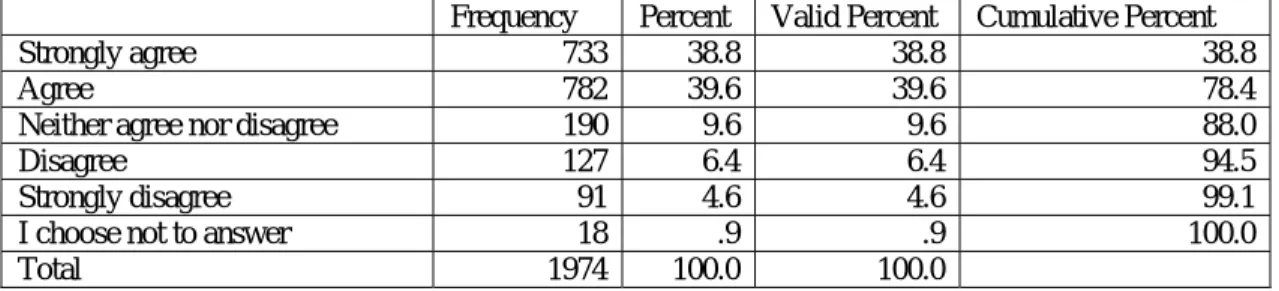
The results of the spring 2000 survey were quite positive overall. When asked to rank their response to the statement "Overall I was very satisfied with this online course", thirty-nine percent (39%) "agreed strongly". Another forty percent (40%) of students "agreed" with the statement. Approximately ten percent (10%) "neither agreed nor disagreed". Six percent (6%) disagreed and another five percent (5%) "disagreed strongly". Thus in the most recent semester for which data is available (spring 2000), overall, seventy nine percent (79%) of students were very satisfied with their online course regardless of their background while only eleven percent (11%) expressed any level of dissatisfaction.
Table 1: Responses to the statement "Overall I was very satisfied with my online course."
Frequency Percent Valid Percent Cumulative Percent
Strongly agree 733 38.8 38.8 38.8
Agree 782 39.6 39.6 78.4
Neither agree nor disagree 190 9.6 9.6 88.0
Disagree 127 6.4 6.4 94.5
Strongly disagree 91 4.6 4.6 99.1
I choose not to answer 18 .9 .9 100.0
Total 1974 100.0 100.0
2. Reported Learning
When asked to rank their response to the statement, "Overall I learned a great deal in this online" thirty nine percent (39%) "agreed strongly". Another thirty nine percent (39%) "agreed". Six percent "disagreed" and five percent "disagreed strongly". Thus, overall seventy-eight percent (78%) of respondents felt that their level of learning was very high in the online environment, regardless of student background while only eleven percent (11%) of students felt that they did not learn a great deal.
Table 2: Responses to the statement "Overall I learned a great deal in my online course."
Frequency Percent Valid Percent Cumulative Percent
Strongly agree 755 38.2 38.2 38.2
Agree 809 41.0 41.0 79.2
Neither agree nor disagree 229 11.6 11.6 90.8
Disagree 108 5.5 5.5 96.3
Strongly disagree 53 2.7 2.7 99.0
I choose not to answer 20 1.0 1.0 100.0
Total 1974 100.0 100.0
In the most recent semester for which data are available 78.3% of students felt they learned as much or more online than in the classroom. Considerably more students reported that they learned more online (34.1%) than in the classroom (19.4%) though the most saw no difference (44.1%).
Table 3: Reported Learning Compared to the Classroom
Frequency Percent Valid Percent Cumulative Percent Much more than in the
classroom
222 11.2 11.2 11.2
More than in the classroom 452 22.9 22.9 34.1 The same as in the classroom 871 44.1 44.1 78.3 Less than in the classroom 280 14.2 14.2 92.5 Much less than in the classroom 103 5.2 5.2 97.7 I choose not to answer 46 2.3 2.3 100.0
Total 1974 100.0 100.0
3. Participation
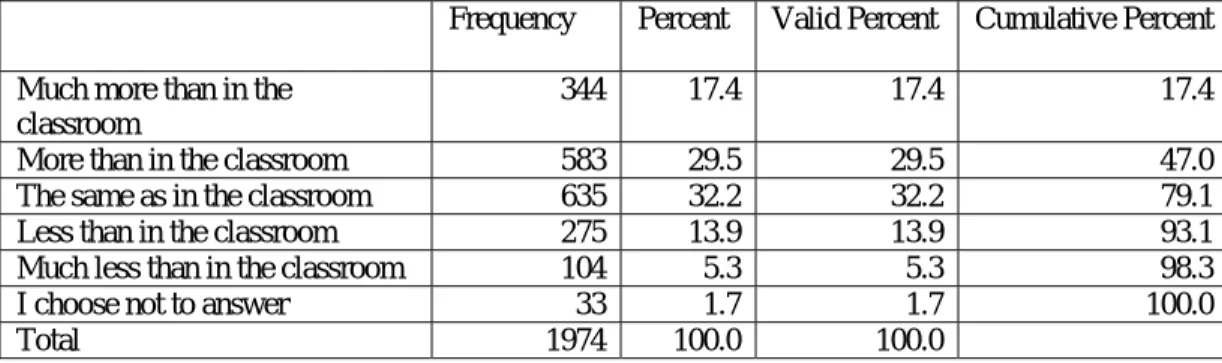
Similar results were found for participation. In the most recent semester for which data are available 79.1% of students felt they participated as much or more online than in the classroom. More than twice as many students reported that they participated more online (47%) than in the classroom (19.2%) though the many saw no difference (44.1%).
Table 4: Participation Compared to the Classroom
Frequency Percent Valid Percent Cumulative Percent Much more than in the
classroom
344 17.4 17.4 17.4
More than in the classroom 583 29.5 29.5 47.0 The same as in the classroom 635 32.2 32.2 79.1 Less than in the classroom 275 13.9 13.9 93.1 Much less than in the classroom 104 5.3 5.3 98.3 I choose not to answer 33 1.7 1.7 100.0
Total 1974 100.0 100.0
Response to the question, "Compared to your classroom experiences, how would you rate your level of participation in this online course?"
Longitudinal Data for Reported Learning:
For the last four semesters reported learning results have been remarkably consistent.
Table 5 - Reported Level of Learning in SLN 1998-2000
0 10 20 30 40 50 60 70 80 90 100
Fall 98 Spring 99 Fall 99 Spring 00
"Sufficient or High" None
Low
In each of the last four semesters approximately 90% of respondents reported at least satisfactory levels of learning in this environment.
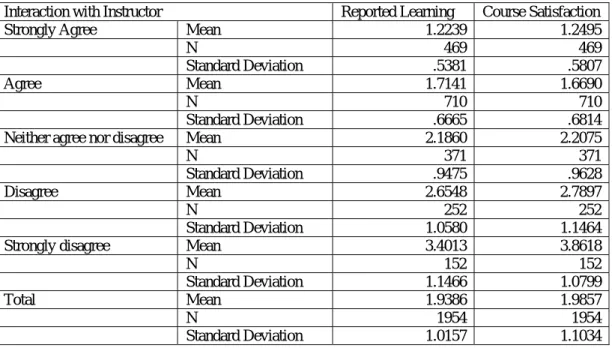
For the spring 2000 survey certain variables were significantly related to satisfaction and reported learning. When asked to rank their response to the statement "Overall, I had a great deal of interaction with my instructor" the following results were found. Twenty-four percent (24%) of the students "agreed strongly". Another thirty six percent (36%) "agreed". Nineteen percent (19%) "neither agreed nor disagreed". Thirteen percent (13%) "disagreed" and eight percent (8%) "disagreed strongly". Thus a total of sixty percent (60%) of the respondents felt that their level of interaction with the instructor was very high in the online environment. When the students level of satisfaction and learning are compared to their level of interaction with the instructor we find, as predicted, a significant relationship between these variables. Students who reported the highest levels of interaction with the instructor also reported the highest levels of satisfaction and learning.
Table 6: Course Satisfaction and Level of Learning by Level of Interaction with the Instructor
Interaction with Instructor Reported Learning Course Satisfaction
Strongly Agree Mean 1.2239 1.2495
N 469 469
Standard Deviation .5381 .5807
Agree Mean 1.7141 1.6690
N 710 710
Standard Deviation .6665 .6814
Neither agree nor disagree Mean 2.1860 2.2075
N 371 371
Standard Deviation .9475 .9628
Disagree Mean 2.6548 2.7897
N 252 252
Standard Deviation 1.0580 1.1464
Strongly disagree Mean 3.4013 3.8618
N 152 152
Standard Deviation 1.1466 1.0799
Total Mean 1.9386 1.9857
N 1954 1954
Standard Deviation 1.0157 1.1034
Note: All responses are based on a Likert scale from 1-5. A score of 1 is a high rating; a score of 5 is a low rating.
As demonstrated in Table 6, each increase in students' level of interaction with the instructor is related to an increase in both satisfaction with the course and the student's reported level of learning. These increases are significant at the .000 level as demonstrated in Table 7 below:
Table 7: Analysis of Variance for Course Satisfaction and Level of Learning by Level of Interaction with the Instructor
Sum of Squares df Mean Square F Sig. Reported Learning *Interaction with Instructor Between Groups (Combined) 752.528 4 188.132 290.522 .000 Within Groups 1262.103 1949 .648 Total 2014.631 1953 Course Satisfaction * Interaction with Instructor Between Groups (Combined) 1041.597 4 260.399 379.879 .000 Within Groups 1336.001 1949 .685 Total 2377.599 1953
4. Relationship of satisfaction and learning with other
variables
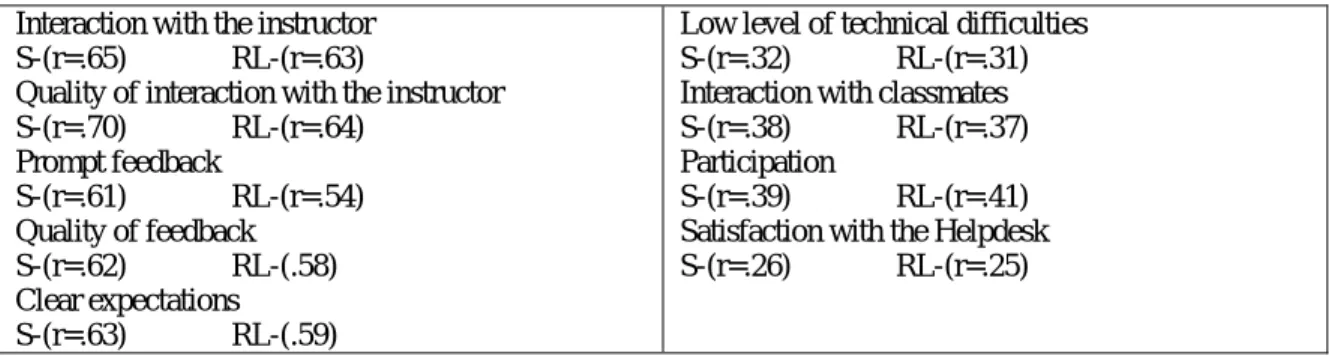
As mentioned, a focus on the social nature of learning allows one to make specific predictions about correlations between reported learning and student and instructor variables. When course instructors provided prompt feedback and high quality feedback significant correlations were found with high satisfaction and high levels of reported learning. The same can be said of faculty who provided clear expectations of how to proceed in the course successfully. When students perceived clear expectations significant correlations were found with high levels of satisfaction and learning. When students reported high levels of interaction with classmate and high levels of participation in the courses, significant correlations were found with high levels of reported satisfaction and learning. (See Table 8 for r-values and significance levels.) Other significant relationships that support the view that design and administration of online instruction should focus on the social aspects of learning include significant relationships between satisfaction with assistance provided by the Help Desk and high reports of student learning and satisfaction. Students who reported the highest levels of satisfaction with the Help Desk also reported the highest levels of learning and satisfaction. Similar relationships were found for students' feelings about technical difficulties. Those that felt that technical difficulties caused problems in the environment were also the most likely to report the lowest levels of learning and satisfaction.
Table 8 - Significant correlations with student satisfaction and reported learning
Interaction with the instructor S-(r=.65) RL-(r=.63)
Quality of interaction with the instructor S-(r=.70) RL-(r=.64) Prompt feedback S-(r=.61) RL-(r=.54) Quality of feedback S-(r=.62) RL-(.58) Clear expectations S-(r=.63) RL-(.59)
Low level of technical difficulties S-(r=.32) RL-(r=.31) Interaction with classmates
S-(r=.38) RL-(r=.37) Participation
S-(r=.39) RL-(r=.41) Satisfaction with the Helpdesk S-(r=.26) RL-(r=.25)
(All correlation were significant at the .01 level) S = Satisfaction
RL = Reported Learning
One of the variables that does not appear to inhibit online learning is students' computers skill prior to taking the course. Students who reported low levels of computer skills before taking the course were no less likely to report high levels of learning and satisfaction in the course. In fact the opposite appears true.
Table 9: Reported Learning by Prior Computer Skill Level
Computer Skill Level Mean N Standard Deviation
High 1.9780 998 1.0987
Average 1.9488 762 .9720
Low 1.8023 177 .8260
Zero 1.5769 26 .7027
I choose not to answer 5.2727 11 1.6181
Note: All responses are based on a Likert scale from 1-5. A score of 1 is a high rating, a score of 5 is a low rating.
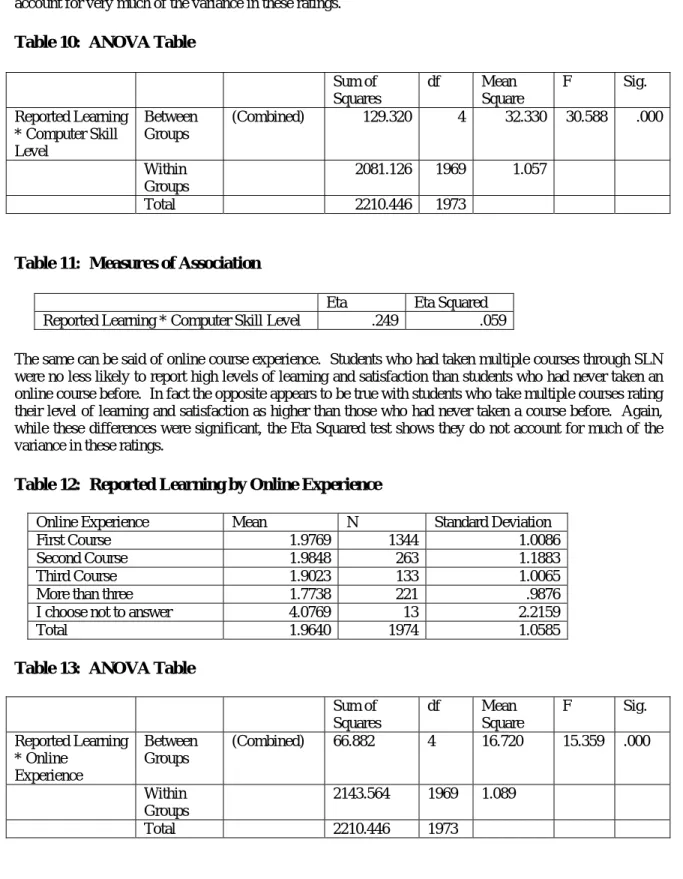
While these differences are significant, the strength of association, Eta Squared test, shows that they do not account for very much of the variance in these ratings.
Table 10: ANOVA Table
Sum of Squares df Mean Square F Sig. Reported Learning * Computer Skill Level Between Groups (Combined) 129.320 4 32.330 30.588 .000 Within Groups 2081.126 1969 1.057 Total 2210.446 1973
Table 11: Measures of Association
Eta Eta Squared
Reported Learning * Computer Skill Level .249 .059
The same can be said of online course experience. Students who had taken multiple courses through SLN were no less likely to report high levels of learning and satisfaction than students who had never taken an online course before. In fact the opposite appears to be true with students who take multiple courses rating their level of learning and satisfaction as higher than those who had never taken a course before. Again, while these differences were significant, the Eta Squared test shows they do not account for much of the variance in these ratings.
Table 12: Reported Learning by Online Experience
Online Experience Mean N Standard Deviation
First Course 1.9769 1344 1.0086
Second Course 1.9848 263 1.1883
Third Course 1.9023 133 1.0065
More than three 1.7738 221 .9876
I choose not to answer 4.0769 13 2.2159
Total 1.9640 1974 1.0585
Table 13: ANOVA Table
Sum of Squares df Mean Square F Sig. Reported Learning * Online Experience Between Groups (Combined) 66.882 4 16.720 15.359 .000 Within Groups 2143.564 1969 1.089 Total 2210.446 1973
Table 14: Measures of Association
Eta Eta Squared
Reported Learning * Online Experience .174 .030
Another variable of interest was gender. Small but reliable differences exist suggesting that when compared to men, women feel that they interact more with the instructor and other students, that they participate more and at higher levels than in the classroom, that they learn more and at higher levels than in the classroom, that they are more likely to want to continue taking online courses, and finally, that they are more satisfied both with their specific courses at SUNY Learning Network and more satisfied with on-line learning in general than their male classmates.
5. Discussion
The results reported here support the notion that online learning is best viewed through a focus on its social nature. Students who reported the highest levels of learning and satisfaction also reported the highest levels and quality of interaction with the instructor and with other students, i.e., they had the greatest opportunity to collaborate. Students who reported the lowest levels and quality of interaction with the instructor and other students reported the lowest levels of satisfaction and learning, i.e., they had the least opportunity for collaboration. Students who reported that their instructors provided prompt and high quality feedback and clear expectations for success also reported the highest levels of satisfaction and learning. Students who reported high levels of interaction with their classmates and high levels of participation in the courses also reported high levels of learning and satisfaction. All of these factors point to the centrality of the social nature of learning in this environment.
Most conceptions of online learning concede that the notion of absence or presence in an online course is defined by participation, inasmuch as one cannot be physically present in a virtual class in the way that physical presence is defined in the traditional classroom. This conception is born out in the results of this study with more than twice as many students reporting greater course participation online than in the classroom.
Results of the study disclosed differences demonstrating that when compared to men, women feel that they interact more with the instructor and other students, that they participate more and at higher levels than in the classroom, that they learn more and at higher levels than in the classroom, that they are more likely to want to continue taking online courses, and that they are more satisfied both with their specific courses at SUNY Learning Network and more satisfied with on-line learning in general than their male classmates. These results suggest that the online classroom is a "female friendly" place.
Results found that students who had taken multiple courses through SLN were no less likely to report high levels of learning and satisfaction than students who had never taken an online course before. Inasmuch as the opposite appears to be true, with students who take multiple courses rating their level of learning and satisfaction as higher than those who had never taken a course before, there is no evidence to suggest a "novelty effect" for satisfaction or perceived learning among these online students.
Barriers to participation such as evidenced by dissatisfaction with the help desk and high levels of technical difficulties were also significantly related to satisfaction and reported learning. Students who reported the lowest levels of satisfaction with the help desk and high levels of technical difficulties also reported the lowest levels of learning and satisfaction. However as long as students were able to get assistance for overcoming technical difficulties reports of learning and satisfaction did not differ by prior computer skill level. Inasmuch as interaction with the instructor and other students accounts for the most variation between students' ratings of their satisfaction and learning, it can be hypothesized that barriers to this interaction caused by technical difficulties and inability to get help with their resolution can be viewed primarily as barriers to student collaboration with instructors, peers and course content. Administrative process and instructional design in online learning should emphasize lowering barriers to and increasing
opportunities for social interaction, the social construction of knowledge and the building of online community.
IV. SECTION III
This section presents a study that documents the efficacy of pedagogical approaches that foster online community. This section looks at factors affecting the success of asynchronous online learning through an investigation of relationships between student perceptions and course design factors.
A.
Purposes
Among the many and various possibilities occasioned by the growth of the World Wide Web (WWW), one of the most promising is distance education. In the rush to create online courses, however, the major focus has too often been on technological issues, whereas, as Mason (1994, p. 52) argues, “Social and
pedagogical issues play by far the bigger part in the creation of a successful [online] learning environment.” In this paper, we document the efficacy of pedagogical approaches that foster online community. This paper looks at factors affecting the success of asynchronous online learning through an investigation of relationships between student perceptions and course design factors in one of the largest asynchronous learning networks in the country. It finds that three such factors -- consistency in course design, interaction with course instructors, and active discussion – have been consistently shown to significantly influence the success of online courses. It is posited that the reason for these findings relates to the importance of building community in online courses.
B. Perspectives
All asynchronous online courses have important features in common. Kearsley (2000), for example, asserts that the virtual classroom is a “unique social context, much different from that of a regular classroom.” On the other hand, online classes can be as various as face-to-face classes. Moreover, online, course interfaces are students’ sole connection to instructors, peers, and the course materials, so their impact is magnified. Indeed, researchers have argued that the structure (Romiszowski & Cheng, 1992), transparency (Eastmond, 1995), and communication potential (Irani, 1998) of course interfaces heavily impact students’ satisfaction, learning, and retention in online courses. Of particular importance, it seems, is the ability of the interface to facilitate interactions between students and teachers and among students.
The relationship between student-teacher interactions and learning outcomes has been well documented in traditional classrooms (Powers & Rossman, 1985). It stands to reason that interactions with instructors would be equally important online. Indeed, researchers have found that instructor activity was related to students’ perceived learning in online education courses (Jiang and Ting, 1998; Picciano, 1998), even more so than with students learning asynchronously through written correspondence ( Richardson and Ting, 1999).
Course discussions seem to be one of the most influential features in online courses. Many researchers note that students perceive online discussion as more equitable and more democratic than traditional classroom discussions (Harasim, 1990; Levin, Kim & Riel, 1990; Siegel, et al., 1998). However, as Eastmond (1995) reminds us, computer-mediated communication is not inherently interactive, but depends on the frequency, timeliness, and nature of the messages posted. Hawisher and Pemberton (1997) relate the success of the online courses they reviewed to the value instructors placed on discussion. Jiang and Ting (1998) and Picciano (1998) report correlations between perceived learning and the percent of course grades based on discussion, and between perceived learning and the specificity of instructors’ discussion instructions.
Such findings indicate that interaction among students is an important factor in the success of online courses. This could lead us to suspect that collaborative learning activities might also be supportive of success. However, researchers who have investigated collaborative learning online have found it remarkably unsuccessful (Hawisher & Pemberton, 1997; Siegel, et al., 1998; Sturgill, Martin & Gay, 1999).
Whether collaborative learning itself does not mesh well with asynchronous formats or we have yet to discover effective ways to support collaboration online remains to be seen.
In summary, research to date indicates that the most successful online courses are well structured and easy to use, and take advantage of the increased access to instructors and more equitable and democratic discussion possible in online environments.
B.
Methodology
Data for this study were taken from an analysis of course design features in asynchronous online courses offered through the SUNY Learning Network (SLN) in the Spring 1999 semester and student responses to an online survey exploring their perceptions concerning the courses they were taking. The SUNY Learning Network is the infrastructure created to support asynchronous online courses for the sixty-four institutions and nearly 400,000 students of the State University of New York (SUNY) system.
In the spring of 1999, approximately 3,800 students were enrolled in 264 courses offered through SLN. At the end of the semester, students in all courses were asked to complete an online survey eliciting demographic information (8 questions) and students’ perceptions about their satisfaction, learning, and activity in the courses they were taking (12 questions). Demographic questions concerned students’ age, gender, academic level, employment, proximity to campus, prior computing and online experience, and their reasons for taking an online course. The more pertinent student perception data included their satisfaction with the courses, perceived learning from them, perceived interactions with instructors and peers, and personal activity in the courses. Fourteen hundred and six (1,406) students returned the survey. Because we were especially interested in actual course designs and the relationship between course design features and student perceptions, we looked at course variables in the 73 courses for which there was a 40% or greater rate of return on the student satisfaction survey. Two of the researchers separately examined each of the 73 courses and rated their content on 22 variables using Likert-type scaling. The variables examined can roughly be categorized as general course structure variables (course level, enrollment, the number of course modules and the consistency between them, the graphical quality of course pages, the number of links to external sources, textbook requirements, and instructor voice); interactivity variables (frequency and gaps in instructor interaction and feedback, frequency of interactions between students, required participation in discussion, authenticity of discussion questions, and the average length of discussion responses); and assessment variables (how often assignments were due and the percentage of the course grade that was based on papers, other written assignments, projects, quizzes and tests, discussion, and/or cooperative or group work). Ratings for each course were checked for agreement, and disagreements were resolved by consensus with reference to the courses themselves.
For each of the 73 courses, data from the students surveys were averaged for the questions concerning student satisfaction, perceived learning, interaction with instructor, and interaction with peers were computed and added to individual course design records. Correlations were then run to look for relationships between course design variables and student perceptions. Because rankings along the various course design variables were not normally distributed, two-tailed Spearman’s correlations were employed.
D. Results
All four student perception variables – student satisfaction, perceived learning, perceived interaction with the instructor, and perceived interaction with peers – were highly interrelated, but not identical.
Student satisfaction with the courses they were taking and their perceived learning from them were the most highly correlated variables we examined (r = .784, p < .01). The more students thought they learned from courses, the more satisfied they were with them.
Correlational analyses also show that the more interaction students believed they had with their instructors, the more satisfied they were with their courses (r = .761, p < .01) and the more they thought they learned from them (r = .707). Similarly, the more interaction students believed they had with other students, the more satisfied they were with their courses (r = .440, p < .01), and the more they thought they learned (r = .437, p < .01). Perceived interaction with course instructors and perceived interaction with peers were also highly correlated (r = .517, p < .01).
The greater the percentage of the course grade that was based on discussion, the more satisfied the students were, the more they thought they learned from the course, and the more interaction they thought they had with the instructor and with their peers. The greater the percentage of the course grade that was based on cooperative or group work, the less students thought they learned from the course.
The correlation between the percentage of the course grade that was based on discussion and students’ satisfaction with courses was significant (r = .381, p < .05). The correlation between the percentage of the course grade that was based on discussion and perceived learning approached significance (r = .286, p < .10). Higher values put on discussion were also found related to greater perceptions of instructor (r = .307, p < .05) and peer interaction (r = .455, p < .10). Taken together, these findings support previous findings linking the valuing of discussion to student satisfaction and learning (Hawisher & Pemberton, 1997; Jiang & Ting, 1998; Picciano, 1998), and further demonstrate the importance of discussion online.
Our results also show, however, that the greater the percentage of the grade that was based on cooperative or group work, the less students believed they learned from the course (r = -.320, p < .05). This finding replicates those of other researchers who have explored collaborative learning online (Hawisher & Pemberton, 1997; Siegel, et al., 1998; Sturgill, Martin & Gay, 1999).
The greater the consistency among course modules, the more satisfied students were, the more they thought they learned, and the more interaction they thought they had with their instructors. The lower the number of modules in a course, the more students believed they learned from it.
Significant correlations were found between consistency among course modules and student satisfaction (r = .333, p < .05), perceived learning (r = .474, p < .01), and interaction with instructor (r = .451, p < .01). All of these correlations favored greater consistency. In addition, perceived learning was found to be related to the number of modules in a course (r = .338, p < .01). The fewer the number of modules a course had, the more likely students were to report higher levels of learning from it. The strength and persistence of these correlations demonstrate the superiority of straightforward course designs with relatively few, similarly structured modules. They support previous findings that link course structure to student satisfaction, learning, and retention ((Romiszowski & Cheng, 1992; Eastmond, 1995; Irani, 1998).
Students’ perceptions of interaction with their peers were related to actual interactions in courses, the percentage of the course grade that was based on discussion, required participation in discussions, and the average length of discussion responses.
A strong correlation was found between students’ perceptions of their interactions with peers and the actual frequency of interactions between students (r = .398, p < .01). This finding demonstrates the accuracy of student perceptions. We also found correlations between students’ perceived interaction with peers and the percentage of the course grade that was based on discussion (r = .455, p < .01), the required frequency of participation in discussion (r = .369, p < .05), and the average length of discussion responses (r = .353, p < .01). The results replicate previous findings (Hawisher & Pemberton, 1997; Jiang & Ting, 1998; Picciano, 1998).
E. Discussion
The findings of the research on computer-mediated communication and asynchronous online learning are quite consistent. They point to three course design factors that contribute significantly to the success of online courses. These are a transparent interface, an instructor who interacts frequently and constructively with students, and a valued and dynamic discussion. This study, which looks at such factors across 73 courses with a similar high-level interface, both corroborates and elaborates these results.
It is our belief that this combination of factors is not an accident, but rather that they jointly support the growth of what Scardmalia & Bereiter (1996) call “knowledge building communities.” We agree with many in the online education field that thedevelopment of such communities is critical to the success of courses online (Harasim, 1990; Wegerif, 1990).
F. Educational Significance
The identification through empirical research of these three factors – consistency in course design, contact with course instructors, and real communication through discussion – is both supported by social constructivist theory and supports social constructivist notions of the importance of the development of knowledge building communities. It also can guide the development of asynchronous online courses. It very well may be that other theoretical approaches can be successfully instantiated online. At present, however, the efficacy of social constructivist designs has been quite clearly demonstrated and surely deserves further, in depth, investigation.
V.
SECTION IV
This section presents results from a case study conducted at the Internet Academy at Herkimer County Community College. This report both substantiates and builds upon results reported in the preceding sections and contains also an ongoing analysis of two objective measures - course completion rates and class grade averages.
A. Case Study: HCCC Internet Academy
1.
History
Herkimer County Community College began offering selected on-line, asynchronous courses through the SUNY Learning Network in the Fall of 1997. Student and faculty acceptance of the courses was overwhelmingly positive. As the number of courses and enrollments grew, the College president challenged the faculty to respond. The faculty responded! The Herkimer County Community College Internet Academy was formed in April 1999 to provide a mechanism by which the college could deliver the courses and student services required for complete on-line degree programs. Six degree programs were initiated in the Fall of 1999: Business Administration (A.A. & A.A.S.), Criminal Justice (A.A. & A.A.S.), General Studies (A.A. ) and Travel and Tourism (A.A.S.) Six additional degree programs were added in the Fall of 2000: Accounting (A.A.S.), Human Relations Management (A.A.S.), Security (A.A.S.), Economic Crime (A.S.), Liberal Arts: Humanities (A.A.) and Liberal Arts: Social Science (A.A.) All required courses are offered on-line, as well as many electives, such that a student can now complete any of the 12 programs completely on-line within 2 years. In addition, a full range of academic and student services are available via the HCCC Internet Academy website: www.hcccia.com. Projecting the future of the Internet Academy is difficult, as the academic landscape is changing too rapidly. It is clear, however, that asynchronous education has become a mainstream feature of our campus, and will continue to grow as we respond to the demands of our constituency.
2. Data collection
Each semester since the inception of the Internet Academy students and faculty have been surveyed regarding their satisfaction with various aspects of the program and their perception of how much learning
occurs in the on-line environment in comparison to the traditional classroom setting. The Fall 1999, Spring 2000 and Summer 2000 survey results are described in this paper. In addition to satisfaction and perceived learning data, there is also an ongoing analysis of two objective measures - course completion rates and class grade averages for a single course, taught in both environments by the same professor and for 13 courses for which data were available
:
Table 15: Course Completion Rates for courses taught by the same professor both online and in the classroom
.
Semester On-line In-room Significance < .01
Fall 1999 85.3% 91.7% ns
Spring 2000 83.2% 90.5% ns
Table 16: Academic achievement in courses taught by the same professor both online and in the classroom.
Semester On-line In-room Significance < .01
Fall 1999 2.65 2.32 ns
Spring 2000 2.68 2.77 ns
Table 17: Course Completion Rates for Two Semesters in Thirteen Courses
Online In Room Significance
Fall 1999 - 85.3% 91.7% < .01 Spring 2000 - 83.2% 90.5% < .01
Table 18: Course Grade Averages for Two Semesters in Thirteen Courses
Online In Room Significance
Fall 1999 - 2.65 2.32 < .01
Spring 2000 - 2.68 2.77 < .01
There has been small but non-significant differences in these outcomes between on-line and in-room courses since fall 1999. We are of the opinion that the ‘nsd’ result is important, and that it supports our contention that our on-line degrees are essentially the same as our on-campus ones: same courses, same textbooks, same professors, same completion rates, and same average achievement levels.
3. Survey data analysis
Data from the Fall 1999/Spring 2000/Summer 2000 student surveys: Fall 1999 N = 152
Spring 2000 N = 236 Summer 2000 N = 191 Total N = 379
4. Key Results
Easier than equivalent classroom course 16%
About the same 56%
Harder than equivalent classroom course 29% b. Perception of learning in Internet courses
Less than in an equivalent classroom course 10%
About the same 57%
More than in an equivalent classroom course 32%
c. Perceptions of interaction in Internet courses
:
Quantity of interactions with classmates:Less than in a traditional classroom 40%
About the same 30%
More than in a traditional classroom 30% Quantity of interactions with professor(s):
Less than in a traditional classroom 16%
About the same 38%
More than in a traditional classroom 30%
Quality of interactions with classmates:
Lower than in a traditional classroom 24%
About the same 43%
Higher than in a traditional classroom 32% Quality of interactions with professor(s):
Lower than in a traditional classroom 21%
About the same 55%
Higher than in a traditional classroom 24%
d. Accessibility of the Professor(s) in Internet courses Less accessible than classroom professor 15%
About the same 55%
More accessible than classroom professor(s) 30% e. Overall Satisfaction with Internet courses
Less satisfied than with classroom courses 12%
About the same 43%
More satisfied than with classroom courses 45%
5. Summary & Discussion
Eighty-nine percent of respondents who complete an Internet-based course believe that they learn as much or more as they would in a classroom-based course. Eighty-eight percent of respondents who complete an Internet course report that they are at least as satisfied, or more satisfied, than with traditional campus-based courses. Eighty-five percent say that their Internet courses are as hard, or harder, than equivalent classroom courses. In addition, 56% said they would definitely take more courses on the Internet, and only 19% said they definitely would not. Forty-one percent noted that they would like to complete their degree entirely over the Internet. What factors account for these findings? Why are students so satisfied with courses they perceive as “as hard or harder” than traditional classroom courses?
a. Factors which correlate with perceived learning and satisfaction: Previous research (Fredericksen, et. al., 1999, Swan et. al., TBA) has documented the positive correlations between the 2 criterion variables of student satisfaction and perceived learning and the 4 predictor variables of quantity of interaction and quality of interaction with students and professors. An additional factor which correlates positively with student satisfaction and perceived learning is the consistency of the course structure (Swan, et. al., TBA). The ‘interaction quality’ factor is now beginning to receive additional attention (Swan, unpublished).
b. Factors which influence the quality of asynchronous interaction: Since
face-to-face and synchronous communications are absent in the on-line environment of HCCC’s Internet Academy, it may seem counterintuitive to pursue interaction quality as a predictor of student satisfaction or perceived learning. However, after 3 years of teaching multiple courses on-line and reviewing countless dozens of courses taught by others on-line, we have has come to the conclusion that asynchronous discussions are frequently characterized by extraordinarily high quality interactions between students and with professors. Some of the factors which contribute to interaction quality are:
1. Social Presence: The on-line personality & motivational arousal of the participants is
revealed in a number of ways which comprise an asynchronous communication equivalent to paralanguage. Examples include:
Using first names & nicknames
Using a conversational, (non-academic) tone
Using emotions ☺
Using net lingo (lol)
Shouting (I KNEW YOU WOULD SAY THAT!) Expressing feelings in writing
“Very well written!! (I like you already!) :) That was great of how you spoke of prejudices against others, and you are absolutely right. There is a lot of that going on. It gets so sickening as to how others will judge others because of their appearance. A person's inner being is what the person is all about, not the outside which is just a shell anyways. A person's make-up is created within, and is unique in all of us. How one treats another is what counts, not our looks. I agree 100% with you Lindsay.”
2. Self disclosure: It is a maxim of social psychology that self-disclosure fosters
reciprocity and interpersonal attraction. Students and professors tend to like one another more when the discussion turns to personal examples and applications. The following student quote is a response to an assignment to submit an autobiographical sketch:
“This is tough! Let’s see I was born some fifty-four years ago in a small town named Alife located some thirty miles south of Naples, Italy. My father although well educated and a college professor prior to WWII was unable to reestablish himself afterward so in 1959 my parents and I immigrated to the United States in search of a better life, as is the case with most immigrants.
Once in the United States and because my mother, by virtue of necessity, had acquired a great deal of knowledge in making clothes was able to secure a job as a piece worker seamstress. On the other hand, my father had a tough time securing employment and eventually settled in a position of porter and custodian. Through this time I attempted to learn the English language and culture.
Around 1964 I graduated high school and began to look for work. By this time my parents had produced to additional children and money was kind of tight to say the least. After working at several less then memorable jobs I decided to join the Armed Forces.
In 1966 I was shipped to Vietnam where I served eighteen months as a combat soldier. After my second wound I was returned State side for rehabilitation and discharge. Upon arriving home I was dismayed at the situation there. My father had lost his job and with my mother, as the only source of
support, had made for meager pickings and difficult times. So, I immediately went out to secure a job.
After my father obtained a secure job I married and found a job that I knew I could grow with. In the interim my wife and I produced two lovely children. My daughter Jennie now a graduate of New York Tech and an assistant producer for Saturday Night Live for whom I am very proud. She has just received her first, of which I hope will be many, Emmy nominations. And my son Louis who is attending St. Johns majoring in criminal justice. I hope he will continue on to be a criminal lawyer.
The rest I think you all know. I made it to a senior management position within my company. It took me years of sixty-hour and seventy-hour weeks to do it. But, in the end, it's the credentials that count. I'm not ready to give up. As a little greenhorn from the other side, I would like to make it to a senior executive position before I retire or expire. God this is a great county!!!!! God bless America!!!!!!!!!!!!!!!”
3. Social expectancies and the absence of ‘lurking’: Everybody participates
in an on-line discussion. It is not only expected, it is typically a graded component of the course. There are no wallflowers on-line. It is similar to the CB radio phenomenon of the seventies and eighties, where mild-mannered men and women put on a completely different persona when chatting. The predominance of discussion encourages mutual engagement, which many individuals find uncomfortable in real time, but enjoy asynchronously.
“I totally can relate to what you are saying. I personally am the type of person who would hold some back if I were face-to-face but being that I'm not I will be able to express my opinions more freely without fear of the consequences.”
4. The accessibility of the students and the professor: Asynchronous
learning is 24/7. In most cases, students and professors participate daily, or at least 3 or 4 times each week. Students may get quicker answers, and often more considered answers to their questions than in the classroom. Easy access and rapid responses foster perceptions of satisfaction and learning. All HCCC courses provide students with the opportunity to participate in public and private discussion with the professor.
“I've always felt that web-based interactions give you more time to think and consider about what you're saying and other people are relaying. Sometimes in a face-to-face conversation, people lose the original discussion.”
It has been stated in the course of informal discussions with the 37 HCCC faculty currently teaching on-line courses that asynchronous on-line discussions are more robust and fruitful that synchronous, in-class discussions. In fact, several Internet Academy professors have requested that the college make asynchronous discussions available for their campus-based classes, an option currently under discussion. The popularity of hybrid classes using asynchronous web discussions in conjunction with classroom-based lectures, labs, or other group activities attests to the compelling draw of asynchronous discussion.
At HCCC, there are no longer discussions of whether on-line learning works. Now, these discussions focus on the much more sophisticated questions of who learns best in this environment, and what pedagogy works best. The rapid and broad acceptance of on-line classes by both faculty and students provides dramatic evidence that the asynchronous teaching/learning paradigm can and does support effective learning.
VI. REFERENCES
1. Brown, J. S., Collins, A., and Duguid, S. Situated cognition and the culture of learning, Educational Researcher, 18(1), 32-42, 1989.
2. Bruner, J.Acts of Meaning, Harvard University Press, Cambridge, MA, 1990.
3. Lave, J. Cognition in Practice: Mind, mathematics, and culture in everyday life, Cambridge University Press, Cambridge, UK, 1988.
4. Lave, J., and Wenger, E., Situated Learning: Legitimate Peripheral Participation, Cambridge University Press, Cambridge, UK, 1990.
5. Pickett, A. The Faculty Development and Course Design Process at the SUNY Learning Network,
Proceedings of Webnet 99, Honolulu, Hawaii, 1999.
6. Vygotsky, L. S. Thought and Language, MIT Press, Cambridge, 1962.
7. Vygotsky, L.S. Mind in Society, Harvard University Press, Cambridge, MA, 1978.
8. Mason, R. Using Communications Media in Open and Flexible Learning, Kogan Page, London, 1994.
9. Hiltz, S. R The Virtual Classroom: Learning without Limits via Computer Networks, Ablex, Norwood, NJ, 1994,
10. Andriole, S. Asynchronous Learning Networks: Drexel's Experience, T.H.E.-Journal; 23 (3), pp. 97-101,
1995.
11. Jiang, M. and Ting, E. Course design, instructions, and students’ online behaviors: A study of course
variables and students’ perceptions of online learning. Paper presented at the Annual Meeting of the
American Educational Research Association, San Diego, 1998.
12. Kearsley, G. Online Education: Learning and Teaching in Cyberspace, Wadsworth, Belmont, CA, 2000.
13. Moore, M. G. and Thompson, M. M. The Effects of Distance Learning: A Summary of the Literature, American Center for the Study of Distance Education, University Park, PA, 1990.
14. Newman, D. R., Webb, B., and Cochrane, C. A content analysis method to measure critical thinking in
face-to-face and computer supported group learning, Interpersonal Computing and Technology, 3 (2) pp.
56-77, 1995.
15. Ruberg, L. F., Taylor, C. D., and Moore, D. M. Student participation and interaction on-line: a case study
of two college classes: freshman writing and a plant science lab, International Journal of Educational
Telecommunication, 2 (1), pp. 69-92, 1996.
16. Wegner, S. B., K. C. Holloway, K. C., and Garton, E. M. The effects of Internet-based instruction on
student learning, Journal of Asynchronous Learning Networks, 3 (2), 1999
17. Martinez, R., and Sweger, B. Plugged in, Vocational Education Journal, 71 (3),1996.
18. Sturgill, A., Martin, W., and Gay, Surviving technology: A study of student use of computer-mediated
communication to support technology education. International Journal of Educational Telecommunications,
5 (3), pp. 239-259, 1999.
19. Robinson, R. Andragogy applied to the open college learner, Research in Distance Education, 4 (1), pp.
10-13, 1992.
20. Blum, K. D. Gender differences in asynchronous learning in higher education: learning styles, participation
barriers, and communication, Journal of Asynchronous Learning Networks, 3 (1), 1999.
21. Ory, J., Bullock, C., and Burnaska, K. Gender similarity in the use of and attitudes about ALN in a
university setting, Journal of Asynchronous Learning Networks, 1 (1), 1997.
22. Becker, D., and Dwyer, M. The impact of student verbal/visual learning style preference on implementing
groupware in the classroom, Journal of Asynchronous Learning Networks, 2 (2), 1998.
23. Dille, B. and Mezack, M. Identifying predictors of high risk among community college telecourse students, The
American Journal of Distance Education,5 (1), 1991.
24. Douzenis, C. The relationship between cognitive style and achievement in a distance education course. Paper
presented at the Annual Meeting of the American Educational Research Association, Montreal, 1999.
25. Miller, G. Are distance education programs more acceptable to field-independent learners? Paper presented
at the 19th Annual Convention of the Association for Educational Communications and Technology;
Albuquerque, NM, 1997.
26. Romiszowski, A. J. and Cheng, E. Hypertext’s contribution to computer-mediated communication: in
search of an instructional model. In Giardina, M. (Ed.) Interactive Multimedia Learning Environments,
Springer, Berlin, 1992.
27. Eastmond, D. V. Alone but Together: Adult Distance Study through Computer Conferencing, Hampton
Press, Cresskill, NJ, 1995.
28. Irani, T. Communication potential, information richness and attitude: A study of computer mediated
29. Madden, M. and Carli, L. Students' Satisfaction with Graduate School and Attributions of Control and Responsibility. Paper presented at the Annual Meeting of the Eastern Psychological Association, New York, 1981.
30. Powers, S. and & Rossman, M. Student satisfaction with graduate education: Dimensionality and
assessment in college education, Psychology: A Quarterly Journal of Human Behavior, 22 (2), pp. 46-49,
1985.
31. Picciano, A. Developing an asynchronous course model at a large, urban university, Journal of
Asynchronous Learning Networks, 2 (1), 1998.
32. Richardson, J. and Ting, E. Making the most of interaction: what instructors do that most affect students’
perceptions of their learning. Paper presented at the 5th International Conference on Asynchronous Learning,
College Park, MD, 1999.
33. Wells, R. Computer-Mediated Communication for Distance Education: An International Review of Design, Teaching, and Institutional Issues (ACSDE Monograph No. 6), The American Center for the Study of Distance Education, University Park, PA, 1992.
34. Siegel, J., Dubrovsky, V., Kiesler, S., and McGuire, T. W. Group processes in computer-mediated
communication. Organizational Behavior and Human Decision Processes, 37, pp. 157-187, 1998.
35. Boshier, S. Socio-psychological factors in electronic networking. Paper present at the annual meeting of the Canadian Association for the Study of Adult Education, Toronto, 1988.
36. Harasim, L. On-line Education: Perspectives on a New Environment, Praeger,New York, 1990.
37. Levin, J. A., Kim, H., and Riel, M. M. Analyzing instructional interactions on electronic message
networks, In L. Harasim (Ed.), On-line Education: Perspectives on a New Environment, Praeger, New
York, 1990.
38. Hawisher, G. E. and Pemberton, M. A. Writing across the curriculum encounters asynchronous learning
networks or WAC meets up with ALN, Journal of Asynchronous Learning Networks, 1 (1), 1997.
39. Bolter, J. D. The Writing Space: The Computer, Hypertext and the History of Writing, University of North Carolina Press, Chapel Hill, NC, 1991.
40. Landow, G. P. Hypertext: The Convergence of Contemporary Critical Theory and Technology, Johns Hopkins University Press, Baltimore, MD, 1992.
41. Lanham, R. A. The Electronic Word: Democracy, Technology, and the Arts, University of Chicago Press, Chicago, 1993.
42. Bush, V. As we may think, The Atlantic Monthly, pp. 101-108, July, 1945.
43. Murray, J. H. Hamlet on the Holodeck: The Future of Narrative in Cyberspace, The Free Press, New York, 1997.
44. Turkle, S. Life on the Screen: Identity in the Age of the Internet, Simon & Schuster, New York, 1997. 45. Palincsar, A. Social constructivist perspectives on teaching and learning, 1998 Annual Review of
Psychology, 49, p. 345, 1998.
46. Haas, C. Writing Technology: Studies on the Materiality of Literacy, Erlbaum, Mahwah, NJ, 1996. 47. Johnson, D. W. and Johnson. R. Positive Interdependence: The Heart of Cooperative Learning,
Interaction, Edina, MN, 1992.
48. Scardamalia, M. and Bereiter, C. Computer support for knowledge-building communities. In
Koschmann, T. (Ed.) CSCL: Theory and Practice of an Emerging Paradigm, Erlbaum, Mahwah, NJ, 1996.
49. Moller, L. Designing communities of learners for asynchronous distance education, Educational Technology Research and Development, 46 (4) pp. 115-122, 1998.
50. Wegerif, R. The social dimension of asynchronous learning networks, Journal of Asynchronous Learning Networks, 2 (1), 1998.
51. J. Romiszowski, A. J., and Corso, M. Computer mediated seminars and case studies. Paper presented at
the 15th World Conference on Distance Education, Caracas, Venezuela, 1990.
52. Fredericksen, E., Picket, A., Pelz, W., Swan, K., and Shea, P. Student Satisfaction and Perceived Learning with On-Line Courses: Principles and Examples from the SUNY Learning Network, On-Line Education: Learning Effectiveness and Faculty Satisfaction, The Center for Asynchronous Learning Networks, Nashville, 2000.
53. Swan, S., Fredericksen, E., Shea, P., Picket, A., Pelz, W., and Maher, G. Building Knowledge Building Communities: Consistency, Contact and Communication in the Virtual Classroom, Journal of Educational Computing Research, (accepted for publication).
V.
ACKNOWLEDGEMENTS
The authors of this paper would like to acknowledge the extraordinary assistance of
Martha Pedersen in the preparation of this revision.
VI.
ABOUT THE AUTHORS
Peter Shea, is the manager of the TLT @ SUNY Project (Teaching Learning and Technology at SUNY). In this position he is responsible for assisting campuses within SUNY to help faculty use technology in instruction both efficiently and effectively. Currently, he is also director of the MELROT project
(Multimedia Educational Resource for Teaching and Online Learnin