Dynamic Hardware Resource Management for Efficient
Throughput Processing
by Ankit Sethia
A dissertation submitted in partial fulfillment of the requirements for the degree of
Doctor of Philosophy
(Computer Science and Engineering) in The University of Michigan
2015
Doctoral Committee:
Professor Scott A. Mahlke, Chair Professor Trevor N. Mudge
Associate Professor Satish Narayanasamy Assistant Professor Zhengya Zhang
c
Ankit Sethia 2015 All Rights Reserved
ACKNOWLEDGEMENTS
The first and foremost thanks goes to Professor Scott Mahlke, whose excellent guidance helped me immensely throughout my graduate school. He has been a constant source of energy and his guidance was critically important into shaping research ideas to completed projects. He made me realize that while success is to be celebrated, failures are a part of research and always motivated me to focus on the future and how in both the situations one can regain a sense of serenity by relying on Coke products.
I would like to thank my thesis committee Professor Trevor Mudge, Satish Narayanasamy and Zhengya Zhang for providing excellent feedback and suggestions that helped me re-fine my thesis. My experience in the industry influenced the way I evaluate the scope of research projects. I thank Stephen Hill of ARM and Debashis Bhattacharya from Huawei Technologies for helping me develop this outlook.
I have had the great opportunity to collaborate with a variety of insightful researchers in the Compilers Creating Custom Processors group; In my initial years, Dr. Ganesh Dasika was very helpful in setting my early foundations as a researcher. He was not only a highly inspirational collaborator, but he has been an influence on all spheres of my life in my graduate school and ensured that i survived the initial years, by picking me from dark parts of Ann Arbor late at night. Currently, I am really excited to work with John Kloosterman, who amazes me with his polite Canadian behaviour and impactful research ideas. Anoushe
Jamshidi’s critical analysis of my work made sure that my research ideas were robust. His deep insights on landmark youtube videos led me to think out of the box several times.
I had some amazing friends at Michigan. I would like to thank Janghaeng Lee and Jason Park for teaching me Korean pleasantries which can never be used in public, Shruti Padmanabha for indirectly ensuring that I maintained decorum in the office, Yongjun Park for being the boss, Andrew Lukefahr for maintaining the fish tank. The importance of Hyoun Kyu Cho and Mehrzad Samadi in ensuring that I did not remain the undisputed slowest runner of the world cannot be under-stated. I would like to thank graduates of the CCCP group; Amin Ansari, Shuguang Feng, Shantanu Gupta, Amir Hormati, and Mojtaba Mehrara for showing that life after graduate school is beautiful enough to make progress.
I was lucky enough to have a group friends that provided me with a constant source of fun, laughter and tea to keep me fresh and motivated. I thank Anchal Agarwal, Mukesh Bachhav, Megha Bachhav, Animesh Banerjee, Gaurav Chadha, Ayan Das, Ujjwal Jain, Deepti Joshi, Vivek Joshi, Daya Shanker Khudia, Mohit Nahata, Gaurav Pandey, Ritesh Parikh and Abhayendra Singh for their support. Thanks also goes to Shaizeen Aga, Neha Agarwal and Aasheesh Kolli for discussing the mystic tales of graduate school.
Above all, the utmost of thanks go to my dear family for their steadfast support. My father Mansukh Lal Sethia persuaded me to have dreams other than watching TV and play-ing video games and he ensured that I followed them without fear. My mother Sashi Sethia exceled in the herculean task of keeping me focused on the important things in life. Finally and most importantly, I would like to express indebtness to my wife Divya Golchha, for her unconditional love and support and making sure that I reached the office everyday with sufficient determination in my heart and food in my stomach.
TABLE OF CONTENTS
DEDICATION . . . ii
ACKNOWLEDGEMENTS . . . iii
LIST OF FIGURES . . . viii
LIST OF TABLES . . . xi
ABSTRACT. . . xii
CHAPTER I. Introduction . . . 1
II. Background . . . 8
2.0.1 Modern GPU architecture . . . 8
2.0.2 GPU memory hierarchy . . . 9
2.0.3 GPU thread management . . . 11
III. Equalizer: Dynamic Tuning of GPU Resources for Efficient Execution 12 3.1 Introduction . . . 12
3.2 Opportunities for a Dynamic System . . . 16
3.2.1 Effect of Execution Parameters. . . 17
3.2.2 Kernel Variations . . . 20
3.3 Equalizer . . . 22
3.3.1 State of Warps . . . 24
3.3.2 Equalizer Decision . . . 27
3.4 Equalizer Hardware Design . . . 30
3.4.1 Counter Implementation . . . 30
3.4.2 Thread Block Allocation Mechanism . . . 31
3.5 Experimental Evaluation. . . 33
3.5.1 Methodology . . . 33
3.5.2 Results . . . 37
3.6 Related Work . . . 42
3.7 Summary. . . 45
IV. Mascar: Speeding up GPU Warps by Reducing Memory Pitstops . . . 46
4.1 Introduction . . . 47
4.2 Motivation . . . 50
4.2.1 Impact of Scheduling on Saturation . . . 52
4.2.2 Increasing Memory Resources to Resolve Saturation . . 54
4.2.3 Impact of Memory Saturation on Data Reuse . . . 55
4.3 Mascar . . . 57
4.3.1 Scheduling in Memory Access Priority (MP) Mode . . . 58
4.3.2 Scheduling in Equal Priority (EP) Mode . . . 63
4.3.3 Cache Access Re-execution . . . 63
4.3.4 MP Mode and Re-execution . . . 67
4.4 Experimental Evaluation. . . 68 4.4.1 Methodology . . . 68 4.4.2 Hardware overhead . . . 69 4.4.3 Results . . . 70 4.5 Related Work . . . 77 4.6 Summary. . . 80
V. APOGEE: Adaptive Prefetching on GPU for Energy Efficiency . . . . 81
5.1 Introduction . . . 82
5.2 Techniques to hide large memory latency . . . 85
5.2.1 High-degree multithreading . . . 85
5.2.2 Traditional CPU Prefetching . . . 88
5.3 Apogee . . . 90
5.3.1 FOA Prefetching . . . 93
5.3.2 Thread Invariant Prefetching . . . 98
5.3.3 Other Stalls . . . 101 5.4 Experimental Evaluation. . . 102 5.4.1 Simulation Setup: . . . 102 5.4.2 Performance Evaluation: . . . 103 5.4.3 Power Evaluation: . . . 103 5.5 Results . . . 105
5.5.1 Performance and Power . . . 105
5.5.2 Analysis of Performance: . . . 109
5.6 Related Work . . . 112
VI. Conclusion and Future Directions . . . 116
LIST OF FIGURES
Figure
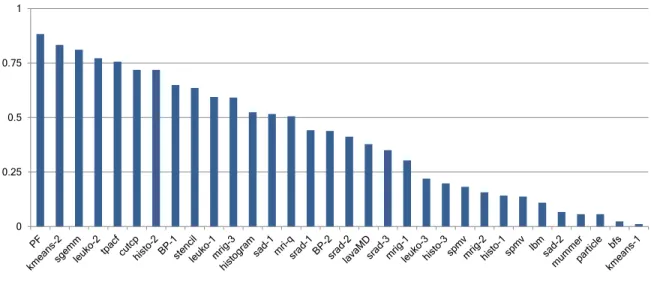
1.1 Utilization of GPU by kernels in parboil and rodinia benchmark suite. . . 3 1.2 Increase in number of register file access rate and degradation in per
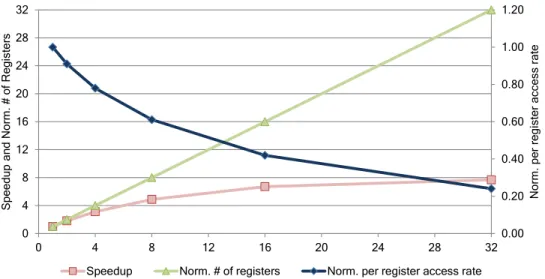
reg-ister accesses. This shows that with SIMT more hardware is required, but the utilization of the hardware reduces significantly. . . 4 1.3 GPUs provide three major resources (compute, memory and cache) and
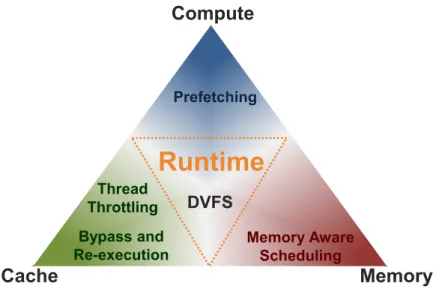
at the center of this research is a runtime management system. This sys-tem observes the resource requirement of the GPU program and provides techniques for efficient execution depending on the required resource. . . 5 2.1 Architecture of a Streaming Multiprocessor(SM) . . . 9 2.2 GPU Memory hierarchy block diagram which shows N SMs and M
mem-ory partitions. . . 9 3.1 Impact of variation of SM frequency, DRAM frequency and number of
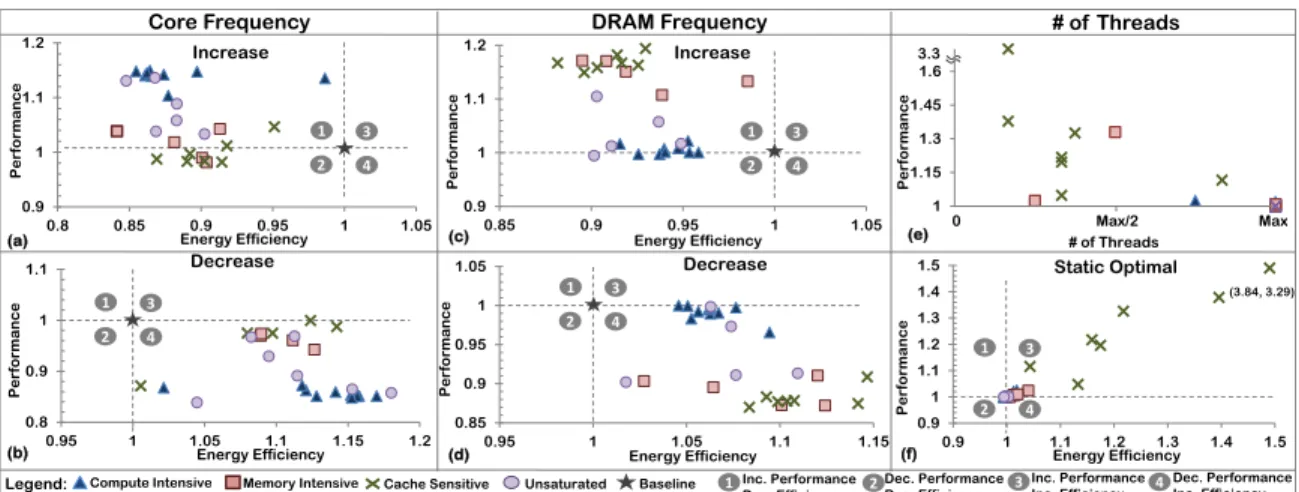
concurrent threads on performance and energy efficiency. The black star mark shows the value for the baseline GPU and is always set to 1 for both performance and energy. The properties of the four quadrants relative to the star mark are explained in the legend at the bottom. . . 17 3.2 Variation of kernel requirements across and within kernel instances. . . . 21 3.3 Equalizer Overview: Each SM requests new thread block and the new
SM and memory frequency domain. The frequency manager takes the requests and changes the SM or memory frequency as requested by ma-jority of the SMs. GWDE manages the request for new thread blocks. . . 22 3.4 State of the warps for different categories of kernels. The names on top
of the chart show the various categories. . . 24 3.5 Performance of memory intensive kernels with number of concurrent
thread blocks . . . 26 3.6 Equalizer Overview. Equalizer is attached with the instruction buffer and
periodically calculates the four counter values. At the end of anepochit sends a request to the Global Work Distribution Engine. . . 31 3.7 Performance and increase in Energy consumption for performance mode . 35 3.8 Performance and Energy savings in energy mode. Static bar on right for
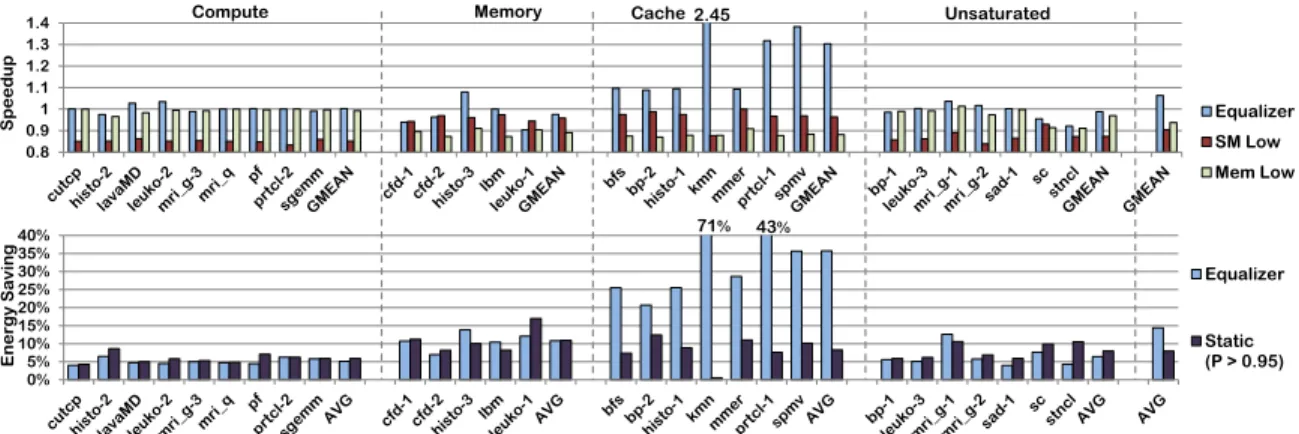
energy savings is either SM low or mem low from the top graph when the performance is above 0.95. . . 36
3.9 Distribution of time for the various SM and memory frequency. P and E are data for performance and energy mode respectively . . . 38 3.10 Comparison of Equalizer with DynCTA and CCWS . . . 40 3.11 Adaptiveness of Equalizer . . . 41 4.1 Fraction of peak IPC achieved and the fraction of cycles for which the
LSU stalled due to memory subsystem saturation. . . 50 4.2 Execution timeline for three systems. The top illustrates an infinite
band-width and MSHR system. The middle shows the baseline system with round-robin scheduling. The timeline on the bottom depicts Mascar’s scheduling. . . 52 4.3 Performance impact on memory intensive kernels when increasing the
number of MSHRs and memory subsystem queues, fully associative L1 and L2 caches, increasing the DRAM frequency by 20%, doubling the L1 and a combination of all four. . . 56 4.4 Fraction of cycles for which there is at least one warp which has one
cache block present in the cache that cannot be accessed due to a stalled LSU. . . 56 4.5 Block diagram of the Mascar scheduler. The WRC and WST are new
hardware structures that interact with the front-end of the SM’s pipeline. . 59 4.6 (a) The baseline system is ready to issueW0’s request but is stalled in the
LSU as the L1’s MSHRs are full, preventingW1’s request from hitting in
the L1. (b) Mascar’s cache access re-execution allowsW1’s request to hit
in the L1 whileW0waits for an MSHR. . . 64
4.7 Coupling of the re-execution queue with an LSU. When a request from the LSU is stalled it is pushed to the re-execution queue. The cache sends an ACK if it accepts a request, or a NACK otherwise. . . 66 4.8 Comparison of performance for different policies on memory intensive
kernels, relative to round-robin scheduling. The two components for the last bar in each kernel represents the contribution of scheduling and cache re-execution, respectively.. . . 70 4.9 Performance of compute intensive kernels for four different scheduling
policies. Overall, the choice of scheduler has little impact on these work-loads. . . 73 4.10 Reduction of LSU stalls when using Mascar. . . 74 4.11 Distribution of execution time in EP and MP modes across workloads. . . 75 4.12 Improvement in L1 data cache hit rates. . . 75 4.13 Energy consumption breakdown for baseline (left bar) and Mascar (right
bar, relative to baseline). . . 76 5.1 Increase in speedup and increase in power as number of warps are increased 86 5.2 Increase in number of register file access rate and degradation in per
reg-ister accesses. This shows that with SIMT more hardware is required, but the utilization of the hardware reduces significantly. . . 87
5.3 Examples to demonstrate the ineffectiveness of common CPU ing techniques on GPU (a) stride prefetching and (b) next-line prefetch-ing. These techniques do not work well due to the unordered execution of warps.. . . 88 5.4 (a) Traditional SM (b) Apogee SM with prefetching in data cache and
reduced register bank size. . . 90 5.5 Example of processing an array of elements in SIMT model with 2 warps 93 5.6 Fixed Offset Address prefetcher design . . . 94 5.7 (a) The three stages in the lifetime of a prefetch entry. (b) Timeline of a
prefetch and related load requests. If next load happens between 01 and 10, the prefetching is slow. If it happens just after 10 it is timely, else it is too late. Once the next load happens the status is reset to 00 . . . 96 5.8 Breakdown of access patterns of loads that missed in cache. . . 98 5.9 PC0 always access same address. Apogee keeps shifting the load from
which the prefetch requests should be issued till it can prefetch early enough and stores that information in the Prefetch Table. . . 100 5.10 Comparison of overall speedup of SIMT with 32 warps, stride prefetcher
per warp with 4 warps, MTA with 4 warps and Apogee. . . 105 5.11 Comparison of overall speedup of SIMT with 32 warps, MTA with 32
warps and Apogee. . . 106 5.12 Comparison of Performance/Watt of high-degree of multithreading and
multithreading with prefetching . . . 107 5.13 Accuracy of the overall prefetching technique. . . 109 5.14 Variation in Dcache Miss Rate. . . 110 5.15 Variation in stall cycles of the SMs, normalized to SIMT with 32 warps. . 111 5.16 Extra data transferred from memory to the cache including prefetching
LIST OF TABLES
Table
3.1 Actions on different parameters for various objectives . . . 20
3.2 Benchmark Description . . . 33
3.3 Simulation Parameters . . . 34
4.1 Simulation Parameters . . . 68
4.2 New Hardware Units per SM . . . 68
4.3 Benchmark Descriptions . . . 69
5.1 Experimental Parameters . . . 102
5.2 Benchmark Description. (M = million) . . . 102
5.3 Experimental Parameters . . . 103
5.4 Details of Area Calculation, and component wise description for the ma-jor components of baseline GPU and Apogee . . . 104
ABSTRACT
Dynamic Hardware Resource Management for Efficient Throughput Processing by
Ankit Sethia
Chair: Scott Mahlke
High performance computing is evolving at a rapid pace, with throughput oriented proces-sors such as graphics processing units (GPUs), substituting for traditional procesproces-sors as the computational workhorse. Their adoption has seen a tremendous increase as they provide high peak performance and energy efficiency while maintaining a friendly programming interface. Furthermore, many existing desktop, laptop, tablet, and smartphone systems support accelerating non-graphics, data parallel workloads on their GPUs. However, the multitude of systems that use GPUs as an accelerator run different genres of data parallel applications, which have significantly contrasting runtime characteristics.
GPUs use thousands of identical threads to efficiently exploit the on-chip hardware re-sources. Therefore, if one thread uses a resource (compute, bandwidth, data cache) more heavily, there will be significant contention for that resource. This contention will even-tually saturate the performance of the GPU due to contention for the bottleneck resource,
leaving other resources underutilized at the same time. Traditional policies of managing the massive hardware resources work adequately, on well designed traditional scientific style applications. However, these static policies, which are oblivious to the application’s resource requirement, are not efficient for the large spectrum of data parallel workloads with varying resource requirements. Therefore, several standard hardware policies such as using maximum concurrency, fixed operational frequency and round-robin style scheduling are not efficient for modern GPU applications.
This thesis defines dynamic hardware resource management mechanisms which im-prove the efficiency of the GPU by regulating the hardware resources at runtime. The first step in successfully achieving this goal is to make the hardware aware of the application’s characteristics at runtime through novel counters and indicators. After this detection, dy-namic hardware modulation provides opportunities for increased performance, improved energy consumption, or both, leading to efficient execution. The key mechanisms for mod-ulating the hardware at runtime are dynamic frequency regulation, managing the amount of concurrency, managing the order of execution among different threads and increasing cache utilization. The resultant increased efficiency will lead to improved energy consumption of the systems that utilize GPUs while maintaining or improving their performance.
CHAPTER I
Introduction
Throughput oriented processors such as Graphics Processing Units (GPU) have been harnessed for their high raw computational power by several supercomputers in the top 500 list [2] and the green 500 list [1]. Many major domains of science and engineering have shown 10-300x speedup over general purpose processors. Furthermore, this speedup is achieved at similar power consumption levels as the general purpose processors. This has provided a significant boost to the overall energy efficiency of high performance computing systems for data parallel applications.
The reason for the success of GPU lies in the large scale exploitation of data level par-allelism. Traditional CPUs process one element at a time and move to the next element after completely processing an element. In CPUs with SIMD extensions, upto 8 elements can be processed in parallel, before moving to the next set of elements. On the other hand, the scale of parallel processing is much higher in GPUs, to the tune of several hundreds of elements per cycle, with each element being processed on a different computational unit, such as floating point unit(FPU). They use high bandwidth GDDR5 memory to provide sufficient volume of data to the core, which can keep the compute units busy. GPUs have
several thousands of threads to keep the several hundreds of compute units busy. The ap-proach that GPUs use, is to divide the given work into several chunks of small, independent tasks(called as warps) and use fine grained multithreading between the warps to hide any stall in the pipeline. They can hide several hundreds of cycles of latency of an operation, if they are provided with enough work. For example, NVIDIA’s GTX580 has 512 FPUs and uses over 20,000 threads to maintain high utilization of these FPUs via fine grained multi-threading. As more elements are processed in parallel, with reduced stalls in the pipeline, the entire work is finished faster.
This parallel processing also enables higher energy efficiency for data parallel appli-cations. GPUs ammortize the cost of fetch and decode stage of the pipeline, by operat-ing only once for all threads in a warp. Furthermore, GPUs deploy energy efficient in-order cores and dedicate less area to traditional features such as branch prediction and data caches. While these features are performance critical for out-of-order CPUs, for throughput oriented architectures with fine grained multithreading such energy consuming hardware structures are not necessary. This is due to the fact that any stalls in the in-order pipeline of a GPU core can be overcome by swapping the stalling warp and executing another warp. All these factors lead to significant improvement in energy savings. As a point of compari-son, the 4 core CPU by Intel(Haswell) with AVX2 instructions has peak throughput of 180 GFLOPS at 84W TDP as compared to 4.2 TFLOPS for NVIDIA’s GTX780 at 250W TDP. With the popularization of high level programming models such as CUDA and OpenCL, there has been a proliferation of general purpose computing using GPUs (GPGPU) on com-modity systems to exploit this large computational power by non-scientific programmers as well. These programming models have facilitated the acceleration of wide range of data
0 0.25 0.5 0.75 1
Figure 1.1:Utilization of GPU by kernels in parboil and rodinia benchmark suite.
parallel workloads such as image processing, computer vision, machine learning on GPUs on servers, desktop and mobile devices. Due to the prevalence of GPUs in commodity systems, a future with ubiquitous supercomputing is plausible.
The prevalence of GPUs to different genre of computing systems introduces a new set of challenges for the hardware designers. The runtime characteristics of these new do-mains do not strictly conform to that of the traditional scientific style applications. These new domains want to exploit not only the high computational power of the GPUs, they also want to exploit the high memory bandwidth and data cache present on the chip. Therefore the variation in requirements of modern GPU applications along with the large concur-rency causes a significant problem. At full occupancy, more than twenty thousand, almost identical threads are executing on an SM. Therefore, if one thread has a high demand for using one of the resources of the GPU, then this imbalance in resource requirement is mag-nified many times causing significant contention. It is observed that the majority of the GPU applications are bottlenecked by the number of compute resources, available memory bandwidth or limited data cache [47]. As threads wait to access the bottleneck resource,
0.00 0.20 0.40 0.60 0.80 1.00 1.20 0 4 8 12 16 20 24 28 32 0 4 8 12 16 20 24 28 32 Nor m. pe r r eg is ter ac ces s rate S pe ed up an d Nor m. # o f Regi sters
Speedup Norm. # of registers Norm. per register access rate
Figure 1.2: Increase in number of register file access rate and degradation in per register accesses.
This shows that with SIMT more hardware is required, but the utilization of the hardware reduces significantly.
other resources end up being under-utilized, leading to imbalanced inefficient execution. Figure1.1 show the fraction of the GPU utilized by all the kernels in two of the most popular GPU benchmark suites. All these kernels provide sufficient amount of work that can be executed independently, ensuring that the GPU is not starved for work. Only 9 out of the 30 kernels achieve above 60% utilization, and from the remaining 21, 13 of achieve even less 30% utilization on the GPU. Low utilization of the GPU leads to lower energy efficiency as majority of the hardware is not being utilized and leaks static energy which is becoming a significant part of the total energy. This energy inefficiency, while unwanted in supercomputing systems, is unacceptable for untethered devices.
While GPUs are provisioned to have large concurrency on chip, the return on addition of new hardware to support large concurrency is not propotional. Figure 1.2 shows the variation in speedup, normalized number of registers as compared to one warp on the pri-mary vertical axis and normalized per register access rate as compared to one warp on the secondary vertical axis. The increase in the number of registers is linear and propotional
Compute
Cache
Memory
Runtime
Prefetching Thread Throttling Memory Aware Scheduling DVFS Bypass and Re-executionFigure 1.3:GPUs provide three major resources (compute, memory and cache) and at the center of
this research is a runtime management system. This system observes the resource requirement of the GPU program and provides techniques for efficient execution depending on the required resource.
to the number of warps present on a core. However, the speedup achieved is not linear and saturates at 7.69 times for 32 warps. Therefore, the overall access rate per register for 32 warps is down to 0.24 times from the 1 warp case. This demonstrates that the design of GPUs with heavy multi- threading has a significant amount of underutilized hardware which can lead to a significant increase in power consumption due to leakage. Technologi-cal trends in semiconductor fabrication show that at present leakage power is around 30% of the total chip power for high performance designs [45,26,75] and will continue to grow in future technologies. Hence, reducing the power of underutilized hardware on GPU has been the focus of recent research activities [26,27,3].
To improve the utilization of GPU resources, this thesis uses a central runtime manage-ment system which deploys several efficiency improvemanage-ment techniques. However, these techniques are effective when the GPU program exhibits certain characteristics (e.g. data locality). Therefore, the runtime system observes the requirement of the GPU program (kernel) and applies appropriate techniques to improve the efficiency of execution. The
resources, the optimization techniques and their sphere of influence is illustrated in Fig-ure1.3. The runtime system observes the resource requirement of the kernel, by first look-ing at the requirements of the warps inside a core and then collectlook-ing the requirements of all the cores. Some decisions are taken at a core granularity (thread throttling) and some are taken at a global granularity (DVFS decisions).
When the runtime system detects that the kernel has data locality it uses a thread throt-tling mechanism to reduce the thrashing of the cache and it uses a unique re-execution mechanism to improve hit-under-miss opportunities. As the data cache size on the GPU core is small, reducing the number of concurrent threads, leads to increased cache per thread and hence reduces contention. The re-execution mechanism unblocks the stalled Load Store Unit in the core by using a re-execution to park the blocking request. This allows loads which have data in the cache to go ahead and make forward progress. These techniques significantly improve the data cache hit rate, leading to higher performance and efficiency. These mechanisms are explained and evaluated in ChapterIIIand IV.
The rate of increase of memory bandwidth has not been able to keep upto the increase in the number of FPUs in the GPU. Therefore memory intensive workloads will saturate the GPU bandwidth and the FPUs might starve for data to process. In several classes of algorithms, such as search, data mining, sparse matrix computation etc. the memory requirement can easily saturate the memory sub-system of the GPU. When the runtime detects that a memory intensive kernel is executing, it changes the traditional scheduling policy between warps in a core to a novel memory aware scheduling. While the tradi-tional scheduling policies are oblivious to the resource requirement of the kernel, the new scheduling policy focuses on making all the memory resources available to one warp so
that it can start its computation. This results in better overlap of computation and memory access. The details of this mechanism are in ChapterIV.
For compute intensive kernels there is not a significant amount of under-utilization of the compute resources. Therefore, to improve the efficiency of such kernels, we focus using prefetching to reduce the perceived memory access latency and hence reduce the parallelism required. This provides the runtime system with opportunities to shut down large parts of the GPU core that are used for supporting large levels of concurrency. This shutting down is done by power gating of register file, resulting in reduction of leakage power for the large structure. The details of this technique and the related performance and energy trade-offs are discussed in ChapterV.
A powerful technique to improve energy efficiency and performance of GPU kernels is Dynamic Voltage and Frequency Scaling (DVFS). This technique is another central con-tribution of this work. As the runtime detects the resource requirements of the kernel, the corresponding resource’s voltage and frequency operating point could be increased to boost the capacity of that resource. As the performance of the bottleneck resource is boosted, the overall performance will be improved. Similarly, the voltage and frequency operating point of the under-utilized resource can be decreased to provide energy efficiency. The two modes of operation and the runtime decision process is explained in ChapterIII.
The thesis explains the background in Chapter IIto explain the GPU architecture, the runtime resource detection system, DVFS and thread throttling in ChapterIII, the memory aware scheduling and cache re-execution mechanism in ChapterIV, the adaptive prefetch-ing in ChapterVand is concluded in ChapterVIalong with discussion for potential exten-sions to this work.
CHAPTER II
Background
This section provides background for the various aspects of GPU that this thesis focuses on and will be relevant for future chapters.
2.0.1 Modern GPU architecture
To develop a background for GPU architecture we choose NVIDIA’s nomenclature in this paper. In a GPU architecture like NVIDIA’s GTX580, the GPU has 16 Streaming Multiprocessors (SM) which operate independently. Figure2.1[26] shows the architecture of one SM. It has banks of register files for all the threads that it handles and has 32 ALUs. The 32 ALUs are divided into groups of 16 ALUs that execute the same instruction. It also has access to local memory, a texture cache and a special function unit (SFU) for transcendental functions, floating point divide, etc. In an SM, groups of 32 threads operate in a lock-step manner and execute the same instruction. These group of threads are known as warps. Each SM can handle several independent warps (upto 32 for GTX 280 and 48 for GTX 580). When a warp starts execution, it will stall for long latency instructions such as access to global memory, long latency floating point instructions, etc. Meanwhile, the warp
Figure 2.1: Architecture of a Streaming Multiprocessor(SM) L1 I C N T SM 0 LSU SM 1 SM N L1 L2 0 . . . . . . L1 L2 M . . . L2 1 DRAM 0 DRAM 1 DRAM M . . . LSU LSU L2 MSHRs L1 MSHRs
Figure 2.2:GPU Memory hierarchy block diagram which shows N SMs and M memory partitions.
scheduler selects another warp from the available ready warps. The warp scheduler will not consider the stalled warp for execution till the warp is ready. If the program running on the GPU is using the maximum number of threads, the scheduler has the option to choose from 32 warps. It is this massive amount of multi-threading that allows the ALUs in the SM to execute continuously, thereby resulting in very high throughput.
2.0.2 GPU memory hierarchy
Figure 2.2 shows the block level diagram of the system considered in this work. The details inside the SM which include the execution units, register file etc. have been ab-stracted. Each SM has its private L1 cache. The L1 cache has hardware support to handle a fixed number of outstanding requests by using Miss status handling register(MSHR) as shown in the figure. All the SMs are connected to an interconnect which is connected to the L2. Depending on the requested address, the request is sent to the corresponding L2
partition which is connected to a DRAM channel. This DRAM channel is responsible for the same set of addresses as the partition itself. Each L2 partition can also handle a fixed number of outstanding memory requests.
For memory intensive workloads, the number of memory requests being sent are high. This results in the MSHRs in the L2 getting filled up much faster than for compute intensive workloads. Therefore, L2 stops accepting requests and sends negative acknowledgements to new requests from the interconnect. With L2 rejecting any new requests, the intercon-nection between L2 and L1 is filled up. This results in the rejection of new requests from L1 to the interconnect. Any new request coming from the core is allocated a new MSHR at L1, but no new request can be sent to L2 due to the earlier congestion in the interconnect. This cascading effect of rejecting memory requests reaches the core once all the MSHRs in the L1 are filled up. At that point an SM can no longer issue a memory instruction from any of the warp. This results in serialization of all memory requests as a new memory request can only be sent if one request is completed by the memory sub-system which frees up one of the MSHRs.
If all the MSHRs in the L1 are filled up and the LSU requests an address from the L1 cache that is a miss in the cache, the cache sends a negative acknowledgement to the LSU. At this point, the LSU can no longer process new requests even from other warps, until an older requests is returned from the memory and frees one MSHR. Since, the LSU can no longer process a new request, no warp can access the L1 cache as the LSU is busy with the previous unallocatable request. Other warps that need the compute units of the SM can still continue execution. If all the memory requests of a warp return before other warps’ compute is finished, then the new warp can hide the latency of warps whose requests are yet
to return. But due to the serialized memory accesses, this required compute is significantly higher as compared to the compute required when the requests are pipelined.
2.0.3 GPU thread management
GPUs use the Single Instruction Multiple Thread (SIMT) model of execution which groups threads together into a warp and executes the same instruction for these threads us-ing a common physical Program Counter (PC). Several warps form a Co-operative Thread Array (CTA) and threads within a CTA can communicate via the Shared Memory on a SM. The global work distribution engine (GWDE) in a GPU is the scheduler of all the CTAs and schedules them to SMs. The granularity of assignment of concurrent threads on an SM is the number of threads in a CTA. Initially, the GWDE fills up all the SMs with the maximum number of CTAs possible, which is dependent on the number of registers, shared memory and number of threads required by a CTA. After receiving the appropriate number of CTAs for execution, an SM continues execution until one of the CTAs finishes. At this point, it requests the GWDE to provide another CTA. This process continues until all the CTAs to be executed are transferred to one of the SMs.
CHAPTER III
Equalizer: Dynamic Tuning of GPU Resources for
Efficient Execution
In this chapter, i will reason for the need to match the resources on the GPU with the application’s requirement. Once the requirement of the kernel are detected then, a dynamic runtime system can modulate the hardware parameters to improve the efficiency of the execution on the GPU. The efficiency improvements can happen by either boosting bottleneck resources or throttling under-utilized resources. The decision to do one or the either can be taken by the operating system or the application.
3.1
Introduction
Modern GPUs provide several TFLOPs of peak performance for a few hundred dollars by having hundreds of floating point units (FPUs) and keeping them busy with thousands of concurrent threads. For example, NVIDIA’s GTX580 has 512 FPUs and uses over 20,000 threads to maintain high utilization of these FPUs via fine-grained multi-threading. GPUs are stocked with high memory bandwidth of up to 192 GBps and 64 kB of local storage per
streaming multiprocessor (SM) to feed data to these FPUs.
At full occupancy, more than a thousand, almost identical threads are executing on an SM. Therefore, if one thread has a high demand for using one of the resources of the GPU, then this imbalance in resource requirement is magnified many times causing significant contention. We observe that the majority of the GPU applications are bottlenecked by the number of compute resources, available memory bandwidth or limited data cache [47]. As threads wait to access the bottleneck resource, other resources end up being under-utilized, leading to inefficient execution. While these hardware resources cannot be increased at runtime, there are three important parameters that can modulate the performance and en-ergy consumption of these resources: number of concurrent threads, frequency of the SM and frequency of the memory system.
Running the maximum number of threads on an SM causes inefficient execution by saturating the compute resources in compute intensive workloads and memory bandwidth for memory intensive workloads. However, its impact on the data cache of an SM is even more critical. It significantly reduces the usefulness of the limited-capacity L1 data cache. For NVIDIA’s Fermi architecture, each SM can have up to 48 kB of data cache resulting in each thread having fewer than 30 bytes of cache on average when running maximum threads. With such a small footprint allotted to each thread, the advantages of data local-ity are lost due to increased cache contention. Rogers et al. [70] and Kayiran et al. [40] have shown the detrimental effect of running large number of threads on cache hit rates in GPUs. However, their solutions use architecture dependent heuristics that are not as effective across architectures.
voltage and frequency operating points. For example, while the GDDR5 DRAM can pro-vide a bandwidth of up to 192 GBps, the idle standby current is 30% higher as compared to when it provides 3.2 Gbps [34]. As the memory system is not utilized significantly for compute intensive kernels, there is an opportunity to save energy if the performance of memory system is lowered for such kernels without degrading the overall performance. Similar opportunity is present for memory intensive kernels, if the core frequency and volt-age can be lowered as SMs are not the bottleneck. Lee et al. [49] analyzed the trade-off of saving energy by DVFS and core scaling for such cases, but do not have a robust runtime mechanism to deal with all scenarios.
If the proclivity of a workload can be known a priori, advanced programmers can set the desired number of concurrent threads, frequency of the core and the memory system. However, static decisions are often infeasible due to three reasons. First, the contention for a hardware resource may be heavily dependent on the input. For example, a small input set might not saturate the memory bandwidth, whereas a large input set might. Second, resource contention is dependent on the amount of given GPU hardware resources and an application optimized for a GPU may change its point of contention on another GPU. Third, due to the prevalence of general purpose computing on GPUs (GPGPU), more irregular parallel applications are being targeted for GPUs [13, 59]. This has resulted in GPGPU kernels having distinct phases where different resources are in demand.
As running the maximum number of threads at fixed core and memory system fre-quency is not always the best solution and they cannot be determined a priori and inde-pendently, an intelligent runtime system is required. This system should be able to tune three important architectural parameters: number of threads, core frequency and memory
frequency in a coordinated fashion as these parameters are dependent.
To address the limitations of prior work and exploit the significant opportunities pro-vided by modulating these three parameters, we propose Equalizer [78], a comprehensive dynamic system which coordinates these three architectural parameters. Based on the re-source requirements of the kernel at runtime, it tunes these parameters to exploit any im-balance in resource requirements. As new GPU architectures support different kernels on each SM, Equalizer runs on individual SMs to make decisions tailored for each kernel. It monitors the state of threads with four hardware counters that measure the number of ac-tive warps, warps waiting for data from memory, warps ready to execute arithmetic pipeline and warps ready to issue to memory pipeline over an execution window. At the end of a window, Equalizer performs two actions to tune the hardware.
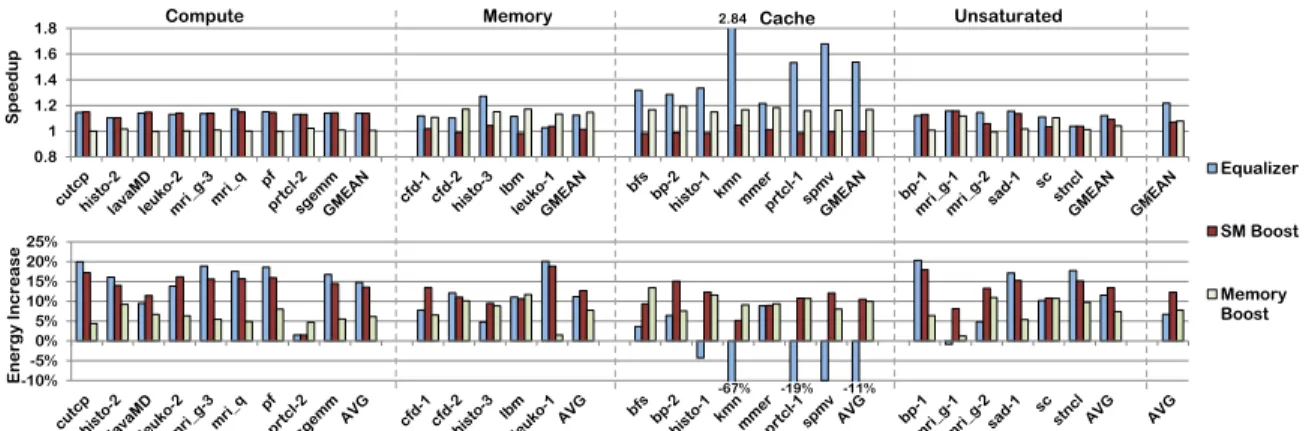
Firstly, it decides to increase, maintain, or decrease the number of concurrent threads on the SM. Secondly, it also takes a vote among different SMs to determine the overall resource requirement of the kernel based on the above counters. After determining the resource requirements of a kernel, Equalizer can work in either energy efficient or high performance modes. In the energy mode, it saves energy by throttling under-utilized re-sources. As only the under-utilized resources are throttled, its performance impact is min-imal. In the performance mode, only the bottleneck resource is boosted to provide higher performance at modest energy cost. Equalizer achieves a net 15% energy savings while improving performance by 5% in the energy saving mode and achieves 22% performance improvement in the performance mode while consuming 6% additional energy across a spectrum of GPGPU kernels.
• We explore the opportunity for energy savings and performance improvement that a dynamic adaptable system can achieve over a fixed GPU architecture for a variety of kernels that have sophisticated resource requirements.
• We provide an in-depth analysis of the time spent by the warps on an SM. Through this analysis, we introduce four novel hardware counters based on the execution state of the warps. These counters represent waiting warps, active warps, ready to execute memory warps, and ready to execute compute warps. They expose the collective resource utilization of the application.
• We propose a comprehensive, low overhead runtime tuning system for GPUs that dynamically adapts the number of threads, core frequency and memory frequency for a given kernel in unified way to either save energy by throttling unused resources or improve performance by reducing cache contention and boosting the bottleneck resource.
3.2
Opportunities for a Dynamic System
In this section we describe various opportunities that a runtime system can exploit. We study 27 kernels from the Rodinia and Parboil benchmark suites and classify them into four categories on a NVIDIA Fermi style (GTX 480) architecture: 1) compute intensive which have contention for the compute units, 2) memory intensive which stress the memory bandwidth, 3) cache sensitive which have contention for L1 data cache and 4) unsaturated which do not saturate any of the resources but can have inclination for one of the resources.
3.3
(3.84, 3.29)
Core Frequency DRAM Frequency # of Threads
(a)
(b)
(c)
(d)
Memory Intensive Cache Sensitive Unsaturated
Legend: Compute Intensive Baseline
(f) (e) 1 3 2 4 1 3 2 4 1 3 2 4 1 3 2 4 1 Inc. Performance 2 3 4
Dec. Efficiency Dec. Performance Dec. Efficiency
Inc. Performance
Inc. Efficiency Dec. Performance Inc. Efficiency
1 3 2 4 0.8 0.9 1 1.1 0.95 1 1.05 1.1 1.15 1.2 Pe rformance Energy Efficiency Decrease 0.9 1 1.1 1.2 0.8 0.85 0.9 0.95 1 1.05 Pe rformance Energy Efficiency Increase 0.9 1 1.1 1.2 0.85 0.9 0.95 1 1.05 Pe rformance Energy Efficiency Increase 1 1.15 1.3 1.45 1.6 Pe rformance 0 Max/2 Max # of Threads 0.9 1 1.1 1.2 1.3 1.4 1.5 0.9 1 1.1 1.2 1.3 1.4 1.5 Pe rformance Energy Efficiency Static Optimal 0.85 0.9 0.95 1 1.05 0.95 1 1.05 1.1 1.15 Pe rformance Energy Efficiency Decrease
Figure 3.1: Impact of variation of SM frequency, DRAM frequency and number of concurrent
threads on performance and energy efficiency. The black star mark shows the value for the baseline GPU and is always set to 1 for both performance and energy. The properties of the four quadrants relative to the star mark are explained in the legend at the bottom.
3.2.1 Effect of Execution Parameters
Figure3.1shows the impact of varying SM frequency, memory frequency and number of threads on the performance and energy efficiency of different kernels. Energy efficiency is defined as the ratio of energy consumed by the baseline Fermi architecture over the en-ergy consumed by the modified system. Higher value of enen-ergy efficiency corresponds to lower energy consumption in the modified system. The kernels and methodology used for this experiment is described in Section 3.5. A black star mark on each sub-figure shows the position of the baseline. The four quadrants 1 , 2 , 3 and 4in the sub-figures represent deviation from the black star. In quadrant 1performance improves and effi-ciency decreases, while in quadrant 2performance and efficiency decrease. In quadrant
3performance and efficiency increase, while in quadrant 4performance decreases and efficiency increases.
SM Frequency: Figure3.1a shows the impact of increasing the SM frequency by 15%. The compute kernels show proportional improvement in performance and increase in
en-ergy by moving deep into quadrant 1 . The result for memory and cache kernels are very different. Since these kernels are not constrained by the SM, faster computations by in-creasing the SM frequency does not reduce any stalls. Therefore, these kernels achieve insignificant speedup and stay close to the dotted line which represents baseline perfor-mance. Hence, increasing SM frequency is effective only for compute kernels and should be avoided for others.
On the other hand, when the SM frequency is reduced by 15%, the most affected kernels are compute kernels and they move significantly into quadrant 4 losing performance while saving energy (Figure3.1b. In such kernels, the SM’s compute resources are the bottleneck and slowing the SM will slow these resources, reducing performance. While there is a significant reduction in the energy consumed, such large drops in performance are generally unacceptable. On the other hand, the loss in performance for memory and cache kernels is small, while the energy efficiency improves significantly, pushing the kernels into quadrant
4 . The primary reason for this behavior is the large periods of inactivity of the compute resources.
Memory Frequency: While SM frequency affects energy and performance of compute kernels, memory frequency has similar effects on memory kernels. Cache kernels behave like memory kernels due to cache thrashing, which leads to higher bandwidth consumption. Figure3.1c shows the impact of increasing the DRAM frequency by 15%. Memory and cache kernels move deep into quadrant 1due to the improved performance. The decrease in energy efficiency is lower than increasing SM frequency as the memory contributes less significantly to the total energy. Analogous to the impact of SM frequency on memory kernels, increasing DRAM frequency does not impact compute kernels as the memory is
not fully utilized at the base frequency. These kernels achieve no speedup and increase the energy consumption by 5%.
Decreasing the memory frequency affects the memory and cache kernels as shown by Figure 3.1d. As memory bandwidth is the bottleneck for such kernels, this behavior is expected. However, reducing DRAM frequency has no performance impact on compute kernels while improving energy efficiency by 5%, indicating an opportunity to decrease the DRAM frequency and voltage for compute kernels.
Number of Thread Blocks: Increasing the DRAM frequency helps cache kernels get data back faster. However, controlling the number of threads to reduce L1 data cache thrashing will improve performance significantly with minimal energy increase. There-fore, we first analyze the optimal number of threads that need to run on an SM. Figure3.1e shows the best performance achieved by the kernels by varying the number of concurrent threads on an SM. The compute and memory kernels achieve best performance with max-imum threads and overlap at (Max Threads, 1) as saturating these resources does not hurt performance significantly and only leads to inefficient execution. The best performance for the cache kernels is achieved at lower concurrency levels where there is less contention for the cache. Therefore the big challenge for a runtime system is to find the most efficient number of threads to run. Note that if threads less than optimal are run, there might not be sufficient parallelism to hide memory access latency, which will result in lower perfor-mance.
The algorithm to decide the number of concurrent threads should ensure that the number of threads are not reduced significantly for compute and memory kernels as performance might suffer due to the lack of work. Figure3.1f shows the improvement in energy
effi-Table 3.1: Actions on different parameters for various objectives Kernel Objective SM DRAM Number
Frequency Frequency of threads
Compute Energy Maintain Decrease Maximum
Intensive Performance Increase Maintain Maximum
Memory Energy Decrease Decrease Maximum
Intensive Performance Maintain Increase Maximum
Cache Energy Decrease Maintain Optimal
Sensitive Performance Maintain Increase Optimal
ciency, if the best performing number of concurrent threads are selected statically. There is significant improvement in performance and energy efficiency as kernels go high into quadrant 3 . Therefore, choosing the best number of threads to run concurrently is suitable for saving energy as well as improving performance. For compute and memory kernels, running maximum threads leads to best performance and energy efficiency
Actions for Dynamic System: The action of increasing, maintaining, or decreasing the three parameters depend on the objective of the user. If the objective is to save energy, the SM and memory frequency should be reduced for memory and compute kernels respec-tively. If the objective is to improve performance, the SM and memory frequency should be increased for compute and memory kernels respectively. Running the optimal num-ber of threads blocks for cache sensitive cases is beneficial in both the objectives. These conditions and actions are summarized in Table3.1.
3.2.2 Kernel Variations
Kernels not only show diverse static characteristics in the resources they consume, but their requirements also vary across and within invocations. Figure3.2a shows the distri-bution of execution time across various invocations of the bfs-2 kernel for three statically fixed number of thread blocks. All values are normalized to the total time taken for the
0 0.2 0.4 0.6 0.8 1 Opt
3 2 1
Relative Execution Time
# of co ncu rr en t B lo cks Invocation Number 1 2 3 4 5 6 7 8 9 10 11 12
(a)Distribution of total execution time across various invocations for different, statically
fixed number of thread blocks for the bfs-2 kernel. No single configuration performs best for all invocations. Each color is a different invocation of the kernel.
0 5 10 15 20 25 # o f W a rps
Waiting Warps Extra Memory Warps Extra Compute Warps Execution Time
(b)Resource requirement for entire execution of the mri-g-1 kernel
Figure 3.2:Variation of kernel requirements across and within kernel instances.
kernel with maximum concurrent thread blocks (3). The performance of having 3 thread blocks is better than having 1 block until invocation number 7 (vertical stripes). But from invocation number 8 to 10 (horizontal stripes), having 1 block is better. After invocation 10, having 3 thread blocks is better again. An optimal solution would never pick the same number of blocks across all invocations. A 16% improvement in performance is possible by simply picking the ideal number of thread blocks for every invocation as shown by the bottom bar.
An example of variation in resource requirements within a kernel invocation is shown in Figure3.2bfor the mri-g-1 benchmark. Over most of the execution time, there are more warps waiting for data to come back from memory than warps ready to issue to memory. However, for two intervals, there are significantly more warps ready to issue to memory,
SM
Equalizer
Counters
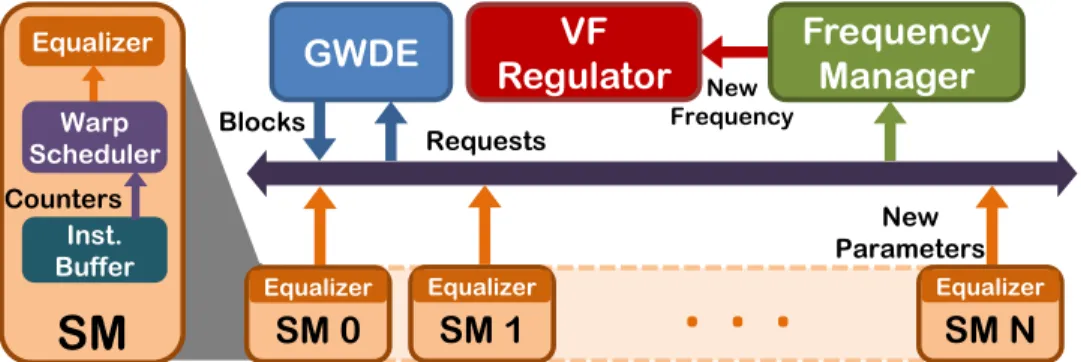
GWDE Regulator VF Frequency Manager
New Parameters Blocks New Frequency
. . .
SM 0 Equalizer Requests Inst. Buffer SM 1 Equalizer SM N Equalizer Warp SchedulerFigure 3.3:Equalizer Overview: Each SM requests new thread block and the new SM and memory
frequency domain. The frequency manager takes the requests and changes the SM or memory frequency as requested by majority of the SMs. GWDE manages the request for new thread blocks.
putting pressure on the memory pipeline. During these intervals, a boost to the memory system will relieve the pressure and significantly improve the performance.
Overall, there are significant opportunities for a system that can control the number of threads, SM frequency and memory frequency at runtime. These opportunities are present not only across different kernels, but also across a kernel’s invocations and within a kernel’s invocation. In the following section, we describe how Equalizer exploits these opportunities to save energy or improve performance.
3.3
Equalizer
The goal of Equalizer is to adjust three parameters: number of thread blocks, SM fre-quency and memory frefre-quency, to match the requirements of the executing kernels. To detect a kernel’s requirement, Equalizer looks at the state of the already present active warps on an SM and gauges which resources are under contention. The state of active warps is determined by a collection of four values: 1) number of active warps, 2) number of warps waiting for a dependent memory instruction, 3) number of warps ready to issue to memory pipeline, and 4) number of warps ready to issue to arithmetic pipeline. Large
val-ues for the last two counters indicate that the corresponding pipelines are under pressure. At runtime, Equalizer periodically checks for contention of resources using the state of the warps. It makes a decision to increase, maintain or decrease the three parameters at the end of each execution window (epoch). If Equalizer decides to change any parameter, the new value differs from the previous value by one step. The details of the decision process are explained in Section3.3.2.
Figure 3.3 shows the interaction of Equalizer with the other components of a GPU. It receives the four counters mentioned above, from the warp scheduler in an SM and makes a local decision. If the decision is to increase number of threads, the Global Work Distribution Distribution Engine (GWDE) which manages thread block distribution across SMs, issues a new thread block for execution to the SM. If Equalizer decides to reduce the number of concurrent threads, it uses the CTA Pausing technique used in [40]. In this technique, Equalizer blacklists a thread block and the warp scheduler does not issue instructions to the data-path from the warps of these thread blocks. After a thread block finishes on the SM, Equalizer maintains the reducednumBlocks by unpausing the paused thread block and does not request a new thread block from the GWDE, thereby maintaining the reduced value ofnumBlocks . Based on the objective of Equalizer, each SM submits a Voltage/Frequency (VF) preference to the Frequency Manager everyepoch. The frequency manager shown in Figure 3.3receives these requests and makes a global decision for the new VF level for the SM and memory based on a majority function.
0% 20% 40% 60% 80% 100% Di strib utio n of W arp s Excess ALU Excess Mem Waiting
Compute Memory Cache Unsaturated
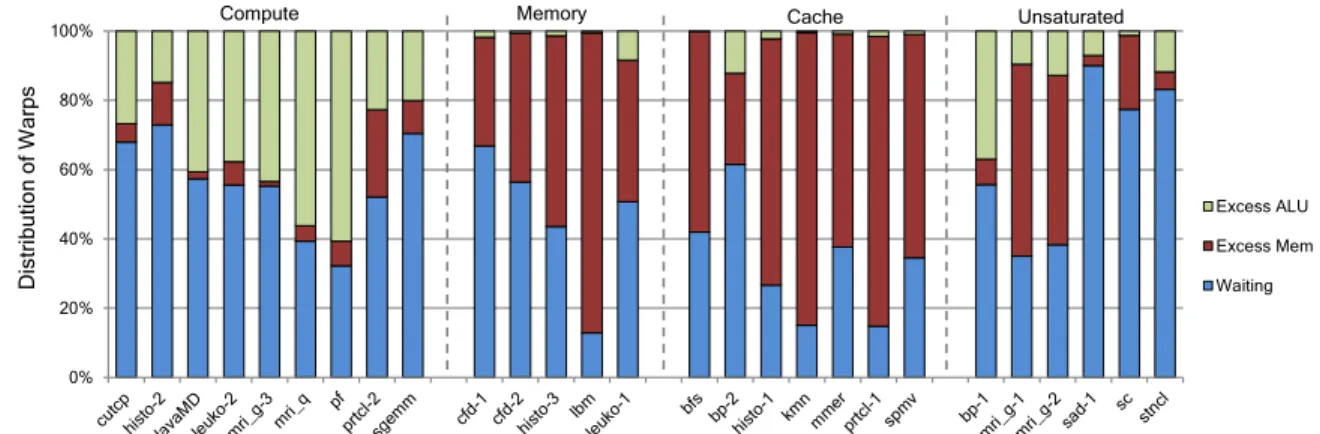
Figure 3.4: State of the warps for different categories of kernels. The names on top of the chart
show the various categories.
3.3.1 State of Warps
When a kernel executes on an SM, warps of the kernel can be in different states. We classify the warps depending on their state of execution in a given cycle:
• W aiting- Warps waiting for an instruction to commit so that further dependent
in-structions can be issued to the pipeline are in this category. The majority of warps are wait-ing for a value to be returned from memory. The number of warps needed to hide memory latency is not only a function of the number of memory accesses made by the warps, but also of the amount of compute present per warp.An SM should run more thanW aiting number of warps concurrently to effectively hide memory access latency.
• Issued- Warps that issue an instruction to the execution pipeline are accounted here.
It indicates the IPC of the SM and a high number of warps in this state indicate good performance.
• Excess ALU (Xalu )- Warps that are ready for execution of arithmetic operations,
but cannot execute due to unavailability of resources are in this category. These are ready to execute warps and cannot issue because the scheduler can only issue a fixed number of
instructions per cycle.Xaluindicates the excess warps ready for arithmetic execution.
• Excess memory(Xmem)- Warps that are ready to send an instruction to the
Load/S-tore pipeline but are restricted are accounted here. These warps are restricted if the pipeline is stalled due to back pressure from memory or if the maximum number of instructions that can be issued to this pipeline have been issued.Xmemwarps represents the excess warps
that will increase the pressure on the memory subsystem from the current SM. • Others- Warps waiting on a synchronization instruction or warps that do not have their instructions in the instruction buffer are called Others. As there is no instruction present for these warps, their requirements is unknown.
In principle, one warp in Xalu or Xmem state denotes contention for resources.
How-ever, Equalizer boosts or throttles resources in discrete steps and in either cases, there should not be lack of work due to the modulation of parameters. Hence, there should be some level of contention present before Equalizer performs its actions.
Figure3.4shows the distribution of three of the above states on an SM for the 27 kernels broken down by category, while running maximum concurrent threads.Otherscategory is not shown as their resource requirements cannot be observed. The following observations are made from the state of warps:
• Compute intensive kernels have a significantly larger number of warps inXalu state
as compared to other kernels.
• Memory intensive and cache sensitive kernels have a significantly larger number of warps that are inXmemstate as compared to the other categories.
• All unsaturated kernels still have inclination for either compute or memory resources as they have significant fraction of warps inXalu orXmemstate.
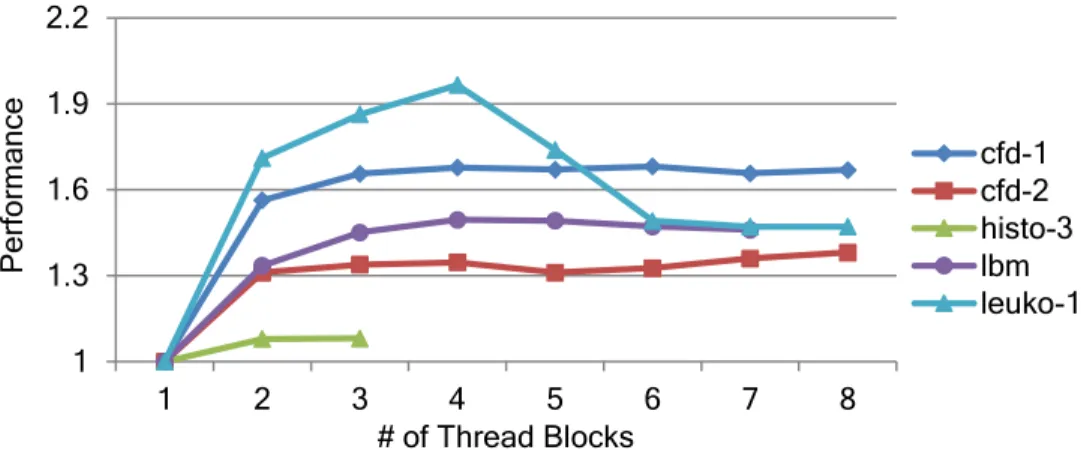
1 1.3 1.6 1.9 2.2 1 2 3 4 5 6 7 8 P erfor ma nc e # of Thread Blocks cfd-1 cfd-2 histo-3 lbm leuko-1
Figure 3.5:Performance of memory intensive kernels with number of concurrent thread blocks
Unifying Actions on Memory Intensive and Cache Sensitive Kernels: As the state of the warps for memory intensive and cache sensitive kernels are similar, we unify the process of tuning the resources for the two cases. Figure 3.5 shows the performance of memory intensive kernels with a varying number of thread blocks. All kernels saturate their performance well before reaching the maximum number of concurrent blocks. As long as the number of blocks for a memory intensive kernel is enough to keep the bandwidth saturated, we do not need to run the maximum number of blocks. In case the large number of warps in Xmem state were due to cache thrashing, this reduction in thread blocks will
reduce cache contention.
In principle, if every cycle an SM sends a request that reaches DRAM, then as there are multiple SMs, the bandwidth will be saturated leading to back pressure at the SM. Therefore, the Load Store Unit(LSU) will get blocked and all warps waiting to access memory will stall. So even a single warp in Xmem state is indicative of memory back
pressure. However, when thisXmemwarp eventually sends its memory request, it might be
hit in the L1 or L2 cache. Therefore the earlierXmem state of the warp was not actually
two warps inXmem state in steady state then the bandwidth is saturated. So Equalizer tries
to run the minimum number of blocks that will keep the number of warps inXmemgreater
than two and keep the memory system busy and reduce L1 cache contention with minimum number of thread blocks.
3.3.2 Equalizer Decision
To exploit the tendencies of a kernel as indicated by the state of warps, we propose a dynamic decision algorithm for Equalizer. Once the tendencies are confirmed, the al-gorithm performs actions based on the two objectives mentioned in Table 3.1. Due to an imbalance in the kernel’s resource requirements, one of the resources is saturated earlier than others and hence, several warps end up inXalu orXmem state. Therefore, whenever
Equalizer detects thatXalu andXmem are beyond a threshold, it can declare the kernel to
be compute or memory intensive. This threshold has to be conservatively high to ensure that the resources are not starved for work while changing the three parameters.
If the number of warps in the Xalu or Xmem are more than the number of warps in a
thread block (Wcta ), executing with one less thread block would not degrade the
perfor-mance on average. These additional warps were stalled for resources and the remaining warps were sufficient to maintain high resource utilization. Therefore,Wctais a
conserva-tive threshold that guarantees contention of resources if number of warps inXalu orXmem
are above it.
Tendency detection: Algorithm1 shows Equalizer decision process that implements actions mentioned in Table 3.1. If the number of Xalu or Xmem warps are greater than
Algorithm 1Decision algorithm of Equalizer
1: . nM em,nALU are the number of warps inXaluandXmemstate
2: . nW aitingis the number of warps inwaitingstate
3: . nActiveis the number of active, accounted warps on an SM
4: . WctaandnumBlocksare # warps in a block and # blocks
5: . M emActionandCompActionare frequency changes
6: —————————————————————————————————————
————-7: ifnM em > Wcta then .Definitely memory intensive
8: numBlocks=numBlocks- 1
9: M emAction= true
10: else ifnALU ¿Wcta then .Definitely compute intensive
11: CompAction= true
12: else ifnM em >2then .Likely memory intensive
13: M emAction= true
14: else ifnW aiting > nActive/2then .Close to ideal kernel
15: numBlocks=numBlocks+ 1
16: ifnALU > nM emthen .Higher compute inclination
17: CompAction= true
18: else .Higher memory inclination
19: M emAction= true
20: end if
21: else ifnActive== 0then
22: CompAction= true .Improve load imbalance
23: end if
and 10). If none of the two states have large number of excess warps, Equalizer checks the number ofXmem warps to determine bandwidth saturation (line 12). As discussed in
Section3.3.1, having more than twoXmem warps indicates bandwidth saturation. If these
three conditions (compute saturation, heavy memory contention and bandwidth saturation) are not met, there is a chance that the current combination of the three parameters are not saturating any resources and these kernels are considered to be unsaturated. Kernels in unsaturated category can have compute or memory inclinations depending on largeXaluor
Xmemvalues (line 16-18). If a majority of the warps are not waiting for data in such cases
(line 14), these kernels considered to be degenerate and no parameters are changed. Equalizer actions: After determining the tendency of the kernel, Equalizer tunes the
hardware parameters to achieve the desired energy/performance goals. For compute in-tensive kernels, Equalizer requests CompAction from the frequency manager (line 11). Equalizer deals with the memory intensive workloads as explained in Section3.3.1. When-ever Equalizer finds that the number of Xmem warps are greater than Wcta , it reduces
the number of blocks by one (line 8) using the techniques in Section3.4.2. Reducing the number of concurrent blocks does not hamper the memory kernels and it can help reduce cache contention. However, if the number of Xmem warps are greater than two, but less
thanWcta , Equalizer does not decrease the number of blocks (line 12-13) because
reduc-ing number of thread blocks might under-subscribe the memory bandwidth as explained in Section3.3.1. In both of these cases, Equalizer requestsM emAction from the frequency manager. For unsaturated and non-degenerate kernels, Equalizer requestsCompActionor
M emActiondepending on their compute or memory inclination (line 16-18).
CompAction andM emActionin Algorithm1refer to the action that should be taken with respect to SM and memory frequency when compute kernels and memory kernels are detected, respectively. As per Table3.1, for compute kernels, if the objective of Equalizer is to save energy, then it requests the frequency manager in Figure3.3 to reduce memory VF. If the objective is to improve performance then Equalizer requests increase in the SM’s VF. The opposite actions are taken for memory kernels as per Table3.1.
Equalizer also provides a unique opportunity for imbalanced kernel invocations. If the kernel has a few long running thread blocks that do not distribute evenly across the SMs, then certain SMs might finish early and other SMs will finish late due to load imbalance. To neutralize this, Equalizer tries to finish the work early (line 21) or reduce memory energy. The assumption is that since majority of the SMs are idle and leaking energy, finishing the
work early will compensate for the increase in energy due to reduction in leakage energy. In energy saving mode, having lower bandwidth will likely be sufficient for sustaining performance as the majority of the SMs are idle.
3.4
Equalizer Hardware Design
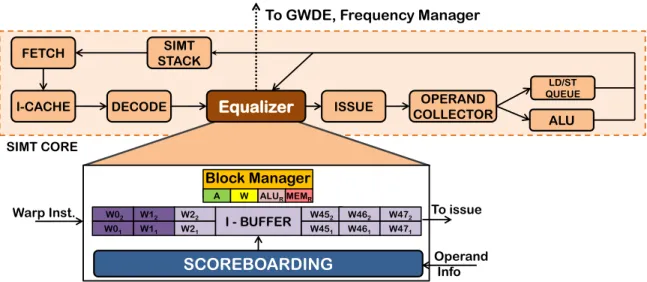
In the baseline Fermi GPU, there are two entries for every warp in the instruction buffer. During every cycle, the warp scheduler selects a warp for execution. In this process, the warp instruction’s operands are checked in the scoreboard for readiness. If a warp instruc-tion is ready for execuinstruc-tion, it is sent to the issue stage. Equalizer monitors the state of the instructions in the instruction buffer to determine about the state of warps. Figure3.6shows the details of Equalizer on an SM. Every 128 cycles, Equalizer checks the head instructions of every warp in the buffer and collects the status of each warp. This process is continued throughout theepochwindow at which point a decision is made.
3.4.1 Counter Implementation
Whenever a thread block is paused, the entries in the instruction buffer for the warps of that thread block are not considered for scheduling. In Figure3.6, the dark grey entries in the instruction buffer are not considered for scheduling. The status of only unpaused warps are taken into account in the decision by Equalizer. If a warp is unpaused and it does not have a valid entry in the instruction buffer, it is considered as unaccounted. The four counters needed for Equalizer in Section3.3are implemented as follows:
FETCH
I-CACHE DECODE Equalizer ISSUE COLLECTOR OPERAND
LD/ST QUEUE ALU SIMT STACK SCOREBOARDING W02 W01 W12 W11 W22 W21 W452 W451 W462 W461 W472 W471 I - BUFFER Block Manager A W ALUR MEMR
To GWDE, Frequency Manager
SIMT CORE
Warp Inst.
Operand Info To issue
Figure 3.6: Equalizer Overview. Equalizer is attached with the instruction buffer and periodically
calculates the four counter values. At the end of anepoch it sends a request to the Global Work Distribution Engine.
• Active warps: This counter is implemented by counting the number of warps that are not paused or unaccounted.
• Waiting warps: The head instructions of every warp that cannot be executed because the scoreboard has not made the operands available are considered for this counter.
• Xalu : All the head instructions waiting to issue to the arithmetic pipeline that have
operands available from the scoreboard are accounted here.
• Xmem : All the warps instructions that are ready to access memory but cannot be
is-sue because the LD/ST queue cannot accept an instruction in this cycle are in this category.
3.4.2 Thread Block Allocation Mechanism
After the collection of counter values, at the end of anepochwindow, Equalizer uses the algorithm explained in Section3.3.2and decides to increase, maintain or decrease thread blocks (numBlocks). Equalizer does not changenumBlockson the basis of one window. If the decision of three consecutiveepochwindow results in different decision than the current
numBlocks, then Equalizer changesnumBlocks. This is done to remove spurious temporal changes in the state of the warps by the decision itself. The SM interacts with the GWDE to request more thread blocks whenever required as shown in Figure3.3. If Equalizer decides to increase the number of thread blocks, it will make a request to GWDE for another thread block. In case, Equalizer decides to reduce the number of thread blocks, it sets the pause bit on the instruction buffer of all warps in that block corresponding warps’ instruction buffer. After one of the active thread blocks finishes execution, Equalizer unpauses a thread block from the paused thread block. At this point, Equalizer does not make a new request to the GWDE. This automatically maintains the reducednumBlocks.
3.4.3 Frequency Management
At the end of eachepoch, every SM calculates whether to increase, maintain or decrease its SM or memory system frequency based on the CompAction andM emAction values of Algorithm1in conjunction with Table3.1. The frequency manager shown in Figure3.3, receives these requests and makes a decision based on the majority vote amongst all the SM requests. If the request is to change SM VF level then the decision is sent to the on-chip or off-on-chip voltage regulator. If the request is to change the memory system VF level then, the operating points of the entire memory system which includes the interconnect between SMs and L2, L2, memory controller and the DRAM are changed. In this work, three discrete steps for each voltage/frequency domain are considered. The normal state refers to no change in frequency, low state and high state is reduction and increase in nominal frequency by 15% Any increase or decrease in the frequency is implemented in a gradual fashion between the three steps. For example, if the decision is to increase the
Table 3.2: Benchmark Description
Application Id Type Kernel num Wcta Fraction Blocks backprop(bp) 1 Unsaturated 0.57 6 8 2 Cache 0.43 6 8 bfs 1 Cache 0.95 3 16 cfd 1 Memory 0.85 3 16 2 Memory 0.15 3 6 cutcp 1 Compute 1.00 8 6 histo 1 Cache 0.30 3 16 2 Compute 0.53 3 24 3 Memory 0.17 3 16 kmeans(kmn) 1 Cache 0.24 6 8 lavaMD 1 Compute 1.00 4 4 lbm 1 Memory 1.00 7 4 leukocyte(leuko) 1 Memory 0.64 6 6 2 Compute 0.36 8 6 mri-g 1 Unsaturated 0.68 8 2 2 Unsaturated 0.07 3 8 3 Compute 0.13 6 8 mri-q 1 Compute 1.00 5 8 mummer(mmer) 1 Cache 1.00 6 8 particle(prtcl) 1 Cache 0.45 3 16 2 Compute 0.55 3 16 pathfinder 1 Compute 1.00 6 8 sad 1 Unsaturated 0.85 8 2 sgemm 1 Compute 1.00 6 4 sc 1 Unsaturated 1.00 3 16 spmv 1 Compute 1.00 8 6 stencile(stncl) 1 Unsaturated 1.00 5 4
SM frequency in the currentepoch and the current SM frequency is in the low state then it is change to normal in first step. If in the nextepochthe same request is made then the frequency is increased from from normal to high.
3.5
Experimental Evaluation
3.5.1 Methodology
Table 3.2 describes the various applications, their kernels and characteristics. These kernels are from the Rodinia suite [14] and parboil [82] suite. We use the kmeans
bench-Table 3.3: Simulation Parameters
Architecture Fermi (15 SMs, 32 PE/SM)
Max Thread Blocks:Warps 8:48
Data Cache 64 Sets, 4 Way, 128 B/Line
SM V/F Modulation ±15%, on-chip regulator
Memory V/F Modulation ±15%
mark used by Rogers et al. [70] that uses large input. We use GPGPU-Sim [8] v3.2.2, a cycle level GPU simulator and model the Fermi Architecture. The configurations for GTX480 are used. The important configuration parameters of the GPU are shown in Ta-ble3.3.
3.5.1.1 Energy Modelli