RL
GRAPH
: M
ODULAR
C
OMPUTATION
G
RAPHS
FOR
D
EEP
R
EINFORCEMENT
L
EARNING
Michael Schaarschmidt* 1 Sven Mika* 2 Kai Fricke3 Eiko Yoneki1
A
BSTRACTReinforcement learning (RL) tasks are challenging to implement, execute and test due to algorithmic instability, hyper-parameter sensitivity, and heterogeneous distributed communication patterns. We argue for the separation of logical component composition, backend graph definition, and distributed execution. To this end, we introduce RLgraph, a library for designing and executing reinforcement learning tasks in both static graph and define-by-run paradigms. The resulting implementations are robust, incrementally testable, and yield high performance across different deep learning frameworks and distributed backends.
1
I
NTRODUCTIONThe recent wave of new research and applications in deep learning has been fueled by both hardware improvements and deep learning frameworks simplifying design and train-ing of neural networks (Chen et al.,2015;Abadi et al.,2016; Seide & Agarwal,2016;Paszke et al.,2017). Reinforce-ment learning (RL) algorithms combined with deep neural networks have in parallel emerged as an active area of re-search due to promising results in complex control tasks (Levine et al.,2016;Tobin et al.,2017;Silver et al.,2017). However, their design and execution have not found similar standardization. This is a consequence of the highly var-ied resource requirements, scheduling, and communication patterns found in constantly evolving RL methods. Imple-mentations hence require a high degree of customization. A number of RL libraries has emerged to focus on dis-tinct aspects of managing such workloads. For exam-ple, OpenAI baselines provides reference implementations meant to reproduce specific benchmark environments (e.g. Atari) (Sidor & Schulman,2017). TensorForce provides a declarative API focusing on ease of use in applications (Schaarschmidt et al.,2018). Ray RLlib seeks to simplify distributing RL workloads by moving from hand-designed distributed communication to actor-based centralized execu-tion on Ray (Liang et al.,2018;Moritz et al.,2017). While these libraries serve different purposes, many of them suffer from similar design problems leading to difficulties in testing, distributed execution, and extensibility. The root
*Equal contribution 1University of Cambridge2
rlcore3Helmut Schmidt University. Correspondence to: Michael Schaarschmidt <[email protected]>.
Proceedings of the2ndSysML Conference, Palo Alto, CA, USA, 2019. Copyright 2019 by the author(s).
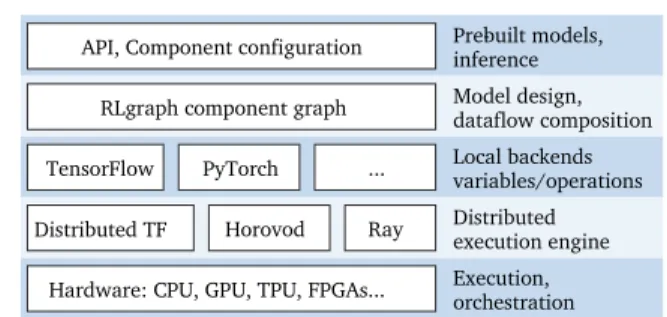
cause of these difficulties lies in a lack of separation of con-cerns. Composition of logical components defined within an RL algorithm is tightly coupled with code fragments specific to a deep learning framework (e.g. TensorFlow calls to define placeholders and variables). This leads to ill-defined APIs and also makes the reuse and testing of components difficult. Similarly, the often complex dataflow within RL algorithms is intertwined with control flow regu-lating (distributed) execution, environment interaction, and device management. This results in distributed execution and local device strategies being tied to specific algorithms. The central contribution of this paper isRLgraph, a mod-ular framework to design and execute RL workloads from high-level dataflow. RLgraph addresses these issues by separating logical component composition, creation of oper-ations, variables and placeholders, and finally local and dis-tributed execution of the computation graph (Fig.1). At the core of our design is a novel component graph architecture responsible for assembling and connecting algorithmic com-ponents, such as buffers or neural networks, and for expos-ing their functionality to a common API. Importantly, this component graph exists independently of implementation specific notions (e.g. TensorFlow variables), and instead relies on generalized space objects and operations. This means it can both be built for static graph and define-by-run backends, and RLgraph currently supports both TensorFlow (TF) and PyTorch (PT).
The component graph is built into a backend-dependent computation graph via a graph builder which generates op-erations, internal state (e.g. variables), device assignments, and a registry for the model’s API. Developers are freed from tedious manual placeholder and variable definition, as they only need to specify type and shape of input spaces to an algorithm’s outermost container component (root
Hardware: CPU, GPU, TPU, FPGAs... Ray Distributed TF Horovod TensorFlow PyTorch ... RLgraph component graph Local backends variables/operations Model design, dataflow composition Distributed execution engine Execution, orchestration API, Component configuration Prebuilt models,inference
Figure 1.RLgraph stack for using and designing RL algorithms.
ponent). They can then rely on the RLgraph utilities to cen-trally handle most aspects of connecting complex models, e.g. splitting and merging complex nested spaces. A re-source aware graph executor expands the component graph to add operations for local and distributed device strategies, e.g. by creating subgraph replicas for GPUs or managing globally shared state. At runtime, the graph executor (e.g. for TensorFlow) serves requests to the agent API by de-termining relevant input placeholders and operations from the op-registry and batching together all relevant operations into a single session call. Our design provides numerous advantages over many existing libraries:
1. Distributed execution. By separating concerns of design and execution, resulting agents can be imple-mented towards any distributed execution paradigm, e.g. using distributed TensorFlow (Abadi et al.,2016), Ray (Moritz et al.,2017), and plugins such as Uber’s Horovod (Sergeev & Balso,2018).
2. Static and define-by-run backends.The component graph does not impose restrictions on its execution. It supports end-to-end static graphs including control flow (Yu et al.,2018) and define-by-run semantics (e.g. PyTorch (Paszke et al.,2017)) through a unified execu-tion interface.
3. Fast development cycles.RLgraph’s abstractions en-ables users to focus on high level dataflow when com-posing components. The build process manages back-end scaffolding and creates operations based on user-provided input spaces.
4. Incremental building and testing.Existing libraries cannot efficiently identify problems in individual com-ponents as they do not offer a modular build sys-tem. In RLgraph, all components (including pre/post-processing heuristics) are first-class citizens which are individually built and incrementally tested.
In the remainder of the paper, we analyze RL design prob-lems and survey existing libraries (§2). We then discuss the design of RLgraph (§3,§4). In the evaluation, we compare RLgraph against reference implementations using different
execution paradigms (§5). Our results show RLgraph can improve sample throughput over existing implementations by up to 180%. In related work, we discuss emerging ap-proaches in programming models and optimization (§6). RLgraph is available as open source1.
2
M
OTIVATION 2.1 RL workloadsThe central difficulty of executing RL workloads lies in the need for frequent interaction with the problem environment during training to evaluate and update the model. Environ-ments may take the form of expensive physical systems (robots), 3D scene simulators, games, or generally any sys-tem exposing a state representation and an action interface. This is in contrast to supervised workloads, where train-ing data is typically entirely available in advance, thus en-abling straightforward batching and synchronization strate-gies (Sergeev & Balso,2018). As a consequence of fast moving and empirically driven research, RL algorithms vary across all dimensions of execution (recently discussed by Liang et al. (Liang et al.,2018)).
State management.Sample trajectories are often collected in a distributed fashion where workers interact with dedi-cated (simulation) environment copies. Algorithms manage synchronization of model weights between one or multiple learners and sample collectors, employing synchronous and asynchronous strategies. In addition, they must process and transmit samples to learners efficiently, sometimes involving hierarchies of local and distributed shared buffers to split post-processing tasks (Horgan et al.,2018).
Resource requirements and scale. Recent successes in applying RL at scale in gaming (e.g. OpenAI Five ( Ope-nAI,2018), AlphaGo (Silver et al.,2017)) were enabled by training models on up to tens of thousands of CPU cores and hundreds of GPUs. In contrast, models for environ-ments which are not easily parallelized may be executed on a single CPU but might have stringent latency requirements. Models and optimization strategies. Neural networks used to represent policies range from small multi-layer perceptrons to complex hierarchical representations ( Sil-ver et al.,2016;Wayne et al.,2018). Learning approaches vary from small incremental updates to expensive but in-frequent policy optimizations over large batches, making effective use of hardware accelerators difficult.
2.2 Existing abstractions
Reference implementations. Many libraries primarily serve as reference implementations. For example,OpenAI
baselines(Sidor & Schulman,2017),Keras-rl(Plappert, 2016) and Google’sDopamine(Bellemare et al.,2018) pro-vide collections of well-tuned algorithms on benchmarks such as OpenAI gym (Brockman et al.,2016) or ALE ( Belle-mare et al.,2013). Nervana Coach(Caspi et al., 2017) contains a similar collection but with added tools for vi-sualizing progress, and facilities for hierarchical learning and distributed training.Horizonfocuses on building end-to-end pipelines for off-policy training at Facebook (Gauci et al.,2018).
Reference implementations share some components be-tween algorithms (e.g. network architectures) but typically ignore many practical considerations in favour of concise code. Retooling them to different execution modes, envi-ronment semantics, or device strategies (e.g. multi-GPU support) requires significant work due to hard-coded, tightly coupled designs.
Centralized control. Ray RLlib(Liang et al.,2018) de-fines a set of abstractions for scalable RL. It relies on Ray’s actor model (Moritz et al.,2017) to execute RL algorithms via centralized control. At the core of RLlib’s hierarchical task parallelism approach lies a set of optimizer classes. Each optimizer implements a step() function which dis-tributes sampling to remote actors, manages buffers, and updates weights. For example, anAsyncReplayOptimizer
implements distributed prioritized experience replay ( Hor-gan et al.,2018). Each step, the optimizer loop pulls samples from actors, inserts them into replay buffers, and performs training on an asynchronous learner thread. A core claim of RLlib is the separation of the execution plane in the op-timizer from the definition of the RL algorithm within a policy graph. However, each optimizer encapsulates both local and distributed device execution. This means for ex-ample that only the dedicated multi-gpu optimizer class supports splitting input batches synchronously over multi-ple GPUs. RLlib’s optimizer abstractions also mix Python control flow, Ray calls, and TensorFlow calls throughout its components. Algorithms implemented in RLlib are hence not easily portable as training is principally meant to be executed only on Ray.
Fixed end-to-end graphs. TensorForce(Schaarschmidt et al.,2018) is a TF library providing a declarative inter-face to a number of RL algorithms. TensorForce focuses on applied use cases where control flow is driven by exter-nal application contexts, not simulation environments. Its end-to-end in-graph control flow design accelerates execu-tion by avoiding unneeded context switches between Python interpreter and TF runtime (Yu et al.,2018). A key dis-advantage of this design (also adopted by Batch PPO and TF-Agents (Hafner et al.,2017;Guadarrama et al.,2018)) is that partial data-flow is difficult to test due to limited in-graph-debugging facilities. Further, execution
assign-ments via device and variable sharing decorators are not separate from algorithm logic in the absence of a modular build process.
3
F
RAMEWORK DESIGN 3.1 Design principlesIn the absence of a single dominant design pattern, frame-works must resolve the tension between flexible prototyping, reusable components, and scalable execution mechanisms. RLgraph’s design is driven by a number of insights: Separating algorithms and execution.RL algorithms re-quire complex control flow to coordinate distributed state and sample collection on one hand, and internal training logic on the other hand. Separating these aspects is difficult but essential to avoid re-implementing execution strategies. RLgraph manages local execution via graph executors which expose a clear interface between a high level API and the component graph. Distributed coordination is delegated to dedicated distributed executors (e.g. on Ray), or as part of the graph build in the executor (distributed TF).
Reusable components with strict interfaces.Deep learn-ing frameworks enable quick prototyplearn-ing of neural networks by exposing APIs to combine different types of layers with compatible interfaces. Providing a similar set of interchange-able components towards RL is complicated by the multi-tude of learning and execution semantics. This is exacer-bated by implementations containing definitions in multiple execution contexts, e.g. Python control flow interleaved with calls to TF runtime. Tight coupling of components, and in turn a lack of well-defined interfaces and component boundaries, means that re-usability is severely constrained. RLgraph addresses this problem via its modular component architecture. Components only interact via declared API methods and guarantee reusability as they are fully specified through compatible input spaces.
Incremental sub-graph testing. An undesirable conse-quence of incorporating stochastic approximations at all levels is numerical sensitivity and non-determinism ( Na-garajan et al.,2018). RL algorithms can require an over-whelming number of hyperparameters (often in excess of 25). This has created severe issues for robustness and re-producibility (Henderson et al.,2017;Mania et al.,2018). Implementations are notoriously difficult to debug and test in part because generating and verifying inputs and outputs of partial dataflow is tedious (e.g. manually creating tensors of required shapes). RLgraph enables sub-graph testing by allowing users to send example data from input spaces through arbitrary components and component combinations.
3.2 Components and graphs
Components. Next, we discuss the design of RLgraph’s component graph. For simplicity, we use TensorFlow as the primary backend and describe the implementation of other backends (e.g. PyTorch) in§4.2. RLgraph’s core abstrac-tion is theComponent class which encapsulates arbitrary computations viagraph functions. RLgraph components are conceptually similar to DeepMind Sonnet’s components (DeepMind,2017) but offer more advanced notions of com-position. Consider a replay buffer component which exposes
PrioritizedReplay Scope/name: prioritizedreplay Device: CPU Backend: TensorFlow insert_records (API) Variables: buffers & indices graph_fn TensorFlow operations graph_fn update (API) get_records (API) SegmentTree (sub component) graph_fn API graph_fn
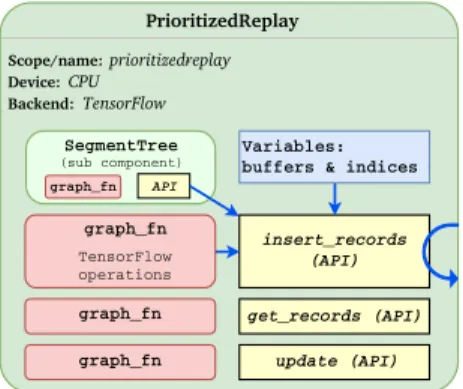
Figure 2.Example memory component with three API methods.
functionality to insert experiences and sample mini-batches according to priority weights. Implementing this buffer in an imperative language such as Python is straight-forward, but including it as part of a TensorFlow graph requires cre-ating and managing many variables through control flow operators (e.g. to update priorities). Composing multiple such components in a re-usable way is difficult due to an impedance mismatch between class-based programming in a driver language, and functional transformations within a dataflow graph. Using a define-by-run framework (e.g. PyTorch) eases development but can create difficulties in large scale distributed execution and program export. Existing high-level APIs for neural networks such as Son-net, (DeepMind,2017), Keras (Chollet et al.,2015), Gluon (Rochel et al.,2018), or TF.Learn (Tang,2016) focus on assembly and training of neural networks. Implementing RL workloads in these frameworks usually means mixing imperative Python control flow with deep learning graph objects, leading to the design issues discussed before. When building for a static graph backend, RLgraph’s com-ponent API enables fast composition of end-to-end differ-entiable dataflow graphs with in-graph control flow. The graph builder and executor automatically manage burden-some tasks such as variable and placeholder creation, scopes, input spaces, and device assignments.
Example component. In figure2, we show a simplified prioritized replay buffer component. All components inherit from the genericComponentclass and assemble logic by
combining their own sub-components. The buffer has a segment tree sub-component to manage priority orders. It exposes API methods to insert, sample, and update priorities which under the hood map to three graph functions. The difference between simple object methods and RLgraph API methods is that registered API methods are identified and managed in the build. Input shapes can be inferred automat-ically via dataflow from inputs to the root component. Developers can declare methods as API methods by call-ing a register function (or in the future uscall-ing a decorator). Technically, not all functionality of a component needs to be registered as an API method. Users can also implement helper functions or utilities, e.g. using TensorFlow opera-tions without including them as API methods, if they do not need to be called from external components. Implementing such utilities as RLgraph components with API methods is nonetheless useful because these features can then be built and tested as sub-graphs.
Components can call arbitrary sub-components (and their sub-components). A component may have multiple API methods where input spaces to one method depend on out-puts of its other methods. The build process ensures com-ponent computations and internal variables are only created once its input spaces are known. Instead of creating implicit device assignments, scopes, and variable sharing through nested contexts, RLgraph explicitly manages these proper-ties per component.
3.3 Building component graphs
RLgraph models are assembled in three distinct phases: 1. Component composition phasein which component
objects are defined and combined, including arbitrary nesting of sub-components.
2. Assembly phasein which a type- and dimension-less dataflow graph (the component graph) is created. This is achieved by calling each of the root component’s API methods once to traverse its graph. The API-methods of the root component define the externally visible API of the component graph.
3. Graph compilation/building phasein which all com-putation operations are defined for each component. Inside a component class, these definitions are placed in special functions calledgraph functions. Graph func-tions are the only places in the code where backend dependent objects are used (e.g. TF ops).
There are also intermittent sub-phases for the initialization of execution aspects (e.g. session management) which are explained in§4. A wide range of off-the-shelf component implementations such as buffers, optimizers, neural net-works, or nested space splitters and mergers means that most
1 @rlgraph_api
2 def update(self, batch_size):
3 sample = self.memory.sample(batch_size)
4
5 s, a, r, next_s, t = self.splitter.split(sample)
6
7
8 loss = self.dqn_loss.get_loss(s, a, r, next_s, t)
9
10 variables = self.policy.variables()
11 update = self.optimizer.step(loss, variables)
12 return update, loss 13 14 15 16 17 @rlgraph_api(split=True) 18 def observe(self, records): 19 return self.memory.insert(records) subcomponent API method of subsomponent Create endtoend graphs by connecting subcomponents Use spacehints to autosplit/merge/flatten; API is actually called once per records component (if records is a dict/tuplecontainer) APIs return abstract “component graphrecords” … … that can be passed into other API methods
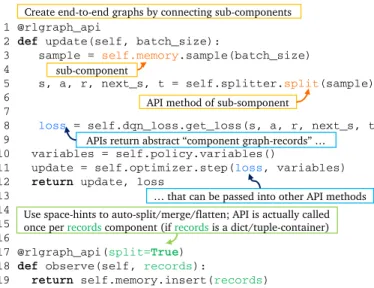
Figure 3.Example API methods show framework-independent control-flow construction.
users will only need to define few components to prototype new algorithms (e.g. loss function, network architecture). 1. Component composition and nesting.All components needed by a model are defined as Python objects. Compo-nents are logically organized as nested subcompoCompo-nents of a root container component exposes the external API. Note that an agent can in theory define multiple root components to act and learn different policies in parallel.
2. Assembling the component graph. Next, users define the dataflow through the model via connections between components. Neither data types nor shape information are necessary at this stage. Each component comes with a set of API-methods (Figure3). The data (tensors) are interpreted inside these methods as abstract meta-graph operator ob-jects, and their shapes and types will be inferred at build time. This is achieved via decorators for API and graph functions which provide options to split, merge, un-nest/re-nest inputs and outputs. Return values of an API call can now be passed into other API-methods, a sub-component’s API-method, or into a graph function for numerical ma-nipulation. RLgraph spaces can conveniently nest, merge, split and fold time and batch dimensions of tensors through components. In our experience, these utilities drastically reduce development times as the different build phases au-tomatically detect problems when manipulating complex spaces, e.g. records containing multiple states and actions with batch and time dimensions.
A simplified component graph assembly procedure is shown in Algorithm1. The root component exposing the external interface (e.g.act,observe,update) and the input spaces for the external API are passed to the component graph builder. This builder generates the backend-independent dataflow graph and the API by iterating over all API methods defined in the root component. For each method, a component graph
Algorithm 1Component graph build procedure Input:componentroot, input spacesspaces api=dict()
// Call all api methods once, generate op columns. formethod, recordinroot.apido
in ops records=list()
// Create one input record per API input param.
forparaminrecord.input argsdo
in ops records.append(Op(param.space))
end for
// Traverse graph from root for this method.
out ops records=method(in ops records)
// Register method with graph inputs and output ops.
api[method] = [in ops records, out ops records]
end for
returnComponentGraph(root, api)
op is created for each of its parameters and looked up in the input graph (type checks and default argument handling omitted). The component graph is then traversed through composed API functions which infer parameters and return values for each call , and these are stored as records in the component graph. Finally, the API method is registered in an API registry which contains the input spaces and final output ops (identified through the traversal).
3. Building computation graphs. All numerical opera-tions occur in the third phase inside graph funcopera-tions which implement each component’s API. Operations defined in a graph function include for example defining loss functions, or sampling from a buffer. As sometimes the component’s variables must be accessed to complete these operations (e.g. a neural network layer must read its weights), RLgraph ensures that any such computation function is only called after all variables of a component have been defined. For ex-ample, the memory component in Fig.2can only define its buffers (e.g. TensorFlow variables) once it receives shapes and types of buffer contents.
This barrier is enforced during the build, and custom com-ponents only need to override a generic method for variable creation. The method is called automatically and receives types and shapes of variables as input arguments. Develop-ers thus only need to specify the external input spaces to the program (e.g. int/float boxes with batch and time ranks, container spaces for nested data). In practice, these are pri-marily state and action layouts defined by the environment. We briefly describe the intuition behind the main build algo-rithm. The build begins by calling all API methods defined at the root from the provided input spaces until a component is input-complete, i.e. all spaces for all its computations are available. It then executes a completion function which calls the component’screate variables, and subsequently its
graph functions under the correct device and scope to define its operations. Once a component is complete, the outputs of its graph functions become available as input spaces for subsequent components/graph functions. We then simply perform breadth-first-search until there are no more com-ponents to build or a constraint violation is detected. Input placeholders and op names are created and stored for all ops and output combinations defined in the API.
1state_space = FloatBox(shape=(64,), add_batch_rank=True,
2 add_time_rank=True)
3# Dict space: 1 discrete, 1 continuous action.
4action_space = Dict(discrete=IntBox(),
5 cont=FloatBox(), add_batch_rank=True)
6policy = Policy("recurrent_policy.json", action_space)
7
8# Construct sub graph from spaces, auto-gen placeholders.
9test = ComponentTest(policy,dict(nn_input=state_space),
10 action_space=action_space))
11# Test with any inputs in the input space.
12action = test.test(policy.get_action, state_space.sample())
Listing 1.Testing sub-graphs from arbitrary spaces.
Testing sub-graphs.Identifying bugs in sub-tasks is diffi-cult without a systematic mechanism for fine-granular input generation. Consider the RLgraph test class example in Listing1. Here, we build aPolicycomponent (with subcom-ponents for a recurrent network and action selection) for the specified state and action spaces (with options for batch and time ranks). The test helper builds the sub-graph for the policy via the phases describe above. Users can then run the test and call an API method (e.g. by sampling an input from the input space). This call is delegated to a graph executor which executes the corresponding op. Every component (including all pre/post processing and learning heuristics) is continuously tested separately and in integration tests for larger graphs (i.e. complete RL algorithms).
3.4 Agent API
Pre-built models can be configured via declarative configu-rations similar to TensorForce (Schaarschmidt et al.,2018). Configurations are provided as e.g. JSON documents speci-fying an algorithm and its components (network with list of layers, buffer, optimizers, device strategy etc.). The agent interface defines a set of abstract methods which agents must support to access certain execution modes (Listing2). The main difference between RLgraph and existing APIs lies in strictly enforced component boundaries and more explicit execution semantics. Fine-grained device control is managed via a device map where each components oper-ations and variables can be assigned separately and selec-tively. Components may only exchange data along edges of the component graph where an edge corresponds to a call to a declared API method. This ensures well-defined APIs and also avoids a common case where two components
are implemented to always be used together, thus making individual reuse difficult. In RLgraph, all components can be used and built individually from any input spaces. Next, we discuss graph execution.
1abstractclassrlgraph.agent:
2 # Build with default devices, variable sharing, ..
3 defbuild(options)
4 defget_actions(states, explore=True, preprocess=True)
5 # Update from internal buffer or external data.
6 defupdate(batch=None, sequence_indices=None)
7 # Observe samples for named environments.
8 defobserve(state, action, reward, terminal, env_id)
9 defget_weights,defset_weights
10 defimport_model,defexport_model
Listing 2.High level agent API.
4
E
XECUTING GRAPHS4.1 Graph executors.
All build phases are invoked from agraph executorwhich serves as the execution bridge between the component graph and a backend framework. Graph executors expose an exe-cute()method which takes name and arguments of an API method and returns the result. They further manage any backend-specific initialization, monitoring, and devices. For example, the TensorFlow executor assumes the following tasks. First, it initializes the TensorFlow session and vari-ables, and builds hooks for summaries or profiling. For operation execution, it fetches input placeholders and op names from the graph operation registry and assembles session inputs. Importantly, there is no other interaction between user programs and graph other than through API operations defined in the root component.
Device management.Graph executors also handle device assignments by interleaving the build with a phase to ini-tialize device strategies. Upon initialization, local device information (e.g. CUDA visible devices) is read and com-pared against user-defined device maps or synchronization modes. Consider a synchronous multi-GPU strategy where each input batch is split to one graph copy per GPU, with gradients averaged for the final update. Managing this syn-chronization requires the creation of additional operations and variables for the device copies and the splitting and av-eraging logic. The graph executor does this by creating core component copies and connecting them through generic input space splitters before building the component graph. Since no variables or placeholders have been created at this stage, components or sub-graphs can straightforwardly be modified, replaced or extended. In addition to generic device strategies, users can define a device map which specifies a device assignment for each component’s ops and variables. Distributed execution. RLgraph can be executed in dis-tributed mode either with framework-specific mechanisms or by using any other means to create and synchronize
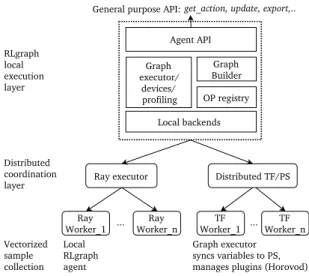
Agent API Graph executor/ devices/ profiling General purpose API: get_action, update, export,.. Local backends Ray executor Ray Worker_1 Distributed coordination layer Ray Worker_n RLgraph local execution layer Local RLgraph agent Graph Builder OP registry ... Distributed TF/PS Vectorized sample collection TF Worker_1 ... Worker_nTF Graph executor syncs variables to PS, manages plugins (Horovod) Figure 4.RLgraph execution stack.
agents. For example, when using distributed TensorFlow, the TF graph executor can create the necessary parameter server and global/local synchronization operations. It can also plug-in third party tools such as Uber’s Horovod to assume specific aspects of distributed communication for a backend (e.g. ring all-reduce (Sergeev & Balso,2018)). To demonstrate RLgraph’s flexibility, we also built a Ray executor which can execute arbitrary RLgraph implemen-tations on Ray’s centralized execution model (Moritz et al., 2017). In the evaluation, we show that our implementation outperforms Ray’s native library RLlib (Liang et al.,2018). Figure4illustrates how local execution and distributed co-ordination are separated. When using Ray, we simply pass an agent configuration to our Ray executor which creates Ray workers, each locally generating their component graph and graph executor to interact with environments. When using non-centralized control (e.g. distributed TensorFlow), the graph executor creates the necessary session and server objects and handles parameter server synchronization on each worker. Common features such as fault tolerance are delegated to the underlying execution engines via a configu-ration interpreted by the respective graph executors. 4.2 Backend support and code generation
Define-by-run graphs.While there are many advantages to defining models as end-to-end computation graphs, define-by-run semantics and eager execution are increasingly pop-ular for ease of use. RLgraph’s component graph can be executed both in static graph construction or define-by-run mode. To implement a PyTorch backend, we only had to modify the build procedure as follows. As there are no placeholders, we simply create torch tensors during the build phase as artificial placeholders to push through the dataflow graph for shape and type inference of variables (e.g. tensors used to store state). This is because even in define-by-run mode, automatically dealing with nesting and
splitting of complex spaces across time and batch dimen-sions can be handled via decorators. Next, after building the component graph, we change the execution mode flag for API methods from ’build’ to ’define-by-run’. In this mode, instead of returning operation objects used for graph construction, RLgraph simply directly evaluates a call-chain of graph functions to retrieve the result. RLgraph hence pro-vides a unified interface for executing its component graph API in define-by-run and static-graph mode.
Autograph and graph optimization. An emerging but early trend in deep learning frameworks are features to au-tomatically convert imperative code to static computation graphs. Examples of this include TensorFlow’s AutoGraph (Moldovan et al.,2018) mechanism and PyTorch’s JIT trac-ing. We encountered temporary limitations e.g. in Auto-Graph on stateful operations which would need to convert list manipulation to TF variable updates. We plan to merge backend-dependent graph-function implementations into single-stream functions, which will then be auto-converted where possible.
The ad-hoc mixed-backend implementation style of many RL libraries creates hurdles for systematically exploiting graph generation. RLgraph provides a natural fit for these features due to its organization of all backend code into graph functions as logical units. Features such as auto-graph can hence be integrated centrally in decorators during the build process (similar to device assignment).
RLgraph’s separation of concerns opens up opportunities for optimization at all stages. Emerging approaches in op-timizing execution (e.g. via automated device placement (Mirhoseini et al.,2018)), or backend-dependent compila-tions can be integrated at the graph build stage.
5
E
VALUATIONWe evaluate RLgraph’s performance using different dis-tributed execution engines, local deep learning backends, and device strategies. Our aim is not to benchmark the underlying frameworks but to show RLgraph can perform competitively compared to native implementations. 5.1 Results
Build overhead.We begin by comparing the one-time build overhead of RLgraph’s abstractions on different backends. Recall there are two sources of overhead during initializa-tion. First, the component graph is created by traversing the graph from the root. Second, creating variables and potentially static graph operations by letting input spaces flow through the component graph requires moving through components in the iterative build procedure.
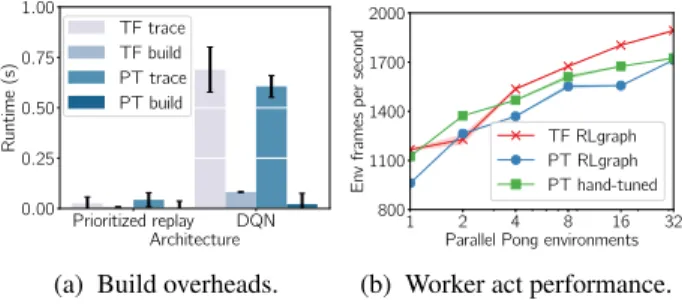
overhead on a single memory component and a common RL architecture (DQN) for the TensorFlow (TF) (v1.11) and PyTorch (PT) (v0.4) backends. Overhead here refers to the time spent on top of creating variables and operations, which would have to be done irrespective of using RLgraph. The overhead for both build phases to build a single component (e.g. for modular performance testing and debugging) is less than 100 ms. For a common architecture (dueling DQN with prioritized replay, 43 components), the combined overhead is about 1 s for TF and 650 ms for PT. PyTorch builds only require a few milliseconds as variables (e.g. to represent memory state) are native Python lists or NumPy arrays.
Prioritized replay DQN Architecture 0.00 0.25 0.50 0.75 1.00 Runtime (s) TF trace TF build PT trace PT build
(a) Build overheads.
1 2 4 8 16 32
Parallel Pong environments 800 1100 1400 1700 2000 Env frames per second TF RLgraph PT RLgraph PT hand-tuned
(b) Worker act performance.
Figure 5.TensorFlow and PyTorch backend comparison.
We also compare backend runtime performance by testing act (inference) throughput on a single-threaded worker act-ing on a vector of environments (Fig. 5b). We use the Atari Pong environment and a standard 3-layer convolu-tional architecture followed by a dueling network for action selection. The TF backend (TF RLgraph) does not incur runtime overhead because the component graph is discarded after building. The graph executor only looks up the name of the operation in the op registry and executes the corre-sponding TF op. In define-by-run mode using PyTorch (PT RLgraph), RLgraph incurs some overhead when calls are routed through components. To understand this overhead, we also implemented a bare-bones PyTorch actor, including fine-tuning OpenMP and MKL settings (PT hand-tuned). TensorFlow outperforms both PyTorch variants as batch-size increases on a CPU, thus making it more suitable for per-forming batch-acting and batch-postprocessing. RLgraph’s PT backend carries overhead due to requiring additional lookups when traversing the graph via API decorators. This overhead becomes negligible as batch size increases and runtime is dominated by the network forward passes. To reduce this overhead when traversing the component graph, we implemented some initial fast-path calls. For some cases, the graph builder can identify edge-contractions (where calls are edges and components are vertices), so define-by-run execution through the relevant sub-graph requires no inter-mediate component calls.
To the best of our knowledge, RLgraph represents the first common interface to TF and PT on a component level. High-level APIs like Keras only support static graph approaches.
Libraries such as Ray RLlib support TF/PT backends but only on an algorithm level where entire implementations can be parallelized via RLlib’s distributed abstractions. Us-ing RLgraph, developers assemble logic via the backend-independent API, and can then implement e.g. a new loss component in their backend of choice.
Distributed execution on Ray.Next, we evaluate RLgraph on the distributed execution engine Ray in comparison to Ray’s native library, RLlib (v0.5.2). We implemented dis-tributed prioritized experience replay (Ape-X (Horgan et al., 2018)), a state-of-the-art distributed Q-learning algorithm on our Ray executor. We further implemented a vector-ized environment worker for sample collection, including all heuristics described in the Ape-X paper and found in RLlib’s implementation (e.g. worker-side prioritization). All experiments were performed on Google Cloud with the learner being hosted on a GPU instance with 1 active V100 GPU, 24 vCPUs and 104 GiB RAM. Sample collection nodes had 64 vCPUs and 256 GiB RAM. Figure6shows
16 32 64 128 256 Number of workers 0 25000 50000 75000 100000 125000 150000 175000 Environment frames/s RLLib RLgraph
Figure 6.Distributed sample throughput onPong.
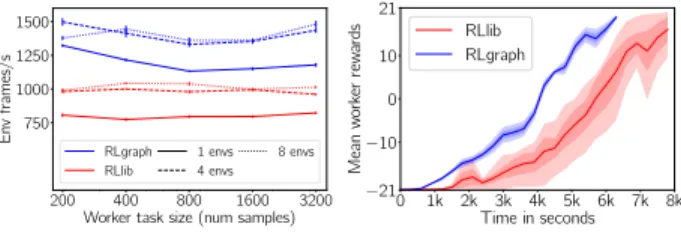
sampling performance on the Pong environment. The x-axis represents the number of policy-evaluators/Ray-workers re-spectively (RLlib, RLgraph), each initialized with a single CPU, and the y-axis shows environment frames per second (including frame skips). Each worker executed 4 environ-ments, and we used 4 instances of replay memories to feed the learner (we did not observe improvements using more memories due to limited vCPUs on GPU nodes). All set-tings were run with 8 sample nodes except 256 workers (16 sample nodes) to ensure sufficient memory. RLgraph outperforms RLlib by a large margin (185% on 16, 60% on 256 workers) despite implementing the same algorithm with equivalent hyper-parameters, model size, and environments. Performance for 16 workers is highest due to better resource utilization. RLgraph also completes its learning tasks faster due to improved implementations.
The reason for RLgraph’s performance is systematic com-ponent analysis yielding insights into efficient sample pro-cessing. For example, RLlib’s policy evaluators execute multiple session calls to incrementally post-process batches. RLgraph instead splits post-processing in incremental and
batched parts to minimize calls to the TensorFlow runtime. These effects can also be observed at the scale of a single
200 400 800 1600 3200 Worker task size (num samples) 750 1000 1250 1500 Env frames/s RLgraph RLlib 1 envs 4 envs 8 envs
(a) Single worker throughput.
0 1k 2k 3k 4k 5k 6k 7k 8k Time in seconds −21 −10 0 10 21 Mean w ork er rew
ards RLlibRLgraph
(b) Training times forPong.
Figure 7.Single task throughput and learning comparison.
task across different task lengths and number of environ-ments (called sequentially). Figure7ashows the requested number of samples versus the achieved frames per second using a single RayWorker (RLgraph) versus a policy eval-uator (RLlib). Both use the same agent and configuration as in the distributed setting (10 warm up runs, mean across 50 runs). RLgraph is not only more effective on a single en-vironment, it also scales better on vectorized environments due to faster accounting across environments and episodes. We show learning results (Fig.7b) to confirm that RLgraph’s throughput is not at the cost of training performance. We use RLlib’s provided tunedPongconfiguration (32 workers). In RL, the same code using the same hyper-parameters can vary drastically across runs, so reliably comparing learning is difficult (Henderson et al.,2017). We ran 10 random seeds and averaged across the 3 best runs (both libraries did not learn anything for some seeds as expected). In line with throughput, RLgraph learns to solve (reward 21) Pong substantially faster than RLlib.
Note that RLlib’s published results on Ape-X throughput do not include updating without stating this explicitly, and later reported results including updates2 are up to 130 k frames per second on 256 workers (versus 170 k max for RLgraph). Experimental versions of Ray’s new backend include improved garbage collection of which RLgraph would benefit to the same extent as RLlib3. Our results show RLgraph’s execution-agnostic design can integrate with external execution engines, and perform competitively. While RLlib could adopt more efficient implementations, our insight is that RLgraph can be used on Ray via few wrapper classes. Implementing other distributed semantics on Ray with RLgraph only requires extending the generic Ray executor to implement a coordination loop. Finally, RLgraph’s modularization helps visualizing computation graphs when compared to programming models such as 2Source: RLlib authors, https://github.com/
ray-project/ray/issues/2466
3
During experimentation using Ray’s original backend, we ex-perienced some difficulties with the Ray engine, including memory leaks and task initialization crashes.
RLlib’s, which scatter code across fragmented tasks. We visualize both Ape-X implementations in AppendixA.2.
0 1k 2k 3k 4k 5k 6k 7k 8k Time in seconds −21 −10 0 10 21 Mean w ork er rew ards Single GPU Multi-GPU-Sync
Figure 8.RLgraph synchronous multi-GPU device strategy
Multi-GPU strategies.We also implemented device strat-egy prototypes where the component graph is automatically expanded during the build phase (e.g. to create sub-graph replicas). When using a synchronous GPU replica strategy, the update batch is internally split into multiple sub-batches, and gradients are averaged across towers. Fig. 8contains Ape-X results using 1 and 2 V100 GPUs. We observe the expected speed-up in convergence.
Distributed TensorFlow. Finally, we evaluate RLgraph using the distributed TensorFlow backend on DeepMind’s (DM) importance-weighted actor-learner architecture (IM-PALA) (Espeholt et al., 2018). The authors have open-sourced an optimized implementation4. IMPALA perhaps best represents the end-to-end computation graph paradigm, where even environment interaction is fused into the TF graph. We implemented IMPALA in RLgraph to demon-strate its ability to generate such graphs. To this end, RL-graph provides generic execution components for RL- graph-fused environment stepping. IMPALA executes updates by letting each actor perform a rollout step (100 samples) and input its samples into a globally shared blocking queue. The learner dequeues rollouts and uses a staging area to hide GPU latency. Figure9compares throughput using the large
16 32 64 128 256 Number of workers 0 5000 10000 15000 20000 Environment frames/s Deepmind IMPALA RLgraph IMPALA
Figure 9.IMPALA throughput comparison onseekavoid arena 01
network described in the paper on a DM lab 3D task (which are more expensive to render than Atari tasks). We again use a single V100 GPU for the learner and let 4 workers
4
Code at: https://github.com/deepmind/
each share a 8 vCPU instance. RLgraph achieves about 10-15% higher mean throughput (5 runs) for fewer workers until both implementations are limited by updates. DM’s implementation exhibited higher variance due to subtle dif-ferences in preprocessing tensors after unstaging. DM’s code also carried out unneeded variable assignments in the actor. Removing these yielded 20% improvement in a single-worker setting for RLgraph. Emerging tools in graph opti-mization (e.g. TF XLA, TVM (Chen et al.,2018)) can help with optimizing data layouts and numerical transformations. RLgraph helps most in improving high level dataflow as it enforces well-defined interactions between components (c.f. AppendixA.1). This in turn improves reasoning about the complex design patterns found in RL algorithms.
5.2 Discussion
Our results show that using RLgraph to define algorithms via combining backend-independent components yields high-performing implementations across backends. Assembling the graph through the different build phases only adds up to one second of build overhead. Using Ray as a distributed backend, we demonstrated that RLgraph run on its own Ray executor outperforms Ray RLlib. This indicates that wide-spread mixed backend (e.g. Python/TF) RL implemen-tations can be significantly accelerated via careful dataflow analysis, and without changing algorithm logic. Using distributed TF, we found that RLgraph can help improve dataflow in end-to-end static computation graphs. Our main take-away is that developers can use RLgraph to focus on logical component composition in RL independently of the underlying execution paradigm.
6
R
ELATED WORKRLgraph builds upon the experiences of many prior libraries which we discussed in§2.2. Here, we discuss emerging trends in programming models and optimizations.
6.1 Programming models
The success of deep learning frameworks has given rise to several higher-level learning APIs seeking to free users from dealing with lower level tensor operations. Keras (Chollet et al., 2015) is a popular framework for quick assembly and training of deep learning models with sup-port for multiple static-graph backends (e.g. TensorFlow (Abadi et al., 2016), CNTK (Seide & Agarwal, 2016), MXNet (Chen et al.,2015)). Gluon provides a concise API for imperative, dynamic neural networks on top of MXNet (Rochel et al.,2018). TF.Learn offers a high level API for constructing symbolic TensorFlow graphs (Tang, 2016). Among these frameworks, TensorFlow’s program-ming model (Abadi et al.,2017) is distinct because it sup-ports in-graph control-flow (Yu et al.,2018). A key issue
in the high-level APIs above is that they typically assume control-flow to be implemented in the driver language (fre-quently Python). RLgraph bridges this gap by providing Sonnet-style (DeepMind,2017) composable components, with the addition of API methods handling in-graph control flow, or define-by-run graph execution.
6.2 Graph optimizations and code generation
Programming models for machine learning and in partic-ular deep learning typically prioritize high level APIs and usability over performance. Code is written in a multitude of languages and libraries, and is executed over a variety of backends. Frameworks like Weld (Palkar et al.,2017) optimize performance by integrating library calls into a com-mon intermediate representation which is then mapped to efficient multi-threaded code. Mirhoseini et al. identify effective TensorFlow device placements via hierarchical re-inforcement learning (Mirhoseini et al.,2018). FlexFlow further improves parallelization strategies for specific de-ployments using an execution simulator and fine-grained randomized search across execution dimensions (Jia et al., 2018). TVM is a compiler stack to optimize tensor opera-tions across diverse hardware backends (Chen et al.,2018). RLgraph constructs component graphs irrespective of ex-ecution semantics. Optimizations can be performed at the level of graph executors by including them in the build. The proliferation of deep learning frameworks which often focus development efforts on Python front-ends has also created the need for new shared representations. The aim of standard formats such as ONNX (Facebook Inc.,2017) is to enable model interoperability, define a common route from prototyping to production deployment, and to create a shared runtime for optimizations. From a RL perspective, the aim of deployable graphs is more difficult to achieve due to the extensive control-flow and state management in RL workloads. Implementing code using e.g. TensorFlow con-trol flow operators allows immediate export, optimization and deployment of the entire RL program but can slow down development. Framework developers have recognized this tension and are designing tools such as AutoGraph in TF for automatic graph generation. As these initiatives mature, we expect RLgraph components to merge backend-dependent graph functions by leveraging automatic graph generation.
7
C
ONCLUSIONRLgraph is a new open source framework for designing and executing computation graphs for reinforcement learning. RLgraph’s component graph abstraction allows develop-ers to separate the composition of logical components in a RL algorithm from their local backend and distributed execution. The resulting implementations are fast, robust, incrementally testable, and easy to extend or re-use.
A
CKNOWLEDGMENTSMichael Schaarschmidt is supported by a Google PhD Fel-lowship. We are also grateful for receiving research credits from Google Cloud. This research was supported by the EPSRC (grant references EP/M508007/1 and EP/P004024), the Alan Turing Institute, and a Sansom scholarship. Further, we thank Lasse Espeholt for providing support to replicate IMPALA results. We also want to thank the RLlib authors for helping to replicate Ape-X results.
R
EFERENCESAbadi, M., Barham, P., Chen, J., Chen, Z., Davis, A., Dean, J., Devin, M., Ghemawat, S., Irving, G., Isard, M., et al. Tensorflow: A system for large-scale machine learning. InOSDI, volume 16, pp. 265–283, 2016.
Abadi, M., Isard, M., and Murray, D. G. A computa-tional model for tensorflow: An introduction. In Pro-ceedings of the 1st ACM SIGPLAN International Work-shop on Machine Learning and Programming Languages, MAPL 2017, pp. 1–7, New York, NY, USA, 2017. ACM. ISBN 978-1-4503-5071-6. doi: 10.1145/3088525. 3088527. URLhttp://doi.acm.org/10.1145/
3088525.3088527.
Bellemare, M. G., Naddaf, Y., Veness, J., and Bowling, M. The arcade learning environment: An evaluation platform for general agents.J. Artif. Intell. Res.(JAIR), 47:253–279, 2013.
Bellemare, M. G., Castro, P. S. C., Gelada, C., Kumar, S., and Moitra, S. Dopamine. https://github.com/ google/dopamine, 2018.
Brockman, G., Cheung, V., Pettersson, L., Schneider, J., Schulman, J., Tang, J., and Zaremba, W. Openai gym.
CoRR, abs/1606.01540, 2016. URLhttp://arxiv.
org/abs/1606.01540.
Caspi, I., Leibovich, G., and Novik, G. Reinforcement learning coach, December 2017. URLhttps://doi.
org/10.5281/zenodo.1134899.
Chen, T., Li, M., Li, Y., Lin, M., Wang, N., Wang, M., Xiao, T., Xu, B., Zhang, C., and Zhang, Z. Mxnet: A flexible and efficient machine learning library for heterogeneous distributed systems.CoRR, abs/1512.01274, 2015. URL
http://arxiv.org/abs/1512.01274.
Chen, T., Moreau, T., Jiang, Z., Zheng, L., Yan, E., Cowan, M., Shen, H., Wang, L., Hu, Y., Ceze, L., Guestrin, C., and Krishnamurthy, A. Tvm: An auto-mated end-to-end optimizing compiler for deep learning.
http://arxiv.org/abs/1802.04799v2, 2018.
Chollet, F. et al. Keras.https://keras.io, 2015.
DeepMind. Sonnet: TensorFlow-based neural net-work library. https://github.com/deepmind/ sonnet, 2017.
Espeholt, L., Soyer, H., Munos, R., Simonyan, K., Mnih, V., Ward, T., Doron, Y., Firoiu, V., Harley, T., Dun-ning, I., Legg, S., and Kavukcuoglu, K. IMPALA: scal-able distributed deep-rl with importance weighted actor-learner architectures.CoRR, abs/1802.01561, 2018. URL
http://arxiv.org/abs/1802.01561.
Facebook Inc. ONNX- Open Neural Network Exchange Format.https://onnx.ai, 2017.
Gauci, J., Conti, E., Liang, Y., Virochsiri, K., He, Y., Kaden, Z., Narayanan, V., and Ye, X. Horizon: Facebook’s open source applied reinforcement learning platform. CoRR, abs/1811.00260, 2018. URL http://arxiv.org/
abs/1811.00260.
Guadarrama, S., Korattikara, A., Ramirez, O., Castro, P., Holly, E., Fishman, S., Wang, K., Gonina, E., Harris, C., Vanhoucke, V., and Brevdo, E. TF-Agents: A library for reinforcement learning in ten-sorflow. https://github.com/tensorflow/
agents, 2018. URL https://github.com/
tensorflow/agents. [Online; accessed
30-November-2018].
Hafner, D., Davidson, J., and Vanhoucke, V. Tensor-flow agents: Efficient batched reinforcement learning in tensorflow. CoRR, abs/1709.02878, 2017. URL
http://arxiv.org/abs/1709.02878.
Henderson, P., Islam, R., Bachman, P., Pineau, J., Precup, D., and Meger, D. Deep reinforcement learning that matters. CoRR, abs/1709.06560, 2017. URL http:
//arxiv.org/abs/1709.06560.
Horgan, D., Quan, J., Budden, D., Barth-Maron, G., Hessel, M., van Hasselt, H., and Silver, D. Distributed prioritized experience replay. CoRR, abs/1803.00933, 2018. URL
http://arxiv.org/abs/1803.00933.
Jia, Z., Zaharia, M., and Aiken, A. Beyond data and model parallelism for deep neural networks.
http://arxiv.org/pdf/1807.05358v1, 2018.
Levine, S., Finn, C., Darrell, T., and Abbeel, P. End-to-end training of deep visuomotor policies. J. Mach. Learn. Res., 17(1):1334–1373, January 2016. ISSN 1532-4435. URL http://dl.acm.org/citation.
cfm?id=2946645.2946684.
Liang, E., Liaw, R., Nishihara, R., Moritz, P., Fox, R., Gold-berg, K., Gonzalez, J., Jordan, M., and Stoica, I. Rllib: Abstractions for distributed reinforcement learning. In
International Conference on Machine Learning, pp. 3059– 3068, 2018.
Mania, H., Guy, A., and Recht, B. Simple random search provides a competitive approach to reinforce-ment learning. CoRR, abs/1803.07055, 2018. URL
http://arxiv.org/abs/1803.07055.
Mirhoseini, A., Goldie, A., Pham, H., Steiner, B., Le, Q. V., and Dean, J. Hierarchical planning for device place-ment. 2018. URL https://openreview.net/
pdf?id=Hkc-TeZ0W.
Moldovan, D., Decker, J. M., Wang, F., Johnson, A. A., Lee, B. K., Nado, Z., Sculley, D., Rompf, T., and Wiltschko, A. B. Autograph: Imperative-style coding with graph-based performance.CoRR, abs/1810.08061, 2018. URL
http://arxiv.org/abs/1810.08061.
Moritz, P., Nishihara, R., Wang, S., Tumanov, A., Liaw, R., Liang, E., Paul, W., Jordan, M. I., and Stoica, I. Ray: A distributed framework for emerging AI applications.
CoRR, abs/1712.05889, 2017. URLhttp://arxiv.
org/abs/1712.05889.
Nagarajan, P., Warnell, G., and Stone, P. The impact of nondeterminism on reproducibility in deep reinforcement learning.https://arxiv.org/abs/1809.05676, 2018. OpenAI. OpenAI Five DOTA. Website, June 2018. URL
https://blog.openai.com/openai-five/.
Palkar, S., Thomas, J. J., Shanbhag, A., Narayanan, D., Pirk, H., Schwarzkopf, M., Amarasinghe, S., Zaharia, M., and InfoLab, S. Weld: A common runtime for high performance data analytics. InConference on Innovative Data Systems Research (CIDR), 2017.
Paszke, A., Gross, S., Chintala, S., Chanan, G., Yang, E., DeVito, Z., Lin, Z., Desmaison, A., Antiga, L., and Lerer, A. Automatic differentiation in pytorch. InNIPS-W, 2017.
Plappert, M. keras-rl. https://github.com/
matthiasplappert/keras-rl, 2016.
Rochel, S. et al. Gluon - A clear, concise, simple yet powerful and efficient API for deep learning. https:
//github.com/gluon-api/gluon-api, 2018.
Schaarschmidt, M., Kuhnle, A., Ellis, B., Fricke, K., Gessert, F., and Yoneki, E. Lift: Reinforcement learning in com-puter systems by learning from demonstrations. CoRR, abs/1808.07903, 2018. URL http://arxiv.org/
abs/1707.06347.
Seide, F. and Agarwal, A. Cntk: Microsoft’s open-source deep-learning toolkit. InProceedings of the 22nd ACM SIGKDD International Conference on Knowledge Dis-covery and Data Mining, pp. 2135–2135. ACM, 2016.
Sergeev, A. and Balso, M. D. Horovod: fast and easy distributed deep learning in tensorflow. CoRR, abs/1802.05799, 2018. URL http://arxiv.org/
abs/1802.05799.
Sidor, S. and Schulman, J. Openai baselines. web-site, 2017. URL https://blog.openai.com/
openai-baselines-dqn/.
Silver, D., Huang, A., Maddison, C. J., Guez, A., Sifre, L., Van Den Driessche, G., Schrittwieser, J., Antonoglou, I., Panneershelvam, V., Lanctot, M., et al. Mastering the game of go with deep neural networks and tree search.
Nature, 529(7587):484–489, 2016.
Silver, D., Schrittwieser, J., Simonyan, K., Antonoglou, I., Huang, A., Guez, A., Hubert, T., Baker, L., Lai, M., Bolton, A., et al. Mastering the game of go without human knowledge. Nature, 550(7676):354, 2017. Tang, Y. Tf.learn: Tensorflow’s high-level module for
dis-tributed machine learning.CoRR, abs/1612.04251, 2016.
URLhttp://arxiv.org/abs/1612.04251.
Tobin, J., Zaremba, W., and Abbeel, P. Domain randomiza-tion and generative models for robotic grasping. CoRR, abs/1710.06425, 2017. URL http://arxiv.org/
abs/1710.06425.
Wayne, G., Hung, C., Amos, D., Mirza, M., Ahuja, A., Grabska-Barwinska, A., Rae, J. W., Mirowski, P., Leibo, J. Z., Santoro, A., Gemici, M., Reynolds, M., Harley, T., Abramson, J., Mohamed, S., Rezende, D. J., Saxton, D., Cain, A., Hillier, C., Silver, D., Kavukcuoglu, K., Botvinick, M., Hassabis, D., and Lillicrap, T. P. Unsuper-vised predictive memory in a goal-directed agent.CoRR, abs/1803.10760, 2018. URL http://arxiv.org/
abs/1803.10760.
Yu, Y., Abadi, M., Barham, P., Brevdo, E., Burrows, M., Davis, A., Dean, J., Ghemawat, S., Harley, T., Hawkins, P., Isard, M., Kudlur, M., Monga, R., Murray, D., and Zheng, X. Dynamic control flow in large-scale ma-chine learning. InProceedings of the Thirteenth EuroSys Conference, EuroSys ’18, pp. 18:1–18:15, New York, NY, USA, 2018. ACM. ISBN 978-1-4503-5584-1. doi: 10.1145/3190508.3190551. URLhttp://doi.acm.
A
V
ISUALIZING COMPUTATION GRAPHS A.1 IMPALATo illustrate how RLgraph helps organize computation graphs, we visualize the IMPALA implementation discussed in the evaluation.
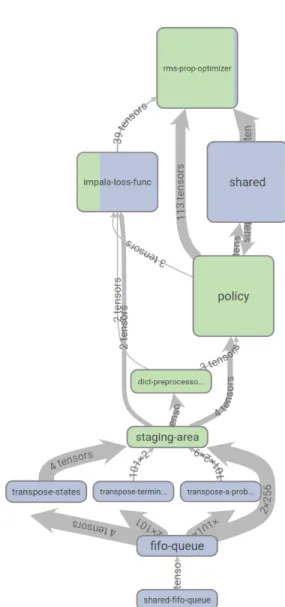
Figure10illustrates the RLgraph implementation using Ten-sorBoard. As each component’s scope and variables are managed by RLgraph during the build, device assignments and dataflow are easy to visualize automatically with exist-ing tools. Here, green components are on the GPU while blue components are on the CPU. The dataflow from bottom to top clearly illustrates how tensors are moved from the shared queue, preprocessed, then moved to a staging area. The prior batch is taken from the staging area, then pre-processed and passed to the policy and loss function. The optimizer and policy interact with asharedscope as learner and workers share policy variables.
Mixed colours imply that a component has multiple sub-components on different devices. For example, the IMPALA loss-function computes an importance correction on the CPU as it is difficult to parallelize, so the loss-component has mixed assignments. We found that RLgraph specifi-cally helps to make more effective use of existing tools like TensorBoard, as clean visualizations are key to identifying problems (e.g. with device assignments).
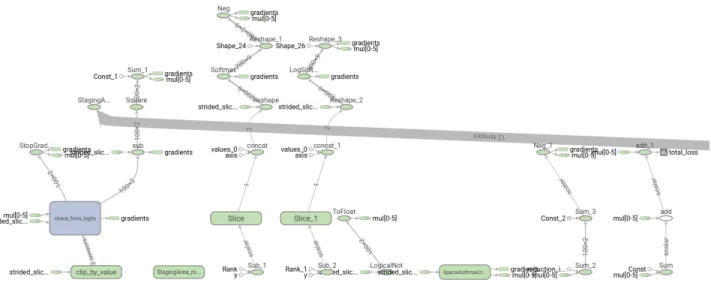
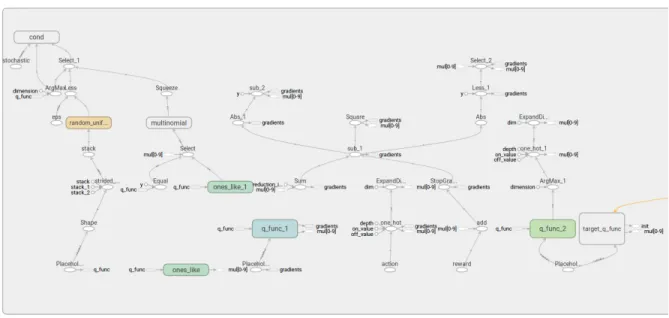
In Figures11and12(split due to size in TensorBoard), we show for comparison a visualization of DeepMind’s open source IMPALA implementation. As is common for self-contained RL scripts, scopes, devices, and operation names are handled on an ad-hoc basis. The resulting graph, while implementing the same logic as our code, is highly frag-mented in the visualization, making insights into potential problems much more difficult.
A.2 Ape-X
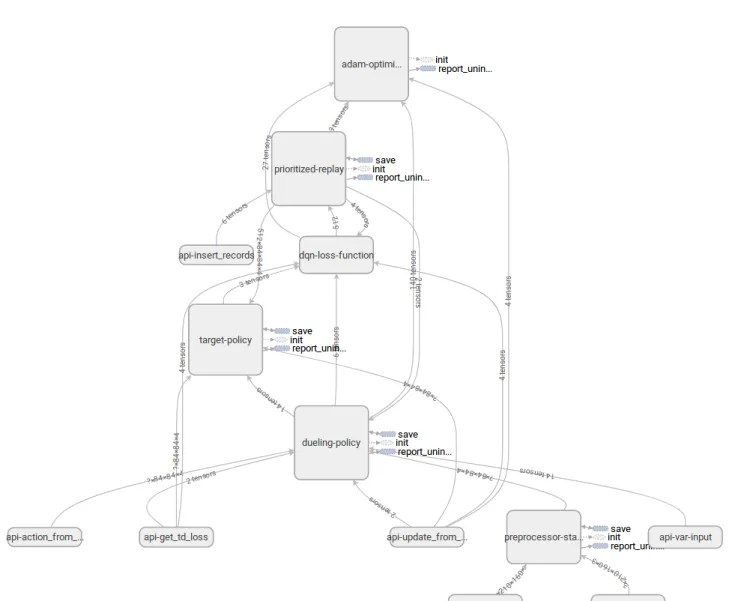
When executing on Ray, computation graphs are fragmented into separate tasks represented by Ray actors, as opposed to end-to-end differentiable graphs such as in distributed TensorFlow (Abadi et al.,2017;Yu et al.,2018). In RLlib, task code is scattered across agent classes, policy graphs, and backend-specific utilities. Understanding dataflow be-tween components is difficult due to a lack of consistent modularization across imperative function calls. RLgraph’s separation of execution semantics and graph design results in consistent graph creation irrespective of the backend used. In Figure13, we show the corresponding TensorBoard visu-alization for RLgraph’s Ape-X learner. Figures14and15 show RLlib’s highly fragmented Ape-X graph.
Figure 10.TensorBoard visualization of RLgraph’s IMPALA learner. As all operations and variables are organized in com-ponents under separate scopes, dataflow between comcom-ponents is clear.
Figure 11.TensorBoard visualization of DeepMind’s IMPALA learner (left).
Figure 14.TensorBoard visualization of RLlib’s Ape-X learner (left).