Competitive Strategy for Open Source Software
Vineet Kumar ([email protected]),
Harvard Business School, Boston, Massachusetts
Brett Gordon ([email protected]),
Columbia Business School, New York, New York
Kannan Srinivasan ([email protected]),
Carnegie Mellon University, Pittsburgh, Pennsylvania
January 25, 2011
Abstract
Commercial open source software (COSS) products—privately developed software based on publicly available source code—represent a rapidly growing, multi-billion dollar market. A unique aspect of competition in the COSS market is that many open source licenses require firms to make certain enhancements public, creating an incentive for firms to free-ride on the contributions of others. This practice raises a number of puzzling issues. First, why should a firm further develop a product if competitors can freely appropriate these contributions? Second, how does a market based on free-riding produce products that effectively compete with similar products from proprietary software firms? Third, from a public policy perspective, does the mandatory sharing of enhancements raise or lower consumer surplus?
We develop a two-sided model of competition between COSS firms to address these issues. Our model consists of (1) two firms competing in a vertically differentiated market, where product quality is a mix of public and private components, and (2) a market for developers whom firms hire after observing signals of their contributions to open source. We demonstrate that free-riding behavior is supported in equilibrium, that a COSS market can produce better products than a traditional software market, and that free-riding can actually increase profits and consumer surplus.
∗
The authors would like to thank Anthony Dukes, Oded Koenigsberg, seminar participants at UT Dallas, the
3GTM Conference at HEC Montr´eal, and the Marketing Research Forum at CKGSB for comments. Any remaining
1
Introduction
Open source software is built through public collaboration and is distributed for free. The source
code is published openly allowing others to modify and enhance it, in contrast to the traditional
model of software where firms keep their source code private.1 The free and open model has led to
the increasing adoption of open source among consumers and firms, and has fundamentally altered
the landscape of competition in the software market.2
A growing number of firms build commercial products based on open source software
(Economist, 2009). These commercial open source software (COSS) firms enhance the features
and usability of the existing open source software, resulting in a product that contains both
pub-licly and privately developed components. A variety of open source licenses exist that dictate how
modified versions may be distributed.3 Certain licenses require COSS firms to release feature
im-provements to the public, where competing firms can incorporate them into their own products.
Thus, some firms are able to free-ride on the contributions of others, a practice which Microsoft
CEO Steve Ballmer referred to as “a cancer that attaches itself in an intellectual property sense to
everything it touches,” (New York Times, 2003).
The unique institutional arrangements discussed above raise a number of puzzling issues. First,
why should a firm develop additional features for its product if competitors can freely appropriate
these features for their products? Second, technology experts have pointed to cases where COSS
products are of comparable or even higher quality than similar products produced by traditional,
1Open source software should be distinguished from two other forms of freely available software. Some firms
make their software available for free (“freeware”) but do not make the source code available (e.g., Adobe Reader). Another form is voluntary open source, where a firm releases the source code but with strong restrictions on its use and redistribution. We do not consider these cases because the strategic issues involved differ significantly from those faced by COSS firms.
2Popular examples of open source software include the Linux operating system, Firefox browser, OpenOffice,
Apache Web Server, SugarCRM, and MySQL, among others. See http://www.sourceforge.net for a web-based repos-itory of open source applications.
3
We focus on the two types of licenses most common and relevant to the COSS industry: the GNU General
Public License (http://www.gnu.org) and the Berkeley Software Distribution License (http://www.opensource.
closed source software firms (Dedeke, 2009). How does a market where firms face a strong incentive
to free-ride produce high quality products? Third, does the mandatory sharing of features always
result in the creation of fewer open source features? Fourth, when are firms and consumers truly
hurt by the “cancer” of free-riding, as Ballmer describes it?
Despite the growing importance of the COSS industry, there is little extant research examining
firms’ competitve strategies in this novel setting. To address these questions, we incorporate the
unique aspects of this industry into a stylized model, and analyze the competitive strategies to shed
light on these empirical puzzles.
We contribute to the literature both along a substantive dimension and to a better
understand-ing of spillover effects in signalunderstand-ing from a methodological viewpoint. From a substantive viewpoint,
we demonstrate a rationale for why free-riding in an open source market is not destructive. Indeed,
it can be beneficial to both consumers and firms. We investigate how free-riding in a market can
result in firms developing high-quality products and how restrictive open source licenses can have a
positive impact on consumer welfare. We also show that a license that forces firms to create open
source may paradoxically reduce the amount of open source created. Methodologically, we
con-tribute to the literature on signaling in the job market by extending the traditional model of Spence
(1973) along two dimensions. First, the signals themselves have a “spillover” effect: developers’
contributions can be appropriated even by a firm that does not hire them. Second, we consider an
imperfectly competitive market where developers and firms share the surplus in a non-cooperative
interaction that can influence the quantity of open source created.
We provide a brief overview of the model and then discuss our key results in more detail. Our
model has two interacting markets: a product market consisting of COSS firms who sell software
products to consumers, and a developer market in which firms hire developers to create software
firms who choose product quality and prices. A product’s quality is a function of its feature and
usability components. Depending on the terms of the open source license, the firm may or may not
be required to publicly release the features it develops. In a private features market, a product’s
feature component is the sum of the open source features and any additional features the firm
develops, which are not made public. In contrast, under a shared features market, features that
firms develop must be contributed to open source, so a product’s feature component is the sum of
the open source features and any additional features developed by both firms. A shared features
market can enable either firm to completely free-ride on the features contributions of the other firm.
On the other hand, usability improvements are always kept private; firms do not have access to
a competitor’s usability components regardless of the license or market. In the developer market,
firms hire developers to create more functionality (features) for their products. However, when
facing a market of developers, firms do not know whether a developer has the appropriate skills
and face the problem of identifying capable developers. Open source provides a mechanism for
high-skilled developers to signal their skill or type to firms by contributing features to open source.
Such contributions can provide a credible signal to firms about skills and provide an economic
rationale for the seemingly puzzling observation that developers make these contributions freely.
The product and developer markets are tightly coupled, and the interaction between them
determines the developers’ wages, how much open source software is created by developers and
by firms, as well as product qualities and prices. Developers’ signaling efforts determine the level
of open source software available to firms to incorporate into their products. Developers form
expectations of the wage offered by firms conditional on market type (shared or private features),
which affect their incentive to contribute to open source. A higher expected wage tends to increase
the initial level of open source features contributed by developers, which in turn affects firms’
usability, implying that firms have less incentive to further improve their product’s features when
the initial level of open source is high. This affects developer wages, and the resulting product
quality is derived by a balance between developers’ incentives to contribute to open source and
firms’ willingness to pay for marginal product improvements. Thus, understanding and leveraging
the creation of open source software is critical to understanding the competitive product design
and pricing strategies of firms.4
We demonstrate how the puzzles raised earlier in this section result from the competitive
strate-gies of COSS firms across the product and developer markets, and compare the models’ equilibrium
outcomes in the shared features and private features markets. Our key results, mirroring the
puz-zles, are the following.
First, in the shared features market, we find that free-riding on features is supported in
equi-librium: the (ex-post) high quality firm creates additional open source features and the low-quality
firm does not. However, both firms develop positive levels of usability. The intuition is that the
high-quality firm contributes to open source because the complementary nature of features and
usability increases the value of differentiating on usability, and firms can appropriate the benefits
from quality differentiation. The low-quality firm has less of an incentive to contribute features for
two reasons: it can free-ride on the high-quality firm and its marginal value of additional features
is lower because it develops less usability. This free-riding outcome is consistent with empirical
findings that the high-quality Red Hat Inc. contributes significantly more code to Linux than any
other competing vendor like Novell (Pal and Madanmohan, 2002; SD-Times, 2008).
Second, comparing product quality across the markets, we find quality can be higher in the
presence of free-riding in the shared features case, because reduced competition between firms in
the developer market lowers the cost of quality for the firms. This effect is stronger when the
4
market is large and signaling is costly for developers.
Third, open source contributions can be lower when firms are required to make public their
improvements to the open source software (i.e., the shared features market). The intuition is that
developers expect competition between firms for their skills to result in higher wages, which means
their incentives to signal are higher and more open source features are created. This effect is
especially strong when the market size is large.
Fourth, both consumers and the low-quality firm are unambiguously better off in the free-riding
shared features market compared to the private features market. Under certain conditions, the
high quality firm may also earn higher profits in the shared features market. Consumer surplus
is higher in the free-riding case because of increased price competition that in turn results from
reduced product differentiation.
From a methodological viewpoint, our paper draws on two distinct streams of research that
have remained disparate. Our formulation of the product market derives from work in marketing
and industrial organization on strategic product development with vertically differentiated firms
(Shaked and Sutton, 1982; Moorthy, 1988). More recent work in this area incorporates, for example,
search costs (Kuksov, 2004) and channel considerations (Luo et al., 2007). However, none of this
work considers products that are a combination of public and private goods as is the case with
commercial open source software. Competing firms may leverage open source software to enhance
their own products. This unique development process alters the incentives of firms’ product design
decisions compared to more standard settings (e.g.,?) where a product’s components are entirely
proprietary. Moreover, the commercial open source software market is growing rapidly and has
many strategic ramifications for the regular software market (Economist, 2009). We believe our
framework helps marketing scholars understand an area with significant conceptual differences that
public good created in the first place.
The second stream of literature inspires our formulation of the developer market, in which
heterogeneous developers contribute to open source to signal their quality to firms. The key
re-quirement is that the signal credibly convey information about a developer’s skill level, so that
a low-skilled (low-ability) developer would not be able to replicate the signal of the high-skilled
developers. This idea was first used in Spence (1973), where workers signal through investments
in education to perfectly competitive firms, in contrast to our imperfectly competitive market with
signal spillovers. This setting applies specifically to open source markets and more broadly to any
market firms may incorporate individuals’ public signals into their own products.
From a substantive viewpoint, several recent studies on open source are closely related. First,
Economides and Katsamakas (2006) model two-sided pricing of operating systems and applications
and evaluate the effects of competition between the platform providers. Casadesus-Masanell and
Ghemawat (2006) focus on the dynamic pricing strategy of a profit-maximizing firm (Microsoft)
facing a competitor (Linux) who prices at zero in the presence of network effects. Note that neither
paper explores product design or the strategic interaction between open source firms. Our work is
complementary to these two papers because we examine COSS products that do not compete with
open source but are, instead, based on open source. Another relevant paper on product competition
is Leppamaki and Mustonen (2003), which examines the strategy of a monopolist firm that hires
developers to create a competing open source product. The model assumes a perfect market
for developers, ignores the multi-dimensional aspect of quality, and does not consider strategic
interaction between the firms and developers.
Related to our formulation of the developer market, several studies in the literature consider
developers’ motivation to contribute to open source projects, including signaling incentives (Lerner
2002), and can be expanded to include studies on altruism (Andreoni, 1990) that are not limited
to our context. We focus on the motivation due to signaling incentives motivations two reasons.
First, signaling incentives have the most direct relationship to, and are more easily affected by,
firms’ competitive strategies compared to the alternative explanations, i.e., it is difficult to imagine
how a firm would influence the altruism a developer feels for contributing to open source.
Second, the signaling motivation has received wide support both in the literature and
anec-dotally.5 For example, in a survey of open source developers, Hars and Ou (2002) report that a
majority explicitly refer to job-related concerns as a motivation for contribution.6 Contributing
to open source projects is a strong job market signal because potential employers can review a
developer’s contributions (Leppamaki and Mustonen, 2003). In their review article, Lerner and
Tirole (2002) argue that much of the evidence concerning developers’ motivations to contribute to
open source is consistent with an economic perspective: career concerns and future rewards through
gains in reputational capital serve as strong motivating factors.
2
The Open Source Industry
The open source movement gained prominence in the 1990s as a small community of expert
devel-opers who made the source code to their programs freely available for anyone to use and modify.
In contrast to freely available but closed software products like Adobe Reader, opening up the
source code allows users to modify and alter the software. The growth of open source software
5
Two apt examples of anecdotal evidence in support of the signaling motivation can be found at http:
//www.odesk.com/blog/2008/02/open-source-work-as-a-portfolio and http://blogs.techrepublic.com.com/ opensource/?p=821.
6
Two other papers in support of the signaling motivation deserve mention. First, J.A. Roberts and Slaughter (2006) show in a study of the Apache Web Server, an early and large OSS project, that an increase in a developer’s performance ranking was associated with an increase in the developer’s status motivations to participate, which supports their argument that participation is consistent with the economic signaling motivation. Second, using a unique data set on developers’ participation across many OSS projects, Fershtman and Gandal (2007) find the output per contributor is higher when the licenses are less restrictive and more commercially oriented. The authors conclude these results support the idea that employment signaling plays a key role in developers’ OSS participation decisions.
has been rapid: market researcher IDC (2007) estimates that the value of this market will grow
to $5.8 billion in 2011. A more recent IDC (2009) report estimates that revenue from open source
software will grow at a 22% compound annual growth rate, mainly due to the fact that “the open
source software market has seen a strong boost from the current economic crisis.” Large technology
firms such as IBM, Sun Microsystems, and Hewlett Packard have launched multi-billion dollar open
source initiatives, a trend that is likely to continue.7
Early adopters of open source software were primarily computer enthusiasts. Most consumers
found the freely available open source software not user-friendly and required significant expertise
to use effectively (Lakhani and von Hippel, 2003). To meet this hand-holding need, COSS firms
add value to open source by improving the product quality in two distinct dimensions:
1. Features: provide additional functionality, in the form of new or modified source code,
that extends the basic operations of the software, including adding an installation program,
administrative tools. For example, Sun’s StarOffice suite has additional features providing
compatibility and support for different document formats than the open source OpenOffice.
In effect, this attribute focuses on what an expert user can perform with the software.
2. Usability: enhance the user’s ability to effectively use the product’s available features.
Us-ability enhancements often take the form of non-software services, such as online help,
tech-nical assistance, documentation, packaging, and other support services.8
A prime example of a COSS firm is Red Hat Inc. The company’s commercial version of the
freely available Linux open source software is designed to simplify and extend the management and
administration of the Linux operating system. Red Hat Linux operates under the GNU General
Public License, which implies that Red Hat must make publicly available any feature contributions
7
Infoworld, “Open Source Platforms: IBM Invests $1 Billion in Linux,” December 18, 2000.
8
it makes to Linux, but can keep any usability enhancements private. Red Hat makes significant
contributions to the Linux kernel, the Linux X Windows System, the GNU Compiler Collection
(GCC), and others, all of which are made public under Linux’s license (Pal and Madanmohan,
2002; Software Development Times, 2008). Red Hat provides customers with additional services,
such as extensive documentation, installation and maintenance, and support programs that are
available to customers who purchase their commercial product.
Numerous firms have, or continue to, adopt the COSS model, and COSS products now span a
wide range of applications from productivity suites to business intelligence to customer-relationship
management.9 Industry professionals clearly recognize that building upon open source is a novel
business strategy (Goldman and Gabriel, 2005; Riehle, 2007). Despite significant commercial
inter-est in the COSS market, the academic literature lacks a model that jointly captures the incentives
of developers to contribute to open source and of firms to build COSS products. We present such
a model in the next section that focuses on the private features market, and extend it to examine
the shared features market in Section 4.
3
The Private Features Market
We model a duopoly ofex-ante identical firms competing in two separate but interconnected
mar-kets: the first is aproduct market in which consumers purchase software produced by the firms, and
the second is adeveloper market in which firms compete for developers. Our model of the product
market builds on earlier work of vertical differentiation (Shaked and Sutton, 1982; Moorthy, 1988)
in which firms choose product quality, and we incorporate the unique aspects of the COSS industry
that significantly alter firms’ competitive strategies. The sequence of stages in our model, common
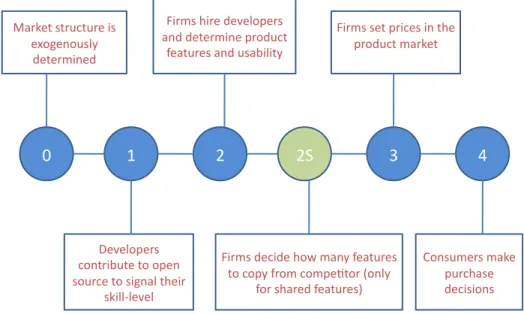
to all market specifications, are detailed in Figure 1. One exception is Stage 2S, which is only
9An exhaustive list of commercial applications based on open source can be found at Wikipedia,
relevant to the shared features market, which we examine in Section 4. !"#$%&'"#(&)(*(+,-(#%& ./)&)(0(#$"/(&-#,)120& 3(.01#(%&./)&1%.4"+"05& !"#$%&%(0&-#"2(%&"/&0'(& -#,)120&$.#6(0& 7.#6(0&%0#1201#(&"%& (8,9(/,1%+5& )(0(#$"/()& :,/%1$(#%&$.6(& -1#2'.%(& )(2"%",/%& !"#$%&)(2")(&',;&$./5&3(.01#(%& 0,&2,-5&3#,$&2,$-(<0,#&=,/+5& 3,#&%'.#()&3(.01#(%>& ?(*(+,-(#%& 2,/0#"410(&0,&,-(/& %,1#2(&0,&%"9/.+&0'("#& %6"++@+(*(+&
A& B& C& CD& E& F&
Figure 1: Sequence of Stages in Model
In Stage 4, consumers purchase software after observing all qualities and prices. Firms set
prices in Stage 3 after observing product qualities. In Stage 2, firms observe developer signals and
simultaneously make wage offers and product development decisions. In Stage 1, developers choose
whether to contribute to open source features to signal their skill-level given their beliefs about
the wage. Table 1 details the notation used in our modeling, distinguishing between exogenous
parameters and endogenous outcomes in the model.
3.1 Model
Product Market: Consumers and Firms
Consumers choose whether to purchase one unit of software from either of the COSS firms or
not purchase a product, in which case they receive a normalized utility of zero.10 Consumers are
heterogeneous in their preferences for quality, and a consumer indexed byθhas utility for a software
10
Equivalently, the no-purchase option corresponds to the consumer choosing the free open source software because without any usability they receive a utility of zero.
Table 1: Notation for Main Constructs in the Model
Symbol Definition
Market Types
P, S Superscripts for private features and shared features markets Exogenous Parameters
M Market size
cL, cH Cost of contributing one feature to open source for low- and high-type developers
cs Cost of developing one unit of usability
ηH =η, ηL Productivity of high-type and low-type developers Equilibrium Strategies and Outcomes
pj, qj Price and quality of firmj’s product
fj, sj Number of developers hired and usability investment by firm j
Fj Number of features in firmj’s product
F0 Number of open source features due to developer contributions eL, eH Contribution to open source by low- and high-type developers
w(e) Wage schedule in the developer market, with e∈ {eL, eH}
product of qualityq at pricep given by:
U(q;θ) =θq−p.
Consumers’ marginal valuation for quality is distributed uniformly, θ∼ U[0, M], and its realized
value determines which product is preferred by the consumer.
The quality q of a software product depends on its level of featuresF and its level of usability
s. We follow industry practice and view these dimensions as mutually exclusive (Boehm, 1981;
Pressman, 2004). Quality is defined by the production function:
q =Q(F, s).
A software product’s features define the set of tasks that can be accomplished with the product,
whereas usability refers to the ease with which a consumer can make use of the product’s features.
features may create an overly complex product. Without a sufficient level of usability, consumers
may not be able to take advantage of all the features. Conversely, a high level of usability is
more beneficial in conjunction with a large number of features.11 We therefore model these two
dimensions of quality as (imperfect) complements, implying ∂s∂F∂2Q > 0. A simple functional form
that captures this complementarity and is concave in both features and usability is Cobb-Douglas:
Q(F, s) = (F·s)14. The above formulation of consumer preferences and product quality are common
to both markets. Figure 2 illustrates the structure of the product market: the upper panel depicts
the private features market where both firms initially have access to F0 features from the open
source community, and the lower panel depicts the shared features market (discussed in Section 4)
where firms contribute any features they develop to open source. In both cases,F0 is determined in
equilibrium through developer signaling in the developer market (discussed in the next subsection).
Firm j ∈ {1,2} determines its product quality by hiring fj feature developers and choosing a
levelsj of usability. Feature developers vary in their skill-level or productivityη∈ {ηL, ηH}, with a
developer producingηunits of features when hired. In the private features market, firmj’s product
includes both open source features and privately developed features. Therefore the level of features
in the firm’s product is, Fj = (F0+ηfj), where η is the average skill-level of hired developers.
The firm also develops the usability of the product to level sj by investing in technical support,
documentation, online help, etc. that make the product’s functionality easier to use. The overall
quality of firmj’s product is
qj =Q(Fj, sj) = [(F0+ηfj)sj]
1 4 .
The firms hire developers at a wage ofwand the marginal cost of creating usability iscs.12 Marginal
11In general, consumers do not benefit from products with a significant imbalance between their level of features
and usability. Thompson et al. (2005) shows that consumers who purchase overly complex products face “feature fatigue” and that improving usability can help consumers effectively utilize the features.
12
1
f
1s
f
2s
2 1s
f
1 Firm 1 chooses andOSS
OSS
0f
Initial level of OSS
available to all
s
2 2f
Firm 2 chooses andes
1f
1f
0f
2 2te
Fe
at
u
re
Firm
1’s
Firm
2’s
Priv
a
Product
Product
0 1 1(
, )
Q f
f s
Q f
(
0
f s
2, )
2OSS
OSS
Initial level of OSS
available to all
s
1s
f
1 Firm 1 chooses and 2s
f
2 Firm 2 chooses and 1f
1s
f
0f
2s
2d
Fe
at
u
re
s
OSS
OSS
0 1 2f
f
f
Shar
ed
Firm
1’s
Product
Firm
2’s
Product
0 1 2 2(
, )
Q f
f
f s
0 1 2 1(
, )
Q f
f
f s
costs of production are zero because software is an information good. The total fixed production
cost C(f, s) is simply the sum of the cost developing features and of making the product more
usable, and is given as:
C(f, s) =w·f+cs·s.
Firms may produce products of different quality, and we denote firm 1 as the higher-quality firm,
letting q1 > q2 without loss of generality.
Market for Developers
Developers are heterogeneously distributed, and are either high-skilled (high-type) or low-skilled
(low-type). The cost of contributing to open source differs according to the developer’s type. To
contribute e features, high-types incur a cost of cH ·e and low-types incur cL·e, with cH < cL
indicating high-types face a lower cost. High-type developers have a reservation option r ∼ψ(·),
with CDF Ψ(·) and support in the range [R,R¯] where 0 ≤ R < R¯.13 This option represents the
utility a developer derives from her current job, and she will accept a new wage offer only if it
exceeds r and the cost of signaling. Note that developers are heterogeneous in two dimensions:
their (discrete) skill levels and their (continuous) reservations wages.
After the developer’s type or skill-level is successfully revealed by the signal, she can choose
either of the COSS firms, or an external market. The external market for high-skilled developers
is present because skills required for successfully contributing to open source can have useful
ap-plication across many markets. For example, a developer who has contributed to a Linux open challenging skill, and thus a more credible signal of skill-level (J.A. Roberts and Slaughter, 2006; Hars and Ou, 2002). Equivalently, we could assume there is a perfectly competitive market for usability developers, who are inelastically supplied at some exogenous wage. Our analysis and results would be identical in this case.
13
No further assumptions on the functional form of Ψ are required for our results. We use the general form in our description since it helps in presenting and interpreting different effects.
source project can receive an offer from a firm like Oracle that is not a primary competitor in
the Linux market. Therefore, the external demand, D(w), is a function of the market wage, and
affects market outcomes only in the sense that it affects the wage by creating an additional source
of demand for high-skilled developers. Note that the external market has no demand for developers
who have not signaled, since their skill-level is uncertain.
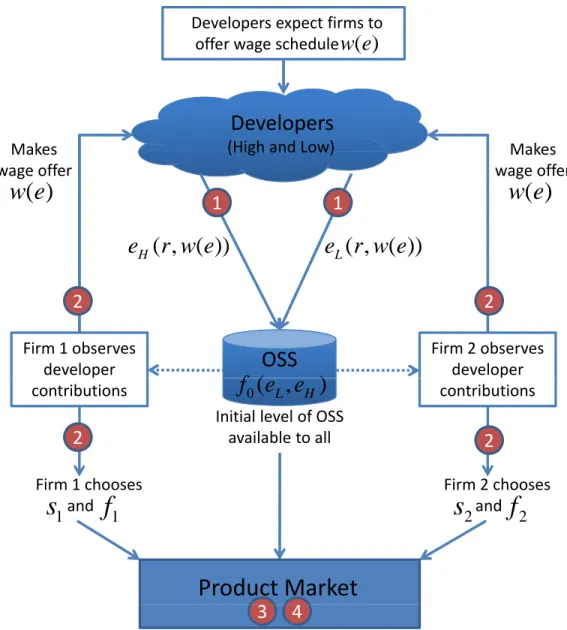
Figure 3 displays the developer market and its link to the product market. The numbers
correspond to the stages in the game outlined in Figure 1 at the start of Section 3. First, developers
form expectations about wages based on the market, and contribute to open source to signal
their skill level to firms. Second, these contributions are publicly observable, and firms use them
to evaluate developers’ skills and make wage offers to developers.14 Firms simultaneously hire
developers and in doing so, they choose their product’s level of features and usability. Third, firms
compete in the product market.
Low-type developers may attempt to masquerade as high-type developers to convince firms to
hire them. Open source projects have “gatekeepers” who screen for low-quality code and decide
which submissions to include in the project (Bagozzi and Dholakia, 2006). Gatekeepers ensure that
high-type developers have an incentive to contribute more to open source to separate themselves
from the low-types. To simplify our exposition, we make two assumptions. First, low-type
devel-opers have a fixed reservation option RL = 0, and second, we normalize the low-type developer’s
skill-level to ηL = 0. These assumptions make it unprofitable for firms to hire the low-types, but
both conditions could be relaxed to yield qualitatively similar results.15 We drop the subscript on
ηH, and refer to it asη, because only high-type developers’ skill-level influences the equilibrium.
14
Firms’ wage offers are consistent with developers’ beliefs in equilibrium.
15
We only require that at the equilibrium wage, the marginal increase in a firm’s profits from hiring an incremental
low-type developer is sufficiently low. This condition would be met ifηL>0 but still low enough such that firms
would not find it profitable to offer them a positive wage. Similar intuition would allow us to setRL>0. Our results
are applicable when both of these values are generalized, but doing so complicates the notation without adding any depth to the results.
Developers expect firms to
ff h d l
( )
Developers
(High and Low) Makes
offer wage schedule
w e
( )
Makes (High and Low)
Makes wage offer
( , ( ))
Le r w e
( , ( ))
He
r w e
( )
w e
1
1
Makes wage offer( )
w e
Firm 1 observesdeveloper
OSS
OSS
(
)
f
Firm 2 observes developer2
2
Firm 1 choosesInitial level of OSS available to all contributions
f e e
0( ,
L H)
contributions Firm 2 chooses2
2
1s
andf
1 2s
andf
2Product
Market
3
3
4
Note: The expected and actual wage schedules are the same due to rational
expectationsp in equilibrium.q The numbers in the diagramg correspondp to the
stages of the game, as outlined at the beginning of Section 3.
If a developer signals by contributing efeatures to open source, her wage isw(e). A developer
of type t ∈ {L, H} contributing e features receives utility ut(w, e) = w(e)−cte and her optimal
contribution level is:
et= arg max
e w(e)−cte (1)
subject to the incentive compatibility (IC) and individual rationality (IR) conditions:
(ICH) :w(eH)−cHeH ≥w(eL)−cHeL (IRH) :w(eH)−cHeH ≥r (2)
(ICL) :w(eL)−cLeL≥w(eH)−cLeH (IRL) :w(eL)−cLeL≥0.
In general, the IR and IC constraints must hold in all separating equilibria.16 To ensure separation,
high-type developers must find it incentive compatible to exert a high level of effort (ICH) and must
be sufficiently compensated to work for the COSS firms given her reservation option (IRH).
Low-type developers must find it prohibitively expensive to imitate the high-Low-type developers (ICL).
In this setting, however, the low-type’s IR constraint does not need to be satisfied because not
participating is equivalent to making a zero contribution. Firms do not find it optimal to hire
low-type developers at any positive wage after their type is revealed, leading them to setw(eL) = 0.
Given that the wage for low-type developers never exceeds their reservation wages (in any separating
equilibrium), they do not contribute to open source, implying thateL= 0. Therefore, the individual
rationality condition for low-type developers, IRL, does not need to be satisfied. The condition
in ICL reduces to 0 ≥ w(eH)−cLeH. Developers with reservation values below a threshold,
r≤w(eH)−cHeH, choose to signal and developers withr > w(eH)−cHeH choose their reservation
16
We focus only on separating equilibria, and not on pooling equilibria, in order to convey the main insights in the simplest manner.
option and do not signal. Thus the number of high-type developers who signal is
fH = Ψ(w(eH)−cHeH), (3)
whereas the number of low-type developers who signal positively is fL= 0. Since only high-types
signal, we also denote the number of developers who contribute by f0=fH.
This condition characterizes the supply of developers available for hire either by the firms or by
the external market. Given an arbitrary wage w, the initial level of open source features available
in Stage 1, F0(w), is a function of the number of developers and their contributions:
F0(w) =f0eH = Ψ(w(eH)−cHeH)eH. (4)
Note the IR and IC conditions are necessary, but not sufficient, to determine the equilibrium
wage since they only reflect developer decisions at a fixed wage. We must know the demand for
developers to calculate the market-clearing wage. The wage influences developer contributions and
yields different levels of open source features. A higher wage raises initial developer contributions
available to the COSS firms. This alters the firms’ incentives to invest further in product quality,
and reduces their need to hire additional developers. The returns to quality also depend on the
structure of the product market, i.e., private features versus shared features. Thus, we must account
for competition between the firms for developers and the nature of the product market.
Discussion and Comparison
We briefly discuss and compare the role of signaling in our model to prior work. In the canonical
model of Spence (1973), workers signal through investments in education to a market of perfectly
open source features serve as signals to COSS firms seeking to hire high-skilled developers. Our work
builds on Spence (1973) in two ways. First, our model considers a vertically-differentiated duopoly
where firms earn positive profits because developer heterogeneitywithintypes allows firms to extract
a surplus for each developer they hire who is not at the margin. An imperfectly competitive market
is applicable to a broader range of industries and institutional settings.
Second, the signaling contributions themselves serve as a substitute to a firm’s investment in
product features, i.e., the more developers contribute to open source, the less firms need to invest
in building new features. Unlike a perfectly competitive market, signals have a “spillover” effect:
each contribution is freely available to any firm for its product, not just to the employer. In this
sense, the signals are not privately appropriable by individual agents, compared to Spence’s case
where an individual’s educational investment only benefits the employer. Signaling by a developer
not only affects that developer’s utility and the COSS firm that hires him, but it also changes the
strategic interaction between the COSS firms in the market. These conflicting incentives create a
critical and unique link between the product and developer markets.
In sum, we generalize the basic job market signaling model to an imperfectly competitive market
with publicly appropriable signals. Next, we characterize the equilibrium interaction between the
product and developer markets.
3.2 Equilibrium Analysis
We analyze the subgame-perfect equilibrium of the model. We examine the firms’ product design
decisions, explicitly characterizing how open source features are produced in equilibrium. The
importance of modeling the developer market lies in the interaction between developers’
contribu-tions to open source features and the quality of products subsequently offered by the COSS firms.
Pricing Equilibrium
The pricing subgame in Stage 3 applies to all cases of the product market.
We define consumer θ12 to be indifferent between firm 1 and firm 2’s products, such that
θ12·q1−p1 =θ12·q2−p2. Consumer θ20 is indifferent between purchasing firm 2’s product and
not purchasing either firm’s product, such that θ20q2−p2= 0. The market size for the firms are:
m1 = 1 M (M−θ12) = 1 M M−p1−p2 q1−q2 and m2 = 1 M (θ12−θ20) = 1 M p1−p2 q1−q2 −p2 q2
Firms set prices to maximize revenues, which are a function of the product prices and qualities
and the market size, leading to optimal revenues:
R1= max p1 M−p1−p2 q1−q2 p1 and R2 = max p2 p1−p2 q1−q2 − p2 q2 p2 (5)
The optimal price for each firm is a best response of the price set by the other firm, and depends
on the quality levels of both products. Thus, the revenues are a function of product quality levels
chosen by the firms in Stage 2. This formulation assumes a fixed wage for feature development that
affects quality decisions, and the question of how that wage is determined is addressed next.
Firm revenues, prices, and the consumer surplus are represented as functions of product quality
levels in Lemma 1.17 This establishes the outcomes of the pricing sub-game conditional on quality
decisions made in Stage 2. Factors such as wages, costs, and market characteristics (shared features
or private features) determine revenue and prices through quality levels chosen by the firms in the
previous stage, and the pricing subgame does not directly depend on these factors. We proceed
to characterize the equilibrium of Stage 2 of the game, how firms make product design choices of
features and usability, and evaluate how that affects quality.
17
Product Quality Equilibrium
The solution of the sub-game in Stage 2 requires the firms to strategically determine the optimal mix
of features and usability. Both firms simultaneously determine their product features and usability,
and hence product quality. The profit functions are derived by substituting the feature and usability
levels into the revenue functions in Lemma 1 and accounting for the costs of development. This
provides the partial-equilibrium responses by the COSS firms given (1) an arbitrary wage in the
developer market and (2) an arbitrary level of open source features.
We collapse the Stage 2 sub-game involving two strategic quality components to one overall
quality level for each firm. If a firm’s best response quality only depends on the overall quality
of its competitor’s product and not the specific mix of usability and features, then the firm will
minimize the cost of attaining a given quality level through an optimal mix of usability and features.
Lemma 2 in the Appendix establishes such a result, allowing us to solve for the equilibrium levels
of features and usability, detailed below.
Proposition 1. [Private Features Product Market]In the private features market with firms
vertically differentiated, each firm develops both usability and features. Specifically, given F0 open
source features initially available and that wage w in the developer market is not excessively high,
firm j will choose quality and its components to be:
qj = M φj 2 r η csw , fj = M2φ2j 4 r η csw3 −F0 η , sj = M2φ2j 4 r η cs3w
forj∈ {1,2}, where the constantsφ1 andφ2 are defined in the Appendix. No symmetric equilibrium
exists in which firms choose the same quality, q1 =q2.
Both firms create features in addition to the freely available open source features F0. Firms
are substitutes. We find that firms differentiate their products more on the less expensive dimension
of quality, implying that if features are less expensive to produce, the firms will differentiate more on
features (f1−f2> s1−s2). Intuitively, firms differentiate their products more on the dimension that
yields a greater return to such differentiation. Note that wages are the only endogenous variable
in the result above, determined by the interaction between the developer and product markets.
All the other parameters are exogenous. Next we examine the developer market equilibrium to
determine the wage.
Developer Market Equilibrium
The wage level influences the firms’ demand for high-type developers, the number of developers
willing to signal, and the level of their contributions to open source. The equilibrium wage must
balance firms’ demand for developers with the supply of developers who are willing to enter the
market by signaling. We focus on separating equilibria where high-type and low-type developers
make different contributions to open source software.
We start with the supply side, establishing the conditions required for the high-type and low-type
developers to separate. For a separating equilibrium in the signaling game, we must identify
conditions on the wage schedule that lead to positive contributions by some high-type developers
and that ensures that low-type developers do not find it rational to imitate them. The following
result provides the necessary conditions for a least-cost separating (LCS) equilibria in terms of the
wage and open source contributions.
Proposition 2. [Separating Equilibrium] The separating equilibria for the signaling game
be-tween the developers and firms is characterized by the following conditions whereris the reservation
(i) The necessary conditions for contributions for each developer type are: eL(r, w) = 0, eH(r, w)∈ {0}, r > w 1−cH cL h w cL, w−r cH i , r≤w 1−cH cL
(ii) In a least-cost separating (LCS) equilibrium, the high-type developers contribute eLCSH (r, w)
and the common out-of-equilibrium beliefs µ(H|e, w) for firms are
eLCSH (r, w) = 0, r > w1−cH cL w cL, r≤w 1−cH cL andµ(H|e, w) = 0, e < eLCS(w) 1, e≥ w cLe LCS(w)
This LCS equilibrium is the only equilibrium that satisfies the Intuitive Criterion.
(iii) In the least-cost separating equilibrium, the number of high-type developers who contribute to
open source features is fH = Ψ
w h 1−cH cL i
and the number of features developed in Stage
1 is F0LCS(w) = Ψwh1−cH
cL i
w cL.
Part (i) identifies the necessary conditions that any separating equilibrium must satisfy. These
conditions arise from the individual rationality and incentive compatibility constraints in (2). Since
a separating equilibrium allows firms to perfectly distinguish developer types, low-types do not
contribute to open source,eL= 0. The high-type developers must contribute a sufficient number of
features to ensure low-types do not find imitation profitable, captured inICL, and using which we
obtaineH(w)≥ cwL. However, some high-type developers must also find signaling to be preferred to
their reservation utility, i.e., for a developer ifr≤w−cHeH =w
1−cH
cL
, then the developer will
choose to signal. Note that an infinite number of separating equilibria exist in which a high-type
developer with reservation utilityr≤w
1−cH
cL
makes a contribution in the continuum
h w cL, w−r cH i .
Each equilibrium is equally valid without imposing further restrictions on out-of-equilibrium beliefs.
Part (ii) establishes the out-of-equilibrium beliefs that satisfy the Intuitive Criterion (Cho and
Kreps, 1987) to determine a unique LCS equilibrium. Signaling models often admit a multiplicity
of equilibria, and we use the Intuitive Criterion to refine ‘unreasonable’ equilibria. In our context,
least-cost refers to the minimum separation required at each prevailing wage. This purification of
out-of-equilibrium beliefs requires that any observed deviation from the equilibrium path will more
likely be from the type that could profit the most from the deviation. This refinement gives us
the minimum contribution to open source high-type developers must make to sustain a separating
equilibrium, and the corresponding wage firms must pay to guarantee separation.
Part (iii) focuses on the minimum amount of separation given by eLCS(w) = cw
L. Developers
with reservation option r < rLCS(w) =w−c
HeLCS(w) =w
1−cH
cL
choose to signal, implying
that the number of high-type developers who signal isf0LCS = Ψ(rLCS) = Ψ(w−cHeLCS(w)). The
number of open source features produced in Stage 1 is the product of the number of developers
who signal and each developer’s contribution, FLCS
0 (w) = f0LCSeLCS(w). This result allows us to
focus on the (expected) wage level that determines F0. We restrict attention to LCS equilibrium
outcomes in the remainder of the paper and drop the LCS superscript.
Developers who have credibly demonstrated their high skill-level by signaling can either work
for the COSS firms or for an external market. The external market has a demand D(w) that
depends on the wage, and captures the fact that the skills can be useful in firms other than the
COSS firms. We observe that the number of high-type developers that firm j wishes to hire at
wagewisfj(F0(w), w). The equilibrium wagewP in the private features market equates the firms’
demand in addition to the external demand for high-type developers to the aggregate supply of
developers who prefer signaling to their reservation option. Below this wage level, fewer high-type
more developers will be inclined to contribute than firms desire to hire. Thus, the equilibrium
wage serves to balance the signaling incentives of developers and firms, and explicitly links the
product and developer markets. Lemma 3 in the Appendix details how this wage is determined
by equating developers signaling with the demand from Proposition 1. We focus on the properties
of the equilibrium wage level next, specifically the comparative statics with respect to the market
size, the cost of signaling, and the cost of producing usability.
Proposition 3. The least-cost separating equilibrium wage for high-type developers satisfies the
following properties: It is increasing in market size (∂w∂MP > 0), signaling cost (∂w∂cP
H > 0), and skill-level (∂w∂ηP >0), and decreasing in the cost of usability, (∂w∂cP
s <0).
Both firms compete for high-type developers, and developers make contributions to open source
anticipating the competition between firms and the resulting wage. The wage increases with the
market size M because a larger market causes firms to invest more in creating a higher quality
product and competition between firms drives wages higher. The wage is higher when producing
usability is less expensive because a lowcs permits firms to invest more in usability. A higher level
of usability raises the value of features for consumers and firms due to complementarity, which in
turns ensures that firms invest more in features, thus raising developer wages. When signaling is
costly for the high-type developers, fewer signal and more choose their reservation option, resulting
in fewer open source features. The marginal value of features is then higher for firms since the
substitution effect with open source features is weaker, and this effect increases the wage.
4
The Shared Features Market
We alter the model from the previous section to accommodate the shared features case. In the
they develop. Firms have to make an additional decision on how many features to copy from their
competitor, corresponding to Stage 2S in the sequence of events. We examine how the model and
equilibrium outcomes change as a result.
4.1 Model
The key difference between the shared features market and the private features market presented
earlier is the formulation for product quality. To see this distinction most clearly, compare the
two panels of Figure 2. In the upper panel, firms in the private features market incorporate open
source features and only their own privately developed features into their products. In contrast,
the shared features market in the bottom panel shows that firms must contribute any features they
develop back to open source, which could subsequently become part of both firms’ products. Both
firms in Stage 2 determine how much to copy from their competitor, and we denote by δj ∈[0,1]
the fraction that firm j copies from its competitor. The quality is thus defined in Stage 2S to be:
q1= [(F0+ηf1+δ1ηf2)s1] 1 4 (6) q2= [(F0+δ2ηf1+ηf2)s2] 1 4 (7)
where firm j hires fj features developers and chooses sj usability similar to the private features
market. The difference between the quality here and in the private features market is the extra
δj(ηf−j) term due to the shared features market that forces mandatory sharing. The rest of the
product market in the shared features case is identical to the private features market. However,
this extra term fundamentally alters the strategic interaction and equilibrium outcomes as we
4.2 Equilibrium Analysis
Unlike the private features market, we cannot uniquely characterize a firm’s best response using
overall product quality. Lemma 2 does not apply because each firm’s feature contribution directly
affects the quality of the other firm’s product. The potential for free-riding on features leads
to decreased product differentiation and increased price competition, making it unclear whether
any firm will contribute to features in equilibrium. The following result provides the outcome for a
market where consumers place sufficient value on quality such that firms develop additional features
beyond those supplied by open source.
Proposition 4. We find that when COSS firms compete in the shared features market:
(i) Both firms will copy features developed by their competitor to the maximum extent possible
(δ1, δ2= 1).
(ii) The features, usability, and overall quality levels in this partial equilibrium with open source
features F0 and wage w are:
f1= M2σ3 1 r η(σ1−σ2)3 w3cs (4σ1−σ2)3 − F0 η f2 = 0 s1 = M2σ5 1 r η(σ1−σ2) wcs3 4σ1−σ2 s2 = M2σ 1 r η(σ1−σ2) wcs3 σ42 4σ1−σ2 q1 = M σ2 1 q η(σ1−σ2) wcs 4σ1−σ2 q2= M σ1σ2 q η(σ1−σ2) wcs 4σ1−σ2
where the constants σ1 andσ2 are defined in the Appendix.
First, the outcome of Stage 2S, where firms determine how much to copy, results in complete
copying. Partial copying might seem like an alternative that creates more features differentiation
well as quality differentiation (q1−q2) between the firms. For the low-quality firm, copying more
increases its own quality butreduces quality differentiation. However, the positive effect of increase
in quality dominates the negative effect of reduction in differentiation when the quality levels are
sufficiently apart from each other. In anticipation of these effects, the low-quality firm invests less
in usability in Stage 2, so that it is advantageous to fully copy features from the high-quality firm.
We find that only the high-quality firm develops features beyond the open source features
F0 available due to developer contributions. The low-quality firm completely free-rides on the
features provided by the high-quality firm. Why does the high-quality firm develop a positive
level of features? The intuition comes from the fact that the quality dimensions are complements,
implying consumers’ marginal utility of usability is increasing in the level of features. Although
features do not contribute directly to product quality differentiation, they do magnify the effect
of usability differences between the firms. Note that the low-quality firm invests less in usability
than the high-quality firm, and the high-quality firm develops features to enhance the degree of
product differentiation, which results from having a higher usability product. Thus, the increase
in the differentiation from usability makes it worth creating features that reduce the intensity of
competition.
The product market outcome above has a critical implication for the developers’ market: only
the high-type firm hires developers because the low-type firm does not develop features (f2 = 0).
Thus, the high quality firm faces lower competition in the developer market, with only the external
market offering a credible alternative to developers who choose to signal. The equilibrium properties
and comparative statics of the wage in the shared features market are similar to those in the
4.3 Comparison of Market Structures
We have derived equilibria under two types of COSS markets: private features and shared features.
In each case, ex-ante identical firms compete in product and developer markets and are
differen-tiated ex-post. We focus on how profits, product qualities, and price levels compare across these
regimes.
Competition between firms in the private features market drives wages higher, and wS < wP
as we expect (Lemma 4 in the Appendix). We next examine the provision of open source features.
This outcome should be of interest to firms who engage in open source, to expert consumers who
use open source features directly, and to policy makers who view open source as an important
driver of innovation in the software market. Further, the initial creator of an open source project,
who chooses the specific license, might seek to maximize the total contributions to the project.
Result 1. [Creation of Open Source] The creation of open source features is higher under the
private features market compared with the shared features market when the market size is large and
signaling costs for high-type developers are low.
In the shared features market, both firms have access not only to the contributions to open
source made from high-type developers, but also to the features developed by the ex-post
high-quality firm. In contrast, the private features market allows firms to keep their features private
leaving only the signaling contributions to features as open source. Thus, we expect more open
source features in the shared features market. However, when the consumer market is large, firms
compete for developers more intensely in the private features market because there is a greater
value in producing a higher quality product. This raises the incentive for high-type developers
to separate themselves from low-type developers. When separation is relatively easy (cH is small
model that treats open source as exogenous. We next evaluate the effects on product quality.
Result 2. [Product Quality] Comparing the markets we find that:
(i) The private features market provides the lowest quality level. For small (large) market size
and low (high) signaling costs, the private features market also provides the highest quality
product.
(ii) The usability ratio s1
s2 is always larger for the shared features market compared to the
private features market, and the features ratio f1
f2 is larger under the private features
mar-ket. The quality differentiation captured by the ratio q1
q2 is higher for the private features
market compared to the shared features market.
The low-quality firm’s quality is always higher in the shared features market since the firm is
able to free-ride on the features provided by the high-quality firm. This effect holds even when
the low-quality firm develops a lower level of usability than in the private features market, and is
independent of the model parameters, such as market size or signaling costs. In fact, as the market
size increases, the quality difference of the low-quality firm compared across the private features
and shared features markets becomes larger.
The effect of the market regime on the high-quality firm’s quality level is more nuanced: it
depends on the market size, signaling cost, and cost to develop usability. When the market size is
large and usability costs are low, there is higher demand for developers and lower cost of developing
a higher quality product, which increases the equilibrium wage high-type developers receive. These
effects are collectively stronger for the shared features market than in the private features market;
therefore, the quality level chosen by the high-quality firm is higher in the shared features market.
This effect is stronger when the signaling cost is higher for the high-type developers, which leads
conditions above are reversed, the high-quality product is better under the private features market.
The marginal benefit of usability increases with the level of public contribution of features,
which implies that more signaling by programmers increases the firms’ incentives to develop
usabil-ity. In the shared features market, firms differentiate more on usability, but this differentiation is
insufficient to overcome the fact that both products have the same level of features because features
are publicly available. The quality differentiation in the shared features market is therefore lower
than in the private features case. Prices are proportional to quality levels by Lemma 1.
Next, we evaluate the level of surplus consumers and firms obtain in both markets.
Result 3. [Profits and Consumer Surplus] Examining the creation and distribution of surplus
across firms and consumers, we find that:
(i) The high-quality firm can make a higher profit under the shared features market, when the
external demand for developers is high.
(ii) Consumer surplus is higher in the shared features market compared to the private features
market under all market conditions.
The high-quality firm may make a higher profit because a higher external demand indicates a
broad base of developers contributing to open source, implying that competition between the COSS
firms may not drive wages up much. A high external demand also increases the wage, but the
high-quality firm reduces its contribution to features, which also lessens the impact of free-riding. In
such a situation, the high-quality firm can do better under a shared features market.
The result in (ii) is surprisingly general and does not depend on the parameters. From the
consumers’ perspective, the shared features market is preferred, and socially-conscious contributors
should consider licensing their software under a framework that makes features publicly available.
to consumers. The reasoning is that both the utility of the signal (open source features) used
in the products developed by the firms and decreased competition in the developers market due
to free-riding on features by the low-quality firm serve to benefit consumers. This implies that
contrary to Ballmer’s notion that a mandatory sharing license is a “cancer that attaches itself...”,
we find such a requirement may benefit both consumers and firms.
5
Limitations and Extensions
The OSS market is a fascinating industry in which to examine the product strategies of firms.
As usual, to conduct such an analysis in the context of a formal model entails making numerous
simplifying assumptions and abstractions. This section discusses several limitations of the current
model and highlights avenues for future research.
First, the market structures we examine in this paper are not an exhaustive list of all the types
of markets associated with open source. Our focus has been on markets where OSS is first developed
by the open source community, and then later firms build on this software base. In contrast, there
are markets where firms have developed proprietary software, and then choose to release the source
code as open source. One example is MySQL, a database product, which released its source code
and permits users to modify it for non-commercial purposes, but requires a negotiated licensing
agreement for commercial applications. This voluntary action of firms to release their software
as open source may also be a strategy that firms use to limit entry, in the sense of Milgrom and
Roberts (1986). However, in many markets firms cannot choose the license—open source developers
choose a product’s license when they create it, and then a firm builds upon that product taking
the license as given. This is the case with Red Hat Linux: the firm had to obey the GNU license
that was in place to create its COSS product. Our paper focuses on a setting that describes the
present paper, but represent potentially interesting cases to explore in the future.
Second, firms face a variety of “market entry”-type decisions. Should a firm release their own
software to the public, and if so, which license should they adopt? The license choice is likely to
affect subsequent product develop decisions and could ultimately play a large role in the eventual
success of the product. Similarly, if a firm faces the choice of entering one of multiple open source
markets (e.g., private features versus shared features markets), which market should it enter? If
these markets are distinct and competitor’s entry decisions are ignored, then the model in this paper
could apply separately to each market setting.18 However, if there is a link between the markets
through either demand (e.g., the products are substitutes) or supply (e.g., product development
efficiencies), then such considerations must be taken into account in an expanded multi-market
entry model. The current model examines an individual open source market without focusing on
whether specific firms will enter, instead studying the equilibrium implications for firms who already
have entered. It may be possible to simplify certain aspects of the current model to construct a
more elaborate model of the license regime choice.
Third, the incentives of firms to contribute to open source are more complicated in multi-product
or forward-looking settings. One reason a multi-product firm may contribute to open source is that
it weakens its competitor in another market. This theory implies one motivation behind IBM’s
contributions to Linux, or Sun’s contribution to OpenOffice, could be a desire to reduce Microsoft’s
market dominance (and revenues) and to enable each firm to compete more effectively. A second
18Modeling the regime entry game between two firms is a challenge. To allow firms to choose which regime to enter,
we could expand our model by creating a super game where in the firms first choose between the private features market, shared features market, or to keep the product completely proprietary. Doing so poses both conceptual and analytical challenges. Many firms in the real world do not change these strategies substantially over a reasonable period of time. Apple’s strategy is strictly closed source while Google has adopted a mostly open source strategy, and both firms have consistently upheld these strategies over time. One could speculate that reputation effects seem to dominate any potential gain arising from periodically changing the strategy. Moreover, firms enter the market at different points of time; entrants are likely to respond strategically to the licensing choice of an incumbent. Therefore, any useful analysis of the selection of the software regime also entails the order and timing of entry of the market. Such a formulation will result in a largely intractable model. Doing so, within our model, is beyond the scope of this paper but can be a useful direction for further research.
reason is that many COSS firms draw significant revenue from services that are separate from
their products but that leverage their expertise. These services help firms subsidize the cost of
developing COSS products in the present given the expectation of revenue in the future from the
sale of services, add-ons, or other complementary products. A firm could also alter its open source
production decisions after learning from the current period’s market outcomes.
Fourth, we abstract away from any horizontal differentiation in open source products. Firms
may develop software that is not general purpose, but targeted at specific niche segments of users.
For example, some versions of Linux target the embedded or mobile device market, where the
focus may be on low-power computation rather than access to high-power functionality. Indeed,
Google has developed its Android operating system based on Linux with some of these goals in mind.
There may be two paths for further research, with a simple approach that assumes that the firms are
located at different places on a Hotelling line, and with the firms investing in multiple dimensions of
quality similar to the present paper. A more sophisticated follow-up would model firms as investing
in features or usability to create horizontal differentiation. However, the interpretation of “taste”
must be carefully considered since most software functionality has the property of “more is better,”
making it more apt as a vertical dimension.
6
Conclusion
We construct a two-sided model of the commercial open source market in which firms compete in a
product market and a developer market. Developers contribute to open source to signal their
skill-level to firms, which determines the skill-level of open source available to firms for their products. Firms
hire developers to build their products, and then compete in a vertically-differentiated market for
consumers. We compare equilibrium outcomes under two common types of open source licenses.
contributes significantly more to Linux than any other firm and why a market with mandatory
sharing can actually produce higher quality products than a proprietary market. First, we show
that the mandatory sharing of feature contributions between firms can actually raise profits and
consumer surplus. The availability of open source contributions and their role as a signaling
de-vice allows firms to improve the quality of their products beyond what they would have obtained
if allowed to keep their contributions private. Second, competition between COSS firms in the
private features market can induce developers to contribute more to open source features
com-pared with the shared features market. Competition between firms in the private features market
leads to a high equilibrium developer wage, which creates a strong incentive for high-skilled
devel-opers t