A Theory of Secure Control Flow
Mart´ın Abadi1, Mihai Budiu2, ´Ulfar Erlingsson2, and Jay Ligatti3 1
Computer Science Department, University of California, Santa Cruz 2 Microsoft Research, Silicon Valley
3
Computer Science Department, Princeton University
Abstract. Control-Flow Integrity (CFI) means that the execution of a program dynamically follows only certain paths, in accordance with a static policy. CFI can prevent attacks that, by exploiting buffer over-flows and other vulnerabilities, attempt to control program behavior. This paper develops the basic theory that underlies two practical tech-niques for CFI enforcement, with precise formulations of hypotheses and guarantees.
1
Introduction
Many modern attacks against computers take advantage of software flaws, such as buffer-overflow or integer-overflow vulnerabilities. The abundance of software flaws, and the corresponding success of the attacks, has motivated substantial defensive efforts. These efforts include systematic attempts to eliminate those flaws from legacy software and to avoid them in new software, relying on pro-grammer education and security reviews. Although these attempts have been at least partly fruitful, one might be concerned about their cost, and also about the possibility that they will not remove all flaws. Therefore, complementary approaches have also been considered and sometimes adopted.
One such approach is the use of various mitigation tools. These tools can be applied to code, more or less automatically, in order to reduce or eliminate the effects of certain vulnerabilities. The goals of these tools include runtime detec-tion of buffer overflows [4, 13], randomizadetec-tion and artificial heterogeneity [11, 20], and tainting of suspect data [17]. Unfortunately, these tools often target only specific classes of vulnerabilities. For example, stack canaries [4] address only certain buffer overflows in the stack (and none in the heap). Moreover, these tools offer imperfect, hard-to-define safeguards, which determined attackers can defeat or circumvent [12, 14, 19].
Another approach is the adoption of high-level, type-safe languages, such as Java and C#. These languages aim to guarantee general, fundamental proper-ties that can be defined precisely and proved rigorously, in particular memory safety. These properties contribute greatly to program security. Unfortunately, implementation flaws and interoperation with low-level code can weaken the guarantees. Furthermore, it is questionable whether every piece of software will be written or rewritten in these languages. For instance, media codecs, automatic
memory management, and operating-system interrupt dispatching typically rely on hand-written, optimized machine code; it seems unlikely that they will enjoy the full benefits of high-level languages, even in new systems.
A third approach, which we advocate, is the enforcement of Control-Flow Integrity (CFI). CFI means that program execution dynamically follows only certain paths, in accordance with a statically specified policy given as a control-flow graph (CFG). Many attacks aim to subvert execution and control software behavior. For instance, a buffer overflow in an application may result in a call to a sensitive system function, possibly a function that the application was never meant to use [12]. An attack may also cause a jump into the middle of a function body, or even into the middle of a multi-byte machine-code instruction (trigger-ing the execution of a different instruction). The result(trigger-ing behavior, while allowed at the hardware level, is in contradiction with programmer intent. Since these attacks invariably affect control flow, CFI can prevent them.
Like various mitigation tools, CFI enforcement can be applied to existing source code and binaries. At the same time, CFI has much in common with the properties guaranteed by high-level, type-safe languages. In particular, as we demonstrate, CFI can be defined precisely and proved rigorously. In these respects, CFI enforcement resembles the use of proof-carrying code (PCC) [10]. (Indeed, although research on PCC has emphasized memory safety, PCC could be used for proving CFI, even under weak assumptions on memory.)
In a companion paper [2], we explore the benefits of CFI and present an implementation. The implementation relies on machine-code rewriting that in-struments software with runtime checks; it applies to legacy systems (e.g., code compiled from C and C++ on x86 Windows) with only a modest performance overhead. We also validate, experimentally, that CFI thwarts many types of ex-ploits and several documented past attacks. Finally, we show that CFI can help in the enforcement of additional security properties.
The CFG on which CFI relies should be designed to exclude unwanted soft-ware behavior. Even a coarse CFG that prevents jumps into the middle of func-tion bodies can be useful; such a coarse CFG is easy to obtain. A more precise CFG, of the sort that could be derived by source-code analysis, might also pre-vent certain dangerous sequences of system calls. Our machine-code rewriting aims to guarantee CFI with respect to the CFG, whatever it is. Simple static verification can ensure that the rewriting achieves the specified effect. This veri-fication can be seen as a special case of PCC proof-checking, while the rewriting obviates the need for explicit logical proofs. Only the verification is required for establishing CFI; design or implementation flaws in the rewriting do not compromise security.
This paper is concerned with the foundations of CFI. It develops the basic theory that underlies our strategy for CFI enforcement. It includes a detailed semantics for programs, definitions for program instrumentation (focusing on its verification), and theorems about the executions of instrumented programs. We regard this basic theory as central to our approach. The precise formulation of hypotheses, guarantees, and proofs is a major difference between our approach
and those based on previous mitigation tools, and an important similarity with research on high-level, type-safe languages. Furthermore, a formal approach is useful not only for elucidating hypotheses and guarantees, but also as a guide in the design and development of techniques. Indeed, in the course of our work, we rejected several alternatives that made unclear assumptions or that offered protection only in hard-to-define circumstances.
The main theorems of the paper establish that CFI holds for programs processed according to either of two enforcement techniques, even with respect to a powerful attacker that controls data memory. Although both techniques em-ploy machine-code rewriting, they differ in their specifics and their assumptions. Most noticeably, one technique requires that data memory not be executable. This assumption, which we call NXD, thwarts some attacks on its own, but not those that exploit unintended control transfers in pre-existing code, such as “jump-to-libc” attacks [12]. Some architectures support NXD, and recent versions of Windows use it [8]. NXD can also be implemented in software, with support from the underlying operating system [11]. The second technique is a refinement of the first with a built-in, inline implementation of NXD.
This second technique relies on a generalization ofSoftware Fault Isolation
(SFI) [18] that we callSoftware Memory Access Control (SMAC). SFI provides multiple domains of memory protection within a single address space. For SFI, code inserted before each memory access ensures that the target memory ad-dress is within a certain range. For SMAC, more generally, each instruction that may perform a memory access is constrained to a particular range of addresses, potentially a different one per instruction. CFI can facilitate the implementation of SMAC for irregular architectures, such as the x86, on which traditional SFI has been problematic [5]. One of the goals of this paper is to show that this cooperation between CFI and SMAC is real, rather than an incorrect result of informal circular reasoning.
Section 2 defines the setting for our work: a simple machine model and a corresponding machine language. Section 3 discusses CFGs. Section 4 describes and analyzes the first technique for CFI enforcement. Section 5 concerns the second technique, in which CFI enforcement is combined with SMAC. Section 6 concludes. Some details of proofs and additional material can be found at our website [3].
2
The Setting: Programs and their Semantics
The machine model and the programs that we define in this section are typical of formal studies in programming-language theory. For the sake of simplicity, we work with a basic machine model and a small set of machine instructions which enable us to study CFI but exclude virtual memory, dynamic linking, threading, and other sophisticated features found in actual systems. Essentially, our language is a minor variant of that of Hamid et al. [6]. We have yet to attempt a similar investigation for the full x86 architecture and for the x86 code sequences that our instrumentation inserts. We believe that such an investigation
would be feasible, particularly because of the similarities between our x86 code sequences and those studied in this paper; on the other hand, the investigation would certainly be laborious and may yield diminishing returns.
2.1 Machine Model
For our machine model, we define words, memories, register files, and states as follows:
Word ={0,1, ...}
Mem=Word→Word Regnum={0,1, ...,31}
Regfile =Regnum→Word State=Mem×Regfile×Word
We often adopt the notations w and pc for elements of Word, and M, R, and
S for elements ofMem, Regfile, andState, respectively. When S is a state, we may writeS.M,S.R, andS.pcfor theMem component, theRegfile component, and thepc inS, respectively.
We further distinguish between code memory (Mc) and data memory (Md),
so we split memories into two functions with disjoint domains, each of them contiguous. We assume that a statically defined program that comprisesn >0 instructions always occupies memory locations 0 to n−1, with the first in-struction of the program located at address 0. When we split a memory M into Mc and Md, we write M = Mc|Md, provided Mc contains n > 0
in-structions and the following constraints hold: dom(Mc) = {0..(n−1)}, and
dom(Md) = dom(M)−dom(Mc), andMc(a) =M(a) for alla∈dom(Mc), and
Md(a) =M(a) for all a∈dom(Md). We consider only states whose memory is
partitioned in this way. We writeS.Mc to indicate the code memory of stateS,
andS.Md for the data memory.
Similarly, we split register files into distinguished and general registers. When we splitRintoR0−2 andR3−31, we writeR=R0−2|R3−31provided the
follow-ing constraints hold: dom(R0−2) = {r0, r1, r2}, and dom(R3−31) = {r3..r31}, and R0−2(r) = R(r) for all r ∈ dom(R0−2), and R3−31(r) = R(r) for all
r∈dom(R3−31). We distinguish the registersr0,r1, andr2because we assume that they are used only in CFI enforcement code. (In fact, in our x86 imple-mentation, we need only one distinguished register and only at certain program points. This feature is important in practice, since the x86 architecture has few registers. While permanently reserving many registers for a special use is diffi-cult, finding a free register now and then is easy.)
2.2 Instructions
Our language is that of Hamid et al. [6] plus a label instruction in which an immediate value can be embedded and which behaves like a nop. (It is not too
IfDc(Mc(pc))= then (Mc|Md,R,pc)→n
label w (Mc|Md,R,pc+ 1), whenpc+ 1∈dom(Mc)
add rd,rs,rt (Mc|Md,R{rd7→R(rs) +R(rt)},pc+ 1),
whenpc+ 1∈dom(Mc)
addi rd,rs,w (Mc|Md,R{rd7→R(rs) +w},pc+ 1),
whenpc+ 1∈dom(Mc)
movi rd,w (Mc|Md,R{rd7→w},pc+ 1), whenpc+ 1∈dom(Mc)
bgt rs,rt,w (Mc|Md,R,w), whenR(rs)> R(rt)∧w ∈dom(Mc) (Mc|Md,R,pc+ 1), whenR(rs)≤R(rt)∧pc+ 1∈dom(Mc) jd w (Mc|Md,R,w), whenw∈dom(Mc) jmp rs (Mc|Md,R,R(rs)), whenR(rs)∈dom(Mc) ld rd,rs(w) (Mc|Md,R{rd7→M(R(rs) +w)},pc+ 1), whenpc+ 1∈dom(Mc) st rd(w),rs (Mc|Md{R(rd) +w 7→R(rs)},R,pc+ 1),
whenR(rd) +w ∈dom(Md)∧pc+ 1∈dom(Mc)
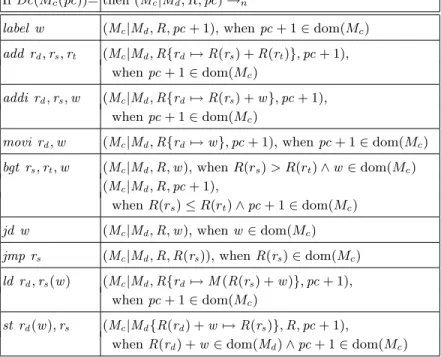
Fig. 1.Normal steps.
hard to implement such a label instruction on common architectures.) The set of instructions is:
Instr::= instructions
label w label (with embedded constant)
add rd,rs,rt add registers
addi rd,rs,w add register and word
movi rd,w move word into register
bgt rs,rt,w branch-greater-than jd w jump jmp rs computed jump ld rd,rs(w) load st rd(w),rs store illegal illegal
wherewis a word andrs,rt, andrd are registers. Thus, instructions may contain
words. Like Hamid et al., we omit the routine details of instruction storage and decoding. We assume a function Dc : Word → Instr that decodes words into instructions.
(Mc|Md,R0−2|R3−31,pc)→a(Mc|Md0,R0−2|R3−310,pc)
Fig. 2.Attacker steps.
2.3 A Semantics of Programs under Attack
In this section we give a first semantics for instructions. Figures 1 and 2 define two binary relations on states,→n and→a.
– The relation→nmodels normal small steps of execution, that is, those steps
that may occur in the absence of an attacker. This relation is deliberately incomplete: many states are “stuck”, including those whereDc(Mc(pc)) =
illegal.
– The relation →a models attack steps. In such a step, an attacker may
un-conditionally and arbitrarily perturb data memory and non-distinguished registers. For example, the attacker may modify a part of memory to con-tain a bit pattern that appears elsewhere in memory. Thus, intuitively, the attacker can read all of memory.
An attack step is quite similar to the possible effect of a computation step in another execution thread (which our model does not represent). In particu-lar, another thread can access all of memory, and can arbitrarily modify data memory. Moreover, registers are specific to a thread, and the values of the registers of one thread might be affected by another thread only if those val-ues are read from memory (possibly after being “spilled” into memory). An attack step therefore corresponds to a computation step in another thread if the values of general registers may be read from memory but those of distinguished registers are not. On the other hand, for simplicity, an attack step need not be restricted to computable functions.
The relation→, defined below, is the union of →n and→a. Thus, this relation
represents a computation step in general, either a normal state transition or one caused by an attacker.
S →nS0
S →S0
S →aS0
S →S0
In security, it is important to identify assumptions, and to justify them to the extent possible, because an attacker that can invalidate assumptions can often circumvent security enforcement. Our definitions embody several assumptions, which we discuss next:
1. The definition of →n implies NXD (that is, that data cannot be executed
as code). Similarly, the definitions of→n and→a imply that code memory
cannot be modified at runtime. We call this property NWC. As indicated in the introduction, NXD is often a reasonable assumption. NWC holds on most current systems (except at special times, such as during the initial loading of dynamic libraries).
IfDc(M(pc))= then (M,R,pc)→n label w (M,R,pc+ 1) add rd,rs,rt (M,R{rd 7→R(rs) +R(rt)},pc+ 1) addi rd,rs,w (M,R{rd 7→R(rs) +w},pc+ 1) movi rd,w (M,R{rd 7→w},pc+ 1) bgt rs,rt,w (M,R,w), whenR(rs)> R(rt) (M,R,pc+ 1), whenR(rs)≤R(rt) jd w (M,R,w) jmp rs (M,R,R(rs)) ld rd,rs(w) (M,R{rd 7→M(R(rs) +w)},pc+ 1) st rd(w),rs (M{R(rd) +w7→R(rs)},R,pc+ 1)
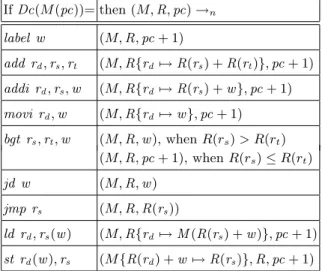
Fig. 3.Normal steps (assuming less memory protection).
2. The definition of→a allows for the possibility that the attacker is in control
of data memory. This aspect of the model of the attacker is conservative, but unfortunately close to reality. Buffer overflows and other vulnerabilities often allow an attacker to write to arbitrary locations in data memory even before subverting control flow [12].
3. The definition of →a implies that the attacker cannot modify the
distin-guished registers r0, r1, and r2. In practice, one may ensure this property by avoiding the use ofr0,r1, andr2 outside the CFI enforcement code and preventing those registers from “spilling” into memory. Our proofs require only a weaker assumption, namely that the attacker cannot modifyr0, r1, andr2 during the execution of CFI enforcement code.
4. The machine model and the definition of→n exclude the possibility that a
jump would land in the middle of an instruction. In practice, many archi-tectures (RISC archiarchi-tectures, in particular) exclude this possibility, and our x86 CFI implementation prevents it. For simplicity, we do not address this feature in the formal analysis.
2.4 A More Permissive Semantics of Programs under Attack
Assumptions NXD and NWC do not hold in some settings, for example on architectures without memory-protection facilities. We should therefore consider an alternative to the program semantics of Section 2.3. For brevity, and since there is no risk of ambiguity below, we reuse the symbols→n,→a, and→.
The resulting, relaxed definition of normal execution steps is in Figure 3. These normal steps can arbitrarily violate NXD and NWC, possibly under the indirect influence of an attacker. On the other hand, the rules for attack steps
and general steps remain those of Section 2.3. In particular, we still require that an attack step cannot directly alter code memory, the distinguished registers, or the program counter. We believe that these restrictions often hold in practice. Moreover, they are necessary: without them, an attacker could trivially create new code (outside the original CFG) and trigger its execution.
3
The CFG
Our instrumentation of a program relies on a CFG for the program, as specifi-cation of a CFI policy. Next we discuss this CFG.
The nodes of the CFG are words that represent program addresses. Given a graph GforMc, andw∈dom(Mc), we let succ(w) be the set of words w0 ∈
dom(Mc) such thatGhas an edge fromwtow0. We say thatw0is a destination
if there existswsuch thatDc(Mc(w)) is a computed jump instruction (jmp rs)
andw0 ∈succ(w).
We need not constrain how the CFG is obtained, or how it matches the executions of the program before instrumentation. The CFG might be computed by analyses, static or dynamic. It might also be derived, at least in part, from a security policy, for example one expressed as a security automaton [5, 7]. (For our implementation, we derive the CFG by static analysis of binaries.) We do require:
1. If Dc(Mc(w0)) =label w, oradd rd,rs,rt, oraddi rd,rs,w, ormovi rd,w,
orld rd,rs(w), orst rd(w),rs, then succ(w0) ={w0+ 1} ∩dom(Mc).
2. IfDc(Mc(w0)) =bgt rs,rt,w then succ(w0) ={w0+ 1,w} ∩dom(Mc).
3. IfDc(Mc(w0)) =jd w then succ(w0) ={w} ∩dom(Mc).
4. IfDc(Mc(w0)) =jmp rs then succ(w0)6=∅. 5. Dc(Mc(w0)) =illegal then succ(w0) =∅.
6. Ifw0, w1∈dom(Mc), then succ(w0)∩succ(w1) =∅or succ(w0) = succ(w1). When these properties hold, we say that the graph in question is a CFG forMc.
These properties hold by definition for many graphs that arise from code analysis. Only the last one (6) is non-trivial. Property 6 is not essential—we can avoid it at the cost of additional dynamic checks; on the other hand, it is convenient and often reasonable. Property 6 can be satisfied by adding edges to a graph; the additional edges result in a looser CFI policy. We believe that this approach is satisfactory in practice: when most addresses are not destinations, even a coarse CFG that allows control to flow from any jump instruction to any destination can thwart many attacks. Alternatively, property 6 can be satisfied by duplicating nodes where the condition is violated. In the extreme, unrealistic case where the condition is violated at all nodes, we may rely on the following construction: given a graphG, we define a new graphG0 such that the nodes of G0are pairs of nodes ofG, and there is an edge from (a1, a2) to (b1, b2) inG0when b1=a2 and there is an edge from a2 to b2 in G. (We omit the straightforward proof that G0 satisfies property 6.)
Because of property 6, we can put destinations into equivalence classes. We give each equivalence class an identifier, called an ID. We represent these IDs by words. For ajmp instruction at addresswinMc, we let dst(w) be the ID of all
successors ofw. Thus, dst(w) is the ID of any element of succ(w).
We write succ(Mc, G, w) and dst(Mc, G, w), instead of succ(w) and dst(w)
respectively, when we wish to be explicit onMc andG.
4
CFI Enforcement (without SMAC)
In this section we present and analyze our first technique for CFI enforcement. 4.1 CFI Enforcement by Instrumentation
CFI means that, during program execution, whenever a machine-code instruc-tion transfers control, it targets a valid destinainstruc-tion according to a given CFG. For instructions that target a constant destination, this requirement can be dis-charged statically. On the other hand, for computed control-flow transfers (whose destination is determined at runtime), this requirement must be discharged with a dynamic check.
Machine-code rewriting offers an attractive, realistic strategy for implement-ing dynamic checks. Modern tools for binary instrumentation address the sub-stantial technical difficulties of machine-code rewriting [15, 16].
Unfortunately, machine-code rewriting remains complex and tied to many implicit compiler-specific details. Therefore, for the sake of trustworthiness, CFI enforcement should preferably depend only on simple, final, static verification steps that check that the instrumentation has produced an acceptable result. These steps, but not the machine-code rewriting, will be part of the “trusted computing base”.
For the present purposes, the verification steps consist in ensuring that a code memoryMc and a CFGGforMc satisfy the following conditions:
1. If n is the length of dom(Mc), then the instruction atn−1 is illegal. (In
other words, the final instruction isillegal.)
2. If w0 ∈ dom(Mc) is a destination, then the instruction at w0 is label w, wherew isw0’s ID. Conversely, ifw0 ∈dom(Mc) holds a label instruction,
thenw0is a destination. (In other words,label instructions can be used only for inline tagging with IDs. This requirement applies to code memory, but not to data memory. In fact, the attacker may, at any time, write label w into any location in data memory.)
3. If w0 ∈ dom(Mc) holds a jmp instruction, then this instruction is jmp r0 and it is preceded by a specific sequence of instructions, as follows:
addi r0, rs,0 ld r1, r0(0) movi r2,IMM bgt r1, r2,HALT bgt r2, r1,HALT jmp r0
where rs is some register, HALT is the address of the illegal instruction
specified in condition (1), and IMM is the word w such that Dc(w) =
label dst(w0). This code compares the dynamic target of a jump, which is initially in registerrs, to thelabel instruction that is expected to be the
target statically. When the comparison succeeds, the jump proceeds. When it fails, the program halts.
4. If bgt rs,rt,w or jd w appear anywhere in Mc, then the target address w
does not hold ajmp instruction or the occurrences of the instructions
ld r1, r0(0)
movi r2,IMM
bgt r1, r2,HALT
bgt r2, r1,HALT
that precede ajmpinstruction according to condition (3). The target address may hold addi r0, rs,0. (Note that (2) removes the possibility that a jmp
instruction can jump to anotherjmp instruction or to any of the preceding instructions considered here.)
We let the predicate I(Mc, G) mean that Mc and its CFG G satisfy the
con-junction of the conditions above.
4.2 A Theorem about CFI
With these definitions, and under the semantics of Section 2.3, we can obtain formal results about our instrumentation method.
Here we present a simple but fundamental result that expresses integrity of control flow. The following theorem states that every execution step of an instrumented program is either an attack step in which the program counter does not change, or a normal step to a state with a valid successor program counter. Thus, despite attack steps, the program counter always follows the CFG.
Theorem 1. Let S0 be a state(Mc|Md, R,pc) such that pc= 0 andI(Mc, G),
where G is a CFG for Mc, and let S1, . . . , Sn be states such that S0 → S1 → ...→Sn. Then, for all i∈0..(n−1), eitherSi→aSi+1 andSi+1.pc=Si.pc, or
Si+1.pc∈succ(S0.Mc, G, Si.pc).
The proof of this theorem consists in a fairly classical induction on executions, with an invariant. In particular, the proof constrains the values of the distin-guished registers within the instrumentation sequences, but puts no restrictions on the use of these registers elsewhere in the program.
Although this theorem is fairly easy to state, it has strong consequences. In particular, it implies that the attacker cannot cause the execution of code that would appear unreachable according to the CFG. For example, if a certain
libc routine should not be reachable, then executing the code memory will never result in running that routine. Thus, “jump-to-libc” attacks that target
dangerous routines (such as system in Unix and ShellExecute in Windows) can be effectively thwarted.
As explained in the introduction, our first technique for CFI enforcement depends on NXD. More specifically, the theorem depends on the formal version of NXD, which says that, during execution, the targets of code transfers are always in the domain of code memory. Without this property, the theorem would fail, since data memory may well containlabel winstructions that look like the expected destinations ofjmp instructions.
5
CFI Enforcement (with SMAC)
Our second technique for CFI enforcement builds on the first, eliminates the need for NXD, and allows program execution steps to modify code memory. While it may be viewed as a refinement of the first (perhaps via a simulation relation), in this section we present it and study it on its own, as a complete and separate mechanism.
SMAC has a number of applications beyond the one described here. For instance, it can serve to protect a call stack in memory, and thereby serve to strengthen CFI by matching calls and returns dynamically [2]. For brevity, we do not formalize those applications in this paper.
5.1 CFI Enforcement by Instrumentation (with SMAC)
We assume that the minimum and maximum addresses of code and data memory are known at instrumentation time, and let min(M) and max(M) respectively return the minimum and maximum addresses in the domain of memoryM.
The SMAC-based verification steps consist in ensuring that a code memory Mc and a CFGGforMc satisfy the following conditions:
1. Ifnis the length of dom(Mc), then the instruction atn−1 is illegal.
2. If w0 ∈ dom(Mc) is a destination, then the instruction at w0 is label w, wherew isw0’s ID. Conversely, ifw0 ∈dom(Mc) holds a label instruction,
thenw0 is a destination.
3. Ifw0∈dom(Mc) holds at astinstruction, then this instruction isst r0(0), rs
and it is preceded by a specific sequence of instructions, as follows:
addi r0, rd, w movi r1,max(Md) movi r2,min(Md) bgt r0, r1,HALT bgt r2, r0,HALT st r0(0), rs
whererdis some register,wis some offset (a word), andHALT is the address
of the illegal instruction specified in condition (1). This code constrains a store to memory, with address initially given byR(rd) +w, to be between
min(Md) and max(Md). This constraint is imposed by two dynamic
compar-isons. When these two comparisons succeed, the store proceeds; otherwise, the program halts.
4. If w0 ∈ dom(Mc) holds a jmp instruction, then this instruction is jmp r0 and it is preceded by a specific sequence of instructions, as follows:
addi r0, rs,0 movi r1,max(Mc) movi r2,min(Mc) bgt r0, r1,HALT bgt r2, r0,HALT ld r1, r0(0) movi r2,IMM bgt r1, r2,HALT bgt r2, r1,HALT jmp r0
where rs is some register, HALT is the address of the illegal instruction
specified in condition (1), and IMM is the word w such that Dc(w) =
label dst(w0). This code is a combination of the code for jmp described in Section 4 with an analogue of the code forst described above. As in the code forst, an address is constrained to be within a range; here the range is the domain of code memory, and the address is the dynamic target of a jump, held inrs. Then, as in the code forjmp in Section 4, that dynamic target is
compared with thelabel instruction expected statically. The program halts unless all checks succeed.
5. Ifbgt rs,rt,w orjd w appear anywhere inMc, then the target addressw is
in code memory (that is,w∈dom(Mc)), andwdoes not holdstinstructions
or any of the preceding instructions listed in (3), orjmp instructions or any of the preceding instructions listed in (4), except possibly the first of these instructions, namelyaddi r0, rd, w andaddi r0, rs,0, respectively.
We let the predicate Is(Mc, G) mean thatMc and its CFG Gsatisfy the
con-junction of the conditions above.
5.2 A Theorem about CFI with SMAC
With the relaxed semantics of Section 2.4 and the instrumentation of Section 5, we obtain a direct analogue to Theorem 1.
Theorem 2. Let S0 be a state(Mc|Md, R,pc)such that pc= 0 andIs(Mc, G),
where G is a CFG for Mc, and let S1, . . . , Sn be states such that S0 → S1 → ...→Sn. Then, for all i∈0..(n−1), eitherSi→aSi+1 andSi+1.pc=Si.pc, or
Si+1.pc∈succ(S0.Mc, G, Si.pc).
The proof of this theorem is analogous to that of Theorem 1.
Because SMAC is implemented by inline checks, it could be circumvented by computed control-flow transfers into or around the code sequences that perform
the checks. Therefore, SMAC is intimately tied to CFI, which prevents such subversive flows of control. Accordingly, our theorem is not about SMAC in isolation, but rather about the combination of SMAC and CFI.
6
Conclusion
In this paper we study techniques for the enforcement of Control-Flow Integrity (CFI). In a simple low-level language of the kind common in programming-language theory, we give definitions for program instrumentation and theorems about the executions of the instrumented programs. The rigorous clarification of assumptions and guarantees is helpful in the development and validation of software-security techniques, and more broadly beneficial for security. While our theorems do not directly say that nothing bad will ever happen—and indeed CFI does not prevent all security problems—they do imply fundamental properties that exclude a variety of attacks.
Many attacks make use of the fact that, at the lowest levels of systems, almost any behavior is considered valid—independently of whether the executing software is written in a structured fashion, e.g., as high-level functions in C or C++. For instance, even activity that is patently invalid for programs that originate in high-level, structured languages (such as jumping into the middle of a function body) is permitted at the hardware level. Similarly, even programs that use very limited system functionality (such as those that only draw on the screen but never use the file system or network) are typically allowed to invoke any operating system service or runtime library routine.
CFI can align low-level behavior with high-level intent, as specified in a CFG. In this respect, CFI is reminiscent of the use of typed low-level languages, such as TAL [9], and of efforts to bridge the gaps between high-level languages and actual behavior (e.g., [1]). Furthermore, the basic theory of CFI enforcement that we develop in this paper relies heavily on fundamental ideas and techniques of the modern literature on programming languages. We regard the viability of this theory as an important feature of CFI. More broadly, we believe that theories based on programming-language methods can enhance assurance and provide guidance for a wide range of approaches to software security.
Acknowledgments Mart´ın Abadi and Jay Ligatti participated in this work while at Microsoft Research, Silicon Valley. Discussions with Greg Morrisett and Ilya Mironov were helpful to this paper’s development and improved its exposition. Milenko Drinic and Andrew Edwards of the Vulcan team were helpful to our implementation efforts.
References
1. M. Abadi. Protection in programming-language translations. In K.G. Larsen, S. Skyum, and G. Winskel, editors, Proceedings of the 25th International Collo-quium on Automata, Languages and Programming, volume 1443 ofLecture Notes in
Computer Science, pages 868–883. Springer-Verlag, 1998. Also Digital Equipment Corporation Systems Research Center report No. 154, April 1998.
2. M. Abadi, M. Budiu, ´U. Erlingsson, and J. Ligatti. Control-flow integrity: Prin-ciples, implementations, and applications. InProceedings of the ACM Conference on Computer and Communications Security, 2005. A preliminary version appears as Microsoft Research Technical Report MSR-TR-05-18, February 2005.
3. M. Abadi, M. Budiu, ´U. Erlingsson, and J. Ligatti. Further formal material on CFI and SMAC. Manuscript, available at http://research.microsoft.com/ research/sv/gleipnir, 2005.
4. C. Cowan, C. Pu, D. Maier, J. Walpole, P. Bakke, S. Beattie, A. Grier, P. Wagle, Q. Zhang, and H. Hinton. StackGuard: Automatic adaptive detection and preven-tion of buffer-overflow attacks. InProceedings of the Usenix Security Symposium, pages 63–78, 1998.
5. ´U. Erlingsson and F.B. Schneider. SASI enforcement of security policies: A retro-spective. In Proceedings of the New Security Paradigms Workshop, pages 87–95, 1999.
6. N. Hamid, Z. Shao, V. Trifonov, S. Monnier, and Z. Ni. A Syntactic Approach to Foundational Proof-Carrying Code. Technical Report YALEU/DCS/TR-1224, Dept. of Computer Science, Yale University, 2002.
7. J. Ligatti, L. Bauer, and D. Walker. Edit automata: Enforcement mechanisms for run-time security policies. International Journal of Information Security, 4(1– 2):2–16, February 2005.
8. Microsoft Corporation. Changes to functionality in Microsoft Windows XP SP2: Memory protection technologies, 2004. http://www.microsoft.com/technet/ prodtechnol/winxppro/maintain/sp2mempr.mspx.
9. G. Morrisett, D. Walker, K. Crary, and N. Glew. From System F to typed assembly language.ACM Transactions on Programming Languages and Systems, 21(3):527– 568, 1999.
10. G. Necula. Proof-carrying code. InProceedings of the 24th ACM Symposium on Principles of Programming Languages, pages 106–119, January 1997.
11. PaX Project. The PaX project, 2004. http://pax.grsecurity.net/.
12. J. Pincus and B. Baker. Beyond stack smashing: Recent advances in exploiting buffer overruns. IEEE Security and Privacy, 2(4):20–27, 2004.
13. O. Ruwase and M.S. Lam. A practical dynamic buffer overflow detector. In Pro-ceedings of Network and Distributed System Security Symposium, pages 159–169, 2004.
14. H. Shacham, M. Page, B. Pfaff, E.-J. Goh, N. Modadugu, and D. Boneh. On the ef-fectiveness of address-space randomization. InProceedings of the ACM Conference on Computer and Communications Security, pages 298–307, 2004.
15. A. Srivastava, A. Edwards, and H. Vo. Vulcan: Binary transformation in a dis-tributed environment. Technical Report MSR-TR-2001-50, Microsoft Research, 2001.
16. A. Srivastava and A. Eustace. ATOM: A system for building customized program analysis tools. Technical Report WRL Research Report 94/2, Digital Equipment Corporation, 1994.
17. G.E. Suh, J. W. Lee, D. Zhang, and S. Devadas. Secure program execution via dynamic information flow tracking. In Proceedings of the International Confer-ence on Architectural Support for Programming Languages and Operating Systems, pages 85–96, 2004.
18. R. Wahbe, S. Lucco, T.E. Anderson, and S.L. Graham. Efficient software-based fault isolation. ACM SIGOPS Operating Systems Review, 27(5):203–216, 1993.
19. J. Wilander and M. Kamkar. A comparison of publicly available tools for dynamic buffer overflow prevention. InProceedings of the Network and Distributed System Security Symposium, pages 149–162, 2003.
20. J. Xu, Z. Kalbarczyk, and R.K. Iyer. Transparent runtime randomization for security. In Proceedings of the Symposium on Reliable and Distributed Systems, pages 260–269, 2003.