2IM91 - Master Thesis
Version: 1.0Eindhoven University of Technology
Department of Mathematics and Computer Science Chair of System Architecture and Networking In cooperation with:
Brandenburgische Technische Universit¨at Cottbus
Department of Mechanical, Electrical and Industrial Engineering Chair of Media Technology
July 24, 2009
Martijn M.H.P. van den Heuvel Student number: 0547028 [email protected] Supervisor: Dr. ir. R.J. Bril Assistant Professor [email protected] Tutor: ir. M.J. Holenderski PhD. Candidate [email protected] Internship Supervisor: Dr.-Ing. habil. C. Hentschel Professor [email protected] Internship Tutor: Dipl.-Ing. S. Schiemenz Researcher [email protected]
Dynamic Resource Allocation in Multimedia Applications Preface and Acknowledgement
PREFACE AND ACKNOWLEDGEMENT
This master thesis describes the work of a six month project to conclude the Embedded Systems Master study at Eindhoven University of Technology. The project is a collaboration between two universities, Eindhoven University of Technology (TU/e) and Brandenburg University of Technology Cottbus (BTU).
The work for this project is partially (the first 1.5 month) done at the System Architectures and Networking (SAN) department at the Eindhoven University of Technology. The main research field of the SAN department is on the architecture of networked embedded systems, including hardware and software aspects. Another part of this project (4 months) is done at the Multimedia Technology (MT) department at the BTU, where extensive research is done in the field of scalable multimedia processing algorithms and technologies.
During the project, the emphasis of the work in this project has moved from research to mechanisms to allow preliminary termination of jobs, towards resource allocation within priority processing applications. The primary description of the project concerns multimedia applications allowing different modes of operation, as developed within the context of the project ITEA/CANTATA. The main goal originally is to investigate, prototype, design, implement and evaluate a mechanism, within a real-time operating system, in order to reduce the required time to perform a mode change.
The project description, as provided by the Multimedia Technology department of the BTU, concerns optimizing the control of priority processing applications. The concept of priority processing, as a paradigm for real-time scalable video algorithms, relies on the availability of mechanisms to preliminary terminate jobs (processing a frame). Although both project descriptions demand preliminary termination of jobs, the project as provided by the SAN department (TU/e) is logically stated from a system’s perspective, whereas the project description at the Multimedia department points more to the application domain.
Initial research done at the SAN department at the TU/e (during the first 1.5 month before my internship period at BTU Cottbus), was targeted at preliminary termination in multimedia applications which support multiple modes of operation. The priority processing application can be seen as a more fine-grained approach of scalability which are applicable for special cases of signal processing algorithms. The goal was to implement and compare performance of different mechanisms allowing preliminary termination within the field of priority processing. This would give additional insights in difficulties from the application perspective, before actual implementation and evaluation of the mechanisms within a real-tme operating system. The implementation and evaluation of mechanisms for preliminary termination within a real-time environment is left as future work and replaced with additional work in optimizing the control of the priority processing applications by means of additionally required mechanisms.
On one hand, changing the emphasis in the project makes parts of the initial research less relevant, especially research towards systems allowing mode changes. On the other hand, new research objectives showed up by means of dynamically allocating processor resources among competing scalable video processing algorithms within the priority processing application. In this report it is briefly pointed out how mechanisms for preliminary termination can be used to speed up mode changes. The new direction taken within the project is based upon the diagnoses of the provided priority processing application, in which it became clear that there was lack of a correct real-time task model. This elementary missing model caused a wrong implementation of task priorities and incorrect assumptions on the behavior of the application. The need for correcting the application’s misbehavior was a reason to put the emphasis of the work to diagnosing the existing mechanisms used for allocating processor time within the priority processing application, and to compare performance attributes between alternative implementations.
Summarizing the research directives taken during this project, my project is especially targeted at the domain of scalable video algorithms. At the BTU Cottbus, a more fine-grained approach by means of priority processing is developed, than the classical approach of discrete quality modes as a paradigm for scalable video algorithms. In this project, we investigate different mechanisms to efficiently manage resource allocation for priority pro-cessing applications. Priority propro-cessing applications are composed from one or more scalable video algorithms, requiring controlled preliminary termination of jobs and distribution of resources over its components, hence the name of this report. The goal of this project is to:
• evaluate different mechanisms to allow preliminary termination of scalable video algorithm jobs; • investigate mechanisms to efficiently divide resources among competing video algorithms; • reduce control overhead of priority processing applications.
ACKNOWLEDGEMENT
I am grateful to my supervisors, Reinder J. Bril and Christian Hentschel, for introducing me to this project and providing me the opportunity to work in a new, challenging environment at BTU. I experienced a very pleasant internship period in Cottbus, which enriched me as well educational as personal. Furthermore, I want to thank them for their suggestions, contributions and feedback during this project.
I also want to thank my tutors, Mike J. Holenderski and Stefan Schiemenz, for their time, encouraging support and useful (sometimes heated) discussions during my project. Next to expressing my gratitude to them, I want to wish them the best with completing their doctorate track.
Furthermore, I want to thank all students and employees at the SAN department (TU/e) as well as the Multime-dia Technology department (BTU) for creating a great working atmosphere and an enjoyable time. Additionally, I want to thank the students I successfully collaborated with during the computer science bachelor and embedded systems master tracks at the TU/e.
I want to thank my friends for supporting me; sharing their ideas and showing interest (also during my internship period). Especially, I want to mention Sander J. Floris and Erik Strijbos for their technical support and friendship.
During my internship in Cottbus, I contacted a lot of fellow students with diverse backgrounds and interests. I want to thank them for spending our spare time in an enjoyable way; sharing insights and relaxing moments. Finally, my special thanks go to my family for their continuous support during my entire study period.
Dynamic Resource Allocation in Multimedia Applications Abstract
ABSTRACT
Scalable video algorithms using novel priority processing can guarantee real-time performance on programmable platforms even with limited resources. According to the priority processing principle, scalable video algorithms follows a priority order. Hence, important image parts are processed first and less important parts are subse-quently processed in a decreasing order of importance. After creation of an initial output by a basic function, processing can be terminated at an arbitrary moment in time, yielding the best output for given resources. This characteristic of priority processing allowing preliminary termination, requires appropriate mechanisms. Dynamic resource allocation is required to maximize the overall output quality of independent, competing priority processing algorithms that are executed on a shared platform. To distribute the available resources, i.e. CPU-time, among competing, independent priority processing algorithms, a scheduling policy has been developed, which aims at maximizing the total relative progress of the algorithms on a frame-basis. Allocation of processor resources to priority processing algorithms can be established by means of different mechanisms. The allocation of resources requires monitoring mechanisms to provide the control component with information about the progress of the individual algorithms relative to the amount of consumed time.
In this report, we describe basic mechanisms for dynamic resource allocation:
1. Preliminary Termination: Upon expiration of a predefined, periodic deadline, all scalable priority processing algorithms must be terminated and computations for a next frame must be started. Although it is conceivable to let the algorithms check whether or not it should preliminary terminate at regular intervals (e.g. at a finer granularity level than entire frames), this would give rise to additional overhead. Alternatively, it is conceivable to provide an a-synchronous signalling mechanism allowing preliminary termination of activities.
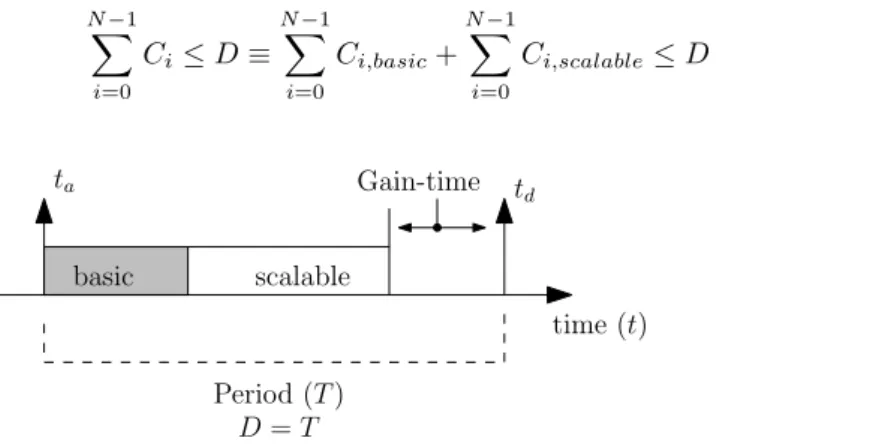
2. Resource Allocation: The decision scheduler divides the available resources within a period into fixed-sized quanta, termed time-slots, and dynamically allocates these time-slots to the algorithms based upon the scheduling policy. To allocate processor time, a task implementing a scalable priority processing algorithm is assigned the processor by means of either (i) suspending and resuming the task or (ii) manipulating the task priority such that the native fixed priority scheduler (FPS) of the platform can be used. The latter option allows the consumption of gain-time.
3. Monitoring: The scheduling policy decides each time-slot which algorithm to assign the processor re-sources. This decision is based upon progress values of the algorithms relative to the amount of time consumed by these algorithms. Monitoring requires the decision scheduler to be activated after each time-unit. Each period consists of a fixed amount of time-slots. Both mechanisms for preliminary termination and resource allocation rely on correct accounting of these time-slots.
The priority processing applications are prototyped in a Matlab/Simulink environment and executed on a multi-core platform under Microsoft Windows XP. This platform is used to compare the performance of different implementations of the above described mechanisms.
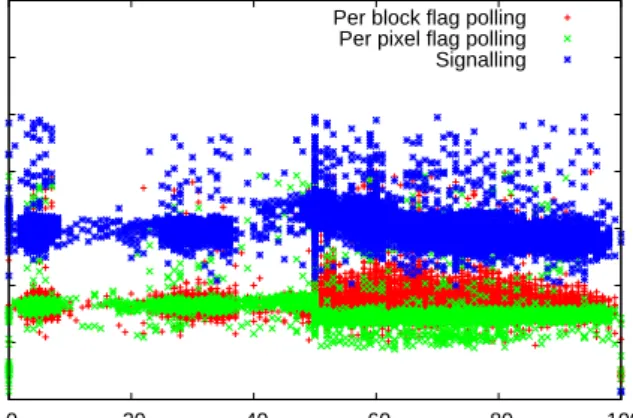
For preliminary termination, we want to minimize the following two measurable performance attributes: 1. Termination latency: Based on extensive tests, there is no measurable difference in polling each
block-or pixel-computation. Signalling is less reliable, causes relative high latencies and is not available on most platforms (including the Windows platform).
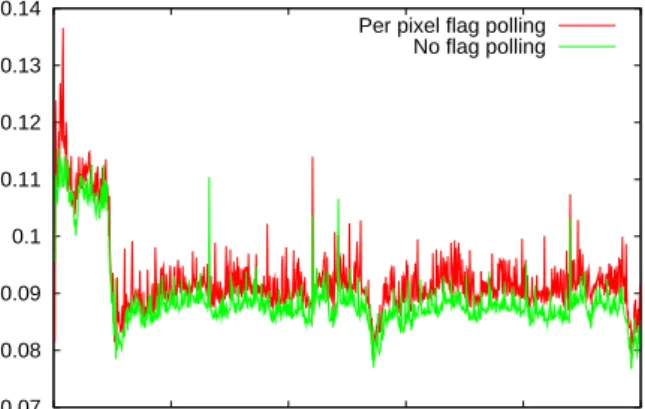
2. Computational overhead: Polling involves computational overhead and disturbs signal processing. In our simulation environment there is just a small computational overhead measurable.
Resource allocation mechanisms are optimized by reducing context-switching overhead. Furthermore, priority manipulation mechanisms has the additional advantage over suspending-resuming of tasks that it allows priority processing to consume gain-time.
Monitoring shows difficulties in enforcing time-slots on the Windows platform, since accounting of time-slots relies on the availability of high-resolution timers. Therefore, the decision scheduler implements a busy-waiting loop and must be mapped on a separate core.
Finally, it is shown that the control overhead of the priority processing application is significantly improved by combining block-based polling as a mechanism for preliminary termination; priority manipulation using the Windows fixed priority scheduler as resource allocation mechanism; reducing context-switching overhead and allowing gain-time consumption.
TABLE OF CONTENTS
Abstract . . . 3
Table of Contents . . . 4
1. Introduction . . . 6
1.1 Context and Background . . . 6
1.2 Problem Description . . . 7 1.3 Project Goals . . . 7 1.4 Approach . . . 7 1.5 Contributions . . . 7 1.6 Overview . . . 8 1.7 Glossary . . . 9 2. Related Work . . . 10
2.1 Scalable Video Algorithms: From Modes to Priority Processing . . . 10
2.2 Priority Processing . . . 11 2.3 Control Strategies . . . 12 2.3.1 Budget-based Control . . . 12 2.3.2 Decision Scheduler . . . 13 2.4 Platform Support . . . 14 2.4.1 Hardware Trends . . . 14
2.4.2 Role of the Operating System . . . 15
2.4.3 Real-time Systems . . . 15
2.5 Resource Reservations . . . 16
2.5.1 Hierarchical Scheduling . . . 17
2.5.2 Multimedia Systems . . . 17
2.6 Applicable Work . . . 18
3. Resource Management Mechanisms . . . 20
3.1 Architecture Assumptions. . . 20 3.2 Generic Architecture . . . 20 3.3 Task Model . . . 21 3.4 Monitoring . . . 24 3.5 Allocation of resources . . . 24 3.5.1 Cooperative Scheduling. . . 25
3.5.2 Suspending and Resuming Tasks . . . 25
3.5.3 Priority Bands . . . 25
3.6 Preliminary Termination of Jobs . . . 26
3.6.1 Cooperative Preliminary Termination of Jobs . . . 26
3.6.2 A-synchronous Preliminary Termination of Jobs using External Events . . . 27
3.7 Towards a Multimedia Application Prototype . . . 28
3.7.1 Towards a Prototype for scalable subtasks . . . 28
3.7.2 Data Transfer to Output Memory . . . 29
3.7.3 Finetuning Granularity of Termination . . . 30
3.7.4 Mapping Priority Processing Tasks to Threads . . . 30
4. Experimental Setup and Implementation . . . 32
4.1 Simulation Environment . . . 32
4.2 Operating System Dependencies . . . 33
4.2.1 Mapping of Components . . . 33
4.2.2 Using Fixed Priority Scheduling . . . 33
4.3 Diagnostics . . . 33
4.3.1 Review the Task Model . . . 33
4.3.2 Review on Multi-Processors . . . 34
4.4 Dynamic Resource Allocation for Priority Processing . . . 34
4.4.1 Resource Users . . . 34
4.4.2 Budget Definition. . . 34
Dynamic Resource Allocation in Multimedia Applications Table of Contents
4.4.4 Preliminary Termination . . . 35
4.4.5 Monitoring . . . 35
4.4.6 Applying Subtask-Structure Modifications . . . 36
4.4.7 Summarizing the Optimization Workflow . . . 38
4.5 Model Implementation on Microsoft Windows XP . . . 39
4.5.1 Resource Allocation . . . 39
4.5.2 Monitoring . . . 39
4.5.3 Preliminary Termination . . . 39
4.6 Porting the Model to GNU/Linux . . . 40
4.6.1 Monitoring . . . 40 4.6.2 Preliminary Termination . . . 40 4.7 Hypotheses . . . 41 4.7.1 Preliminary Termination . . . 41 4.7.2 Resource Allocation . . . 41 4.8 Research Questions . . . 41 4.8.1 Preliminary Termination . . . 41 4.8.2 Resource Allocation . . . 41 4.8.3 Monitoring . . . 42
5. Measurements and Results . . . 43
5.1 Measurement Accuracy . . . 43
5.2 Performance Comparison for Preliminary Termination Mechanisms . . . 43
5.2.1 WCET for Videoframes and Pixelblocks . . . 43
5.2.2 Thread Termination Latencies . . . 47
5.2.3 Intermezzo: Reimplementing Worker Threads on Windows . . . 48
5.2.4 Termination Latencies Continued . . . 49
5.3 Optimization of Resource Allocation Mechanisms . . . 54
5.3.1 Suspend-resume versus Priority Manipulation . . . 55
5.3.2 Gain-time Usage . . . 56
5.3.3 Optimized Control . . . 57
5.3.4 Processor Utilization . . . 57
5.4 Monitoring . . . 58
6. Conclusions . . . 60
6.1 Optimizing the control of Priority Processing . . . 60
6.2 Future Work . . . 61
6.2.1 Towards System Deployment: Mapping on Hardware Accelerated Platforms . . . 61
6.2.2 Virtual Platforms . . . 62
References . . . 64
I Appendices
67 A. Mode Change Protocols in Real-time Systems . . . 68A.1 Task Structure . . . 69
A.2 Preliminary Termination of Jobs . . . 69
A.2.1 Managing Preliminary Termination of Sub-tasks . . . 70
A.2.2 Finetuning Granularity of Termination . . . 71
B. State Consistency using Fault Tolerance Mechanisms . . . 73
B.1 Recovery Preparation . . . 73
B.2 Fault Detection and Recovery . . . 74
B.3 Recovery Blocks . . . 74
C. System benchmarking on X86 platforms . . . 76
D. POSIX Threads and Signals . . . 78
D.1 Linux Signals . . . 78
D.2 Suspending and Resuming POSIX Threads . . . 78
1. INTRODUCTION
In this report, we look at mechanisms to support the control of priority processing applications. Priority processing defines a novel approach towards scalable video algorithms. Dynamic resource allocation is required to maximize the overall output quality of multiple video algorithms that are executed on a shared platform. First, Section 1.1 motivates the development of scalable video algorithms. Next, in Section 1.2 the problem description is stated more carefully, followed by Section 1.3 which defines the goals of this report. In Section 1.4 the used approach of this research project is summarized, followed by a description of the contributions of this project compared to current research results. Section 1.6 presents a global report outline. Finally, the glossary at the end of this section presents a list with abbreviations used through this report.
1.1 CONTEXT AND BACKGROUND
In current multimedia systems, signal processing functionality are moved from dedicated hardware to software implementations [18]. A problem is to guarantee real-time constraints on programmable platforms with data dependent load conditions. Most algorithms for video processing have a fixed functionality and cannot be adapted to resources. First generation of scalable video algorithms can trade-off picture quality against resource usage at the level of individual frames, by means of providing a limited number of quality levels [18,39]. These first developed scalable video algorithms typically have a kernel which is not scalable and a scalable part to increase quality.
High quality video processing has real-time constraints. Hard real-time systems require analysis based upon Worst-Case Execution Time (WCET). Due to the highly fluctuating, data dependent resource demands of video processing algorithms, it is not very cost effective to deploy these algorithms on hardware platforms based upon worst-case resource demands. On one hand, implementing video algorithms using the classical real-time approach based upon WCET analysis would lead to:
1. high development cost to extract the WCET from an algorithm. Due to complex algorithms and the data dependent characteristics it is very difficult, if not impossible, to obtain correct WCET estimates. 2. low processor utilization. Due to high load fluctuations within video processing applications, the average
case computation times for a frame are not near to the worst case computation times. By requiring resource availability based upon worst case demands, a lot of resources are wasted.
On the other hand, due to the characteristic that worst-case and average case execution times differ a lot, also overload situations can occur. Overload situations cause deadline misses and therefore a reduced output quality.
• Figure 1: Scalable video algorithms allow a trade-off in resource requirements and output quality and provide cost-effective development. Products in different price-ranges and product families can be supplied with the same software by adapting the resource demands of the algorithms to the available resources on the platform. Source: [18].
Scalable video algorithms allow to compromise quality for lower resource demands, as indicated in Figure 1. The trade-off in resource requirements allows deployment of the same software components in consumer electronic products of different price-ranges as well as different product families. A typical use-case, as shown in Figure 1, shows that full software functionality is available in the highest price-range consumer product, which is supplied
Dynamic Resource Allocation in Multimedia Applications Introduction
with the most powerfull hardware. Lower price-ranges are supplied with cheaper hardware and must deal with reduced functionality and/or quality.
The possibility to reuse software components makes scalable video algorithms attractive in a cost-effective sense and decreases the time to market for new products.
1.2 PROBLEM DESCRIPTION
Current trends in consumer electronic products move towards more software oriented approaches, with an increased amount of functionality within the same device. This trend causes that multiple (scalable) software components have to share the same hardware. In this report we consider a special variant of scalable video algorithms, named priority processing. It is investigated which mechanisms are required to efficiently share (processor) resources among competing priority processing video algorithms, which have to share the same resources.
1.3 PROJECT GOALS
Mechanisms are investigated to allow efficient allocation of resources over competing, independent scalable video components. These mechanisms are applied in the priority processing applications to compare efficiency of resource usage. The goal is to allow an abstraction layer, which provide appropriate mechanisms allowing the priority processing components to share processor resources as efficient as possible, and therefore reduce control overhead.
Part of the resource management scheme is to support fast termination of jobs in scalable video applications, preventing overload situations. Using scalable priority processed multimedia applications, a sub-goal is to get rid of the additional overhead caused by polling of the available budget at regular intervals. Providing signalling mechanisms to preliminary terminate tasks in a predictive manner makes the polling mechanism superfluous. Depending on the granularity of the scalable video algorithms, the polling versus the signalling mechanism can be considered trade-offs in overhead versus latency.
Due to the fluctuating load characteristic of video processing algorithms, it is conceivable that processing of a frame consumes less time than expected. This leaves space for other components to use the otherwise wasted processor resources. An additional challenge is to effectively use this so called gain-time.
1.4 APPROACH
The approach of this project is to first investigate mechanisms to support preliminary termination of jobs and distribute resources over competing, independent components. An important issue is to guarantee state and data consistency for an application.
The next step is to evaluate how the investigated mechanisms can be applied in the priority processing appli-cation. These priority processing applications are prototyped in a Matlab/Simulink environment which run on standards Microsoft Windows or GNU/Linux machines.
Subsequently, the investigated mechanisms are compared amongst each other in terms of efficiency, by imple-menting them in scalable priority processing applications. We consider different mechanisms to allow local scheduling of tasks, as well as mechanisms to account the amount of time used by an task. Mechanisms for preliminary termination of jobs are the first objective to optimize.
Finally, the observations extracted from the experiments are used to indicate further directions towards suc-cessful implementation of priority processing applications on a real-time platform.
1.5 CONTRIBUTIONS
This report contributes a dynamic resource allocation scheme applied within the priority processing application. Three basic mechanisms for dynamic resource allocation are identified, for which different implementations are compared to each other:
1. Preliminary Termination: This report compares different mechanisms to allow preliminary termination of jobs in multimedia applications. For example: a signalling based approach for preliminary terminating jobs is implemented in a priority processing application, in which the performance, by means of control
overhead and termination latency, can be compared to polling based control mechanisms.
2. Resource Allocation: It is investigated which mechanisms are needed to supply the priority processing application with a resource management scheme, which dynamically allocates the available resources over competing, independent components.
3. Monitoring: The monitoring mechanism extracts state information from the application on which the scheduling policy relies to make appropriate decisions. Furthermore, the resource allocation and pre-liminary termination mechanisms rely on information concerning the consumed time by a scalable video component.
Furthermore, the priority processing application has been ported to the GNU/Linux platform, which helped to identify incorrect behavior of the application. A main issue corrected in the models is remapping the priority processing tasks on threads, resulting in reduced latencies upon preliminary termination of jobs.
Finally, a proposal is done to deploy the priority processing applications in a real-time environment, based on gathered simulation results.
1.6 OVERVIEW
During this section, the problem to be solved has been briefly defined and the context of this project is sketched. Section 2 summarizes related literature, containing useful background information for a general system model. During this section, more elaborate information about scalable video techniques and their control are described. After this section, issues to be solved in project should be clarified in more detail.
Section 3 presents a general architecture for the control of scalable multimedia applications with fluctuating quality levels. After presenting this general architecture, the interaction between the controlling components, system level components and application components will be described in more detail. The main contribution of Section 3 is to outline different implementations for the preliminary termination, resource allocation and monitoring mechanisms.
Section 4 introduces the priority processed video application and shows how the architecture and mechanisms introduced in Section 3 can be mapped onto the priority processing applications. The simulation environment, in which the priority processing applications are prototyped, is also explained in detail. The prototyped models of the priority processing applications, as initially implemented, are carefully diagnosed. Finally, questions and hypotheses are stated in Section 4 which are to be answered and tested.
Section 5 describes the experiments performed with the priority processing applications and presents the corre-sponding measurement results.
Finally, Section 6 summarized conclusions extracted from the priority processing application; proposes directions of further research and states some overall concluding remarks.
Dynamic Resource Allocation in Multimedia Applications Introduction
1.7 GLOSSARY
Notation Description Page List
APC A-synchronous Procedure Call 40
API Application Programming Interface 39
ARM Advanced RISC Machine 61
ASP Application Specific Processor 14
CPU Central Processing Unit 3
DSP Digital Signal Processor 14
FPDS Fixed Priority Deferred Scheduling 69
FPPS Fixed Priority Preemptive Scheduling 69
FPS Fixed Priority Scheduling 17
GCC GNU Compiler Collection 40
GOPS Giga Operations Per Second 63
LCD Liquid Crystal Display 11
MIPS Microprocessor without Interlocked Pipeline Stages 61
MPSoC Multi-Processors System on Chip 61
POSIX Portable Operating System Interface for Unix 78
QMC Quality Manager Component 69
QoS Quality of Service 10
RDTSC Read Time Stamp Counter 76
RL Reinforcement Learning 54
RR Round Robin 54
SMP Symmetric Multi-core Processing 76
TSC Time Stamp Counter 58
VLIW Very Long Instruction Word 35
VQEG Video Quality Experts Group 32
2. RELATED WORK
This section presents related literature to topics relevant to this report. First a more elaborate description of scalable video algorithms will be given.
Scalable video applications which can run in several modes of operation must ensure smooth transition between quality levels. During mode switches overload situations must be prevented. Similarly, frame-computations must reside within assigned (fixed-sized) budgets. A trend is observed towards more fine-grained scalable video applications. For example: set a quality mode for each frame. Section 2.1 presents most common techniques in the field of scalable video algorithms and relates it to the priority processing concept. Priority processing is introduced in Section 2.2, as a way of self-adapting scalable video algorithms, is capable of handling fluctuating resource availability.
In Section 2.3 different control strategies are compared. First reservation-based strategy for a single algorithm is explained. Thereafter, it is compared with the control strategy developed for competing algorithms within the priority processing application.
Scalable video algorithms are developed to exploit their advantageous characteristic of adaptable resource re-quirements. This means that salable video algorithms can be ported to different hardware platforms, which provide different amount of resources. However, each platform (software and hardware) provides its own set of primitives to do resource management. In Section 2.4 a overview of trends in platform design is given as basic background information.
In the application domain of scalable video algorithms, preliminary termination of pending work is a desired mechanism to guarantee progress at a certain quality level within resource constraints. Mechanisms for resource management within scalable video applications typically assume a semi-static resource availability. Mechanisms for resource management while guaranteeing availability of resources, known as resource reservation mechanisms, are described in Section 2.5.
A summary of the related work is given in Section 2.6. For a brief description of related research topics which are applicable in this project, it is sufficient to read Section 2.6.
2.1 SCALABLE VIDEO ALGORITHMS: FROM MODES TO PRIORITY
PRO-CESSING
A classical approach to achieve scalability in multimedia applications is to introduce multiple modes of operation, which trade-off resource requirements versusQuality of Service (QoS). An application running on a particular platform is assumed to be able to run in a number of different application-modes. Each mode may for example represent a specific quality level of that application. Example applications include a video decoder that can process an MPEG video-stream at different quality levels or an algorithm improving the quality of an individual frame. Whenever such an application is requested to change its quality level, it typically defers the actual change to a well-defined moment in its code, for example upon completion of an entire frame or completion of an enhancement layer of that frame.
Figure 2 shows an example of a scalable video algorithm which is split into a set of specific functions. Some of these functions are scalable to provide different quality levels. The quality control block contains the information to set appropriate combinations of quality levels of the functions in order to provide an overall acceptable output quality. These quality levels are modes in which the multimedia application can act. A mode change request is initiated when the control triggers an application to change its quality level.
Hentschel et al. [18] define scalable video algorithms as an algorithm that:
1. allows dynamic adaption of output quality versus resource usage on a given platform; 2. support different platforms for media processing;
3. is easily controllable by a control device for several predefined settings.
As an alternative to modes of operations in scalable real-time multimedia applications, the scalable priority processing principle is developed [17]. Priority processing offers a way of deploying scalable video algorithms, which can be interrupted during processing and still deliver best quality for the resources used, instead of skipping a complete output image.
Dynamic Resource Allocation in Multimedia Applications Related Work
•Figure 2: Basic structure of a scalable component, in which all functions have common interfaces to communicate with the quality control block in order to adapt quality levels to available resources; source: [18]
2.2 PRIORITY PROCESSING
With the principle of priority processing [17], an efficient way for self-adapting video algorithms at not guaranteed system resources has been proposed. According to this principle, signal processing follows a priority order. Important image parts are processed first, less important parts in a decreasing order. After creation of an initial output by a basic function, signal processing can be preliminary terminated at arbitrary moment in time. Hentschel and Schiemenz [17] introduce a scalable priority processing algorithm for sharpness enhancement. After creating a basic output, the image content is analyzed and finally the scalable functions processes the image blocks in which the blocks with high frequency content get preference over other blocks. An example of this algorithm is shown in Figure 3. Traditional image enhancement algorithms process the content from left to right and in a top down fashion. By only enhancing 25% of the image content, this would result in enhancing background content. By giving preference to high frequent blocks, important parts of the foreground are processed first, resulting in an immediately visible result.
Priority processing is characterized by an algorithm dependent quality function with three stages: apply a basic function, analyze the image content and finally apply the scalable algorithm part in order of importance. The behavior of priority processed scalable video algorithms is shown in Figure 4, by a characteristic function in time versus the output quality:
1. Initially, time is spent to produce a basic output at the lowest quality level.
2. Thereafter, time is spent to identify the most important parts of the image content.
3. Finally, the quality of the picture is increased by processing the most important picture parts first. When a basic output is available, processing can be interrupted at any time, which leaves the output at the quality level obtained so far. Each priority processing algorithm has its own characteristic trend.
Schiemenz and Hentschel [33] introduce a more comprehensive deinterlacing priority processing algorithm. A deinterlacer fills in the missing lines of interlaced transmitted (or stored) video signals for representation on progressive pixel-oriented displays, such as plasma or Liquid Crystal Displays (LCDs) [33]. After creating a basic output by simple linear interpolation, the scalable part of the deinterlacing algorithm has two parts:
1. Motion adaptive interpolation in stationary areas of the video content.
2. Edge dependent motion adaptive interpolation in moving areas of the video content.
The deinterlacer algorithm analyses the video content and gives priorities on basis of extracted motion infor-mation. Each stage of the algorithm improves the signal to noise ratio of the picture content. Both stages are applied sequentially, because applying both algorithms consecutively on a single block would give visible artifacts when preliminary terminating the processing of a frame.
Knopp [23] implemented the scalable deinterlacing algorithm on the DM642 evaluation board of Texas Instru-ments and compares the results by the hardware accelerated measureInstru-ments with the measureInstru-ments obtained from the Matlab/Simulink environment. The qualitative results are good, however the algorithms run a lot
• Figure 3: Example result of applying an scalable sharpness enhancement algorithm: a) The blocks of the image are processed in sequential order; b) The most important picture parts are identified and processed. In both images the red parts show the progress of the algorithm. c) The result of the sequential algorithm in which only background content is filtered and therefore no visible quality improvement is obtained. d) The result of the priority processing algorithm when the most important image parts are enhanced. Source: [6]
slower on the hardware as on modern general purpose computers such that realtime performance is not achieved. The flexibility and the increasing computing power of modern general purpose computers give preference to implementing the algorithms in high level languages, instead of porting them to embedded platforms.
2.3 CONTROL STRATEGIES
W¨ust et al. [39] describe strategies to adapt quality levels by balancing different parameters determining the user-perceived video quality. These parameters are:
1. Picture quality: this is measured as perceived by the user and must be as high as possible; 2. Deadline misses: these should be as sparse as possible, because of the induced artifacts; 3. Quality changes: the number and size of quality level changes should be as low as possible.
Control strategies try to find optimal settings for these parameters, to maximize the perceived quality level.
2.3.1 BUDGET-BASED CONTROL
W¨ust et al. [39] introduce a control strategy which selects a quality mode at the border of each frame-computation. Each quality level assumes a fixed availability of budget for a single algorithm. The selection of the quality level is designed as a discrete stochastic decision problem by means of a modified Markov Decision Process.
A Markov Decision Process is built from states and actions. The states incorporate the task progress and the previous quality level. The actions select a new quality level with an attached probability. The Markov Decision Process is solved off-line for particular budget values. During runtime when the control starts a new job, the controller decides its action by consulting the Markov policy by a simple table look-up.
Dynamic Resource Allocation in Multimedia Applications Related Work
Basic Analyse Enhance
time Qualit y Basic Quality (0%) 100%
•Figure 4: Priority processing, as a function of time consumption versus output quality, can be divided in three time-frames: 1) produce a basic output at the lowest quality level; 2) Identify the most important image content; 3) Enhance the quality of the output by processing the most important picture parts first.
Such a decision table can also be built during runtime by means of reinforcement learning. A reinforcement learning strategy starts with no knowledge and has to learn optimal behavior from the experience it gains during runtime [4]. State-action values in the table give estimates how good a particular action is in a given state. Given a state, the best action in the table is chosen during runtime. This action gives the new runtime quality mode. W¨ust et al. [39] claim that only a small amount of pre-determined statistics is needed to get reasonably good start results.
Control strategies described by W¨ust et al. [39] assume a work preserving approach, which means that a job processing a frame is not aborted if its deadline is missed, but is completed anyhow. The reasoning behind this strategy is that abortion of jobs would waste work already done. In this report, considering priority processing applications, the work preserving property is not applicable.
2.3.2 DECISION SCHEDULER
The strategy [39] selects a quality level for processing the next frame upon completion of the previous frame, i.e. synchronous with processing. Despite the fact that the priority processing approach does not have modes of operation, it also applies reinforcement learning strategies to assign budgets for the scalable video tasks [6, 22, 32]. The control of the priority processing application selects the algorithm to execute next upon completion of a time-slot instead of upon completion of a frame, i.e. synchronous with time.
For the control of priority processing algorithms, a scheduling method based on time-slots is used. A collection of time-slots define a periodically available budget for a frame-computation. The control (decision scheduler) receives the result from the reinforcement learning scheduling policy and enables the selected video task for the duration of one time slot with the entire resources. The decision scheduler allocates time-slots to the scalable algorithms [32] and preliminary terminates processing when the capacity is depleted. Because each algorithm must provide an output at the end of each period, we need appropriate mechanisms to preliminary terminate algorithms when the period ends (deadline is reached).
The allocation of time slots is dependent on the processing progress of individual algorithms. The scalable algorithms update their progress value at runtime. The so called decision scheduler decides an allocation on basis of progress values according to apportion of resources in a fair way, using methods from reinforcement learning. Basic implementations of the decision scheduler plus some scalable priority processing algorithms are available.
Schiemenz [32] compares a reinforcement learning scheduling approach with the round-robin approach and the minimum-decision approaches. Each deadline period in which a frame must be processed, is cut into time-slots. The amount of time-slots in a period is at least the amount of competing algorithms. The decision scheduler assigns the time-slots to the algorithms and makes the decision on the basis of obtained progress values. The goal is to assign the time-slots in such a way that the total progress of all algorithms is maximized. It is assumed
that the progress of an algorithm, measured by the amount of processed blocks, is proportional to the perceived quality level:
Quality∼P rogress (1)
Due to the learning characteristic of the reinforcement learning approach, this approach achieves better overall quality than other approaches like:
1. Round-robin: Every algorithm is alternately assigned a time-slot. Since progress trends are characteristic for an algorithm and data dependent, one algorithm might need more time than another to reach similar progress values.
2. Minimum Decision: The algorithm which has the lowest progress value is assigned the next time-slot. This approach only works with algorithms requiring a similar amount of resources. When an algorithm requires a lot of resources to reach a certain progress value, it can exclude all other competing algorithms. These other algorithms might require only a few resources to complete. Therefore the minimum decision approach does not maximize the total progress value.
Joost [22] investigated how to stabilize the reinforcement learning scheduling in priority processing applica-tions, such that progress values show reduced fluctuations compared to an earlier implementation of Berger [6]. This stabilization leads to less fluctuation in quality. Joost [22] also implemented a prototype on the Texas Instruments DM642 evaluation board. Despite the labor-intensive, but successfully applied, task of mapping a priority processing application on this (relatively outdated) embedded platform, the implementation lacks a satisfactory performance result.
2.4 PLATFORM SUPPORT
In order to map the priority processing application successfully on an arbitrary platform, it is required to have extensive knowledge about the target platform. This section give an overview of the most important aspects of a platform. Aplatform, which is capable to run software components, is defined by [8]:
1. Hardware: provides the computational power, memory and possible additional components to speed up computations;
2. Programming language: a formalism to express how to use the hardware;
3. Operating system: a software layer which distinguishes the hardware layer from the software. 4. Runtime-libraries: standard libraries (provided by - or built on top of - the operating system) which
provide basic functionality reusable by different components.
Especially the hardware and the operating system are given extra attention in this section. As a special type of system, real-time systems are briefly introduced.
2.4.1 HARDWARE TRENDS
Considering the development of computational power in embedded devices in the last decades, a trend is shown towards increased parallelism [12, Section 2] on different levels in the design. A graphical overview of different classes in processor design, trading off flexibility for efficiency, is shown in Figure 5. Flexibility is a metric which indicates the programmability of the platform. Efficiency is measured in energy consumption.
Figure 5 shows three most important classes of processor architectures:
1. Application Specific Processor (ASP) consists of processing elements dedicated and optimized for a single application.
2. Digital Signal Processor (DSP) consists of relative simple hardware capable of efficiently executing signal processing applications.
3. General purpose processor are very dynamic and programmable platforms, allowing a wide range of applications to run, but at the cost of efficiency.
Production of programmable chips is only cost-effective when mass-production is possible. Therefore, a trend towards more dynamic architectures is visible, such that after production of the chip the functionality can be changed by means of software updates.
An example of devices containing application specific processors, is the first generation mobile-phones, which are capable of making phone calls and sending text messages. Hardware chips inside these mobile-phones are very energy efficient, but it is not possible to extend the mobile-phone with additional software applications.
Dynamic Resource Allocation in Multimedia Applications Related Work
Flexibility
efficiency
General Purpose DSP ASP
Telephone chips Signal Processing Acceleration Desktop PC / Laptop Current trend
• Figure 5: Current processor architectures, embedded in current user electronic devices, show a trend towards more flexibility. By example of: H. Corporaal and B. Mesman (TU/e)
These days, mobile-phones are very flexible and allow installation of software applications on user demand. This is at the cost of energy efficiency.
Energy savings is a topic getting a lot of attention in current research. Combining research in energy efficient computing with programmability means that the gap between general purpose and application specific processor designs becomes smaller.
2.4.2 ROLE OF THE OPERATING SYSTEM
An operating system provides an interface between hardware and software by providing [8]:
1. Abstraction: implement generic concepts and handle complexity. For example: implement basic hard-ware drivers, such that application engineers can abstract from hardhard-ware details.
2. Virtualization: from the point of view of an application or an user, it looks like the operating system provides each of them with the full system resources. Furthermore, the operating system provides the same abstraction for multiple underlying hardware systems.
3. Resource management: resource management aims at sharing resources among different application within the system. Sharing of resources includes allocating the resources as efficient as possible and prevent applications from abusing resources (protection of resources).
Important in operating system design is the distinction between policy, providing the abstraction, and the mechanism, providing the means. The decision scheduler, as introduced in Section 2.3.2, is an application specific component, which specifies thepolicy (orstrategy) to distribute the resources. Apolicy describes how a system should behave. In order to realize a policy, appropriate mechanisms must be provided by the operating system or a layer built on top of the operating system. A mechanism provides the instrument to implement a policy.
Topic of research are resource management mechanisms to allow efficient allocation of processor resources for multimedia applications. The mechanisms required to dynamically allocate resources are built on top of the operating system, assuming that operating system sources are not available and aiming at general applicable approaches. This preserves platform abstraction for the application.
2.4.3 REAL-TIME SYSTEMS
A real-time system is not only characterized by its functional requirements, but also by its timing requirements. This means that tasks in such a system are bounded by a deadline. By violating this deadline, the functional output of this task becomes less valuable, irrelevant or even wrong. A lot of research has been done in order to achieve predictability in real-time systems, such that correctness in this temporal behavior can be guaran-teed [11]. However, most common techniques described in literature assume that a system is formed by a fixed set of tasks. These tasks, assumed to be independent of each other, execute the system functionality, and are often categorized as periodic or a-periodic. Atask is defined as a sequence of actions that must be performed in reaction of an event, whereas ajob is defined as an instantiation of a task.
analysis described in literature, such as by Buttazzo [11], rely on a task model description based on the following task characteristics:
1. Timing parameters are known-upfront (for example: worst-case execution times, periods and relative deadlines). These parameters (dependent on the scheduling policy) are required to provide the analysis whether a feasible schedule is possible with the tasks composing the system.
2. Worst-case execution times are close to average-case execution time. When the difference between worst-case and average-worst-case execution times is relatively high, it leads to low processor utilization. In order to guarantee timing constraints, the worst-case scenario must be taken into account. When accounting the worst-case scenario, it means that an average case job leaves a lot of unused processor time.
3. Each task is assigned a priority, which is determined by the scheduling policy. The priority can be fixed or dynamically assigned. Tasks are assigned to the processor according to their priority.
4. Tasks are assumed to be independent. Precedence relations or communication between tasks can influence the schedulability of the system.
Since the main task of a real-time operating system is to provide predictable task latencies, this requires appropriate implementations of system calls, memory management and offered primitives [11]. All kernel calls should have a bounded execution time. Memory management must be done deterministically. Constructs as semaphores and dynamic datastructures must be prevented, since these constructs do not allow analysis of resource allocation upfront.
On the one hand, high quality video applications also require precise timeliness constraints, for example: peri-odically a frame is computed with a predefined deadline. On the other hand, multimedia applications do not fit in the classical real-time model. Media processing applications are typically organized as chains of data driven tasks [38], which violates the assumption of independent tasks. Furthermore, the data-dependent computational load of a signal processing algorithm violate the assumption that worst-case execution times are close to average-case execution times. Therefore, scalable alternatives are developed to fit multimedia processing applications in a real-time environment, such as reservation based mechanisms (see Section 2.5) with corresponding quality modes.
It might be desirable for a system to accommodate changes of functionality or behavior to respond to external events. It is possible to include different flavors of tasks in a single task set, however this approach does not scale very well. Alternatively, the task set can depend on themode the application is running in. An event in the system can trigger the application to switch between two application modes, which is called amode change request. However, in literature several techniques are described in order to achieve predictability during the transition of application modes, see [31]. An overview of the applicability of investigated resource allocation mechanisms in applications supporting different modes of operating is described in Appendix A.
2.5 RESOURCE RESERVATIONS
Resource reservations is an approach to manage resources at the level of real-time operating systems, by means of providing a virtual platform among competing applications within the system [28]. A reserve represents a share of a single computing resource [29], for example: processor time, physical memory or network bandwidth. A reserve is implemented as a kernel entity, which means that it cannot be counterfeited. This report focusses mainly on resource management mechanisms for processor time, for which similar mechanisms are required as resource reservations.
As described by Rajkumar et al. [29], the resource reservation paradigm relies strongly on the implementation of mechanisms for:
1. Admission Control: This mechanism contains a feasibility test, which checks how much resources can be consumed. A reservation is only granted if it does not exceed the maximum amount of available resources and does not jeopardize overall system performance.
2. Scheduling: Defines the policy to distribute the available resources over competing applications. 3. Enforcement: These mechanisms must ensure that the amount of resources used by an applications does
not exceed the reservation.
4. Accounting: Keeps track of the amount of resources used by each application. This information can be used by the scheduling and enforcement mechanisms.
Resource reservations provide temporal protection among different applications. If an application violates its timing constraints, other applications will not suffer from this. This allows independent design, analysis and
Dynamic Resource Allocation in Multimedia Applications Related Work
validation of real-time applications. Each application can even use a local scheduler, which subdivides the acquired resources among its components. The integration of multiple applications in such an hierarchical scheduled system consists of schedulability test on the system level, verifying that all timing requirements are met [5].
2.5.1 HIERARCHICAL SCHEDULING
Behnam et al. [5] present an hierarchical Scheduling framework built on top of VxWorks, without modifying the kernel source code. The implemented framework provides temporal isolation of programs by means of periodic servers. These servers are the highest level tasks, which are scheduled by the fixed priority scheduler of VxWorks, and their budget is replenished every constant period.
Fixed Priority Scheduling (FPS) means that the highest priority ready task will always execute. If during runtime a task with a higher priority becomes ready to execute, the scheduler stops the execution of the running task and assigns the processor to the higher priority task.
Using the fixed priority scheduler of VxWorks, Behnam et al. [5] describe how to implement arbitrary scheduling policies. This is done by using a interrupt service routine which manipulates tasks in the ready queue. This interrupt service routine can add tasks to the ready queue, remove tasks from the ready queue and can change priorities of tasks. Since periodic servers can be scheduled as periodic tasks, the model is easily extended to provide an hierarchical scheduler. This local scheduler can be implemented by:
1. changing the ready queue, which means that if an server is preempted, all its tasks are removed from the ready queue and marked with a suspend flag;
2. decreasing the priorities of the tasks corresponding to the preempted server to the lowest priority and schedule the tasks of the higher priority server with higher priorities, according to the local scheduling policy.
The advantage of the priority manipulation approach is that unused processor time can be consumed by other servers. The disadvantage is that the overhead of the system scheduler will also increase due to larger ready queues, which have to be sorted.
2.5.2 MULTIMEDIA SYSTEMS
The advantage of independent development of applications and guaranteed resources provide a good basis for multimedia applications. Scalable multimedia applications can trade-off resource usage for quality output. By means of well defined interfaces, applications can require an amount of resources from the global system. This allows scalable multimedia applications to negotiate the amount of reserved resources for quality of service. If these resources demands are subject of change during run-time, this requires a run-time admission control mechanism. Therefore, we will assume a fixed amount of available resources per component per activation period. Steffens et al. [35] present propositions and considerations for resource reservations in different applications domains. Most important in the field of multimedia processing include:
1. How do multimedia application adapt their resource needs? 2. How are non-used resources efficiently re-allocated?
3. How do interfaces look like to monitor resource usage?
4. How do interfaces look like to negotiate resource requirements?
5. How is dealt with multiple resources, for example multi-processor systems?
6. What is the granularity at which the resources are allocated? This has influence on efficient use of cache, pipelined computations, and caused control overhead.
Successful application of a resource reservation scheme is based upon operating system support in cooperation with communication via well defined interfaces with the applications. Mercer et al. [26] describe processor reservations for multimedia systems. The analysis is based upon WCET estimations. When the computation time is not constant, a conservative worst case estimate reserves the necessary processor capacity, and the unused time is available for background processing. In multimedia processing, worst case execution times are typically not close to the average case computation times.
The reservation scheme presented by Mercer et al. [26] is implemented in the kernel of a real-time operating system, with the purpose to support higher level resource management policies. A quality of service (QoS) manager could use the reservation system as a mechanism for controlling the resources allocated to various
applications. The QoS manager would translate the QoS parameters of applications to system resource require-ments (including processor requirerequire-ments), possibly with the cooperation of the application itself.
P´erez et al. [28] describe resource reservations for shared memory multi-processors for embedded multimedia applications. The processor reservation scheme is based upon a fixed priority hierarchical scheduling approach to be implemented in a real-time operating system environment, comparable to Behnam et al. [5]. In order to tackle the problem of cache poisoning in a shared cache between multiple processors and the bottleneck of a shared memory bus to access the main off-chip memory, the virtual platform as provided by the resource reservation scheme is extended with algorithms in hardware to divide the available memory resources. By managing the memory resources in an appropriate way, the processor utilization can be increased, due to less stall cycles. Memory reservation schemes are suggested to be applied in hardware as follows:
1. The cache reservation scheme consists of separated domains, which means that each applications is allowed to use a specific part of the cache. The cache partitioning scheme can be extended to overlapping domains, to obtain a better cache utilization.
2. The memory reservation scheme is based upon the distinction between periodic, high bandwidth requests versus sporadic, bursted, low latency requests. High bandwidth request have a fixed priority. The memory controller accounts the amount of cycles used by the low latency memory requests and manipulates the priorities according to its budget. When the budget is depleted for a low latency request, the priority for the low latency request is decreased, such that high bandwidth request get precedence.
2.6 APPLICABLE WORK
In this section two different approaches for scalable video applications are described:
1. Quality modes of operation, which are coarse-grained, discrete quality gradations. Each mode of opera-tion requires a semi-static amount of resource availability, whereas mode transiopera-tions introduce addiopera-tional complexity to the systems. A quality mode is typically selected on the boundaries of a frame and a frame computation is typically work-preserving.
2. Priority processing, which introduces fine-grained steps of increasing quality levels. Priority processing processes video content in decreasing priority order, allowing preliminary termination after availability of a basic output. The preliminary termination property makes this type of applications applicable to handle fluctuating resource availability in a self-adapting way. The output quality of priority processing algorithms is determined by the resources that are allocated during run-time.
When multiple scalable video algorithms are competing for a single processor resources, control strategies are required to balance the available resources as efficient as possible, In [39], a control strategy is presented for a single, work-preserving scalable video algorithm. The strategy selects a quality level for processing the next frame upon completion of the previous frame, i.e. synchronous with processing. When a deadline is missed, e.g. a frame is not completed within its budget, a frame might be either skipped or the previous frame can be repeated instead of showing no output at all. The latter option requires additional buffering of frames. In this report, we consider mechanisms for dynamic resource allocation to multiple, scalable priority-processing video algorithms. The control strategy [32] selects the algorithm to execute next upon completion of a time-slot, i.e. synchronous with time. Because each algorithm must provide output at the end of each period, we need appropriate mechanisms to preliminary terminate the scalable video algorithms. The preliminary termination mechanism introduces system overhead due to the required time synchronization enforced by this mechanism. Whereas W¨ust et al. [39] assume a fixed amount of resources for a single algorithm, the priority processing algorithms are capable of handling fluctuating resource availability.
Dynamic resource allocation has much in common with reservation-based resource management [29]. Resource reservations is an approach to manage resources at the level of real-time operating systems, by means of providing a virtual platform among competing applications within the system [28]. Guaranteed resources by means of reservation-based management can be an additional technique to dynamic resource allocation. The distinguishing characteristics with dynamic resource allocation approach on a time-slot basis, as applied in the priority processing application, are:
1. the lack of admission control. Admission control is superfluous for priority processing due to its capabilities to handle fluctuating resource availability.
2. the need for preliminary termination of scalable video algorithms, enforcing a synchronization between processing and time.
Dynamic Resource Allocation in Multimedia Applications Related Work
In case of priority processing, the roll-forward mechanism is a straightforward action upon preliminary termi-nation, meaning that a new frame-computation is started upon preliminary termination. When a pending job is terminated, it means that its budget is depleted and that a next job must be started.
Summing up the demands, the priority processing applications must be analyzed and optimized for the following key aspects:
1. Efficient distribution of processor time over the competing algorithms on a time-slot basis, according to the pre-defined scheduling policy;
2. Preliminary termination of all signal processing tasks (active and waiting tasks) by an external signal from controller if the budget is depleted.
3. RESOURCE MANAGEMENT MECHANISMS
This section first presents assumptions on the priority processing application and its environment, see Section 3.1. Thereafter, a general architecture for scalable multimedia applications is presented, see Section 3.2.
Section 3.3 describes the taskmodel within a priority processing application. The task model is extended with mechanisms to efficiently manage resources, which relies on the mechanisms for monitoring, preliminary termination and resource allocation, as described in Section 3.4 through Section 3.6.
Finally this section summarizes different design considerations for the priority processing applications, which are investigated in Section 3.7.
3.1 ARCHITECTURE ASSUMPTIONS
A1. An application is composed of a decision scheduler and one or more (priority processing) algorithms. A2. All algorithms are known upfront by the decision scheduler.
A3. Each algorithm is mapped on an independent task.
A4. Priority processing algorithms are characterized by three phases: basic, analysis and enhancement. A5. An algorithm can be preliminary terminated after the basic function, e.g.: during the analysis or
enhance-ment phase.
A6. The decision scheduler divides the available resources of the algorithms. A7. Each algorithm within the application is each period provided a budget.
A8. The budget is divided over the algorithms on the basis of fixed-size quanta, e.g.: time-slots.
A9. All algorithms are synchronous with the period, which means that each period the algorithms start with a new frame and at the end of a period the frame is terminated.
A10. Each period the input for the algorithms is available and the output can be written to an output buffer, which means that algorithms are not blocked by input and output.
A11. Each algorithm accounts its own progress and updates the progress during runtime. A12. The application is mapped on a multi-processor platform.
A13. The platform provides a fixed priority scheduler.
A14. The algorithms have the complete processor at their disposal.
3.2 GENERIC ARCHITECTURE
A generic architecture for scalable priority processing applications is shown in figure 6. In this model, a single application is assumed to consist of one or more algorithms. The algorithms are controlled by an application dependent controlling component, named the decision scheduler. The decision scheduler is expected to know all priority processing algorithms upfront. The algorithms on their turn are assumed to provide the decision scheduler with feedback information, such that the decision scheduler can make better decisions about the division of available resources among the algorithms. The decision scheduler uses the system support layer, which provides interfaces for mechanisms which are needed to enforce real-time requirements.
Platform
System Supp
ort
Decision Scheduler Scalable Priority
Processing Algorithm 1 Scalable PriorityProcessing Algorithm 2
budget
progress progress budget
Application
Lev
el
Resource Management
uses
•Figure 6: Layered reference architecture consisting of a system support layer with an application layer on top. Appli-cation components are indicated with a gray background. The resource management layer on top of the platform (red rectangle) indicates the area in which mechanisms are implemented to provide platform abstraction and efficient resource allocation and deallocation for the multimedia application. This is the main subject of research in this report.
Dynamic Resource Allocation in Multimedia Applications Resource Management Mechanisms
decision scheduler, can use system support components, which on its turn use platform internals. The system support layer consists of the resource management and platform layers. The resource management layer can be seen as a library, with corresponding interface definitions, which can be included by the application. The decision scheduler uses the library by using the #include statement in C/C++ and the compiler links the application against the corresponding library.
The following parts can be identified from this layered architectural application model: 1. Application Level
An application consists of components, which can either be control components running at the highest priority, or functional components (scalable algorithms) performing the actual work to be done.
(a) Decision Scheduler
The decision scheduler is assumed to be an application dependent control component running at the highest priority, which is capable to assign budgets and make decisions to trade-off the overall resource needs of the system versus the output quality of the system. This includes the application specific scheduling policy. This report abstracts from the internal design of the decision scheduler, but emphasizes on the mechanisms needed to support local resource management.
(b) Algorithms
An application consists of one or more scalable algorithms. An algorithm is mapped directly onto a task. The behavior of each of these algorithms is defined by a characteristic progress function and has real-time requirements. Section 3.3 describes the structure of a task in more detail.
2. System Support Level
The system support level consists of two layers: the resource management layer is built on top of the operating system, which implement interfaces to abstract from the platform.
(a) Resource Management Layer
The decision scheduler needs mechanisms for dynamically allocating and deallocating processor re-sources over the scalable algorithms. An additional resource reservation scheme based upon mecha-nisms as described by Rajkumar et al. [29], and for example as implemented by Behnam et al. [5], can guarantee availability of resources for an application. This includes the availability of primitives to implement mechanisms for: scheduling, accounting, enforcement and admission control, as intro-duced in Section 2.5. However the mechanisms look similar, the mechanisms described in Sections 3.5 through 3.6 aim to provide efficient resource management mechanisms to dynamically allocate the available resources for competing algorithms within an application. The decision scheduler is allowed to define a policy to distribute the processor resources over the components, such that appropriate scheduling mechanisms are required.
(b) Platform layer
The platform provides the primitives which can be used by the decision scheduler (eventually via the resource management layer on top of the operating system) and the resource management layer itself to control the application. The platform consists of hardware and (optionally) a corresponding (real-time) operating system, as described in Section 2.4. In case of a resource centric operating system (kernel support is provided for resource reservations), the provided platform is virtual, which also entails virtual timing issues, which are briefly discussed in Section 6.2.2.
3.3 TASK MODEL
An application consists of several tasks, representing a priority processing algorithm. The tasks in multimedia applications typically behave periodic. A scalable priority processing application can be composed of several algorithmic stages, or functions. Figure 6 shows the general architecture of a priority processing application, whereas Figure 7 shows the structure of a single algorithm. Example video processing algorithms are en-hancement filters and deinterlacing algorithms which use the scalable priority processing method, as described in Section 2.2. An example application is a picture-in-picture processing of a deinterlacer and a sharpness enhancement algorithm.
A task is composed from sub-tasks, which occur in the implementation as functions. An algorithm in the priority processing application is composed from the following functions, as shown in Figure 7, which are executed consecutively each period:
1. Non-scalable basic function: The non-scalable basic function generates a lowest quality frame output and can not be preliminary terminated. The lack of preliminary termination during this stage, requires at least the availability of enough budget to complete the basic functions of all algorithm during a period.
•Figure 7: Structure of a scalable priority processing algorithm, source: [17]
2. Content analysis function: The content analysis and control part sorts the content by importance, which is the priority order in which the scalable part will process the picture content. When the deadline expires during the content analysis function, the remaining work of the current frame, including the scalable functions, are skipped.
3. Scalable functions: Functions, numbered from 1. . . n (see Figure 7), are scalable sub-tasks, which enhance the output quality. Each of these functions include algorithmic signal processing complexity and represent a stage in the scalable part of the priority processing algorithm. When such a function is preliminary terminated, the remaining part of the pending frame is discarded and a roll-forward action is performed to the next frame, similar to the content analysis function.
In soft real-time video applications a typical component is composed of different algorithms as shown in Figure 8, which is similar for the composition of the functions described for priority processing algorithms. These functions implement the actual signal processing and each function represents a subtask.
Function1 Function2 Function3
Input signal Output signal
•Figure 8: Typical video application component composed of different algorithms which represent a subtask.
All algorithmic stages, or functions, will be executed consecutively. When an algorithm is requested to terminate, the complete job, which represents an instantiation of a task, is terminated and reset to its initial point. This is a roll forward action, which allows to skip computational parts. Upon preliminary termination it must be ensured