Statistics Preprints Statistics
6-25-2015
Estimating standard errors for importance sampling
estimators with multiple Markov chains
Vivekananda Roy
Iowa State University, [email protected]
Aixin Tan
University of IowaJames M. Flegal
University of California, Riverside
Follow this and additional works at:http://lib.dr.iastate.edu/stat_las_preprints Part of theStatistics and Probability Commons
This Article is brought to you for free and open access by the Statistics at Iowa State University Digital Repository. It has been accepted for inclusion in Statistics Preprints by an authorized administrator of Iowa State University Digital Repository. For more information, please contact
Recommended Citation
Roy, Vivekananda; Tan, Aixin; and Flegal, James M., "Estimating standard errors for importance sampling estimators with multiple Markov chains" (2015).Statistics Preprints. 34.
Estimating standard errors for importance sampling estimators with
multiple Markov chains
Abstract
The naive importance sampling estimator based on the samples from a single importance density can be extremely numerically unstable. We consider multiple distributions importance sampling estimators where samples from more than one probability distributions are combined to consistently estimate means with respect to given target distributions. These generalized importance sampling estimators provide more stable estimators than the naive importance sampling estimators. Importance sampling estimators can also be used in the Markov chain Monte Carlo (MCMC) context, that is, where iid samples are replaced with positive Harris Markov chains with invariant importance distributions. If these Markov chains converge to their respective target distributions at a geometric rate, then under two finite moment conditions a central limit theorem (CLT) holds for the importance sampling estimators. In order to calculate valid asymptotic standard errors, it is required to consistently estimate the asymptotic variance in the CLT. Recently Tan and Doss and Hobert (2015) developed an approach based on regenerative simulation for obtaining consistent estimators of the asymptotic variance. It is well-known that in practice it is often difficult to construct a useful
minorization condition that is required in Tan and Doss and Hobert ’s (2015) regenerative simulation method. We provide an alternative estimator for these standard errors based on the easy to implement batch means methods. The multi-chain importance sampling estimators depend on Geyer’s (1994) reverse logistic estimator (of ratios of normalizing constants) which has wide applications, in its own right, in both frequentist and Bayesian inference. We also provide batch means estimator for calculating asymptotically valid standard errors of Geyer’s (1994) reverse logistic estimator. We illustrate the method with an application in Bayesian variable selection in linear regression. In particular, the multi-chain importance sampling estimator is used to perform empirical Bayes variable selection and the batch means estimator is used to obtain standard errors in the large p situation where regenerative method is not applicable.
Keywords
Bayes factors, Geometric ergodicity, importance sampling, Markov chain Monte Carlo, ratios of normalizing constants, standard errors
Disciplines
Statistics and Probability
Estimating standard errors for importance sampling
estimators with multiple Markov chains
Vivekananda Roy
1, Aixin Tan
2, and James M. Flegal
31
Department of Statistics, Iowa State University
2
Department of Statistics and Actuarial Science, University of Iowa
3Department of Statistics, University of California, Riverside
June 25, 2015
Abstract
The naive importance sampling estimator based on the samples from a single importance density can be extremely numerically unstable. We consider multiple distributions importance sampling es-timators where samples from more than one probability distributions are combined to consistently estimate means with respect to given target distributions. These generalized importance sampling estimators provide more stable estimators than the naive importance sampling estimators. Impor-tance sampling estimators can also be used in the Markov chain Monte Carlo (MCMC) context, that is, where iid samples are replaced with positive Harris Markov chains with invariant importance distributions. If these Markov chains converge to their respective target distributions at a geometric rate, then under two finite moment conditions a central limit theorem (CLT) holds for the impor-tance sampling estimators. In order to calculate valid asymptotic standard errors, it is required to consistently estimate the asymptotic variance in the CLT. Recently Tan and Doss and Hobert (2015) developed an approach based on regenerative simulation for obtaining consistent estimators of the asymptotic variance. It is well-known that in practice it is often difficult to construct a useful mi-norization condition that is required in Tan and Doss and Hobert ’s (2015) regenerative simulation method. We provide an alternative estimator for these standard errors based on the easy to imple-ment batch means methods. The multi-chain importance sampling estimators depend on Geyer’s (1994) reverse logistic estimator (of ratios of normalizing constants) which has wide applications, in its own right, in both frequentist and Bayesian inference. We also provide batch means estimator for calculating asymptotically valid standard errors of Geyer’s (1994) reverse logistic estimator. We illustrate the method with an application in Bayesian variable selection in linear regression. In par-ticular, the multi-chain importance sampling estimator is used to perform empirical Bayes variable selection and the batch means estimator is used to obtain standard errors in the large p situation where regenerative method is not applicable.
Key words and phrases: Bayes factors, Geometric ergodicity, importance sampling, Markov
1
Introduction
Letπ(x) =ν(x)/mbe a probability density function (pdf) onXwith respect to a measureµ(·).
Supposef :X→Ris aπintegrable function and we want to estimateEπf :=
R
Xf(x)π(x)µ(dx).
Letπ1(x) = ν1(x)/m1 be another pdf onXsuch that{x : π(x) = 0} ⊂ {x : π1(x) = 0}. The
importance sampling estimator of Eπf based on iid samples X1, . . . , Xn from the importance
densityπ1is (see. e.g. Robert and Casella, 2004, chap. 3)
Pn i=1f(Xi)ν(Xi)/ν1(Xi) Pn i=1ν(Xi)/ν1(Xi) a.s. −→ Z X f(x)ν(x)/m ν1(x)/m1 π1(x)µ(dx) Z X ν(x)/m ν1(x)/m1 π1(x)µ(dx) = Eπf. (1.1) The above importance sampling estimator can also be used in the setting where the iid samples
{Xi}ni=1are substituted with realizations of a Markov chain, which is suitably irreducible and has
π1 as its stationary density (Hastings, 1970). Note that the estimator (1.1) requires the functions
ν, ν1 to be known. On the other hand, it does not depend on the normalizing constants m, m1
which are generally unknown in all practical examples.
In this article we consider situations where one wants to estimate Eπf for all π belonging
to a large collection Π. As mentioned below, this situation arises in different problems, both in
frequentist and Bayesian statistics. Although (1.1) provides consistent estimators of Eπf for all
π ∈ Πbased on asingleMarkov chain{Xn}n≥0with stationary densityπ1, (1.1) does not work
well unless ν1 puts appreciable mass under all π ∈ Π. Since otherwise the ratios ν(x)/ν1(x)
can be arbitrarily large for some sample values making the estimator (1.1) unstable. Generally,
there is not a single good importance sampling densityπ1 which is “close” to allπ ∈Π(see e.g.
Geyer, 1994). In this case a natural modification to the estimator (1.1) is to replace π1 in (1.1)
with a mixture ofkappropriately chosen “scattered” densities,π ≡Pk
i=1(ai/|a|)πi, wherea =
(a1, a2, . . . , ak)arek positive constants,|a| =
Pk
i=1ai, andπi(x) = νi(x)/mi, i = 1,2, . . . , k
arekdensities generally known upto normalizing constants. Supposen1, n2, . . . , nkare positive
integers,di =mi/m1, i= 2, . . . , k,withd1 ≡1, and the(k−1)dimensional vector
d= (m2/m1, . . . , mk/m1). (1.2)
Let {Xi(l)}nl
i=1 be iid sample from πl or a positive Harris Markov chain with invariant density
πl, l = 1,2, . . . , k. (See Meyn and Tweedie, 1993, chap. 10 for the definition of positive Harris
Markov chain.) Then asnl → ∞,for alll = 1,2, . . . , k, we have
ˆ η ≡ k X l=1 al nl nl X i=1 f(Xi(l))ν(Xi(l)) Pk s=1asνs(X (l) i )/ds !, k X l=1 al nl nl X i=1 ν(Xi(l)) Pk s=1asνs(X (l) i )/ds ! (1.3) a.s. −→ k X l=1 al Z X f(x) ν(x) Pk s=1asνs(x)/ds πl(x)µ(dx) !, k X l=1 al Z X ν(x) Pk s=1asνs(x)/ds πl(x)µ(dx) ! = Z X f(x)ν(x) ¯ π(x)π¯(x)µ(dx) Z X ν(x) ¯ π(x)π¯(x)µ(dx) =Eπf.
The above multiple samples based estimator has been discussed in the literature before. Vardi (1985), Gill, Vardi and Wellner (1988), Meng and Wong (1996), Kong et al. (2003), and Tan
(2004) consider estimation based on iid samples. The estimator is applicable to a much larger class of problems if Markov chain samples are allowed. Geyer (1994), Buta and Doss (2011) and Tan and Doss and Hobert (2015) study the case when only Markov chain samples are available from the importance densities and this is the setting we work in this paper. The multi-samples importance sampling estimator has many applications including Monte Carlo maximum likeli-hood estimation and Bayesian sensitivity analysis. In Section 4, we illustrate our methodology with an example of Bayesian sensitivity analysis.
As noted above, the estimatorηˆis consistent in both settings: iid samples as well as Markov
chain samples satisfying the usual regularity conditions. In practice, it is important to provide
valid standard errors associated with the Monte Carlo estimate η. Except for the recent work ofˆ
Tan and Doss and Hobert (2015), other authors largely avoid this very important issue. Tan and
Doss and Hobert (2015) provide a way of calculating standard errors of ηˆusing the method of
regeneration. The success of this method crucially depends on the construction of an appropriate
minorization condition. (See Mykland, Tierney and Yu (1995) for definition of minorization con-dition as well as the description of regeneration method.) As otherwise infrequent regenerations render this method practically useless. Successful applications of the regeneration method for calculating standard errors is problem specific and involves a great deal of trial and error (see e.g. Tan and Hobert (2009) and Roy and Hobert (2007)). In the present paper we provide
standard error estimators ofηˆusing easy-to-use batch means method. Our batch means estimator
is straightforward to implement and hence can be routinely applied in practice. In the process
we also establish central limit theorem (CLT) for ηˆgeneralizing some results in Buta and Doss
(2011).
The estimator ηˆin (1.3) depends on the vector d of ratios of normalizing constants which
are unknown in all practical applications. We consider the two-stage scheme studied in Buta and
Doss (2011) where first an estimate dˆof d is obtained using Geyer’s (1994) “reverse logistic
regression” method based on samples fromπl, l= 1,2, . . . , k, and then independently of the first
stage, new samples are used to estimate Eπf, π ∈ Π using the estimator ηˆ(dˆ) in (1.3) with dˆ
substituted ford. Buta and Doss (2011) showed that the asymptotic variance ofηˆ(dˆ)depends on
the asymptotic variance of d. Thus we study the CLT ofˆ dˆand provide a batch means estimator
of the asymptotic variance covariance matrix of d. Sinceˆ dˆinvolves multiple Markov chain
samples, here we need to use multivariate batch means estimator. Although, the form of the
asymptotic variance covariance matrix ofdˆis complicated, our consistent batch means estimator
is straightforward to code. Recently Doss and Tan (2014) provide an estimator of the variance
covariance matrix of dˆusing the method of regenerations, which, as mentioned before, may be
difficult to implement in practice.
The problem of estimatingd, the ratios of normalizing constants of unnormalized densities is
important in its own right and has many other applications both in frequentist and Bayesian infer-ence. When the samples are iid sequences, this is the biased sampling problem studied in Vardi (1985). Here are three instances where the problem of estimating ratios of normalizing constants arises naturally– calculation of likelihood ratios in missing data (or latent variable) models, cal-culation of mixture densities for use in the importance sampling as mentioned before and finally in calculation of Bayes factors which has many applications including the hyperparameter selec-tion problems in Bayesian analysis. We devote an entire secselec-tion (Secselec-tion 2) in this paper on this important problem of estimating ratios normalizing constants.
The rest of the paper is organized as follows. In Section 2, we consider the problem of
estimatingdusing Geyer’s (1994) reverse logistic regression method. In fact, we study the
gen-eral quasi-likelihood function proposed in Doss and Tan (2014). Unlike Geyer’s (1994) method, this extended quasi-likelihood function has the advantage of using user defined weights which is appropriate in situations where the multiple Markov chains have different mixing rates. We
establish the CLT for the resulting estimators of d and develop the batch means estimators of
their asymptotic covariance matrix. Section 3 contains the construction of CLT for η. In thisˆ
section, we also describe how valid standard errors ofηˆcan be obtained using the batch means
method. These easy to compute standard errors of η, developed in Section 3, has been recentlyˆ
used in Roy and Evangelou and Zhu (2014) for choosing the skeleton points in the importance sampling estimator (1.3). Section 4 contains a toy example showing the benefits of different weight functions. In Section 4 we also consider a standard linear regression model with moder-ately large number of variables and use the batch means estimator developed here for empirical Bayes variable selection. The proofs of the theorems are relegated to the appendix.
2
Estimating ratios of normalizing constants in the Markov
chain setting
In this section we consider the problem of estimating ratios of normalizing constants. In partic-ular, we havek densitiesπl = νl/ml, l = 1, . . . , k with respect to the measure µ, where theνl’s
are known functions and the ml’s are unknown constants. For eachl we have a positive Harris
Markov chain Φl = {X
(l)
1 , . . . , X
(l)
nl} with invariant density πl. Our objective is to estimate all
possible ratiosmi/mj, i6=jor, equivalently, the vectorddefined in (1.2).
Geyer (1994) proposed a method of estimatingd, which he called the “reverse logistic
regres-sion”. We now describe the method. Letn =P
nland setal =nl/nfor the moment. Define the
vectorζ by
ζl=−log(ml) + log(al), forl = 1, . . . , k, (2.1)
and let pl(x,ζ) = νl(x)eζl Pk s=1νs(x)eζs , forl= 1, . . . , k. (2.2)
Given that the valuexbelongs to the pooled sampleXi(l), i= 1, . . . , nl, l = 1, . . . , k ,pl(x,ζ)
is the probability that x came from the lth sample. Of course, we know which distribution the
sample xcame from, but here we pretend that the only thing we know about xis its value and
estimateζby maximizing the log quasi-likelihood function
ln(ζ) = k X l=1 nl X i=1 log pl(Xi(l),ζ) (2.3)
with respect to ζ. Since ζ has a one-to-one correspondence withm = (m1, . . . , mk), by
es-timating ζ we can estimatem. As Geyer (1994) mentions, there is a non-identifiability issue
regarding ln(ζ): for any constant c ∈ R, ln(ζ) is same as ln(ζ +c1k) where 1k is the vector
m only up to an overall multiplicative constant, that is, we can estimate onlyd. Letζ0 ∈ Rk
be defined by [ζ0]l = [ζ]l − Pks=1[ζ]s
/k, that is, ζ0 is the true ζ normalized to add to zero.
Geyer (1994) proposed to estimate ζ0 by ζ, the maximizer ofˆ ln subject to the linear constraint
ζ>1k = 0, and thus obtain an estimate ofd. The estimatordˆ(written explicitly in Section 2.1),
was introduced by Vardi (1985), and studied further by Gill et al. (1988), who proved that in the
iid setting, dˆis consistent and asymptotically normal, and established its optimality properties.
Later Geyer (1994) proved the consistency and asymptotic normality of dˆin the more general
setting where Φl,Φ2, . . . ,Φk are k Markov chains satisfying certain mixing conditions. In the
iid setting, Meng and Wong (1996), Kong et al. (2003), and Tan (2004) rederived the estimate, although using different computational schemes. None of the papers mentioned above discusses
how to consistently estimate the variance covariance matrix of dˆeven in the iid setting. Only
recently Doss and Tan (2014) address this important issue and, as mentioned in the introduction,
obtain a regeneration based estimator of the covariance matrix ofdˆin the Markov chain setting.
Doss and Tan (2014) mention that the optimality results of Gill et al. (1988) does not hold in the Markov chain case. In particular, when using Markov chain samples, the choice of the weights
aj = nj/n to the probability density νj/mj in the denominator of (2.2) is no more optimal
and should instead incorporate the “effective sample size” of different chains as they might have quite different rates of mixing. Doss and Tan (2014) introduce the following more general log quasi-likelihood function `n(ζ) = k X l=1 wl nl X i=1 log pl(X (l) i ,ζ) , (2.4)
where the vectorw∈Rkis defined by
wl =al
n
nl
, l= 1, . . . , k, (2.5)
for an arbitrary probability vector a. (Note the change of notation froml to`.) Clearly if al =
nl/n, thenwl = 1and (2.4) becomes (2.3). In the setting where the regeneration method can be
used, Doss and Tan (2014) proved the consistency (to the true valueζ0) and asymptotic normality
of the constrained maximizer ζˆ(subject to the constraintζ>1k = 0) of (2.4). They also obtain
a regeneration based estimator of the asymptotic covariance matrix. They describe an empirical
method for choosing the optimal a based on minimizing the trace of the estimated covariance
matrix ofd. A crucial assumption in Doss and Tan’s (2014) results is the minorization condition,ˆ
that is, in order to implement their regenerative simulation method, it is needed to construct a
practically useful minorization condition for each of thekMarkov chainsΦl,Φ2, . . .Φk, which is
extremely difficult in practice. In the next section, without assuming such minorization condition,
we show that dˆis a consistent estimator ofd and also satisfies a CLT. We also provide a batch
means estimator of the covariance matrix ofd.ˆ
2.1
Central limit theorem and covariance estimation using batch means
In this section we discuss central limit theorems of the estimateζ, the maximizer of (2.4). Thisˆ
(1.2). We also construct consistent batch means estimator of the variance covariance matrix in the
CLT thus leading to asymptotically valid standard errors ford. Sinceˆ ζˆinvolves multiple Markov
chains, we need to use multivariate batch means estimator to calculate its standard errors. We assume thatn1, . . . , nk → ∞in such a way thatnl/n →sl∈(0,1), forl= 1, . . . , k. In order to
obtain the CLT result ford, we first establish a CLT forˆ ζˆ. Note that the functiong: Rk →
Rk−1
that mapsζ0 intodis given by
g(ζ) = eζ1−ζ2a 2/a1 eζ1−ζ3a 3/a1 .. . eζ1−ζka k/a1 , (2.6)
and its gradient atζ0 (in terms ofd) is
D= d2 d3 . . . dk −d2 0 . . . 0 0 −d3 . . . 0 .. . ... . .. ... 0 0 . . . −dk . (2.7)
Sinced=g(ζ0), and by definitiondˆ=g(ζˆ), we can use the CLT result ofζˆto get a CLT ford.ˆ
In order to state the CLT ofζˆ, we introduce the following notations.
Forr= 1,2, . . . , k, let
Yi(r,l) =pr(Xi(l),ζ0)−Eπl pr(X,ζ0)
, i= 1, . . . , nl. (2.8)
The asymptotic variance covariance matrix in the CLT ofζ, involves twoˆ k×k matricesB
andΩ, which we now define. The matrixBis given by
Brr = k X j=1 ajEπj pr(X,ζ)[1−pr(X,ζ)] , r= 1, . . . , k, Brs =− k X j=1 ajEπj pr(X,ζ)ps(X,ζ) , r, s= 1, . . . , k, r6=s. (2.9)
LetΩbe thek×k matrix defined by
Ωrs = k X l=1 a2l sl h Eπl{Y (r,l) 1 Y (s,l) 1 }+ ∞ X i=1 Eπl{Y (r,l) 1 Y (s,l) 1+i }+ ∞ X i=1 Eπl{Y (r,l) 1+i Y (s,l) 1 } i , r, s= 1, . . . , k. (2.10)
Remark1. Note that the right hand side of (2.10) involves terms of the formEπl{Y (r,l) 1 Y (s,l) 1+i }and Eπl{Y (r,l) 1+i Y (s,l)
1 }. For any fixedl, r, sand i, the two expectations are the same ifX
(l)
1 andX
(l) 1+i
are exchangeable, which happens if Φl = {X
(l)
i } nl
i=1 is a reversible chain. But in general cases
The matrixB will be estimated by its natural estimateBbdefined by b Brr = k X l=1 al 1 nl nl X i=1 pr(Xi(l),ζˆ) 1−pr(Xi(l),ζˆ) , r= 1, . . . , k, b Brs =− k X l=1 al 1 nl nl X i=1 pr(X (l) i ,ζˆ)ps(X (l) i ,ζˆ) , r, s= 1, . . . , k, r6=s. (2.11)
To obtain a batch means estimateΩb, suppose we simulate the Markov chainΦl fornl = elbl
iterations (henceel =enl andbl=bnl are functions ofnl) and define forr, l= 1, . . . , k
¯ Zm(r,l) := 1 bl (m+1)bl X j=mbl+1 pr(X (l) j ,ζˆ) form = 0, . . . , el−1. Now set Z¯m(l) = ¯ Zm(1,l), . . . ,Z¯m(k,l) >
for m = 0, . . . , el − 1. Forl = 1,2, . . . , k, denote
¯ ¯ Z(l)= ¯ ¯ Z(1,l),Z¯¯(2,l), . . . ,Z¯¯(k,l) > whereZ¯¯(r,l)=Pnl i=1pr(X (l) i ,ζˆ)/nl. Let b Σ(l) = bl el−1 el−1 X m=0 h ¯ Zm(l)−Z¯¯(l)i hZ¯m(l)−Z¯¯(l)iT for l = 1,2, . . . , k. (2.12) Finally, let b Σ = b Σ(1) b Σ(2) . . . . . . . . . ..
0
0
b Σ(k) . (2.13)and define the followingk×k2matrix
An = − r n n1 a1Ik − r n n2 a2Ik . . . − r n nk akIk , (2.14)
whereIk denotes thek×kidentity matrix. Define
b
Ω = AnΣbA>n. (2.15)
We are now ready to state the following theorem which describes the strong consistency, and
asymptotic normality of d. This theorem also provides consistent estimate of the asymptoticˆ
covariance matrix of dˆusing batch means method. As mentioned in Doss and Tan (2014), the
consistency of dˆholds under minimal assumptions on the Markov chainsΦ1, . . . ,Φk. In
partic-ular, ifΦ1, . . . ,Φk are positive Harris chains thendˆis a consistent estimator ofd. On the other
hand, CLTs and consistency of batch means estimator of asymptotic covariance require some mixing conditions on the Markov chains, and the most commonly used condition is that of
geo-metric ergodicity of the chains. For a square matrixC, letC†denote the Moore-Penrose inverse
Theorem 1 Suppose that for eachl = 1, . . . , k, the Markov chain{X1(l), X2(l), . . .}has invariant distributionπl.
(1) If the Markov chains Φ1, . . . ,Φk are positive Harris, the log quasi-likelihood function (2.4)
has a unique maximizer subject to the constraintζ>1k = 0. Letζˆdenote this maximizer, and
letdˆ=g(ζˆ). Thendˆ−→a.s. dasn1, . . . , nk→ ∞.
(2) If the Markov chainsΦ1, . . . ,Φkare geometrically ergodic, asn1, . . . , nk→ ∞,
√
n(dˆ−d)→ Nd (0, V) where V =D>B†ΩB†D. (2.16)
(3) Assume that the Markov chainsΦ1, . . . ,Φkare geometrically ergodic and for alll = 1,2, . . . , k,
bl = bnνlcwhere1 > ν > 0. LetDb be the matrixDin (2.7) withdˆin place ofd, and letBb
and Ωb be defined by (2.11) and (2.15), respectively. Then, Vb := Db>Bb†ΩbBb†Db is a strongly
consistent estimator ofV.
The proof of Theorem 1 is given in Appendix A.
Remark2. Since Theorem 1 does not require the chainsΦl, l = 1. . . , kto be stationary, there is
no need for burnin.
3
Importance sampling with multiple Markov chains
In this section we consider CLT and estimation of standard errors for the multi-chain importance
sampling estimatorηˆgiven in the Introduction.
From (1.3) we see thatηˆ≡ηˆ[f](π;a,d) = ˆv[f](π, π
1;a,d)/uˆ(π, π1;a,d), where ˆ u≡uˆ(π, π1;a,d) := k X l=1 al nl nl X i=1 u(Xi(l);a,d) and vˆ≡ˆv[f](π, π1;a,d) := k X l=1 al nl nl X i=1 v[f](Xi(l);a,d) (3.1) with u(x;a,d) := ν(x) Pk s=1asνs(x)/ds and v[f](x;a,d) := f(x)u(x;a,d). (3.2) Note that ˆ u−→a.s. k X l=1 alEπlu(X;a,d) = Z X Pk l=1alνl(x)/ml Pk s=1asνs(x)/(ms/m1) ν(x)µ(dx) = m m1 , (3.3)
as n1, . . . , nk → ∞. Thus uˆ itself is a useful quantity as it consistently estimates the ratios of
normalizing constants {u(π, π1) ≡ m/m1|π ∈ Π}. Unlike the estimator dˆin Section 2, the
above estimator uˆ in (3.1) does not require sample from each density π ∈ Π. Thus uˆ is well
suited for the situations where one wants to estimate the ratios u(π, π1)for a very large number
ofπ’s based on samples from a small number (k) of skeleton densities.
In the context of Bayesian analysis, letπ(x) = lik(x)p(x)/mbe the posterior density
case,u(π, π1)is the so-called Bayes factor between the two models. The Bayes factors are often
used in model selection. Recently, Roy and Evangelou and Zhu (2014) estimate link function and covariance function parameters in spatial generalized linear mixed models by calculating
ˆ
u corresponding to a large number (combination) of these parameter values and subsequently
choosing that value which maximizes the marginal likelihood function.
The estimatorsuˆ and vˆin (3.1) depend on d, which is generally unknown in practice. As
mentioned in the Introduction, here we consider a two-stage procedure for evaluating u. In theˆ
1st stage,dis estimated by its reverse logistic regression estimatordˆdescribed in Section 2 using
Markov chains Φ˜l ≡ {X˜il} Nl
i=1 with stationary densityπl, for l = 1, . . . , k. Note the change of
notation from Section 2 where we used nl’s to denote the length of the Markov chains. In order
to avoid introducing more notations and since estimatingdis not the primary goal of this section,
we useΦ˜l’s andNl’s to denote the stage 1 chains and their length respectively. Oncedˆis formed,
new MCMC samples Φl ≡ {Xil}
nl
i=1, l = 1. . . , k are obtained and u(π, π1)(Eπf) is estimated
using uˆ(π, π1;a,dˆ)(ηˆ[f](π;a,dˆ)) based on these 2nd stage samples. This two-stage method is
proposed in Buta and Doss (2011) who quantify its benefits over the single stage method where
the same MCMC samples are used to estimate both d andu(π, π1). In Section 3.1 we present
a CLT foruˆand construct batch means estimator of its asymptotic variance. Finally, we discuss
the estimation of standard errors ofηˆin Section 3.2.
3.1
Estimating a large number of ratios of normalizing constants
Before we state a CLT foruˆ(π, π1;a,dˆ), we define the following notations:
τl2(π;a,d) =Varπl(u(X (l) 1 ;a,d)) + 2 ∞ X g=1 Covπl(u(X (l) 1 ;a,d), u(X (l) 1+g;a,d)), (3.4) τ2(π;a,d) = Pk l=1(a 2
l/sl)τl2(π;a,d), c(π;a,d) is a vector of length k − 1 with (j − 1)th
coordinate as [c(π;a,d)]j−1 = u(π, π1) d2 j Z X ajνj(x) Pk s=1asνs(x)/ds π(x)dx forj = 2, . . . , k, (3.5) ˆ
c(π;a,d)is a vector of lengthk−1with(j −1)th coordinate as
[ˆc(π;a,d)]j−1 ≡ k X l=1 1 nl nl X i=1 ajalν(X (l) i )νj(X (l) i ) (Pk s=1asνs(X (l) i )/ds)2d2j forj = 2, . . . , k, (3.6) and assumingnl =elml ˆ τl2(π;a,d) = bl el−1 el−1 X m=0 [¯um(a,d)−u¯¯(a,d)]2, (3.7)
whereu¯m(a,d)is the average of the(m+ 1)st block{u(X
(l)
mbl+1;a,d),· · · , u(X (l)
(m+1)bl;a,d)},
and u¯¯(a,d)is the overall average of {u(X1(l);a,d),· · · , u(Xn(ll);a,d)}. Here, bl andel are the
block sizes and the number of blocks respectively. Finally letτˆ2(π;a,d) =Pk
l=1(a 2
Theorem 2 Suppose that for the stage 1 chains, conditions of Theorem 1 holds such thatN1/2(dˆ−
d) → Nd (0, V)asN ≡ Pk
l=1Nl → ∞. Assume that the stage 2 Markov chainsΦ1, . . . ,Φk are
geometrically ergodic, and there exists >0such that
Eπl|u(X;a,d)|
2+ <∞
for eachl = 1,· · ·, k. Suppose there existsq ∈[0,∞)such thatn/N → qwheren = Pk
l=1nl
is the total sample size for stage 2. In addition, letnl/n→slforl= 1,· · · , k.
(1) Then asn1, . . . , nk → ∞,
√
n(ˆu(π, π1;a,dˆ)−u(π, π1))
d
→N(0, qc(π;a,d)>V c(π;a,d) +τ2(π;a,d)). (3.8)
(2) Let Vb be the consistent estimator of V given in Theorem 1 (3). Assume that there exist
> 0, δ > 0such that Eπl|u(X;a,d)|
2+δ+ < ∞for all l = 1,2, . . . , k, b
l = bnνlc where
1 > ν > 2/(2 + δ). Then qˆc(π;a,dˆ)>Vbcˆ(π;a,dˆ) + ˆτ2(π;a,dˆ)) is a strong consistent
estimator of the asymptotic variance in (3.8).
The proof of Theorem 2 is given in Appendix B.
Note that the asymptotic variance in (3.8) has two components. The second term is the
vari-ance ofuˆwhendis known. The 1st term is the increase in the variance ofuˆresulting from using
ˆ
dinstead of d. Since we are interested in estimatingu(π, π1)for a large number ofπ’s and for
every π the computational time needed to calculate uˆin (3.1) is linear in the total sample size
n, this can not be very large. If generating MCMC samples is not computationally demanding,
then long chains can be used in the 1st stage (that is, large Nl’s can be used) to obtain a precise
estimate ofd, thus greatly reducing the first term in the variance expression (3.8).
3.2
Estimation of expectations using multiple chain importance sampling
In this section we discuss the estimation of standard errors of the multi chain importance sampling estimatorηˆgiven in (1.3). Recall from (3.1) thatηˆ≡ηˆ[f](π;a,d) = ˆv[f](π, π
1;a,d)/uˆ(π, π1;a,d), where vˆ ≡ vˆ[f](π, π 1;a,d) := Pk l=1(al/nl) Pnl i=1v[f](X (l) i ;a,d) and uˆ ≡ uˆ(π, π1;a,d) := Pk l=1(al/nl) Pnl i=1u(X (l) i ;a,d).
In order to state a CLT forηˆwe define the following notations:
γl11 ≡γl11(π;a,d) =Varπl(v [f] (X1(l);a,d)) + 2 ∞ X g=1 Covπl(v [f] (X1(l);a,d), v[f](X1+(l)g;a,d)), γ12l ≡γl12(π;a,d) =γl21 ≡γl21(π;a,d) =Covπl(v [f](X(l) 1 ;a,d), u(X (l) 1 ;a,d)) + ∞ X g=1 [Covπl(v [f](X(l) 1 ;a,d), u(X (l) 1+g;a,d)) +Covπl(v [f](X(l) 1+g;a,d), u(X (l) 1 ;a,d))], γl22≡γl22(π;a,d) = Varπl(u(X (l) 1 ;a,d)) + 2 ∞ X g=1 Covπl(u(X (l) 1 ;a,d), u(X (l) 1+g;a,d)),
(Note that,γ22
l is same asτl2(π;a,d))defined in (3.4).) and
Γl(π;a,d) = γ11 γ12 γ21 γ22 ; Γ(π;a,d) = k X l=1 a2l sl Γl(π;a,d). (3.9)
Since ηˆ has the form of a ratio, to establish a CLT for it, we apply the Delta method on the
functionh(x, y) =x/y, with∇h(x, y) = (1/y,−x/y2)0. Let
ρ(π;a,d) = ∇h(Eπf u(π, π1), u(π, π1))0Γ(π;a,d)∇h(Eπf u(π, π1), u(π, π1)), (3.10)
e(π;a,d)is a vector of lengthk−1with(j−1)th coordinate as
[e(π;a,d)]j−1 = aj d2 j Z X [f(x)−Eπf]νj(x) Pk s=1asνs(x)/ds π(x)dx, j = 2, . . . , k, (3.11)
andˆe(π;a,d)is a vector of lengthk−1with(j −1)th coordinate as
[ˆe(π;a,d)]j−1 ≡ Pk l=1 al nl Pnl i=1 ajf(Xi(l))ν(X (l) i )νj(X (l) i ) d2 j( Pk s=1asνs(Xi(l))/ds)2 Pk l=1 al nl Pnl i=1 ν(Xi(l)) Pk s=1asνs(Xi(l))/ds − [c(π;a,d)]j−1ηˆ [f](π;a,d) ˆ u(π, π1;a,d) , (3.12)
where[c(π;a,d)]j−1is defined in (3.6). We use the same two-stage procedure, as in Section 3.1,
for evaluatingη. Again assumingˆ nl =elml, let
b Γl(π;a,d)≡ bl el−1 el−1 X m=0 " ¯ v[mf] ¯ um − ¯ ¯ v[f] ¯ ¯ u #" ¯ vm ¯ um − ¯ ¯ v[f] ¯ ¯ u #> (3.13) = bl el−1 Pel−1 m=0 h ¯ vm[f]−v¯¯[f] i2 Pel−1 m=0 h ¯ v[mf]−¯¯v[f] i [¯um−u¯¯] Pel−1 m=0 h ¯ vm[f]−v¯¯[f] i [¯um−u¯¯] Pel−1 m=0[¯um−u¯¯] 2 (3.14) = ˆ γ11(π;a,d) ˆγ12(π;a,d) ˆ γ21(π;a,d) ˆγ22(π;a,d) ,say, (3.15)
where v¯m[f] is the average of the (m+ 1)st block{v[f](Xmb(l)l+1;a,d),· · · , v[f](X((ml)+1)b
l;a,d)},
¯ ¯
v[f] is the overall average of {v[f](X1(l);a,d),· · · , v[f](Xn(ll);a,d)}andu¯m ≡ u¯m(π,a,d),u¯¯ ≡
¯ ¯
u(π,a,d)defined in Section 3.1. Finally letΓ(b π;a,d) = Pk l=1(a 2 l/sl)bΓl(π;a,d), and ˆ ρ(π;a,dˆ) =∇h(ˆv[f](dˆ),uˆ(dˆ))0bΓ(π;a,dˆ)∇h(ˆv[f](dˆ),uˆ(dˆ)).
Theorem 3 Suppose that for the stage 1 chains, conditions of Theorem 1 holds such thatN1/2(dˆ−
d) → Nd (0, V)asN ≡ Pk
l=1Nl → ∞. Assume that the stage 2 Markov chainsΦ1, . . . ,Φk are
geometrically ergodic, and there exists >0such that
Eπl|u(X;a,d)|
2+
<∞ and Eπl|v
[f]
(X;a,d)|2+ <∞ (3.16)
for eachl = 1,· · ·, k. Suppose there existsq ∈[0,∞)such thatn/N → qwheren = Pk
l=1nl
(1) Then asn1, . . . , nk → ∞,
√
n(ˆη[f](π;a,dˆ)−Eπf)
d
→N(0, qe(π;a,d)>V e(π;a,d) +ρ(π;a,d)). (3.17)
(2) Let Vb be the consistent estimator of V given in Theorem 1 (3). Assume that there exists
> 0 such that (3.16) holds for all l = 1,2, . . . , k, bl = bnνlc where 1 > ν > 0. Then
qˆe(π;a,dˆ)>Vbˆe(π;a,dˆ) + ˆρ(π;a,dˆ))is a strong consistent estimator of the asymptotic
vari-ance in (3.17).
The proof of Theorem 3 is given in Appendix C.
Remark 3. Theorem 2 (1) and Theorem 3 (1) extend Buta and Doss’s (2011) Theorem 1 and
Theorem 3 respectively who consider the special case whenal=nl/n. Tan and Doss and Hobert
(2015) mention thatal = nl/n is not an optimal choice fora. This is why here we consider a
general arbitrary vectora.
Remark4. In the case whendis unknown, Tan and Doss and Hobert (2015) provide a
regener-ation based consistent estimator of the asymptotic variance of uˆandηˆin the special case when
a = (1,dˆ). With this particular choice, u(x;a,dˆ) and v[f](x;a,dˆ) in (3.2) become free of dˆ
leading to independence among certain quantities. As can be seen in the proofs of Theorem 2 in Appendix B and Theorem 3 in Appendix C, proving consistency of the batch means estimators
of the variances ofuˆandηˆin the general case requires careful, deep calculations.
Remark 5. As mentioned in Remark 4, Tan and Doss and Hobert (2015) provide regeneration
estimators for calculating standard errors ofuˆandηˆin the special case whena= (1,dˆ). We now
describe a trick that will essentially allow any choice ofafor Tan and Doss and Hobert ’s (2015)
regeneration estimator. In particular, set a = w∗(1,dˆ) for any user specified fixed vector w.
This general choice ofastill allow the expressions in (2.18) of Tan and Doss and Hobert (2015)
to be free ofd, thus leading to the independence of certain quantities required for their estimatorˆ
to work (details are given in the supplementary materials). This method was not mentioned in Tan and Doss and Hobert (2015).
4
Illustrations
In Section 4.1 through a toy example, we first discuss the different choices of weight functions and their effect on the estimates of expectations and ratios of normalizing constants. Next in Sec-tion 4.2, we use our batch means method for empirical Bayes variable selecSec-tion in the context of standard linear regression models with moderately large number of variables where regeneration based simulation is impractical.
4.1
Toy example
Lettr,µdenote the t-distribution with degree of freedom rand central parameterµ. We consider
a toy example whereπ1(·)andπ2(·)are the density functions fort5,µ1=1 andt5,µ2=0respectively.
For simplicity, let νi(·) = πi(·)for i = 1,2. Our plan is (1) to estimate the ratio between the
µ ∈ M} where M is a fine grid over [0,1], say M = {0, .01,· · ·, .99,1}. For each µ ∈ M,
we assume thatνµ(·) = πµ(·), and we want to learn the ratio between the normalizing constants
throughdµ :=
mµ
m1, as well as the expectation of each distribution inΠ,Et5,µX, written asEµX
for short. Clearly, we know the exact answer to all the questions above: d = dµ = 1 and
Et5,µX =µfor anyµ∈ M. Nevertheless, we follow the two-stage procedure from section 3 to
generate Markov chains fromπ1andπ2respectively, and build MCMC estimators as described in
Theorem 1, 2, and 3. The main goal is to check the performance of the batch means (BM) and the regeneration based simulation (RS) estimators for the asymptotic variance of these estimators.
We will draw iid samples fromπ1, and draw Markov chain samples fromπ2using the so called
“independent Metropolis Hastings (MH) algorithm” with proposal density t5,1. For i = 1,2,
we will draw Ni observations from πi in stage 1, andni observations from πi in stage 2. We
set N1 ≈ N2 and n1 ≈ n2, and further ask stage 2 sample sizes to be smaller than that of
stage 1, specifically, n1 = N1/10, due to reasons about computing cost explained right after
Theorem 2. We consider an increasing sequence of sample sizes, fromn1 = 103 to105, in order
to examine trace plots for the BM and the RS estimates of the asymptotic variances. Such two stage procedures are repeated 1000 times, so that empirical estimates of the asymptotic variances can be calculated and used to evaluate our estimators.
Note that, for estimators based on stage 1 samples, Theorem 1 allows any choice of weight,
a1. And for estimators based on stage 2 samples, Theorem 2 and 3 allow any choice of weight,a2,
in constructing BM estimators. As for RS estimators, similar Theorems hold and are described in Doss and Tan (2014); Tan and Doss and Hobert (2015). Recall from Remark 5 that we made an important generalization to existing theorems concerning RS estimators. That is, essentially any non-negative numerical vector can now be used as weight. We will discuss the choice of weights and their impact on the estimators in a separate section below. For now, we use the toy example to check the aforementioned Theorems, to see if both the BM estimator and the RS estimator are consistent, regardless of the weight chosen.
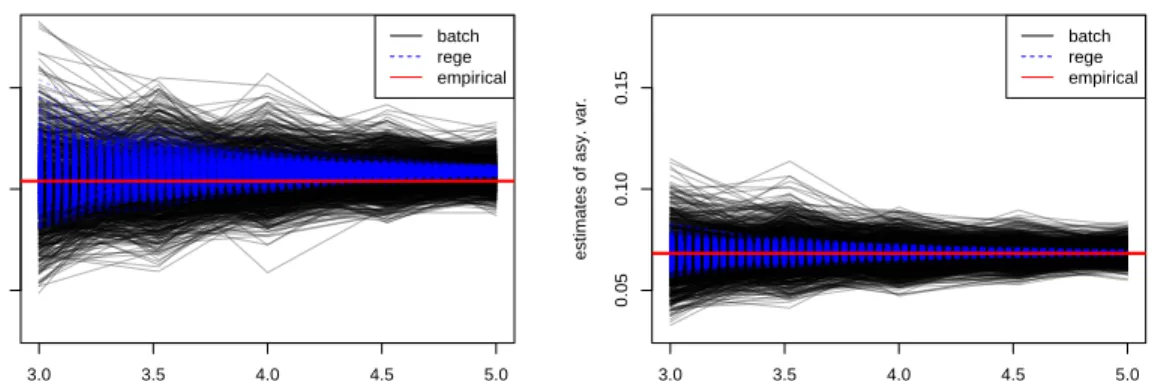
Figure 1 displays the BM and the RS estimates of dˆin stage 1, obtained from each of the
replications. They are evaluated at a sequence of sample sizes, from n1 = 103 to 105, and we
can see that both the BM and the RS estimates approach the empirical asymptotic variance as the sample size increases, suggesting their consistency. Also, as expected, the BM estimator are more variable than the RS estimates. Similarly, Figures 2 to 4 show convergence of the BM and the RS
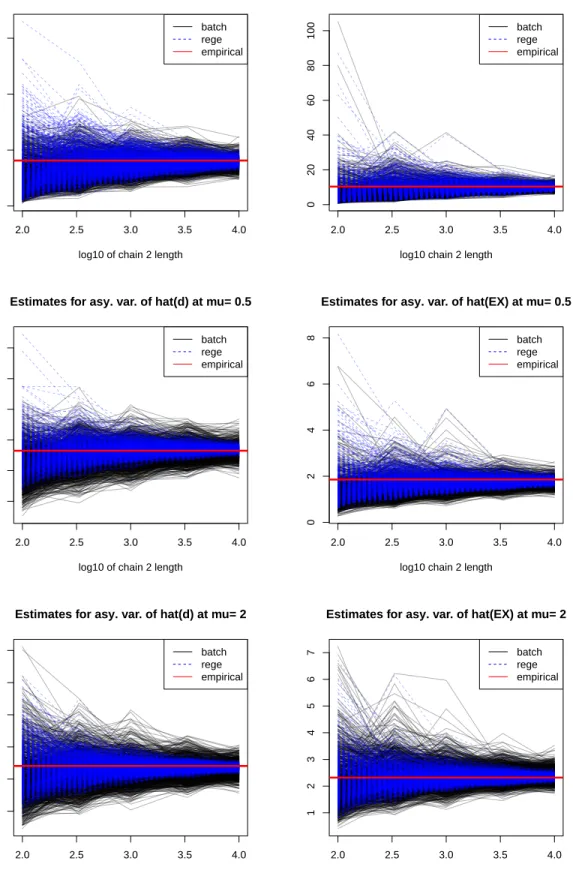
estimators to the empirical asymptotic variance ofdˆµandEˆµ(X)respectively, in stage 2. (Small
deviations between the limit of the estimators and the empirical asymptotic variance are probably due to the fact that we do not know the true asymptotic variance, but are using an empirical estimate of it based on a finite sample size over a finite number of repetitions. Also, only plots
at selected values of µ∈M are shown due to space limit, but convergence of the estimators are
indeed observed in all the case we have inspected. )
Overall, the simulations study suggests that both the BM and the RS methods provide con-sistent estimators for the true asymptotic variance. Also, the RS estimators enjoy smaller mse in most cases. Nevertheless, when the number of regenerations is not great, BM estimators could be
the more stable estimator. For example, in the top left plot of Figure 2, at sample sizen2 = 1000,
in more than 5 out of the 1000 replications, RS estimators wildly over estimated the target. Fur-ther, in the cases where regeneration is “not viable”, i.e., where the number of regenerations is extremely small for any affordable sample size, BM would be the more stable estimator, or the
only reliable estimator between the two.
Choice of weights in stage 1
In practice, for stage 1, we recommend obtaining a close-to-optimal weight, a1opt, using a
short pilot study. See Doss and Tan (2014) for details on how the pilot study can be done. The
right panel of Figure 1 displays empirical asymptotic variance of dˆover 1000 replications with
n1 = 105. For comparison, the left panel of Figure 1 presents such results based on the naive
choice of a1 = (.5, .5). The naive choice is determined by the relative sample sizes of the
refer-ence chains, which is an asymptotically optimal choice had both chains been independent. But
in our example where chain 2 involves dependent samples, using a1opt results in dˆwith smaller
standard errors.
3.0 3.5 4.0 4.5 5.0
0.05
0.10
0.15
log10 of chain 1 length
estimates of asy. v ar . batch rege empirical 3.0 3.5 4.0 4.5 5.0 0.05 0.10 0.15
log10 of chain 1 length
estimates of asy. v ar . batch rege empirical
Figure 1: Estimates of the asymptotic variance ofdˆin stage 1.
Choice of weights in stage 2
As for stage 2, where we have a sea of parameter values of interest, for eachµ ∈ M, there
would be a weighta2(µ)that is optimal for estimatingdµ, yet another weighta2(µ)that is optimal
for estimatingEt5,µX. Again, a pilot study can be used to find approximations for the2|M|sets
of optimal weights, or a selected subset of them scattered insideM. A less costly alternative is to
seta2(µ)to be inversely proportional to the deviation ofπµfrom thekreference points. Different
ways of defining deviation may be appropriate in different problems, here we simply measure the deviation betweent5,µandt5,µ0 by|µ−µ0|. Further adjustment ofa2(µ)are possible that assigns
the more efficient chains heavier weight. After all, we experiment with the following strategies for stage 2 estimates.
1. basic: a2 = (.5, .5)
2. inv-dist: a2(µ)∝( 1
|µ−µ1|, 1
3. ess by inv-dist: a2(µ)∝(ess
1,ess2)∗(|µ−1µ 1|,
1
|µ−µ2|), where∗denotes point-wise product.
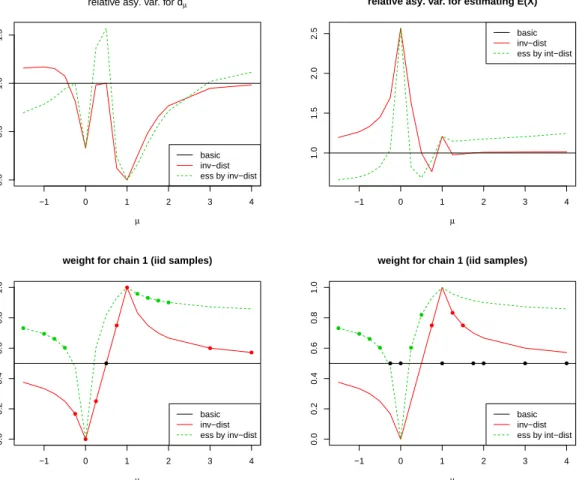
Not surprisingly, none of the three strategies is a clear winner, and their performances vary
greatly depending on the quantity being estimated (dµ or Eµ(X), or the expectation of other
functions), as well as on whether we are only interested in µ falling in between the reference
values µ1 = 1andµ2 = 0, or beyond. Still, we visualize the simulation results in Figure 5 and
summarize the situation briefly.
For estimatingdµ
1. Forµ∈(0,1), strategy 2 works the best.
2. Forµ= 0, strategy 2 and 3 work better than strategy 1. Indeed, both of them simply set their
stage 2 estimatesdˆ0 to be the stage 1 estimate,d. This would be a better choice than strategyˆ
1 because in a two-step procedure, stage 1 chains are often much longer than stage 2 chains,
and hencedˆis already a very accurate estimate ford0 =d.
3. Though not recommended, in case it is of interest to explore µ /∈ [0,1], strategy 2 and 3
generally leads to more stable estimates of dµ. However, all strategies lead to much larger
asymptotic variances than desired. Indeed, in case µ /∈ [0,1], it’s better to reconsider the
choice of reference chains to be drawn atµin its vicinity.
For estimatingEµ(X)
1. Forµ∈(0,1), strategy 2 works the best in general. Strategy 3 is very unstable.
2. For eitherµ= 0or1, strategy 2 and 3 are the same, and they only utilize the reference chain
fromµ. This was a wise choice for estimatingdµas explained above, but not so for any other
quantities of interest.
After all, strategies 2 and 3 have an advantage over using the naive weight when the
esti-mands are ratios between normalizing constants. However, when estimatingEµ(X), the situation
is more complicated. Our impression is that assigning any extreme weight will lead to high vari-ability in the estimator. So it is reasonable to simply use the naive weight, or use other strategies
that bound the weights from0and1.
5
Discussion
In this paper we consider two separate but related problems. The first problem is to estimate the
ratios of unknown normalizing constants given Markov chain samples from each of thek
proba-bility densities for some integerk larger than 1. The second problem is to estimate expectations
of a function with respect to a large number of probability distributions. The two problems are related in the sense that the multiple chains importance sampling estimators used for the latter uses the estimates derived for solving the first problem. The first situation also arises in a variety of contexts other than the multiple chain importance sampling estimators. In both situations, we consider estimators derived by methods involving flexible choice of weights and thus these es-timators are appropriate for Markov chains with different mixing behaviors. We establish CLTs
for these estimators and develop batch means methods for consistently estimating their standard errors. Although we compare batch means and regeneration based methods in this paper, spectral methods can also be used for variance estimation. Generally estimation by spectral methods is computationally more expensive (Doss and Tan, 2014, p. 703). Flegal and Jones (2010) com-pare the performance of confidence intervals produced by batch means, regeneration and spectral methods for the time average estimator, and they conclude that if tuning parameters are chosen appropriately, all these three methods perform equally well.
Appendices
A
Proof of Theorem 1
Proof. The proof of the consistency ofdˆfollows from Doss and Tan (2014) (section A.1) and is
omitted. Now onward, we use D&T to denote Doss and Tan (2014). Establishing a CLT for dˆ
is although analogous to section A.2 of D&T, there are some significant differences. Below we
establish the CLT fordˆand finally, we show thatVb is a consistent estimator ofV.
We begin by consideringn1/2(ζˆ−ζ
0). As before, let∇represents the gradient operator. As
in the classical proof of asymptotic normality of maximum likelihood estimators, we expand∇`n
atζˆaroundζ0, and using the appropriate scaling factor, we get
−n−1/2 ∇`n(ζˆ)− ∇`n(ζ0)
=−n−1∇2`
n(ζ∗)n1/2(ζˆ−ζ0), (A.1)
where ζ∗ is between ζˆandζ0. Consider the left side of (A.1), which is just n1/2n−1∇`
n(ζ0),
since ∇`n(ζˆ) = 0. There are several nontrivial components to the proof, so we first give an
outline.
1. Following D&T we show that each element of the vectorn−1∇`n(ζ0)can be represented as a
linear combination of mean0averages of functions of thekchains.
2. Based on Step 1 above, applying CLT for each of the k Markov chain averages, we obtain
a CLT for the scaled score vector. In particular, we show that n1/2n−1∇`
n(ζ0)
d
→ N(0,Ω),
whereΩdefined in (2.10) involves infinite sums of auto-covariances of each chain.
3. Following Geyer (1994) it can be shown that−n−1∇2`
n(ζ∗) a.s. −→Band that −n−1∇2` n(ζ∗) † a.s. −→ B†, whereB is defined in (2.9). 4. We conclude thatn1/2(ζˆ−ζ 0) d → N(0, B†ΩB†).
5. Sinced=g(ζ0)anddˆ=g(ζˆ), wheregis defined in (2.6), by the delta method it follows that n1/2(dˆ−d)→ Nd (0, V)whereV =D>B†ΩB†D.
1. Following D&T we start by consideringn−1∇`
n(ζ0). Forr= 1, . . . , k, from D&T we have
∂`n(ζ0) ∂ζr =wr nr X i=1 1−pr(X (r) i ,ζ0) − k X l=1 l6=r wl nl X i=1 pr(X (l) i ,ζ0)
(can be shown to) =wr
nr X i=1 1−pr(X (r) i ,ζ0)− 1−Eπr pr(X,ζ0) − k X l=1 l6=r wl nl X i=1 pr(X (l) i ,ζ0)−Eπl pr(X,ζ0) . (A.2)
That is, (A.2) can be used to viewn−1∂`
n(ζ0)/∂ζras a linear combination of mean0averages
of functions of thekchains.
2. Next, we need to write a CLT for the vector∇`n(ζ0) = (∂`n(ζ0)/∂ζ1,· · · , ∂`n(ζ0)/∂ζk)T,
that is, to show that
n−1/2∇`n(ζ0) d →N(0,Ω) asn→ ∞. Note that, 1 √ n ∂`n(ζ0) ∂ζr =−√1 n k X l=1 wl nl X i=1 pr(X (l) i ,ζ0)−Eπl pr(X,ζ0) =− k X l=1 r n nl al 1 √ nl nl X i=1 pr(X (l) i ,ζ0)−Eπl pr(X,ζ0) =− k X l=1 √ nalY¯¯(r,l), (A.3) whereY¯¯(r,l) := 1 nl Pnl i=1Y (r,l) i andY (r,l)
i is as defined in (2.8). Sincepr(x,ζ) ∈ (0,1)for all
x,randζ, we haveEπl |pr(X,ζ0)−Eπl(pr(X,ζ0))| 2+
<∞for any >0. Then sinceΦl
is geometrically ergodic, we have asymptotic normality for the univariate quantities√nlY¯¯(r,l).
Sincenl/n →slforl = 1,2, . . . , k andal’s are known, by independence of thek chains, we
conclude that 1 √ n ∂`n(ζ0) ∂ζr d → N(0,Ωrr) asn→ ∞,
whereΩis defined in (2.10). Next, we extend the component-wise CLT to a joint CLT.
Con-sider anyt∈(t1,· · · , tk)∈Rk, we have
t1 1 √ n ∂`n(ζ0) ∂ζ1 +· · ·+tk 1 √ n ∂`n(ζ0) ∂ζk =− k X l=1 t1 √ nal Pnl i=1Y (1,l) i nl +· · ·+tk √ nal Pnl i=1Y (k,l) i nl ! =− k X l=1 r n nl al Pnl i=1 t1Y (1,l) i +· · ·+tkY (k,l) i √ nl d → N(0,tTΩt) asn → ∞.
Hence, the Cram´er-Wold device implies the joint CLT,
n−1/2∇`n(ζ0)
d
→ N(0,Ω) asn→ ∞. (A.4)
3. Items 3-5 are omitted here as the derivations are basically the same as in D&T.
Next we provide a proof of the consistency of the estimate of the asymptotic variance covari-ance matrixV, that is, we show thatVb ≡Db>Bb†ΩbBb†Db
a.s.
−→V ≡D>B†ΩB†Dasn→ ∞. Since
ˆ
ζ −→a.s. ζ0anddˆ−→a.s. d, it implies thatDb
a.s.
−→ D. From D&T, we know thatBb
a.s.
−→B and using
the spectral representation ofBband ofB, it follows thatBb†
a.s.
−→B†.
To complete the proof, we now show thatΩb
a.s.
−→ Ω where the batch means estimatorΩb is
defined in (2.15). This will be proved in couple of steps. First, we consider a single chainΦlused
to calculatekquantities and establish a multivariate CLT. We use the results in Flegal et al. (2014)
who obtain conditions for the nonoverlapping batch means estimator to be strongly consistent in
multivariate settings. Second, we combine results from the k independent chains. Finally, we
show thatΩb is a strongly consistent estimator ofΩ.
Denote Y¯¯(l) = ¯ ¯ Y(1,l),Y¯¯(2,l), . . . ,Y¯¯(k,l) >
. By a proof similar to what we used to derive
(A.4) using the Cram´er-Wold device, we have the following joint CLT forWl:
√
nlY¯¯(l)
d
→ N(0,Σ(l)) asnl → ∞,
whereΣ(l)is ak×kvariance covariance matrix with
Σ(rsl) =Eπl{Y (r,l) 1 Y (s,l) 1 }+ ∞ X i=1 Eπl{Y (r,l) 1 Y (s,l) 1+i }+ ∞ X i=1 Eπl{Y (r,l) 1+i Y (s,l) 1 }, r, s= 1, . . . , k. (A.5)
The nonoverlapping batch means estimator ofΣ(l)is given in (2.12). We now prove the strong
consistency of Σb(l). Note that Σb(l) is defined using the terms Z¯ (r,l)
m ’s which involve the random
quantityζ. We defineˆ Σb(l)(ζ0)to beΣb(l)withζ0 substituted forζ, that is,ˆ
b Σ(l)(ζ0) = bl el−1 el−1 X m=0 h ¯ Ym(l)−Y¯¯(l)i hY¯m(l)−Y¯¯(l)i > for l= 1,2, . . . , k, whereY¯m(l) = ¯ Ym(1,l), . . . ,Y¯m(k,l) > withY¯m(r,l) :=Pj(m=+1)mbl+1bl Yj(r,l)/bl. We proveΣb(l) a.s. −→ Σ(l) in two steps: 1. Σb(l)(ζ0) a.s. −→Σ(l)and 2. Σb(l)−Σb(l)(ζ0) a.s. −→0.
Strong consistency of the multivariate batch means estimator Σb(l)(ζ0) requires both el → ∞
and bl → ∞. Since for allr, Eπl |pr(X,ζ0)−Eπl(pr(X,ζ0))| 2+
< ∞for any > 0, Φl is
geometrically ergodic, andbl =bnνlcwhere1> ν > 0, it follows from a more general result in
Flegal et al. (2014) thatΣb(l)(ζ0)
a.s. −→Σ(l)asn l → ∞. We showΣb (l) rs−Σb (l) rs(ζ0)−→a.s. 0whereΣb (l) rs andΣb (l)
rs(ζ0)are the(r, s)th elements of thek×kmatricesΣb (l)
rs andΣb (l)
mean value theorem (in multiple variables), there existsζ∗ =tζˆ+ (1−t)ζ0for somet∈(0,1), such that b Σ(rsl)−Σb(rsl)(ζ0) =∇Σb(rsl)(ζ ∗ )·(ζˆ−ζ0), (A.6)
where·represents the dot product. Note that
b Σ(rsl)(ζ) = bl el−1 el−1 X m=0 [ ¯Zm(r,l)(ζ)−Z¯¯(r,l)(ζ)][ ¯Zm(s,l)(ζ)−Z¯¯(s,l)(ζ)], whereZ¯m(r,l)(ζ) := Pj(m=+1)mbl+1bl pr(X (l) j ,ζ)/bl andZ¯¯(r,l)(ζ) := Pnl j=1pr(X (l) j ,ζ)/nl. Some
calcu-lations show that fort 6=r
∂Z¯m(r,l)(ζ) ∂ζt =− 1 bl (m+1)bl X j=mbl+1 pr(X (l) j ,ζ)pt(X (l) j ,ζ) and ∂Z¯m(r,l)(ζ) ∂ζr = 1 bl (m+1)bl X j=mbl+1 pr(X (l) j ,ζ)(1−pr(X (l) j ,ζ)). We denote U¯r m := ¯Z (r,l) m (ζ)−Eπl[pr(X,ζ)], ¯ ¯ Ur := ¯Z¯(r,l)(ζ)−E
πl[pr(X,ζ)], and similarly the
centered versions of ∂Z¯m(r,l)(ζ)/∂ζt and ∂Z¯¯(r,l)(ζ)/∂ζt by V¯
(r,t)
m and V¯¯(r,t) respectively. Since
pr(X,ζ) is uniformly bounded by 1 and Φl is geometrically ergodic, there exist σr2, τr,t2 < ∞
such that √blU¯mr d → N(0, σ2 r), √ nlU¯¯r d → N(0, σ2 r), √ blV¯ (r,t) m d → N(0, τ2 r,t), and √ nlV¯¯(r,t) d → N(0, τ2 r,t). We have ∂Σb (l) rs(ζ) ∂ζt = 1 el−1 el−1 X m=0 [pbl( ¯Umr −U¯¯ r)p bl( ¯Vm(s,t)−V¯¯ (s,t)) +p bl( ¯Vm(r,t)−V¯¯ (r,t))p bl( ¯Ums −U¯¯ s)] = 1 el−1 el−1 X m=0 hp blU¯mr p blV¯m(s,t)+ p blV¯m(r,t) p blU¯¯ms i − 1 el−1 h√ nlU¯¯r √ nlV¯¯(s,t)+ √ nlV¯¯(r,t) √ nlU¯¯s i .
It is easy to see that the negative term in the above expression goes to zero as el → ∞. Further,
since p blU¯mr p blV¯m(s,t) ≤ 1 2 bl( ¯Umr) 2 + 1 2 bl( ¯Vm(s,t)) 2 , we have 1 el−1 el−1 X m=0 p blU¯mr p blV¯m(s,t) ≤ 1 2 1 el−1 el−1 X m=0 bl( ¯Umr) 2 +1 2 1 el−1 el−1 X m=0 bl( ¯Vm(s,t)) 2 a.s. −→ 1 2σ 2 r+ 1 2τ 2 s,t,
where the last step above is due to strong consistency of the batch means estimators for the
asymptotic variances of the sequences{pr(X
(l)
j ,ζ), j = 1,· · ·, nl} and{∂ps(X
(l)
j ,ζ)/∂ζt, j =
1,· · · , nl}respectively. Similarly, we have
1 el−1 el−1 X m=0 p blV¯m(r,t) p blU¯ms ≤ 1 2 1 el−1 el−1 X m=0 " bl( ¯Vm(r,t)) 2+1 2 1 el−1 el−1 X m=0 bl( ¯Ums) 2 # a.s. −→ 1 2τ 2 r,t+ 1 2σ 2 s.
Note that the termsUmrVm(r,t), σr2, τr,t2 , etc, above actually depends onζ, and we are indeed
con-cerned with the case where ζ takes on the value ζ∗, lying betweenζˆandζ0. Since,ζˆ−→a.s. ζ0,
ζ∗ −→a.s. ζ0 asnl → ∞. Letkukdenotes theL1norm of a vectoru∈ Rk. So from (A.6), and the
fact that∂Σb (l)
rs(ζ)/∂ζtis bounded with probability one, we have
|Σb(rsl)−Σbrs(l)(ζ0)| ≤ max 1≤t≤k ( ∂Σb (l) rs(ζ∗) ∂ζt ) kζˆ−ζ0k−→a.s. 0 asn→ ∞. SinceΣb(l) a.s.
−→Σ(l),forl= 1, . . . , k, it follows that
b
Σ−→a.s. ΣwhereΣbis defined in (2.13) and
Σis the correspondingk2×k2 variance covariance matrix, that is,Σis a block diagonal matrix
as Σb withΣ(l) substituted for Σb(l), l = 1, . . . , k. Sincenl/n → sl forl = 1,2, . . . , k, we have
An→Acasn → ∞whereAnis defined in (2.14) and
Ac = − r 1 c1 a1Ik − r 1 c2 a2Ik . . . − r 1 ck akIk .
Finally from (2.10) and (A.5) we see thatΩ = AcΣATc. So from (2.15) we haveΩb ≡AnΣbATn
a.s.
−→
AcΣATc = Ωasn→ ∞.
B
Proof of Theorem 2
Proof. As in Buta and Doss (2011) we write
√ n(ˆu(π, π1;a,dˆ)−u(π, π1)) = √ n(ˆu(π, π1;a,dˆ)−uˆ(π, π1;a,d))+ √ n(ˆu(π, π1;a,d)−u(π, π1)). (B.1) First, consider the 2nd term, which involves randomness only from the 2nd stage. From (3.3)
note thatPk
l=1alEπlu(X;a,d) = u(π, π1). Then from (3.1) we have
√ n(ˆu(π, π1;a,d)−u(π, π1)) = k X l=1 al r n nl Pnl i=1(u(X (l) i ;a,d)−Eπlu(X;a,d)) √ nl .
SinceΦlis geometrically ergodic andEπl|u(X;a,d)|
2+is finite, it follows thatPnl
i=1(u(X (l) i ;a,d)− Eπlu(X;a,d))/ √ nl d → N(0, τl2(π;a,d))where τl2(π;a,d)is defined in (3.4). As nl/n → sl
and the Markov chains Φl’s are independent, it follows that
√
n(ˆu(π, π1;a,d)− u(π, π1))
d
→
N(0, τ2(π;a,d)).
Now we consider the 1st term in the right hand side of (B.1). LettingF(z) = ˆu(π, π1;a,z),
by Taylor series expansion ofF aboutdwe have
√ n(F(dˆ)−F(d)) =√n∇F(d)>(dˆ−d) + √ n 2 ( ˆ d−d)>∇2F(d∗ )(dˆ−d), (B.2)
Simple calculations show that [∇F(d)]j−1 = k X l=1 al nl nl X i=1 ajνj(X (l) i )ν(X (l) i ) (Pk s=1asνs(X (l) i )/ds)2d2j a.s. −→[c(π;a,d)]j−1 (B.3)
where [c(π;a,d)]j−1 is defined in (3.5). We know thatn/N → q. Using similar arguments as
in Buta and Doss (2011), it follows that∇2F(d∗
)is bounded in probability. Thus from (B.2) we
have √
n(F(dˆ)−F(d)) =√qc(π;a,d)>√N(dˆ−d) +op(1).
Then Theorem 2 (1) follow from (B.1) and the independence of the two stages of Markov chain sampling.
Next to prove Theorem 2 (2), note that, we already have a consistent batch means estimator
b
V ofV. From (B.3), we have[ˆc(π;a,d)]j−1 = [∇F(d)]j−1 a.s.
−→[c(π;a,d)]j−1. Applying mean
value theorem on[∇F(d)]j−1and the fact that∇2F(d
∗
)is bounded in probability, it follows that
[ˆc(π;a,dˆ)]j−1−[ˆc(π;a,d)]j−1 a.s. −→0. Writingc(π;a,d)>V c(π;a,d)asPk−1 i=1 Pk−1 j=1ciVijcj, it
then follows thatcˆ(π;a,dˆ)>Vbˆc(π;a,dˆ)
a.s.
−→c(π;a,d)>V c(π;a,d).
We will now show thatτˆ2
l(π;a,dˆ) is a consistent estimator ofτl2(π;a,d) whereτl2 and τˆl2
are defined in (3.4) and (3.7) respectively. Since the Markov chains{Xi(l)}nl
i=1,l= 1,2, . . . , kare
independent, it then follows that τ2(π;a,d)is consistently estimated byτˆ2(π;a,dˆ)completing the proof of Theorem 2 (2).
Ifd is known from the assumptions of Theorem 2 (2) and the results in Jones et al. (2006)
(also Bednorz and Latuszynski (2007)), we know that τ2
l(π;a,d)is consistently estimated by
its batch means estimatorτˆ2
l(π;a,d). Note that,τˆl2(π;a,d)is defined in terms of the quantities
u(Xi(l);a,d)’s. We now show thatτˆ2
l(π;a,dˆ)−τˆl2(π;a,d)
a.s.
−→0. Denotingτˆ2
l(π;a,z)byG(z), by the mean value theorem (in multiple variables), there exists
d∗ =tdˆ+ (1−t)dfor somet∈(0,1), such that
G(dˆ)−G(d) =∇G(d∗)·(dˆ−d).
For anyj ∈ {2,· · · , k}, andz∈R+k−1,
∂G(z) ∂zj = bl el−1 "el−1 X m=0 2(¯um(a,z)−u¯¯(a,z)) ∂u¯m(a,z) ∂zj − ∂u¯¯(a,z) ∂zj # (B.4) LetW¯m := ¯um(a,z)−Eπl(u(X;a,z))and ¯ ¯
W := ¯u¯(a,z)−Eπl(u(X;a,z)). Note that, there
exists, σ2 < ∞ such that √b
lW¯m d → N(0, σ2), and √n lW¯¯ d → N(0, σ2). Simple calculations show that ∂u¯m(a,z) ∂zj = aj z2 j 1 bl (m+1)bl X i=mbl+1 ν(Xi(l))νj(X (l) i ) P sasνs(X (l) i )/zs 2. Hence, lettingαj =Eπl[ν(X)νj(X)/( P sasνs(X)/zs) 2 ], we write ∂u¯m(a,z) ∂zj − ∂u¯¯(a,z) ∂zj ≡ aj z2 j ¯ Zm,j − aj z2 j n ¯ ¯ Zj o ,
where Z¯1,j = (1/bl) Pbl i=1[ν(X (l) i )νj(X (l) i )/{ P sasνs(X (l)
i )/zs}2]−αj and Z¯¯j is similarly
de-fined. Note that, there exists τj2 < ∞, such that √blZ¯m,j d → N(0, τj2), and√nlZ¯¯j d → N(0, τj2). From (C.6) we have ∂G(z) ∂zj =aj z2 j 2 el−1 el−1 X m=0 hp bl( ¯Wm−W¯¯) p bl ¯ Zm,j−Z¯¯j i =aj z2 j 2 e−1 e−1 X m=0 h√ bW¯m √ bZ¯m,j i − aj z2 j 2b " ¯ ¯ Zj 1 e−1 e−1 X m=0 ¯ Wm+ ¯W¯ 1 e−1 e−1 X m=0 ¯ Zm,j− e e−1 ¯ ¯ WZ¯¯j # =aj z2 j 2 e−1 e−1 X m=0 h√ bW¯m √ bZ¯m,j i − aj z2 j 2 e−1 h√ nW¯¯√nZ¯¯j i .
Then using similar arguments as in the proof of Theorem 1, it can be shown that∂G(z)/∂zj is
bounded with probability one. Then it follows that
|G(dˆ)−G(d)| ≤ max 1≤j≤k−1 ∂G(d∗) ∂zj kdˆ−d|−→a.s. 0. (B.5)
C
Proof of Theorem 3
Proof. As in the proof of Theorem 2 we write
√
n(ˆη[f](π;a,dˆ)−Eπf) =
√
n(ˆη[f](π;a,dˆ)−ηˆ[f](π;a,d)) +√n(ˆη[f](π;a,d)−Eπf). (C.1)
First, consider the 2nd term, which involves randomness only from the 2nd stage. Since
ˆ v −→a.s. k X l=1 alEπlv [f] (X;a,d) = Z X f(x)Pk l=1alνl(x)/ml Pk s=1asνs(x)/(ms/m1) ν(x)µ(dx) = m m1 Eπf, (C.2) we havePk l=1alEπlv [f](X;a,d) =E
πf u(π, π1). Then from (3.1) we have
√ n ˆ v[f](π;a,d)−E πf u(π, π1) ˆ u(π, π1;a,d)−u(π, π1) = k X l=1 al r n nl 1 √ nl nl X i=1 v[f](X(l) i ;a,d)−Eπlv [f](X;a,d) u(Xi(l);a,d)−Eπlu(X;a,d) ! . (C.3)
From the conditions of Theorem 3 and the fact that the Markov chainsΦl, l = 1, . . . , k are
inde-pendent, it follows that the above vector (C.3) converges in distribution to the bivariate normal
distribution with mean 0 and covariance matrix Γ(π;a,d) defined in (3.9). Then applying the
Delta method to the functiong(x, y) = x/y we have a CLT for the ratio estimatorηˆ[f](π;a,d),
that is, we have √n(ˆη[f](π;a,d)− Eπf) d
→ N(0, ρ(π;a,d)) where ρ(π;a,d)) is defined in (3.10).
Next lettingL(z) = ˆη[f](π;a,z), by Taylor series expansion ofLaboutdwe have
√ n(L(dˆ)−L(d)) =√n∇L(d)>(dˆ−d) + √ n 2 ( ˆ d−d)>∇2L(d∗ )(dˆ−d), (C.4)
whered∗is betweendandd.ˆ Simple calculations show that
[∇L(d)]j−1 = [ˆe(π;a,d)]j−1 a.s.
−→[e(π;a,d)]j−1 (C.5)
where [e(π;a,d)]j−1 and[ˆe(π;a,d)]j−1 are defined in (3.11) and (3.12) respectively. It can be
shown that∇2L(d∗
)is bounded in probability. Thus from (C.4) we have
√
n(L(dˆ)−L(d)) =√qe(π;a,d)>√N(dˆ−d) +op(1).
Then Theorem 3 (1) follow from (C.1) and the independence of the two stages of Markov chain sampling.
Next to prove Theorem 3 (2), note that, we already know thatVb is a consistent batch means
estimator of V. From (C.5), we have [ˆe(π;a,d)]j−1 a.s.
−→ [e(π;a,d)]j−1. Applying mean value
theorem on [∇L(d)]j−1 and the fact that ∇2L(d∗) is bounded in probability, it follows that
[ˆe(π;a,dˆ)]j−1−[ˆe(π;a,d)]j−1 a.s.
−→0. From (3.8) we know thatuˆ(π, π1;a,dˆ)
a.s.
−→u(π, π1). From (3.17) we knowηˆ[f](π;a,dˆ) a.s.
−→
Eπf. Since ˆv[f](π, π1;a,d) = ˆη[f](π;a,d)ˆu(π, π1;a,d), it follows that vˆ[f](π, π1;a,dˆ)
a.s.
−→
Eπf u(π, π1). Thus ∇h(ˆv[f](π, π1;a,dˆ),uˆ(π, π1;a,dˆ)) a.s.
−→ ∇h(Eπf u(π, π1), u(π, π1)). Thus
to prove Theorem 3 (2), we only need to show thatbΓl(π;a,dˆ)
a.s.
−→Γl(π;a,d).
Ifdis known from the assumptions of Theorem 3 (2) and the results in Flegal et al. (2014),
we know that Γl(π;a,d)is consistently estimated by its batch means estimatorbΓl(π;a,d). We
now show thatbΓl(π;a,dˆ)−Γbl(π;a,d)
a.s.
−→0.
From Theorem 2 (2), we know that γˆl22(π;a,dˆ) − γˆl22(π;a,d) −→a.s. 0. We now show
ˆ γ11 l (π;a,dˆ)−γˆl11(π;a,d) a.s. −→0. Lettingˆγ11
l (π;a,z)byH(z), by the mean value theorem, there existsd
∗
=tdˆ+ (1−t)dfor somet∈(0,1), such that
H(dˆ)−H(d) =∇H(d∗)·(dˆ−d).
For anyj ∈ {2,· · · , k}, andz∈R+k−1,
∂H(z) ∂zj = bl el−1 "e l−1 X m=0 2(¯vm[f](a,z)−v¯¯[f](a,z)) ∂v¯ [f] m(a,z) ∂zj − ∂v¯¯ [f](a,z) ∂zj !# . (C.6) Let W¯m[f] := ¯vm[f](a,z)−Eπl(v [f](X;a,z))andW¯¯[f] := ¯¯v[f](a,z)−E πl(v [f](X;a,z)). Note
that, there exists, σ2
f < ∞such that √ blW¯ [f] m d → N(0, σ2 f), and √ nlW¯¯[f] d → N(0, σ2 f). Simple
calculations show that
∂¯vm[f](a,z) ∂zj = aj z2 j 1 bl (m+1)bl X i=mbl+1 f(Xi(l))ν(Xi(l))νj(X (l) i ) P sasνs(X (l) i )/zs 2 . Hence, lettingα[jf]=Eπl[f(X)ν(X)νj(X)/( P sasνs(X)/zs) 2 ], we write ∂¯vm[f](a,z) ∂zj − ∂u¯¯ [f](a,z) ∂zj ≡ aj z2 j n ¯ Zm,j[f]o−aj z2 j n ¯ ¯ Zj[f]o,
whereZ¯1[f,j]= (1/bl) Pbl i=1[f(X (l) i )ν(X (l) i )νj(X (l) i )/{ P sasνs(X (l) i )/zs}2]−α [f] j andZ¯¯ [f] j is
sim-ilarly defined. Note that, there existsτ2
j,f < ∞, such that √ blZ¯m,j d → N(0, τ2 j,f), and √ nlZ¯¯j d → N(0, τ2
j,f). Doing similar calculations as in the proof of Theorem 2 we have
∂H(z) ∂zj = aj z2 j 2 e−1 e−1 X m=0 h√ bW¯m[f]√bZ¯m,j[f]i−aj z2 j 2 e−1 h√ nW¯¯[f]√nZ¯¯j[f]i.
Then using similar arguments as in the proof of Theorem 2, it can be shown that ˆγl11(π;a,dˆ)−
ˆ
γl11(π;a,d)−→a.s. 0. Similarly we can showˆγl12(π;a,dˆ)−ˆγl12(π;a,d)−→a.s. 0.
References
Bednorz, W. and Latuszynski K. (2007). A few remarks on Fixed-width output analysis for
Markov chain Monte Carlo by Jones et al., Journal of the American Statistical Association
1021485–1486.
Buta, E. and Doss, H. (2011). Computational approaches for empirical Bayes methods and
Bayesian sensitivity analysis. The Annals of Statistics392658–2685.
Doss, H. (2010). Estimation of large families of Bayes factors from Markov chain output.
Sta-tistica Sinica,20537–560.
Doss, H. and Tan, A. (2014). Estimates and standard errors for ratios of normalizing constants
from multiple Markov chains via regeneration.Journal of the Royal Statistical Society,Series B
76683–712.
Flegal, J. M. and Jones, G. L. (2010). Batch means and spectral variance estimators in Markov
chain Monte Carlo. The Annals of Statistics, 38:1034–1070.
Flegal, J. M., Jones, G. L., and Vats, D. (2014). Covariance matrix estimation in high-dimensional
Markov chain Monte Carlo. In preparation.
Geyer, C. J. (1994). Estimating normalizing constants and reweighting mixtures in Markov chain Monte Carlo. Tech. Rep. 568r, Department of Statistics, University of Minnesota.
Gill, R. D., Vardi, Y. and Wellner, J. A. (1988). Large sample theory of empirical distributions in
biased sampling models. The Annals of Statistics161069–1112.
Hastings, W. K. (1970). Monte Carlo sampling methods using Markov chains and their
applica-tions. Biometrika5797–109.
Jones, G. L. (2004). On the Markov chain central limit theorem. Probability Surveys, 1:299–320.
Jones, G. L., Haran, M., Caffo, B. S., and Neath, R. (2006). Fixed-width output analysis for