Comparison Data Traffic Scheduling Techniques for Classifying QoS over 5G Mobile Networks
Mohammed Dighriri, Ali Saeed Dayem Alfoudi, Gyu Myoung Lee, Thar Baker and Rubem Pereira Department of Computer Science, Liverpool John Moores University, L3 3AF, UK
[email protected], [email protected], {G.M.Lee, T.baker, R.Pereira}@ljmu.ac.uk
Abstract— Enhancing Quality of Service (QoS) in mobile networks is the key aim for mobile operators. Mobile networks transport several forms of data traffic for real-time applications (i.e., video monitoring). These applications need to get the advantage of QoS adaptation. Numerous scheduling techniques are utilized at the router to assure the QoS of the mobile networks. Upcoming 5G mobile networks will be launched; hence, Human-Type-Communication (HTC) and Machine-to-Machine (M2M) data traffic are expected to increase dramatically over mobile networks, which results in growing the capacity and raising high data rates. These networks are expected to face challenges in cases of Radio Access Network (RAN) overload and congestion due to the massive smart devices data traffic with various QoS requirements. This paper presents a comparison for data traffic scheduling techniques, which are Priority Queuing (PQ), First-In-First-Out (FIFO) and Weighted Fair Queuing (WFQ). We consider to select a suitable data traffic scheduling technique in terms of QoS provisioning and helping 5G network, also we propose models and algorithms for efficiently utilized the smallest unit of a RAN in a relay node by aggregating and slicing the data traffic of several M2M devices. Keywords— FIFO, PQ, WFQ, Machine-to-Machine (M2M); 5G; Network Slicing; Physical Resource Block (PRB)
I. INTRODUCTION
Mobile network data traffic has been foreseen to grow more than 24-fold between 2010 and 2015, and more than 500-fold between 2010 and 2020 [1]. Mobile networks are expected to face challenges due to the future Machine-to-Machine (M2M) data traffic with various Quality of Service (QoS) requirements, such as a provision of radio resources to a huge number of M2M devices, prioritization, and inter-device communication [2]. The existing mobile networks might face massive issue by reducing their radio resources capability in the near future due to significantly increasing M2M traffic [2]. M2M devices transmit various size of data with different QoS requirements and levels, for example, smart healthcare system devices convey big size data of targeted patients with sensitive delay [3].
The Physical Resource Block (PRB) is the smallest radio resource unit, which is allocated to a single device for data transmission in 5G mobile networks [13]. In smart systems, there are different devices transmitting numerous sizes of data; where some transmit small size of data thereof the capacity of the PRB is used in an inefficient way.
This paper proposes a novel comparison among data traffic scheduling techniques based on data traffic aggregation model for 5G cellular radio resources by efficiently utilizing the smallest unite of PRB by aggregating the data of several M2M
devices. Furthermore, we have designed data traffic slicing model based on smart systems different QoS requirements (e.g., several priorities and bandwidths) in smart city environment. Therefore, the delay that happens at the output buffer of a router is called queuing delay [4]. Such delay is dealt with effectively and fairly by several scheduling techniques. QoS and fairness services are the most significant features offered by any scheduler techniques [4]. Priority Queuing (PQ), First-In-First- Out (FIFO) and Weighted Fair Queuing (WFQ) are the most usually utilized scheduling techniques. In this research paper we have applied PQ technique in order to classify services network in 5G slices technology relying on different priorities of the data traffic in the smart systems QoS requirements [5]. The classified services architecture function upon a basic model where packets incoming a network is first classified and then dependent on the limits of the network in the IP packet header, and allocate diverse handlings to the packets called Per Hop Behaviour (PHB) [4].
The rest of the paper is organized as follows. Firstly, 5G protocols architecture, 5G slicing technology, and the expected challenges face M2M data traffic in future of 5G mobile network are presented in section II. We have illustrated in section III the related work to M2M applications data traffic model, and architecture of traffic classified services, then the limitations of existing models, while section IV highlights the proposed system models the M2M data traffic aggregation model and 5G data traffic slicing model, also we have compared scheduling techniques in term of advantages and disadvantages based on QoS requirements. Lastly, in section V this paper is concluded that PQ technique is an appropriate scheduling technique in term of enhancing data traffic of smart systems.
II. BACKGROUND A. 5G Protocols Architecture
5G mobile network interfaces between User Equipment (UE), Evolved UMTS Terrestrial Radio Network (E-UTRAN), Evolved Packet Core (EPC) and Serving Gateways (SGWs) are linked with protocol stacks that are used by the network component to conversation signalling messages and data [6]. Consequently, the 5G-protocol stack could be separated among following groups, which include user plane protocols and control plane protocols that are defined as follows:
Signalling protocols
Signalling protocols are utilized for exchanges signalling data between numerous devices within the network.
User plane protocols
These protocols enhance routing of users messages between UEs and S-GWs.
Transport protocols are accountable for the conveying of data and signalling messages between several networked devices on the air (Uu) interface, the UE high-level functionalities are controlled by the Mobility Management Entity (MME). Nevertheless, there is no straight connection route between UE and the MME. The connection path between UE and the MME is established using E-UTRAN evolved Node B (eNB) that somehow support the level of hardware complexity in the network. To decrease this complexity, the Uu interface is additionally separated into two levels of protocols [6]. One is named Access Stratum (AS) while the second is the Non Access Stratum (NAS) level protocols. The MME high-level signalling lies at the NAS high-level, however, is transported within the network using AS protocols. The control and user plane termination protocols are maintained by the base station. A high-level outline of the protocol stack [7]. The user plane protocols contain the Packet Data Convergence Protocol (PDCP), the Medium Access Control (MAC) and the Physical (PHY) layer protocols. In addition, the protocols of control plane include the Radio Resource Control (RRC) protocols [7].
B. 5G Network Slicing
5G, as a new generation of the mobile network, is being actively discussed in the world of technology. Network slicing is one of the most deliberated technologies nowadays. Mobile network operators, such as China Mobile, [8] and SK Telecom, and merchants (e.g., Nokia, and Ericsson) [8], are all knowing it as a model network architecture for the coming 5G period [9]. This novel technology allows operators to slice one physical network among numerous, virtual, end-to-end (E2E) networks, each rationally isolated counting device, access, transport and core networks such as separating a HDD into C and D drives and devoted for diverse kind of services with different features and QoS requirements. Each network slice, committed resources for example resources within Network Functions virtualization (NFV), Software Defined Networking (SDN), cloud computing, network bandwidth, QoS, and so on are certain as seen in Figure 1 [9].
Figure 1: 5G Network Slicing [9]. C. Problem Statement
Real-time applications, such as video monitoring in critical smart systems are essential to gain the advantage of the QoS adaptation by any network. In fact, it is highly critical to offer QoS for priority application such as healthcare systems [10]. The highest priority of such packets must be efficiently handled by scheduling techniques. In contrast, less priority packets would also be managed and conveyed fairly. So, it is the serious task of developing scheduling techniques to balance among all these standards [4]. Since radio resources are essential assets and rarely obtainable in mobile networks, therefore, efficient utilization is required. The novel communication technologies, such as Long
Term Evolution (LTE), Long Term Evolution Advanced (LTE-A), and 5G, make use of multiple carriers schemes to offer better data rates and to ensure high QoS. The smallest resource unit allocable in the 5G systems to an M2M device is the PRB as shown in Figure 2. Under favourable channel conditions, PRB is capable of transmitting several kilobytes of data. These multiple carriers’ schemes are able of transmitting a large amount of data. However, in the case of M2M communication, both narrowband and broadband applications have to be considered to enhance QoS requirements. Especially, these applications have different size of data traffic, which needs QoS specifications such as real-time, accuracy and priority. If one PRB is allocated to a single M2M device for data transmission of just a few bytes, then it might cause severe wastage of radio resources. Also, the different types of data traffic should be considered in 5G slices approach in terms of network operators can provide an appropriate QoS for different users as illustrated in Figure 1. Therefore, utilization of the full radio resources and classifying data traffic should be an ideal solution for data traffic explosion and the fairness of services in the near future.
Figure 2: M2M Data Traffic on 5G Mobile Network [13]. III. STATE OF THE ART
A. M2M Applications Data Traffic Model
The authors of [11] have stated that the data streams in various M2M applications follow different statistical patterns which are difficult to capture. According to [12], M2M traffic is classified into the source and aggregated traffic. Some of the available traffic models for M2M are aggregated which are identified in [13] (i.e., defining M2M data traffic as one stream from numerous devices). Contrarily, to model and understand the behaviour of the M2M traffic more accurately, source traffic modeling is required (i.e., modeling each M2M device on its own). Though, in M2M source traffic modeling, there are many difficulties that need to be overcome. For example, it is very hard to model the behaviour of traffic being produced from a massive amount of devices in parallel and in the existence of strong spatial and temporal connection between devices [14]. In [13], a Coupled Markov Modulated Poisson Processes (CMPP) Model has been presented, mostly aiming the source traffic modeling in M2M networks.
B. Architecture of Traffic Classified Services
The several parts in the classified services architecture execute traffic classification and customizing. Customizing functions includes marker, meter, shaper and dropper [15]. Figure 3, mentions the block illustration of a classifier and traffic conditioner.
Classification is relying on some part of a packet header of each data packet. There are two categories of classifiers, the Behaviour Aggregate (BA) the classifier that classifies packet based the multi-field (MF) Classifier which chooses packets to rely on the value of a grouping of one or more than one header fields of packets [5]. Temporal properties are measured by traffic meter of the stream of packets selected by the classifier as per the traffic profile. Packet marker is responsible for setting the classified services field value of a packet to a code point. Shapers reason delay to some or all of the packets in the traffic stream for the aim of transporting the stream into acquiescence with a traffic profile, though droppers reject some or all of the packets in a traffic stream for the aim of transporting the stream into acquiescence with traffic profile [15]. Queue management describes which packets are to be dropped in terms of congestion. Internet Engineering Task Force (IETF), the classified services working group, has defined diverse PHB groups for dissimilar applications [16]. The most regularly applied PHB groups are Expedited Forwarding (EF), Assured Forwarding (AF), and Best Effort (BE). Before classified services, the three-bit precedence field in the Type of Service (ToS) of the IP header was utilized for priority marking of traffic by IP networks [16]. IETF reprocessed the ToS byte of the IP header as the classified services field for networks [15]. The EF-PHB is commonly utilized to offer low latency, assured bandwidth, low loss, low jitter, and end-to-end services through classified services domains [16]. These features are favourite for VoIP, video user and FTP for other real-time services existing. EF traffic is usually specified as a higher priority rather than all other traffic classes when congestion happens. The Certain forwarding action lets the network operator to offer a guarantee of transport of packets as long as the traffic does not cross some subscribed rate. Traffic that crosses the subscription rate has a higher possibility of dropping if congestion occurs [16].
Figure 3: Packet classifier and traffic conditioner profile [15].
C. Limitations of Existing Models
As per the literature review for data traffic aggregation models, limited study efforts have been done to review the influences of data aggregation in the case of the mobile network for M2M communication. For example, authors in [13] assess the performance of data aggregation in relations to energy consumption, thus to grow the lifetime of capillary M2M networks. Though, the authors ignored the emerging mobile M2M applications in their study. Furthermore, authors in [2] suggested a system of bundling M2M data packets at the macro station also called Donor eNBs (DeNBs) to decrease the risks of congestion in backbone networks.
Therefore, this research presents a novel data aggregation model over 5G mobile network slices and also assess data traffic scheduling techniques. For this purpose, based on wireless layer3 inband RN is utilized for supporting coverage and aggregating uplink M2M data traffic each slice separately.
IV. SYSTEM MODELS A. Proposed Data Traffic Models
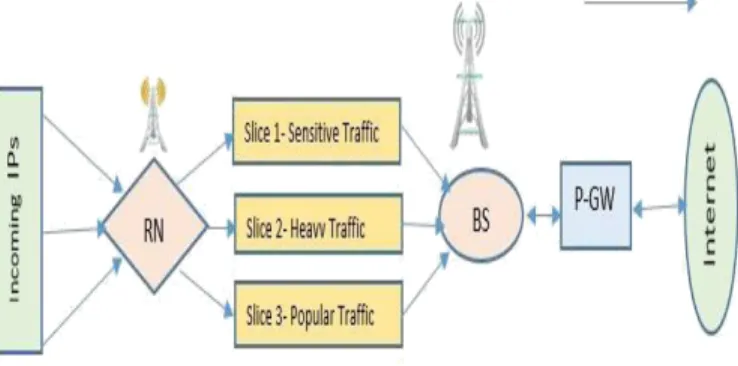
Proposed models will be relying on 5G slicing networks, which will focus on classifying QoS requirement and data traffic of M2M applications such as smartphones, smart healthcare system, and smart traffic monitoring. Since M2M applications have data traffic characteristics and diverse packets size, we have developed data aggregated model in RN to get maximum OoS of 5G radio resources. Then, we have designed three data traffic classification between RN and DeNB based on PQ technique. These two models are proposed in 5G uplink M2M date traffic.
B. M2M Data Traffic Aggregation Model
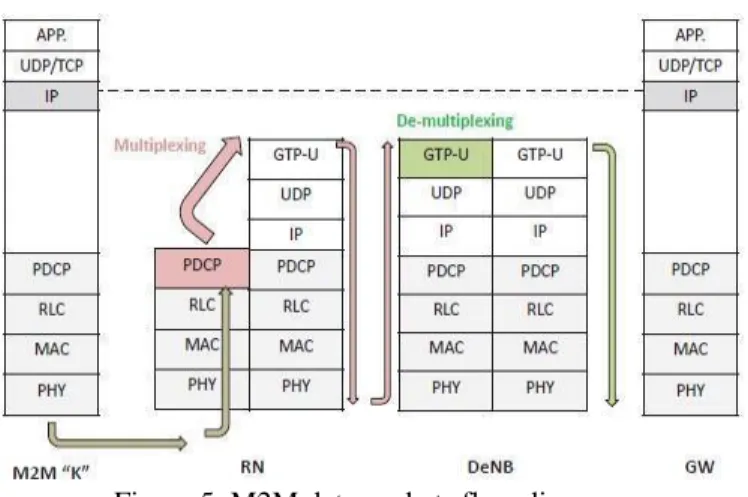
The proposed model is relying on aggregating data from several M2M devices at the Packet Data Convergence Protocol (PDCP) layer of the RN. The PDCP layer performs header compression, delivery, and retransmission of PDCP Session Data Units (SDUs), duplicate detection, etc. In the proposed model, PDCP layer is used for the aggregation of the M2M data in the uplink. The main reason for selecting PDCP for aggregation in the uplink is to aggregate data with a minimum number of the additional headers.
The individual data packets from the several M2M devices approach the PHY layer of aggregation device with various intact headers such as Medium Access Control (MAC), Radio Link Control (RLC), and PDCP. The headers are removed as the received data is transported to the upper layers. On arriving the PDCP, all the headers are removed and only the payload from the individual devices are available which are aggregated. One single aggregation buffer B at the RN is considered to aggregate M2M traffic. This buffer aggregates data from different M2M devices ensuring QoS for both the 5G and M2M traffic. In this implementation, RN is used for M2M devices and DeNB for 5G traffic. In order to reach the maximum performance improvements in spectral efficiency, packet propagation delay, and cell throughput, we consider scenarios in which all the M2M devices communicate with the DeNB through a RN. The M2M data aggregation algorithm is shown in Figure 4 and described as follows:
Data from K M2M devices is considered for aggregation. The essential parameter for M2M data aggregation is the maximum delay time Tmax for the packet at the RN.
The maximum delay time Tmax is an essential parameter for M2M data and is calculated according to the various traffic classes of the M2M devices. M2M data have different priorities according to their applications. For example, data packets received from the M2M device deployed in a smart healthcare system scenario for the measurement of temperature or pulse rate of the patient have high priority over the packets from M2M devices, which are deployed in smartphones. The data packets from a device having the highest priority face the smallest delay. Therefore, we initiate the Tmax value as the inter-send time of the M2M device data with the highest priority. For example, in the simulation setup for distinct M2M applications, the inter- send time of the M2M traffic
models is 1ms, which is the maximum time a packet is delayed at the RN. Thus, the value of the Tmax is initiated as 1ms, which means that the data packets received from the distinct M2M devices are delayed for
1 ms at the RN.
Algorithm 1: An overview of the proposed data aggregation algorithm in the RN PDCP.
Result: Efficient utilization of PRBs among M2M devices initialization;
set expiry timer Tmax == 5 ms; set Bmax == (available TBS − RN Un
overhead); set timer T == 0;
set multiplexing buffer B == 0;
schedule RN and allocate PRBs (e.g., 5 PRBS are set for RN to analyse multiplexing process); schedule M2M devices within the coverage of RN for uplink transmission;
while packet arrival == TRUE do
start multiplexing process based on the value of timer and the size of the multiplexing buffer;
if T < Tmax && B < Bmax then accumulate incoming packet into
buffer B;
increment timer T; else
re-assemble aggregated packet of size available TBS
− overhead from buffer B;
send large multiplexed packet to RN PHY via RN Un protocols; add RN Un protocols overhead; route multiplexed packet to BS in next TTI;
reset timer T;
end if end while
Figure 4: M2M data aggregation algorithm
The value of Tmax is adaptive (i.e., the algorithm updates the value of Tmax if RN receives packets from a device), which has higher priority than the priorities of all other devices in the queue of the RN. The data from all the M2M devices is buffered at the RN. The individual IP headers of all the M2M devices are kept intact. The data packets are usually buffered until time delay approaches Tmax. In order to compare the performance of data aggregation model in narrowband and broadband M2M application scenarios, the aggregation scale for M2M devices is kept 1 (un-aggregated), 5, 10, 15 and 20 in both cases. The aggregation scale represents the number of devices, which are aggregated. For example, in a scenario with 180 M2M devices, the aggregation scale of 5, 10, 15 and 20 means that the data from the group of 5, 10, 15 and 20 devices is aggregated at the RN respectively. The aggregated data is sent to the DeNB through the Un interface where the data is de-multiplexed. The individual IP streams will be sent by the DeNB to respective application server.
The M2M packets flow from the M2M devices to the Access Gateway (aGW) through RN is described in Figure 5. K number of M2M devices transmits data packets to the RN, which are collected at the PHY layer of the RN. The packets are transported to the PDCP layer of the RN on the uplink. The IP packets are packed according to their Quality Control Identifier (QCI) values in the aggregation buffer. The aggregation buffer collects packets from several M2M devices. The data packets are placed in the aggregation buffer according to the packet arrival from the different devices. The detailed structure of the aggregated data stream where only the layer two protocols, are presented to illustrate the aggregation of the M2M data. The RN PHY layer receives the data packets in the form of distinct Transport Block Size (TBS). The TBS are shown from 1 to K,
which shows the TBS transmitted by the M2M devices at the RN. The data packets arrive to the RLC through MAC layer. The RLC headers are removed and remaining Protocol Data Unit (PDU) is transported to the PDCP. The received PDUs at the PDCP layer comprised of the individual IP headers of each M2M device and pack into single PDCP buffer.
Figure 5: M2M data packets flow diagram C. Scheduling Techniques
The three main scheduling techniques are used in this research paper: FIFO, PQ and WFQ. This section shows these three scheduling techniques in more details.
1. First-in-First-out (FIFO)
The simplest method to schedule a packet in any network is FIFO. Here the first packet in the queue is served first in a specific time slot, in any case of any prioritization, protection or even fairness [10]. Therefore, it is quite simple to execute. Though, it fails to reach all other scheduling customize except complexity. FIFO suffers from Head of Line (HOL) issue, which means that if the first packet in the queue is blocked for any cause, the rest is blocked even although the link is idle [10].
Figure 6: First-in-First-out Technique [10].
2. Priority Queuing (PQ)
PQ is designed to cope the issue of FIFO, which does not offer any priority to any data traffic or any class. PQ normally confirms the fastest service of high priority data at each point where it is applied [10]. It provides firm priority to the traffic, which is quite essential. The location of each packet in one of four queues known as high, medium, normal or low is achieved depending on the allocated priority of each packet [10]. The possible disadvantage of this scheduling technique is that the lower level traffic cannot be served for a long time, if the high priority is usually there [10]. Consequently, the lower class will
impact from a deficiency issue that drives to a major dismiss of the packets.
Figure 7: Priority Queuing Technique [10].
WFQ is a queuing mechanism relied on data packet flow and the applied realization of Generalized Processor Sharing (GPS) structure that is a theoretical theory and maintain decent fairness [17]. Two things are done seamlessly in WFQ, first reactive traffic is scheduled to the front of the queue for the decrease of response time, and secondly, it shares the remaining bandwidth among high-bandwidth flows in a fair mode [17]. WFQ commonly looks into the matter that queues do not starve for bandwidth and all packets must get the anticipated services. WFQ can notice the superiority bit marked in the IP packet header of each packet and in order to that marking; it classifies the priority levels of packets, with the growth of the superiority value, WFQ assigns more bandwidth to that exact packet to avert congestion [17].
Figure 8: Weighted Fair Queuing Technique [17].
D. 5G Data Traffic Slicing Model
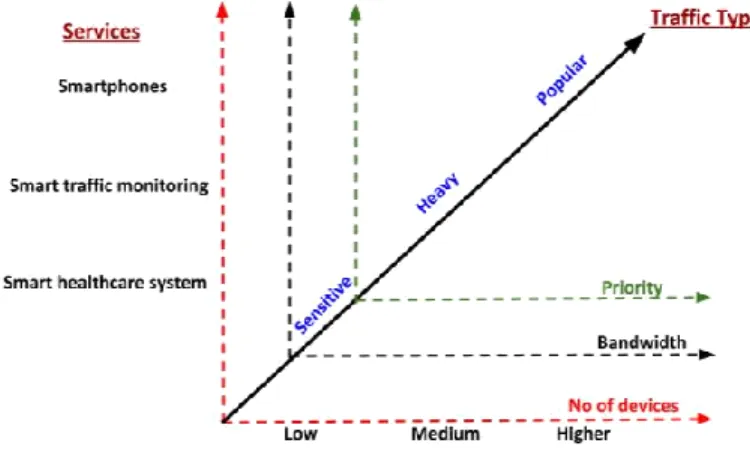
The 5G mobile network terminal offers exceptional QoS through a diversity of networks. Nowadays, the mobile Internet users choose manually the wireless port of different Internet service providers (ISP) without having the opportunity to exploit the QoS history to choose the suitable mobile network linking for a provided service. In the future, the 5G phones will deliver an opportunity for QoS analysis and storage of measured data traffic in the mobile network terminal. There are diverse QoS parameters (e.g., bandwidth, delay, jitter, and reliability), which will support in future of 5G mobile running in the mobile terminal. System processes will offer the best appropriate wireless connection based on needed QoS
automatically. Therefore, we will consider diverse types of data traffic (e.g., sensitive, popular, and heavy traffic) as service slices model as shown in Figures 9 [18]. These data traffic types will be working as following M2M communication environment.
1. Smartphones
Smartphones and tablets are recent technologies that are represented as popular data traffic. Although smartphones are expected to continue as the key personal device and more develop in terms of performance and ability, the number of personal devices growth was driven by such devices as wearable or sensors to reach millions in 2020. In These devices the content type of mobile streaming is video; the total of the flow packets is regularly numerous megabytes or even tens of megabytes, it is many of packets; the transmission way is usually continual transmission; the priority is generally low because the video requires broad bandwidth, and is likely to be blocked in congestion [8].
2. Smart Healthcare System
The smart healthcare system as sensitive data traffic is a promising model, which has currently achieved extensive attention in research and industry. A sensor Body-Area-Network (BAN) is generally positioned around the patient to gather information about the numerous health parameters, for instance, blood pressure, pulse rate, and temperature. Moreover, the patients are also monitored repeatedly by placing smart M2M sensors on the body of the patient when they are outside the hospitals or home. For handling critical situations, alarms are triggered to send messages to the related physicians for urgent treatment [12]. In a smart healthcare system scenario, in order to monitor the patients frequently outside the medical centres (e.g., hospitals) the patients are equipped with smart M2M devices that monitor various health parameters.
3. Smart Traffic Monitoring
Smart traffic monitoring allows the conversation of alerted information between vehicles infrastructure and the system applications over communication approaches and technologies. In this system, we will consider heavy data traffic. Vehicles connect with other Vehicles (V2V) or communicate with smart traffic monitoring servers, Vehicle to Infrastructure (V2I). This system application includes the collision avoidance and safety, parking time, the Internet connectivity, transportation time, fuel consumption, video monitoring, etc. [19]. In the case of emergency, the information from devices positioned to monitor emergency situations is transmitted to other networked vehicles within the communication range. To prevent any more accidents, the communication between the server and vehicles should be very fast for the detection of emergency messages and delivery of alerting messages. Since the response time of the warning messages is very small, collision avoidance services request high level of QoS (i.e., low latency), which can be supported by the 5G cellular networks. According to [19], the alerting messages are small size and must only be sent in serious circumstances for effective using of the communication network bandwidth. Traffic and infrastructure management play an important role in monitoring the issue of traffic congestion.
Figure 9: Traffic data with different smart systems and QoS E. Comparison Data Traffic Scheduling Techniques In this part, we described the advantages, drawbacks and QoS of FIFO, PQ and WFQ scheduling techniques:
Table 1: Scheduling Techniques Comparison
Queuing Advantages Drawbacks
Mechanisms
Simple and fast (one Unfair allocation of single queue with a bandwidth among
FIFO simple scheduling multiple flows
mechanism) Causes starvation
Supported on all (aggressive flows can
platforms monopolize links)
Supported in all Causes jitter (bursts or switching paths packet trains
temporarily fill the
queue)
Provides low-delay Starvation of lower- propagation to high- priority classes when
PQ priority packets higher-priority
Supported on most classes are congested
platforms Manual configuration
Supported in all IOS of classification on versions (above 10.0) every hop
Simple configuration Multiple flows can end (classification does not up in one queue
WFQ have to be configured) Does not support the
Guarantees throughput configuration of
to all flows classification
Drops packets of most Performance aggressive flows limitations due to Supported on most complex classification
platforms and scheduling
mechanisms
QoS variables FIFO PQ WFQ
Default on interfaces >2 Mbps No <=2 Mbps
No of Queues 1 4 Dynamic
Configurable Classes No Yes No
Bandwidth Allocation Automatic Automatic Automatic
Provides for Minimal Delay No Yes No
Modern Implementation Yes No No
F. Data Traffic Slices Algorithm and PQ Technique In the data traffic slices model, we have considered associating our previous data traffic aggregation model, which was enhancing QoS by efficient utilization of the 5G radio resources for M2M and the principle idea of PQ technique. We have found that PQ technique is the appropriate scheduling techniques in terms of supporting various of priorities queuing, which is based on the priority of the packets, the highest priority is transferred on the output port first and then the packets with lower priority and so on as illustrated in data traffic slices algorithm in figure
6 [17]. Therefore, we design our smart systems environment in three level of priorities high (slice1), medium (slice2), and low (slice3), rely on the data traffic types as following:
Smart healthcare system as sensitive data with high priority (1ms)
Smart traffic mo nitoring as h ea v y data wi t h medium priority (5ms)
Smartphones as popular data with low priority (10ms)
These data traffic will work in a form of slicing over the 5G mobile network in the uplink path between RN and DeNB based on user plane interface as shown in Figure 11.
Figure 10: Data traffic slices algorithm based on PQ Technique
Figure 11: A proposed model for data traffic slices
V. CONCLUSION
We have proposed the M2M data traffic aggregation model and algorithm in fixed RNs for uplink in 5G cellular networks. It will improve the radio resource utilization for M2M commutations in 5G networks. It offers maximum multiplexing gain in PDCP layer for data packets from the several M2M devices along with considering diverse priorities to so lve packets E2E delay. Further, this research proposes a data traffic slicing model and algorithm based on comparing advantages and drawbacks of scheduling techniques, such as FIFO, PQ, and WFQ, as we found PQ technique as the appropriate scheduling technique in case of supporting various of priorities queuing for data traffic. Also, it is based on smart systems QoS need in smart city case study to support and assist the operations of diverse systems (e.g., smart traffic monitoring, smart healthcare system and smartphones). In the future work, we will use OPNET 17.5 simulation to assess scheduling techniques in different scenarios of QoS. It can present opportunities for more research in term of resolving data traffic explosion and fairness of services area.
REFERENCES
[1] W. H. Chin, Z. Fan, and R. Haines, “Emerging technologies and research challenges for 5G wireless networks,” IEEE Wirel. Commun., vol. 21, no. 2, pp. 106–112, 2014.
[2] M. Iftikhar, B. Landfeldt, S. Zeadally, and A. Zomaya, “Service level agreements (SLAs) parameter
negotiation between heterogeneous 4G wireless network operators,” Pervasive Mob. Comput., vol. 7, no. 5, pp. 525–544, 2011.
[3] S. Y. Lien and K. C. Chen, “Massive access
management for QoS guarantees in 3GPP machine-to-machine communications,” IEEE Commun. Lett., vol. 15, no. 3, pp. 311–313, 2011.
[4] H. S. Mewara and D. Manghnani, “Comparative analysis of VOIP application with different queuing schemes in WiMAX using OPNET,” in Proceedings - 2015 IEEE International Conference on
Computational Intelligence and Communication Technology, CICT 2015, 2015, pp. 475–481. [5] S. A. Alqahtani and M. Alhassany, “Comparing
different LTE scheduling schemes,” in 2013 9th International Wireless Communications and Mobile Computing Conference, IWCMC 2013, 2013, pp. 264–
269.
[6] I. Abdalla and S. Venkatesan, “Remote subscription management of M2M terminals in 4G cellular wireless networks,” in Proceedings - Conference on Local Computer Networks, LCN, 2012, pp. 877–885. [7] S. Sesia, I. Toufik, and M. Baker, LTE – The UMTS
Long Term Evolution, vol. 3, no. 42. 2009.
[8] A. Annunziato, “5G vision: NGMN - 5G initiative,” in IEEE Vehicular Technology Conference, 2015, vol. 2015.
[9] M. Tesanovic and M. Nekovee, “mmWave-Based Mobile Access for 5G: Key Challenges and Projected Standards and Regulatory Roadmap,” 2015 IEEE Glob. Commun. Conf., pp. 1–6, 2015.
[10] Y. Miaji and S. Hassan, “Comparative simulation of scheduling mechanism in packet switching network,” in Proceedings - 2nd International Conference on Network Applications, Protocols and Services, NETAPPS 2010, 2010, pp. 141–147.
[11] G. Casale, E. Z. Zhang, and E. Smirni, “Trace data characterization and fitting for Markov modeling,” Perform. Eval., vol. 67, no. 2, pp. 61–79, 2010. [12] M. Chen, J. Wan, and F. Li, “Machine-to-machine
communications: Architectures, standards and applications,” KSII Transactions on Internet and Information Systems, vol. 6, no. 2. pp. 480–497, 2012. [13] F. Ghavimi and H. H. Chen, “M2M communications in
3GPP LTE/LTE-A networks: Architectures, service requirements, challenges, and applications,” IEEE Commun. Surv. Tutorials, vol. 17, no. 2, pp. 525–549, 2015.
[14] X. Jian, X.-P. Zeng, Y.-J. Jia, J.-Y. Yang, and Y. He, “Traffic modeling for machine type communication and its overload control,” Tongxin Xuebao/Journal Commun., vol. 34, no. 9, pp. 123–131, 2013. [15] C. Semeria, “Supporting Differentiated Service
Classes: Queue Scheduling Disciplines,” Juniper Networks, pp. 1–27, 2000.
[16] S. Blake, D. Black, M. Carlson, and E. Davies, “An architecture for differentiated services,” Zhurnal Eksp. i Teor. Fiz., pp. 1–36, 1998.
[17] G. Zirong and Z. Huaxin, “Simulation and analysis of weighted fair queueing algorithms in OPNET,” in Proceedings - 2009 International Conference on Computer Modeling and Simulation, ICCMS 2009, 2009, pp. 114–118.
[18] C. S. Lee, G. M. Lee, and W. S. Rhee, “Smart Ubiquitous Networks for future telecommunication environments,” Comput. Stand. Interfaces, vol. 36, no. 2, pp. 412–422, 2014.
[19] M. J. Booysen, S. Zeadally, and G.-J. van Rooyen, “Survey of media access control protocols for vehicular ad hoc networks,” IET Commun., vol. 5, no. 11, pp. 1619–1631, 2011.
![Figure 2: M2M Data Traffic on 5G Mobile Network [13].](https://thumb-us.123doks.com/thumbv2/123dok_us/507962.2559940/2.919.54.434.729.888/figure-m-m-data-traffic-on-mobile-network.webp)
![Figure 3: Packet classifier and traffic conditioner profile [15].](https://thumb-us.123doks.com/thumbv2/123dok_us/507962.2559940/3.919.55.432.661.864/figure-packet-classifier-traffic-conditioner-profile.webp)
![Figure 7: Priority Queuing Technique [10].](https://thumb-us.123doks.com/thumbv2/123dok_us/507962.2559940/5.919.57.433.110.304/figure-priority-queuing-technique.webp)