Vol. 6, No. 1, 2013, pp. [35–45] www.cscanada.net DOI: 10.3968/j.sms.1923845220130601.1065 www.cscanada.org
A Class of Weighted Weibull Distributions and Its
Properties
Mervat Mahdy Ramadan
[a],*[a] Department of Statistics, Mathematics and Insurance, College of Commerce, Benha University, Egypt.
* Corresponding author.
Address: Department of Statistics, Mathematics and Insurance College of Com-merce, Benha University, Egypt; E-Mail: [email protected] Received: December 18, 2012/ Accepted: February 13, 2013/ Published: February 28, 2013
Abstract:
The Weibull distribution is a well known and common distribu-tion. In this article, a skewness parameter to a Weibull distribution is intro-duced using an idea of Azzalini, which creates a new class of weighted Weibull distributions. This new distribution has a probability density function with skewness representing a general case of weighted probability density function of the Extreme value distribution, the Rayleigh distribution and Exponential distribution. Different properties of this new distribution are discussed and the inference of the old parameters and the skewness parameter is studied.Key words:
Hazard function; Moment generating function; Truncated distribution; Weighted gamma distribution; Selection model; Constrained normal mean vector; Probabilistic representationMahdy, M. (2013). A Class of Weighted Weibull Distributions and Its Properties. S-tudies in Mathematical Sciences, 6(1), 35–45. Available from http://www.cscanada.net/ index.php/sms/article/view/j.sms.1923845220130601.1065 DOI: 10.3968/j.sms.19238452 20130601.1065
1. INTRODUCTION
The usefulness and applications of parametric distributions including the Weibull distribution, the Raleigh distribution and the extreme value distribution in various areas including reliability, renewal theory, and branching processes can be seen in recent papers by several authors including Oluyede [19] and in references therein.
Weighted distributions are used to adjust the probabilities of the events as ob-served and recorded. Patil and Rao [20] discussed how, for example, truncated distributions and damaged observations can give rise to weighted distributions.
Azzalini [4] was the first to introduce the skew-normal distribution to incorpo-rate a shape/skewness parameter to a normal distribution depending on a weighted function denoted byF(αX) whereαis a skewness parameter. Since then extensive work has been done to introduce a skewness parameter to some symmetric distri-butions, for instance skew-t, skew-Cauchy, skew-Laplace, skew-logistic. In general, skew-symmetric distributions have been defined and several of their properties and inference procedures have been discussed, see for example, Arnold and Beaver [3], Gupta and Kundu [14] and the recent monograph by Genton [11]. Arnold and Beaver [2] provided a nice interpretation of Azzalini’s skew-normal distribution as a hidden truncation model, although the same interpretation may not be true for other skewed distributions.
Actually, Azzalini’s method has been used extensively for several symmetric distributions and non-symmetric distributions. In this article, it will be observed that if we apply Azzalini’s method to the weibull distribution, then it produces a new class of weighted weibull W W(λ, β, α) distributions with an additional parameter called “sensitive skewness parameter”. From now we denote a member of this new class of weighted distributions asW W(λ, β, α) distribution. The sensitive skewness parameter governs essentially the shape of the probability density function of the
W W(λ, β, α) distribution.
The main aim of this article is to introduce this distribution and study its prop-erties. It will be observed that although the distribution has been obtained as a
W W(λ, β, α) distribution, it has several other special cases and can be considered as a hidden truncation model.
It can be seen that theW W(λ, β, α) distribution function has a compact form and all its moments can be computed explicitly, for instance mean, variance, skew-ness, kurtosis, coefficient of variation, hazard function (HF), and mean residual lifetime.
The rest of the article is organized as follows. In Section 2, we provide the defi-nition ofW W(λ, β, α) distribution. Different properties are discussed in Section 3, also we introduce special cases by defining a weighted the Extreme value distribu-tion, and a weighted Rayleigh distribution and a weighted Exponential distribution in Section 4. The inference of old parameters and sensitive skewness parameter is studied in Section 5.
2. DEFINITION OF WEIGHTED WEIBULL DISTRIBUTION
LetXbe a non-negative random variable with an absolutely continuous distribution functionFX and probability density functionfX.
Let
lX = inf{x∈ <:FX(x)>0},
uX = sup{x∈ <:FX(x)<1},
SX ={x:lX ≤x≤uX}.
Let w be a non-negative function defined on the real line. Suppose that the realizationxofX will be recorded with probability proportional tow(t(x)). Then
the recordedt(x) is not an observation onXbut it is an observation on the so-called weighted random variableX|{w}with density function given by:
fX|{w}(x) =
w(t(X))fX(x)
E[w(t(X))] for − ∞< x <∞, where 0< E[w(t(X))]<∞.
The random variableX|{w} is called the weighted version of X, and its distri-bution relative toX is called the weighted distribution of X with weight function
w. Let lX ≥ 0 and w(t(x)) = x, x ∈ SX, for some positive integer. Then the
corresponding weighted distribution is called a size biased distribution. If this dis-tribution is of order one, then it is simply called a length-biased disdis-tribution (see Blumenthal [6], Gupta and Kirmani [12], Mahfoud and Patil [16]).
Now, the new class of weighted distributions is defined by the corresponding density function: fX|{α}(x) = FX(αx)fX(x) E[F(αX)] , for x >0, (1) with w(t(x)) =F(αx).
According to (1) the new class of weighted Weibull distributions can be derived as follows. LetXbe distributed according to a Weibull distribution with parameters
λandβ, and density function as follow
fX|{λ,β}=λβxβ−1e−λx
β
, (2)
where λis a scale parameter,β is a shape parameter. The distribution function of
X|{β, λ} is FX|{λ,β}(x) = 1−e−λx β . Hence, we get FX|{λ,β}(αx) = 1−e−λ(αx) β , and E FX|{λ,β}(αX)= Z x FX|{λ,β}(αx)fX|{λ,β}(x)dx= αβ 1 +αβ,
Inserting into (1) yields
fX|{λ,β,α}(x) =
λβ(1 +αβ)xβ−1e−λxβ1−e−λ(xα)β
αβ , for x >0, (3)
andfX|{λ,β,α}(x) = 0 otherwise. The density function (3) is referred to asW W(λ, β, α). Suppose X1 and X2 are two i.i.d. random variables with probability density functionfY and distribution functionFY. Then for anyα >0, andβ= 2, consider
the new random variable X with X = X1 given that αX1 > X2. Azzalini [4] obtained the weighted skew-normal distribution from two i.i.d. normal distributions and Mahdy [15] obtained the weighted gamma distribution from two i.i.d. gamma distributions as follows
fX|{λ,2,α}(x) =
1
PX1,X2({(x1, x2) :αx1> x2})
Now, (1) can be obtained explicitly from (4) by inserting fX|{λ,2}(x) = 2λxe−λx 2 , FX|{λ,2}(x) = 1−e−λx 2 , and PX1,X2({(x1, x2) :αx1> x2}) = ∞ Z 0 αx1 Z 0 fX1,X2(x1, x2)dx2dx1= α2 1 +α2.
3. SOME PROPERTIES OF THE
W W
(
λ, β, α
) MODEL
In this section we study the W W(λ, β, α) distribution. Without loss of generality, the density function of theW W(λ, β, α) distribution is provided by (3). The graphs of the density function ofW W for different values ofαare displayed in Figure 1.
Figure 1
Weighted Weibull Densities
It is easy to see that asαincreases, the skewness of the distribution increases. IfX is a random variable with probability density functionW W(λ, β, α), then
thekth moment ofX|{λ, β, α} is given by EW W(λ,β,α)(Xk) = λ−k/β αβ 1 +α β Γ k+β β ! 1− 1 +αβ−(k+β)/β. (5) From (5),the first moment ofW W(λ, β, α) is obtained:
EW W(λ,β,α)(X) = λ−1/β αβ 1 +α βΓ 1 +β β ! 1− 1 +αβ−(1+β)/β.
Similarly, the variance is obtained as
VW W(λ,β,α)(x) =a1−a2, where, (i).a1=EW W(λ,β,α)(X2) = λ−2/β αβ 1 +α βΓ 2 +β β ! 1− 1 +αβ−(2+β)/β, and (ii).a2=EW W2 (λ,β,α)(X) = " λ−1/β αβ 1 +α β Γ 1 +β β ! 1− 1 +αβ−(1+β)/β #2 . Moreover, we get EW W(λ,β,α)(X3) = λ−3/β αβ 1 +α βΓ 3 +β β ! 1− 1 +αβ−(3+β)/β.
Some other measures, like the coefficient of variationCVW W(λ,β,α)ofW W(λ, β, α) and the skewness coefficientτW W(λ,β,α)can also be easily obtained in explicit forms:
CVW W(λ,β,α)(x) = √ a1−a2 /λ −1/β αβ 1 +α β Γ 1 +β β ! 1− 1 +αβ−1/β, and τW W(λ,β,α)= s1−s2 (a1−a2) 3/2, where s1= λ−3/β αβ 1 +α βΓ 3 +β β ! 1− 1 +αβ−(3+β)/β −3(a1−a2) λ−1/β αβ 1 +α βΓ 1 +β β ! 1− 1 +αβ−(1+β)/β; s2= λ−1/β αβ 1 +α βΓ 1 +β β ! 1− 1 +αβ−(1+β)/β !3 .
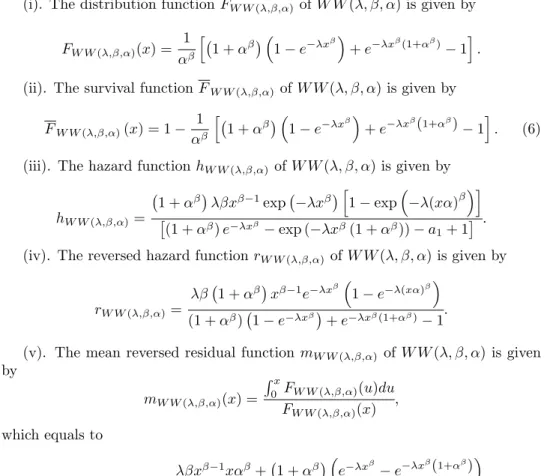
Next, we provide the distribution function, survival function, hazard function, reversed hazard function, and mean residual life function for theW W(λ, β, α) dis-tribution:
(i). The distribution functionFW W(λ,β,α)of W W(λ, β, α) is given by FW W(λ,β,α)(x) = 1 αβ h 1 +αβ1−e−λxβ+e−λxβ(1+αβ)−1i.
(ii). The survival functionFW W(λ,β,α)ofW W(λ, β, α) is given by
FW W(λ,β,α)(x) = 1− 1
αβ h
1 +αβ1−e−λxβ+e−λxβ(1+αβ)−1i. (6) (iii). The hazard functionhW W(λ,β,α)ofW W(λ, β, α) is given by
hW W(λ,β,α)= 1 +αβλβxβ−1exp −λxβh1−exp−λ(xα)βi (1 +αβ)e−λxβ −exp (−λxβ(1 +αβ))−a 1+ 1 .
(iv). The reversed hazard functionrW W(λ,β,α)ofW W(λ, β, α) is given by
rW W(λ,β,α)= λβ 1 +αβ xβ−1e−λxβ1−e−λ(xα)β (1 +αβ) 1−e−λxβ +e−λxβ(1+αβ) −1.
(v). The mean reversed residual functionmW W(λ,β,α) ofW W(λ, β, α) is given by mW W(λ,β,α)(x) = Rx 0 FW W(λ,β,α)(u)du FW W(λ,β,α)(x) , which equals to mW W(λ,β,α)(x) = λβxβ−1xαβ+ 1 +αβ e−λxβ−e−λxβ(1+αβ) λβxβ−1(1 +αβ) 1−e−λxβ −λβxβ−1 1−e−λxβ(1+αβ).
It can be shown thatmW W(λ,β,α)is an increasing function of x.
Table1contains the values of survival function (6). Looking at this table we can see that the survival probability of the distribution decreasing with increase in the value ofαfor a holdingxandλandβ at a fixed level. Further, from the table we can see that; for fixed α,λandβ; the survival probability decreases with increase in x.
4. SPECIAL CASES
4.1. The Weighted Extreme Value Distribution
In many fields of modern science, engineering and insurance, extreme value distri-bution is well established (see e. g. Embrechts et al.[10], Reiss and Thomas [21]). Recently, more and more research has been undertaken to analyze the extreme vari-ations that financial markets are subject to, mostly because of currency crises, stock market crashes and large credit defaults. The tail behavior of financial series has, among others, been discussed in McNeil and Frey [18], Coles [7], Beirlantet al.[5], Mandira [17], Cooley et al. [8] and Andjelic et al. [1]. An interesting discussion about the potential of extreme value theory in risk management is given in Diebold et al.[9].
Table 1
Survival Function of Weighted Weibull Distribution for λ= 1; β= 1 x α= 1 α= 1.2 α= 1.4 α= 1.6 α= 1.8 α= 2 α= 5 0.1 0.990944 0.990103 0.989273 0.988454 0.987645 0.986847 0.976043 0.2 0.967141 0.964309 0.96155 0.958862 0.956243 0.95369 0.911138 0.3 0.932825 0.927457 0.922294 0.917326 0.912545 0.907943 0.855922 0.4 0.891311 0.883268 0.875625 0.868361 0.861454 0.854883 0.78624 0.5 0.845182 0.83458 0.824628 0.81528 0.806494 0.798231 0.717879 0.6 0.796429 0.783542 0.771586 0.760484 0.750166 0.740568 0.653109 0.7 0.746574 0.731755 0.718165 0.705685 0.694211 0.68365 0.592903 0.8 0.696761 0.680399 0.665559 0.652078 0.639813 0.628634 0.537549 1 0.600424 0.58211 0.565852 0.551383 0.538474 0.526926 0.44096 1.1 0.554939 0.536162 0.519664 0.505123 0.492267 0.480865 0.399173 1.2 0.51167 0.492722 0.476237 0.461842 0.449227 0.438129 0.361284 1.3 0.47079 0.451918 0.435657 0.421585 0.409354 0.398677 0.326956 1.4 0.432384 0.413795 0.397927 0.384312 0.372572 0.362398 0.295871 1.5 0.396473 0.378336 0.362992 0.349935 0.33876 0.329141 0.267732
Let random variable X has a Weibull distribution in (2), then the weighted probability density function ofY =−βlog Xλ1/βis given by
fY|{β,α}(y) =
1 +αβ αβ e
−ye−e−y1−e−αβe−y,
which is weighted extreme value distribution.
4.2. The Weighted Rayleigh Distribution
The Rayleigh distribution is an important distribution in statistics and operations research. It is applied in several areas such as health, agriculture, biology, and other sciences.
Let random variableY has the weighted Rayleigh distributionW R(σ, α), thenY
has the weighted Weibull distributionW W (1/σ√2)2,2, α
. Therefore, ifw(t(x)) =
F(αx), the weighted Rayleigh distribution has an probability density function and distribution function are given by
f Y n (1/σ√2)2,2,αo(y)
= 1 +α2/ σ2α2yexp−0.5(y/σ)2 1−exp−0.5(yα/σ)2,
and
F
W R(1/σ√2)2,2,α(y)
4.3. The Weighted Exponential Distribution
The second distribution can be obtained following Gupta and Kundu [13] who introduced a new weighted exponential distribution but not fixedλ. Supposeβ= 1 in (2), and then we get the density function of the weighted exponential distribution of the random variableY|{λ, α}as
fY|{λ,α}(y) =λ(1 +α) exp (−λy) (1−exp (−λyα))/α, for y >0, andfY|{λ,α} otherwise also, the distribution function can be written as
FW E(λ,α)(y) = 1
α[(1 +α) (1−exp (−λy)) + exp (−λy(1 +α))−1].
5. PARAMETER ESTIMATION
This section is devoted to the estimation of the unknown parameterαin caseβ= 2. For this case, the maximum likelihood and the moment estimator is derived and their asymptotic distributions are given.
5.1. Maximum Likelihood Estimates
The weighted Weibull distribution is obtained by means of (3) in case β = 2. We can write it as follows:
fX|{λ,α}(x) = 2λ 1 +α2xexp −λx2
1−exp−λ(xα)2/α2, for x >0.
The likelihood function based on the observed sample{x1, x2, ..., xn} is
L(x1, x2, ...., xn|λ, α) = 2nλn 1 +α2n Πni=1xiexp −λ n X i=1 xi2 ! Πni=11−exp−λ(xiα)2 /α2n. (7)
From (7) we obtain the log-likelihood function`(x1, x2, ..., xn|λ, α):
`(x1, x2, ...., xn|λ, α) = nln 2 +nlnλ+nln 1 +α2 + n X i=1 lnxi−λ n X i=1 x2i + n X i=1 lnh1−e−λ(xiα)2i−2nlnα. (8)
For determining the maximum likelihood estimators (MLE) of λ and α, the expression (8) must be maximized with respect toλandα. Thus, firstly, the MLE ofλis obtained as a solution of the following fixed-point type equation:
where gλˆ=C1+ ˆλ C2 C3 , C1= n n P i=1 x2 i , C2= n X i=1 (xiα) 2 exp−λ(xiα) 2 , and C3= n X i=1 x2i n X i=1 lnh1−exp−λ(xiα) 2i .
The solution of (9) can be obtained by a simple iterative procedure. Suppose we start with an initial guess ˆλ0, then the next iteration ˆλ1 can be obtained as ˆ
λ1=g(ˆλ0), similarly, ˆλ2=g(ˆλ1), and so on. Finally the iterative procedure should be stopped when ˆ λi−ˆλi+1
< , whereis a preassigned tolerance value.
Secondly, the MLE of α is obtained as a solution of the following fixed-point type equation: g( ˆα) = ˆα, (10) where g( ˆα) =S1−S2, S1= 1 + ˆα2 ˆ α , and S2= 1 + ˆα2 n P i=1 2λαˆ(xi) 2 exp−λ(xiαˆ) 2 2n n P i=1 ln1−exp−λ(xiαˆ) 2 .
The solution of (10) can be obtained by a simple iterative procedure. Suppose we start with an initial guess ˆα0, then the next iteration ˆα1 can be obtained as
ˆ
α1=g( ˆα0), similarly, ˆα2=g( ˆα1), and so on. Finally the iterative procedure should be stopped when |ˆαi−αˆi+1|< , whereis a preassigned tolerance value.
5.2. The Moment Estimators
Next, we discuss the moment estimators ofλandαwhenβ = 2. Ifm2 denotes the second non-central moment, then by equating the second moment, we obtain the moment estimator of αas 0 = λ −1 α2 1 +α 2 1− 1 +α22 −m2.
Thus, the moment estimators ofαcan be obtained as a solution of the following fixed-point type equation:
where g( ˆα) = λ −1 m2 1 + ˆα 2 1− 1 + ˆα22 !1/2 ,
This solution can be obtained by a simple iterative procedure, analogously as in the case of the solution of (10).
Also, we can be obtained the moment estimator ofλas ˆ λ= 1 α2m2 1 +α 2 1− 1 +α22. REFERENCES
[1] Andjelic, G., Milosev, I., & Djakovic, V. (2010). Extreme value theory in emerging markets. Economic Annals, LV(185), 63-105.
[2] Arnold, B. C., & Beaver, R. J. (2000a). Hidden truncation models. Sankhya, A(62), 23-35.
[3] Arnold, B. C., & Beaver, R. J. (2000b). The skew Cauchy distribution. S-tatistics &Probability Letters, 49, 285-290.
[4] Azzalini, A. (1985). A class of distributions which includes the normal ones. Scandinavian Journal of Statistics, 12, 171-178.
[5] Beirlant, J., Teugels, J., Goegebeur, Y., & Segers, J. (2004). Statistics of extremes: theory and applications. New York: Wiley.
[6] Blumenthal, S. (1967). Proportional sampling in life-length studies. Techno-metrics, 9, 205-218.
[7] Coles, S. G. (2001). An introduction to statistical modeling of extreme values. New York: Springer-Verlag.
[8] Cooley, D., Nychka, D., & Naveau, P. (2007). Bayesian spatial modeling of extreme precipitation return levels. Journal of the American Statistical Association, 102, 824-840.
[9] Diebold, F. X., Schuermann, T., & Stroughair, J. D. (1998). Pitfalls and opportunities in the use of extreme value theory in risk management. In Refenes, A. P., Burgess, A., & Moody, J. (Eds.), Decision technologies for computational finance (pp. 3-12). Kluwer Academic Publishers.
[10] Embrechts, P., Kl¨auppelberg, C., & Mikosch, T. (1999). Modelling extremal events for insurance and finance: applications of mathematics. New York: Springer.
[11] Genton, M. G. (2004). Skew-elliptical distributions and their applications: a journey beyond normality (1st ed.). New York, Chapman & Hall/CRC. [12] Gupta, R. C., & Kirmani, S. N. U. A. (1990). The role of weighted
distribu-tions in stochastic modeling. Communications in Statistics, 19, 3147-3162. [13] Gupta, R. C., & Kundu, D. (2007). Skew-logistic distribution. Technical
Report, Indian Institute of Technology Kanpur, India.
[14] Gupta, R. C., & Kundu, D. (2009). A new class of weighted exponential distributions. Statistics, 43, 621-634.
[15] Mahdy, M. (2011). A weighted gamma distribution and its properties. Journal of Economic Quality Control, 26(2), 133-144.
and probability: essays in honor of C. R. Rao (pp. 479-492). New York: North-Holland.
[17] Mandira, S. (2005). Characterisation of the tail behaviour of financial returns: studies from India. The Netherlands: Eurandom.
[18] Mcneil, A. J., & Frey, R. (2000). Estimation of tail-related risk measures for heteroscedastic financial time series: an extreme value approach. Journal of Empirical Finance, 7, 271-300.
[19] Oluyede, B. O. (2006). On bounds and approximating weighted distributions by exponential distributions. Probability in the Engineering and Informational Sciences, 20, 517-528.
[20] Patil, G. P., & Rao, C. R. (1977). Weighted distributions: a survey of their application. In P. R. Krishnaiah (Ed.), Applications of statistics (pp. 383-405). North Holland Publishing Company.
[21] Reiss, R. D., & Thomas, M. (1997). Statistical analysis of extreme values with applications to insurance, finance, hydrology and other fields. Basel: Birkh
¨