Psychology of Learning and Motivation, Volume 58
ISSN 0079-7421, http://dx.doi.org/10.1016/B978-0-12-407237-4.00007-4© 2013 Elsevier Inc.All rights reserved. 233
Individual Differences in
Intelligence and Working
Memory: A Review of Latent
Variable Models
Andrew R. A. Conway*,1, Kristof Kovacs**
*Department of Psychology, Princeton University, Princeton, NJ, USA
**Department of Psychology, University of Amsterdam, Amsterdam, The Netherlands
1Corresponding author: E-mail: [email protected]
Contents 1. Introduction 234 1.1. Overview 234 1.2. TwoDisciplinesofPsychology 235 1.3. Unification:BenefitsandChallenges 237 1.4. InterimSummary 240 2. ModelsofIntelligence 240 2.1. FactorAnalysis 240 2.2. ASingleGeneralFactor 241 2.3. SeveralGroupFactors 242 2.4. Higher-orderandBi-factorModels 244 2.5. TheContentofFactors 246 3. InterpretationoftheGeneralFactor 247 3.1. AUnitarySource 247 3.2. EvidenceAgainstaUnitarySource 249 3.3. MultipleSources 250 4. ModelsofWorkingMemoryCapacity 252 4.1. HistoryRepeating 252 4.2. TheGeneralFactor,Again 255 5. TowardaUnifiedModel 256 5.1. IntelligenceandWorkingMemoryCapacity 256 5.2. ComponentsofWorkingMemory 257 5.3. ComponentsofIntelligence 258 5.4. ConvergingEvidence 259 6. Conclusion 262 Appendix 263
Abstract
Thepurposeofthecurrentreviewistoexamineindividualdifferencesinintelligence and working memory capacity. The emphasis is on latent variable models and theoretical frameworks that connect interindividual differences in behavior with intraindividual psychological processes. Our review suggests that intelligence and working memory capacity are strongly correlated and that the shared variance is primarilyduetothefluidreasoningcomponentofintelligenceandmechanismsof cognitivecontrolinworkingmemory.Weconcludethatresearchonintelligenceand workingmemoryisararesuccessfulexampleoftheunificationofexperimentaland differentialpsychology.Finally,wearguethatgeneralabilitymodelsofintelligence thatpositaunitarysourceofvariancearenotconsistentwithcontemporaryresearch andshouldbefairlyrejected.
1. INTRODUCTION
1.1. Overview
Intelligence and working memory are among the most extensively studied constructs in Psychology. Both are related to higher-level cognition, both involve processes associated with cognitive control, and both have been linked to critical neural mechanisms in pre-frontal cortex. It should therefore come as no surprise that the connection between these constructs has become a major focus of research interest in cognitive psychology and neuroscience.
Search of PsycInfo, an online database, carried out on June 30, 2012 showed that the number of journal articles and dissertations that included both the word ‘Intelligence’ and the phrase “working memory” in the abstract or title has consistently increased over the last 30 years. In succes-sive 5-year periods between 1981 and 2010, the numbers were 7, 15, 37, 87, 218, and 426! Not only did the first decade of the third millennium see a huge increase in joint research on intelligence and working memory, the years between 2006 and 2010 produced more papers and dissertations on this topic than the previous 25 years combined.
Given this recent proliferation of research, a single manuscript can-not possibly review all contemporary work. Therefore, our goal here is to review latent variable models of intelligence and working memory, and in so doing, to address two of Psychology’s most vexing questions: (1) is it pos-sible, or even desirable, to bridge experimental psychology and differential psychology? (2) What is the theoretical status of the general factor in models of cognitive ability?
1.2. Two Disciplines of Psychology
At the outset, it is essential to highlight a fundamental difference between intelligence and working memory. After a few unsuccessful early attempts to channel research on individual differences in mental abilities into m ainstream experimental psychology (e.g. Cattell, 1890), and following the invention of the modern IQ-test at the turn of the 20th century, the field of intelligence was essentially agnostic with respect to intraindividual psychological processes, and for most of the twentieth century focused solely on the measurement and explanation of interindividual differences in cognitive abilities (Mackintosh, 2011). Working memory, on the other hand, is a construct developed by cog-nitive psychologists to refer to the intraindividual processes that enable one to hold goal-relevant information in mind, often in the face of concurrent pro-cessing and/or distraction (B addeley, 1992; Baddeley & Hitch, 1974).
Thus, joint research on intelligence and working memory not only con-nects two fields of study, but is also an ideal candidate to answer Cronbach’s (1957) call for integrating the two disciplines of scientific psychology, that is, the one studying interindividual differences (“differential psychology”) and the one studying intraindividual processes (“experimental psychology”). Cronbach’s call for a unified psychology has been echoed on several occasions (e.g. Underwood, 1975) as well as for different target audiences: intelligence researchers have been encouraged to apply experimental methods (Eysenck, 1995), and experimental psychologists have been advised to favor nomothetic theories that also explain individual differences (Cohen, 1994). Yet, unified models are still extremely rare in psychology because bridging the two disci-plines presents unique challenges, which we will discuss in more detail below. As well, in many realms of psychology it is possible to maintain a successful program of research by working in one discipline while ignoring the other.
One area where this is not possible is developmental psychology. Theo-ries of development can’t dismiss interindividual differences in behavior as noise. For example, despite having enormous impact, Piaget’s theory of cognitive development has been widely criticized because it failed to explain why some children advanced to different stages at different rates. In the 1970s, developmental psychologists began to address this limitation by incorporating ideas from information processing models of cognition (Case, Kurland, & Goldberg, 1982; Pascual-Leone, 1970). This work, in turn, had an enormous impact on the field of working memory and set the stage for a unified account of intelligence and working memory (Case & Daneman, 1981; Daneman & Carpenter, 1980).
A pivotal moment was the introduction of so-called complex span tasks, that is, tasks which require the simultaneous storage and processing of infor-mation. The tasks are unique because they are developed from a t heoretical perspective—Case’s theory of development and Baddeley’s theory of work-ing memory—and they account for important individual differences in cognitive performance. One of the first such tasks, reading span, in which subjects have to read sentences and remember the last word of each sen-tence, was developed by Daneman and Carpenter (1980), who showed that variation in performance on this particular measure of working memory capacity predicts performance on reading comprehension tests. Over the years, many versions of complex span tasks have been developed (for a review of working memory span tasks, see Conway et al., 2005). The point here is that the construction of complex span tasks is a theory-driven enter-prise. In contrast, the construction of intelligence tests is largely a data-driven enterprise, that is, tests are constructed to predict various real-life outcomes. Connecting complex span tasks to intelligence tests therefore connects theory to data in a novel way.
Amid the siren songs calling for the unification of differential and exper-imental psychology, a few researchers have expressed skepticism. Jensen (2000) argued that differential and experimental psychology are justifiably separated, because in order to systemize individual differences, one need not understand universal laws of cognition. Contrary to Jensen, who appears to be in favor of the separation of the two disciplines, Borsboom, Kievit, Ce rvone, and Hood (2009), albeit not having much faith in convergence either, do allow special conditions under which a common framework is tenable: “the idea that correlational and experimental research can ‘con-verge’, in the sense that they render support for the same hypothesis (…) only makes sense in a limited set of situations—namely those in which the interindividual differences found in correlational research are exclusively the result of the intraindividual processes studied in the corresponding experi-mental research” (p. 73). Moreover, “(t)o have a real connection between the fields under consideration here, one should be able to infer what an inter-individual differences structure should (sic!) like from a theory of intrain-dividual processes—more specifically, one should be able to place refutable restrictions on the interindividual model structure” (p. 93).
Borsboom et al. come to the conclusion that these conditions have not yet been appropriately met, and quite likely never will be met. While agree-ing with the conditions they propose, we are substantially more optimistic about future possibilities of integrating the differential and experimental
disciplines, in particular, of integrating models of individual differences in intelligence with intraindividual theories of working memory, primarily through the interindividual construct “working memory capacity.” It fur-ther sparks our optimism that Cohen (1994) cites Baddeley and Hitch’s (1974) model of working memory as “an excellent example of how experi-mental data and individual differences can be treated within the same th eoretical framework” (p. 10), and even Borsboom et al’s highly pessimistic evaluation admits that “it would seem that the experimental psychologists (sic!) ‘w orking memory’ and the differential psychologists (sic!) ‘working memory’ are related, and how they may be is an important issue” (p. 94).
Besides skepticism about a common framework of experimental and correlational psychology, it appears that Borsboom et al. (2009) and Jensen (2000) also share a fondness of aliens and car analogies. They both apply a similar thought experiment to show that if extraterrestrial creatures were to study cars, they would most likely develop separate lines of research for (a) how individual cars work, and (b) what makes them differ in performance. While these thought experiments seem convincing, there would be practi-cal problems that our alien would have to face. Let us assume that she is interested in the speed of cars and she finds that faster cars have, in general, more gears, larger engines, more valves per cylinder, and fancier hubcaps. Which of these cause some cars to go faster than others?
A radical improvement in the state of affairs in differential psychology is that, thanks to the advancement of confirmatory factor analytical techniques, one can now test elaborate causal models about individual differences— something that, at the time Cronbach’s paper appeared, was considered to be the privilege of experimental psychologists working from nomothetic theories. In our example, one could rule out the possibility that hubcaps causally influence speed solely by applying statistical control. Nevertheless, converging lines of evidence can always further corroborate this conclusion, such as effects of experimental manipulations (do fitting different hubcaps significantly influence performance?) or other natural causes (does perfor-mance decrease as a result of losing a hubcap or does it remain intact?).
1.3. Unification: Benefits and Challenges
Even though the conditions for research on intraindividual processes and individual differences to converge under the same theoretical framework are hard to meet, when they in fact can be met, the advantages are enormous. A theory with more converging lines of evidence is undoubtedly better supported than one with less. As well, a theory of individual differences
which is not embedded into a theory of within-individual processes, and which therefore cannot use explanatory constructs discovered by individ-ual-level research, is scientifically inferior to a theory which is embedded in such a theoretical framework. In the car example, an account of why some cars are faster than others that is based on the explanation of how engines work is necessarily more elaborate, plausible, and parsimonious than one that only explores variation, attempting to explain speed differences with-out an understanding of what makes speed possible in the first place.
The advantages of differential/correlational psychology as an individual discipline are therefore contingent upon the development of theories that provide psychological explanations and predictions, rather than mere struc-tural accounts of covariance. As we shall see, there are occasions when dif-ferent models provide equally good fit to interindividual data, but these models are compatible with different accounts of intraindividual processes. Without taking into account these processes, and relying only on individual differences data, such models are technically isomorphic.
Furthermore, the interpretation of latent variables is a very difficult enterprise, which without corroborating evidence about intraindividual processes is restricted to the analysis of test content and regression param-eters of the model. Many cognitive scientists are skeptical about the objec-tivity of this process, the most pronounced of whom is probably Stevan Harnad, who claims that: “there is a huge hermeneutic component to psy-chometric analysis. The empirical part is the calculation of the correlations in the extraction of factors; the hermeneutic part is in interpreting the f actors, figuring out what on earth they may mean” (Bock, 2000, p. 48).
In spite of several warnings (e.g. Borsboom, Mellenbergh, & Van Heerden, 2003; Jensen, 1998) the vast majority of differential psychologists are apparently unable to resist the temptation to carelessly link latent vari-ables to intraindividual processes. The foremost example is the interpreta-tion of psychometric g, the general factor obtained from diverse batteries of mental tests, as “general intelligence”, a domain-general intraindividual mechanism that enables any given individual to solve items in IQ-tests. In fact, the very practice of labeling tests with completely different content as “IQ-tests” is a case of implicitly assuming that all tests tap the same domain-general mechanism.
For these reasons we believe that the convergence of both interindi-vidual and intraindiinterindi-vidual lines of working memory research as well as the study of variation in intelligence is a meaningful and promising enterprise. However, we admit that this has to be done with exceptional rigor. That is,
when evaluating converging models of intelligence and working memory, we will take very seriously the conditions under which such convergence makes sense.
First, it is important to be aware that evidence about individual dif-ferences and intraindividual processes are mutually underdetermined with regard to theories of intraindividual processes and the structure of indi-vidual differences, respectively. This means that, on the one hand “even the most impressive fit of a between-subjects model to interindividual differ-ences data does not have implications for the structure of psychological attributes or processes that operate at the level of the individual” (B orsboom et al., 2009, p. 76.). In the car example, studying how variation in some components causes variation in the speed of the car will never reveal how individual cars obtain their speed. On the other hand, even though a theory of intraindividual processes is capable of predicting the structure of indi-vidual differences, “the set of situations in which laws concerning univer-sal processes yield any predictions about the structure of interindividual d ifferences is highly limited” (Borsboom et al., 2009, p. 73). Once again, in the car analogy: (a) some components either do not manifest variation, or their variation does not correlate with overall performance (such as that of hubcaps) and (b) differentiable components can still correlate and thus load on the same latent variable, even to such an extent that makes them unitary from an individual differences perspective (such as power and capacity).
Second, from the mutual underdetermination of individual differences and within-individual data to the other type of theory follows the necessity of the distinction between intraindividual and interindividual concepts. Such a distinction, however, is rarely made, which results in conceptual confusion when the two disciplines actually communicate. Differential psychologists’ concept of “general intelligence”, even if it is simply meant as “the general factor of intelligence”, and never in fact refers to an intraindividual mech-anism, is still naturally interpreted by cognitive psychologists and cogni-tive scientists as a domain-general, within-individual cognicogni-tive mechanism: something like, for instance, Newell and Simon’s (1972) “G eneral Problem Solver.” This interpretation, in turn, sharply opposes domain-specificity and modularity, whereas the general factor of intelligence clearly does not, since it only says that variation appears to be domain-general at the group level. At the individual level, it can be completely domain-specific (for a theory that actually incorporates both modularity and a general factor of mental abilities, see Anderson, 1992). With respect to the topic of this paper, it is crucial to distinguish working memory as an intraindividual and as an
interindividual construct. To do so, we will refer to “working memory” and “working memory capacity”, respectively.
Third, it is imperative to keep in mind Borsboom et al.’s call for refut-able predictions from intraindividual theories to the structure of individual differences. This suggestion is especially important in the current state of research on intelligence and working memory: since it has been firmly established that they are strongly related constructs, research on the nature of the relationship could enter a more mature stage by specifying which com-ponents are responsible for the correlation and, more importantly, which are not. “Every ‘good’ scientific theory is a prohibition: it forbids certain things to happen. The more a theory forbids, the better it is” (P opper, 1963, p. 36). A strong theoretical account of intelligence and working memory will therefore predict which outcomes will be correlated and it will predict which outcomes are not correlated.
1.4. Interim Summary
To sum up this rather lengthy Introduction: the purpose of the current chapter is to closely examine latent variable models of intelligence and working memory capacity and then determine whether a unified model is possible. While doing so, we will prefer individual-differences mod-els that are predicted by accounts of intraindividual cognitive processes, and we will prefer refutable, differential predictions to cases of simple convergence.
First, we discuss accounts of the structure of individual differences in intelligence. Second, we try to do justice to explanations of such structure in general, and in particular as to whether the general factor of intelligence is the result of a unitary process. Third, we provide a similar outline of working memory capacity, focusing on whether a domain-general account of variance is tenable. This is followed by an evaluation of whether such domain-general variance in working memory capacity is the result of a uni-tary mechanism or a number of interacting components. Finally, we discuss how models and interpretations of intelligence and working memory might converge to a unified account.
2. MODELS OF INTELLIGENCE
2.1. Factor Analysis
Psychologists studying individual differences in intelligence have applied the method of factor analysis to explore the structure of abilities responsible
for performance on various mental tests. With the help of factor analysis, the large correlation matrices that consist of the intercorrelations of diverse cognitive tests can be simplified, assuming that the correlation between any two tests is the result of the tests’ correlation with a latent variable, which is not directly measurable.
Factors are therefore latent variables, with which the original tests cor-relate, and we call this correlation the loading of the test on the factor. The correlation between two tests (A and B) equals the product of the test’s loading on the factor (F):
r= (A.B) =r(A.F) ×r(B.F)
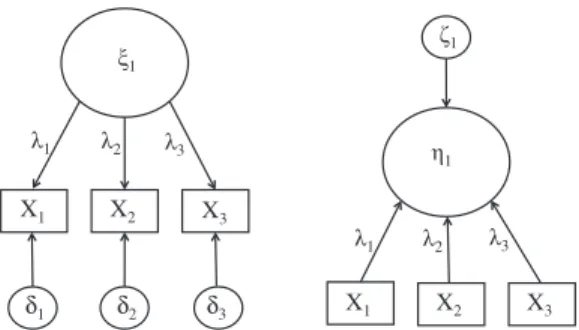
The idea behind factors is that they (a) explain correlations among tests, and (b) can reproduce the original correlation matrix based on factor loadings. With the invention of confirmatory factor analytic methods, it has become possible to test elaborate causal models of latent and manifest variables, simi-larly, by evaluating how much a hypothetical covariance matrix, derived from the hypothesized links between latent and manifest variables, fits the actual, empirical covariance matrix (in order to fully grasp the logic of latent variable analysis, we suggest readers unfamiliar with this topic refer to a brief overview presented in the Appendix).
The early development of factor analysis, as well as the first systematic study of individual differences in cognition owe a great deal to Charles Spearman. Spearman discovered that if one examines a matrix of correlations between various mental tests, the most apparent thing one notices is that all the corre-lations are positive. This is called the “positive manifold”, and according to Jen-sen (1998) it is the most replicated result in all Psychology. Spearman wanted to establish that all of these positive correlations could be accounted for by postulating a single source of variance. In order to do so, he invented an early precursor of factor analysis, the so-called “method of tetrad differences”, with which provided an objective empirical test of general ability theory.
2.2. A Single General Factor
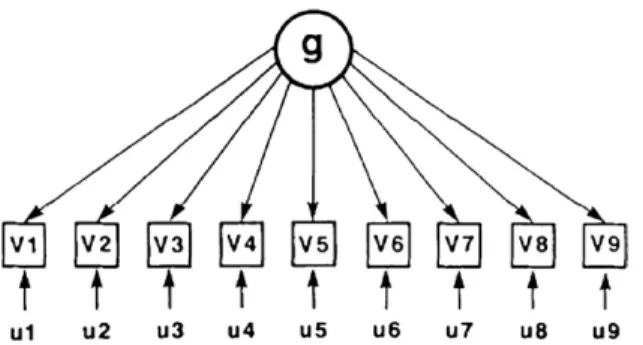
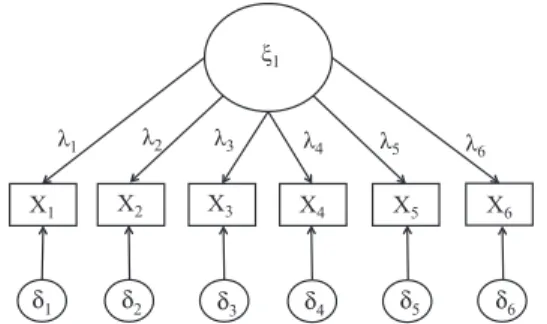
When Spearman (1904) applied this method, he found that the correlations could indeed be accounted for by a general factor, which he termed g. The initial model that he developed is often referred to as a two-factor theory, but it is actually consistent with the one-factor solution depicted in Figure 7.1. For Spearman, the two “factors” referred to (a) a general factor, g, and (b) several specific factors, called s, one for each individual manifest variable. In Figure 7.1, the task-specific abilities are contained in the “error” terms. A more appropriate
interpretation of these latent variables is to consider part of their influence systematic, i.e. specific to the particular manifest variable, and part of their influence as unsystematic, i.e. measurement error. Of theoretical importance is Spearman’s insistence on the s factors being strictly unique to the given test; there is no common variance between tests that is not explained by g, that is, there are no “kinds” of tests that belong to different (verbal, spatial, etc.) abilities.
2.3. Several Group Factors
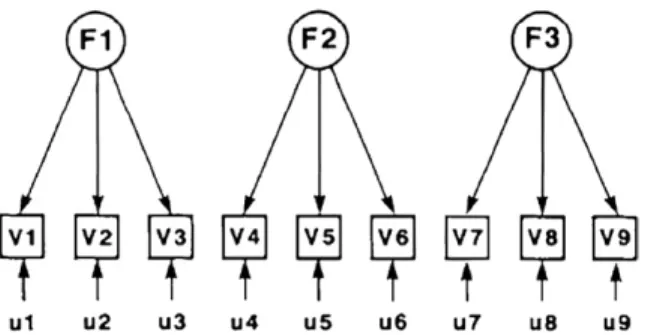
Thurstone, the sharpest contemporary critique of Spearman’s model, was more concerned with patterns of convergence and divergence than he was with the positive manifold. He argued that two tests within a particular domain (e.g. verbal ability) tend to be more highly correlated with each other than two tests from different domains (e.g. verbal and spatial ability), despite the fact that the correlations among all tasks are positive. Thurstone (1938) questioned the necessity of a general factor and argued for a model of intelligence that included seven primary mental abilities and did not include a general factor (Figure 7.2).
Thurstone applied a slightly different statistical method than Spearman. He did not try to maximize the variance explained by a single factor, but rather looked for factors that were independent of one another, each of which explained a sub-set of the correlation matrix, and together explained as much of the entire variance as possible. The independence of factors, achieved through so-called factor rotation, meant that each test had a loading on a single factor only (this is called simple structure in the terminology of factor analysis). Figure 7.1 A latent variable model consistent with Spearman’s original model of intel-ligence: variance in each measured variable (V1, V2, etc.) can be decomposed to its load-ing on the general factor, g, and its unique source of variance (u1, u2, etc., equivalent to Spearman’s s factors). The correlation between the variables is entirely the function of their loading on the general factor. (From Jensen and Weng (1994), p. 243).
The technique of rotation of factors, which is an umbrella term c omprising of several actual statistical techniques, made it possible to provide different factorial solutions to any given correlation matrix. Kline (1991) concisely summarizes why this is problematic: “it is (…) clear that the rotated factors may take up any position in factor space and that accord-ingly, as has been argued, there is a virtual infinity of solutions. Since, as has been seen, these are mathematically equivalent there is no mathematical reason for choosing one rather than another” (p. 61).
Opponents of the psychometric measurement of intelligence, most notably Gould (1996) used this fact to argue that factors are mere math-ematical abstractions, and they cannot be meaningfully grounded in differences in actual cognitive processes or neurological attributes. The point of the argument is that since there are an infinite number of fac-torial solutions, it is not possible to reject any of them. This argument, however, rests on a logical fallacy: in reality, the fact that there are an
i nfinite number of mathematically equivalent solutions does not imply that any factorial solution will be acceptable. For instance, the set of natu-ral numbers consists of an infinite amount of numbers, yet neither “−1” nor “0.5” are parts of the set of natural numbers. Similarly, even if there are an infinite number of mathematically equivalent factorial solutions, it is still possible to show that a given factorial solution is incorrect, and that is exactly what happened with Spearman’s and Thurstone’s original models: in the light of large-scale data sets they turned out to be lacking in terms of model fit.
Figure 7.2 A latent variable model consistent with Thurstone’s model of intelligence, displayed here with three rather than seven factors: variance in each measured variable (V1, V2, etc.) can be decomposed to its loading on one of the specific ability factors (F1, F2, etc., representing ability domains, such as verbal, spatial, etc.) and its unique source of variance (u1, u2, etc.). The correlation between the variables is entirely the function of their loading on the general factor. (From Jensen and Weng (1994), p. 243).
A single factor proved to be insufficient to explain all of the variance, because there are kinds of tests (e.g. spatial, verbal, etc.) that correlate more with one another than with other kinds. The view that each test loads onto a single group factor has also proved to be untenable. Evidence supports the existence of both a general factor and group factors: a large proportion of the total variance can be explained by a single factor, but there are tests that correlate more with one another than with other tests, (for instance, vocabulary and reading comprehension correlate more with one another than with mental rotation), and such tests load on the same group factor.
2.4. Higher-order and Bi-factor Models
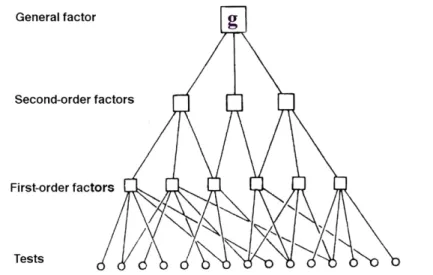
“Higher-order” factor models have been proposed to incorporate both a general factor and multiple second-order factors. These factors are arranged in a hierarchical manner, for instance, in a second-order factor model the first-order (i.e. group) factors correlate with one another, and the general factor emerges because it explains the covariance of the first-order fac-tors the same way as the first-order facfac-tors explain the covariance of the manifest variables. Several models of this type have been proposed. Carroll (1993a) summarized a huge number of exploratory-factor analytic studies, over 460 data sets, and provided a single, systematic framework, synthesiz-ing a century of research on the structure of individual differences in men-tal abilities. Carroll’s three-stratum model, which is presented in Figure 7.3, acknowledges both g and specific factors at different levels of a hierarchy.
In a higher-order factor model, such as Carroll’s, the general factor depends on first- and second-order factor loadings. This is not a problem if model fit is the only concern but it is a serious constraint if latent variables are to be interpreted in terms of psychological processes, since it means that the mechanisms responsible for the general factor do not have a direct effect on test performance, rather, they must be some common parameters effect-ing all abilities (such as speed, etc.). An alternative to the hierarchical solu-tion is the bi-factor model (originally proposed by Holzinger & Swineford, 1937; Figure 7.4), in which each variable loads on both a group factor and a general factor, which means that the correlation between the general fac-tor and an individual variable is not constrained by the correlation with the group factor. Moreover, it has been shown that the hierarchical and the bi-factor solutions are mathematically equivalent or near-equivalent (Mulaik & Quartetti, 1997). However, these models are compatible with different accounts of within-individual mechanisms in general, and different theo-retical interpretations of the general factor in particular.
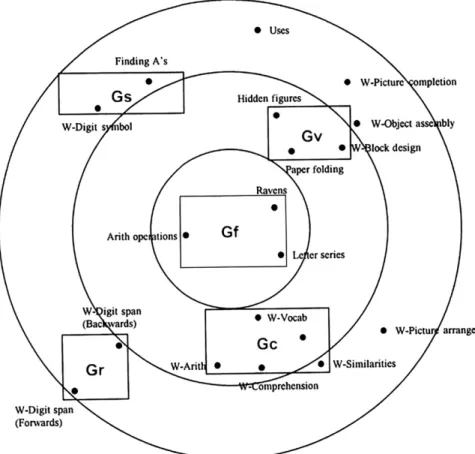
Finally, the radex model proposed by Snow, Kyllonen, and Marshalek (1984) arranges factors by two-dimensional scaling according to complex-ity, with the most complex tasks located in the middle of the radex. The individual points on Figure 7.5 represent tests and the distance between points is inversely related to the correlation between the two tests, i.e. the further apart the points the smaller the correlation between them. Once again, the radex model has been shown to be parallel to the hierarchical solution.
Figure 7.3 Carroll’s hierarchical latent variable model of intelligence: tests load on first order factors, which load on second order factors, which load on the general factor.
Figure 7.4 A bi-factor latent variable model of intelligence: the variance in the test scores (V1, V2, etc.) is the function of their loading on the general factor (g) and one of the specific factors (F1, F2, etc.), with the additional unique variance of each test (u1, u2, etc.). (From Jensen and Weng (1994), p. 245).
2.5. The Content of Factors
The three-stratum, the bi-factor, and the radex models are all adequate structural descriptions of the positive manifold, and the convergence and divergence found in the patterns of correlations. But what about the con-tent of the factors?
The most influential account of factor content is the fluid-crystallized model proposed by Cattell (1971); Horn (1994). There are several primary abilities in their model, but the main idea, which will have great signifi-cance later on, is the distinction between the ability to solve problems in novel situations, regardless of previously acquired knowledge (fluid intel-ligence or Gf ) and the ability to solve problems using already acquired skills or knowledge (crystallized intelligence or Gc). The other most important Figure 7.5 The radex model of intelligence (from Mackintosh, 2011, p. 53.): the dots represent individual tests, and the distance between any two tests is the inverse of their correlation. This figure is a greatly simplified version of Snow et al.’s (1984) original.
factors in the model are Gv (visual–spatial), Gs (speed) and Gr (retrieval from memory). (Figure 7.5 for examples of typical measures of these fac-tors). It is interesting to note that in the radex model, Gf, the factor of fluid intelligence is in the middle of the figure, which means that the correlation of Gf with other factor is stronger than the other factors’ correlation with each other.
Johnson and Bouchard (2005) argued that a fundamental flaw of the fluid-crystallized model is that it denies the existence of a general factor on the grounds that general factors extracted from different batteries are not the same. However, large-scale analyses show that this is not necessarily the case, and that general factors may be identical across batteries (Johnson, Bouchard, Krueger, McGue, & Gottesman, 2004, 2008). Instead of Gf–Gc, they propose their own model: verbal–perceptual–mental–rotation, which is basically an extension of Vernon’s model (Vernon, 1961). Unlike Cat-tell and Horn, Vernon did postulate a general factor, along with two broad second-order factors, v:ed for verbal–educational abilities and k:m for kin-esthetic and mechanic abilities. The group factors are much more content-oriented: whereas Gf and Gc are basically described by whether one has to deal with novel or already learned information, v:ed and k:m are described by the domain they cover.
In the last 15 years, a new structural account of intelligence has emerged: the CHC (Cattell–Horn–Carroll) model (McGrew, 2009), which merges the fluid-crystallized model with Carroll’s three-stratum account. Since there is a large similarity in the factors of the Gf–Gc model and factors in the second strata of Carroll’s model, the merge is relatively easy, apart from one crucial difference: the former does not allow a general factor, whereas on stratum three there is g. That is, while almost completely accepting the factorial structure of the Gf–Gc model, CHC does allow a third-stratum general factor to explain the covariance between factors at the second stra-tum. Therefore, with regard to the format of the model, CHC is the same as Carroll’s model (Figure 7.3), whereas the second-order factors in the model follow Gf–Gc factors almost completely.
3. INTERPRETATION OF THE GENERAL FACTOR
3.1. A Unitary Source
From a psychometric point of view it might be sufficient to explore the structure of variation in cognitive abilities, but from a psychological perspec-tive an explanation rather than a pure exploration of individual differences
is warranted. Nevertheless, latent variable models historically have empha-sized model fit, and have been difficult to interpret in terms of psychologi-cal theory. As emphasized in the Introduction, one should be cautious when proposing intraindividual processes as possible candidates of the sources of interindividual differences, and unfortunately most theorists have not pro-ceeded with such caution.
Since the positive manifold is the most ubiquitous phenomenon in the field of cognitive abilities, most explanations have tried to explain why all mental tests correlate positively with one another. Given that the general factor is nothing but a statistical equivalent of the—general—positive mani-fold, such explanations have taken the form of theories of g.
The first explanation of g was provided by its discoverer, Charles Spearman. He believed that the general factor is the factor of general intelligence, and described it as a general mental energy. He applied the analogy of engines: the specific abilities (s factors) are thought of as independently operating engines, while the general factor is analogous to the source of power that supplies all the engines. Therefore, he postulated the existence of a domain-general cognitive process.
This is certainly a parsimonious explanation: it is perfectly reasonable, unless evidence to the contrary exists, that performance on two tests cor-relates because they tap the same psychological process. However, it is cer-tainly not the only explanation either, and it is important to discuss in the light of available evidence, whether g is unitary or not. But, what kind of evidence should be taken into account?
Kranzler and Jensen (1991a, 1991b, 1993) and Carroll (1991a, 1991b, 1993b) had a series of discussions about the unitary nature of the general factor. Kranzler and Jensen factor-analyzed various so-called elementary cognitive tasks (such as various reaction time measures) and found differ-ent “elemdiffer-entary cognitive factors”, many of which correlated with the g
factor extracted from psychometric tests, but not with each other, which lead them to conclude that g is the result of several independent processes. Carroll debated this explanation and claimed that the procedure used by Kranzler and Jensen could not extract pure factor scores, hence could not yield a clear picture of the subjects’ level of g. He did not claim that g is uni-tary, he only argued that the question could not be decided by the methods employed by Kranzler and Jensen.
Jensen summarizes the debate claiming: “if successful performance on every complex mental test involves, let us say, two distinct, uncorrelated processes, A and B (…) in addition to any other processes that are specific to
each test or common only to certain groups of tests, then in a factor analysis all tests containing A and B will be loaded on a general factor. At this level of analysis, this general factor will forever appear unitary, although it is actu-ally the result of two separate processes, A and B” (Jensen, 1998, p. 261.) This is perfectly in agreement with what has been said in the Introduction about the under-determination of individual differences data to theories of intraindividual process.
However, Jensen takes one step further: “to show that the general factor involves individual differences in two independent processes, A and B, and is therefore not fundamentally unitary would require that individual differ-ences in A and B be measured separately and that A and B are each inde-pendently correlated with the general factor of the psychometric tests. The more difficult condition to satisfy (…) is that it must be assumed that the empirical g factor scores derived from the tests are “pure” g uncontaminated by any non-g “impurities”. (…) [But] because it is virtually impossible to prove definitively that the g factor scores are “pure” in this sense, the issue retreats from the scientific arena, and it then becomes a purely metaphysical question whether g is or is not unitary” (Jensen, 1998, p. 261, italics added).
This is a surprising conclusion. Arguably, it is not metaphysics, but rather experimental psychology and neuroscience that should be able to answer whether g can be equated with a unitary intraindividual process, since these are exactly the disciplines that have the methods to fractionate both cog-nitive and neural mechanisms. Experimental psychologists generally claim that two processes are different if the tasks that purportedly tap the two processes respond differently to changes in experimental conditions. In neuropsychology, two processes are dissociated if injury or developmental impairment in one part of the brain disrupts one process while leaving the other intact.
3.2. Evidence Against a Unitary Source
There is now ample evidence from experimental cognitive psychology, neuro-psychology, and neuroscience, which directly contradict the idea of a domain-general problem-solving mechanism involved in all kinds of cognitive activity. Experimental studies have demonstrated the fractionation of abilities, primar-ily verbal and spatial. For instance, experimental manipulations that engage the cognitive system responsible for the short term storage of verbal information impair performance in verbal, but not spatial reasoning tasks, whereas a similar engagement of the short-term spatial store results in impaired performance in spatial reasoning while verbal reasoning remains intact: this result was crucial
for proposing domain-specific short-term stores in the working memory model (Baddeley, 1992). Some genetic disorders resulting in cognitive mal-function also selectively impair spatial and verbal abilities (e.g. Williams syn-drome and specific language impairment, respectively). Moreover, localized damage to frontal brain regions can cause impairment on tests measuring Gf, such as those of nonverbal reasoning, while performance on tests of Gc, such as those measuring vocabulary and general information, remains intact ( Duncan, 1995; Duncan, Burgess, & Emslie, 1995).
Also, the secular increase in IQ-test results, the so-called Flynn-effect, is observed to varying degrees across different tests. Increases in average raw scores in most ability tests have been observed in the last century (Flynn, 1987). However, on tests of abstract inductive reasoning (Gf) the gains equal about 15 IQ-points per generation, whereas on tests of general knowledge, arithmetic, or vocabulary (Gc), the increases are only marginally significant, in the range of 3–5 points per generation.
Finally, evidence of sex differences also supports the fractionation of g
into components: the general tendency for males to excel in spatial tests, especially mental rotation, and for females to excel in various tests of verbal ability show that even though performance on these tests correlate, they cannot measure a single ability. If they did, and verbal and spatial tests mea-sured the same general intelligence, then males or females should be better on both verbal and spatial tests (Mackintosh, 1996). All these different lines of evidence converge toward the conclusion that g cannot be equated with “general intelligence” as an individual-level mechanism, such as one that makes it meaningful to say: “John used his general intelligence to solve test items in both the vocabulary test and the one requiring mental rotation.”
3.3. Multiple Sources
There have been a number of attempts to explain the general factor (that is, the positive manifold) without reference to a general intelligence. In 1916, Godfrey Thompson illustrated that a unitary source of variance is not neces-sary to account for the presence of a general factor. That is, unlike Thurstone, he admitted the existence of the general factor, but denied that it could be identified with a single, unitary process. Thomson proved mathematically that a general factor can emerge not just without a single general underlying mechanism, but even without a single process being common to all of the tests. He argued that the positive manifold manifests itself because any bat-tery of mental tasks will “sample” processes (which he called ‘bonds’) in an overlapping manner, such that some processes will be required by a shared
subset of tasks, while other processes will be unique to particular tasks. Two decades later, Tryon (1935) proposed a similar, but much more ambitious model, and argued that unitary-source models would eventually become untenable with respect to psychological processes (he was ahead of his time).
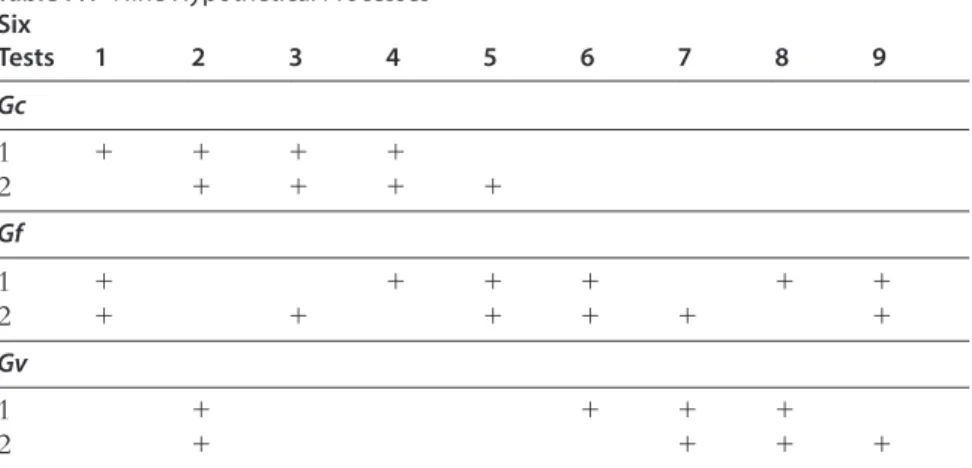
The idea of overlapping psychological processes is elaborated by Mackintosh (2011). His explanation is illustrated in Table 7.1. Suppose a battery of six tests was administered to a group of subjects and across the battery, nine psychological processes were sampled. Tests that share several processes will form a cluster, suggesting group factors, but the fact that every test shares at least one process with another test will result in a general factor. Using random data, Thomson was able to show that a general factor can be explained both by postulating a single general ability or a large number of independent processes. There is another important question: whether there are any processes common to all mental tests, or whether the process common to tests A and B is quite different from the process common to A and C, which is in turn different from the process common to B and C. Thomson also showed that this last possibility is logically just as consistent with the general factor as the alternative answer that there is one, or there are several, processes common to all tests.
Thompson’s model was originally referred to as a “sampling theory” but it has been recently revised and updated as “the bonds model of in telligence” (Bartholomew, Deary, & Lawn, 2009). Bartholomew et al. also showed that there is no mathematical way of choosing between Spearman’s and Thomson’s models, since they both provide plausible accounts of the positive manifold: once again, it has been demonstrated that theories of intraindivid-ual cognitive processes are underdetermined by individintraindivid-ual d ifferences data. Table 7.1 Nine Hypothetical Processes
Six Tests 1 2 3 4 5 6 7 8 9 Gc 1 + + + + 2 + + + + Gf 1 + + + + + + 2 + + + + + + Gv 1 + + + + 2 + + + +
Finally, the ““mutualism” model of g by van der Maas et al. (2006) proposes that the positive manifold arises because independent cognitive processes engage in mutually beneficial interactions during cognitive devel-opment. Thus by the end of development the processes will be correlated, resulting in the positive manifold, but there is no single ability underlying performance on all tests.
In summary, the general factor of intelligence can be, and has been, interpreted in many ways. Which interpretation is most valid? If one were to consider evidence solely from research on interindividual differences then it is impossible to judge. However, if we consider converging evidence, for example, from neuroscience, and if we consider models of intraindividual processes, in particular models of working memory, then it may be possible to favor one interpretation over others. In our view, theories of general intelligence that posit a unitary source of variance should be rejected. As discussed, several new areas of research, especially in neuroscience, simply do not support such models. In our opinion, the rejection of general ability theories of intelligence, on the basis of solid empirical evidence rather than conjecture or politics (e.g. Murdoch, 2007), may eventually be viewed as one of Psychology’s greatest achievements.
4. MODELS OF WORKING MEMORY CAPACITY
4.1. History Repeating
The “positive manifold” is not confined to the correlation matrices of the intelligence literature. The same type of positive manifold is commonly observed when a battery of working memory tasks is administered to a large group of subjects. As with batteries of intelligence tests, patterns of conver-gence and diverconver-gence are typically observed amidst the positive manifold. For example, working memory tasks with verbal content tend to be more strongly correlated with other verbal tasks than with tasks with spatial con-tent. Yet the positive manifold is still observed.
As mentioned in the Introduction, the first “test” of working memory capacity was the reading span task (Daneman & Carpenter, 1980). The task requires subjects to read sentences aloud and remember the last word of each sentence for later recall. The number of sentences/words per list varies, typi-cally from two to six or seven. Daneman and Carpenter found that working memory capacity, as measured by their reading span task, was strongly cor-related with Scholastic Aptitude Test (SAT) scores. This is not a surprising result, given that reading span and the SAT, particularly the verbal sections,
both require reading, and so the correlation could be interpreted to reflect domain-specific variability. Indeed, Daneman and Carpenter suggested that domain-specific processes largely determine working memory capacity.
An alternative interpretation is to assume that domain-general processes largely drive working memory capacity. Turner and Engle (1989) were the first to offer evidence in support of a domain-general view. They demon-strated that a complex span task that does not require reading (the opera-tion span task) predicted SAT scores just as strongly as reading span, and moreover, operation span and reading span accounted for the same variance in SAT scores.
In effect, Turner and Engle (1989) sparked a debate about generality vs. specificity with respect to working memory capacity. Yet it is all just a little bit of history repeating. The debate bears a striking resemblance to the debate between Spearman and Thurstone. On one side is the more general/ unitary view, which assumes that variation is largely caused by domain-general factors and on the other side is the specificity view, which assumes that variation is largely caused by more specific factors. In the end, the two sides acknowledge the existence of both general and domain-specific sources of variation but they argue about their relative importance. The structure of working memory capacity is therefore analogous to the structure of intelligence and can be explained by the same latent variable models that were used to explain the structure of intelligence (specifically, the hierarchical and bi-factor models).
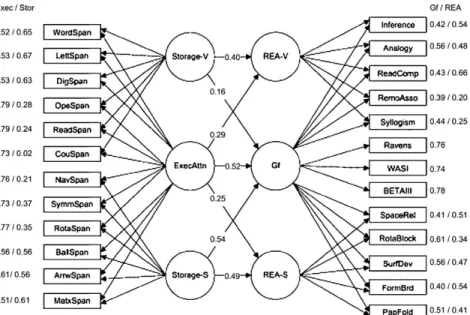
As an illustration, consider two models of working memory capacity published by Kane et al. (2004), shown here in Figures 7.6 and 7.7. Kane et al. administered several memory span tasks to a large heterogeneous sam-ple of subjects. Some tasks were simsam-ple span and others were comsam-plex span, and some were verbal and others were spatial. The model in Figure 7.6 depicts a unitary, domain-general capacity that is strongly correlated with fluid intelligence. Kane et al. argued that this one-factor model of capacity fits the data as well as a two-factor model and therefore chose the more par-simonious one-factor model. The fact remains, however, that the two-factor model fits too! So again, it is possible to account for interindividual differ-ences with alternate models. The model in Figure 7.7 is similar in struc-ture to the bi-factor model of intelligence and demonstrates that whatever complex span tasks have in common, after accounting for simple span, is strongly correlated with fluid intelligence. Kane et al. interpreted this com-mon variance to reflect “executive attention.” We discuss this interpretation, and others, in the next section.
Figure 7.6 Kane et al.’s (2004) one-factor latent variable model of working memory capacity and its relation to general fluid intelligence (Gf).
Figure 7.7 Kane et al.’s (2004) “executive attention” interpretation as the general factor underlying working memory task performance.
4.2. The General Factor, Again
The models published by Kane et al. (2004) are obviously not the only latent variable models of working memory capacity to consider but their theoretical framework is among the most influential in the field of work-ing memory. As well, their “executive attention” view of individual differ-ences in working memory capacity is supported by a wealth of data from both correlational and experimental psychology (Engle and Kane, 2004). This particular framework therefore uniquely informs our current review. In short, there are pros and cons to their unified approach. We discussed the many benefits of a unified approach in the Introduction so here we consider the challenges.
Perhaps the most difficult challenge for unified approaches, and a chal-lenge for executive attention theory, is articulating the distinction between the model that accounts for interindividual differences and the theory of working memory. For example, executive attention theory is widely consid-ered a unitary model because Kane et al. (2004) favored a one-factor model of working memory capacity. This does not imply, however, that they also endorse a unitary model of working memory in terms of intraindividual psychological processes. Unfortunately, unified theories are so uncommon in Psychology that this subtle point is lost on many researchers, so the onus is on the authors to repeatedly clarify their position. To their credit, Kane et al. (2004) were clear on this point. After endorsing the unitary latent variable model, they explicitly stated that multiple mechanisms/functions/processes contribute to working memory task performance. They explain “executive attention” as follows: “we believe that these executive-attention functions reflect a capability to maintain information in an active, easily accessible state, whether that information corresponds to a list of several external stim-uli or a single goal for action. Moreover, such active maintenance is particu-larly important in the presence of interference, which disrupts rapid retrieval of information from long-term memory (LTM) and in the blocking of distraction and competing response tendencies.” (p. 213.) The plural phrase, “executive attention functions”, clearly implies that “executive attention” is nonunitary in terms of intraindividual psychological processes.
More recently, Unsworth and Engle (2007) revised and extended the executive attention view. Their theory presents an even more dramatic shift away from a unitary/general ability account because it is nonunitary BOTH in terms of interindividual differences and in terms of intraindividual psy-chological processes. According to their view, multiple domain-general
mechanisms are engaged in task performance AND contribute variation to task performance. Specifically, they argue that working memory capacity is determined by mechanisms required for active maintenance of informa-tion as well as mechanisms required for controlled, rapid search of long-term memory. Active maintenance and controlled search are operationally defined in distinct ways, they account for unique variance in intelligence, and neuroimaging research suggests that they depend upon distinct neural pathways (Chein, Moore, & Conway, 2011; Unworth, Spillers, & Brewer, 2011). The emerging view is that there are multiple and independent psy-chological processes involved in the performance of working memory tasks, and multiple and independent sources of variance contributing variation in task performance. And critically, the psychological processes and varia-tion in behavior can be linked in a theoretically meaningful fashion (e.g. Unsworth & Engle, 2007).
In sum, the general factor in models of working memory capacity does not appear to be linked to a single psychological process. We prefer to inter-pret the general factor to reflect multiple domain-general mechanisms that are tapped in an overlapping fashion across a battery of working memory span tasks. This is consistent with our view of the general factor in models of intelligence, and supports our contention that unitary source models of general cognitive ability are no longer viable and new lines of research should be encouraged to further investigate nonunitary, multi-mechanism models.
5. TOWARD A UNIFIED MODEL
5.1. Intelligence and Working Memory Capacity
Having independently reviewed both intelligence and working memory, it is time to turn our attention to the link between these constructs. The closest possible link between any two constructs, of course, is identity. Are intelligence and working memory identical constructs? Or, more precisely, are individual differences in intelligence and individual differences in work-ing memory capacity caused by variation in the same processes?
As we have seen, a positive manifold is observed among measures of working memory capacity as well as measures of intelligence. Two decades ago, Kyllonen and Chrystal (1990) published a series of studies suggesting that psychometric working memory capacity might be equivalent to psy-chometric g. While some authors continue to claim that working m emory capacity and g are isomorphic (Colom et al., 2008), two meta-analyses
concluded that the two constructs are strongly correlated but not quite equivalent (Kane, Hambrick, & Conway, 2005; Oberauer, Schulze, Wilhelm, & Süß, 2005).
What causes, then, working memory capacity and g to share a large part of their variance? This question can be decomposed into two differ-ent ones: (a) which compondiffer-ent of working memory capacity is responsible for its correlation with g, (b) which component of g is responsible for its co rrelation with working memory capacity? Let us answer these questions in order.
5.2. Components of Working Memory
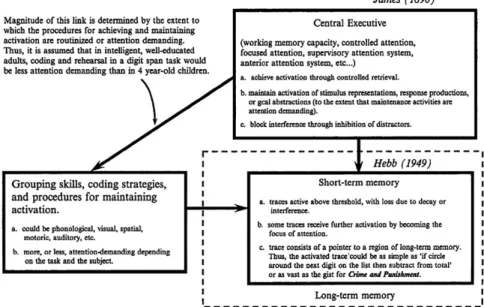
To answer the first question we must consider all the components of work-ing memory and assess the degree to which each component influences task performance. Engle and Kane (2004) provided a detailed illustration of the components of working memory (Figure 7.8). This illustration is particu-larly useful here because it allows us to succinctly explain three important points. First, complex span tasks are considered to be more accurate mea-sures of working memory capacity than simple span tasks. Simple span tasks, such as digit span and word span, do not involve a secondary processing task
(such as reading sentences aloud in reading span). Simple span performance is therefore considered to be more strongly influenced by the components listed in the left-most box in Figure 7.8. In contrast, complex span task performance is thought to be more strongly influenced by the components listed in the top box, labeled Central Executive.
The second point is the distinction between domain-general and domain-specific influences on task performance. The Central Executive component is considered to be more domain-general and the Skills/Strat-egies component is considered to be more domain-specific. Finally, the third point is that multiple domain-general mechanisms are listed under the umbrella term Central Executive. Again, this suggests that multi-mechanism views are certainly more viable at the level of intraindividual differences and have potential at the level of interindividual differences as well.
Taken together, this framework suggests that the components of working memory that contribute to the correlation with g are associated with the central executive and are more directly tapped by complex span tasks than simple span tasks. For brevity, we refer to these components collectively as executive/attentional mechanisms.
5.3. Components of Intelligence
Now let us turn to the question of what causes variation in g to be in large part common with variation in working memory capacity. As mentioned, a good model of intelligence and working memory should prohibit certain correla-tions while predicting others. The Gf–Gc model passes this test: it predicts that the executive attention component of working memory, that is, what complex span tasks measure beyond simple storage and retrieval should correlate with tests of fluid (Gf), but not, or to a much smaller extent, with tests of crystallized intelligence (Gc). Two large-scale studies verify this prediction.
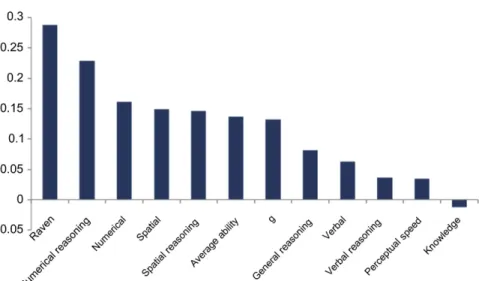
The first one is the meta-analysis of working memory and intelligence by Ackerman, Beier, and Boyle (2005), which, although independently explored short-term memory’s and working memory’s correlation with various types of cognitive tests, did not originally compare these results. The following figure (Figure 7.9) shows in decreasing order the difference in correlations with working memory and short-term memory in different types of ability tests (based on Kovacs, 2009).
It is clear that on one side, with the largest difference, are the Raven’s Progressive Matrices (Gf), whereas on the other side, with negligible differ-ences, are tests of general knowledge as well as the ones with verbal con-tent (Gc), and tests measuring perceptual speed (Gs). In the middle, with
significant, but less substantial differences than in the case of Gf, are spatial tests (Gv) and ones that support to measure “general ability” or g. Therefore, this result shows that the processes working memory (complex span) tasks tap beyond simple storage are strongly associated with Gf, but not associ-ated, or to a negligible extent, with Gc and Gs.1
In a study employing partial correlations and analyzing large and r epresentative samples, Kovacs et al. (in press) compared the relationship between forward digit span, backward digit span, and a complex working memory task (Letter–Number Sequencing) on the one hand, and tests of Gf (matrix reasoning) and Gc (vocabulary and general knowledge) on the other. They found that even though a large part of backward span perfor-mance can be attributed to the short-term storage of information, what backward span measures above and beyond pure storage and retrieval is closely related to fluid reasoning (Gf) in all age groups, but is only related to crystallized intelligence (Gc) in children aged 6–10. They also found that Letter–Number Sequencing correlates significantly with tests of both Gf and Gc, and generally more strongly than backward span, albeit there is a large difference favoring Gf in this case as well.
Overall, the results considered in this section point to the conclusion that it is the executive/attentional component of working memory and the fluid reasoning component of intelligence that are primarily responsible for the working memory–intelligence relationship.
5.4. Converging Evidence
Another kind of evidence pointing to the possibility of the same processes being involved in working memory and fluid intelligence comes from neuro-imaging. Neuroimaging studies of executive processes and working memory highlight the importance of the prefrontal cortex which, in most cases along with posterior parietal areas, is involved in cognitive control (e.g. Miller, 2000), task switching (e.g. Sohn, Ursu, Anderson, Stenger, & Carter, 2000), and inhibition (Aron, Robbins, & Poldrack, 2004). Henson (2001) reviewed neuroimaging studies of working memory and concluded that “the central 1 Note that in tests of numerical reasoning the difference in explained variance between working
memory and short term memory is surprisingly high, almost as much as in the Raven’s Matrices. However, only six tests belong to this category, two of which are number series, and one is “induction-quantitative” (Ackerman et al., 2005, p. 58.). Although these tests do have numerical content, they are clearly measures of Gf. Actually Horn (1989) in his categorization of ability tests according to the Gf–Gc model, put “inductive reasoning, measured using letter series, number series and/or figure series” as the first example of indicators of Gf, “matrices reasoning with visual patterns” comes only second (p. 79.)”.
executive maps to midlateral prefrontal regions, particularly left and right dorsal lateral prefrontal cortex; the phonological store maps to left interior parietal cortex; the articulatory control process maps to the left premotor regions (including Broca’s area), left supplementary motor regions and per-haps right cerebellum; the visual cache maps to bilateral anterior occipital and/or inferior temporal regions; and the inner scribe maps to right premo-tor and right superior parietal regions.” (p. 166–167.).
Wager and Smith (2003) performed a meta-analysis of 60 neuroimaging studies of working memory. They found that the fractionation of working memory according to content type was limited to the posterior areas: they found no evidence of fractionation in the frontal cortex according to con-tent domains. With respect to executive functions, they found that “effects of executive processes were found primarily in the frontal and parietal cortices, including the anterior prefrontal, the dorsal lateral prefrontal cortex (DLPFC) and ventral lateral prefrontal, the bilateral premotor (centered in the SFS [supe-rior frontal sulcus]), and the lateral and medial supe[supe-rior parietal cortices. (…) Only in the aforementioned regions did we find that the presence of executive demand significantly increased the probability of activation” (p. 269–270.).
Similarly, there is ample evidence pointing to the involvement of the prefrontal cortex in fluid reasoning. Duncan et al. (1995) tested three fron-tal lobe patients with the Wechser Adult Intelligence Scale (WAIS) and the Cattell Culture Fair test (CCF), and compared their results to healthy Figure 7.9 The difference between correlations with working memory and short-term memory in different types of ability tests (based on Kovacs, 2009, p. 94.).
controls matched according to their WAIS scores, which ranged from 126 to 130, and to a group of patients with injury to more posterior regions. They found a large discrepancy between frontal patients’ scores on the WAIS and the CCF: their WAIS IQ was 22, 29, and 38 points higher than their CCF IQ. The healthy controls, however, had equal or higher scores on the CCF than on the WAIS. Moreover, when the frontal patients’ CCF IQ was compared to that of the healthy controls, the patients’ IQ was 23, 51, and 60 points lower. The patients with more posterior damage had lower WAIS scores than frontal patients, but they demonstrated no discrepancy between their WAIS and CCF scores.
Waltz et al. (1999) presented matrix problems to patients, which were similar to the ones in the Raven’s Matrices, albeit in a much simpler arrange-ment. There were three levels of complexity. Level 0, the missing piece of the matrix was identical to all the presented pieces. Level 1 meant a single change in one of the features of the items (e.g. two white squares in the top row, and a black square in the bottom row plus the missing piece), whereas level 2 meant changes in both the horizontal and vertical dimensions (e.g. a white square and a white triangle in the top row, and a black square in the bottom row plus the missing piece). Prefrontal and temporal patients, as well as healthy controls had equal scores on level 0 and level 1 problems (with correct answers ranging between 80 and 100%). The performance of pre-frontal patients, however, was seriously impaired on level 2 problems (with approximately 10% correct answers), whereas temporal patients and healthy controls scored at approximately 90% correct on these problems, too.
Neuroimaging studies also confirm that tests of Gf activate the PFC, just like working memory tasks. Duncan et al. (2000) presented items that were created to be similar to the ones in the Cattell’s Culture Fair test, and control items that do not load on Gf. They found that the regional blood flow was increased in the PFC for complex Gf-items, but found no similar pattern for items that do not load highly on Gf. Their results support the idea that executive processes, that can be localized in the PFC, primarily in dorsolateral areas, are important in tests of Gf.
In an fMRI study, Prabhakaran, Smith, Desmond, Glover, and Gabrieli (1997) used items similar to the ones that appear in the Raven’s Matrices, but categorized them according to whether they required only figural– spatial reasoning or analytic reasoning as well. They found that both kinds of items activated the lateral PFC, but the analytic items activated more prefrontal areas, and brain activity was more bilateral. Moreover, solving analytic items resulted in greater activation than figural–spatial problems. In
a PET study, Wharton et al. (2000) presented figural analogies that required inductive reasoning, and also found activation in the lateral PFC.
Finally, Kane (2005) reviewed two studies that involved the parametric manipulation of complexity in tasks that resembled the Raven’s Progressive Matrices (RPM), and concluded that “what seems quite clear from these studies, then, as predicted by working memory (WM)/attention theories of Gf and PFC functioning, is that LPFC regions are recruited in RPM-type problems as their memory load and control demands increase.”
In sum, neuroimaging research provides compelling converging evidence to support the conclusion that it is the executive/attentional component of working memory and the fluid reasoning component of intelligence that are primarily responsible for the working memory–intelligence relation-ship. In our opinion, future work in neuroscience will provide insight into the nature of the relationship between working memory and intelligence because the fine-grained level of analysis will help to clarify the cognitive and neural mechanisms that contribute to task performance (e.g. Burgess, Braver, Conway, & Gray, 2011).
6. CONCLUSION
Having reviewed models of intelligence and working memory, and having specified cognitive processes that might underlie the common vari-ance between these complex systems involved in higher-order cognition, what can we conclude? We present here a brief list of clear and concise arguments. They are presented in bullet-point format because it is our hope that each of these statements has some impact. Consider this the take-home message:
1. Intelligence and WM are related, but not identical constructs, with a large degree of common variance in behavioral outcomes.
2. It is the fluid (Gf) component of intelligence and the executive attention component of WM that is responsible for the relationship.
3. It seems likely that WM capacity (WMC) and Gf are related because some of the processes involved as well as the neural substrates of these processes are identical.
4. It is indeed possible for theories about intraindividual processes to pre-dict the structure of interindividual differences, and the relation between WM and intelligence is a good example.
5. The general factor, g or WMC, does not imply a unitary source of vari-ance. This is not novel but the message needs to be delivered loud and