Unsupervised Semantic Parsing
Hoifung Poon Pedro Domingos
Department of Computer Science and Engineering University of Washington
Seattle, WA 98195-2350, U.S.A.
{hoifung,pedrod}@cs.washington.edu
Abstract
We present the first unsupervised approach to the problem of learning a semantic parser, using Markov logic. Our USP system transforms dependency trees into quasi-logical forms, recursively induces lambda forms from these, and clusters them to abstract away syntactic variations of the same meaning. The MAP semantic parse of a sentence is obtained by recur-sively assigning its parts to lambda-form clusters and composing them. We evalu-ate our approach by using it to extract a knowledge base from biomedical abstracts and answer questions. USP substantially outperforms TextRunner, DIRT and an in-formed baseline on both precision and re-call on this task.
1 Introduction
Semantic parsing maps text to formal meaning representations. This contrasts with semantic role labeling (Carreras and Marquez, 2004) and other forms of shallow semantic processing, which do not aim to produce complete formal meanings. Traditionally, semantic parsers were constructed manually, but this is too costly and brittle. Re-cently, a number of machine learning approaches have been proposed (Zettlemoyer and Collins, 2005; Mooney, 2007). However, they are super-vised, and providing the target logical form for each sentence is costly and difficult to do consis-tently and with high quality. Unsupervised ap-proaches have been applied to shallow semantic tasks (e.g., paraphrasing (Lin and Pantel, 2001), information extraction (Banko et al., 2007)), but not to semantic parsing.
In this paper we develop the first unsupervised approach to semantic parsing, using Markov logic (Richardson and Domingos, 2006). Our USP sys-tem starts by clustering tokens of the same type, and then recursively clusters expressions whose subexpressions belong to the same clusters. Ex-periments on a biomedical corpus show that this approach is able to successfully translate syntac-tic variations into a logical representation of their common meaning (e.g., USP learns to map active and passive voice to the same logical form, etc.). This in turn allows it to correctly answer many more questions than systems based on TextRun-ner (Banko et al., 2007) and DIRT (Lin and Pantel, 2001).
We begin by reviewing the necessary back-ground on semantic parsing and Markov logic. We then describe our Markov logic network for un-supervised semantic parsing, and the learning and inference algorithms we used. Finally, we present our experiments and results.
2 Background 2.1 Semantic Parsing
The standard language for formal meaning repre-sentation is first-order logic. A term is any ex-pression representing an object in the domain. An atomic formula or atom is a predicate symbol ap-plied to a tuple of terms. Formulas are recursively constructed from atomic formulas using logical connectives and quantifiers. A lexical entry de-fines the logical form for a lexical item (e.g., a word). The semantic parse of a sentence is de-rived by starting with logical forms in the lexi-cal entries and recursively composing the mean-ing of larger fragments from their parts. In tradi-tional approaches, the lexical entries and
meaning-composition rules are both manually constructed. Below are sample rules in a definite clause gram-mar (DCG) for parsing the sentence: “Utah bor-ders Idaho”.
V erb[λyλx.borders(x,y)]→borders N P[Utah]→U tah
N P[Idaho]→Idaho
V P[rel(obj)]→V erb[rel] N P[obj] S[rel(obj)]→N P[obj] V P[rel]
The first three lines are lexical entries. They are fired upon seeing the individual words. For exam-ple, the first rule applies to the word “borders” and generates syntactic category Verb with the mean-ingλyλx.borders(x,y)that represents the next-to relation. Here, we use the standard lambda-calculus notation, where λyλx.borders(x,y) represents a function that is true for any (x,y )-pair such thatborders(x,y)holds. The last two rules compose the meanings of sub-parts into that of the larger part. For example, after the first and third rules are fired, the fourth rule fires and generatesV P[λyλx.borders(x,y)(Idaho)]; this meaning simplifies to λx.borders(x,Idaho) by the λ-reduction rule, which substitutes the argu-ment for a variable in a functional application.
A major challenge to semantic parsing is syn-tactic variations of the same meaning, which abound in natural languages. For example, the aforementioned sentence can be rephrased as “Utah is next to Idaho,”“Utah shares a border with Idaho,” etc. Manually encoding all these varia-tions into the grammar is tedious and error-prone. Supervised semantic parsing addresses this issue by learning to construct the grammar automati-cally from sample meaning annotations (Mooney, 2007). Existing approaches differ in the meaning representation languages they use and the amount of annotation required. In the approach of Zettle-moyer and Collins (2005), the training data con-sists of sentences paired with their meanings in lambda form. A probabilistic combinatory cate-gorial grammar (PCCG) is learned using a log-linear model, where the probability of the final logical form L and meaning-derivation tree T conditioned on the sentence S is P(L, T|S) =
1 Zexp (
P
iwifi(L, T, S)). HereZ is the normal-ization constant and fi are the feature functions with weightswi. Candidate lexical entries are gen-erated by a domain-specific procedure based on the target logical forms.
The major limitation of supervised approaches is that they require meaning annotations for ex-ample sentences. Even in a restricted domain, doing this consistently and with high quality re-quires nontrivial effort. For unrestricted text, the complexity and subjectivity of annotation render it essentially infeasible; even pre-specifying the tar-get predicates and objects is very difficult. There-fore, to apply semantic parsing beyond limited do-mains, it is crucial to develop unsupervised meth-ods that do not rely on labeled meanings.
In the past, unsupervised approaches have been applied to some semantic tasks, but not to seman-tic parsing. For example, DIRT (Lin and Pan-tel, 2001) learns paraphrases of binary relations based on distributional similarity of their argu-ments; TextRunner (Banko et al., 2007) automati-cally extracts relational triples in open domains us-ing a self-trained extractor; SNE applies relational clustering to generate a semantic network from TextRunner triples (Kok and Domingos, 2008). While these systems illustrate the promise of un-supervised methods, the semantic content they ex-tract is nonetheless shallow and does not constitute the complete formal meaning that can be obtained by a semantic parser.
Another issue is that existing approaches to se-mantic parsing learn to parse syntax and sese-mantics together.1 The drawback is that the complexity in syntactic processing is coupled with semantic parsing and makes the latter even harder. For ex-ample, when applying their approach to a different domain with somewhat less rigid syntax, Zettle-moyer and Collins (2007) need to introduce new combinators and new forms of candidate lexical entries. Ideally, we should leverage the enormous progress made in syntactic parsing and generate semantic parses directly from syntactic analysis. 2.2 Markov Logic
In many NLP applications, there exist rich rela-tions among objects, and recent work in statisti-cal relational learning (Getoor and Taskar, 2007) and structured prediction (Bakir et al., 2007) has shown that leveraging these can greatly improve accuracy. One of the most powerful representa-tions for this is Markov logic, which is a proba-bilistic extension of first-order logic (Richardson and Domingos, 2006). Markov logic makes it
1The only exception that we are aware of is Ge and
possible to compactly specify probability distri-butions over complex relational domains, and has been successfully applied to unsupervised corefer-ence resolution (Poon and Domingos, 2008) and other tasks. A Markov logic network (MLN) is a set of weighted first-order clauses. Together with a set of constants, it defines a Markov net-work with one node per ground atom and one fea-ture per ground clause. The weight of a feafea-ture is the weight of the first-order clause that origi-nated it. The probability of a state x in such a network is given by the log-linear modelP(x) =
1 Zexp (
P
iwini(x)), whereZ is a normalization constant, wi is the weight of theith formula, and niis the number of satisfied groundings.
3 Unsupervised Semantic Parsing with Markov Logic
Unsupervised semantic parsing (USP) rests on three key ideas. First, the target predicate and ob-ject constants, which are pre-specified in super-vised semantic parsing, can be viewed as clusters of syntactic variations of the same meaning, and can be learned from data. For example,borders represents the next-to relation, and can be viewed as the cluster of different forms for expressing this relation, such as “borders”, “is next to”, “share the border with”; Utahrepresents the state of Utah, and can be viewed as the cluster of “Utah”, “the beehive state”, etc.
Second, the identification and clustering of can-didate forms are integrated with the learning for meaning composition, where forms that are used in composition with the same forms are encour-aged to cluster together, and so are forms that are composed of the same sub-forms. This amounts to a novel form of relational clustering, where clus-tering is done not just on fixed elements in rela-tional tuples, but on arbitrary forms that are built up recursively.
Third, while most existing approaches (manual or supervised learning) learn to parse both syn-tax and semantics, unsupervised semantic pars-ing starts directly from syntactic analyses and fo-cuses solely on translating them to semantic con-tent. This enables us to leverage advanced syn-tactic parsers and (indirectly) the available rich re-sources for them. More importantly, it separates the complexity in syntactic analysis from the se-mantic one, and makes the latter much easier to perform. In particular, meaning composition does
not require domain-specific procedures for gener-ating candidate lexicons, as is often needed by su-pervised methods.
The input to our USP system consists of de-pendency trees of training sentences. Compared to phrase-structure syntax, dependency trees are the more appropriate starting point for semantic processing, as they already exhibit much of the relation-argument structure at the lexical level.
USP first uses a deterministic procedure to con-vert dependency trees into quasi-logical forms (QLFs). The QLFs and their sub-formulas have natural lambda forms, as will be described later. Starting with clusters of lambda forms at the atom level, USP recursively builds up clusters of larger lambda forms. The final output is a probability distribution over lambda-form clusters and their compositions, as well as the MAP semantic parses of training sentences.
In the remainder of the section, we describe the details of USP. We first present the procedure for generating QLFs from dependency trees. We then introduce their lambda forms and clusters, and show how semantic parsing works in this set-ting. Finally, we present the Markov logic net-work (MLN) used by USP. In the next sections, we present efficient algorithms for learning and infer-ence with this MLN.
3.1 Derivation of Quasi-Logical Forms A dependency tree is a tree where nodes are words and edges are dependency labels. To derive the QLF, we convert each node to an unary atom with the predicate being the lemma plus POS tag (be-low, we still use the word for simplicity), and each edge to a binary atom with the predicate being the dependency label. For example, the node for Utah becomes Utah(n1) and the subject
depen-dency becomes nsubj(n1,n2). Here, the ni are
Skolem constants indexed by the nodes. The QLF for a sentence is the conjunction of the atoms for the nodes and edges, e.g., the sentence above will becomeborders(n1)∧Utah(n2)∧Idaho(n3)∧
nsubj(n1,n2)∧dobj(n1,n3).
3.2 Lambda-Form Clusters and Semantic Parsing in USP
Given a QLF, a relation or an object is repre-sented by the conjunction of a subset of the atoms. For example, the next-to relation is represented byborders(n1)∧nsubj(n1,n2)∧dobj(n1,n3),
byUtah(n2)and Idaho(n3). The meaning
com-position of two sub-formulas is simply their con-junction. This allows the maximum flexibility in learning. In particular, lexical entries are no longer limited to be adjacent words as in Zettlemoyer and Collins (2005), but can be arbitrary fragments in a dependency tree.
For every sub-formula F, we define a corsponding lambda form that can be derived by re-placing every Skolem constant ni that does not
appear in any unary atom in F with a unique lambda variable xi. Intuitively, such constants
represent objects introduced somewhere else (by the unary atoms containing them), and corre-spond to the arguments of the relation repre-sented by F. For example, the lambda form forborders(n1)∧nsubj(n1,n2)∧dobj(n1,n3)
is λx2λx3. borders(n1) ∧ nsubj(n1,x2) ∧
dobj(n1,x3).
Conceptually, a lambda-form cluster is a set of semantically interchangeable lambda forms. For example, to express the meaning that Utah bor-ders Idaho, we can use any form in the cluster representing the next-to relation (e.g., “borders”, “shares a border with”), any form in the cluster representing the state of Utah (e.g., “the beehive state”), and any form in the cluster representing the state of Idaho (e.g., “Idaho”). Conditioned on the clusters, the choices of individual lambda forms are independent of each other.
To handle variable number of arguments, we follow Davidsonian semantics and further de-compose a lambda form into the core form, which does not contain any lambda variable (e.g., borders(n1)), and the argument forms,
which contain a single lambda variable (e.g., λx2.nsubj(n1,x2) and λx3.dobj(n1,x3)). Each
lambda-form cluster may contain some number of argument types, which cluster distinct forms of the same argument in a relation. For example, in Stan-ford dependencies, the object of a verb uses the de-pendencydobjin the active voice, butnsubjpass in passive.
Lambda-form clusters abstract away syntactic variations of the same meaning. Given an in-stance of cluster T with arguments of argument typesA1,· · ·,Ak, its abstract lambda form is given
byλx1· · ·λxk.T(n)∧
Vk
i=1Ai(n,xi).
Given a sentence and its QLF, semantic pars-ing amounts to partitionpars-ing the atoms in the QLF, dividing each part into core form and argument
forms, and then assigning each form to a cluster or an argument type. The final logical form is de-rived by composing the abstract lambda forms of the parts using theλ-reduction rule.2
3.3 The USP MLN
Formally, for a QLF Q, a semantic parseL par-titionsQ into parts p1,p2,· · ·,pn; each part pis
assigned to some lambda-form cluster c, and is further partitioned into core formfand argument formsf1,· · ·,fk; each argument form is assigned
to an argument type a inc. The USP MLN de-fines a joint probability distribution overQandL by modeling the distributions over forms and ar-guments given the cluster or argument type.
Before presenting the predicates and formu-las in our MLN, we should emphasize that they should not be confused with the atoms and formu-las in the QLFs, which are represented by reified constants and variables.
To model distributions over lambda forms, we introduce the predicates Form(p,f!) and ArgForm(p,i,f!), wherep is a part, iis the in-dex of an argument, andfis a QLF subformula. Form(p,f) is true iff partphas core formf, and ArgForm(p,i,f)is true iff theith argument inp has formf.3 The “f!” notation signifies that each part or argument can have only one form.
To model distributions over arguments, we in-troduce three more predicates: ArgType(p,i,a!) signifies that theith argument ofpis assigned to argument type a; Arg(p,i,p′) signifies that the
ith argument ofpisp′;Number(p,a,n)signifies that there are narguments of pthat are assigned to type a. The truth value of Number(p,a,n) is determined by theArgTypeatoms.
Unsupervised semantic parsing can be captured by four formulas:
p∈+c∧Form(p,+f)
ArgType(p,i,+a)∧ArgForm(p,i,+f) Arg(p,i,p′)∧ArgType(p,i,+a)∧p′∈+c′
Number(p,+a,+n)
All free variables are implicitly universally quan-tified. The “+” notation signifies that the MLN contains an instance of the formula, with a sep-arate weight, for each value combination of the
2Currently, we do not handle quantifier scoping or
se-mantics for specific closed-class words such as determiners. These will be pursued in future work.
3There are hard constraints to guarantee that these
variables with a plus sign. The first formula mod-els the mixture of core forms given the cluster, and the others model the mixtures of argument forms, argument clusters, and argument numbers, respec-tively, given the argument type.
To encourage clustering and avoid overfitting, we impose an exponential prior with weightαon the number of parameters.4
The MLN above has one problem: it often clusters expressions that are semantically oppo-site. For example, it clusters antonyms like “el-derly/young”, “mature/immature”. This issue also occurs in other semantic-processing systems (e.g., DIRT). In general, this is a difficult open problem that only recently has started to receive some at-tention (Mohammad et al., 2008). Resolving this is not the focus of this paper, but we describe a general heuristic for fixing this problem. We ob-serve that the problem stems from the lack of nega-tive features for discovering meanings in contrast. In natural languages, parallel structures like con-junctions are one such feature.5 We thus introduce an exponential prior with weightβ on the number of conjunctions where the two conjunctive parts are assigned to the same cluster. To detect con-junction, we simply used the Stanford dependen-cies that begin with “conj”. This proves very ef-fective, fixing the majority of the errors in our ex-periments.
4 Inference
Given a sentence and the quasi-logical form Q derived from its dependency tree, the conditional probability for a semantic parse L is given by P r(L|Q) ∝ exp (Piwini(L, Q)). The MAP se-mantic parse is simply arg maxLPiwini(L, Q). Enumerating all L’s is intractable. It is also un-necessary, since most partitions will result in parts whose lambda forms have no cluster they can be assigned to. Instead, USP uses a greedy algorithm to search for the MAP parse. First we introduce some definitions: a partition is calledλ-reducible frompif it can be obtained from the current parti-tion by recursivelyλ-reducing the part containing p with one of its arguments; such a partition is
4Excluding weights of∞or−∞, which signify hard
con-straints.
5
For example, in the sentence “IL-2 inhibits X in A and induces Y in B”, the conjunction between “inhibits” and duces” suggests that they are different. If “inhibits” and “in-duces” are indeed synonyms, such a sentence will sound awk-ward and would probably be rephrased as “IL-2 inhibits X in A and Y in B”.
Algorithm 1 USP-Parse(MLN, QLF)
Form parts for individual atoms inQLFand as-sign each to its most probable cluster
repeat
for all partspin the current partition do for all partitions that areλ-reducible from pand feasible do
Find the most probable cluster and argu-ment type assignargu-ments for the new part and its arguments
end for end for
Change to the new partition and assignments with the highest gain in probability
until none of these improve the probability return current partition and assignments called feasible if the core form of the new part is contained in some cluster. For example, consider the QLF of “Utah borders Idaho” and assume that the current partition isλx2x3.borders(n1)∧
nsubj(n1,x2) ∧ dobj(n1,x3), Utah(n2),
Idaho(n3). Then the following partition is
λ-reducible from the first part in the above partition: λx3.borders(n1) ∧ nsubj(n1,n2) ∧
Utah(n2) ∧ dobj(n1,x3), Idaho(n3). Whether
this new partition is feasible depends on whether the core form of the new partλx3.borders(n1)∧
nsubj(n1,n2) ∧ Utah(n2) ∧ dobj(n1,x3) (i.e.
borders(n1) ∧ nsubj(n1,n2) ∧ Utah(n2)) is
contained in some lambda-form cluster.
Algorithm 1 gives pseudo-code for our algo-rithm. Given partp, finding partitions that areλ -reducible frompand feasible can be done in time O(ST), where S is the size of the clustering in the number of core forms andT is the maximum number of atoms in a core form. We omit the proof here but point out that it is related to the unordered subtree matching problem which can be solved in linear time (Kilpelainen, 1992). Inverted indexes (e.g., frompto eligible core forms) are used to fur-ther improve the efficiency. For a new partpand a cluster that containsp’s core form, there arekm ways of assigningp’smarguments to thek argu-ment types of the cluster. For largerkandm, this is very expensive. We therefore approximate it by assigning each argument to the best type, indepen-dent of other arguments.
This algorithm is very efficient, and is used re-peatedly in learning.
5 Learning
The learning problem in USP is to maximize the log-likelihood of observing the QLFs obtained from the dependency trees, denoted by Q, sum-ming out the unobserved semantic parses:
Lθ(Q) = logPθ(Q) = logPLPθ(Q, L)
Here,Lare the semantic parses,θare the MLN pa-rameters, andPθ(Q, L)are the completion likeli-hoods. A serious challenge in unsupervised learn-ing is the identifiability problem (i.e., the opti-mal parameters are not unique) (Liang and Klein, 2008). This problem is particularly severe for log-linear models with hard constraints, which are common in MLNs. For example, in our USP MLN, conditioned on the fact thatp∈ c, there is exactly one value offthat can satisfy the formula p∈ c∧Form(p,f), and if we add some constant number to the weights ofp ∈ c∧Form(p,f)for allf, the probability distribution stays the same.6 The learner can be easily confused by the infinitely many optima, especially in the early stages. To address this problem, we impose local normaliza-tion constraints on specific groups of formulas that are mutually exclusive and exhaustive, i.e., in each group, we require that Pki=1ewi = 1, where w
i are the weights of formulas in the group. Group-ing is done in such a way as to encourage the intended mixture behaviors. Specifically, for the rule p ∈ +c∧Form(p,+f), all instances given a fixed c form a group; for each of the remain-ing three rules, all instances given a fixedaform a group. Notice that with these constraints the com-pletion likelihood P(Q, L) can be computed in closed form for anyL. In particular, each formula group contributes a term equal to the weight of the currently satisfied formula. In addition, the opti-mal weights that maximize the completion likeli-hood P(Q, L) can be derived in closed form us-ing empirical relative frequencies. E.g., the opti-mal weight ofp∈c∧Form(p,f)islog(nc,f/nc),
where nc,f is the number of parts p that satisfy
bothp∈ cand Form(p,f), andnc is the number
of partspthat satisfyp∈c.7We leverage this fact for efficient learning in USP.
6Regularizations, e.g., Gaussian priors on weights,
allevi-ate this problem by penalizing large weights, but it remains true that weights within a short range are roughly equivalent.
7To see this, notice that for a given
c, the total contribu-tion to the complecontribu-tion likelihood from all groundings in its formula group isPfwc,fnc,f. In addition,
P
fnc,f = nc
Algorithm 2 USP-Learn(MLN, QLFs) Create initial clusters and semantic parses Merge clusters with the same core form Agenda← ∅
repeat
for all candidate operationsOdo
ScoreOby log-likelihood improvement if score is above a threshold then
AddOto agenda end if
end for
Execute the highest scoring operationO∗ in the agenda
Regenerate MAP parses for affected QLFs and update agenda and candidate operations until agenda is empty
return the MLN with learned weights and the semantic parses
Another major challenge in USP learning is the summation in the likelihood, which is over all pos-sible semantic parses for a given dependency tree. Even an efficient sampler like MC-SAT (Poon and Domingos, 2006), as used in Poon & Domingos (2008), would have a hard time generating accu-rate estimates within a reasonable amount of time. On the other hand, as already noted in the previous section, the lambda-form distribution is generally sparse. Large lambda-forms are rare, as they cor-respond to complex expressions that are often de-composable into smaller ones. Moreover, while ambiguities are present at the lexical level, they quickly diminish when more words are present. Therefore, a lambda form can usually only belong to a small number of clusters, if not a unique one. We thus simplify the problem by approximating the sum with the mode, and search instead for the Landθthat maximizelogPθ(Q, L). Since the op-timal weights and log-likelihood can be derived in closed form given the semantic parsesL, we sim-ply search over semantic parses, evaluating them using log-likelihood.
Algorithm 2 gives pseudo-code for our algo-rithm. The input consists of an MLN without weights and the QLFs for the training sentences. Two operators are used for updating semantic parses. The first is to merge two clusters, denoted by MERGE(C1,C2) for clusters C1,C2, which does
the following:
and there is the local normalization constraintPfewc,f= 1.
The optimal weightswc,fare easily derived by solving this constrained optimization problem.
1. Create a new clusterCand add all core forms inC1,C2toC;
2. Create new argument types for C by merg-ing those inC1,C2so as to maximize the
log-likelihood; 3. RemoveC1,C2.
Here, merging two argument types refers to pool-ing their argument forms to create a new argument type. Enumerating all possible ways of creating new argument types is intractable. USP approxi-mates it by considering one type at a time and ei-ther creating a new type for it or merging it to types already considered, whichever maximizes the log-likelihood. The types are considered in decreasing order of their numbers of occurrences so that more information is available for each decision. MERGE clusters syntactically different expressions whose meanings appear to be the same according to the model.
The second operator is to create a new clus-ter by composing two existing ones, denoted by COMPOSE(CR,CA), which does the following:
1. Create a new clusterC;
2. Find all parts r ∈ CR,a ∈ CA such that ais
an argument ofr, compose them to r(a)by λ-reduction and add the new part toC; 3. Create new argument types forCfrom the
ar-gument forms ofr(a)so as to maximize the log-likelihood.
COMPOSE creates clusters of large lambda-forms if they tend to be composed of the same sub-forms (e.g., the lambda form for “is next to”). These lambda-forms may later be merged with other clusters (e.g.,borders).
At learning time, USP maintains an agenda that contains operations that have been evaluated and are pending execution. During initialization, USP forms a part and creates a new cluster for each unary atomu(n). It also assigns binary atoms of the form b(n,n′) to the part as argument forms and creates a new argument type for each. This forms the initial clustering and semantic parses. USP then merges clusters with the same core form (i.e., the same unary predicate) usingMERGE.8 At each step, USP evaluates the candidate operations and adds them to the agenda if the improvement is
8Word-sense disambiguation can be handled by including
a new kind of operator that splits a cluster into subclusters. We leave this to future work.
above a threshold.9 The operation with the highest score is executed, and the parameters are updated with the new optimal values. The QLFs which contain an affected part are reparsed, and opera-tions in the agenda whose score might be affected are re-evaluated. These changes are done very ef-ficiently using inverted indexes. We omit the de-tails here due to space limitations. USP terminates when the agenda is empty, and outputs the current MLN parameters and semantic parses.
USP learning uses the same optimization objec-tive as hard EM, and is also guaranteed to find a local optimum since at each step it improves the log-likelihood. It differs from EM in directly opti-mizing the likelihood instead of a lower bound. 6 Experiments
6.1 Task
Evaluating unsupervised semantic parsers is dif-ficult, because there is no predefined formal lan-guage or gold logical forms for the input sen-tences. Thus the best way to test them is by using them for the ultimate goal: answering questions based on the input corpus. In this paper, we ap-plied USP to extracting knowledge from biomedi-cal abstracts and evaluated its performance in an-swering a set of questions that simulate the in-formation needs of biomedical researchers. We used the GENIA dataset (Kim et al., 2003) as the source for knowledge extraction. It contains 1999 PubMed abstracts and marks all mentions of biomedical entities according to the GENIA ontology, such as cell, protein, and DNA. As a first approximation to the questions a biomedi-cal researcher might ask, we generated a set of two thousand questions on relations between enti-ties. Sample questions are: “What regulates MIP-1alpha?”, “What does anti-STAT 1 inhibit?”. To simulate the real information need, we sample the relations from the 100 most frequently used verbs (excluding the auxiliary verbs be, have, and do), and sample the entities from those annotated in GENIA, both according to their numbers of occur-rences. We evaluated USP by the number of an-swers it provided and the accuracy as determined by manual labeling.10
9
We currently set it to 10 to favor precision and guard against errors due to inexact estimates.
10The labels and questions are available at
6.2 Systems
Since USP is the first unsupervised semantic parser, conducting a meaningful comparison of it with other systems is not straightforward. Stan-dard question-answering (QA) benchmarks do not provide the most appropriate comparison, be-cause they tend to simultaneously emphasize other aspects not directly related to semantic pars-ing. Moreover, most state-of-the-art QA sys-tems use supervised learning in their key compo-nents and/or require domain-specific engineering efforts. The closest available system to USP in aims and capabilities is TextRunner (Banko et al., 2007), and we compare with it. TextRunner is the state-of-the-art system for open-domain informa-tion extracinforma-tion; its goal is to extract knowledge from text without using supervised labels. Given that a central challenge to semantic parsing is re-solving syntactic variations of the same meaning, we also compare with RESOLVER (Yates and Et-zioni, 2009), a state-of-the-art unsupervised sys-tem based on TextRunner for jointly resolving en-tities and relations, and DIRT (Lin and Pantel, 2001), which resolves paraphrases of binary rela-tions. Finally, we also compared to an informed baseline based on keyword matching.
Keyword: We consider a baseline system based on keyword matching. The question substring containing the verb and the available argument is directly matched with the input text, ignoring case and morphology. We consider two ways to derive the answer given a match. The first one (KW) sim-ply returns the rest of sentence on the other side of the verb. The second one (KW-SYN) is informed by syntax: the answer is extracted from the subject or object of the verb, depending on the question. If the verb does not contain the expected argument, the sentence is ignored.
TextRunner: TextRunner inputs text and outputs relational triples in the form (R, A1, A2), where R is the relation string, andA1, A2 the argument strings. Given a triple and a question, we first match their relation strings, and then match the strings for the argument that is present in the ques-tion. If both match, we return the other argument string in the triple as an answer. We report results when exact match is used (TR-EXACT), or when the triple string can contain the question one as a substring (TR-SUB).
RESOLVER: RESOLVER (Yates and Etzioni, 2009) inputs TextRunner triples and collectively
resolves coreferent relation and argument strings. On the GENIA data, using the default parameters, RESOLVER produces only a few trivial relation clusters and no argument clusters. This is not sur-prising, since RESOLVER assumes high redun-dancy in the data, and will discard any strings with fewer than 25 extractions. For a fair compari-son, we also ran RESOLVER using all extractions, and manually tuned the parameters based on eye-balling of clustering quality. The best result was obtained with 25 rounds of execution and with the entity multiple set to 200 (the default is 30). To an-swer questions, the only difference from TextRun-ner is that a question string can match any string in its cluster. As in TextRunner, we report results for both exact match (RS-EXACT) and substring (RS-SUB).
DIRT: The DIRT system inputs a path and returns a set of similar paths. To use DIRT in question answering, we queried it to obtain similar paths for the relation of the question, and used these paths while matching sentences. We first used MINIPAR (Lin, 1998) to parse input text using the same dependencies as DIRT. To determine a match, we first check if the sentence contains the question path or one of its DIRT paths. If so, and if the available argument slot in the question is con-tained in the one in the sentence, it is a match, and we return the other argument slot from the sen-tence if it is present. Ideally, a fair comparison will require running DIRT on the GENIA text, but we were not able to obtain the source code. We thus resorted to using the latest DIRT database released by the author, which contains paths extracted from a large corpus with more than 1GB of text. This puts DIRT in a very advantageous position com-pared with other systems. In our experiments, we used the top three similar paths, as including more results in very low precision.
USP: We built a system for knowledge extrac-tion and quesextrac-tion answering on top of USP. It generated Stanford dependencies (de Marneffe et al., 2006) from the input text using the Stan-ford parser, and then fed these to USP-Learn11, which produced an MLN with learned weights and the MAP semantic parses of the input sen-tences. These MAP parses formed our knowledge base (KB). To answer questions, the system first parses the questions12 using USP-Parse with the
11
αandβare set to−5and−10.
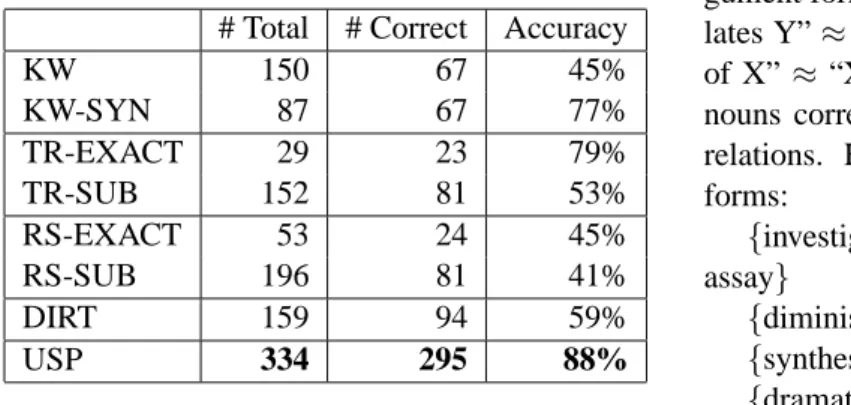
Table 1: Comparison of question answering re-sults on the GENIA dataset.
# Total # Correct Accuracy
KW 150 67 45% KW-SYN 87 67 77% TR-EXACT 29 23 79% TR-SUB 152 81 53% RS-EXACT 53 24 45% RS-SUB 196 81 41% DIRT 159 94 59% USP 334 295 88%
learned MLN, and then matches the question parse to parses in the KB by testing subsumption (i.e., a question parse matches a KB one iff the former is subsumed by the latter). When a match occurs, our system then looks for arguments of type in accor-dance with the question. For example, if the ques-tion is “What regulates MIP-1alpha?”, it searches for the argument type of the relation that contains the argument form “nsubj” for subject. If such an argument exists for the relation part, it will be re-turned as the answer.
6.3 Results
Table 1 shows the results for all systems. USP extracted the highest number of answers, almost doubling that of the second highest (RS-SUB). It obtained the highest accuracy at 88%, and the number of correct answers it extracted is three times that of the second highest system. The informed baseline (KW-SYN) did surpris-ingly well compared to systems other than USP, in terms of accuracy and number of correct answers. TextRunner achieved good accuracy when exact match is used (TR-EXACT), but only obtained a fraction of the answers compared to USP. With substring match, its recall substantially improved, but precision dropped more than 20 points. RE-SOLVER improved the number of extracted an-swers by sanctioning more matches based on the clusters it generated. However, most of those ad-ditional answers are incorrect due to wrong clus-tering. DIRT obtained the second highest number of correct answers, but its precision is quite low because the similar paths contain many errors. 6.4 Qualitative Analysis
Manual inspection shows that USP is able to re-solve many nontrivial syntactic variations with-out user supervision. It consistently resolves the
syntactic difference between active and passive voices. It successfully identifies many distinct ar-gument forms that mean the same (e.g., “X stimu-lates Y”≈“Y is stimulated with X”, “expression of X” ≈ “X expression”). It also resolves many nouns correctly and forms meaningful groups of relations. Here are some sample clusters in core forms:
{investigate, examine, evaluate, analyze, study, assay}
{diminish, reduce, decrease, attenuate} {synthesis, production, secretion, release} {dramatically, substantially, significantly}
An example question-answer pair, together with the source sentence, is shown below:
Q: What does IL-13 enhance?
A: The 12-lipoxygenase activity of murine macrophages.
Sentence: The data presented here indicate that (1) the 12-lipoxygenase activity of murine macrophages is upregulated in vitro and in vivo by IL-4 and/or IL-13, . . .
7 Conclusion
This paper introduces the first unsupervised ap-proach to learning semantic parsers. Our USP system is based on Markov logic, and recursively clusters expressions to abstract away syntactic variations of the same meaning. We have suc-cessfully applied USP to extracting a knowledge base from biomedical text and answering ques-tions based on it.
Directions for future work include: better han-dling of antonyms, subsumption relations among expressions, quantifier scoping, more complex lambda forms, etc.; use of context and discourse to aid expression clustering and semantic parsing; more efficient learning and inference; application to larger corpora; etc.
8 Acknowledgements
We thank the anonymous reviewers for their comments. This research was partly funded by ARO grant W911NF-08-1-0242, DARPA contracts FA8750-05-2-0283, FA8750-07-D-0185, HR0011-06-C-0025, HR0011-07-C-0060 and NBCH-D030010, NSF grants IIS-0534881 and IIS-0803481, and ONR grant N00014-08-1-0670. The views and conclusions contained in this document are those of the authors and should not be interpreted as necessarily representing the offi-cial policies, either expressed or implied, of ARO, DARPA, NSF, ONR, or the United States Government.
References
G. Bakir, T. Hofmann, B. B. Sch ¨olkopf, A. Smola, B. Taskar, S. Vishwanathan, and (eds.). 2007.
Pre-dicting Structured Data. MIT Press, Cambridge,
MA.
Michele Banko, Michael J. Cafarella, Stephen Soder-land, Matt Broadhead, and Oren Etzioni. 2007. Open information extraction from the web. In
Pro-ceedings of the Twentieth International Joint Con-ference on Artificial Intelligence, pages 2670–2676,
Hyderabad, India. AAAI Press.
Xavier Carreras and Luis Marquez. 2004. Introduction to the CoNLL-2004 shared task: Semantic role la-beling. In Proceedings of the Eighth Conference on
Computational Natural Language Learning, pages
89–97, Boston, MA. ACL.
Marie-Catherine de Marneffe, Bill MacCartney, and Christopher D. Manning. 2006. Generating typed dependency parses from phrase structure parses. In
Proceedings of the Fifth International Conference on Language Resources and Evaluation, pages 449–
454, Genoa, Italy. ELRA.
Ruifang Ge and Raymond J. Mooney. 2009. Learning a compositional semantic parser using an existing syntactic parser. In Proceedings of the Forty
Sev-enth Annual Meeting of the Association for Compu-tational Linguistics, Singapore. ACL.
Lise Getoor and Ben Taskar, editors. 2007.
Introduc-tion to Statistical RelaIntroduc-tional Learning. MIT Press,
Cambridge, MA.
Pekka Kilpelainen. 1992. Tree Matching Prob-lems with Applications to Structured Text databases.
Ph.D. Thesis, Department of Computer Science, University of Helsinki.
Jin-Dong Kim, Tomoko Ohta, Yuka Tateisi, and Jun’ichi Tsujii. 2003. GENIA corpus - a seman-tically annotated corpus for bio-textmining.
Bioin-formatics, 19:180–82.
Stanley Kok and Pedro Domingos. 2008. Extract-ing semantic networks from text via relational clus-tering. In Proceedings of the Nineteenth European
Conference on Machine Learning, pages 624–639,
Antwerp, Belgium. Springer.
Percy Liang and Dan Klein. 2008. Analyzing the er-rors of unsupervised learning. In Proceedings of the
Forty Sixth Annual Meeting of the Association for Computational Linguistics, pages 879–887,
Colum-bus, OH. ACL.
Dekang Lin and Patrick Pantel. 2001. DIRT - dis-covery of inference rules from text. In Proceedings
of the Seventh ACM SIGKDD International Con-ference on Knowledge Discovery and Data Mining,
pages 323–328, San Francisco, CA. ACM Press.
Dekang Lin. 1998. Dependency-based evaluation of MINIPAR. In Proceedings of the Workshop on
the Evaluation of Parsing Systems, Granada, Spain.
ELRA.
Saif Mohammad, Bonnie Dorr, and Graeme Hirst. 2008. Computing word-pair antonymy. In
Proceed-ings of the 2008 Conference on Empirical Methods in Natural Language Processing, pages 982–991,
Honolulu, HI. ACL.
Raymond J. Mooney. 2007. Learning for semantic parsing. In Proceedings of the Eighth International
Conference on Computational Linguistics and Intel-ligent Text Processing, pages 311–324, Mexico City,
Mexico. Springer.
Hoifung Poon and Pedro Domingos. 2006. Sound and efficient inference with probabilistic and determin-istic dependencies. In Proceedings of the Twenty
First National Conference on Artificial Intelligence,
pages 458–463, Boston, MA. AAAI Press.
Hoifung Poon and Pedro Domingos. 2008. Joint unsu-pervised coreference resolution with Markov logic. In Proceedings of the 2008 Conference on
Empiri-cal Methods in Natural Language Processing, pages
649–658, Honolulu, HI. ACL.
Matt Richardson and Pedro Domingos. 2006. Markov logic networks. Machine Learning, 62:107–136. Alexander Yates and Oren Etzioni. 2009.
Unsuper-vised methods for determining object and relation synonyms on the web. Journal of Artificial
Intelli-gence Research, 34:255–296.
Luke S. Zettlemoyer and Michael Collins. 2005. Learning to map sentences to logical form: Struc-tured classification with probabilistic categorial grammers. In Proceedings of the Twenty First
Conference on Uncertainty in Artificial Intelligence,
pages 658–666, Edinburgh, Scotland. AUAI Press. Luke S. Zettlemoyer and Michael Collins. 2007.
On-line learning of relaxed CCG grammars for parsing to logical form. In Proceedings of the Joint
Con-ference on Empirical Methods in Natural Language Processing and Computational Natural Language Learning, pages 878–887, Prague, Czech. ACL.