Copyright Notice
The copyright of this thesis vests in the University of the Witwatersrand, Johannesburg, South Africa, in accordance with the University's Intellectual Property Policy.
No portion of the text may be reproduced, stored in a retrieval system, or transmitted in any form or by any means, including analogue and digital media, without prior written permission from the University. Extracts of or quotations from this thesis may, however, be made in terms of Sections 12 and 13 of the South African Copyright Act No. 98 of 1978 (as amended), for non-commercial or educational purposes. Full acknowledgement must be made to the author and the University.
An electronic version of this thesis is available on the Library webpage (www.wits.ac.zallibrary) under "Research Resources".
For permission requests, please contact the University Legal Office or the University Research Office (www.wits.ac.za)
An Integrated Framework of Growth and Human Capital:
Application to Selected African Countries
Dissertation Submitted for the
Degree of Doctor of Philosophy
Grace Goitsemodimo Kgakge-Tabengwa
School of Economic and Business Sciences
University of the Witwatersrand
Supervisor: Professor Christopher Malikane
Revised October 2010
Table of Contents
Abstract ... 6
Acknowledgements ... 7
Chapter 1: Introduction ... 8
1.2 Background to the Study ... 8
1.2.1 Research Problem ... 8
1.1 Selected African Countries ... 11
1.2 Objectives of the Study ... 13
1.3 Rationale and Justification of the Study ... 16
1.4 Limitations of the Study ... 18
1.5 Organization of the Thesis ... 19
Chapter 2: Descriptive Evidence and Stylized Facts on Human Capital and Growth ... 21
2.1 Introduction ... 21
2.2 Literature Review ... 22
2.2.1 Human Capital and Economic Growth ... 23
2.2.2 Fiscal Dynamics, Human Capital and Growth ... 26
2.2.3 Summary ... 30
2.3. Macroeconomic, Health and Education Profiles of Selected Countries ... 32
2.3.1 Comparative Analysis: Macroeconomic and Fiscal Dynamics ... 33
2.3.2. Comparative Analysis: Health and Education Patterns ... 37
2.3.3 Comparative Analysis: Expenditure Patterns on Health and Education ... 41
2.3.4 Correlation Matrices: Growth, Health and Education Indicators ... 45
2.3 Stylized Facts on Human Capital, Public Debt and Growth ... 47
2.4.1 Interactions between Health and Education ... 48
2.4.2 Endogeneity between Health and Education ... 50
2.4.3 The Role of Lags and Effects ... 51
2.4 Summary ... 52
Chapter 3: A Macro-Model for Assessing the Relative Effects of Health and Education on Economic Growth ... 55
3.1 Introduction ... 55
3.1.1 Objectives and Hypothesis ... 58
3.3. Dynamics of the Model ... 62
3.4. Empirical Estimation ... 65
3.4.1 Data Description and Measurement. ... 65
3.4.2 Estimated Parameters of the Model ... 68
3.4.3 Testing for Endogeneity and Model Stability ... 74
3.4.4 Dynamic Estimations and Simulations ... 76
3.4.4.1 The Impact of Human Capital on Growth ... 76
3.5 Summary ... 87
Chapter 4: Macro-Model for Human Capital and Growth with the Government Budget Constraint, Government Spending and Fiscal Policy Rules ... 89
4.1 Introduction ... 89
4.1.1 Objectives and Hypothesis ... 92
4.2 The Model. ... 93
4.2.1 The Productive Sector ... 94
4.2.2 The Household Sector ... 96
4.2.3 The GovernmentSector ... 97
4.2 Dynamics of the Model ... 101
4.4 Empirical Estimation ... 105
4.4.1 Data Description and Measurement. ... 105
4.4.2 Estimated and Calibrated Parameters of the ModeL ... 108
4.4.3 Dynamic Estimations and Simulations ... 110
4.4.3.1 Impact of Public Debt Human Capital and Growth ... 110
4.4.3.2 Impact of Public Debt under Different Fiscal Policy Rules ... 122
4.4.3.3 Impact of Government Spending on Human Capital and Growth ... 126
4.5 Summary ... 134
Chapter 5: Conclusions and Implications ... 138
5.1 Introduction ... 138
5.2 Role of Health and Education on Growth ... 139
5.3 Role of Fiscal Dynamics on Human Capital and Growth ... 140
5.5 Questions for Further Research ... 143
References ... 145
Appendix 1: Derivations of Equations: Chapter 3 ... 155
Appendix 2: Derivations of Equations: Chapter 4 ... 157
List of Tables
Table l:Summary Characteristics of the Selected African Countries ... 12
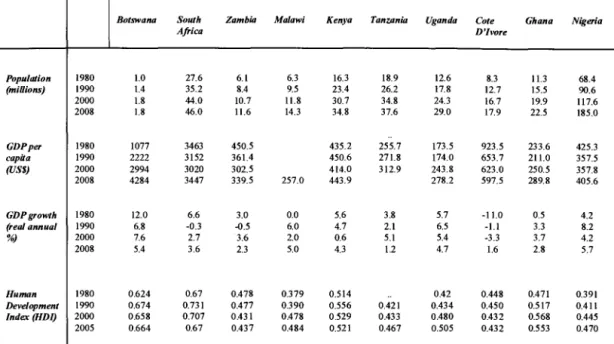
Table 2: Macroeconomic Indicators for Selected Years ... 34
Table 3: Aid per Capita, DebtjGDP Ratio and Total Debt Service for Selected Years ... 36
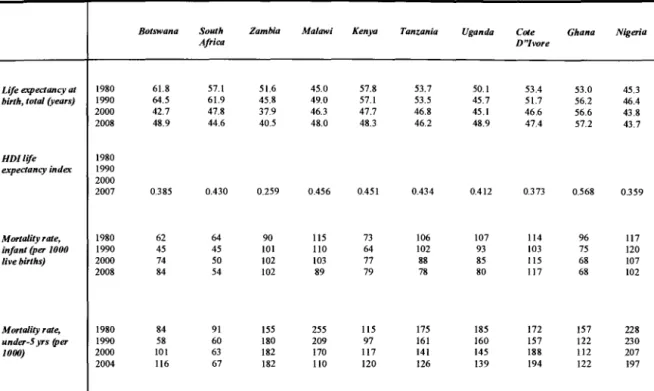
Table 4: Health Indicators and Patterns for Selected Years ... 39
Table 5: Expenditure Indicators and Patterns on Health for Selected Years ... 42
Table 6: Expenditure Indicators and Patterns on Education for Selected Years ... .43
Table 7 Correlations between GDP, Health and Education Indicators ... 46
Table 8: Description of the Data and Measurement.. ... 65
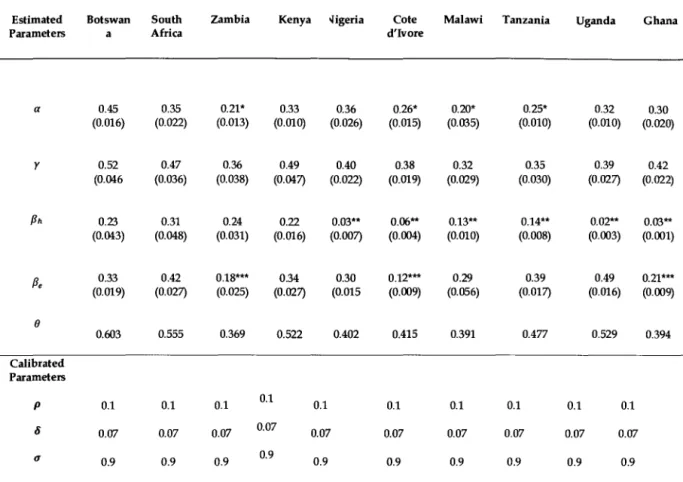
Table 9: Summary of the Estimated Parameters of the Model ... 70
Table 10:Summary Table for the Impact Effects of Temporary and Permanent Shocks to Health and Education ... 86
Table 11: Average % Change Due to a Public Debt Shock Under Different Fiscal Policy Rules ... 123
Table 12: Summary of Measurement Impact of Shocks to the Public Debt under different Fiscal Policy Rule ... 125
Table 13: Summary Diagnostic Statistics for the Estimated Equations of the Model ... 161
List of Figures
Figure 1: Phase Diagrams Analysis of the Theoretical Model.. ... 64 Figure 2: Dynamic Response of Output to Temporary Shocks on Health and
Education ... 78
Figure 3: Dynamic Response of Output to a 1 % permanent Shock on Health and
Education ... 80 Figure 4: Dynamic Response of Output to a Temporary Shock to the Human Capital Index ... 82 Figure 5:Dynamic Response of Output to a 1 % Permanent Shock to the Human Capital Index ... 83 Figure 6: Impact of a Temporary Shock to the Public Debt under a Flexible Fiscal Policy Rule ... 113 Figure 7: Impact of a 1 % Permanent Shock to the Public Debt Under a Flexible Fiscal Policy Rule ... 114 Figure 8: Impact of a Temporary Shock to the Public Debt under a Balanced Budget Fiscal Policy Rule ... 115 Figure 9: Impact of a 1 % Permanent Shock to the Public Debt under a Balanced Budget Fiscal Policy Rule ... 116 Figure 10: Impact of a Temporary Shock to the Public Debt under a Zero Growth in Debt Fiscal Policy Rule ... 117 Figure 11: Impact of a1 % Permanent Shock to the Public Debt under a Zero Growth in Debt Fiscal Policy Rule ... 118 Figure 12: Impact of a Temporary Shock to Government Spending on Health/
Education (holding one constant) ... 128
Figure 13: Impact of a 1 % permanent Shock to Government Spending on
Health/Education (holding one constant) ... 129 Figure 14: Impact of a Temporary Shock to Government Spending on Health and Education (total effect) ... 130
Figure 15: Impact of a 1 % Permanent Shock to Government Spending on Health and
DECLARATION
I, Grace Goitsemodimo Kgakge-Tabengwa, declare that this research report is my own unaided work. It is submitted in partial fulfillment of the requirements for the degree of Doctor of Philosophy at the University of the Witwatersrand, Johannesburg, South Africa. It has not been submitted before for any degree or examination in this or any other university.
. --:-,;da
I~"L:1
t
I '- ,)./
'~C
1(',SIGNATURE, ...
7i¥.'. ...
,.t ... ,... ... \.. DATE: 26111 February 2010NAME:Grace Goitsemodimo Kgakge-Tabengwa
Abstract
The main thrust of my thesis is to develop an integrated framework of human capital and growth to investigate the role of the two major components of human capital, health and education on growth for a set of selected African countries} from 1980-2008. The descriptive analysis and stylized facts on human capital, fiscal dynamics and growth is carried out in Chapter 2. In Chapter 3, we assess the impact of health and education on per capita output. In our model, health and education determine labour effectiveness. In Chapter 4, we explicitly introduce the government budget
constraint and the role of government expenditure in the model. This is mainly to capture fiscal constraints and challenges facing developing countries and to assess their possible implications for human capital development and growth. Our analysis and results show that both health and education play a positive role in promoting the effectiveness of labour and in influencing growth. The model foatures the role of the physical capital stock, which is found to have a significant positive role on health, education and growth. The dynamics of the model reveal that, in the long run, temporary and permanent positive shocks to health and education impact positively on labour effectiveness and growth. Increasing education and health on a permanent basis by 1% leads to on average, a
permanent sustained increase in output of 1.2% and 0.8%, respectively. For some countries, the
permanent shock to health and education raises output by 1.2% in both cases, indicating presence of
increasing returns to scale from health and education on output growth. Similar findings are obtained with the human capital index which constitutes health and education mainly to capture the possible interactions between health and education.
With the government budget constraint in the model, the dynamics show that high stocks of the public debt depresses the effect of human capital on output growth through limiting government expenditure resources available for developing human capital. The impact of the public debt on human capital and growth varies in the selected countries depending on the public debtlGDP ratio and on whether the fiscal policy rule is more flexible in reacting to debt and government expenditure; maintains a balanced budget or maintains a zero growth rate in the public debt. Although for all the three fiscal policy rules we find consistency that an increase in the public debt adversely affects human capital and growth and that the impact is much more pronounced when the public debtlGDP ratio goes beyond 40%, our findings show that maintaining a flexible fiscal policy rule and the balanced budget rule gives better results compared to the other fiscal policy rule. There are pronounced lag effects on the impact of education and health on output as well as on how the public debt and government expenditure affects human capital and growth. We conclude that the implications of the public debt on human capital and growth indicate that some developing countries, especially those where the public debt remains high and face fiscal challenges such as poor unsustainable revenue prospects to back government expenditure on health and education cannot solely develop human capital based on the strength of their domestic resources. Also, while we find a significant positive role for education and health on growth in the model without the government budget constraint, incorporating fiscal dynamics reveals that the impact of health and education on growth becomes less pronounced. This underscores the importance of taking into account fiscal dynamics in assessing the impact of health and education on growth to avoid possibly over estimating their growth potential in countries where there are fiscal constraints such as those where the public debt remains high and recurs.
Acknowledgements
I thank God for the strength, courage and detennination He gave me to preseroe during the course of writing this thesis.
I would like to sincerely thank the African Economic Research Consortium for the sponsorship they awarded me Jor my PhD studies without which this dissertation would not have been possible. I also extend many thanks to my employer, Botswana Institute for Development Policy Analysis for allowing me to pursue my studies and for the support they offered me throughout my studies.
I am most grateful to my superoisor Professor Christopher Malikane for his exceptional guidance, patience, encouragement and enthusiasm which have been quite instrumental throughout my thesis work. This work has also benefited from valuable comments from participants at the African Economic Research Consortium Biannual Conferences, in particular, Prof David Weil, Browns University, Prof Victor Murinde, University of Birmingham and Professor Ernest Aryeetey, Institute of Statistical, Social and Economic Research (ISSER). I also appreciate the comments received from the departmental seminars at the University of the Witwatersrand notably, Professor Giampaolo Gazerrelli, Professor Harry Zarenda, Dr Umakrishnan Kollamparambil, Dr Yasmina Reem Limam, Dr Neil Rankin and Dr Tendai Gwatidzo which have seroed to enhance the quality of this work.
Finally, I thank my spouse and children, who have seroed as my pillar of strength, who gave me the drive and urge to keep going, no matter what. They were a source of joy by always giving me the smile, laughter and cheer I needed most amidst the long nights and many difficult days to finish this work. I wholeheartedly dedicate this work to them.
Chapter 1: Introduction
1.2 Background to the Study
1.2.1 Research Problem
This thesis investigates the role of human capital on growth within an integrated framework of human capital and growth. The main focus is to develop a model that captures the two components of human capital, health and education, and assess their relative impact on
output, measured in per capita terms. In our model, both health and education determine the
effectiveness of labour. An important aspect of the analysis centers on investigating the
reaction of output per capita to temporary and permanent shocks to education and health within the developed dynamic model. The other major aim in the thesis is to extend the analytical framework to capture the fiscal dynamics facing African countries in developing human capital. This is carried out by explicitly introducing the government budget constraint, fiscal policy rules and the role of government expenditure in the model and assessing their growth implications for human capital.
The motivation for the model developed in the thesis and analysis is that, while there is substantial literature on the role of human capital on growth, pioneered by the work of Romer (1990) and Barro (1990), a number of studies identify human capital only with education, leaving out health as a component of human capital. A number of cross-country studies that explain income differences, for example studies by Mankiw, Romer and Weil (1992), Caselli, Esquivel and Lefort (1996), Klenow and Rodriguez (1997), Barro (1991, 1997), Benhabib and Spiegel (1994), Barro and Sala-i-Martin (1995), Sala-i-Martin (1997), Easterly and Renelt (1997) use education as an indicator of human capital. They find that human capital has a significant positive effect on economic growth. These studies do not include health as part of human capital. Also, health and education are not captured as factors that determine labour effectiveness in the analysis.
Although human capital, in the fonn of education, contributes significantly to economic
growth, these studies identify human capital narrowly with education2
. For developing
countries, health problems are as important as education problems. It is therefore, important to consider health as a crucial aspect of human capital and a critical ingredient of economic growth. Furthennore, even if education levels are high, a deteriorating state of health of the labour force reduces life expectancy and productivity gains. As a result, the growth rate of labour productivity will fall over time, and this will reduce long run economic growth. As pointed out by Weil (2006) and the World Bank (1988), absence from work due to health problems affects productivity. Most importantly, for African countries with major health challenges, the studies point out that the prevalence of HIV -AIDS is high among the ages of 20-50 years. This is the most productive segment of the population from the standpoint of the life cycle income hypothesis. This has direct implications for productivity and long-run growth.
It is thus imperative that an assessment of the role of human capital on growth in developing countries integrates health as one of the components of human capital. Leaving out health as a component of human capital encounters obvious difficulties, such as the variable omission bias and the possible overestimation or underestimation of the contribution of human capital to growth. In Chapter 3 of the thesis, therefore, a dynamic model in which human capital is jointly determined by the levels of education and health of the labour force, following Romer
(1990), is formulated and estimated. In this model, health and education impact on the
effectiveness of labour and productivity. In order to deal with possible interactions between health and education, we formulate an index of human capital which constitutes of health and education index for the selected set of countries. A second major aspect of the research in Chapter 3 of the thesis is investigating the dynamic reaction of output in to temporary and permanent shocks to health and education and measuring their relative impact on economic growth, measured in per capita terms.
The thesis also features the role of fiscal dynamics in human capital development and growth in Chapter 4. Developing countries are encouraged to prioritize human capital improvements as part of meeting the Millennium Development Goals. However, the fiscal sustainability of
2 For example Romer (1990) Barro, (1990, 1991, 1996), Mankiw, Romer and Wei! (1992), Easterly and Levine
(1997),Benhabib and Spiegel (1997) Barro and Sala-i-Martin (1995, Sala-i-Martin (1997) Greiner, Semmler and Gong (2004)
such policy proposals remains an issue that requires further research. The upshot of the analysis may be that because of major gaps in human capital levels, some developing countries may be unable to close these gaps within reasonable time on the strength of their domestic resources. Surprisingly, few studies integrate endogenous growth with the government budget constraint and the role of fiscal policy rules. For example, Romer (1990) features government spending but does not explore the implications of the government budget constraint. The study that comes close to ours is the one by Greiner et.al. (2004). This study features the government budget constraint, but human capital is modeled as education. Against this backdrop, we introduce the government budget constraint in the model developed in Chapter 4 of the thesis where the main is to assess the extent to which expenditure on human capital delivers long run fiscal sustainability. The impact of the public debt and fiscal policy rules on human capital and growth is also investigated.
The relevance of considering the growth effects of fiscal policy on human capital and growth through introducing the government budget constraint within the model are predicated, of course, on the basic proposition that policy matters for long run growth. The importance of the government budget constraint in growth models has been highlighted by Turnovsky (1975) and Kneller, Bleany and Gemmell (1999). They posit that it is important to capture the variables that enter the government budget constraint for a meaningful analysis of the long run growth effects of fiscal policy. Christ (1968) and Aizenman et. al. (2007) also state
that econometric models used for policy analysis should be careful to keep track of the implications of the government budget constraint in order to avoid being subject to potential biases arising from omitting variables that enter the government budget constraint.
The framework and analysis presented in this thesis is based on three guiding hypotheses. The first is that health and education impact positively on economic growth and that health has a greater impact on labour effectiveness and output. The second hypothesis is that an increase in the public debt depresses human capital development by lowering health and education. When testing this hypothesis, we adopt different fiscal policy rules to assess the impact of the public debt on human capital, growth, government expenditure and the public deficit to capture aspects of fiscal sustainability under different fiscal policy rules often
adopted by countries to maintain a sound fiscal stance and macroeconomic stabilitl. The three different fiscal policy rules explored are (i) a flexible fiscal policy rule where government reacts to the public debt and government expenditure to maintain them at sustainable proportions (ii) a fiscal policy rule where a balanced budget is maintained and (iii) a fiscal policy rule where a zero growth rate in the public debt is maintained. Thirdly, we
test the impact of government expenditure on health and education4. This hypothesis is tested
under two scenarios where in the first scenario we assess the impact of government expenditure on one of the components of human capital holding one component constant. In the second scenario, the hypothesis is tested where the change in government expenditure is on all the components of human capital. The theoretical and empirical considerations for these hypotheses are given in more detail in the respective chapters ofthe thesis.
1.1 Selected African Countries
The study focuses on a set of 10 selected developing countries in Africa, notably Botswana,
South Africa, Zambia, Malawi, Kenya, Tanzania, Uganda, Cote d'Ivore, Ghana and Nigeria.
The selection gives a reasonable representation of African countries with varying macroeconomic conditions and performance, development stages and growth rates as well as differing fiscal challenges, health and education profiles. The selection of the countries is largely informed by the need to ensure representatively of a wide range of countries from Africa, but also the availability of data for the analysis in the thesis particularly a time series of data on the health and education indicators. The inclusion of several African countries for such a study provides an opportunity for comparisons among African countries.
The selection also gives a mix of countries that represents most of the regions of Africa such as countries from Southern Africa, East Africa Countries and those from North/West Africa. In this regard, the selection is hoped to give results that show dynamics in various African countries and the possible human capital, growth and debt dynamics that may emerge.
3 The role of fiscal policy and fiscal policy rules is emphasized in studies for example by Annicchariarico and Giammarioli
(2004), Funte (1997), Miller and Russek (1997), King and Rebelo (1990), Blinder and Solow (1993) and Christ (1979).
4 Studies emphasizing the role of government expenditure on growth and development include those of Barro and Lee
(1994), Barro (1990, 1991), Bose, Haque and Osborn (2003), Cashin (1995) Aschauer (1989), Ladau (1983, 1985, 1989) and Shantayanaan, Swaroop and Zou (1996)
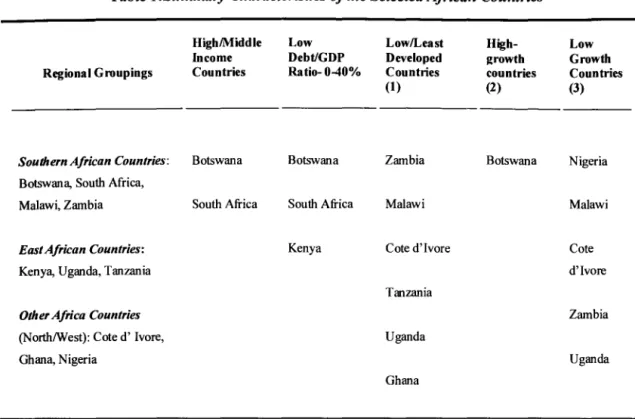
Table 1 :Summary Characteristics of the Selected African Countries
Regional Groupings
Southern African Countries:
Botswana, South Africa, Malawi, Zambia
EastAfrican Countries:
Kenya, Uganda, Tanzania
Other Africa Countries
(North/West): Cote d' Ivore, Ghana, Nigeria HighlMiddle Income Countries Botswana South Africa Low DebtlGDP Ratio- 0-40% Botswana South Africa Kenya LowlLeast Developed Countries (1) Zambia Malawi Cote d'Ivore Tanzania Uganda Ghana High-2rowth countries (2) Botswana Low Growth Countries (3) Nigeria Malawi Cote d'Ivore Zambia Uganda
Notes I. The low and lease developed countries have an average DebtlGDP ratio exceeding 60% from 1980-2008- These are countries mostly among the highly indebted poor countries that have benefited from the IMF/World Bank HIPC Initiative and Multilateral Debt Relief Initiative.
2. The high growth countries here have experienced GDP growth exceeding 6% on average between 1980-2008 GDP growth less than 5% between 1980-2008
3. Low growth countries have experienced GDP averaging less than 5% between 1980-2008 period
We also selected a combination that has high growth countries such as Botswana and South Africa, less developed and highly indebted countries (Zambia, Malawi, Cote'd Ivore). A summary table outlining some of the characteristics of the selected Africa countries is provided in Table 1 for ease of reference. Some of the countries, such as Zambia, Malawi, and Tanzania, Uganda and Cote d'Ivore have had high debt to GDP ratios and debt service obligations which may serve to constrain government resource allocation to social development, mainly in areas of health and education. Even with multilateral interventions to arrest the high debt in the highly indebted poor countries (RIPC) by international organization such as the International Monetary Fund (1M F) under the Highly Indebted Poor Countries Initiative (HPIC) and the Multilateral Debt Relief Initiative (MDRI), some countries still remain trapped in the high debt or tend to slip back into debt after the debt
cancellation, for example, m the cases of the highly indebted countries5 (e.g. Zambia, Malawi, Cote d 'Ivore).
It is therefore, of interest to look at how the fiscal dynamics such as the public debt in these countries may shape and impact on the development of human capital and growth prospects within our analytical framework when we introduce the government budget constraint to capture the role of the public debt, fiscal policy rules and government spending. Also, the sample gives countries where government expenditure faces challenges of prioritization amongst competing priority sectors but also with limited sustainable revenue sources to back up continued expenditure on social development areas such as those of health and education. For example, while Botswana has had high revenues compared to other countries in the sample, the challenge is that the revenue is dominated by mineral revenues and the economy is not diversified. Nigeria is highly dependent on oil production as a source of revenue which the country is not able to plough back into social development due to political instabilities and poor governance. Generally, taxes are higher in African countries and collection is inefficient (Bose et. al (2003). This leads to poor prospects for revenue generation and limited tax bases to generate resources for sustained expenditures on education and health and other priority development objectives.
In Chapter 2, a detailed comparative analysis of economic performance based on
macroeconomic indicators in the selected countries is provided and discussed which provides more information on the set of countries offocus.
1.2 Objectives of the Study
As already highlighted in the preceding sections, the main aim in this thesis is to develop a model that assesses the relative impacts of the two components of human capital, health and education on output per capita. A second focus is to extend the macro-model to introduce the role of the public debt, government expenditure and fiscal rules by explicitly introducing the government budget constraint in the analytical framework developed. This is intended to
5 See for supporting evidence in studies by Chowhoudry (2001),Clements et. Al (2004), Denis e.t al (2008) Sachs (1986,1989)
capture the fiscal dynamics and their implications on growth and human capital development. The two main issues being investigated within the integrated growth framework developed in the thesis center on the following aspects:
1. Examining the growth effects of the two components of human capital with particular focus on health and education. In this case, the analysis disaggregates human capital into two components, health and education, where health and education determines labour effectiveness and assessing their relative impact on growth.
2. Assessing the fiscal policy implications ofthe government budget constraint, government expenditure and the public debt on health, education, public deficit and growth. That is, the analysis introduces a government budget constraint into the model framework to capture the fiscal dynamics and their implications for fiscal policy sustainability, human capital development and growth. Here, we assess how the public debt under different fiscal policy rules affects human capital and growth and how the government expenditure impacts on growth and human capital development.
A number of research questions are asked in the main chapters which guide the formulation of the model, the specific research interest questions and analysis. The issues being investigated in each of the chapters are elaborated below:
• Chapter 2:
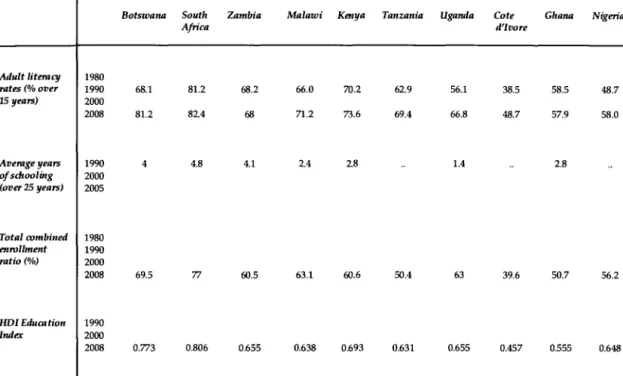
This Chapter presents the descriptive analysis and stylized facts on the state of health, education and growth in the selected African countries. We look at the various indicators of health (including life expectancy and mortality rates) and compare them. With regard to education, we compare the indicators of education, notably, adult literacy rates, enrollment ratios in the set of selected countries. We also carry out a comparison of the economic performance based on GDP per capita and average growth rates. Developing countries face challenges in developing human capital, particularly health and education. One of the main challenges is the allocation of resources to education and health amidst the competing priority goals for government on a sustainable basis. This is compounded by the poor revenue prospects of developing countries which constrain government spending on various
sectors of the economy. We therefore compare the debt/GOP ratios and debt service obligations, and indicators of aid dependency and discuss government expenditure resource allocations for health and education. The role played by multilateral institutions like the World Bank and donor agencies in addressing constraints on human capital development and the fiscal constraints such as the high debt through for example the Highly Indebted Poor Countries (HIPC) Initiative and the Multilateral Debt Relief Initiative is also captured in this chapter. A number of stylized facts, mainly on the interactions between health and education, global intervention policy initiatives and dynamics, the lag and delayed effects of human capital on growth and between fiscal policy variables on human capital and growth which are of importance and have a bearing on the analysis carried out in this thesis are also highlighted in this chapter. This Chapter aims to give a solid background of the issues of focus in the thesis from a descriptive analytical perspective.
• Chapter 3:
A number of research questions are at the core of the analysis in this section of the thesis. The main research question being addressed in this chapter include: What is the impact of the two components of health and education on economic output? What is the impact of health and education on labour effectiveness? What is the reaction of output per capita to persistent and permanent shocks to education and health? What is the relative impact of the components of human capital on growth of output? In order to address the possible of interaction of health and education, the analysis pertaining to these research questions is carried out on health and education individually but also with the formulated index of human capital which constitutes of health and education.
Therefore, the specific objectives in this chapter are to:
l. Formulate a macro model framework where health and education determine
the effectiveness oflabour.
n. Assess the dynamic response of output to persistent and permanent shocks to
education and health.
iii. Measure the relative impacts ofthe two major components of human
IV. Measure the impact of permanent shocks to human capital on output.
• Chapter 4:
The main research questions here center on how fiscal dynamics affect the development of human capital and growth. For example, some questions being asked include: How does an increase in the public debt affect human capital (health and education), the public deficit, government spending and growth under different fiscal policy rules? What is the reaction of output to persistent and temporary shocks to the public debt is this framework? How does government spending on health and education affect human capital, growth and the public debt? What is the impact of government spending on one of the components of human capital holding one component constant? What is the impact of government spending on all the components of human capital, public debt and growth?
With these research questions, the specific issues of research in this chapter are therefore, to:
1. Extend the model framework in Chapter 3 to integrate the government budget
constraint, government spending, public debt and fiscal policy rules in the model.
ii. Assess the dynamic behavior of output, health, education, public deficit to shocks on the public debt in this framework.
111. Assess the impacts of increased government spending on health and education
IV. Assess the impact of increasing public debt on health, education, government
expenditure and growth.
1.3 Rationale and Justification of the Study
It is no doubt that the role of human capital in the process of development has received much attention in the development literature in recent years. However, the existing research focusing on cross-country income differences largely identifies human capital with education. Also, the studies do not integrate the role of fiscal dynamics in the frameworks
adopted. This study will therefore contribute to the existing research gap by explicitly including health as one of the components of human capital as well integrating the role of fiscal dynamics by integrating the government budget constraint. The framework adopted allows for an understanding of how health and education determine labour effectiveness and output. This study, through an assessment of the impacts of the major components of human capital on growth and integrating the role of fiscal dynamics in the analytical framework developed will fill the current existing research gap with regard to:
• Improving on previous research on this topic by explicitly including both components
of human capital, health and education in the growth model adopted to assess the implications of human capital on growth. In this regard, the present paper will fill an important gap that currently exists in the literature in as far as the role of health and education as components of human capital on growth are concerned
• Contributing to an understanding of the role of human capital on growth given fiscal
constraints for developing countries. Existing research on human capital and growth studies6 have not considered the implications of the fiscal policy sustainability in their analysis through including the government budget constraint in the analytical framework used. As such, these studies, through neglecting the role of health on human capital and the government budget constraint are subject to potential biases because they omit health as one of the components of human capital and the variables for fiscal policy sustainability. Our study therefore captures the role of fiscal dynamics and how they affect human capital development which is justified for an understanding of the dynamic effects of government expenditure, fiscal rules and public debt on human capital and growth.
The research therefore serves as a contribution to the recent methods of analysis through looking at the dynamics of the model over the long run, but also from a time series perspective compared to cross section analysis on human capital and growth which dominates the existing literature in this subject matter. This analysis is also enriched by a comparative analysis of the state of human capital, fiscal dynamics and growth of the selected African countries which gives scope for an in-depth understanding of the issues of
research interest in this thesis. Further, the study contributes to the current existing research gap on an integrated growth framework of the role of human capital on growth within a model that captures all the components of human capital and addresses the problems of omission variable bias. It also forms a human capital index to address problems of possible interactions between health and education which have a bearing on the interpretation of estimations. The analysis, through its focus on a set of selected7 developing countries using recent time series data (1980-2008) from Africa where development of human capital remains a challenge and fiscal dynamics affect human capital and growth prospects, will contribute to the current ongoing policy and academic debates on human capital development in these countries.
1.4 Limitations of the Study
The data collected here has limitations especially where there is need for a wide number of indicators to proxy for the health and education indicators when dealing with endogeneity. We encountered weak instruments but also non-availability on a consistent basis for some education and health indicators which limited using the instrument variable (IV) technique to test for endogeneity in some suspect variables particularly between health and education. The explanation given by the World Bank is that statistical systems in many developing countries, particularly Africa are still weak and the coverage and variable definitions differ widely among countries. For these reasons, the World Bank warns that although the sources from which the data are drawn are authoritative, they should be construed only as indicating trends. Temple (1998) also notes that indicators may change markedly as a result of change to either the numerator or denominator.
There were limitations in finding the physical capital stock data for all the countries in our sample. We therefore had to derive the physical capital stock series for each country using the perpetual inventory method following Limam and Miller (2004).
There are possible interactions between health and education which need to be taken into account. The analysis on health and education cannot always be separated and hence, this posed some limitations in that one has to come with an index of human capital which attempts to address these possible interactions. In this regard, the research attempts to develop an index that captures the two components. As such, the interactions between health and education in the analysis are mainly driven by the way the human capital index is formulated in this thesis, hence being limited where other approaches to interact health and education may be deemed critical.
There are also issues of the delayed effects of human capital as it relates to health and education. The impact of health and education on labour effectiveness and output may take time to take effect. Hence, these time effects and lag effects have to be considered when interpreting the results. The impulse response functions indicating the response to permanent and temporary shocks is a tool that allows one to discern the lag and delayed time responses between variables following the shocks. A limiting factor to measuring the exact lag/delayed effects from the functions is not always 100 percent accurately measured and the length of the lag is treated as indicative ofthe time period taken for the impact to take effect.
1.5 Organization of the Thesis
The thesis is divided into five chapters. Chapter 1 introduces the study, giving the background of the thesis and research problem, the research objectives as well as the rationale of the study. This is followed by the three main inter-related chapters of the thesis (Chapter 2,3 and 4) one building on the findings of the preceding one. Chapter 2 presents the descriptive evidence and stylized facts on human capital, growth and public debt and gives a comparative analysis of the indicators and macroeconomic data in the selected sample of countries. It also highlights the stylized facts on human capital, growth and the public debt and provides the literature review underpinning the research.
In Chapter 3, we formulate a macroeconomic model for assessing the relative impact of the two major components of human capital, health and education, on economic growth and investigate the response of output to shocks on education and health within a dynamic
analytical framework. In Chapter 4 we introduce the government budget constraint in the model developed in the preceding chapter where we assess the extent to which expenditure on human capital delivers long run fiscal sustainability. Here we integrate the role of the fiscal dynamics on human capital and growth. The conclusions and implications of the study are given in Chapter 5.
Chapter 2: Descriptive Evidence and Stylized Facts
on Human Capital and Growth
2.1
Introduction
In the early 1960s, Africa's growth potential prospects were much better than those of East Asia (Easterly and Levine, 1997). But during the period 1965-1990, real GDP per capita for East Asian countries increased by 5% per year while that in Africa stagnated. Most African countries experienced negative growth in this indicator (World Bank, 1993). With the declining trends in economic performance and growth in African countries, a number of factors have therefore been identified to spur growth and development. One of the sectors that can help accelerate development and be an engine for economic growth in Africa is the development of its human capital base. However, there are some challenges in African countries that have served to limit the potential of the role of human capital on growth. According to Bose e.t al (2004), these challenges include fiscal challenges, notably the limited government resources to be allocated among competing development priorities. Research by Clements e.t al (2001) underscores the adverse effects of the high public debt in developing countries on growth and development initiatives which crowds out available resources for use on other sectors of the economy.
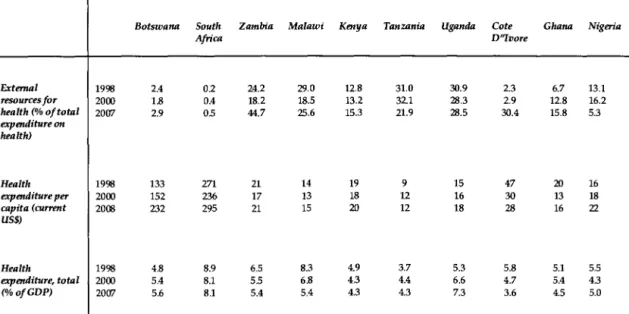
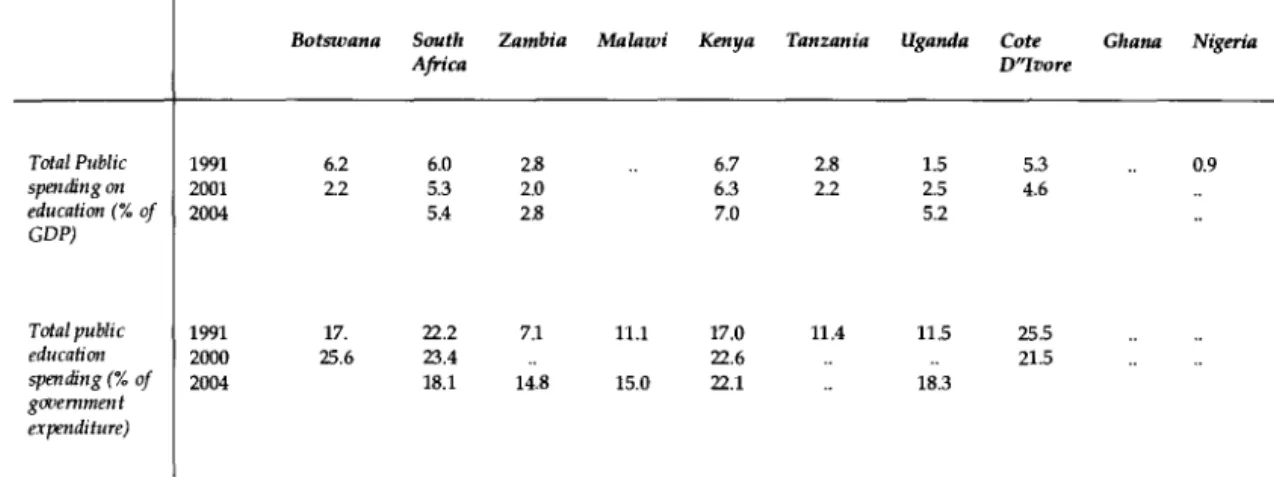
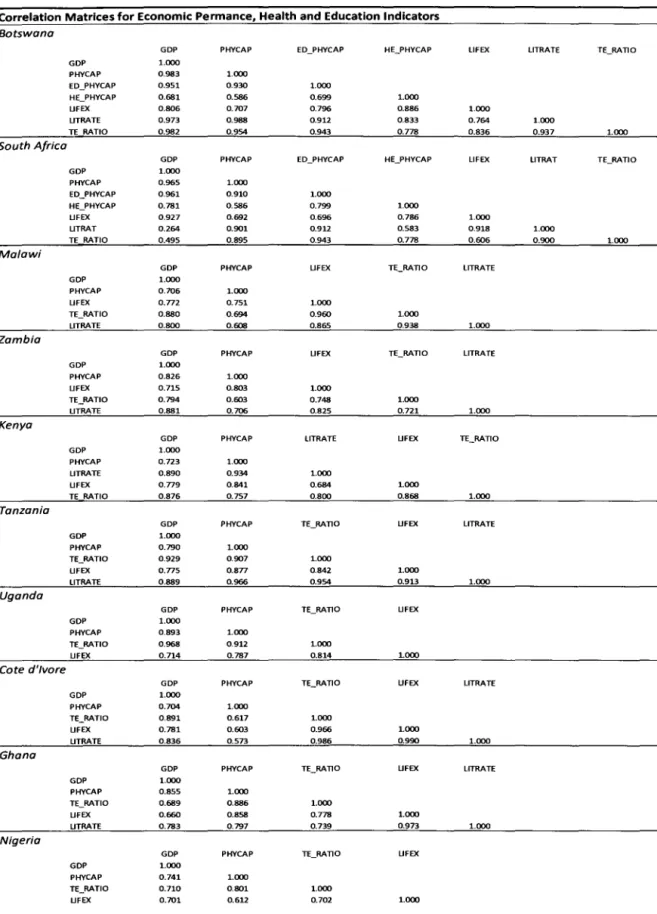
This chapter therefore, carries out a descriptive analysis to examine the relationship between the indicators of human capital pertaining to health and education in the sample of African countries from a qualitative context. It gives a comparative analysis of the indicators relating to economic performance and growth, health, education, public debt, debt service and aid dependency measures amongst the set of countries which constitutes, high growth, middle income and less developed low income countries. Also, the expenditure patterns on the health and education sectors are compared. This is mainly to assess the health and education profiles in the various African countries and resource allocation and commitments by governments in the development of human capital. The analysis will shed light on the
possible relationships between for example, trends in education indicators and the role of government policy through resource provision in the form of government expenditures.
Including the public debt and other fiscal indicators in the descriptive analysis will shed light on whether countries with high public debt are constmined by fiscal dynamics in developing human capital. This is because it is possible for a high debt to limit resources available for priority sectors such as on education and health8• The extent of the public debt and debt
service obligations in these countries is given to assess the debt burden of the countries and perhaps to gauge the extent to which debt service obligations might affect the ability of countries to develop health and education and provide resources such as the infrastructure in these sectors.
The literature review is provided in Section 2.2 which gives the theoretical and empirical review on human capital, growth and fiscal policy.
2.2 Literature Review
This section focuses on summarizing the relevant theoretical and empirical literature on human capital and growth. A review of the literature on the role of fiscal policy in shaping human capital and growth is also carried out. This review informs the theoretical foundations of the analytical framework followed in this thesis. The framework we develop is based on the conventional endogenous growth models as popularized by Romer (1986, 1990) and Lucas (1988), and then by Barro (1990). Recently, Barro and Sala-i-Martin (1992) extended the framework of optimizing economic agents that allows for the inclusion of a public sector variable in the production function.
8 There is evidence on the adverse effects of a high public debt on growth and resource allocation. For example, Pattillo et
al. (2002) finds evidence of debt overhang. Using a panel data set comprised of 93 developing countries for the period 1969-1998, they suggest that at a debt stock of 3540 percent of GDP, the average effect of debt on per capita growth becomes negative. Clements et al. (2003) confIrm their results of a debt overhang. Furthermore, they fmd that debt service has a
"crowding out" effect on public investment, thereby lowering the overall growth rate of a developing country. They argue that if resources freed up by debt service relief can be directed towards public investment, growth rates in some HIPC countries would increase by half a percentage point armually. Similarly, Chowdhury (2001) fmds evidence for debt ovemang in his sample
As such, in the two sub sections that follow below, I review the literature relating to human capital and growth along the Romer (1990) and Barro (1990) which lays the theoretical and empirical considerations of the analysis being carried out in the thesis. The other review focuses on the role ofthe public sector in developing human capital which follows along the Barro (1990) and Barro and Sala-i-Martin (1992), laying the theoretical background for extending the analytical framework to introduce government spending and the government budget constraint in the growth and human capital framework we develop. In chapter 3 and 4 where the model framework in the respective chapters is laid down, I draw extensively from the literature review carried out in the following subsections and use it to guide the analytical framework.
2.2.1 Human Capital and Economic Growth
As already highlighted in the earlier sections of the thesis, the role of human capital in the process of development has received much attention in the growth literature in recent time. The literature on human capital occupies a prominent place in both the macroeconomic and microeconomic growth literature.
There are two main debates in the macro growth literature: the traditional growth models of Solow and Swan (1956), Cass (1965), and Koopmans (1965) and the new endogenous growth theories. While the former disregards human capital, the later incorporates it. In the traditional growth models physical capital drives growth. They are based on the crucial assumption of diminishing marginal returns to capital, which leads the growth process of an economy to eventually arrive at the steady state where the rate of technological progress is exogenously given (Bassanini and Scarpetta, 200 I). Whereas in the new endogenous growth models, human capital occupies a central role in spurring growth as knowledge spillovers and human capital externalities aid in delaying the tendency for diminishing returns to capital accumulation (Barro and Sala-i-Martin, 2004).
As such, in the last 20 years the new endogenous growth theory has increasingly influenced the economic growth literature. It emphasizes the role played by human capital accumulation in boosting growth through stimulating technological creation and invention, eventually
leading to increased productivity (Barro, 1990). The endogenous model by Romer (1990) assumes that the creation of new ideas is a direct function of human capital which manifests in the form of knowledge. While in the Lucas (1988) model, human capital is inserted as a factor of production, in the Romer (1990) model it is used as a facilitator of technological growth. As such, in modem growth theory, the accumulation of human capital is an important contributor to economic growth (Romer, 1990). The main advantage of the new growth theories is that they incorporate explanations for long run growth (human capital and technological growth) into the model. In this way it is theoretically possible to determine the importance for growth of technology and human capital accumulation. The endogenous growth theory therefore provides explanations on why human capital investments are important to economic growth (Barro and Sala-i-Martin, 1995).
Lately, Aghion and Howitt (1998) have observed that the modeling of the role of human capital in new endogenous growth theories can be further divided into two approaches: the Nelson-Phelps (NP) (1966) and the Lucas approach (1988). The NP approach argues that the stock of human capital directly influences growth by enhancing the innovation capability of the country and indirectly influences growth through its ability to facilitate technology adoption and 'catch up' with other leading countries. In contrast, the Lucas (1988) approach, which is also broadly consistent with the Mincerian earnings function literature, assumes that growth is driven by the accumulation of human capital.
These approaches have different implications for human capital investments on the long-run growth of a country. Under the NP approach, raising human capital levels will affect the country's level of output while the Lucas approach predicts that raising the level of human capital will affect the country's permanent growth rate (Aghion and Howitt, 1998). Therefore, empirical results of testing the importance of human capital for economic growth are mixed. Some studies have found no relation between human capital and growth under the Lucas approach (see Benhabib and Spiegal, 1994).
In this regard, there have been numerous cross-country studies, which have extensively
explored whether the attainment of education can contribute significantly to the generation of overall output in economy. The theoretical framework which has widely been followed to model the effects of human capital in growth follows the endogenous growth models of
Barro (1990), Romer (1990) Barro and Sala-i-Martin (1995, 2004). This framework is based on a production function of the constant returns to scale with output being a function of capital, labour and human capital. Examples of studies that also found support for human capital as source of growth include those by Barro and Lee (1994) Romer (1991), Benhabib and Spigel (1994) and Mankiw, Weil and Romer (1992) and Barro and Sala-i-Martin (1995, 2004).
A number of indicators of education have been adopted for the analysis of human capital on growth. These include indicators such as enrollment ratios, average years of schooling and adult literacy rates. Mankiw, Romer and Weil (1992), Caselli, Esquivel and Lefort (199); Easterly and Levine (1992) Klenow and Rodriguez (1997; Barro (1991, 1997), Benhabib and Spiegel (1994), Barro and Xavier Sala-i-Martin (1995), Sala-i-Martin (1997), and many others find schooling to be positively correlated with the growth rate of per capita GDP across countries. Barro and Sala-i-Martin (1995) employ data on years of schooling attainment in a country's working-age population to test the hypothesis that schooling promotes growth and find that growth is highly correlated with school enrollment. These studies, however, define human capital to constitute of education and do not include health as a component of human capital.
Having examined the literature, it is clear that in a number of studies9 quantifying the
contribution of human capital to growth, only education indicators are used to define human
capital. There is therefore a need to re-examine the growth effects of human capital on growth where human capital is determined by both health and education. Also, it is important that the role of health and education are considered as the main drivers of labour effectiveness. Human capital is a multifaceted concept which comprises various types of investments in people. Its definition has evolved over years of research on it. Although, initially it was simply considered as skills and knowledge acquired by people (Schultz 1961),
Strauss and Thomas (1998) have expanded it to incorporate individual competencies,
non-market activities, innate abilities, and individual attributes that facilitate the creation of social, personal and economic wellbeing as well . It is against this backdrop that my thesis is
9 Refer to studies by Mankiw, Romer and Wei! (1992), Caselli, Esquivel and Lefort (1999); Easterly and Levine (1992)
Klenow and Rodriguez (1997; Barro (1991, 1997), Benbabib and Spiegel (1994), Barro and Martin (1995), Sala-i-Martin (1997),
an empirical examination of the two most important indicators of human capital, health and education.
2.2.2 Fiscal Dynamics, Human Capital and Growth
Although the new endogenous growth theory emphasizes the role of knowledge spillovers in macroeconomic growth, it tends to neglect the role of the government budget constraint. For example while in Barro (1990) the role government spending is emphasized in the endogenous growth framework by including a variable for the government sector, the components of the government budget constraint are not captured. This has led to a wide number of studies such as those cited in the previous section only assessing the role of human capital as education without considering the role of fiscal dynamics by capturing all variables that enter the government budget constraint. (see for example studies referred to above of
Mankiw e.t.a/ (1992), Barro (1990), Barro and Sala-i-Martin (1990, 1995) Benhabib and
Spiegel (2004).
The government budget constraint captures the fiscal resources in terms of revenues at the disposal of the government to pursue development projects and expenditures (Turnovsky, 1975). The constraint also features the use government revenues through government expenditure on various sectors of the economy and the debt repayments. Given that developing countries tend to have poor fiscal profiles due to the high debt burden which limit
resource allocation and spendinglO, it is therefore important to capture the government budget
constraint in the analytical frameworks to assess how fiscal dynamics shape human capital and growth.
The literature analyzing the effects of fiscal policy on growth is also based on the theory of endogenous economic growth (Barro 1990, Barro and Sala-i-Martin 1990) where the impact of public expenditures on economic growth is formalized in a simple endogenous growth model following Barro (1990) and Barro and Sala-i-Martin (1990) where output is a function
of technology, labour, the capital stock and government spending. Other than the literaturell which tests for the relationships between fiscal policy and growth following the work of King and Rebelo (1990), Easterly and Rebelo (1993), Kneller, Bleany and Gemmell (1999), there is no empirical evidence capturing both aspects of human capital and their effects on growth in an integrated growth framework which also captures the fiscal policy implications by including the government budget constraint. Studies that capture the government budget constraint, although not focusing on the implications for human capital, include those of Christ (1979) Christopher (1995), Leeper and Sims (1994) which test the empirical implications of the government budget constraint. Therefore, this paper will thus fill this gap in the literature.
One study that is of particular importance in our work which we draw from in the approach to setting up the dynamics of the model framework we develop is the recent study by Greiner, Semmler and Gong (2004) which capture the government budget constraint under different fiscal policy rules in assessing the role of human capital on growth for a set of developed countries. However, in this work, human capital is only identified as education compared to our work where human capital constitutes health and education. Later in Greiner (2008) in an assessment of human capital formation, public debt and economic growth, an endogenous growth model where human capital formation is the result of public education and the government finances expenditures in the schooling sector by the tax revenue and by public deficit is presented. Also, the government sets the primary surplus such that it is a positive linear function of public debt which guarantees that public debt is sustainable. The paper analyzes the structure of the growth model and derives implications of public debt and carries out a sensitivity analysis ofthe dynamics ofthe model.
Greiner (2008) finds that a loose fiscal policy, where the government does not pay great attention to stabilizing debt, does not permit sustained growth in the long-run, unless the government is a creditor. In this case, there is a crowding-out of private investment and sustained growth is not feasible, unless the government is a creditor and lends to the private sector, so that the latter can finance necessary investment On the other hand, if the government puts a large weight on debt stabilization and does not invest sufficiently in the
II Kneller R, Bleaney and Gemmell (1999), Landau (1983,1985), Easterly and Rebelo (1993), Davarajan e.1 al (1996),
formation of human capital, sustained growth is not possible either, unless the government is again a creditor. In this case, the government must use its wealth in order to finance necessary investment in the formation of human capital (Greiner, 2008). In this study, it is found that a strong rise in the primary surplus as a reaction to higher public debt stabilizes the economy. Greiner argues that for certain values of the reaction coefficient, cyclical growth occurs. If the reaction coefficient is set to a larger value, the economy stabilizes and converges to the constant balanced growth rate, if the reaction coefficient is set to a lower value, the economy becomes unstable. This analysis highlights the role of public debt and fiscal policy in developing human capital. However, in this case also, human capital is identified as education.
A few studies, which I have reviewed below, are of interest since they feature some of the issues of interest in this thesis on fiscal policy aspects and rules, the impact effects of dissaggretaed government expenditure on sectors including health and education but also the role of the public debt on growth and the public deficit which are issues that are related to some of the analysis we carry out. Such studies include the recent work by Bose, Haque and
Osborn (2003), Aizenman, Kletzer and Pinto (2007) Clements e.t al (2003) and Patillo e.t al
(2002).
Fernandez-Huertas Moraga and Vidal (2007) investigate fiscal sustainability in an overlapping generation's economy with endogenous growth coming from human capital formation through educational spending. This paper conducts an assessment of the implications of budgetary imbalances and undesirable debt dynamics for fiscal sustainability in a model where both interest rates and economic growth are affected by fiscal developments. The study carries an assessment of how budgetary imbalances affect economic dynamics and the outlook for economic growth, thereby providing a rationale for fiscal rules ensuring sustainability. The results obtained in the study show that the appropriate response of fiscal policy to temporary shocks is not trivial in the absence of fiscal rules. According to Fernandez-Huertas Moraga and Vidal (2007) fiscal rules allow for a timely reaction, thereby avoiding possibly disruptive fiscal adjustment in the future: the more adjustment is delayed, the larger is its necessary scale. They also perform a rough calibration of the model to simulate the effects of a demographic shock (change in the population growth rate) under different fiscal policy scenarios. The main conclusion reached is that fiscal sustainability can
be extremely fragile in the absence of fiscal rules. On the contrary, fiscal rules make the economic equilibrium stable and ensure that public debt does not endanger fiscal sustainability. Furthermore, fiscal rules allow for a timely reaction, thereby avoiding disruptive fiscal adjustment in the future: the more adjustment is delayed, the larger is its necessary scale
Bose e.t al (2003) examine the growth effects of government expenditure for a panel of thirty developing countries over the decades of the 1970s and 1980s, with a particular focus on sectoral expenditures using the seemingly unrelated regressions (SURE) method. Compared to other previous works which do not recognize the role of the budget constraint, the analysis conducted by Bose e.t.al (2003) improves on previous research on this topic by explicitly recognizing the role of the government budget constraint and the possible biases arising from omitted variables. The study finds that the share of government capital expenditure in GDP is positively and significantly correlated with economic growth, but current expenditure is insignificant. The share of government capital expenditure in GDP is positively and significantly correlated with economic growth, while the growth effect of current expenditure is insignificant for the group of countries. At the sectoral level, government investment and total expenditures in education are the only outlays that remain significantly associated with growth throughout the analysis. The other findings of the analysis are that although public investments and expenditures in other sectors (transport and communication, defense) initially have significant associations with growth, these do not survive the government budget constraint and other sectoral expenditures are incorporated into the analysis. The study finds that the private investment share ofGDP is associated with economic growth in a significant and positive manner and there is strong evidence that a government budget deficit gives rise to adverse growth effects.
Aizenman, Kletzer and Pinto (2007) analyzes the impact of limited tax and debt capacity on growth. The study evaluates optimal public investment and fiscal policy for countries characterized by limited tax and debt capacities. The study adopts a non stochastic CRS endogenous growth model where public expenditure is an input in the production process, in countries where distortions and limited enforceability result in limited fiscal capacities, as captured by a maximal effective tax rate. The study finds that although the flow of public expenditure raises productivity, government should not borrow to finance it as the resulting
increase III public debt would lower welfare and the growth rate. For countries with
outstanding public debt, the optimal fiscal policy should keep the debt-to-GDP ratio constant in the economy with or without a binding constraint on tax revenues as a share ofGDP. The analysis shows that the effects of debt limits on economic growth depend on the nature of the
externality associated with public goods spending. Aizeman et. al (2007) conclude that
higher debt is associated with lower long-run growth rates which are reached in finite time in the model economy. Also, a country with a lower debt-to-GDP ratio will have a higher balanced growth rate than a country with identical characteristics and higher debt.
The empirical research on how the stock of debt affects growth provides mixed evidence. Some studies find a negative impact of debt on growth when the debt ratio reaches a certain threshold. These studies include those of Clements et al. 2003 and Pattillo et al. 2002. The
studies emphasize the crowding out effects on a stock of debt particularly when it exceeds 60% of GDP. They also note that the high stock of debt takes away resources that can be alloocated for other development initiatives. Other studies that have found empirical support for the adverse effects of the public debt on growth and development include those by
Bigsten et al (2001), Boote e.t al (1997 Chowhoudry (2001) and Ebaldawi et.al (1997).
These are important for this research where the analysis gives an assessment of the possible impact ofthe public debt on human capital development, mainly on health and education.
2.2.3 Summary
From the review of the theoretical and empirical research on human capital, education has been acknowledged as generating externalities that increase the quantity and quality of labor force and contributing to growth. The most often used indicator is the panel dataset of Barro and Lee (1993; 2001) average years of education which consists of five-yearly country-level data on average years of schooling in the population. These data are used in many empirical applications of the new growth theories, with the growth of per capita GDP as the dependent variable, but generally result in implausibly low human capital coefficients (see for example studies by Benhabib and Spiegel 1994; Barro and Sala-i-Martin, 1995; Barro 1997,2001; and Temple 1998).