This is the final version of the paper: Indihar Štemberger M., Jaklič J. (2007). Towards e-government by business process change - a methodology for public sector. International journal of information
management, 27 (4), 221-232.
Official version is available at the ScienceDirect site:
http://www.sciencedirect.com/science?_ob=ArticleURL&_udi=B6VB4-4NMCV9D-2&_user=4776866&_coverDate=08%2F31%2F2007&_alid=1494502455&_rdoc=1&_fmt=high&_or ig=search&_origin=search&_zone=rslt_list_item&_cdi=5916&_sort=r&_st=13&_docanchor=&view =c&_ct=3&_acct=C000033658&_version=1&_urlVersion=0&_userid=4776866&md5=d7e0dfa9ffbd a28f1c779af5a08fcd8d&searchtype=a
Towards E-government by Business Process Change – a
Methodology for Public Sector
Mojca Indihar Štemberger, Jurij Jaklič
Faculty of Economics, University of Ljubljana, Kardeljeve pl. 17, 1000 Ljubljana, Slovenia
Abstract
E-government is becoming extremely important, however, it can not be successfully implemented without changes in business processes that are performed inside governmental institutions. Public sector has some specifics, which make renovation projects considerably different. It is clear that radical changes in the execution of business processes and in the organizational structures are not suitable for because they are not possible for many reasons. Therefore classic business process change methodologies have to be adapted. The paper presents such methodology that has been successfully applied in a process change project at one of the Slovene Ministries, which is presented as a case study. Activities, techniques, and tools are proposed for each of the six traditional business process change project’s stages.
Keywords
business process change; methodology; e-government; public sector; case study
1.
Introduction
E-business is becoming extremely important in private sector and in governmental institutions as well: here it is named e-government and is not uniquely defined. In (Hernon et al., 2002) e-government is defined as a technology, particularly the Internet, that is used to enhance the access to and delivery of governmental information and services to citizens, businesses, government employees, and other agencies. A broader definition is given in (Gil-Garcia & Pardo, 2005), where e-government has been conceptualized as the intensive use of information technologies for the provision of public services, the improvement of managerial effectiveness and the promotion of democratic values and mechanisms. By (Beynon-Davies, 2005) the term e-government denotes the use of information and communications technology to change the structures and processes of government organisations. This is also the way we see e-government and the way it is understood in the rest of the paper.
Much attention has been paid to different issues of e-government. For example, in (Torres et al., 2005) quality and usage of public e-services in 33 European large cities is analysed. (Beynon-Davies, 2005) present a case study of the process of ‘constructing’ e-government experienced by the Inland Revenue department, which was at the forefront of e-Government vision in the UK. Some case studies of e-government initiatives worldwide can also be found in (Lianga et al., 2004), (Joia, 2004), (Gupta & Jana, 2003) and (Smith, 2001).
Information technology (IT) has the potential to improve information management and the quality of governmental services. But to take full advantages of IT requires organizations to understand and to overcome several challenges. Technological complexity and incompatibility are neither the only, nor the most difficult challenges to overcome. One of the major challenges is to develop credible business processes for enterprise information management (Williams et al., 2006). Although much attention has been given to e-government lately, most of the papers treat e-government from a customer's point of view and overlook the benefits it brings to governmental institutions.
Only a few papers deal with the necessary changes in business processes, organizational structures and information system (IS) inside governmental institutions that have to be performed in order to e-governmental initiatives be truly successful. By (Di Mario, 2001) the progression of the activities in an e-services introduction project should be: first inside processes and then activities in which customers take part. Similarly in (Beynon-Davies, 2005) opinion, e-government implementation is not just a technological but also organisational change. It particularly demands a greater customer oriented focus from government agencies and is clearly tied to performance improvement. The paper also reports of the lack of clear case material, which describes the potentialities and pitfalls experienced by organisations grappling with this change. Thus, the root of the problems to be solved in introducing e-services has moved from the technological into the information and process management domain (Mutula & van Brakel, 2006). Therefore, the business process change methods should be used in the framework of e-services introduction.
It is clear that radical changes in the execution of business processes and in the organizational structures are not suitable for the public sector because they are not possible for many reasons. Business process change in the public sector mostly means unification of business processes, automation of some activities and elimination of some unnecessary ones. Organizational changes are achievable only to a certain limit. Therefore classic methodologies for process change projects have to be adapted. The purpose of the paper is to present the business process change methodology suitable for public sector. The methodology has been developed and successfully applied by the authors and other members of the Business Informatics Institute (BII).
The paper is structured as follows: the following section presents business process change methodologies, while section three begins by describing the specifics of business process change projects in public sector and proposes a methodology suitable for such projects. The proposed methodology has been successfully applied in a process change project at the Slovene Ministry of Education, Science, and Sport (Ministry), which is also presented as a case study illustrating the application of the methodology. Problems and topics to which special attention has to be paid and some final remarks are discussed in the last section.
2.
Business Process Change
The need for business process change in public sector had been recognised before. In 1990, during the period of many business process reengineering (BPR) projects, e.g. US government organizations went through the reform initiative named National Performance Review (Thompson, 2000), the main intention of which was organizational change. It is particularly important when companies are introducing ERP systems (Davenport, 1998), (Al-Mashari & Zairi, 1999), e-business (Bosilj-Vuksic et al., 2002) or SCM systems (Trkman et al., 2005).
Business process change (BPC) is a strategy-driven organizational initiative to improve and (re)design business processes to achieve competitive advantage in performance through changes in the relationships among management, information, technology, organizational structure, and people (Harmon, 2003). It integrates a radical strategic method of business process reengineering and a more progressive method of continuous process improvement with adequate information technology (IT) and e-business infrastructure strategies.
It is very important to use a formal methodology for a BPC project to be successful. A methodology can be defined as a collection of problem-solving methods governed by a set of principles and a common philosophy for solving target problems (Kettinger et al., 1997). Many methodologies for BPC are known, some are described in (Harmon, 2003), (Tenner & DeToro, 1997), and (Kettinger et al., 1997).
In (Kettinger et al., 1997) a composite Stage-Activity (S-A) framework for BPC methodologies, techniques and tools was derived. The framework is based on the description of 25 BPC methodologies practiced by the leading process change consulting firms. The methodologies in BPC projects are tailored to clients’ unique needs. A framework consists of six stages that are subdivided into major activities. The six stages can be categorized as to containing the following activities: [1] Envision – This stage typically involves the establishment of management commitment and
vision, a review of business strategy and IT opportunities, and identification and selection of key business processes.
[2] Initiate – This stage encompasses setting of project goals, project planning and organizing a project team.
[3] Diagnose – In this stage the existing processes are documented and analysed. The processes are decomposed to sub-processes and modelled with different techniques. The models of the existing processes are named AS-IS models. Many of modelling tools also allow for some type of quantitative analysis in the sense of activity-based costing or simulation analysis depending on the sophistication of the underlying modelling technique. The processes are analysed by qualitative methods as well, because many inefficiencies and drawbacks can be observed from the model alone.
[4] Redesign – In this stage a new process design is developed. This is accomplished by evaluating different alternative processes (TO-BE models) through brainstorming and creativity techniques and also by conducting simulation and other types of quantitative analysis that is also supported by modelling tools. The new design should meet strategic objectives. This stage also encompasses proposing changes in organizational structures, management, people and information management. IS for the automation of redesigned processes are planned.
[5] Reconstruct – This stage has to ensure migration to new processes and requires much change management. During this stage IS are implemented and users go through training.
[6] Evaluate – The last stage of the BPC methodology includes evaluation of process performance to determine whether the project met its goals. Often it involves linkage to a firm’s TQM programmes and business process management.
The customization of the framework based on unique project characteristics, like the project radicalness, is suggested in (Kettinger et al., 1997).
3.
BII methodology for the Public Sector
Although a decade old, we found the observation by Cats-Baril, W. and Thompson, R. (1995) still actual, namely that the concept of redesigning processes goes against the common culture in many public sector organizations, but on the other side taxpayers are increasingly comparing public sector
to private sector, demanding better customer service. But do public institutions have some specifics, which make renovation projects significantly different?
While the differences between business and government are blurring, several differences that are crucial to be considered in BPC projects are ascertained in literature. Governmental organizations have a unique culture and face many challenges due to their social obligations and higher legislative and public accountability (Kumar et al., 2002).
In the literature review of e-government challenges and success strategies (Gil-Garcia & Pardo, 2005) report, among organizational and managerial challenges, of the lack of alignment between organizational goals and the IT project, the existence of multiple, sometimes conflicting, goals, and of individual interests and associated behaviours that cause resistance to change and internal conflicts. Government institutions also often act as independent and autonomous units without taking into account what other public organizations are doing.
Cats-Baril, W. and Thompson, R. (1995) observed the following specifics of the government among others: more constrains imposed by red tape, greater level of interdependence across organizational boundaries, higher level of extra-organizational linkages, greater interdependence across organizational boundaries, the turnover of top level administrators, the need to convince employees to change the existing organizational processes is greater, the difficulty to implement change is increased, and management tends to have less authority than its private sector counterparts.
This is in accordance with the Thompson’s research (2000) on the National Performance Review (NPR) success, the main objectives of which were: downsizing, reducing administrative costs, reforming administrative systems, decentralization of authority within agencies, empowerment of front-line workers, cultural change, quality of services improvement, and efficiency of agency work practices improvement. The research showed that some of the demands of the NPR, such as the decentralization of authority and cultural change, were difficult to enforce. Although the business process reengineering plan envisioned dramatic improvements in service and efficiency, the project ended up with less radical, incremental changes.
There are four major characteristics that should be considered in business process change (BPC) planning (Kettinger et al., 1997): (1) project radicalness; (2) process structuredness; (3) customer focus; and (4) the potential for IT enablement. By analysing a typical BPC project in the public sector according to the above mentioned criteria, the following characteristics can be observed:
[1] Although it would be possible to radically change some (or most) of the processes in the public sector, readiness for such radical changes is currently low in many public institutions. The organizational structures are often rigid, project resources are scarce, the ingenuous senior management commitment is usually difficult to achieve, several processes are predominantly intra-functional, culture supports status quo etc. All these characteristics support the belief that radical changes impose high risks.
[2] Processes are mostly well structured; some of them are even governed by laws (e.g. administrative processes). However, many of them are partially semi-structured or not structured and they vary greatly in comparison with business, for example some professional activities, judgements.
[3] Customer focus is more emphasized in the public sector as it had been in the past. Customer friendliness and simplification of procedures is the imperative of the government and administration. Very often this is the main motive for business process change in the public sector. However, in most cases the goal is not to attract new customers and keep the current ones. Customers are very often obligated to use these services, e.g. when someone wants to found a sports society it has to be registered by the state.
BPC projects in the public sectors have some common characteristics with projects in private sector; however, it is necessary to customize the S-A framework for public sector BPC projects due to the
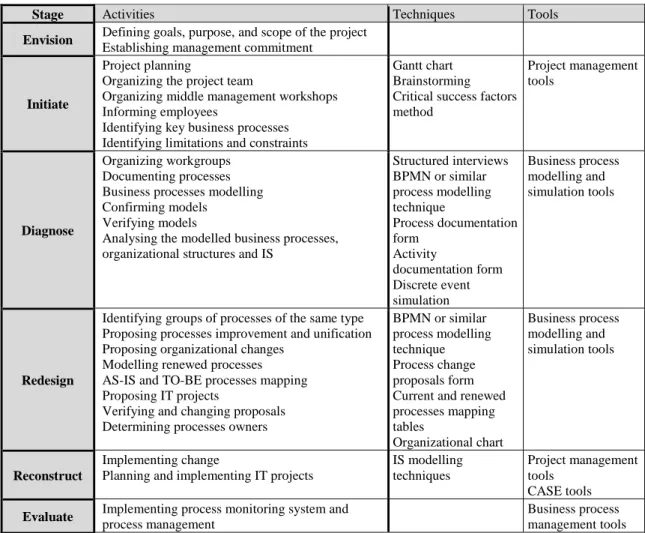
above observations and specifics. Since the radicalness of the projects in public sector is low, the emphasis should be on documenting the existing and analysing processes as proposed by Kettinger et al. (1997). Table 1 shows activities, techniques, and tools of the proposed methodology categorized by stages of a typical BPC project as proposed and validated by Kettinger at al. (1997).
Table 1: Stages, activities, techniques, and tools of BII methodology for the public sector
Stage Activities Techniques Tools
Envision Defining goals, purpose, and scope of the project
Establishing management commitment
Initiate
Project planning
Organizing the project team
Organizing middle management workshops Informing employees
Identifying key business processes Identifying limitations and constraints
Gantt chart Brainstorming Critical success factors method Project management tools Diagnose Organizing workgroups Documenting processes Business processes modelling Confirming models
Verifying models
Analysing the modelled business processes, organizational structures and IS
Structured interviews BPMN or similar process modelling technique Process documentation form Activity documentation form Discrete event simulation Business process modelling and simulation tools Redesign
Identifying groups of processes of the same type Proposing processes improvement and unification Proposing organizational changes
Modelling renewed processes AS-IS and TO-BE processes mapping Proposing IT projects
Verifying and changing proposals Determining processes owners
BPMN or similar process modelling technique Process change proposals form Current and renewed processes mapping tables Organizational chart Business process modelling and simulation tools Reconstruct Implementing change
Planning and implementing IT projects
IS modelling techniques
Project management tools
CASE tools
Evaluate Implementing process monitoring system and
process management
Business process management tools
3.1
Envision
In this stage the goals, purpose and scope of a BPC project are to be set.
Sincere commitment of the top management is considered to be the most important achievement of this stage and the critical success factor of the project. As ascertained by Thompson (2000) the sustained, demonstrated commitment of its top leadership to initiate and insist on the use of results-oriented management practices is necessary. In the public sector this could be one of the major problems due to the fact that this commitment is more of a formal nature, a consequence of public opinion pressure and not the truthful awareness of a need for a change. As BPC in the public sector are very often strongly constrained and related to the changes of laws, by-laws, regulations, commitment of top management should include a will to make the necessary changes in the regulations which fall under their competence and sometimes also to propose changes of laws and by-laws.
In the case of the Ministry the goal of the project was to do away with inefficiencies in business processes, to change the organizational structure, and to improve the information management practices. The main purpose was to make the processes as customer friendly (not cumbersome, short etc.) as possible. This has also been the main factor in redesigning the processes. As the key to delivering quality services is decreasing variability, unification and standardization of processes were strongly emphasised. The awareness of the necessity to change the processes has been achieved, also because of the lucky coincidence: at the time when the project started, the Slovene government also started the so-called anti-bureaucratic program.
By adopting the “Strategy of E-commerce in Public Administration for the Period 2001-2004” in February 2001 the Government of Slovenia has defined the primary strategic orientations for the next essential phase of informatization of public administration, which is the development of e-government. As a result, Slovenia is following a number of most developed European countries, which are approaching the accelerated development of e-government in a similar way (SEP-2004, 2001). Although, as a result, Slovenia has started a new developmental cycle of technological modernization of administration and have launched a number of new projects, we have concluded that development is not progressing as planned and expected. This is not only a problem in Slovenia, but, based on the analyses carried out in the EU, a problem in nearly all other countries as well (Kovacic & Jaklic, 2003). After a few years we can see that in most countries it was relatively easy to achieve stage I (cataloguing of information online), which refers to the introduction of information services, as this step does not require specific changes in internal operations of administration and in business processes and procedures. On the web pages of administrative bodies users can acquire plenty of useful and practical information, which makes it easier for them to find solutions to administrative affairs and to communicate with administration; however this is just the first development level of the e-government. The Ministry recognized that development changes in internal business processes are required for the next stage of e-government.
3.2
Initiate
In this stage the project is initiated, which includes project planning (time, finance, outcomes), organization of the project team, and identification of the key business processes, which will be analysed and redesigned.
In some organizations key business processes are already identified and listed but in others they are identified in a series of meetings using discussion and brainstorming techniques. Usually there are 5 to 10 key business processes (Harmon, 2003) that can be decomposed into several sub-processes. Top management commitment for process changes at this stage should be transformed in a way that the employees of all levels understand the goals of the project. Resistance to changes should be diminished and full participation of employees in the project ensured. As the public sector organizations are usually more rigid than profit organizations, we propose that related activities should be even more emphasised in a public sector BPC project. We propose that several workshops for middle management should be organized and all employees be informed about the project, its goals, and the expected outcomes.
As noted earlier, one of the obstacles for a radical business process is the limitations of the current regulations, constraints of the common organizational rules and procedures at the governmental level etc. The project team has to be familiar with these limitations and constraints and moreover with the realistic possibilities to change these regulations, rules, procedures.
In the case of the Ministry the project group consisted of members from the Ministry and consultants from the Business Informatics Institute (BII). A workshop for the ministry project group was conducted, in which the participants were acquainted with project goals and the methodology used. The workshop identified the key processes, which fall into the following five groups, as well: (1)
Strategic planning, (2) Working program preparation, (3) Preparation of laws and provisions, (4) Financial processes, and (5) Administrative processes.
The identification of the key processes was a three-phase process. Firstly, it was necessary for the project team members from the Ministry to fully understand the business process concept. Secondly, the list of all processes was prepared, and the last step was the selection of the processes to be renovated. The brainstorming technique was used in the second and the third step. Several criteria have to be used for the selection of processes. For example a process for which the renovation benefits are promising but has a very low frequency (e.g. once a year) was not considered for a change. A very useful technique at this point is identification of critical success factors (CSF) of the project.
3.3
Diagnose
The activities at this stage can be divided into two groups or phases. Firstly, the processes are modelled, and secondly they are analysed. As radicalness of BPC projects in the public sector is usually low and the current processes will be improved, documentation and analysis of the existing processes are important and should be detailed.
3.3.1 Business Process Modelling
Before the modelling of processes is conducted, workgroups are organized for different organizational units or areas. These workgroups consist of process actors, process modellers, and middle management. Since the understanding of the process concept is usually low at this stage, all the actors are not yet known, so the workgroups can be expanded later. It is our experience that, despite workshops in earlier stages actors and middle management usually fully understand the concept of processes, which flow through different organizational units after the process models are developed and presented.
Workgroups document the processes by means of structured interviews with activity actors. For documentation purposes two different forms are developed: the process documentation form and the activity documentation form. In this way all the (sub)processes and activities are documented in the same manner. The process documentation form consists of the following elements: (sub)process name, (sub)process number, process trigger(s) – events, inputs, detailed description, outputs, additional comments, proposals for improvements, evaluation (cycle time, frequency, splits and decision points frequencies for each output etc.). And the activity documentation form consists of: organizational unit, process name, activity number, activity name, actors and other required resources, inputs, detailed description, outputs, evaluation (average/min/max time, number of available resources, costs), additional comments and proposals for improvements, attachments. The documentation also includes organizational structure documentation and IS support documentation (description and additional comments).
Processes are usually modelled in several iterations. Designed models are presented to workgroup members, who change them according to their observations. It is essential for each process model and process description to be confirmed at the end of the modelling phase by a responsible person (usually a middle manager) to avoid possible misunderstandings in the future stages of the project.
For business process modelling we suggest to use a technique that supports development of models, which are very clear and easily understood by non-specialists. Business Process Modelling Notation (BPMN) is becoming the de-facto standard technique for business process modelling and is supposed to be easy to use and understand, but also to provide the ability to model complex business processes. In the case of the Ministry the processes were modelled by interviewing the actors and middle management. iGrafx Process tool, which supports the Enhanced Process Maps (EPM) modelling technique, was used for business process modelling. The EPM technique was selected, as at the time
the required properties, such as simplicity and expressiveness, sufficient for the BPC type of projects and is very similar to BPMN.
This phase of the project was utterly resource consuming and lasted for almost six months. Models had to be changed several times based on the comments of the workgroup members and verification made by the consulting team. A number of ambiguities were discovered and removed in the modelling activity and the actors were acquainted with the “process way of thinking”. It was difficult to evaluate the duration for some activities. During verification several inconsistencies in the models have been discovered, e.g. when the activity durations were multiplied by the process frequency the result was much higher than the number of working hours of the available resources.
3.3.2 Analysis of key business processes on the basis of their models
In this phase a qualitative and a quantitative analysis of the current (AS-IS) processes is conducted. It very often appears that the same processes are implemented in a different way for different in different organizational units. People are usually not aware of these differences, so the BPC project is a good opportunity to acquaint them with this problem and unify the processes of the same type. The unification can lead to the improvement of customer orientation.
The analysis results can be presented at different levels. In case of a group of similar processes there are findings for the group as a whole, and then for each process. Apart from the findings of the analysis some data from the models and process documentation, which might be of interest in the redesign phase, are presented in the analysis report.
At this point at the Ministry several processes were analyzed using simulation as well. Processes for such detailed analysis were selected by using the criteria such as: frequency of process execution, quantity of consumed resource, level of observed problems, etc.
3.4
Redesign
Process redesign based on the findings of the analysis calls for the application of creative thinking techniques (such as brainstorming). Firstly, groups of similar processes that can be defined as one TO-BE process are identified and then new, renovated processes are designed.
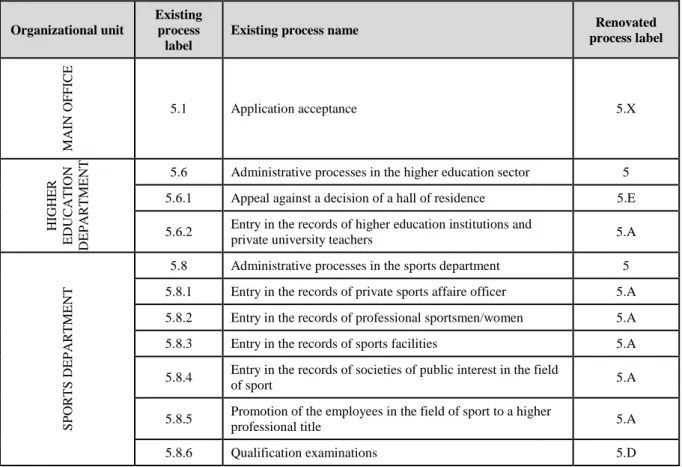
As mapping between AS-IS and TO-BE processes is not 1:1, proposed new processes are relabelled. We use letters to label TO-BE processes. Usually one TO-BE process corresponds to several unified AS-IS processes. Two tables which present mapping between the current and the renewed processes (and vice versa) are built (see Tables 2 and 3).
As evident from the two tables, the existing-to-the-renovated-processes mapping is not just about relabelling, regrouping and unification. The main achievement of different classification (and consequently different labelling) is completely changed view on business processes. Before the change the processes had been grouped by departments (e.g. higher education department processes, sports department processes etc.). After the changes employees started to understand that process view is horizontal (process flows through several departments), that processes are cross-departmental. This was one of the main breakthroughs in the employees understanding of business processes. Proposals of new processes are described by using standardized forms. Like for the findings of the current processes analysis, proposals for changes are presented in two levels: for each process group and then for each individual process. Proposals were made on the basis of the analysis of the process modells, descriptions, simulation, regulations etc. The standardized form for proposals consists of the following elements: (sub)process name, (sub)process label, corresponding processes labels, process owner, process model, event(s), input, description, output, changes by activities, other findings and proposals, resources, and findings, relevant to information management improvements.
Table 2: Mapping of the existing to the renovated processes (A segment of the entire catalogue) Organizational unit Existing process label
Existing process name Renovated
process label M A IN O F F ICE 5.1 Application acceptance 5.X H IG H E R E D U CA T IO N D E P A RT M E N T
5.6 Administrative processes in the higher education sector 5
5.6.1 Appeal against a decision of a hall of residence 5.E
5.6.2 Entry in the records of higher education institutions and
private university teachers 5.A
S P O RT S D E P A RT M E N T
5.8 Administrative processes in the sports department 5
5.8.1 Entry in the records of private sports affaire officer 5.A
5.8.2 Entry in the records of professional sportsmen/women 5.A
5.8.3 Entry in the records of sports facilities 5.A
5.8.4 Entry in the records of societies of public interest in the field
of sport 5.A
5.8.5 Promotion of the employees in the field of sport to a higher
professional title 5.A
5.8.6 Qualification examinations 5.D
Table 3: Mapping of the renovated to existing the processes (A segment of the entire
catalogue)
Renovated
process label Renovated administrative process name Existing process labels
5.A
Maintenance of records of societies, private officers, professional and top-level sportsmen/women, legal personalities, and sports facilities. Satisfying the conditions for financing of a private kindergarten.
5.2.1, 5.5.1, 5.6.2, 5.7.1, 5.8.1, 5.8.2, 5.8.3, 5.8.4, 5.8.5, 5.9.2, 5.9.5, 5.10.4,
5.10.6
5.B Consent to the establishment of education, science, or sport institution act
5.9.3
5.C Nostrification of foreign diplomas 5.10.1
5.D Qualification examinations in the fields of education and sport 5.8.6, 5.10.5
5.E Second level processes
5.2.2, 5.3.1, 5.3.2, 5.4.1, 5.6.1, 5.9.1, 5.9.4, 5.9.6,
5.10.2
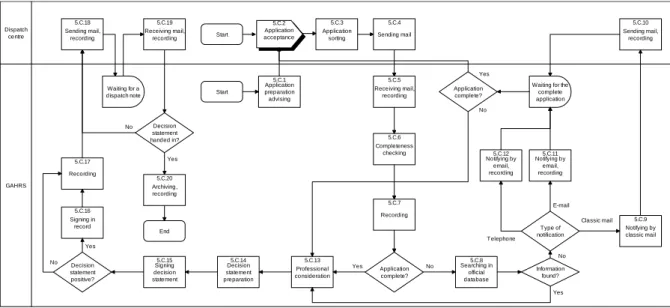
In the case of the Ministry the main guidance in the redesign stage was the goal to simplify the processes, improve information management and provide better services for customers (institutions, citizens etc.). Secondary goals were shorter cycle times, unburdening of employees, and lower costs. There were several cases of the same process carried out differently in different areas. For instance the process “Promotion of the Employees to a Higher Professional Title” had been executed in a different way in the sports department (labelled as 5.10.6) and in the educational department (5.8.5). The renovated process labelled 5.C (see Figure 1) is only one for both departments. Of course the substantial activity Professional Consideration (5.C.13) is specific in both departments and requires different professionals with specific knowledge.
Figure 3: Redesigned process Promotion of Employees
The fact that from the point of view of process flows several processes were unified makes the whole administrative function of the Ministry less complex in the eyes of the customers. Additionally one stop shops in the form of services centres shared by different departments were proposed. The shared services centres can be helpful for avoiding long-lasting search processes and avoids the confusion about responsibilities to the users (Janssen & Joha, 2006).
3.5
Reconstruct and Evaluate
In the last two phases of a BPC project the proposed changes have to be implemented. The reconstruction also encompasses IS projects planning and implementation. Continuous improvement requires that processes are monitored continuously to identify changes in overall quality level, therefore a process-monitoring system (or process management system) is to be implemented at a later stage.
The Ministry has started the reconstruction phase. It is quite limited in IS projects planning and implementation, because it depends on the internal regulation for all governmental institutions in Slovenia. However, the project has certainly brought about many benefits for them. One of the main benefits is that the processes are now known and are performed in a much more uniform way than before. To make the new way of work easier and to acquaint people with new renewed business processes the models are published on the internal web pages of the Ministry. Is simplifies change management and also provides an unambiguous way of process implementation.
Dispatch centre GAHRS Start Sending mail, recording 5.C.18 Receiving mail, recording 5.C.19 Waiting for a dispatch note Recording 5.C.17 Signing in record 5.C.16 Start Decision statement positive? No Yes Decision statement handed in? No Archiving, recording 5.C.20 Yes End Signing decision statement 5.C.15 Application preparation advising 5.C.1 Application acceptance 5.C.2 Application sorting 5.C.3 Sending mail 5.C.4 Receiving mail, recording 5.C.5 Completeness checking 5.C.6 Application complete? Professional consideration 5.C.13 Decision statement preparation 5.C.14 Recording 5.C.7 Searching in official database 5.C.8 No Yes Application complete? No Yes
Waiting for the complete application Sending mail, recording 5.C.10 Type of notification Notifying by email, recording 5.C.11 Notifying by classic mail 5.C.9 Classic mail E-mail Notifying by email, recording 5.C.12 Telephone Information found? No Yes
4.
Discussion and Conclusion
Although the public sector has many limitations (e.g. rigid structures and political reasons) BPC is of importance also for this sector especially to successfully execute e-government. The paper presented the methodology for BPC projects in the public sector. The methodology is based on the general framework for BPC methodologies, techniques and tools (Kettinger et al., 1997) and is customized for governmental institutions due to their specifics, e.g. projects radicalness. It has been successfully employed in some process improvement projects, e.g. in a BPC project at one of the Slovene ministries and this project has been used in the paper as a case study, and is applicable to other governmental organizations.
Before this project the processes at the Ministry were neither documented nor defined. Jobs were organized strictly upon the traditional functions. Departments that should be the owners of the processes (e.g. financial department) had no influence on these processes (e.g. financial processes) performance in other departments. Now the processes are documented, known and performed in a much more uniform way than before, models are published on the organizational internal web pages, process managers are appointed. The process managers have responsibility to harmonize all the necessary future changes in all departments, so changes to the processes must now go through a formal procedure. The financial department for instance is the owner of all the financial processes and now has cross-departmental jurisdiction. The crucial achievement is that the way of thinking has been changed and as a consequence information management and sharing is improved. The results of the project also directly influence the government initiatives of all forms; more complex transactional e-services are now possible.
A potential for IT enablement is also one of the important characteristics of BPC projects that have influence on the methodology customization (Kettinger et al., 1997). The potential depends on the involvement of different institutions. If only one organization from the public sector (e.g. Ministry) is involved in a BPC project, then the potential for IT enablement is low, because it cannot decide about IT infrastructure and IS independently of other institutions (e.g. other ministries that have to use the same application). However, in the case of a larger BPC project, e.g. for all state institutions, the potential for IT enablement is quite high. Therefore BPC projects should be performed for more public institution simultaneously.
Lately, business process management methods and systems that enable process modelling, analysis, and also their automation and performance measurement are emerging (Smith & Fingar, 2003). Such systems will be applicable to governmental processes as well and will probably change BPC methodologies. The adoption of the proposed methodology with regard to business process management is left for the future work.
5.
References
Al-Mashari, M., & Zairi, M. (1999). BPR implementation process: an analysis of key success and failure factors. BusinessProcess Management Journal. 5, (1), 87-112.
Beynon-Davies, P. (2005). Constructing electronic government: the case of the UK inland revenue.
International Journal of Information Management, 25, 3–20.
Business Process Modelling Notation. Available at: http://www.bpmi.org/, Accessed October 15, 2004.
Bosilj-Vuksic, V., Indihar Stemberger, M., Jaklic, J., & Kovacic, A. (2002). Assessment of E-Business Transformation Using Simulation Modelling. Simulation, 78, (12), 731-744. Cats-Baril, W., & Thompson, R. (1995). Managing Information Technology Projects in the Public
Davenport, T. H. (1998): Putting the Enterprise into the Enterprise System. Harvard Business Review, 76, (4), 121-131.
Di Mario, A. (2001). E-Government: What Are Citizens Really Looking For. Available at: http://www4.gartner.com. Accessed June 22, 2001.
Gil-Garcia, J. R., & Pardo, T. A. (2005). E-government success factors: Mapping practical tools to theoretical foundations. Government Information Quarterly, 22, 187-216.
Gupta, M. P., & Jana, D. (2003). E-government evaluation: A framework and case study. Government
Information Quarterly, 20, 365–387.
Harmon, P. (2003). Business Process Change: A Manager’s Guide to Improving, Redesigning, and
Automating Processes. San Francisco: Morgan Kaufmann Publishers.
Hernon, P., Reylea, H. C., Dugan, R. E., & Cheverie, J. F. (2002). United States government
information: Policies and sources. Westport, CT: Libraries Unlimited.
Janssen, M., Joha, A. (2006): Motives for establishing shared service centers in public administrations. International Journal of Information Management, 26, 102–115.
Joia, L. A. (2004): Developing Government-to-Government enterprises in Brazil: a heuristic model drawn from multiple case studies. International Journal of Information Management, 24, 147– 166.
Kettinger, W.J., Teng,T.C., & Guha, S. (1997). Business process change: A study of methodologies, techniques, and tools. MIS Quarterly, 21, 1, 55-81.
Kovacic, A., & Jaklic, J. (2003). E-government is more than just portals and web pages. In Slovene. In: Proceedings of the INDO 2003 Conference, (pp. 303-312). Ljubljana: Government information centre.
Kumar, V., Maheshwari, B., & Kumar, U. (2002). ERP systems implementation: Best practices in Canadian government organizations. Government Information Quarterly, 19, 147–172. Lianga, H., Xueb, Y., Byrd, T. A., Kellly Rainer Jr., R. (2004): Electronic data interchange usage in
China’s healthcare organizations:the case of Beijing’s hospitals. International Journal of
Information Management, 24, 507–522.
McCormack, K., & Johnson, W. (2001). Business Process Orientation: Gaining the E-Business
Competitive Advantage. Delray Beach, FL: St Lucie Press.
Mutula, S. M., van Brakel P. (2006): An evaluation of e-readiness assessment tools with respect to information access: Towards an integrated information rich tool. International Journal of
Information Management, 26, 212–223.
SEP-2004 (2001). Strategy of E-commerce in Public Administration for the Period 2001-2004 Version 1.2, Slovenia Available at: http://mid.gov.si/, Accessed September 10, 2003.
Smith, A. G. (2001): Applying evaluation criteria to New Zealand government websites. International
Journal of Information Management, 21, 137-149.
Smith, H., & Fingar P. (2003). Business process management: the third wave. Tampa: Meghan-Kiffer Press.
Tenner, A. R., DeToro, I. J. (1997). Process Redesign: The Implementation Guide for Managers. Reading, MA: Addison-Wesley.
Thompson, J. R. (2000). Reinvention As Reform: Assessing the National Performance Review. Public
Administration Review, 6, (60), 508-521.
Torres, L., Pina, V., & Acerete, B. (2005). E-government developments on delivering public services among EU cities. Government Information Quarterly, 22, 217–238.
Trkman, P., Indihar Stemberger, M., Jaklic, J. (2005). Information transfer in supply chain
Williams, S. P., Scifleet, P. A., Hardy, C. A. (2006): Online business reporting: An information management perspective. International Journal of Information Management, 26, 91–101.