Measuring and Characterizing Cache Coherence Traffic
Tuan Bui, Brian Greskamp, I-Ju Liao, Mike Tucknott CS433, Spring 2004
Abstract
Cache coherence protocols for shared-memory multiprocessors have been well-studied. Here we present a trace-driven cache simulator used to derive network traffic statistics for three simple coherence protocols and three directory formats. Results for the SPLASH benchmarks are compared with published results and found to be in agreement. A short discussion of the strengths and weaknesses of each coherence scheme ensues.
1 Introduction
Cache coherence protocols and directory schemes were a popular topic in the late 1980s. Little new material on hardware cache coher-ence has appeared since then, and interest has shifted from large-scale shared memory ma-chines to message-passing clusters. However, shared-memory multiprocessors are being re-born in the form of the chip multiprocessor. As CMPs grow to include more cores, the cache co-herence problem may again draw research inter-est. In the meantime, we have undertaken an empirical performance study in order to bet-ter understand the strengths and weaknesses of both invalidation and update protocols in snoopy and directory-based systems. Good sur-veys on cache coherence protocols already exist [4,1,2], so this paper does not aspire to novelty. Instead, it attempts to validate and reinforce the earlier work with independent simulation results.
This paper considers both snoopy (ie. bus-based) and directory-based systems. It
cov-ers both sparse and full-directory schemes and both write-update and write-invalidate proto-cols. The SPLASH/SPLASH-2 [9, 7] scientific benchmarks are used to evaluate the amount of network traffic for each system. The results are compared with those of previous work, yielding conclusions about the efficacy of each protocol for various applications.
The remainder of this paper is organized as follows. Specifications for the protocols and directory schemes appear in section 2. The tools used in the study, including a trace-driven cache simulator, a multiprocessor simulator, and a benchmark suite feature insection 3. Sec-tion4details the cache system simulator. Sim-ulation results appear in section 5. Section 6 discusses the strengths and weaknesses of each configuration, and finally,section 7concludes. 2 Protocols
This section specifies the cache coherence protocols and directory formats used through-out the paper. Two invalidation-based proto-cols are considered: the simple three-state in-validation or ‘MSI’ protocol and the Illinois [6] or ‘MESI’ protocol. DEC Firefly [8], an up-date protocol designed for small-scale snoopy systems, is also considered. All three of these protocols can operate on a shared bus in snoopy fashion or on a non-broadcast interconnect with the help of a directory. In snoopy mode, any PE has the ability to send a broadcast to all other caches in a single bus cycle. On a non-broadcast interconnect, a directory and asso-ciated controller are needed to maintain the shared state of each cache line and notify caches when a line’s state changes. The following
paragraphs briefly describe the operation of each protocol in both the snoopy and directory-based cases.
Note that some details such as ACKand NAK
messages are missing from our protocol mod-els. In a real system, every coherence transac-tion has a request and a response phase. For simplicity, we omit the response phase. This should not be a problem since we do this con-sistently for all protocols and since the number of messages comprising the response phase is equal to the number sent in the request phase, so it does not affect theproportion of the mes-sages.
Three State Invalidation A cache line may
be in one of three states: dirty, shared, or
invalid. Before making a line dirtyby
writ-ing to it, a cache must first broadcast an in-validation for that line to all other caches in the system. In a snoopy system, this is accom-plished by sending a singlesnoopy invalidate
message onto the bus. In directory mode, the protocol must send a make dirty message to the directory. The directory is then responsible for sendinginvalidatemessages to any caches that might have the line. The snoopy system handles the dirty read-miss case easily. In the directory system, the directory must check to see if any processor has the line dirty before re-turning data from memory on a read request. The directory will send a writeback request
to the dirty cache. The dirty cache obeys the message by writing the line back and supplying it to the requesting processor.
Illinois Also known as “MESI”, Illinois
builds on three-state invalidation by adding an
exclusive state. A line is exclusive when
there is only one sharer and that sharer has not yet written to the line. No coherence traf-fic is required to transition from exclusive
to dirty. It works well on snoopy systems
which have hardware support to allow a cache to determine if it is the only sharer. In a directory-based system, the directory must
re-gardexclusive lines as dirty since the cache
may write the line without notifying the direc-tory. Thismay cause extraneous traffic (in the form of writeback requests for lines which are not actually dirty.
Firefly An update protocol, Firefly was
de-signed for small bus-based systems. Its states
are: exclusive,shared, dirty, andinvalid.
On a write hit to asharedline, the cache must broadcast an update to all other sharers. On a read miss, the cache tests a special line on the bus to determine whether it should have the line in shared or exclusive mode. As with the Illinois protocol, when operating in direc-tory mode, an exclusive line may transition
todirtywithout notifying the directory.
2.1 Directory Formats
In directory-based systems, a single proto-col transaction such as an invalidation may re-quire many messages to be sent. The number of messages that will be sent depends on the num-ber of sharers and the granularity with which state data is kept in the directory. We con-sider three directory formats: DirN, DirI, and DirICV. DirN maintains a complete bit
vec-tor for each line of memory, recording the state of that line for every processor in the system. With the full bit vector, the directory knows exactly which caches need to receive invalida-tions and updates, so network traffic is at a minimum. On the other hand, the bit vector consumes a significant amount of memory for large systems. DirI saves memory by keeping a limited number of pointersito sharers for each line. When the number of sharers exceeds i, a broadcast bit is set and the directory conserva-tively assumes that all caches have a copy of the line. A variant of DirI is DirICV. The directory
enters “coarse vector” mode when the number of sharers exceeds i. In coarse vector mode, each bit in the directory entry is used to store the state for a group of processors. Withn pro-cessors, the size of a group is dn/dlg(n)×iee.
3 Tools
A trace-based simulator was used to count protocol coherence messages. The simulator is discussed in detail in section 4. Traces for the simulator were generated with the RSIM [] multiprocessor simulator running SPLASH/SPLASH-2 [] benchmarks. The fol-lowing sections discuss the simulation proce-dure in detail.
3.1 Memory Trace Generation
We use RSIM [5] to generate our memory traces. RSIM is a shared-memory multisor simulator that models superscalar proces-sors connected to a CC-NUMA memory sys-tem. We modified RSIM to generate a trace file which contains a line for each memory ac-cess a proac-cessor makes. The line includes the processor ID, the memory address, and whether the access was a read or a write. We use select programs from the SPLASH/SPLASH-2 appli-cation suite running on RSIM to generate our traces.
3.1.1 Simulator Overview
RSIM is an execution-driven simulator de-signed to study multiprocessor system build from superscalar PEs. Its processor model is more representative of current and near-future processors than other currently available mul-tiprocessor simulators. Since RSIM models an out-of-order processor with parallel issue, mem-ory access patterns correspond more closely to those of real-world advanced processors than if we had used a simulator with a more simplistic in-order or single-issue-width processor model.
3.1.2 Modifications
The only modification made to RSIM is a call to print each memory access (on the proces-sor side) to our memory trace file (henceforth,
memfile). Memfile sizes range from the high
hundreds of megabytes to the low gigabytes for each application run.
3.2 Simulated Applications Overview
The Stanford ParalleL Applications for SHared memory (SPLASH) and The improved SPLASH (SPLASH-2) are suites of parallel pro-grams written for cache-coherent shared mem-ory machines. For this project, three programs were chosen from the SPLASH-2 suite to run on RSIM. The three programs from SPLASH-2 are FFT, LU, and Radix. The program cho-sen from SPLASH was MP3D. The following sections give a brief description of each of the programs used.
MP3D In this N-body simulation program, each processor computes the movement of a set of molecules. Since the partitioning of molecules is not related to its position is space, each processor must access the space array to complete its computation. This causes proces-sor locality to be low. Contention for the same data occurs when two processors compute on molecules that occupy the same space cell.
FFT The FFT Kernel implements Bailey’s six-step fast fourier transform. Bailey’s six-step fft is described in [3] This in an improved FFT for hierarchical memory systems. Every proces-sor is assigned a contiguous set of rows. Com-munication is mainly through 3 all to all matrix transpose steps. The transposes are blocked to exploit reuse of the cache lines.
LU The LU Kernel performs the LU matrix factorization. A dense square matrix A is di-vided into an array of B ×B blocks and dis-tributed among the processors. The elements within the blocks are allocated to improve spa-tial locality.
Radix In this radix sort algorithm, each
processor generates a set of local histograms. These histograms are then combined into one large, globally shared histogram. The global histogram is then used to generate keys for the next iteration. Communication is all to all mainly through writes.
4 Simulated Cache System
A custom-written cache simulator processes the memory access traces from RSIM. The sim-ulator is designed to be extensible, capable of implementing a wide range of directory-based and snoopy cache coherence protocols. For sim-plicity, the intricacies of the interconnect net-work are ignored, and reliable equal-cost mes-sage delivery is assumed between all nodes. The following sub-sections discuss the simu-lator abstractions and their implementations. The meanings of the various statistics reported by the simulator are also enumerated.
4.1 Implementation Overview
An important observation is that the direc-tory format (DirN, DirI, DirICV) is logically
separate from the coherence protocol. There-fore, the two are implemented as separate mod-ules in the simulator. With this separation, p cache protocols and v directory formats can simulate a total ofp×v distinct cache systems with only O(p+v) implementation effort. Each coherence protocol and each directory format is implemented as a dynamically loadable library that exports a common interface. At runtime, the simulator customizes itself by loading the protocol and directory format specified on the command line. New protocols and directory formats can thus be added by simply compiling a new shared object (.so) file. Consequently, the use dynamic rather than static linking sim-plifies the task of adding new protocols to the distribution. On the other hand, it is detrimen-tal to portability.
In order to serve a wide range of protocols, the interface to the directory schemes and pro-tocol state machines was carefully considered. Among the compromises that were made in the name of simplicity are that the directory does not support dirty sharing; no line can simul-taneously be dirty in two or more processors’ caches. Also, instead of a distributed directory, a central directory equidistant from all proces-sors is assumed.
4.2 Per-Processor Cache Implementation
The simulator contains an array of caches (one per processor) wrapped in the cache sys
module. All of the caches in the system have identical parameters (ie. size, associativ-ity, line length, and replacement policy). The
cache sysAPI allows the caller to perform the
following operations on a particular cache, ad-dressed by processor number:
touch(address) If the given address is not in
the cache, allocate a line for it and mark it valid, evicting a resident line if neces-sary. Move the line to the tail of the LRU replacement queue.
set state(address, state) Set the state of
the line containing the specified address. State can be any protocol-defined integer value. If state=-1, invalidate the line.
get state(address) Return the state set by
the most recent call toset state or−1 if the line is not cached.
4.3 Directory Implementation
In addition to the per-processor states kept in the cache line, the simulator uses a central-ized directory to store information about which processors have copies of a given line. The di-rectory is implemented as a sparse data struc-ture, containing lines only for data that the di-rectory believes currently exists in some proces-sor’s local cache.
Each line in the directory has a ‘share state’ and a list of sharers1. The share state is the global state of the line. All caches that have the line are in the same share state. The list of sharers is to be interpreted as a conserva-tive listing of processors thatmighthave a copy of the line. Each directory format implements functions to extract the share state and sharer list from a directory entry as follows:
1not necessarily implemented as a list, depending on
get share state(entry) Return the share state for the given entry.
set share state(entry, state) Set the
share state for the specified entry.
clear sharers(entry) Clear the sharers list
for the given entry.
get is sharing(entry, proc) Return true if
the specified processor is sharing the line associated with this entry.
set is sharing(entry, proc, is sharing)
If is sharing is true, add the specified
processor to the list of sharers. If
is sharingis false, remove it.
The directory provides an API for retrieving a directory entry for each cache line as follows:
touch(address) If the given address is not in
the directory, allocate an entry for it and set the share state toINVALID.
get entry(address) Return the directory
en-try for the given address.
4.4 Protocol Implementation
Each protocol implements four functions, each corresponding to a different event that the protocol must process. At the simulator top level, the trace feeds read and write events to the protocol. As the protocol manipulates the directories and the local caches, those objects also generate events to the protocol via two call-back functions. The interface is as follows:
read(address, processor) Invoked by the
top level whenever the trace specifies a read event.
write(address, processor) Invoked by the
top level whenever the trace specifies a write event.
evict(address, processor, state)
Invoked by a processor’s local cache when it must evict a line on a write miss.
Depending on the state of the line being evicted, the protocol may need to write it back.
invalidate(address, processor) Invoked
by the directory when using a directory entry format with a limited number of sharer pointers and an old pointer must be deallocated to make room for a new sharer (would be needed to implement DirIN B).
4.5 Output
The protocol module keeps track of the num-ber of messages sent. These statistics will form the basis for the protocol comparison. The fol-lowing counters are maintained and dumped to
stdoutat the end of the simulation:
bus reads Number of times data is read into
a cache.
bus writes Number of write-backs to memory.
invalidations Number of invalidation
mes-sages sent. An invalidation to n nodes counts asn. Unused in snoopy mode.
snoopy invalidations Number of
invalida-tion broadcasts in snoopy mode. Unused in directory mode.
updates The number of point-to-point update
messages in directory mode. Unused in snoopy mode.
snoopy updates Number of update broadcasts
in snoopy mode. Unused in directory mode.
writeback reqs Number of point-to-point
messages from the directory to caches requesting the caches to write back a specified line.
make dirty msgs Number of point-to-point
messages from the caches to the directory requesting that the directory mark the line as dirty.
eviction notification How many lines have been evicted from the caches due to conflicts (not bus traffic).
5 Results
This section uses the cache simulator of sec-tion 4to measure network traffic. For all of the simulations, the cache size is 128KB with 4-way set asscoiativity and 64-byte lines unless other-wise noted. The working sets for all bench-marks except Radix fit comfortably within the caches, so conflict and capacity misses should be at a minimum.
5.1 Sparse Directories
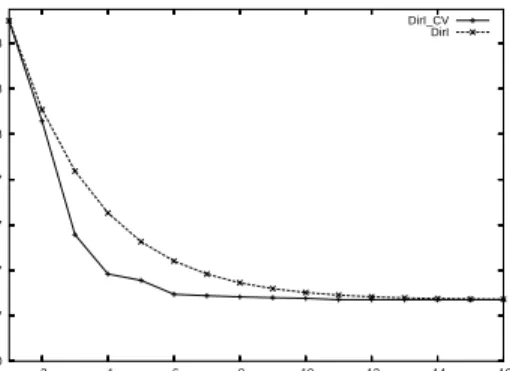
To test the cache simulator and evaluate the three directory formats, a memory trace was generated stochastically. 64 processors access memory addresses with a gaussian random dis-tribution. The center address µ is the same for each processor and σ =s/2 where s is the cache size in bytes. Figure 1 shows the total amount of network traffic on a trace with ten million accesses, 30% of which are writes. The full directory DirN scheme caused 27,033,133 coherence messages. Since a sparse directory for a 64 processor machine requiresdlg(64)e ×i bits, it is only profitable to build the sparse di-rectory with fewer than eleven pointers. Within the feasible range fori, DirICV performs
signif-icantly better than DirI, approaching optimal-ity at i= 6.
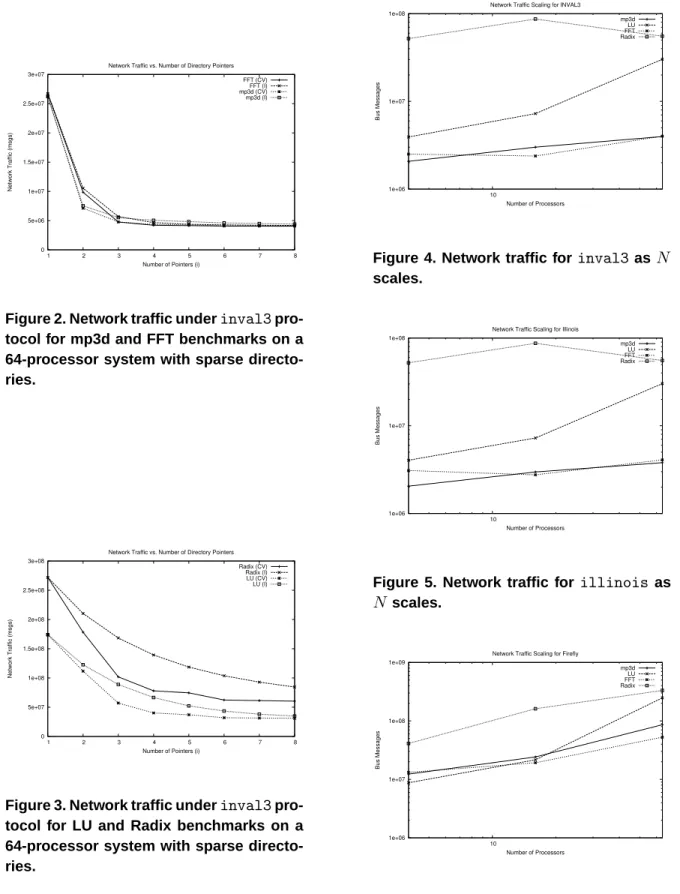
In order to understand behavior of sparse directories on the SPLASH/SPLASH-2 bench-marks, each benchmark was executed on a 64-processor system using theinval3protocol for all three directory formats. Figure2 shows the effect of varying the number of sparse directory pointers from 1 to 8 for the mp3d and FFT benchmarks. Figure3 varies the same parame-ter for the LU and FFT benchmarks. LU and Radix benefit from the coarse vector optimiza-tion much more than mp3d and FFT. With three pointers, the coarse vector optimization reduces network traffic over DirI by 36% for
0 2e+07 4e+07 6e+07 8e+07 1e+08 1.2e+08 1.4e+08 2 4 6 8 10 12 14 16
Total Network Traffic (msgs)
Number of Pointers (i) Network Traffic for Sparse Directories
DirI_CV DirI
Figure 1. Network traffic for inval3
pro-tocol with gaussian random memory ac-cesses on a 64-processor system with sparse directories.
LU, 40% for Radix, 16% for FFT, and 14% for mp3d.
Having characterized the directory perfor-mance and seeing that the DirI scheme per-forms much more poorly than DirICV, the
re-mainder of this paper focuses on determining the scalability of the various coherence schemes given a full directory. For the four bench-marks examined here, a DirICV directory with
six pointers would have performance almost equivalent to the full directory assuming a 64-processor system.
5.2 Directory-Based Protocols
Figures4,5, and6show the total number of coherence messages for a directory-based sys-tem running inval3, illinois, and firefly
respectively. The results for illinois and
inval3 are practically indistinguishable, but
firefly produces much more traffic than the
invalidation protocols in most cases. For invali-dation protocols, LU traffic is expectes to scale asO(√N) whereN is the number of processors [4]. FFT and Radix are predicted to be O(1). Both predictions appear to hold2.
Another important metric is the number of
2
0 5e+06 1e+07 1.5e+07 2e+07 2.5e+07 3e+07 1 2 3 4 5 6 7 8 Network Traffic (msgs)
Number of Pointers (i) Network Traffic vs. Number of Directory Pointers
FFT (CV) FFT (I) mp3d (CV) mp3d (I)
Figure 2. Network traffic underinval3
pro-tocol for mp3d and FFT benchmarks on a 64-processor system with sparse directo-ries. 0 5e+07 1e+08 1.5e+08 2e+08 2.5e+08 3e+08 1 2 3 4 5 6 7 8 Network Traffic (msgs)
Number of Pointers (i) Network Traffic vs. Number of Directory Pointers
Radix (CV) Radix (I) LU (CV) LU (I)
Figure 3. Network traffic underinval3
pro-tocol for LU and Radix benchmarks on a 64-processor system with sparse directo-ries. 1e+06 1e+07 1e+08 10 Bus Messages Number of Processors Network Traffic Scaling for INVAL3
mp3d LU FFT Radix
Figure 4. Network traffic forinval3asN
scales. 1e+06 1e+07 1e+08 10 Bus Messages Number of Processors Network Traffic Scaling for Illinois
mp3d LU FFT Radix
Figure 5. Network traffic for illinoisas
N scales. 1e+06 1e+07 1e+08 1e+09 10 Bus Messages Number of Processors Network Traffic Scaling for Firefly
mp3d LU FFT Radix
Figure 6. Network traffic forfireflyasN
100000 1e+06 1e+07 1e+08 10 Read Misses Number of Processors Read Miss Scaling for INVAL3
mp3d LU FFT Radix
Figure 7. Bus reads under inval3 as N
scales. 100000 1e+06 1e+07 1e+08 10 Read Misses Number of Processors Read Miss Scaling for Illinois
mp3d LU FFT Radix
Figure 8. Bus reads underillinoisasN
scales.
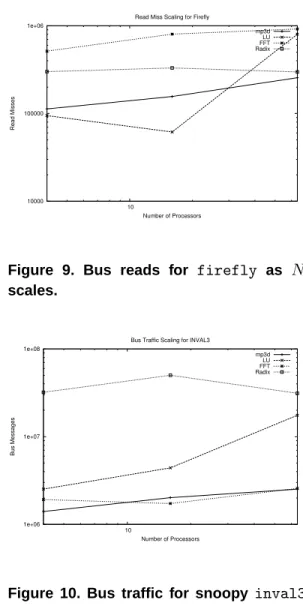
bus reads incurred by each protocol. Assuming a network of sufficient capacity to handle all of the protocol messages, bus reads will be the main cause of processor stalls. Figures7,8, and 9show how the number of bus reads scales with system size forinval3,illinois, andfirefly
respectively. Here, Firefly is the clear winner with an order of magnitude fewer bus reads in many cases.
5.3 Snoopy Protocols
If the coherence protocol remains unchanged, the number of bus reads remains constant when switching from a DirN directory-based system
10000 100000 1e+06 10 Read Misses Number of Processors Read Miss Scaling for Firefly
mp3d LU FFT Radix
Figure 9. Bus reads for firefly as N
scales. 1e+06 1e+07 1e+08 10 Bus Messages Number of Processors Bus Traffic Scaling for INVAL3
mp3d LU FFT Radix
Figure 10. Bus traffic for snoopy inval3
asN scales.
to a snoopy system. However, the number of protocol messages changes since the snoopy bus allows invalidation and update messages to be broadcast. Figures 10, 11, and 12 show the message counts for the benchmark traces, tak-ing advantage of the broadcast capability. In these plots, invalidating or updating all proces-sors in the system costs only 1 message. 6 Analysis
This section contains a discussion of each protocol’s strengthss and weaknesses, based on the data from the previous section. Topics in-clude the apparent poor performance of Firefly,
1e+06 1e+07 1e+08 10 Bus Messages Number of Processors Bus Traffic Scaling for Illinois
mp3d LU FFT Radix
Figure 11. Bus traffic for snoopyillinois
asN scales. 1e+06 1e+07 1e+08 10 Bus Messages Number of Processors Bus Traffic Scaling for Firefly
mp3d LU FFT Radix
Figure 12. Bus traffic for snoopyfirefly
asN scales.
an evaluation of sparse directory performance, and an explanation of the apparent equiva-lence between Illinois and three-state invalida-tion protocols.
6.1 Update vs. Invalidation
In general, it is expected that write-update protocols will perform well when shared data exhibits the producer-consumer pattern. In the presence of other sharing patterns, they pro-duce large amounts of bus traffic but still de-liver the lowest-possible cache miss rate. The write-invalidate protocols have modest bus traf-fic for all sharing patterns but suffer high miss rates in the producer-consumer pattern. Un-surprisingly, for the scientific SPLASH-2 work-load, update protocols scaled poorly. One ex-ception was Radix, where each processor writes to a shared buffer after performing its local sort. Each processor then reads the data from the shared buffer.
The Firefly protocol’s high message rates on te SPLASH benchmarks are justified by the fact that it was originally designed for a small-scale SMP workstation; it was never intended to be directory-based or to be scaled to a large number of processors. Workstation-class UNIX workloads would benefit from a write-update protocol, since the traditional parallel program-ming model on UNIX calls for multiple pro-cesses communicating through sockets or pipes. The processes share no memory except for the kernel buffers used for communication. Pipes implemented on top of shared memory exhibit exactly the kind of producer-consumer behavior at which Firefly excels. Firefly also has the ad-vantage of guaranteeing a lower read-miss rate than the invalidation protocols at the expense of greater bus traffic.
With two or four processors, the extra traf-fic is probably manageable, but problems can arise with process migration on even a small system. Each time a process is scheduled onto a different CPU than the one on which it pre-viously ran, the coherence protocol will con-tinue to update stale lines in the old
proces-sor’s cache. Consequently, in spite of its excel-lent handling of sockets and pipes, Firefly has fallen out of favor and most current SMP sys-tems use invalidation protocols. Invalidation protocols efficiently support a wider variety of communications patterns.
In an invalidation protocol, a processor must fetch the line from another cache on a dirty miss. A processor that writes to a shared line needs only send one broadcast message to inval-idate all other shared copies. Therefore, if a line is written by one processor before it is read by another processor, then the invalidation proto-cols will generate exactly two bus cycles: an in-validation and a read miss serviced by the dirty cache. The number of writes before the read does not matter. However, in an update proto-col, the number of bus transactions is exactly equal to the number of writes before the second processor reads. The two protocols are even in terms of network traffic when a cache line is written twice before it is read. If the number of writes is greater on average, then invalidation protocols win. In general, for applications that are parallelized by pipelining, Firefly will be su-perior. In most other cases, like the SPLASH benchmarks, invalidation protocols will gener-ate less network traffic.
6.1.1 Illinois vs. Three-state
Invalida-tion
Overall, the illinois and inval3 proto-cols perform approximately the same on the SPLASH benchmarks we examined. The dif-ference in the protocols is the exclusivestate present only in Illinois. This extra state allows Illinois to perform better when there is data that exists in only one cache at a time. When compared to three-state invalidation, Illinois will produce one fewer protocol transaction when un-shared data is read into a cache and modified. This is because no invalidation sig-nal is needed to go from exclusive to dirty
whereas inval3 must send an invalidation to transition fromsharedtodirty.
While this works in favor of the Illinois
pro-tocol in some cases, it is detrimental in the event of multiprocessor reads. If a directory scheme is used with Illinois, the directory con-troller must send a writeback request to the
exclusive processor if a second processor
at-tempts to read the line. This is because the di-rectory cannot distinquish between the dirty
and exclusive states (the cache does not
no-tify it on the exclusive → dirty transition). In the SPLASH benchmarks, the beneficial and detrimental features approximately cancel.
6.2 Snoopy vs. Directory
At first glance, the snoopy protocols appears to work much better than directory schemes be-cause the total bus traffic (measured by number of messages) is far lower. Although a snoopy hardware scheme requires significantly less to-tal bandwidth than a directory scheme, it re-quires a bus. This single bus grows more con-gested as the system size increases. The dif-ficulties of constructing a snoopy bus system that can both accomodate the high amount of traffic that would pass across it, as well as main-tain a high clock rate over potentially large dis-tances as found in a multi-board system pre-vent the snoopy protocol from finding use in large systems. The SGI Challenge computers of the mid-90’s scaled to only 12 processors us-ing a snoopy protocol. Directory schemes sur-pass snoopy ones in terms of scalability, and are more suited to large shared memory systems.
With the advent of CMPs, the snoopy pro-tocols may become a viable alternative to di-rectory schemes. The physical proximity of processing elements would mean that a snoopy bus could theoretically maintain a high clock rate. However, contention might still be high. In addition, each cache must perform more tag checks in a snoopy system than in a directory system; each PE must listen to every request on the bus and query its cache to find out if the line in question needs to be updated, inval-idated, or sent out to another PE. Thus, even if overhead on the snoopy bus line itself were manageable, hardware complexity of the caches
might be increased.
6.3 Directory Protocol Scaling
As shown in Figure 1 and Figure 3, the DirICV scheme scales much better than DirI.
Using less than half the space of the full direc-tory, the coarse vector sparse directory gener-ates about the same amount of network traf-fic on the SPLASH benchmarks. Also of inter-est isFigure 2, where DirI performs quite well. This is due to the ‘all-or-nothing’ communica-tions patterns in the LU and Radix applica-tions. The buffers processors use to do their local sorting are not shared, and the global his-togram is shared by all. The broadcast bit in the DirI scheme captres both states. In gen-eral, though, there is no reason to build DirI directories without the coarse vector optimiza-tion, since the optimization should never hurt performance.
7 Conclusions
We have presented a trace-driven cache sim-ulator, which we used to obtain statistics on coherence protocol network traffic. We have studied the behavior of three coherence proto-cols with three different directory formats and found our results to be in accordance with exist-ing literature. Finally, we have provided a dis-cussion of the specific conditions under which a particular coherence protocol or directory for-mat should be selected. Non-scientific work-loads were not featured in our empirical study, and would be an interesting topic for future re-search.
References
[1] A. Agarwal, A. Simoni, J. Hennessy, and
M. Horowitz. An evaluation of directory
schemes for cache coherence. ISCA, pages 280– 289, May 1988.
[2] J. Archibald and J. L. Baer. Cache coherence protocols: evaluation using a multiprocessor simulation model. ACM Transactions on Com-puter Systems, 4(4):273–298, November 1986.
[3] D. H. Bailey. FFT’s in external or hierarchical memory. Journal of Supercomputing, 4(1):23– 35, March 1990.
[4] D. J. Lilja. Cache coherence in
large-scale shared-memory multiprocessors: Issues and comparisons. ACM Computing Surveys, 25(3):303–338, 1993.
[5] V. Pai. Rsim: An execution-driven simulator for ilp-based shared-memory multiprocessors and uniprocessors, 1997.
[6] Papamarcos and J. Patel. A low overhead coher-ence solution for multiprocessors with private cache. ISCA, 1984.
[7] J. Singh, W. Weber, and A. Gupta. Splash: Stanford parallel applications for shared mem-ory. Technical Report CSLTR-91-469, Stanford University, 1991.
[8] C. Thacker, L. Stewart, and E. Satterthwaite. Firefly: A multiprocessor workstation. IEEE Transactions on Computers, 37(8):909–920, Au-gust 1988.
[9] S. Woo, M. Ohara, E. Torrie, J. Singh, and A. Gupta. The splash-2 programs: Charac-terization and methodological considerations.