Research Article
Effort for Payment
A Tale of Two Markets
James Heyman
1and Dan Ariely
21
University of California, Berkeley, and
2Massachusetts Institute of Technology
ABSTRACT—The standard model of labor is one in which individuals trade their time and energy in return for monetary rewards. Building on Fiske’s relational theory (1992), we propose that there are two types of markets that determine relationships between effort and payment: monetary and social. We hypothesize that monetary markets are highly sensitive to the magnitude of compen-sation, whereas social markets are not. This perspective can shed light on the well-established observation that people sometimes expend more effort in exchange for no payment (a social market) than they expend when they receive low payment (a monetary market). Three exper-iments support these ideas. The experimental evidence also demonstrates that mixed markets (markets that in-clude aspects of both social and monetary markets) more closely resemble monetary than social markets.
People often need help accomplishing tasks such as moving their possessions to a new residence, painting a room, preparing tax returns, and even taking care of their offspring. When we ask for help, we may wonder whom to approach and how best to motivate him or her. Should we ask a professional or a friend? If we ask a friend, should we offer compensation? If so, how much should we offer, and what form of compensation would be most effective? Would cash or token rewards (e.g., personal gifts or chocolates) provide a stronger incentive? Finally, are there in-teractions between these factors such that different levels of incentives are more or less effective for different forms of compensation?
Suppose, for example, that you are about to give birth (or pass a kidney stone) and want someone to be there to support and help you. You are faced with multiple options: You can ask friend A; you can hire a professional doula (a birthing coach); or you can ask friend B, who is also a professional doula. You want someone motivated to give you the best possible support despite
the long hours and the expected pain and difficulty. You also know that you will get accurate information about this person’s ability and dedication only once you are in the hospital, well past the point when you can ask someone else to help. You are also considering ways to further motivate your potential helper. You can offer the helper nothing, you can offer different amounts of cash, or you can offer token rewards such as gifts. Which type of reward will be the most effective, and will this depend on whom you select to help you?
Another example, highly relevant to experimental psycholo-gists, concerns motivating participants in laboratory experi-ments. Psychologists typically either pay participants or offer them a course credit as a reward for showing up, rather than rewarding them directly for their effort. Participants in psy-chological experiments, however, have control over their own effort level and are unlikely to face any adverse consequences of low performance. Under these conditions, it is important to know how to motivate participants so they exert the maximum effort in their tasks.
In this article, we focus on cases such as these—that is, sit-uations in which payment is independent of effort—by exam-ining the relationship between forms of compensation (cash vs. token), the levels of payment (no, low, and medium), and the resulting effort expended. We propose that the relationship between compensation and effort hinges on the distinction be-tween two kinds of markets: monetary markets and social markets, which are characterized not only by the type of good or service exchanged but also by the form of compensation offered. Using monetary payments causes participants to invoke mon-etary-marketplace frames and norms. When money is not in-volved (i.e., when there is no monetary reward or there is a gift reward), the market is perceived to be a social market. Three experiments demonstrate that this distinction has material consequences for payment-effort trade-offs.
The foundation for our proposal is Fiske’s relational theory (1992; see also Aggarwal, 2004). Fiske’s model posits four basic types of social relationships: communal sharing (CS), authority ranking (AR), equality matching (EM), and market pricing (MP). High levels of cooperation and ‘‘we-ness’’ earmark CS Address correspondence to Dan Ariely, MIT, 38 Memorial Dr.,
relationships. AR relationships are recognized by their clear superior-subordinate relationships. For example, in the work environment, there is no question as to who is the boss (the one giving orders) and who is the peon (the one doing menial tasks). EM relationships lie somewhere between CS and AR relation-ships—they are very structured but exhibit equality. In EM relationships, everybody receives the same rewards, and reci-procity is monitored to ensure that the scales never get too far out of balance. Finally, MP relationships generally involve ongoing cost-benefit analysis, and participants’ payments for their labor are based on a wage rate that reflects the amount and quality of the work performed.
From the perspective of labor, we can divide Fiske’s four types of social relationships into two general categories: one based on economic exchanges and one based on social ex-changes. The economic-exchange category (which we term money market) includes only MP relationships and represents the most common incarnation of labor markets. The social-ex-change category (which we term social market) includes the other three relationship types (CS, AR, and EM) and represents most nonmonetary exchange relationships.
Our central proposition is that the relationship between payment and effort will depend on the type of exchange (money vs. social markets). In money-market relationships, effort will be exerted according to reciprocity, and the amount of com-pensation directly influences individuals’ level of effort (Clark & Mills, 1993; Fehr & Falk, 2002; Rabin, 1993). Reciprocity means that performance will be lowest when there is no pay-ment, higher in exchange for low paypay-ment, and still higher in exchange for medium payment. Conversely, in social-market relationships, effort is shaped by altruism, the amount of com-pensation is irrelevant, and individuals work as hard as they can regardless of payment (Batson, Sager, Garst, & Kang, 1997; Cialdini, 1997; Trivers, 1971). Altruism results in a level of performance that is high, constant, and insensitive to payment level. Thus, we have the following hypotheses for one-shot markets in which individuals are compensated up front for participation:
Hypothesis 1: The relationship between compensation level and effort will be different in social versus money markets. Hypothesis 1a: In money-market relationships, effort will
increase with payment level.
Hypothesis 1b: In social-market relationships, effort will be at a high level and insensitive to payment level.
Hypothesis 1 also predicts a distinction between exchanges in which payment is not mentioned (‘‘not paying at all’’) and those in which individuals are told explicitly that they will not be paid (‘‘paying nothing’’). Whereas not mentioning payment is likely to cause individuals to consider themselves to be in a social-market relationship, telling individuals explicitly that they are not getting paid is likely to cause them to consider themselves to be in a money-market relationship. Our
frame-work predicts that not paying at all in the context of social-market relationships can create higher levels of incentives than low levels of compensation in the context of money-market re-lationships, a prediction that is shared by many other accounts (Bem, 1965; Deci, Koestner, & Ryan, 1999; Festinger, 1957; Gneezy & Rustichini, 2000b; Lepper, Greene, & Nisbett, 1973). Thus, we have an additional hypothesis:
Hypothesis 1c: Effort in exchange for no payment can be higher than effort in exchange for low monetary payment. It is important to consider factors that influence whether exchanges are perceived as money or social markets. One im-portant aspect of Fiske’s (1992) model is that relationships be-tween two parties can take on different forms at different times. Consider, for example, a stereotypical nuclear family in which chores can be completed because everyone pitches in (CS), because mom tells family members what to do (AR), or because allowances depend on performance (MP). Similarly, the rela-tionship between an employer and an employee can sometimes be characterized as a social-market relationship and at other times as a money-market relationship. The question arises, what shifts the relationship from one type of market to the other?
Our second central prediction is that markets containing sig-nals of both social-market relationships and money-market rela-tionships will be perceived and treated much like money-market relationships (for a related study on the effect of monetary out-comes on the type of market, see Gneezy & Rustichini, 2000a): Hypothesis 2: Including both monetary payments and signals
of social exchanges will cause individuals to perceive an exchange as a money-market exchange, and the pattern predicted by Hypothesis 1a will follow.
According to these predictions, in social markets, when the payoffs are nonmonetary or when there is no payment at all, effort will be high and relatively insensitive to reward levels. In contrast, in money markets, effort will start at low levels and will increase with payment (reciprocity). Finally, mixed markets, which have both social and monetary components, will behave much like money markets. Figure 1 illustrates these predictions.
EXPERIMENT 1
Experiment 1 tested the hypotheses via a survey in which re-spondents were asked to rate how likely other1students would be to help load a sofa into a van in return for various levels and forms of payment. Although hypothetical scenarios do not test real behavior, they have the advantage of allowing one to test participants’ intuitions. Hypothesis 1 was tested by manipulating whether or not money was offered in exchange for loading a sofa onto a van, and by varying the amount of money
1We used ratings of others in order to reduce the social demand to respond
favorably to the request for help (Epley & Dunning, 2000; Fisher, 1993; Fisher & Katz, 2000).
from low to medium (Hypothesis 1a). Students not paid were assumed to be in a social-market condition, whereas those paid (low and medium payment levels) were assumed to be in a money-market condition. Hypothesis 1b was tested by includ-ing scenarios in which the students were offered similar finan-cial compensation, but in units of candy. We propose that such exchanges are part of the social market and thus expected that results for these scenarios would be different from results for the scenarios involving monetary payment (contrasting Hypotheses 1a and 1b). Hypothesis 2 states that introducing money is suf-ficient to shift individuals from the social market to the money market. We tested this hypothesis by combining the compen-sations of the money-market condition (payment) and the social-market condition (candy).
Method
Six hundred fourteen students at the University of California, Berkeley, and Massachusetts Institute of Technology were ap-proached in a variety of campus locations and asked to complete a brief survey. The between-participants experimental design included three forms of payment crossed with two levels of payment, plus a control condition with no payment (see Table 1). The payment form was cash, candy, or ‘‘monetized candy’’ (i.e., the payment was candy and the cost of the candy was men-tioned). The low payment level was $0.50 or its candy equiva-lent. The medium2 payment level was $5.00 or its candy equivalent. The control condition mentioned no payment and thus had no payment form. After reading the scenario, partici-pants were asked to rate the likelihood that the average student would help move a sofa. The rating scale ranged from 1,not at all likely to help, to 11,will help for sure.
Results and Discussion
As shown in Figure 2, the results supported all the hypotheses. As predicted in Hypothesis 1a, the expected willingness to help in the cash condition (money market) increased when the payment level increased from low to medium,F(1, 607)55.03,
p<.001,3 a pattern that is similar to reciprocation. As pre-dicted in Hypothesis 1b, the expected willingness to help in the candy condition (social market) was insensitive to the increase in payment level from low to medium, F(1, 607)50.25,
p5.81, n.s., a pattern that is similar to altruism. Both of these results support Hypothesis 1 by demonstrating the expected interaction between compensation level and form of payment in determining effort,F(1, 607)53.44,p<.001. As predicted in Hypothesis 1c, the expected willingness to help in the low-payment level of the cash condition (money market) was below that in the no-payment control condition, F(1, 607)54.65,
p<.001; in contrast, the expected willingness to help in the low-payment level of the candy condition was not below that in the control condition,F(1, 607)50.2,p5.84, n.s. The differ-ence in the reaction to the low level of payment in the two markets was statistically significant, F(1, 607)54.53, p <
.001, again supporting Hypothesis 1. Finally, as predicted in Hypothesis 2, the monetized-candy condition resembled the cash condition,F(1, 607)51.27, n.s., but not the candy condi-tion,F(1, 607)53.36,p<.01, showing an increase in expected willingness to help when payment level increased from low to medium, F(1, 607)53.48, p<.001, and a lower expected willingness to help at the low-payment level than was found in the no-payment control condition,F(1, 607)53.84,p<.001. Fig. 1.Graphical summary of the predicted levels of effort in social and
money markets.
Fig. 2.Results from Experiment 1: expected willingness to help (WTH) as a function of payment level (none, low, or medium) and payment form (money, candy, or monetized candy).
2
We use the term medium for our highest level of payment to emphasize that its magnitude is within the range of acceptable payment for such small tasks.
3
All analyses were carried out as planned contrasts within analyses of vari-ance, because standard factorial designs were not used.
This initial experiment measured participants’ intuitions about how individuals would react to a request for assistance under different incentives. The results supported the distinction between money and social markets (Hypothesis 1) by docu-menting a higher predicted level of compliance when no pay-ment was offered than when low monetary paypay-ment was offered, and by documenting a higher level of predicted com-pliance when a low level of candy was offered than when a low monetary payment was offered. The results also showed that monetizing candy resulted in a predicted willingness to help that resembled predicted willingness to help in the cash con-dition (Hypothesis 2).
EXPERIMENT 2
Whereas Experiment 1 examined hypothetical situations, Ex-periment 2 tested participants’ actual effort under a variety of pay-ment levels and across monetary and candy forms of paypay-ment. Following the tradition of using mind-numbing tasks devoid of any intrinsic motivation (Deci, 1971; Festinger & Carlsmith, 1959; Kreps, 1997), and updating these tasks to the 21st cen-tury, we asked respondents to repeatedly drag a computerized ball to a specified location on the screen. Pretesting and post-experiment debriefing showed that our implementation con-tinues in the grandest tradition of tasks that participants view as being utterly uninteresting and without any redeeming value.
Method
Design and Stimuli
One hundred fifty-nine students participated in the experiment. The between-participants experimental design included two forms of payment crossed with two levels of payment, plus a control condition with no payment (see Table 1). The form of
payment was either cash or an equivalent amount in Jelly Belly jellybeans. It is important to note that participants were not told the market price of the candy. The level of payment was either low ($0.10 in the cash condition or five Jelly Bellies in the candy condition) or medium ($4.00 in the cash condition or a half-pound of Jelly Bellies in the candy condition). The control condition mentioned no payment and thus had no payment form.
Procedure
The software instructed participants that a light gray circle (the ‘‘ball’’) would appear on the left side of the screen and that their task was to drag as many of these balls as they could onto a dark gray square on the right side of the screen for a period of 3 min. Next, participants saw a screen that informed them of the payment they would receive (unless they were in the control condition). As an added reminder of their payment, they were given a piece of paper and asked to write, ‘‘I participated in the ball study and received [the incentive promised]’’ and sign their names (MacCoun & Kerr, 1987). In the control condition, par-ticipants were asked to write a sentence acknowledging their participation.
Results and Discussion
As shown in Figure 3, the results supported the basic hypoth-eses. As predicted in Hypothesis 1a, effort in the cash condition increased when the payment level increased from low to me-dium,F(1, 154)510.27,p<.001. As predicted in Hypothesis 1b, effort in the candy condition was insensitive to the increase in payment level from low to medium, F(1, 154)51.13,
p5.26, n.s. Both of these results support Hypothesis 1 by demonstrating the expected interaction between level of com-pensation and form of payment in determining the level of effort,
F(1, 154)55.86, p<.001. As predicted in Hypothesis 1c, TABLE 1
Experimental Design of the Three Experiments
Payment form
Payment level
No Low Medium
Experiment 1: Willingness to help load a sofa into a van
Cash — $0.50 $5.00
Monetized candy — $0.50 candy bar $5.00 chocolate box
Candy — Candy bar Chocolate box
Experiment 2: Physical effort dragging balls on a computer screen
Cash — $0.10 $4.00
Candy — 5 Jelly Bellies 0.5 lb Jelly Bellies Experiment 3: Mental effort solving arithmetic puzzles
Cash — $0.50 $5.00
Monetized candy — $0.50 candy bar $5.00 chocolate box
Note.All experiments had three levels of payment (no, low, medium), crossed with either two or three forms of payment (cash, candy, monetized candy). Note that the no-payment control condition was the same across the different forms of payment. Bold entries represent conditions that, according to the hypotheses, are part of the money-market condition.
effort under the low-payment level of the cash condition was below that of the no-payment control condition, F(1, 154)512.15,p<.001, but effort in the low-payment level of the candy condition was not,F(1, 154)51.04,p5.3, n.s. The difference in the reaction to the low level of payment in the two markets was statistically significant, F(1, 154)512.53,
p<.001, again supporting Hypothesis 1. It is also interesting to note that the level of effort was about 10 ball drags higher in the no-payment control condition than in the medium-payment cash condition, although this difference was not significant,
F(1, 154)51.6,p5.112, n.s.
In summary, these results supported the distinction between money and social markets. The results of Experiment 2 rein-force those of Experiment 1 by demonstrating that the decrease in performance from no-payment to low-payment conditions is found in monetary exchanges, but not in gift exchanges. The similarity in results between Experiments 1 and 2 also suggests that individuals have a reasonable level of intuition about this aspect of human behavior and can generally predict the pattern of behavior.
EXPERIMENT 3
Experiment 3 was designed to replicate the part of Experiment 1 that was not tested with real effort in Experiment 2: the contrast among no payment, cash, and monetized candy. That is, in addition to testing for the effect of no payment, Experiment 3 tested Hypothesis 2. Our prediction was that once the retail value of the candy was mentioned, the resulting effort would be similar to that observed with cash payment. In addition, Ex-periment 3 was designed to test a domain of effort that required mental rather than physical effort.
Method
Participants, Design, and Materials
Ninety students participated in the experiment. The between-participants experimental design included two levels of pay-ment crossed with two forms of paypay-ment, plus a control condi-tion with no money (see Table 1). The level of payment was either low ($0.50 in the cash condition and a candy bar in the candy condition) or medium ($5.00 in the cash condition and a Godiva chocolate box in the candy condition). The payment form was either cash or an equivalent amount in chocolate (monetized candy). It is important to note that participants in the monetized-candy condition were specifically told the market price of the candy when informed about their reward: for ex-ample, ‘‘You will receive a 50bcandy bar.’’ The control con-dition mentioned no payment and thus had no payment form.
Procedure
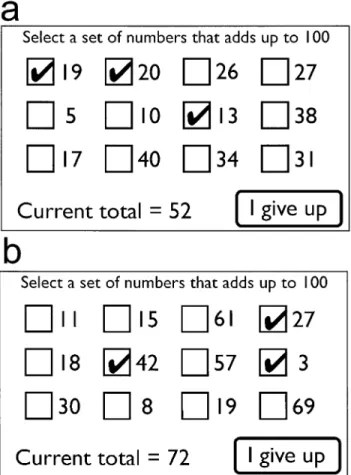
At the beginning of the experiment, participants were informed what their payment for participating would be (unless they were in the control condition) and instructed to leave the lab when they decided to end the experiment. The task was to solve a series of puzzles, each consisting of 12 numbers; a puzzle was solved by selecting a subset of the numbers that added up to 100 (see Fig. 4 for examples). At the bottom of the screen was a button labeled ‘‘I give up’’; participants were told to push this button if they wanted to quit the experiment. The first four puzzles were relatively easy and served to introduce the pro-cedure and make participants feel that they were capable of completing this task (Koblitz, 1987). The final, fifth puzzle did not have a solution, and the dependent measure was the length of time that participants spent trying to solve it.
Results and Discussion
As shown in Figure 5, the results supported the basic hypoth-eses. As predicted in Hypotheses 1a and 2, effort in both the cash and monetized-candy conditions increased when payment level increased from low to medium,F(1, 84)52.41,p5.018, andF(1, 84)52.52,p5.014, respectively, and there was no difference between these conditions,F(1, 84)50.84, n.s. As predicted in Hypothesis 1c, effort was lower in the low-payment condition than in the no-payment control condition for both the cash and the monetized-candy conditions, F(1, 84)53.11,
p5.007, which were not different from each other, F(1, 84)50.111, n.s. In addition, persistence in the no-payment control condition was about 40 s longer than in the medium-payment cash condition, and about 35 s longer than in the medium-payment monetized-candy condition, although neither of these effects was significant,F(1, 84)51.02,p5.31, and
F(1, 84)50.73,p5.47, respectively.
In summary, these results replicated the results of the cash conditions from Experiments 1 and 2. More important, the similarity of the results between the cash and monetized-candy Fig. 3.Results from Experiment 2: measured effort (number of balls
dragged in 3 min) as a function of payment level (none, low, or medium) and payment form (money or candy).
conditions suggests that the existence or saliency of monetary compensation can act as a strong signal invoking norms of money markets instead of social-market relations. Thus, when an individual is faced with signals from both the money market
and the social market, the countervailing forces seem to favor money-market relations (Hypothesis 2).
GENERAL DISCUSSION
In Chapter Two of Mark Twain’s (1876) novelTom Sawyer, Tom is faced with the unenviable job of whitewashing his aunt’s fence. When his friends pass by and mock him for having to work, he turns around, asking, ‘‘Do you call this work? Does a boy get a chance to whitewash a fence every day? And beside Aunt Polly’s awful particular about her fence’’ (p. 15). Armed with this ‘‘new information,’’ his friends discover the joys of whitewashing a fence, and before long give him all their per-sonal treasures for the privilege of painting the fence.
Twain ended the chapter by noting that ‘‘if [Tom] had been a great and wise philosopher, like the writer of this book, he would now have comprehended that work consists of whatever a body is obliged to do, and that play consists of whatever a body is not obliged to do.’’ Twain then added, ‘‘There are wealthy gentleman in England who drive four-horse passenger-coaches twenty or thirty miles on a daily line in the summer because the privilege costs them considerable money; but if they were offered wages for the service, that would turn it into work, and then they would resign’’ (pp. 16–17).
In this description of the negative effects of compensation on motivation, Twain suggested that monetary incentives can have profound influences on the ways in which tasks are framed, and hence on the motivation to engage in them. Following Twain, and Fiske’s (1992) relational theory, we have presented a model that categorizes labor markets into two types: monetary and social. Money markets are characterized by a monotonic rela-tionship between payment and effort. In social markets, effort is largely independent of compensation levels.
Two real-behavior experiments and one hypothetical-be-havior experiment were carried out in a general setting of one-shot games, in which payment was granted or credibly promised before effort was exerted. The results support the two-markets perspective: When payments were given in the form of gifts (candy) or when payments were not mentioned, effort seemed to stem from altruistic motives and was largely insensitive to the magnitude of the payment. In contrast, when payments were given in the form of cash, effort seemed to stem from recipro-cation motives and was sensitive to the magnitude of the pay-ment. Finally, in mixed markets (payment was in the form of gifts but cost was also mentioned), the mere mention of mone-tary payment was sufficient to switch the perceived relationship from a social-market relationship to a money-market relation-ship. That is, money itself can be a cue to the type of exchange that individuals consider themselves to be in, which in turn influences their propensity to exert effort.
A long history of research has demonstrated that rewards can decrease motivation and attitudes (Festinger & Carlsmith, 1959), alter self-perception (Bem, 1965), increase overjustifi-Fig. 4. One of the four easily completed numerical puzzles (a) and the
impossible puzzle (b) from Experiment 3.
Fig. 5. Results from Experiment 3: measured effort (time spent before giving up on an impossible task) as a function of payment level (none, low, or medium) and payment form (money or monetized candy).
cation (Lepper et al., 1973), and turn feelings of competence into feelings of being controlled (Deci & Ryan, 1985). The debate over these findings (Eisenberger & Cameron, 1996; Ryan & Deci, 2000) has generally shifted to the question of what specific circumstances give rise to these counterintuitive ef-fects. The current work sheds some light on this debate by pointing out an additional factor that can influence the rela-tionship between reward and motivation—the type of market in which the exchange takes place. Note, however, that this work is methodologically different from most previous research on the perverse effects of rewards, in that rewards in the current work were provided up front and were not contingent on performance, performance rather than attitudes was measured, and per-formance was measured on trials that immediately followed the manipulation. One possible implication of the current results is that social rewards do not easily undermine intrinsic motiva-tion. A second implication is that the social aspects of reward are fragile and a social reward can easily be made into a non-social extrinsic reward by merely mentioning monetary cir-cumstances or perhaps just promoting comparisons to other tasks or other individuals’ reward levels.
The two-markets distinction suggests that compensations for employment and effort should be considered separately for so-cial and monetary markets and that the level and type of com-pensation should be designed to fit the defined relationship. There are many questions remaining regarding these two mar-kets: What types of labor are best suited for social and monetary markets? How can employment institutions be shaped to allow changes from one type of exchange to the other? What kinds of environmental factors affect effort in the social market? An-swering these questions is likely to shed some light on the ways in which individuals construct their social environment. As to whom to ask when you need help moving, we suggest asking friends and offering them dinner. Just do not tell them how much the dinner costs.
Acknowledgments—The authors thank Barbara Spellman, Uri Gneezy, Stacy Woods, Mike Norton, and two anonymous re-viewers for their constructive comments. The authors also want to acknowledge the support of Harvard’s Computer Lab for Experimental Research (CLER).
REFERENCES
Aggarwal, P. (2004).The effects of brand relationship norms on con-sumer attitudes and behavior. Unpublished manuscript, Univer-sity of Toronto, Scarborough, Ontario, Canada.
Batson, C.D., Sager, K., Garst, E., & Kang, M. (1997). Is empathy-induced helping due to self-other merging?Journal of Personality and Social Psychology,73, 495–509.
Bem, D.J. (1965). An experimental analysis of self-persuasion.Journal of Experimental Social Psychology,1, 199–218.
Cialdini, R.B. (1997). Reinterpreting the empathy-altruism relation-ship: When one into one equals oneness.Journal of Personality and Social Psychology,73, 481–494.
Clark, M.S., & Mills, J. (1993). The difference between communal and exchange relationships: What it is and is not. Personality and Social Psychology Bulletin,19, 684–691.
Deci, E.L. (1971). Effects of externally mediated rewards on intrinsic motivation. Journal of Personality and Social Psychology, 18, 105–115.
Deci, E.L., Koestner, R., & Ryan, R.M. (1999). A meta-analytic review of experiments examining the effects of extrinsic rewards on in-trinsic motivation.Psychological Bulletin,125, 627–668. Deci, E.L., & Ryan, R.M. (1985). The general causality orientations
scale: Self-determination in personality. Journal of Research in Personality,19, 109–134.
Eisenberger, R., & Cameron, J. (1996). Detrimental effects of reward: Reality or myth?American Psychologist,51, 1153–1166. Epley, N., & Dunning, D. (2000). Feeling ‘‘holier than thou’’: Are
self-serving assessments produced by errors in self- or social predic-tion?Journal of Personality and Social Psychology,79, 861–875. Fehr, E., & Falk, A. (2002). Psychological foundations of incentives.
European Economic Review,46, 687–724.
Festinger, L. (1957).A theory of cognitive dissonance. Evanston, IL: Peterson.
Festinger, L., & Carlsmith, J.M. (1959). Cognitive consequences of forced compliance.Journal of Abnormal and Social Psychology,
58, 203–210.
Fisher, R.J. (1993). Social desirability bias and the validity of indirect questioning.Journal of Consumer Research,20, 303–315. Fisher, R.J., & Katz, J.E. (2000). Social desirability bias and the validity
of self-reported values.Psychology & Marketing,17, 105–120. Fiske, A.P. (1992). The four elementary forms of sociality: Framework
for a unified theory of social relations.Psychological Review,99, 689–723.
Gneezy, U., & Rustichini, A. (2000a). A fine is a price.Journal of Legal Studies,XXIX, 1–18.
Gneezy, U., & Rustichini, A. (2000b). Pay enough or don’t pay at all.
Quarterly Journal of Economics,115, 791–810.
Koblitz, N. (1987).A course in number theory and cryptography. New York: Springer-Verlag.
Kreps, D.M. (1997). Intrinsic motivation and extrinsic incentives.
American Economic Review,87, 359–364.
Lepper, M.R., Greene, D., & Nisbett, R.E. (1973). Undermining chil-dren’s intrinsic interest with extrinsic reward: A test of the ‘‘overjustification’’ hypothesis.Journal of Personality and Social Psychology,28, 129–137.
MacCoun, R.J., & Kerr, N.L. (1987). Suspicion in the psychological laboratory: Kelman’s prophecy revisited.American Psychologist,
42, 199.
Rabin, M. (1993). Incorporating fairness into game theory and eco-nomics.American Economic Review,83, 1281–1302.
Ryan, R.M., & Deci, E.L. (2000). When rewards compete with nature: The undermining of intrinsic motivation and self-regulation. In C. Sansone & J.M. Harackiewicz (Eds.),Intrinsic and extrinsic mo-tivation: The search for optimal motivation and performance(pp. 13–54). San Diego, CA: Academic Press.
Trivers, R.L. (1971). The evolution of reciprocal altruism.Quarterly Review of Biology,46, 35–57.
Twain, M. (1876).The adventures of Tom Sawyer. New York: C.H. Webb.