Wageningen Centre for Development Innovation supports value creation by strengthening capacities for sustainable development. As the international expertise and capacity building institute of Wageningen University & Research we bring knowledge into action, with the aim to explore the potential of nature to improve the q uality of life. With approximately 30 locations, 5 ,000 members of staff and 10,000 students, Wageningen University & Research is a world leader in its domain. An integral way of working, and cooperation between the exact sciences and the technological and social disciplines are key to its approach.
Marion Herens, Bram Peters, Jan Brouwers, Diane Bosch, Edwin van der Maden, Vincent Linderhof, Jan Verhagen
A desk review
Commercially viable agriculture and
consumption of nutritious foods: a framework
for identifying development pathways
Wageningen Centre for Development Innovation Wageningen University & Research
P.O. Box 88 6700 AB Wageningen The Netherlands T +31 (0)317 48 68 00 www.wur.eu/cdi Report WCDI-18-039
Commercially viable agriculture and
consumption of nutritious foods: a framework
for identifying development pathways
A desk review
Marion Herens1, Bram Peters1, Jan Brouwers1, Diane Bosch1, Edwin van der Maden1, Vincent Linderhof2,
Jan Verhagen3
1 Wageningen Centre for Development Innovation 2 Wageningen Economic Research
3 Wageningen Plant Research
This research was funded by the Dutch Ministry of Agriculture, Nature and Food Quality (KB-22-001-003).
Wageningen Centre for Development Innovation Wageningen, October 2018
Marion Herens, Bram Peters, Jan Brouwers, Diane Bosch, Edwin van der Maden, Vincent Linderhof, Jan Verhagen, 2018. Title; Subtitle. Wageningen Centre for Development Innovation, Wageningen University & Research. Report WCDI-18-039. Wageningen.
DLO Theme: Global Food and Nutrition Security (GF&NS)
Subtheme: Sustainable agricultural development pathways
Project: Developmental agricultural pathways for viable commercial agriculture and consumption of nutritious foods
Project codes: KB22–001-003 and KB28-001-005
Food systems in low and middle income countries are changing rapidly in response to economic and market developments, environmental impacts, and dietary changes. Within this context, informed policy and sustainable development processes are needed to shape climate-smart and resilient food systems for food and nutrition security at farming household level. This research project aimed to a) explore the complexity of the contextual dynamics in which smallholder farming households operate; and b) contribute to a better conceptual understanding of commercial food production strategies in relation to consumption choices.
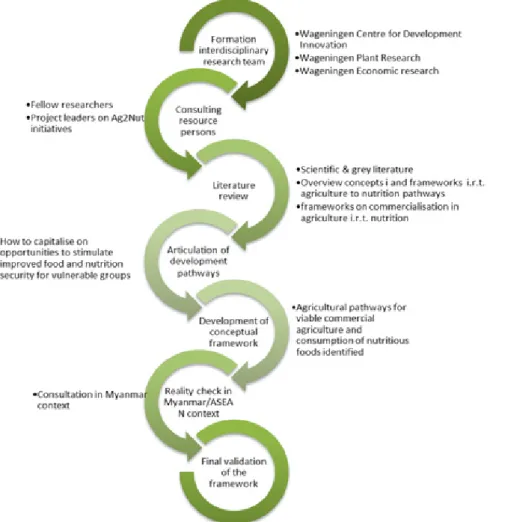
A literature review was conducted, exploring both scientific and grey literature, in parallel to
consultation rounds with a multidisciplinary team of agronomists, economists, nutritionists and international development specialists to explore existing insights, align available expertise, and find common ground on how to create a useful framework that would fit the specific interests and expertise of each of the actors involved.
Key elements for our framework were preliminary drawn from existing frameworks. A number of - non-exclusive - pathways were identified. These include subsistence-oriented production for the household’s own consumption (source of food), whereby women – as producers as well as care takers - are seen as the crucial agents for household food security and health outcomes; production for sale in markets (source of income); and agricultural policies (national and global), affecting a range of supply and demand factors that establish the price of marketed food and non-food crops (food price policies). The important characteristics for the framework for viable commercial agriculture and consumption of nutritious foods evolve around different aggregation levels: the individual (gender and power dynamics), the household (household food production, income generation, food purchase choices, care practices, access to health care), the community (employment opportunity,
collaboration, microfinance, care and social (infra)structure), and the regional/nation (price and trade policy) level.
Keywords: framework, food systems, agricultural commercialization, food and nutrition security, farm households, transition
This report can be downloaded for free at www.wur.eu/cdi (under publications).
© 2018 Wageningen Centre for Development Innovation, part of the Stichting Wageningen Research. P.O. Box 88, 6700 AB Wageningen, The Netherlands. T + 31 (0)317 48 68 00, E [email protected], www.wur.eu/cdi.
The Wageningen Centre for Development Innovation uses a Creative Commons Attribution 3.0 (Netherlands) licence for its reports.
The user may copy, distribute and transmit the work and create derivative works. Third-party material that has been used in the work and to which intellectual property rights apply may not be used without prior permission of the third party concerned. The user must specify the name as stated by the author or licence holder of the work, but not in such a way as to give the impression that the work of the user or the way in which the work has been used are being endorsed. The user may not use this work for commercial purposes.
The Wageningen Centre for Development Innovation accepts no liability for any damage arising from the use of the results of this research or the application of the recommendations.
Report WCDI-18-039 Photo cover: XXXX
Contents
Acknowledgements 7
List of abbreviations and acronyms 9
Executive summary 11
1 Introduction 15
1.1 Background 15
1.2 Research aim and objectives 16
1.3 Methodological approach 17
1.4 Operationalising viewpoints and definitions 17
1.5 Outline of the report 18
2 Literature review of developments in linking agriculture to nutrition 19
2.1 Agricultural development and food and nutrition security 19
2.2 Evidence base for nutrition-sensitive agriculture interventions 20
3 Agricultural commercialisation 23
3.1 Areas of tension linking agricultural commercialisation to nutrition 24
4 Conceptual framework for identifying development pathways from
commercially viable agriculture to consumption of nutritious foods 27
4.1 Review of frameworks linking agriculture to nutrition 28
4.2 Development of conceptual framework 33
4.3 Farm household as key entry point 33
4.4 Community level 38
4.5 The wider context: policy, environment and climate 39
4.6 Conclusions and way forward 41
References 43
Iterative approach for consultation and sense-making 47
Acknowledgements
This report is a result of a joint effort by Wageningen Economic Research, Wageningen Plant Research, and Wageningen Centre for Development Innovation. We would like to thank all persons who
contributed by sharing information, contributing expert knowledge or by reviewing the manuscript. Any errors and omissions are and will remain the responsibility of the authors.
List of abbreviations and acronyms
ASEAN Association of South East Nations
DFID Department for International Development
FAO Food and Agricultural Organisation
GF&NS Global Food and Nutrition Security
LMICs Low and Middle Income Countries
PLW Pregnant and Lactating Women
UNEP-IRP United Nations Environmental Programme – International Resource Panel
USAID United States Agency for International Development
WCDI Wageningen Centre for Development Innovation, Wageningen University & Research
Executive summary
Background
Food systems in low and middle income countries are changing rapidly in response to economic and market developments, environmental impacts, and dietary changes. Within this context, informed policy and sustainable development processes are needed to shape climate-smart and resilient food systems for food and nutrition security at farming household level. This research project aims to: • Explore the complexity of the contextual dynamics in which smallholder farming households operate;
and
• Contribute to a better conceptual understanding of commercial food production strategies in relation to consumption choices.
This desk review is part of the research project Developmental agricultural pathways for viable commercial agriculture and consumption of nutritious foods, implemented under the Global Food and Nutrition Security research programme of Wageningen University and Research (WUR). To grasp the complexity of the context in which farm households operate, a better understanding of food production strategies and consumption choices at multiple levels is required. Realised adaptation occurs in
response to macro-level and community level interacting with farming household processes and capitals.
Approach
The desk review was done to articulate a conceptual framework for analysis of nutrition-sensitive and commercial viable agriculture pathways at different levels (macro, community, household) to
capitalise on opportunities to stimulate improved food and nutrition security for vulnerable groups. Developmental pathways are seen as ‘causal relations which are translated into mechanisms for action from macro to community to household levels that translate into time allocation for activities’.
For exploring the literature, both scientific and grey literature, Google Scholar, Web of Science and Scopus were explored, using generic search terms such as: pathways, framework, causal
relationships, in combination with topic specific terms: commercialisation in agriculture, food security, nutrition security, food and nutrition security, nutrition sensitive agriculture, and nutrition specific interventions. Parallel to the literature review, consultation sessions were organised with a multidisciplinary team of agronomists, economists, nutritionists and international development specialists (n=8) to explore existing insights, align available expertise, and find common ground on how to create a useful framework combining commercialisation factors with food and nutrition security.
Findings and interpretations
The defined focus was on rural agricultural households, being production and consumption unit in one, thus representing a key linkage between agricultural commercialisation processes on the one hand, and nutritional outcomes on the other. Key elements to define our framework were preliminary drawn from several existing frameworks. For the nutrition components, we built on the UNICEF framework on maternal and child undernutrition, and the framework for Actions to Achieve Optimum Foetal and Child Nutrition and Development presented in the Lancet in 2013. To cover all components of food and nutrition security, highlighting the multiple entry points at multiple levels, we built on FAO’s Food Insecurity and Vulnerability Information and Mapping System (FIVIMS). For the commercialisation components at household level, we built on the frameworks developed by Von Braun (1995), and Kanter et al. (2015) describing the linkages between agriculture, the food system, nutrition and public health.
Literature showed a number of - non-exclusive - pathways through which agriculture-oriented interventions and policies may lead to positive food security and nutritional outcomes. These included subsistence-oriented production for the household’s own consumption (source of food), whereby
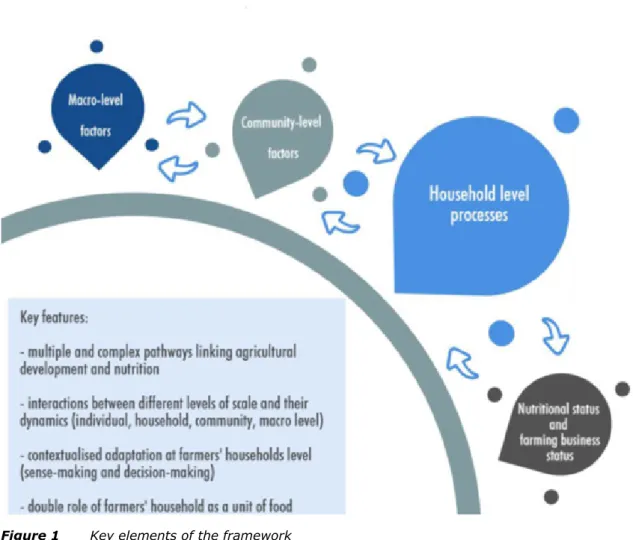
women – as producers as well as care takers - are seen as the crucial agents for household food security and health outcomes; production for sale in markets (source of income); and agricultural policies (national and global), affecting a range of supply and demand factors that establish the price of marketed food and non-food crops (food price policies, see Figure 1).
Figure 1 Key elements of the framework
Important characteristics of our framework for viable commercial agriculture and consumption of nutritious foods evolve around different aggregation levels: the individual (gender and power
dynamics), the household (household food production, income generation, food purchase choices, off-farm labour, care practices, access to health care), the community (employment opportunity,
collaboration, microfinance, care and social (infra)structure), and the regional and macro level (price and trade policy).
Conclusions
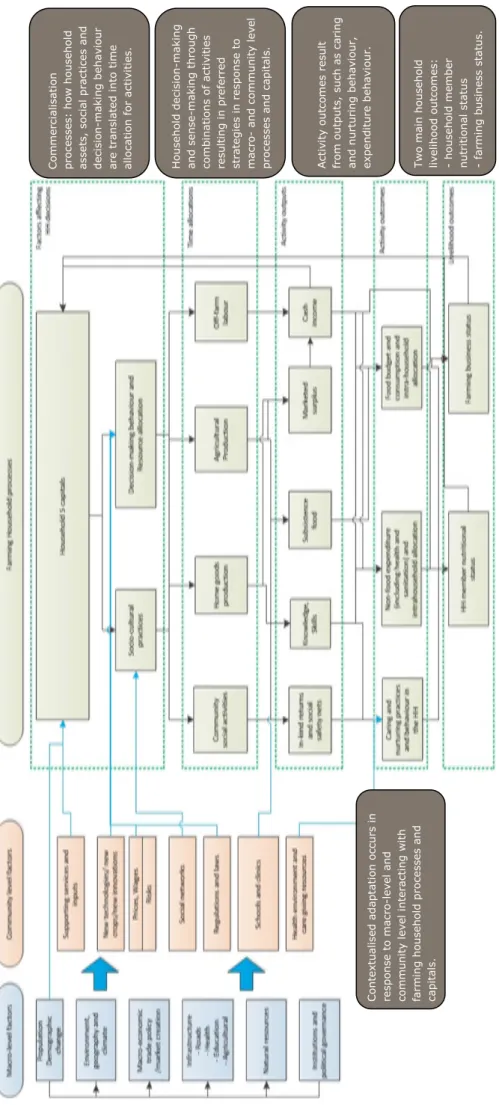
Rural agricultural household and intra-household decision-making and experiential dynamics represent the key linkage between agricultural commercialisation and nutritional outcomes. The key features of the framework for ‘Development Pathways from Agricultural Commercialisation to Nutrition’ highlight the multiple and complex pathways linking agricultural commercialisation with food security and nutrition. Key aspects that affect farm household’s agricultural commercialisation processes relate to household sense- and decision-making behaviours relating to use of household assets, social practices and how these translate into time allocation and activity outputs. The framework also allows to analyse the influence of contextual, community- and macro level factors. Activity outputs such as surplus food, income, social safety nets, and education and training consequently generate activity outcomes such as caring and nurturing behaviour, non-food expenditure and food budget and consumption. These outputs result into two main household livelihood outcomes: household member nutritional status and farming business status.
It was acknowledged that development pathways between agricultural commercialisation and food and nutrition security cut across different levels. There is a need to further capture the processes of contextualised adaptation at the farm household level in terms of sense-making and decision-making processes and to explore the (non-linear) aspects of the conceptual framework, to better understand how human well-being, or benefits experienced throughout the life course, can be an outcome as well as an asset for innovative action at the farm household level to achieve household goals.
1
Introduction
The research project ‘Developmental agricultural pathways for viable commercial agriculture and consumption of nutritious foods’ is part of the Wageningen University and Research (WUR) Knowledge Base Global Food and Nutrition Security (GF&NS) programme. The GF&NS programme aims to inform long term policy and investment processes to shape climate-smart and resilient food systems that stimulate food and nutrition security, with a particular focus on the reduction of chronic undernutrition and micronutrient deficiencies. The research conducted under this programme will connect to long term decision-making processes in the public and private sector using qualitative and quantitative methods. This report describes the main findings of a desk review exploring development pathways resulting in commercially viable and sustainable agriculture, with sustained access to and consumption of
nutritious foods. The report also presents a conceptual framework for analysing agricultural pathways for viable commercial agriculture and consumption of nutritious foods.
1.1
Background
Food systems1 in low and middle income countries (LMIC) are undergoing rapid changes in response to economic, environmental, and dietary changes. Root causes relate mainly to population growth and the consequences of climate change, going hand in hand with rapid urbanization rates. Food systems differ widely across the world, varying from traditional, intermediate and modern food systems (Table 1.1). It is estimated that globally most people (around 4 billion), notably in Asia, participate in food systems which could be called ‘intermediate’. However, food systems may vary between and within countries (Westhoek, van Berkum, Özay, & Hajer, 2016).
Table 1.1 Food systems characteristics (Westhoek et al., 2016)
Food system feature ‘Traditional’ food systems
‘Intermediate’ food systems ‘Modern’ food systems
Estimated number of people in system
~1 billion ~4 billion ~2 billion Principal employment in
food sector
In food production In food production In food processing, packaging, logistics and retail Supply chain Short, local;
small-scale structures
Supply chain has more actors than in ‘modern’ food systems
Long; consolidation in input, processing and food retail segment Typical farm Family-based, small to
moderate
Combination of small-holder and larger farms
Industrial, large Typical food consumed Basic locally produced
staples
Combination of basic products and processed food
Processed food with a brand name, more animal products Purchased food bought
from
Small, local shop or market
local shops, rapid supermarketisation
Large supermarket chain, restaurants and catering Nutritional concern Under-nutrition Both under-nutrition as well as
diet related diseases
Diet related diseases
NB: The terms ‘traditional’ and ‘modern’ are being used by lack of better alternatives. They certainly do not express a judgement (Westhoek et al., 2016)
1 A food system is defined as: a system that embraces all the elements (environment, people, inputs, processes,
infrastructure, institutions, markets and trade) and activities that relate to the production, processing, distribution and marketing, preparation and consumption of food and the outputs of these activities, including socio-economic and environmental outcomes (CFS-HLPE, 2014).
The agricultural sector2, an important element of food systems, is dynamic and seeks to constantly adjust to these changes affecting markets, household needs, and consumer demands. In the coming years, one of the expected response strategies in developing countries and emerging economies is commercialisation of the smallholder agriculture, in order to promote and provide for high-value agricultural products, and to improve linkages between rural, urban and global markets.
1.2
Research aim and objectives
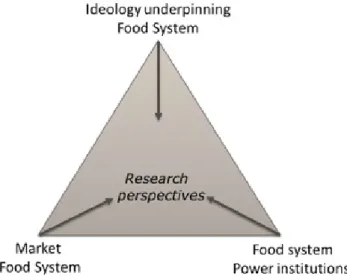
The overall research project seeks to identify development pathways in agriculture that stimulate both commercially viable agriculture and improve the production and consumption of nutritious foods. This will be done within a framework of understanding that market conditions and the functioning of institutions (laws, policy, education on agricultural production, etc.) basically shape the circumstances in which producers operate without much power to negotiate changes that would favour them
(Figure 1).
Figure 2 Framework of Food Systems interplay between ideology, market conditions, and power
relations
More particularly, the aim is to identify nutrition-sensitive (commercial) development pathways in agriculture in which improved production technologies enable:
• Commercialisation, or: selling more yields at the (local, regional or national) market and increase income in this way;
• a more efficient use of (natural) resources in an environmentally sustainable way;
• Increased production of nutritious foods: balancing attention for the production of cash/staple foods and nutritious commodities like fruits and vegetables;
• Increased stability and availability of nutritious foods to vulnerable population groups. To fully grasp the complexity of the context in which farmers in LMICs operate, in particular the smallholders who are producers and consumers at the same time, a better understanding of food
2 Agricultural sector, in the broadest sense, includes four kinds of functions: the green functions relate to landscape and
wildlife management, animal welfare, maintenance of biodiversity, improvement of nutrient recycling and limitation of carbon sinks. The blue functions relate to water management, water quality, flood control, water harvesting and creation of (wind-) energy. The yellow functions relate to the role of farming for rural cohesion and development, cultural and historical heritages, regional identity, and agro-tourism. The white functions produced by agriculture relate to food security and safety (Van Huylenbroeck, Vandermeulen, Mettepenningen, & Verspecht, 2007).
production strategies and consumption choices at multiple levels is required: the farm (household), the regional and the national level. In the current debates on strengthening food and nutrition security, there is growing consensus on the need to reduce barriers between disciplines and sectors, particularly those between different food value chain actors, consumers and policy makers. This will require a focus on changes in social contexts.
The aim of the desk review presented here, is “to define a generic framework to capture the key processes that determine farm household commercialisation processes and household food and nutrition security”. In addition, strategies and development pathways for food and nutrition security will be examined.
1.3
Methodological approach
A desk review was conducted, exploring both scientific and grey literature. Since our main interest was to identify development pathways relating to causal relationship between viable commercial
agriculture and consumption of nutritious foods, the combination of terms used were: • Generic: Pathways, framework, causal relationships, in combination with:
• Topic specific: commercialisation in agriculture, food security, nutrition security, food and nutrition security, nutrition sensitive agriculture, nutrition specific interventions.
Google Scholar, Web of Science and Scopus were the databases explored.
In parallel, a number of consultation sessions were organised with a multidisciplinary team of agronomists, economists, nutritionists and international development specialists (n=8) to explore insights, align available expertise, and find common ground on how to create a useful framework combining commercialisation factors with food and nutrition security (see Appendix 1).
The desk review was geared towards the articulation of a conceptual framework for analysis of nutrition-sensitive and commercial viable agriculture pathways at different levels (macro, community, household) to capitalise on opportunities to stimulate improved food and nutrition security for
vulnerable groups.
1.4
Operationalising viewpoints and definitions
In order to explore ‘development pathways leading from commercially viable and sustainable agriculture to sustained access to and consumption of nutritious foods’ and a framework for identification, a set of concepts was identified and defined:
Generic definitions
• Developmental pathways: are seen as causal relations which are translated into mechanisms for action from macro to community to household levels that translate into time allocation for activities. • Conceptual framework: the way ideas are organized to achieve a research project’s purpose (Shields
& Rangarjan, 2013). As such it is an analytical tool with several variations and contexts. It is used to make conceptual distinctions and organize ideas.
• Households: From an economic perspective - in the case of small-holders - the household is the level of decision making for food consumption and decision making for agricultural practices. For household food security and nutrition it is a group of people who eat from a common pot, and share a common stake in perpetuating and improving their socio-economic status from one generation to the next (Carloni & Crowley, 2005).
• Livelihoods: a livelihood comprises the capabilities, assets (including both material and social resources) and activities required for a means of living. A livelihood is sustainable when it can cope with and recover from stresses and shocks and maintain its capabilities and assets both now and in the future, while not undermining the natural resource base (Carloni & Crowley, 2005).
Topic specific definitions
• Agricultural commercialisation: entails an “agricultural transformation process in which individual farms shift from a highly subsistence-oriented production towards more specialized production targeting markets both for their input procurement and output supply” (Jaleta, Gebremedhin, & Hoekstra, 2009). As such, commercialization generally implies increased market transactions for capturing the gains from specialization (Von Braun, 1995). These increased market transactions may have the potential to translate into the realisation of household welfare outcomes including better nutrition and caring practices;
• Food security: Food security exists when all people, at all times, have physical and economic access to sufficient, safe and nutritious food that meets their dietary needs and food preferences for an active and healthy life (FAO, 1996);
• Nutrition security: When all people, at all times, have access to adequate food, care and feeding practices, and sanitation and health (UNICEF, 1991);
• Food and nutrition security: Food and nutrition security exists when all people at all times have physical, social and economic access to food, which is consumed in sufficient quantity and quality to meet their dietary needs and food preferences, and is supported by an environment of adequate sanitation, health services and care, allowing for a healthy and active life (UNSCN, 2013); • Nutrition-sensitive agriculture: is a food-based approach to agricultural development that puts
nutritionally rich foods, dietary diversity, and food fortification at the heart of overcoming malnutrition and micronutrient deficiencies (ISCN, 2014);
• Nutrition-sensitive interventions/programmes: address the underlying determinants of foetal and (child)nutrition and development, with a focus on access to, and stability and availability of nutritious foods to vulnerable population groups (Ruel & Alderman, 2013);
• Nutritious foods: Foods containing essential substances needed for life and growth, i.e foods rich in essential (micro-)nutrients such as fruits, vegetables, fish, meat, dairy products and biofortified staple foods for (Hawkes & Ruel, 2012).
1.5
Outline of the report
Chapter two describes the findings on the literature review addressing agriculture and nutrition linkages. Chapter three describes the current views on development pathways in commercialisation of agriculture in relation to food and nutrition security, and the most commonly used frameworks. Chapter four describes the synthesis of our literature findings, and the development of a conceptual refined framework for analysis of agricultural pathways for viable commercial agriculture and consumption of nutritious foods.
2
Literature review of developments in
linking agriculture to nutrition
This chapter describes the key developments and current insights on developments in linking
agriculture to food security and nutrition, and in linking agricultural commercialisation to food security and nutrition.
2.1
Agricultural development and food and nutrition
security
In the past decades much attention has been given to food security. The main focus was largely on staple grains (McDermott, Aït-Aïssa, Morel, & Rapando, 2013). The dominant agricultural pathways to promote food and nutrition security were related to increasing incomes of farmers, workers and market actors, enabling improved production as well as the purchase of food, goods and services, and increasing national agricultural production and efficiency in order to increase food availability and reduce food prices. Current world food systems have been performing incredibly well when it comes to producing staple grains such as maize, rice and wheat. Much food and calorie intake come from these grains, in combination with oils, sugars and fats. However, especially in low-income and middle-income countries, dietary intake of nutrients and vitamins remains relatively low (Hunter & Fanzo, 2013).
On the other hand, dominant strategies for improved nutrition outcomes mainly focused on the immediate and underlying causes of malnutrition, addressing dietary intake, hygiene and sanitation, and care. In the early nineties, the UNICEF food and nutrition security framework was developed, which still forms the basis of many frameworks. It distinguishes between the different causes of maternal and child undernutrition: basis causes: lack of human, financial, social, physical or natural capital, unfavourable socio-economic or political contexts); underlying causes: income poverty, resulting from lack of employment, assets, remittances; and immediate causes: inadequate intake, or disease (Gross, Schoeneberger, Pfeifer, & Preuss, 2000; UNICEF, 1991). This has generated a wide variety of nutrition-focused individual-level interventions, usually conducted by, or under supervision of health-related agencies.
Thus, agricultural development and nutrition interventions have long worked separately, at best working in parallel, achieving separate successes (Du, Pinga, Klein, & Danton, 2015). Internationally, a renewed emphasis on food and nutrition security from a food systems perspective has revitalised the debate on agricultural development for improved nutrition. Global donors and international actors have responded to make ‘nutrition-sensitive agricultural programmes and policies’ work, and ‘make agriculture work for nutrition’, acknowledging that ‘presence of food is just not enough for nutrition’ (Webb, 2013).
The focus gradually shifted from improving food production, the quantity, and access to food, to the
quality of diets, or the possibility to have food at all times, building on a human impact oriented perspective in terms of nutrition outcomes. This generated possibilities by which food systems interventions are intended to directly affect food and nutrition security while also taking into
consideration cross-cutting issues such as gender, intra-household resources and dynamics and food safety (Webb, 2013).
The possible ways in which agricultural interventions link to nutrition outcomes is, however, still not fully understood (Thompson & Amoroso, 2014). In particular ways to accelerate the progress of nutrition improvements for vulnerable groups still requires programming of effective, large scale nutrition-sensitive interventions addressing key underlying determinants of nutrition. According to Hunter and Fanzo (2013), agriculture will continue to be instrumental in achieving better health and
nutrition for all populations throughout their whole lives, but there is a need for “more holistic and multi-sector packages that combine child and maternal care and disease control together with nutrition-sensitive programming from agriculture, education, social protection have been limited in their development and implementation” (Hunter & Fanzo, 2013, p.2).
2.2
Evidence base for nutrition-sensitive agriculture
interventions
Based on several review studies looking for effectiveness of agricultural interventions aimed at improving nutritional status, Meeker and Haddad (2013) argue that results in nutrition outcomes are mixed (Arimond et al., 2011; Berti, Krasevec, & FitzGerald, 2004; Corinna Hawkes & Ruel, 2007; Kawarazuka, 2010; Masset, Haddad, Cornelius, & Isaza-Castro, 2011; Ruel, 2001; Webb & Kennedy, 2014). Nutrition-sensitive agricultural interventions may be successful in promoting the production and consumption of specific (nutritious) foods. But the main gap in available evidence relates to sustained changes in the overall diet (or indeed micronutrient status). In addition, nutritional status is usually not monitored using anthropometric indicators or measurements. There is no generic evidence for the impact of these interventions on nutrition outcomes at the national level or in farm household surveys, usually only for projects or case studies. There is, however, some evidence for impacts on vitamin A intake and status from homestead food production programmes and distribution of bio-fortified vitamin A-rich orange sweet potato (Meeker & Haddad, 2013).
The key challenge faced by nutrition-sensitive agriculture practices is that knowledge and information provision becomes much more complex as the intervention goes beyond nutritious food production and consumption patterns but also includes intra-household power relations and gender dynamics. Programme objectives expand to include households in market-oriented systems which simultaneously lead to income, food and other household consumption. As the level of intervention scales up from households to communities and value chains the organisation of knowledge, information, inputs, financial services, output markets becomes more challenging (McDermott et al., 2013).
Hawkes and Ruel (2011) suggested that, if the agricultural sector is to play a more effective role in improving nutrition by increasing the access, acceptability, and quality of diets, there needs to be a greater focus on what happens between production and consumption. This is particularly relevant at the level of the smallholder, who is producer and consumer at the same time. Producer and consumer decisions cannot be separated due to market imperfection (Taylor & Adelman, 2003). A suggested way is the use of the “value chain” concept (Benson, 2011). A value chain focus requires the engagement of not only the agriculture sector, but also other sectors involved, and approaches are needed to help overcome intersectoral barriers, which create disincentives to closer cooperation. Integrating nutrition into value chains also requires a closer look at how value chain analysis and development are
conducted, with a particular focus on nutrition goals:
• Increase the supply of accessible (available and affordable) nutritious foods for the poor (and for different target groups) all year round;
• Increase the demand for and acceptability of nutritious foods for the poor;
• Increase the coordination among value-chain actors and activities that are essential to increasing the supply of and demand for nutritious foods for the poor;
• Address the trade-offs between the economic returns and nutritional benefits of agriculture in the value chain.
Limitations to the value chain approach for achieving nutrition benefits are:
• The focus on value addition and differentiated products may by-pass poor consumers because food products may become too expensive;
• Consumers are not usually seen or treated as actors in the value chain;
• “Value” in most value-chain literature/interventions is defined in terms of economic value, rather than in social or societal value;
• The focus on single food commodities in value chain analysis tends to easily overlook the need for dietary diversity;
• The focus on competitive markets leaves out other – symbiotic (Wegerif & Hebinck, 2016) or informal– markets whereby seeds, foods, production resources are exchanged between neighbours or villagers (Hawkes & Ruel, 2011).
Webb (2013) further explored the connection between agricultural interventions and nutrition with a particular focus on intermediate linkages and mechanisms, with the aim to identify cross-cutting issues, such as food preferences/taste, seasonality, women’s health, and the role of sanitation. He identified a number of impact pathways, based on work of the World Bank (2007), through which agriculture oriented interventions and policies may lead to positive food and nutrition outcomes: • Subsistence-oriented production for the household’s own consumption;
• Income-oriented production for sale in markets;
• Reduction in real food prices associated with increased agricultural production;
• Empowerment of women as agents instrumental to household food security and health outcomes; Ruel and Alderman (2013) specified these into direct - food production for direct household consumption - and indirect - purchase of food via income) – linkages whereby it invariably seems that women play a key role as mediators;
• The indirect relationship between increasing agricultural productivity and nutrition outcomes through the agriculture sector’s contribution to national income and macroeconomic growth.
These pathways are not exclusive, though, but can be used in combination in comprehensive intervention strategies.
In a review conducted in the Irish AgriDiet project by Meeker and Haddad (2013), the main pathways through which agriculture is hypothesised to affect nutrition outcomes are further specified as: 1. As a source of food: increases household availability and access to food from own production; 2. As a source of income: increases income from wages earned by agricultural workers or through
the marketing of agricultural produce;
3. (Fluctuating) Food prices: agricultural policies (national and global) affect a range of supply and demand factors that establish the price of marketed food and non-food crops; this price in turn affects the income of net seller households, the purchasing power of net buyers, and the budget choices of both;
4. Women’s social status and empowerment: women’s participation in agriculture can affect their access to, or control over, resources and assets, and increase their power to make decisions on the allocation of food, health, and care within their household;
5. Women’s time allocation patterns/habits: women’s participation in agriculture can affect their time allocation and the balance between time spent in income-generating activities and time allocated to household management and maintenance, care giving, and leisure;
6. Women’s own health and nutritional status: women’s participation in agriculture can affect their health (for example through exposure to agriculture-associated diseases) and nutritional requirements (for example through increased energy expenditure); their health and nutritional status can, in turn, affect their agricultural productivity and hence their income from agriculture. These pathways are to be considered as complex, encompassing economic, social and gender
considerations, suggesting that investing in agricultural production alone does not necessarily result in improved nutrition (Meeker and Haddad, 2013). In addition, Webb (2013), following Hawkes and Ruel (2012), noted that it is important to realise that addressing these pathways as causal chains between intervention and outcomes, holds the risk of making too simple associations.
It is important to consider the role and influence of external factors and contexts on a case-to-case basis, having a potential impact on the development pathways defined. For example, the adoption of a certain technology or best practice in agriculture may have the intention to increase crop production and income generation. However, the way in which farmers, markets and other stakeholders react to these changes may show different results, leading to limited impact on nutrition. This is in line with the findings of Berti et al. (2004), who found that interventions affecting multiple pathways had more effect than one-sector interventions.
In sum, based on a summary of the different ways how essential nutrition knowledge can underpin nutrition-sensitive agriculture, lessons for improving nutrition through agriculture include: efficient and effective production of diversified, highly nutritious and bio fortified foods, enhancing value chains to improve nutritional quality and food safety, better policies and investments, and requirements for capacity development and extension to scaling-out and sustaining improved nutrition outcomes through agriculture (McDermott et al., 2013). Webb (2013, p.7) concluded, based on the research exploring the validity of the main pathways describing agriculture to nutrition linkages and the interventions based on them, that:
• The evidence for positive net impacts on nutrition is scarce;
• When positive impacts have been observed, the mechanisms by which this happens are not fully clear;
• Positive impacts seem to revolve around interventions that link multiple sectors, but the contribution of each of these sectors remains unclear in most cases;
• Impact can be achieved via multiple pathways but the roles of the different pathways needs to be further explored;
• There is a need for pathway alignment: women’s roles matter a great deal via agriculture, dietary choices and healthcare, but not many interventions target all three at the same time;
• The nutrition impacts of price and trade policies on household level choices have not been fully explored;
• Study and research methods might not be fully able to explore and recognise evidence for the linkages.
Relevant entry points to kick-start or improve nutrition-sensitive agriculture approaches, identified by Jaenicke and Virchow (2013), should depart from a multilevel perspective and include:
(i) enabling policies and government structures expressing the political will to fight malnutrition and micronutrient deficiencies;
(ii) appropriate mechanisms for intersectoral and inter-organizational collaboration within the countries;
(iii) increased awareness of nutrition-sensitive agriculture and capacity to design and implement relevant projects at different levels;
(iv) appropriate focus on those groups who will benefit most from nutrition-sensitive approaches without being exclusive; and
(v) an approach cognizant of the elements of the food chain and recognizing the links between its various elements from production through to consumption as well as relevant technological, economic and societal innovations.
3
Agricultural commercialisation
A focus on commercialization and expansion of scale in the agricultural sector is a common response to tackle food and nutrition insecurity. In this paper, commercialisation refers to the agricultural transformation process in which individual farms shift from a highly subsistence-oriented production towards more specialized production targeting markets both for their input procurement and output supply (Jaleta, Gebremedhin, & Hoekstra, 2009). Commercialization can occur on the output side of production with increased marketed surplus, but it can also occur on the input side with increased use of purchased inputs. Commercialization is not restricted to just cash crops: The so called traditional food crops are frequently marketed to a considerable extent, and the so-called cash crops can be retained, to a substantial extent, on the farm for home consumption (Von Braun, 1995).
The emphasis in agricultural development strategies has long been on increasing food production, especially in low- and middle income countries. Notably small holder farmers have been given priority when targeting agricultural development interventions. This has often been through the introduction of a wide diversity of crops (such as legumes, fruits, vegetables and animal source products) which also have the potential to positively affect nutrition (Carletto, Ruel, Winters, & Zezza, 2015).
As smallholders progress from subsistence towards market orientation, the success and failure of this process is influenced by socio-economic factors, farm resources, and individual skills determinants whose effects are also influenced by the drivers. So far, it remains unclear what the effect of commercialization is on income and food and nutrition security of smallholders, especially under the conditions of a transforming economy. Smallholders often face challenges and constraints to commercialize: changes in the socio-economic/demographic environment driven by growing population, urbanization and changing diets, global interconnectedness, export policy of a country, technology, food industry restructuring and consequences of climate change presents opportunities for smallholder market participation. Commercialisation of agriculture can have several adverse effects, especially in terms of equity and environmental consequences. With the increase of mechanisation, a consistent part of the rural labour force needs to be relocated in the industrial and service sector, with consequent loss of human and social capital (Pingali & Rosegrant, 1995). Commercial systems face environmental consequences due to the increased use of agricultural chemicals (Pingali, 2001). Where property rights are unclear phenomenon such as land grabbing can take place. Also, commercialisation may lead to a decline in crop diversity for households (Rerkasem et al., 2009). In some cases, farmers that invested in cash crop resulted worse off in terms of nutritional status than subsistence farmers (Anderman, Remans, Wood, DeRosa, & DeFries, 2014).
Nevertheless, the expected income-mediated positive results at household and societal level are generally greater than the constraints experienced (Zhou, Minde, & Mtigwe, 2013).Tendencies of specialization and commercialization in agriculture could, theoretically, be perceived as more efficient than subsistence farming. Gains in income may occur through comparative advantages, economies of scale and different changes caused by social learning effects (Gebremedhin & Jaleta, 2010). When these factors are favourable, they facilitate or enable the success of the commercialisation process, but when unfavourable they hinder the process causing its failure. Most successful cases are based on collaborative efforts between different actors along a particular value chain as successful
commercialization has proved difficult without partnerships and all-inclusive approaches (Zhou et al., 2013). On the other hand, due to market imperfections, risks for agricultural households may also increase: commercialization of agriculture may result in a decline in crop diversity for households (Rerkasem et al., 2009), or in employment opportunities. Households risk to become less self-sufficient and more dependent on local markets. In regions where markets are not well-integrated, volatile market prices of crops and inputs, inefficient marketing institutions and poor infrastructure may pose risks to household income (Immink & Alarcon, 1993; Jaleta, Gebremedhin, & Hoekstra, 2009). Moreover, due to the lack of access to credit, households may become less able to mitigate
these risks (Immink & Alarcon, 1993). In such regions subsistence farming serves as a kind of insurance against the risks and costs of the market (Von Braun, 1995).
3.1
Areas of tension linking agricultural commercialisation
to nutrition
Acknowledging that the impact of agricultural interventions on the nutritional outcomes at household or individual level is hard to identify (Kanter, Walls, Tak, Roberts, & Waage, 2015) and the signalled lack of evidence is surprising given the multiple pathways of potential influence of these types of programmes (Ruel & Alderman, 2013). One reason might be that several of the programs documented so far were not originally designed with clear nutrition goals and actions from the outset and were “retrofitted to be nutrition-sensitive” (Meeker & Haddad, 2013). Other reasons might be related to contextual factors of influence, or to the entire agricultural value chain. During our review of
frameworks and pathways, several issues of tension became explicit between agricultural development and food and nutrition security.
Dury et al. (2015) explored the main pathways linking commercialisation in agriculture to nutrition and identified a number of potential risk areas. A first risk related to income: an increase in income may not necessarily improve nutrition options and choices, as these are heavily dependent on control over income and income regularity. A second risk related to the mismatch in food availability and diversity. This may play a role at meso- and macro-levels where food availability may be dominated by a certain type of crops promoted by agricultural interventions, in particular when the focus is mostly on staple or cash crops, potentially leading to simplified/monotonous diets (Gillespie &
Kadiyala, 2011). A third risk related to price drops as a result of increased production of a certain crop leading, with diverse and ambivalent consequences on nutrition security. Price drops of agricultural products can have both positive and negative effects, dependent on factors such as what type of product it relates to; whether the household is in an urban or rural area; and whether the household is a net seller or buyer. Policies that emphasise one crop could lead to substitution as more farmers switch to the subsidized crop, potentially increasing the prices of other crops. The fourth risk related to the role of women as key actors in the pathways. In some cases agricultural interventions have the consequence of decreasing the women’s role in decision-making and increase the workload for women. This may be because extension projects are specifically targeted at men, or that increased agricultural activities take time and energy away from other household responsibilities. The fifth risk related to health and environmental degradation resulting from agricultural interventions. Some farming practices have shown negative effects on the environment or the quality of food, consequently affecting nutrition security and health. Intensified livestock farming, for example, may can increase the presence of disease and decreased hygiene practices. Exposure to pesticides holds potential risks for health of people working with them, and those who eat exposed food products. Irrigation might bring risks related to water-borne diseases and virus-transmitting insects. A sixth risk relates to the fact that people might become excludedfrom agricultural interventions supporting commercialisation, thereby creating or reinforcing inequalities. This may be linked to a wide spectrum of factors including diminishing or limited access to land, access to finance and resources, access to human and social capital (Dury et al., 2015).
Also USAID, based on the USAID Spring programme, flagged a number of critical issues relating to the planning and development of market oriented agricultural development interventions for improving nutrition (USAID, 2016), stating that the aims and strategies for agricultural development for improved nutrition are hard to align. The main hurdles according to the USAID Spring experiences relate to:
• The first area relates to beneficiary targeting, highlighting the fact that nutrition-specific and – sensitive programmes typically target the at risk groups: the nutritionally vulnerable, such as pregnant and lactating women (PLW), and children under two years of age. Agricultural market development programmes typically target smallholder farmers producing, or having the potential to produce (including PLW), usually using facilitation as implementation strategy, thus encouraging
self-selection. Thus, the overlap between economically vulnerable, and the nutritionally vulnerable groups may be limited.
• The second area relates to the intervention approach. Nutrition-specific programmes generally use stepwise and sequential approaches for implementation, building on a cascade strategy of capacity building at multiple levels. They start with training government staff, then local trainers to train community leaders, who then educate and train the target population. Agricultural development programs work, whenever possible, through existing market actors (private sector, leverage commercial incentives) and focus on public-private liaisons. The common denominator in both strategies is the focus on behaviour change mechanisms of actors involved. There are substantial differences, however, in professional paradigms underpinning the different actions.
• The third area relates to the commercialisation of food: Agriculture and nutrition are both concerned with markets for food. particularly because many smallholder farmers are net buyers of food, representing farmer households in transition, producing for consumption and for markets.
Agricultural programmes typically promote the production and sale of a small number of crops that have high market demand but may not be nutrient-rich. When nutritious crops are selected, smallholder farmers who previously produced for home consumption may switch to selling these nutritious crops.
• The fourth area relates to monitoring and evaluation: This is challenged by the fact that nutrition-sensitive agricultural activities may contribute to reductions in stunting, underweight, and wasting – the classic nutrition indicators -, but are unlikely to directly cause them, particularly in the absence of complementary interventions such as nutrition behaviour change communication. Indicators for agricultural development activities typically include increases in total production, sales, and incomes. Linking such outcomes to improvements in nutrition is difficult and highly context-specific. In
addition, changes at the household or individual level are relatively easy to measure directly but there are no defined methods for measuring systems-level change.
In the current debates on strengthening food and nutrition security through nutrition-sensitive agriculture, there is growing consensus on the need to reduce barriers between disciplines and sectors, particularly those between consumers, different food value chain actors, and policy makers. This will require a focus on changes in the social contexts, where farmer level and people are central, leading to new social arrangements and innovations. However, the causal chain from results of commercialisation in agriculture to nutritional impact is rarely articulated during activity design processes: nutrition-sensitive agricultural market development activities should articulate the theory of change, what is within the manageable interest of the activity, and causal pathways connecting agriculture and nutrition results. Intermediate indicators should be defined and tracked to verify assumptions made in the causal pathway (USAID, 2016).
Private sector players nowadays increasingly seek to get involved in smallholder farming and market systems. These actors act in parallel to government actors and development organisations,
traditionally playing the biggest role in agricultural development and extension (McDermott et al., 2013). Also new technologies and innovations, such as mobile phone connections, are becoming available to urban as well as rural communities. These new constellations of actors and information technologies enable increased information and knowledge exchange, also challenging more cross-sectoral cooperation, because pathways linking agriculture and nutrition are largely indirect and require awareness, support from policy, and investments (McDermott et al., 2013).
In sum, to grasp the dynamics and contexts in which smallholders operate, taken from the dual perspective of farmers being (commercial) producers as well consumers, a better understanding is needed of the choices and decision making strategies relating to (food) production strategies on the one hand, and consumption choices on the other. Specialisation and commercialisation could represent a more efficient strategy than subsistence for smallholders (Gebremedhin & Jaleta, 2010), but this requires a reorientation towards sustainable food systems, delivering ‘food security and nutrition for all in such a way that the economic, social and environmental bases to generate food security and nutrition for future generations are not compromised would be needed’ (Westhoek, van Berkum, Özay, & Hajer, 2016); p.12).
4
Conceptual framework for identifying
development pathways from
commercially viable agriculture to
consumption of nutritious foods
Within the scope of the research project ‘Developmental agricultural pathways for viable commercial agriculture and consumption of nutritious foods’ this desk review seeks contribute to generating the information base for long term policy and investment processes to shape climate-smart and resilient food systems that stimulate food and nutrition security, with a particular focus on the reduction of chronic undernutrition and micronutrient deficiencies. The overall aims are to explore the complexity of the contextual dynamics in which smallholder farming households operate - context defined by food systems, acknowledge global (trade and climate) national levels, and ongoing process of
commercialisation in agriculture - ; and to contribute to a better conceptual understanding of commercial food production strategies in relation to consumption choices – the combination of agricultural production and consumption at farm household level.
More particularly, the aim is to formulate a framework for identification of nutrition-sensitive
(commercial) development pathways in agriculture in which improved production technologies enable: • Commercialisation, or: selling more yields at the (local, regional or national) market and increase
income in this way;
• a more efficient use of (natural) resources in an environmentally sustainable way;
• Increased production of nutritious foods: balancing attention for the production of cash/staple foods and nutritious commodities like fruits and vegetables;
• Increased stability and availability of nutritious foods to vulnerable population groups.
Based on the outcomes of the multidisciplinary dialogue, the common ground for a framework was found in:
• A focus on rural agricultural household level dynamics, forming the key linkage between agricultural commercialisation processes and nutritional outcomes;
• The acknowledgement that pathways between agricultural commercialisation and food and nutrition security cut across different levels, and can take various shapes and forms, potentially leading to positive as well as negative consequences;
• It was agreed that there was a need to capture the interrelatedness within the flexible framework, in the sense that well-being, or benefits throughout the life course (Black et al., 2013), are an outcome in itself, but at the same time provide an input for new processes and decisions that may impact other household goals.
Therefore, the important characteristics for a conceptual framework for viable commercial agriculture and consumption of nutritious foods should evolve around different aggregation levels: the individual (gender and power dynamics), the household (household food production, income generation, food purchase choices, care practices, access to health care), the community (employment opportunity, collaboration, microfinance, care and social (infra)structure), and the regional/national (price and trade policy) level. These elements, emerging from practical every document reviewed, form the backbone of the conceptual framework to be developed, alongside with identifying the key actors, assets and processes that shape nutrition sensitive development pathways in farm households in a commercializing agriculture.
This chapter presents the overall synthesis of the findings of the literature and framework reviews in the form of a refined framework for identifying and analysing of development pathways for viable commercial agriculture and consumption of nutritious foods. As indicated earlier, the underlying theoretical concept of the framework builds on a food systems perspective. This entails that there are many dimensions and outcomes that are affected by how food is produced and consumed.
4.1
Review of frameworks linking agriculture to nutrition
A number of existing frameworks linking agriculture to nutrition were reviewed to serve as a basis for the formulation of a conceptual framework for identifying development pathways from commercially viable agriculture to consumption of nutritious foods. While authors may differ in the definition of specific pathways, four key areas are recurrent in the literature and have been taken on by the Study Group in charge of the Lancet Series on Maternal Health and Nutrition (Ruel & Alderman, 2013). These four broad areas are: (i) food prices, (ii) income from agriculture, (iii) consumption of own production due primarily to market imperfections, and (iv) factors linked to gender. The latter include issues such as women’s social status and empowerment in agriculture, women’s time, and women’s health and nutritional status, all of which can be both influenced by their role in agriculture and affect their productivity in agriculture and ability to care for their family and especially their young children (Pinstrup-Andersen, 2013).The frameworks reviewed are:
• FAO Food security framework; incorporates food availability, accessibility, utilisation and stability, as food insecurity is a fluctuating condition relating e.g., seasonality, income insecurity, or climate conditions (FAO 1996);
• UNICEF framework on maternal and child undernutrition covering the basis, underlying and immediate causes of malnutrition and nutrition insecurity (UNICEF, 1991);
• the FAO FIVIMS, Covering both what is often referred to food and nutrition highlighting the multiple entry points at multiple levels for food and nutrition security (FAO, 1998; Webb, 2013);
• The Lancet Series on Maternal Health and Nutrition. In this model the main factors and levels linking the food economy with households and individual nutrition status are described. Especially relevant for this topic is how the contextual environment and the food economy affect household livelihood strategies, assets and activities;
• The Conceptual pathways between agriculture and nutrition: Feed the Future programme (Du, Pinga, Klein, Danton, & Jeyakumar, 2015); adapted from (Gillespie et al., 2012);
• The ‘commercialisation at household level framework’ (Von Braun, 1995; Von Braun & Kennedy, 1994);
• The conceptual framework on linkages between agriculture, the food system, nutrition and public health (Kanter, Walls, Tak, Roberts, & Waage, 2015).
Table 4.1 summarizes the frameworks exploring linkages and pathways between agricultural interventions and nutrition-related outcomes.
As is emphasised by GloPan, taken from a food systems perspective, there is a need to include dynamics related to environment, health, education and socio-economics (Global Panel on Agriculture and Food Systems for Nutrition, 2016). This requires a multilevel approach of contextual elements that affect farm household decision-making and livelihood outcomes. Different combinations of national and regional political, environmental and cultural factors, agricultural commercialisation processes, and institutional realities, together with local and household considerations, influence the decisions and activities of agricultural households. Through these combinations, different pathways and options arise that can affect food and nutrition outcomes.
The conceptual framework to be developed departs from the existing frameworks (Von Braun, 1995; FAO, 1996; DFID, 1998; Black et al., 2013; Webb, 2013; Hertforth & Harris, 2014; Kanter et al., 2015), but seeks to highlight three main contributions:
• it embraces a multi-level approach taking in account several factors that affect farm household livelihood outcomes. This emphasises the interactions between macro dynamics and the household considerations;
• the rural agricultural household interactions with the external environment are the focus of this framework. In this space farmers negotiate their assets with the external environment through their decision- and sense-making behaviours. These dynamics generate pathways which cut across different levels and can take various shapes and forms, potentially leading to changes for famers’ livelihood;
• it considers time thanks to the inclusion of a life course perspective (Black et al., 2013). From this point of view the relations between inputs and outcome are non-linear, providing new processes and decisions that impact new household goals.
abl e 4 .1 O ve rv ie w f ra m ew or ks e xp lo ri ng li nk ag es a nd p ath w ay s be tw ee n ag ri cu ltu ra l i nte rve nt io ns an d nu tr iti on -r el at ed o utco m es (se e al so A pp en di x 2) h eme Fr am ew or k ti tl e S our ce K ey el em en ts Food Se curi ty and su stai nab le liveliho ods Food se cu ri ty FA O 19 96 Fou r-pill ar f ra m ew or k, h ig hli ght in g ac ce ss , av ail ab ili ty , sta bi lity a nd uti lis at io n of f oo d: • Fo od a va ila bility : Th e av ai la bi lit y of su ff ic ie nt q ua nt iti es of f ood of a pp rop ri at e qu al ity , su pp lie d th rou gh d om est ic prod uct io n or im port s (i nc lu di ng f ood ai d). • Food a cc ess : Acc ess by i nd iv id ua ls to ad eq ua te r esou rc es (e nt itl em en ts) f or a cq ui ri ng a pp rop ri at e food s fo r a nu tr iti ou s di et . En tit le m en ts ar e de fin ed a s th e s et of a ll c om m od ity b un dl es ov er w hi ch a p er son ca n est ab lis h co m m an d g iv en t he l eg al , p ol iti ca l, econ om ic a nd soc ia l arra ng em en ts of t he com m un ity in w hi ch t he y liv e (i nc lu di ng t ra di tion al ri gh ts su ch a s ac ce ss to com m on re sou rce s) . • U tili za tio n : U til iz at ion of f ood t hrou gh a de qu at e di et , cl ea n w at er, sa ni ta tion a nd h ea lth ca re t o re ach a st at e of n ut ri tion al w el l-be in g w he re a ll ph ys io log ica l n ee ds are m et . Th is br in gs ou t th e im port an ce of n on -f ood in pu ts i n foo d se cu ri ty . • S ta bility : To be f ood se cu re , a po pu la tion , hou se hol d or in di vi du al m ust h av e acc es s to ad eq ua te f ood a t al l tim es . Th ey sh ou ld n ot ri sk l os in g acc es s to food a s a co nse qu en ce of su dd en sh ock s (e .g . an e con om ic or c lim at ic cr is is) or cy cl ica l e ve nt s (e .g . se ason al f ood in se cu ri ty ). Th e co nc ep t of s ta bili ty c an th er ef or e re fe r to bo th t he a va ila bi lit y an d ac ce ss dim en si on s of f oo d se cu ri ty . Su st ai na bl e liv el ih ood fr ame w or k D FI D , 19 98 Fra m ew ork g rou nd ed in f iv e cr iti ca l con ce pt s for asse ss m en t an d an al ys is : • The vuln er ab ility c onte xt : Th e ri sk t ha t th e foo d an d nu tr iti on s ta tu s of t he h ou se ho ld is un de rm in ed b y ne ga tiv e sh ock s. • Live liho od a ss et s : o D iv ers ity in a ss et s o Ab ili ty t o acc ess , de fe nd a nd s ust ai n th es e asse ts o Ab ili tie s to tra nsf orm t ho se a ss et s in to in com e, d ig ni ty , po w er an d su st ai na bi lit y o hu m an a nd soc ia l ca pa bi lit ie s to use a nd d ef en d as se ts • Ins titutio ns • Live liho od s tr ate gie s to d ea l w ith sh ock s o R isk p re ve nt ion : st ra te gi es to re du ce t he p ro ba bi lit y of occu rr en ce of u ne xp ect ed n eg at iv e ev en ts o R isk m iti ga tion : st ra te gi es to re du ce t he im pa ct of f ut ure n eg at iv e sh ock s o Ri sk co pi ng : st ra te gi es to lim it th e im pa ct a ft er ne ga tiv e sh ock s ha ve occu rre d o R es ili en ce : Th e tim e ne ed ed t o ac hi ev e or s ur pa ss t he p re -sh ock st at us of w el l-be ing • Live liho od o utc om es : Li vi ng con di tion s th at im pl y an im prov ed q ua lit y of li fe a ccor di ng t o pe op le ’s ow n cr ite ri a, in flu en ce d by t he v ul ne ra bi lit y co nt ex t. Food I nse cu ri ty a nd V ulne ra bi lity In form at ion a nd M ap pi ng Sy st em s (FIV IM S ) FA O , 19 98 Fra m ew ork b as ed on t he f ood s ec uri ty a nd su st ai na bl e liv el ih ood f ra m ew ork d escr ib ed a bov e : a fra m ew ork f or an al ysi ng f ood in se cur ity a nd li ve lih ood vul ne ra bili ty , lin ki ng t he : • ov er all (v ul ne ra bili ty ) de ve lo pm en t co nte xt , re la tin g to the S oci o-ec on om ic an d po lit ica l e nv iron m en t • the p erf or m an ce of t he f oo d eco nom y • hou se ho ld o liv eliho od s tr ate gi es , as se ts a nd a cti vi tie s; o Food a cc ess , vu ln era bi lit y to fo od & n ut ri tion in se cu ri ty o Ca re p ra ct ic es ;