University of Nebraska - Lincoln University of Nebraska - Lincoln
DigitalCommons@University of Nebraska - Lincoln
DigitalCommons@University of Nebraska - Lincoln
West Central Research and Extension Center,North Platte Agricultural Research Division of IANR
2013
Late Gestation Supplementation of Beef Cows Differing in Body
Late Gestation Supplementation of Beef Cows Differing in Body
Condition Score: Effects on Cow and Calf Performance
Condition Score: Effects on Cow and Calf Performance
D. W. BohnertOregon State University, [email protected]
L. A. Stalker
University of Nebraska-Lincoln, [email protected]
R. R. Mills
Oregon State University Extension Service
A. Nyman
Oregon State University
S. J. Falck
USDA-ARS
See next page for additional authors
Follow this and additional works at: https://digitalcommons.unl.edu/westcentresext
Part of the Agriculture Commons, Ecology and Evolutionary Biology Commons, and the Plant Sciences Commons
Bohnert, D. W.; Stalker, L. A.; Mills, R. R.; Nyman, A.; Falck, S. J.; and Cooke, R. F., "Late Gestation
Supplementation of Beef Cows Differing in Body Condition Score: Effects on Cow and Calf Performance" (2013). West Central Research and Extension Center, North Platte. 77.
https://digitalcommons.unl.edu/westcentresext/77
This Article is brought to you for free and open access by the Agricultural Research Division of IANR at
DigitalCommons@University of Nebraska - Lincoln. It has been accepted for inclusion in West Central Research and Extension Center, North Platte by an authorized administrator of DigitalCommons@University of Nebraska - Lincoln.
Authors Authors
D. W. Bohnert, L. A. Stalker, R. R. Mills, A. Nyman, S. J. Falck, and R. F. Cooke
This article is available at DigitalCommons@University of Nebraska - Lincoln: https://digitalcommons.unl.edu/ westcentresext/77
5485
Late gestation supplementation of beef cows differing in body condition score:
Effects on cow and calf performance
1,2D. W. Bohnert,*3 L. A. Stalker,† R. R. Mills,‡ A. Nyman,* S. J. Falck,§ and R. F. Cooke*
*Eastern Oregon Agricultural Research Center, Oregon State University, Burns 97720; †West Central Research and Extension Center, University of Nebraska, North Platte 69101; ‡Oregon State University Extension Service, Pendleton 7801; and §USDA-ARS, Burns, OR 97720
ABSTRACT: A 2-yr study utilizing 120 mature, crossbred (Angus × Herford) cows/year, evaluated the
influence of cow BCS and dried distillers grains with
solubles (DDGS) supplementation during late gestation on cow performance and productivity of subsequent offspring. Treatments were arranged as a 2 × 2 facto-rial in a randomized complete block design with 2 BCS and with or without DDGS supplementation. Cows were nutritionally managed to enter the last trimester of gestation with a BCS of approximately 4 (LBCS) or 6 (HBCS) and were thereafter managed in a single herd (initial BCS were 4.4 and 5.7 for LBCS and HBCS treatments, respectively). During the last trimester, 12.7 kg/cow of low quality meadow hay (6.4% CP; DM basis) was provided each day. Supplemented cows were gathered and sorted into pens (12 pens; 5 cows/pen; 6 pens/BCS) every Monday, Wednesday, and Friday, and received the equivalent of 0.9 kg/cow daily of DDGS (31% CP; DM basis; supplement was consumed within 30 min on each supplementation day). Calf birth weight was greater for HBCS compared to LBCS (P = 0.001) and for supplemented compared to nonsupplemented
cows (P = 0.04). Cow weight at weaning was greater for HBCS compared with LBCS (P < 0.001); however, no differences were noted because of supplementation (P = 0.16). Weaning weight was greater for the offspring of supplemented compared to nonsupplemented cows (P = 0.02). There were no differences in postweaning calf performance (growing lot and feedlot) or carcass char-acteristics (P > 0.05) due to treatments. Nevertheless, HBCS cows had approximately 10% more live calves at birth and at weaning (P ≤ 0.01) compared to LBCS
cows. Consequently, the total weaned calf weight per cow was 26 kg greater for HBCS compared with LBCS (P = 0.004). Pregnancy rate was greater (P = 0.05) for HBCS than LBCS cows (92% vs. 79%, respectively) but not affected by supplementation (P = 0.94). This research demonstrates the potential consequences of not maintaining cows in adequate BCS at calving. Also, though it appears that supplementation of beef cows with DDGS during late gestation has a positive effect on weaning weight, there was no apparent develop-mental programming effect on feedlot performance and carcass characteristics of calves.
Key words:
beef cattle, body condition score, production systems, supplementation
©
2013 American Society of Animal Science. All rights reserved
.
J. Anim. Sci. 2013.91:5485–5491
doi:10.2527/jas2013-6301
INTRoDuCTIoN
Protein supplementation of late-gestation beef cows consuming low-quality forages has increased cow BW and BCS at calving (Sanson et al., 1990; Bohnert et al., 2002). Cow BCS at calving is among the most important factors affecting pregnancy rate (Richards et
al., 1986), with BCS ≤ 4 cows often becoming preg -nant late in the breeding season or not at all. As a result, it is recommended that cows have a BCS of 5 to 6 prior to calving to maximize reproductive performance.
1The Eastern Oregon Agricultural Research Center, including the
Burns and Union Stations, is jointly funded by the Oregon Agricultural Experiment Station and USDA-ARS. Financial support for this re-search was provided by the Oregon Beef Council and the Agricultural Research Foundation. Appreciation is expressed to Tony Runnels, Vern Brown Jr., Lyle Black, Lynn Carlon, and Arthur Nyman for their assistance during this study.
2USDA is an equal opportunity provider and employer. 3Corresponding author: [email protected]
Received January 25, 2013. Accepted August 5, 2013.
Bohnert et al.
5486
Research has suggested that an insult to nutrition
of the dam during gestation can influence the long-term
health and productivity of offspring through a process that has been termed fetal, or developmental, program-ming (Barker, 2004; Wu et al., 2006; Reynolds et al., 2010). A growing body of evidence suggests that gesta-tional nutrition can alter offspring body composition and growth, hormonal balance, cardiovascular development, metabolic function, neonatal health, organ development and function (Wu et al., 2006; Long et al., 2009), and gene expression (Long et al., 2010b). However, Long et al. (2009, 2010b) indicated that providing beef cows
sufficient nutrition during late gestation can amelio -rate many of the negative consequences of intrauterine growth restriction that occur in early to mid-gestation,
specifically related to organ growth, animal performance,
and carcass characteristics, even though some differenc-es in organ cellular composition and function were not corrected by realimentation. Nevertheless, Stalker et al. (2006) provided supplemental protein to mature cows during the last 90 d of gestation and improved calf sur-vivability, weaning performance, and economic returns. The cows used by Stalker et al. (2006) began late
ges-tation and the supplemenges-tation period with an average
BCS ≥ 5. We hypothesize cows in poor body condition (BCS ≈ 4) will respond more favorably to supplementa
-tion than cows in good condi-tion (BCS ≈ 6).
The objectives of the current study were to
deter-mine the influence of cow BCS and dried distillers
grains with solubles (DDGS) supplementation during the last third of gestation on cow reproductive
perfor-mance, calf growth and performance through finishing
in a commercial feedlot, and carcass characteristics.
MATERIALS AND METhoDS
All procedures were approved by the Oregon State University Animal Care and Use Committee.
Each year for 2 yr, 120 cows were used in a ran-domized complete block design with a 2 × 2 facto-rial arrangement of treatments at the Eastern Oregon Agricultural Research Center (EOARC) near Burns, OR. Factors were cow BCS (Herd and Sprott, 1996) at start of the last trimester of gestation (approximately 4 or 6;
LBCS or hBCS, respectively) and supplementation level during the last trimester of gestation (0 or 0.9 kg cow-1 d-1). In January of each year, 120 pregnant cows
were blocked by age within BCS category (6 blocks; 20 cows/block), and within block randomly allocated to 1 of 4 treatments (5 cows per treatment): LBCS with no supplementation (LBCS NS); LBCS with supplementa-tion (LBCS S); HBCS with no supplementasupplementa-tion (HBCS NS); HBCS with supplementation (HBCS S). The LBCS and HBCS cows were obtained each year from 120 cows
selected from the EOARC herd approximately 60 d prior to study initiation (cow BCS was determined by 3 expe-rienced individuals; 4.2 ± 0.02 yr 1 and 4.4 ± 0.29 yr 2). In the second year of the study, the 120 cows were se-lected from the EOARC cow herd with no consideration
of previous treatments. Cows were stratified by age and
randomly allocated to LBCS or HBCS groups, and the two groups were then nutritionally managed to obtain the target BCS (approximately BCS 4 or BCS 6) by the study start date (NRC, 2000; level 1).
At study initiation, 120 cows were placed into a
26-ha flood meadow pasture t26-hat 26-had been 26-harvested for 26-hay
the previous summer and were offered 12.7 kg cow-1 d-1
of low-quality (yr 1 = 6.6% CP; yr 2 = 6.1% CP; DM basis) meadow hay. Cows remained in this pasture until the day they calved. At 0700 h on each supplementation day the cows were gathered and all nonsupplemented cows were immediately returned to the pasture while the supplemented cows were sorted into 1 of 12 pens (6 × 18 m) based on the previous blocking structure (5 cows/pen; 6 pens/BCS category). Supplemented cows received 1.81 kg/cow of DDGS (yr 1 = 31.2% CP; yr 2 = 30.6% CP; DM basis) every Monday and Wednesday and 2.72 kg/ cow every Friday such that the total amount of DDGS provided over the course of a week averaged 0.9 kg cow-1 d-1. Cows were returned to the pasture immediately after their allocated supplement was completely consumed (ap-proximately 30 min). Samples of meadow hay and DDGS were collected weekly for determination of CP. Feed sam-ples were ground to pass a 1-mm screen in a Wiley mill (Wiley Mill, Model 4; Arthur H. Thomas, Philadelphia, PA) and analyzed for DM (AOAC, 1996) and N (Leco CN-2000; Leco Corp., St. Joseph, MI).
On the day a cow calved, she was weighed, with-out restriction of feed or water, and BCS was assessed by 2 experienced technicians. Average calving date was March 18 and March 22 for yr 1 and 2, respectively.
The calf was weighed, uniquely identified, castrated if
male using elastrator bands (Agri-Pro Enterprises-Iowa Inc., Iowa Falls, IA), and blood was collected between 24 and 48 h after birth (Vacutainer; Becton Dickinson, Franklin Lakes, NJ) via jugular venipuncture and stored (4°C). Serum was harvested 24 h after collection by
cen-trifugation at 1,500 × g for 15 min and stored at −20° C
until analyzed for immunoglobulin G (IgG) concentra-tion by singe radial immunodiffusion (Bovine IgG SRID kit; VMRD Inc., Pullman, WA). After being weighed, all cow/calf pairs were placed into a second 26-ha pasture and offered 13.6 kg cow-1 d-1 of the same meadow hay
as was offered precalving until all cows had calved. No supplement was provided postcalving. After all cows had calved (May 15), all cow-calf pairs were trans-ported to the Northern Great Basin Experimental Range (NGBER) where they grazed within a 810-ha pasture
Late gestation supplementation 5487
as a single herd for approximately 85 d. Six bulls were introduced into the pasture on June 1 after passing a breeding soundness exam and remained with the herd for 60 d. At the end of summer grazing (early August), calves were weaned at which time they were 150 ± 1.3 and 129 ± 1.6 d of age for yr 1 and 2, respectively.
At weaning, cows and calves were weighed follow-ing an overnight shrink (feed and water were withheld for 16 h), and BCS of cows was assessed by 3 experienced technicians. All weaned calves were transported from the
NGBER to the EOARC and placed on a flood meadow
pasture for 45 d where they grazed rake-bunched hay (Turner and DelCurto, 1991) that had been harvested in July. Weaned calves were fed 0.9 kg/calf of DDGS ev-ery Monday and Wednesday and 1.4 kg/calf evev-ery Friday such that the total amount of DDGS provided over the course of a week averaged 0.45 kg calf-1 d-1. After 45
d, the weaned steer calves were placed in a commercial
growing lot (61 d in yr 1; 105 d in yr 2) and then finished
in a commercial feedlot in northeast Oregon. The weaned heifer calves were retained as herd replacements; there-fore, they were not used for determination of treatment effects on growing and feedlot performance or carcass characteristics. No reproductive data was collected on heifer offspring. Cows remained in a single herd at the NGBER until mid-October, with no supplemental nutri-tion provided, at which time they were returned to the EOARC and pregnancy status determined by rectal pal-pation. About 1 mo prior to calving (February 15), all cows were vaccinated against respiratory and gastroin-testinal diseases using Vira Shield 5 and Clostri Shield 7 (Novartis Animal Health US, Inc., Greensboro, NC). About 2 mo after calving (May 15) all cows were treated for internal and external parasites using Dectomax
inject-able (Pfizer Animal Health, Madison, NJ). Additionally,
all cows were vaccinated with Vira Shield 5 + VL5 (Novartis Animal Health US, Inc.) at weaning.
At branding (mid-May), all calves were vaccinated with Clostrishield 7 and Virashield 6 + Somnus (Novartis Animal Health US, Inc.). At weaning, calves were vac-cinated with One Shot Ultra 7, Bovi-Shield Gold 5, and
TSV-2 (Pfizer Animal Health). In addition, they received Dectomax injectable (Pfizer Animal Health) for treatment
of internal and external parasites. Four weeks later, all calves received a booster of Bovi-Shield Gold 5 + Somnus,
Ultra Choice 7, and TSV-2 (Pfizer Animal Health).
Cow and calf performance data, excluding carcass traits, were analyzed as a randomized complete block design with supplementation pen as the experimental unit using the PROC MIXED option in SAS (SAS Inst. Inc., Cary, NC). Satterwaite approximation used to de-termine denominator degrees of freedom for the tests
of fixed effects. The model included the effects of BCS,
supplementation, and BCS × supplementation. Data
were analyzed using supplementation pen (BCS × sup-plementation) and year as random variables. Data are reported as LS means.
The model statement used for analysis of carcass traits contained the effects of BCS, supplementation, and BCS × supplementation, whereas days on feed (DOF) was included as a covariate using PROC MIXED of SAS. Supplementation pen was used as the experi-mental unit. Data were analyzed using supplementation pen (BCS × supplementation) and year as random vari-ables. Also, the proportion of carcasses grading choice was analyzed using the PROC GLIMMIX procedure of SAS with Satterwaite approximation for determining
denominator degrees of freedom for the test of fixed ef -fects. As with the analysis of the aforementioned carcass traits, the model statement contained the effects of BCS, supplementation, and BCS × supplementation, with DOF included as a covariate. Data were analyzed using supplementation pen (BCS × supplementation) and year as random variables.
Binomial data (cow pregnancy rate, live calves at birth and weaning, and calf sex) were analyzed as a randomized complete block design using the PROC GLIMMIX procedure of SAS with Satterwaite approxi-mation used to determine denominator degrees of
free-dom for the tests of fixed effects. The model included
the effects of BCS, supplementation, and BCS × supple-mentation. Data were analyzed using supplementation pen (BCS × supplementation) and year as random vari-ables. Data are reported as LS means.
RESuLTS AND DISCuSSIoN
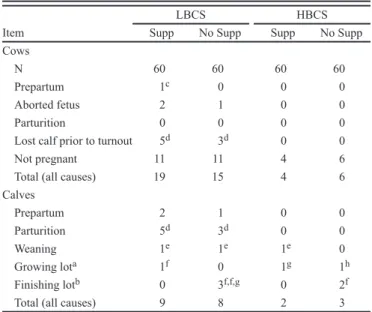
No BCS × supplementation interactions (P > 0.05) were noted; therefore, only main effect LS means are discussed. Also, the total number of cows removed from the study because of death, death of her calf prior to weaning, or failure to become pregnant during the breeding season was 19, 15, 4, and 6 for LBCS S, LBCS NS, HBCS S, and HBCS NS, respectively (Table 1). Consequently, 28% of LBCS cows were removed from the study compared with 8% of the HBCS cows. The number of calves that died was 9, 8, 2, and 3 for LBCS S, LBCS NS, HBCS S, and HBCS NS, respectively.
Cow Performance
At study initiation, BW of HBCS cows was 62 kg greater (P < 0.001) than LBCS cows. Also, initial BCS of treatments came close to meeting our targeted val-ues for HBCS and LBCS cows, respectively. The HBCS cows averaged 5.7 while LBCS cows averaged 4.4 (P < 0.001). At calving, the difference in BW and BCS be-tween HBCS and LBCS cows remained (P < 0.001), and
Bohnert et al.
5488
at weaning, the HBCS cows were still 29 kg heavier (P < 0.001) and had a 0.5 greater (P < 0.001) BCS than LBCS cows. These data agree with those reported by Stalker et al. (2007) who showed cows with greater BW and BCS at the beginning of the last trimester of gestation also had greater BW and BCS at calving and at weaning.
As with BCS treatments, BW and BCS of supple-mented and nonsupplesupple-mented cows were similar at study initiation (P ≥ 0.41; Table 2). However, supple -mented cows weighed 34 kg more (P = 0.002) and had 0.2 greater (P = 0.005) BCS than nonsupplemented cows
at calving. This agrees with other work in which DDGS was supplemented to mature beef cows consuming low-quality forage in late gestation (Winterholler et al., 2012). However, no difference in BW of supplemented and non-supplemented cows was noted at weaning (P = 0.16) but there was a tendency (P = 0.08) for supplemented cows to have a greater BCS than nonsupplemented. Our data agrees with numerous reports documenting the effect of protein supplementation of cows consuming poor qual-ity forage during late gestation on BW and BCS (Randel, 1990; Bohnert et al., 2002; Stalker et al., 2007).
Percentage of cows that became pregnant during the study was not affected by supplementation treatment (P = 0.94); however, there was a difference (P = 0.05) between HBCS and LBCS treatments. The average pregnancy rate for LBCS cows was 79% compared to 92% for the HBCS cows (Table 2). Body condition score at calving has been
shown to influence pregnancy rates and interval from
calving to pregnancy (DeRouen et al., 1994). Mature cows calving with a BCS 5 or greater become pregnant in fewer days than do cows calving with a BCS 4 or less (Richards et al., 1986). Our breeding season was 60 d, so it is possible that a longer breeding season may have re-sulted in a greater overall pregnancy rate for the LBCS cows; however, if length of the breeding season were limiting pregnancy rate, lengthening the breeding season would increase the calving interval and decrease the aver-age aver-age and BW of calves at a common weaning date.
Calf Performance
No effects on calf birth date were observed for LBCS or HBCS cows (P = 0.59) or for supplementation treat-ments (P = 0.48; Table 3). Also, no difference in the pro-portion of live calves at birth and weaning were observed due to supplementation (P > 0.27); however, the percent-age of live calves at birth for the HBCS cows was 100% compared with 90% for the LBCS cows (P = 0.003). Also, the percentage of live calves at weaning was greater for HBCS, averaging 99% and 88% for HBCS and LBCS
Table 1. Causes for cows being removed from the study and calf loss
Item
LBCS HBCS
Supp No Supp Supp No Supp Cows
N 60 60 60 60
Prepartum 1c 0 0 0
Aborted fetus 2 1 0 0
Parturition 0 0 0 0
Lost calf prior to turnout 5d 3d 0 0
Not pregnant 11 11 4 6
Total (all causes) 19 15 4 6 Calves Prepartum 2 1 0 0 Parturition 5d 3d 0 0 Weaning 1e 1e 1e 0 Growing lota 1f 0 1g 1h Finishing lotb 0 3f,f,g 0 2f
Total (all causes) 9 8 2 3
aOnly steer calves were placed in growing lot; n = 27, 26, 35, and 25 for supplemented and non-supplemented LBCS and supplemented and non-sup-plemented HBCS, respectively.
bOnly steer calves were placed in finishing lot; n = 26, 26, 34, and 24 for supplemented and supplemented LBCS and supplemented and non-supplemented HBCS, respectively.
cCow suffocated.
dCalves born dead, no dystocia observed. eCause of death unknown.
fCalves died of pneumonia. gCalf died of bloat. hCrippling injury.
Table 2. Body weight, BCS and reproductive performance of cows managed to enter the last trimester of gestation in low BCS (LBCS; approximately 4) or high BCS (HBCS; approximately 6) and offered 0.0 (No) or 0.9 kg/d (Yes) of dried distillers grains plus solubles during the last trimester of gestation1
Item
BCS Supplementation
LBCS HBCS SEM P-value No Yes SEM P-value
Initial BW, kg 503 565 14.7 <0.001 535 533 14.7 0.81 Calving BW, kg 513 554 13.2 <0.001 516 550 13.2 0.002 Weaning BW, kg 518 547 27.6 <0.001 528 537 27.6 0.16 Initial BCS 4.4 5.7 0.13 <0.001 5.1 5.0 0.13 0.41 Calving BCS 4.4 5.3 0.06 <0.001 4.8 5.0 0.06 0.005 Weaning BCS 4.7 5.2 0.15 <0.001 4.9 5.0 0.15 0.08 Pregnancy rate, % 79.3 91.6 4.14 0.05 85.2 85.6 4.14 0.94
Late gestation supplementation 5489
cows, respectively (P = 0.01). A reduction in live calves at weaning caused by nutrient restriction (Corah et al., 1975) or a lack of supplementation (Stalker et al., 2006)
during the last trimester of gestation has been reported. However, like Stalker et al. (2007) we did not observe an effect of supplementation on live calves at weaning. Nevertheless, we did observe an effect of cow BCS dur-ing the last trimester of gestation on percentage of live calves at weaning which is in contrast to the results re-ported by Stalker et al. (2007). The difference between the two studies could be because the BCS of cows in our study was lower. The LBCS cows in our study entered the last trimester of gestation with a BCS of 4.4 whereas
the November weaned cows in Stalker et al. (2007) en-tered the last trimester of gestation with a BCS of 5.0.
Calf birth weight was 2.6 kg greater (P = 0.001) for HBCS cows compared to LBCS cows (Table 3) and 1.5 kg greater (P = 0.05) for supplemented compared to non-supplemented cows; no incidents of dystocia were noted during the study. The effect of supplementation during gestation on calf birth weight has been inconclusive, with some studies showing an increase in birth weight (Clanton and Zimmerman, 1970; Larson et al., 2009; Winterholler
et al., 2012) but most showing no influence of supplemen -tation on calf birth weight (Bohnert et al., 2002; Currier et al., 2004; Stalker et al., 2006). The reason for the
ap-Table 3. Performance of calves born to cows that entered the last trimester of gestation in low BCS (LBCS; approxi-mately 4) or high BCS (HBCS; approxiapproxi-mately 6) and offered 0.0 (No) or 0.9 kg/d (Yes) of dried distillers grains with solubles during the last trimester of gestation
Item
BCS Supplementation
LBCS HBCS SEM P-value No Yes SEM P-value
Live calves at birth, n 108 120 116 112
Male calves, % 50 50 5.1 0.95 45 56 5.1 0.16
Calf birth date, Gregorian d 77 76 3.3 0.59 77 76 3.3 0.48
Live calf at birth, % 90.0 100.0 2.11 0.003 96.7 93.3 2.11 0.28 Live calf at weaning, % 88.3 99.2 3.05 0.01 95.8 91.7 3.05 0.28
Birth BW, kg 38.8 41.4 2.14 0.001 39.3 40.8 2.14 0.04 IgGa, mg/dL 6,121 5,962 570.2 0.62 6,213 5,870 570.2 0.30 Wean BW, kg 184 190 2.3 0.12 183 191 2.3 0.02 Wean age, d 139 140 10.8 0.45 139 140 10.8 0.59 ADG to wean, kg 1.05 1.06 0.057 0.92 1.04 1.07 0.057 0.09 Weight weaned/cow, kg 162 188 7.0 0.004 175 175 7.0 0.98 Growing lotb Calvesc, n 53 60 51 62 Initial BW, kg 203 213 3.0 0.02 204 211 3.0 0.10 Final BW, kg 252 263 3.4 0.02 254 261 3.4 0.13 ADG, kg/d 0.62 0.62 0.12 0.89 0.61 0.64 0.12 0.24 Finishing lot Calvesc, n 52 58 50 60 Initial BW, kg 252 263 3.4 0.02 254 261 3.4 0.13 Final BWd, kg 584 591 6.8 0.45 585 590 6.8 0.53 ADG, kg/d 1.87 1.90 0.032 0.51 1.90 1.86 0.032 0.32 Days on feed 177 175 1.2 0.09 176 177 1.2 0.40 HCW, kg 368 372 4.3 0.44 368 372 4.4 0.54 Backfate, cm 1.72 1.65 0.058 0.31 1.72 1.66 0.059 0.41 LM area, cm2 86.0 87.1 1.14 0.42 86.1 87.1 1.17 0.44 KPH, % 2.03 2.09 0.16 0.50 2.12 2.00 0.16 0.21 Marblingf 420 427 10.1 0.54 417 430 10.4 0.24 Yield grade 3.4 3.3 0.10 0.52 3.4 3.3 0.11 0.39 Choice, % 54.1 73.4 21.6 0.08 63.4 64.1 21.6 0.18 Retail product g, % 48.8 49.0 0.25 0.54 48.8 49.0 0.26 0.40 aImmunoglobulin G concentration in calves between 24 to 48 h after birth measured by radial immunodiffusion.
bCalves were in growing lot for 61 and 105 d for yr 1 and yr 2, respectively. cOnly steers were used in the growing lot and finishing lot.
dCalculated from HCW assuming a 63% dressing percentage. eThickness measured at the 12th rib.
fMarbling score: 400 = small00, 500 = Modest00.
gUSDA Retail Yield Equation: 51.34 – (5.78*inches backfat) – (0.0093*pounds HCW) – (0.462*percentage kidney, pelvic, and heart fat) + (0.74*rib-eye area in square inches).
Bohnert et al.
5490
parent inconsistencies is not readily apparent; however, it is possible that differences in the type and amount of
supplements used in the studies could have influenced
fetal growth. In support of our data, Winterholler et al. (2012) supplemented late-gestation cows with DDGS and noted an increase in calf birth weight. These authors implied that added energy from DDGS supplementation may have been partitioned to help support fetal growth.
The increased birth weight of calves from HBCS compared with LBCS cows is most likely due to the im-proved energy status and body condition of the HBCS cows. Spitzer et al. (1995) and Winterholler et al. (2012) reported that increasing cow BCS during late gestation increased calf birth weight. In addition, lower calf birth weights have been documented from cows with lower body weight and/or decreased precalving nutrient intake (Bellows et al., 1971; Bellows and Short, 1978; Corah et al., 1975). Therefore, the improved energy status of the HBCS compared with the LBCS cows prior to study initiation may have ameliorated the potential negative ef-fects on calf birth weight resulting from the lower energy status of the LBCS cows. There was no effect of treat-ment on calf serum IgG level at birth (P ≥ 0.30), and all IgG levels were sufficient to indicate successful transfer
of passive immunity to the calf (Tyler et al., 1996).
Calf BW at weaning was not influenced by cow BCS
(P = 0.12) but was increased for calves from supple-mented compared to nonsupplesupple-mented cows (P = 0.02; Table 3). This data agrees with previous work indicating that supplementation of cows precalving increases wean-ing performance of steer (Larson et al., 2009; Stalker et al., 2006, 2007) and heifer (Funston et al., 2010) off-spring. Also, improved weaning performance of calves has been reported from cows receiving a greater plane of nutrition than those experiencing nutrient restriction dur-ing late gestation (Clanton and Zimmerman, 1970; Corah et al., 1975). Also, calf ADG to weaning was not affect-ed by cow BCS (P = 0.92) but tended to be greater for calves born to cows that received supplement during the last third of gestation (P = 0.09). Because of the greater number of live calves at weaning for the HBCS compared with LBCS cows, the weight weaned per cow was 26 kg greater (P = 0.004) for HBCS, thereby yielding more marketable product. Supplementation had no affect (P = 0.98) on weight weaned.
Initial and final BW of calves entering the growing
lot and, consequently, initial BW of calves entering the feedlot were greater (P = 0.02) for calves from HBCS cows compared with calves from LBCS cows (Table 3). Also, calf initial BW entering the growing lot tended (P = 0.10) to be heavier for supplemented cows com-pared with nonsupplemented cows. However, no BCS or supplementation treatment effects were observed on calf ADG in the growing lot or feedlot (P ≥ 0.24) or on car
-cass characteristics (P ≥ 0.16). Consequently, our ges -tational treatments did not affect calf development in a manner that altered growing lot or feedlot performance, including carcass traits, which agrees with data reported by Stalker et al. (2006) in which late gestational supple-mentation of cows consuming dormant winter range did not alter feedlot performance or carcass traits of the sub-sequent offspring. This is in contrast to other research in which the HCW (Stalker et al., 2007) and yield grade and marbling score (Larson et al., 2009) of steer prog-eny from dams that received supplement during the last third of gestation were improved compared to progeny from nonsupplemented dams. An explanation for the in-consistent results is not readily apparent; however, it is possible that differences in prior nutritional status of the cows, winter grazing system, and/or weaning strategies may be responsible for the differences noted. Stalker et al. (2007) weaned cows in mid-August or early November and half of each group was provided a CP supplement from December to March while Larson et al. (2009) evaluated the effect of CP supplementation on 2 winter grazing systems (dormant winter range or corn residue) during late gestation. In our work and Stalker et al. (2006), all cows consumed a common basal diet and all calves were weaned at a common date, within study, thereby minimizing potential confounding of supple-mentation results by grazing system and weaning strat-egy. For example, Larson et al. (2009) reported grazing system × CP supplementation interactions for calf wean-ing weight and HCW while Stalker et al. (2007) reported
weaning date × CP supplementation interactions for fin -ishing ADG and HCW of progeny.
Prior research has shown that nutrient restriction during early to mid-gestation negatively affects fetal growth (Wu et al., 2004), including myogenesis and adi-pogensis (Du et al., 2010, 2011), decreases tenderness and adipose tissue deposition (Underwood et al., 2010), decreases the responsiveness of the hypothalamic-pitu-itary-adrenal axis in female progeny (Long et al., 2010a), organ development and function (Long et al., 2009), and gene expression (Long et al., 2010b). Nevertheless, even though differences in organ cellular composition and function were noted, Long et al. (2009, 2010b) showed that when beef cows are provided nutrients at a level that meets nutritional requirements during late gestation, it can ameliorate many of the negative con-sequences (growth and carcass characteristics) of intra-uterine growth restriction resulting from early- to mid-gestational nutrient restriction. Also, other research with late-gestational supplementation of cows has resulted in positive effects on age at puberty and pregnancy rate of female offspring (Martin et al., 2007; Funston et al., 2010). Even though the current study was not designed
Late gestation supplementation 5491
mid-gestational nutrient restriction on the performance of progeny, our data adds novel information regarding the relationship of BCS, within the range of 4 to 6, and supplementation of beef cows during late gestation on preweaning and postweaning performance of calves. In addition, our research further substantiates historical data that stresses the importance of maintaining cows in acceptable BCS entering the last third of gestation. Further research is warranted to help elucidate the mech-anisms (environmental, nutritional, genetics, gestational period, etc.), and subsequent interactions, by which dam nutrition effects progeny performance.
LITERATuRE CITED
AOAC. 1996. Official Methods of Analysis. 16th ed. Assoc. of Off. Anal. Chem., Arlington, VA.
Barker, D. J. 2004. Developmental origins of well-being. Philos. Trans. R. Soc. Lond. 359:1359–1366.
Bellows, R. A., and R. E. Short. 1978. Effects of precalving feed level on birth weight, calving difficulty and subsequent fertility. J. Anim. Sci. 46:1522–1528.
Bellows, R. A., R. E. Short, D. C. Anderson, B. W. Knapp, and O. F. Pahnish. 1971. Cause and effect relationships associated with calving difficulty and calf birth weight. J. Anim. Sci. 33:407–415. Bohnert, D. W., C. S. Schauer, and T. DelCurto. 2002. Influence of rumen protein degradability and supplementation frequency on performance and nitrogen use in ruminants consuming low-quality forage: Cow performance and efficiency of nitrogen use in wethers. J. Anim. Sci. 80:1629–1637.
Clanton, D. C., and D. R. Zimmerman. 1970. Symposium on pasture methods for maximum production in beef cattle: Protein and en-ergy requirements for female beef cattle. J. Anim. Sci. 30:122–132. Corah, L. R., T. G. Dunn, and C. C. Kaltenbach. 1975. Influence of pre-partum nutrition on the reproductive performance of beef females and the performance of their progeny. J. Anim. Sci. 41:819–824. Currier, T. A., D. W. Bohnert, S. J. Falck, and S. J. Bartle. 2004.
Daily and alternate day supplementation of urea or biuret to ruminants consuming low-quality forage: I. Effects on cow per-formance and the efficiency of nitrogen use in wethers. J. Anim. Sci. 82:1508–1517.
DeRouen, S. M., D. E. Franke, D. G. Morrison, W. E. Wyatt, D. F. Coombs, T. W. White, P. E. Humes, and B. B. Greene. 1994. Prepartum body condition and weight influences on reproductive performance of first-calf beef cows. J. Anim. Sci. 72:1119–1125. Du, M., J. Tong, J. Zhao, K. R. Underwood, M. Zhu, S. P. Ford, and
P. W. Nathanielsz. 2010. Fetal programming of skeletal muscle development in ruminant animals. J. Anim. Sci. 88:E51–E60. Du, M., J. X. Zhao, X. Yan, Y. Huang, L. V. Nicodemus, W. Yue, R.
J. McCormick, and M. J. Zhu. 2011. Fetal muscle development, mesenchymal multipotent cell differentiation, and associated signaling pathways. J. Anim. Sci. 89:583–590.
Funston, R. N., J. L. Martin, D. C. Adams, and D. M. Larson. 2010. Winter grazing and supplementation of beef cows during late gestation influence heifer progeny. J. Anim. Sci. 88:4094–4101. Herd, D. B., and L. R. Sprott. 1996. Body condition, nutrition and reproduction of beef cows. Texas Agric. Ext. Serv. Bull. 1526, College Station, TX.
Larson, D. M., J. L. Martin, D. C. Adams, and R. N. Funston. 2009. Winter grazing system and supplementation during late gesta-tion influence performance of beef cows and steer progeny. J. Anim. Sci. 87:1147–1155.
Long, N. M., M. J. Nijland, P. W. Nathanielsz, and S. P. Ford. 2010a. The effect of early to mid-gestational nutrient restriction on fe-male offspring fertility and hypothalamic-pituitary-adrenal axis response to stress. J. Anim. Sci. 88:2029–2037.
Long, N. M., M. J. Prado-Cooper, C. R. Krehbiel, U. DeSilva, and R. P. Wettemann. 2010b. Effects of nutrient restriction of bovine dams during early gestation on postnatal growth, carcass and organ characteristics, and gene expression in adipose tissue and muscle. J. Anim. Sci. 88:3251–3261.
Long, N. M., K. A. Vonnahme, B. W. Hess, P. W. Nathanielsz, and S. P. Ford. 2009. Effects of early gestational undernutrition on fetal growth, organ development, and placentomal composition in the bovine. J. Anim. Sci. 87:1950–1959.
Martin, J. L., K. A. Vonnahme, D. C. Adams, G. P. Lardy, and R. N. Funston. 2007. Effects of dam nutrition on growth and repro-ductive performance of heifer calves. J. Anim. Sci. 85:841–847. NRC. 2000. Nutrient Requirements of Beef Cattle. 7th ed. Natl.
Acad. Press, Washington, DC.
Randel, R. D. 1990. Nutrition and postpartum rebreeding in cattle. J. Anim. Sci. 68:853–862.
Reynolds, L. P., P. P. Borowicz, J. S. Caton, K. A. Vonnahme, J. S. Luther, C. J. Hammer, K. R. Maddock Carlin, A. T. Grazul-Bilska, and D. A. Redmer. 2010. Developmental programming: The con-cept, large animal models, and the key role of uteroplacental vas-cular development. J. Anim. Sci. 88(E-Suppl.):E61–E72. Richards, M. W., J. C. Spitzer, and M. B. Warner. 1986. Effect of
varying levels of postpartum nutrition and body condition at calving on subsequent reproductive performance in beef cattle. J. Anim. Sci. 62:300–306.
Sanson, D. W., D. C. Clanton, and I. G. Rush. 1990. Intake and diges-tion of low-quality meadow hay by steers and performance of cows on native range when fed protein supplements containing various levels of corn. J. Anim. Sci. 68:595–603.
Spitzer, J. C., D. G. Morrison, R. P. Wettemann, and L. C. Faulkner. 1995. Reproductive responses and calf birth and weaning weights as af-fected by body condition at parturition and postpartum weight gain in primiparous beef cows. J. Anim. Sci. 73:1251–1257.
Stalker, L. A., D. C. Adams, T. J. Klopfenstein, D. M. Fuez, and R. N. Funston. 2006. Effects of p and postpartum nutrition on re-production in spring calving cows and calf feedlot performance. J. Anim. Sci. 84:2582–2589.
Stalker, L. A., L. A. Ciminski, D. C. Adams, T. J. Klopfenstein, and R. T. Clark. 2007. Effects of weaning date and prepartum pro-tein supplementation on cow performance and calf growth. Rangeland Ecol. Manage. 60:578–587.
Turner, H. A., and T. DelCurto. 1991. Nutritional and managerial considerations for range beef cattle production. In: J. Maas, edi-tor, Veterinary Clinics of North America: Food Animal Practice. 7th vol. W. B. Saunders, Co., Philadelphia, PA. p. 103. Tyler, J. W., D. D. Hancock, S. M. Parish, D. E. Rea, T. E. Besser, S. G.
Sanders, and L. K. Wilson. 1996. Evaluation of 3 assays for fail-ure of passive transfer in calves. J. Vet. Intern. Med. 10:304–307. Underwood, K. R., J. F. Tong, P. L. Price, A. J. Roberts, E. E. Grings, B. W. Hess, W. J. Means, and M. Du. 2010. Nutrition during mid to late gestation affects growth, adipose tissue deposition, and tenderness in cross-bred beef steers. Meat Sci. 86:588–593. Winterholler, S. J., C. P. McMurphy, G. L. Mourer, C. R. Krehbiel, G. W. Horn, and D. L. Lalman. 2012. Supplementation of dried distillers grains with solubles to beef cows consuming low-quality forage dur-ing late gestation and early lactation. J. Anim. Sci. 90:2014–2025. Wu, G., F. W. Bazer, T. A. Cudd, C. J. Meininger, and T. E. Spencer. 2004.
Maternal nutrition and fetal development. J. Nutr. 134:2169–2172. Wu, G., F. W. Bazer, J. M. Wallace, and T. E. Spencer. 2006. Board-invited review: Intrauterine growth retardation: Implications for the animal sciences. J. Anim. Sci. 84:2316–2337.