A Hypervisor Based Security Testbed
Dan Duchamp and Greg DeAngelis
Computer Science Department Stevens Institute of Technology
Hoboken, NJ 07030 USA
[email protected], [email protected]
ABSTRACT
We are developing an experimental testbed intended to help support security research. The testbed allows a network of unmodified hosts, running any of several of unmodified op-erating systems, to execute in a controlled and reproducible manner. The network is implemented on a hypervisor that is instrumented to observe and control security-relevant events. These events are securely logged to a relational database for later analysis.
1.
INTRODUCTION
We are developing an experimental testbed intended to help support security research. The testbed allows a network of unmodified hosts to be subjected to se-curity attacks in a controlled, observable, and repro-ducible manner using hypervisor technology.
The two most notable characteristics of our testbed are the use of a virtual machine monitor (VMM, aka hypervisor) as a tool for gathering information over an entire heterogeneous LAN, and a highly generalized in-frastructure for the description, measurement, and anal-ysis of experiments.
Unmodified guest host software (operating system and applications) runs on an instrumented virtual ma-chine monitor. The VMM provides a powerful tool for observing and controlling the behavior of the guest software. Measurement points added to the hypervi-sor allow the experimenter to log the occurrence of key security-relevant events such as a system call or a buffer overflow. When our work is complete, the experimenter will be able not only to log but also to control guest host behavior via the measurement points; for example, the hypervisor could intercept and verify a system call be-fore allowing it to proceed.
The VMM not only emulates x86 hardware, it also implements a virtual Ethernet. Emulating both hosts and network on the same hypervisor provides experi-menters with a more complete view of how network-based attacks spread.
Furthermore, the idea of implementing a LAN and all its hosts on a single virtual machine might also prove to be a superior way to deploy an intrusion detection
system (IDS) on a real world network that is small and highly vulnerable, such as a honeypot [13] or a DMZ.
Conventional approaches to intrusion detection are either host-based or network-based. A host-based IDS monitors computing activity on a host and raises an alarm when suspicious activity is observed. One weak-ness of a host-based IDS is that it places the IDS in the same domain of execution as the vulnerable ma-chine, exposing the IDS to whatever happens when the machine is compromised. Another weakness is that in-trusion detection logic is applied to only a single host. To protect an entire installation using host-based IDS software, each host must run the IDS and anomalous ac-tivity must be detectable on a per-host basis. Attacks that manifest across several hosts may not be detected by a host-based IDS approach. In contrast, a network IDS sniffs packets, reconstructs “flows” from the con-stituent packets, then applies intrusion detection logic to each flow. One weakness of a network-based IDS is that flow reconstruction can be very difficult, espe-cially if—as is often the case—an attack intentionally includes nonsense packets specifically intended to con-fuse or trick the recipient. A classic example of an at-tack containing nonsense packets is when two TCP seg-ments contain overlapping data; e.g., one segment con-tains bytes numbered 100-300, while the next segment contains bytes numbered 200-400. It is implementation-dependent whether TCP will accept bytes 200-300 from the first segment or the second. A network IDS must first reconstruct the flow that will be seen by the host under attack, then analyze the flow for anomalies or suspicious content. In the case of overlapping TCP segments, merely to reconstruct the flow the network-based IDS must be aware of the host’s exact TCP state and even of the host’s TCP implementation details. Host-based and network-based intrusion detection ap-proaches each suffer from their own blind spot. A se-curity testbed facility based on virtual machine (VM) technology need not have a blind spot.
Having a system-wide view permits capture and record-ing of a timestamped “movie” of activity in all parts of the system during an attack. Such movies can be
an-alyzed off-line afterward to discover attack signatures that could then serve as input to standard IDSs. Movies could also be stored and replayed later to reproduce an attack on demand.
The main components of our testbed are: 1. Hardware base
2. Infrastructure for experiment description and con-figuration
3. Support for measurement and logging during exper-iments
Each component is discussed in its own section below.
2.
HARDWARE BASE
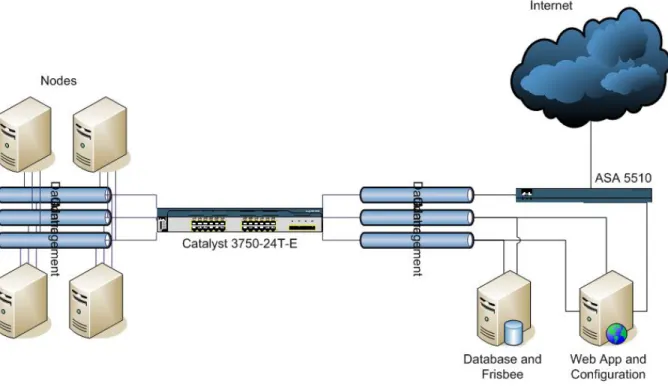
Our current hardware base is shown in Figure 1. Ex-periments run on five real machines, each of which has two dual-core Xeon 5060 (Dempsey) processors with In-tel Virtualization Technology (IVT) extensions [8, 6] for virtualization and 8GB of RAM. IVT providesVMentry
andVMexitstate transitions that manage where inter-rupts and system calls are directed. Certain instruc-tions must be trapped within a guest host and for-warded to the hypervisor. Access to I/O devices is han-dled as described below.
The virtualization software is KVM [10, 11], a load-able module for Linux versions 2.6.20 and later. KVM leverages IVT to implement a virtual machine monitor with much less code than traditional hypervisors like VMWare [15], Xen [2], etc. KVM expands the tradi-tional two modes of a UNIX process (user and system) to three: user, system, and guest. When guest software runs in such a 3-state process, I/O instructions execute in user mode at the Linux privilege level of the user who owns the guest host process. Non-I/O code runs in guest mode, and system mode is used only to transition among modes and for special instructions.
Linux/KVM can host any unmodified x86-based erating system. Therefore, our testbed supports all op-erating systems of interest to us: Windows, Linux, and NetBSD. Support for heterogeneity allows the execution of more varied and realistic experiments.
Because Linux exposes dual dual-core Xeon sors with hyperthreading enabled as 8 virtual proces-sors, each hypervisor is configured to support 8 guest hosts by default. So the overall facility supports a min-imum of 40 guest hosts. However, the hypervisors can be configured to support more than 8 guest hosts each, so larger virtual networks are possible. Memory is the resource most likely to limit the number of virtual hosts that can be supported.
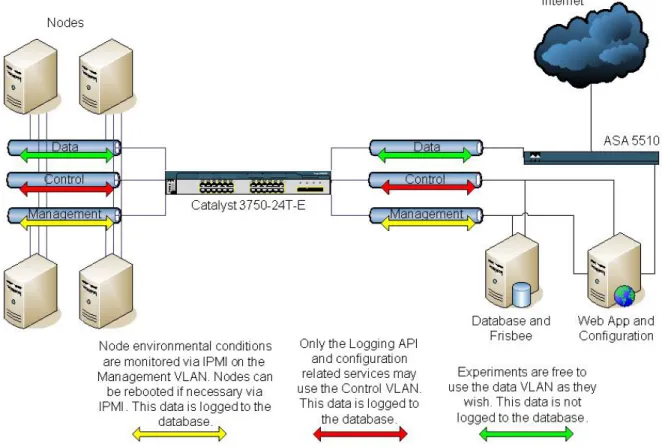
Each real machine has 3 Ethernet ports that are all attached to a Cisco Catalyst 3750 switch. The switch implements three types of network. A “management” network connects the 5 real machines to a control server (to be described below). The management network is
used exclusively to control the physical machines in lim-ited ways such as rebooting them and initializing their disks. A second “control” network is used exclusively for logging. Events logged by each virtual machine are transmitted over the control network to a database server (to be described below).
The third type of network implemented by the switch is the “data” network. Guest hosts use only the data network for their traffic. To form networks of guest hosts, each guest operating system is given a virtual network interface. Each virtual network interface is connected to a software bridge running on the physi-cal machine. The software bridge also connects to its machine’s physical Ethernet adapter for the data net-work. A combination of the settings on the software bridges on each machine and the VLAN settings of the Catalyst switch allow guest hosts on the same or dif-ferent physical machines to be grouped arbitrarily into virtual networks. Traffic for the virtual network passes through either one or two hypervisor(s) and therefore can be monitored.1
Besides the five physical machines that support guest hosts for experiments, two physical machines provide support functions. One machine is used as a database. During experiments, it collects records about security-relevant events produced by measurement points within KVM and transmitted over the control network. After queueing, these records are stored in a MySQL database. The database machine also acts as a disk image server. We initialize the disk images of the physical machines when a complete physical reset is necessary.
The final machine shown in Figure 1 is the control host. Users connect to this machine to configure the system in preparation for an experiment, configure and run experiments, and perform post-experiment analysis of events logged in the database.
The database server and control host are connected to only the control and management networks, keep-ing them physically isolated from the dangerous data network.
All this hardware is separated from the campus net-work and Internet by a Cisco ASA 5510 firewall. The firewall allows connections between the outside and the control host so that users can enter the testbed, set up and run their experiments.
Experiments running on the data network can also be granted access to the outside when appropriate. Not ev-ery experiment will involve dangerous code; the testbed can be used for non-security experiments as well as for security experiments. The firewall supports 100
1
Traffic between guest hosts passes through one hypervi-sor if the two guest hosts are running on the same physical machine; otherwise, the two guest hosts are running on dif-ferent physical machines so their traffic passes through two hypervisors.
Figure 1: The hardware base includes five physical machines dedicated to experimental software. Each machine runs the Linux/KVM hypervisor and is capable of supporting several guest hosts. Each of these machines is connected to three networks, two of which are reserved for control and management. A Catalyst switch helps to connect guest hosts together on VLANs. Two support machines are dedicated for configuration and data storage, respectively. The entire facility lies behind a firewall.
VLANs. Therefore, if an experiment requires access to the outside—and the experiment is deemed trustworthy— then the firewall can join the VLAN allocated to a vir-tual network of guest hosts. In this way, guest hosts can access the outside through the firewall. The firewall configuration is part of the definition of an experiment.
3.
SYSTEM AND EXPERIMENT
CONFIG-URATION
To set up and run an experiment, a user connects to the control host and runs a web application, cleverly named “WebApp.” WebApp allows the user to set up, initiate, monitor, and post-analyze the experiment. The setup process is suggested by Figure 2 while experiment execution is suggested by Figure 3.
The first step is to configure the software on the sub-set of virtual nodes necessary for the experiment. For this purpose, we are developing a tool for virtual node configuration that is a “generalized package manager” (GPM) that can interoperate with popular Linux pack-age manpack-agers such as RPM, portpack-age, and apt. The GPM is not a single cross-OS package manager like Au-topackage [1]. Instead, it is much simpler—it translates the user’s specifications into calls to the native package manager of the underlying Linux distribution. GPM
Figure 2: The experiment is configured by a user employing a modified version of Emulab’s Netbuild client to specify network connections and our own Generalized Package Manager to specify guest software. The experiment descrip-tion is compiled into XML and stored in the database. If necessary, the physical machines are given a clean disk image.
allows a user to load and configure both the kernel and application software for any Linux-based virtual node. In the future, we hope to configure Windows guest hosts in the same way if a package manager for Windows be-comes available (e.g., WPM [12]).
The second step in setting up an experiment is to specify the mapping of virtual hosts to virtual LANs. For this step, we use a modified version of Emulab’s “Netbuild” client in which nodes, links between them, and link properties are specified visually. A significant difference, however, is that our experiment configura-tion is compiled into XML and the XML is then loaded into the database. The reason for doing so is to create a machine readable permanent record of the experimental setup that can be associated with the data it produces, which will also be stored in the database. Once in the database, an experiment and its data can be analyzed and/or archived.
There are two ways to prepare virtual host software in advance of an experiment. One way is to reconfigure with the package manager as described above. How-ever, if there is reason to suspect that either or both of the guest host or the hypervisor has been compromised or damaged, a second and more complete preparation can be performed using IPMI [5]. This preparation ini-tializes an entire physical machine, not just a virtual host.
Our physical machines are each equipped with an IPMI card. IPMI allows a machine to be remotely con-trolled even if it is not yet running an operating system. To initiate a clean-slate experiment, a physical ma-chine is booted using IPMI commands sent over the management network. The physical machine boots up into the disk image client which then loads a virgin disk image containing the hypervisor operating system (i.e., Linux with KVM extensions). After receiving a com-plete clean disk image, the physical machine reboots, this time coming up running the Linux/KVM hypervi-sor.
Once KVM is running, virtual hosts are booted in the order specified as part of experiment configuration. Virtual hosts start application software following their usual procedures; e.g.,/etc/rc,cronand the like. The sequencing of application startup, creation of background traffic, placement of innocent and malicious software, etc.—all this is the responsibility of the experimenter.
We plan to eventually add a hypervisor checkpoint facility so that an experimenter can pause a guest host and save its state. Being able to run a guest host from a prior saved state can benefit experiments that require a lengthy and/or complicated setup of the state that immediately precedes an attack.
4.
MEASUREMENT AND LOGGING
Measurement points exist inside the hypervisor to
re-port the occurrence of relevant low level events. Since KVM is implemented as a loadable module, we are de-veloping a library of modules, each of which provides a different set of measurement points. The experimenter can select from among these modules, or he can write his own. Part of the experiment description is a specifica-tion of which measurement points should be activated, how often they should report, and what is the format of the log record that describes the event.
Logged events are queued within the hypervisor be-fore being transmitted to the database server over the control network. Once at the database server, they are again queued there before being entered into the MySQL database. The purpose of queueing at both ends is to provide buffering to absorb variations in load. One consequence of compiling the experiment descrip-tion into XML is that the database holds an XML de-scription of the format of log records produced by each type of monitored event. This allows XSLT to translate an XML description of a group of logged variables into typed headers of functions in a variety of languages.
For example, this XML description
<target name="target1">
<value name="param1" type="integer" /> <value name="param2" type="float" /> <value name="param3" type="double" /> </target>
is translated into
void target1(int param1, float param2, double param3) { // C or Java implementation
}
for C or Java and
def target1(param1, param2, param3): // Python implementation
for Python.
The function implementation is responsible for send-ing a message to the local queuesend-ing daemon. Messages are tagged with the time, target name, and experiment name so that the message can be unwrapped and in-serted into the “ExperimentName.TargetName” table in the relational database.
Presently, events are only logged. We plan to allow future modules to invoke policy modules so as to control the guest host.
The most difficult and least mature part of this work is how to relate low level events that the hypervisor can easily observe to high level actions that would be rele-vant to intrusion detection. Mapping low level events (such as system calls) and facts (such as the contents of a region of memory) to a security-relevant high level
Figure 3: The data network is reserved for experiments. Several experiments can be in progress simultaneously by configuring the Catalyst switch to assign separate VLANs to separate groups of virtual hosts. The control network is reserved for log records produced by measurement points within the hypervisor and sent to the database server. The management network is reserved for IPMI-based reset, initialization, and monitoring of the physical hardware.
conclusion (such as that a buffer overflow occurred) re-quires non-trivial knowledge about how the guest oper-ating system and guest applications use memory. This knowledge, encoded in data structures of the guest op-erating system, is complex and is subject to corruption when the guest operating system is compromised during an attack.
Previous work—most notably Livewire [4]—tackled this problem by implementing an interface between the hypervisor and an out-of-hypervisor intrusion detection module that had detailed knowledge about the guest operating system. The Livewire interface allowed the external IDS module to give commands to the hypervi-sor to inspect and monitor guest host state.
In contrast, we are designing a callout mechanism that would permit an out-of-hypervisor IDS (i.e., Linux process that is not supporting a guest host) to register callout criteria with the hypervisor, in much the same way that processes can register packet filters with the Berkeley Packet Filter (BPF) [7]. Whenever a callout’s criteria are met the hypervisor will pause the guest host and transfer control to the external IDS so that it can
inspect the guest host’s memory. This approach isolates guest-host-specific knowledge in the external IDS, leav-ing the hypervisor largely ignorant of any of the guest host’s implementation details.
Until such time as the callout-based control mech-anism is working, users can log (only) events such as system call, interrupt service, and I/O instructions (es-pecially packet transmit/receive).
5.
SUMMARY
We are developing an experimental testbed intended to help support security research. The testbed allows a network of unmodified hosts to execute on a hyper-visor that is instrumented to observe and eventually to control security-relevant events occurring across the network. As much as possible, experimental parameters are compiled into XML and recorded in order to ease repeatability, control, and analysis.
6.
ACKNOWLEDGEMENT
This work was supported in part by the U.S. Army Armament Research, Development and Engineering
Cen-ter (ARDEC) under contract W15QKN-05-D-0011, Task Order 12.
7.
REFERENCES
[1] Autopackage development team.Autopackage: Easy Linux Software Installation.http://autopackage.org
[2] P. Barham et al.Xen and the Art of Virtualization.in Proc. 19th ACM Symp. on Operating Systems Principles (SOSP ’03), October 2003.
[3] T. Benzel et al.Experience with DETER: A Testbed for Security Research.in Proc. 2006 IEEE
TridentCom, March 2006
[4] T. Garfinkel and M. RosenblumA Virtual Machine Introspection Based Architecture for Intrusion Detection.in Proc. Network and Distributed Systems Security Symposium, February 2003.
[5] Intel Corp.Intelligent Platform Management Interface.http://www.intel.com/design/servers/ipmi
[6] Intel Corp.Intel Trusted Execution Technology. http://download.intel.com/technology/security/ downloads/31516803.pdf
[7] S McCanne and V. JacobsonThe BSD Packet Filter: A New Architecture for User-level Packet Capture.in Proc. Winter USENIX Technical Conf., pp. 259–270, 1993.
[8] G. Neiger et al.Intel Virtualization Technology: Hardware Support for Efficient Processor Virtualization.Intel Technology Journal 10(3), August 2006.
http://developer.intel.com/technology/itj/index.htm
[9] M. Ott et al.ORBIT Testbed Software Architecture: Supporting Experiments as a Service.in Proc. 2005 IEEE TridentCom, Feb. 2005
[10] Qumranet Corp.KVM Wiki. http://www.qumranet.com/kvmwiki
[11] Qumranet Corp.KVM: Kernel-based Virtualization Driver.http://www.qumranet.com/wp/kvm wp.pdf
[12] E. RoppleWPM—Windows Package Manager. http://blacken.superbusnet.com/oss/wpm
[13] K. SeifriedHoneypotting with VMWare—basics http://www.seifried.org/security/ids/20020107-honeypot-vmware-basics.html
[14] M. Singh et al.ORBIT Measurements Framework and Library (OML): Motivations, Design, Implementation and Features.in Proc. 2005 IEEE TridentCom, Feb. 2005
[15] J. Sugerman et al.Virtualizing I/O Devices on VMWare Workstation’s Hosted Virtual Machine Monitor.in Proc. USENIX 2001.
[16] B. White et al.An Integrated Experimental
Environment for Distributed Systems and Networks. in Proc. 5th USENIX Symp. on Operating Systems Design and Implementation (OSDI ’02), October 2002.