Developing Online Roleplay Simulations for Preparing
Engineering Students for Multidisciplinary and International
Practice
Holger R. Maier and Judi Baron
The University of Adelaide, Adelaide SA 5005, Australia
Abstract
Increasingly, engineers are required to work as part of multidisciplinary teams, often in an international context. In this paper, it is proposed that online roleplay simulations provide an excellent means of developing the graduate attributes required for this type of work. A framework for developing online roleplay simulations to achieve higher-order learning outcomes, particularly in the context of preparing engineering students for multidisciplinary and international practice, is introduced, which is based on the Community of Inquiry model. The Mekong e-Sim, which is centred on proposed development issues in the Mekong region of South-East Asia, is presented as a case study of how this can be achieved in practice. Surveys of the students who participated in the Mekong e-Sim in 2005 indicate that the e-Sim is successful in developing communication and teamwork skills, raising awareness of the requirements of working in an international environment and developing the ability to see engineering issues from multiple perspectives and an awareness of the political, social, economic and scientific dimensions to engineering decision-making.
1. Introduction
Increasingly, engineers are required to work as part of multidisciplinary teams, often in an international context. This is reflected in the generic graduate attributes that need to be developed by degree programs accredited by Engineers Australia, which include the “ability to function effectively… in multi-disciplinary and multi-cultural teams…” and an
“understanding of the social, cultural, global and environmental responsibilities of the professional engineer …”1. However, ensuring engineering students acquire these skills in a traditional classroom setting is not an easy task, and a number of active learning methods have been proposed as alternatives, including collaborative learning, problem-based learning, case methods, enquiry-based learning and roleplay simulations2.
Roleplay simulations have already been used successfully in a number of disciplines, including engineering, and are generally characterised by interactions of multiple learners who adopt the roles of stakeholders with different responsibilities and points of view and interact about complex issues that do not have a single “correct” outcome. Consequently, they are ideally suited to facilitating the achievement of graduate attributes related to the preparation of engineering students for multidisciplinary and international practice.
Traditionally, roleplay simulations have been conducted in a face-to-face setting. However, with the increased usage of computers in university environments, online roleplay simulations have gained popularity, as they are generally more cost effective, provide the option of
adopting an extended timeframe, thus providing greater opportunities for reflection and analysis and are able to cater for geographically distributed participants, possibly from different disciplines and / or countries. The last point is particularly pertinent in the context of preparing engineering students for multidisciplinary and international practice.
In order to ensure that higher-order learning outcomes are achieved in relation to online roleplay simulations, a new framework for their development, based on Garrison and Anderson’s Community of Inquiry (COI) framework3, is introduced in this paper. The framework is discussed in the context of developing roleplay simulations for preparing engineering students for multidisciplinary and international practice and the implementation of the above framework is illustrated with a case study, the Mekong e-Sim, which is a cross-institutional, multidisciplinary online roleplay simulation centred on development issues in the Mekong region of South-East Asia.
2. Framework for Developing Online Roleplay Simulations 2.1 Background
2.1.1 Online Roleplay Simulations
Online roleplay simulations are characterised by the interaction of multiple learners, who represent stakeholders with varying points of view, about an issue or problem that does not have a “correct” outcome and contains sufficient conflict to spark debate. They generally consist for three main stages, including briefing, interaction and debriefing. In the briefing stage, students become familiar with the requirements and setting of the roleplay simulation, as well as the online learning environment. In addition, they adopt their particular role, which requires a good understanding of what the responsibilities and views of their character are, and how their character would act in a variety of situations. The interaction stage commences with a “trigger event”, which requires the various roles to interact with each other in order to solve the problem or explore the issue that forms the basis of the enacted scenario. However, in many instances the expected learning outcomes of online roleplay simulation go beyond the specific issues that are a feature of the particular scenario being considered. Generally, a scenario is an instance of a larger class of problem, and the lessons learnt from the scenario being played out have wider applicability. In order for students to be able to generalise beyond their experience of a particular scenario, it is vital for them to have the opportunity to step back and look at general processes that occurred as part of the interaction phase of the roleplay simulation. This is achieved during the debriefing stage.
2.1.2 Community of Inquiry Framework
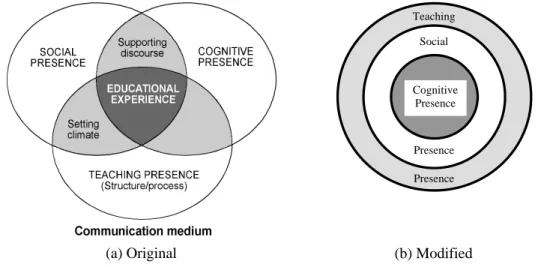
The COI framework is based on the concept that a community of learners“is an essential, core element of an educational experience when higher-order learning is the desired learning outcome”3. Further, “the teaching of high-level concepts inevitably involves a considerable amount of discourse”3 (discussion). An online learning environment where students are able to take responsibility and control of their learning has distinct advantages for a community of inquiry process – the asynchronous text-based communication medium of groups, discussion boards and email is both reflective and explicit, and learners have access tounlimited data sources3. There are three key elements to the COI framework – cognitive, social and teaching presence (Figure 1a). Cognitive presence is“the extent to which learners are able to construct and confirm meaning through sustained reflection and discourse in a critical community of
inquiry”3. Social presence is “the ability of participants… to project themselves socially and emotionally”3, and teaching presence is the “design, facilitation and direction of cognitive and social processes”3.
(a) Original (b) Modified
Figure 1: Community of Inquiry Framework
2.2 Proposed Framework
In this paper, it is proposed that the COI framework can be used as a basis for developing online roleplay simulations to ensure that higher-order learning outcomes are achieved. In the specific context of developing online roleplay simulations, it is suggested to adopt a slightly modified representation of the COI model, as shown in Fig. 1b. As can be seen, the total educational experience is still represented as the intersection of cognitive, teaching and social presence. However, the model suggests that cognitive presence can only be achieved if there is an appropriate online communications environment to enable (social presence), and an appropriate course design and structure to provide opportunities for (teaching presence), the construction of meaning and confirmation of understanding (cognitive presence).
Consequently, cognitive presence is represented as a subset of both social and teaching presence. This notion is an agreement with Garrison et al.4, who suggest that the purpose of teaching presence is to “…manage and monitor the cognitive and social dynamic to create a purposeful community of inquiry” and Rourke et al.5, who state that “social presence supports cognitive objectives through its ability to instigate, sustain, and support critical thinking in a community of learners”. Similarly, the provision of an online communications framework that enables students to project themselves socially and emotionally (social presence) is considered a subset of overall course structure and design (teaching presence).
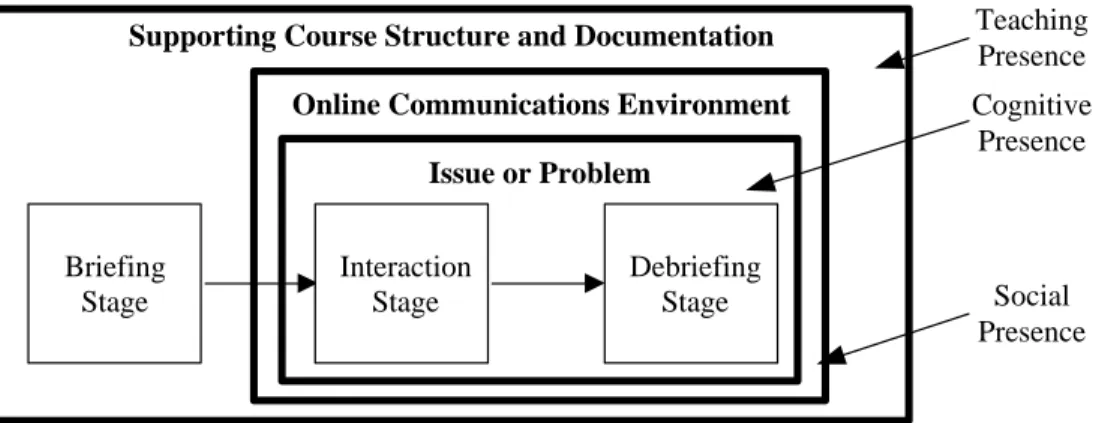
The proposed framework for developing online roleplay simulations is shown in Fig. 2. It can be seen that, as part of the framework, the problem or issue, around which the roleplay simulation revolves, provides cognitive presence, as it enables students to construct meaning through interaction and reflection. The online communications environment, coupled with the problem or issue being considered, constitute social presence, as they provide students with the motivation and ability to project themselves socially and emotionally in a community of inquiry. The problem or issue, online communications environment and supporting course structure and documentation provide overall teaching presence. The role each of these
Teaching Presence Social Presence Cognitive Presence
elements plays in the development of online roleplay simulations is discussed in detail in the subsequent sections, particularly in the context of preparing engineering students for interdisciplinary and international practice.
Figure 2: Proposed Framework for Developing Online Roleplay Simulations 2.2.1 Cognitive Presence
According to Garrison and Anderson3, the following four phases are essential in order to achieve the higher order thinking processes associated with cognitive presence: trigger, exploration, integration and resolution. The triggering event is generally an issue, dilemma or problem that needs to be addressed. During the exploration phase, students obtain a better understanding of the problem and find relevant information that enables them to address the problem. As students move from the exploration to the integration phase, they begin to “…construct meaning from the ideas generated in the exploratory phase”4. Finally, the problem is resolved through direct or vicarious action.
In relation to the design of online roleplay simulations, the four phases outlined above need to be incorporated into the interaction and debriefing stages in order to ensure that higher order cognitive learning outcomes are achieved. During the interaction stage, the initial trigger is the announcement of the issue or problem that is at the centre of the roleplay. This can be done in a number of ways, such as the use of media announcements. In response, students try to come to a better understanding of the issue or problem being investigated through private reflection and the sharing of information and opinions. As a result, they move repeatedly between critical reflection (private) and discourse (shared with community of inquiry) during the exploration and integration phases, which Garrison et al.4 stress is vital for higher-order learning to occur. The interaction stage comes to a conclusion once a satisfactory solution has been found, which can be achieved by consensus or the judgement of a role that acts as a moderator.
During the debriefing stage, the trigger might be the topic for a debriefing report. In order to obtain a better understanding of what is required, and the information and insight necessary to complete the report, students can reflect on their own experiences of the interaction stage and share their experiences and thoughts with participants who adopted different roles. This initially broadens their perspective, as they learn about other peoples’ experiences
(exploration), before they integrate the information from the various sources to obtain a better understanding of the general processes that govern the larger class of problem of which the
Supporting Course Structure and Documentation Online Communications Environment
Briefing Stage Interaction Stage Debriefing Stage Issue or Problem Teaching Presence Cognitive Presence Social Presence
particular issue or problem investigated during the interaction stage is an example. Finally, the problem is resolved upon completion of the debriefing report.
In a typical online roleplay simulation, the trigger – exploration – integration – resolution phases can occur many times. For example, a trigger can be provided by an e-mail received from another role. If the e-mail contains a request for information that falls within the area of expertise of the recipient’s role, the exploration phase would consist of the gathering of relevant information by private research or communication with other roles (or with other members of the same role, if roles are made up of groups of people), the integration phase would entail the formulation of the response and resolution of the issue would occur when the reply was sent. In this way, many “smaller” learning events, each consisting of the four phases described above, can occur within the interaction and integration phases of a “larger” learning event. In addition, the resolution of one issue can provide the triggering event for another issue, thus repeating the learning cycle again and again.
In order to ensure students actively engage with each other, it is vital that the issue or problem being investigated causes sufficient conflict. In addition, care needs to be taken to ensure that all relevant stakeholder groups are represented and that there are sufficient stakeholders with similar and conflicting views. When using online roleplay simulations for engineering education, the issue being investigated is generally a proposed engineering project. In the context of preparing engineering students for multidisciplinary and international practice, the proposed project should be set in an international context and exploit areas of potential conflict, such as opposing emotions or motives, perpetual differences and/or clashes over scarce resources. The potential of trans-boundary issues provides additional sources of conflict. By ensuring that the proposed project is multidisciplinary, and that stakeholder groups from the relevant disciplines are represented, interdisciplinary interaction will occur. This will assist engineering students with seeing engineering developments from multiple perspectives, and highlight the social, cultural, global and environmental responsibilities of professional engineers.
2.2.2 Social Presence
In order to ensure students have the means to engage in discourse that enables them to project themselves socially and emotionally during the interaction and debriefing stages of online roleplay simulations, an appropriate online communication framework needs to be made available. It is important to represent the available communication channels in a realistic manner, including appropriate communication hierarchies and provision for both private (e.g. e-mail) and public (e.g. discussion boards) communication. The provision of appropriate online “meeting places” is particularly important in the context of online roleplay simulations. Some of these “meeting places” might be accessible by all stakeholders (e.g. discussion boards that everybody can read and post to), whereas others might provide forums for “private” discussion and/or sharing of information for some of the stakeholder groups (e.g. discussion boards that only selected groups can read and post to). Such private “meeting places” are also useful in situations where individual roles are played by groups of students, rather than individuals. However, as discussed previously, the degree of interaction, and the types of responses (e.g. affective, interactive, cohesive – see Rourke et al.5), are generally a function of the issues and problems that are being explored, which is why cognitive presence is considered as a subset of social presence in this paper.
In the context of preparing engineering students for multidisciplinary and international practice, the requirement to interact with characters and/or organisations from different disciplines and/or countries about a proposed engineering project provides students with the opportunity to improve their formal communications skills and their ability to act in a professional manner. In addition, as various roles often collaborate during the interaction stage of roleplay simulations, students have the chance to develop their teamwork skills. This benefit is amplified when individual roles are played by groups of students.
2.2.3 Teaching Presence
As discussed previously, teaching presence is the “…design, facilitation and direction of cognitive and social processes for the purpose of realizing personally meaningful and educationally worthwhile learning outcomes”3. Consequently, the selection of appropriate issues, the design of the interaction (e.g. issues and problems, stakeholders and trigger events) and debriefing stages and the provision of appropriate “meeting places” and other
communications channels are a subset of overall teaching presence. In addition, teaching presence encompasses the provision of additional support material, such as that required during the briefing stage (e.g. information on structure and assessment of roleplay simulation, background reading material, role profile descriptions, streaming videos etc.). This material can take on a variety of forms, ranging from purely text-based to multi-media. In the context of staging roleplay simulations centred on international engineering projects, the use of multimedia resources, such as videos and images, can provide additional context and realism.
3. Case Study: Mekong e-Sim 3.1 Background
The Mekong e-Sim involves between 60-140 students with various technical backgrounds from a number of universities who adopt the roles of stakeholders and respond to proposed development issues in the Mekong River basin of South-East Asia. Through research and interaction with other roles, participants build a case as to whether the proposed development should proceed or not, which they present and defend during an on-line public inquiry. The Mekong e-Sim was developed in 2001, and a detailed description of the Mekong e-Sim prototype (2001-2002), are given in McLaughlan et al.6 and McLaughlan and Kirkpatrick2. Over the last 3 years, a number of significant changes have been made to the Mekong e-Sim as a result of student feedback and a Community of Inquiry evaluation of the e-Sim7. This work builds on knowledge described in previous studies about the Mekong e-Sim by providing a different interpretive framework and using the resulting outcomes to improve student learning. Details of the most recent version of the Mekong e-Sim (2005), which changes have been implemented over the last three years and how its current design is motivated by the framework for developing online roleplay simulations introduced in this paper, are given in Sect. 3.2.
3.2 Design
3.2.1 Cognitive Presence
As mentioned above, the Mekong e-Sim is centred on a number of online public inquiries into proposed developments in the Mekong region. In 2005, public inquiries were held into two
proposed developments, including the Nam Theun II hydropower dam in Laos and the Lancang development project in China, which includes the construction of a large
hydropower dam and the blasting of rapids to improve river navigation. The Nam Theun II scenario was developed as part of the e-Sim prototype, whereas the Lancang scenario has been developed over the last three years.
The proposals at the centre of the public inquiries are highly controversial and are likely to polarise stakeholder groups. In addition, the potential impacts of the projects are far reaching. For example, there are environmental impacts, such as the impediment to fish passage, sedimentation and a loss of biodiversity, social impacts related to the dislocation of villagers and cultural issues concerned with the loss of relics and traditional ways of life. However, there are also a number of positive effects, such as economic development, potential increases in living standards, increased opportunities for employment, and the generation of renewable electricity. The above impacts also span a number of countries.
The stakeholder groups considered come from a variety of countries, disciplines and views, and include government, non-government, development, academic and research, engineering and media organisations, as well as village groups. Each of these stakeholder groups is represented by a number of specific characters / organisations, and includes a decision-maker group for each public inquiry, which chairs the public inquiry, weighs up the evidence presented and comes to a final decision in relation to whether the proposed development should proceed or not. Details of the individual roles associated with the Nam Theun II and Lancang public inquiries are given in Baron and Maier7. While some roles are common to both public inquiries, a number of roles specific to the Lancang project have been developed over the last three years.
In 2005, the participants in the Mekong e-Sim consisted of 47 students from the University of Adelaide and 16 students from the University of Technology, Sydney. There were a total of 24 roles, each of which was adopted by 2 to 4 students. The initial trigger event was the release of the terms of reference for the two public inquiries by the e-Sim facilitators via news bulletins (see Baron and Maier7 for details). In response, students had to explore the issues surrounding the terms of the reference of the public inquiries by conducting research and corresponding with other roles. The integration phase consisted of the preparation of the public inquiry submissions, with resolution provided by making the actual submission. However, there were numerous trigger-exploration-integration-resolution events throughout the interaction stage of the e-Sim. For example, the initial submissions to the public inquiries were the trigger for making responses to the submissions in order to back up the point made in a particular submission, or to discredit it by providing contradictory factual information. This process was repeated a number of times, culminating in the announcement of a decision by the decision-maker groups. Other trigger events throughout the interaction stage include the regular release of news bulletins, both from the e-Sim facilitators and the media groups played by some of the students, which might contain interviews with current e-Sim participants, and the receipt of e-mails from other roles, as discussed previously. Each of these events triggers exploration-integration-resolution cycles, and requires private reflection and discourse between students portraying the same or different roles.
Repeated trigger-exploration-integration-resolution cycles are also evident in the debriefing stage. The first part of debriefing process, which was added in 2005 in response to the Community of Inquiry evaluation of the 2004 e-Sim by Baron and Maier7, requires students to form consortia of like-minded roles, which examine and discuss the justification given by
the decision-maker groups in order to pose questions to the decision-maker groups with the aim of gaining a better understanding of the process the groups went through in reaching their decision. This process is triggered by the resolution of the interaction stage of the e-Sim (i.e. the announcement of the decisions in relation to the proposed developments at the conclusion of the public inquiries) and is resolved by a face-to-face meeting between the stakeholder and decision-maker groups. The second part of the debriefing stage consists of guided face-to-face reflection on the events of the interaction stage, as part of which students step outside their roles and discuss various aspects of the engineering decision-making process to enable them to complete a debriefing report. In this case, the trigger is provided by the debriefing report topic, exploration of ideas and concepts occurs during the face-to-face discussions, which are integrated during the writing of the debriefing report. The issue is resolved once the debriefing report has been completed and submitted.
3.2.2 Social Presence
In the Mekong e-Sim, the online communications environment is provided by the Blackboard learning management system, which is used at the University of Adelaide. Students log into the system as their role, thereby maintaining student anonymity and assisting students with interacting with the various roles in a professional manner. Groups with the actual name of the role are created, and individual students who portray that role are enrolled in this group. This enables e-mails to be sent to various roles, and the Group feature in Blackboard enables a number of students, who play a particular role, to share files and communicate via
discussion boards in private. The group feature is also used in the first part of the debriefing stage, where groups are set up for the various consortia. A separate discussion board is set up for each media group to enable them to reach a mass audience. However, while the messages on the media discussion boards are accessible to every role, only the appropriate media group is able to post to their designated discussion board. Separate discussion boards are also used as the main meeting places, the public inquiries. By reading the public inquiry submissions from the various roles, students are exposed to a range of views on the proposed
developments, have to challenge the views of other roles and defend their own viewpoint. As the Mekong e-Sim uses a blended learning approach, much of the debriefing was done during face-to-face sessions.
3.2.3 Teaching Presence
As discussed by Baron and Maier7, the Mekong e-Sim has a high degree of teaching presence. In addition to the development of the scenarios that form the basis of the interaction and debriefing stages, as well as the online communications environment, teaching presence is evidenced by a number of supporting resources for students7. In 2005, a number of multi-media enhancements were made to the e-Sim in order to provide context and improve access to information for students. Examples of these enhancements include the development of video clips for news releases, a number of audio-narrated presentations and streaming videos, video clips with advice from past students, the addition of images from the Mekong region throughout the Mekong e-Sim website and the creation of logos for the major stakeholder groups, which were used to provide a visual distinction between the various discussion board forums. Also in 2005, general discussion board guidelines for all participants were developed and more responsibility was given to the decision-making group in each public inquiry including management of the public inquiry discussion board forums and kick-starting of discussions.
3.3 Evaluation
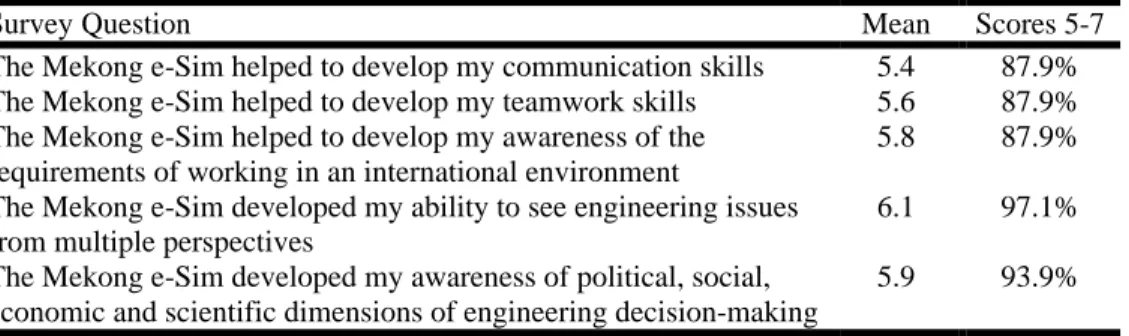
In order to assess the ability of the Mekong e-Sim to contribute to the development of the graduate attributes most relevant to preparing engineering students for multidisciplinary and international practice, a survey was designed which contained the questions shown in Table 1. Student responses were measured on a 7-point scale, ranging from “strongly agree”, which corresponds to a rating of 7, via “neutral”, which corresponds to a rating of 4, to “strongly disagree”, which corresponds to a rating of 1. The survey was randomly administered to 33 of the 47 University of Adelaide students who participated in the Mekong e-Sim in 2005 and processed by the Centre for Learning and Professional Development at the University of Adelaide. In addition, written student responses to some of the topics discussed as part of the face-to-face debriefing sessions at the University of Adelaide were included in the evaluation.
3.4 Results and Discussion
The results of the survey are summarised in Table 1. It can be seen that students believed that their participation in the e-Sim was successful in developing their communication and teamwork skills, raising their awareness of the requirements of working in an international environment and developing their ability to see engineering issues from multiple perspectives and an awareness of the political, social, economic and scientific dimensions to engineering decision-making, with mean scores ranging from 5.4 to 6.1 out of 7 for all of the above categories. For all of the survey questions, at least 87.9% of the students gave responses of either 5, 6 or 7 (ranging from “agree” to “strongly agree”). This highlights the success of the Mekong e-Sim, and the potential of online roleplay simulations in general, for preparing engineering students for multidisciplinary and international practice.
Table 1: Results of Student Evaluation of Learning and Teaching Surveys
Survey Question Mean Scores 5-7
The Mekong e-Sim helped to develop my communication skills 5.4 87.9%
The Mekong e-Sim helped to develop my teamwork skills 5.6 87.9%
The Mekong e-Sim helped to develop my awareness of the requirements of working in an international environment
5.8 87.9%
The Mekong e-Sim developed my ability to see engineering issues from multiple perspectives
6.1 97.1%
The Mekong e-Sim developed my awareness of political, social, economic and scientific dimensions of engineering decision-making
5.9 93.9%
This is highlighted further by the following student comments.
“The esim provided an environment in which to communicate with others in a professional manner, in a simulated environment. This was particularly valuable as these communication skills are difficult to practice in a standard lecture/tute university environment.”
“[The e-Sim] helped me develop an awareness of the chain reaction on social, cultural, political and environmental aspects that a major engineering project can have. Social context was brought to light by the need to look after and accommodate the villagers. This also brought the cultural importance into context, as the risk of a loss of culture of the villagers [who] were [to be] relocated was debated. Political and international context of
engineering was emphasised by the involvement of government organisations, and groups which were not local to the MB (Mekong Basin). Environmental context was explained in depth in the forum, and from this I learnt the huge effects engineering projects can have.” 4. Summary and Conclusions
In this paper, a Community of Inquiry based framework for developing online roleplay simulations is introduced, particularly in the context of preparing engineering students for multidisciplinary and international practice. The framework is illustrated with the Mekong e-Sim, which is an online roleplay simulation centred on proposed development issues in the Mekong region of South-East Asia. An evaluation of the Mekong e-Sim has demonstrated that students who participated in the e-Sim in 2005 believe that the e-Sim is successful in developing communication and teamwork skills, raising awareness of the requirements of working in an international environment and developing the ability to see engineering issues from multiple perspectives and an awareness of the political, social, economic and scientific dimensions to engineering decision-making. This highlights the potential of the Mekong e-Sim in particular, and online roleplay simulations in general, for preparing engineering students for multidisciplinary and international practice, particularly if they are developed using the development framework introduced in this paper.
Acknowledgments
The authors would like to thank Dr. Robert McLaughlan for his contributions to the development of the e-Sim and discussions about this paper.
References
1 Engineers Australia (2005) “Engineers Australia policy on accreditation of professional engineering
programs”. Accreditation Board, Document No. P02, Issued February 7.
2 McLaughlan R.G. and Kirkpatrick D. (2004) “Online roleplay: design for active learning”. European Journal
of Engineering Education, 29(4), 477-490.
3 Garrison D. and Anderson T. (2003) “E-Learning in the 21st century: a framework for research and
practice”. RoutledgeFalmer, Taylor & Francis Group, London.
4 Garrison D.R., Anderson T. and Archer W. (2005) “Critical thinking and computer conferencing: a model
and tool to assess cognitive presence”. American Journal of Distance Education, in press.
5 Rourke L., Anderson T., Garrison D.R. and Archer W. (2001) “Assessing social presence in asynchronous
text-based computer conferencing”. Journal of Distance Education, 14(2).
6 McLaughlan R.G., Kirkpatrick D., Hirsh, P. and Maier H.R. (2001) “Using online roleplay/simulations for
creating learning experiences”. CAL-laborate, 7, October, 23-25.
7 Baron J. and Maier H.R. (2004) “A community of inquiry evaluation of Mekong e-Sim: an online
collaborative simulation”. Proceedings (CD ROM), ICET2004 Conference, Singapore, September 9-11.
Biographical Information
Holger Maier is an Associate Professor in the School of Civil & Environmental Engineering and Associate Dean (Learning & Teaching) in the Faculty of Engineering, Computer and Mathematical Sciences at the University of Adelaide, Australia. His e-mail address is [email protected].
Judi Baron is the Online Education Coordinator at the Centre for Learning and Professional Development, University of Adelaide, Australia.