+
The role of the Internal Audit Function (IAF)
in Integrated Reporting and possible
challenges and barriers to internal audit’s
involvement
Lindie Engelbrecht
Student number 1298673Ethics number:CACCN/1102
A research report submitted to the faculty of Commerce, Law and Management at the University of the Witwatersrand in partial fulfilment of the requirements for
the degree of
Master of Commerce (Accountancy)
Supervisor: Yaeesh Yasseen February 2017
DECLARATION OF OWN WORK
I hereby declare that this research report is my own unaided work. It is submitted in partial fulfilment of the degree of Master of Commerce by Coursework and Research Report at the University of the Witwatersrand, Johannesburg. It has not been submitted elsewhere for the purpose of being awarded another degree or for examination purposes at any other university.
SIGNATURE: DATE:
____________________________ __________________________
TABLE OF CONTENTS
ABSTRACT i
ABBREVIATIONS ii
DEFINITIONS iii
LIST OF TABLES AND ILLUSTRATIONS v
CHAPTER I - INTRODUCTION 1
1.1 Purpose of this study 1
1.2 Context of the study 3
1.3 Research question 4
1.4 Contributions of the study 5
1.5 Limitations of the study 5
1.6 Assumptions 7
1.7 Outline of report 8
CHAPTER II - LITERATURE REVIEW 9
2.1 Introduction 9
2.2 A conceptual framework for assurance 9
2.3 A conceptual framework for integrated reporting 12
2.4 Importance of assurance on integrated reporting 13
2.4.1 Nature and levels of assurance 15
2.4.2 The competence of the assurance provider 17
2.4.3 Lack of assurance standards 18
2.4.4 Legitimacy internal audit 21
2.5 The potential role of the IAF in integrated reporting 25
2.6 Conclusion 29
CHAPTER III - RESEARCH METHOD 30
3.1 Introduction 30
3.2 Research paradigm 30
3.4 Research design 33
3.5 Purposive sampling 34
3.6 Data collection 35
3.7 Data analysis and interpretation 37
3.8 Limitations of the study 38
3.9 Validity 39
3.10 Research ethics 41
3.11 Summary and conclusion 41
CHAPTER IV – FINDINGS 42
4.1 Introduction 42
4.2 Data categories and themes 42
4.3 The roles of the IAF in integrated reporting 46
4.4 The benefits of internal audit’s involvement in integrated reporting 52 4.5 The barriers to internal audit’s involvement in integrated reporting 54
4.6 Better utilisation of the IAF in the integrated reporting process 58
CHAPTER V – CONCLUSIONS, RECOMMENDATIONS
AND SUGGESTIONS FOR FURTHER RESEARCH 61
5.1 Conclusions 61
5.2 Recommendations 64
5.2.1 Recommendations for entities 64
5.2.2 Recommendations for CAEs 65
5.3 Impact of the study 66
5.4 Opportunities for further research 66
REFERENCES 68
ANNEXURE A 75
ANNEXURE B 80
ABSTRACT
The purpose of this research is to explore the roles of the internal audit function (IAF) in integrated reporting and identify the possible challenges and barriers tointernal audit’s involvement. The research was conducted to fulfill three main purposes: to determine if the IAF has any role to play in integrated reporting; to identify the potential challenges and barriers ofinternal audit’s involvement; and to identify and recommend best practices for internal audit’s involvement. The potential roles of the IAF in integrated reporting is predicted through current practices and literature. The research approach required an understanding and contextualisation of current practices by interviewing Chief Audit Executives (CAEs), following a qualitative approach within an interpretivist paradigm. The results were analysed using a data analysis spiral.The main conclusion drawn was that the involvement of the IAF in integrated reporting is closely linked to the maturity of the integrated reporting process. The research sample consisted of CAEs of listed companies that are recognised as producing good integrated reports and whose integrated reporting processes are in varying stages of maturity. The practical implications for CAEs are to apply best practices in becoming involved in the integrated reporting process and to avoid potential challenges and barriers. The role of the IAF in integrated reporting has not yet been identified through prior studies and this can be considered as the most significant contribution of this study.
Key words – Assurance, Integrated reporting, Internal audit TABLE OF CONTENTS
ABBREVIATIONS
CAE Chief Audit Executive
GRI Global Reporting Initiative
IAF Internal Audit Function
IFAC International Federation of Accountants
IIA Institute of Internal Auditors
IIARF Institute of Internal Audit Research Foundation
IIAS International Internal Auditing Standards
IIRC International Integrated Reporting Council
<IR> Integrated Reporting Framework
IoD Institute of Directors in Southern Africa
ISA International Standards of Auditing
King III King Report on Governance for South Africa 2009
DEFINITIONS
Assurance An engagement in which a practitioner expresses a
conclusion designed to enhance the degree of confidence of the intended users, other that the responsible party, about the outcome of the evaluation or measurement of a subject matter against criteria (International Federation of Accountants [IFAC], 2014; O’Dwyer & Owen, 2005a).
Internal Audit Function Internal auditing is an independent, objective assurance and consulting activity designed to add value and improve an entity's operations. It helps an entity accomplish its objectives by bringing a systematic, disciplined approach to evaluate and improve the effectiveness of risk management, control, and governance processes. Although accounting is an important skill for an internal auditor, the focus for internal auditors is the evaluation of operational, risk management, internal control and the governance processes of the entity (Chambers & Odar, 2015; Institute of Internal Auditors South Africa [IIA], 2015).
Integrated reporting A holistic and integrated representation of the entity’s performance in terms of both its finance and its sustainability (Brown & Dillard, 2014; de Villiers, Rinaldi, & Unerman, 2014; Simnett & Huggins, 2015; Stubbs & Higgins, 2014).
Stakeholders Stakeholders are simplistically defined as a broad range individuals or groups of individuals who can influence or are influenced by an entity. Generally stakeholders are grouped in internal and external stakeholders (Cooper & Owen, 2007; Darnall, Seol, & Sarkis, 2009).
Chief Audit Executive An independent corporate executive with the overall executive responsibility for the internal audit. In the case of outsourced internal audit, the partner responsible for the
engagement is considered the Chief Audit Executive (CAE). Alternative designations may be used for this individual including Director of Audit, Director of Internal Audit or Chief Internal Auditor (Institute of Directors [IoD], 2009; Institute of Internal Auditors South Africa [IIA], 2015).
LIST OF TABLES AND ILLUSTRATIONS TABLE
NUMBER DESCRIPTION NUMBER PAGE
I “Stewart’s ladder” of accountability 11
II Governance and risk components of
integrated reporting
20
III Summary of Suchman’s (1995)
typology of legitimation
24
IV The roles of internal audit in integrated reporting
26
V The evolution process of internal audit 27
VI The maturity of the
integrated reporting process
28
CHAPTER I - INTRODUCTION 1.1 Purpose of this study
The need for public accountability stems back several decades, and emerged during the Industrial Revolution where greater economic activity created the need for broader accountability (Ravenscroft & Williams, 2009). Accounting practices needed to adapt to provide information to a wider audience. The argument was made that the change to provide greater information was not driven by technological changes but by social and political forces (Ravenscroft & Williams, 2009). Peat (2011), as cited by Stent and Dowler (2015) state that more recently, the need for greater information is driven by issues confronting the world economy, such as population increase, climate change and the depletion and pollution of finite natural resources. This information is conveyed as part of an entity’s integrated report (Cooper & Owen, 2007).
The number of entities that issue integrated reports have increased dramatically over the last few years and integrated reporting is expected to become the preferred framework for the discharge of corporate stakeholder responsibilities (Cheng, Green, Conradie, Konishi, & Romi, 2014; Deloitte, 2011). An integrated report conveys the impact an entity has had on its stakeholders, both positive and negative, and explains how the positive impacts will be enhanced and the negative impacts ameliorated (IoD, 2009). The report should address the additional information needs of stakeholders. Subsequent to the release of the King Code of Corporate Governance in 2009 (King III), the International Integrated Reporting Council (IIRC) released a framework to guide companies in drafting an integrated report (International Integrated Reporting Council [IIRC], 2013). The framework focuses on providing a guide to entities on how to prepare an integrated report, the considerations of materiality, an understanding of the ‘trade-offs’ and the appropriate context of the report (Bepari & Mollik, 2016).
studies have critically analysed external assurance practices in integrated reporting (Cooper & Owen, 2007; Darnall et al., 2009; O’Dwyer & Owen, 2005a; O’Dwyer, Owen, & Unerman, 2011; Simnett, Vanstraelen, & Chua, 2009). Prior research also investigates the demand for sustainability assurance (Simnett et al., 2009); the legitimation of assurance practices (Brown & Dillard, 2014; O’Dwyer & Owen, 2005b; O’Dwyer et al., 2011), and the current practices of sustainability assurance (Mock, Turner, Gray, & Coram, 2009; O’Dwyer & Owen, 2005b; Park & Brorson, 2005). These studies mostly conclude that independent external assurance provisions appear to have more credibility (Ackers, 2009; Haji & Anifwose, 2016; Simnett et al., 2009), but there are numerous challenges for independent external assurance providers. For example, the suitability of conventional assurance models have yet to be determined ([IIRC], 2014a).
Haji & Anifwose (2016) suggests that internal assurance provided by, for example, the IAF and the audit committee are proposed as alternatives. Therefore, there is a need to conduct empirical research to determine whether internal assurance providers, such as the audit committee and the IAF can be alternative assurance providers on integrated reporting (Haji & Anifwose, 2016). However, the need for the involvement by the internal audit specifically in the relatively new <IR> Framework is still evolving and not yet clearly understood (The Institute of Internal Auditors Research Foundation [IIARF], 2014).
The purpose of this research is to explore the roles of the IAF in integrated reporting and identify the possible challenges and barriers to internal audit’s involvement. In particular, this research aims to determine the extent to which the IAF can be involved in the integrated reporting process i.e. the IAF’s ability to express internal and/or external assurance over the integrated report (Chambers & Odar, 2015; [IIRF], 2014). This study will contribute to the literature concentrating exclusively on the IAF and its role in integrated reporting.
1.2 Context of the study
Stiglitz (2002), as cited by Brown & Dillard (2014) states that modern societies are facing significant social and environmental challenges such as ‘biodiversity loss, depletion of resources, globalisation and social justice’ (Brown & Dillard, 2014). These concepts are often described as sustainability issues and are considered the primary moral and economic imperatives of the twenty-first century ( Marx & van Dyk, 2011). The impact that entities have on broader society have resulted in a greater awareness of sustainability issues and its impact on people and the planet. In the 21st century where there exists a greater focus on transparency , stakeholders are demanding more information and accountability from entities. The landscape of investment has changed from investors being concerned only about the financial performance of the entity, to understanding that a failure to take care of society and the environment can lead to financial losses in the long term (Abeysekera, 2013; de Villiers et al., 2014; Simnett et al., 2009; Wong, Wong, Willow, & Chen, 2016).
The deeper understanding of accountability and the need to provide additional non-financial information resulted in the emergence of the sustainability report, issued mostly as a separate document reporting on corporate social and environmental responsibility (Simnett & Huggins, 2015). King III introduced the concept of integrated reporting in South Africa to enable stakeholders to make a more informed assessment of the economic value of an entity based on a holistic view of strategy (IoD, 2009). The integrated report is not an evolution of the sustainability report, but rather an attempt to promote a ‘more cohesive and efficient approach to corporate reporting’ drawing on different types of reporting ([IIRC], 2013). The integrated report is a means of demonstrating how an entity corporate strategy links to financial aspects and how this strategy impacts upon performance and corporate value. While most entities agree on what the objective of the integrated report is, the content and process of preparing an integrated report has not yet been standardised (Abeysekera, 2013).
1.3 Research question
In the context of the growing importance of integrated reporting and public accountability, the issue of assurance of these reports need to be addressed. Assurance adds to the credibility of the integrated report and provides the required accountability to entities stakeholders. Whilst the role of the external audit in integrated reporting has been explored and defined (IIRC, 2014a), the possibility of obtaining internal assurance has yet to be established. This is particularly relevant in the case of the IAF, whose close proximity to the risks and controls of an entity would be ideally placed to play an integral part of the integrated reporting process.
Firstly, the evidence of the growing interest and importance of integrated reporting worldwide suggests that academic responses are necessary in this area. Having been closely involved in the drafting of King III, the researcher was intrigued by the relatively new concepts introduced, such as integrated reporting and combined assurance. The researcher’s personal experience when consulting with entities should that these vital terms were not well understood and greater clarity needed to be provided. Secondly, a gap in the body of knowledge regarding the assurance of the integrated report and the most appropriate sources of such assurance was evident. Much research is available on the concept of assurance and the role of external assurance providers, however the research on the role of internal audit in integrated reporting is very limited. This study aims to add to the body of knowledge of integrated reporting, and specifically the roles of internal assurance providers, such as the IAF.
The objectives of this study are to provide a review of current literature on the topics of assurance, integrated reporting, and internal audit to investigate the potential roles of the IAF in integrated reporting; to identify the potential challenges and barriers for internal audit’s involvement in integrated reporting; and to recommend how the IAF can be better utilised in the integrated reporting process. This research further aims to determine if internal assurance mechanisms, such as an IAF, may potentially become
appropriate standalone alternative assurance providers in integrated reporting.
1.4 Contributions of the study
The study has the potential to make three sets of contributions. Firstly, it has the potential to extend, broaden and deepen existing literature on integrated reporting, assurance and internal audit, specifically the role of the IAF in the integrated reporting process. Empirical research on integrated reporting is limited (Haji & Hossain, 2016). Secondly, it may assist the IAF to understand their role in integrated reporting and what the challenges and barriers may be. Lastly, it will recommend practices that might be implemented by internal auditors to improve the integrated reporting process.
The study will provide clearer insights about the participants within this study and on how their roles in the integrated reporting process compares to other similar entities. The study will also identify improvements that can be made to the exiting reporting process. By applying the best practices recommendations from this study, entities that have not yet embarked on an integrated reporting process can apply these recommendations and avoid many of the pitfalls identified by other CAEs. This study will encourage those entities that are still at the early stages of integrated reporting to design optimum processes for the involvement of the IAF. Although the study focuses on local entities, the concept of internal audit is globally consistent and the recommendations from this study can equally be applied by international companies.
1.5 Limitations of the study
A qualitative exploratory enquiry was deemed most appropriate for the purpose of the study as it contributes to fundamental knowledge and theory of assurance on integrated reporting (Patton, 2015). The results of the study may be limited due to methodological choices. Qualitative research cannot be generalised and the information obtained from
the interviews may not be representative of all entities, the relevant IAFs or CAEs in South Africa. The results of the study may further be limited by the use of semi-structured interviews as a research instrument. An unavoidable risk of interviews is that participants provide commentary that may be biased by the views of their current employer entity (Alvesson, 2003). Structuring the questions in such a manner to obtain the participants’ personal opinions, and excluding the name of their current employer entity, attempted to mitigate the potential bias.
Despite these potential limitations, it was envisaged that the findings of this study will be applicable to entities not included in the research. The results of this study will assist IAFs to understand and define their role in the integrated reporting process, to avoid potential pitfalls and follow best practice in preparing integrated reports. The integrated reporting process within an entity involves various parties within, as well as, external to the entity. These would include, amongst others, audit committees, external auditors, finance teams, and operational management. The emphasis of this research will be placed on the IAF and the entire integrated reporting process and any other parties involved in the process is beyond the scope of this study. Several different opinions and models of structuring IAFs exist, including insourcing, outsourcing and co-sourcing (Barac & Motubatse, 2009; Coram, Ferguson, & Moroney, 2008; Papageorgiou, Padia, & Yasseen, 2013; Selim & Yiannakas, 2000).
For the purposes of this study, the IAF is defined as an IAF where, although independent, the CAE is a member of the executive team of the entity. This study will use purposive sampling by targeting specific individuals per pre- defined criteria (refer to 3.5). The participants include CAEs from entities that are considered mature in their integrated reporting process. It was decided to only include CAEs that are currently involved in an integrated reporting process who can provide relevant, practical insights, as opposed to CAEs that are not involved in integrated reporting. Due to the choice of the sampling method and the criteria set, a limited number of interviews were conducted. The quantitative benefits and contribution of the IAF’s involvement in the integrated reporting process to the value of the entity did not form part of this study. This
could be an area for future research.
1.6 Assumptions
IAFs have a vital role to play in integrated reporting and there is a need for exploring and understanding what this role could be. For example, in 2014, the Institute of Internal Auditor’s Research Foundation’s issued a request for further research focusing on ‘Integrated reporting - What is Internal Audit’s Role’ ([IIARF], 2014). This study draws from the theoretical perspective of legitimacy theory. In doing so this study, based on the literature review, develops a hypothesis to predict the role of the overall and specific aspects, of the role of the IAF in integrated reporting. The theoretical perspective on integrated reporting is that of a management as agent providing relevant information to stakeholders. The specific role of the IAF will depend on the overall legitimacy of the IAF hence the use of legitimacy theory. This research study further assumes that the reality generated during the research process depends on the context in which it is constructed (Lukka & Modell, 2010; Rowley, 2012). The context is limited to the actual involvement of t h e IAF in the integrated reporting process and not the perceived involvement from outside parties.
Ten semi-structured interviews with CAEs within the pre-defined criteria will be conducted. This will allow the interviewer or interviewee to diverge in order to pursue an idea or response in more detail and provide a deeper understanding of social phenomena that would be obtained from purely quantitative methods (Babbie & Mouton, 2010). The flexibility of this approach, particularly compared to structured interviews, also allows for the discovery or elaboration of information where detailed insights are required from individual participants. They are also particularly appropriate for exploring sensitive topics, where participants may not necessarily want to talk about such issues in a public forum. (Alvesson, 2003). The use of interviews as collection instrument for the primary data does introduce some methodological limitations. In particular, complete candour of participants cannot be guaranteed, despite the
safeguards to ensure that responses provided are complete and accurate. Consequently, there is an assumption that all participants have been honest and forthcoming with their responses.
1.7 Outline of report
While the first chapter introduces the purpose of this study to determine the role of the IAF in integrated reporting, the second chapter provides a relevant literature review of assurance, integrated reporting and internal audit. This chapter also highlights gaps in the literature. The third chapter sets out the research methodology for this study, identifying a qualitative research methodology as the most appropriate for this particular study. Chapter 4 sets out the findings of this study and provides an analysis of the results from the semi-structured interviews. The last chapter provides a conclusion of the study, recommendations for the role of the IAF in integrated reporting, and suggestions for further qualitative and quantitative research in this area of study.
CHAPTER II - LITERATURE REVIEW
2.1 Introduction
This chapter presents the literature review and identifies gaps in research. It attempts to conceptualise the theoretical frameworks of assurance and integrated reporting, with particular focus on addressing the importance of assurance in integrated reporting. The chapter investigates the potential roles of the IAF in integrated reporting; identifying the potential challenges and barriers for internal audit’s involvement in integrated reporting. It further recommends how t h e I A F can be better utilised in the integrated reporting process and also highlights the gaps in research.
2.2 A conceptual framework for assurance
The term ‘audit’ is derived from the Latin word "audire" which means "to hear". In conducting an examination and verification of transactions, the auditor has to listen to those being audited (Lee & Ali, 2005). Boyd (1905), as cited by Lee and Ali (2005), states that the concept of auditing stems back to the ancient civilisations of China, Egypt and Greece, where activities in Greece at around 350 B.C. may be the closest to modern auditing activities (Lee & Ali, 2005). From the 1840s to the 1920s, when manual book-keeping was prevalent, the duties of auditors was to detect fraud and errors (Porter, Simon, & Hatherly, 2005). The 1920s to 1990s saw the concept of an audit becoming closer aligned to accountability, where the separation of ownership and management became more evident (Lee & Ali, 2005). The term ‘accountability’ has evolved from the traditional view of “giving and demanding the reasons for conduct” to being ‘accountable’ (Mulgan, 2000; Roberts & Scapens, 1985; Sinclair, 1995). An independent account from an auditor was required to convince investors to continue providing capital. Essentially the auditor added credibility to the financial statements (Lee & Ali, 2005).
extensively on systems and having a deep understanding on the risks facing an entity. The external audit focused more on providing ‘assurance’ to stakeholders than the pure ‘audit’ or account of transactions (Lee & Ali, 2005). Various studies have emphasised the importance of assurance in providing credibility to information provided by management (Curtis & Turley, 2007; Gong, Kim, & Harding, 2014; Holland, 2005; O’Dwyer & Owen, 2005a; Porter, O’hO’gartaigh, & Baskerville, 2009; Power, 2003; Vanstraelen, Schellenman, Hofmann, & Meuwissen, 2011). Fraser & Pong (2009) suggests that the concept of assurance is not as simplistic as implied by Shakespeare in the work Timon of Athens:
“If you suspect my husbandry of falsehood call me before the exactest auditors and set me on the proof”.
Stewart (1984), as cited by Mzensi and Gaspar (2015), identifies accountability as a relationship between various parties, arguing that this relationship can only be effective if the accountee must “possess the power to hold the accountor to account”. Furthermore, Stewart identifies five forms of accountability: probity and legality; process; performance; programme and policy. It is his contention that each type of accountability requires different information, which then determines its success (Mzensi & Gaspar, 2015).
Table I – “Stewart’s ladder” of accountability (Mzensi & Gasper, 2015, p. 684)
Source: Mzensi & Gasper, 2015, p. 684
The provision of assurance is the result of an external audit process, with the purpose of allowing stakeholders to hold the entity accountable for its actions (Mzensi & Gaspar, 2015). However, the accountability of entities has broadened in the last century and stakeholders are much more focused on performance accountability, leading to the introduction of the integrated report (Abeysekera, 2013). This study uses the concept of accountability as described by Stewart (1984) in defining assurance on the integrated report. The theoretical framework of assurance, and the importance of accountability (as depicted in Table I), emphasises the need for assurance on all types of corporate reporting, including the integrated report. In understanding the conceptual framework for integrated reporting, the question should be asked if assurance is necessary on the
integrated report.
2.3 A conceptual framework for integrated reporting
Brudney (1985), as cited by Abeysekera (2013) warns against the power imbalances in disclosure. Stakeholders do not have first-hand knowledge of entities and can only rely on information provided by managers, and this asymmetry of information results in an agency problem. With the evolution of social media and greater transparency, stakeholders are becoming more vociferous in holding entities accountable for their activities (Abeysekera, 2013; Dumay, Bernardi, Guthrie, & Demartini, 2016). Chow (1982), as cited by Wong et.al, states that entities generally disclose information to the public to allow the principal to verify the actions of the agent. In the case of integrated reporting there is information asymmetry between broader stakeholders and the entity, resulting in a demand for sustainability [integrated] reporting (Simnett et al., 2009). Integrated reporting is aimed at bringing together material financial and non-financial information in an integrated and concise manner, demonstrating how corporate strategy aligns with the financial aspects, allowing market participants to understand how this strategy affects performance and value (Brown & Dillard, 2014; de Villiers et al., 2014; Haji & Anifwose, 2016; Simnett & Huggins, 2015; Stent & Dowler, 2015; Stubbs & Higgins, 2014) This reduces information asymmetry and enhanced accountability, providing greater transparency (Wong et al., 2016).
An increasing number of countries have introduced specific reforms to encourage reporting of non-financial information to enhance the quality of reports and disclosures (Haji & Anifwose, 2016; IIRC & Black Swan, 2014; [IoD], 2009). Internationally, over one thousand entities have adopted integrated reporting practices, with over 35 per cent of the world’s largest entities producing integrated reports. Moreover, regulations in an increasing number of jurisdictions are requiring entities to produce an integrated report. In particular, in South Africa, this requirement is included in the listing requirement in 2010 for listed companies in South Africa. The UK government released a Strategic Report in
2013 requiring companies to provide non-financial information on the effect of the business plan on communities, employees and the environment. The European Union Council issued a concept paper which will require companies to provide non-financial information on organisation policies, risk and business outcomes (Haji & Anifwose, 2016; IIRC & Black Swan, 2014). There are also ongoing considerations in Australasia to introduce related measures (de Villiers et al., 2014). However, the value of the integrated report, and the broader acceptance of the report, depends on assurance provided on the integrated report. In identifying and understanding the importance of assurance on integrated reporting, the most appropriate sources for such assurance should be identified.
2.4 Importance of assurance on integrated reporting
One of the main concerns of integrated reporting, as with any voluntary corporate disclosure, is the completeness and credibility of the information provided (Merkl-Davies & Brennan, 2007). Both academic research, regulatory bodies and standard setters have emphasised the importance of external and internal assurance provisions in enhancing the credibility and reliability of non-financial disclosures (Haji & Anifwose, 2016; [IIRC], 2014a; Simnett et al., 2009).
If reliance cannot be placed on integrated reports there is a potential for these reports to be perceived as marketing documents absent of credible and decision- useful information (Simnett & Huggins, 2015). Assurance is considered one of the means through which the completeness and credibility of information can be assured (O’Dwyer et al., 2011). In fact, assurance is considered an important tool in validating integrated reports and enhances the credibility of the information and stakeholder confidence in the matters reported (Millington & Wong, 2014). As early as 1972, David Rockefeller of Chase Manhattan Bank said that:
“…because of the growing pressure for greater corporate accountability, I can foresee the day when, in addition to the annual financial statements certified by
independent accounts, corporations may be required to publish a social audit [report], similarly certified” (Ackers, 2009).
This early prediction highlights the growing tendency and need for assurance on integrated reports (Bepari & Mollik, 2016). In fact, Cheng et al. (2014) question whether stakeholders will be interested in the integrated report without assurance. There are, however, no statutory or regulatory requirements for assurance on integrated reporting, either internationally or in South Africa, and requirements for independent assurance are only contained in guidelines such as the Global Reporting Initiative (GRI) G3 guidelines and King III (Marx & van Dyk, 2011).
The IIRC states that assurance will enhance the trustworthiness of the integrated report and that credibility and trust will ensure that the aims of integrated reporting are achieved ([IIRC], 2014b).
Carey et al. (2000), as cited by Wong & Millington (2014), suggests that the decision to obtain assurance over integrated reports is influenced by external stakeholders. Wallage (2000), as cited by Millington & Wong (2014), believes that increased credibility of reporting will result in an improved relationship with stakeholders and ultimately increase stakeholder confidence (Millington & Wong, 2014). In fact, Kolk and Perego (2010), as cited by Marx & van Dyk (2011) suggest that the demand for assurance on sustainability reporting is higher in countries that are more stakeholder oriented.
Assurance is, however discretionary and costly for entities and the benefits should outweigh the costs (Simnett et al., 2009). Due to the costs of independent assurance, only entities that are committed to reliable disclosure will be willing to incur the additional expense (Cho, Michelon, Patten, & Roberts, 2014). Assurance practices for assurance on integrated reporting are on the agendas of several standard setting bodies and entities. For example, the International Auditing and Assurance Standards Board (IAASB) have developed an assurance standard applicable to assurance engagements of non-financial information and Accountability developed its own Sustainability Assurance standard
(Bepari & Mollik, 2016). Despite the potential obstacles, there is a need for new accounting audit methodologies to enable the reporting and assurance on non-financial information and both internal and external auditors have a significant role to play (Royal NIRVA, 2008).
There are, however some issues for assurance on non-financial information. It should be established if the IAF has any role to play in integrated reporting, by highlighting the various factors that impact assurance in integrated reporting. The sections below address the most pertinent of these challenges for an IAF playing a role in the integrated reporting process from an assurance perspective, namely the nature and levels of assurance the IAF may be able to express, the competence of the internal auditor to be able to express assurance, lack of assurance standards on integrated reporting and the legitimacy of the IAF.
2.4.1 Nature and levels of assurance
The nature of assurance will differ depending on the manner in which the integrated report is structured. In cases where the entity produces separate sustainability and financial reports, separate assurance engagements and assurance statements may be produced. However, separate assurance statements on the financial statements and the sustainability report could potentially confuse users (O’Dwyer & Owen, 2005a). A merger of sustainability information into an annual report requires greater effort to ensure the connectivity of information but separate assurance engagements and s tatements addressing financial and non-financial information may not adequately reflect the integration. Eccles et al. (2012), as cited by Simnett & Huggins (2015), state that an integrated report requires the integration of financial and non-financial information in a holistic manner and a single assurance statement should be constructed. In fact, the majority of the respondents to the IIRC discussion paper preferred integrated assurance (Hoang & Simnett, 2013).
namely reasonable and limited assurance and the uninformed user may not understand the differences. The usefulness of the assurance statement could be questioned (Ackers, 2009). The Glossary of Terms of the International Standards of Auditing (ISA) defines a reasonable assurance engagement as:
‘An engagement in which a practitioner expresses a conclusion designed to enhance the degree of confidence of the intended users other than the responsible party about the outcome of the evaluation or measurement of a subject against criteria. The outcome of the evaluation or measurement of a subject matter is the information that results from applying the criteria’ ([IFAC], 2014).
The <IR>Framework provides the criteria against which an integrated report can be evaluated. In order to apply the definition of an assurance engagement on an integrated report a formulation of a conclusion on whether the integrated report is prepared in accordance with the <IR> Framework can be evaluated (IIRC, 2014a). Entities that are relatively new to integrated reporting and have an immature or underdeveloped reporting system may include only limited information in the integrated report. It is questionable whether the assurance provider will be able to assess the accuracy and completeness of the information reported and assurance will be limited (Park & Brorson, 2005). Reasonable assurance is possible only in the context of suitable criteria and in cases where the assurance provider is confident in the completeness and accuracy of the information reported.
The question, however, is if the <IR> Framework constitutes suitable criteria or, if additional measurement frameworks are required. The <IR> Framework provides a principles-based approach to preparing an integrated report as opposed to financial reporting frameworks that provide for measurement and recognition criteria. Consequently, disclosures in integrated reports vary significantly (International Integrated Reporting Council [IIRC], 2014a). If it is accepted that a consistent framework, such as the <IR> Framework will allow any assurance provider to evaluate an integrated report against the set criteria and only limited assurance will be expressed, it should be
possible for assurance to be obtained from internal sources, such as the IAF. 2.4.2 The competence of the assurance provider
Assurance on integrated reports will only be useful if stakeholders can rely on the assurance statements. In their 2014 study, Millington & Wong (2014), posited that the demand for assurance is positively related to the perceived value of corporate social disclosures in decision making and if the information is useful and validated (Millington & Wong, 2014). The research conducted by Park & Brorson ( 2005) determined that the main reasons entities do not obtain independent assurance included: the lack of external pressure; prioritising other work; the high cost of assurance and uncertainty about the value of assurance. The independence of the assurance providers and the degree of management control over the assurance process may also negatively impact the value of the assurance, and pose a challenge to the IAF in providing assurance on the integrated report. In addition, traditional assurance models may not be appropriate for assurance on integrated reports (Simnett & Huggins, 2015).
In order for the assurance process to be reliable it needs to be based on ‘sufficient, reliable information, be performed independently of the underlying processes and be evidenced by a report’ (European Confederation of Institutes of Internal Auditing (ECIIA), 2015). T h e a ssurance on integrated reports presently are often limited to selected sustainability indicators, GRI application level confirmations and sometimes less often on accountability principles. The level of assurance also varies from mostly limited assurance to reasonable assurance in some cases (Cheng et al., 2014). Respondents to the IIRC Assurance Discussion Paper listed issues such as: the nature and levels of the assurance; the competence of assurance providers; the robustness of internal controls and the lack of assurance standards as matters that concern stakeholders and practitioners alike (IIRC, 2014b).
specialist consultants and professional accounting firms (O’Dwyer et al., 2011). Research conducted by Ackers (2009) showed that in the earlier years of assurance in sustainability reports most the assurance statements were provided by professional accounting firms. Some studies have found that stakeholders do not consider assurance statements as trustworthy and tend to place more trust on assurance provided by consultants rather than financial auditors (Millington & Wong, 2014). The fact that there are differences in assurance providers suggests that the quality of assurance and the credibility of the report depends on the type of assurance provider (Mock et al., 2009; Wong et al., 2016). Some research opines that assurance expressed by members of the accounting profession is regarded of a higher quality than non-accounting assurance providers (Wong et al., 2016). However, O’Dwyer & Owen (2005b) finds that financial auditors provide a limited approach resulting in lower levels of assurance whereas assurance provided by consultants offer higher levels of assurance, nevertheless this does not affect the perceived quality of external providers.
Assurance on the integrated report requires broadened skill sets compared to financial statement assurance engagements due to the range of resources and relationships that are being assured. Integrated audit teams are likely to be multidisciplinary to ensure that there is sufficient subject matter expertise (Simnett & Huggins, 2015). Organisations may also consider outsourcing specific specialist areas to experts (ECIIA, 2015).On the basis that the appropriate, specialist skills are available within the IAF, whether in-sourced, co-sourced or outsourced, the IAF should be able to play a significant role in integrated reporting.
2.4.3 Lack of assurance standards
One of the key technical issues that impact assurance on integrated reports is the lack of assurance standards. Currently assurance pronouncements provide little guidance for the qualitative nature of information contained in the integrated report (Simnett & Huggins, 2015). The two standards that are predominantly applied by assurance providers in the performance of assurance engagements on integrated reports are:
Assurance Standards 1000 (AA1000AS) and International Standard of Assurance Engagements 3000 (ISAE 3000). However, both these standards are limited in their application and guidance to provide assurance on the integrated report (Coram et al., 2008; Marx & van Dyk, 2011; Simnett & Huggins, 2015). Existing assurance standards cover a broad range of subject matters but do not specifically recognise that historical financial information, non-financial information and future-oriented information may be contained in a single integrated report (IIRC, 2014a).
The IAASB and other assurance standard setters are in the process of considering the need for assurance standards and the appropriate forms and structures of these standards (IIRC, 2014b). Current auditing and assurance standards have been developed for either financial or non-financial engagements and newly developed standards will have to address the integrative nature of information in the integrated report (Simnett & Huggins, 2015). De Villiers et al., (2014) suggests that assurance providers may have to combine integrated reporting with existing regulatory requirements, however, regulatory bodies will have to amend auditing standards.
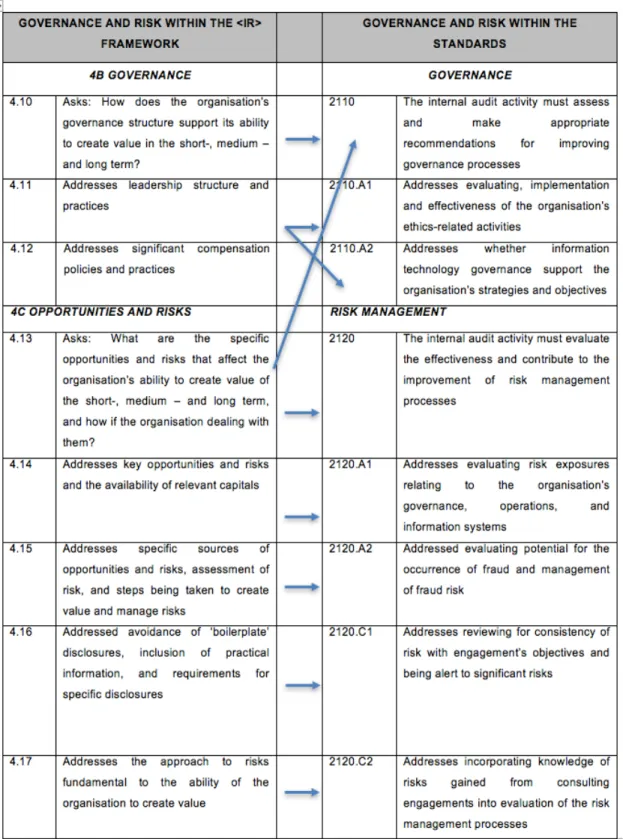
Despite the lack of guidance in the current International Standards of Professional Practice of Internal Auditing, the governance and risk components of the <IR> Framework do overlap and provide useful guidance for the assurance role of internal audit in integrated reporting (refer to Table II on the next page). In applying these standards, the role of the IAF in integrated reporting may also include assurance, on the basis that generally accepted standards can be used in fulfilling this function.
Table II – Governance and risk components of integrated reporting
Source: Integrated reporting and the emerging role of internal auditing,(The Institute of Internal Auditors Audit Executive Centre, 2013).
The concept of assurance on integrated reporting was introduced through King III in the ‘combined assurance’ model which integrates assurance provisions from management, internal and external assurance processes (Haji & Anifwose, 2016; [IoD], 2009). Although the role of the audit committee as part of the internal assurance providers is clear, there have been little or no consideration of the role of the IAF in its internal assurance role. This is attributed to a perceived lack of legitimacy of the internal auditor in providing assurance on integrated reporting.
2.4.4 Legitimacy internal audit
The role of the IAF in the past has been limited to that of watchdog forming part of the system of internal control but regarded as subservient to the achievement of corporate objectives (Spira & Page, 2003). However, to expand the jurisdiction of the IAF to providing assurance on the integrated report a process of legitimising will be necessary. Abbot (1998), as cited by O’Dwyer et.al., (2011), suggests that the process of legitimising professional work ‘connects professional diagnosis, treatment, and inference to central values in the larger culture, thereby establishing cultural authority’. The objective of the legitimising process is to justify the work professions undertake as well as the manner in which the work is undertaken. Professional work is legitimised by highlighting reliance on its technical and scientific expertise and promoting the efficiency of the service provided (O’Dwyer et al., 2011). Internal audit practice can only generate trust in financial statements, and by inference integrated reports, if the profession is able to generate trust in itself (Power, 2003).
Abbott (1988) further postulates that the legitimising process of professional work involves using various strategies to gather support from key audiences, even in the face of competition from other professions. Accountants’ efforts to expand assurance services to new domains have been criticised by several researchers for the lack of providing actual benefits. However, sustainability assurance may be unique in the sense that the assurance is a voluntary undertaking and the profession remains
largely unregulated at present. The development and legitimising will be subject to market forces, auditing standards and the needs of the audiences using the integrated report (O’Dwyer et al., 2011). Financial audit practices have historically been influenced by attempts to secure legitimacy with assurance clients. These financial audit practices enabled the establishment of auditable environments securing legitimacy by showing the economic value of assurance (Curtis & Turley, 2007). Assurance statements play a key role in establishing legitimacy with the users of these statements. However, management will have to sensitize and manage the expectations of users to legitimize any new assurance practices (O’Dwyer et al., 2011).
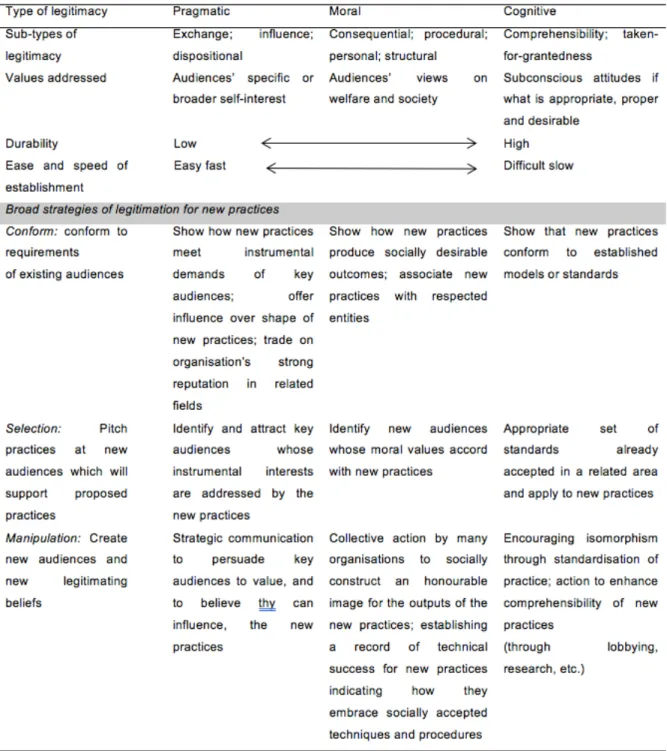
The research conducted by O’Dwyer et al. (2011), formulated the basis as well as the strategies used by, financial statement auditors to seek legitimacy for assurance on sustainability reporting. Using the work of Suchman (1985), three broad strategies, summarised in Table III, for legitimisation were identified (O’Dwyer et al., 2011). The researchers confirmed that the audiences to be influenced and the extent of difficulties involved affected the various types of legitimacy. The initial strategy involved pragmatic legitimacy through persuading ‘informed’ clients of the value of improved information systems and reporting practices. This form of legitimacy is, however, short term in nature and can only be sustained if there is sufficient stakeholder demand and reporting entities can be convinced of its benefits (Kumar & Das, 2007).
Seeking legitimacy with non-clients proved to be largely ineffective and resistance to expand the assurance statement content to include non-financial information and increased levels of assurance remained high. The legitimising strategy in this instance required changing the perceptions of non-clients and convincing this group of the greater level of transparency, and subsequent reduced risk, in expanded assurance statements. In contrast to what Power (2003) believes, O’Dwyer et al.( 2011) concluded that the expanded commentary included in sustainability assurance statements can provide greater transparency in reported information garnering support from clients and non-clients . Assurance providers have to ‘construct users and create
and expand user demand by developing perceptions of increased attention to accountability within assurance practice’ (O’Dwyer et al., 2011). The commitments of assurers to create expectations of assurance have a positive influence on the development of expansive and informative assurance statements (Power, 2003). As an extension to the research conducted by O’Dwyer et al., (2011), it is postulated that the IAF needs to establish accountability to achieve cognitive legitimacy which is the most durable form of legitimacy.
Table III - Summary of Suchman’s (1995) typology of legitimation
2.5 The potential role of the IAF in integrated reporting
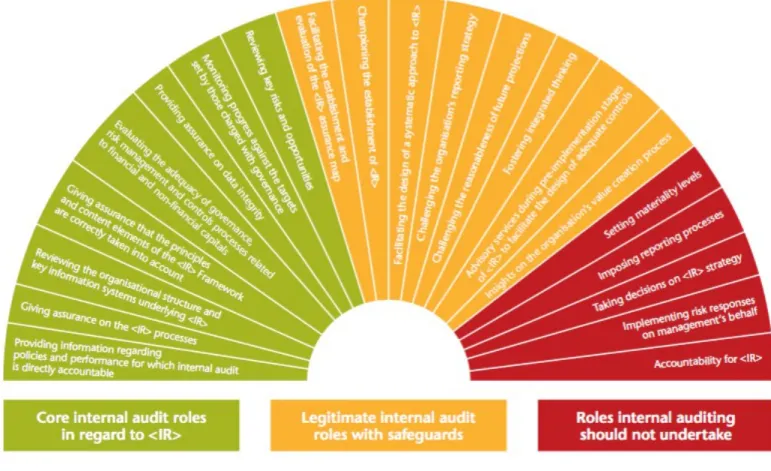
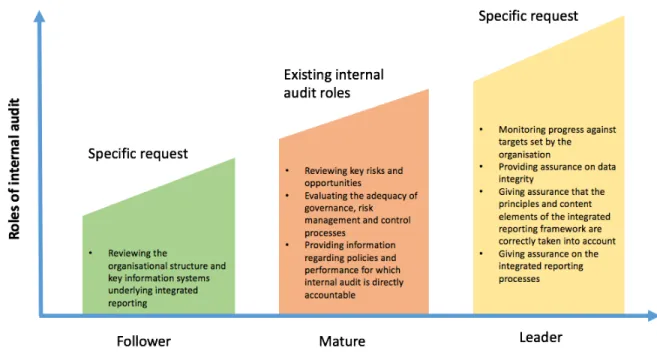
Despite the concerns around the IAF providing assurance on the integrated report, practice indicates that the IAF is an ideal position to provide guidance and advice on the integrated reporting process. The IAF function has a broad view across the whole entities’ systems and processes and understands risks and controls (ECIIA, 2015). By focusing on extended reporting areas required in integrated reporting, such as, sustainability and non-financial metrics, the internal audit can make a valuable contribution (ECIIA, 2015). In many entities, the IAF focuses their attention mainly on internal information flows and compliance with laws and regulations ensuring the auditability of internal processes and information. The internal auditor could verify that the control processes implemented meet the objectives of the entity and supply reliable information. The internal auditor could also determine if the objectives are appropriately formulated and can advise on the design and security of the information system (Royal NIRVA, 2008). Table IV sets out the potential roles of internal audit in integrated reporting. These potential roles described in Table IV can be as follows:
Table IV - The roles of internal audit in integrated reporting
Source: The Role of Internal Audit in Non-financial and Integrated Reporting, (The Institute of Internal Auditors Audit Executive Centre, 2013).
In practice, however, two factors appear to affect the role of internal audit in integrated reporting, as identified through the literature review. The first is the maturity of the IAF and the second is the maturity of the integrated reporting process. The IIA Johannesburg discussion forum believes that internal audit has an opportunity to assist entities to improve the value derived from the integrated reporting process (Deloitte, 2011). The evolution of the IAF is described in Table V.
Table V - The evolution process of internal audit
Source: The Role of Internal Audit in Integrated Reporting: a blend of the right ingredients (Deloitte, 2011).
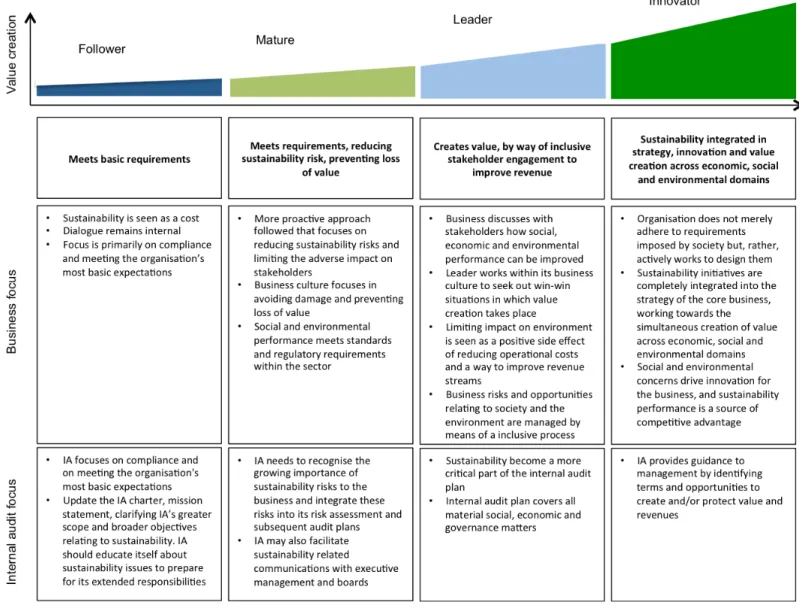
The second factor affecting internal audit’s role is the maturity of the integrated reporting process. The role of the IAF is likely to evolve from an advisory role to an assurance role as the entities integrated reporting process matures. The advisory role of the IAF may include: training key participants in the process of integrated reporting; providing recommendations to the entity for the implementation of the integrated reporting process; promoting the coordination and benefits of integrated thinking and assessing the process design and controls (ECIIA, 2015). The assurance roles could include
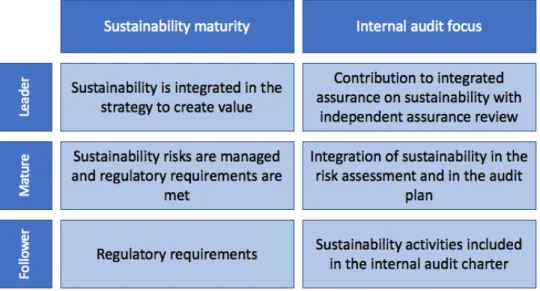
reviewing the underlying processes for the compilation of the report; assessing the risk assessments included in the integrated report; reviewing the materiality of non-financial information; assessing the balance in the report and confirming the accuracy of the business model as described in the integrated report (ECIIA, 2015). Table VI sets out the changing internal audit focus based on the maturity of the integrated reporting and sustainability processes.
Table VI – The maturity of the integrated reporting process
Source: Non-financial reporting: Building trust with internal audit (European Confederation of Institutes of Internal Auditing (ECIIA), 2015).
The IAF’s organisational independence and extensive knowledge of the business places it in an ideal position to take a strategic role in assessing risks and provide a road map for entities in integrated reporting ([ECIIA], 2015).
Despite the IAF being in an ideal position to play a significant role in the integrated reporting process there are some practical challenges. These challenges include the skills and capacity of the internal auditor (ECIIA, 2015).
2.6 Conclusion
The concept of integrated reporting is growing in importance, and the theoretical framework is becoming well established as identified in the preceding literature review. The theoretical framework for assurance establishes the need to hold an entity accountable through corporate reporting. On this basis, the need for assurance on integrated reporting is established and recognised, however the most appropriate sources of this assurance should be established. Regardless of the source of the assurance, there are significant obstacles that will impact the assurance: the nature of assurance; the competence of the assurance provider; the lack of standards; and the legitimacy of the assurance provider. Both the literature review and current practices indicate that the IAF will be able to overcome most of these obstacles, however the internal and external legitimacy of the IAF would need to be addressed. If it is assumed that the IAF is able to address the challenges of assurance, the question then begs: “what is the role of the IAF in integrated reporting?” This study aims to address this question, and identify the potential challenges and barriers to internal audit’s involvement.
CHAPTER III - RESEARCH METHOD
3.1 Introduction
The aim of this study was to explore the roles of the IAF in integrated reporting and identify the possible challenges and barriers to internal audit’s involvement. This chapter outlines the research methodology employed for this study. It describes the research design, methods, instruments and processes undertaken to collect and analyse the data. It also provides an overview of the ethical considerations of the study.
3.2 Research paradigm
A qualitative exploratory enquiry was chosen for this study. The interpretive research method was deemed the most appropriate as it allows the researcher to capture and analyse people’s perceptions and interpretation of experiences (Bryman & Bell, 2003). This research paradigm was specifically chosen due to the exploratory nature of the study, where the results and conclusions would be based mainly on perceptions and experiences.
The interpretive researcher’s assumes that ‘reality’ is only seen through or set in ‘social constructions’ such as language, consciousness and shared meanings (Andrade, 2009; Babbie, 2007). Qualitative approaches to research focus on phenomena in their natural setting and involve studying the complexity of phenomena Trauth (2001), as cited by Rowlands (2005), states that the choice of qualitative method is influenced by the nature of the research problem, the researcher’s theoretical lens and the degree of uncertainty surrounding this evolving topic.
Qualitative inquiry is particularly orientated towards exploration, discovery and inductive logic (Patton, 2014). Inductive analysis commences with the specific observations whereby categories or dimensions emerge from open-ended observations. This is done
in order to gain a deeper understanding of the patterns that exist in the phenomenon being investigated. It seeks to understand the multiple inter-relationships among the dimensions that emerge, without presupposing what those dimensions will be. It was regarded as the most appropriate for the current study as it aims to examine relevant stakeholders’ understanding and subjective experiences of the role that the IAF should play in the preparation of the integrated report.
The ontological approach is social constructivism, as it assumes that ‘truth’ is a matter of “consensus among informed and sophisticated constructors” (Patton, 2015:122). In such ‘social constructs’, ‘truth’ does not exist in any absolute sense. ‘Truth’ is merely perceptions, of either more or less ‘informed’ or ‘sophisticated constructors’ (Andrade, 2009; Patton, 2015). This approach allowed the researcher to distil the divergent perceptions of the participants in this study in order to construct a potential framework for the involvement of the IAF in the integrated reporting process. It also assisted in identifying the potential challenges and barriers to internal audit’s involvement.
3.3 Research approach
The research design, interpretation and analysis of the data was structured to understand the role of the IAF in integrated reporting and the challenges and barriers to internal audit’s involvement. Taking into consideration the complexity of such an endeavour, the research approach required an understanding and contextualisation of current practices, and a qualitative approach within an interpretivist paradigm. It was deemed most appropriate as it attempted to describe, understand and interpret the perceptions and opinions of individuals in the internal auditing profession (Baker & Bettner, 1997).
While positivism emphasises statistically rigorous research, interpretivists reject the possibility of an objective account of existing internal audit practices and seeks a relative understanding of the phenomena (Rowlands, 2005). In contrast, positivism holds a deterministic approach towards the nature of social beings, while interpretivists acknowledges that people actively engage in creating their own environments (Bryman &
Bell, 2003). In positivist research, hypotheses are derived from scientific theories to be tested empirically, and only data which are observable and can be measured is to be regarded as useful (Alvesson, 2003). Positivism does not fit very well with the research approach as the aim was to provide insight and understanding of the current and potential roles the IAF can fulfil in the integrated reporting process. Each situation was unique and relative to the environment within which the internal function operated. In addition, an empirically based research methodology with pre-defined variables overlooked more subtle findings which for the evaluation investigation of the differing roles and environments were of great importance. Therefore, and interpretive research approach allowed for the researcher to explore a potential and meaningful change in internal audit practices in the context of the highly dynamic setting of current internal audit practices (Parker, 2008).
The major emphasis of interpretive studies is the discovery of ideas and insights. The study therefore undertook an exploratory approach. The interpretation and conclusions reached in this research lead to the enhancement and understanding of internal audit practices in the context of integrated reporting. Lukka and Modell (2010) define exploratory research as research conducted to gain new insights, discover new ideas and/or increase knowledge of a phenomenon of internal audit’s involvement in integrated reporting. This was particularly useful as the exploratory nature of the research allowed respondents to reflect on their individual situations and contribute in an open and unstructured manner. Thus, this qualitative study undertook an exploratory approach within an interpretivist paradigm to understand the role of the IAF in integrated reporting and the challenges and barriers to internal audit’s involvement.
In summary, the orientation of the study was based on the philosophical assumptions of the interpretivist approach. It was evident that the research approach was exploratory and interpretive as its purpose was gathering explanations, gaining insight and collecting information, in order to gain a clear understanding of the issue at hand (Rowlands, 2005).
3.4 Research design
Semi-structured interviews are characterised by a flexibility of approach to questioning. It follows a system of pre-determined questions and allows the researcher greater flexibility to ask, in case of need, supplementary questions or ‘probing questions’. While it is acknowledged that this level of flexibility may influence the level of comparability between results, it was deemed most appropriate as this technique enabled the researcher to gain insights into the opinions and experience of interviewees (Alvesson, 2003).
Therefore, the study used semi-structured interviews with CAEs to gain insights into their experiences in participating in integrated reporting. The flexibility of this approach, particularly compared to structured interviews, also allowed for the discovery or elaboration of information where detailed insights were required from individual participants. The semi-structured interviews were also particularly appropriate for exploring sensitive topics, where participants did not necessarily want to talk about such issues in a public forum (Alvesson, 2003).
The interview agenda was initially conceptualised, developed and adapted from research questions used in the international Internal Audit Research Foundation study, that focused on the consulting and advisory role of internal audit in integrated reporting ([IIARF], 2014). This particular study was used due to the alignment of the topics explored and to gain an understanding of the South African context and the role of the IAF in integrated reporting as well as the challenges and barriers to internal audit’s involvement.
A pilot study was undertaken with three participants before the full study commenced. This ensured that the interview contained questions that were sufficiently clear and adequately addressed the research question (Rowley, 2012). The data from this pilot study was used to refine and improve the interview agenda and to increase the validity of the research. As a result of the literature reviewed and the results of the pilot interviews, further questions were added to the interview agenda (refer to Annexure B).
3.5 Purposive sampling
Research is often conducted in situations that do not permit the kinds of probability samples used in large-scale social surveys (Babbie, 2007). The current study was directed at entities that have prepared reports. According to specific criteria CAE’s were sampled using the purposive sampling method. The target population of CAEs included those ranked in the ‘Top 10’ and ‘Excellent’ categories of the EY Excellence in Integrated Reporting Awards 20141. This specific population was targeted to ensure that the research focused on entities that issue quality integrated reports and the process of producing an integrated report is more mature than entities that have recently embarked on similar processes.
The purposive sample elements were chosen based on the following four criteria: • CAEs serving in listed entities, across varying industries, that have been
producing integrated reports for more than 5 years; • Entities that have an existing IAF;
• CAEs have some history or evidence of training and knowledge in the field of governance, risk and corporate reporting; and
• CAEs or equivalent designations that have a strategic role in the IAF of the entity. The aim was to conduct eight to fifteen semi-structured interviews. Several CAEs that adhered to the above criteria were invited to participate in the study. As a result of the criteria and the relatively limited number of entities included in the targeted population, ten CAEs were interviewed. In all of the entities included in the sample the IAF was mostly in-sourced, by occasion co-sourcing certain aspects of the internal audit plan. The participants can further be categorised as follows:
1 This awards programme was introduced 15 years ago, with the last 4 years focusing on integrated reports after the release of King III. Companies are considered from the top 100 JSE Limited and the top 10 State Owned Companies. 94% of the JSE’s market capitalisation is included in the programme. The mark plan is compiled and administered by independent adjudicators from the College of Accounting at the university of Cape Town (EY, 2014).
• three CAEs in multinational entities of significant size (i.e. secondary listings on international stock exchanges);
• two CAEs from the banking and finance industry; and
• 5 CAEs from South Africa companies (i.e. listing on the JSE only).
Purposive sampling may have created a risk that a bias may be introduced to the study, but it ensured that only participants that possessed the required knowledge and experience were to share insights into the research question (Rowley, 2012). Interviews ranged from 60 to 120 minutes, and the majority of the interviews lasted between 75 to 100 minutes. The length of these interviews was considered to be appropriate as it resulted in sufficient data to support the findings and the conclusions (Rowley, 2012). In addition, the lengthy interviews ensured sufficient saturation in the concepts being investigated (O’Dwyer et al., 2011).
The selected CAEs were contacted via e-mail and an appropriate time scheduled for the interview. Interviews in Johannesburg were conducted in person, whilst interviews with participants in Cape Town and Durban were conducted telephonically. By using the criteria, a very stable and well-represented population and sample were identified. Although limited, the sample chosen was still representative of entities that have or will prepare an integrated report. The ten semi-structured interviews took place between October and December 2016.
3.6 Data collection
The intended participants were contacted via e-mail or telephonically to request their involvement in the study. The nature and purpose of the study was explained to them and it was emphasised that the interview would be conducted and reported on an anonymous basis (Rowley, 2012). The interview agenda was made available to participants before the interview in order to ensure that they were placed in a position to provide sufficient detail in their responses.