Mandarin Directional Serial Verb Constructions:
A Constructionist Approach
Zhishuang Chen
Doctor of Philosophy University of York
Language and Linguistic Science
Abstract
This thesis presents a neo-constructionist theory to account for a couple of puzzles centring around the Mandarin directional serial verb constructions (DSVC), such as song tang jin lai ‘send soup enter come’.
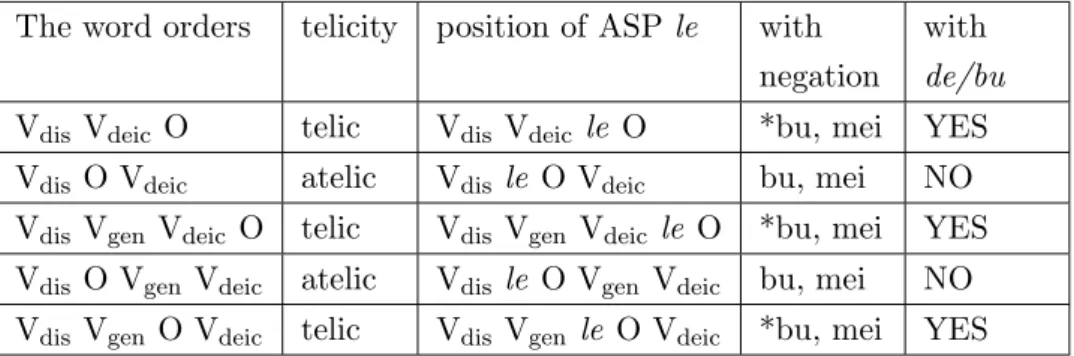
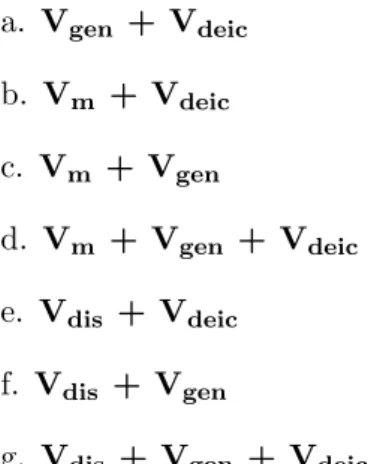
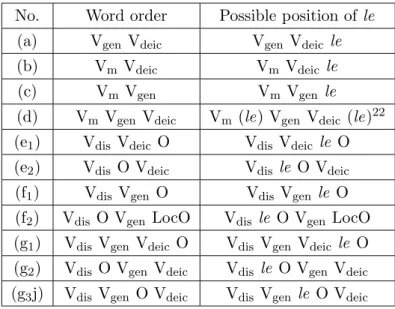
Mandarin DSVCs are divided into seven types. I first look into the word or-der alternations observed with certain types of DSVCs. I find that the word order variants differ in telicity and their interaction with the aspectual mor-phemele, the potential morphemesde/bu and the negationbu/mei. Then the DSVCs involving no word order alternations are also examined. I compare the distribution of le and the locative object in all types of DSVCs. The relation between the metaphoric interpretation and the syntactic position of directional verbs is also discussed.
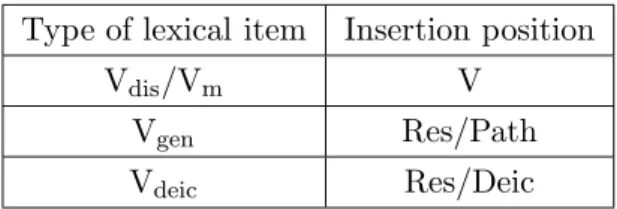
To cover the data, I propose that syntax first generates an eventuality-encoding structure for the lexical items to be inserted. In this structure, VP is sand-wiched between a series of functional projections including ResP, PathP, DeicP, RealiseP and IAsP. VP represents the process of the event; ResP expresses the result state; PathP describes a moving track; DeicP encodes deictic informa-tion; RealiseP accommodates the aspect marker le; IAspP calculates telicity value. Different options for the insertion of the directional verbs (under Res, Path or Deic) result in the word order alternations. And the observed syntactic and semantic characteristics of DSVCs can all be captured by the interaction among these projections. The proposal is sympathetic to many other construc-tionist theories in the belief of an impoverished lexicon, the idea that syntactic structure is basically event structure, and the decompositional approach that spans one item to different heads.
Overall, this work not only contributes to our understanding of how DSVCs are syntactically represented, but also shows the explanatory power of the constructionist approach in modelling the human language faculty.
Contents
Abstract 3 Contents 5 Acknowledgements 9 Author’s Declaration 11 1 Introduction 131.1 The Research Topic . . . 13
1.2 The Debate between Constructionist and Projectionist Approaches 22 1.2.1 Projectionist Approach . . . 22
1.2.2 Constructionist Approach . . . 40
1.2.3 Interim Summary . . . 54
1.3 Key Claims . . . 55
1.4 Outline of the Thesis . . . 58
2 Empirical Data 61 2.1 Overview . . . 61
2.1.1 The Descriptive Literature . . . 62
2.1.2 Compound or Two Words . . . 68
2.1.3 Against V-P Reanalysis . . . 77
2.1.4 The Serialising Patterns of DSVCs . . . 82
2.2 The Word Order Puzzles . . . 84
2.2.1 Word Order Alternation . . . 85
2.2.2 The Syntactic and Semantic Characteristics of the Word Order Variants . . . 87
2.2.3 Interim Summary . . . 113
2.3 The Vdis Vgen O Order . . . 114 5
2.4 More Word Orders . . . 119
2.4.1 The Serialising Pattern Vgen Vdeic . . . 120
2.4.2 The Serialising Patterns Beginning with Vm . . . 123
2.5 Summary . . . 128
3 Building up the Theory 133 3.1 Previous Solutions to the Word Order Alternation Puzzles . . . 134
3.1.1 Zou’s Solution . . . 134
3.1.2 Paul’s Solution . . . 142
3.1.3 Chen’s Solution . . . 146
3.2 Ramchand’s First Phase Syntax . . . 151
3.3 A Neo-constructionist Approach to the Mandarin DSVCs . . . 161
3.3.1 The Proposal . . . 162
3.3.2 Functional Projections . . . 194
3.4 Summary . . . 220
3.4.1 Two Structures . . . 220
3.4.2 Lexical Item Insertion Mechanism . . . 224
3.4.3 Head Movement . . . 229
3.4.4 Mechanism for Telicity Calculation . . . 231
4 Deriving the Directional Serial Verb Constructions 233 4.1 V1=Vgen . . . 235
4.1.1 Decomposing the Single Vgen . . . 236
4.1.2 Decomposing the Vgen Vdeic Cluster . . . 240
4.1.3 Potential Morphemes in the Vgen Vdeic Cluster . . . 247
4.2 V1=Vm . . . 253
4.2.1 VmVgen and Vm Vdeic . . . 254
4.2.2 VmVgen Vdeic. . . 266
4.3 V1=Vdis: the Word Order Alternations . . . 273
4.3.1 Deriving the Word Order Alternations . . . 274
4.3.2 Telicity . . . 279
4.3.3 Position ofle . . . 283
4.3.4 Potential Morpheme de/bu . . . 287
4.3.5 Negation . . . 290
4.4 V1=Vdis: the Vdis Vgen Pattern . . . 298
4.4.1 The Missing Word Order Alternation . . . 298
4.4.2 The Metaphoric Reading of the Directional Verb . . . . 302
CONTENTS 7
5 Crosslinguistic Application 317
5.1 Word Order Alternations . . . 318
5.2 The Position of the Aspect Marker . . . 323
5.3 The Merge Position of the Locative Object . . . 328
5.4 The Insertion Rules and Microparameter . . . 332
6 Concluding Remarks 337
Abbreviations 347
Acknowledgements
I would like to express my gratitude to all those who have helped me during the writing of this thesis, and during my four-year challenging and most memorable PhD life.
My deepest gratitude goes first and foremost to my supervisor, Dr. George Tsoulas, who has always been so patient, supportive and enlightening to me. I still remember when I just came to York, I was a complete newbie in syn-tax, who did not even know what trees are! I had a really tough time in the beginning and thought I would drop out the PhD programme because of this deficiency. However, with such a ‘dumb’ student like me, George has never shown any impatience or been harsh. He always believes in me, and encour-ages me to explore the intrinsic data, to experiment various theories, and to experience different academic challenges, such as conferences, publication and teaching. When I was diagnosed with the intimidating illness in my last year, George immediately offered his support and warm comfort, which helped me to defeat the panic and eventually complete this thesis. Without his consistent support, I would not have made so many achievements. His guidance also de-velops in me, a strong interest in pursuing deeper and wider research in human languages in the future.
Secondly, I’m deeply grateful to Professor Raffaella Folli and Dr. Norman Yeo, who graciously agreed to be my examiners. Their insightful suggestions on my thesis and warm-hearted encouragement for my future work are invaluable. Meanwhile, I would like to say thank you to all the staff in my department, who have helped me in all these years to become a qualified syntactician. Professor Peter Sells, Dr. Norman Yeo, Dr. Shin-Sook Kim and Dr. Eytan Zweig have all offered me very inspiring advice in my work and my writing at different stages of my work. As a senior colleague, Norman has also shared with me a lot of precious experience in completing the PhD degree. Dr. Bernadette Plunkett
has helped me with many tough questions when I audited her syntax class. Dr. Heather Marsden has provided me with kind guidance in the second lan-guage acquisition module. I really appreciate the help from all these intelligent minds surrounding me.
Thirdly, I greatly acknowledge my sponsor, the China Scholarship Council. It is because of their funding that I could focus on my research and did not have to worry about any financial issues in these years.
I would not have been able to reach this milestone without the unconditional support from my families. My parents, being academics themselves, have cul-tivated my passion and ambition in learning and research since an early age. They have encouraged me to go after my dream and provided substantial sup-port despite the geographic distance. My husband, Pedro, who himself is now a brilliant researcher in computer science, is the proofreader of this thesis and has solved loads of LATEX problems for me. Pedro has been a great support to me in both my life and study in the UK. His considerate care and gentle love have accompanied me fighting through the spiking path towards the PhD award, which I will eternally cherish.
Last but not least, my thanks also go to the following colleagues and friends, who have helped me in various ways in my study and life in York: Becky Woods, Margarita Makri, Theodora Lee, Qita, Weimin Wu, Yingru Zheng, Wenlin Cao, Shanshan Lou and Hongyan Zhao.
Author’s Declaration
I declare that this thesis is a presentation of original work and I am the sole author. This work has not previously been presented for an award at this, or any other, University. All sources are acknowledged as References.
In this thesis, I have included the work presented in the following published papers:
Chen, Z. (2014), ‘Movement and Direction in the Chinese V-V Construction’, Proceedings of the Inaugural ShefLing Postgraduate Conference pp. 14–18. Chen, Z. (2015), ‘The Word Order of The Directional Serial Verb Construction in Mandarin Chinese’, The Second Asian and European Linguistic Conference Proceedings pp. 1–16.
Chapter 1
Introduction
1.1
The Research Topic
Constructionism and projectionism represent two major research camps within generative grammar with contrasting views concerning the division of labour between the lexicon and the syntactic component of the human language fac-ulty.
Specifically, the debate centres around questions such as: How much infor-mation should be associated with the lexical entries, and how much can be considered as the result of syntactic operations? What is the correct level for representing argument structures? What regulates specific semantic roles to get linked to specific syntactic positions? And how can argument structure alternations as well as the limitations on such operations best be accounted for without losing explanatory power? (Tungseth 2008: 7)
Researchers working within the projectionist tradition assume that the correct level for stating argument structure information is the lexicon (e.g. Larson 1988, Levin & Rappaport Hovav 1995, Reinhart 2003, Reinhart 2006). How-ever, projectionist approaches generally have restricted power in accounting for argument alternation issues (which will be addressed in Section 1.2). Hence rise the constructionist proposals, which, contrary to projectionist theories, seek to derive the alternated argument structure of lexical items from the syn-tactic structure in which they appear (e.g. Hale & Keyser 1993, Goldberg 1995, Marantz 1997, Ritter & Rosen 1998, Borer 2005, Travis 2010, among others). The thesis puts the constructionist approach to the test, in a complex empirical
domain, which is the Directional Serial Verb Construction in Mandarin Chi-nese, also abbreviated as DSVC in this thesis. Two examples of the Mandarin DSVC are illustrated in (1) and (2):
(1) Ta 3sg zou walk jin enter le ASP fangjian. room ‘S/He walked into the room.’ (2) Ta 3sg na take chu exit lai come le ASP yi one ben CL houhou thick de DE shu. book ‘S/He took out a very thick book.’
In (1), there are two verbs in a row: a motion verbzouand a direction denoting verbjin, both of which can be used alone as the predicate of a sentence: (3) Ta 3sg zou walk le ASP 100 100 mi. meter ‘S/He walked 100 meters.’ (4) Ta 3sg jin enter le ASP fangjian. room ‘S/He entered the room.’
In (2), there are three verbs in a row: a displacement verbna ‘take’ and two directional verbschu ‘exit’ andlai ‘come’. They can also be used alone as the predicate of a sentence.
(1) and (2) merely represent two possible combinations of verbs among the various DSVC data in Mandarin. More combination patterns will be revealed as we proceed, especially in Chapter 2.
Note that this kind of verb string is not necessarily referred to as “directional serial verb construction” in the literature, especially in the descriptive litera-ture. For example, in Li & Thompson (1981), the verb string is described as a compound. The reason for which I do not view them as compounds will be fully discussed in Chapter 2. For now I briefly show that the usage of the term serial verb construction (SVC) in this thesis is reasonable.
SVC itself is a loose term that does not receive a consensual definition among linguists. In general, the use of the term “serial verb construction” basically aims to limit the data rather than entail a specific syntactic analysis.
1.1. THE RESEARCH TOPIC 15 For example, in the Chinese descriptive literature, the term “serial verb con-struction” is used to cover an even wider range of phenomena involving more than one verb in a surface string, which actually require totally different syn-tactic analyses. For example, in some SVCs, one VP is analysed as an adjunct to another, whereas some other SVCs involve object control.1.
Collins (1997) takes (5) as a provisional definition for SVC.
(5) “A serial verb construction is a succession of verbs and their comple-ments (if any) with one subject and one tense value that are not sepa-rated by any overt maker of coordination or subordination.”
(Collins 1997: 462) Collins further emphasises, consenting with Baker (1989), and Foley and Olson (1985), that
(6) “In a serial verb construction, V1 and V2 must share an internal argu-ment.”
(Collins 1997: 463) Based on (5) and (6), the Ewe examples (7) - (9) are classified as SVC and are referred to as “resultative SVC”, “instrumental SVC” and “direct-object-sharing SVC” respectively. (7) Me I nya chase ãevi-ε child-DEF dzo. leave ‘I chased the child away.’ (8) Kofi Kofi tsO take ati-ε stick-DEF fo hit Yao. Yao
‘Kofi took the stick and hit Yao with it.’2 (9) Wo they ãa cook fufu fufu ãu. eat
‘They cooked fufu and ate it.’
(Collins 1997: 461)
1See Paul (2008) for a critical discussion on the various phenomenon under the label of
the termserial verb construction in the Chinese descriptive literature
2(8) is considered as SVC because the object of V1 tsO ‘take’ is also the instrumental
In comparison, examples (10)-(12) are analysed as cases of covert coordination. (10) Me I fo hit kaãεgbε lamp gba break (yεme) its tsimini. glass ‘I hit the lamp and broke its glass.’
(Collins 1997: 463) (11) Kofi Kofi liε climb ati tree gbe pick ne. coconut
‘Kofi climbed a tree and picked a coconut.’ (12) E he fo clear ave forest fa plant blafo. corn
‘He cleared the forest and planted corn.’3
(Collins 1997: 466)
More recently, Aikhenvald defines SVCs as in (13), consolidating the existing terminological consensus. And this thesis is sympathetic to this definition. (13) “A serial verb construction (SVC) is a sequence of verbs which act
to-gether as a single predicate, without any overt marker of coordination, subordination, or syntactic dependency of any other sort. Serial verb constructions describe what is conceptualized as a single event. They are monoclausal; their intonational properties are the same as those of a monoverbal clause, and they have just one tense, aspect, and polarity value. SVCs may also share core and other arguments.”
(Aikhenvald & Dixon 2006: 1)
Aikhenvald argues that SVCs with no shared argument are comparatively rare, but not non-existent (Aikhenvald & Dixon 2006: 12), which is different from the assumptions of Baker and Collins. Although this definition covers a wide range of phenomena in various languages, many of which are beyond the scope of this thesis, it is worth mentioning because it provides criteria generally accepted to judge whether a particular construction can be classified as a an SVC. Aikhen-vald also divides SVCs into two types depending on their semantic composition: Symmetrical Serial Constructions and Asymmetrical Serial Constructions. The
3(11) and (12) are not considered as internal argument sharing, according to Collins,
because the object of the V1 is the location of the V2, but it is less plausible for a location than for a instrument (as in (8)) to be an argument.
1.1. THE RESEARCH TOPIC 17 components from Symmetrical SVCs all come from unrestricted classes, whilst the asymmetrical SVCs involve one verb from “a relatively large, open or oth-erwise unrestricted class” and another from a “semantically or grammatically restricted (closed) class” (Aikhenvald & Dixon 2006: 21).
The main data of this thesis, i.e. the directional SVCs, such as (1) and (2), conform to Aikhenvald’s definition. They have no overt syntactic dependency marker, share aspect marker and certain arguments. They are conceptualized as a single event and their intonational properties are just like a monoverbal clause. Therefore, classifying these data as SVCs is justified. And we can easily see that the directional SVCs in Mandarin fall into the asymmetrical type of SVCs since they involve one motion/displacement verb which constitute a relatively open class of verbs and one or more direction encoding verbs which constitute a closed set with limited number of verbs.
I specially choose DSVC in Mandarin as as the main data for the thesis mainly for three reasons. Basically, the data provides good support for the construc-tionist approach. Secondly, the studies on Mandarin DSVC lack a systematic syntactical analysis in the literature. Thirdly, the study of DSVC data also sheds some light on the study of resultatives and spatial PPs. Now I elaborate on these three points one by one.
First and foremost, some DSVCs (e.g. (2)) demonstrate word order alterna-tions as in (14), which is related to the core debate between constructionist and projectionist theories, i.e. the argument alternation issues.
(14) a. Ta 3sg na take chu exit lai come le ASP yi one ben CL houhou thick de DE shu. book b. Ta 3sg na take le ASP yi one ben CL houhou thick de DE shu book chu exit lai come c. Ta 3sg na take chu exit le ASP yi one ben CL houhou thick de DE shu book lai. come ‘S/He took out a very thick book.’
In Section 1.2, I show that argument alternation is the main problem on which constructionists question and challenge projectionists, and that construction-ists provide various models, which have more advantages than the projectionist approaches, to account for data as such. In this thesis, I also propose a con-structionist model for the Mandarin DSVC word order alternations with certain
tentative projectionist solutions also being discussed but discarded in the end. In this way the thesis provides one more piece of supporting data and more arguments for the constructionist approaches applied on argument alternation issues, and also demonstrates the explanatory power of the constructionist framework.
The second reason for which I choose Mandarin DSVC as my research focus is that few researchers have delved into Mandarin DSVCs, investigating their syntactic and semantic derivation. In general, investigation of directional SVCs in human languages is often correlated with the typological studies on motion events. Researchers’ interest tends to centre around the typological classifica-tion of the languages that utilise SVCs as a strategy to express moclassifica-tion and di-rection. The most famous proposal is probably made by Talmy (1975). Talmy (1975) proposes that human languages fall into two types with respect to their way of encoding motion event: verb-framed languages and satellite-framed languages. Basically, the major semantic components of a motion event are
path and manner of motion. Verb-framed languages, represented by most Romance, Semitic, Japanese and Korean, encode path in the main verb and the manner in a subordinated adjunct clause. Satellite-framed languages, rep-resented by Indo-European languages (except for most Romance languages), Chinese, Finno-Ugric, Ojibwa and Walpiri, encode manner in the main verb and path in a ‘satellite’ which primarily subsume prepositions, particles and verb affixes. Examples of each type are shown below.
Verb-framed language: (15) Je I suis am entre entered dans in la the maison house (en in boitant). limping (French) ‘I entered the house (limping).’
Satellite-framed language:
(16) John limped into the house.
(Beavers, Levin & Wei Tham 2010: 333) As we can see, in French, a verb-framed language, path is encoded in the main verb entre while the manner of motion is expressed with an adjunct clause en boitant. In contrast, as a satellite language, English lexicalises manner of motion as the main verb limp and path as a preposition satellite into.
1.1. THE RESEARCH TOPIC 19 Talmy’s binary typology hinges on a crucial criterion: whether a given language prefers to express path in the main verb or in a satellite element associated with the main verb. Hence, identifying the main verb is of utter importance. This is relatively easy in languages such as English and French because the distinct morphological marking helps to differentiate the main verb from the satellite elements. However, applying such an approach to Mandarin Chinese is problematic. Take (1) for example again, repeated in (17).
(17) Ta 3sg zou walk jin enter le ASP fangjian. room ‘S/He walked into the room.’
Now both the manner and path information are encoded in verbs. Identify-ing the ‘main verb’ is not straightforward. The translation for (17) may lead people to speculate that the second verb jin is equal to the preposition into in English because the translation seems to suggest that the manner of mo-tion verb zou expresses the main information while the path verb jin seems to drop its motion meaning and only provide a direction/path information for the manner of motion verb. However, there is no independent evidence show-ing that jin can be reanalysed as a preposition (more arguments are given in Chapter 2). Besides, it is not entirely impossible for (17) to be interpreted as ‘He entered the room by walking’, although this reading is less salient and normally requires some context support. For example, (18).
(18) Ting listen qingchu! carefully Ta 3sg shi SHI pao run jin enter fangjian room de, DE, bushi NEG-SHI zou walk jin enter fangjian roon de! DE
‘Listen carefully! It was by running that he got into the room, not by walking.’4
If this kind of reading is accepted, it indicates that jin could be the main verb and zou therefore is an adjunct. This amounts to say Mandarin can be on either side of Talmy’s typology classification. If zou is considered to be the main verb, jin as a preposition, then Mandarin should be classified as a Satellite-framed language, just as Talmy himself suggested. Ifjin is considered
4Theshi...de construction is a emphatic construction. The material betweenshi and de
as the main verb while zou is an adjunct, then Mandarin would be viewed as a verb-framed language.5
In fact, using serial verbs to express motion/displacement and direction is not solely observed in Mandarin Chinese. A lot of Chinese dialects, such as Cantonese, Min, Wu, as well as other languages that allow serial verbs, such as Thai, Vietnamese, West-African languages and Oceanic languages, also display very similar constructions.
Cantonese (19) lei you lo take di pl saam clothing lai. come “Bring some clothes.”
(Aikhenvald & Dixon 2006: 21) (20) Kh˘aw he wˆıN run tRoN go.straight y˘o:n reverse kl`ap return khˆaw enter pay. go
‘He ran along straight back in (away from the speaker’s center of at-tention).’ (Sudmuk 2005: 18 (14)) Oceannic languages (21) I he i-htuat S:3S-run i-ew. S:3S-go.away (Kele) ‘He ran away.’6
(Ross 2004: 305 (22)) (22) Go=wali S:2S=carry na ACC loko pudding mo S:3S:REAL vanai. come (N.E. Ambae) ‘Bring the pudding.’
(Ross 2004: 306 (27))
5The debate between these two possibilities regarding the grammatical status of the
di-rectional verb in Mandarin DSVCs has never reached consensus among the Chinese linguists. While linguists such as Hsueh (1989) and Tai (2003) consider the directional verb to be the main verb, others such as Chao (1968), Li & Thompson (1981), and Chang (2001) refer to it as a ‘complement’, or satellite to the main verb, following Talmy’s terminology. (Chen & Guo 2009)
1.1. THE RESEARCH TOPIC 21 Clearly, Talmy’s two-way typology is not powerful enough to accommodate lan-guages adopting a SVC strategy to express directed motion. Therefore, recent studies suggest a third solution. Slobin (2004a, 2004b) proposes a third class of languages called equipollently-framed languages in addition to Talmy’s binary classification. In equipollently-framed languages, “both manner and path are expressed by ‘equipollent’ elements, that is, elements that are equal in formal linguistic terms, or appear to be equal in force or significance”. Obviously, languages encoding directed motion with SVCs are encompassed under this new label.
Although the addition of the equipollently-framed languages into the typology provides a good solution to the controversial typological status of Mandarin and languages with the same strategy, the new label still tells nothing about the hierarchical syntactic structure of these SVCs. We cannot infer from the typo-logical classification how directional SVCs are derived, let alone answer more advanced questions such as whether the three types of languages, including V-framed, S-framed and E-framed languages, generate a structure of the same kind when expressing directed motion, and which syntactic parameter leads to the strategic difference. Although this thesis is not intended to discuss the parameter setting between each type of languages, we shall provide a system-atic analysis on the Mandarin DSVCs, focusing on their syntactic derivation and semantic interpretation, complementing the perspective that is left aside by the typology studies. This study, therefore, could be a possible basis for future research on deriving a general syntactic rule for the motion expressions in human languages.
Last but not least, investigating the DSVCs in Mandarin also contributes to the understanding of the resultative structure and spatial PPs.
In Mandarin and many serial verb languages, motion event and resultatives are both represented with serial verbs. Chinese resultatives have received various analyses, from different perspectives such as their argument structure or as-pectual properties. Representative studies include Li (1990, 1993, 1995, 1999), Huang (2006), Sybesma (1999, 1991), Tang (1997) and Zou (1994b), to name but a few. However, few studies have systematically tackled the DSVCs which bear similarities to the resultative structures. A thorough investigation in DSVCs can correlate and shed some light on the study of the resultative struc-tures in Mandarin, and possibly on other languages that utilise serial verbs to express both motion event and resultative structures as well.
Moreover, investigating DSVCs in Mandarin also constitutes a complement to the study of spatial PPs. Recent years have seen an impressive growth in the number of studies on the fine grained articulation of prepositional phrases that express spatial relations, namely spatial PPs. A common idea is to assume that PP has a complex internal structure with a series of functional projec-tions, just as NP and VP.7 All these studies are focusing on languages with an uncontroversial category P, hence cannot be applied directly to languages like Mandarin which use serial verb constructions to indicate motion and path. A study investigating the path structure in serial verb languages can comple-ment the study of spatial PPs and provide a more complete picture for the path structure in human languages.
All in all, Mandarin DSVC is an intriguing research topic for the study of Uni-versal Grammar, from both the empirical and theoretical perspectives. As I mentioned in the first point for which I choose this topic, Mandarin DSVCs demonstrate word order alternations under certain circumstances, which are closely related to the debate between projectionist and constructionist ap-proaches. In Section 1.2, I shall present a literature review on the debate between these two schools and briefly illustrate how our data are related.
1.2
The Debate between Constructionist and
Projectionist Approaches
1.2.1 Projectionist Approach
The dominant theories in generative grammar through the late 1980s to 1990s attribute the syntactic structure to the meaning of lexical items. These theories assume that verbs are listed in the lexicon together with their argument struc-ture information, which specifies the number and the types of arguments (i.e.
θ-roles) the verbs combine with in the syntax. Based on such information, a verb can project its syntactic structure.
Such approaches are referred to as ‘projectionist approach’ (Rappaport Ho-vav & Levin 1998), ‘lexical–thematic approach’ (Ramchand 2010), ‘lexicalist approach’, or ‘endo-skeletal approach’ (Borer 2005b) in the literature. These approaches “construct the properties of larger units from the properties of
1.2. THE DEBATE 23 some central lexical entry, which is itself presumably to be projected as a syn-tactic head” (Borer 2005b: 6). They allow for “the semantic classification of role types within the lexicon, readable by a ‘linking’ theory that places these different roles in different places within the structure. ... Under this view, the lexicon is a ‘submodule’ of the language faculty since it has its own distinct primitives and modes of combination.” (Ramchand 2010: 4)
Projection Principle Chomsky (1981, 1986) is an early expression of this sort of ideas, which states that “lexical structure must be represented categorically at every syntactic level”, hence ensuring that syntactic structure in a given sentence is lexically licensed. Besides, hypotheses such as UTAH (Baker 1988) and UAH (Perlmutter & Postal 1984), a series of works by Levin and Rap-paport on argument structure and lexical semantic representation, e.g. Levin (1993), Rappaport and Levin (1995, 1998, 2010), among others, and some re-cent accounts in the field, such as Garboden (2009), Beaver & Knootz-Garboden (2012), Wechsler (2015), are all proponents of this view.
One important challenge faced by projectionist approaches is the puzzle posed by the pervasively observed phenomenon under the label ‘multi argument re-alization’, which is reviewed thoroughly by Levin & Rappaport Hovav (2005). Multi argument realization generally has two types of manifestations. The first type concerns the argument alternation of a particular verb. For example, the famous dative alternation, locative alternation and with/against alternation in English are of this sort. Examples are shown in (23), (24) and (25) respectively. (23) dative alternation
a. Terry gave the newspaper to Kim. (to variant)
b. Terry gave Kim the newspaper. (double object variant) (24) locative alternation
a. Devon smeared butter on the toast. (locative variant) b. Devon smeared the toast with butter. (with variant) (25) with/against alternation
a. Kerry hit the stick against the fence. (against variant) b. Kerry hit the fence with the stick. (with variant)
The dative, locative, and with/against alternations are object alternations, involving alternate realization of the V’ internal arguments of three-argument verbs, with one argument always being realized as the object. Similarly, two-argument verbs also show two-argument alternations. The causative-inchoative alternation and conative alternation are of this kind, which are shown in (26) and (27) respectively.
(26) causative-inchoative alternation
a. The clumsy waiter broke a whole tray of glasses. (causative vari-ant)
b. A whole tray of glasses broke. (inchoative variant) (27) conative alternation
a. Pat hit the door. b. Pat hit at the door.
(Levin & Rappaport Hovav 2005: 187) The argument alternations illustrated above all take the form of alternate real-ization of a single set of arguments. Besides, the variants are somewhat related in semantics: they could be paraphrase for each other, as in (23); or the mean-ing of one variant is subsumed to the meanmean-ing of the other, as in (26), where the inchoative variant is implied by the causative variant. Nonetheless, multi argument realization is not confined to phenomenon as such. Another demon-stration of multi argument realization involves complex event composition by introducing an extra argument-taking predicate, an additional argument or both, but neither of them are selected by the verb. Example (28)-(30) are illustration of such cases.
(28) a. Terry swept.
b. Terry swept the floor.
c. Terry swept the leaves into the corner. d. Terry swept the leaves off the sidewalk. e. Terry swept the floor clean.
f. Terry swept the leaves into a pile.
1.2. THE DEBATE 25 (29) a. Kim whistled.
b. Kim whistled at the dog. c. Kim whistled a tune. d. Kim whistled a warning. e. Kim whistled me a warning. f. Kim whistled her appreciation. g. Kim whistled to the dog to come. h. The bullet whistled through the air. i. The air whistled with bullets.
(Levin & Rappaport Hovav 2005: 189)
(30) a. Pat ran.
b. Pat ran to the beach. c. Pat ran herself ragged. d. Pat ran her shoes to shreds. e. Pat ran clear of the falling rocks.
f. The coach ran the athletes around the track.
(Levin & Rappaport Hovav 2005: 189) Furthermore, some verbs are notoriously flexible with respect to the syntactic environment they can appear in – they seem virtually unconstrained. (31) and (32) are classical examples in the literature.
(31) a. John ate the apple. b. John ate at the apple.
c. The sea ate into the coastline. d. John ate me out of house and home. e. John ate.
f. John ate his way into history.
(Ramchand 2010: 21) (32) a. The factory horns sirened throughout the raid.
b. The factory horns sirened midday and everyone broke for lunch. c. The police car sirened the Porche to a stop.
d. The police car sirened up to the accident site. e. The police car sirened the daylight out of me.
(Borer 2005a: 8) No matter what form the multiple argument realization takes, be it argument alternation or event composition, these pieces of data pose a threatening chal-lenge to the lexicalist/projectionist approaches, which claim that a verb has a structured lexical entry that alone determines the argument realization of its arguments. If the phenomenon is restricted to a few verbs or a delimited class of verbs and the alternations are small in number, it is reasonable to ascribe the source of multiple argument realization to polysemy. However, multiple argument realization is widely found in many verbs of different classes and it is also observed cross-linguistically. This means we have to assume a large num-ber of polysemous verbs existing in the lexicon, which renders a redundancy in the theory about the lexicon. Besides, observing the examples from (23) to (32), we can see that the core meaning of the verb in each variant is the same.
1.2. THE DEBATE 27 For example in (30), all theruns mean something like ‘moving limbs fast and repeatedly’. And in (32), allsirens entertain the meaning of ‘emitting a high pitch noise’. Hence, it is rather counter-intuitive to assume that these verbs across the variants are all polysemous verbs.
Interestingly, the directional serial verb constructions in Mandarin Chinese il-lustrate behaviours which are very similar to the multiple argument realization we have seen above. For example, it is observed that when the first verb is a displacement verb and the second verb is a deictic directional verb such aslai ‘come’, the direct object of the displacement verb can occur after either verb: (33) a. Ta 3sg ji post lai come le ASP yi one feng CL xin. letter b. Ta 3sg ji post le ASP yi one feng CL xin letter lai. come ‘S/He posted one letter (to the speaker).’
The second verblai ‘come’ only indicates the letter’s moving orientation which is towards the speaker. Whether the subject moves is not denoted. To some extent, the verb lai is similar to the PP goal argument in dative structures because it can be interpreted as ‘to/towards here’. If we view the second verb lai ‘come’ as a goal argument and the direct object as a theme, the alternation in (33) highly resembles the one in dative alternation (as in (23)). In this sense, Mandarin DSVCs illustrate argument alternation. Moreover, the directional verb itself is also not c-selected by the displacement verb. The sentence is perfectly grammatical without the directional verb lai, although yielding a different meaning in which no path/goal information is conveyed (compare (34) with (33)). In other words, Mandarin DSVCs also demonstrate event composition. (34) Ta 3sg ji post le ASP yi one feng CL xin. letter ‘S/He posted one letter.’
Therefore, it is reasonable to subsume this word order alternation phenomenon observed with the Mandarin DSVCs under the label multiple argument real-ization. The behaviours of Mandarin DSVCs raise the same questions to the traditional projectionist theories: if the displacement verb has a structured lex-ical entry, how can they allow such a form of argument alternation and event composition?
Undoubtedly, the challenge posed by multiple argument realization is not ne-glected by linguists on the projectionist camp. They did posit various solutions to account for this phenomenon. I review some of these solutions in the fol-lowing sections Section 1.2.1.1 to Section 1.2.1.5.
1.2.1.1 Traditional Transformational Approach
Traditionally, some of the argument alternation phenomenon are captured with a transformational approach which follows Chomsky’s (1957, 1965) analysis on active/passive alternations as in (35).
(35) a. John ate the apple.
b. The apple was eaten by John.
According to Chomsky, the active and passive verb forms share the same lexical entry hence they are inserted into the same underlying structure. In the case of the active variant, the surface order is the direct projection of the underlying one, while the surface structure of the passive variant is derived via a trans-formation operation. This line of argumentation is extended to the dative and locative alternations: an alternating verb has a single projection of arguments onto the syntax, with a second realization of arguments being transformation-ally derived from the first. For example, Hall (1965) suggests that to variant in the dative alternation should be the basic structure while the double object variant is derived from it. Similarly, in the locative alternation, the locative variant is the basic whereas thewith variant is derived.
A weakness of the traditional transformation approach is that they lack a con-straint on the changes that transformation can effect. In reaction, ‘neotransfor-mational’ approaches arose, which appealed to independently motivated con-straints on movement rules to explain the range of attested argument alter-nations (Levin & Rappaport Hovav 2005: 198). Baker’s Uniformity of Theta Assignment Hypothesis (1985, 1988) and Larson’s VP-shell analysis (1988) are examples of such theories.
1.2. THE DEBATE 29
1.2.1.2 Baker
Based on the assumption that the variants in the alternations are “thematic paraphrases,” i.e., have the same meaning, Baker (1985, 1988) proposes the Uniformity of Theta Assignment Hypothesis (UTAH).
(36) The Uniformity of Theta Assignment Hypothesis: Identical thematic relationships between items are represented by identical structural re-lationships between those items at the level of d-structure.
(Baker 1988: 46, (30)) According to UTAH, the variants of the dative alternation have the same un-derlying structure. The derivation from one variant to another is captured by the operation termed ‘incorporation’. I show Baker’s analysis on the dative alternation in Chiche ˆwa, in which one variant is an applicative construction as in (37-a), and the other an oblique construction, as in (37-b).
(37) a. Mbidzi zebras zi-na-perek-er-a SP-PAST-hand-to-ASP nkhandwe fox msampha. trap ‘The zebras handed the fox the trap.’
b. Mbidzi zebras zi-na-perek-a SP-PAST-hand-ASP msampha trap kwa to nkhandwe. fox
‘The zebras handed the trap to the fox.’
(Baker 1988: 229, (3a)(2a)) Baker suggests that the Chiche ˆwa applicative affix –ir (with allomorph –er) in (37-a) fulfils the same semantic function as the preposition kwa in (37-b). Following the Uniformity of Theta Assignment Hypothesis, both variants have the d-structure in (38), as they are thematic paraphrases.
(38) S NP zebras VP V hand NP trap PP P kua/-er NP fox
In other words, the oblique variant is the basic structure. The applicative variant is derived by the “incorporation” of the affix -er into the verb. This “incorporation”of the affix into the verb means that the recipient, as the sister of the applicative affix, is now governed by the verb and, thus, is now expressed as an object. The s-structure of the applicative variant is shown in (39).
(39) S NP zebras VP V V hand P -ir PP P t NP fox NP trap
Baker’s “incorporation” analysis can be extended to the English dative alter-nation, on the assumption that both variants share a single thematic struc-ture, hence the same d-structure. The to variant stands as the basis and the double object variant involves the covert “incorporation” of a preposition (Den Dikken 1995, Pesetsky 1996).
1.2. THE DEBATE 31
1.2.1.3 Larson
Another widely adopted analysis of the dative alternation is presented by Lar-son (1988, 1990). Moving beyond Baker’s concerns, LarLar-son (1988) pays more attention to the apparent differences in the c-command relations between the VP-internal arguments in the dative alternation. It is argued that in the dou-ble object variant the recipient appears to c-command the theme, while in the to variant the c-command relation is reversed.
(40) a. I showed Mary herself. b. *I showed herself Mary.
(Larson 1988: 336, (3a)) (41) a. I showed Mary to herself.
b. *I showed herself to Mary.
(Larson 1988: 338, (5a)) To handle these c-command relations, Larson proposes that both variants are derived from the same underlying structure as in (42), which is actually as-sumed for all English verbs and their complements, including dative verbs.
(42) VP SpecV’ V’ V e VP NP a letter V’ V send PP to Mary
The to variant is simply derived via moving the lower V to the higher V. As for the double object variant, Larson suggests a passive-like operation on the lower VP, which results in the recipient occupying its specifier position and the theme expressed as an “adjunct” position.
Larson motivates this analysis on purely syntactic grounds, with no semantic support8. Similar to Baker, Larson’s analysis also takes the starting assump-tion that the variants are thematic paraphrases.
1.2.1.4 Variants Are Not Paraphrases
However, it was soon noticed that many of the argument alternation cases are not simply swapping arguments’ positions. Fraser (1971) points out that in the locative alternation, the range of the NPs found as the direct object of the locative variant is not the same as the range of the NPs appearing as the object ofwith in the with variant, for instance:
(43) a. They loaded a box onto the truck. b. *They loaded the truck with a box. c. They loaded the truck with (?the) boxes.
(Fraser 1971: 606, (4)) (44) a. The girl planted a tree in the garden.
b. *The girl planted the garden with a tree. c. The girl planted the garden with (?the) trees.
(Fraser 1971: 606, (4)) Furthermore, based on the hypothesis that transformation does not change meanings (Katz & Postal 1964), the variants should be truth-conditionally equivalent. However, certain semantic divergence across the variants in many argument alternations are detected, although some differences are really subtle. For example, the variants in locative alternation differ in the choice of
incre-8See Jackendoff (1990) for an extensive discussion of this assumption and Larson (1990)
1.2. THE DEBATE 33 mental theme. As Dowty (1991) and Tenny (1994) point out, locative alterna-tion verbs, such assmear or cram, necessarily describe events which inherently take two arguments that are potential measures or incremental themes. For example,
(45) a. Ariadne crammed the pencils into the jar. b. Ariadne crammed the jar with the pencils.
The two arguments arethe pencils and the jar. The pencils can be consumed in increments over time (in this case, pencils are consumed in the sense that they are crammed into the jar one by one or bit by bit). The jar is not a simple location, but something that can contain, or be filled up by, the pencil. The locative variant chooses the pencils as its incremental theme, so it indicates that the action cram finishes when all the pencils are inside the jar. On the contrary, the with variant chooses the jar as its incremental theme, so the action finishes when the jar is full regardless of the number of the pencils left outside. In other words, the meaning difference of the variants in the locative alternation can be characterised in aspectual terms.
The aspectual difference is more obviously observed in the cases of the multiple argument realization of the event composition type. It is noticed that direct object/oblique alternations can result in telicity differences. As Tenny (1994) points out, when eat takes a quantized NP as a direct object, the sentence is telic, but when a preposition at is inserted betweeneat and the quantized NP, turning the direct object into an oblique, the sentence becomes atelic, as is shown in (46):
(46) a. eat the apple in an hour. b. *eat at the apple in an hour
(Tenny 1994: 45, (78))
Resultative construction is another good example. Basically when a result phrase is added to an activity verb, such as the English verb sing, as in (47), it turns the sentence into telic.
(47) a. Pat sang for hours. (atelic)
b. Pat sang herself hoarse in two hours. (telic)
c. Pat sang the audience to their feet in twenty minutes. (telic) (Levin & Rappaport Hovav 2005: 104, (22)) Turning back to our own data, the alternation variants in Mandarin DSVCs are also not completely equivalent. As a preview here, I suggest that the VVO order in (48-a) yields a telic reading while the VOV order in (48-b) yields an atelic reading. I show more detailed data and tests to support my view in Chapter 2, where more differences between the two variants are also addressed. (48) a. Ta 3sg ji post lai come le ASP yi one feng CL xin. letter b. Ta 3sg ji post le ASP yi one feng CL xin letter lai. come ‘S/He posted one letter (to the speaker).’
Obviously, Baker and Larson’s approaches which assume the variants in the dative alternation are thematic paraphrase cannot be extended to those alter-nations with variants differing in meaning.
1.2.1.5 Rappaport Hovav and Levin
Efforts have been made within the projectionist theories to capture the dif-ferences in meaning among the argument alternation variants, for example, Levin (1993), Rappaport & Levin (1988, 1995, 1998, 2010), Knootz-Garboden (2009), Beaver & Knootz-Garboden (2012), Wechsler (2015), among others. Here I review some of Levin and Rappaport Hovav’s work, which claims that verb meaning determines syntax, as an example in dealing with multi argument realization in the projectionist camp.
In Levin (1993), she claimed that the variable argument structure observed in human languages are linked to verb meaning and are predictable. Specifically, verbs can be divided, according to their lexical semantics, into sets that pre-dict the various syntax structures in which they may appear. For example, identifying a verb as a member of the “change of state” class might predict its
1.2. THE DEBATE 35 appearance in intransitive (“The vase broke”) and transitive (“John broke the vase”) frames, and its non-appearance in “there insertion” contexts (“*There broke a vase”). This means that the same verb in each variant of a particular argument alternation has a different meaning. For example, the verb ‘load’ in the locative variant has a lexical semantic representation in (49-a), while the one in thewith variant is represented as in (49-b) in the lexicon.
(49) a. load: [x CAUSE [y TO COME TO BE AT z] /LOAD]
b. load: [[x CAUSE [z TO COME TO BE IN STATE]] BY MEANS OF [x CAUSE [y TO COME TO BE AT z]] /LOAD]
(Rappaport & Levin 1988: 26)
The overlapping of the lexical semantic representation captures the intuition that the two variants are near paraphrase. Whereas the difference in the rep-resentation captures the slight meaning difference that thewith variant entails the locative variant, but not vice versa.
In Rappaport Hovav and Levin (1998), they propose a series of rules and con-ditions, including “event structure templates”, “canonical realization rules”, “template augmentation” and “well-formedness condition”, in order to explain why verbs can have variable meanings that enable them to project different syntax structures.
They assume that each verb has a lexical semantic representation, which in-volves an “event structure template” and a constant associated with this tem-plate. The event structure templates are composed of a list of primitive pred-icates such as ACT, CAUSE, BECOME, etc. Specific combinations of these primitive predicates lead to different templates, which determine the ‘structural meaning’ of the verb, as is quoted from them in (50).
(50) “The structural part of a verb’s meaning is that part which is relevant to determining the semantic classes of verbs that are grammatically related.”
(Rappaport Hovav & Levin 1998: 106)
The inventory of event structure templates is provided by the Universal Gram-mar and is limited, whereas the set of constants is open-ended. Each constant
has an ontological category (Jackendoff 1990), drawn from a fixed set of types such as STATE, THING, PLACE, MANNER. A constant is associated with the event structure templates via “canonical realization rules”. Basically, the constants may either be modifiers of predicates (noted as subscript) or serve as arguments of predicates. The event structure templates associated with the constants are illustrated below, where the italicized material in angle brackets represents the constant.
(51) a. [ x ACT<MANNER> ] (activity)
b. [ X <STATE>] (state)
c. [ BECOME [ X <STATE>]] (achievement)
d. [[ x ACT<MANNER> ] CAUSE [ BECOME [ y<STATE> ]]]
(ac-complishment)
e. [ x CAUSE [ BECOME [ y <STATE>]]] (accomplishment)
(Rappaport Hovav & Levin 1998: 108) The particular instantiation of the constant determines the idiosyncratic mean-ing of the verb, which distmean-inguishes that verb from other members of the same class. For example, causative change of state verbs share the lexical semantic template in (52), with the various members of the class being derived by a particular instantiation of the constantSTATE, as illustrated by the represen-tation of causative dry in (53) :
(52) [[ x ACT ] CAUSE [ BECOME [ y <STATE>]]] (53) [[ x ACT ] CAUSE [ BECOME [ y <DRY>]]]
(Rappaport Hovav & Levin 1998: 107) Rapparport and Levin attribute the widespread variation in verb meaning to Template Augmentation, which allows more complex event structure templates to be built on simpler ones. However, Template Augmentation can only create meanings that are consistent with the basic inventory of lexical event structure
1.2. THE DEBATE 37 templates, as is stated in (54).
(54) Template Augmentation: Event structure templates may be freely augmented up to other possible templates in the basic inventory of event structure templates.
(Rappaport Hovav & Levin 1998: 111) For Template Augmentation to proceed successfully, two well-formedness con-ditions on syntactic realization, shown in (55) and (56), must by satisfied.
(55) Subevent Identification Condition: Each subevent in the event structure must be identified by a lexical head (e.g. a V, an A, or a P) in the syntax.
(Rappaport Hovav & Levin 1998: 112)
(56) Argument Realization Condition:
a. There must be an argument XP in the syntax for each structure participant in the event structure.
b. Each argument XP in the syntax must be associated with an iden-tified subevent in the event structure.
(Rappaport Hovav & Levin 1998: 113) These statements reflect common assumptions in the literature that elements in the semantic representation must be syntactically encoded and that the syntactic representation must be fully interpreted semantically.
We have seen that the English verb sweep can appear in different syntactic environments. In Rappaport and Levin’s view, this reflects the fact thatsweep has multiple meanings. And the multiple meanings are achieved by the tem-plate augmentation introduced above. Basically, the sweep in ‘John swept the floor.’ is associated with an activity template, as in (57).
(57) [ x ACT<SWEEP> y ]
This basic template is a subpart of several other event structure templates, thus it can be augmented to give these other templates as long as the well-formedness conditions are met. For instance, it can be augmented to an accomplishment template as in (58), thus creating a resultative construction as in (59), where
the head of the resultative phrase identifies the second subevent, satisfying the Subevent Identification Condition, and the DPthe floor is an argument of this subevent, so that the Argument Realization Condition is also satisfied. (58) [[ x ACT<SWEEP> y ] CAUSE [ BECOME [ y<STATE>]] (59) John swept the floor clean.
Rappaport and Levin’s proposal about event structure templates augmenta-tion semantically captures the variable verb meanings. Nevertheless, in order to map the semantic representation to syntax, they have to independently posit the linking theory, i.e. the well-formedness conditions. Besides, they ad-ditionally propose four linking rules for mapping the arguments in the semantic representation to the syntactic representation, listed in (60).
(60) a. Immediate Cause Linking Rule. The argument of a verb that de-notes the immediate cause of the eventuality described by that verb is its external argument.
b. Directed Change Linking Rule. The argument of a verb that cor-responds to the entity undergoing the directed change described by that verb is its internal argument.
c. Existence Linking Rule. The argument of a verb whose existence is asserted or denied is its direct internal argument.
d. Default Linking Rule. An argument of a verb that does not fall under the scope of any of the other linking rules is its direct in-ternal argument
(Levin & Rappaport Hovav 1995: 135, 146, 153, 154) These solutions, including an independent compositional semantic represen-tation, a paralleled syntactic representation as well as some linking theory, render a very stipulative and redundant theory, which violates an assumption held by many linguists that syntax is the only generative system of the human language faculty, just as Lin (2004: 29) comments, “positing an independent level of semantic representation essentially adds an ‘extra degree of freedom’
1.2. THE DEBATE 39 in formulating theories of argument structure, freedom that, if not properly constrained, will result in arbitrary stipulations.”
1.2.1.6 Summary for the Projectionist View
In summary, the projectionist approaches have obvious disadvantages in ac-counting for the phenomenon of multiple argument realization, which is widely observed cross-linguistically. They either assume that one structural variant that a certain verb projects is the basic and the other is derived from it, ignor-ing the fine-grained differences in meanignor-ing between the variants which often accompany these alternations, as well as differences in their information struc-ture, or have to introduce a series of mapping rules or some form of lexical redundancy rules, which specify how certain well-defined classes of words are systematically related to each other. In other words, if we attempt to solve the issues of multiple argument realization in the projectionist framework, we may end up with either an unexplanatory or an undesirably redundant theory.
1.2.2 Constructionist Approach
Unlike projectionist approaches, contructionist approaches account for the mul-tiple argument realization in the opposite direction.
Constructionists believe that lexical items possess no syntactically relevant in-formation which could constitute a constraint on their insertion possibilities. The lexical entry of the verb registers only its core meaning or “root”. The syntactic structures themselves represent the event-based meanings. Associ-ating a root with particular positions or substructures results in the meaning divergence. In other words, it is the syntactic structures that determine the meaning rather than the verb’s meaning that determines the structure. As Levin and Rappaport (2005: 190) comment, in constructionist theories, “the verb is integrated into the construction, rather than determining the construc-tion, and the construction itself licenses some of the complement structure.” Note that although constructionist theories allow free building of syntactic ter-minals, it does not mean that any lexical item can be inserted in any terminal. And indeed, empirically, not every verb can appear in all syntactic contexts. This is explained by ‘compatibility’ between the core meaning of the verb and the construction meaning.9
1.2. THE DEBATE 41 There are various instantiations of the constructionist approach, including the “traditional” constructionist approach, represented by Goldberg (1995, 1997, 1998), and the “neo-constructionist” approach, represented by Hale & Keyser (1993), Kratzer (1996), Borer (2005), Erteschik-Shir & Rapoport (2004), Hoek-stra (1992), Ritter & S. T. Rosen (1998), Travis (2010), Ramchand (2010), Folli & Harley (2013) etc.
Among these proposals, the traditional constructionist theory represented by Goldberg is in essence a cognitive theory, which does not draw a categorical dis-tinction between lexicon and grammar. It argues for the existence of Argument Structure Constructions, which are pieces of syntactic frames associated with certain meanings, memorised just as words. I do not delve further into this type of theory because it is not relevant to the approach proposed in this thesis. The main focus of this section is on the neo-constructionist approach. Neo-constructionists consider the constructions as fragments of syntactico-semantic structures made available by the Universal Grammar, and that the inventory of grammatical configurations in any given language is constructed from these fragments (Borer 2005a: 14). Hence, the neo-constructionists tend to reduce the properties attributed to lexical items to a minimum and propose elaborated syntactic structures with various functional projections. They view the mean-ing of the constructions as compositionally derived from the meanmean-ing of the root together with the meaning encoded in the elaborated syntactic structure. I review a couple of representative proposals in the following Sections 1.2.2.1 to 1.2.2.4.
1.2.2.1 Precursors of neo-constructionism: Hale and Keyser
Hale and Keyser’s (1993, 1997a, 1997b, 2002, 2013) theory can be viewed as a precursor to the neo-constructionist approaches. According to them, argument structure is itself a syntax (Hale & Keyser 1993: 2), as is quoted in (61).
(61) “Argument structure is determined by properties of lexical items, in particular, by the syntactic configurations in which they must appear. There are just two relations, complement and specifier, defined so as to preclude iteration and to permit only binary branching.”
Specifically, they identify a small number of major semantic classes of verbs and assume that the verbs in each class are lexically associated with a particular syntactic structure that configurationally encodes the semantic relations be-tween a verb of that type and its arguments. They call these “lexical syntactic structures”.
For example, a denominal verb,shelve, is represented by four syntactic heads: N, P and two Vs, as is illustrated in (62).
(62) V1P DP V1’ V1 V2P DP books V2’ V2 PP P NP N √ shelve
The verb shelve is derived by successive head movement and incorporation from the root under N to P and the two V heads, as is shown by the arrows. All of the four heads have meanings. N is the endpoint of the action. P represents a locative relation like the preposition on. V1 represents CAUSE and V 2 BE/BECOME. The theta-roles of the argument is determined by their position in the structure. For example, the spec of V1 is automatically interpreted as Agent while the spec of V2 is interpreted as Theme.
Hale and Keyser’s proposal of lexical syntactic structures is crucial to the shift to constructionist approaches in the study of argument structure. These lexical syntactic structures actually extend the VP shells proposed by Larson (1988), but they are more constructional in that they do away with UTAH and assume thematic roles can be read off the syntactic structure. The verb meaning is composed by the root and the layers of light verbs built above the root. These
1.2. THE DEBATE 43 all share the spirit of neo-constructionism that the meaning is compositional based on the syntactic structure. Although starting to formulate the theory in a constructionist view, Hale and Keyser still assume that the lexical syntactic structures occur in the lexicon, hence they term the lexical syntactic structures as L-syntax, differing from the real syntax component, S-syntax. In the neo-constructionist work, which we describe next, the lexicon is devoid of generative power to a much larger extent.
1.2.2.2 Radical Neo-constructionist Proposal: Borer
Borer is representative of the radical neo-constructionist view. According to her, the lexicon can be completely abandoned as a module of the grammar. A lexical item (in her terms ‘listeme’) is a unit of the human conceptual system. The reservoir of listemes is called encyclopedia. The listemes are simply pairs of sound and meaning, in which sound is a phonological index and meaning refers to “the appropriate package of conceptual properties associated with such an index” (Borer 2005a: 30). It is noteworthy that she proposes that the encyclopaedic listemes are devoid of any syntactic properties, including the syntactic category, the syntactic or morphological insertion environment or morphological marking of any sort, be it derivational or inflectional. In other words, encyclopaedia is merely a storage of sound-meaning pairs without any power to generate recursive sentences. The generating power resides only in thegrammar.
Borer suggests that the grammar itself has a functional lexicon, which con-tains two types of grammatical formatives: f-morphemes(independent gram-matical functional formatives), such as the,will, etc. and (phonologically ab-stract)head features, for example,<pst>for past tense. The latter requires the support of some head, which triggers obligatory head movement. It is these grammatical formatives that burden all the computation in generating various structures.
Briefly, in Borer’s architecture of grammar, the merger of some listemes from the conceptual array10 gives rise to a Lexical Domain (L-D). Then functional heads are successively merged with the L-D, giving rise to the structure in (63):
(63) F-1max Spec listeme-2 (ARGUMENT-1) F-1 F-1min F-2max Spec listeme-1 (ARGUMENT-2) F-2 F-2min listeme-3 L-D listeme-3 (Borer 2005b: 13) According to her, the specific merger of listeme-1 and listeme-2 as [Spec,F-1] or [Spec, F-2], respectively, will result in a particular interpretation (‘sub-ject’, ‘ob(‘sub-ject’, etc. in some well-defined sense). Listeme-3, by virtue of having merged a copy in some intermediate head, becomes the head of L-D. If L-D is categorized as a V by some appropriate functional structure (such as Tense), listeme-3 becomes a verb. If L-D is categorized as N, it becomes a noun, etc. (Borer 2005a, 28; 2005b, 12).
She also points out that the grammar as it now stands gives us no way to determine the specific internal architecture or the relative order of functional nodes. On the other hand, the existence of a functional structure, the fixed hierarchical ordering of at least some functional projections with respect to each other, and the placement of some constituents in functional specifiers, can be shown to be an empirical fact. (Borer 2005b: 11)
The semantic composition works in the following way: the use of a listeme returns a meaning based fundamentally on its conceptual value. And the syn-tactic structure will also return an interpretation, “based on combinatorial, computational principles of interpretation assignment, as linked with the struc-tural and the formal-semantic properties of functional vocabulary and syntactic structure.” (Borer 2005b: 9)
Under such a treatment, the differences between, for example, transitive, in-transitive and middle break are no longer to be determined by distinct but
1.2. THE DEBATE 45 related lexical entries ofbreak, but rather by the functional structure in which break is embedded. Specifically, in the context of a structure licensing two ar-guments,break would be transitive, but in the context of a structure licensing only one argument, it would be either a middle or an intransitive, depending on the structure projected. (Borer 2005b: 6)
Last but not least, Borer also argues for a ‘making sense’ component in the cognitive place. This component would allow the world knowledge to interfere with the felicity of the structure.
In the projectionist systems, s-selection restrictions specified on the lexical item are normally appealed to in order to exclude the infelicitous argument structure combinations. For example,
(64) #John drank (up) the steak. (65) #John ate (up) the water.
According to the projectionists’ view, the oddity of (64)-(65) derives from the s-selection properties of drink and eat: the former requires a theme bearing [+liquid] feature while the latter requires one with a [+solid] feature.
Borer argues that such information as selectional restrictions should be ascribed to the restrictions born of world knowledge rather than grammar. Our world knowledge tells us that drinking is a mode of consumption associated with liquids, and that eating is a mode of consumption associated with solids. As she further points out, the oddity of (64)-(65) can be overridden by “modifying our presuppositions regarding the objects consumed (e.g. a liquefied steak can be drunk; frozen water can be eaten), or by modifying our presuppositions about the consumption mode” (Borer 2005b: 7). The metaphoric use of drink and eat clearly shows this coercion effect of the world knowledge.
(66) She drank him with her eyes. (67) She ate him with her eyes.
(Borer 2005b: 7) On the contrary, a projectionist approach would find it much harder to explain such examples, which obviously violate the existing selectional restrictions.
According to Borer, the ‘making sense component’ is neither the conceptual system that harbours the listemes nor the grammar that generates the struc-ture. Instead, this component compares the outputs of the conceptual system and the grammar. The extent to which these two outputs match each other would decide the felicity/oddity of the sentence, as is illustrated in Borer’s words:
“The overall felicity of any linguistic behaviour would emerge as a direct func-tion of the extent to which these two outputs match each other. It is in the nature of things that the two outputs will not always match, or at least, not in a straightforward way. In the event of a mismatch, the grammar will al-ways prevail. The interpretation put forth by the conceptual component can and will stretch, as much as possible within the confines of the concept under consideration, so as to match the rigid, absolute interpretational constraints circumscribed by the grammar. The more the conceptual system stretches, the more the utterance will appear ‘odd’ or metaphoric, and at times, the oddity may be so extreme that it becomes difficult to distinguish from a straightfor-ward case of ungrammaticality, where by ‘ungrammatically’ I would like to refer exclusively to the effect created by the violation of formal computational principles.”
(Borer 2005b: 9)
1.2.2.3 Other Neo-constructionist Proposals
Neo-constructionist’s proposals vary with respect to how much information is allocated to the lexical root and how much is related to the functional struc-ture. Apart from radical representatives such as Borer, others choose a moder-ate view, which allows the root to contain some syntactic information ranging from category information to syntactic selectional information and degrees of argument-structure information, depending on the particular theory. (Ramc-hand 2010: 11)
Sharing the basic spirit that the semantics reads off the structure, linguists on the neo-constructionist camp have proposed different versions of functional pro-jections for any specific effect. For example, Borer posits an aspectual quantity phrase on top of the VP and is responsible for both telicity and object quantity effects. Now I show a few more neo-constructionist models, including Ritter & Rosen (1998), Travis (2010) and Ramchand (2010), to further illustrate the general idea of the neo-constructionist program.
1.2. THE DEBATE 47
Ritter and Rosen (1998)
Ritter & Rosen (1998) propose two functional projectionsFP-initiation and
FP-delimitation to encode event information.
In their view, events that have an endpoint (D-event) such as accomplishment and achievement are syntactically represented in (68). The object raises to the Spec of the lower FP to receive the delimiter event role. The external argument raises to the Spec of the higher FP where it receives the event role of initiator. The initiator subsequently raises to the so-called subject position, i.e. the position in which nominative case is assigned. If there is no external argument, the object may raise further to the subject position.
(68) TP T FP(-initiantion) Spec F’ F VP XP V’ V FP-delimitation Spec F’ F VP/SC ...YP...
(Ritter & Rosen 1998: 149) In comparison, undelimited events such as activities and states have the syntac-tic representation in (69), where delimiting FP is missing. According to Ritter & Rosen, when there is no delimiting FP, the object (if there is one) does not receive a delimiter role. Besides, the higher FP cannot assign the initiator role. Instead, it takes on the function of topic. (Ritter & Rosen 1998: 150)