Using Hypervisor to Provide Data Secrecy for User Applications
on a Per-Page Basis
Jisoo Yang
Kang G. Shin
University of Michigan {jisooy,kgshin}@eecs.umich.edu
Abstract
Hypervisors are increasingly utilized in modern computer systems, ranging from PCs to web servers and data centers. Aside from server applications, hypervisors are also becoming a popular target for implementing many security systems, since they provide a small and easy-to-secure trusted computing base. This paper presents a novel way of using hypervisors to protect application data privacy even when the underlying operating system is not trustable. Each page in virtual address space is rendered to user applications ac-cording to the security context the application is running in. The hypervisor encrypts and decrypts each memory page requested de-pending on the application’s access permission to the page. The main result of this system is the complete removal of the operating system from the trust base for user applications’ data privacy. To reduce the runtime overhead of the system, two optimization tech-niques are employed. We usepage-frame replicationto reduce the number of cryptographic operations by keeping decrypted versions of a page frame. We also employlazy synchronizationto minimize overhead due to an update to one of the replicated page frame. Our system is implemented and evaluated by modifying the Xen hyper-visor, showing that it increases the application execution time only by 3% for CPU and memory-intensive workloads.
Categories and Subject Descriptors D.4.6 [Operating Systems]: Security and Protection
General Terms Design, Security
Keywords Hypervisor, Application Protection, Data Privacy, Vir-tualization
1. Introduction
Hypervisor, a virtual machine monitor that directly runs on bare hardware, is becoming popular and has already penetrated deeply into modern computing environments. The Xen hypervisor [3] and the VMware ESX Server [30] are representative examples of this popularity. Hypervisor is not only attractive in consolidating servers and planning server resources, but also advantageous in enhancing system security.
Hypervisor can provide a perfect implementation point for many security applications because it can be inserted between
hard-Permission to make digital or hard copies of all or part of this work for personal or classroom use is granted without fee provided that copies are not made or distributed for profit or commercial advantage and that copies bear this notice and the full citation on the first page. To copy otherwise, to republish, to post on servers or to redistribute to lists, requires prior specific permission and/or a fee.
VEE’08 March 5–7, 2008, Seattle, Washington, USA Copyright c°2008 ACM 978-1-59593-796-4/08/03. . . $5.00
ware and operating system. For instance, many intrusion detection systems based on hypervisors have been proposed [13, 17, 19]. Hy-pervisor has also been utilized for providing security services to upper-layer software. For example, hypervisor can provide vir-tual instances of Trusted Platform Module (TPM) of the trusted computing architecture [4, 12]. The hypervisor used for enhancing security relies on the property that it forms a relatively small and easy-to-secure trusted computing base.
In this paper, we propose a novel usage of hypervisor for im-plementing a new layer of protection. This protection layer directly secures the memory contents of user-level applications, guarantee-ing protection even from a malicious or faulty operatguarantee-ing system. This protection is achieved by encrypting the contents of the user memory pages; when a program accesses a memory page, the hy-pervisor determines which image of the page to provide to the pro-gram. Whether to use a decrypted image of the page or a verbatim (hence encrypted) image is determined by the access permission of the program accessing the page.
Our protection system results in a very powerful privacy pro-tection infrastructure that can secure the entire execution of a user-level application. The sensitive information of a user application, including both code and data, is guaranteed to be protected against malicious or faulty operating systems. Therefore, unless the hyper-visor itself is compromised, the privacy of an application’s memory contents and relevant execution context is preserved even when the operating system has been compromised.
The semantics and interface of this page-based encryption sys-tem are abstractly defined in terms of a protection model, which we callSoftware-Privacy Preserving Platform(SP3). As with any protection model, SP3defines the relationship between principals and their access permission. In SP3, a protectiondomainis defined to be the principal in which a set of access permissions associates domains to a set of cryptographic keys. These access rights govern the ability to use the keys which are to encrypt/decrypt memory pages. If an application program is running inside an SP3domain, the application sees the decrypted memory contents through the virtual address space; programs outside the domain, including the operating system, may only see the encrypted memory contents.
In this paper, we focus on the hypervisor-based realization of this SP3protection model. Specifically, we describe modifications and extensions made to the hypervisor to implement SP3. To en-crypt pages and secure the SP3domain boundary, SP3extends the semantics of the paging system and interrupt interface of a CPU. We make the hypervisor emulate the extended paging and interrupt semantics. We also discuss and evaluate techniques to improve hy-pervisor’s emulation performance.
Page-frame replicationis a way to reduce the overhead of en-cryption. In this technique, a hypervisor retains page frame copies containing decrypted images of an original page. When a decrypted image of a page needs to be supplied to a program, the hypervisor
manipulates the page table entry (PTE) to redirect requests to the page frame copy containing the decrypted image. This reduces the number of costly cryptographic operations that would have to be performed on the entire page frame.
Lazy synchronizationis also used to further reduce the number of page-wide encryptions. Under the page-frame replication, syn-chronization is needed when an update occurs to one of the repli-cated images. This synchronization propagates the update to the other images by page-wide encryptions. However, with lazy syn-chronization, this costly synchronization is deferred as long as pos-sible: the synchronization happens not when an image is modified, but when one of the other images is accessed. This technique turns out to be very effective because no synchronization takes place un-less two SP3domains actively access the two related images simul-taneously.
We modified the Xen hypervisor and Linux kernel to implement a hypervisor-based SP3 system. The modified Xen, serving as the trusted computing base for user-application privacy protection, im-plements the full semantics of the SP3model. Linux, running on top of the modified Xen, is thus removed from the trust base of user applications that are running within SP3domains. If Linux violates the protection rules, it will at worst crash the system, but protection of the applications’ memory privacy is guaranteed.
We evaluated the Xen-based implementation by measuring the runtime performance of SP3 applications. Our evaluation results indicate that applications running in the modified Xen experience only a 3% slowdown compared to the same applications running in the native Xen environment. The result also confirms the efficacy of the page-frame replication and the lazy synchronization schemes.
The rest of the paper is organized as follows. Section 2 provides the background on Xen and Linux’s memory management and interrupt handling. Section 3 defines the SP3 protection model. Section 4 presents the key ideas for realizing SP3 protection in a hypervisor. Section 5 details our modification of Xen. Section 6 evaluates the implementation. Section 7 discusses related work. Finally, Section 8 presents conclusion.
2. Background
In this section, we provide background on the internal workings of hypervisor and operating system. We focus on paging (Section 2.1) and interrupt interface (Section 2.2) as they are closely related to the description of our implementation. We summarize them with an example (Section 2.3) by stepping through what happens when we execute a program in a virtual machine environment. In the following discussion, we assume Linux running on the x86 architecture as the choice of computing platform. We also use Xen as our choice of hypervisor.
2.1 Paging
Paging is the fundamental facility for memory management in con-temporary systems. Supported by a hardware Memory Manage-ment Unit (MMU), a physical memory page is mapped to a vir-tual address space via the Page Table Entry (PTE) structure. The MMU translates a virtual address to a physical address by page-table lookup using the virtual address to find a PTE that contains the physical page frame number. Each PTE also contains bit flags such as Present (P) bit (accessing a page withPbit cleared causes a non-present page-fault), Writable (W) bit (writing a page withWbit cleared causes a read-only access-violation page-fault), and Dirty (D) bit (the processor setsDbit when data has been written to the mapped page).
Operating systems, without a hypervisor, directly manipulate the MMU data structure to implement the virtual address space
and various paging tricks such as demand-paging, copy-on-write, virtual memory, and disk buffer cache.
With a hypervisor present, an operating system runs on a vir-tualized hardware platform where the operating system is given a “physical memory” of virtual machine that is an illusion created by the hypervisor. Running between the bare hardware and operating systems, the hypervisor adds another layer of address translation. One way to implement this translation layer is to use shadow page tables [30]. In this technique, a guest operating system’s page tables are “shadowed” by real page tables to be directly used by the pro-cessor. The hypervisor intercepts all references and updates to the guest operating systems’ page tables, performing additional trans-lation, which is called “physical-to-machine” translation.
In para-virtualized systems where operating systems are modi-fied to run on a virtual machine, part of the “physical-to-machine” translation is performed by the guest operating system. This is to avoid complexity and overhead that would otherwise be incurred in a fully virtualized system. Although a para-virtualized system directly exposes MMU states to the guest operating system, the hy-pervisor still enforces strict rules regarding MMU and page table updates, thus guaranteeing safety to the hypervisor.
2.2 Interrupt
If the processor receives a hardware interrupt or generates an excep-tion, it suspends its execution of current program in order to serve the interrupt or exception. The processor saves the context of the in-terrupted program for later use when the program is to be resumed. In the x86 architecture, this context, called “exception frame”, is saved in the kernel-mode stack upon interrupt. The interrupt is usu-ally the point where the kernel is entered; it causes the processor to vector to the kernel’s interrupt/exception handler and the processor mode is switched from user-mode to privileged-mode.
Operating systems, without the hypervisor present, directly han-dle interrupts. An operating system is to directly program interrupt vector tables to cause the processor to jump to appropriate handler code in the kernel. The handler then performs appropriate actions to resolve the source of the interrupt or exception. Upon completion of handling the event, the kernel runs a scheduler to select the next program to run. To switch the context to the selected program, the kernel executes an instruction called “return from interrupt” with the saved exception frame as the argument of this instruction. The processor switches back to the user mode and resumes execution of the user program.
With the hypervisor present, however, the hypervisor intercepts every interrupt and exception. It examines the cause and nature of the interrupt and then decides whether to handle the interrupt itself or to forward the interrupt to the guest operating system. When it decides to forward the interrupt, it creates an exception frame on the guest operating system’s kernel mode stack to emulate the processor’s behavior. The content of this exception frame can be programmed by the hypervisor to suit its need.
From an operating system’s perspective, the underlying hyper-visor’s involvement is completely hidden in the case of full vir-tualization. In a para-virtualized case, such as Xen, the operating system is required to be modified to use the para-virtualized inter-rupt interface. Nevertheless, the para-virtualizing hypervisor is able to intercept every interrupt and exception and thus fully protected from guest operating systems.
2.3 Example
Here we summarize paging and interrupt in a virtualized environ-ment by using an example where we step through an application be-ing executed. When a user application program is first executed by a process callingexec()system call, the kernel handlingexec()
information. Then, the kernel maps code, data, and stack area to the process address space. At this time, the operating system only assigns virtual memory regions and memory is not assigned; the corresponding PTEs for the regions are with theirPbit cleared. This is because of the demand-paging scheme. The actual mapping occurs when non-present page-faults on these unmapped pages are handled.
During these events of system call, PTE manipulation, and page-faults, the hypervisor intervenes to virtualize hardware by page-table shadowing and forwarding interrupts: each non-present page-fault vectors first to the hypervisor’s handler. If the hypervi-sor determines the fault should be handled by the guest operating system, it forwards the fault to the guest operating system. Then the page-fault handler in the guest operating system allocates and maps a physical page to the faulting address by updating the corre-sponding PTE. This PTE update is too intercepted by (or submitted to) the hypervisor for its implementation of shadow paging.
3. SP
3protection model
This section first provides an overview of the SP3system and then illustrates with an example how it provides data privacy protection to user-level applications.
3.1 SP3definition
As the principal of the SP3 protection, we use the concept of protection domain [20]: access permission is determined based on the domain context. Each domain of a running SP3 system is uniquely assigned and identified by anSID(SP3DomainID) value. To identify the currently executing domain, the SP3 system may keep a variable calledcurrentSID. The operating system is assigned SID of 0. Therefore, current SID is automatically switched to 0 when an interrupt or an exception occurs. In most cases, it is safe to consider a domain as a process, but a domain is not exactly the same as a process; multiple processes can share the same SP3 domain. The kernel always execute withSID0.
The definition of SP3 is divided into three parts. First, the
secure pagingextends the interface of a general paging system to maintain the domain boundary. Second, thesecure domain switch
is responsible for safe domain crossing upon interrupts. Last, the
domain operationshandle the dynamics of domain creation and deletion as well as transferring access permissions for sharing. In this section, we only outline the SP3constituents, omitting details relevant to actual implementation.
Secure paging: The page table entry (PTE) structure is extended to include a new multi-bit field, called KID (KeyID), which is used to locate a symmetric key. An SP3 system internally keeps a database that stores symmetric keys, called thekey database. The KID value of a PTE serves as an index to the key database. The SP3 system also maintains a permission bitmap that tells which domain (identified bySID) can use which symmetric key (identified byKID). The operating system is prohibited from directly accessing the key database and the permission bitmap, but it is allowed to modify theKIDfield in a PTE. When a domain withSIDsaccesses memory, page tables are traversed for virtual-to-physical address translation. During the page traversal, theKIDkof the matching PTE is checked against the permission bitmap to see if s can usek. If so, the SP3 system renders the decrypted image of the physical page using the symmetric key indexed byk. Otherwise, the SP3system renders the verbatim image of the page.KID0 is defined as a ‘null’ key, which always renders the verbatim image when it is used in a PTE.SID0 is reserved for the domain of the operating system.
Secure domain switch: The currentSIDchanges to 0 when in-terrupts or exceptions occur, since these events cause traps into the operating system. However, before the operating system takes over control, the execution context of an outgoing domain must be securely stored to prevent information leakage and hijacking of domain context. Thus, the value of machine registers andSID of the interrupted domain are encrypted, creating asecure domain context, which is passed to the operating system and then safely stored as an opaque data structure. The secure domain context is also tagged by an authentication hash to prevent overridingSID. Domain operations: For creation and deletion of domains, we define two operations,AllocandFree.Alloccreates a domain by assigning anSID, loading symmetric keys to the key database, and initializingKIDpermissions by setting appropriate bits in the permission bitmap. Symmetric keys may be loaded via a key ex-change protocol: a unique public key pair (KP+, KP−) is assigned to an SP3 system. To deliver a symmetric keyKs to the system,
{Ks}K+
P is passed as an argument to theAlloc, which usesK −
P to
extractKsand store it to the key database.Freedeletes a domain
by revoking the key permission and releasing theSID. To transfer key access permissions, two operations,GrantandRelease, are defined.Grantallows a domain to permit the other domain to use a key by setting the permission bitmap accordingly. Granting suc-ceeds only when the current domain executingGrantalready has permission to the key. To securely identify other domains, eachSID is tagged with an identifier, which is loaded whenAllocis called. The identifier may be unique to each application and only known to trusted applications.Releaseclears the permission bitmap. The last two operations enable secure shared memory among trusted applications.
3.2 SP3example
Figure 1 illustrates how SP3renders different views of the virtual memory as the currentSIDchanges. In the figure, there are three active domains in the system. Two of them, domains 1 and 2, were created by theAlloc operation, loading symmetric keys to the system along the operations. The remaining domain is the domain 0, which is the domain of the operating system. Using the
Grantoperation, the permission bitmap was set as shown in the figure. The three domains share the same page table. The figure also shows a section of the page table with theKIDvalues of PTEs. When domain 1 was executing, it saw decrypted images of pages at virtual address 31 and 32. The two pages were decrypted by the symmetric keys referenced byKID1 and 3. When an interrupt occurred, the current SIDwas changed to 0. Now, the operating system is running, but it cannot see the decrypted image at the virtual address 31 and 32, because it does not have permission to KID1 and 3. Instead, the operating system sees the pages’ verbatim images. The domain is switched again when the operating system returns from the interrupt. The operating system uses the saved encrypted domain context for domain 2, which will be executing after the domain switch. Domain 2 will see the decrypted images at the virtual address 31 and 33, according to theKID values of corresponding PTEs and permission bitmap entries.
We now illustrate how a user application is generated from source code, transferred to an SP3-capable host, loaded to mem-ory, and finally, executed on the host. First, an application source code is compiled normally. Compiler/linker tricks are used to en-sure the sections are aligned with page boundaries. Then, the bi-nary is encrypted usingKs. A special header that contains{Ks}K+ P is attached to the executable, which is then transferred to an SP3 -capable host and stored on the disk. When a user runs the appli-cation, the executable is loaded by theexecsystem call, which detects the special header and executesAllocthat creates domain
OdI7SnHm 7C8icb49 +fqwUS1p 9fCqsx1o BIwAAAIE AxFL76Ig z9UDcMIC uNmWQRWx BuYaf2or iepmypjJ 6l2YvcN9 B1ox8ygL rh2fY5Y8 ltaDdPUb 0CbB1K5K WtS3rvp6 OdI7SnHm 7C8icb49 +fqwUS1p 9fCqsx1o rh2fY5Y8 ltaDdPUb 0CbB1K5K WtS3rvp6 BIwAAAIE AxFL76Ig z9UDcMIC uNmWQRWx rh2fY5Y8 ltaDdPUb 0CbB1K5K WtS3rvp6 Password :secret Docket Number: 2115-000 Acct Number: 3723-93 Docket Number: 2115-000 current SID :1 2 3 1 0 P.Addr KID Flag
Page table
Memory contents seen through the virtual address space 31 33 30 32 30 31 32 33 V. Addr 2 1 0 1 2 3 SID – KID permission bitmap SID KID domain
switch domain switch
vi rtu al a dd re ss (interrupt) interrupt return ( ) 30 31 32 33 30 31 32 33 N N N Y Y Y Y N N
current SID :0 current SID :2
Figure 1. An example SP3system. SP3renders different views of the virtual memory as the currentSIDchanges. Domain 1 has permission toKID1 and
3, thus it sees decrypted images at virtual addresses 31 and 32. Domain 0 has no permission to any keys, thus the memory contents are rendered as verbatim images. Domain 2 has permission toKID1 and 2, thus memory contents at virtual addresses 31 and 33 are rendered decrypted.
s, loadsKsonKIDk, and sets the permission bitmap on(s,k). The binary is to be loaded to the user address space, but pages have not yet been mapped due to the use of demand paging. Later, when the application causes page-faults on these unmapped pages, the page is loaded from the disk as is, which is the verbatim image en-crypted withKs. The corresponding PTE is fixed to map the page
and to containkin theKIDfield. When the application resumes, it will see the decrypted image.
Running within the context of the SP3 protection domain, the loaded application sees the decrypted content of the memory pages via its entire virtual address space. Note that this decryption is done transparently to the application. Also, minimal effort is required from the application in accessing this decrypted image: the appli-cation does not have to call special functions nor does it have to set up special barriers in its code. The application can use differ-ent cryptographic keys to access differdiffer-ent virtual address regions by using differentKIDs to PTEs that map the regions. Using a null KID, the application can also set virtual address regions that are not encrypted.
4. Design
In this section, we describe how to realize the SP3protection model using a hypervisor. We first present how to efficiently emulate SP3secure paging by introducing page-frame replication and lazy synchronization. Then we discuss how to realize SP3 secure do-main switch by changing interrupt semantics. Finally, we provide how to emulate SP3domain operations.
4.1 Emulating SP3secure paging
As defined in Section 3.1, the heart of the SP3 system is the SP3secure paging, which is capable of rendering different views of the same page frame. That is, the page frame referenced by a PTE with non-zeroKIDshould be rendered as decrypted if the page is accessed when the currentSIDhas the permission to use theKID. We now discuss how to use a hypervisor to emulate such semantic of SP3paging.
In the design of hypervisor-based emulation of SP3paging, we should consider the performance impact of encryption. To provide the decrypted view of a page, the hypervisor should perform a soft-ware decryption on the page the size of which typically 4KB. Obvi-ously, a naive design would incur significant run-time performance
overhead. Thus, we would like to minimize the performance over-head by using two schemes that can minimize the number of cryp-tographic operations as described below.
Page-frame replicationis the primary vehicle for efficient em-ulation of SP3 paging. In this scheme, the hypervisor maintains copies of decrypted images of a page frame. Each of the decrypted images contains the decryption result on the original page using a particular symmetric key. The hypervisor keeps these images in its privately-maintained memory area. Rendering a decrypted view of a page is thus realized by redirecting the page to one of the de-crypted images. The hypervisor can realize this redirection by vir-tualizing access to the page tables; it intercepts modifications on page tables to realize the extendedKIDfield, and it induces page-faults to provide the hypervisor the points to check the permission and to perform actual redirection. These operations are directly handled by the hypervisor, and thus hidden to the operating sys-tem.
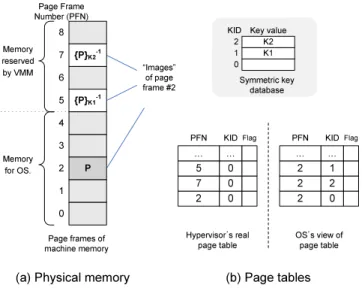
Figure 2 illustrates how a hypervisor implements the page-frame replication scheme. In Figure 2(a), physical page page-frame num-ber (PFN) 2 has two decrypted images located on PFN 5 and 7, each of which is the decryption of PFN 2 using the symmetric key se-lected byKID1 and 2, respectively.1Figure 2(b) shows page tables virtualized by the hypervisor. On the right side is the virtualized page table which the operating system can modify. The virtual-ized page table is shadowed by the real page table which the MMU refers to. In the figure, the operating system programmed virtual-ized page table such that PFN 2 is mapped in three different PTEs with differentKIDvalues of 0, 1, and 2. The corresponding PTEs in the real page table then contain PFN 2, 5, and 7, and thus, the hypervisor renders decrypted views on the same page, realizing the SP3paging semantic.
Although keeping decrypted images reduces the number of cryptographic operations, those images must be synchronized if one of the images or the original page gets modified. The synchro-nization is necessary for providing consistent views on all images; if a program modifies a decrypted image, then the original page, although its content is encrypted, must reflect the change when
ac-1Actual hypervisor adds another layer of address indirection by which
a “physical address” (the virtualized address local to a virtual machine) translates to a “machine address” (the physical address of the underlying hardware). To simplify the discussion, we ignore this translation layer.
Hypervisor’s real
page table OSpage table’s view of
(a) Physical memory (b) Page tables
Memory reserved by VMM Memory for OS. Page frames of machine memory Page Frame Number (PFN) {P}K2-1 {P}K1-1 P 2 0 2 2 2 1 ... ... PFN KIDFlag 2 0 7 0 5 0 ... ... PFN KIDFlag “Images” of page frame #2 0 1 2 3 4 5 6 7 8 Symmetric key database 0 1 2 K1 K2 KID Key value
Figure 2. Shown in (a), the hypervisor keeps decrypted copies of an original page frame (PFN 2) in different memory locations (PFN 5 and 7). The hypervisor uses one of these page frames when the original frame is mapped with a PTE with aKIDvalue. The redirection of page frame is performed transparently by manipulating page tables as shown in (b).
cessed later. Obviously, this involves cryptographic operations and, unless properly handled, incurs high runtime overhead.
We solve this problem by employinglazy synchronizationthat reduces the number of synchronizations among the images by de-laying update propagation until the last minute. Synchronization is performed only to the pages that need to be updated and only when it is necessary; the synchronization happens not when one image is modified, but when one of the other images is accessed. This is re-alized by keeping track of the most-recently updated image among the images including the original. Tracking the most-recently up-dated image is achieved by checkingD(dirty) bit of PTE. The con-tent of the most up-to-date copy is propagated to one of the ‘stale’ pages by means of the hypervisor’s page-fault handler. The hyper-visor clearsPbit of those stale pages to induce a page-fault through which the hypervisor can propagate updates behind the scene.
The lazy synchronization scheme is highly effective because it exploits the fact that there are limited occurrences of active sharing in application programs: if a page is not accessed during the activation of the particular SP3domain, it will not generate any page-fault. Therefore, the images of a page frame are synchronized only when necessary, thereby reducing the runtime overhead of re-encryption for synchronization. Note that this lazy synchronization does not incur any encryption overhead for most of the normal application execution scenarios because page frames are not shared among different SP3domains.
4.2 Emulating SP3secure domain switch
The SP3secure domain switch extends the interface of interrupt and exception. To recap, the current domain switches to operating sys-tem’s domain,SID0, when an interrupt or exception occurs. Also, upon occurrence of these events, the execution context of the outgo-ing domain must be securely stored in the ‘secure domain context’ to prevent information leakage and hijacking of the domain con-text. We now discuss how to emulate such SP3interrupt semantic in a hypervisor.
We can realize the transition of current domain by intercept-ing every interrupt and exception generated by hardware. Hyper-visors are, by definition, capable of intercepting all interrupts and
exceptions. When the hypervisor forwards an interrupt to a guest operating system, the hypervisor can change the current domain by setting currentsidvariable to 0.
The secure domain context, which is to contain register con-texts andSIDof the outgoing domain, is realized by extending the exception frame structure. As briefed in Section 2.2, the proces-sor generates an exception frame into the kernel mode stack upon an interrupt, and the hypervisor already simulates this behavior to virtualize interrupts. We extend this exception frame to contain a secure domain context. Thus, this extended exception frame has a new field for general-purpose registers (GPRs) andSIDvalue of the outgoing domain. These fields are encrypted and hashed. When the hypervisor forwards an interrupt to a guest operating system, it generates this extended exception frame instead of the original one. The GPRs are cleared when the hypervisor raises a virtual interrupt by generating a secure exception frame. Upon receipt of this interrupt, the guest operating system will find the GPRs to be zeroed out. This is to prevent information leakage upon domain switch, because the operating system is untrusted.
After handling the virtual interrupt, the guest operating system requests the hypervisor to perform a ‘return-from-interrupt’ opera-tion using the extended excepopera-tion frame that have been saved from a previous interrupt. Upon receipt of this request, the hypervisor processes the extended exception frame to restore GPRs andSID value.
4.3 Emulating SP3domain operations
In the hypervisor-based realization, the domain operations are ba-sically requests made to the hypervisor. Therefore, the interface for the domain operations could be simply realized by creating a new hypercall entry for each domain operation. However, we can alter-natively achieve this by creating virtual ‘instructions’ for the do-main operations. Execution of this instruction opcode will generate an ‘invalid-opcode’ fault, which should be captured by the hyper-visor. The hypervisor will then examine the opcode to perform the matching SP3domain operation.
We favor defining new instruction opcodes than extending hy-percall entries, because by creating new opcodes, the entire SP3 in-terface looks as if the processor were supporting SP3: from the per-spective of an operating system, and hence, feels no functional dif-ference between the hypervisor-based implementation and direct-hardware modification. Using the ‘invalid-opcode’ fault has no per-formance disadvantage over extending hypercall, because a hyper-call is also implemented by generating a software interrupt.
5. Implementation
We modified Xen hypervisor [3] which runs on top of x86 (IA-32) architecture [16]. Xen runs with higher privilege than the virtual machines it manages, and thus, it has a safe perimeter against op-erating systems.2 Note that Xen’s administrative virtual machine, known as dom0, cannot access the private area of Xen, therefore guaranteeing safety.
One unfortunate name collision needs to be resolved before we proceed. In Xen-terminology, a “domain” refers to a virtual ma-chine instance created by Xen. In this paper, this usage is dis-couraged to eliminate confusion with our SP3 protection domain. Henceforth, Xen’s “domain” is referred by ‘virtual machine’, and we use ‘SP3domain’ or simply ‘domain’ to refer to SP3domain.
2We can say that Xen and its SP3 extension implemented within, can
form a small and secure trust base, provided Xen is securely bootstrapped and attested. Secure bootstrapping and providing integrity measures are important for securing a trusted computing base, but it is out of scope of this paper. We refer the readers to secure bootstrapping [18] for safe and secure loading of the Xen hypervisor.
Page-Table Base Address KID (Avail) Flags B. Addr
0
31 12 11 9 8
4K page
Page-Table Base Address Avail Flags
0
31 12 11 9 8
4K page with PAE
Reserved KID
32 35 36
63 4645
Original x86 exception frame ... ESP after transfer to kernel SS0:ESP0 of current TSS ESPSS EFLAGS EIPCS E. Code (Opt) ... ... 0 SS EFLAGS 0 CS E. Code (Opt) ... Modified exception frame SS0:ESP0 of current TSS ESP after transfer to kernel Saved content of general purpose registers Copy of original exception frame
Extended SID field
EAX ESPSS EFLAGS EIPCS ECX EDX EBX EBP EDIESI Type SID-1 SID-2 SID-3 SID-0 + 16 + 12 + 8 + 4 + 0 + 20 + 24 + 44 + 40 + 36 + 32 + 28 + 48 + 52 + 72 + 68 + 64 + 60 + 56 + 76 + 80 + 104 + 100 + 92 + 88 + 84 + 108 + 112 + 120 + 116 + 124 + 96 + 16 + 12 + 8 + 4 ESP + 20 + 20 + 16 + 12 + 8 + 4 ESP + 24 + 148 + 152 G ro w s do w nw ar d
(a) Extended x86 page table entry
(b) Modified x86 exception frame Secure
domain context (128B, encrypted)
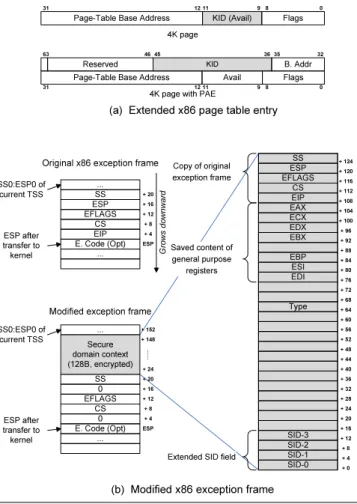
Figure 3. Extensions made to x86 PTE and exception frame structures. The extended PTEs includes a new multi-bit field forKIDvalue. The secure exception frame, which is to be generated on the kernel stack upon interrupt, is larger than the original exception frame to contain fields for the GPRs and SIDof outgoing domain.
In this section, we first describe the implementation of emulat-ing the modified interface of extended x86 architecture for SP3 sup-port. Then, we detail the realization of our design on the hypervisor, focusing on the mechanisms to efficiently emulate the SP3secure paging.
5.1 Emulating the modified x86 interface
It is straightforward to incorporate into Xen the data structures directly related to the SP3protection model. We modified Xen to keep variables for storing the permission bitmap and cryptographic keys. To identify which SP3domain is executing in the system, an integer variable calledcurrent sidis created to store theSID value of currently executing SP3domain.
It gets tricky when we make Xen emulate the new extensions to CPU-level interface, specified in Figure 3. The extensions are to reflect the new KID field in PTE structure, and to generate a secure interrupt frame upon interrupt. Obviously, we did not actually modify the hardware; the specification given here is used as the reference interface that Xen ultimately emulates.
Figure 3(a) shows the modified PTE structures into which the KIDfield is integrated. In its ‘native’ paging mode, the original x86
has 3 bits available for theKIDfield.3In its Physical Address Ex-tension (PAE) paging mode, which has an expanded PTE structure, 27 bits available for theKIDfield. The actual number of bits re-quired for theKIDdepends on the size of requiredKIDspace. For instance, when 10 bits from the PAE-enabled PTE structure are se-lected asKIDfield, as shown in the figure, it allows theKIDspace to range from 0 to 1023.
We modified Xen to emulate this PTE extension by adding a code that can interpret the KID field. This code is added to the Xen’s handler routine responsible for PTE updates. This handler routine is always invoked when a guest operating system modifies a PTE to map a page. Since MMU updates are sensitive, Xen makes sure it intercepts all PTE updates. In the para-virtualized environment of Xen, operating systems can update a PTE either by making a PTE-update hypercall, or by directly modifying the PTE. Either way, Xen can always intercept the PTE update: a hypercall causes trap to Xen by definition; a modification to a PTE incurs a page-fault since the pages used as guest page tables are always mapped withW bit cleared, meaning any attempt to write to the guest page tables causes a access-violation page-fault, trapping into Xen. Therefore, by modifying the Xen’s handler for PTE updates, the safe and transparent illusion of the extendedKIDfield can be achieved. A guest operating system can update a PTE as if the hardware supported theKIDextension.
Another modification we made to CPU-level interface is the secure version of x86 exception frame as specified in Figure 3(b). This secure exception frame, instead of the original x86 exception frame, is generated on the operating system’s kernel mode stack when an application running in an SP3domain gets interrupted. As shown in the figure, the first top 128 bytes of the secure exception frame represent the secure domain context , which is encrypted using a key private to the SP3system. This encrypted part contains the entire register context of the interrupted program. TheSIDvalue of the interrupted SP3domain is also saved atSID-0toSID-3field. SIDvalue is stretched and then hashed to avoid overridingSID. The secure domain context is followed by the plaintext part which is identical to the original x86 exception frame except for the zeroed EIPandESPfields.
To generate this secure exception frame, we modified Xen’s in-terrupt bouncer code that handles forwarding of an inin-terrupt to a guest operating system. Xen monitors every interrupt by intercept-ing it. If Xen decides to forward an interrupt to a guest operat-ing system, it “artificially” creates an exception frame by writoperat-ing to the kernel mode stack of the guest operating system, emulat-ing the behavior of the CPU. This forwardemulat-ing is implemented by the interrupt bouncer code which we modified in such a way that ifcurrent sidis not 0, it generates an secure exception frame instead of standard one. At the moment Xen transfers control to the guest operating system, General-purpose registers (GPRs) are cleared andcurrent sidis set to 0.
To perform a return-from-interrupt on this secure exception frame, we defined a new instruction, calledS IRET. Executing this instruction causes traps to Xen via invalid-opcode fault. We mod-ified Xen’s invalid-opcode handler to unwind the secure exception frame and resume the interrupted program. To restore SP3domain context, Xen reloads GPRs and setscurrent sidback from the saved values of the secure exception frame. The SP3paging exten-sion takes advantage of this to correctly prepare a data structure when the operating system requests page table update with a non-zeroKIDvalue.
A scheme is provided for the operating system and user ap-plications to pass arguments and return values via GPRs. In this
3In fact, these bits are intended to be utilized by the operating system. But
scheme, GPRs are normally cleared unless the cause of exception is a software interrupt; a user process can pass system call parameters via GPRs. TheTypefield tells whether GPRs have been cleared or not, indicating that the secure exception frame was generated by a software interrupt or another type of exception. Upon receipt of an interrupt–return request, Xen reloads GPRs from the saved register values unless theTypeindicates the the secure exception frame was generated by a software interrupt, enabling a convenient channel for passing system call return values. Note that this facility does not necessarily incur leakage of information through GPRs, because applications can always clear contents of registers unused in the system call before generating a software interrupt.
5.2 Implementation detail of SP3secure paging
During initialization, Xen reserves a pool of physical page frames for storing decrypted images. A page frame containing decrypted image is mapped by PTEs with PFN value of original page frame and non-zeroKID field. It is important to recognize this class of PTEs with non-zero KID and the page frames mapped by them. Hence, we assign names for them to facilitate description. In the following discussion, we will refer to a page mapped with non-zero KIDasSP3pageand the PTE for SP3page asSP3PTE.
We use the P(present) bit of SP3 PTE so that the processor can generate a non-present page-fault. These extra page-faults are intended to provide trap into Xen when accessing a SP3page needs attention of Xen, such as performing a check for PTE redirection. The page-fault handler of Xen is modified to separate this type of page-fault from other normal page-faults by examining theKID field of the PTE that caused the non-present page-fault.
Under the para-virtualizing architecture of Xen, this nontradi-tional usage ofPcan cause problems, since page tables are directly exposed to the operating system. We clear thePbit purposely even though the page is physically mapped by the operating system ker-nel. However, the operating system may be confused because it is possible for the operating system to see thePbit cleared when the bit was set before.
Without the hypervisor’s shadow page table support, we would have only resolved this problem by modifying the operating sys-tem. However, Linux —our target operating system— already has a mechanism that can treat PTEs with P bit cleared as physi-cally present. This facility fortunately enabled us to avoid excessive modifications. In the current version of Linux, a page is considered non-present only if bothPbit andPATbit (bit 7) are cleared.4We exploit this by settingPATbit for SP3PTEs so that Linux can rec-ognize the page as present. Also, Linux does not get any additional page-fault from this because Xen filters page-faults generated by SP3PTE.
When a page-fault is generated by SP3PTE, Xen fixes the fault by settingPbit with an appropriate value on PTE. Which page should be used is determined according to the SP3 rule: if the currentSIDhas access to theKID, Xen uses the decrypted image page. In other cases, original page is used. In this process, theD
(dirty) bit of the PTE is checked to synchronize between the two copies. The synchronization entails 4Kb AES operation which is time-consuming. However, under our lazy synchronization scheme, it happens only when it is needed. In practice, the synchronization is under full control of a user program (e.g., the program explicitly shares an SP3 page with another SP3domain), or it occurs if the
4This facility is devised for memory regions mapped withPROT NONE
type. Linux clearsPbit but setsPATbit when loading a PTE for a page of that type. This way, the page is considered present by the kernel but CPU generates a non-present fault upon access. This way the kernel can raise protection violation, realizingPROT NONEsemantic.
operating system wants to swap out the page to disk, which is rare in modern platforms and already a very slow operation.
SP3 PTEs have to be invalidated by clearing P bit when-ever domain is changed. This ensures the access permission of SP3 pages to be reevaluated when the other SP3domain accesses that SP3pages. Once the SP3page is made present, access on the page will not generate any page-fault and the program can proceed. However, if the SP3PTEs’Pbits are not cleared whenSIDchanges, the other domain will access the old page, which can possibly con-tain decrypted image. Therefore, this SP3PTE invalidation ensures the access permission of SP3pages to be reevaluated.
To implement this invalidation logic, Xen maintains a list of SP3 PTEs that should be made non-present upon change of SID. When Xen reevaluates an SP3PTE by settingPbit, it also adds the PTE to the list. Later whenSIDchanges, Xen goes through this list to clear thePbit, and the list is emptied. Exceptions andS IRET
can only changeSID, the SP3PTE invalidation is performed when Xen handles those operations.
6. Evaluation
In our evaluation, we want to answer the following questions:
• How much performance degradation do SP3applications expe-rience?
• How effective are the page-frame replication and the lazy syn-chronization?
• How does the performance overhead vary with application’s memory access pattern?
• What is the impact of SP3secure interrupt on performance? To evaluate the impact on the performance of using SP3 protec-tion, we first measured overall performance overhead with CPU-and memory-intensive workloads. Such a workload is chosen since our modifications are made on the CPU and the memory manage-ment part. We then performed a micro-benchmark measuring the performance impact of the locality of the applications’ page refer-ence patterns.
6.1 Methodology
The machine used in our evaluation has a 3.2 GHZ Pentium 4 (HT) processor with 1 GB of RAM. We used Xen version 2.0.4 and Linux kernel version 2.6.10, which is para-virtualized for Xen. Only single virtual machine instance, namely dom0, is used for all experiments. Xen allocates 512 MB of RAM for this guest virtual machine. For the Linux kernel setting, we used the default config-uration in the original Xen distribution, which results in a unipro-cessor kernel image without highmem support. We chose AES and RSA for our cryptographic primitives whose implementation was taken from OpenSSL version 0.9.7e as C code without additional optimization.
We measured the performance of the SP3system by executing benchmark programs on a system running our SP3 enabled Xen. This modified Xen is allocated additional 256 MB of RAM dedi-cated for storing decrypted images. For each benchmark program, two executables are generated from the same source code: one is an encrypted executable that can be executed only on the SP3enabled system, and the other is a normal insecure executable that can be used for performance comparison with a system without SP3 pro-tection. Both executables are statically linked with a modified ver-sion of dietlibc C library [1].
6.2 The price of protection measured in performance penalty
We wanted to know how much an application needs to pay for the SP3protection in terms of performance penalty. Since our SP3
im-1 .0 1 1 .0 0 1 .0 0 1 .0 0 1 .0 0 0 .9 9 1 .2 3 1 .0 3 0 .9 9 1 .0 0 0 .9 9 1 .0 1 0 .9 9 0 .9 9 1 .1 1 1 .0 0
mcf bzip2 vpr twolf parser gzip vortex gcc 0.6 0.8 1.0 1.2 1.4 N o rm a liz e d r u n ti m e r e la ti v e t o L in u
x Xen with SP3 Xen without SP3
Figure 4. Application benchmark results. The bars and the numbers on top represent runtime of benchmark programs normalized to native Linux. Each value is the mean of 5 trials.
plementation changed the paging interface, we chose CPU- and memory-intensive workloads for measuring the impact on perfor-mance. For the workloads, we selected 8 programs from the SPEC CPU2000 integer benchmarks. Measuring the time to complete each program, we compared the running time of the workloads in three different setups. In the first setup, labeled as ‘Without SP3’, normal insecure executables were executed on the native Xen. In the second setup, labeled as ‘With SP3’, the encrypted SP3 executa-bles were executed on the modified Xen. In the last setup, normal executables were executed on native Linux without Xen. To avoid disk loading, all measurements were made right after a prior run of the same program.
Figure 4 shows the benchmark results. The performance over-head is presented as a relative runtime normalized to native Linux without Xen. Overall, it takes less than 3% longer to finish the same program with SP3protection, except forvortexbenchmark.
This good performance result empirically confirms that both page-frame replication and lazy synchronization are indeed effec-tive in reducing costly cryptographic operations. Since Xen keeps the copies of decrypted images, decryption is performed only when the image is initially created from the page that contains the original verbatim image. Once the decrypted image is created, it continues to be used without incurring any further decryption until there is a need to synchronize among images. However, this synchronization does not occur even after the application updates the decrypted im-age, thanks to the lazy synchronization. The update in a decrypted image propagates to the original page only when the operating sys-tem accesses the original page, which rarely happens because an operating system doesn’t usually access application memory under the normal condition.
Since the overhead of page-wide encryptions is negligible, we can assume that the runtime penalty comes from the overhead of the PTE invalidation and subsequent page-fault for reevaluation. This type of penalty is paid less by a program with a small runtime footprint (i.e., accessing less pages during its activation between interrupts) than by one with a large footprint. If we assume that a statically larger program has also a larger runtime footprint, we can therefore expect that a statically larger program pays a higher penalty due to PTE invalidation than smaller one. In fact, it is found that there is a positive relationship between the runtime footprint and the performance penalty. In Section 6.3, we present a more clear relationship between them with a micro-benchmark varying the size of dynamic memory footprint.
0 2 4 6 8 10 12 14 16 18 0.8 1.0 1.2 1.4 1.6 1.8 2.0 2.2 2.4 S lo w d o w n Memory footprint (MB)
Figure 5. Impact of memory access locality. Performance of a test pro-gram is shown as the dynamic memory footprint of the test propro-gram in-creases. The y-axis shows increased runtime in SP3system normalized to
the native Xen.
Securing interrupts can be another source of potential perfor-mance degradation. Although securing an interrupt involves cryp-tographic operations, in general it does not add much overhead be-cause the frequency of interrupt is very low relative to the processor clock speed in modern computing systems, and also the overhead is overshadowed by the greater overhead of interrupt service routines and the resulting I/O operations. However, it is possible that se-curing interrupts can degrade performance of certain applications, such as the one that requests many simple system calls that the ker-nel can quickly return.
Secure interrupts are the culprit of the anomaly of thevortex
benchmark program in this experiment. vortex is an object-oriented database program which is modified for the inclusion to the SPEC benchmark suite. The result of the modification is a program that runs in a tight loop of database transactions, which incur a lot of system calls. In Section 6.4, we analyze the system call overhead in detail.
We were curious how disk buffer cache affects performance since loading an executable from the disk carries initial decryp-tion overhead in addidecryp-tion to the disk access overhead. We therefore performed a comparison between ‘cold’ and ‘hot’ runs of the work-loads. In ‘cold’ run, we execute a workload program in boot-clean state without prior execution of the program, whereas in ‘hot’ run, we execute the program right after executing the same program.
When we measured and compared the two, we failed to find any significant difference. Although it is a non-trivial overhead to decrypt a page for creation of a decrypted image copy, it is obvious that the encryption penalty is hidden under the heavier overhead of disk I/O operation.
6.3 Impact of memory access locality on performance
To obtain a more clear relationship between the runtime foot-print and the PTE invalidation penalty, we performed a micro-benchmark with a varying runtime footprint size. The micro-benchmark program touches all of the allocated pages continuously through a loop, therefore we can artificially control the dynamic memory footprint.
Figure 5 shows the results. As expected, runtime penalty in-creases as dynamic memory footprint inin-creases. If the dynamic footprint is small enough (less than 4MB), the performance degra-dation is less than 15%. The performance penalty increase as the footprint increases, and when the footprint hits 14MB, it takes twice as long.
Since many applications exhibit strong locality in accessing main memory, as can be seen in our SPEC benchmark, users of SP3 system should not generally concern the performance degra-dation. Also this result is obtained from the un-optimized
imple-mentation: we didn’t aggressively optimized the invalidation and reevaluation logic. It is probable that we can further reduce the im-pact of invalidation on the performance by optimizing the invali-dation logic. For example, we are considering invalidating a page directory entry instead of page table entry to reduce the number of entries in the invalidation list.
6.4 Impact of frequent system call on performance
SP3applications that request system calls frequently are expected to suffer from the encryption overhead of SP3secure interrupt. To assess the increased cost of system calls in SP3, we performed a micro-benchmark that measures the overhead of system calls. We used system call latency benchmark oflmbench, which was slightly modified to fit to the SP3environment.
Syscall Type With SP3 Without SP3 Native Linux
null 10.6 0.952 0.322
open 22.9 3.27 2.07
Table 1. System call latency measured in microsecond. Table 1 shows the benchmark results. ‘null’ measures the round trip overhead between user and kernel mode with minimum work required inside the kernel. ‘open’ measures how long it takes to open and then close a file, thus more time is spent in the kernel.
As expected, the system call overhead is significant higher in SP3compared to both native Xen and Linux. This increased latency is due to the increased round trip time for user/kernel crossing, which is caused by the encryption of SP3secure interrupt frame. This result also confirms the slowdown ofvortexbenchmark in Section 6.2:vortexcalls the system more than 500k times until its completion. Since it takes less than 4 minutes to compete in native Linux, the rate of system call is roughly 2,100 requests per second, which explains the anomaly of thevortexbenchmark.
7. Related work
Virtual machine monitors are being utilized to solve systems secu-rity problems. IntroVirt [17] used virtualization to log/replay tem events, achieving a perturbation-free intrusion detection sys-tem that can also detect past intrusions. Garfinkel and Rosenblum [13] designed an intrusion detection system based on virtual ma-chine introspection. The proposal of using hypervisor in commod-ity mobile systems [11] is motivated by the advantage of using hy-pervisor for implementing security services.
SecVisor [26] is a tiny hypervisor that protects the code integrity of kernels. It achieves small code size by supporting only one oper-ating system instance and virtualizing only memory. SecVisor en-sures integrity of the code executing in privileged mode, thereby preventing unauthorized kernel modification. In contrast, our sys-tem protectsuser-modeapplication’sdata secrecy, not the kernel integrity. In addition, SP3 protects applications even in the pres-ence of a compromised kernel.
Proxos [29] is a hypervisor-based trust-partitioning system in which users can configure the trust on the operating system. A trusted application runs in a private trusted operating system cre-ated by underlying hypervisor. A set of system calls, which the user can specify, is dynamically forwarded into another operat-ing system instance, which is full-fledged operatoperat-ing system but un-trusted. In contrast, our system provides protection to user memory in per-page basis, and does not require a private operating system instance.
The protection ring [24, 25] defines multiple levels of privilege mode on a processor. Using more than two protection rings (the
least privileged ring is given to user space), multiple layers of ker-nel can be constructed with varying degrees of privilege, and hence, importance. Although many processors support multiple privileged rings, they are not widely used except for the layer of hypervisors [3, 5]. Many other architectures have been proposed to protect the more important kernel part against failures of less important kernel parts [8, 31]. In contrast, our approach has a completely different goal: SP3aims to protect the user applications running in the least privileged ring against operating system compromises.
Secure processors are a class of processors with hardware im-plementation of various cryptographical primitives. Some of them can provide secrecy and integrity protection directly to individual processes bypassing all or most of the operating system. AEGIS [28] and Cerium [7] are among them and focus primarily on phys-ical tamper-resistance. The XOM secure processor [21] can host a fully-untrusted operating system, and can thus protect applications from operating system compromises. However, XOM requires spe-cial hardware and heavy compiler/assmembler support, limiting its practicality.
Many of approaches to protection of applications’ sensitive in-formation can be viewed as code obfuscation [9, 10, 22]. Unfortu-nately, obfuscating a program is considered a weak form of protec-tion, as shown by Baraket al.[2]. In contrast, our system is stronger than obfuscation since we use cryptography directly for the protec-tion of informaprotec-tion.
Reducing the size of trust base as well as separating trust depen-dency have been general strategies to enhance system security and robustness. Those strategies are used to solve problems in many ar-eas such as file system [33], kernel construction [31], application partitioning [6, 32] and relocating service to the virtual machine monitor [12, 19].
The negative impact of the size and complexity of a trusted com-puting base (TCB) on system security has been widely recognized [15]. H¨artig’s Nizza architecture [14], Singaravelu’s AppCore [27], and IBM’s PERSEUS [23] are example efforts to reduce TCB size and complexity.
8. Conclusion
In this paper, we presented a novel way of using hypervisors to protect application data privacy. Even if the operating system is not trustable, the hypervisor prevents application information from unauthorized exposure. This protection is achieved by encrypting the contents of the user memory pages; when a program accesses a memory page, the hypervisor determines which image of the page to provide to the program. Whether to use a decrypted image of the page or a verbatim image is determined by the access permission of the program accessing the page.
We detailed the modifications and extensions made to the hy-pervisor to realize this page-granular secrecy protection. To encrypt pages and secure the protection boundary, we extended the seman-tics of paging system and interrupt interface of a processor. We made the hypervisor emulate the extended paging and interrupt se-mantics.
We also employed performance-improving techniques, such as page-frame replication and lazy synchronization: page-frame repli-cation reduces the number of cryptographic operations by keep-ing multiple decrypted versions of the same page frame; lazy syn-chronization further minimizes the overhead triggered by an update on one of the replicated page frames. Our system is implemented and evaluated by modifying the Xen hypervisor, showing that it increases the application execution time only by 3% for CPU and memory-intensive workloads.
Acknowledgments
We would like to thank Thuy Vu and the anonymous reviewers for their help and feedback. The work was supported in part by the US Airforce Office of Scientific Research under Grant FA9550-07-1-0423.
References
[1] Diet Libc a libc optimized for small size, http://www.fefe.de/dietlibc/. [2] Boaz Barak, Oded Goldreich, Rusell Impagliazzo, Steven Rudich,
Amit Sahai, Salil Vadhan, and Ke Yang. On the (im)possibility of obfuscating programs. InProceedings of the 21st Annual International Cryptology Conference on Advances in Cryptology (CRYPTO), pages 1–18, Aug 2001.
[3] Paul Barham, Boris Dragovic, Keir Fraser, Steve Hand, Tim Harris, Alex Ho, Rolf Neugebauer Ian Pratt, and Andrew Warfield. Xen and the art of virtualization. InProceedings of the 19th ACM Symposium on Operating Systems Principles (SOSP), pages 164–177, Oct 2003. [4] Stefan Berger, Ram´on C´aceres, Kenneth A. Goldman, Ronald Perez,
Reiner Sailer, and Leendert van Doorn. vTPM: Virtualizing the trusted platform module. InProceedings of the 15th USENIX Security Symposium, pages 305–320, Aug 2006.
[5] Thomas C. Bressoud and Fred B. Schneider. Hypervisor-based fault-tolerance. InProceedings of the 15th ACM Symposium on Operating Systems Principles (SOSP), pages 1–11, Dec 1995.
[6] David Brumley and Dawn Song. Privtrans: Automatically partitioning programs for privilege separation. InProceedings of the 13th USENIX Security Symposium, Aug 2004.
[7] Benjie Chen and Robert Morris. Certifying program execution with secure processors. InProceedings of the 9th Workshop on Hot Topics in Operating Systems (HotOS), May 2003.
[8] Tzi-cker Chiueh, Ganesh Venkitachalam, and Prashant Pradhan. Integrating segmentation and paging protection for safe, efficient and transparent software extensions. InProceedings of the 17th ACM Symposium on Operating Systems Principles (SOSP), pages 140–153, Dec 1999.
[9] Christian Collberg, Clark Thomborson, and Douglas Low. Manu-facturing cheap, resilient, and stealthy opaque constructs. In Pro-ceedings of the 25th ACM Symposium on Principles of Programming Languages (POPL), pages 184–196, Jan 1998.
[10] Christian S. Collberg and Clark Thomborson. Watermarking, tamper-proofing, and obfuscation – tools for software protection.
Transactions on Software Engineering, 28(8):735–746, 2002. [11] Landon P. Cox and Peter M. Chen. Pocket hypervisors: Opportunities
and challenges. InProceedings of the 8th IEEE Workshop on Mobile Computing Systems and Applications (HotMobile), Feb 2007. [12] Tal Garfinkel, Ben Pfaf, Jim Chow, Mendel Rosenblum, and Dan
Boneh. Terra: A virtual machine–based platform for trusted computing. InProceedings of the 19th ACM Symposium on Operating Systems Principles (SOSP), pages 193–206, Oct 2003.
[13] Tal Garfinkel and Mendel Rosenblum. A virtual machine introspec-tion based architecture for intrusion detecintrospec-tion. InProceedings of the 10th Annual Symposium on Network and Distributed System Security (NDSS), pages 191–206, Feb 2003.
[14] Hermann H¨artig. Security architectures revisited. InProceedings of the 10th Workshop on ACM SIGOPS European Workshop, pages 16–23, Sep 2002.
[15] Michael Hohmuth, Michael Peter, Hermann H¨artig, and Jonathan S. Shapiro. Reducing TCB size by using untrusted components – small kernels versus virtual-machine monitors. InProceedings of the 11th Workshop on ACM SIGOPS European Workshop, page 22, Sep 2004.
[16] Intel Corporation. IA-32 Intel Architecture Software Developer’s Manual.
[17] Ashlesha Joshi, Samuel T. King, George W. Dunlap, and Peter M.
Chen. Detecting past and present intrusions through vulnerability specific predicates. InProceedings of the 20th ACM Symposium on Operating Systems Principles (SOSP), pages 91–104, Oct 2005. [18] Bernhard Kauer. OSLO: Improving the security of trusted computing.
InProceedings of the 16th USENIX Security Symposium, pages 229– 237, Aug 2007.
[19] Samuel T. King and Peter M. Chen. Backtracking intrusions. In
Proceedings of the 19th ACM Symposium on Operating Systems Principles (SOSP), pages 223–236, Oct 2003.
[20] Butler W. Lampson. Protection. InProceedings of the 5th Annual Princeton Conference on Information Sciences and Systems, pages 437–443, Mar 1971.
[21] David Lie, Chandramohan A. Thekkath, and Mark Horowitz. Implementing an untrusted operating system on trusted hardware. InProceedings of the 19th ACM Symposium on Operating Systems Principles (SOSP), pages 178–192, Oct 2003.
[22] Cullen Linn and Saumya Debray. Obfuscation of executable code to improve resistance to static disassembly. InProceedings of the 10th ACM Conference on Computer and Communications Security (CCS), pages 27–31, Oct 2003.
[23] Birgit Pfitzmann, James Riordan, Christian St¨uble, Michael Waidner, and Arnd Weber. The PERSEUS system architecture. Technical Re-port RZ 3335 (#93381), IBM Research Division, Zurich Laboratory, Apr 2001.
[24] Jerome H. Saltzer. Protection and the control of information sharing in multics.Communications of the ACM, 17(7):388–402, Jul 1974. [25] Jerome H. Saltzer and Michael D. Schroeder. The protection
of information in computer systems. Proceedings of the IEEE, 63(9):1278–1308, Sep 1975.
[26] Arvind Seshadri, Mark Luk, Ning Qu, and Adrian Perrig. SecVisor: A tiny hypervisor to provide lifetime kernel code integrity for commodity OSes. InProceedings of the 21st ACM Symposium on Operating Systems Principles (SOSP), pages 335–350, Oct 2007. [27] Lenin Singaravelu, Calton Pu, Hermann H¨artig, and Christian Hel-muth. Reducing TCB complexity for security-sensitive applications: Three case studies. InProceedings of the EuroSys 2006, Apr 2006. [28] G. Edward Suh, Dwaine Clarke, Blaise Gassend, Marten van Dijk,
and Srinivas Devadas. AEGIS: Architecture for tamper-evident and tamper-resistant processing. InProceedings of the 17th International Conference on Supercomputing (ICS), pages 160–171, Jun 2003. [29] Richard Ta-Min, Lionel Litty, and David Lie. Splitting interfaces:
Making trust between applications and operating system configurable. InProceedings of the 7th Symposium on Operating Systems Design and Implementation (OSDI), Nov 2006.
[30] Carl A. Waldspurger. Memory resource management in VMware ESX Server. InProceedings of the 5th Symposium on Operating Systems Design and Implementation (OSDI), pages 181–194, Dec 2002.
[31] Emmett Witchel, Junghwan Rhee, and Krste Asanovi´c. Mondrix: Memory isonation for linux using mondriaan memory protection. InProceedings of the 20th ACM Symposium on Operating Systems Principles (SOSP), pages 31–44, Oct 2005.
[32] Steve Zdancewic, Lantian Zheng, Nathaniel Nystrom, and Andrew C. Myers. Untrusted hosts and confidentiality: Secure program partitioning. In Proceedings of the 18th ACM Symposium on Operating Systems Principles (SOSP), pages 1–14, Oct 2001. [33] Xin Zhao, Kevin Borders, and Atul Prakash. Towards protecting
sensitive files in a compromised system. InProceedings of the 3rd International IEEE Security in Storage Workshop, Dec 2005.