What We Know and What We Do Not Know
KEVIN CROWSTON
Syracuse University
KANGNING WEI
Syracuse University
JAMES HOWISON
Carnegie Mellon University
ANDANDREA WIGGINS
Syracuse University
________________________________________________________________________
We review the empirical research on Free/Libre and Open Source Software (FLOSS) development and assess the state of the literature. We develop a framework for organizing the literature based on the input-mediator-output-input (IMOI) model from the small groups literature. We present a quantitative summary of articles selected for the review and then discuss findings of this literature categorized into issues pertaining to inputs (e.g., member characteristics, technology use and project characteristics), processes (software development practices, social processes and firm involvement practices), emergent states (e.g., social states and task related states) and outputs (e.g. team performance, FLOSS implementation and project evolution). Based on this review, we suggest topics for future research, as well as identify methodological and theoretical issues for future inquiry in this area, including issues relating to sampling and the need for more longitudinal studies.
Categories and Subject Descriptors: D.2.9 [Software Engineering]: Management – Life cycle; D.2.9 [Software Engineering]: Management – Programming teams; J.4 [Computer Applications]: Social and Behavioral Sciences - Sociology; K.6.3 [Computing Milieux]: Management of Computing and Information Systems – Software management
General Terms: Design, Human Factors, Management, Measurement, Performance
Additional Key Words and Phrases: Free/Libre open source software, development, computer-mediated communication, distributed work
ACM File Format:
CROWSTON, K., WEI, K., HOWISON, J., AND WIGGINS, A. 2010. Free/libre open source software development: what we know and what we do not know. ACM Comput. Surv. XX, XX, Article XX (Month Year), XX pages. DOI = XXXXXXXXXXXXXXXXXX
________________________________________________________________________
1. INTRODUCTION
In this paper, we review the published empirical research literature on development of Free/Libre and Open Source Software (FLOSS) development. FLOSS is an umbrella
__________________________________________________________________________________________ Authors’ addresses: K. Crowston, K. Wei, and A. Wiggins, School of Information Studies, Syracuse University, Syracuse, NY 13244. E-mai J. Howison, Institute for Software Research, School of Computer Science, Carnegie Mellon University, Pittsburg, PA 15213. E-mail: [email protected].
Permission to make digital/hard copy of part of this work for personal or classroom use is granted without fee provided that the copies are not made or distributed for profit or commercial advantage, the copyright notice, the title of the publication, and its date of appear, and notice is given that copying is by permission of the ACM, Inc. To copy otherwise, to republish, to post on servers, or to redistribute to lists, requires prior specific permission and/or a fee. Permission may be requested from the Publications Dept., ACM, Inc., 2 Penn Plaza, New York, NY 11201-0701, USA, fax: +1 (212) 869-0481, [email protected]
2 term that covers a diversity of kinds of software and approaches to development, so we start this review by clarifying our focus. In general, the term free software1 or open source
software refers to software released under a license that permits the inspection, use, modification and redistribution of the software’s source code2. The distinction between free software and open source software is sometimes controversial and there are important differences between these two development communities [Kelty 2008]. However, our focus in this paper is on research on their development processes, which are acknowledged by participants to be largely similar (Free Software Foundation, http://www.fsf.org), hence our use of this umbrella term.
While FLOSS-licensed software may be developed in the same way as proprietary software (e.g., as in the case of MySQL), much of it is developed by teams of organizationally- and geographically-distributed developers, in what has been described as community-based development [Lee and Cole 2003], which is the focus of the research examined in this review. In some projects, a focal organization may take the lead in coordinating the efforts of a broader community of developers [Fitzgerald 2006], but many projects exist outside of any formal organizational structure. Forges such as SourceForge and GForge are often used to organize FLOSS development efforts. Though recent years have seen an increase in the participation of firms in FLOSS and so in contribution from employees paid to work on FLOSS projects [Lakhani and Wolf 2005], even these contributions are often made available to the wider community [Henkel 2006]. As a result, FLOSS can be characterized as a privately-produced public good [O'Mahony 2003]. These private/public development practices are the focus of this review.
Over the past ten years, FLOSS has moved from an academic curiosity to a mainstream focus for research. There are now thousands of active FLOSS projects, spanning a wide range of applications. Due to their sizes, success and influence, the Linux operating system and the Apache Web Server and related projects are the most well known, but hundreds of others are in widespread use, including projects on Internet infrastructure (e.g., sendmail, bind), user applications (e.g., Mozilla Firefox, OpenOffice), programming language interpreters and compilers (e.g., Perl, Python, gcc), programming environments (e.g., Eclipse) and even enterprise systems (e.g., eGroupware, openCRX).
With this growth has come a concurrent increase in the volume of research examining the phenomenon. A review of this literature is important and timely for several reasons. First and foremost, FLOSS has become an important phenomenon to understand for its own sake. FLOSS is now a major social movement involving an estimated 800,000 programmers around the world [Vass 2007] as well as a commercial phenomenon involving a myriad of software development firms, large and small, long-established and startup. On the user side, millions have grown to depend on FLOSS systems such as Linux, not to mention the Internet, itself heavily dependent on FLOSS tools. A recent report estimates that 87% of US businesses use FLOSS [Walli, et al. 2005]. Ghosh [2006] estimated the cost of recreating available FLOSS code at €12B, and noted “This code base has been doubling every 18-24 months over the past eight years, and this growth is projected to continue for several more years”. As a result, FLOSS has become an integral part of the infrastructure of modern society, making it critical to understand more fully how it is developed.
1 Sometimes referred to as “libre software” to avoid the potential confusion between the intended
meaning of free meaning freedom and free meaning at no cost.
2 See http://www.gnu.org/philosophy/free-sw.html for a definition and discussion of free software
As well, FLOSS represents a different approach to innovation in the software industry. The research literature on software development and on distributed work emphasizes the difficulties of distributed software development, but successful community-based FLOSS development presents an intriguing counter-example. Characterized by a globally distributed developer force, a rapid, reliable software development process and a diversity of tools to support distributed collaborative development, effective FLOSS development teams somehow profit from the advantages and overcome the challenges of distributed work [Alho and Sulonen 1998]. FLOSS is also an increasingly important venue for students learning about software development, as it provides a unique environment in which learners can be quickly exposed to real-world innovation, while being empowered and encouraged to participate. For example, Google Summer of Code program offers student developers stipends to write code for FLOSS projects (http://code.google.com/soc/).
In addition to its intrinsic merits, FLOSS development has attracted great interest because it provides an accessible example of other phenomena of growing interest. For example, many researchers have turned to community-based FLOSS projects as examples of virtual work, as they are dynamic, self-organizing distributed teams comprising professionals, users and others working together in a loosely-coupled fashion [von Hippel 2001, von Hippel and von Krogh 2003]. Teams are almost purely virtual in that community-based developers contribute from around the world, meet face-to-face infrequently if at all and coordinate their activities primarily by means of computer-mediated communications (CMC) [Raymond 1998, Wayner 2000]. The teams have a high isolation index [O'Leary and Cummings 2007] in that many team members work on their own and in most cases for different organizations (or no organization at all). For most community-based FLOSS teams, distributed work is not an alternative to face-to-face: it is the only feasible mode of interaction. As a result, these teams depend on processes that span traditional boundaries of place and ownership. While these features place FLOSS teams toward the end of the continuum of virtual work arrangements [Watson-Manheim, et al. 2002], the emphasis on distributed work makes them useful as a research setting for isolating the implications of this organizational innovation. Traditional organizations have taken note of these successes and have sought ways of leveraging FLOSS methods for their own distributed teams, difficult without first understanding what these methods are.
Another important feature of the community-based FLOSS development process is that many developers contribute to projects as volunteers, without remuneration; others are paid by their employers, but still not directly by the project. As a result, recruiting and retaining new contributors is a critical success factor for a FLOSS project. Furthermore, the threat of “forking” (starting a parallel project from the same code base), while uncommon and discouraged, limits the ability of project leaders to discipline members. These features make FLOSS teams extreme examples of self-organizing distributed teams, but they are not inconsistent with the conditions faced by many organizations when recruiting and motivating professionals or developing distributed teams. As Peter Drucker put it, “increasingly employees are going to be volunteers, because a knowledge worker has mobility and can go pretty much every place, and knows it… Businesses will have to learn to treat knowledge workers as volunteers” [Collins and Drucker 1999]. As a result, research on FLOSS development offers lessons for many organizations.
However, as Scacchi [2002] noted, “little is known about how people in these communities coordinate software development across different settings, or about what
4 software processes, work practices, and organizational contexts are necessary to their success”. While a great number of studies have been conducted on FLOSS, our review shows there have been few efforts made to integrate these findings into a coherent body of knowledge based on a systematic review of the literature. The few surveys that have been done [e.g. Rossi 2006, Scacchi 2007, von Krogh and von Hippel 2006] synthesize various major issues investigated in FLOSS research, based on a small set of studies, but without explaining how their review processes informed these issues or their sample strategies. Indeed, it is clear that the term FLOSS includes groups with a wide diversity of practices and varying degrees of effectiveness, but the dimensions of this space are still unclear. A key goal of our review is to synthesize the empirical literature to date in order to clarify what we know and do not know about community-based FLOSS development and to suggest promising directions for further work.
This paper is organized as follows. The next section provides a brief overview of the research methodology applied in conducting this review. It is followed by two reviews of empirical studies that examine FLOSS development. Building on this review, we then identify trends as well as gaps in current research and provide suggestions for future research. The paper concludes with a summary of key points drawn from our review.
2. METHODOLOGY
This section describes the methodology we followed to identify and classify relevant work as a basis for a systematic review. Our goal in this paper is to summarize the findings of the published research on FLOSS, rather than presenting our own perspectives on the subject. Our literature review therefore required: 1) a literature search strategy; 2) the development of criteria for the types of studies to be included in our analysis; and 3) a coding scheme to analyze the selected studies. We performed two types of analysis, requiring two approaches to coding. The methods adopted for these tasks are described below.
2.1 Literature search strategy and criteria for inclusion
A challenge we faced in preparing this review is that the literature on FLOSS is expanding all the time, requiring a strategy for dealing with this growth while still producing a useful review article. To address this challenge we collected and analyzed papers for the review in two waves, the first in early 2006 and the second in early 2009.
At the time we began this review, FLOSS research was relatively new and often not published in journals, so we initially attempted to collect as many articles on FLOSS as possible before refining the collection. The first wave of papers was collected using three methods to search for appropriate literature, with a goal of identifying essentially all available papers on FLOSS to that point. First, we collected all papers from the opensource.mit.edu working paper repository3 (commonly used by researchers in the
field to distribute papers), from journal special issues on FLOSS, and from FLOSS tracks in conferences such as the International Conference on Open Source Software (OSS)
(organized by International Federation for Information Processing (IFIP) Working Group 2.13) and International Conference on Software Engineering (ICSE) workshops, as well as conferences in related fields such as the Academy of Management and Association of Information Systems. Second, we conducted a search in document databases such as ABI/Inform and Web of Science using “open source software” as the keyword (we had
3 Papers at opensource.mit.edu repository have been migrated to FLOSShub (http://flosshub.org),
noted that most papers on FLOSS development used that term, and at the time even papers addressing free software specifically included the term as a point of comparison). Finally, we looked through the reference lists of key articles to ensure that we had not overlooked other articles. The search process resulted in 586 papers in total. To ensure the quality of the review results, we retained only papers published in refereed journals and conference proceedings. Thus, working papers, unpublished dissertations, magazine articles and opinion articles were excluded. Given our goal of reviewing FLOSS research to clarify what we know and what we do not know about FLOSS development, we limited our review to 135 published empirical studies where FLOSS development was the main theme.
The dramatic increase in research after 2006 and increased acceptance of FLOSS as a research topic made it possible to focus our search the later stage of collection and analysis. The quantitative analysis of the first wave of papers indicates that there were no significant differences in the constructs studied between articles published in journals and conferences. Thus, the second wave of papers was collected only from journal articles published between 2006 and early 2009, yielding a further 49 empirical papers. The resulting 184 papers are from 52 different journals and 40 different conferences (Appendix 1 lists the journals and conferences4). The diversity of audiences for research
on FLOSS development highlights the need for a systematic survey that pulls together work from these diverse sources, which might otherwise go unnoticed by researchers working in a single discipline.
One concern about this sampling approach is that in some research areas, particularly in computer science, research is presented primarily at conferences. Therefore, our coverage of the recent research (2006-9) may include the kinds of work done in disciplines where the major focus is on journal publication but overlook the kinds of work done in disciplines where only conference proceedings are more typical. However, we do note that we have a representation of computer science research in both phases of the study, including a number of computer science journal papers. On the other hand, including both conference and journal papers poses a possible threat of double counting papers, as in some disciplines (e.g., management), it is common for researchers to publish findings first in a conference paper, then as a revised version in a journal. Identifying when a paper should be counted as a revision of another paper can be difficult. Such duplication could again result in overrepresentation of certain kinds of research in the sample. We considered these possible sampling biases in designing the analysis approach, as we will describe.
We carried out two types of analysis that are presented in this paper: a quantitative review and a qualitative review. The qualitative review, which is the main contribution of this paper, includes articles from both waves of collection, while the quantitative review includes only articles from the first wave for which the sample is complete. Papers from the second wave were not included in the quantitative analysis because of concerns that the selective collection of these papers had resulted in a biased sample as noted above, making quantitative summaries of this sample suspect. The approach taken for these analyses is described in the following subsections.
4 Appendix 1 is available at
6
2.2 Quantitative review methodology
The goal of the quantitative review was to provide an overview of the nature of research being published on FLOSS development. For this review, each article from the first wave was coded on several dimensions: publication year, publication venue type (conference or journal), level of analysis (e.g., group or individual), research methods (e.g., survey, case study), data collection methods, number and names of projects studied, reference disciplines that support the research, theories applied (if any) and the main constructs it examined (please refer to Appendix 2 for a presentation of the coding scheme5). Specific categories for each dimension were developed by a group of coders until basic agreement was achieved on a sample group of papers. The full collection was then split between two coders working through an online system that showed their coding work, enabling coders to use codes created by other coders. The two coders met from time to time to review their use of codes. This information provides a quantitative assessment of the state of FLOSS research as of early 2006 and suggests gaps that future research might address.
2.3 Qualitative review methodology
The goal of the qualitative review was to identify constructs studied in the literature and to summarize research findings. A crucial task for a review paper is to provide a framework capable of organizing the existing literature and assisting future researchers in positioning their work in reference to that existing literature. We began our search for such a framework with an inductive card sorting exercise. Four coders examined a sample of the literature from the first wave and inductively recorded codes for the concepts studied in the paper. These codes were used as the starting point for the systematic coding of constructs noted above. To develop the overall model, we transferred the codes onto sticky notes and sorted them as a group on a white-board. We then used the results of this sorting process to guide a search for relevant frameworks in the literature, leading to the selection of the model described below, which in turn was used to structure the review of the papers from both waves of paper collection. Having identified the constructs studied in the literature and organized them in a framework, we then returned to the papers to identify the findings of each study, collecting together those that addressed similar constructs. These findings are presented below.
3. AN OVERVIEW OF THE FLOSS RESEARCH LITERATURE
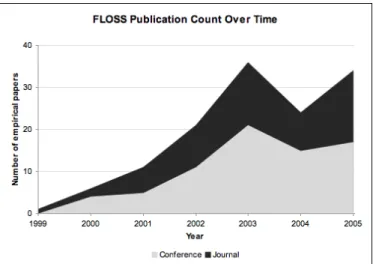
In this subsection, we present the quantitative analysis of the research publications on FLOSS development. This analysis is based on the exhaustive survey of papers collected in the first wave, that is those published up through early 2006. A little more than half of the sample (55%) were papers from conferences, with journal papers make up the remaining 45%. A sharp increase in the number of annual publication from 1999 through 2005 (Figure 1) demonstrates the increasing interest in the topic. This increase is reflected in the selective review of more recent publications. In particular, the increased acceptance of FLOSS research in journals allowed us to consider only journal publications in the second wave of our study, as noted above.
5 Appendix 2 is available at
Fig. 1: Annual counts of empirical research publications 3.1 Level of analysis
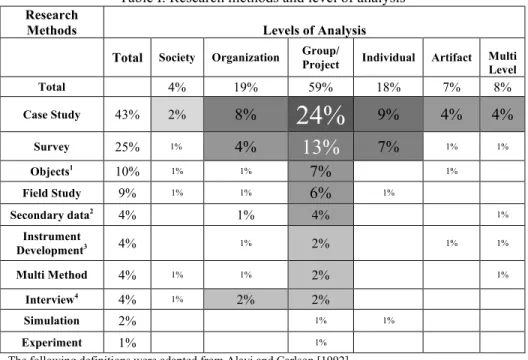
FLOSS can be studied at different levels of analysis. We distinguished among studies at the artifact (which captures papers whose focus is on source code of FLOSS, technologies that support FLOSS development such as SourceForge and programming or algorithms), individual, group, organization and societal levels. Approximately 8% of papers included multiple levels of analysis, most often integrating the group and organization levels. The literature demonstrates a strong preference for research at the group or project level of analysis, which makes up 59% of the studies in the sample, with an additional 18% at the individual level, 19% at the organizational level, and just 4% at the level of society. About 7% of the studies focused on artifacts, with little discussion of behavioral aspects of FLOSS development.
3.2 Research methods
Although a variety of research methods were observed, the case study was the most common, making up 43% of all papers in the sample (n=58). Case studies were typically performed at the group level of analysis (n=32, 24% of total), and based on archival data in more than half of these instances (n=17, 12.5% of total). It is notable, however, that all of the papers in the sample for which the coders found the data collection methods unclear were case studies. In addition, some case studies did not specify the number of projects in their sample, which implies that the details of data collection may frequently go unstated in case study research, while all other research methods had clearly identifiable data collection methods.
Surveys were the next most common choice of research method, appearing in about 25% of our sample. For these papers, it may be surprising to note that studies conducted at the group level were also based on archival data in about two-thirds of the papers. This speaks to the overall trends for data types used in FLOSS studies; regardless of the data collection methods or source, 52% of studies in the sample were based on archival data retrieved from development repositories. Only about 10% of papers used interview data, and likewise, only about 10% used data collected through observation. Multi-method studies, while infrequent, were most likely to incorporate interviews with case studies, surveys and field studies.
8
3.3 Sample Size and Projects Studied
The distribution of sample sizes of projects studied in these papers was highly skewed toward single projects (42%), followed by studies of fewer than ten projects (18%), studies using repository data (16%) that may include anywhere from hundreds to thousands of projects, and studies of 10-100 projects (6%). Considering research methods and levels of analysis, the dominant form of FLOSS research overall was the study of a single project at the group level: 35 such papers comprised approximately 26% of our sample. This choice is closely related to the choices of research and data collection methods, as shown seen in Table I. To highlight the distribution of studies, the darkness of the cell and size of the font are proportional to the fraction of studies represented.
Table I. Research methods and level of analysis
Research
Methods Levels of Analysis
Total Society Organization Group/ Project Individual Artifact
Multi Level Total 4% 19% 59% 18% 7% 8% Case Study 43% 2%
8%
24%
9%
4%
4%
Survey 25% 1%4%
13%
7%
1% 1% Objects1 10% 1% 1%7%
1% Field Study 9% 1% 1%6%
1% Secondary data2 4% 1% 4% 1% Instrument Development3 4% 1% 2% 1% 1% Multi Method 4% 1% 1% 2% 1% Interview4 4% 1% 2% 2% Simulation 2% 1% 1% Experiment 1% 1%The following definitions were adapted from Alavi and Carlson [1992]
1. As a research method, objects identify articles that describe a system, product or project. 2. Data used in the articles are collected by sources other than the researchers.
3. Instrument development identifies papers that describe the development of instruments and/or measurements of FLOSS activities.
4. As a research method, interview means the research is conducted by interviewing on an individual basis, which is different from using interviews as a data collection technique.
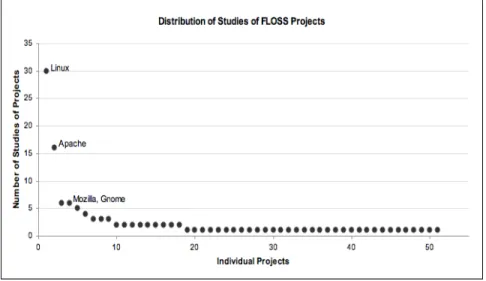
With respect to the projects studied in the FLOSS literature, 42% of the papers sampled did not name the projects they studied, or did not study a specific project, but rather some other aspects of FLOSS, such as implementation. None of the studies using repository data named the projects that were studied, presumably due to the scale of the research (these studies can include hundreds or thousands of projects). The remaining 58% of the sample provided some interesting insights into the types of open source projects covered in the literature. The distribution of projects named in different studies showed a classic long-tail distribution, seen in Figure 2. Linux was clearly the most commonly studied FLOSS project, appearing in 30 studies, followed by Apache (usually meaning the httpd server). Two-thirds of these papers studied only Linux and the
remaining third of the papers included additional projects besides Linux. However, while Linux and Apache have been most studied overall, the frequency of papers including these two projects peaked in 2003 and dropped sharply thereafter. At the same time, the number of studies with no projects named, often those examining a large sample of projects or using repository data (these factors correlate at r=0.98), have been increasing over time. This suggests that as data on a wider variety of projects became more easily available, the variety of projects studied also rose.
As indicated by the distribution of projects studied, shown in Figure 2, only 18 of the 51 projects (35%) named as subjects that appeared in our sample were included in more than one study. This trend brings into question how well the projects currently studied in FLOSS research represent the entire population; it is reasonable to expect that there are significant differences between Linux, for example, and such projects as VIM, GIMP, and XML included in other studies.
Fig. 2. Distribution of Studies of FLOSS Projects
Figure 3 shows the tradeoff in FLOSS research between the sample sizes of projects studied and the intensity of the research approach. The size of the circle represents the relative number of the studies in that area. The figure shows the two types of studies that dominate current FLOSS research, as noted above: one or a small number of projects studied using the case study method or survey covering a few variables to investigate larger sample sizes. These two types of studies represent two extremes of the tradeoff between the depth and breadth of a research study, anchoring the ends of a frontier of feasible research designs indicated by the red arc in Figure 3.
10
Fig. 3. Distribution of Research by Research Methods and Number of Projects Studied 3.4 Reference Disciplines and Theories
We examined the reference disciplines and theories identified in the research papers to shed light on the intellectual underpinnings of these studies. We identified the reference disciplines on which an article was based by examining the theories or papers the authors used to formulate their models or hypotheses, and classified a paper as belonging to a particular reference discipline when it predominantly cited other papers from that discipline as the source [Vessey, et al. 2002]. Approximately 20% of the papers did not explicitly refer to any reference disciplines and about 64% referred to only a single reference discipline. The remaining 16% of the papers incorporated two to four reference disciplines, with business and management influences presented in 80% of these multidisciplinary papers. Business and management was also the most common reference discipline overall, with one-third of the total mentions. Computer science and computer engineering together comprised almost a third of the references as well, with information science and sociology being the next most common reference disciplines mentioned in the literature. While it may seem surprising that computer science and engineering are not a larger fraction of the studies found, the diversity of fields reflects our focus on empirical studies of development practices. In addition, 62% of papers that drew upon multiple reference disciplines employed theory in their studies, in contrast to only 27% of papers that referenced a single discipline, suggesting that the development and application of theory in this research area is often characterized by leveraging the intellectual resources of multiple disciplines.
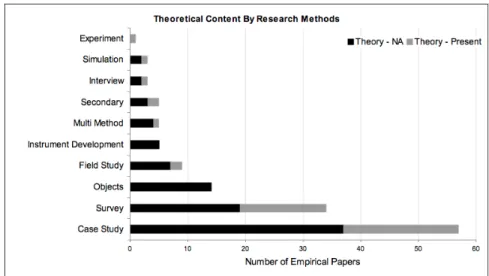
We also examined how studies used existing theories. We classified a paper as “theory-included” when it explicitly cited existing theories/principles to support its models or hypotheses. Case studies and surveys made up the bulk of the papers in our sample, and were also the most likely to contain references to theory, as seen in Figure 4: 35% of case studies mentioned theoretical content, as did about 44% of surveys. While only about 32% of the overall sample contained references to theory, the more technical research approaches of instrument development and studies of objects or artifacts (usually code) had no instances of theory usage. This demonstrates one of the challenges in describing an interdisciplinary body of research literature, as not all studies’ contributions can be adequately judged based on the traditional classifications that we have applied here.
Fig. 4. Inclusion of References to Theory by Research Methods 4. FINDINGS OF THE FLOSS RESEARCH LITERATURE
In this section, we present the main contribution of our review, namely an overview of the findings of the research literature, drawn from the published papers. In the first subsection, we provide a description of our organizing framework, which draws on an Inputs-Mediators-Outputs-Inputs (IMOI) model. This model is used to organize the constructs studied in the literature. A detailed review of the findings of the literature organized by these constructs follows in subsections 4.2–4.5, which forms the bulk of this paper.
4.1 An Organizing Framework for the Review
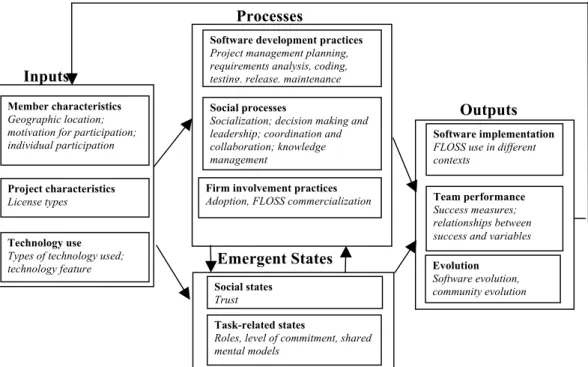
As noted above, we developed a framework for organizing the research papers on FLOSS development based on the constructs studied. We chose to organize these constructs according to the inputs-mediators-outputs-inputs (IMOI) model (Figure 5) [Ilgen, et al.
2005], which draws together decades of work in the ‘small group’ literature [Hackman and Morris 1978, Marks, et al. 2001, McGrath 1984, McGrath 1991, McGrath 1997]. This model most closely matched the inductive model and provided additional structure for the framework presented in this paper. We chose the IMOI model over earlier Input-Process-Output models [e.g., Hackman and Morris 1978] because: 1) it distinguishes emergent states from processes, which describe cognitive, motivational and affective states of a team, as opposed to the interdependent team activities; and 2) it provides feedback loops between outputs and inputs, treating outputs also as inputs to future team processes and emergent states [Ilgen, et al. 2005]. The suitability of the model is unsurprising since most FLOSS development does occur in small teams and the majority of the studies conducted research at the project level of analysis. Where necessary, we adapted the model to incorporate detailed constructs directly tied to the software engineering context of FLOSS work.
Fig. 5. Inputs-Mediators-Outputs-Inputs Model (adapted from Ilgen et al. 2005) Inputs Mediator
s
12 Figure 6 shows the resulting framework, with the major concepts that we identified in the FLOSS research papers in each of the categories of the IMOI model. Inputs represent starting conditions of a team, such as its member characteristics and project/task characteristics. Mediators represent variables that have mediating influences on the impact of inputs on outputs. Mediators can be further divided into two categories: processes and emergent states. Processes represent dynamic interactions among team members as they work on their projects, leading to the outputs. Emergent states are constructs that “characterize properties of the team that are typically dynamic in nature and vary as a function of team context, inputs, processes and outcomes” [Marks, et al.
2001, p.357]. Outputs represent task and non-task consequences of a team functioning [Martins, et al. 2004].
Fig. 6. Constructs Studied in the Reviewed FLOSS Research Papers and Their Relations
A variety of constructs were observed in the literature, with one to seven distinct constructs identified in each paper. The most commonly studied class of construct was project characteristics, which made up 21% of all instances of constructs studied in the first wave, indicating the descriptive nature of much of the FLOSS literature in our sample. Project characteristics were overwhelmingly studied through archival data (15% of total), while constructs such as implementation and context do not rely as heavily on a single data type. Social processes (16%) and success (12%) were the next most frequent constructs observed, and studies of these constructs were also strongly reliant on archival data. In contrast, studies of motivation tended to use questionnaire data more often than other types of data.
Certain research methods are also more strongly aligned with certain constructs; for example, field studies were most often used with the construct of social processes in the first wave, and instrument development was most frequently related to research
Social processes
Socialization; decision making and leadership; coordination and collaboration; knowledge management
Software development practices
Project management planning, requirements analysis, coding, testing, release, maintenance
Inputs
Processes
Social states
Trust
Task-related states
Roles, level of commitment, shared mental models
Emergent States
Outputs
Member characteristics
Geographic location; motivation for participation; individual participation
Project characteristics
License types
Technology use
Types of technology used; technology feature
Team performance
Success measures; relationships between success and variables
Software implementation
FLOSS use in different contexts
Evolution
Software evolution, community evolution
Firm involvement practices
methodology. The level of analysis was also relevant to the constructs studied. As we have mentioned, the overwhelming majority of studies were at the group level. However, not all constructs conformed to this trend. Motivation was more often studied at the individual level and implementation was most frequently studied at the organizational level, while tasks were studied at multiple levels of analysis. We now present our review of the literature, drawing on papers from our full collection, using this framework to structure our discussion (Please refer to Appendix 3 for a complete summary of coding for each paper we collected.6)
4.2 Inputs
We first discuss papers that analyzed an input to the FLOSS project process. Inputs represent the design and compositional characteristics of a team, such as members’ skills and personalities, group size and composition, technology use and task characteristics that influence how the teams work [Martins, et al. 2004, Powell, et al. 2004]. Inputs that have been investigated by previous FLOSS research can be grouped under the labels of member characteristics, project characteristics and technology use.
4.2.1 Member Characteristics. The member characteristics of FLOSS teams have been mainly examined with respect to geographical location, motivations at the individual and firm levels, and participation at the individual level.
Geographic Location. There have been a number of studies of the geographical
location of FLOSS participants. By using self-reported descriptions of developer activity containing geographical information that are by-products of project practices, these studies claimed that FLOSS involves global development efforts, dominated by European and North American participants, with a leading position of the former. For example, by examining the Linux CREDITS file on all major kernel releases and developer contact information on the GNOME project website, Lancashire [2001] showed a predominance of developers in the United States and Northern Europe in raw numbers of contributors. After adjusting for population size and prevalence of Internet access, the U.S. declines in influence (high absolute numbers but low relative numbers) while Europe, especially Northern Europe, grows in importance. Based on data from code repositories, Ghosh [2006] revealed Europe is the leading region in terms of globally active FLOSS software developers and global project leaders, followed closely by North America. Asia and Latin America face disadvantages at least partly due to language barriers, but may have an increasing share of developers active in local communities. By tracing individual-level information such as email addresses and time zone information from SourceForge database and the mailing list archives of Debian, GNOME and FreeBSD projects, Gonzalez-Barahona, et al. [2008] reported that North America and Europe (especially Germany, UK and France) are the top regions for FLOSS developers. Further, European developers have overtaken North American developers in terms of active participation in recent years. Other studies have confirmed the relatively high representation of European FLOSS participants, particularly from Germany and Finland [Dempsey, et al. 2002, Tuomi 2004].
Motivation for participation. FLOSS teams are nothing without contributing
participants and the question of what motivates participation has been a central theme in studies of FLOSS. Much of the empirical work in this area is driven, at least rhetorically,
6 Appendix 3 is available at
14 by a reaction to early analytical modeling articles by economists (e.g. [Lerner and Tirole 2002, Lerner and Tirole 2005a]) who argued that motivation is derived from indirect signaling about quality, with the payoff to come in higher career earnings. While it would be premature to argue that this work has been discredited, the empirical work on motivations has found little evidence for these expected motivations. In general, this body of research has addressed individuals’ motivations for joining FLOSS development, as well as those of firms.
Motivation at individual level. Most research has focused on individual motivations. Early empirical work on this topic documented a range of factors that propel individuals to contribute to FLOSS projects, with consistent results. These studies found that motivations are heterogeneous, and generally there are three types: extrinsic motivations, intrinsic motivations and internalized extrinsic motivations. Our analysis revealed that reputation [Hann, et al. 2004] and reward motives such as career development [Hann, et al. 2002, Hars and Ou 2002, Orman 2008] are the two most frequently mentioned extrinsic motivations. Enjoyment-based motivations such as fun [Ghosh 1998] and sharing or learning opportunities [Shah 2006, Ye and Kishida 2003] are the two most commonly mentioned intrinsic motivations. User needs [Lakhani and von Hippel 2003, Lerner and Tirole 2002] are the most commonly mentioned internalized extrinsic motivations.
Recently, researchers have advanced this line of research by exploring what motivates individuals to continue participating in FLOSS [e.g. Fang and Neufeld 2009, e.g. Shah 2006, Wu, et al. 2007]. Results show that individuals’ motives are not static, but evolve over time. For example, based on interviews and archive data analysis of a FLOSS project hosted on SourceForge, Shah [2006] found that a need for software development drives the initial participation, but the majority of participants leave once their needs are met. For the remaining developers other motives evolve, and participation may become a hobby. By studying OpenOffice.org, Freeman [2007] argued that individuals’ motivations to join and continue participate in the FLOSS projects are related to personal history prior to and during participation. In the PhpMyAdmin project, Fang and Neufeld [2009] revealed that initial motivations to participate does not effectively predict long-term participation, but situated learning and identity construction behaviors are positively linked to sustained participation.
A few studies have gone beyond reports of motives to examine how intrinsic, extrinsic and other factors interact to influence individuals’ participation in particular projects. [e.g. David and Shapiro 2008, Roberts, et al. 2006]. For examples, by studying 135 projects on SourceForge, Xu et al. [2009] found that individuals’ involvement in FLOSS projects depends on both intrinsic motivations (i.e., personal needs, reputation, skill gaining benefits and fun in coding) and project community factors (i.e., leadership effectiveness, interpersonal relationship and community ideology). Through their comparison of FLOSS developers in North American, China and India, Subramanyam and Xia [2008] found that developers in different regions with similar project preferences are driven by different motivations. For instance, for projects that are larger in scale, more modular and universal in nature, Chinese developers are found to be drawn by intrinsic motives while Indian developers are found to be mostly motivated by extrinsic motives.
Motivation at firm level. At present, more and more software companies are involved in open source software development, primarily through creating a service business around open source software, or by sponsoring open source software and employing
software engineers to participate [West and O'Mahony 2005]. Surveys have shown that as many as 45% of contributors are paid by firms for their participation, either directly or indirectly [Hars and Ou 2002]. Research on this topic has also examined the reasons that companies are investing internal resources in FLOSS development. For example, Bonaccorsi and Rossi [2006] found that firms are motivated to be involved with FLOSS because it allows smaller firms to innovate, because “many eyes” assist them in software development, and because of the quality and reliability of FLOSS, with, not surprisingly for firm motivations, the ideological fight for free software coming at the bottom of the list. In comparison with individuals, they found that firms focus less on social motivations such as reputation and learning benefits. Similarly, by studying the firm-developed innovations embedded within Linux, Henkel [2006] emphasized the importance of receiving outside technical support as a motivator for revealing code.
Individual participation. A few studies have examined reported individual measures of time commitment, using either self-reports or attempts to impute total time from public records (such as lines of code contributed or mailing list messages sent). Luthiger Stoll [2005] found that participants spend an average of 12.15 hours per week, with project leaders averaging 14.13 hours, and bug-fixers and otherwise active users at around 5 hours per week. Lakhani and von Hippel [2003] studied the amount of time participants spend reading and answering user support questions in the Apache forums, finding that the most frequent answer providers spend 1.5 hours per week, but that frequent information seekers spend just half an hour.
In addition to actual time spent, researchers have examined individual tenure with projects, or the length of time that participants continue to participate. Howison et al. [2006b], who studied 120 relatively successful SourceForge projects, found that the most common length of participation, across all roles, is no longer than a single month, reflecting a highly skewed distribution of participation. The tenure of participants varies significantly according to their roles. For example, Robles and Gonzalez-Barahona [2005] found comparatively long tenure amongst Debian package maintainers (more than half of the maintainers in 1998 continued to maintain their packages in 2005.)
More recent work has explored the factors that influence individuals’ level of contribution. Roberts et al. [2006] studied the impact of different motivations on individual contribution levels in Apache project. The results showed developers’ paid participation and status motivations lead to above-average contribution levels; use-value motivations lead to below-average contribution levels; and intrinsic motivations do not significantly impact average contribution levels. In another study, Fershtman and Gandal [2007] studied the relationship between licenses types and individuals’ contribution level. They found that the output per contributor in open source projects is much higher when licenses are less restrictive.
4.2.2 Project characteristics. Another input variable that is often examined in the FLOSS literature is project characteristics, that is, the distinguishing features of these projects. Software license types attract the most attention in this topic as a particularly concrete differentiator of FLOSS projects. Licensing is also one of the most important tactics that used by a project to allow its intellectual property to be publicly and freely accessible and yet governable [O'Mahony 2003].
The license type used in a project has been identified as playing a crucial role with respect to all activities in FLOSS development, such as motivations, coordination, and relationships with commercial firms [Rossi 2006]. The definitions of different licenses
16 are complex legal terms and significant ambiguities still remain about their interpretation [Lerner and Tirole 2005b]. In empirical research, licenses are usually described as falling into three classes according to their relative restrictiveness7 [Fershtman and Gandal 2007, Lerner and Tirole 2005b]: unrestrictive (e.g., the Berkeley Software Definition (BSD) license), restrictive (e.g., Lesser General Public License (LGPL)), and highly restrictive (e.g. General Public License (GPL)).
A few empirical studies have taken this framework to examine the influence of license choices on various aspects of FLOSS development. By examining the SourceForge projects, Lerner and Tirole [2005b] examined the relationships between project types and the license choices. For example, they found that highly restrictive licenses are more common for projects geared towards end-users, but they are significantly less common for projects that aimed at software developers. Some research has examined the impact of license choices on FLOSS team effectiveness, but the results are mixed. Using data gathered from the Freshmeat website (http://www.freshmeat.net/), Stewart and her colleagues [2005, 2006] found that OSS projects that use a non-restrictive license become more popular over time than those that use a non-restrictive license. On the other hand, using data from 62 projects in SourceForge (www.sourceforge.net), Colazo et al. [2005] found a reverse result, indicating that copyleft/restrictive licenses are associated with more successful projects in terms of higher developer membership and productivity.
4.2.3 Technology Use. The type of technology used by FLOSS teams is an important input since FLOSS team members coordinate their activity primarily by means of computer-mediated communications. But surprisingly little research has examined the use of different software development tools and their impact on FLOSS team activities. One exception is Scacchi [2004], who discussed the importance of software version control systems such as CVS or Subversion, for coordinating development and for mediating control over source code development when multiple developers may be working on any given portion of the code at once. This paper also discussed the interrelation of CVS use and email use (i.e. developers checking code into the CVS repository discuss the patches via email). Michlmayr [2003] illustrated the importance of bug trackers to coordinate among those working on questions and answers.
A small body of research studied the tools developers or users use to share and exchange knowledge. For example, Robbins [2002] discussed nine types of commonly used OSS engineering tools and illustrated their impact on the software development process. Using data from the developer mailing lists of two open-source software projects, Lanzara and Morner [2004] argued that technological artifacts and software-based artifacts are critical for knowledge sharing and creation in OSS development.
4.3 Processes
Processes are the dynamic interactions among FLOSS team members as they work on a project. Research on processes in FLOSS development has focused on software development practices and social processes within the projects. Increasing firm involvement in FLOSS development is leading researchers to investigate how firms make
7 The label “restrictiveness” is used in the literature to refer to whether the modified versions of
the software are also required to be open and whether the modified versions of the software may only be combined with software distributed under licenses that share the first requirement [Stewart, et al, 2006; Lerner and Tirole, 2005].
use of FLOSS to gain profits. In the following section, we review the empirical findings related to these three themes.
4.3.1 Software development practices. In this section, we review the findings of research on the practices followed by FLOSS teams for software development. Researchers have suggested that FLOSS development does not seem to readily adopt modern software engineering processes [Scacchi 2004]. Projects usually rely on “virtual project management”, meaning that different people take on management tasks as needed. In this way, the project also mobilizes use of private resources [Scacchi 2004]. In the following sections, we consider the research on more specific practices, using the systems development lifecycle [Blanchard and Fabrycky 2006] as an organizing structure.
Planning. It is commonly held that FLOSS projects do not engage in formal planning. For example, Glance [2004] examined the kernel change logs to determine the criteria applied for releasing the Linux kernel. She argued that a release contains whatever has been added, as opposed to a clear process of planning the functionality needed for a release. However, projects often do have TODO lists or feature requests that form a sort of agenda for development [Yamauchi, et al. 2000]. Planning seems to be one contribution made by firms involved with projects [Fitzgerald 2006].
Software Requirements Analysis. Similar to the planning stage, FLOSS projects are often said to not conduct formal software requirements analyses. Scacchi [2004] stated that FLOSS projects do not have conventional requirements documents. Instead, requirements are found in email messages, which emerge from discussions among users and developers about what the software should and should not do, and from after-the-fact assertions by developers about the need for a new piece of functionality. Similarly, Mockus et al. [2002] stated that a user community can communicate its needs through bug reports or feature requests. Again, this is an area in which firm involvement may lead to changes.
Coding. Much work in this area focuses on modularity and software architecture. Modularity has been seen as key to the feasibility of distributed development. Scacchi [2004] noted the importance of what he called “software extension mechanisms” that allow developers to easily add functionality to FLOSS projects via scripting or plug-ins. MacCormack, et al. [2006] reported that a redesign of Mozilla results in an architecture that is much more modular that its predecessors, which emphasized the important role of purposeful managerial actions in increasing modularity.
Testing. There are mixed results reported by the research on testing processes in FLOSS development, which vary by projects. Glance [2004] noted that the Linux kernel release process is not based on formal testing. Rather, it relies on individuals testing their own code before submission and subsequent testing by users of releases, also described as peer review [Glance 2004]. Stark [2002] noted that peer review has been used in conventional development as well and cited research showing that it works without meetings. Although this survey showed that only half of 23 FLOSS respondents said that their code was reviewed, one possible explanation is that it might be reviewed later, since it is open to inspection by any interested party. It also noted that any quality control approach relies on developer commitment to the process, which may come from compliance, identification or internalization, suggesting FLOSS relies on later mechanisms. Other studies have shown that some projects have more formal testing for releases. For example, Thomas [2003] described several testing processes, such as the
18 Linux Test Project and the Linux Stabilization Project. Dinh-Trong and Bieman [2005] noted that the FreeBSD project also has a more defined testing process.
Release. The nature of open code is that users can almost always access the latest version of the code. However, as the code is being worked on it may or may not be stable, so many users prefer to use a “released” version of known quality. However, it is difficult to identify a single FLOSS approach to releases. Erenkrantz [2003] compared release practices of Apache httpd, Subversion and Linux on dimensions of release authority, versioning, prerelease testing, approval of releases, distribution, and formats, and noted considerable differences among the projects. Some projects have quite informal release schedules, following advice from Raymond [1998] to “release early; release often”. For example, Glance [2004] found that in Linux, releases comes at an irregular rate. It is not clear what drives the schedule, but a release pattern is observed in terms of accepting patches for a while, then freezing acceptance of new code to allow the system to stabilize, though stability is assessed only by an absence of reported problems. In contrast, some projects have more organized approaches to releases. Dinh-Trong and Bieman [2005] reported that FreeBSD releases a new version every four months. A “Release Engineering Team” coordinates the release, following a pattern similar to that of Linux.
Maintenance. Maintenance is a primary activity in FLOSS development, as in conventional development. In FLOSS development, however, the nature of maintenance has been described as more like reinvention, which acts as “a continually emerging source of adaptation, learning, and improvement in FLOSS functionality and quality” [Scacchi 2004]. Studies of maintenance in FLOSS has focused on activities such as problem solving processes, user support practices [Lakhani and von Hippel 2003], change cycles (bugs and new features), software quality maintenance work, improvement, bug fixing processes, problem resolution interval, patches (internal or external submission), shallow bugs, and incident/problem/change management. Maintenance has been done differently in different projects. For example, in Linux, user support may be provided commercially [Leibovitch 1999]. Other projects have commercial sponsors who sell support (e.g., MySQL, SugarCRM). Smaller projects tend to rely on community support, e.g., via email or discussion boards. However, Singh et al. [2006] analyzed help interactions and found that this process is often inefficient because initial posts lack the necessary information to answer questions, resulting in back-and-forth postings. The authors suggested that some details be captured automatically as part of initial reports, and also articulated the potential benefit of developing practices and tools for more explicitly reusing information, e.g., marking particularly helpful answers to automatically populate a kind of FAQ.
4.3.2 Social Processes. Social processes capture cognitive, verbal and behavioral activities performed by team members to manage interpersonal relationships among them [Marks, et al. 2001]. To date, the majority of FLOSS research pertaining to social processes has focused on socialization, decision making and leadership, coordination and collaboration, and knowledge management.
Socialization. The work on motivations shows that there is a large pool of people
with motivations sufficient to participate in FLOSS development. Yet this number is substantially smaller than the number of active users of software and, presumably, smaller than the number of people who have ever considered participating in an open source project. The process of moving from a non-participant to a fully-fledged FLOSS developer has been addressed in a small volume of literature on socialization in FLOSS
projects, which examines the strategies and processes through which new members join an existing FLOSS development community. This body of literature treats socialization as a process that places emphasis on a participant's actions and willingness to understand not just the code base but also the social structure of the project.
For example, in a study of socialization in the Freenet project, von Krogh et al. [2003] proposed that joining script (the level and type of activity a joiner goes through to become a member of the development process), specialization of new members, contribution barriers, and the feature gifts a new member can contribute are related to the process of being a new member. Duchenaut [2005] studied socialization in the Python project from both learning and political perspectives, and, confirming the findings of von Krogh et al. [2003], found that participants who move to the center of a project act in a way that expose more of the network to them, come to understand the relationships between people and code and, largely through action in the form of code, or detailed discussions of code, build legitimacy and “enrolled allies” for their evolution towards the core of the project. He also highlighted the manner in which the onus for socialization falls almost entirely on the would-be developer, rather than the team. The process thus acts as a filter for participants that match the project. Because of the importance of attracting new developers, some projects have devoted efforts to making the project more accessible, though the success of these efforts does not appear to have been studied.
Decision Making and Leadership. In conventional teams, decision-making effectiveness is very important to team effectiveness. A lack of transparency and consideration in the decision making process tends to alienate those who are not being consulted and erodes the sense of community [Jensen and Scacchi 2005].
One common concern in studies of FLOSS teams’ decision making is decision style, which depends on the hierarchy of the developers. As Gacek and Arief [2004] pointed out, a stricter hierarchy differentiates between levels of developers and generates a more centralized power structure, while a looser hierarchy treats developers on a similar level and implies a decentralized decision-making process. Both centralized and decentralized decision making styles have been examined. Shaikh and Cornford [2003] examined how debate over version management tools (CVS versus BK) reflects governance and decision making processes in the Linux Kernel community, providing an example of a centralized decision making process. Moon and Sproull [2000] also pointed out that in Linux, Linus Torvalds originally made most of the key decisions for the team. German [2003] provided a decentralized decision making example by studying the GNOME project. Committees and task forces composed of volunteers are created to complete important tasks. Annual face-to-face meetings are also organized to make major decisions. By doing so, GNOME flattens the organizational structure of the project and allows broader participation in the decision-making process. In the Apache web server project, members adopt the voting mechanism to reach consensus [Fielding 1999]. Researchers have also noted that decision making styles might change over the life of the project. In the early life of a project, a small group will control decision making, but as the project grows, more developers will get involved [Fitzgerald 2006].
Closely related to decision-making, leadership has been much discussed in the literature. The main duties of a leader in FLOSS projects includes providing a vision; coordinating contributors’ efforts; attracting developers to the project; and keeping the project together and preventing forking [Giuri, et al. 2008, Lerner and Tirole 2002]. Research has focused on who can become a leader in FLOSS development teams. First, leaders are usually not appointed, and in most cases not formally identified, but rather
20 emerge from participation in FLOSS development. Individuals are perceived by others as leaders based on their sustained and strong technical contributions [Scozzi, et al. 2008], diversified skills [Giuri, et al. 2008] and a structural position in their teams [Evans and Wolf 2005, Scozzi, et al. 2008]. Second, FLOSS teams usually exhibit shared leadership instead of having a single leader [Sadowski, et al. 2008]. According to Fielding [1999], shared leadership enables these teams to continue to survive independent of individuals, and enables them to succeed in a globally distributed and volunteer organizational environment. Similarly, Mateos-Carcia and Steinmueller [2008] reported that the distribution of authority and decentralization found in the Debian community facilitate its growth and development.
Coordination and collaboration. Collaboration occurs through coordination, which manages dependencies between activities [Malone, et al. 1999]. The FLOSS environment makes coordination more difficult for several reasons. Volunteers without formal contracts, geographically and temporally dispersed contributors, the virtual environment, and different types of actors (firm-sponsored vs. volunteers) are factors that all complicate coordination efforts [van Wendel de Joode and Egyedi 2005]. Coordination activities play an important role in FLOSS development, and are critical to project success [Sagers 2004] and to sustaining collective efforts in FLOSS teams, especially for large project such as Linux [Kuwabara 2000].
The backgrounds and characteristics of the different projects may influence the use of coordination mechanisms in general. For example, Java tends to uses ex ante mechanisms (i.e., coordination before taking action) while Linux tends to uses ex post mechanisms (i.e., coordination after action), which researchers suggest is because Java is a company-sponsored project while Linux is a community project [van Wendel de Joode and Egyedi 2005, Yamauchi, et al. 2000]. Using 10 large FLOSS projects, den Besten, et al. [2008] found that collaboration effort is associated with the complexity of the code.
The literature review reveals four types of coordination mechanisms that are frequently discussed in FLOSS development:
Mechanisms to control the number of developers. The general collaborative mode of FLOSS development is that a small portion of developers are responsible for most of the outputs [Crowston and Scozzi 2004, Dinh-Trong and Bieman 2005, Koch and Schneider 2002, Mockus, et al. 2002]. Based on a theoretical framework of network governance, Sagers [2004] demonstrated that restricted access to the development team improves coordination within the project.
Modularity and division of labor. Modularity is the most explicit mechanism used in FLOSS development. It keeps the core software product small enough to be handled by a small core group, and makes communication smooth and effective [Jensen and Scacchi 2005, Mockus, et al. 2002]. An example is Linux, as Dafermos [2001] stated, “modularity makes Linux an extremely flexible system and propels massive development parallelism and decreases the total need for coordination”. However, Mockus et al. [2002] noted that while developers tend to work on the same modules repeatedly, most modules are worked on by several people, which does not support the notion of individual code ownership and requires other ways of coordinating. One possible way is to introduce coordinators to coordinate development between modules, as suggested by Asklund and Bendix [2001].
Task assignment mechanisms. Findings on task assignment mechanisms across the literature are quite consistent. Contrary to commercial software development, self-assignment is observed as the most common mechanism used in community-based