APEC Human Resources Development Working Group
Network on Economic Development Management
Conference on
Linkages between Paid and Unpaid Work in
Human Resources Policy
Hong Kong, China, May 8, 1999
Philippines
by
Josefino I. Torres
1. Introduction: The Philippine Context
The significance of measuring the economic contributions of unpaid work of women and men was recognized, in principle, in 1975 at the first International Women's Conference in Mexico City. Ten years later, the Nairobi Forward Looking Strategies specifically called for action to recognize and measure and reflect unpaid contributions in national accounts and economic statistics and in the gross national product.
Similarly, full recognition of unpaid work was a major focus of discussion at the Fourth World Conference on Women and the call for development of improved methodology was reiterated in the Platform of Action. The Platform of Action adopted at the Fo urth World Conference on Women in Beijing in September 1995, called for "suitable statistical means to recognize and make visible the full extent of the work of women and all their contributions to the national economy including their contribution in the unremunerated and domestic sectors, and to examine the relationship of women's unremunerated work to the incidence of their vulnerability to poverty."
The United Nations Decade for Women (1975-1985) focused the world’s attention on the situation of women. This period highlighted the problems and issues confronting women in countries at various stages of development and gave rise, in most instances, to measures intended to improve their situation. The Philippines’ response to the Women’s Decade and the worldwide concerns for women has been encouraging. For one, the Philippine government has ratified the UN Convention on the Elimination of All Forms of Discrimination Against Women and has committed itself to the Nairobi Forward-Looking Strategies for the Advancement of Women.
1.1 Linkages between Paid and Unpaid Work and HRD Policy
In the Philippine experience, human resource development (HRD) has been closely associated with the broader concept of social development or the improvement of the quality of life of the population. This is done through the provision of basic human needs; equitable distribution of opportunities, income, and wealth; inculcation of self -reliance and community consciousness; and the promotion of popular participation in both the prod uctive and social sectors. Social development is viewed both as an objective and as a strategy. As an objective, it proceeds from the fundamental premise that all development begins, and ends with people and therefore, the goals of economic growth and all development efforts, for example, in the ultimate improvement in the quality of life of the population. As a strategy, social development is the process, which enables the population to become active agents of development.
The development of human resources entails the improvement of the physical, intellectual, and material well being of the population. From a short-term perspective, it requires the provision of basic needs: food, health, nutrition, education, and housing to nourish and sustain the population in order for them to deliver the vital inputs for economic growth. From a longer-term perspective, it is full enjoyment of the fruits of development, a consequence of the conquest of mass poverty and unemployment.
In the short -term, the promotion of the physical, intellectual and material aspects is viewed as directly affecting the productive capacity of the labour force. The labour force must be adequately nourished, housed, and trained. They must be gainfully employed and given wages commensurate to their work, including other benefits and incentives to improve their productivity. This, in turn, is expected to promote production, investment, and overall economic output.
It is in this larger context and framework of HRD that the issues and concerns related to paid and unpaid work are tackled and discussed, consistent with the avowed goals and aspirations for integrating women in the development process.
3
2. Toward Defining and Accounting for Paid and Unpaid Work
But while the Philippine government has ratified on the UN Convention on the Elimination of all Forms of
Discrimination Against Women (August 3, 1981), discrimination against women continues to be a major obstacle for women seeking to enter the labour force. For instance, the stereotyping of roles has a pervasive influence on the employment of women. The age-old tradition that the proper role of Filipino women is that of wife, mother, and homemaker remains honoured in Philippine society. Meanwhile, the Filipino man is generally considered as the provider/breadwinner. And while historians generally allude to the equal position occupied by Filipino men and women during the pre-colonial period (i.e., before the 16th century), it cannot be denied that even then the domain of the Filipino women was the home. Inside the home, then as now, she remained the 'boss," the educator, the financial officer, the accountant, the censor, the laundry woman, and the cook.
This stereotyping of roles is felt even in the way labour force statistics are assemb led. One of the major concerns of women's groups is that 'housekeeping" is not classified as an occupation under the definition of labour force. Housewives are automatically disqualified from being part of the country’s workforce as having no reported economic activity.
While unpaid work remains a mute contributor to the Philippine economy, ideas about counting and recognizing the unpaid work of housewives as labour had surfaced as early as 1976, when it was suggested that "the hours (women) devote to caring for the family and running the household should be quantified and given weight in terms of their corresponding economic and social value…(if a woman) is not employed elsewhere but stays at home doing the chores…the number of hours she spends doing those should also be quantified and considered as her labour output. Thus, she becomes a contributor to the national economic set-up and not just a non-entity or a burden to society as statistics would have it."
Perhaps the sociological treatment of unpaid work in the Philippine context contributed to the dismissal of these ideas as “wild”. Such thinking was largely out of synch to even attempt to quantify or put a value to unpaid work rendered by a family member in a household activity that would later accrue to an income or economic gain.
It is because of the foregoing that there is still no exact and officially accepted definition of “paid and unpaid work” as used in the system of national accounts, more precisely in the gathering of employment-related statistics in the Philippines. But some terms are used which are related and may help in defining “paid and unpaid work.”
Included in defining employment in establishments are working owners, unpaid workers and paid workers. Unpaid workers are persons working without regular pay for at least one-third of the working time normal to the
establishment. Paid workers, meanwhile, include full-time/part-time workers, employees working away from the establishment paid by and under the control of the establishment. These workers are distinguished from working owners who do not receive regular pay but render work in and for the establishment. Excluded from the employment of the establishment are the service workers hired through service providers and contractors, that is, security guards, janitors, messengers, and homeworkers.
Meanwhile, workers are segregated further by class of worker: wage and salary workers; own-account workers; and unpaid family workers. A worker is classified as an unpaid family worker if a member of the family worked without pay in a farm or business operated by another member living in the same household. Room and board and any cash allowance given as incentives are not counted as compensation for these family workers.
In a paper presented by the National Statistics Coordinating Board, a working definition of unpaid work was listed as “those utilized in the production of all types of goods and services, both for the market and non-market whose labour inputs are not paid,” with the rest being “paid work.”
The discussion in government in integrating paid and unpaid work in public polices is virtually at an infertile stage. However, in response to the call for "suitable statistical means to recognize and make visible the full extent of the work of women and all their contributions to the national economy including their contribution in the unremunerated
4
and domestic sectors, and to examine the relations of women’s unremunerated work to the incidence of their vulnerability to poverty,” the governme nt has embarked on the exploration of a methodology by which the concern for the inclusion of unpaid work can be addressed (see below).
3. Significance of Unpaid Work to the Philippine Economy
3.1 Economic Contribution
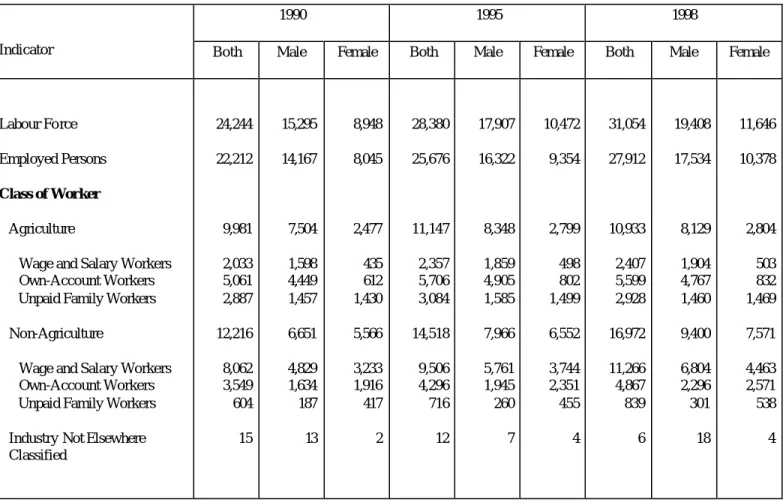
The size of the Philippine labour force grew from 24.24 million in 1990 to 28.38 million in 1995 and to 31.05 million in 1998. In 1998, 19,408 million (62.5 percent) of the country’s labour force were men (Table 1).
Despite the economic crisis, employment in 1998 expanded by 8.01 percent to 27.912 million from 25.676 in 1995. Of these, 17.534 are men while women accounted for 10.378 million. Correspondingly, women posted a growth rate of 28.9 percent while men posted a much lower growth of 23.76 percent for the eight-year period (Table 1).
By major occupation group, the non-agricultural sector accounted for 61 percent of total employed in 1998, while the agricultural sector registered at 39 percent. By class of worker, wage and salary workers comprised nearly half the employed in 1998, while the own-account employment category accounted for 37.5 percent. The unpaid work category, on the other hand, comprised 13.5 percent of total employment (Table 1). On the average, women accounted for 53.3 percent of unpaid workers.
3.1.1 Women in the Agricultural Sector
The share of female employment in agriculture in rural areas was about 50 percent in 1997. Female wage and salary earners were no more than 20 percent of the total employed female, with the highest proportion recorded in 1997 at 17.6 percent. The proportion of female own-account workers was highest in 1995 at 27.9 percent. The lowest proportion was in 1990 at 23.74 percent while in 1997 the figure settled at 25.8 percent. Unpaid female workers in the country accounted for more than 55 percent of total agricultural employment during the reference period. In 1995, however, the rate decreased to 55.1 percent from 58.97 but went up again to 56.6 in 1997.
Women in the agricultural sector are mostly engaged in rice, corn, sugarcane, and coconut production, animal breeding and fishing. Aside from their traditional house/home tasks, they also worked in the fields transplanting, harvesting, and threshing. Most rural women who are working find themselves engaged in farm work, peddling, running sari-sari stores, doing laundry, weaving, etc., which are forms of self-employment or unpaid family labour carried out intermittently, irregularly, and quite often when the opportunities arise (Castillo, 1979).
The many tasks involved in farming, animal breeding, and fishing are distributed between males and females, both undertaking specific roles and responsibilities that usually vary by crop or by activity. Except for land preparation, most farm-related activities like fertilizer application, chemical spraying and mechanized threshing, rice and corn production, harvesting and post-harvesting tasks rely heavily on female labour. Moreover, women take over land preparation where minimum tillage is required. Women and children usually do planting and weeding, but male family members sometimes help with the tasks to minimize labour costs. In fishing communities, capture fishery is
predominantly a male activity but women have been known to join their spouses. Processing and selling of the produce are the wome n’s domain. Hauling is mainly done by males, but improved transport facilities has lessened women’s dependence on male labour. Throughout rural Philippines, women keep much longer total working hours than men. In many cases, the long working day covers earning wages or profit, growing food crops for home consumption, and doing time -intensive housework (Illo, 1997). In the rural areas, women spend almost 16 hours a day producing, processing, marketing, and preparing food, gathering fuel, and water and performing other household tasks in addition to caring for their children and extended families.
5
Although more and more rural women participate in the labour force, their participation may be considered part-time since housekeeping is still their main activity. Women in agriculture work hand-in-hand with men but there is a gross under-estimation of women in the rural workforce and their work is often not counted. This is due largely to the confusion and contradiction over what is “productive work,” how to deal with “housework” and who is the “worker.” But the primary reason for non-inclusion of women’s work in the computation of the Gross National Product is that so much of it is done within the family setting and is often subsistence in nature.
In most surveys, only fixed employers and regular wages are reported. Not reflected in these surveys are the large number of women who usually undertake various market (informal sector work) and non-market production (produced for home/own consumption) tasks to support their families, as well as other non-economic tasks, i.e., domestic chores, such as housework, child and family care, shopping for goods and services, and community services and organizational volunteer work.
In the Philippine setting, it is a generally accepted standard that women’s work be recorded as “unpaid family labour.” As such, it is to a large extent labeled domestic work and is conventionally excluded from the labour force statistics. Unpaid work is especially prevalent in the rural areas. So much so that the significant role and functions of women in the domestic scene and in the national economy are deemed far less important compared to men. Women involved in such activities are normally reported as housekeepers, and not considered part of the lab our force. These are the millions of farmers’ and fishers’ wives and daughters who work in the fields, grow subsistence crops, raise chickens or pigs, engage in actual capture and trading of fishery products, do community volunteer work, but who basically view these activities as part of their housekeeping/household activities.
All these activities, whether in the form of self-employment opportunities or non-market production, have been assessed and identified as productive activities that contribute to the welfare of society and the development of the economy.
3.1.2 Women in Volunteer Work
In many Philippine communities, women are in charge of unpaid, volunteer activities in the areas of nutrition, immunization, and health care, cleanliness, sanitation, solid waste management, beautification, religious ceremonies, fiestas and other festivities.
Women are usually missing in formal community leadership structures because the real value of their social development work is not recognized, or they do not have enough time to attend meetings, which are usually held, when they are occupied with other responsibilities. Thus, even when it comes to development programs and projects at the community level, women are disadvantaged compared to the men who are more vis ible and have more time.
3.2 The Informal Sector
The informal sector penetrates every aspect of the Philippine economy (ILO, 1994). However, the majority of informal activities are agricultural and rural in nature, and mainly unrecorded. In the agricultural sector, these workers are primarily those who have limited access to land. These include smallholder and tenant farmers that are self-employed and own limited land or farm; usually, the farm is located in isolated areas, with limited exposure to modern
technology and irrigation, and produces only enough for family consumption. It also includes landless workers who earn a living by wage labour or payments in kind; usually they are in seasonal share -rate contracts. In urban areas, it includes the poor who have no substantial capital or training to allow them to participate in qualified and higher-paying jobs. These people are the self-employed entrepreneurs who perform independent jobs that require little training or capital, and wage labourers in small and family business, who have no capital to start a business. The extent to which these operations affect the national economy in terms of their contribution to total output and their effects on employment have not been calculated. Nevertheless, there is a consensus that the size of the informal sector is substantial (Lanzona, 1998).
6
Using the operational definition that the informal sector is composed of self-employed, own-account workers and unpaid family workers, and based on official employment figures (1998 Labour Force Survey), the number of informal sector workers is estimated to be 51 percent. Of these, 10 million were self-employed/own account workers and 3.8 million were unpaid family workers.
In a 1996 survey of the urban informal sector in the National Capital Region (NCR) conducted by the National Statistics Office (NSO), a detailed breakdown of the activities of informal sector operators was provided. Sari-sari store operators account for 17.7 percent, followed by other trades with 10 percent , and then by restaurants, cafés, and other eating and drinking places with a 7.9 percent (Table 3). A comprehensive nationwide estimate of the total number of persons employed in the informal sector was provided by the International Labour Organization (ILO) Project on the Informal Sector in Metro Manila. The study revealed that the agricultural sector accounts for the majority of people engaged in the informal sector, followed by the services sector, and then by the industry sector. From 1993 to 1995 however, the figures for the agricultural sector decreased from 8,580 to 8,252 but increased to 8,670 in 1996 (Table 4).
According to the NSO’s 1995 Integrated Survey of Households, nearly 73 percent of females among the self-employed are engaged in trade, with the largest percentage, over 77 percent, self-employed as unpaid family workers (Table 5). Women are concentrated in the service category, which includes personal services. The findings indicate that women dominate the informal sector.
The extent of the informal sector’s contribution to the national total output and its effects on employment have not been accurately calculated. Nonetheless, several studies have estimated the output produced by the informal sector. In a study by the Center for Research and Communication (CRC), the informal sector accounted for P125 to P130 billion of the GNP per year, or an average of 20 percent of the GNP from 1980 to 1990. In 1993, the sector was
calculated to have generated about P225 billion, or 30 percent of the GNP. These estimates were derived by taking the difference between the amount of currency in circulation and the amount of demand deposits. The remaining money in circulation, after subtracting those in bank accounts, was supposed to reflect the extent of output transactions in the informal sector, which are perceived to be excluded from the financial markets.
The linkages of the informal and formal sectors are significant in the export manufacturing sector, characterized by the existence of an industrial structure where formal and informal sector enterprises can complement each other through subcontracting arrangements. This is observed in the following industries: leather, garments, electronics, toys and gifts, handicrafts, food processing, paper and packaging p roducts, and furniture making. In agriculture, contracting exists in sectors like banana, rubber, poultry, swine, beef, cattle, feedgrains and shrimp (ILS, 1998).
The informal sector is also able to link the formal sector with the majority of the poor, benefiting a broad range of sectors in the economy. Since informal enterprises are able to do away with costly procedures and government regulations, they can operate profitably, especially in vending which is the most common activity. Informal
enterprises using household resources purchase their products and raw materials from grocery stores and retail them to low-income markets. This makes formal sector goods more affordable to the poor (Lanzona, 1998).
3.3 Unpaid Work in Non-Market Production
For non-market production, this may be translated into income and/or savings, considering its value in terms of price, that is, how much would it cost if a hired person had provided the service. Virola and De Perio (1998) provided some estimates of the relative contribution of women and men to the GDP, both conventional and adjusted, for the years 1990-1997. The study made use of both opportunity cost and market valuation in estimating unpaid domestic work, and of other parameters from previous studies (Tables 6, 7, 8 and 9). The following are among the significant findings of the study:
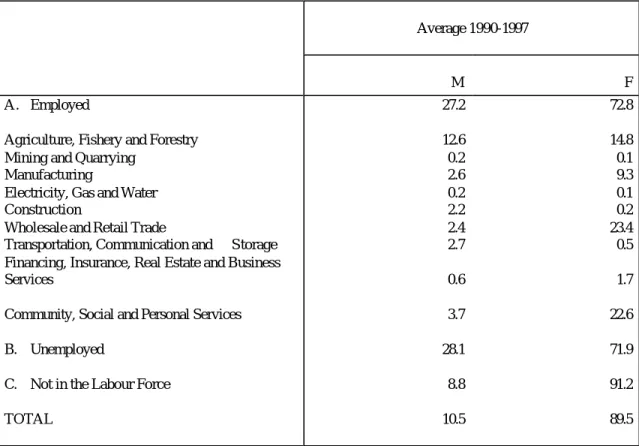
• Almost 90 percent of the total unpaid hours of work were done by women, with about 72 –73 percent coming from the employed and unemployed (ie: classified as part of the labour force). Unpaid work performed by women
7
is higher among those outside the labour force, representing 91 percent. There was also a slight increase in the employed women’s share of unpaid work and a slight decrease in the share of unemployed women. By economic activity, women’s contribution to unpaid work is higher in agriculture, fishery and forestry, manufacturing, wholesale and retail trade, financing, insurance, real estate and business services, and community, social and personal services, which comprised 80 percent of the total GNP in 1997.
• Women contributed about 90 percent in terms of the monetary value of unpaid work, with a slight difference between opportunity and replacement cost methods. This is attributed to the representation of unpaid work where the majority comes from those outside the labour force for which the same cost (replacement) was used to derive the value of unpaid work.
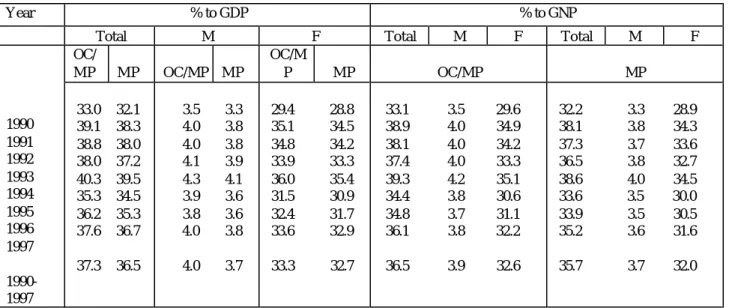
• An average of 33 percent represented women's unpaid work against only 4 percent for men in the conventional GDP for the period under study. If the value of unpaid work had been included in 1997, the GDP would have increased by 37 – 38 percent.
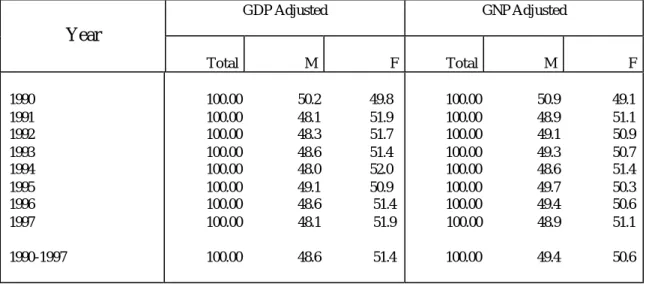
• The share of women's unpaid work increased to 51 percent from the 35-40 percent share when the GDP/GNP was adjusted for unpaid work.
3.3.1 Enhancing Access to Training and Gainful Employment
The majority of workers in the informal sector, including unpaid family workers, are from impoverished groups. They lack access and the means to acquire skills and education, to new production t echnologies and methods from formal institutions that can fully enhance their productivity, and ultimately increase their income. It is largely through unpaid work that they develop and acquire the skills and acumen to ply certain trades and/or occupations . Rendering unpaid work, to some, is a solid investment to increase capacities through skill formation, and therefore acquire the means for survival. Thus, unpaid work in the Philippine context has contributed through the enhancement of access to training and gainful employment, and more specifically, through the skills formation through hands-on
apprenticeship and time-tested approaches, and the promotion of entrepreneurship.
3.4 Enhancing Women's Equality
In the Philippines, the promotion of gender equity in its pursuit of human development has come a long way, enabling women to be more active participants in national growth and development. But while investment in
opportunities for women has grown, there still exists a wide gap in equality between men and women. Both still live in different worlds, with different access, opportunities, rewards, and legal protection. Yet, women’s economic roles could be greater in society if they had equal access to education and training and other opportunities. Unpaid w ork is seen as contributing to increasing gender equality through enabling women's access to informal education and training.
3.4.1 Enhancing Family Relationships
Workers in the informal sector, including unpaid family workers, are widely accepted to be central to the support and survival of families. This sense of responsibility for the care of the family is entrenched in Philippine culture. As such, much can be done to harmonize work and family responsibilities to further strengthen family relationships. Thus, unpaid work, in one way or the other, contributes to the strengthening of the family, which is regarded as the basic institution for personal and citizenship development. Unpaid work is regarded as the training ground for future caretakers or managers of a family enterprise or economic activity.
Unpaid labour, is also seen to contribute to the changing paradigms in Filipino family relationships, through:
• Challenging traditional definitions, concepts and ideas about women and work;
8
• Encouraging equitable sharing of housework;
• Harmonizing household and housework and market activities; and
• Encouraging and increasing entry of unpaid labour in the workplace.
4. Public Policy Respo nses
4.1 The Legal Framework
The spheres of law and government policies are probably the most crucial mechanisms in effecting changes in the economic and social integration of unpaid workers. A brief overview of existing labour and social security laws and executive issuances that are deemed important in promoting and enhancing the even distribution of unpaid work is provided in this section.
National policy provides a relatively favorable atmosphere for women’s development. The 1987 Philippine
Constitution explicitly stipulates the fundamental equality between women and men and cites women’s role in nation building, recognizing women’s maternal and economic roles, and women’s special health needs. It also declares natural-born those children of Filipino mothers born before January 17, 1973 and those who elect Philippines citizenship at the age of majority, and allows Filipino women married to aliens to retain their citizenship, thereby correcting the iniquitous provisions of earlier laws. Equity and access to education and training opportunities and enjoyment of their benefits is also provided for in the 1987 Constitution.
Executive Order 27, “The New Family Code of the Philippines” (signing on July 17, 1987), eliminated many of the discriminatory provis ions contained in the Spanish colonial law-based Civil Code of the Philippines.
Several legislative acts protect and extend women’s rights. The Women in Development Act, for example, mandates that a portion of all development assistance funds received from international agencies and other governments be set aside to support income -generating programs for women. It also allows women to borrow, and obtain loans and credit without the consent of their spouses. The Act also provides women the right to attend the Philippine Military Academy.
The Maternity Act extends the period of maternity leave to 60 days for normal delivery and 78 days for caesarian section with pay, and increases the benefits due to a woman on maternity leave. Meanwhile, the Paternity Act grants seven days paternity leave to married male employees during childbirth by their legitimate wives.
Social security coverage of married persons who manage the household and family affairs full-time is also provided for under R.A. (Republic Act) 7192. Upon the spouse's consent, they are entitled to the above coverage to the extent of one-half of the salary and compensation of the working spouse.
In addition, whereas before, a Filipino wife was unable to practice her profession without the consent o f the husband, the Philippine Family Code of 1988 empowers her to practice any legitimate profession, occupation, business or activity without the consent of the husband. The same Code provides that the latter may object only on valid, serious and moral g rounds.
The Philippines is also signatory to ILO Convention No. 100, Equal Remuneration for Men and Women Workers for Work of Equal Value. Remuneration includes "the ordinary, basic or minimum wage or salary and additional emoluments whatsoever payable directly or indirectly, whether in cash or in kind, by the employer to the worker and arising out of the worker's employment."
Improvements in national policy, particularly in HRD policy, remain to be done in order to establish functional linkages between paid and unpaid work. For instance, many areas tend to reinforce the "stereotyped" domestic roles of women while ignoring their productive work. For instance, technology transfer in agriculture, land tilling, job opportunities in industry, financial credit and skills development programs target male beneficiaries as "household
9
heads" and economic producers. Women on the other hand, are provided with more housekeeping skills like cooking, gardening, and nurturing their offspring.
National policies, particularly HRD policy, have gone a long way in reducing, if not eliminating "stereotyped" roles for women. Priority is now being given to developing new employment models/flexible work arrangements, which will enable both women and men to combine career with family commitments. With the "partial liberation" of working mothers from the traditional perception that they are responsible for childrearing and household management, husbands are now taking a more active role in the performance of these tasks.
4.2 Government Programs and Services
The Philippines has also embarked on a number of pilot projects, mostly with the assistance of the International Labour Organization, that are designed to explore various methodologies and approaches to minimize, if not eliminate the vulnerability of disadvantaged sectors among paid and unpaid workers. Among the targeted sectors are
homeworkers and workers in the informal sector. These pilot projects address various issues including working conditions, enterprise development, and schemes for expanding social protection.
Some recent and notable government initiatives include the following:
• Measuring women's and men's contribution to the economy
The National Statistical Coordination Board (NSCB), in coordination with the National Commission on the Role of Filipino Women (NCRFW) and the National Statistics Office (NSO), under the auspices of the Government of the Philippines and the Canadian International Development Agency, is undertaking a project to develop a framework for measuring women's and men's contributions to the economy.
The proposed framework uses satellite accounts (SAs), a special construct that is semi-integrated with the central System of National Accounts (SNA) framework. The SAs focus on a certain field or aspect of economic or social life in the context of national accounts. Through the SAs, housework services and the contribution of women can be measured and linked with the core national accounts.
The SAs have two parts: identification of the percentage contrib ution by sex to the economy of the production boundary of the conventional accounts; and identification, measurement and inclusion of housework
services/unpaid work of those not in the labour force i.e., those not considered economically active in the SNA. Estimation methodologies include: Gross Domestic Product (GDP) by sex; Gross Value Added (GVA) decomposed by employment; Gross Value Added (GVA) decomposed by number of hours; Unpaid Household Services by sex; and Net Factor Income from Abroad by sex.
• Training of women in new and non-traditional trades
The training of women in new and non-traditional trades aims to increase participation of women in national development by developing a broader and more diversified range of job opportunities. This program promotes the entry of women in non-traditional trades in specific areas of technological and industrial trades. It also provides entrepreneurial development training. In its pilot testing in July 1988 until March 1992, some 615 women were trained. It is now part of the regular offering of the Technical Education and Skills Development Authority (TESDA).
The National Vocational Training and Development Center for Women was established in April 1998 to provide traditional and nontraditional trades training. The vocational courses include comprehensive trainers training, pre -employment training, skills upgrading training, methodology training, and non-skills training. Research and development activities include focus on women’s capability and development, wider employment opportunities for women, and other measures enhancing women’s status. In collaboration with NGOs and other relevant organizations, the Center organizes and conducts symposium/seminars and other activities on gender and development issues. Since April 1998, the Women’s Center has turned out 91 women graduates.
10
• Social security protection for unpaid work
Social security protection, as defined in the Philippines, is the development, delivery, and promotion of work-related standards and projects that would cushion the impact of unemployment, seasonality of employment, and lack of access to basic services.
Under the formal conventional scheme, social security protection for workers in the private sector is provided through the Philippines’ Social Security System (SSS). In response to the call of the International Labour
Organization for the establishment of appropriate forms of social protection, the SSS implemented several measures in an attempt to provide social protection to all Filipinos. In 1992, the SSS initiated a line of coverage expansion
programs that led to inclusion of farmers and fishermen with an annual income of at least PhilP18,000.00. In
succeeding years, other expansion programs were added which included the coverage of household helpers earning at least PhilP1, 000.00 a month. In 1995, self-employed persons such as cigarette vendors, newspaper vendors, watch-your-car boys, hospitality girls, and other workers in the informal sector with a monthly net income of PhilP1, 000.00 were included. In 1997, the Social Security Law was amended with the enactment of Republic Act 8282, which saw benefit packages, and expansion of coverage to private workers such as the self-employed persons, farmers, fishers, household helpers, overseas workers, and household managers.
A household manager is a person who manages his/her household and family affairs full-time. His/her coverage in the SSS, however, is purely voluntary and is subject to the following:
• he/she is legally married to an actively paying SSS member;
• he/she has never been a member of the SSS;
• his/her coverage has the approval of his/her working spouse; and
• his/her contributions are based on 50 percent of the working spouse's last posted monthly salary credit but be no lower than PhilP1, 000.00.
As of December 1998, a total of 1,821 non-working spouses and 1,181,475 workers in the informal sector have voluntarily been registered for their social security coverage under the Social Security System.
5. Private Sector Strategies
Private sector initiatives to enhance and promote productivity in unpaid work can be grouped into those related to employee relations and those related to community relations:
5.1 Employee Relations Initiatives and Strategies
To maintain harmonious relationships and industrial peace between workers and the company, business organizations have pursued varying yet innovative and well-meaning strategies and initiatives in promoting the living and working conditions of their employees and their families. Busines s organizations have adopted a range of strategies and initiatives including:
• Menstrual leave wherein women employees are allowed rest day (s) with full pay due to menstrual disorder;
• Maternity leave over and above that mandated by law, with provisions for extension, advanced payment, and special maternity privileges;
• Emergency/calamity leave wherein regular employees are allowed to go on emergency leave with full pay equivalent to a specified number of working days in a year in any of the following causes: natural disasters such as typhoons, fire, earthquake, and other calamities directly affecting the employees, and serious illness of an immediate member of the employee’s family.
• Maintaining a medical clinic, along with the services of a physician and a nurse with emergency cases being referred to an accredited hospital nearest the workstation.
• Free dental services such as prophylaxis, extraction, temporary and permanent filling of cavities and minor tooth operations.
11
• Free medicines for common illnesses such as influenza, stomach aches, colds, coughs, diarrhea, and dizziness.
• Hospitalization benefits in addition to those found under the National Health Insurance Law comprising of confinement for a maximum number of calendar days, non-surgery and surgery c ases including medicines, professional and laboratories fees.
• Leaves for serious illnesses such as tuberculosis and cancer.
• Nursery/infant assistance in the form of cash assistance to married employees for the birth of their first to fourth child.
• Term life insurance with double indemnity in case of death for regular employees;
5.2 Community Relations Initiatives and Strategies
A review of community relations programs by the Philippine Business for Social Progress, a non-government organization supported by the country’s top companies, shows a spectrum of activities ranging from corporate giving or philanthropy to the less advantaged with the view that communities are partners in the business.
Exhibit 1 (see appendices) outlines a range of examples of these corporate initiatives to illustrate these emerging dimensions of these new concepts in Philippine business as they define their mission in society and their target “community”.
6. Recommendations
•
Recommendations for Governments
1. To harness the full productive potential of unpaid work in contributing to the economy, national governments should institutionalize support mechanisms that would provide access to productive resources, skills and education and new production technologies/methods. Followin g are some recommendations that could enhance the
productivity of the unpaid sector:
• Promoting community-based training to provide some new skills in secondary activities to supplement household income;
• Expanding capability building programs to include on-site, advisory, and consultancy services in the areas of skills, values and preparatory technical assistance;
• Linking skills training programs to existing job opportunities to ensure that these training programs do not become static and can accommodate volatile labour markets;
• Promoting growth-oriented micro-enterprises where motivation is made not by economic survival but by the prospect of making a profit;
• Opening access to wider and more reliable markets to avoid overcrowding and thereby increasing potential for growth.
2. Sustain the initiatives in measuring the contributions of paid and unpaid work to the economy
The research currently being done with the Philippines’ National Statistical Coordinating Board on measuring the contributions of women and men to the economy should be sustained. While the conceptual framework has been established, future directions should determine the data items, designs, classification of activities, and data collection schemes. Further discussions of the results, approaches, or methodology and issues concerning the conceptual framework should be held among fellow researchers and policymakers, including senators, congress, and other government officials and interest groups.
12
While there are various public sector initiatives and strategies that give due recognition and benefit to those rendering unpaid work, much remains to be done. For public sector initiatives and programs to have cons iderable impact and relevance in improving the living and working conditions of those performing unpaid work, the public sector must be able to adapt to the needs, conditions, and circumstances of those with unpaid work. The establishment of one-stop shops for unpaid work is an initial step in this direction. One-stop shops aim to deliver under one roof to unpaid workers programs and services that will enhance their contributions to the economy.
4. Provide an environment where private sector initiatives that recognize and support unpaid work are supported, recognized, and rewarded.
While the key policy consideration in the Philippines remains to the generation of productive and paid labour, an environment must be created that catalyzes or facilitates private sector initiatives that either extend the gains of paid employment or spurs development in communities where unpaid work is thriving or predominating or where paid and unpaid work are necessarily or indispensably linked. With industry regarded as the main engine of economic development, the private sector continues to be the primary source of creative and innovative ways of enhancing the linkages of paid and unpaid work. Thus, a system of helping, recognizing, and rewarding private sector initiatives should be instituted. In the Philippines, the "Galing Pook Awards" or the "Gawad Sikap Awards” are worth emulating in this regard. The "Galing Pook Awards" recognize initiatives of local authorities in pursuing development in their respective communities while the "Gawad Sikap Awards” recognize outstanding individual and institutional efforts in promoting workers' welfare and industrial peace.
•
Recommendations to the APEC Human Resource Development Working Group
It is hoped that this project on “Linkages bet ween Paid and Unpaid Work in Formulating Human Resources Development Policies” will promote a broader understanding of how intra- and inter-relationships among APEC member economies can be further strengthened and enhanced. The new insights on paid and unpaid work, and intellectual gains from this project notwithstanding, there are many paths that the APEC HRD Working Group could consider, for example:
1. To widen the discussions to transcend those related to work to look deeper in the socio -cultural dimension of paid and unpaid work
While the discussion of paid and unpaid work in some APEC member economies often leads to the recognition of unpaid work by attaching proper monetary values, the Asian handling of unpaid work transcends monetary values and has deep roots in culture and family. Thus, to some APEC member economies, unpaid work is not synonymous to exploitative conditions of work like child labour and/or forced labour but is related to family rearing or future assumption of family responsibilities such as managing the family business enterprise. This aspect of unpaid work is very Asian and very Filipino. A deepening of the discussions of paid and unpaid work with a focus on this aspect is necessary to understand the subject matter across APEC member economies.
2. To continue the discussions on the measurement of the contributions of men and women in each economy
Recognition of the linkages of unpaid work and other “invisible” contributors to the economy begins with an accounting of their quantity, dimensions and contribution to the economy. The Philippines, for instance, with support from the APEC Central Fund and under, perhaps, the auspices of the APEC HRD Working Group LMI, could take the lead among APEC member-economies on capability building and information dissemination on the
measurement of "unpaid work" contributions.
3. To take up the agenda of paid and unpaid work for wider debate and discussion
As a follow through to the debates and discussion that ensued in this project and the HRD Working Group, the recognition and accounting of unpaid work and strengthening their linkages should be brought to a higher level of
13
discussion toward arriving at an international consensus on the matter. The APEC HRD Working Group could bring forward these issues in other forums, notably starting with the other working groups, committees, and the ministers' levels (i.e., HRD Ministerial, Finance Ministers, Labour Ministers and the like).
14
References
Ericta, Carmencita. N., “Measuring Women’s and Men’s Contribution to the Economy: Philippine Framework”, Proceedings of the Seminar on Human Resource Accounts, 8-10 December 1998.
Illo, Jeanne Frances I., "Country Briefing Paper: Women in the Philippines, 1997
Joshi, Gopal., Urban Informal Sector in Metro Manila A Problem or Solution? International Labour Organization. 1997.
Lanzona, Leonardo A., "Transforming the Informal Sector," Handbook on the Informal Sector, 1998
National Commission on the Role of Filipino Women, Filipino Women Issues and Trends (Co-published with the Asian Development Bank). October 1995.
Philippine Country Report on Women 1986-1995. Fourth World Conference on Women 4-15 September 1995, Beijing, China.
Soriano, Ma. Teresa and Ma. Concepcion E. Sardana., “Assessment of needs and Available Resources for Informal Sector Development,” Country paper for the Philippines 9-11 October 1997.
Torres, Josefino I., “Towards a Sustained Corporate Social Responsibility to its Workers: A Development Strategy for the Workers of the Central Azucarera Don Pedro (CADP) Mill District. An Unpublished Master’s Thesis. Asian Institute of Management. School Year 1995-96.
Virola, Romulo A. and Sylvia M. de Perio., “Measuring the Contribution of Women to the Philippine Economy”,Paper prepared for the 8th National Convention on Statistics. December 2-4, 1998
15
Appendices
Table 1. Summary of Employment Situation: Philippines 1990, 1995 and 1998
(In Thousands)
1990 1995 1998
Indicator Both Male Female Both Male Female Both Male Female
Labour Force
Employed Persons
Class of Worker Agriculture
Wage and Salary Workers Own-Account Workers Unpaid Family Workers
Non-Agriculture
Wage and Salary Workers Own-Account Workers Unpaid Family Workers
Industry Not Elsewhere Classified 24,244 22,212 9,981 2,033 5,061 2,887 12,216 8,062 3,549 604 15 15,295 14,167 7,504 1,598 4,449 1,457 6,651 4,829 1,634 187 13 8,948 8,045 2,477 435 612 1,430 5,566 3,233 1,916 417 2 28,380 25,676 11,147 2,357 5,706 3,084 14,518 9,506 4,296 716 12 17,907 16,322 8,348 1,859 4,905 1,585 7,966 5,761 1,945 260 7 10,472 9,354 2,799 498 802 1,499 6,552 3,744 2,351 455 4 31,054 27,912 10,933 2,407 5,599 2,928 16,972 11,266 4,867 839 6 19,408 17,534 8,129 1,904 4,767 1,460 9,400 6,804 2,296 301 18 11,646 10,378 2,804 503 832 1,469 7,571 4,463 2,571 538 4
Table 2. Summary of Female Employment in Agriculture in Rural Areas, Philippines,
1990, 1995 and 1997 (%)
Indicator 1990 1995 1997
TOTAL
Wage and Salary Earners
Own -Account
Unpaid Family Workers
48.77 17.29 21.43 58.97 48.8 17.0 27.9 55.1 50.1 17.6 25.8 56.6
Source: Bureau of Agricultural Statistics
Table 3. Breakdown of Activities of Operators in the Informal Sector, National Capital
Region, Philippines, 1995 (by number and %)
Agriculture, forestry, fishery Textile, wearing apparel, leather Manufacturing
Other manufacturing Construction Sari-sari stores
Other food and beverage retailing Other trade
Operators of bus, taxicabs, jeepneys Tricycles and other transport Renting of buildings and rooms Financing insurance, real estate, Business services
Repair services
Other personal and household s ervices Restaurants, cafes and other eating and Drinking places
Hotels, motels and other lodging places Others Frequency 140 265 210 138 642 284 366 197 217 169 84 136 192 287 174 126 Percent 3.9 7.3 5.8 3.8 17.7 7.8 10.1 5.4 6.0 4.7 2.3 3.7 5.3 7.9 4.8 3.5 TOTAL 3,627 100.0
17
Table 4. Persons in the Informal Sector in the National Capital Region, Philippines by
Major Industry Group, 1990- 1996 (in tho usands)
Year All Agriculture Industry Services
1990 11,387 7,499 744 3,144 1991 11,708 7,667 790 3,251 1992 12,278 8,140 699 2,794 1993 12,854 8,580 810 4,194 1994 12,936 8,513 839 3,584 1995 12,911 8,252 856 3,803 1996 13,540 8,670 828 4,042
18
Table 5. Distribution of Own-Account and Unpaid Workers in the Informal Sector,
National Capital Region, Philippines by Class of Worker, Sex and Industry Group, 1995
(in %).
Self-Employed
Own -Account Employer
Unpaid Family Worker
Industry
M F Both M F Both M F Both
Agriculture, Fishery, Mining, Quarrying
5.2 0 2.8 5.7 0 3.3 3.4 0 1.4
Manufacturing,Construct ion, Electricity, gas and water
11.9 8.4 10.2 18.6 11.8 15.7 17.2 9.1 12.3
Wholesale and Retail trade,
35.6 72.6 52.7 32.9 56.9 43.0 41.4 77.3 63.0
Transportation, Storage and Communication
25.4 1.3 14.3 15.7 5.9 11.6 13.8 0 5.5
Financing, insurance, real estate and business services
2.5 1.6 2.1 7.1 2.0 5.0 0 2.3 1.4
Community, social and personal services 19.3 16.1 17.9 20.0 23.5 21.5 24.1 11.4 16.4 Total (%) 100.0 100.0 100.0 100.0 100.0 100.0 100.0 100.0 100.0 Number (000) % of employed work force 363 11.7 312 10.0 675 21.7 70 2.2 50 1.6 120 3.9 30 1.0 44 1.4 74 2.4
19
Table 6: Percentage Distribution of Estimated Total Unpaid Hours of Work
(Housework Services) By Sex, Employed, Unemployed and Not in the Labour Force (in
thousands)
Average 1990-1997
M F
A. Employed
Agriculture, Fishery and Forestry Mining and Quarrying
Manufacturing
Electricity, Gas and Water Construction
Wholesale and Retail Trade
Transportation, Communication and Storage Financing, Insurance, Real Estate and Business Services
Community, Social and Personal Services
B. Unemployed
C. Not in the Labour Force
TOTAL 27.2 12.6 0.2 2.6 0.2 2.2 2.4 2.7 0.6 3.7 28.1 8.8 10.5 72.8 14.8 0.1 9.3 0.1 0.2 23.4 0.5 1.7 22.6 71.9 91.2 89.5
Source: From the study of Virola, Romulo A. and Sylvia M. de Perio., “Measuring the Contribution of Women to the Philippine Economy”
20
Table 7. Percentage Distribution of Total Value (at current prices) of Unpaid Hours by Sex
for All, 1990-1997 Opportunity Cost and Market Prices
Employed Unemployed Not in Labour Force Total M F M F M F M F Year OC MP OC MP MP MP OC/ MP MP OC/ MP MP 1990 1991 1992 1993 1994 1995 1996 1997 1990-1997 6.2 27.0 73.8 73.0 26.1 26.8 73.9 73.2 27.2 27.5 72.8 72.5 26.0 26.8 74.0 73.2 26.2 26.7 73.8 73.3 26.3 26.5 73.7 73.5 26.4 26.5 73.6 73.5 25.9 25.9 74.1 74.0 26.3 26.7 73.7 73.3 25.5 74.5 26.9 73.1 27.4 72.6 27.9 72.1 28.4 71.6 27.6 72.4 28.5 71.5 28.9 71.1 27.6 72.4 8.7 91.3 8.3 91.7 8.3 91.7 8.7 91.3 8.8 91.2 8.9 91.1 8.6 91.4 8.6 91.4 8.6 91.4 10.7 10.3 10.2 9.9 10.4 10.0 10.7 10.4 10.7 10.4 10.8 10.7 10.6 10.2 10.6 10.2 10.6 10.3 89.3 89.7 89.8 90.1 89.6 90.0 89.3 89.6 89.3 89.6 89.1 89.4 89.4 89.9 89.5 89.8 89.4 89.8
Source: From the study of Virola, Romulo A. and Sylvia M. de Perio., “Measuring the Contribution of Women to the Philippine Economy”
21
Table 8. Percentage of Value of Unpaid Hours (Housework Services) to GDP/GNP
(at current prices)
Year % to GDP % to GNP
Total M F Total M F Total M F
OC/ MP MP OC/MP MP OC/M P MP OC/MP MP 1990 1991 1992 1993 1994 1995 1996 1997 1990- 1997 33.0 32.1 39.1 38.3 38.8 38.0 38.0 37.2 40.3 39.5 35.3 34.5 36.2 35.3 37.6 36.7 37.3 36.5 3.5 3.3 4.0 3.8 4.0 3.8 4.1 3.9 4.3 4.1 3.9 3.6 3.8 3.6 4.0 3.8 4.0 3.7 29.4 28.8 35.1 34.5 34.8 34.2 33.9 33.3 36.0 35.4 31.5 30.9 32.4 31.7 33.6 32.9 33.3 32.7 33.1 3.5 29.6 38.9 4.0 34.9 38.1 4.0 34.2 37.4 4.0 33.3 39.3 4.2 35.1 34.4 3.8 30.6 34.8 3.7 31.1 36.1 3.8 32.2 36.5 3.9 32.6 32.2 3.3 28.9 38.1 3.8 34.3 37.3 3.7 33.6 36.5 3.8 32.7 38.6 4.0 34.5 33.6 3.5 30.0 33.9 3.5 30.5 35.2 3.6 31.6 35.7 3.7 32.0
Source: From the study of Virola, Romulo A. and Sylvia M. de Perio, “Measuring the Contribution of Women to the Philippine Economy”
22
Table 9. Percentage Distribution of GDP and GNP (at current Prices) Adjusted or
Unpaid Housework Services by Sex, Using Hours of Work, Employed-Opportunity
Cost; Unemployed and Not in Labour Force -Market Price, (in Millions of Pesos).
GDP Adjusted GNP Adjusted
Year
Total M F Total M F 1990 1991 1992 1993 1994 1995 1996 1997 1990-1997 100.00 50.2 49.8 100.00 48.1 51.9 100.00 48.3 51.7 100.00 48.6 51.4 100.00 48.0 52.0 100.00 49.1 50.9 100.00 48.6 51.4 100.00 48.1 51.9 100.00 48.6 51.4 100.00 50.9 49.1 100.00 48.9 51.1 100.00 49.1 50.9 100.00 49.3 50.7 100.00 48.6 51.4 100.00 49.7 50.3 100.00 49.4 50.6 100.00 48.9 51.1 100.00 49.4 50.6Source: From the study of Virola, Romulo A. and Sylvia M. de Perio, “Measuring the Contribution of Women to the Philippine Economy”
Exhibit 1. Spectrum of Programs on Community Relations of Selected Business Organizations in the Philippines.
1. Name of Organization: PHINMA Group of Companies PHIMCO Industries Inc. RFM Corp. Central Azucarera Don Pedro 2. Title of Program: Community Relations Community Development Family Welfare and
Livelihood Program
Community Development
3. Logic/Philosophy: Development of community residents into productive, self-reliant and “empowered individuals and groups
Assist in combating unemployment, drug
dependency, malnutrition and lack of education
Enable employee or their family members to engage in projects which will augment their threshold income
Promotion of corporate social responsibility through the implementation of relevant community development program and assistance in achieving industrial welfare by conducting effective employee-oriented program 4. Target "Community" Communities around the factories
and plants
Urban Poor of Punta, Sta. Ana, Manila
Needy employees and their families
Communities where employees reside and contiguous to the factory 5. Structure: Full Time COMREL Group Integrated in the human
resource function of the company
Working committee with management and labour representatives
Community Development Office reporting directly to the Resident Manager 6. Strategies: 1. Livelihood group assistance
2. Day care center 3. Scholarship grants 4. Health care services
5. Skills training and workshops
1. Supplementary feeding program
2. Preparatory school for pre-school children 3. Training & livelihood
4. Organizing into business group 1. Family welfare 2. Livelihood projects 1. Livelihood 2. Social services 3. Community organizing 4. Information