
Switching Gaussian Process Dynamic Models for Simultaneous Composite
Motion Tracking and Recognition
Jixu Chen
Minyoung Kim
Yu Wang
Qiang Ji
Department of Electrical,Computer and System Engineering
Rensselaer Polytechnic Institute
Troy, NY 12180
{chenj4,kimm8,wangy15}@rpi.edu [email protected]
Abstract
Traditional dynamical systems used for motion tracking cannot effectively handle high dimensionality of the motion states and composite dynamics. In this paper, to address both issues simultaneously, we propose the marriage of the switching dynamical system and recent Gaussian Process Dynamic Models (GPDM), yielding a new model called the switching GPDM (SGPDM). The proposed switching vari-ables enable the SGPDM to capture diverse motion dynam-ics effectively, and also allow to identify the motion class (e.g. walk or run in the human motion tracking, smile or angry in the facial motion tracking), which naturally leads to the idea of simultaneous motion tracking and classifica-tion. Moreover, each of GPDMs in SGPDM can faithfully model its corresponding primitive motion, while performing tracking in the low-dimensional latent space, therefore sig-nificantly improving the tracking efficiency. The proposed SGPDM is then applied to human body motion tracking and classification, and facial motion tracking and recogni-tion. We demonstrate the performance of our model on sev-eral composite body motion videos obtained from the CMU database, including exercises and salsa dance. We also demonstrate the robustness of our model in terms of both facial feature tracking and facial expression/pose recogni-tion performance on real videos under diverse scenarios in-cluding pose change, low frame rate and low quality videos.
1. Introduction
Traditional dynamical systems and their variants are widely used to tackle the tracking problems. Traditional dynamical models include the popular Kalman filtering and particle filtering as shown in Figure 1(a). Although these dynamical systems are commonly used to represent dynam-ics in the motion space, they have two main limitations: (1)
they are not efficient in modeling complex dynamics with a large number of model parameters, and (2) they are inher-ently limited to modeling single monolithic motion dynam-ics, inappropriate to account for composite motions with di-verse dynamics.
In the community, the two issues of high dimension-ality of the motion and composite dynamics have been tackled considerably, but often individually. For instance, the switching dynamical systems [8] can resolve the lat-ter issue, yet suffering from modeling complexity. On the other hand, the recent Gaussian Process Dynamic Mod-els (GPDM) [5, 12] (Figure 1(b)), which are inspired by the Gaussian Process Latent Variable Model [4], can alle-viate the first limitation by discovering the intrinsic low-dimensional latent representation of the model dynamics. The latent embedding, latent dynamics and reconstruction mapping can be learned simultaneously from the training sequences [12]. However, the model capacity of GPDMs may be insufficient to capture multiple heterogeneous dy-namics by nature.
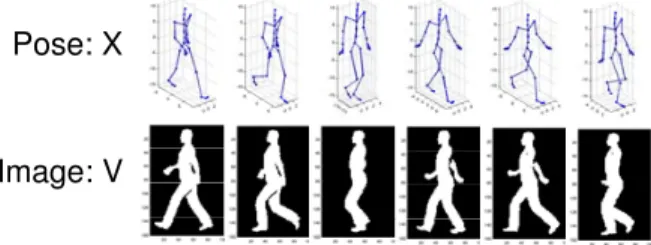
In this paper, we propose to combine Switching Model with the Gaussian Process Dynamic Models to produce a dynamic model called the Switching Gaussian Process Dy-namic Model (SGPDM) as shown in Fig.1(e) and Fig.1(f). This model has a switching layer on top of the latent vari-ables. Hence, it enjoys both worlds of switching dynam-ics and low dimensional dynamdynam-ics with significantly re-duced number of parameters. By incorporating a switching layer this model also allows simultaneous motion tracking and recognition. To demonstrate the proposed model, we then consider two representative composite motion track-ing problems, the human body motion tracktrack-ing and facial motion tracking. Human motion tracking or facial motion tracking(in this paper, facial motion tracking refers to fa-cial feature tracking) is a task of predicting the sequence ofX, which are body poses (typically 3D joint angles of human body) or facial features (typically coordinates of the
fiducial points of facial features) from the image measure-ment sequenceV. The image measurement is represented by the moment features extracted from the silhouette im-ages as shown in Fig. 2 or Gabor features around the facial feature points.
Xt-1 Xt
Vt-1 Vt
(a) Traditional Dy-namical System Xt-1 Xt Vt-1 Vt Zt-1 Zt (b) GPDM in [12] Xt-1 Vt-1 Zt-1 Zt Xt Vt (c) Shared-Space GPDM Xt-1 Xt Vt-1 Vt St-1 St (d) Switching Dy-namical System Xt-1 Xt Vt-1 Vt Zt-1 Zt St-1 St (e) Switching GPDM Xt-1 Vt-1 Zt-1 Zt Xt Vt St-1 St (f) Switching Shared-Space GPDM
Figure 1. Graphical representation of dynamic models for track-ing.X,V,ZandSrepresent the state (body or facial pose), image measurement, latent variable and switching state respectively. (a) is the traditional dynamic system, such as Kalman filter and parti-cle filter. (b) is the GPDM model used in [12]. (c) is the proposed shared-space GPDM model (Section 3.2.2). (d) is the switching dynamic system used in [8]. (e) is the Switching GPDM model, an extension of (b) (Section 4.2) (f) is the Switching Shared-Space GPDM model, an extension of (c) (Section 4.1)
Pose: X
Image: V
Figure 2. The stateXand image measurementV for body pose tracking
The dynamic systems of Human body/facial motion have high dimensionality ofX and multiple heterogeneous dy-namics. For example, the body pose or facial features is typically composed of several dozens of joint angles or fidu-cial points which would produce too many parameters for modeling dynamics directly in theXspace. Human body/ facial motion also contain different styles and contents (e.g,
facial feature points are subject to the pose and expression change), which may not be faithfully represented by stan-dard dynamic models incorporating a single dynamics.
We first apply the Switching GPDM model on the hu-man body motion estimation/tracking problem, where we predict the body pose (3D joint angles) from the observed sequence of image silhouettes. Then we consider the prob-lem of simultaneous facial feature tracking and facial ex-pression/pose recognition on real video, under diverse sce-narios including pose change, low frame rate and low qual-ity videos.
2. Related works
In this section, some works related to latent variable models, switching systems, and simultaneous motion track-ing and recognition methods are reviewed. The high dimen-sionality of state space in the tracking problem can be cir-cumvented by introducing the low dimensional latent vari-ables (Z) on top of the state variables, and model the dy-namics in this low dimensional space. For example, Urtasun et.al [12] introduced the Gaussian Process Dynamic Model (GPDM) for body tracking (as shown in Fig.1(b)). Z indi-cates the intrinsic manifold maps that generate the poseX. With the incorporated nonlinear Gaussian Process based di-mensionality reduction methods, GPDM showed significant performance improvement in Human motion tracking.
Besides the standard GPDM model in Fig.1(b), we also introduce another form of GPDM in this paper, as shown in Fig.1(c). Similar to the standard model, it also models the dynamics in a learned low-dimensional latent space based on Gaussian Process, where the latent space is shared by both the pose (X) and the image measurement (V). We call it Shared-Space GPDM, and more details are discussed in section 3.2.2. Please notice that sinceZis hidden and is not known,V andXare dependent.
However, these dimensionality reduction approaches ba-sically assume a single dynamics, preventing it from being successfully applied to composite motions. To address the composite motion issue, the so-called switching dynamic systems have been proposed by [8] (Fig.1(d)). Here, the la-tent switching variables (S) effectively represent switching over different motion dynamics. Specifically, in the switch-ing dynamic systems, the latent switchswitch-ing variable (S) has several discrete states. It automatically selects the current member from a set of dynamic models to increase the ro-bustness and accuracy of the motion tracking, and also per-forms classification of current motion. This naturally leads to the idea of simultaneous motion recognition and tracking. Tracking and recognition have been often tackled indi-vidually as independent task. For example most existing methods for facial expression recognition generally involve two steps, tracking facial features is followed by the expres-sion recognition based on extracted facial features.
Simultaneous tracking and recognition which aims to exploit the synergy of tracking and recognition is not a new idea and some efforts for simultaneous tracking and recognition [7, 15, 1] already exist in the literature. In [7], a simultaneous tracking and recognition method based on mixed-state CONDENSATION [3] is designed for track-ing and recogniztrack-ing the juggled balls. Zhou et al. [15] proposes a probabilistic framework allowing simultaneous tracking and recognition of Human face from video. In [1], a method is presented for simultaneous facial action track-ing and expression recognition. In this method, there are three layers in the graphical model. The first layer repre-sents the expression states which decide the dynamic model of the facial action control vector of the employed 3D face model in the second layer. The facial action control vec-tor along with the face pose parameters recovered from a separate deterministic optimization framework are used for warping the face into geometrically free facial patch, which is then compared with an on-line appearance model to out-put an observation likelihood. Inference of this model is also based on the mixed-state CONDENSATION.
However, like other switching systems, existing simulta-neous methods based on particle filter either are limited to tracking a motion of limited dimension because the work-able dimensionality for particle filter is small (e.g. the fa-cial action control vector in [1] involves only the eyebrow and mouth of the face, and has a dimension of six), or em-ploy weak (linear) dynamic models (e.g. the auto-regressive (AR) model is used as the transitional model of facial action in [1]).
Compared to the existing simultaneous methods in the literature, by combining GPDM with switching vari-ables, our Switching GPDM model for simultaneous mo-tion tracking and recognimo-tion is capable of tracking high-dimensional motion (e.g. there are 59 dimension for the joint angles in the human pose tracking model and 56 di-mensions for 28 facial feature points in our simultaneous facial feature tracking model. None of the simultaneous methods mentioned above can track such high-dimensional motion), and has the power of handling more complex (non-linear) dynamics.
In summary, the contributions of this paper are listed as follows: First, a new model called Switching Gaussian Process Dynamic Model is proposed by combining GPDM and switching variables. It addressed the two issues of tra-ditional tracking system simultaneously. Second, besides pure tracking problems, the proposed Switching GPDM can also perform simultaneous tracking and recognition. We test its capability in both tracking and recognition in the ex-periments.
3. Proposed Approach
3.1. Gaussian Process Latent Variable Model Here we briefly review the Gaussian Latent Variable Model (GPLVM), which is the basis for GPDM. GPLVM proposed by Lawrence [4] is an efficient tool to model the distribution in a high dimensional space with a compact low dimension representation. It has been previously used to provide a prior probability of human pose for animation [2] and body tracking [13, 10]
3.1.1 Gaussian Process
We first start with the Gaussian Process (GP). GP is a non-parametric approach for solving regression problem, which learns a mappingy=f(z)from some training pairs
{zi,yi}Ni=1, where eachyi ∈ RD, andzi ∈ RS. Arrange the training vectors into the rows of matrices YN×D = [y1, ...,yN]T andZN×S = [z
1, ...,zN]T. The conditional probability ofYgivenZis defined based on GP:
p(Y|Z, β) = D Y d=1
N(Y:,d|0,K(Z,Z)) (1) Y:,d indicate thedthcolumn ofY, which is aN ×1 vec-tor constructed from thedthdimension of the training data. K(Z,Z)is aN ×N covariance matrix whose entries are given by the kernel function:
k(zi,zj) = exp(−βkzi−zjk2) (2) The learning process of GP is to adjust the parameterβto maximize the probability in Eq. 1.
Once the parameters have been learned, the GP predic-tion ofy, given a new inputz, can be derived as a Gaussian distribution (For full details, please refer to [4] or [9]):
p(y|z) =p(y|z,Y,Z, β) =N(µ(z), σ2(z)I) (3) with:
µ(z) =YTK(Z,Z)−1k(z,Z)
σ2(z) =k(z,z)−k(z,Z)TK(Z,Z)−1k(z,Z) (4)
wherek(z, Z)is aN×1vector whoseithentry isk(z, z i). Notice that, the covariance matrix of this Gaussian dis-tribution is diagonal, which means givenz, each dimension ofyis conditionally independent with others.
3.1.2 GPLVM
Instead of knowing the complete training pairs{zi,yi}Ni=1,
given onlyY, and we need to optimize the kernel functions and the latent variableZtogether:
Z∗, β∗= arg max
Z,β p(Y|Z, β)p(Z) (5) where the first term is from Eq. 1 and the second term, i.e., the prior of the latent variable, is defined as Gaussian [2, 13, 10]: p(Z) = N Y i=1 N(zi|0,I) (6) It is known that this optimization is non-convex, and it does not admit a closed-form solution. The scaled conjugate gra-dient (SCG) method search is often used, and known to be effective [4]. We use the SCG for optimization where the latent positionsZare initialized as the PCA coefficients of Y
Usually, the latent spaceZ has much lower dimension thanY. For example, in human pose estimation, the posey usually have 20-50 dimensions, while the latent variablez only need 2-3 dimensions, which is a widely believed mani-fold dimensionality for single motions like walking and run-ning. So, once GPLVM is learned, the pose can be repre-sented by a low-dimensional variablez, and the mapping fromztoy(p(y|z)) is modeled as Eq. 3.
3.2. Gaussian Process Dynamic Model
The basic idea of using GPLVM for tracking is modeling the dynamics in the low-dimensional latent space instead of modeling it in the high-dimensional pose space. Two typ-ical latent variable tracking models are shown in Fig. 1(b) and Fig. 1(c).
3.2.1 GPDM
Fig. 1(b) shows the standard GPDM proposed in [12].xt∈
RDrepresent the current body pose,z
t ∈RSrepresent the corresponding low-dimensional latent variable.
Same as GPLVM, given the training sequence:XT×D= [x1, ...,xT]T, the mapping from low-dimensional latent space to pose space is modeled by GP regression:
p(X|Z, βX) = D Y d=1
N(X:,d|0,KX(Z,Z)) (7) whereβX is the kernel parameter for this mapping GP re-gression. Taking one step further, the dynamics in the latent space is also modeled by GP regression:
p(Z+|Z−, βT) = S Y s=1
N(Z+:,s|0,KT(Z−,Z−)) (8)
whereβT is the kernel parameter for the dynamic GP re-gression, andZ+ = [z2, ...,zT]T,Z− = [z1, ...,zT−1]T.
The GPDM is then trained to maximize: Z∗, β∗
X, βT∗ = arg max Z,βX,βT
p(X|Z, βX)p(Z+|Z−, βT) (9) Once the model is learned, following Eq.3, the condi-tional probabilities needed for tracking can be written as Gaussian distribution: p(xt|zt) = p(xt|zt,X,Z, βX) and
p(zt|zt−1) =p(zt|zt−1,Z+,Z−, βT).
Notice that, for this standard GPDM tracking model, the relationship between pose xt and measurement vt (
p(vt|xt), the link fromxttovtin Fig.1(b)) is not modeled by Gaussian Process. In [12], this likelihood of pose is de-fined based on the detected joint points. In our face tracking algorithm, the likelihood is defined based on Gabor feature matching (Section 4.2).
3.2.2 Shared Space GPDM
However, in our body tracking experiment (Section 4.1), the measurement is a moment feature from silhouette. It is dif-ficult to directly model the relationships between pose and the moment feature. Although some other learning based method, such as neural network [10], has been used to learn this relationship, we propose to model it also though Gaus-sian Process for consistency. Fig. 1(c) shows our GPDM for body tracking. The posevt and measurement xt are combined as the training data:
yt= µ xt vt ¶ (10) Then we learn the latent space from the training se-quenceY = [y1, ...,yT]T. The learning process is same as the standard GPDM. However, because Y includes both pose and measurement, we call the learned latent Z space ”shared latent space”. (More detailed discus-sion of shared latent space using GPLVM can be found in [6]). Similarly, once the GPDM is learned, the con-ditional probability can be written as Gaussian distribu-tions p(yt|zt) = p(yt|zt,Y,Z, βY) and p(zt|zt−1) = p(zt|zt−1,Z+,Z−, βT)(Eq.3). Notice that in Eq.3, the co-variance matrix of this Gaussian is diagonal matrix, so the conditional probability can be factorized as Eq.11, andyt can be represented by two separate nodes: xt andvt con-nected toztin Fig.1(c). p(yt|zt) =p( µ xt vt ¶ |zt) =p(xt|zt)p(vt|zt) (11)
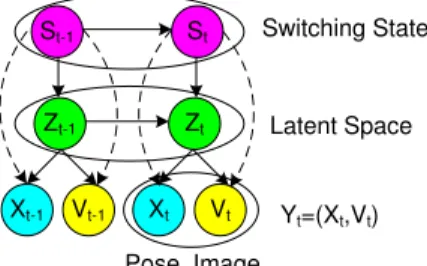
3.3. Switching Gaussian Process Dynamic Model The above GPDMs basically assume a single dynamics in the latentZ space. In order to deal with the compos-ite motion dynamics, we extend the GPDM to the Switch-ing GPDMs whose graphical representations are shown in
Fig.1(e) and Fig.1(f). The three layers of a Switching GPDM are denoted in Fig.3, which is an extension of shared space GPDM. We also extended the standard GPDM as shown in Fig.1(e). But due to the similarity of two mod-els, we will only discuss the model in Fig.3.
Xt-1 Vt-1 Zt-1 Zt Xt Vt St-1 St Yt=(Xt,Vt) Pose Image Latent Space Switching State
Figure 3. The three layers of a Switching GPDM
Roughly, a Switching GPDM is composed of the dynam-ics of the switching componentp(st|st−1), and for each
switching statest = c, we have a specific GPDM(motion dynamic model) denoted by GPDMc,wherec = 1, ..., M (AssumingMdifferent dynamics).
3.3.1 Learning
We first discuss how to train the Switching GPDM model in the supervised case, where we are given the true switch-ing state valuesS = [s1, ..., sT]. Notice that the learning criterion is the joint log-likelihood:
logp(S,Z,Y) = logp(S) + logp(Z|S) + logp(Y|S,Z). (12) Knowing the switching variables makes the objective de-composed along the switching values, and we indepen-dently learn the individual GPDM models. We need to es-timate the parameters(θ, λ(1..M)), whereθdenotes the
dy-namics of the switching state, andλ(c) = (Z(c), β(c)
Y , β
(c)
T ) denotes the parameters of thecthGPDM,c= 1..M.
For example, given a 10-frame labeled sequence where t= 1..4andt= 8..10are labeled as the1stGPDM, and the rest frames are labeled as the2ndGPDM. Then, we can maximize the following log-likelihood:
logp(S,Z,Y|θ, λ(1..2)) =
logp(s1..10|θ) + logp(s1..4,8..10,z1..4,8..10,y1..4,8..10|λ(1))
+ logp(s5..7,z5..7,y5..7|λ(2))
(13) While training individual GPDMs, we should take care of some boundary slices(e.g., t=4 and t=7), which commonly appears in two GPDMs.
For the unsupervised case, where the switching states are not labeled in the training sequence, we optimizep(S,Z,Y)
with respect toSandZiteratively. In each iteration, we first
estimate the most likelySgiven the current model, then the model is updated using the estimatedSthrough the super-vised learning algorithm.
3.3.2 Tracking
Tracking in the SGPDM is the task to compute p(xt|v1, ...,vt)or to find its mode or mean. The two hidden layers (standzt) can be merged into a single layer, namely by introducing the so-called super-nodeut = (st,zt), and we can readily run the standard particle filtering algorithm. More specifically, we assume the weighted samples (parti-cles) are given at timet−1, namely,
p(ut−1|v1, ...,vt−1)≈ {u(ti−)1, w (i)
t−1}ni=1 (14)
Then, we estimate the particles at timetby the following steps:
1. Re-sample from{u(ti−)1, w (i)
t−1}ni=1
2. Let the samples from step.1 undergo the dynamics p(ut|ut−1), which is done by first propagating the
switching statep(st|st−1) followed by the Gaussian
Process dynamicsp(zt|zt−1, st).
3. Re-weight the samplesutaccording to the GP likeli-hoodp(vt|ut) =p(vt|zt, st).
4. Numerically integrate the samplesut and the weights from step.3, as follows:
p(xt|v1, ...,vt) = Z
ut
p(xt|ut)p(ut|v1, ...,vt) (15)
4. Experiment
To validate the performance of the proposed SGPDM, we applied it to two different applications: human body mo-tion tracking and classificamo-tion, and facial feature tracking and expression/pose recognition.
4.1. Human Body Tracking
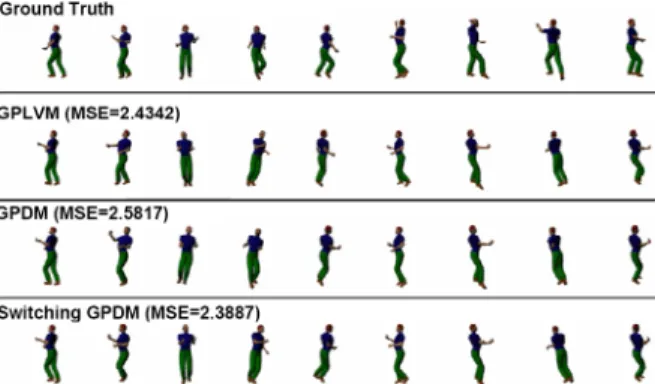
We consider 3D motion capture data from the CMU MoCap database (http://mocap.cs.cmu.edu). The posexis composed of 59 joint angles of human body. We study the performance of Switching GPDM (Fig.1(f)) for two differ-ent motion activities: salsa dance and exercises and quan-titatively compare it against two state of art techniques, GPLVM [6] and GPDM [12].
For salsa dance, we roughly segment the sequence into 3 primitive motions: turn clockwise, turn anticlockwise and miscellaneous motion (e.g., move fwd/bwd, twist body). We use two synchronized camera views at front and side, and for each silhouette image, we take 10-dim PCA fea-tures and 10-dim moment feafea-tures [10]. The test prediction
errors (MSE) and the selected frame results are shown in Fig.4 for the three techniques.
Figure 4. Salsa dance motion tracking results and tracking errors for three techniques.
The challenging exercise motion consists of 6 differ-ent primitive motions: jumping jack, turn-torso, turn-arms, hand-to-foot, knee-to-elbow, squat-up. We use the front-view silhouette images for measurement, where we ex-tracted the 10-dim PCA features and the 10-dim moment features. The test prediction errors and some selected syn-thesized images are shown below in Fig.5.
Figure 5. Exercise motion tracking results and tracking errors for three techniques.
Both Figures 4 and 5 show that the proposed Switch-ing GPDM can switches automatically among different dy-namics, and outperforms GPLVM and GPDM visually and quantitatively. The performance improvement is especially significant for the more complex exercise motion sequence. 4.2. Facial Feature Tracking and Expression/Pose
Recognition
We can easily apply the Switching GPDM to the simul-taneous facial feature tracking and facial expression/pose recognition problem. Here we track 28 facial feature points
(X) on the face (as shown in Fig.6), and the switching variables (S) now have explicit meaning of facial expres-sion (neutral, surprise, happy, disgust and fear, as shown in Fig.7) and/or the out-of-plane facial poses.
Figure 6. 28 facial feature points around eye, eyebrow, nose and mouth.
Figure 7. Five face expressions as the switching states.
Different from the silhouette measurement in human body motion tracking, we extract the Gabor features around the facial feature points as our measurement. Hence, we use the Switching GPDM in Fig.1(e) for facial feature track-ing, and directly model the observation likelihoodp(vt|xt) based on an off-line trained Gabor template matching:
p(vt|xt) =p(vt|xt, It,T)≈eSa(G(xt,It),T) (16) where,G(xt, It) is Gabor feature extracted from the cur-rent image It, T is the off-line trained Gabor template.
Sa(•,•) ∈ [−1,1]is the similarity functions which com-pares two Gabor features. (More details about Gabor fea-ture extraction and matching can be found in [14]).
Since the observation likelihood is directly defined, the learning process of Switching GPDM becomes independent of the image observations. Given the labeled facial feature point positions and expressions: {xt, st}Tt=1, the model is
learned by the method given in section 3.3.1.
With this model, facial feature tracking and facial ex-pression/pose recognition are performed simultaneously in a unified framework. Such a framework represents a sig-nificant change from most current practices, which tend to treat the two problems of facial feature tracking and fa-cial expressions separately and therefore ignore their inter-plays and inter-dependencies. Moreover, inference (sam-pling) in the low-dimensional latent space can improve the tracking accuracy with significantly reduced computational complexity.
In the experiments, we demonstrate the robustness of our model in terms of both facial feature tracking and
expres-sion/pose recognition performance on real videos under di-verse scenarios including low frame rate and low quality videos, and face with out-of-plane pose changes.
4.2.1 Facial feature tracking + Expression Recognition In this experiment, the model is trained on image sequences (each with length around 450) of one subject and then tests on the other sequences. 28 facial points and 5 expression expressions are manually labeled. We also down-sampled the sequence (sample every5thframe, the video frame rate is reduced from 30fps to 6fps), so as to simulate the low-frame rate videos.
The motivations for experimenting on low frame rate(LFR) videos include: (1) LFR tracking is more chal-lenging for previous trackers which assume thatxtis quite close toxt−1(2) Because the dynamic model of the
switch-ing state is trained by all the(st, st−1)pairs in the
train-ing data, reductrain-ing the lengths of equi-state segments might yield a better dynamic model. The tracking results are shown in Table 1:
Table 1. Tracking errors for different facial components for the proposed Switching GPDM (SGPDM) and the tracker in [11] based on Gabor feature and ASM under two different frame rates (without pose change)
Here, we compared with the state-of-the-art face tracker [11] based on the active shape model (ASM). We can see from the table, ASM-based tracker performs better than SG-PDM on HFR (30fps) video. However, for LFR video, the tracking performances of SGPDM and ASM based tracker become comparable. Meanwhile, the SGPDM also yields the expression recognition result. The recognition error is 42% for HFR video and 22% for LFR video. This verify the assumption that LFR produces a better GP dynamic model. 4.2.2 Facial feature tracking+ Expression/Pose
Recog-nition
Now, we take into account out-of-plane head poses. We roughly categorize pose into 3 groups: frontal, left, right, and deal with two expressions: neutral and happy. We form a switching state as a joint pose/expression, that is, we have
6 states (e.g., neutral-front). The tracking results are sum-marized in Table.2 and the expression/pose prediction errors are 33% for HFR and 29% for LFR.
Table 2. Tracking errors for different facial components for SG-PDM and the tracker in [11] based on Gabor feature and ASM under two different frame rates (with pose change)
From Table.2, it is clear that the proposed method signifi-cantly outperforms the state-of-the-art face tracker for every facial component for both low and high frame rate videos, especially for the low frame rate video.
To further investigate the performance of our method, we did the experiment with low resolution images. We run the low-resolution video experiments by imputing every (5×5) site by the pixel value of their upper-left pixel. The results are summarized in Table 3.
Table 3. Average tracking errors and expression/pose recognition accuracies (in parenthesis) for different image conditions.
Table 3 shows that for sequences with expression and pose change, the proposed method outperforms the ASM based tracker in every cases. In addition, we notice that while the expression/pose recognition of SGPDM is af-fected significantly by the low resolution image, the facial feature tracking errors are not affected as much.
5. Conclusion
In this paper, we introduce a dynamic model that can simultaneously address two problems in motion tracking, namely tracking complexity and tracking composite mo-tions. Based on combining Gaussian Process Dynamic Models and switching variables, the proposed SGPDM model can efficiently track composite motions with di-verse dynamics. The switching variables allows systemati-cally capture the interplays and dependencies between high
level motion patterns and the dynamics of each motion pat-tern. And the Gaussian Process Dynamic Models reduce modeling complexity by modeling the dynamics in a low-dimensional latent space, improving both tracking accuracy and efficiency. The proposed SGPDM is also more suitable for the problem of simultaneous tracking and recognition. Experiments with human body motion tracking reveal the improved tracking performance of the proposed technique over the state-of-the-art methods. Experiments with facial feature tracking also indicate that SGPDM is suitable for the problem of simultaneous tracking and recognition.
References
[1] F. Dornaika and F. Davoine. Simultaneous facial action tracking and expression recognition in the presence of head motion.IJCV, 2008.
[2] K. Grochow, S. L.Martin, A. Hertzmann, and Z. Popvic. Style-based inverse kinematics.SIGGRAPH.
[3] M. Isard and A. Blake. A mixed-state condensation tracker with automatic model-switching.ICCV, 1998.
[4] N. D. Lawrence. Probabilistic non-linear principal compo-nent analysis with gaussian prcess latent variable models.
Journal of Machine Learning Research (JMLR), 2005.
[5] J. M.Wang, D. J. Fleet, and A. Hertzmann. A gaussian process dynamical models for human motion. IEEE Trans. on Pattern Analysis and Machine Intelligence, (2):283–298, 2008.
[6] R. Navaratnam, A. W.Fitzgibbon, and R. Cipolla. The joint mnifold model for semi-supervised multi-valued regression.
ICCV, 2007.
[7] B. North, A. Blake, M. Isard, and J. Rittscher. Learning and classification of complex dynamics.PAMI, 2000.
[8] V. Pavlovic, J. M. Rehg, , T.-J. Cham, and K. P. Murphy. A dynamic bayesian network approach to figure tracking using learned dynamic models.IEEE International Conference on Computer Vision, 1999.
[9] C. E. Rasmussen and C. Williams. Gaussian Processes for Machine Learning. MIT Press, 2006.
[10] T.-P. Tian, R. Li, and S. Sclaroff. Articulated pose estimation in a learned smooth space of feasible solutions.
[11] Y. Tong, Y. Wang, Z. Zhu, and Q. Ji. Robust facial feature tracking under varying face pose and facial expression. Pat-tern Recogn., 2007.
[12] R. Urtasun, D. J. Fleet, and P. Fua. 3d people tracking with gaussian process dynamical models.CVPR, 2006.
[13] R. Urtasun, D. J. Fleet, A. Hertzmann, and P. Fua. Priors for people tracking from small training sets.ICCV, 2005.
[14] L. Wiskott. Face recognition by elastic bunch graph match-ing. IEEE Transactions on Pattern Analysis and Machine Intelligence, 19:775–779, 1997.
[15] S. Zhou, V. Krueger, and R. Chellappa. Probabilistic recog-nition of human faces from video.CVIU, 2003.
![Table 2. Tracking errors for different facial components for SG- SG-PDM and the tracker in [11] based on Gabor feature and ASM under two different frame rates (with pose change)](https://thumb-us.123doks.com/thumbv2/123dok_us/277472.2528549/7.918.112.443.526.687/table-tracking-errors-different-components-tracker-feature-different.webp)