Open Research Online
The Open University’s repository of research publications
and other research outputs
Big data academic and learning analytics: connecting
the dots for academic excellence in higher education
Journal Item
How to cite:
Chaurasia, Sushil S.; Kodwani, Devendra; Lachhwani, Hitendra and Ketkar, Manisha Avadhut (2018). Big data academic and learning analytics: connecting the dots for academic excellence in higher education. International Journal of Educational Management, 32(6) pp. 1099–1117.
For guidance on citations see FAQs.
c
2018 Emerald Publishing Limited Version: Accepted Manuscript
Link(s) to article on publisher’s website:
http://dx.doi.org/doi:10.1108/ijem-08-2017-0199
Copyright and Moral Rights for the articles on this site are retained by the individual authors and/or other copyright owners. For more information on Open Research Online’s data policy on reuse of materials please consult the policies page.
International Journal of Educational Management
Big data academic and learning analytics: Connecting the dots for academic excellence in Higher Education
Journal: International Journal of Educational Management
Manuscript ID IJEM-08-2017-0199.R1 Manuscript Type: Original Article
Keywords: Big data analytics, Academic and learning analytics, Business value, Higher education information management
International Journal of Educational Management
Big data academic and learning analytics: Connecting the dots for
academic excellence in Higher Education
1. Introduction
We are living in the era of Big data, flooded with “raw” data captured by billions of devices which further is “processed” to information useful for decision making. Big data is the hottest buzzword in Industry (Waller and Fawcett, 2013). Some scholars suggested Big data as to be the “the next frontier for innovation, competition, and productivity” (Manyika et al., 2011) and career as data scientist as "sexiest job of the 21st century (Davenport & Patil, 2012). The word “Big data” is defined as gigantic, complex, and real-time data that necessitates robust management of information and analytical techniques to extract meaningful insights (Daniel, 2015). Though there is no unanimous agreement on the characteristics and definition of Big data, the term “Big data” was primarily coined to manage, process and analyze the 5 Vs of data-linked dimensions and deliver sustained value by measuring performance and establishing competitive advantages (Fosso et. al., 2015). In conjunction with “Volume”, 5Vs consists of Variety (i.e., unstructured or structured formats of data), Velocity (i.e., the speed at which data is created), Veracity (i.e., disorderliness of data) and Value (i.e., the earlier unknown insights) (Davenport, 2014; Lee, 2017).
Increasing complexities in evaluating quality in services necessitates understanding service complexities in education where the students have to evaluate the intangible services for a prolonged period (Hart and Coates, 2011). In education institutes quality has different dimension. Quality of teaching methodology, teaching tools, teaching material, curriculum, projects, and research conducted to name a few. Higher Education Institutions (HEIs) are operating in an increasingly complex and competitive environment. Over the past 20 years, due to developments in information and communications technologies, academic revolution have taken place, which are exceptional in their comprehensive scope and stakeholders they affect (Williams, 2016). Academic institutions are under increasing pressure to react to national and international economic, social and political change. Phrases such as attaining knowledge & skills for the 21st century, developing 21st-century competencies, competing in the global economy, and career readiness could be found throughout the advocacy narratives and reports on education (Cator & Adams, 2013; Cope and Kalantzis 2016; Pincus, K. V., et al., 2017).
As compared to traditional classrooms, teaching and learning become even more challenging in online settings (like MOOC) where there are reduced teacher-to-student ratios, asynchronous interactions, and more heterogeneity. The answer to this developing complex picture of the contemporary relationship between designers, instructor and users are “data.” Data such as
Page 1 of 26 International Journal of Educational Management
1 2 3 4 5 6 7 8 9 10 11 12 13 14 15 16 17 18 19 20 21 22 23 24 25 26 27 28 29 30 31 32 33 34 35 36 37 38 39 40 41 42 43 44 45 46 47 48 49 50 51 52 53 54 55 56 57 58 59
International Journal of Educational Management
physiological data, user trace data, and other sensor data serves to build sets of “Big data” to equip designers and instructor about their users (Barakova et.al., 2013; Terzis et.al., 2013; Van Den Broek, 2013). Hence, Big data can help with the academic and learning analytics to understand learners well and help designers and instructor develop shared understanding and shape the work of design. Such data-driven market for academic institutions has now earmarked a new term: Academic and Learning analytics. Long & Siemens (2011) distinguish the terms academic analytics and learner analytics as the former reflects the use of data at the institutional level, whereas learning analytics centers in the learning process and the relationship between the learner, content, and educator.
Over the last two decades, India has extraordinarily transformed its higher education landscape. Next, to the United States and China, India’s higher education system is the third largest in the world. Going from two decades ago, India has created widespread access to low-cost, high-quality university education with 23 of its universities among the global top 200 (E & Y, 2013). Data and analytics gradually are being used by future teachers and institute administrators for enhanced teaching, learning, and academic excellence. Higher education policymakers also require a sound database for planning, policy formulation, fulfilling International Commitments, Research, etc. (Chen, 2014). Due to lack of sufficient evidence on how Big data analytics investment can pay off, it is tough for HEIs practitioners to realize value from the adoption of Big data analytics. A deeper understanding of value creation from Big data analytics will also subsequently result in reducing resistance to adopting Big data analytics and its ineffective use. This current study tries to find answers to the following research question: How HEIs can create value from Big data analytics?
To answer such research question, the study based our exploratory investigation on a theoretical model(Big data academic and learning analytics enabled business value model) to detail in what way Big data analytics capabilities can be developed and potential benefits which can be obtained by these analytics capabilities in HEIs. The study reports a specific set of benefit sub-dimensions matrix in the big analytics HEI context. By doing so, we expect the study to give HEIs a more current and all-inclusive understanding of Big data analytics and how it helps to transform HEIs.
2. Theoretical foundation for deriving Big data academic and learning analytics enabled value creation model
Big data analytics architecture can be considered as a specific technical IT resource characterized by a set of components that leads to sustainable competitive advantage (Goes, 2014; Mcafee & Brynjolfsson, 2012). Each Big data analytics architectural component is used to transform higher education data from various sources into meaningful insights through Big data analytics tools. Big data analytics architecture is loosely encompassed of five main architectural layers: data;
Page 2 of 26 International Journal of Educational Management
1 2 3 4 5 6 7 8 9 10 11 12 13 14 15 16 17 18 19 20 21 22 23 24 25 26 27 28 29 30 31 32 33 34 35 36 37 38 39 40 41 42 43 44 45 46 47 48 49 50 51 52 53 54 55 56 57 58
International Journal of Educational Management
data aggregation; analytics; information exploration; and data governance (Wang and Hajli, 2017).
Building on the Big data analytics architecture, each component could be rationally projected to have Big data application capability within higher education Institutes. Based on complexity of Big data (Lee, 2017) and competitive advantage (Goes, 2014; Mcafee & Brynjolfsson, 2012), four application area emerges. Each of these Big data analytics capabilities are expected to create the business value (Shang and Seddon, 2002; LaValle et.al, 2011). The study thus links the logical paths among the components of Big data architectural, Big data benefit matrix for HEI, and potential value created by these capabilities.
The abstraction of our model is demonstrated in the subsequent sections and subsections, the study briefly discusses on each Big data architectural component, followed detailed review of components of Big data analytics benefit matrix, and its business value.
3. The constructs of Big data academic and learning analytics enabled value creation model
3.1 Big data analytics architecture
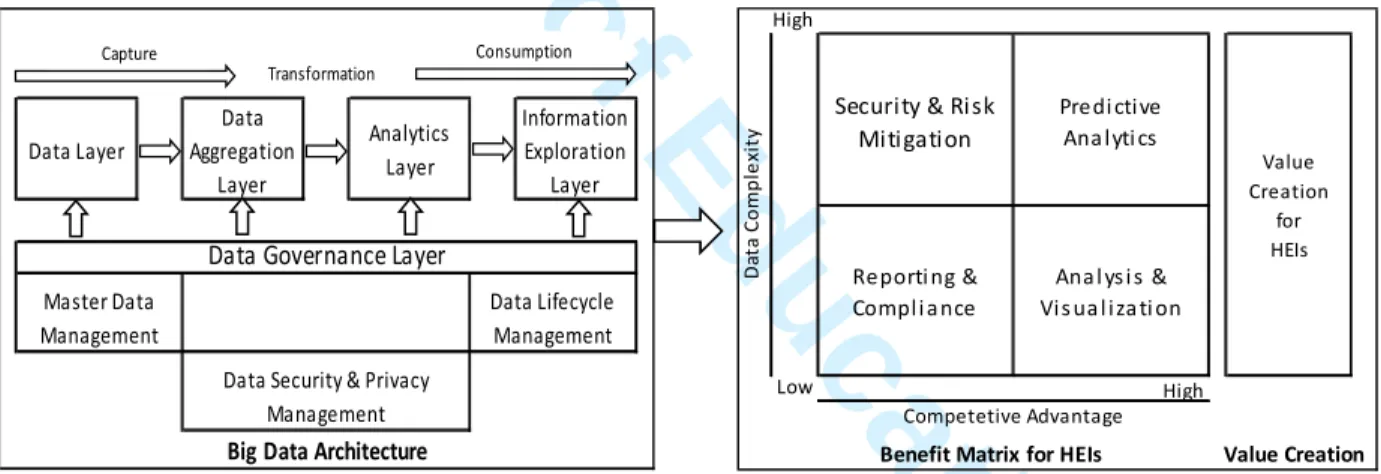
Data layer comprises of data sources required to offer insights to support routine operations and resolve any business problems. Data aggregation layer is accountable for data management arising from various data sources. Variation of incoming data is one of the main obstacles to implementing Big data analytics. As the data could be from various communication channels, sizes, formats and frequencies, the main objective of data acquisition layer is to read data provided from this variety. For example, structured data (e.g. electric record extracted from Learning Management System) and consequently altered into a particular standard data format (e.g. student’s name, gender, and other demographic data). Analytics layer helps HEIs analysis of data for the purpose of optimizing learning and the environment in which it occurs (Daniel, 2015). Information exploration layer provides outputs such as real-time information monitoring reports, visualization reports deriving meaningful business insights. Data governance layer consists of master data management, data lifecycle management, and data security & privacy management. Master data management is considered as the governance, policies, standards, processes, and tools for management of data. Data life-cycle management is the procedure for management of information throughout its lifecycle (e.g. archiving data, maintaining data warehouse, testing and delivering data to various application systems, to disposing of data). Data security and privacy management is the platform to provide enterprise-level data for monitoring, auditing, and protection (Hosangadi, 2014).
These layers form the Big data analytics inclusive architecture that accomplishes required functions, and so empower HEIs administrators to understand and appreciate ways for Big data
Page 3 of 26 International Journal of Educational Management
1 2 3 4 5 6 7 8 9 10 11 12 13 14 15 16 17 18 19 20 21 22 23 24 25 26 27 28 29 30 31 32 33 34 35 36 37 38 39 40 41 42 43 44 45 46 47 48 49 50 51 52 53 54 55 56 57 58 59
International Journal of Educational Management
implementations and transform the higher education data from various sources into meaningful information.
Big data analytics architecture is embedded in the idea of data life cycle framework that leads from data capture to data transformation and concludes with data consumption (Wang and Hajli, 2017).
3.2 Big data analytics business value
The outcome of value is derived by cost benefit analysis (Ravald and Grönroos,1996). In its most rudimentary sense, some form of change is echoed by value creation , such as increased productivity, increased service quality, cost reductions, or improved reliability (Normann and Ramirez, 1998). Grönroos (2012) considers value as actionable information that splits into direct and indirect levels. Potential direct benefits from Big data analytics include operational benefits, IT infrastructure benefits, managerial benefits, organizational benefits, and strategic benefits (Shang and Seddon, 2002). Indirect value creation in HEIs includes vendors enhanced understanding of problems, enhanced understanding of operations, enhanced team coordination, perceived service quality knowledge and broader knowledge base allows for a better understanding of activities and issues. LaValle et al. (2011) categorized Big data analytics capability into three levels: aspirational, experienced, and transformed. Aspirational and experienced analytics capabilities focus on using technologies to attain a cost reduction and operation optimization. Whereas the purpose of transformed analytics capability is to drive customer profitability and make planned investments in niche analytics.
For efficient utilization of such diversified Big Data Analytics (BDA) capability, organizations need to make a trade-off of balancing speed with cost and acceptance. Organizations first need to decide if they will develop internal resources to construct analytic models or utilize external vendors. Complex but even best of analytics tools and systems may be underutilized and unproductive in utilizing appropriate data (Chen, 2014). Training is necessary when integrating Big data within the organization (Daniel, 2015). Education to IT teams that support database architectures within HEIs can act as a primer for BDA initiatives (Landon-Murray, 2016). When a small change got positive results, organizations can build upon their capability to initiate larger full-scale changes (Court, 2015). Data frameworks should be strategically planned to prioritize internal and external resources and align these with the Institution’s overall goals (Kiron, 2013; Ward et.al, 2014).
3.3 Reporting and compliance
One of the key requirements of higher education institutions is compliance with all legal & regulatory requirements. Administrators are required to provide reports to both internal (pupils, staff, and governors) and external (government, regulators, voluntary organizations and
Page 4 of 26 International Journal of Educational Management
1 2 3 4 5 6 7 8 9 10 11 12 13 14 15 16 17 18 19 20 21 22 23 24 25 26 27 28 29 30 31 32 33 34 35 36 37 38 39 40 41 42 43 44 45 46 47 48 49 50 51 52 53 54 55 56 57 58
International Journal of Educational Management
reporters, etc.) stakeholders. Firms interested in creating BDA capabilities must integrate their internal and external data (Daniel, 2015). HEIs are required to provide data & reports related to teaching and learning, curricular aspects, student achievement and academic progression, faculty research & productivity, technology transfer, innovation, and governance, etc. For example, institutions are required to maintain and analyze data for students; these include personal information, attendance records, academic records, disciplinary incidents, various academic evaluation results, hobbies, career goals and attitudes toward self and University (Shah et.al, 2014).
Academicians in HEIs have access to many data points required for personalized learning; but scarcity of interoperability amongst the systems averts them from utilizing data to drive instruction (Cope and Kalantzis, 2016). HEIs along with its paper records, increasingly rely on computers and applications that collect and maintain and manipulate digital data and images. Academicians frequently use standardized examination scores and benchmark this data for their session planning, but, such standardized examination score is not capable of giving instant “actionable feedback” to the students (Cator & Adams, 2013, Bienkowski et al., 2014).Teachers have their personal physical records of student experiences and also their own mental records of each student’s strengths and weaknesses. However, most of these records are not easily transferrable or quickly analyzable. Even though instructor and learners are collaborating, no one, including the administrators, and the policy makers had any systematic large-scale technique to monitor true academic and learning outcomes(Daniel, 2015; Cope and Kalantzis, 2016).
Higher education institutions require dynamic information framework that would assist to develop transparency, provide data for academic leadership, create data sources and exposes isolated information. Automated platforms (Learning Management Systems) can conduct various automated audits of high-risk areas, and provide information to the campus regarding changes in laws and regulations (Hosangadi, 2014). It can replace the hard copy by rationalization and automate data and information collection processes. Big data analytics can simplify access to fragment various automated platforms for higher education Institutions. It can easily categorize at summary and detail sublevel like Institute or department level, institution, selected time periods or any such various pre-defined categories based on the requirement for reporting and compliance.
3.4 Analysis and visualization
Big data analytics has the potential to prepare organizations with all the tools they require to utilize the enormous heterogeneous data, information, and knowledge that organization’s usually collect (Bardhan et.al, 2015; Basole et al., 2015; Bates et.al, 2014), and upkeep an extensive variety of HEIs functions at a lower cost, and develop a new strategies for academic transformation and excellence.The developing work on BDA has acknowledged a positive association between the implementation of analytics and firm performance (Germann et.al.,
Page 5 of 26 International Journal of Educational Management
1 2 3 4 5 6 7 8 9 10 11 12 13 14 15 16 17 18 19 20 21 22 23 24 25 26 27 28 29 30 31 32 33 34 35 36 37 38 39 40 41 42 43 44 45 46 47 48 49 50 51 52 53 54 55 56 57 58 59
International Journal of Educational Management
2014). BDA have motivated firms to develop advanced statistical model and design of mechanisms for academic transformation. With a plethora of course to be offered on traditional and online platforms in the near future, scholars have initiated to take data mining methods based on Big data to study student behavior (Daniel, 2015; Williams, 2016).
Big data can be classified into five distinct types: web and social media, machine-to-machine, big transaction data, biometrics, and human generated data (Soares 2012, 2013).Web and social media consists of clickstream and social media data from Facebook, Twitter, LinkedIn, blogs etc. Machine-to-machine data includes technologies that allow wired, wireless, or hybrid systems to interconnect with other devices such as RFID readings and utility smart meter readings. Biometric data refers to the automatic identification of any individual based on his or her behavioral or anatomical traits or characteristics such as face, fingerprint, a voice pattern etc. Big transaction data includes healthcare claims, call detail records etc. Finally, human generated data consists of call center agents’ notes, email, voice recordings, surveys, paper documents etc. For HEIs, daily reports on the help desk, maintenance statistics, capacity, bandwidth usage, security and other concerns relating to campus infrastructure and operations can be used to create customized automated dashboards to support critical decisions. For example, Institutions can correlate internet usage with IP addresses and monitor bandwidth consumption, to recognize the top trafficked internet destinations. In this way, institutions can make a routing instruction to navigate traffic onto inexpensive lines. As a result, instead of upgrading, institutions would have a low-cost alternative, saving thousands of dollars per month.
On the same lines, HEIs can see predefined visualizations reports for Revenue, Research Expenditure, Graduation Rates, Peer Data, Grievances, Student Debt, Tuition Fees and much more. Analytics can support institutions to statistically benchmark themselves with other comparable institution for today or future management information reporting.
3.5 Risk and security
While the welfares of Big data got the potential to reach diverse functions in HEIs and its stakeholder’s life in the digitized world, this also presents a far greater threat to security and privacy risks (Dhar and Mazumdar, 2014). Security and privacy concerns have been mentioned as one of the hindering factors in Big data adoption (Rubel and Jones, 2016). With cyber-security still in its evolving phase, globalization brought substantial challenges for the HEIs of developing countries, like India. Cyber security is dedicated to defending the confidentiality, privacy, and integrity of digital data stored on internal networks and/or over the Internet. With cyber-attacks becoming more sophisticated than before, cybersecurity safeguard like intrusion detection systems, firewalls, and other such systems, are of significant importance for individuals, government, and corporations alike (Babiceanu and Seker, 2014).
Page 6 of 26 International Journal of Educational Management
1 2 3 4 5 6 7 8 9 10 11 12 13 14 15 16 17 18 19 20 21 22 23 24 25 26 27 28 29 30 31 32 33 34 35 36 37 38 39 40 41 42 43 44 45 46 47 48 49 50 51 52 53 54 55 56 57 58
International Journal of Educational Management
Institutions that are conversant with the security protocols applicable in shielding their structured data, but their experience may be lacking with the unstructured data, (Kshetri, 2014). The movement to cloud-based IT resources is still not common in HEIs due to several roadblocks including legal policies, security, and implementation. Although the tools are easily available, a lot of customization is required for education domain w.r.t control algorithms, new integration architectures, and important is the willingness and enthusiasm of the stakeholders in higher education (Chen et.al., 2014). Most of the prevailing technologies did not take the whole process of data security lifecycle henceforth jeopardizing the Big data environment (Dong et. al., 2015). Data analytics for investigating security and risk, appear to be the appropriate components for operation virtualization and thus giving organizations a capability to move operations closer to the cloud paradigm (Babiceanu and Seker, 2015). Risk and security analysis and its planning can be done from many perspectives including services points, infrastructure, and decision support solutions (Dong et. al., 2015; Rees et al., 2011).
As HEIs may not have the complete expertise and competency in crafting a Big data architecture, there may be a need to get an outsource partner for some tools or applications that support data storage, sharing and access (Jagadish et.al., 2014). Although such service providers and other third-party tools vendors are critical for creating and capturing the value of Big data, it requires a further consideration for HEIs on security and privacy. Thus, to get intended benefit of Big data along with protecting data from security breaches, organizations are required to make modifications in their value chain and even need to innovate their business model (Buhl et.al, 2013). Besides technological inability, the challenges may also arise from organizational culture. A Big data governance program may be required for organizations to act by governmental cyber and society’s ethical regulations (Chang, 2015).
3.6 Predictive analysis
Predictive analytics is used to make predictions about unfamiliar future events. Predictive analytics have been used in a wide variety of settings in higher education. As the Big data uses automated algorithms to replace human decision-making (Manyika et al., 2011), learning analytics had replaced tables of data with dashboards that gives immediate feedback about student needs, academic goals, and targets (Chen, 2014). Learning analytics had taken many academic decisions out of the monarchy of human judgment and reduced it to figures and statistics (Long & Siemens, 2011). Learning analytics has significant positive implications for pedagogy, curriculum, and assessment decisions, typically made at the policy, university, or classroom level by policy makers, administrators, and academicians.
Most of the traditional academic initiatives were usually a one-size-fits-all solution. However, now when significant student activities are online, the prospects for detailed analysis with data mining approaches to understand student behavior are far greater (Blikstein, 2011; Strang, 2016). In addition to demographic and academic data, measuring and collecting data on non-cognitive
Page 7 of 26 International Journal of Educational Management
1 2 3 4 5 6 7 8 9 10 11 12 13 14 15 16 17 18 19 20 21 22 23 24 25 26 27 28 29 30 31 32 33 34 35 36 37 38 39 40 41 42 43 44 45 46 47 48 49 50 51 52 53 54 55 56 57 58 59
International Journal of Educational Management
factors, and inter and intrapersonal skills or affective data holds even strong prospects (Cator & Adams, 2013; Williams, 2016).
Each student’s learning behavior (or engagement) can modeled independently as each student hold certain levels of seeking (question asking) and disseminating (question answering) inclinations for the course. Learning analytics based models can have many algorithm for identifying appropriate time when students are prepared to go to the next topic; Identifying students that are lagging behind in a course; for identification of students with high probability of dropping out of the course before its completion ; probability of performing poor on exams/quizzes; for recommendations of discussion participation with faculty/counsellor and of specific peer grading allocations; for personalization of the content delivered to each student; what score a student is likely to get without interference from faculty; and what is the next best course for a given student (Brown et.al, 2009 ; Limongelli et.al., 2009; Macfadyen & Dawson, 2010; Long & Siemens, 2011; Bienkowski et.al., 2014; Meier et.al., 2016).
Figure 01- Big data Academic and Learning Analytics Enabled Value Creation Model
4.Research Design
For this exploratory study, a qualitative research design was employed. The “inquiry process” expedited by a qualitative research approach provided an opportunity to triangulate primary and secondary source materials from the literature review. Native category approach is used as our research methodology as it avoids investigator historical bias by successively and gradually eliminating the investigator from the direction of the interview process. The methodology is intended to force respondents into open-ended deliberations with the investigator, fixing future inquiry by questioning key comments made by the respondent. This technique of qualitative research proves particularly appropriate when the phenomena to be researched are not accurately understood, and researcher desires to get perspective from respondents experiencing the phenomena (Strauss and Corbin, 1990).
Data Layer Data Aggregation Layer Analytics Layer Information Exploration Layer
Data Governance Layer
Master Data Management
Data Lifecycle Management Data Security & Privacy
Management
Big Data Architecture
Transformation
Capture Consumption
High
Security & Risk Mitigation Pre di cti ve Ana l yti cs Re porti ng & Compl i a nce Ana l ys i s & Vi s ua l i za ti on Low High D a ta C o m p le x it y Competetive Advantage Value Creation for HEIs
Benefit Matrix for HEIs Value Creation
Page 8 of 26 International Journal of Educational Management
1 2 3 4 5 6 7 8 9 10 11 12 13 14 15 16 17 18 19 20 21 22 23 24 25 26 27 28 29 30 31 32 33 34 35 36 37 38 39 40 41 42 43 44 45 46 47 48 49 50 51 52 53 54 55 56 57 58
International Journal of Educational Management
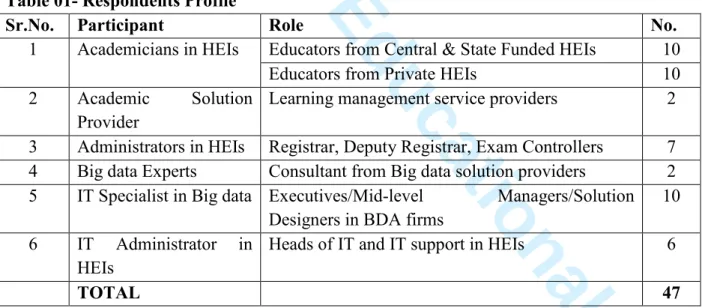
The research requires respondents having a thorough understanding of our interest, with diverse perspectives. Purposive sampling in qualitative research enables respondents for selecting experience congruent with the research objective (Guest et al., 2006). Semi-structured interviews were conducted with 47 case descriptions covering 26 higher education Institutions. The respondents include academicians, Academic Solution Provider, Administrators, Big data Experts, IT Specialist in Big data and IT Administrator in HEIs. All respondents had more than a decade experience in respective domain area. Academic leaders were selected as both practitioners and managers of Big data analytics initiatives in HEIs. According to Jongbloed et al. (2008), professors got a status as “definitive stakeholders,” with attributes of legitimacy, power, and urgency (p. 310). Five academic respondents also had some experience in an international context. Participants were chosen carefully on the basis of their profile, willingness to participate in the research, along with contextual factors of each institution. The study intended to ensure “the maximum variation sampling” (Patton, 2000). Based on specified criteria which Hopkin (2004) refers to frame factors, the study ensured representation from mature (the traditional elaborate higher education systems of developed states), evolving (younger higher education systems) and embryonic (higher education systems that are at the early stage of development) institutions.
Table 01- Respondents Profile
Sr.No. Participant Role No.
1 Academicians in HEIs Educators from Central & State Funded HEIs 10 Educators from Private HEIs 10 2 Academic Solution
Provider
Learning management service providers 2 3 Administrators in HEIs Registrar, Deputy Registrar, Exam Controllers 7 4 Big data Experts Consultant from Big data solution providers 2 5 IT Specialist in Big data Executives/Mid-level Managers/Solution
Designers in BDA firms
10 6 IT Administrator in
HEIs
Heads of IT and IT support in HEIs 6
TOTAL 47
The interviews were informal, and included open-ended questions. The researcher used a uniform semi-structured interview guide. The interviews were focused on respondents on their current big data infrastructure, current benefit deriving from their respective domain area and potential business value and challenges for big data analytics success. For example, in the interviews with IT-specialists and IT Administrator were more focused on technical, privacy and security solutions. In the same way, the interviews with administrators were on regulations, reporting, and compliances. Interaction with Academic Solution Provider, Big data Experts and
Page 9 of 26 International Journal of Educational Management
1 2 3 4 5 6 7 8 9 10 11 12 13 14 15 16 17 18 19 20 21 22 23 24 25 26 27 28 29 30 31 32 33 34 35 36 37 38 39 40 41 42 43 44 45 46 47 48 49 50 51 52 53 54 55 56 57 58 59
International Journal of Educational Management
IT Specialist in Big data were more focused on current status and future development in Big data. With the faculty, researcher addressed current applications and challenges of Big data in teaching and learning. During these interviews, we took notes and wrote down key quotations. After each interview, descriptive summaries were made of what had been said. The informal nature of the interviews provided us with an opportunities to collect continuous feedback on the primary results, hence increasing the validity of results (Eisenhart & Graebner, 2007; Yin, 2009). Table 1 shows the distribution of respondents for all interviews. The diversity of respondents provided us with a broad view of understanding the Big data initiative in HEIs in India.
5. Data analysis
Data collected was analyzed through pattern matching technique (Yin, 2009). Data was organized around topics (Hartley, 2004) corresponding to the four main subsections of our Big data academic and learning analytics enabled business value model (i.e reporting & compliance, analysis & visualization, risk, and security; predictive analysis) along with one additional dimension of business value. An initial division was made between describing how traditionally data is utilized across these broad dimensions, i.e. four broad application areas and Big data capability and business value, and data regarding the change, i.e. changing dynamics of use of data in HEIs. This is based on the assumption that the four main categories of our Big data application matrix lead to a positive change in HEIs and create value.
The data coding was made for determinants of big data across our proposed theoretical model, to capture information on the prevailing ability or big data initiatives and the developing changes and thought process on big data academic and learning analytics in HEIs. During informal interviews, a large amount of data was collected contributing to our understanding of the context. Information that was not substantially providing direct answers to the formulated research questions of explaining potential benefit of big data analytics and business value, were excluded from the analysis. Only information related to big data architectural component, big data analytics benefit matrix, and its business value were considered for further analysis. The data related to each subsection was analyzed to identify patterns (Yin, 2009). Several pieces of such information were analyzed to relate with the theoretical proposition (proposed model). If the entire pattern of results across these multiple cases is found, in the aggregate, it would provide substantial support for the initial proposition. These analyzed patterns provided the basic building blocks for the findings. To increase generalizability, the findings were compared with previously developed theory, also referred to as analytical generalizability (Meyer, 2001; Yin, 2009). These perspectives are presented in the subsequent section of findings.
6. Findings
Page 10 of 26 International Journal of Educational Management
1 2 3 4 5 6 7 8 9 10 11 12 13 14 15 16 17 18 19 20 21 22 23 24 25 26 27 28 29 30 31 32 33 34 35 36 37 38 39 40 41 42 43 44 45 46 47 48 49 50 51 52 53 54 55 56 57 58
International Journal of Educational Management
Our study provides several indications of current underutilization and potential use of Big data academic and learning analytics in HEIs. From the study, it is evident that most of the HEIs are utilizing their current tools and infrastructure for mainly reporting & compliance and analysis & visualization. There is limited use of data for maintaining security & risk. Use of predictive analysis in teaching and learning is almost missing for all cases. The study suggests potential use across all four main categories of our Big data academic and learning analytics model leading to a create enhanced business value for HEI.
Reporting and Compliance
In this study, we have identified three major findings. First, reporting and compliance are one of the major rationales for HEIs moving towards Big data initiatives. Second, use of Big data analytics tools had significantly impacted the current governance of higher education Institutions. Lastly, most of the HEIs are into BDA with a very low expectation, limited to reporting and compliance. HEIs would not realize true value when their benefit expectation are limited to just compliance reports.
Reporting and Compliance as top priority for HEIs
One significant change driver in higher education data has been the multiple governments mandated regulations urging academic institutions to implement electronic record (EHR) technology. Administrators are required to provide reports to both internal and external stakeholders. Prospective students now select a particular university based on feedback received directly from other current students on various forums and star accreditations. Higher education administrators are concerned over the accreditors grading. Institutions are also mandatorily required to comply with regulations regarding opening a university/college; offering a course; getting accredited, Human Resources, Quality Assurance, Governance, and Infrastructure. A senior academician noted the significance of sophisticated data requirement by HEIs.
The multiple governments' mandated regulations, accrediting and rating agencies data requirements had pushed us hard to implement electronic record based technology.
BDA had equipped most of higher education institutions with dynamic information framework that subsequently had led to more transparency and accuracy of information. The sophistication of data had enabled HEIs to easily categorize at summary and detail sublevel, based on the requirement for reporting and compliance.
We can easily categorize at summary and detail sublevel like an institution, department level, even course/program or student level, for any selected time periods or any such various pre-defined categories based on any requirement for reporting and compliance. Big data expert Institutions are required to maintain and analyze huge data related to teaching and learning, curricular aspects, student achievement and academic progression, faculty research &
Page 11 of 26 International Journal of Educational Management
1 2 3 4 5 6 7 8 9 10 11 12 13 14 15 16 17 18 19 20 21 22 23 24 25 26 27 28 29 30 31 32 33 34 35 36 37 38 39 40 41 42 43 44 45 46 47 48 49 50 51 52 53 54 55 56 57 58 59
International Journal of Educational Management
productivity, technology transfer, innovation, and governance, etc. Big data analytics tools are required to conduct various automated audits of high-risk areas and provide information to the campus regarding compliances with changed laws and regulations. A senior administrator at privately funded HEI noted.
Automation had replaced hard copy by rationalization and information collection processes for a myriad of our data.
A Big data expert also expressed his focus on the quality of data:
No data is better than inconsistent or wrong data.
The modern technology/automated platforms had created the capability and knowledge of creating, implementing and maintaining data file structures in databases, how to implement new methods of data distribution, data flows throughout the organization, data extracting procedures and analytics methods
Reporting and Compliance leading to change
With the ever changing legislation and the potential value that can be produced from EHR systems, there is mindset shift amongst higher education institutions. Big data analytics can simplify access to fragment various automated platforms for higher education Institutions. An administrator noted the importance of data interoperability.
Fragmentation of data dilutes the value of data transferred between different systems and departments of an academic institution that cannot communicate well with each other. As a result, incomplete and inaccurate data was a common occurrence when data used to move across different networks or applications.
An academician, also taking care of quality assurance initiative in university added with a point:
Human errors and lack of data format consistency across the departments impacts the quality and accuracy of data.Standardization of data is must and is the foundation in data-driven era.
The purpose of the information required by almost all internal and external stakeholders are same, i.e. quality assurance and sustenance initiatives these HEIs.
All compliance, rankings and accreditation reports intend to get the same data in different formats. Automated platforms had made our administrative work much smoother and
synchronized. An academician.
On the concern of collecting and managing huge data, an IT administrator from HEI added:
Comprehensive databases are being built to house myriad academic and nonacademic data points on students and teachers.
Page 12 of 26 International Journal of Educational Management
1 2 3 4 5 6 7 8 9 10 11 12 13 14 15 16 17 18 19 20 21 22 23 24 25 26 27 28 29 30 31 32 33 34 35 36 37 38 39 40 41 42 43 44 45 46 47 48 49 50 51 52 53 54 55 56 57 58
International Journal of Educational Management
Most of the universities keep records of students data (data includes student names, demographic information, grades, test scores, discipline history, attendance records, graduation requirements), but it is not all stored in one place. Few records are not even stored for a longer duration.
Typically, most of the data was not saved beyond five years due to a large amount of storage required for paper records. Use of technology and automated platforms (learning management system) had increase transparency and efficiency. An administrator.
Analysis and Visualization
Competitive insight for sustenance & excellence
Higher education data sources are shifting and steadily increasing from multiple locations. The information that is gathered from the various stakeholders through online surveys is utilized for current Institution status and future planning. With the transparency that the web and analytics tool brings, stakeholder supplied feedback can be a valuable source of data for HEIs eyeing to recognize opportunities within their system.
We see advanced analytics as a key to higher education reform and the design of true “Teaching
and Learning Intelligence.” Academician.
Learning analytics allowed tables of data to be replaced with automated and interactive dashboards that show data about goals and targets. These complex analyses and real-time visualizations are deemed necessary by administrators and academicians who want immediate feedback about student needs and goals (Haythornthwaite, de Laat, & Dawson, 2013).
With such a large-scale information exchange, data gets to the right place at the right time enabling better data-driven decision making at the point of care. Administrator
An academician focused on the importance of using analytics tool for teaching and learning
Information management in HEIs refers to the quality, reliability, and timeliness of data. These are significant factors when making strategic, operational or tactical decisions.
Similarly, an IT administrator also expressed his concern over data volume and velocity
Academics data sources are changing and steadily increasing from multiple locations. Summarizing anyone dimensions requires a birds eye view, which was very difficult for all of us.
Analysis and Visualization Myopia
Data integration from various sources and data points is still a major concern for enhanced visualization.
Page 13 of 26 International Journal of Educational Management
1 2 3 4 5 6 7 8 9 10 11 12 13 14 15 16 17 18 19 20 21 22 23 24 25 26 27 28 29 30 31 32 33 34 35 36 37 38 39 40 41 42 43 44 45 46 47 48 49 50 51 52 53 54 55 56 57 58 59
International Journal of Educational Management
While my students and I are engaged in the classroom, other stakeholders, including the head of department and Institution, and the government and/or state education officials have no organized large way to monitor & measure outcomes, other than grade sheet. An academician. An administrator showed his concern over fragmented data
Technology has changed our teaching over the past 70 years, but our process for documenting and accessing data is still created in silos. Information is not networked or integrated across departments and faculty.
As many institutions are looking forward toward online platforms, an administrator expressed his concern over visualization reports from new data sources.
Online content (for digitized curriculum, online support linked to the curriculum, virtual schools, and online staff development) is another area, many of us are expanding into, but we are not sure these tools would discover information on such learner-produced and individually identifiable data.
Security and Risk Mitigation
Balancing work commitment or proactive work
Institutions that can take the time and efforts to focus and strengthen all data points within their governance system can further improve on their security and risk mitigation.
We have to look at lots of concerns in Integration and Management of data. One such implementation decision requires a myriad of background checks for ethical, legal, security and risk compliances. IT specialist in Big data
There are lots of existing IT infrastructural issue related to data acquisition, transformation, ownership, governance, usage, and ethical issues. One IT administrator added.
Most of our time is spent in managing internet network abuse and security violation, along with routine work of ensuring seamless user experience of our IT infrastructure.
Similarly, an IT administrator expressed his concerns.
We got other important IT priorities than Big data analytics strategy & roadmaps!
Predictive Analytics A potential game changer
As learning management systems and other tools push for more student’s engagement, there is abundant opportunity to harness technology to not only record vital information but guide students on how to improve their learning.
Page 14 of 26 International Journal of Educational Management
1 2 3 4 5 6 7 8 9 10 11 12 13 14 15 16 17 18 19 20 21 22 23 24 25 26 27 28 29 30 31 32 33 34 35 36 37 38 39 40 41 42 43 44 45 46 47 48 49 50 51 52 53 54 55 56 57 58
International Journal of Educational Management
Leveraging analytics can help us significantly improve on institutional effectiveness and student success. Big data expert
An IT specialist in Big data expressed his concern over no existing comprehensive solution on measuring true learning.
No comprehensive model to identify at-risk students (apart from test score) for interventions targeted to their individual needs to help them achieve better outcomes
Prospective student’s micro-targeting now guides major aspect of modern advertising. It enables advertising campaigns to allocate their field resources very efficiently along with creating innovative ways to discover and turn out new and prospective applicants. It also supports new ways of delivering individualized messages using both old media (direct mail, phone calls, etc.) and new media (targeted e-mail, social networking services, etc.). Thus, prospective applicant micro-targeting depends on very reliable predictions about applicant’s preferences, intentions, and beliefs.
A lot is happening in this regards internationally. It’s on our agenda, but right now we are more focused on other things( accreditation, compliance, brand building). An administrator
Lacks expertise in understanding Predictive Analytics
As I teacher I have access to various systems that house many of the student's data points, however the lack of interoperability among the systems and any structured guideline by university prevents me from using data to drive and create value for students.
The information system processes should be consolidated under one universal system to increase ease of access. An academician further added his concern over the integration of data.
I have physical and electronic records of student and also my mental records of each student’s strengths and weaknesses. However, I am unable to give precise, immediate “actionable feedback” to my students due to lack of integration of all these three.
Huge data is generated from video content (individual clickstream events are captured) and data from discussion forums, all threads, posts, comments, and votes, peer grading allocations.
The developments around us are pushing hard to incorporate more and more technology; it becomes even more challenging to visualize evaluating true learning in online settings (like MOOC) where there are much smaller teacher-to-student ratios, asynchronous interactions, and more heterogeneity to begin with.
Business Value
Page 15 of 26 International Journal of Educational Management
1 2 3 4 5 6 7 8 9 10 11 12 13 14 15 16 17 18 19 20 21 22 23 24 25 26 27 28 29 30 31 32 33 34 35 36 37 38 39 40 41 42 43 44 45 46 47 48 49 50 51 52 53 54 55 56 57 58 59
International Journal of Educational Management
Big data to bigger impact
Use of Big data academics and learning analytics is acknowledged as an ability leading to a sustainable competitive advantage in the Big data environment in higher education institutions. It got the capability to support a wide range of HEIs functions at a lower cost, and develop a new portfolio of strategies for academic transformation and excellence. A Big data expert noted.
Use BDA intelligence got the potential to achieve multiple aims of education by improving the student's experience and quality of learning and reducing the per capita cost of education.
An academic solution provider expressed his views on business value from Big data
Addition to student engagement there is ample opportunity to utilize technology not only to record vital information but guide students on how to improve their academic performance.
Similarly, an academician added.
Because students differ in their preferences, interests, and background, and even goals for learning, there is an urgent need for user profiling through Big data analytics that can provide personalized learning environments for individual student or groups of students to maximize their learning effectiveness and efficiency.
On the use of BDA tool to attain operational optimization along with cost reduction, an administrator expressed his view.
Prospective student’s micro-targeting based on modeling their preferences, intentions, and beliefs gives us more ROI on our branding and advertising investments.
Change without overarching strategy
Use of BDA tools for reporting & compliances and analysis and visualization has an agreement by most of the stakeholders in higher education institutions. However, the study found out that application of risk & security and predictive analytics to higher education fields was still in its early stages of application. An academic solution provider expressed his concern.
Very less understanding Big data analytics as a business case. Most of them have wrong or very low expectations of Big data value proposition. All they want is various compliance reports to various accrediting, government and non-government bodies
Integrating data into routine operations requires concrete strategy action plans or efforts can fail. An academician noted.
A lot of development is happening in the world, but it seems like we got into a marathon race without proper training and strategy.
Page 16 of 26 International Journal of Educational Management
1 2 3 4 5 6 7 8 9 10 11 12 13 14 15 16 17 18 19 20 21 22 23 24 25 26 27 28 29 30 31 32 33 34 35 36 37 38 39 40 41 42 43 44 45 46 47 48 49 50 51 52 53 54 55 56 57 58
International Journal of Educational Management
Similarly, an academic solution provider further added.
Too frequent small changes in visualization reports are required by institution. Seems rather than strategic decisions they just want to optimize operational and tactical decisions
Institutions many times are in a dilemma with making a decision on utilizing internal resources to build analytic models or external vendors. Many Institutions contract with private companies for technology that enhances curriculum and provides technical support. In data analysis and management, firms can provide data from raw test score data to tools on making decisions to interpret that data. An IT specialist added.
They have the desire to analyze everything; however, costs can add up quickly.
Big data architecture required to create sustainable business value
To get real business value, The IT department and intuitions other resources have to get aligned with institutions strategic goals to meet growing data analysis demand and create future value. A Big data expert noted.
Just collecting huge data will never create value. Data must be analyzed to create value. They must have overarching BDA strategy with standardized processes, guidelines, methods, and best practices.
Institutions that have multiple systems to access data may find it difficult to bring information together in a meaningful and useful way. One IT administrator expressed his concern.
Our current IT infrastructure and network architecture limit options to upgrade or adapt technologies to growing our data and data analysis demands.
Similarly, one IT administrator added
Since most of the Institutions typically invest 2-8% of gross revenue on IT’s expenses, adding extra staff to create value from such systems post-implementation can be looked at by many as wasteful
Mind shift along with strategy shift
Investments into various IT deliver value along with performance aligning with their strategic purpose (Aral & Weill, 2007). Data analytics in higher education can play a major role in ensuring institutions ability to respond effectively to changes happening within and outside them and remain relevant to their purpose in the societies that they serve. A Big data expert noted
With the ever-changing regulations and the potential value that can be produced from BDA systems, there needs to be a mindset shift from viewing BDA as a support system to an IT business partner.
Page 17 of 26 International Journal of Educational Management
1 2 3 4 5 6 7 8 9 10 11 12 13 14 15 16 17 18 19 20 21 22 23 24 25 26 27 28 29 30 31 32 33 34 35 36 37 38 39 40 41 42 43 44 45 46 47 48 49 50 51 52 53 54 55 56 57 58 59
International Journal of Educational Management
There is a need for Big data governing body comprising of experts from all domain (within an academic institution), to assist and focus efforts on the validity of data created. An academic solution provider said.
Now, mainly coordinate with math or computer science departments… these departments think that they own it ( all BDA initiatives in an Institution). But it’s actually an essentially different skill set….technical is small part of it.
7. Discussion and conclusion
Research in innovations related to big data-related technologies has been majorly concentrated on the technical side, rather than the managerial and strategic understandings, which had further hindered the development of big data analytics research. A distinctive theoretical contribution of this study is its conceptualization of understanding business value from big data analytics in the typical setting of higher education. We study developed a big generic data academic and learning analytics enabled business model as a research base and then validated it empirically in the context of higher education. The model methodically captured the complex relations Big data analytics architecture, its applications, and the related business value. Compared to previous proposed of Big data analytics process model (Seddon, Constantinidis, & Dod, 2012; Tamm, Seddon, & Shanks, 2013), our theoretical model illuminates how four Big data analytics capabilities were formed making a tradeoff with data complexity and competitive advantage, and how these application matrix lead to business value creation. The findings could be a beginning idea to understand how Big data analytics lead to business value in practice and propose an empirical foundation to encourage a further comprehensive examination of Big data analytics implementation.
The pressure of compliance with all legal & regulatory requirements and competition had pushed higher education institutions hard to adopt BDA tools. Use of BDA tools for reporting & compliances and analysis and visualization has an agreement by most of the higher education institutions. However, the study found out that application of risk & security and predictive analytics to higher education fields is still in its infancy. New idea generation is essential for higher education institutions innovation as it would lead to changes in routine operations along with increasing productivity, students experience and also build competitive advantage. Big data predictive analytics tools is a powerful tool through which this could be achieved. These tools can identify trends that allow education institutions to accelerate new ideas and creative thinking. Big data predictive analytics can provide an answer to many unknown questions related to providing immediate feedback to prospective student needs, academic goals and targets ( Campbell et. al., 2007), along with discovering new ideas and market opportunities, and assess the feasibility of ideas (Kwon et al., 2015).The realization for security and privacy risks is in a transition phase. HEIs are concerned securing confidentiality, privacy, and integrity of digital data stored by acknowledging the need of cyber security safeguard (like intrusion detection
Page 18 of 26 International Journal of Educational Management
1 2 3 4 5 6 7 8 9 10 11 12 13 14 15 16 17 18 19 20 21 22 23 24 25 26 27 28 29 30 31 32 33 34 35 36 37 38 39 40 41 42 43 44 45 46 47 48 49 50 51 52 53 54 55 56 57 58
International Journal of Educational Management
systems, firewalls, and other such systems), but are reluctant with the challenges Big data adoption and implementation on such advanced level.
As the data is stored in many different formats, both structured and unstructured. It had challenged the capability many Institutions for managing and analyzing such different data variety. With the use of learning management systems and other electronic platforms used in HEIs for their routine operations, the volume of data stored is increasing day by day. It is further making the task of managing data from various such sources and in different formats even more challenging. IT infrastructure for Big data analytics requires investment for hardware and software to support the analysis of records in real time. At most of the existing institutions, technologies were not capable of meeting the requirements of Big data analytics. The dearth of workforces with Big data or general analytics skills is also one of the foremost challenges for higher education institutions motivated for implementing Big data.
Higher Education Institutions across India have an understanding that the capability to analyze and utilize Big data sets will be a significant source of competitive advantage in the 21st century. Big data has the potential to deliver better student experience along with operational, managerial, institutional and strategic benefits (Shang and Seddon, 2002). Big data analytics adds indirect value creation in HEIs by institutions enhanced understanding of problems and process, enhanced understanding of operations, enhanced team coordination, perceived service quality knowledge and broader knowledge base allows for a better understanding of activities and issues. However, many higher education institutions lack an overall understanding of how Big data can significantly improve and optimize operations and strategy and so, consequently, see little value in pursuing Big data initiatives. This result in higher education institutions resistance to Big data. Big data’s emergence has not just isolated to a few segments or scopes of technology, rather established its broad applications across industries and business alike. Considering this reality, higher education institutions must pursue Big data competencies as an essential foundation for growth that may facilitate building and create their respective unique positioning. Higher education institutions will face challenges in pursuit of Big data integration, but the potential strategic, operation and financial benefits of Big data promise to impact institutions academic excellence and sustenance positively. An integrated view of understanding Big data promises and challenges will help higher education institutions to realize the individual benefits of Big data integration along with positioning themselves within the widespread technological shift, as Big data analytics becomes a part of mainstream education practice.
8. Limitations and future research directions
With the increasing number of research on academic and learning analytics, more cases can be included to validate our theoretical model. Future research may consider a supplementary
Page 19 of 26 International Journal of Educational Management
1 2 3 4 5 6 7 8 9 10 11 12 13 14 15 16 17 18 19 20 21 22 23 24 25 26 27 28 29 30 31 32 33 34 35 36 37 38 39 40 41 42 43 44 45 46 47 48 49 50 51 52 53 54 55 56 57 58 59
International Journal of Educational Management
analysis of theoretical model on other variables such as university size and institution type or status (public /private, internationally accredited/ non-accredited).Second, different organizations may have different needs or goals for using Big data analytics solutions. This study targeted higher education institutions. Hence, the results are specific to higher education domain. Future research can be extended to use the logic of the proposed theoretical model to other specific industries. New insight may surface for Big data analytics capabilities for a different sector. The concluding limitation may be the coder bias. To address any such bias, the study well-defined the constructs in our theoretical model based on the literature and followed Strauss and Corbin's (1998) coding process to confirm reliability. Even though we have wisely analyzed and interpreted the data to explore the patterns, the coding process can be still improved upon by putting additional rigor in the coding process. Investigating the interactions in the model with a quantitative analysis method could offer more robust empirical evidence.
References
Aral, S. and Weill, P. (2007) ‘IT assets, organizational capabilities, and firm performance: How resource allocations and organizational differences explain performance variation’, Organization Science, Vol. 18, No. 5, pp. 763-780.
Babiceanu, R. F. and Seker, R. (2015) ‘Manufacturing operations, internet of things, and big data: towards predictive manufacturing systems’, Service orientation in holonic and multi-agent manufacturing, pp. 157-164.
Barakova, E. I., Spink, A. S., Ruyter, B., and Noldus, L. P. (2013) ‘Trends in measuring human behavior and interaction’, Personal and Ubiquitous Computing, Vol. 17, No. 1, pp. 1-2.
Bardhan, I., Oh, J., Zheng, Z., and Kirksey, K. (2015) ‘Predictive analytics for readmission of patients with congestive heart failure’, Information Systems Research, Vol. 26, No. 1, pp. 19-39. Basole, R. C., Park, H., Gupta, M., Braunstein, M. L., Chau, D. H., and Thompson, M. (2015) ‘A visual analytics approach to understanding care process variation and conformance’,
Proceedings of the 2015 Workshop on Visual Analytics in Healthcare- ACM, Art. 06, pp.1-8. Bates, D. W., Saria, S., Ohno-Machado, L., Shah, A., and Escobar, G. (2014) ‘Big data in health care: Using analytics to identify and manage high-risk and high-cost patients’, Health Affairs, Vol. 33, No. 7, pp. 1123-1131.
Bhatt, G. D. and Grover, V. (2005) ‘Types of information technology capabilities and their role in competitive advantage: An empirical study’, Journal of Management Information Systems, Vol. 22, No. 2, pp. 253-277.
Bienkowski, M., Feng, M., & Means, B. (2012). Enhancing teaching and learning through educational data mining and learning analytics: An issue brief. US Department of Education, Office of Educational Technology, No. 1, pp. 1-57
Page 20 of 26 International Journal of Educational Management
1 2 3 4 5 6 7 8 9 10 11 12 13 14 15 16 17 18 19 20 21 22 23 24 25 26 27 28 29 30 31 32 33 34 35 36 37 38 39 40 41 42 43 44 45 46 47 48 49 50 51 52 53 54 55 56 57 58
International Journal of Educational Management
Blikstein, P. (2011, February) ‘Using learning analytics to assess students' behavior in open-ended programming tasks’, Proceedings of the 1st international conference on learning
analytics and knowledge-ACM, pp. 110-116.
Brown, B., Chui, M., and Manyika, J. (2011) ‘Are you ready for the era of ‘big data’’, McKinsey Quarterly, Vol.4, No. 1, pp. 24-35.
Brown, E. J., Brailsford, T. J., Moore, A., and Fisher, T. (2009) ‘Evaluating learning style personalization in adaptive systems: Quantitative methods and approaches’, IEEE Transactions on Learning Technologies, Vol. 2, No. 1, pp.10-22.
Buhl, H. U., Röglinger, M., Moser, F., and Heidemann, J. (2013) ‘Big data: A fashionable topic with(out) sustainable relevance for research and practice?’, Business and Information Systems Engineering, Vol. 5, No.2, pp. 65-69.
Campbell, J. P., DeBlois, P. B., and Oblinger, D. G. (2007) ‘Academic analytics: A new tool for a new era’, EDUCAUSE Review, Vol. 42, No. 4, pp. 42-57.
Cator, K. and Adams, B. (2013) ‘Expanding evidence approaches for learning in a digital world’,
US Department of Education Office of Educational Technology, Vol.1, pp.1-114
Chahal, H. and Devi, P. (2013) ‘Identifying satisfied/dissatisfied service encounters in higher education’, Quality assurance in Education, Vol. 21, No. 2, pp. 211-222.
Chang, V. (2015) ‘Towards a big data system disaster recovery in a private cloud’, Ad Hoc Networks, Vol. 35, pp. 65-82.
Chen, K. Z. (2014) ‘Review of the development of learning analytics applied in college-level institutes’, Journal of Educational Media and Library Science, Vol. 51, No. 4, pp. 597-636. Chen, M., Mao, S., and Liu, Y (2014) ‘Big data: A survey’, Mobile Networks and Applications. Vol. 19, No. 2, pp.171–209.
Cope, B. and Kalantzis, M. (2016) ‘Big Data Comes to School: Implications for Learning, Assessment, and Research’, AERA Open, Vol. 2, No. 2.
Court, D. (2015) ‘Getting big impact from big data’, McKinsey Quarterly, 1, pp. 52-60.
Cristea, V., Dobre, C., and Pop, F. (2013) ‘Context-Aware Environments for the Internet of Things’, Internet of Things and inter-cooperative computational technologies for collective intelligence, 460, pp. 25-49.
Dai, W., Wardlaw, I., Cui, Y., Mehdi, K., Li, Y., and Long, J. (2016) ‘Data Profiling Technology of Data Governance Regarding Big Data: Review and Rethinking’, Information Technology:
New Generations: 13th International Conference on Information Technology, Vol. 448, pp. 439.
Daniel, B. (2015) ‘Big data and analytics in higher education: Opportunities and challenges’,
British Journal of Educational Technology, Vol. 46, No. 5, pp. 904-920.
Page 21 of 26 International Journal of Educational Management
1 2 3 4 5 6 7 8 9 10 11 12 13 14 15 16 17 18 19 20 21 22 23 24 25 26 27 28 29 30 31 32 33 34 35 36 37 38 39 40 41 42 43 44 45 46 47 48 49 50 51 52 53 54 55 56 57 58 59