This is the author’s version of a work that was submitted/accepted for pub-lication in the following source:
Boles, Wageeh,Goncher, Andrea, &Jayalath, Dhammika (2015)
Uncovering misconceptions through text analysis. In
6th Research in Engineering Education Symposium (REES2015), 13-15 July 2015, Dublin, Ireland.
This file was downloaded from: http://eprints.qut.edu.au/86060/
c
Copyright 2015 [please consult the authors]
Notice: Changes introduced as a result of publishing processes such as copy-editing and formatting may not be reflected in this document. For a definitive version of this work, please refer to the published source:
Uncovering Misconceptions through Text Analysis
Wageeh BolesQueensland University of Technology, Brisbane, Australia [email protected]
Andrea Goncher
Queensland University of Technology, Brisbane, Australia [email protected]
Dhammika Jayalath
Queensland University of Technology, Brisbane, Australia [email protected]
Abstract: Assessing students’ conceptual understanding of technical content is important for instructors as well as students to learn content and apply
knowledge in various contexts. Concept inventories that identify possible misconceptions through validated multiple-choice questions are helpful in identifying a misconception that may exist, but do not provide a meaningful assessment of why they exist or the nature of the students’ understanding. We conducted a case study with undergraduate students in an electrical engineering course by testing a validated multiple-choice response concept inventory that we augmented with a component for students to provide written explanations for their choice selection. Results revealed that correctly chosen multiple-choice selections did not always match correct conceptual understanding for question testing a specific concept. The addition of a text-response to multiple-choice concept inventory questions provided an enhanced and meaningful assessment of students’ conceptual understanding and highlighted variables associated with current concept inventories or multiple choice questions.
Introduction
Assessing students’ conceptual understanding of technical content is important for instructors as well as students to learn content and apply knowledge in various contexts. Recommendations in STEM education have endorsed moving away from the memorization of facts and procedural learning toward helping students develop accurate and deeper
conceptual understanding of these content areas. It is often the case that procedural and rote learning is rewarded more than conceptual learning in engineering courses (Koretsky et al., 2014). A lack of conceptual understanding or faulty conceptual understanding can affect students’ problem solving abilities needed in engineering and science (Hestenes & Wells, 1992). Assessment of technical knowledge should include evaluations of both problem-solving skills and conceptual understanding based on a variety of qualitative and quantitative measurements.
Concept Inventories (CIs) purpose is to improve pedagogy by formatively assessing students rather than summatively (Adams & Wieman, 2011). The utility of multiple-choice tests and concept inventories, a specific type of multiple-choice test, lends itself to assessing large classes because of the relatively lower time needed to provide immediate feedback to students. Concept inventories that identify possible misconceptions through validated
multiple-choice questions are helpful in identifying a misconception that may exist, but do not provide a meaningful assessment of why they exist or the nature of the students’
understanding.
A major challenge for assessing students’ conceptual understanding of STEM subjects is the capacity of assessment tools to reliably and robustly evaluate student thinking and
understanding, especially for large class sizes, but do not provide measures of higher-level thinking. Another drawback to multiple-choice testing is that it lacks the capacity to assess a fully accurate understanding of concepts. For example, a student may select the correct answer from four or five possibilities, but not have a complete understanding of that
conceptual area. In this case, the student may have an accurate understanding to the point of eliminating incorrect responses, but the multiple-choice style of test does not evaluate how the student would explain why that selection is correct compared to a process of elimination or guessing.
Concept inventories have been used an objective assessment of students’ conceptual understanding of various areas, e.g. signal processing. A CI test includes a set of questions, with each question having four selections for students to choose from: the correct answer plus three distractors that were designed to represent common misconceptions. (Padgett, Yoder, Forbes, 2011). The CIs are also tested for reliability (measure of the degree to which repeated administrations produce the same results) after the questions and distractors are designed (Nelson, Geist, Miller, Streveler, & Olds, 2007). While concept inventories have been developed to produce high reliability measures, deficiencies in students’ understanding can still go undetected because of the limited nature of the multiple choice selections. In this study, we utilize the Signals and Systems Concept Inventory (SSCI) (Wage et al., 2005) as our instrument. The SSCI, like other concept inventories, has been rigorously evaluated to provide feedback on students’ conceptual understanding. The SSCI question design, including distractor selections, linked questions, and synthesis questions, contribute to providing a more accurate assessment of a concept or concepts rather than relying on a single question answered correctly.
The purpose of this study is to investigate what the addition of a text response component, where students provided written explanations, to a multiple-choice CI test revealed about students’ conceptual understanding that was not exhibited in the conventional CI results.
Research Questions: 1) Do students' selected answers of the multiple-choice based
Concept Inventory in Signals and Systems accurately reflect their conceptual understanding? And 2) what additional insight do students’ written explanations provide into their conceptual understanding?
In the following section of this paper, we discuss the theoretical frameworks that underpin our approach. The remaining sections present our findings and discussions and
recommendations for educators based on this study’s results.
Theoretical Frameworks
We based our study on two models to frame how students understand concepts and conceptual areas and how to change or repair certain misconceptions.
Conceptual Change
The overarching theoretical framework of conceptual change guided our study in which we ultimately aim to explain the process of how an individual’s understanding transforms from naïve or simplistic to more accurate or expert-like. A first and foundational step to explaining this process of conceptual change is the identification of misunderstandings for specific content. Chi (2008) distinguishes learning from conceptual change, where learning involves the addition of new knowledge and conceptual change involves preconceptions students may have. Several models of conceptual change have been identified and categorized (Salzman, Strobel, Johannsen, 2011). We are working under the model of conceptual
change that students can carry a stable understanding or an ad-hoc assembly of fragmented concepts (Ozdemir & Clark, 2007), which will investigate through their explanations for various concepts.
Language Acquisition and Enculturation
One needed stream of research focused on changing aspects of incorrect student
conceptual understanding investigates the role of explanations and language in forming and changing conceptual understanding (Ivarsson,, Schoultz,, & Säljö, 2002; Sinatra& Pintrich, 2003). In our approach we will use the analysis of students’ explanations to identify possible causes of misconception. Given that eliciting student written responses to problems has also resulted in better conceptual understanding compared to students who did not complete written problems (Venters, McNair, Paretti, 2013), our approach of using text also facilitates student learning through the activity of engaging students in providing written or more explanatory answers.
Methods
The purpose of this study was to examine if possible misconceptions went undetected by conventional concept inventory (multiple-choice) results. A concept inventory was
augmented with space for students to enter their explanations of the selected answers. This test was administered to students in the first week of an undergraduate electrical engineering course. After the course was completed, we offered the test again to students to compare with their previous results. The data were segmented into multiple-choice selections and the written explanations and coded for analysis in order to determine if the text explanations supported the multiple-choice selections.
Research Design
InstrumentThe goal of concept inventories, including the Signals and Systems Concept Inventory (SSCI), is to assess conceptual understanding rather than computational skills. Because assessment instruments require careful design and extensive testing, the SSCI Continuous Time (CT) and Discrete Time (DT) versions were developed in multiple cycles that tested the appropriateness of the questions as well as the distractors. The distractors, or the incorrect response options, were designed to provide an indication if a student holds common misconceptions about the signals and systems concept (Wage, Buck, Wright, & Welch, 2005).
The SSCI is a useful tool for obtaining quantitative data on conceptual learning in the classroom. (Padgett, Yoder, Forbes, 2011). SSCI pre and post-test results have shown improved learning in classrooms that used interactive learning methods (Buck & Wage, 2005). Our approach can improve these interactive methods, if used as a formative assessment and more in-depth understanding of students’ conceptual understanding.
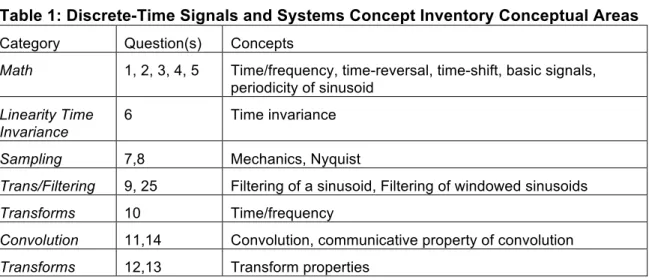
Table 1: Discrete-Time Signals and Systems Concept Inventory Conceptual Areas
Category Question(s) Concepts
Math 1, 2, 3, 4, 5 Time/frequency, time-reversal, time-shift, basic signals, periodicity of sinusoid
Linearity Time Invariance
6 Time invariance Sampling 7,8 Mechanics, Nyquist
Trans/Filtering 9, 25 Filtering of a sinusoid, Filtering of windowed sinusoids Transforms 10 Time/frequency
Convolution 11,14 Convolution, communicative property of convolution Transforms 12,13 Transform properties
Table 1 outlines the conceptual dimensions addressed in the SSCI, DT version. We used a subset of the total number of questions (25) due to the time respondents needed to provide the written explanations in addition to the MCQ selection.
Course context
Content on signals, systems, and transforms are typically a prerequisite for courses covering digital communications systems. A strong conceptual understanding of signal processing is important to learning and understanding the theory and application of digital communications systems and technology. Therefore, we conducted this study using students enrolled in a undergraduate Digital Communications course to collect data on conceptual understanding in signals and systems after the completion of those courses.
Participants
The test group consisted of 60 undergraduate electrical engineering students of the 96 total enrolled in the Digital Communications Course. Of the 60 pre-test respondents, 14
completed the concept inventory again after the completion of the digital communications course. Volunteer-based participation and the timing of administering the post-test (at the end of the semester during the exam period) contributed to the low participation rates. Students who completed the pre- and post-tests were from English and non-English speaking backgrounds, however the scope of the study presented here did not include comparisons between those two groups of participants.
Procedure
Data from the pre-test and post-test text enriched SSCI were collected and analyzed separately. Students who volunteered to take the pre-test or pre- and post-test took the test as part of a two-hour tutorial or recitation component of the course. Students were given the full two-hour timeslot, but the majority of students finished within the first hour. Printed copies of the SSCI were provided (and subsequently collected) for each student and they entered their selections and explanations through an online submission format.
Analysis and Findings
Descriptive statistics examined conceptual knowledge, as measured by the mean scores of participants. We qualitatively coded the textual data using the software, SPSS Text Analytics. This software package uses linguistic-based extraction to identify terms and/or phrases from blocks of machine-readable text. This was useful to our analysis in creating the categories for respondents’ short answer textual responses.
The process of coding the textual data, which captured students’ explanations, identified the text using several categories. Initial coding segmented explanations into concepts, generally consisting of two or more words. A technical expert was consulted and the identified
concepts were categorized as being correct. We then organized the correct and incorrect responses into smaller categories that were later compared with the accompanying multiple-choice selections.
Results Overview
Results from the multiple-choice scores, written explanations, and the combination of these answers revealed that correctly chosen multiple-choice selections did not always match correct conceptual understanding for question testing a specific concept. Learning gains from the pre-test to post-test were generally modest and did not significantly correlate with final grades for the course. By eliminating guessed selections, as identified by the students in the textual component, we found that misconceptions of certain concepts persisted in several of the explanations to individual questions; a result that was otherwise concealed.
Quantitative Results
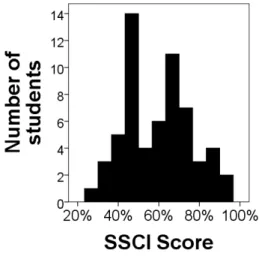
A histogram of the overall scores of the pretest is shown in Figure 1. The mean score was 59.56%, with a 16.42% standard deviation, reported in Table 2. The average scores for the SSCI are not compared to the reported averages from the developers of the SSCI because only a selected subset of questions was used in our study.
The overall statistics for the students we tested show a range of conceptual understanding for the conceptual dimensions included in the evaluation. The modality represents two groups of students; one centered around a score of 45% and the other group with scores around 70%. The large standard deviation, 16%, also suggested that these students had mixed abilities regarding the conceptual understanding of the tested signals and systems concepts
Figure 1: Histogram Pre-test SSCI
Table 2: Pre-Test Statistics
N Minimum Maximum Mean Std. Deviation
Pre-test Score 60 27% 93% 60% 16%
We also analyzed the results of the post-test scores of the 14 participants who returned to take the test at the end of the course. Table 3 reports the post-test statistics, including the mean score of 68%, with a 17% standard deviation. Again, the large standard deviation for this group of students represents a range of conceptual understanding for the selected signals and systems concepts (refer to Table 1 for the complete list of concepts).
Table 3: Post-Test Statistics
N Minimum Maximum Mean Std. Deviation
Post-test Score 14 40% 100% 68% 17%
Analysis of Written explanations
A main category identified in the coding the written explanations or responses was students using some variation of “guessing” to explain their reasoning for their multiple-choice
selection. Based on the combination of multiple choice selection and written explanation for each questions, four possibilities of results existed when we coded the text for the “guessed” category. Table 4 delineates the possibilities for explanations that did or did not indicate a guessed response.
Table 4: Confidence Level in Answering Multiple Choice Questions
Guess Did not guess
Correct Possible understanding/ inability to explain or not confident in explanation
Adequate understanding and confident in explanation Incorrect Possible/ likely misconceptions and not
confident in explanation
Established misconceptions and confident in explanation
The possibility where a student selects the correct answer, but indicates that they chose the selection based on some variation of guessing is most interesting to this study because it highlights the case where the multiple-choice results do not accurately reflect conceptual understanding (refer to Research Question 1). In this instance, a student receives credit for a correct understanding and the instructor has evidence that a student or class has some level of conceptual understanding. The least interesting case that captures how a respondent arrived at the selection is the guessed, incorrect selection. Here, students were not able to identify the correct answer and do not provide any information of their possible
misconceptions for the instructor to address and repair.
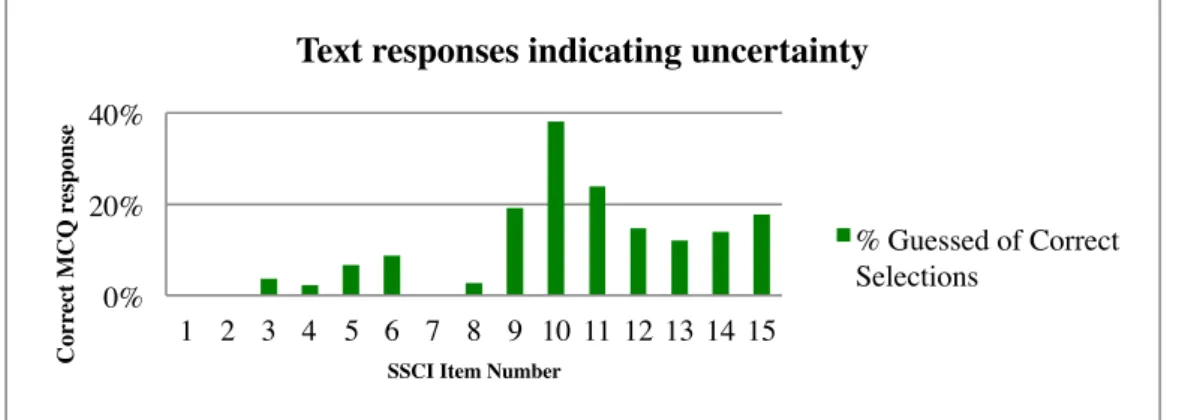
All 15 questions (see Table 1 for question numbers and related concepts) were analysed to identify the textual responses for explanations indicating some form of “guessing”. Textual responses were coded individually per question and student. Responses that included some form of uncertainty, e.g. “guess”, “no clue”, “no idea”, and “process of elimination,” were categorized as a Guessed/Uncertain response. The graph in Figure 2 illustrates the question and the percentage of responses that were answered correctly, but where students indicated that the selection was chosen as a guess.
Figure 2: Guessed Selections for Each of the SSCI Questions
A specific example of the case where students chose the correct selection but provided a guessed explanation is question 10. The written explanation for this question had the most responses indicating that respondents arrived at their multiple-choice selection through some form of guessing. In the pre- and post-test scores, the majority of students answered the question correctly, while distractors 1) and 2) were the more common incorrect selections.
Table 5: Question answered correctly with the most guessed explanations
Question 10 tests time/ frequency concepts using given plots of windowed sinusoid and its transform. For this question, students needed to recognize the transform of a higher-frequency windowed sinusoid given its time plot. The selections were four different plots of the Fourier series.
Multiple-choice selections Pre Post
Correct Selection 72% 71%
Distractor 1) Cannot tell the faster oscillation has the lower amplitude 10% 21% Distractor 2) Does not understand more than one cosine is involved 10% 7% Distractor 3) Identified that two frequencies are presented, but thought the magnitude of
the coefficients were equal.
7% 0% 0% 20% 40% 1 2 3 4 5 6 7 8 9 10 11 12 13 14 15 C or re ct M C Q r es p on se
SSCI Item Number
Text responses indicating uncertainty
% Guessed of Correct Selections
Each of the text responses was classified as guessed or not guessed (meaning that the student / respondent indicated some form of reasoning with concepts related to their
selection). While some written explanations simply indicated, “guessed” or “I don’t know, just a guess.” other students partially explained their reasoning for arriving at the correct or incorrect selection.
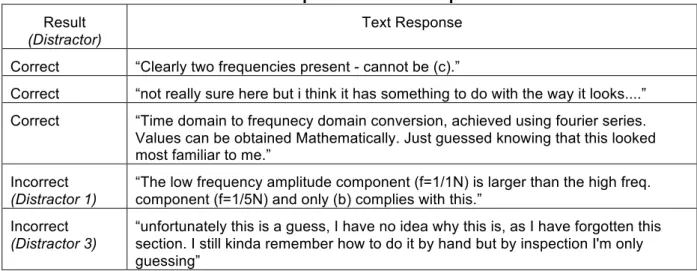
Table 6. Examples of student responses
Result (Distractor)
Text Response Correct “Clearly two frequencies present - cannot be (c).”
Correct “not really sure here but i think it has something to do with the way it looks....” Correct “Time domain to frequnecy domain conversion, achieved using fourier series. Values can be obtained Mathematically. Just guessed knowing that this looked most familiar to me.”
Incorrect (Distractor 1)
“The low frequency amplitude component (f=1/1N) is larger than the high freq. component (f=1/5N) and only (b) complies with this.”
Incorrect (Distractor 3)
“unfortunately this is a guess, I have no idea why this is, as I have forgotten this section. I still kinda remember how to do it by hand but by inspection I'm only guessing”
These responses usually included explanations or reasoning for eliminating one or two distractors, but then guessing between the remaining selections. Table 6 provides examples of students’ written explanations. From these examples it is evident that there was variation in how students arrived at their guessed responses showing, in both correct and incorrect cases, they were unsure of their selection or how to explain why they believed it was correct.
Discussion and Recommendations
The addition of a textual component highlighted several issues for current multiple-choice based tests, indicating that the quantitative results do not always accurately represent a student’s understanding of a certain concept. Twelve of the 15 questions (refer to Figure 2) used to assess conceptual understanding had students that chose the correct selection, but were not able to accurately explain their understanding. We highlight that students appear to have the most difficulty explaining their reasoning for one of the SSCI questions. In that instance, students had difficulty connecting the required computations (summation of harmonically related complex exponentials) to a conceptual understanding of the process and visualizing the process. For students who used guessing or partial explanations, the challenge was often translating a symbolic mathematical representation to the graphical understanding of the process.
The additional insights gained from written explanations, such as partial explanations or students knowing the answer but “not being able to explain it”, supports the reflective writing framework and how it can be used to improve understanding. Some written explanations showed students reflecting on past learning or understanding, where they indicate that they need to revisit the information or did not have a solid understanding when they were learning the concepts in a previous setting. Students may or may not have realized deficiencies in their understanding when learning the concepts. The active of writing and reflecting on these concepts at the time of learning can help address deficiencies earlier.
Recommendations for Educators
Based on this study, we present some preliminary ideas for instructors to make use of the gained insights into their students’ conceptual understanding. An instructional challenge for instructors responsible for large class sizes is formatively and accurately assessing students’
understanding of the course content. While CI’s are good instruments to use in large classes to get an overview of possible misconceptions, we recommend the use of classroom
discussions to begin to remove identified misconceptions. In this case, the discussions will allow students to explain and explore these concepts in a similar format to providing written explanations. The reflective approach to discussing and thinking about concepts can also be tied to using the pre-test and post-test approach as part of the classroom approach.
Additionally, one can use the intermediate test data to build on or as a foundation on how to structure class discussions.
From the quantitative results and textual responses in our study we found diversity in
students’ responses, meaning that our sample had students with mixed abilities. In this case, we recommend providing offline resources for the lower-achieving students (as well as all students wanting to revisit conceptual areas) to self-correct.
Limitations and future work
Several limitations exist for this study including, the small sample size to report on the
quantitative data. While the results are not generalizable, it provides an evaluation of how an undergraduate electrical engineering class might perform if tested on signals and systems concepts. We also only used a subset of the total SSCI questions and cannot report on how students performed in all of the conceptual areas that were included in the design of the original SSCI. Also, the pre-test data assessed the prerequisite knowledge for the students enrolled in the digital communications course.
The addition of a text-response to multiple-choice concept inventory questions provided an enhanced and meaningful assessment of electrical engineering students’ conceptual knowledge in some areas of signals and systems. Engineering education researchers and practitioners can use these text-based responses to increase certainty in the judgment of student work, thus creating a more solid foundation of conceptual knowledge as students progress through the curriculum. Further investigations are underway to examine possible links between students’ explanations of various conceptual dimensions and persistent misconceptions.
References
Adams, W. K., & Wieman, C. E. (2011). Development and validation of instruments to measure learning of expert-like thinking. International Journal of Science Education, 33, 1289–1312. Buck, J. R., & Wage, K. E. (2005). Active and Cooperative Learning in Signal Processing Courses.
IEEE Signal Processing Magazine, 22(2). 76-81.
Chi, M.T.H. (2008). Three types of conceptual change: Belief revision, mental model transformation, and categorical shift. In S. Vosniadou (Ed.), Handbook of research on conceptual change (pp.61-82). New York, NY: Routledge.
Hestenes, D. & Wells, M. (1992). A mechanics baseline test. The Physics Teacher. 30. 159-166. Ivarsson, J., Schoultz, J., & Säljö, R. (2002). Map reading versus mind reading: Revisiting children's
understanding of the shape of the earth. In M. Limón & L. Mason (Eds.), Reconsidering conceptual change: Issues in theory and practice (pp. 77-99). Amsterdam: Kluwer Academic Publishers.
Koretsky, M.D., Falconer, J,L., Brooks, B.J., Gilbuena, D.M., Silverstien, D.,L., Smith, C., Miletic,M. (2014). The AIChE Concept Warehouse: A Web-Based Tool to Promote Concept-Based Instruction. Advances in Engineering Education, (4)2.
Nelson, M. A., Geist, M. R., Miller, R. A., Streveler, R. A. & Olds, B. M. (2007). How to create a concept inventory: The thermal and transport concept inventory, In Annual conference of the American Educational Research Association, Chicago, Illinois.
Özdemir, G., & Clark, D. B. (2007). An overview of conceptual change theories. Eurasia Journal of Mathematics, Science & Technology Education, 3(4), 351-361.
Padgett, W.T., Yoder, M.A., & Forbes, S.A. (2011). Extending the Usefulness of the Signals and Systems Concept Inventory (SSCI). In Digital Signal Processing Workshop and IEEE Signal Processing Education Workshop. Sedona, Arizona.
Salzman, N. & Strobel, J. (2011). Full paper: Conceptual change in precollege engineering. Proceedings of the Research in Engineering Education Symposium, Madrid, Spain.
Sinatra, G. M. & Pintrich, P. R. (Eds.) (2003). Intentional Conceptual Change. Lawrence Erlbaum Associates.
Venters, C., McNair, L. D. & Paretti, M. C. (2013). Using Writing to Link Procedures and Concepts in Statics. In American Society for Engineering Education Annual Conference and Exposition. Atlanta, GA.
Wage, K.E., Buck, J.R., Wright, C.H.G. &Welch, T.B., (2005). The Signals and Systems Concept Inventory, in IEEE Transactions on Education, 48(3), 448–461.
Acknowledgements
This study was sponsored as part of Learning and Teaching grant through Queensland University of Technology. Special thanks are due to all the student participants for their feedback.
Copyright © 2015 Authors’ names: Wageeh Boles, Andrea Goncher, Dhammika Jayalath. The authors assign to the REES organisers and educational non-profit institutions a non-exclusive licence to use this document for personal use and in courses of instruction provided that the article is used in full and this copyright statement is reproduced. The authors also grant a non-exclusive license to REES to publish this document in full on the World Wide Web (prime sites and mirrors), on portable media and in printed form within the REES 2015 conference proceedings. Any other usage is prohibited without the express permission of the authors.