Evaluation of TCP/UDP on Networks
A Doctor of Computing Thesis
byShaneel Narayan
Supervisors
Principal
Professor Abdolhossein Sarrafzadeh
Associate
Dr Chandimal Jayawardena Dr Iman Ardekani
Submitted in partial fulfilment of the requirements for the degree of
Doctor of Computing
Department of Computing UNITEC Institute of Technology
Auckland, New Zealand December 2014
Computer networks are complex - they are a heterogeneous environment in which numerous services, such as electronic mail, web browsing, voice and multimedia data, traverse the globe daily. The needs and demands of end users continuously change, and to meet these, new technologies are being incorporated into this mega digital infrastructure at a phenomenal rate. In addition to ensuring that necessary functionalities are provided, it is vitally important to ensure that network performance is always at its optimum.
Fundamentally, networks are an environment where data, mostly in the form of TCP and UDP, are being propagated end-to-end between the sending and receiving nodes. There are numerous avenues of network performance that can be exploited in order to improve its performance. Research in this area is multi-faceted, and in this thesis the focus is on evaluating the behaviour of TCP and UDP end-to-end on networks in three scenarios, namely, networks with transition mechanisms, wireless based networks, and in the context of using virtual private network technologies as security protocols.
This thesis will give insights into the behaviour of common protocols on real networks. Therefore, performance metrics related to networks have been gathered from test-bed implementations. The collected data has been pre-sented in graphs and heat maps, which have been evaluated to ascertain network related characteristics. In particular, key metrics have been identi-fied, networking techniques within each context have been ranked, specific observations related to each network environment have been made, and fi-nally, the impact of either version of the Internet Protocol or an operating system has been evaluated.
A lifelong dream of completing a Doctorate has been fulfilled, and for that, first and foremost I would like to thank my Mum. She has inspired me and instilled in me the value of education. Her sacrifices, blessings, and encour-agement have been my strength from inception to conclusion. Thank you Mum.
I would like to express my sincere gratitude to my principal supervisor Pro-fessor Abdolhossein Sarrafzadeh, and associate supervisors Dr Chandimal Jayawardena and Dr Iman Ardekani. Thank you for giving me an opportu-nity to work with you, your guidance has been priceless. Special acknowl-edgements go to my employer Unitec Institute of Technology and the De-partment of Computing for supporting me in this process for a number of years. I thank my Head of Department Professor Abdolhossein Sarrafzadeh for believing in me.
A big shout out to all those undergraduate and postgraduate students who have worked with me tirelessly on various network research projects over the last 14 years. Your enthusiasm and support has been brilliant.
I am forever grateful for my daughter Gitali’s unconditional love. Moments with you are always priceless, and now with the completion of the Doctor-ate, I will spend more time with you.
Last but not least, I would like to thank God for being my strength. Without His blessings, this would have never come to fruition.
AES Advance Encryption Standard
AH Authentication Header
AMID Additive-Increase Multiplicative-Decrease
APNIC Asia Pacific Network Information Centre
ARP Address Resolution Protocol
ARPA Advance Research Project Agency
BYOD Bring Your Own Device
CA Certification Authority
CCK Complementary Coding Key
CCMP Chaining Message Authentication Code Protocol
CGA Cryptographic Anomaly
CHAP Challenge-Handshake Authentication Protocol
CIDR Cluster-based Inter-Domain Routing
CPU Central Processing Unit
CRC Cyclic Redundancy Check
CSMA/CA Carrier Sense Multiple Access/Collision Avoidance
D-ITG Distributed-Internet Traffic Generator
DES Data Encryption Standard
DoD Department of Defense
DOS Denial of Service
DSCP Differentiated Service Code Point
DSSS Direct-Sequence Spread Spectrum
DSTM Dual Stack Transition Mechanism
DTTS Dynamic Tunnelling Transition Solution
DUPACK Duplicate Acknowledgement
EAP Extensible Authentication Protocol
ECN Explicit Congestion Notification
ELISIA Evolvable Locator/ID Separation Internet Architecture
ERP Extended Rate Physical
ESP Encapsulated Security Payload
FTP File Transfer Protocol
GPRS General Packet Radio Services
GRE Generic Routing Examinations
HMAC Hash Message Authentication Code
HR-DSSS High Rate - DSSS
HTTP Hypertext Transfer Protocol
HTTPS Secure HTTP
IANA Internet Assignment Numbers Authority
ICAAN Internet Corporation for Assignment Name and Numbers
ICMP Internet Control Message Protocol
ICV Integrity Check Value
IEEE Institute of Electrical and Electronics Engineers
IETF Internet Engineering Task Force
IMP Interface Message Processor
IP Internet Protocol
IPSec Internet Protocol Security
ISAKMP Internet Security Association and Key Management Protocol
ISATAP Intra-Site Automatic Tunnel Addressing Protocol
ISM Industrial Scientific Medical
ISO International Organization for Standards
ISP Internet Service Provider
IV Initiation Vector
IVC Integrity Value Check
L2TP Layer 2 Tunnelling Protocol
LAN Local Area Network
LDPC Low-Density Parity-Check
MAC Media Access Control
MANET Mobile Ad hoc Network
MD Message Digest
MIC Message Integrity Check
MIMO Mutiple-Input and Multiple-Output
MPPE Microsoft Point-to-Point Encryption
MTU Maximum Transmission Unit
MU-MIMO Multiple-User MIMO
NAPT-PT Network Address Port Translation - Protocol Translation
NAT Network Address Translation
NAT-PT Network Address Translation - Protocol Translation
NBMA Non-Broadcast Multiple Access
NLB Network Load Balancing
OFDM Orthogonal Frequency-Division Multiplexing
OSI Open Systems Interconnection
PAT Port Address Translation
PEAP Protected EAP
PET Prefixing, Encapsulating, and Translation
PKI Public Key Infrastructure
PPP Point-to-Point Protocol
PPTP Point-to-Point Tunnelling Protocol
PRL Potential Router List
PSK Pre-Shared Key
PSMP Power Save Multi-Poll
QAM Quadrature Amplitude Modulation
QoS Quality of Service
RA Router Advertisement
RARP Reverse Address Resolution Protocol
RC Rivest Cipher
RD Reverse Direction
RFC Request for Comments
RIPE NCC The Rseaux IP Europens Network Coordination Centre
RIR Regional Internet Registry
RS Router Solicitation
SA Security Association
SACK Selective Acknowledgement
SDM Spatial-Division Multiplexing
SHA Secure Hash Algorithm
SKEME Security Key Exchange Mechanism
SLAAC Stateless Address Auto-configuration
SMTP Simple Mail Transfer Protocol
SPD Security Policy Database
SPI Security Parameter Index
SSL Secure Socket Layer
ssthresh Slow Start Threshold
SSTP Secure Socket Tunnelling Protocol
STBC Space-Time Block Code
TCP Transmission Control Protocol
TCPA Teredo Client Protection Algorithm
TELNET Terminal Network or Network Virtual Terminal Protocol
TEP Tunnel End-Point
TKIP Temporal Key Integrity Protocol
TTL Time to Live
UDP User Datagram Protocol
UHF Ultra High Frequency
VHT Very High Throughput
VoIP Voice over Internet Protocol
VPN Virtual Private Network
WEP Wired Equivalent Privacy
WiGig Wireless Gigabit
WiMax Worldwide Interoperability for Microwave Access
WLAN Wireless LAN
WPA Wi-Fi Protected Access
Abstract v
Acknowledgements vii
List of Abbreviations xiii
List of Publications 1 1 Introduction 5 1.1 Thesis Objectives . . . 8 1.2 Thesis Contributions . . . 9 1.3 Thesis Structure . . . 10 2 Background 11 2.1 Introduction and Motivations . . . 11
2.2 A Layered Structure . . . 12
2.2.1 OSI Reference Model . . . 13
2.2.2 TCP Reference Model . . . 16
2.2.3 OSI and TCP Reference Model Comparison . . . 18
2.2.4 The Internet Model . . . 19
2.2.5 The UDP Protocol . . . 22
2.2.6 The TCP Protocol . . . 24
2.2.7 IP Header . . . 35
2.2.8 Comparison of IPv4 and IPv6 . . . 37 xv
2.2.9 Exhaustion of IPv4 addresses . . . 40
2.2.10 IP Addressing . . . 41
2.2.11 TCP/UDP Related Research . . . 44
3 Methodology 47 3.1 Testing Networks in Realistic Conditions . . . 47
3.1.1 Simulation . . . 48
3.1.2 Emulation . . . 50
3.1.3 Test-bed Networks . . . 51
3.2 Experimental Test-bed Architecture . . . 52
3.2.1 Network Schematic . . . 53
3.2.2 Traffic Generation Software . . . 54
3.2.3 Traffic Generator . . . 55
3.3 Performance Metrics . . . 56
3.4 Test-bed Data Collection . . . 58
4 TCP/UDP Behaviour across Transition Mechanisms 63 4.1 Introduction and Motivation . . . 63
4.2 The IP Addressing Problem . . . 64
4.3 The Transition Mechanisms . . . 67
4.3.1 Dual Stack . . . 67
4.3.2 Address Translation . . . 69
4.3.3 Tunnelling . . . 73
4.4 Literature Analysis of Transition Mechanisms . . . 83
4.5 Test-bed Transition Mechanism Implementations . . . 86
4.6 Performance Metrics Measurement for various Transition Mech-anisms . . . 92
4.7 Results Evaluation . . . 107
5 TCP and UDP Behaviour in Wireless Environments 109 5.1 Introduction and Motivation . . . 109
5.2 Wireless Preamble . . . 110
5.3 Wireless Standards . . . 112
5.3.1 IEEE802.11b . . . 114
5.3.2 IEEE802.11g . . . 115 xvi
5.3.3 IEEE802.11n . . . 116
5.3.4 IEEE802.11ac . . . 117
5.4 Wireless Security Protocols . . . 120
5.4.1 Wired Equivalent Privacy . . . 120
5.4.2 Wi-Fi Protected Access . . . 122
5.4.3 Wi-Fi Protected Access 2 . . . 124
5.5 Some Key Research . . . 125
5.6 Wireless Test-bed Setup . . . 126
5.7 Performance Metrics Measurements from Wireless Test-beds . 127 5.8 Results Evaluation . . . 144
6 TCP/UDP Behaviour in Virtual Private Networks 147 6.1 Introduction and Motivation . . . 147
6.2 VPN Preamble . . . 147 6.3 VPN Protocols . . . 149 6.3.1 Layer 2 VPN Protocols . . . 150 6.3.2 Layer 3 VPN Protocols . . . 151 6.4 Key VPN Research . . . 167 6.5 VPN Test-bed Setup . . . 168
6.6 Performance Metrics Measurements from IPSec and SSTP VPN Protocols . . . 169
6.7 Results Evaluation . . . 183
7 Discussion 185 7.1 Preamble . . . 185
7.2 Networks with Transition Mechanisms . . . 186
7.3 Networks with Wireless Implementations . . . 188
7.4 Networks with VPNs . . . 190
7.5 Thesis Contributions . . . 192
8 Conclusions 195
References 197
1.1 Statistics -Network Performance Index . . . 7
1.2 Thesis -Thesis Structure. . . 10
2.1 Different Models -OSI, TCP/IP, and Internet . . . 18
2.2 Packet Structure -UDP . . . 23
2.3 Data Transfer Structure -Reliable and Unreliable . . . 24
2.4 Packet Structure -TCP . . . 26
2.5 Three Way Handshake -TCP . . . 29
2.6 TCP Congestion Control -Slow Start Algorithm . . . 31
2.7 TCP Congestion Control -Saw Tooth . . . 33
2.8 Internet Protocol -IPv4 and IPv6 Header . . . 36
2.9 Statistics -IPv6 Address Usage . . . 41
3.1 Experimentation Approaches -Simulation . . . 49
3.2 Experimentation Approaches -Simulation, Emulation, Test-bed, and Real Networks . . . 52
3.3 Performance Tools -Test-bed Schematic . . . 54
3.4 Performance Tools -D-ITG Diagram. . . 58
3.5 D-ITG -Sender Command Line Interface . . . 59
3.6 D-ITG -Sender Sample Commands . . . 60
3.7 D-ITG -Decoder Sample Commands . . . 60
3.8 D-ITG -Decoded Data . . . 61 xix
4.1 Statistics -IPv4 Address Rundown . . . 65
4.2 Transition Mechanisms -Dual Stack Architecture. . . 69
4.3 Transition Mechanisms -NAT-PT Architecture . . . 71
4.4 Transition Mechanisms -NAT64 Architecture . . . 73
4.5 Transition Mechanisms -6to4 Architecture . . . 77
4.6 Transition Mechanisms -ISATAP Architecture . . . 79
4.7 Transition Mechanisms -Teredo Architecture . . . 81
4.8 Test-bed Implementation -Dual Stack Transition Mechanism . . 86
4.9 Test-bed Implementation -Configured Tunnel . . . 87
4.10 Test-bed Implementation -6to4 . . . 88
4.11 Test-bed Implementation -ISATAP . . . 89
4.12 Test-bed Implementation -Teredo . . . 90
4.13 Test-bed Implementation -NAT64 . . . 91
4.14 Transition Mechanism Graph -TCP Throughput . . . 93
4.15 Transition Mechanism Heat Map: TCP Throughput . . . 94
4.16 Transition Mechanism Graph -UDP Throughput . . . 94
4.17 Transition Mechanism Heat Map -UDP Throughput . . . 95
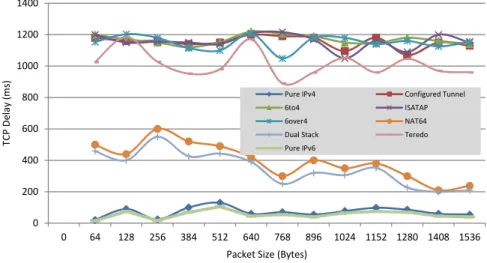
4.18 Transition Mechanism Graph -TCP Delay . . . 96
4.19 Transition Mechanism Heat Map -TCP Delay . . . 97
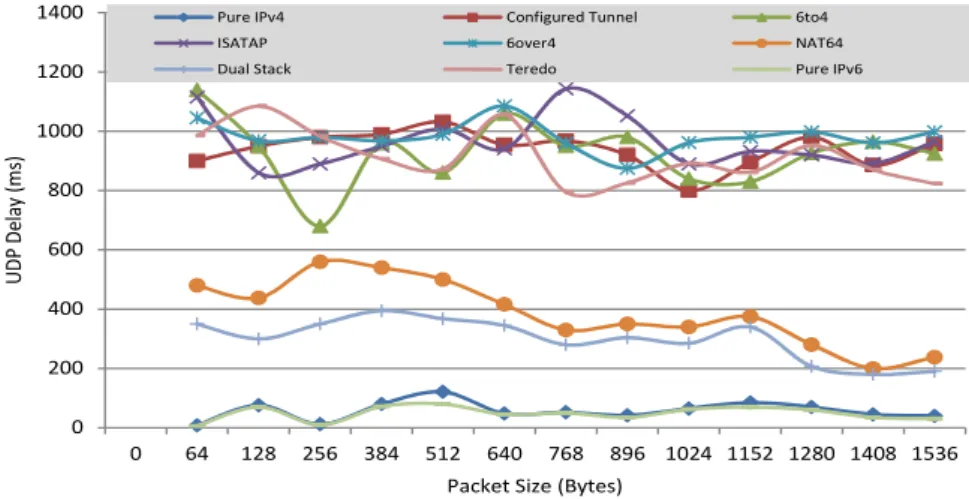
4.20 Transition Mechanism Graph -UDP Delay . . . 97
4.21 Transition Mechanism Heat Map -UDP Delay. . . 99
4.22 Transition Mechanism Graph -TCP Jitter . . . 100
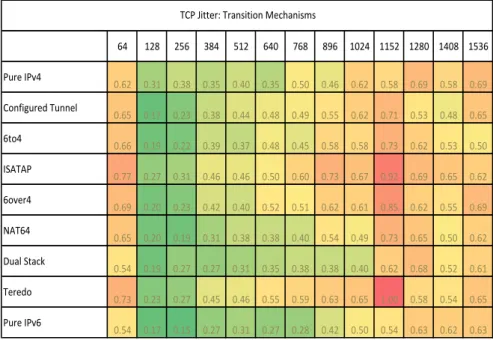
4.23 Transition Mechanism Heat Map -TCP Jitter . . . 100
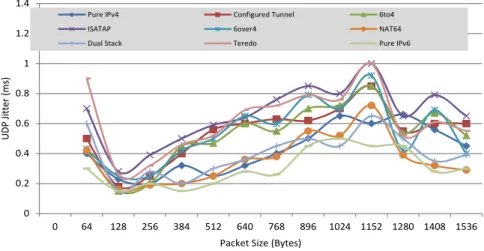
4.24 Transition Mechanism Graph -UDP Jitter . . . 101
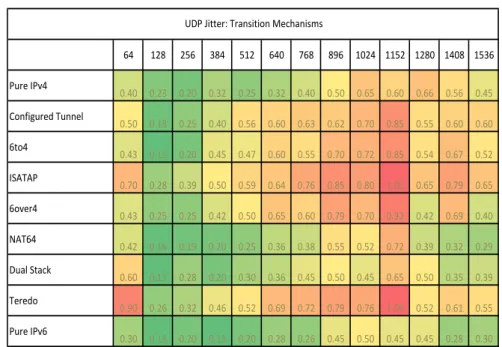
4.25 Transition Mechanism Heat Map -UDP Jitter . . . 102
4.26 Transition Mechanism Graph: TCP CPU1 Usage Percentage . . 103
4.27 Transition Mechanism Heat Map: TCP CPU1 Usage Percentage 103 4.28 Transition Mechanism Graph: UDP CPU1 Usage Percentage . . 104
4.29 Transition Mechanism Heat Map: UDP CPU1 Usage Percentage 104 4.30 Transition Mechanism Graph: TCP CPU2 Usage Percentage . . 105
4.31 Transition Mechanism Heat Map: TCP CPU2 Usage Percentage 105 4.32 Transition Mechanism Graph: UDP CPU2 Usage Percentage . . 106
4.33 Transition Mechanism Heat Map: UDP CPU2 Usage Percentage 106 5.1 IEEE 802.11 Protocol -802.11 Frame Format. . . 113
5.2 IEEE 802.11 Protocol -802.11ac Frame Format . . . 119
5.3 Wireless Security Protocol -WEP . . . 122
5.4 Wireless Security Protocol -WPA . . . 123
5.5 Test-bed Implementation -Wireless . . . 126
5.6 Wireless Graph: TCP Throughput . . . 128
5.7 Extrapolated Graph:TCP Throughput. . . 128
5.8 Heat Map:TCP Throughput . . . 129
5.9 Wireless Graph: UDP Throughput . . . 131
5.10 Extrapolated Graph:UDP Throughput . . . 131
5.11 Heat Map: UDP Throughput . . . 132
5.12 Wireless Graph: TCP Jitter . . . 134
5.13 Extrapolated Graph:TCP Jitter . . . 134
5.14 Heat Map: TCP Jitter . . . 135
5.15 Wireless Graph: UDP Jitter . . . 136
5.16 Extrapolated Graph:UDP Jitter . . . 136
5.17 Heat Map: UDP Jitter . . . 137
5.18 Wireless Graph: TCP Delay. . . 138
5.19 Heat Map: TCP Delay . . . 139
5.20 Wireless Graph: UDP Delay . . . 140
5.21 Heat Map: UDP Delay . . . 141
5.22 Wireless Graph: UDP Drop Rate . . . 142
5.23 Heat Map: UDP Drop Rate . . . 143
6.1 VPN Protocol:PPTP Implementation . . . 153
6.2 VPN Protocol:IPsec Implementation . . . 155
6.3 IPSec Protocol: AH and ESP Packet . . . 157
6.4 IPsec Protocol:AH IPv4 Header . . . 158
6.5 IPSec Protocol: ESP IPv4 Header . . . 160
6.6 VPN Protocol:SSTP Implementation. . . 162
6.7 VPN Protocol:OpenVPN Implementation . . . 164
6.8 VPN Protocol:SSL Implementation . . . 165
6.9 Test-bed Implementation -VPN . . . 168
6.10 VPN Graph:TCP Throughput . . . 170
6.11 VPN Heat Map:TCP Throughput . . . 171
6.12 VPN Graph:UDP Throughput . . . 172 xxi
6.13 VPN Heat Map:UDP Throughput . . . 173 6.14 VPN Graph:TCP Delay . . . 174 6.15 VPN Heat Map:TCP Delay. . . 175 6.16 VPN Graph:UDP Delay . . . 176 6.17 VPN Heat Map:UDP Delay . . . 177 6.18 VPN Graph:TCP Jitter . . . 178 6.19 VPN Heat Map:TCP Jitter . . . 179 6.20 VPN Heat Map:UDP Jitter . . . 180 6.21 VPN Graph:UDP Jitter . . . 181 6.22 Collective Graphs:Throughput. . . 182 6.23 Collective Graphs:IPv4 Delay . . . 182 6.24 Collective Graphs:IPv6 Delay . . . 183
2.1 Application Layer -TCP and UDP Ports . . . 21 2.2 TCP Congestion Control -TCP Algorithms . . . 34 2.3 Statistics -IPv4 Address Exhaustion . . . 40 2.4 Internet Protocol -IPv4 Classes. . . 41 2.5 Internet Protocol -IPv6 Unicast and Anycast . . . 42 2.6 Internet Protocol -IPv6 Global and Multicast Addresses . . . 43 2.7 Internet Protocol -IPv6 Abbreviation Technique . . . 44
3.1 Performance Tools -Comparison . . . 55 4.1 Transition Techniques -Translation . . . 70 4.2 Transition Techniques -Tunnelling . . . 75 4.3 Related Research -Transition Mechanism . . . 85 5.1 IEEE 802.11 Protocol -Wireless Network . . . 112 5.2 IEEE 802.11 Protocol -Wireless Standards . . . 114 5.3 IEEE 802.11 Protocol -Wireless Security . . . 120 5.4 Related Research -Wireless . . . 125 6.1 VPN Protocol -Layer 2 and Layer 3 VPN . . . 150 6.2 Types of VPN -Layer 2 VPN . . . 150 6.3 Types of VPN -Layer 3 VPN . . . 151 6.4 VPN Algorithms -Encryption Algorithms . . . 151 6.5 Related Research -VPN . . . 167
7.1 Ranking -Performance Metrics . . . 186 7.2 Ranking -Transition Mechanism TCP and UDP Delay . . . 187 7.3 Ranking -Transition Mechanism TCP and UDP Throughput . . . 187 7.4 Ranking -Wireless . . . 188 7.5 Ranking -Wireless Delay . . . 189 7.6 Ranking -Wireless Throughput . . . 189 7.7 Ranking -Wireless UDP Drop Rate . . . 190 7.8 Ranking -VPN TCP and UDP Delay. . . 191 7.9 Ranking -VPN TCP and UDP Throughput . . . 191
Journal Articles
Narayan, S., & Fitzgerald, M. (2012). Empirical network performance evaluation of security protocols on operating systems. International Journal of Wireless and Microwave Technologies (IJWMT), 2(5), 19.
Narayan, S., & Lutui, P. R. (2012). TCP/IP jumbo frames network performance evaluation on a test-bed infrastructure. International Journal of Wireless and Microwave Technologies (IJWMT), 2(6), 29.
Narayan, S., Graham, D., & Barbour, R. H. (2009). Generic factors influencing optimal LAN size for commonly used operating systems maximized for network performance. International Journal of Com-puter Science and Network Security, 9(6), 6372.
Conference Papers
Narayan, S., Jayawardena, C., Wang, J., Ma, W., & Geetu, G. (2015). Performance test of IEEE 802.11ac Wireless Devices.Paper to be presented at the IEEE International Conference on Computer Communication and Informatics (ICCCI) (January 8-10, 2015).
Narayan, S., Williams, C.J., Hart, D.K., & Qualtrough, M.W. (2015). Network performance comparison of VPN protocols on wired and wireless networks.Paper to be presented at the IEEE International Conference on Computer Communication and Informatics (ICCCI) (January 8-10, 2015).
Narayan, S., & Lutui, P. (2013, Dec). Network performance evaluation of jumbo frames on a network. InProceedings of the 6th IEEE International Conference on Emerging Trends in Engineering and Technology (ICETET). (p. 69-72). doi: 10.1109/ICETET.2013.16
Kolahi, S.S.,Narayan, S., Nguyen, D.D.T., & Sunarto, Y. (2011, March). Performance monitoring of various network traffic generators. InProceedings of the 13th IEEE International Conference on Computer Modelling and Simulation (UKSim). (p. 501-506). doi: 10.1109/UKSIM.2011.102
Narayan, S., FitzGerald, M., & Ram, S. (2010, Dec). Empirical network performance evaluation of IPSec algorithms on windows operating systems implemented on a test-bed. InProceedings of the IEEE Interna-tional Conference on ComputaInterna-tional Intelligence and Computing Research (ICCIC). (p. 1-4).
Narayan, S., Lutui, P.R., Vijayakumar, K., & Sodhi, S. (2010, Dec). Performance analysis of networks with IPv4 and IPv6. InProceedings of the IEEE International Conference on Computational Intelligence and Computing Research (ICCIC). (p. 1-4). doi: 10.1109/ICCIC.2010.5705805
Narayan, S., & Lutui, P.R. (2010, Dec). Impact on network performance of jumbo-frames on IPv4/IPv6 network infrastructure: An empirical test-bed analysis. InProceedings of the 4th IEEE International Con-ference on Internet Multimedia Services Architecture and Application (IMSAA). (p. 1-4). doi: 10.1109/IM-SAA.2010.5729409
Narayan, S., & Tauch, S. (2010, July). IPv4-v6 configured tunnel and 6to4 transition mechanisms net-work performance evaluation on linux operating systems. InProceedings of the 2nd IEEE International Conference on Signal Processing Systems (ICSPS). (Vol. 2, p. 113-117). doi: 10.1109/IC- SPS.2010.5555209 Narayan, S., & Tauch, S. (2010, July). IPv4-v6 transition mechanisms network performance evaluation on operating systems. InProceedings of the 3rd IEEE International Conference on Computer Science and Infor-mation Technology (ICCSIT). (p. 664-668). doi: 10.1109/ICCSIT.2010.5564141
Narayan, S., & Shi, Y. (2010, July). Application layer network performance evaluation of VoIP traffic on a test-bed with IPv4 and IPv6 LAN infrastructure. InProceedings of the 8th Region IEEE International Conference on Computational Technologies in Electrical and Electronics Engineering (SIBIRCON). (p. 215-219). doi: 10.1109/SIBIRCON.2010.5555344
Narayan, S., & Shi, Y. (2010, July). TCP/UDP network performance analysis of windows operating systems with IPv4 and IPv6. InProceedings of the 2nd IEEE International Conference on Signal Processing Systems (ICSPS)(Vol. 2, p. 219-222). doi: 10.1109/ICSPS.2010.5555285
Narayan, S., Gordon, M., Branks, C., & Fan, L. (2010, July). VoIP network performance evaluation of operating systems with IPv4 and IPv6 network implementations. InProceedings of the 3rd IEEE Inter-national Conference on Computer Science and Information technology (ICCSIT). (Vol. 5, p. 669-673). doi: 10.1109/ICCSIT.2010.5564004
Narayan, S., Gordon, M., Branks, C., & Fan, L. (2010, June). Network performance evaluation of VoIP on windows desktop operating systems with IPv4 and IPv6 network implementations. InProceedings of the IEEE International Conference on Computer Design and Applications (ICCDA). (Vol. 5, p. 393-397). doi: 10.1109/ICCDA.2010.5540931
Narayan, S., & Tauch, S. (2010, June). Network performance evaluation of IPv4-v6 configured tunnel and 6to4 transition mechanisms on windows server operating systems. InProceedings of the IEEE Inter-national Conference on Computer Design and Applications (ICCDA). (Vol. 5, p. 435-440). doi: 10.1109/IC-CDA.2010.5540939
Narayan, S., Sodhi, S., Lutui, P., & Vijayakumar, K. (2010, June). Network performance evaluation of routers in IPv4/IPv6 environment. InProceedings of the IEEE International Conference on Wireless Commu-nications, Networking and Information Security (WCNIS). (p. 707-710). doi: 10.1109/WCINS.2010.5541871
Narayan, S., Feng, T., Xu, X. & Ardham, S. (2009, Dec). Impact of wireless IEEE802.11n encryption meth-ods on network performance of operating systems. InProceedings of the 2nd IEEE International Conference on Emerging Trends in Engineering and Technology (ICETET). (p. 1178-1183). doi: 10.1109/ICETET.2009.121 Narayan, S., & Shi, Y. (2009, Dec). Application layer network performance analysis of IPv4 and IPv6 on windows operating systems. InProceedings of the 4th IEEE International Conference on Computers and Devices for Communication (CODEC). (p. 1-4).
Narayan, S., Feng, T., Xu, X., & Ardham, S. (2009, April). Network performance evaluation of wire-less IEEE802.11n encryption methods on windows vista and windows server 2008 operating systems. InProceedings of the IEEE/IFIP International Conference on Wireless and Optical Communications Networks (WOCN). (p. 1-5).
Narayan, S., Brooking, K., & de Vere, S. (2009, April). Network performance analysis of VPN proto-cols: An empirical comparison on different operating systems. InProceedings of the IEEE International Conference on Networks Security, Wireless Communications and Trusted Computing (NSWCTC). (Vol. 1, p. 645-648). doi: 10.1109/NSWCTC.2009.367
Narayan, S., Shang, P., & Fan, N. (2009, April). Network performance evaluation of internet protocols IPv4 and IPv6 on operating systems. InProceedings of the IEEE/IFIP International Conference on Wireless and Optical Communications Networks (WOCN). (p. 1-5). doi: 10.1109/WOCN.2009.5010548
Narayan, S., Shang, P., & Fan, N. (2009, April). Performance evaluation of IPv4 and IPv6 on windows vista and linux ubuntu. InProceedings of the IEEE International Conference on Networks Security, Wireless Communications and Trusted Computing (NSWCTC). (Vol. 1, p. 653-656). doi: 10.1109/NSWCTC.2009.368
Narayan, S., Kolahi, S., Sunarto, Y., Nguyen, D., & Mani, P. (2008, Dec). Performance comparison of IPv4 and IPv6 on various windows operating systems. InProceedings of the 11th IEEE International Confer-ence on Computer and Information Technology (ICCI). (p. 663-668). doi: 10.1109/IC- CITECHN.2008.4803056 Narayan, S., Kolahi, S.S., Brooking, K. & de Vere, S. (2008, Dec). Performance evaluation of virtual private network protocols in windows 2003 environment. InProceedings of the IEEE International Confer-ence on Advanced Computer Theory and Engineering (ICACTE). (p. 69-73). doi: 10.1109/ICACTE.2008.187 Kolahi, S.,Narayan, S., Nguyen, D., Sunarto, Y., & Mani, P. (2008, July). The impact of wireless LAN security on performance of different windows operating systems. InProccedings of the IEEE Symposium on Computers and Communications (ISCC). (p. 260-264). doi: 10.1109/ISCC.2008.4625636
Narayan, S., Kolahi, S., Sunarto, Y., Nguyen, D., & Mani, P. (2008, May). The influence of wireless 802.11g LAN encryption methods on throughput and round trip time for various windows operating systems. InProceedings of the 6th Annual IEEE communication networks and services research conference (CNSR). (p. 171-175). doi: 10.1109/CNSR.2008.60
Introduction
Information technology networks are at the core of communication in soci-eties today. With the advent of the World Wide Web, social networking, mul-timedia streaming and similar, the Internet has become a global phenomenon allowing seamless, global communication and information sharing. On a mi-cro scale, there has also been explosive growth in the number of small-scale networks, such as intranets and extranets, mainly resulting from increased business activities and continuous changes to the nature of conducting busi-nesses. The way consumers purchase goods is also changing remarkably, as global interconnectivity has given rise to borderless economies. The unprece-dented increase in its scale of establishment and its complexities, irrespective of the size of the actual network, has led to several challenging research prob-lems in improving and enhancing network performance.
The fundamental manner in which networks are created have also evolved dramatically. It all started as a small collaborative network with a limited number of nodes created by researchers at the US Defence Advanced Re-search Projects Agency. The networks of today are vastly different, but they still are based on that original distributed packet-switching technology which facilitates data transmission end-to-end on communication links. That same basic building block, originating in the early 1980’s, continues to dominate the networking arena in the 21st century, however it incorporates a
num-ber of new, necessary technologies. Some key developments are mentioned herewith.
• The version of the Internet protocol that is used widely has limitations, and this has necessitated a new version. Although this solves a num-ber of the fundamental problems of its predecessor, uptake of the new
version has been extremely slow. Also the two versions happen to be incompatible. This has given rise to a number of interim solutions, known as transition mechanisms, which facilitate co-existence of the two versions on one network. It is important to understand the impli-cations for implementing these.
• Wireless based technology plays a dominant role in all networks to-day. It boosts productivity and facilitates increased mobility, leading to increased effectiveness and improved responsiveness in business envi-ronments. Wireless, at the implementation level, is excellent as it min-imises cabling, allowing networks to be easily expanded/reconfigured cost effectively. However, most networks today are an amalgamation of both wired and wireless counterparts. The back-end of the major-ity of network infrastructures are generally purely wired, while thelast
mile data deliveryto a client node is mostly wireless. Currently this
com-bination works well since it allows incorporation of fast cabled data transfer technologies, like fibre optics, and new standard twisted pair cables with wireless technologies. This gives rise to wired-to-wireless type networks.
• There has been substantial development in maximizing network secu-rity in recent times due to a profileration of cyber-crimes, as funda-mental networking technologies are insecure by design. A network needs to be secure at all different levels of operation, and this can be achieved by securing all entities (software and hardware) at granular level. Implementing security enhancements on a network downgrades performance, therefore the correct choice of technique and optimal con-figurition are of the uttermost importance.
• With the emergence of technologies, there is now a plethora of differ-ent network traffic types traversing communication pathways. While they may be using the same fundamental communication protocols as traditional data types, networks nowadays are experiencing increased traffic. Voice, multimedia streaming, games traffic and similar all have to be appropriately prioritised so that they can coexist on cables, to-gether with traditional data forms.
In order to move with the times many other aspects of networking have un-dergone both incremental and significant change since the early 1980s. The evolutionary nature of networks poses a number of challenges and ques-tions, and of interest to the work in this thesis are the questions related to network performance, particularly in the context of communication proto-cols on infrastructures implemented with new technologies.
Network performance has always been a hot topic for both academics and practitioners. Its significance on a global scale is highlighted in Figure 1.1 (data date: December 2014), where it can be clearly seen that network per-formance in various parts of the world are different. This is indicated by dissimilar performance index values, where a higher value is indicative of a comparatively better performing network. To enhance network performance so that end-users get the best experience on information technology infras-tructures, network practitioners and academia continually research, redesign and upgrade networks.
asfafas
Figure 1.1: Global network performance index
In this thesis, two commonly used transport layer protocols, the Transmis-sion Control Protocol (TCP) and the User Datagram Protocol (UDP), have been evaluated for network performance in three different network scenar-ios, namely, networks with transition mechanisms, wireless based networks, and in the context of using virtual private network technologies as security protocols. In each of the three contexts, various networks have been imple-mented on test-beds and then performance related metrics were measured and analysed with a view to evaluating the network behaviour of the two protocols. It was envisaged that this undertaking would lead to a better un-derstanding of the two protocols’ network performance behaviours.
1.1
Thesis Objectives
The primary focus of this thesis is to evaluate network performance char-acteristics of transport layer protocols in three different scenarios. In each of the three contexts, various networks have been implemented to evaluate protocol behaviour. Thus the core objectives of this thesis are:
1. To exploit TCP and UDP traffic behaviour on networks that have var-ious IPv4/IPv6 transition mechanisms implemented. Dual stack, transla-tion and tunnelling mechanisms have been analysed with different trans-port layer data types to ascertain if there are any performance difference between some commonly used mechanisms.
2. To analyse TCP and UDP traffic behaviour on wireless networks imple-mented with various IEEE802.11 standards. Here the objective is to eval-uate wireless environments configured with different wireless standards (IEEE802.11g,n,ac) and security protocols so that each environments net-work behaviours can be differentiated for the two traffic types.
3. To evaluate TCP and UDP network behaviour on networks with var-ious virtual private network security protocols. There are a number of technologies that can be used to secure data in motion on a network. The degree by which they impact on network performance when transport layer traffic crosses through these implementations will be analysed.
4. To ascertain if the choice of operating systems influences the behaviour of TCP and UDP traffic types. The goal here is to empirically determine if the network operating system used has any effect of the network perfor-mance on traffic types.
5. To determine, based on different performance metrics, which specific technology, in each of the three different contexts, gives the best network performance. Subsequently this will lead to an ordinal ranking of the specific technologies that are commonly used within each context of focus in the thesis.
Accomplishing the above thesis objectives will enhance knowledge related to the two protocols’ behaviour on networks. This will be very useful for professional practitioners who may be making decisions related to the choice of technology they are to implement on network infrastructures.
1.2
Thesis Contributions
This thesis is a culmination of work undertaken in the arena of network performance over a number of years. Subsequently, three journal articles and more than 20 IEEE international conference papers have been published
(seeList of Publications). The focus of each of these research publications has
been on a different aspect of network performance evaluation, and details re-lated to performance metrics in that particular context have been presented in those peer, blind-reviewed research outputs. The common theme in all publications is performance of TCP and UDP traffic types analysed on test-bed implementations.
Following on from that, the purpose of this doctoral undertaking is to bring together all those prior works into one cohesive thesis on network perfor-mance evaluation. The thesis will enhance professional practice knowledge in the area of network performance. As stated earlier, networks continue to evolve, and the contents of this thesis will enable network practitioners to make informed decisions when changing or incorporating technologies, such as transition mechanisms, wireless, or virtual private networks into the
infrastructure. The presented contents will be beneficial for those wanting to get the best performance out of a network infrastructure.
1.3
Thesis Structure
The thesis is organised as follows: Chapter 2 provides background informa-tion on key concepts relating to the topic and finishes off by highlighting other research work with a similar focus. In Chapter 3, the thesis methodol-ogy is presented with an emphasis on detailing the test-bed schematic em-ployed. Data collection and analysis process have been outlined. Following that, Chapters 4, 5 and 6 contain intricacies related to the three network con-texts namely, transition mechanisms, wireless and virtual private networks respectively. In each of these three chapters, the technical details related to the context are provided, followed by test-bed details specific to the technol-ogy. At the end of each of these chapters, empirical results from the test-bed analysis are presented. The results presented in Chapters 4, 5 and 6 are analysed and discussed in Chapter 7 collaboratively, and finally, conclusions related to network performance behaviour of TCP and UDP are drawn in Chapter 8. Thesis contributions have also been stated in the final chapters.
Chapter 1: Introduction
Content Chapters
Chapter 5: Wireless 802.11 is an IEEE standard that
indicates wireless.
802.11 have different standards that are currently available in the market, which are: a, b, g, n, and ac.
Chapter 4: Transition Mechanism Different transition techniques that can
be implemented; namely, DSTM, Teredo, ISATAP, NAT-PT, NAT64, and 6over4.
Chapter 6: VPN VPN extends private networks across a
public network (internet).
Types of VPNs are remote-access and site-to-site VPNs.
VPNs can be implemented in either layer 2 or 3 of the OSI model. Chapter 2: Background Chapter 3: Methodology Chapter 7: Discussion Chapter 8: Conclusion
Background
2.1
Introduction and Motivations
The objective of this thesis is to investigate the network performance be-haviour of TCP and UDP traffic types in various network scenarios, espe-cially that of networks which are wireless, or have either transition mech-anisms, or security enhancements related to data transmission. End-to-end data delivery was revolutionised by Cerf and Kahn (1974) in their landmark paper which detailed the TCP and outlined concepts related to encapsula-tion, datagrams, and functions of a gateway. By transferring the responsi-bility of error correction in communication from the Interface Message Pro-cessor (IMP) to the host machine, the Advance Research Project Agency Net-work (ARPANET) netNet-work became the focus for all communication devel-opment (Neigus, 1972). Then in 1977, a network consisting of ARPANET, packet radio and packet satellite was successfully demonstrated, thus giving rise to a new era in modern communication.
Thereafter, TCP/IP was split into two distinct protocols: TCP and Inter-networking Protocol (IP) (Postel, 1981b). With this, split datagram routing was handled by IP, while TCP performed tasks like segmentation, reassem-bly, and error detection. The new internetworking protocol became TCP/IP, which was later incorporated into computer network systems like UNIX (K. Kim, Sung, & Lee, 1997). By 1981, TCP/IP was formalised and its in-clusion as networking software in computer operating systems gave rise to data communication on desktop computers (Socolofsky & Kale, 1991). Even-tually the original ARPANET protocol was abolished and TCP/IP became the standard for various networks, and the Internet. The protocol has been in use, and in continuous development, for more than three decades; what
started off as experimental communication technology has now become the powerhouse of the most used and complex network in the world.
In this chapter, background concepts related to common network protocols and network performance are discussed. In this context, the different mod-els commonly used to compartmentalise and understand networks are first presented. This is followed by a discussion on the two communication pro-tocols at the core of this thesis, their different characteristics are detailed, and finally the Internet protocol versions are discussed. Intertwined in these dis-cussions, some key research undertaken in the area of network performance are mentioned. The actual context in which the protocols have been perfor-mance evaluated will be presented in later chapters. In summary, this chap-ter mainly presents the intricacies of TCP/IP important to know, in order to understand network performance.
2.2
A Layered Structure
Networks and the Internet are extremely complicated systems, since there are numerous components working together to provide a platform for end-to-end communication. Applications, software, protocols, operating sys-tems, switches, routers, link level media, and more, are all supposed to work together to seamlessly facilitate connectivity. Given this immense complex-ity, network architecture has been organised in layers. This aligns with the basic principles and philosophies of the Internet architecture design, which in summary states that complexity must be controlled if one hopes to effi-ciently scale a complex problem (Bush & Meyer, 2002). By doing so, func-tions of communication systems have been split into abstraction layers, giv-ing rise to standardisation in data transmission. Functionality at each layer relies on the services offered by the layer directly below.
2.2.1 OSI Reference Model
There are two prevailing models that exist as the foundation for the lay-ered structure in communication. The International Standards Organisa-tion (ISO), established in 1947 and responsible for agreements on interna-tional standards, introduced the Open System Interconnection (OSI) model in the late 1970s (Forouzan, 2001). OSI enables one to understand and de-sign a network architecture that is flexible, reliable, and interoperable, allow-ing end systems to communicate regardless of their underlyallow-ing architecture (Staalhagen, 1996) (Day & Zimmermann, 1983). The second model, known as the TCP reference model (originally known as the Department of Defense (DoD) model) was developed prior to the OSI model. The TCP model has interactive modules, each providing a specific functionality in communica-tion, although each module is not necessarily interdependent. However, in the OSI model, functions belonging to specific layers rely on the working of the other layers, while in the TCP model, since it uses relatively inde-pendent protocols as various layers, modules can be mixed and matched to suit the needs of the system. Nonetheless, both OSI and TCP models provide mechanisms by which complex heterogeneous environments can be sensibly segmented. The two models are detailed next.
The Physical Layer
The physical layer (layer 1) is mainly responsible for coordinating transmis-sion of bit streams over the physical medium between the end nodes. It defines the rules that transmission media follow in relation to moving data bits (zeros and ones) on a circuit (Staalhagen, 1996). The protocols in that layer are link dependant, that is, it relies on the actual details of the trans-mission medium (i.e. fibre-optics, twisted-pair copper wire etc.) (Heller, Hei-dinger, Schneele, Fischer, & Klose, 2010) (Xia, Bataineh, Hassoun, & Kryzak, 1999). Following are the concerns at this layer: characteristics of the inter-faces between the devices and the transmission medium are defined; data bits are encoded into electrical or optical signals; the transmission rate is de-fined; sender and receiver clocks are synchronised; either a point-to-point or a multi-point link between the devices are established; and finally the
direc-tion of transmission between the devices (simplex, half-duplex, full-duplex) is defined.
The Data Link Layer
The primary task of layer 2 is to ensure that the raw data received at the physical layer is transformed into a circuit that appears error free to the up-per layers of the OSI model. This is done by masking the real errors, and is accomplished by breaking the sender data into data frames, and then trans-mitting the frames sequentially. This layer also adds a header to the frame to define the physical addresses of the sender and receiver nodes (Postel & Reynolds, 1988) (Staalhagen, 1996). The main responsibilities of the data link layer are: to divide the data stream into frames of manageable size; physical addressing of the frames to include sender and receiver addresses; impos-ing a flow control mechanism that will prevent overwhelmimpos-ing the receiver; adding reliability to data transmission by implementing a mechanism to de-tect and retransmit lost or damaged data; and controlling access on links where two or more devices are connected to the same link.
The Network Layer
This layer is responsible for source to destination moving of network layer packets, known as datagrams, possibly across different networks. The data link layer is responsible for transportation within a network, while the net-work layer ensures that each packet reaches its final destination, even if it is across multiple networks (Hornig, 1984) (Staalhagen, 1996). So at this layer a header containing logical addresses of the sender/receiver is added to the packets coming from upper layers. On completing that, the datagram starts the process of being routed to the destination by determining the next net-work node the message should be sent to, so that the best possible route (depending on the implemented routing protocol) is found (R. Hong, 2011). The network layer contains the IP protocol and numerous routing protocols, however this layer is simply referred to as the IP layer.
The Transport Layer
The fourth layer of the OSI mainly deals with end-to-end connectivity is-sues, such as determining the procedures that have to be followed for data entering and departing various networks. The previous network layer is re-sponsible for end-to-end delivery of individual packets without realising the relationship between the packets - the transport layer, on the other hand, ensures that the entire message arrives at the destination intact, and in the correct sequence (R. Hong, 2011). That is, it is responsible for both error control and flow control for the entire transportation process (Staalhagen, 1996). This layer: adds a header with a service-point address (port address) allowing a network node to get the entire message to the correct process on a destination computer; segments a message into transmittable segments and appends a sequence number (later uses this information to reassemble the message); maintains a connection control mechanism; maintains flow con-trol end-to-end; and finally, ensures error free (damage, loss or duplication) delivery by using retransmissions when necessary.
The Session Layer
This layer is the network dialogue controller since it is responsible for initiat-ing, maintaininitiat-ing, and terminating interactions between the communicating systems. The managing and structuring of sessions, during which session participants undertake activities, like logging onto equipment, file transfers and performing security checks, are all done at this layer. At the end of the communication process, the session is also terminated by mechanisms at this layer, however, if there is a premature session termination, in-built redun-dancies are able to re-establish the session (Staalhagen, 1996). In summary, the session layer allows the two systems to enter into a dialogue, and adds checkpoints (for synchronisation purposes) into the data stream.
The Presentation Layer
The lower layers of the OSI, mentioned above, are mainly responsible for moving bits around a communication infrastructure - the presentation layer is concerned with the syntax and semantics of the information exchanged
between the communicating devices. It formats the data for presentation to the user so that different interfaces on various communications devices, and applications on computers, need not worry about data formats, that is, it is concerned with displaying, formatting, and editing user inputs and outputs (Staalhagen, 1996). Specific responsibilities of the presentation layer include: translating data so that the sender-dependant data format is changed into a common format, which at the receiving end is changed into a receiver-dependant format; data encryption, so that sensitive information can be car-ried across systems; and finally, data compression, where the number of bits contained in the information is reduced.
The Application Layer
This is the upper most layer (layer 7) of the OSI reference model. At this layer, a variety of protocols that are commonly utilised by end users are pre-sented, facilitating network access via services such as electronic mail, file transfers, database access, and similar (C. Nguyen, Vialatte, & Rieu, 1989). Other network-centric applications, such as network monitoring and net-work management facilities, are also available at this layer.
2.2.2 TCP Reference Model
The OSI model has been used as the underpinning mechanism to explain net-work concepts for a long time; however, underpinning the OSI model is the reference model used in the ARPANET project. The TCP reference model, initially described by Carf and Kahn (1974), and later refined by Braden (1989) has only four layers (Renbo & Xiong, 2009), brief details of which are presented next.
The Link Layer
The link layer is mainly concerned with the relationship between hosts and the transmission links. Early material relating to this model had little infor-mation related to this layer, however requirements at this layer led to the choice of packet-switched network technology based on concepts of a con-nectionless layer running across multiple networks. So, this layer describes
what links, like serial lines or Ethernet, must do to meet the requirements of the next layer up, the Internet Layer.
The Internet Layer
In the TCP/IP reference model, the Internet layer corresponds closely to the network layer in the OSI model. This layer is crucial to the architecture of a network since it enables network hosts to initiate communication by inject-ing packets into any network, facilitatinject-ing their travel to the destination, po-tentially via different network routes. Arriving at the destination, the higher layers in this architecture will rearrange and assemble the packets. That is, the Internet layer is responsible for delivering IP packets to any location that it is destined for.
The Transport Layer
Like in the OSI model, the transport layer is designed to allow communicat-ing source and destination nodes to carry on a conversation. To do this, there are two protocols defined at this layer: TCP and UDP. TCP is the connection-oriented protocol that enables error free data transmission, while UDP is the connectionless protocol that can be used by applications not requiring checks and balances commonly found in TCP type connections.
The Application Layer
The application layer in the TCP/IP model is the highest layer, and in addi-tion to containing the higher-level protocols required by a user of a network, it also includes session and presentation functions that exist on discreet lev-els in the OSI model. Incorporating the functions of all three layers into one is worthy, since session and presentation layers generally are of little use to most applications. In the application layer, there are numerous protocols that are typically used on networks, including the Terminal Network (TELNET), File Transfer Protocol (FTP), Simple Mail Transfer Protocol (SMTP), Hyper-text Transfer Protocol (HTTP), Domain Name System (DNS)and the like.
2.2.3 OSI and TCP Reference Model Comparison Application Layer (Processes) Transport Layer (TCP and UDP) Network Layer (IP Addresses and
other protocols)
Data Link Layer
Physical Layer (Cables, NICs, FDDI) Application Layer (Processes) Presentation Layer (Data Encryption) Session Layer (Interhost Communication) Transport Layer (TCP and UDP) Network Layer (IP, DHCP, ARP, and
other protocols)
Data Link Layer (MAC, PPP, Physical Layer (Cables, NICs, FDDI) Application Layer (Processes) Transport (TCP and UDP) Internet Layer (IP Addresses and
other protocols)
Physical Layer (Cables, NICs,
FDDI)
OSI Layers TCP/IP Model Internet Model
Figure 2.1: Different network models and their corresponding layers
The functionalities at the layers in both the OSI and the TCP reference mod-els, as shown in Figure 2.1, are roughly similar. Layers up to, and including transport, provide end-to-end network independent transport services for communication, while layers above transport are application-oriented for the users. However, there are some key differences between the two models. First, the OSI model makes a very clear distinction between services, inter-faces, and protocols, unlike the TCP model (Muskinja, Tovornik, & Terbuc, 2003). Here, services define the semantics of a layer, interfaces are related to informing the processes above the layer of what parameters are, in relation to interaction between the layers, and protocols relate to how a layer exe-cutes instructions within the layer to achieve desired goals. By separating the
three, OSI is able to fit in well with the modern concepts of object-oriented programming. However, in the TCP model, these boundaries between the services, interfaces, and protocols are blurred. Second, the OSI model is generic and not biased towards any particular routered protocol like TCP/IP. This is mainly due to the fact that the model itself was delineated well before the designing of any particular protocol. This was not the case for the TCP model: the model came first, followed by the protocols. From a design point of view, protocols like TCP/IP are a perfect fit into the TCP reference model. Thirdly, in relation to connectionless versus connection-orientated commu-nication, the OSI model supports both at the network layer, but at the trans-port layer it only suptrans-ports connection-oriented communication. However, the TCP model supports only connectionless at the network layer, but both at the transport layer - this matters since transport layer services are visible to the end user, so this gives TCP model users a choice. Finally, the lack of distinction between the physical and data link layer in the TCP model is of concern. The physical layer communication characteristics of copper wires, fibre optics, or wireless and data link layer issues related to start/end frames and desired degrees of reliability are distinct sets of characteristics that are only differentiated in the OSI model.
2.2.4 The Internet Model
Historically, OSI is the most common model used to describe network ac-tivities. However, a more simplified, five-layer model dominates current hardware and software designs. This model runs from a physical layer, up through the link, network and transport layers to the application layer. The details of each layer are discussed herewith.
The Physical Layer
Activities at this layer are link and media dependant. Here, individual bits within each frame, handed down from the link layer, are moved from one node to the next. The Internet model does not define any specific protocols at this layer, however, it supports all the standard and commonly used pro-prietary protocols.
The Link Layer
At this layer, routing activities take place whereby datagrams can be moved through a series of routers between source and destination nodes. The ser-vices provided at this layer are dependant on specific link-layer protocols that are employed over the link. So if the specific protocols have details about reliable delivery of data, the link layer will ensure that such is achieved. Since data traverses several links in the path from source to destination, a datagram may be subject to multiple link-layer protocols at different links along the path.
Network Layer
Here, datagrams are moved between hosts. The multiple links that exist in networks and between networks are combined at this layer so that data can be successfully sent between distant computers. Paths between the nodes are found and protocols, like the Address Resolution Protocol (ARP), Re-verse Address Resolution Protocol (RARP), Internet Control Message Pro-tocol (ICMP)(Postel, 1981a) and Internet Group Message ProPro-tocol (IGMP) (Fenner, 1997), also exist at this layer (Renbo & Xiong, 2009). The Internet’s celebrated IP protocol is included here.
The Transport Layer
The transport layer is responsible for transporting application-layer mes-sages between the endpoints of applications used by the nodes. This is done using the two transport layer protocols, TCP and UDP, either of which is capable of transporting application-layer messages. This layer also strength-ens the delivery guarantees of the Network Layer, and provides delivery abstractions, such as reliable byte streams to match the needs of different applications.
The Application Layer
In OSI model application, the presentation and session layers activities are combined into one layer called the application layer in the Internet Model. Applications that make use of the network reside at this layer, some of which
are HTTP, SMTP and FTP. In addition to these, network specific services, such as DNS, are also present. Protocols used at the application layer may be distributed across multiple systems in the path of communication between the sender and receiver.
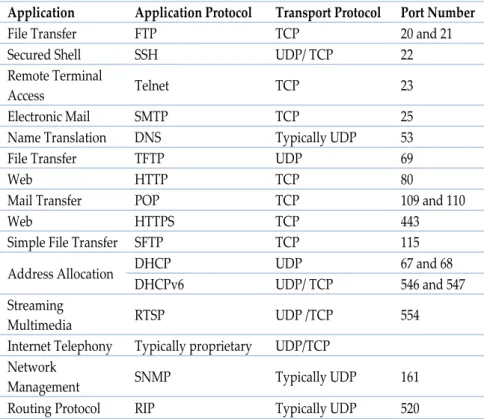
Application Application Protocol Transport Protocol Port Number
File Transfer FTP TCP 20 and 21
Secured Shell SSH UDP/ TCP 22
Remote Terminal
Access Telnet TCP 23
Electronic Mail SMTP TCP 25
Name Translation DNS Typically UDP 53
File Transfer TFTP UDP 69
Web HTTP TCP 80
Mail Transfer POP TCP 109 and 110
Web HTTPS TCP 443
Simple File Transfer SFTP TCP 115
Address Allocation DHCP UDP 67 and 68
DHCPv6 UDP/ TCP 546 and 547
Streaming
Multimedia RTSP UDP /TCP 554
Internet Telephony Typically proprietary UDP/TCP
Network
Management SNMP Typically UDP 161
Routing Protocol RIP Typically UDP 520
Table 2.1: Different applications for both TCP and UDP, and their corre-sponding port number(s)
The three reference models discussed earlier have multiple services and pro-tocols at different layers. The five-layer Internet model will be used as a basis in this thesis, and of interest are some of the protocols at network and trans-port layer. In particular, the TCP and UDP protocols’ network performance analysis is a common thread in this research. TCP and UDP protocols are commonly used by Internet applications [see Table 2.1] and are discussed next.
2.2.5 The UDP Protocol
The Internet model has both TCP and UDP at its transport layer, and of the two UDP is the simpler protocol. It is a connectionless (RFC 768)(Postel, 1980), unreliable protocol that provides a mechanism for applications to send encapsulated IP datagrams, without the need to establish a connection be-tween the communicating nodes (P. Liu, Meng, Ye, & Gu, 2002) (Brownlee & Claffy, 2002). UDP does not have a flow control mechanism and lacks func-tions related to acknowledgement of received packets (Gopinath, Kumar, & Sharma, 2013) (R. Hong, 2011). Error checking is not a prevailing feature: if it detects an error, the packet is dropped silently. UDP can be described as a no-frills, bare-bones transport protocol.
A transport layer protocol has to provide a mechanism for connecting pro-cesses between the communicating nodes. Connecting propro-cesses entails es-tablishing a connection between the sender and receiver, segmenting the packet stream into transportable units, numbering them, and then sending one by one, from sender to receiver. At the receiving end, the transport layer waits until all the different units common to a process arrives, checks them and then passes the error free entities to the process as a stream. However, UDP does not perform any of the activities mentioned here - it just receives a data stream for a process and delivers it unreliably. So UDP is the simplest of the transport protocols, providing process-to-process communication in-stead of a host-to-host complete process.
In spite of the drawbacks of UDP and its inherent disadvantages, it is a widely used communication protocol due to some of its integral advantages.
It is a simple protocol that has only 8 Bytes overhead per segment. If a sender needs to send information, and reliability is not a concern, UDP is the pro-tocol of choice (Cai, Zhang, & Song, 2010). UDP will immediately package data inside a UDP segment and swiftly pass it to the network layer. Also the interaction between the sender and the receiver is at a bare minimum, that is, there are no preliminaries at the beginning of the process. UDP does not establish and maintain a connection state, which includes entities like receive and send buffers, congestion control mechanisms and acknowledge-ment and sequence number parameters.
The UDP segment structure was originally defined in RFC 768. It has a header of 8 bytes, fixed in size, which is followed by the payload (Renbo & Xiong, 2009). As shown in Figure 2.2, the source and destination nodes are identified by the ports, and when a packet arrives, the payload is trans-ferred to the process attached to the destination port (Partridge & Pink, 1993). The port then delivers the embedded segment to the correct application. The source port field is copied to the incoming segment so that a reply can be sent via it to the communication origin is required (Akhtar & Siddiqui, 2011). The UDP length field can be a minimum of 8 bytes (size of the header) or up to 65515 bytes. Header checksum field is an optional field that can be used for adding extra reliability to the header information, or to the data itself.
IP IPv4/IPv6 Header
U
D
P
UDP Source Port UDP Destination Port UDP Message Length UDP Checksum
Data . . .
32 Bits
Unreliable Channel Sending Process Receiver Process Reliable
Channel Transfer protocolReliable Data (sending side) Reliable Data Transfer protocol (receiving side) Application Layer Transport Layer Network Layer Data Data Packet Packet Data Data Sending Process Receiver Process
Figure 2.3: Reliable and unreliable data transfer structure
The UDP protocol is used in communication situations where error correc-tion facilities are not needed, or where there is a need for a single short message exchange between applications. However, in most communication channels, reliable data transmission is warranted, where loss of even one single bit cannot be tolerated (i.e. transactions related to a customer’s bank details). In such situations, TCP is the favoured protocol, as discussed next.
2.2.6 The TCP Protocol
The TCP protocol, unlike UDP, is a connection-oriented protocol that trans-fers data between the source and the destination reliably, traversing unre-liable internetworks. In 1981, the US DoD standardised the protocol, prior to which there were nine earlier additions of ARPA TCP (R. Hong, 2011) (Brownlee & Claffy, 2002). The importance of the TCP protocol as the basis for today’s communication infrastructure is highlighted by the number of subsequent RFCs written after RFC793 (Postel, 1981c), each suggesting im-provements and fixes for errors and inconsistencies. The full collection of all RFCs related to the protocol has been road-mapped in a separate RFC doc-ument, RFC 4614 (Duke, Braden, Eddy, & Blanton, 2006). The TCP protocol
is dynamic, and capable of adapting to various properties of the communi-cations infrastructure, whilst providing a robust environment for data trans-mission.
There are a number of distinctive TCP features. One of its key features is in its design, where it has been optimised for accurate and reliable delivery, rather than a fast and timely delivery. Consequently, TCP data transmission may be subjected to relatively long transmission delays due to corrections related to transmission errors (Caceres & Iftode, 1995) (T.-H. Nguyen, Park, Youn, & Jung, 2013) . Thus, TCP is not suitable for real time data transmis-sion applications, such as Voice-over IP (VoIP). In addition, all TCP connec-tions are full duplex, that is, data is transmitted in both direcconnec-tions during the communications process. TCP is also a point-to-point protocol, implying that it is a must that there are always only two end points in the communica-tions process (for this reason the protocol is not suitable for applicacommunica-tions that utilise multicasting and broadcasting mechanisms). The use of sockets plays an important role when communicating using the TCP protocol. The sockets, being the end points on the sending and the receiving nodes, are given socket numbers that can be used by multiple applications for connection purposes. When establishing sockets, socket numbers for each end node point are cre-ated, which consist of the IP address and a 16-bit local port number. Flow and congestion controls are also prevalent in TCP data transmission. Here, the transfer rates are managed by the receiver to ensure that data is reliably received by the sender (this is done by the receiver continuously hinting to the sender how much data it can receive in a given period).
When transmitting using the TCP protocol, each byte in the communication process has its own sequence number. These 32-bit numbers are carried, to-gether with the packets, in both directions of the transmission and are used to ensure that all data in motion arrives at the destination intact (otherwise re-transmission procedures are initiated) (Safa, Karam, Assi, & Mcheick, 2011). When it comes to transferring data between the sender and the receiver, TCP segments are used. These are made up of a fixed 20-byte header, which is normally followed by some optional parameters. Generally the size of the
entire segment will be governed by the amount of data it can carry, which is restricted by two parameters: each segment has to fit into a 65535 byte pay-load (header inclusive), and must fit in with the size of the Maximum Trans-mission Unit (MTU). The actual structure of the TCP packet is discussed next.
The TCP packet, as shown is Figure 2.4, has an IP header and the TCP header. In the TCP header, the first two fields are the port addresses of the source and destination nodes, similar to that in UDP packet structure (Ahmad, 2001). These two addresses are the end points of the communication channel to be established. Following this is the sequence and the acknowledgement num-bers, where the former is related to data transfer direction and the latter is used in the reverse direction. Both these numbers relate to the position of the actual octet in the complete message stream identifying either the posi-tion of the first octet relative to the start of the data stream, or in the reverse data stream. Next, the options field is a variable length field that can accom-modate headers if they are of variable lengths.
IP H ead er IPv4/IPv6 Header T CP H ead er
Source Port Destination port Sequence Number Acknowledgement Number Data Offset Reserved Flags (8 bits) Window Co n g e s ti o n Win d o w E c h o Urg e n t Ackno w le d g e Pus h R e s e t S y n c F in is h
Checksum Urgent Pointer TCP Options (if any) Padding
TCP Data (if any) 32 Bits
The eight 1-bit flags follow next. The congestion window is a flag set by the sender to indicate that it received a TCP segment and has responded with a congestion control mechanism (Ramakrishnan, Floyd, & Black, 2001), while the echo flag plays a dual role, depending on the value of the SYN flag (Fukushima & Goto, 1999). Both these flags use Explicit Congestion Notifica-tion (ECN) (Edwan, Guan, Oikonomou, & Phillips, 2010) (Ramakrishnan et al., 2001) in the process of controlling congestion on a network. The urgent field value dictates if the urgent pointer is being used, while the acknowl-edgement field indicates if this field is significant. Data pushed through to the application, activates the push field, indicating that upon arrival, the new data does not need to buffer, but can go directly to the application. Fol-lowing this, the reset flag can be activated if the connection between the sender and the receiver needs to be reactivated, assisting the SYN bit with re-establishment of the connection. The final flag (finish) is used to indicate that no more data needs to be transmitted.
In TCP connections, the amount of data that can be sent before being ac-knowledged is controlled using a variable-sized sliding window. The win-dow size field manages this using the winwin-dow scale option, to allow senders and receivers to negotiate a window size. Following on, the checksum field adds extra reliability to both the header and the data, while the optional field can be used to provide extra facilities if required by the regular header. In every packet sent is a timestamp value, which is echoed by the receiver. A Se-lective Acknowledgement (SACK) option allows a receiver to tell the sender about the range of sequence numbers it has received (Leerujikul & Ahmed, 2001). As described in RFC 2018 and RFC 2883 (Mathis, Mahdavi, Floyd, & Romanow, 1996), (Floyd, Mahdavi, Mathis, & Podolsky, 2000), SACK en-ables the sender to determine what data the receiver already has, and what needs to be retransmitted (W. Xu, Xu, Wu, & Ou, 2011). The actual transfer of data occurs only after session parameters have been negotiated, as discussed next.
TCP Connection Establishment and Release
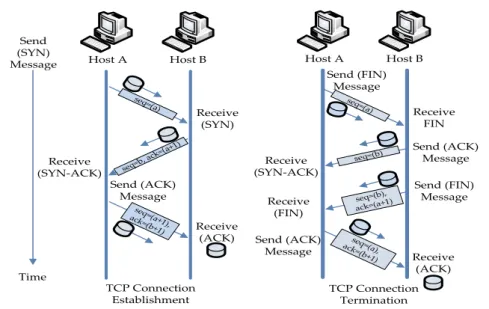
At the beginning of the TCP data transmission process, a three-way mes-sage exchange procedure known as a three-way handshake is performed. As shown in Figure 2.5, the purpose of this procedure is to synchronise the con-nection ends by negotiating the parameters that will be used during the TCP session. The handshake mechanism also ensures that both sides are ready for the transmission process, and that all transmissions will occur only after a successful session establishment, and that transmission will stop at session termination.
The actual session is setup when the sending node sends a segment with a SYN flag, together with a proposed first sequence in the appropriate TCP header field (syn=X) (Park, Lee, & Kim, 2003). On receiving this information, the receiver takes a note of what has been sent and then returns a segment with both the SYN and the ACK flags set with its own assigned values for the reverse direction, for both the sequence number (syn=Y) and the acknowl-edgement field (Shakkottai, Srikant, Brownlee, Broido, & Others, 2004). This is sent together with syn=X+1 and Ack=X+1 to acknowledge that the initial values from the incoming direction have been received. On the sender re-ceiving the reciprocated information, it takes note of the Y value and sends back an acknowledgement with the value Y+1 (H. Zeng, Peng, Li, Xu, & Jin, 2009) (Cardwell, Savage, & Anderson, 2000). After successfully undertaking the three-way handshake, both sides in the communication channel are con-figured and can start independently sending data to each other.
At the end of the communication process, the session between the sender and receiver has to be terminated. This can be initiated by either of the com-municating nodes by sending a TCP segment with a FIN bit, indicating that there is no more data left to be transmitted (Shukla & Brecht, 2006). On re-ceiving the FIN bit, the other end shuts down the communication channel one way for any new data. However data may continue to flow in the oppo-site direction. This reverse direction can also be shut down in a similar way when a FIN packet is sent from the other node to its counterpart. So in total, four TCP segments have to be sent to terminate a session.
Host A Ho