This is the author’s version of a work that was submitted/accepted for pub-lication in the following source:
Hudson, Peter B.(2013) Developing and sustaining successful mentoring relationships. Journal of Relationships Research,4.
This file was downloaded from: http://eprints.qut.edu.au/61695/
c
Copyright 2013 Cambridge University Press
Notice: Changes introduced as a result of publishing processes such as copy-editing and formatting may not be reflected in this document. For a definitive version of this work, please refer to the published source:
Hudson, P. (2013). Developing and sustaining successful mentoring relationships. Journal of Relationships Research, 4. DOI: http://dx.doi.org/10.1017/jrr.2013.1
Developing and sustaining successful mentoring relationships
Peter Hudson
Queensland University of Technology
Abstract
As mentor teachers hold the balance of power in the relationship, how do they build and sustain positive mentor-mentee relationships? This study involved eleven pairs of mentors and mentees (n=22) with audio-recorded interviews to explore their relationships, mentors’ support and mentors’ expectations for
mentees’ involvement in the school. Findings suggested ways to build and sustain mentoring relationships (e.g., professionalism, respect, and support). Indeed, support in providing information for planning, access to resources, two-way dialoguing with feedback and reflections, and establishing safe, risk-taking environments to trial and evaluate newly-learnt teaching practices were considered as a ways to build and sustain relationships.
Relationships and relationship building are pivotal in teaching, particularly as it facilitates productive collaborations with colleagues and parents (e.g., Ferguson & Johnson, 2010; Merrill, 2006; Romano & Gibson, 2006), and as a way to engage students in education (Pianta, Hamre, & Allen, 2012). Preservice teachers are learning about professional relationships and relationship building when in the school system, particularly as they are required to work closely with their mentor teachers (Hobson, Ashby, Malderez, &
Tomlinson, 2009). Mentoring is a way for preservice teachers (mentees), in the formative stages of learning how to teach, to engage productively with a more experienced teacher. The mentoring relationship is formalised when a mentee undertakes practicum and internship experiences with the acceptance of the mentee into the mentor teacher’s
classroom.This mentor-mentee relationship is socially formed and developed. Beutel and Spooner-Lane (2009) assert that the success of mentoring relationships lies in the skills and knowledge of the mentors; yet this also requires developing professional-personal
relationships.
Mentors demonstrate a range of levels of interacting with their mentees from those who are highly supportive to laissez-faire or ad hoc in their approaches (O’Brien & Goddard, 2005), which can contribute to the quality of outcomes (Hellsten, Prytula, Ebanks, & Lai, 2009),
including teaching, student learning and mentor-mentee relationships. Mentors and mentees form professional relationships at varying levels and these “mentoring relationships are conceptualized as close relationships that occur along a spectrum from highly functional to highly dysfunctional, with most occurring in between” (Gormley, 2008, p. 45). This recognises the complexities of mentoring relationships and that research is required to understand “the complex interactions that constrain and promote these relationships” (Bradbury & Koballa, 2008, p. 2143). Hence, a guided approach to mentoring and relationship development can assist mentors in their practices. The importance of an effective mentoring relationship is underpinned by a variety of factors, including the mentor-mentee personal and professional qualities (Rippon & Martin, 2006), skills and practices (Hall, Draper, Smith, & Bullough, 2008), the environment or context in which it operates (Forsbach-Rothman, 2007), and the selection and pairing of the personnel involved in the relationship (Hobson et al., 2009).
Despite mentors operating at complex levels with competing demands that shape their actions (Valencia, Martin, Place, & Grossman, 2009), there can be lost opportunities for learning how to teach when mentors do not have a sound relationship for providing constructive feedback to their
mentees. Although Niehoff’s (2006) study focused on mentoring in another occupation, the findings about mentors’ personality predictors to be a mentor may have relevance to teaching. Niehoff discovered that “mentoring involves active engagement in an environment requiring social, task, and idea-related capabilities, thus individuals who are extroverted, conscientious, and open to experience would likely feel more comfortable” (p. 321). Although the word “extroverted” appears as a high-end term, it signifies being friendly, outgoing, communicative, and is opposite to being introverted.
Studies (Gehrke, 1988; Gormley, 2008) highlight the critical nature of strong interpersonal skills for mentors to articulate pedagogical knowledge to their mentees. Obstacles to successful
mentoring relationships mainly focus on the mentor’s time issues, lack of support and poor interpersonal skills, with a call for more rigorous mentor selection processes (Kilburg, 2007; McCann & Johannessen, 2009). Bradbury and Koballa (2008) identify sources of tension in the mentoring relationship have considerable focus on didactic communication and, as power exists with the mentor, the mentee “may be unwilling to question the practices of the school or mentor teacher for fear of fracturing the relationship or affecting the mentors’ evaluation of their
progress” (p. 2135). Bradbury and Koballa continue to outline that within this communication other concerns may surface such as tensions between teaching philosophies and mentor guidance that can contrast with education reform ideologies. In addition, the mentor’s dual role as
confidant and assessor to the mentee can be a catalyst for further relationship tensions (Ganser, 1996). There is evidence that both partners need “to illuminate expectations and to foster productive communication” to build relationships (Bradbury & Koballa, 2008, p. 2143).
Though mentor selection is another issue, the inadequate number of willing mentors is another obstacle, which presents as a rationale for educating mentors about the quality and quantity of available mentors (Hudson, 2010). When entering into a mentor-mentee relationship, Anderson’s (2007) study of 48 mentor teachers and 56 preservice teachers shows that mentors and mentees need to be aware of the power differential in the mentoring roles. Hansman (2003) outlines that “mentoring is a social constructed power relationship, and the power that mentors have and exercise within mentoring relationships can be helpful or hurtful” to the mentee (p. 15); consequently mentees must learn how to manage mentors to ensure maximum benefits
(Maynard, 2000). It is also important to note that the mentoring relationship can assist mentees’ psychosocial development, as “mentoring relationships can be powerful and life-changing events in people's lives” (Hansman, 2003, p. 14).
Mentees seek professional and personal qualities in their mentors (O'Brien & Christie, 2005). Many studies (e.g., Rajuan, Beijaard, & Verloop, 2007; Rippon & Martin, 2003) outline how mentees place importance of a positive relationship with their mentors, with the mentor’s personal attributes (i.e., personal intelligence, interpersonal skills) surrounding the mentoring process. Hudson (2006) outlines that the mentor’s personal attributes contribute to the mentoring process and includes: having the personal qualities for the mentee to be willing to reflect with the mentor, being supportive, being comfortable with talking, being an active listener, and instilling positive attitudes and confidence in the mentee. These qualities are claimed to assist in
commencing and sustaining the mentor-mentee relationship. Mentees can also develop personal attributes to assist them in interacting with their mentors, such as being motivated and reflective (Moberg, 2008). In a mixed-method study, Hudson (under review a, b) shows that experienced mentor teachers want specific desirable mentee attributes such as: enthusiasm for teaching, being personable for relationship building (not just with the mentor but also with students, staff and parents), displaying commitment to children and their learning, being a lifelong learning, having the ability to reflect on constructive feedback, having resilience, and taking responsibility for their learning. Indeed, preservice teachers can have adverse experiences requiring a level of resilience (Gu & Day, 2012; Howard & Johnson, 2004). Mentees need to take active roles in facilitating the professional relationship for which Allen, Cobb, and Danger (2003) suggest that “preservice teachers expanded their instructional strategies as a result of three components of the mentoring relationship: selection of strategies, organization, and non-judgmental support”. Being non judgmental infers the involvement in productive and communicative interactions that do not reflect bias or breach ethical and moral standards.
Mentors are beginning to recognise their role encompasses not only being a critical friend but also a counsellor and confidant with a greater emphasis on the mentor-mentee relationship (Ganser, 1996; Kwan & Lopez-Real, 2005). Undoubtedly, a sound mentor-mentee relationship would help to facilitate successful teaching experiences; hence it is important to discover ways mentors and mentees can contribute to the relationship development (Margolis, 2007). A sound mentoring relationship where mentors employ personal attributes can also assist the mentee to reflect on practices towards achieving student outcomes (Sempowicz & Hudson, 2012); yet the process begins with forming the mentor-mentee relationship. In teaching and in other
occupations (e.g., Gibson, 2004), there is a call for more qualitative studies to uncover attributes that may assist in understanding successful mentoring partnerships.
Concepts drawn from the literature review were used as an explicit framework for this study. These concepts indicate that mentor-mentee interactions are variable (Gormley, 2008;
O’Brien & Goddard, 2005), and mentors need to display personal attributes to interact with mentees (Niehoff, 2006), which appear critical to the relationship (Gehrke, 1988; Gormley, 2008). It infers that mentor support and expectations from both mentor and mentee can foster positive relationships (Bradbury & Koballa, 2008; Ganser, 1996). However, research is needed around the complexities of the mentor-mentee relationship (Bradbury & Koballa, 2008) and, as mentors are positions of power (Anderson, 2007; Hansman, 2003), it is important to understand how mentors can effectively facilitate a positive mentor-mentee relationship during the professional school experience. Identifying ways in which these relationships are built and sustained may assist in guiding the mentoring process. Thus, the research question for this study was: How can mentors, in their positions of power, build and sustain positive mentor-mentee relationships?
Data collection and analysis
This qualitative study collected data from mentor teachers and preservice teachers (mentees) about their understandings of the mentor-mentee relationship. All mentor teachers had completed or were in the final stages of completing the Mentoring for Effective Teaching (MET) program. This program was conducted over two full days for some but others were involved in 12 one-hour sessions held within the school by a MET facilitator. There were sessions around school culture and infrastructure, developing the mentor-mentee
relationship, understanding desirable personal attributes for mentors and conflict resolution, which comprised one third of the MET program. Other sessions focused on mentoring for effective teaching about the system requirements, articulating pedagogical knowledge, modelling teaching practices, and providing feedback to the mentee. For instance, articulating pedagogical knowledge involved eleven literature-based practices, based around: planning for teaching, timetabling and timing teaching, preparation of resources, selecting teaching strategies, having appropriate content knowledge for student learning, problem solving, classroom management, questioning skills, implementation of the lesson structure, assessment of and for learning, and the mentor’s viewpoints of teaching (further details about the program can be noted here: www.tedd.net.au).
Constructivism was viewed as an epistemology for this study with interpretivism as the theoretical perspective that draws upon a methodology of case study research (Crotty, 2003).
Interviews of key stakeholders (mentors and mentees) would be used to gather data along semi-structured lines of questioning around how the mentor builds and sustains the mentor-mentee relationship, and in particular around mentor support and mentor-mentor-mentee
expectations. For example, participants were asked to describe their specific mentor-mentee relationship, how the mentor supported the mentee, and their expectations of each other in the relationship. Data were collated and analysed under broad themes (e.g., relationships, support, expectations) where both mentor and mentee voices would be represented to triangulate information (Creswell, 2012). In addition, this study uses narrative research design to “focus on the experiences of one or more individuals” with a retelling of personal accounts of actions (Creswell, 2012, p. 507); thus data from two mentor-mentee pairs would be used to provide more detail on the broad themes through their retold experiences. These were also coded around the aforementioned broad themes and triangulated to determine validity of responses.
This study involved eleven pairs of mentors and mentees were interviewed using a digital audio recorder in the school setting either the second last day or last day of the preservice teachers’ four-week practicum. Interview questions were based on the mentor-mentee relationship but focused on describing the relationship, the quality of mentor support, and mentor expectations of the mentee for completing the school experience. Interview data were transcribed by an experienced research assistant with a PhD.
Findings
The qualitative study involved 22 mentors and mentees (11 pairs) individually interviewed at the conclusion of a four-week school experience. Table 1 presents the mentor
demographics, for instance Mentor 1 (M1) has 12 years experience at this school and is currently on a Year 3 class. M1 has mentored more than 30 mentees, and appears as the most experienced mentor teacher in this study. This mentor has undertaken the Mentoring for Effective Teaching (MET) training program and is mentoring a university student who is in her fifth year because this student had a leave of absence. M1’s mentee reported that she had taught more than 40 lessons during this four-week period, which amounts to
approximately two or more lessons per day. As an example of data collected across the mentor-mentee interviews, two pairs (mentor 1 & mentee 1, and mentor 2 & mentee 2) will be presented here.
Table 1. Mentors’ demographics M1 M2 M3 M4 M5 M6 M7 M8 M9 M10 M11 Years at this school 12 16 3 4 1 2 8 16 2 15 10 Current grade 3 1 1 3 3 5 P-7 2 3 6 6 How many mentees? >30 >20 3 6 10 5 3 3 8 >10 10-12 MET training Yes Yes Yes Yes No Yes No Yes No Yes Yes Mentee’s year at university 5 3 3 3 3 4 3 3 4 3 3 Number of lessons taught by mentee >40 7 >15 10 >40 >40 >30 >40 >30 >30 >40
Mentor 1 (M1), who was a teaching deputy principal of the school, claimed to be a “natural mentor” and her “biggest focus with mentoring preservice teachers is building
relationships”. She said her methods for building relationships was “all about taking time, listening to them, building relationships, finding connections and developing that
relationship as they go along”. She indicated the use of terms that facilitated relationship building such as “we’re a team here” and, during the interview, she made several inferences about working as a team. M1 stated that her preservice teacher was “all about relationship building too... and I think it’s just the relationship we’ve built together”. Yet she said the relationship was on a professional basis only, which appeared to instil respect, “we’re not best friends or any of that sort of thing. There’s still that fine line but she respects me and I respect her”. The level of respect for the mentee was noted in M1’s support with “lots of discussions... talk about reflections and the effect that reflections have on your next lesson”. Part of developing the respect seemed to be the mentor’s expectations, for instance: “I have high expectations; this school has high expectations like many other schools do”. M1
highlighted that her expectations included “extensive planning” and asking questions such as “if a child didn’t achieve a concept what are you going to do about it?” She expected her mentee to assess work thoroughly and ensure there was always follow up on students’ work “whether it’s homework, whether it’s lunchtime, whether you talk to them now, whether you talk to parents”. As part of relationship building and sustaining the relationship, M1 would share her achievements and also her challenges such as “we talk about difficult parents, we talk about children and their backgrounds and why they come to school like this and how we need to support them”. It was very clear that M1’s main motivation for developing a positive mentor-mentee relationship was to have her Year 3 students succeed, “Especially in this
class they’re quite low level and they’ve made massive improvements compared to any other 3 class”.
Mentee 1, on the other hand, claimed that the relationship was “both personal and
professional”. She emphasised how the relationship was friendly, as her mentor was “very open” and made her “feel like part of the furniture, she’s great, she makes me fit in”. This was noted in how her mentor supported her with reflective discussions about students’ learning and teaching practices, particularly planning and preparation. She stated that her mentor’s expectations included: “work hard, turn up every day, be prepared, organisation that was a big one... she’s really drummed into me about coming in early or get it done the day before”. Both M1 and Mentee 1 had a successful professional relationship and the mentor’s assessment of the mentee’s teaching showed a high success rate across the measureable categories (e.g., planning, organisation, classroom management, & student assessment). There was no tension noted between the mentor roles as assessor and confidant primarily because, from both perspectives, the relationship was built upon mutual respect with effective communication and clear expectations.
Mentor 2 (M2) claimed she had an “open supportive relationship where [the mentee] is allowed to express her insecurities, and in an open way, so that we can work on those”. This was further articulated as an expectation within the relationship: “I’ve sort of made it quite clear that is to identify her weaknesses and that’s what we want to work on, to make it her strengths”. The level of support provided around this expectation was also forthcoming, “for example, one of the weaknesses [the mentee] identified was behaviour management so I provided her with reading material explaining different ways, different styles of and strategies for behaviour management and we focused on trialling those”. Here, the mentor claimed to provide resources and facilitate discussions around the “weaknesses” so that she could “come to her own conclusion as to what things she’d like to try”. This was further supported when the mentee would trial an action to test its success, for which M2 stated,
Mainly I think I supported her through her risk taking, in that learning to be a teacher is taking risks. It isn’t always going to work out how you want but the secret is to recognise that that didn’t work, and change it.
M2 claimed she had high expectations, particularly with a strong focus on her Year 1 students’ learning, including explaining the lesson goals, assisting specific students and “differentiation for the others”. She explained that her expectations involved her mentee
providing “explicit instruction, modelling what was required and then following up on becoming aware of who actually attained the goals and having that assessment in your head, of who was where, who wasn’t, who needed something else”.
Mentee 2 stated the relationship with her mentor “was a really close relationship between us”. Although her mentor did not mention a personal relationship, Mentee 2 claimed that they would “share actual personal things about each other and our life, not only... it’s just not about the professional school work, it’s [that] she shares personal things with me”. Mentee 2 said there were mentor-mentee conversations around the “struggles she’s had becoming a teacher”, which supports M2’s claim about having an open supportive
relationship and identifying her weaknesses to convert into strengths. According to Mentee 2, there was the aspect of encouraging her “to do my best”. Mentee 2 outlined the access to resources provided by her mentor that allowed her to broaden her perspectives: “She gave me a lot of resources which were valuable… I’ve got ten pages of behaviour management strategies so different ones that I can try”. This was further supported with advice from her mentor, for example, according to Mentee 2, “She said one will not work the whole time so you need to keep trying different ones”. Importantly, this mentee noted how her mentor helped with planning and with student differentiation “to make modifications to see how the kids are coping with everything”. Mentee 2 said her mentor’s expectations were largely based on professionalism; “right from the start… we share personal things but don’t bring it into the classroom just be professional”. Professionalism encompassed broad and specific roles (and behaviours) for this mentee, which transcended into classroom practices such as “how I catered for the different learners in the classroom… asking them questions and setting them different tasks”. Evidence from both M2 and Mentee 2 concurred that the relationship was supportive, communicative and built around trust, respect and
professionalism.
Relationship
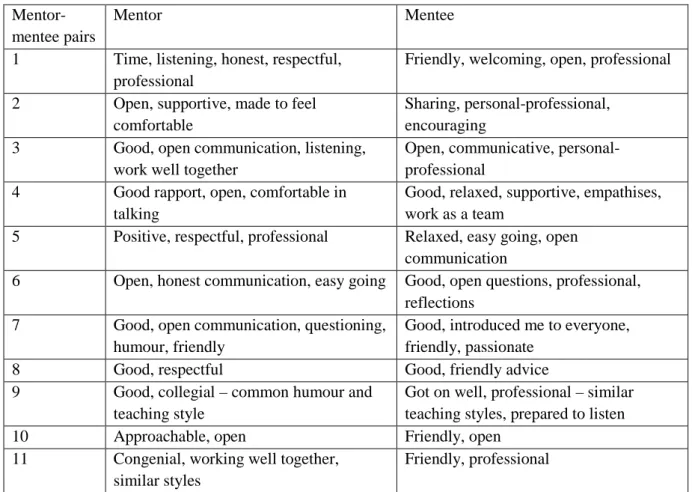
All participants (n=22) emphasised that the mentors’ personal attributes were considered essential to the mentor-mentee relationship. Table 2 outlines mentors’ and mentees’ words to describe the quality of their mentor-mentee relationships. Professional, friendly,
respectful, open communication (comfortable with talking), and listening were key words they used to indicate the quality of the relationships. Friendliness may be noted in being “easy going”, having a sense of humour and “working well together”.
Table 2. Descriptions of mentors’ relationships with mentees
Mentor-mentee pairs
Mentor Mentee
1 Time, listening, honest, respectful, professional
Friendly, welcoming, open, professional 2 Open, supportive, made to feel
comfortable
Sharing, personal-professional, encouraging
3 Good, open communication, listening, work well together
Open, communicative, personal- professional
4 Good rapport, open, comfortable in talking
Good, relaxed, supportive, empathises, work as a team
5 Positive, respectful, professional Relaxed, easy going, open communication
6 Open, honest communication, easy going Good, open questions, professional, reflections
7 Good, open communication, questioning, humour, friendly
Good, introduced me to everyone, friendly, passionate
8 Good, respectful Good, friendly advice
9 Good, collegial – common humour and teaching style
Got on well, professional – similar teaching styles, prepared to listen
10 Approachable, open Friendly, open
11 Congenial, working well together, similar styles
Friendly, professional
Mentees expressed a level of comfort when the relationship was working well, whether in the initial introductory stages, such as “always more than willing to help and introduce me to like everyone around school and made me feel really comfortable and happy to be here” (Mentee 7) or as the school experience progressed: “She empathises with my situation” (Mentee 4) and “she’ll always give me guidance. She’s just like a fountain of knowledge for me. I normally reflect and share that with her” (Mentee 4). Reflecting and sharing critical information about teaching practices required a level of comfort in the relationship for communication to be open and honest. In contrast, Mentee 6 outlined an initial
misinterpretation of the mentor’s expectations for teaching that made her feel uncomfortable or as she expressed it “went through a bit of a panic”; however M6 rectified this situation by explaining she was not expected to know everything, which can be noted in the following:
I got the feeling that he expected me to know everything and be able to ...but what it turned out to be is I misinterpreted it... The reason I think I misinterpreted him is because I went through a bit of a panic where I thought I don’t have the knowledge to do this, I don’t know what I'm doing. So I went into a bit of a panic but he sat me down and he said that you know you need to build your confidence, you’re not expected to know everything. He made that
clear to me and this is your time to learn. So he was very comforting, he was very ...he had faith in me if that makes any sense.
Interview data suggested that when the mentoring relationship was working, both parties could generally pinpoint similar reasons, for example: “I think we both share a similar sense of humour and I think possibly a similar sort of a style” (M9) and Mentee 9 commented, “I guess we’re the same age, being a mature age student. I think helped a lot and just similar teaching styles, very similar teaching styles”. Working as a team projected a sense of unity between the mentors and mentees. “She gives me heaps of feedback on what I'm doing. We work as a team so we’ve never had any conflict which is fantastic” (Mentee 4; Table 2).
Mentoring was articulated as a two-way relationship, consequently, the mentee also needs to contribute by displaying desirable personal attributes. To illustrate, “I found my mentee to be very approachable and amenable. She really wanted to listen and take on board things and so I found that it was easy to work with her” (M10). Other mentors indicated specific mentee attributes deemed to be desirable for sustaining the mentoring relationship, “she’s very willing to learn, enthusiastic and motivated” (M7).
Support
The quality of the relationship was linked strongly to the level of support provided by the mentors. Mentor support was largely associated with providing information for planning, resources, and two-way dialoguing. All mentors in this study indicated they had a working mentor-mentee relationship (Table 2) and all provided positive comments about their
mentors’ support (Table 3); although when asked specifically of the mentor support, Mentee 5 provided no response. Nevertheless, Mentee 5 indicated mentor support elsewhere in her interview (e.g., modelling behaviour management). These working relationships were outlined as being enjoyable by some mentors, “I'm enjoying having her company in the room… so that’s a nice experience” (M4). No mentee in this study failed their school experience; however the enjoyment of the experience may have been altered if this were the case. Indeed, Mentee 5 successfully overcame difficulties with behaviour management during her practicum.
Support was noted in the mentors’ sharing of information (documents, strategies, resources) through discussions, feedback and reflections (Table 3), which mainly focused on students and their learning needs, for example: “Meeting before hand and making sure that I had
information about specific students that were going to be challenging either in their behaviour or in their academic abilities so that there was preparedness for that” (M5). The mentor’s knowledge about teaching strategies to target students’ differentiated learning needs was apparent in the planning stages: “Well essentially I write up my lessons and then I liaise with her and she makes suggestions here and there and ensures that I have
differentiation in my lessons to cater for some of the students” (Mentee 8). Lesson designs and classroom management drew upon the mentor’s knowledge during mentor-mentee discussions, for instance, M10 claimed her discussions included “classroom management was a fairly big focus and the questioning skills and giving instructions” (M10).
Table 3. Descriptions of mentors’ support for mentees
Mentor-mentee pairs
Mentor Mentee
1 Discussions, reflections, working as a team, class and school information
Reflection, access to resources, hands-on approach
2 Provide resources, strategies, risk taking, identify strengths and weaknesses
Advice, resources, strategies, planning, information
3 Information, examples, resources Resources, curriculum, information, strategies, modelling practice
4 Planning, feedback, reflection, developing resilience
Guidance, helpful, content knowledge, observe modelling of practices
5 Meetings, planning, feedback No 6 Meetings, strategies, observations of mentor
practices, gradual learning
Confidence, safety net, help out, debrief, reflect 7 Advice, observe mentor, support documents,
feedback, reflect, student assessment
Planning, timetabling, philosophy of teaching, modify lessons
8 Feedback, scaffolding lessons, resilience, observe modelling of practices
Planning, differentiation, behaviour
management, observe modelling of practices, feedback
9 Discussion, questions, classroom teaching access, reflect
Discussions 10 Reflect, conversations, guidelines for teaching
focuses, target learning, school goals, modelling
Reflections, honesty, constructive feedback
11 Discussion about commitment to university expectations, knowledge of curriculum areas, resources, model planning
Feedback, discussion, questioning
Various mentors and mentees noted support as allowing the mentees to trial teaching practices in the classroom. Indeed, facilitating a supportive, risk-taking environment appeared essential to the mentors and mentees in this study. To illustrate, M4 stated, “supporting her to try and step outside her comfort zone and do things in a different way to
what she’s been doing” and Mentee 3, “not restricting you at all in the classroom”. “So if things didn’t go to plan it didn’t matter, then she learnt from that to continue on” (M8). “I think giving her enough scope in the classroom to do what she wanted to do... We’d talk a lot before hand and we’d talk afterwards and reflect on it and build for the next lesson” (M9). Indeed, reflections were mentioned by all mentors and mentees in this study, though they may have occurred in varying ways. For instance, Mentee 4 claimed that “I said that we would be doing reflections and I was just doing it as a conversation, I have my notes, she has her notes and we chat about it”. As part of risk taking, mentors also discussed supporting mentees to develop resilience, for instance: “So I'm trying to help her develop that
resilience… that even if your lesson flops it’s not reflective on your teaching” (M3). Specifically about developing resilience, M4 outlines in the mentee a “struggle with time management at the moment and sort of try to give her tips on how to manage that balance between your work and your home life”. Discussions (feedback and reflections), planning, resources, strategies for teaching and behaviour management, modelling and developing resilience appeared as significant and supportive mentor actions (Table 3).
Expectations
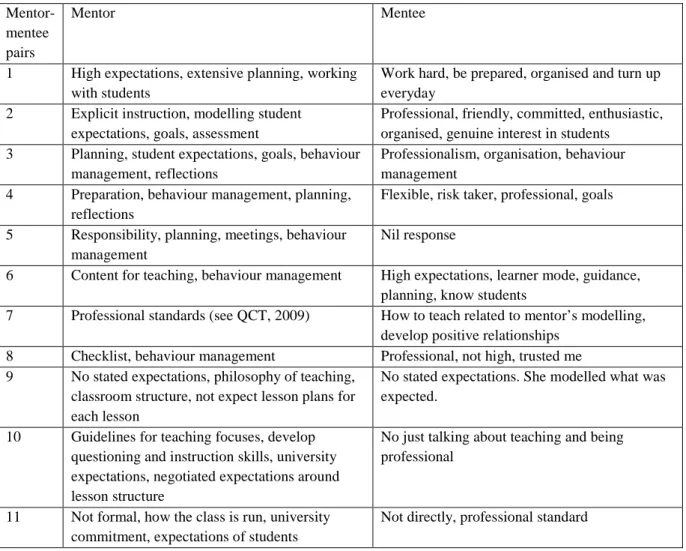
All mentors claimed they provided clear expectations (formally and informally) of the mentee’s work within the school, which was further supported by their mentees’ comments (except Mentee 5; Table 4). Two mentors (3, 11) referred to university guidelines as the mentees’ expectations, while others presented the Queensland College of Teachers (QCT, 2009) expectations and their own specific expectations. To illustrate, most emphasised professionalism as an expectation which encompassed professional behaviour and professional approaches to teaching, including planning, preparation, behaviour management, strategising and other aspects within the classroom. This required professionalism with other people: “To be professional with other teachers as well and professional with the kids and the parents and stuff” (Mentee 3). More than half the mentors highlighted regular reflections (oral and/or written) as part of their expectations.
Mentees expected mentors to have high expectations. For example, Mentee 7 stated she wanted her mentor to have “high expectations and I think really getting you to go in there and teach” and Mentee 6 commented, “I quickly came to the understanding that his
expectations of me were high, which was a really good thing. Because it helped me to push myself to demonstrate my abilities”. Mentee 6 emphasised a mentor’s trust and confidence
in the mentee to teach the class, in that mentors “should have high expectations; trust that you’ll provide that safe and supportive environment for their classroom because you know it is their class. They need to expect that they can trust you with their class”. Expectations were considered transferable to the students in the classroom, for instance: “To have high expectations of the students, to never have a negative outlook on them and their
achievements. To always expect the best from them” (Mentee 8).
Table 4. Mentors’ expectations of mentees, as stated by mentors and mentees
Mentor-mentee pairs
Mentor Mentee
1 High expectations, extensive planning, working with students
Work hard, be prepared, organised and turn up everyday
2 Explicit instruction, modelling student expectations, goals, assessment
Professional, friendly, committed, enthusiastic, organised, genuine interest in students
3 Planning, student expectations, goals, behaviour management, reflections
Professionalism, organisation, behaviour management
4 Preparation, behaviour management, planning, reflections
Flexible, risk taker, professional, goals 5 Responsibility, planning, meetings, behaviour
management
Nil response
6 Content for teaching, behaviour management High expectations, learner mode, guidance, planning, know students
7 Professional standards (see QCT, 2009) How to teach related to mentor’s modelling, develop positive relationships
8 Checklist, behaviour management Professional, not high, trusted me 9 No stated expectations, philosophy of teaching,
classroom structure, not expect lesson plans for each lesson
No stated expectations. She modelled what was expected.
10 Guidelines for teaching focuses, develop questioning and instruction skills, university expectations, negotiated expectations around lesson structure
No just talking about teaching and being professional
11 Not formal, how the class is run, university commitment, expectations of students
Not directly, professional standard
Expectations were not always articulated as a rigid set of practices, for instance, M9 stated that, “We talked about my kind of philosophy of teaching and how I structured the
classroom and the kids” (Table 4). Many comments about expectations were packaged around the mentor’s personal attributes, supportiveness and professionalism, “was good friendly, professional, she always guided me in the right direction” (Mentee 11) and some into one key word, “to be professional” (Mentee 10). M11 focused on expectations around “her commitment to uni”. Indeed, M11 claimed that “sitting down formally and saying this
is what I expect of you... probably not”. Instead, M11 was more focused on “how things are done in this school and how I ran my classroom and my expectations of my students”.
Discussion
Mentees were required to work collaboratively with their mentors (Hobson et al., 2009) and all the mentees in this study explained they had positive working relationships that helped them to learn about teaching. Unlike O’Brien and Goddard’s (2005) study, there did not appear to be laissez-faire or ad hoc approaches to the mentoring, though expectations from some mentors were less formalised. Both groups of participants indicated a
highly-supportive mentoring environment that contributed to favourable outcomes with all mentees completing the school experiences successfully, as indicated by interviews and the mentors’ reports. This supportive environment as a key for achieving success concurs with Hellsten et al’s study (2009). There were no dysfunctional relationships in this study. Mentors
demonstrated positions of power (Bradbury & Koballa, 2008; Hansman, 2003) by outlining expectations and being the person responsible for learning in the classroom but they did not appear to abuse or misuse this power, as demonstrated by comments regarding the mentors’ supportiveness of the mentees’ pedagogical development.
Mentees had high expectations of having a positive mentor-mentee relationship and expected support in their learning about teaching. Mentees appeared keen to please the mentor by “working hard” “being enthusiastic” and displaying other desirable personal attributes that may contribute to a positive mentor-mentee relationship, particularly with mentors in their positions of power. There was no indication of tension in the mentors’dual role as confidant and assessor (Ganser, 1996); this appeared to be managed by outlining expectations, open and honest communication, continuous feedback and reflection, and facilitating a supportive learning environment. Yet, it might also be a result of mentees feeling guarded about their responses, as mentors are in positions of power.
The mentors’ personal attributes, skills and practices seemed to contribute to the mentees’ successful school experiences (see also Hall et al. 2008; Rippon & Martin, 2006), despite not being purposively selected and paired in their mentor-mentee roles, which demonstrates that such pairing may not be the only factor for ensuring positive mentor-mentee relationships (Hobson et al., 2009). Instead of a more rigorous mentor selection processes as called by some educators (Kilburg, 2007; McCann & Johannessen, 2009), an effective mentoring
program may make a difference for building and sustaining a mentor-mentee relationship. More to the point, all these mentors had recently undertaken or were in the final stages of undertaking a mentoring for effective teaching (MET) professional development program, with mentor’s attributes and practices at the centre of this two-day program. It is possible that these mentors had learnt skills and employed strategies indicated in the MET program; however further research is required to determine if the professional development program was a reason for mentors having successful mentoring relationships, which would require a much greater pool of participants.
The mentors (n=11) were considered to be open, communicative and supportive, and
interview data suggested that the mentors had open and possibly “extroverted” personalities, which may be a desirable personality predictor for being an effective mentor (see Niehoff, 2006). Descriptions from mentors and mentees about the mentoring indicated the mentors were conscientious and could deconstruct pedagogical practices to make it understandable for mentees. Mentors were deemed to utilise desirable personal attributes to facilitate the mentoring process (Hudson, 2006); however it was suggested that mentees must also exhibit desirable personal attributes (Hudson, under review), as relationships are a two-way
interaction. It appeared that mentors’ and mentees’ personal attributes noted in this study lead towards favourable outcomes with mentees succeeding in their practicum experiences. These findings have implications for mentors and mentees to ensure they understand what may constitute desirable ways to build and sustain the mentoring relationship, particularly how a mentor can support the process, manage the power differential, and the articulation of expectations from both mentors and mentees.
Conclusion
This study explored mentor-mentee relationships, mentor support, and mentor expectations of preservice teachers undertaking school experiences. Developing and sustaining positive mentoring relationships were considered essential by all participants, particularly as a benefit to the students’ learning (see also Pianta et al., 2012). Relationships were built and sustained through trust and respect, which also included the mentors’ professionalism, open communication, attentive listening and friendly dispositions. It can be concluded that as a mentoring partnership, both mentor and mentee need to exhibit positive attributes to build and sustain the relationship. However, as mentors are in a position of power with legal
responsibility for the class and substantially more teaching experience, they will need to be proactive in facilitating the relationship.
High levels of mentor support involved the provision of information for planning, access to resources, and two-way dialoguing with feedback and reflections. Support was also in the form of establishing safe, risk-taking environments for mentees to step outside their comfort zones to trial and evaluate newly-learnt teaching practices. It was inferred in this study that scaffolding these types of investigative efforts may lead to greater resilience. Articulating expectations at the beginning of the mentee’s school experiences seemed to establish a foundation for developing the relationship. High expectations from the mentors were expected of mentees, and these expectations seem to translate into support around pedagogical knowledge practices and meeting teaching standards, as advocated by
university and department of education requirements (e.g., QCT, 2009). Mentors expected their mentees to be risk takers with high levels of professionalism that have students at the centre of learning how to teach.
There were several limitations to this study that require further investigations. Data were collated around interview questions that focused on relationships, mentor support and mentor-mentee expectations. More open-ended questions may divulge data that extends beyond these broad themes. This study focused only on the mentor and mentee and did not take into account the effect of this relationship on others (e.g., students), which would provide an understanding of how the relationship affects teaching and learning. As these participants taught on mainly the lower primary grades, it may have been difficult for such young children to determine the mentor-mentee relationship, however, a study conducted in the high school could shed light on the effects of this relationship. Indeed, studies are needed on how these relationships affect other school staff, parents and students as a consequence of positive and negative mentor-mentee relationships. These mentees were in their third or final year of their preservice teacher education program, and as such other studies can concentrate on earlier years and across various contexts (e.g., rural compared with metropolitan).
Research is needed to explore deeper narratives about the mentor-mentee relationship, and further research is required that uses multiple data collection tools, particularly observations of mentoring practices, that may assist to determine the level of support necessary to sustain relationships and how the mentor’s expectations impact on the mentee’s development.
Crucial to addressing the issue of suitability-pairing of mentors and mentees is the notion that a professional development program may negate relationship issues by educating mentors on how to build and sustain mentoring relationships. Relationships are essential to the mentoring partnership yet mentors may not have had professional development on how to develop these relationships. Indeed, data from this study can be used within mentoring programs to demonstrate effects of developing and sustaining positive relationships and how mentors can support their mentees’ development.
Acknowledgements: This work was conducted within the Teacher Education Done
Differently (TEDD) project funded by the Australian Government Department of Education, Employment and Workplace Relations (DEEWR). Any opinions, findings, and conclusions or recommendations expressed in this paper are those of the authors and do not necessarily reflect the views of the DEEWR. I would like to acknowledge the work of Dr Sue Hudson as Project Leader and Julie Christensen as the Research Assistant.
References
Allen, D. D., Cobb, J. B., & Danger, S. (2003). Inservice teachers mentoring aspiring teachers. Mentoring & Tutoring: Partnership in Learning, 11(2), 177-182. Anderson, D. (2007). The role of cooperating teachers' power in student teaching.
Education, 128(2), 307-323.
Beutel, D., & Spooner-Lane, R. (2009). Building mentoring capabilities in experienced teachers. The International Journal of Learning, 16(4), 351-360.
Bradbury, L. U., & Koballa, T. R., Jr. (2008). Borders to cross: Identifying sources of tension in mentor-intern relationships. Teaching and Teacher Education: An International Journal of Research and Studies, 24(8), 2132-2145.
Creswell, J. W. (2012). Educational research: Planning, conducting, and evaluating quantitative and qualitative research (4th Edn.). Upper Saddle River, NJ: Merrill Prentice Hall.
Crotty, M. (2003). The foundations of social research. Meaning and perspective in the research process. London: Sage.
Ferguson, C. J., & Johnson, L. (2010). Building supportive and friendly school
environments: Voices from beginning teachers. Childhood Education, 86(5), 302-306.
Forsbach-Rothman, T. (2007). The mentor role: Is training necessary? Journal of In-service Education, 33(2), 245-247.
Ganser, T. (1996). What do mentors say about mentoring? Journal of Staff Development, 17(3), 36-39.
Gehrke, N. (1988). Toward a definition of mentoring. Theory into practice, 27(3), 190. Gibson, S. K. (2004). Mentoring in business and industry: The need for a phenomenological
perspective. Mentoring & Tutoring: Partnership in Learning, 12(2), 259-275. Gormley, B. (2008). An application of attachment theory: Mentoring relationship dynamics
and ethical concerns. Mentoring & Tutoring: Partnership in Learning, 16(1), 45-62. Gu, Q., & Day, C. (2012). Challenges to teacher resilience: Conditions count. British
Educational Research Journal, 1-23.
Hall, K. M., Draper, R. J., Smith, L. K., & Bullough, Jr, R. V. (2008). More than a place to teach: Exploring the perceptions of the roles and responsibilities of mentor teachers, Mentoring & Tutoring: Partnership in Learning, 16(3), 328–345.
Hansman, C. A. (2003). Reluctant mentors and resistant protégés: Welcome to the "real" world of mentoring. Adult Learning, 14(1), 14-16.
Hellsten, L.-a. M., Prytula, M. P., Ebanks, A., & Lai, H. (2009). Teacher Induction: Exploring Beginning Teacher Mentorship. Canadian Journal of Education, 32(4), 703-733.
Hobson, A. J., Ashby, P., Malderez, A., & Tomlinson, P. D. (2009). Mentoring beginning teachers: What we know and what we don’t. Teaching and Teacher Education, 25(1), 207-216.
Howard, S., & Johnson, B. (2004). Resilient teachers: Resisting stress and burnout. Social Psychology of Education, 7(4), 399-420.
Hudson, P. (2006, February). The status of mentoring primary science teaching in Australia. In Haigh, M., Beddoe, E., & Rose, D. (Eds.), Towards excellence in PEPE: A
collaborative endeavour: Proceedings of the Practical Experiences in Professional Education Conference. Auckland, N.Z.: University of Auckland, Faculty of
Education.
Hudson, P. (2010). Mentors report on their own mentoring practices. Australian Journal of Teacher Education, 35(7), 30-42.
Hudson, P. (under review). Desirable attributes and practices for mentees: Mentor teachers’ expectations. European Journal of Teacher Education.
Hudson, P. (under review). Identifying desirable attributes and practices for mentees. The New Educator.
Kilburg, G. M. (2007). Three mentoring team relationships and obstacles encountered: a school-based case study. Mentoring & Tutoring: Partnership in Learning, 15(3), 293-308.
Kwan, T., & F. Lopez-Real (2005). Mentors' perceptions of their roles in mentoring student teachers. Asia-Pacific Journal of Teacher Education, 33(3), 275-287.
Margolis, J. (2007). Improving relationships between mentor teachers and student teachers: Engaging in a pedagogy of explicitness. New Educator, 3(1), 75-94.
Maynard, T. (2000). Learning to teach or learning to manage mentors? Experiences of school-based teacher training. Mentoring and Tutoring, 8(1), 17–30.
McCann, T. M., & Johannessen, L. (2009). Mentoring matters: Working with student teachers. English Journal, 99(1), 114-117.
Merrill, S. (2006). Is the glass half full or half empty: Newly qualified teachers' perceptions of their progress at the midpoint of their induction year. Management in Education, 20(2), 29-35.
Moberg, D. J. (2008). Mentoring for protege character development. Mentoring & Tutoring: Partnership in Learning, 16(1), 91-103.
Niehoff, B. P. (2006). Personality predictors of participation as a mentor. Career Development International, 11(4), 321-333.
O'Brien, J., & Christie, F. (2005). Characteristics of support for beginning teachers: evidence from the new Teacher Induction Scheme in Scotland. Mentoring & Tutoring:
Partnership in Learning, 13(2), 189-203.
O’Brien, P., & Goddard, R. (2006). Beginning teachers: Easing the transition to the classroom. Australian Educational Leader, 28(1), 28-31.
Queensland College of Teachers. (2009). Professional standards for Queensland teachers (graduate level): A guide for use with preservice teachers. Retrieved from
http://www.qct.edu.au/standards/documents/PSQT_GradLevel_v3_Web.pdf Pianta, R. C., Hamre, B. K., & Allen, J. P. (2012). Teacher-student relationships and
engagement: Conceptualizing, measuring, and improving the capacity of classroom interactions. In S. L. Christenson, A. L. Reschly & C. Wylie (Eds.), Handbook of research on student engagement, (pp. 365-386). US: Springer.
Rajuan, M., Beijaard, D., & Verloop, N. (2007). The role of the cooperating teacher: Bridging the gap between the expectations of cooperating teachers and student teachers. Mentoring & Tutoring: Partnership in Learning, 15(3), 223-242.
Rippon, J. H., & Martin, M. (2006). What makes a good induction supporter? Teaching and Teacher Education, 22(1), 84-99.
Rippon, J., & Martin, M. (2003). Supporting induction: Relationships count. Mentoring & Tutoring: Partnership in Learning, 11(2), 211.
Romano, M., & Gibson, P. (2006). Beginning teacher successes and struggles: An
elementary teacher's reflections on the first year of teaching. Professional Educator, 28(1), 1-16.
Sempowicz, T., & Hudson, P. (2012). Mentoring preservice teachers’ reflective practices to produce teaching outcomes. International Journal of Evidence Based Coaching and Mentoring, 10(2), 52-64.
Valencia, S. W., Martin, S. D., Place, N. A., & Grossman, P. (2009). Complex interactions in student teaching: Lost opportunities for learning. Journal of Teacher Education, 60(3), 304-322.