Sequencing Fiscal Decentralization
Roy Bahl and
Jorge Martinez-Vazquez∗
Andrew Young School of Policy Studies Georgia State University
Atlanta, Georgia 30303
World Bank Policy Research Working Paper 3914, May 2006
The Policy Research Working Paper Series disseminates the findings of work in progress to encourage the exchange of ideas about development issues. An objective of the series is to get the findings out quickly, even if the presentations are less than fully polished. The papers carry the names of the authors and should be cited accordingly. The findings, interpretations, and conclusions expressed in this paper are entirely those of the authors. They do not necessarily represent the view of the World Bank, its Executive Directors, or the countries they represent. Policy Research Working Papers are available online at http://econ.worldbank.org.
∗ The authors are Professors of Economics, The Andrew Young School of Policy Studies, Georgia State University. This paper was prepared for the World Bank’s Decentralization and Subnational Economics Thematic Group, with financial support from the Danish Trust Fund. Annexes are available on request from the authors. An earlier version of this paper was presented at a half-day seminar April 25, 2005 during the World Bank’s Poverty Reduction and Economic Management (PREM) Learning Week.
WPS3914
Public Disclosure Authorized
Public Disclosure Authorized
Public Disclosure Authorized
Table of Contents
1. Introduction... 2
2. Conceptual Framework... 3
2.1. A Normative Approach to Sequencing... 3
2.2. Deconcentration before Decentralization?... 5
3. Theory and Practice... 6
3.1. The National Debate About Fiscal Decentralization... 6
3.2. Reasons for Decentralization... 6
3.3. Who Should Participate in the National Discussion?... 8
3.4. The Format for Discussion ... 10
3.5. The Champions ... 11
4. Policy Design ... 11
4.1. The White Paper ... 11
4.2. Sequencing ... 14
4.3. Fiscal Decentralization Policy Should Be Comprehensive ... 14
4.4. The Critical Role of Political Accountability... 15
4.5. Finance Should Follow Function... 16
4.6. The Significance of Local Revenue Autonomy... 22
4.7. Design of the Intergovernmental Transfer System... 23
4.8. Subnational Governments Must Face a Hard Budget Constraint ... 23
4.9. The Decentralization Law... 24
4.10. Implementing Regulations ... 26
5. Implementation ... 27
5.1. Transition Measures: Asymmetric Decentralization ... 28
5.2. Building Capacity ... 29
5.3. Contingency Funds ... 30
Big Bang or Gradual Implementation? ... 30
Transition Measures: Hold Harmless versus “Cold Turkey” ... 31
6. Monitoring and Evaluation... 33
7. Breaches in Sequencing: Causes and Risks... 34
7.1. Sequencing Does Not Matter? ... 34
7.2. Sequencing Matters... 36
7.3. Why Do Countries Deviate from Optimal Sequencing? ... 36
7.4. Risks Associated with Sequencing Mistakes ... 37
High-Risk Sequencing Choices... 38
Lower Risk Sequencing Mistakes... 40
List of Tables and Figure Table 1: Summary of Selected Decentralization Sequencing Issues in Five Case Countries ... 21
Abstract
While there is extensive knowledge about how to design fiscal decentralization policies, considerably less is understood about how a decentralization program should be
sequenced and implemented. Countries embarking on decentralization often struggle with decisions about the essential components of decentralization including the order of an introduction of decentralization policies, the number of years necessary to bring a full program on line, and the components of the transition strategy.
We argue that the sequencing of decentralization policies is an important determinant of its success. The consequences of a poorly sequenced decentralization program can range from minor delays and complications to ineffectiveness and subsequent failing support of decentralization efforts, macroeconomic instability, and fundamental failure in public sector delivery. At a minimum, the strategy of “making it up as we go” will not lead to the same structure of decentralization as will a planned strategy.
The paper raises two questions: First, is there an optimal sequencing for decentralization policies and implementation? Our answer is that there is, and that following these sequencing rules can reduce the costs and risks of implementing fiscal decentralization. Second, to what extent do countries follow these optimal sequencing rules? The answer is, in general, they do not. The gap between theory and practice is a result of the
complexity of sequencing design, which discourages fiscal planners from implement the full process. In addition, sequencing requires a sustained discipline and vision for its implementing, as well as overcoming pressures from political actors, especially in developing countries.
1. Introduction
While there is extensive knowledge about how to design fiscal decentralization policies, considerably less is understood about how a decentralization program should be sequenced and implemented.1 Countries embarking on decentralization often struggle
with decisions about its essential components, the order of introduction of
decentralization policies and activities, the number of years necessary to implement a program fully, and the components of the transition strategy. We argue in this paper that the sequencing of decentralization is an important determinant of its success. The consequences of a poorly sequenced decentralization program can range from minor delays and complications, to ineffectiveness and subsequent failing support of
decentralization efforts, to macroeconomic instability, and even to chaotic situations with failed public services.
Logically, and as experience shows, some decentralization measures (e.g., devolution of expenditure responsibilities) may not yield the desired decentralization outcome without a previous complementary reform (e.g., providing for budget autonomy by eliminating mandates), or the effects may even be pernicious (putting revenue
decentralization ahead of decisions about expenditure assignment). As we elaborate in this paper, there is ample country evidence, accumulated over several decades that the sequencing of decentralization does matter. At best, the argument that sequencing does not matter may be correct only if one is willing to ignore the adjustment, friction and time costs that may be involved in getting to the “right” decentralization outcome. At a
minimum, the strategy of “making it up as we go” will not lead to the same structure of decentralization as will a planned strategy.
If sequencing matters, what is the best way to proceed? There are two ways to develop guidelines for sequencing decentralization. One is to offer a normative
approach, i.e. in a world without political and administrative constraints, what is the best way to bring a decentralization strategy on line? We propose such an approach in the next section of this paper. The other approach is to distill real-world lessons about sequencing decentralization by studying the practice, which reflects the political economy issues that intervene in the process of designing and implementing a fiscal decentralization program. In this paper, we consider the practice in some detail in five countries—Indonesia, India, Mexico, Russia, and Tanzania—and comment on the experience in several others. These five countries were chosen for special attention because they represent various, ongoing decentralization processes around the world, and provide a good cross section of sequencing experience. This international practice shows there is no single best approach to sequencing fiscal decentralization and that that one formula will not produce the same results in every country.
1
2.
Conceptual Framework
2.1. A Normative Approach to Sequencing
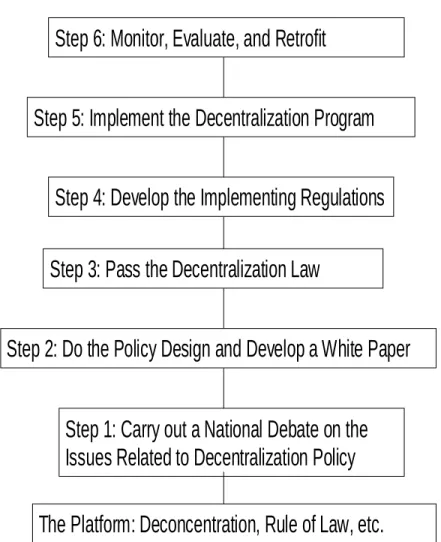
Our version of the normative textbook approach to sequencing fiscal
decentralization has six steps, as outlined in Figure 1. This might be argued to be a stylized approach to sequencing decentralization that might serve as a reasonable baseline against which to compare the real world practice, where politics and administrative constraints will certainly rule the day.
There should be a platform of enabling administrative and institutional structures on which the decentralization can be built. One important precondition for effective decentralization is the rule of law for the adjudication of intergovernmental disputes or democratic electoral rules. This is critical given the divergent interests associated with decentralized governance. Other preconditions include the existence of an orderly budget process and fiscal rules. The platform might also include the deconcentration of central government services to the regions. Deconcentration can speed up the process of decentralization because there is already a local experience with managing local service delivery. However, it does not fall into the category of absolute requirements for
beginning a decentralization program.
The actual fiscal decentralization process begins with a national debate involving the key stakeholders (Step 1). This debate might be in the context of a national election, sometimes responding to bottom-up demands for local autonomy. Alternatively, it might be part of a discussion led by an appointed national commission to consider a change in the pattern of governance. Either way, a general consensus may be reached about the sentiment for pushing ahead with decentralization and some clear “champions” of decentralization should emerge. This would seem necessary if the decentralization program is to stay on track and be sustainable.
Figure 1: Sequencing Fiscal Decentralization: A Normative Approach
FIGURE 1
Sequencing Fiscal Decentralization: A Normative Approach
The Platform: Deconcentration, Rule of Law, etc.
Step 1: Carry out a National Debate on the
Issues Related to Decentralization Policy
Step 2: Do the Policy Design and Develop a White Paper
Step 3: Pass the Decentralization Law
Step 4: Develop the Implementing Regulations
Step 5: Implement the Decentralization Program
Step 6: Monitor, Evaluate, and Retrofit
The second step is the design of the fiscal decentralization program, culminating in a policy paper or a framework for the fiscal decentralization. While the national consensus might be around the broad idea of moving government closer to the people, the White Paper would lay out the government’s plan for accomplishing this. It would outline the main components of the fiscal decentralization program, provide a timetable for implementation and serve as the basis for writing the law.
Step three is to draft and pass the decentralization law(s). This naturally follows on from the national mandate and from the policy framework paper, and it gives legal standing to the implementation of the fiscal decentralization measures. The law must be
clear and it must be true to the policy design. The decentralization law might stand alone, or some elements of the decentralization program might become part of the constitution.
Step four is to adopt a set of implementing regulations that spell out the detail of how the fiscal decentralization will be put in place. For example, the White Paper and the law might call for the transfer of civil servants from central to subnational
governments. The implementing regulations on the other hand, would spell out the detail of this transfer. Essentially, the implementing regulations are written for those
government officials—central and local—who would put the new system in place. Step five is implementation, which involves a multitude of tasks. Following a very clear set of rules and regulations, the central and subnational governments begin assuming their new fiscal responsibilities and so on.
Step six involves a well-designed and operational system of monitoring and evaluation by the central (state) government and a well laid out accountability system at the subnational level.
The steps outlined above might be thought of as a normative approach to ordering the elements of a sustainable fiscal decentralization strategy. This sequencing allows each step to build on the necessary prerequisites, and therefore could minimize the
chances for failure of the system to accomplish its objectives. In the real world, however, there are important constraints that steer countries away from such an optimal
sequencing. And sometimes, these departures are in the best interests of getting the job done. But clearly, while some departures may be admissible in terms of the costs and disruption involved in the decentralization process (for example, getting the
implementation started without complete implementing regulations), some other departures may be too costly (for example, decentralizing borrowing powers without providing for a hard budget constraint for subnational governments).
In what follows we elaborate on each of these six steps in an optimal sequencing, provide more detail on what is entailed in each, examine the potential costs of ignoring or mishandling each step, and consider how the sequencing steps have been addressed in a number of countries that either have already decentralized or are in the process of doing so. Our goals are to develop amendments to the normative approach outlined in Figure 1, based on the international practice, to identify some of the reasons for deviation, and to assess the risks that can come from making different sequencing decisions.
2.2. Deconcentration before Decentralization?
A successful deconcentration of central government service delivery may provide an important platform for implementing decentralization successfully. This platform might include a cadre of central (or state) officers involved in service delivery in the regions. When the decentralization policy is eventually crafted, the local civil service will be more ready to take on the responsibilities assigned to the subnational level, and the risks of extreme disruption of service delivery will be less. This appears to be a major
reason why Indonesia’s “big bang” decentralization was accomplished without a
breakdown in public service delivery. On the other hand, the slow pace and reversals of decentralization policies in many Latin American countries over the past several decades may be linked to initial conditions that did not include deconcentration of public services.
However, one could also make the case, we believe a weaker one, that
deconcentration policies may retard the adoption of a fiscal decentralization strategy. Bureaucrats in deconcentrated agencies may resist decentralization to local governments, because they fear loss of their power base or even their job. Moreover, taking the
deconcentration step may even reduce the demand for strengthening local government finance by softening political dissatisfaction with existing centralized policies. 3. Theory and Practice
3.1. The National Debate about Fiscal Decentralization
The momentum for decentralization may originate from the bottom up, as in Russia, Spain or Estonia, from the top down, as in Tanzania, Thailand or Bulgaria, or from both directions as in Mexico, India, or Indonesia. Regardless of where the pressure originates, some form of national discussion about the desirability of decentralization is an important first step in the process. The key political and administrative stakeholders and ultimately the voters must buy into the desirability and general outlines of a fiscal decentralization strategy. Otherwise, fiscal decentralization may not be sustainable. This national discussion should be about the basic goals of the decentralization program and the options that are available for structuring decentralization, but should not dwell on the detail. The idea is to get some general agreement on what fiscal decentralization should accomplish and on how it should change the way government does its business. The national debate that took place in Canada during the last part of the past century on federal-provincial fiscal relationships provides a good example of this.
Ideally, this national debate will involve the main political parties, will have some degree of formality (as in the case of a national commission), and will be transparent (as in the case of a national election). If this is not the first step in the process, it almost certainly will take place later and in that event could prove detrimental or perhaps even fatal to the implementation of the program. A recent example is provided by Moldova where in the past three years an incipient and promising decentralization program got reversed and abandoned once the opposition party took power in the national elections.
3.2. Reasons for Decentralization
Decentralization is usually introduced as a policy to offset a problem that has caused dissatisfaction with the present centralized system of governance. Identifying this underlying problem is a crucial step in designing a program that will match up with the demands coming from those who are calling for a change in the present system.
The identification of the underlying problem, however, depends very much on whose vantage is taken. When viewed through the eyes of the population in general, fiscal decentralization can become a high priority policy issue because of dissatisfaction with the government performance. In a developing country, this often means that they are dissatisfied with the quality of public services that they receive, with their lack of voice in determining outcomes, and with the responsiveness and accountability of government officials. Another possibility is that significant groups of voters feel
unconnected to the present governance structure because they are ethnically or culturally different. There may also be a general perception of failure and resentment towards highly centralized models of governance, such as Russia and other countries that are in transition from planned socialism and absolutist regimes.
From the perspective of the central government political players and
administrative bureaucracy, however, the underlying rationale may be quite different. Politicians may react opportunistically to a decentralization initiative and support improved citizen participation in governance to gather more political favor, or to act strategically to appease centrifugal, or separatist forces and hold the country together. All of this rhetoric needs to be part of the national discussion because it calls out the relationship between the underlying problems as seen by the population and the policy direction being advocated by government leaders.
The main point in this discussion is that the design of the decentralization
program and the sequencing of decentralization policies must follow identification of the primary objectives of the decentralization. The order in which decentralization policies should be introduced in a program driven by one objective may be very different from the best sequencing for a program driven by another primary goal. A national discussion of the reasons for decentralization would seem an absolutely essential first step. Moreover, only by knowing the primary objectives of the program can one evaluate the success of the decentralization strategy. However, identifying the primary objectives of the decentralization may not be an easy task. The objectives that most drive the
decentralization strategy can be wrapped in a heavy load of many other contemporary issues. This is well illustrated in the five countries of our focus. (See also the summary in row 1 of Table 1.)
There are some common threads in the rationale for fiscal decentralization in the Indonesian and Russian cases. The celebrated Indonesian “big-bang” decentralization in 2001 was a long-in-the-making policy reform that was driven by a perceived over-centralization of government decision-making and a perceived exploitation of some regions by a very strong and allegedly corrupt Suharto regime.2 Independence
movements and centrifugal forces in many of the regions in the Russian periphery, especially those with heavy ethnic populations, in combination with a weak center in the midst of a power struggle between President Yeltsin and a communist dominated
2
Two very good discussions of the origins of the Indonesian decentralization program are Rasyid (2004) and Hofman and Kaiser (2004).
parliament, seemed to call for a decentralization program with heavy emphasis on local political control and expenditure autonomy.
Mexico’s decentralization was also a reaction to a longstanding perception of too much central control. In 2004, a National Finance Convention was convened with the objective of developing a national consensus on the direction of future decentralization reforms in Mexico.3 The impetus for the new drive for decentralization in Mexico has
enhanced political competition and demands for greater political decentralization and administrative efficiency. The current policy design of fiscal federalism emphasizes expenditure autonomy and local political control and control over the civil service.
Tanzania’s decentralization is being driven more by dissatisfaction with the quality of local public services, which has been attributed to too little expenditure discretion at the local government level. India is likewise attempting to address a problem of too little discretion at the local government level, as well as a problem of fiscal indiscipline at the state government level.
3.3. Who Should Participate in the National Discussion?
A national debate about the merits of fiscal decentralization ideally would involve all relevant interest groups, i.e., all of those who see potential benefits or costs from a move toward fiscal decentralization. The discussion will be led by the central
government, which ultimately will make the rules of any new decentralization. But the discussion must be inclusive. A basic idea behind decentralization is to empower those at the state and local government level by making them part of the decision-making process. It would be self-defeating to leave them out of the debate. The flip side of this is that much of the central bureaucracy will lose power with decentralization. It would be equally foolish to leave them out of the debate. The goal is to develop as much of a consensus as is possible and to forestall later criticism that the process was not transparent.
But there are important tradeoffs involved. The broader the audience in the national debate, the harder it will be to gain consensus for a program. The result may be a prolonged discussion that finally dies of inertia, or a watered-down program that may not address the underlying problems.
The national debate may be spontaneous, as it was in Indonesia, and all parties can have voice. In other cases, the national discussion is more formal and orchestrated from the top, as in the cases of Tanzania, China, Bulgaria or Vietnam. It is not unusual for the national discussion about decentralization to be the responsibility of a commission or even a Ministry. In such cases, the discussion is led by the higher level government (central or state), as was the case in South Africa. It is a mistake, however, to leave the
3
See the discussion in Webb and Gonzalez (2003) on the difficulties and opportunities Mexico faces in reaching a national consensus for future reforms.
decentralization discussion fully in the hands of the central (or state) government.4 The
result can be a struggle between central ministries that would gain or lose influence, with potentially little input from the subnational governments, who are the key to making fiscal decentralization succeed.
The Parliament or Legislature also should be part of the national discussion. After the decentralization program is underway, Parliament will be the body that passes or repeals the legislation that supports or defeats the intent of the decentralization
program. In fact, if the general framework for decentralization is not in place at the time of implementation, Parliament may well become a principal influence on the shape of the program. This is all the more reason to have Parliament or Congress heavily involved in the initial national debate. However, Parliament alone cannot lead the national discussion because its members may be too politically driven and power is often too unequally divided. Parliament was not a key player in the national debate over decentralization in Indonesia. However, shortly after the program was conceived, Parliament became a principal influence on shaping the decentralization program in its first years.
Parliament in Tanzania played only a minor role. One of the reasons for the introduction of a formula-based transfer system appears to have been that the MOF was tired of being unable to explain to MPs the criteria for distribution of revenues among local governments.
The involvement of subnational governments in the national debate is not easily accomplished because often this sector is not represented in an organized way.
Associations of local governments, or of mayors, or governors, should be given voice in the national discussion. For example, in Mexico, the National Conference of Governors (Conago) has emerged as a powerful counterpart to the federal government. However, because their interests diverge (e.g., richer vs. poorer regions, or urban vs. rural local governments), their formal representation may be splintered. In Russia in the mid 1990s, an association representing a small number of the richer regions lobbied the federal government, sometimes quite effectively, on a variety of divisive issues, such as the overall level of interregional redistribution and the sharing of revenues from natural resources. In contrast, the Association of Local Authorities in Tanzania is very weak, and has little impact on the reform process, although the urban areas do appear to have some political power.
It is important that a central ministry not be taken to stand for the interests of local governments. The Ministry of Local Government or Ministry of Home Affairs may be “closest” to the subnational governments on a day-to-day basis, but in many cases are not strong proponents of significantly enhanced local fiscal autonomy. Their primary interest may well be in the direction of not giving up control over the fiscal operations of the
4
A conspicuous example of this kind of mistake is to put the line ministries at the central level in charge of defining decentralization in their respective sectors, such as has been the case in El Salvador, Nicaragua and other Central America countries (see Arze and Martinez-Vazquez, 2004).
local governments. Arguably, this has been the experience with the Ministry of Home Affairs in Indonesia.
Civil society, unions, and representatives of the civil service may be important contributors to the development of a decentralization program. Typically these groups do not find a place at the table in the national discussion, and when they do, their knowledge about the subject of decentralization may be limited to a single issue of self-interest. For example, national teacher and health professional unions have been a serious impediment to the decentralization of education and health services in Mexico. However, informal organizations and NGOs have become increasingly important in fiscal decentralization strategies in many countries and it would be a mistake to ignore them in the national debate.
3.4. The Format for Discussion
In what format can the national discussion about decentralization take place? Sometimes, the process itself can play a major role in shaping the kind of decentralization that will be adopted.
The discussion might be prompted by external events and the national debate might be organized as a result of these events. One possibility is that it can be part of a political or economic upheaval, such as the end of apartheid in South Africa or the breakup of the Soviet Union and regime change in Central and Eastern Europe.5 In such
cases, the national discussion about decentralization can be especially reactionary to the unfairness of the present system, and more prone to lead to an entirely new framework than to adjust the present system. Indonesia and Bosnia-Herzegovina are other cases in point.
In Tanzania, the latest wave of decentralization reforms got started with a National Conference in 1996 under the banner of “Towards a Shared Vision for Local Government in Tanzania.” The results of the conference were incorporated in a strategy document, The Local Government Reform Agenda (LGRA), which in 1998 was endorsed by the Government.
In Indonesia, the process was simply commissioned. The Ministry of Regional Autonomy (later merged into the Ministry of Home Affairs) was commissioned to draw up the law describing the new assignment of expenditure responsibly, the new civil services rules, and the nature of local government autonomy in matters of fiscal management. The Ministry of Finance was commissioned to draft the law on the financing of these local governments including revisions to the system of
intergovernmental fiscal transfers.
A second way in which the decentralization discussion might be joined is through the deliberations of an appointed commission. In this case, the reform program might be
5
less comprehensive, especially if there is no national imperative to make a sweeping change in the system of governance. This has been the situation for over five decades with India’s Finance Commissions.6 This has also been the case in Russia in the late
1990s when several government commissions were created to suggest alternative paths to reforming equalization transfers and other aspects of the intergovernmental finance system. More recently, President Putin appointed the Kozak commission for the same purpose and the commission recommendations have been highly influential in the reform agenda of the Russian government.7
In Pakistan, the military government appointed the National Reconstruction Bureau (NRB) in 1999 and charged it with developing a decentralization plan. Though inputs from all sectors were encouraged, the NRB had a relatively free hand in
developing the program. The appointed head of the NRB was a retired general. In other cases, the national discussion about decentralization may be more conventional and may take place in the context of a regular national or state election, as was the case in Mexico’s presidential election of 2000.
3.5. The Champions
An important ingredient for the success of fiscal decentralization is a coalition of strong advocates. These advocates, or champions, will keep decentralization in the center of the national debate and will work to develop the coalitions necessary to enact a
decentralization policy.
But what if there are no decentralization champions? In theory, the policy design may go on, but in practice what is likely to happen is that the entire process will drag on for years with otherwise minor obstacles becoming insurmountable. The recent
experiences of countries like Thailand and Georgia show how the process of
decentralization has failed to advance because of a lack of strong champions. For this reason, it is important that the champions become active in the very first steps of the introduction of a fiscal decentralization program.
4. Policy Design
4.1. The White Paper
Fiscal decentralization is a policy that is designed to achieve certain objectives. Therefore, it is critical that the objectives be clearly specified before the program is designed. The overall framework for the decentralization must be elaborated in a policy paper. This policy paper must be specific enough, and comprehensive enough, to guide
6
India has had twelve successive Finance Commissions with the main role of recommending to
Government on center-state revenue sharing and other finance issues. An independent Finance Commission is mandated in the Constitution. See Singh (2004).
7
the development of the law and the implementation. And, it must come after the national discussion that gives the mandate for decentralization policy.
What if decentralization goes forward, but there is no such policy paper? Two major problems are almost certain to occur.
First, without a roadmap for the decentralization strategy, government and Parliament will “make it up as they go.” This can lead to pieces of the decentralization strategy that do not fit together, e.g., starting the process by decentralizing revenues before any clear assignment of expenditure functions, mandating an expenditure assignment list that does not match revenues assigned, authorizing borrowing powers with no provision for repayment capacity, building expectations of fiscal responsibility, but making no provision for a hard budget constraint, or assuming that all subnational governments will have the same capacity to implement decentralization programs. Even with a White Paper in place, elected politicians and bureaucrats who are new to the scene might introduce changes that are contradictory and eventually harmful to the objectives of the decentralization. Or, interest groups might prevail in getting policy adjusted to satisfy their own objectives. But this will be much less likely to happen if a framework is clearly in place.
The other problem with not having a documented framework is that later year policy changes may not be consistent with the overall goals for the fiscal decentralization program. It is easier, for example, for Parliament to pass a new decentralization measure and label it as “supportive of the strategy,” when the strategy has not been written down. An interesting case in point is Indonesia, where a hold harmless system was put in place by Parliament to protect local government from receiving any reductions in revenues upon the introduction of the new, formula-based system of equalization grants. This hold harmless provision minimized the equalization effects of the new grant regime and
helped perpetuate undesirable aspects of the previous system (directly compensating local governments according to the number of their employees.) This was not envisioned in the original program design. Parliament, after year one of the decentralization program, decided to keep this hold harmless system in place. With hindsight, the problem was that there never was a firm plan as to how the new transfer system would be phased in. Of course, Parliament may have overruled any firm plan in favor of its own program in any case, but the existence of a policy paper would have made that more difficult.
The White Paper that frames the decentralization policy needs to cover all of the elements of the program, but it need not cover them in a detail that would be expected in the implementing regulations, nor should it strive to impose a tight timetable where all reforms should happen at once. However, it should be the result of a careful analysis of the options, it should have benefited from review and input from a broad cross-section of stakeholders, and it should propose a realistic timetable with a clear and connected road map of the steps to be taken over the next several years. The White Paper should be a published document in order to give transparency to the process.
Common sense would seem to dictate the need for an overall framework as an early step in implementing decentralization, yet countries often skip this step (Table 1). Indonesia never did prepare an overall framework and instead went forward with two laws followed by a set of implementing regulations. The result, as discussed below, has been a good bit of “making it up as we go” which has brought some serious challenges and has considerably delayed the decentralization program.8 Decentralization has been
reasonably successful in Indonesia, despite the absence of a guiding framework. The question to raise is how much more successful it would have been with a framework. Similarly, Russia jumped into the decentralization process in 1992 without preparing an explicit framework and overall strategy. Successive laws and measures were often disconnected and sometimes contradictory. It took Russia almost a decade to issue a comprehensive vision of the decentralization process in what became known as the Kozak Commission Report in 2002.9 Mexico’s decentralization policy has continued to
drift forwards and sideways without a comprehensive reform blueprint.
Tanzania, on the other hand, did produce a White Paper on local government reform at the beginning of the current phase of decentralization reforms in 1998. While this policy paper does not provide a great amount of detail on planned fiscal adjustments, it lays out the government’s general objectives for the program. By persistently
emphasizing the theme of “decentralization by devolution,” Tanzania’s “Government Policy Paper on Local Government Reform” has continued to inform and order the ongoing reform process quite successfully. Its lack of specific policy reforms may have helped to reduce potential opposition against the reform agenda.
Elsewhere in East Africa, the experience is mixed (NCG, 2004). Uganda adopted a fiscal decentralization strategy in 2002. However, the strategy is not comprehensive and to date is still focused on reforming the system of intergovernmental transfers. Kenya, on the other hand, has identified some areas of local government finance reform, but has not developed a comprehensive strategy.
India is a case apart in this respect. Although there has not been a fundamental White Paper mapping out the reform of India’s federalism, every five years, India’s Finance Commission issues a comprehensive report on intergovernmental finance issues and options for reform.
8
The problems that arose from no real fiscal decentralization plan were recognized by the government, and in 2002, the Ministry of Finance issued a draft “White Paper” on Fiscal Decentralization (Ministry of Finance, 2002). Though the basic objectives and policies were aired out, this document was not the result of a broad national discussion. It could however, be an input to redrafting the original laws, an exercise that was underway at the time of this writing.
9
After the August 1998 ruble crisis, a wide reform process, such as the Budget Code and Tax Code, gained new momentum and the Government issued a document that can also be considered a White Paper under the title of “Concept of reform of Intergovernmental Fiscal Relations in the Russian Federation for 1999-2001.” However, this document has less buy-in and smaller scope than the Kozak Report. For a discussion, see Martinez-Vazquez (2002).
4.2. Sequencing
Some would argue that the single most important factor in getting a successful decentralization in place is to include the key elements in the policy design. But what are the key elements? And, must all be introduced simultaneously, or are there some
sequencing rules?
4.3. Fiscal Decentralization Policy Should Be Comprehensive
Intergovernmental fiscal relations must be thought of as a system, and all the pieces in this system must fit together (Bahl, 1999b).10 Ideally, the implementation of a decentralization program should begin with a design of the comprehensive system and should lay out the plan for each element of the system. Not all of the components of decentralization will be implemented right away, but it is important that all of the components be included in the comprehensive plan.
A little reflection will lead one quickly to the conclusion that fiscal
decentralization involves more than what are traditionally thought of as fiscal issues. In fact, the electoral system and other forms of accountability, the civil service and a number of other institutional arrangements are arguably as important to assuring the success of fiscal decentralization as are the taxing and spending components. A “one-off” piecemeal reform, encompassing only one element of the system (e.g., central government revenue sharing with local governments), is not likely to fully capture the benefits of decentralization. In fact, it can lead to undesirable outcomes, including larger central deficits and macroeconomic instability.11
The key elements to be included in the sequencing plan for fiscal decentralization are:
• expenditure assignment and autonomy
• revenue assignment and autonomy
• design of the intergovernmental transfer system
• provisions for fiscal discipline
• civil service rules
• political accountability
Getting all the pieces of the fiscal decentralization puzzle on the table gives the best chances for success. Making the pieces fit together is the sufficient condition. In a sense, this is what the sequencing question is all about. For example, Indonesia’s big-bang decentralization of 2000 did consider both expenditure assignment and revenue assignment, but the planning was done by two different ministries with little coordination
10
Intergovernmental fiscal relations is a term that refers generally to division of fiscal powers and
responsibilities among levels of government. Fiscal decentralization refers to an intergovernmental system where the balance of power moves more toward the subnational government sector than has been the case. 11
(Alm, Aten and Bahl, 2001). There did not seem to be a plan for making the two sides of the budget fit together.
Not everyone believes that design should be comprehensive. Some countries (and international agencies) may at times think of a fiscal decentralization program as no more than a revision of the existing revenue sharing system, or an upgrading of the property tax administration.12 Some ignore the fiscal issues completely and think of decentralization
only in terms of the local election system, and planners very often focus exclusively on developing methods to get inputs from local population groups included in the project selection discussion. The “one dimension” approach is not likely to be sustainable or produce successful decentralization because other elements crucial to capturing the benefits may not have changed in a supportive way, or may even work to yield offsetting results.
4.4. The Critical Role of Political Accountability
Accountability to local voters is perhaps the most crucial element of a decentralized system, and the one that ties together all the other components of
decentralization design. But is it the essential first step in the decentralization sequence? Local governments’ expenditure and revenue autonomy are less likely to be put to good use (benefiting local citizens/voters) when local government officials are not accountable to their local constituencies. More centralized systems tend to substitute vertical
accountability of local officials to higher up authorities for horizontal accountability to citizen/voters. Vertical accountability can prevent local officials from behaving
irresponsibly but it works much less well in making them responsive to the needs and preferences of local residents. Horizontal accountability is enhanced through the
appointment of officials through open politically contested elections, as well as by other institutions including, proper publicity, internal control and external audit and evaluation of budgets, a free press, and the participation in the public discourse of non-governmental organizations. The efficiency gains that are at the heart of fiscal decentralization
strategies will not be captured if local voters cannot have a voice in making budget choices.
Countries like China, Vietnam and Nepal, which have been pursuing substantial decentralization reforms on many fronts, but which still do not have contested,
democratic elections, are unlikely to benefit from the full range of efficiency gains associated with decentralization. In particular, the dominance of vertical accountability to upper-level government officials and the desire to please them quite likely leads to distorted spending decisions at the subnational level.13
12
Of course, this may be quite correct if the issue is a correction being made to an ongoing system of fiscal decentralization.
13
For example, Martinez-Vazquez, Qiao, and Wang (2005) argue that the lack of horizontal accountability in China has led to different expenditure patterns in poorer and richer provinces.
Awareness of these issues has led both China and Vietnam to experiment with openly contested elections at the lowest level of local government, the rural settlements.14
A full solution to this problem will require a regime change, which is not likely to happen anytime soon.
Does the absence of elected local governments mean that decentralization in these countries is meaningless or ineffective? It would appear that there are still sizable
advantages to be obtained from decentralization in production efficiency and competition among local governments,15 and some gains in allocative efficiency from limited levels of
horizontal accountability.16
Full horizontal accountability to voters is limited in other developing and
transition countries by less than full direct elections of executive and legislative branches of government. In a common modality, the legislative branch is democratically elected but the executive branch is appointed by the center, as will now be the case in Russia’s regions. Representatives may be indirectly elected by lower-level governments, as in the case of the district councils in the Czech Republic. The point with any of these variations is that accountability and, therefore the overall performance of decentralization, will be hurt the further away the system moves from full democratic institutions. Even the method followed in democratic elections may have consequences for accountability. For example, proportional representation under closed-party list systems may generate strong alliances and accountability toward the party bosses in the capital of the country in comparison to the greater responsiveness to local issues in the case of district-wide winner-take-all open elections.
4.5. Finance Should Follow Function
It is important to get the correct order of reform as regards to how much should be spent by subnational governments, and how much revenue should be given to subnational governments. There is a conventional wisdom. First should come the assignment of expenditure responsibility to subnational governments, and then the assignment of revenue raising powers and central government revenue shares should be determined. There is a good logic to this finance-follows-function rule.
14
See Bahl and Martinez-Vazquez (2005) for China and Martinez-Vazquez (2004) for Vietnam. 15
Montinola, Qian, and Weingast, (1995) and Qian, and Weingast, (1996) argue that the fiscal decentralization process started in China in the mid-1980s with the “contracting system” was “market preserving” in that it stimulated local governments to become entrepreneurial and to seek the growth of their local economies.
16
Local councils, although not freely elected, are often open to the complaints and demands of local residents. Furthermore, local governments in richer areas where there is more residential mobility, such as China’s coastal provinces or in the Ho Chi Minh City area in South Vietnam, need to be more responsive to the preferences and demands of residents to retain and attract qualified workers and to compete for
The first reason is that one cannot establish the required level of subnational government revenues independent of an estimate of expenditure needs.17 The second
reason is that it becomes difficult to effectively impose a hard budget constraint at the subnational level if there is an insufficient revenue assignment. Examples abound of local governments being given expenditure responsibilities and mandates that exceed their assigned revenues. Local governments may take this to mean that they are expected to overspend and that the deficit will be covered by the higher level government. If, on the other hand, subnational government revenues are over assigned relative to
expenditure needs, then the central government can become fiscally strapped and there will be pressures on the central budget deficit. Such was the case in China in the mid-1990s.
There is a third argument for finance to follow function, and this is discussed less often. The economically efficient assignment of revenues requires a prior knowledge of expenditure assignment. For example, services that may be priced (public utilities, bus transportation) should be largely financed by user charges; general services with a local area benefit zone (roads, parks) should be financed with local taxes; and goods
characterized by significant externalities should be financed from region-wide taxes and intergovernmental transfers. A blanket statement that the aggregate of local government services should be financed by user charges, local taxes, and intergovernmental transfers, simply misses the efficiency point. Government must settle on the assignment of
expenditure responsibilities to local governments, before it can choose an efficient mix of taxes (Bahl and Linn, 1992).
Despite all this good a priori reasoning, most countries begin intergovernmental reform on the revenue side. Examples of this sequencing mistake abound in Latin America. Currently, Thailand is in the midst of approaching policy in this fashion. And, there are some who would see this as a not-too-serious policy mistake. One justification for this “back-end” approach is that the expenditure needs of subnational governments often are so great that feasible intergovernmental revenue reform programs do not typically make much of a dent in the service level and infrastructure backlog. In such a case, it is sometimes argued that it matters little where one begins. This would seem a flawed argument, though. All that happens in this case is that standards for minimum subnational government services are increased or reduced in an implicit way. It is far better to do this reduction explicitly than implicitly. This argues for starting
intergovernmental fiscal reform on the expenditure side.
Another reason why many countries get the revenue and expenditure assignment decision in the wrong order is that the revenue side is easier to work. Politically, at the central level, it is rather easy for a President to propose and a parliament to approve a proposition for a given percentage of central government revenues to be shared with local governments. This is a populist measure that not very many outside the government or
17
Note that even if the subnational government revenue share is determined on a basis of expenditure needs, it does not follow that there will be a correspondence for every local government. The finance follows function rule applies only to the aggregate vertical share.
inside the government, with the possible exception of the Ministry of Finance, will oppose. Political opposition is more likely to take place for issues involving the decentralization of expenditure responsibilities. From the perspective of local
governments, an entitlement to some level of revenue sharing is clearly more attractive than being assigned expenditure responsibilities for which there may or may not be adequate funding.18
A positive argument for starting the process on the revenue side is that the
assignment of revenue to local governments may dampen the resistance of line ministries to the expenditure reassignment that will follow. Once the funds to support certain functions have been transferred, there may be less of a rationale for line ministries to argue to keep control over direct delivery.
The assignment of expenditure responsibility is a much more politically charged issue. Giving local governments significant control over the expenditure budget reduces the control that can be exerted by the line ministries and shifts the balance of power away from the center. Moreover, once decentralized to local governments, expenditures are not so easily controlled or “called back.” Revenue assignment, as practiced in most
developing countries, is a less permanent proposition: local tax rates can be limited or subject to approval, intergovernmental transfers to local governments might not be delivered as promised, and all borrowing might be subject to central government approval.
On the implementation side, policy analysts know well how to design reforms in tax systems and intergovernmental transfer systems, implementing these reforms is a manageable issue and such reforms can yield visible short-term results. The
decentralization of expenditure responsibility poses more challenging implementation problems. First, the decentralization of expenditure responsibilities needs to be implemented in the context of reformed national sectoral laws (e.g. Education Law, Health Law, etc.). This will lead to redefinition of the role to be played by line ministries and other central government agencies within the new decentralized framework. The failure to coordinate central government sectoral policies with decentralization policy generally leads to confrontations between agencies at different levels of government, confusion in expenditure assignment, and inefficient outcomes. Second, subnational governments must have the capacity to deliver the newly assigned services or to develop the new skills to do so. The public policy fear is that service quality will deteriorate while local governments are climbing the learning curve.
Most bothersome of all, there are no hard and fast rules about which functions should be assigned to which level of government. Expenditure assignment decisions
18
The exception is those countries where decentralization is driven by political, ethnic, or separatist reasons. In this case regional and local governments are eager to get as much expenditure responsibility as possible even if it is well known that the finances may not follow for some time to come. That is the position taken, for example, by ethnic republics in Russia, such as Tatarstan and Bashkortostan, or by the ethnic Indonesian provinces of Aceh and Papua-New Guinea.
should be based on a painstaking unbundling of each function into sub functions, and for concurrent functions, the identification of attributes for regulation, financing and
implementation, and then analysis of the viability of each as a central, state or local responsibility.19 Policy analysts, international donors, and central ministries all find
reasons to shy away from this difficult analytic task.
Some analysts and even policy makers in countries undergoing recent
decentralization take an “evolutionary” view of the expenditure assignment question. In this mind frame, the different levels of government will eventually sort out the functions they should perform. After all, it is claimed, one can find decentralized developed countries with rather stable and well sorted out expenditure assignments at different levels of government, which never had a comprehensive law that explicitly stated
expenditure assignments. However, this argument ignores the fact that it may have taken these countries decades, if not centuries, of political friction and inefficient public sector operations to arrive at the de facto expenditure assignments one can observe today.
Is there a correct way to implement the finance-follows-function rule for sequencing? We suggest a three-step process. First, one might begin by clearly assigning a package of expenditure responsibilities to subnational governments on the basis of the subsidiarity principle, benefit areas of services and externalities present, economies of scale and scope, and best international practice. This is to some extent a subjective exercise, and there is no unique answer for every country. In fact, many countries apply these exact criteria and come to different answers about what subnational governments should do.
The second step is to establish the cost of providing minimum levels of these services. As in the case for expenditure assignment, there is no one best way to do this. The international practice suggests three basic approaches:
One can use a “retrospective” methodology and try to calculate a cost that is equivalent to the moneys spent on those services before they were decentralized (e.g., Spain). This approach simply assigns a vertical share of revenues to the subnational government sector that is adequate in amount to cover the existing level of spending for the functions being reassigned.
The advantage of this approach is that it is relatively easy to implement and minimizes disruption. The disadvantage is that it assumes that existing levels of spending are somehow “proper,” when in fact it is these existing levels that may have prompted the move toward decentralization in the first place. If it is done on a region-by-region basis, it may perpetuate the service and funding inequities of the past. This approach is also problematic in a dynamic sense, for example if it is used to evaluate expenditure needs in equalization transfers formulae in future years, because the distribution of population and other conditions may change very fast.
19
A second approach is to establish minimum spending levels by using per capita (or per client) financial norms. An advantage of this method is that the per capita financial norms can be modified by information on existing conditions in the local government areas, such as differences in prices due to climate or geography (e.g., South Africa, Ukraine, and the U.K.).
A more complicated approach is to define minimum physical service standards for the provision of each service and try to cost them out separately (e.g. Japan, the Netherlands, and Denmark). This approach has the advantage of allowing a costing of the inputs required for delivering a minimum level of services. Hence it can provide detailed information on the cost implications of higher or lower vertical shares.
The third step in this process is to bring affordability into the discussion.
Ultimately, the choice of an exact minimum service level will be driven by affordability. While the retrospective method ensures affordability, the per capita method and the method that costs out and adds up physical norms and standards do not.20 What is
affordable is also driven by national priorities. Thus, how a country ends up quantifying expenditure needs also depends on the national consensus regarding how important some services are vis-à-vis others, and in particular the importance of those assigned to the subnational sector vs. those retained at the central level. Some methods for quantifying expenditure needs, for example financial per capita expenditure norms, are more adaptable to changes in national priorities than others.
There is one last normative issue to be considered. This is whether expenditure assignments should be uniform for all subnational units. The alternative is some
asymmetric treatment depending on administrative capacity and readiness of subnational governments to absorb expanded expenditure responsibilities. Asymmetric treatments have the disadvantage of creating complexity but the ability to adapt to very different conditions and capabilities may more than offset that disadvantage. Furthermore, asymmetric treatments are by nature temporary, because local governments have an incentive to use all the technical assistance provided so that they can graduate and assume the competencies assigned to their peers.
The arguments for finance to follow function do not seem to have fully persuaded international practice, as described in Table 1.
20
We should note that the problem of quantifying needs is not unique to expenditure assignments.
Table 1: Summary of Selected Decentralization Sequencing Issues in Five Case Countries
Indonesia Russia India Tanzania Mexico
Rationale for Fiscal Decentralization
Over centralization in decision making; secession threats
Secession threats; demand for local political autonomy
Need to establish fiscal discipline at the state level; demand for decentralization to third tier.
Improve quality of local service delivery by giving more fiscal discretion to local governments.
Reaction against over-centralization and demand for greater local political autonomy.
Finance Follows Function
Revenue assignment and transfers, and expenditure assignment were developed simultaneously by two different ministries
Murky expenditure assignments that have changed over time.
Revenue assignment and transfers change over time by Finance and Planning Commission recommendations. Expenditure assignments, with a long “concurrent” list are based on the 1950 Constitution.
Followed the “finance follows function” rule but with some murkiness in expenditure assignment.
Expenditure assignments are defined by sectoral laws.
Subnational Government Taxing Powers
Minimal local government taxing power
Minimal regional and local government taxing power
States have some significant taxing powers. Local governments have access to property tax and little else.
Minimal local taxing power
States raise about 5 percent of revenues from own taxes. Municipalities raise about one-third of revenues from own sources.
Rationality in the design of the transfer system
Core grant is unconditional and vertical sharing rule is transparent. Natural resource revenue sharing has less clear objectives and exacerbates disparities.
A formula-based equalization grant has been established. Revenue sharing is not equalizing and conditional grants not well developed.
Transfers are distributed by three different bodies with what often appear to be contradictory objectives.
All grants are earmarked and both vertical and horizontal shares are distributed in an ad hoc way. There is no equalization grant.
Transfers are distributed by formula but the overall results are not equalizing.
Policy Paper or White Paper
There was no policy framework.
A White Paper was developed after the decentralization program was underway.
The Federal Finance Commission reports every five years. The State Finance Commissions report every three years.
A White Paper guides decentralization policy development.
4.6. The Significance of Local Revenue Autonomy
It is important to a complete decentralization that subnational governments have independent sources of revenue. If all financing is from revenue sharing and other forms of transfers from higher-level governments, there is a danger of the lower level
government becoming a spending agent for the center. Such an arrangement can give subnational governments less discretion in deciding how much they will spend, and how they will spend it in the case of conditional grants. The imposition of a hard budget constraint is more difficult when there is no local revenue raising capability. Once a culture of dependency on revenue sharing and transfers is created, subnational
governments will always push for more funding from above as opposed to using their own revenue autonomy. As the international experience shows, many central/federal governments eventually succumb to demands and pressures from below for more revenue sharing, and the pattern continues.
There are several important beneficial effects of subnational government revenue autonomy that are often overlooked. First, subnational tax autonomy is the best way, if not the only way, to address permanently the problem of vertical imbalances in fiscal decentralization design. Second, there cannot be discretion as regards to the level of expenditure and a hard budget constraint on subnational governments unless at the margin they are required to use their own revenue instruments to raise additional revenues. Third, revenue autonomy is a key indicator of subnational governments’ borrowing capacity and creditworthiness. All of this argues for revenue raising to be an early decision in the design of a fiscal decentralization strategy.
In practice, local revenue sources are often not part of the initial decentralization package. To some extent, this is because there is no constituency for this policy. Central government officials do not want to devolve taxing powers for fear of competing with local governments for the same taxing base. Subnational government officials are loathe to take on the responsibility of making politically unpopular taxing decisions to meet budget needs. Moreover, some local officials may fear that new local taxing powers may be accompanied by a more equalizing distribution of intergovernmental transfers that would penalize their increased tax effort. Intergovernmental transfers are seen to be a much easier path for all concerned.
Of the five country cases highlighted here, Indonesia, Russia and Tanzania provide subnational governments with little discretion to raise tax revenues. Mexican municipal governments cover about one-third of expenditures from their own sources but state governments are mostly dependent on transfers. India’s states do have significant taxing powers but urban and rural governments are mostly limited to the property tax. A more detailed discussion of subnational government revenue raising power is
4.7. Design of the Intergovernmental Transfer System
An important sequencing question has to do with the design and implementation of intergovernmental transfers. The right order of policy formulation is to first ask and answer the question about which of many possible objectives the intergovernmental transfer system is to accomplish, and then to design the reformed system.
There are many different kinds of intergovernmental transfer systems, and they have many different types of impacts on local government finances.21 Some stimulate
local spending, some are substituted for local revenue effort, some are equalizing, and some lead to more local government fiscal autonomy than others.22
Countries too often enter into the process of grant design without clear objectives for what the transfer system is to accomplish.
The major issue is that different types of transfers have different objectives, and it is important to sequence grant design according to these objectives. One goal is to reconcile the difference between the assignment of expenditure responsibility and the assignment of revenue raising powers. This vertical balance goal of transfers is arguably the first job to take care of in designing the transfer system. The second step in grant system design is to implement conditional grants for those functions of national/regional importance where it is feared that under-provision might take place without assistance. Finally, the equalization grants should be designed to address the horizontal imbalances that result after the first two pieces of the transfer system are designed.
Often, countries do not design their intergovernmental transfer systems in so rational a way, as can be seen for the five countries highlighted in this study in Table 1.
4.8. Subnational Governments Must Face a Hard Budget Constraint23
Fiscal discipline is a key element of a successful decentralization strategy. It is important that it be introduced when the program begins. If subnational governments are not forced to operate with balanced budgets, they become accustomed to looking to the higher level governments to cover their shortfalls. The moral hazard here is that the subnational governments will consciously overspend knowing that their losses will be made good. Furthermore, a soft budget constraint will tend to discourage their own tax effort and encourage inefficient and even wasteful spending. As many countries have learned, it is difficult to break the culture of a soft budget constraint.
21
There is often a debate about what is an “intergovernmental transfer.” Grants to lower-level governments are clearly intergovernmental transfers. The confusion comes in the case of shared taxes and tax
expenditures. We would argue the following: If the local government can control either the rate or base of a levy, it is a tax. If the rate and base are determined by the higher-level government, and revenue
collections are assigned to the local government, it is a transfer. If the central government allows deductibility of property taxes from central income tax liability, it is likewise a form of transfer. 22
For a primer on transfer design issues see Bahl, Boex, and Martinez-Vazquez (2001). 23
A hard budget constraint implies that those local governments who are given autonomy will be asked to balance their budgets without recourse to any end-of-year assistance from the central government. Central governments must enforce this rule, and local governments must believe that they are “on their own.” For a hard budget
constraint to be an effective feature of intergovernmental fiscal policy, the higher level government should be mostly committed to a “no-bailout strategy” and to shy away from year-end deficit grants. A hard budget constraint is not always a central tenet of
decentralization. Many central governments prefer to hold to a paternalistic approach to intergovernmental fiscal relations characterized by insufficient formal revenue
assignments, fuzzy ex-ante levels of transfers, and year-end results covered by some sort of deficit grants. In other cases, there may simply be a flawed design of the
intergovernmental fiscal system. Brazil’s states did not face a hard budget constraint and increased current expenditures in the 1990s even when the resources were not available to cover debt repayment. Ultimately, there was a federal bailout.
The experience in the country cases studied here has varied. Indonesia does impose a hard budget constraint on local governments. Two factors are important in assuring this fiscal balance: there are few avenues open to local governments to finance a deficit, and the primary intergovernmental transfer was set at a level sufficient to cover personnel costs. India, on the other hand, is at the opposite extreme with state
governments running deficits of significant size. The Union government has adopted numerous policies that encourage this behavior.
Mexico and Russia are somewhere in between. After a period of allowing a soft constraint on regional government budgets (through loan forgiveness and year-end “mutual settlements”), Russia has moved to adoption of a hard budget constraint for subnational governments. Mexico has a history of bailouts and of fearing the fiscal failure of important subnational governments, hence its threat of imposing a hard budget constraint for the future may lack credibility.
4.9. The Decentralization Law
It is essential that legislation govern decentralization, and that it is unambiguous. It would seem almost axiomatic that the development of the decentralization law should follow the policy design. Otherwise, how could it reflect the goals of government and the consensus resulting from the national debate?
There is much to be said about defining the best legal framework for decentralization. A fundamental question would seem to be how much of the
decentralization framework should be in the constitution and how much should be in the decentralization law. This is a crucial sequencing decision, though for countries with longstanding traditions of decentralization, this question may have long ago been
resolved. What shape decentralization takes in federal systems is fundamental to the very nature of the state and therefore the division of powers and responsibilities among the federal and subnational governments is an intrinsic part of the constitution in these countries. This is, for example, the case of three federal countries considered here: India, Mexico and Russia.