The Effectiveness of a Training Program Based on Educational
Games to Develop Visual Perception Skills in Autistic Children
Dr.Abd AlRazaq AlHassan
Al-Balqa Applied University, Irbid University College of Educational sciences Irbid, Eastern Quarter –P.O.Box. 1293
Abstract
This study aimed of to investigate the effectiveness of a training program based on the educational games for the development of visual perception skills in autistic children. The study’s sample made of 16 children, who were chosen purposely from the autistic children attached to Al Rahmah Centre for Special Education in Ajloun / Jordan, the study’s sample were divided into two equal experimental and control groups, each one included (4) males (4) females.The visual perception scale constructed by Waqfi and Kalani (1998), and which is Codified for the Jordanian environment was used, the training program for the development of visual perception skills prepared by the researcher, was implemented on members of the experimental group for two months, and To analyse the study data, the Mann-Whitney Test was applied.The analyses results indicated, that there were differences of statistical significance at the level of (α <= 0.05) between the experimental and control groups on the total visual perception scale and in all its dimensions, in favour of the experimental group. The results also indicated to the none existence of differences with statistical significance due to gender variable. The researcher recommends further studies to develop auditory perception in autistic children.
Keywords: Autistic Children . Visual perception. Play. the training program
Introduction
Autism is defined as a type of developmental disorder, that shows signs before the age of three ends, due to a defect in the blood’s chemistry or brain injury, which affects the brain’s functions, and thereafter, impact different aspects of growth, failure to communicate, interact with others, is its characteristics in children, in addition to the emerging of abnormal patterns of language and behaviour, and imaginative play weakness (Al-Qamash, Maaytah, 2012).
Early intervening attempts, through the use of training treatment and educational programs of children with autism disorder, are a providing means of linguistic prowess, which will help them to communicate or learn positive behavioural patterns, that control their disorders (Ahmad, 2001).
Al Awhali 2013 believes; that images, have a strong impact on the autistic child development, as they help to teach autistic children, the skills to focus, because autistic children are visual learners, and the use of images and visual strategies, helps them to understand what is going on around them, meaning; that it is through the use of imageries, visual learning games, visual activities in an organized way, will increase their chances of participating in group activities and enhancing their visual memory.
One of the characteristics of autism, is weakness in play and imagination. Some of them have no awareness of the elements of play, where the game usually takes a limited and repetitive form, such as focusing on some parts of the game and not involving their peers in playing, and in that they show difficulty in synchronizing mobility visual skills (Shami, 2004).
Judman and Williams 2007 sees that; the introduction of visual techniques and strategies, stimulates play in autistic children, thus helping them to socialize, communicate and reciprocal play.
Soliman's study 2004, refers to the role of play activities in developing the basic mobility skills of the autistic child, which increases their linguistic capacity and enhances their social interaction ability.
Even when they have a sound sense of vision, autistic children also suffer from visual perceptual disorders, , these disorders manifests itself in visual memory, optical closure, visual spatial perception , therefore, play is recognised as a mediator helps autistic children develop their visual perception through sensing colour and distance.
The study’s Problem
Studies have shown that autistics are receptive to training and learning through visual educational games, and drawing .khatab(2004), Nasr (2002) and Khader (2009) demonstrated the role of play and its activities, in the development of visual motor skills, high linguistic growth and increased ability in social interaction and communication, through remedial training programs.
The researcher believes; that autistic children need training programs to develop visual perception skills, to overcome their problems in language, communication and social interaction. Early educational intervention through the training and development of visual perception, is crucial in alleviating the autistic child disorder severity, and to achieve the maximum extent possible according to his/her abilities, through a multidisciplinary
team, where the special needs education teacher, is the main element, that the effectiveness of programs and services is determined by him/her .
Gaddafi, (1994) concludes, that autistic children have a cognitive disorder leading to lack of understanding, or the ability to communicate, or learn, or participate in educational activities.
In her study on the role of children's magazines photographic activities in developing the visual perception skills of the kindergarten child,(Najla, 2014), T believes that these magazines rely mainly on the representation of meanings and their embodiment through photos. Where the idea of her research is to employ the photographic activities in the developing the children's visual skills.
Laurna wing (1994) asserts, that autistics suffers from cognition abnormality. Where they often respond in strange ways, and they seem unable to hear the high voices, but respond to lower voices, that others only hear with difficulty, or close their ears in anticipation of terrifying sounds.
Stilman( 2008) points out; that some autistic children continue to explore things by placing them in the mouth, bringing some objects closer to the nose or bringing them closer to the eye. Some may sets their eyesight on the lights, some have abnormal cognitive experiences such as; ignoring sounds, refusing to look at things, to conceal pain, and the absence sense of temperature.
Al-Fawzan, (2000), makes recommendations regarding autistic children's games, some of which are: 1 - The game must indicate visual stimuli, aiming for visual stabilization.
2. The game must contain audio stimuli to help reduce barbarity.
3 - The game contains interesting touches, because he usually tries to hit his body or put his finger in his mouth. 4- The games should contain spontaneous stimuli to alleviate the strange habits of autism.
From the autistics play, It is concluded that he/she has a visual, auditory perception and motor disorders, which requires the construction of different programs and early treatment of cognitive disorders.
The following question summarises the study’s problem :
What is the effectiveness’ of a training program based on educational games to develop the visual perception skills of autistic children in Jordan?
Elements of the study’s problem:
The current study sought to answer the following questions:
1. Are there significant differences in visual perception skills among autistic children between the experimental group and the control group due to the impact of the training program?
Are there significant differences in the visual perception skills of autistic children between the experimental group and the control group due to gender?
The study’s hypotheses.
To answer the study’s questions, the following assumptions were formulated: 1-There are no differences with statistical significant at the level of
(α ≤ 0.05) between the averages arithmetic of the visual perception skills for the experimental group and the control group due regarding the effect of the program.
2- There are no differences with statistical significant at the level of
(α ≤ 0.05) between the averages arithmetic of the visual perception skills for the experimental group and the control group due to the gender factor.
The study’s importance:
• The present study provides a visual perception program that can be applied in special education centres in Jordan, in order to improve the visual perceptual disorder in autistics.
• Assists Special needs education teachers in the Ministry of Education to t select training activities through play, to develop cognitive disorders in children with special needs in general and people with autism disorders in particular.
• Educational means can be used at; home, school, outside community, and can be carried out individually, or in small groups to increase the chances of social interaction.
The Study’s limitations
1- The study is limted by the autistic children whom are attached to the special education centre in Ajloun governorate, for the academic year 2016/2015. The study tool, and the training program used in the study. 2- The methods accuracy used by the centres in the diagnosis of autistic children.
Terminology of the study
Autism; defined as developmental disability, that affects verbal and nonverbal communication, social interaction, and the child's educational performance.its Characteristics emerges before the age of 3 are represented through repetitive stereotypes behaviours , resisting change, and abnormal responses to sensory stimuli. (Khatib, and Iron
2007).
Procedural definition
Students with autism disorder are; students who receives special education services at Al Rahmah Centre for Special Education, and who have been diagnosed with autism by this centre .
Visual perception
It is defined as interpreting the visual stimuli that inters into the brain through the sense of sight, where its function is to recognise the similarity and difference between the stimuli in terms of colour, shape, size, image, clarity and depth (Batayneh, Osama, Rashdan, Malik).
Procedural definition: it is the mark that the autistic child receives in the visual perception test in this study.
The training program
A set of consecutive planned activities, that are carried out over a specified period of time, and which works to achieve the overall goal of the program (Mr. Bader, 2001).
Procedural definition
It is the program that the researcher constructed, consists a set of; goals, therapeutic activities, and strategies for each aspect of the visual perception skills, which aims to
develop these skills of autistic children during a limited period of time.
Educational games
Means through which children learn social, emotional, mental and cognitive skills (gauze).
Procedural definition
A set of sports activities, aimed at developing the skills of visual perception for autistics, and within their abilities, and their behavioural skills, directed at adjusting inappropriate behaviours.
Theoretical framework
It includes three main variables; Visual perceptual Disorder, Autism Disorder, and Educational Games. • Autism disorder:
The American 4th Statistical Manual of the American Psychiatric Association - pointed to in Al zaraa2010 -, has defined it as; a major developmental disorder that leads to a deviation in a child’s normal development, and is a subgroup of the total group of the pervasive developmental disorders (PDDs) to include autism disorder, Asperger syndrome, Rete syndrome, disintegration disorder and pervasive developmental disorder.
The autistics are one of the categories of children with special needs that require more attention and effort by the teachers of special education and educational institutions, because of their characteristics distinct from other groups. Autism is about 1 - 2/100, with more males than females (Gescnwind, 2008).
But autism often appears to be very severe in females, and is accompanied by severe mental retardation to bring the ratio to 1: 2. Autism is manifested in different social strata and cultural and ethnic levels. These children affected by it, exhibit an abnormality or defects in the midbrain, which consist of network activation centres, and Has a special role in the attention to visual stimuli as well as control of eye movement and balance, and there are indications that the spreading extent of autism is increasing. (Al-Qamash, Al-Ma'aytah, 2012).
Roussan(2010) noted that; the (TEACH) program, is considered one of the educational programs offered for autism, and is the most important in modifying their behaviours. The program aim is, to develop communication skills for autistics.
The educational environment for (TEACH) program, is an organised educational environment, founded on certainties and visual evidence, so that the student can adapt to the environment because he/she suffers from some of the following behaviours: attachment to the routine and anxiety and tension in the normal educational environment, and the difficulty of moving from one activity to another, and difficult to understand speech, and difficulty in understanding the areas and spaces in class .
Therefore; it is important to learn through visual perception rather than language, and the organized learning environment is based on:
• Configure a specific routine. • Organization of spaces. • Daily schedules. • organization of work . • Visual Education.
(TEACH) program gives great attention to the organizational structure of the learning process, which leads to the development of everyday life skills, by increasing the use of visual stimuli. (Halhan, Kauffman, & Pullen, 2009).
Visual perception.
Is the interpretation of the visual stimuli in terms of; form and size, their relations, and providing true meanings, or the correct interpretations of visual stimuli, and what intended here is not the visual impairment , but how the child deals with visual stimuli (apparent, 2004).
Visual perception difficulties.
1 - Difficulties of visual recognition: the difficulty of distinguishing between letters, shapes, images, objects and types (Al-Zahir, 2004).
2 - Difficulties of optical closure: refers to the ability of the individual mental to complete the object (whole) when it missing one part of it (Al-Qasem, 2015).
3 - Difficulties of visual memory: the ability to call the stimuli presented visually.
4 – Distinguishing the form and the surface: is the distinction between the main stimuli from the overall surrounding which the surface is in. (Al-Zaher, 2004).
5 - visual motor synergy: the ability to achieve a proper harmony between eye movements and hand movements during drawing or writing.
6 - the visual - vacuum relationship: the ability to know the locations of shapes in the vacuum.
7. Visual - auditory integration: the ability to connect a group of stimuli provided visually by the stimuli provided orally.
8. Visual - motor integration: the ability to integrate vision with body movements.
9 - Visual focus: the employment of activities in the development of children's visual skills. Treatment of visual perception difficulties.
1. Activities related to visual distinguishing :
• Presenting different things for an autistic child, such as balloons to distinguish them in terms of size and colour.
• Display a range of different images for an autistic child and ask him/her to identify these objects in the pictures.
• Mixing different types of grains and then ask the autistic child to separate them to , chic beans , broad beans , white beans.
• Provide different parts of an image , and then request of the autistic child to assemble it. • The autistic child to distinguish between similar characters such as (v.u).
2. Improvement of visual memory.
• Show a collection of items in front of an autistic child, and then hide one of them, and then ask him/her to remember the missing item.
• Show two pictures for an autistic child, where one of these pictures missing something and ask him/her to remember the missing part.
3. Improvement of visual focus.
• The teacher puts a box and asks the autistic child to throw objects into it from a distance of two meters. • Usage of darts.
4. Improvement of optical closure:
• The teacher draws a part of something, and asks the autistic child to recognize the whole thing . 5. Improvement of visual-motor perception:
• such as kicking or catching a ball.
Autism’s Educational Therapy and Educational games.
- Activities and educational games introduced to autistics, help them to develop their visual and auditory perceptions, through their sense of colour, space, distance and size.
Al Shami, (2004) noted; that Playing for an autistic child, goes through the following stages: sensory - motor play , organizational play, functional play, symbolic imaginative play, and play for them is consistence and moves in the same way.
Pictures, paintings or symbols, are one of the language communication alternative for children with autism. These visual strategies are for visual support that includes, the use of photos, coloured images and symbols which help the autistic child, to perform the tasks required. Therefore, using the of imagery activities charts, helps the autistics to anticipate the events and interpret the information in a Visual form , which helps him/her to participate in the group’s activities. (Fethiye, 2006).
visual messages, which support their visual perception, then in turn contributes to the production of language. and visual charts can be used within the classroom or home to enhance the visual memory of the autistic.
Goodman and Williams (2007) and Morris and Flores (2008) believes, that visual strategies and visual means stimulate play in autistic children, help them to play together, and improve their ability to use verbal language. The problem of visual perception is very common among autistic children, and they often find it difficult to remember, organize and interpret visual images.
Autistic children, such as ( Asperger) motor difficulties, late acquisition of motor coordination skills, the like of catching a ball, weak hands Sequential skills, and clear visual motor- balance skills (Comer, 2010).
Al-Zureiqat(2016) also mentioned; that autism is characterized by weak motor- coordination, and lack of success in games that demands the skills of movement. Therefore, he presented some therapeutic suggestions, in the form of involving the autistic child in a sports program, and encouraging him/her to draw, because it helps him/her to adjust size and writing.
Early diagnosis of autistic children, helps to take advantage of therapeutic programs, and there is evidence to confirm, that there are certain results achieved through the use of early intervention programs, and preserved life- cost for them (Zwaigenbaum & Stone, 2006).
Al-Zureiqat (2016) points out that there is an existence of a very severe weakness in the ability to recall the newly practiced activities, which supports the hypothesis; that the abnormal linguistic development of autistic children might be the result of remembering difficulties, or difficulty in recalling memories, or their weak ability to follow instructions from the visual or auditory memory.
The reviews of (Romanczyk, Lockshin & Navaltg 1994) noted; that autistic children exhibit early difficulties in perception and attention.
Previous studies
In the study of sayah(2007), entitled Effectiveness of a training program in the development of some visual perception skills among students with a simple mental disability in primary schools, which aimed to find out ,the impact of a training program, in the development of some visual perception skills, among a sample of students, with intellectual disabilities in the Kingdom of Bahrain.
The study used the semi-experimental method and the researcher used two groups: experimental and control groups, and the study sample consisted of (32) male and female students, the study used to the Coloured successive matrix / technique of Al Qurashi ),and Gardner’s visual skills test, and a training program designed by the researcher. The results indicated to the existence of statistical significant differences on both the Tribal and remote measurement for the experimental group in all dimensions of the skills ;visual distinction , visual memory, and optical closure, for the benefit of visual measurement, and there are statistical significant differences between the average achievement scores in both groups in all skills dimensions of the total score combined, to the advantage of the Experimental group.
In the Qahtani study (2015), titled; the effectiveness of an educational program based on visual strategies in the development of some motor skills in children with autism spectrum disorders, aimed at grasping the impact of an educational program, based on visual strategies, in the acquisition of some motor skills for children with autism disorder, the researcher used the experimental method using the experimental design of one group, and the study community represent children with autism disorder in Riyadh KSA, between the age of (6-9) years. The results indicated the effectiveness of the training program in developing some of the motor skills of the autistic children.
The study of Abdul Ghaffar (1999), which aimed to develop social skills in autistic children, through his strategy, first of which, depends on the child him/herself, and the other depends on the family, where the use of play and photographic story, and the sample of the study formed of three groups each one includes (4) children, a social skills program was applied on; the first group and their families, the second group , and the families of fourth group . The results indicated, that the social skills and family guidance program had an impact on mitigating autism disorder in all experimental groups.
In the study of Rasha (2011), which aimed to improve the visual perception of the autistic child, through a program based on educational games, where the sample consisted of 30 autistic children, between the ages of (12, 16) year, the training was conducted inside a number of art museums, the study took the training method, and the results indicated an improvement in the visual perception of autistic children as a result of the use of educational games.
Al-Azab (2007), which aimed at developing the visual perception of autistics, through the preparation of a training program and measuring its effectiveness in preserving the typical behaviour of the autistic, the sample included 12 male and female children, aged 4-8 years, divided into two experimental groups,and one control group. The researcher used the scale of the man's drawing of jodang and the autistic child scale and the visual perception skills scale. The results showed that, there were differences with statistical significant between the scores of the two experimental groups, before and after the application of the program on the dimensions and
measure of visual perception of autistic, for the benefit of the remote measurement .
Griffiths & Milne (2007): titled the Visual perception and visual impairment in autism spectrum disorder, its objective: to describe autism spectrum disorders and to review evidence associated with visual impairment in this disorder. The first research was carried out using the web for science with the key words: Autism, Autism and Vision, Autism and Visualization, Autism and Eye Catalyst. The results indicated, that the basic visual function is affected by autism disorders and a specific number of studies indicate a clear conclusions about deficiencies and specific visual functional areas in autistic children. Autism sufferers are likely to need a specific vision screening for this group and further studies on large samples It will be of great value.
The study of Fernandes &Elsabbagh & Webb & Dawson & Charman & Johnson (2012)) aimed to observe the stages of visual attention in autistic children during the first year of life, by using visual decoding as a standard for diagnosis of autism. The study showed that the criterion of visual disconnection at the age of 7 months was not strongly associated with diagnosis (short periods of visual disconnection)however, at 14 months a longer periods of decoding visual attention were observed. This study is the first to study visual attention in infants and young children exposed to autism, and the results indicated that improvements in visual perception can predict the symptoms, and severity of these symptoms is a very important first step in showing priority Improvements in visual perception in children with autism spectrum, and treated it at a very early stage is necessary before showing symptoms of full autism.
The study of; Helmi Adly Mohd Noor 1, *, Faaizah Shahbodin 2, Gede Pramudya Ananta 2, CikNuraini Che Ku Mohd 2, Syarifah Nadiyah Razali 3, Mohd Sazali Khalid 4, Rahimah Kassim 1, Fauziah Abdul Rahman 1, Zirawani Baharum 1 (2017) ) Which aimed to reduce the negative effects of autism and early diagnosis,and to provide solutions for children and help them to deal properly with problems related to autism. The study also aimed to develop important games as a tool for special education teachers, to diagnose the problems of visual perception in autistic children , through the use of Chlavant theory which stats the use of diagnostic tools, to help inexperienced teachers who do not have the knowledge to diagnose visual perception for the purpose of diagnosing autistic students, and will be a high-tech solution for diagnosis and treatment
In the study of Gonzalez and Cambes (1999), which aimed at knowing the effectiveness of social skills training, in increasing social interaction in autism, compared to their ordinary peers, the sample consisted of (4) children unite between the ages of 5 - 7 years, who have been trained in social skills by playing and storytelling, and study results showed an increase in the level of social interaction between the ordinary and their peers.
Dawson and Galpertm (1990),study referred to in the National Research Council.2001, included 14 children aged between 20 and 60 months,and their mothers. The method of treatment was in teaching parents to imitate the child in playing with the games for 20 minutes every day for two weeks
Comment on previous studies:
The study of Rasha (2011), El-Azab (2007), Griffiths & Milne2007 (Fennadess & etl. 2012), and previous studies have indicated the impact of training programs on improving Visual perception, also indicated, that improvements in visual perception can predict the symptoms of autism. also pointed to the importance of early intervention in improving the visual perception of the autistic child. Other studies, such as HelmiAdly Noor, et al., 2017, pointed to the importance of developing modern games, and technologies in the diagnosis of visual perception, which will reduces the effects of autism. Play as an input to the training of visual perception and its effect in reducing some inappropriate behaviours in autistic students.
Method and procedures. Methodology of the Study..
The current study was semi-experimental because the study sample was purposely selected but as for the distribution of the study groups, it was randomly assigned to two experimental groups.
The Study community.
The study population is composed of 50 autistic males and females child, and their ages from 9-5 years, who are assigned to special education centres attached to the Ministry of Social Development in Ajloun Governorate in the year 2015/2016.
The study sample.
The study sample consisted of (16) children of autism (8 males and 8 females) who were assigned to the Al Rahmah Centre for Special Education of the Ministry of Social Development in Ajloun Governorate for the 2015-2016 academic year. The sample was divided into two experimental groups as in following Table (1) of the distribution of the students to the experimental and control groups
Table (1)
Distribution of the sample of the study group for the experimental and control groups 8
Experimental group
8 The control Group
16 Total
The Study’ Tools. The following was used:
1 - Visual perception test prepared by Kilani and Waqfi (1998) and the Jordanian environment, the test includes the following tests:
• Visual analysis. • Visual integration. • Visual deterioration
To verify the validity and consistency of these tests, the researcher implemented Validation of the test; The validity of the test has been verified in two ways:
First :Content Validation; These tests were presented to eight arbitrators who are specialized in Jordanian universities and four of the teachers of autism, working in special education centres in the Governorate, to judge these tests in terms of relevance, accuracy and clarity. where agreement on these paragraphs was reached, including 96% did not delete any paragraph.
Second: Stability Validation; The test was confirmed by using the Cronbach alpha coefficient. The application and re-application after two weeks of application, by means of an exploratory sample outside the sample of the study, and have the specifications of the sample and the coefficient of stability (0.89).
The training program.
The researcher prepared a training program to develop the visual perception skills in light of theoretical literature, and previous studies. The program was presented to a group of specialized arbitrators and verified its suitability. The program was applied on 45 sessions, for a duration of 30 minutes in a period of two months.
Program Authenticity: The content of the program was used after it was presented to eight arbitrators who are specialized in the Jordanian universities and four teachers from the autism teachers working in special education centres.
Program Objectives: The program aims to develop the skills of visual perception.
Steps of preparing the program.
The program has been prepared according to the following steps:
1. The theoretical framework and previous studies related to the content of the program have been reviewed.
2. The program was presented to specialized arbitrators in order to know the suitability and clarity of its language.
3. The adding, deleting, and modifying of some paragraphs was carried, until it reached its final version commensurate with its objectives.
The program’s content.
1. The program included therapeutic training activities to develop visual perception skills, and activities have been scaled from easy to difficult to reach the student proficiency standard .
2. The program was applied to a sample of autistic children attached to Al - Rahmah Centre for Special Education by the teachers of autism working in the centre.
The program’s activities.
The program consisted of (45) sessions of 30 minutes per session. (A) visual distinction.
(B) Optical memory. (C) optical closure.
(D) Visual distinction between shape and background. (E) Visual motor impairment.
(F) Visual analysis. (G) Visual integration. (H) Visual focus.
The program’s content.
The current program for the development and treatment of visual perception disorders in autistic children, based on training activities through educational games, drawings and images. The program content was selected according to their needs, which were considered objectives of the program to achieve them.
• Graduation in the presentation of the program. • Focus on activities that develop cognitive skills. • Using different games, images and graphics.
• The material and moral reinforcement system was used. • The program was applied to a sample of autistic children. • The program included teachers specialized in autism programs.
The validityof conten.
The training program was presented to a group of specialized arbitrators to ensure the clarity of the instructions and the suitability of the program for autistic children. The percentage of the agreement was 90%. This is an indication of the validity of the content. A pilot experiment was also conducted by applying it to a sample of autistic children Program for the target age group.
The program preparation procedures.
The program was constructed to develop the visual perception skills of the autistic child, in the special education centres, after reviewing the theoretical literature and related studies, direct and indirect such as: (Rasha, 2011) | (Al-Qahtani, 2015), Morris and Florence (2008), Shami (2004) and Khadr (2009).
Grounds for building the training program.
• The need for autistic children to be provided with a training program to develop their visual perception skills, as an early intervention to treat cognitive disorders, which are necessary requirements for learning. • The program should nurture the visual perception of the autistic child, such as visual distinction, visual memory, and perception of shapes.
Application Procedures.
After the preparation of the program in its final form, the centre of Al Rahmah for special education was chosen, and the autistic children were enrolled in the study. The following steps were followed in the application procedures:
• Visited the centre and met with the administration, and the teachers, clarify the objective of the study and the nature of activities to be provided in the program.
• Met some parents of the autistic children subject of the research, and shared with them the importance of active participation in the application of the program .
• Trained teachers on how to apply the program, and a written paragraphs were provided for them. • The training program was evaluated according to the following procedures:
1. Tribal assessment: aimed to identify deficiencies in visual perception skills of the researched group. 2. Structural assessment: It aimed to measure the student's performance, and the extent to which the student achieve the objectives of the proficiency standard.
3. Final assessment: This program aimed at measuring the effectiveness of the program by re-testing the visual perception to observe differences between the two groups.
The program’s implementation time.
The program was implemented between 10/8/2015 and 10/10/2016. - Duration of the session is (30) minutes.
The study’s Procedures.
Study’s design and implementation.
This study was semi-experimental. The sample was randomly chosen from autistic children who were attached to the Al Rahmah Centre for Special Education attached to the Ministry of Social Development for the 2015-2016 academic year. The sample was divided into two groups, experimental, and control. The program was applied to the experimental group only. - Design of equal groups with tribal and remote-test as in Table (2): Table (2)Study Design
Tribal measurement Processing Remote measurement the number the group O1 X O2 8 Experimental O1 - O2 8 Control 16 Total
The study’s variables. Independent variable.
• Training program to develop visual perception skills Dependent Variables:
• The achieved mark by visual perception test.
The parity of the two study groups on tribal measurement
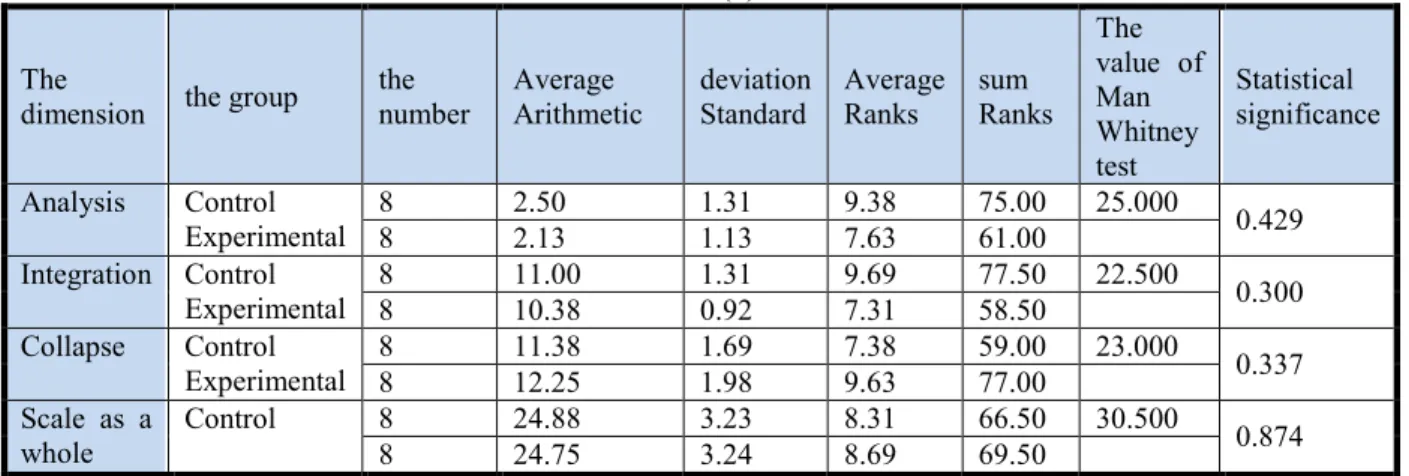
To verify the parity of the two groups of study on the overall tribal measurement of the visual perception scale and each of its dimensions (analysis, integration, and regression), use the average arithmetic and standard deviations and the Mann-Whitney Test according to the group variable. Table 3 shows this.
Table (3) Statistical significance The value of Man Whitney test sum Ranks Average Ranks deviation Standard Average Arithmetic the number the group The dimension 0.429 25.000 75.00 9.38 1.31 2.50 8 Control Experimental Analysis 61.00 7.63 1.13 2.13 8 0.300 22.500 77.50 9.69 1.31 11.00 8 Control Experimental Integration 58.50 7.31 0.92 10.38 8 0.337 23.000 59.00 7.38 1.69 11.38 8 Control Experimental Collapse 77.00 9.63 1.98 12.25 8 0.874 30.500 66.50 8.31 3.23 24.88 8 Control Scale as a whole 8 24.75 3.24 8.69 69.50
The two averages arithmetic and tribal standard deviations of the performance of the two study groups on the visual perception scale as a whole and each of its skills, and the Mann-Whitney Test according to the group variable
Its noted from Table (3) ,that all the values of the statistical significance of the Mann-Whitney Test are greater than the statistical significance level (α = 0.05), indicating the parity of the two groups of the study on the total tribal measurement of the visual measurement for each dimension (Analysis, integration, and fragmentation).
Presentation of the results.
Results of the first study question: "What is the impact of the educational games based on the training program proposed in the current study, upon the development of visual perception as a whole and each of its skills?
To answer this question, averages arithmetic, and standard deviations were calculated for the performance of the two groups of study (experimental and control), on the visual cognition scale, as a whole and each skill, and Table 4 shows this.
Table (4) averages arithmetic, and standard deviations, for the performance of members of the two groups of post-study on the measure of visual perception as a whole and each skill of his skills
Table (4)
The two averages arithmetic and standard deviations of the performance of the two groups of post-study on the visual perception scale as a whole and on each of his skills and the Mann-Whitney Test according to the group variable Size of the effect Statistical significance Value of Man- Whitney test Total Rank Average Rank Standard deviation Average Arithmetic The Number The group The dimension 0.717 0.001 * 3.386 36.00 4.50 1.20 6.50 8 Control Experimental Analysis 100.00 12.50 1.28 11.25 8 0.714 0.001 * 3.381 36.00 4.50 2.19 18.25 8 Control Experimental integration 100.00 12.50 1.04 31.25 8 0.647 0.001 * 3.217 37.50 4.69 4.06 20.25 8 Control Experimental fragmentation 98.50 12.31 1.51 27.50 8 0.664 0.001 * 3.260 36.00 4.50 5.37 45.00 8 Control Experimental Scale as a whole 8 70.00 2.33 12.50 100.00
Table (4) shows the following.
• The statistical significance of the Mann-Whitney Test for the performance of the study’s sample members, on the visual perception scale was (0.001), which is less than the statistical significance level of (α = 0.05), indicating a difference due to the variable of the group, from the two averages arithmetic, the difference is statistically significant for the benefit of the experimental group, which means; the existence of an effect for the game-based training program proposed in the present study, on the development of the visual perception as a whole, where the effect size reached(0.717), indicating , that the game- imagery based training program proposed in the present study, affected the visual perception as a whole by (71.7)
• The statistical significance of the Mann-Whitney Test for the performance of the study sample in the Analysis skill was (0.001), which is less than the statistical significance level of (α = 0.05), indicating a difference, due to the variable of the group, and from the two averages arithmetic, the difference is statistically significant for the benefit of the experimental group. Which means; the existence for an effect for the game-based training program proposed in the present study, on the development of the Analysis skill, where the affect size has reached (0.714), indicating, that the game& imagery based educational program proposed in the present study has an impact on the development of Analysis skill by ( 71.4%).
• The statistical significance of the Mann-Whitney Test for the performance of the study sample in the integration skill was (0.001), which is less than the statistical significance levelof (α = 0.05), indicating a difference, due to the variable of the group, and from the two averages arithmetic, the difference is statistically significant for the benefit of the experimental group, which means; the existence for an effect for the game-based training program proposed in the present study, on the development on the development of the integration skill, where the size of the effect reached (0.647), indicating ; that the game& imagery based educational program proposed in the present study, has an impact on the development of the visual perception as a whole by (64.7).
• The statistical significance of the Mann-Whitney Test for the performance of the study sample in the skill of fragmentation reached (0.001), which is less than the statistical significance level of (α = 0.05), indicating a difference due to the variable of the group, and from the two averages arithmetic, the difference is statistically significant for the benefit of the experimental group, which means; the existence for an effect for the game-based training program proposed in the present study, on the development of the That the effect of the game-based training program proposed in the current study on the development of the skill of fragmentation, where the size of the effect reached (0.664), indicating that the games & imagery based educational program proposed in the present study had an impact on the development of fragmentation skill by (66.4%).
The results of the second study question, which read; Does the impact of the game-based training program proposed in the present study differ on the development of visual perception as a whole and each of its skills according to gender variable?
To answer this question, the averages arithmetic and standard deviations were calculated for the performance of the post-experimental group on the visual perception scale as a whole and each of its skills, and Table 5 shows this.
Table (5)
averages arithmetic, and standard deviations, for the performance of members of the post-experimental group on the visual perception scale as a whole and each of its skills
Table (5)
The two averages arithmetic and the standard deviations of the performance of the members of the two groups of post-study on the visual perception scale as a whole and each of its dimension and the Mann-Whitney Test according to the variable of the group
Statistical significance value of Man- Whitney test sum Ranks Average Ranks Deviation Standard Average Arithmetic the number gender The dimension 0.294 1.049 21.50 5.38 1.50 11.75 4 Male Female Analysis 14.50 3.63 0.96 10.75 4 0.549 0.599 16.00 4.00 0.82 31.00 4 Male female Integration 20.00 5.00 1.29 31.50 4 0.655 0.447 19.50 4.88 1.50 27.75 4 Male female Fragmentation 16.50 4.13 1.71 27.25 4 0.661 0.438 19.50 4.88 2.52 70.50 4 Male female Scale as a whole 4 69.50 2.38 4.13 16.50
Table (5) shows the following:
• The statistical significance of the Mann-Whitney Test for the performance of the members of the study’s sample on the visual perception scale as a whole was 0.661, which is greater than the statistical significance level of (α = 0.05), indicating that there is no different due to the gender, which means; that there is no difference in impact of the game-based training program proposed in the present study on the development of visual perception as a whole and each of its skills according to the gender variable.
• The statistical significance values of the Mann-Whitney Test for the performance of the members of the study’s sample, for every skill of the visual perception skills performance was higher than the statistical significance (α = 0.05), which indicate, that there was no difference due to gender variable, meaning no difference regarding the impact of the game-based training program proposed in the current study, on the
development of each visual perception skill according to gender variable.
Discussion of the results
The results of this study are in line with the findings of Fernands et al. (2012), whose results indicate that visual perception improvements predict the symptoms of autism. also stressed on the importance of early intervention in visual perception improvements, and early treatment before symptoms of autism appear at a later stage. Helmi Adly, and atl. 2017, whose results indicated the importance of the development of high-tech games in the diagnosis of visual perception of autism and its importance in the treatment of autism disorder.
The results of this study are consistent with the results of Griffith & Milne (2007) and Al-Qahtani (2015). The results of their studies indicate the importance of developing visual strategies, as a means to improve visual perception, and that the basic visual function is affected by autism spectrum disorders.
The results of this study are in part correlated with the results of the Gonzalez and Cambes study (1999) and Dawson and Gilbert (1990). And the study of Abdul Ghaffar (1999), whose results indicated the importance of playing as an input in the training of children with autism, and the importance of parental participation in the methods of treatment, as the participation of parents in autistic children's games, increases the game’s methods, and a noticeable increase in the child’s focusing in the face of his mother. Also it correlate with results of Sayah (2007).study. which noted that the results indicated that there were statistically significant differences between the 2 experimental groups and control group in favour of the experimental group on all dimensions of visual perception. this study results differed according to the type of disability. The study of Sayah examined mental disability, where This study deals with autism, where visual perception disorders occur in people with mental disabilities and autism. Al Rousan (2010) and Zerikat (2016) mentioned that mental health problems occur in 75% of cases of autism.
Is consistent with the results of Rasha (2011), whose results indicate a significant improvement in the visual perception of autistic children as a result of the use of the games within the training program for the development of visual perception skills.
Sayah (2007) results indicated ,that there were statistical significant differences in the tribal and remote measurements in the two experimental groups on all dimensions of visual perception skills, visual distinction, visual perception, and optical closure in favour of the remote measurements of the 2 experimental groups.
It’s also consistence with Al Azab (2007). For it has showed; that there were statistically significant differences between the experimental and control groups in all dimensions of the visual perception scale, for the autistic child and for the post-test.
The results of this study agree with what is stated in the theoretical literature, which is consistent with Badr (2004), where it has stated ; that educational activities and games, develop the visual and auditory perception of autism by their sense of colour, distance, size, andwith Gillian (2010), Goodman Williams (2007), Morris and Florence (2008). In; that Visual strategies support the visual perception of autism, and stimulate play for the autistic child.
Also it agrees with Najla(2014) , khatab (2004), Nasir(2002) and Al uhali(2013) which sees autism are receptive for training through games and activities. These activities and games play an important role in the development of visual perception.
Also agrees with Lollerberg (1994) and Gadhafi (1994), which confirmed that autistics suffer from abnormalities in visual perception manifested in the difficulty of interpreting, and regulating visual images, and mixing the use of optical symbols for learning.
Recommendations.
In the light of the research results, the researcher recommends the following:
1. Inviting officials in the Ministry of Education and special education centres to use the proposed program to improve the cognitive skills of children with autism.
2 - The need to pay attention to the development of hearing, motor skills and tactile in autistic children, and conducting studies including this issues .
3 - Further studies to develop the skills of visual and auditory perception and to measure their impact, in the mitigation of inappropriate autism behaviours
Resources and references
Amin, Soha Ahmed (2001): Effectiveness of a therapeutic program for the development of linguistic communication in some autistic children, unpublished PhD thesis, Institute of Graduate Studies for Children, Ain Shams University, Egypt.
Al-Batayneh, Osama, Al-Rashdan, Malik, Al-Saweelah, Abdul-Karim and Al-Khattabah, Abdul Majeed, (2005) The difficulties of theoretical education and practice, second ed.
children, unpublished PhD thesis, Faculty of Education, Ain Shams University, Egypt.
Khattab, M. (2004) Effective therapeutic program to save some degree of behavioral disorders in the eye of autistic, a thesis, University of Ain Shams.
Khatib, Jamal, and Hadidi, Muna (2007), Early Intervention for Special Education in Early Childhood, Amman, Dar Al-Fikr.
Rasha Sobhi Mohamed Abdulla, (2011) A program based on educational games to improve the visual perception of the autistic child. Helwan University . The 10th and International Scientific Conference III.
Al - Rousan, Farouk (2010). The Psychology of Unusual Children. Introduction to Special Education. Second Edition. Dar Al - Fikr, Kingdom of Jordan Hashemite, Amman.
Zareiqat, Ibrahim (2016). Autism. Diagnosis and treatment. Second appartment, Dar Wael Publishing and Distribution, Jordan, Amman.
Suleiman, Abdul Rahman Sayed (2001). Psychology of People with Special Needs, Concept and Attitudes, Part I, Cairo, Zahraa Al Sharq Library.
Suhay Nasr: Linguistic Communication of the Unitarian Child, 2002, Amman, Dar Al-Fikr.
Suheir Shash: Playing and Developing Language for Children with Mental Disabilities, 2001, Cairo. Mr. Ali Bader and Super (2001). Sensory, visual and auditory perception 1, Cairo.
Shami Wafa, (2004). The disappearance of AutismSawyer, Mansour (2009) Effectiveness of a training program in visual and auditory cognition and its impact on the skills of word recognition among students with a simple mental disability in elementary schools in Bahrain. PhD Thesis No.
Al-Zaher, Qahtan (2004). Learning difficulties. First, Dar Wael Publishing and Distribution. Amman, Jordan. Abdul Ghaffar, Siham (1999). The program includes a program for the guidance of families, and a program to
train on social skills, to alleviate the symptoms of autism in children. Ph.D., College of Education, University of Tanta.
Al - Azab, Rasha (2007). Effective training program for the development of cognition and its impact on the reduction of the typical behavior of the child autistic, MA Thesis.
Al-Ohali, Lama Mohammad (2013) Let me know how to connect, Dubai, Madarak Publishing House.
(2006). Visual strategies and alternative means of communication with children with autism, College of Education, King Abdulaziz University.
Al-Fawzan, Muhammad (2000) .Unification / concept -Education -Training, guide to parents and professionals, Riyadh.
Al-Qasem, Jamal (2015). The basics of learning difficulties. Third appartment Dar Safa for publishing and distribution - Amman.
Al-Qahtani, Abdullah, (2015), based on the visual strategies in the development of motor skills in children with autism spectrum disorders.
Kadhafi, Ramadan 1994. The Psychology of Disability. Open University of Libya.
Al - Qamash, Mustafa. Al - Maaaitah, Khalil (2012) Psychology of children with special needs. Fifth edition. The biography for publication, distribution and printing.
Najla Ali (2014) The role of activities developed in children's magazines to develop the visual perception skills of the kindergarten child.
Waqfi, Radi, Wakilani, Abdullah (1998). Group of cognitive tests, Amman: Princess Tharwat College. Comer ,R.(2012).Abu or mal Psychology. New Work :Worth Publisher.
Flores, Margret., M, et al (2008): Effects of the use of visual strategies in play groups for children with autism spectrum disorders and their peers, Journal of autism and development Disorders, v38, n5. Geschwind GHand.(2008). Autism: many genes, common pathway . Cel:135(3):391-5.
Gillian. R., Hayes. S., Gaberiela. M, Mohamed. M., David. H., Michael. Y., (2010): Interactive Visual Supports With Autism, j. Springer,V14, no.7.
Goodman, G., & Williams, C. M (2007): Interventions For Increasing The Academic Engagement of Students With Autism Spectrum Diorders In Inclusive Classrooms, Teaching Exceptional Children, 39 ).( 6
Griffiths, H.J. and Milne, E. (2007) Visual perception and visual dysfunction in autism spectrum disorder: a literature review. British and Irish Orthoptic Journal. 15 - 20. ISSN 1743-9868.
Hallahan,Daniel.P.&Kauffman ,James,(2009).Exceptional Learnes:Introduction To Special Education ,prentice-Hall.Inc.Englewood cliffs,New JerseyY 07632,USA.
Helmi Adly Mohd Noor 1, *, Faaizah Shahbodin 2, Gede Pramudya Ananta 2, Cik Ku Nuraini Che Ku Mohd 2, Syarifah Nadiyah Razali 3, Mohd Sazali
Khalid 4, Rahimah Kassim 1, Fauziah Abdul Rahman 1, Zirawani Baharum 1 (2017) .A prototype development of visual perception diagnosis games for autism children. International Journal of Advanced and Applied Sciences .
MayadaElsabbagh12JaniceFernandes2SaraJanWebb3GeraldineDawson4TonyCharman5Mark
Toddlerhood. The British Autism Study of Infant Siblings Team .
National Research Council.( 2001) Educating Children with autism .Committee on educational interventions for Children with autism ,Catherine Lord ,and James P.McGee,eds Division of behavioural and Social Scences and education .Washing ,DC:National Academy Press.
Romanczyk, Raymond G.,Lockshin, Stephanie B.,& Navalta, Carry.(1994).Autism ;differential diagnosis .In :Johanny L. Matson (Ed.) ,Autism in children and adult :Etiology , assessment , and intervention. Pacific Grove, California :Brooks / Cole publishing Company .
Stilman. M,John. (2008) Aspergers Syndrome: Beverly press , New York.
zwaigenbaum,L.&Stone,W.(2006).Early diagnosis of Children with autism Spectram disorders in Clinical Practic setting ,In:TonyCharman and Wendy stone (eds).Social &communication development in autism Spectrum disorders:Earlyidentication ,diagnosis,&intervention .New Work Guil ford Press.