Inter-state differences in caste-specific risks for child
deprivation in India
Ekbrand, Hans,
1Nandy, Shailen,
25 January 2017
Abstract
The issue of caste has long been an important structural cause of poverty in India, with certain groups and communities socially and physically excluded from the benefits of national economic and social development. While differences between groups are often explained at national and state levels, this paper focuses instead on the issue of inter-state caste-specific risks of child poverty and basic needs deprivation. We show that while children from schedule caste and tribe (SC/ST) communities fare poorly at the national level, it need not be so given some states manage to protect SC/ST children, ensuring outcomes for them are on a par or better than for children from higher caste groups. Caste and tribe status need not condemn children to lives of poverty, and this paper identifies for policy makers where caste and tribe status remain important drivers of poverty and disparities for children. Tackling these would be a start for making India a more equitable society in coming decades.
key wordscaste•child poverty•India•deprivation•discrimination
Introduction
Over the last few decades, India has made significant progress in a range of technological, eco-nomic and social areas; these include a well-funded space research agency, impressive and pro-longed economic growth, and the rise of a large and prosperous middle class. That said, it also remains the case that hundreds of millions of its citizens continue to live in conditions of extreme deprivation and poverty. Depending on the measure used, around half the countrys young children are malnourished (Nandy et al, 2005), and many millions fail to receive a quality education of suf-ficient duration to equip them for life in modern India (Gordon and Nandy, 2016). Add to this the political and social turmoil exemplified by ongoing Maoist/ Naxalite and separatist insurgencies in the states of Odisa, Jharkhand, Andhra Pradesh, Bihar and West Bengal, 1 the highly publicised cases of rape and murder of women and girls in the nations capital and in Uttar Pradesh, and the election of the Bharatiya Janata Party (BJP), and it is clear India faces many important (and some might argue, linked) economic and social justice challenges over the next decade. Also at play is a social force caste which has over many years systematically disadvantaged large swathes of the population, effectively excluding millions of Indian citizens from equal access to education, employment and a range of economic and social services. There is a large literature which deals with the issue of caste and its role in the generation and propagation of poverty and deprivation in India (Agarwal and Srivastava, 2009; Chaudhary, 2005; Kumari, 2005; Srinivasan and Kumar, 1999; Srinivasan and Mohanty, 2004; Subramanian et al, 2006; Weber, 1967). It identifies the many socially-imposed limits placed on members of lower castes, and shows how discrimination on the basis of caste or religion can be attributed to a range of cultural and historical factors which differ from region to region in a country as large and diverse as India. In addition to these factors is the way the governance of India is structured. Being a federal system, state governments are often responsible for social policies and public spending. Thus it is that state-level policies and programmes, and levels of spending, are key factors in understanding how and why peoples basic
1University of Gothenburg, Sweden.[email protected] 2Cardiff University, UK.[email protected]
needs remain unmet. States differ in their capacity to deliver social policies and programmes eq-uitably, as well as in their efficiency of programme administration (Dreze and Sen, 1995; Harriss, 1999; Harriss, 2005). This paper aims to contribute to these debates using empirical evidence to show how states differ when it comes to the effect caste membership has on outcomes for children. Some states demonstrate clearly that being born into a scheduled tribe (ST) or scheduled caste (SC) community does not necessarily have to result in worse outcomes or prospects for children. This is good news, even if in most states children from lower caste backgrounds suffer from increased risks of being deprived of an education, food, sanitation, shelter, healthcare and other basic needs. The wellbeing of children is often considered a barometer of the wider economic and social health of the nation, so we ask a relatively straightforward question: where in India is it least damaging to be a child from either a scheduled caste or scheduled tribe? Our answers may surprise some and/or confirm the prejudices of others, but what they reveal has important social, political and economic implications for India in the years to come.
Child poverty and caste in India
Why should caste continue to be considered as a determinant of poverty?
The caste system in India (and in some other south Asian countries, like Nepal) has ancient roots, stratifying people into groups with clearly ascribed roles, duties, and restrictions. It has been said it represents one of the most entrenched structures of domination and subordination, with an in-built system of demarcation and exclusion (Appasamy et al, 1996, 85). Social restrictions prevent members of lower castes from getting and doing a range of jobs, and in times past were actively prohibited from accessing public services and facilities (like schools, wells, or even parts of villages or towns). The exclusionary impact of caste has been well documented, both in the academic literature and in the daily Indian media, so some discussion of its dynamics are warranted here. Understanding that caste does not act and cannot be analysed in the same way as occupational social class is important for those unfamiliar with the Indian context. Although discrimination on the grounds of caste (caste-ism) is banned under Article 15 of the Constitution of India, it remains the case that caste continues to play a role in shaping outcomes for individuals and communities (Dreze and Gazdar, 1996). Ever since independence in 1947 the Constitution of India has recognised the systematic discrimination against members of scheduled castes (SC), scheduled tribes (STs) and other backward classes (OBCs), required a continuous monitoring of the rights of these groups, and has reserved seats in the legislative assemblies for these groups (The Constitution of India, Articles 332, 33842). During the last 30 years, jobs and educational opportunities have been reserved as well, but not yet to the extent initially envisaged by the second Backward Classes Commission, the Mandal Commission, in 1980. The caste into which an Indian child is born still determines, to a high degree, the life chances he or she will have. During the last 20 years or so, differences in access to primary education between children from different castes have decreased, and children from scheduled tribes groups in particular have gained better access to primary education (Rachna, 2013). The proportion of dropouts from primary school among scheduled caste children decreased significantly between 1997 and 2003 (Jenkins and Barr, 2006). Regarding child deprivation at large, there are still major differences between higher and lower caste children in India. A lucid account of the continuing role and influence of caste in perpetuating poverty, inequality and disadvantage in India was made by Kabeer (2006). She highlighted how certain social constraints, often missed in mainstream poverty and economic analysis, were critical in understanding why poverty persists and inequality rises. These social constraints, revolving around peoples identity who they are and who they are perceived to be have led to the devaluing of certain groups (that is, lower castes, scheduled tribes, Muslims) by sections of the general public, by the media, by politicians and by policy makers, with the end result being their exclusion from the benefits of Indias recent economic growth and social development. Whether this is in the form of collective resources (for healthcare, education, and so on) to which groups are legally entitled not being provided (Betancourt and Gleason, 2000), in access to legal redress when required, in employment discrimination, or the victimisation of children in schools because of their caste or religion (Dreze and Gazdar, 1996), what is clear is that across a range of outcomes, members of SC/ST groups fare less well than non-SC/ ST groups. Children from SC/ST groups are less likely to go to school, to complete their education, or to be fully immunised than non-SC/ST children. Their mortality and malnutrition
rates are higher, their employment prospects lower, and standard of living undeniably lower (Dreze et al, 2007). Caste also plays a role in the intergenerational transmission of poverty, given the limits it places on occupational mobility, and also on where and how people can live. By limiting members of SC/ST groups to low paid (or even unpaid) jobs, by restricting access to education for children, and by controlling access to important assets and capital, such as land and housing tenure, caste reinforces structural and social barriers that keep groups and communities poor. In recognition of endemic and systematic discrimination, policies such as quotas and reservations have enabled a relatively small proportion of SC/ST people to secure places at university, public sector jobs and legislative positions in government, but not in anything like sufficient numbers to redress historic (and current) imbalances of opportunity. Given that caste discrimination is outlawed under the Constitution, that national and state social and economic policies exist to ameliorate its impact, and that people in India are increasingly aware of their human, political, economic and social rights, one might ask if there is still a need to consider caste as a determining factor with regards poverty. The answer, on the face of it, is simple: the continued (and growing) disparities between people in these groups and those belonging to higher castes requires examination and explanation. Members of these groups are expressing their discontent with the situation in many ways, including at the ballot box, through peaceful protests, but also with armed uprisings in many states. If democracy has not (yet) resulted in meaningful representation of their interests, at either state or national government levels, then it is not surprising that tensions and demands manifest themselves in other ways. It is apparent from the patterning of recent insurgencies in India that the demands and grievances of many SC/ST groups remain unmet. It is also noteworthy that the only states where the rights of SC/ST groups appear to be accorded systematic protection are in the north-east of the country, where they form a majority of the population and thus retain a degree of political and economic control. The election of a BJP national government in 2014, which is dominated by high caste groups and business interests, does not bode well with regards prospects for reducing intra-caste differences in India.
Caste is not a law of nature
Given the almost universal finding in the literature that members of SC/ST groups consistently ex-perience or report worse outcomes across a range of social indicators (for example, mortality rates, education attainment, and so on), one might be forgiven for thinking that it is the characteristics and peculiarities of being from these groups which causes worse outcomes; that the disadvantaged po-sition of SC/ST members is almost, for want of a better phrase, a law of nature. In some instances this may appear so, especially when certain tribal communities live in remote forest or mountain areas, geographically isolated from the potential benefits of state social and economic policies, and the provision of basic services. More often than not, however, what is occurring is more straight-forward social, economic and political discrimination (Dreze and Sen, 2014). The longstanding history of systematic discrimination against members of the lower castes and its ongoing effects is an outrage. However, by focusing on inter- state differences in the deprivation risks for different castes we hope to show that membership of a lower caste need not condemn SC/ST groups to poor outcomes. We show that in a number of states children from lower caste or tribal groups can in fact have the best predicted outcomes, providing an example for further study. What occurs in those instances which result in better relative outcomes for lower caste children compared with higher caste children?
Using child poverty to assess the impact of caste
There is an abundant literature on poverty in India, stretching back well over a century to the work of people like Dadabhai Naoroji (Naoroji, 1901). It covers not only the meanings of poverty (Saith, 2005; Sen, 1981; 2006) but also its measurement (Subramanian, 2012) and policies to tackle it. That said, there is relatively little written about child poverty in India as a distinct topic (Nakray, 2015; Mehrotra, 2006), and given the increased attention paid to the issue of child poverty in recent years (Minujin and Nandy, 2012) we thought it of interest and use to examine where and how caste plays a role in the perpetuation of child poverty in India. The NFHS data used here are of high quality, and have long been used by researchers to examine poverty and deprivation in India, to see how they correlate with nutritional status, educational attainment, health behaviours, mortality, and
more recently, attitudes to and experiences of gender violence (Filmer and Pritchett, 2001; Nandy et al, 2005; Subramanian and Davey Smith, 2006; Subramanian et al, 2005). The data have also been used by organisations like UNICEF to assess the situation of children in India, in its comparative Global study on child poverty and disparities (UNICEF, 2007). The Global study adopted and applied an indicator of child poverty developed by Gordon et al (2003), which operationalised an internationally-agreed definition of absolute poverty adopted at the World Summit for Social Development in Copenhagen in 1995.
Developing a measure of child poverty
In 2003, Gordon et al developed a method to assess the extent and nature of child poverty in devel-oping countries, and produced the first global estimates of child poverty. They developed indicators of severe deprivation of basic human needs for children, including for shelter, water, food, sanita-tion, healthcare, education and informasanita-tion, which aligned with internationally-agreed conventions like the United Nations Convention on the Rights of the Child (UNCRC). In doing this, children were identified as being severely deprived, or not, of the seven basic needs mentioned, and a sum-mary simple additive index was developed denoting the extent of single and/or multiple depriva-tions (Gordon and Nandy, 2012; Delamonica and Minujin, 2007; Gordon and Nandy, 2016). The thresholds set were so severe that they were likely to impair the healthy development of children. For example, children considered education deprived were those who had never been to school; the health deprived were those children who had either never received any of the standard vaccinations which protect against major causes of mortality and disability, for example, measles or polio, or who had experienced an illness involving diarrhoea but who had not received treatment or advice on treatment. Children experiencing two or more deprivations (that is, multiple deprivation) were classed as living in absolute poverty. The more deprivations a child experienced the more deprived she/he can be said to be. This approach is now widely applied, and termed the Bristol Approach to child poverty measurement (Minujin and Nandy, 2012).
Using deprivation indicators to reflect intra-state inter-caste differences
The NFHS data can be used to test empirically whether or not being a child from an SC/ST group is disadvantageous with regards poverty, and if so, where. Households are ascribed the caste/tribe status of the head of household, with four main categories possible: SC, ST, OBC, and None of the Above a catch all for respondents for whom caste should either not be an issue (for example, Muslim or Christian respondents) or who are members of higher caste groups. That said, caste is complicated, and it is frequently the case that respondents/households reporting to be Christian, Muslim or even of No Religion also identified as being from either an SC/ST or OBC. With this in mind, and with our outcome variable reflecting child poverty, we can investigate inter-caste differ-ences with regards the relative risk of poverty for children both within states and between states. In doing so, we hope to demonstrate that the greater risks of poverty for children of SC/ST/OBC groups are not inevitable, and that there are, in fact, state(s) in India where SC/ST/OBC children actually have lower risks of poverty relative to children in higher castes. By highlighting these cases, policy makers can explore why it is that caste and tribe status do not necessarily condemn children to poverty or reduced life chances.
Data and methods
We use data from Indias third National Family and Health Survey (NFHS), conducted in 2005/06, which covers all 29 states of India (IIPS and Macro International, 2007). The sample included individual-level data on over 515,000 people in 109,000 households, with data collected on their living conditions, access to health and education services, as well as a range of other topics. Anal-yses of inter-caste differences routinely present absolute rates of poverty, mortality or educational attainment by caste and state. Our approach is somewhat different, in that what we are interested in are the relative risks of poverty or deprivation for low caste children (that is, SC/ST/OBC children) compared to children from higher caste groups in that state. We therefore control for non-caste-specific inter- state differences in child poverty as well as the nation-wide fixed effects of caste on individual deprivations. Thus we can model the extent of any state specific heightened risk for
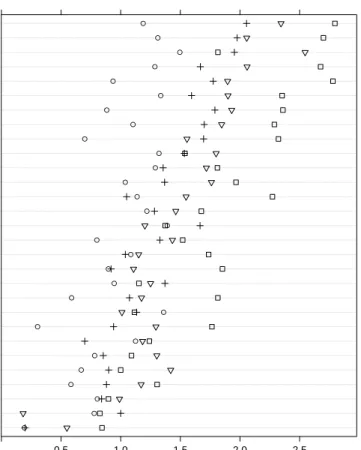
Kerala Delhi Mizoram Goa Sikkim Andhra Pradesh Punjab Tamil Nadu Maharashtra Himachal Pradesh Arunachal Pradesh Nagaland Meghalaya Tripura West Bengal Assam Manipur Uttaranchal Gujarat Karnataka Haryana Uttar Pradesh Jammu and Kashmir Madhya Pradesh Chhattisgarh Orissa Bihar Rajasthan Jharkhand 0.5 1.0 1.5 2.0 ● ● ● ● ● ● ● ● ● ● ● ● ● ● ● ● ● ● ● ● ● ● ● ● ● ● ● ● ●
Figure 1: Mean number of deprivations experienced by children, by state
deprivation for low caste children. In technical terms, we use a random slope mixed-model linear regression, where the random intercept for each state represents the deviation from the national mean in the expected number of deprivations for higher caste children, and the slopes represent the additional deviations from this value for children from SC, ST and OBCs respectively. This type of model captures differences between states in the effect of caste on the expected number of depriva-tions. A state can either increase the between-caste- differences or it can reduce them. When we say that a state reduces the between- caste-differences, we mean that the expected differences between a child born into the higher castes and a child born into SC/ST/OBCs are smaller in that state than compared to the Indian average. In future work we aim to explain the state specific heightened risks of low caste children by comparing the politics of good states, where between-caste differences are small or negative, with badly performing states, where between-caste differences are larger. Are there any particular state level policies that seem to even out the risks of deprivation for lower caste children and higher caste children? This work is currently ongoing.
Findings
State-level deprivations among children
Our analysis is presented in stages. Our simple research question then is: Where in India is it least bad to be a child from an SC/ST/OBC group, with regards to deprivation and poverty? This question can be interpreted in several ways, and each interpretation will yield a different answer. Consider the simple interpretation: In what state of India is the expected number of deprivations for an SC/ST/OBC child lowest? The answer to this question can be answered with a simple bi-variate analysis of the mean number of deprivations experienced by children in different states. Figure 1 shows the expected number of deprivations children experience in each state. Children in Jharkand, Bihar and Rajasthan experience the highest mean number of deprivations.
However, state-level means hide considerable disparities. Figure 2 shows that when state-level results are disaggregated by caste status, more complex patterns emerge. Now, we see that the states
Kerala Mizoram Sikkim Delhi Punjab Goa Meghalaya Tamil Nadu Arunachal Pradesh Andhra Pradesh Nagaland Maharashtra Tripura Himachal Pradesh Manipur Assam West Bengal Karnataka Uttaranchal Haryana Gujarat Uttar Pradesh Chhattisgarh Jammu and Kashmir Madhya Pradesh Orissa Bihar Rajasthan Jharkhand 0.5 1.0 1.5 2.0 2.5 ● ● ● ● ● ● ● ● ● ● ● ● ● ● ● ● ● ● ● ● ● ● ● ● ● ● ● ● ● higher caste other backward class scheduled caste scheduled tribe
●
Figure 2: Inter-caste mean number of deprivations experienced by children, by state
with the lowest mean number of deprivations for SC children (represented by a + sign) are Mizoram and Sikkim. SC/ST children in the states of Bihar, Rajasthan and Jharkhand experience the largest mean number of deprivations. One could also use Figure 2 to assess the level of inequality between children from different groups, by examining the spread between markers for SC/ ST/OBCs and higher castes. A greater spread represents more inequality (for example, Gujarat and Tamil Nadu) and a smaller spread less inequality (for example, Manipur and Arunachal Pradesh).
Table 1 below shows the fixed terms of our model, that is, the nationwide average differences in predicted number of deprivations for each caste.
A random Indian child from the upper castes has, on average, 1.06 deprivations, while a random Indian child from an SC background has 1.06 + 0.36 = 1.42 deprivations, on average. There is however, as we have seen in Figure 2, a great deal of interstate variation. Kerala has the lowest mean number of deprivations for children (Figure 1). The states of Bihar, Rajasthan and Jharkhand have the highest mean number of deprivations, at or above 2.
We know that at the national level, the mean number deprivations experienced by children of SC/ST and OBC groups is higher than for children of higher castes. SC and ST children ex-perienced on average 1.42 and 1.44 deprivations respectively, and OBCs 1.19. These should be compared to the mean for higher castes of 1.06. If we control for both the average deprivation risk in each state for the higher caste children, as well as the nation-wide deprivation risks for each caste group, what then are the state-specific risks of deprivation for low caste children? In each state we compare the risks for low caste children to those of higher caste children (our reference category). Figure 3 plots these risks by state and caste.
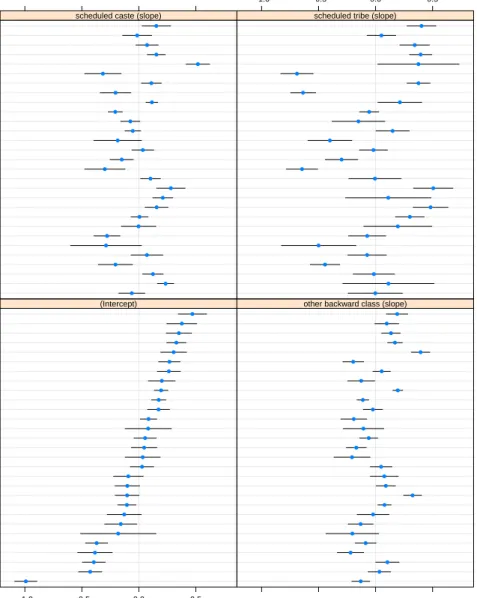
The bottom left quadrant shows, the deviance from the national mean (of 1.06 deprivations) for higher caste children. This figure provides a reference point for the other three quadrants. The top left quadrant shows the deviance of ST children in each state from the reference group (that is, upper caste children in that state). The top right quadrant shows the deviance of OBC children from the reference group and the bottom right quadrant shows the deviance of SC children from the reference group. If there were no inter-state differences between children of different castes each quadrant would report zeros across all rows. Figure 3 shows the complexity of risk patterns for children of different castes in each state. Taking Jharkhand as an example, the risks of
Kerala Punjab Himachal Pradesh Sikkim Goa Mizoram Tripura Tamil Nadu Andhra Pradesh Gujarat Haryana Jammu and Kashmir Uttaranchal Arunachal Pradesh Assam Karnataka Meghalaya West Bengal Delhi Maharashtra Uttar Pradesh Nagaland Orissa Manipur Bihar Madhya Pradesh Rajasthan Chhattisgarh Jharkhand −1.0 −0.5 0.0 0.5 ● ● ● ● ● ● ● ● ● ● ● ● ● ● ● ● ● ● ● ● ● ● ● ● ● ● ● ● ● (Intercept) ● ● ● ● ● ● ● ● ● ● ● ● ● ● ● ● ● ● ● ● ● ● ● ● ● ● ● ● ●
other backward class (slope) Kerala Punjab Himachal Pradesh Sikkim Goa Mizoram Tripura Tamil Nadu Andhra Pradesh Gujarat Haryana Jammu and Kashmir Uttaranchal Arunachal Pradesh Assam Karnataka Meghalaya West Bengal Delhi Maharashtra Uttar Pradesh Nagaland Orissa Manipur Bihar Madhya Pradesh Rajasthan Chhattisgarh Jharkhand ● ● ● ● ● ● ● ● ● ● ● ● ● ● ● ● ● ● ● ● ● ● ● ● ● ● ● ● ●
scheduled caste (slope)
−1.0 −0.5 0.0 0.5 ● ● ● ● ● ● ● ● ● ● ● ● ● ● ● ● ● ● ● ● ● ● ● ● ● ● ● ● ●
scheduled tribe (slope)
Figure 3: State specific deprivation risks for children, by caste. Note: Coefficients represent the difference in expected number of deprivations compared to the national mean of expected number of deprivations for an upper caste child, calculated using multilevel regression with random slopes. Lines represent confidence intervals for alpha = 0.05. Source: NFHS 3 data.
experiencing a deprivation are greater for ST, OBC and SC children than for higher caste children, whose risks in Jharkhand are higher than the national average for higher caste children. To get the predicted number of deprivations for an ST child in Jharkhand we add together (i) the estimated intercept 1.06, and (ii) the general additional deprivation level of Jharkhand 0.19, and (iii) the extra deprivations given to all ST children in India 0.38 and, (iv) an extra 0.39 deprivations for being an ST child in Jharkhand, which is a state where it appears particularly disadvantageous to be an ST child. As Jharkhand has a positive value (of 0.39) for extra deprivations for ST children, we can say that living in Jharkhand increases the between-caste differences. States which have negative values for this measure, for example, Manipur, can be said to decrease between-caste differences. All in all, a child born into a ST family in Jharkhand can expect to live with 2.02 deprivations, around twice the Indian average.
Contextual effects and explanations of disparities
Having demonstrated the clear disparities in the risk of SC/ST children experiencing deprivation relative to higher caste peers in the same state, we now consider potential explanations for such patterns. Assuming that all social groups in India have equal or even equitable access to resources at community and state levels is unwise, given the mechanics of caste explained above. A safer assumption would be that the interests of those groups in or with political power, either via the ballot box or other means, are secured first, and that in those states where SC/ST groups form a majority, children from these groups are less likely to be disadvantaged relative to their higher caste peers. This assumption can be tested, when we include in our model information the relative proportions of different caste/tribe groups in the populations of each state. In other words, is it better to be a child from an SC/ST in a state where they constitute a larger proportion of the population than it is in states where there are relatively few other members of SC/STs?
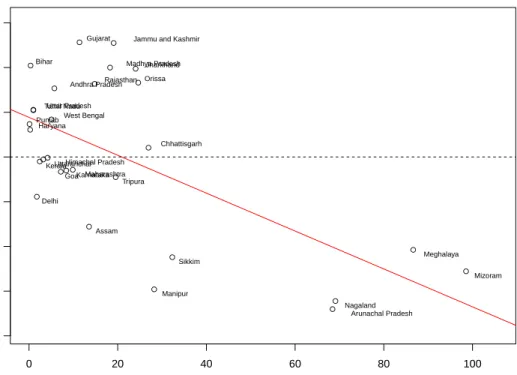
We modify our original regression model to now include a number of fixed effects for the percent of the state population that is SC, percent ST, percent OBC and the interactions of all of these with caste. With regards to the interaction between predicted number of deprivations for children in each caste and the percent of the state population being SC, there was no significant effect or difference. For the interaction between predicted number of deprivations for children in each caste and the percent of the state population being ST, there was an interesting effect in that children from higher caste had a higher number of expected deprivations the larger the share of the ST population in a state. Regarding the share of OBCs in the state population, the effect for each caste is positive and significant for all groups. Overall, there is a systematic pattern across the country, in that where state populations have higher proportions from the OBCs a greater risk of deprivation exists for all children, regardless of caste/tribe status. What this means is that child deprivation in India is by and large a collective phenomenon. In areas and states where everyone is poor, it is unlikely children (even higher caste ones) will have access to basic services like sanitation, safe drinkable water, access to healthcare and education and so on. Strength in numbers matters, but from our analysis, it is particularly the case for ST groups who appear able as they increase as a share of the population to reduce the deprivation gap between themselves and higher caste groups (Figure 4).
In states where STs are in a majority, the deprivation gap between children from STs and higher castes is more than a half deprivation less than the mean in the other states. In the states of Mizoram, Meghalaya, Arunachal Pradesh and Nagaland, children from STs are less at a disadvantage than elsewhere, and this is likely to be due to the fact that STs make up a majority of the population in these states. Relatively low numbers of deprivations for ST children are also found in the states of Manipur, Sikkim and Assam, but this is not related to their groups being in a majority, as the percentages of STs here are similar to the states of Jammu & Kashmir, Jharkhand and Orissa, each of which have markedly higher rates of deprivation among ST children than among children of higher castes.
Considering religion
Caste and religion in India combine to make the culture what it is. As such we consider the interac-tion of caste/tribe status and religion when assessing childrens risk of experiencing a deprivainterac-tion.
● ● ● ● ● ● ● ● ● ● ● ● ● ● ● ● ● ● ● ● ● ● ● ● ● ● ● ● ● 0 20 40 60 80 100 −0.8 −0.6 −0.4 −0.2 0.0 0.2 0.4 0.6
Percent scheduled tribe in this state
Extr a depr iv ations f or scheduled tr ibe Andhra Pradesh Bihar Chhattisgarh Gujarat Haryana
Jammu and Kashmir
Jharkhand Madhya Pradesh
Orissa
Punjab
Rajasthan
Tamil NaduUttar Pradesh West Bengal Arunachal Pradesh Assam Delhi Goa Himachal Pradesh Karnataka Kerala Maharashtra Manipur Meghalaya Mizoram Nagaland Sikkim Tripura Uttaranchal
Figure 4: Extra deprivations for scheduled tribe children as a function of per cent scheduled tribe in the state.
R2≈0.38;p <0.001;n= 29
From Table 1 we saw that the predicted number of deprivations for higher caste Hindu children was about 1; for OBC children the predicted number of deprivations was 1.2, and about 1.45 depri-vations for SC and ST children. Figure 5 shows how caste, religion and child deprivation interact, displaying the expected number of deprivations children experience calculated using multilevel regression.
The differences between higher caste children and SC and ST children are clearly significant among Hindus. Among Muslims, in which all those reporting caste or tribe status are more de-prived than any other large religious group, SC and ST children have a higher number of predicted deprivations than OBC and higher caste children, but the difference is not statistically signifi-cant. Muslim and Hindu populations are in this regard the extremes, with Christians somewhere in between. Christians feature substantial caste differences in life chances since the SC children experience significantly more deprivations than the higher castes and the OBC, but ST children are less disadvantaged among Christians compared to Hindus. Also, the difference between ST and higher castes are not statistically significant among Christians.
Decomposing disparities between castes within states
The deprivation index used thus far provides an overall picture of intra-state differences between high and low caste and tribe groups. However, from a policy perspective, it is also important to know more precisely which types of deprivation drive disparities between children in different groups. To show this we calculate for each state and each type of deprivation the average difference in probability of being deprived between the higher castes and the mean for scheduled tribe and scheduled caste respondents. As can be seen in Figure 6, the most important types of deprivation when it comes to intra-state caste differences in child deprivation are (lack of) adequate sanitation and shelter. 2 In most states it is a lack of sanitation and a lack of shelter which are the deprivations to which low caste children but not high caste children are exposed.
Caste Depr iv ations 0.9 1.0 1.1 1.2 1.3 1.4 1.5 1.6 higher OBC SC ST ● ● ● ● = Religion Hinduism higher OBC SC ST ● ● ● ● = Religion Islam higher OBC SC ST ● ● ● ● = Religion Christianity
Figure 5: The interaction between caste, religion and child deprivation
Arunachal Pradesh Sikkim Manipur Nagaland Tripura Goa Meghalaya Haryana Kerala Assam Himachal Pradesh Uttaranchal Maharashtra Karnataka Punjab Bihar Jammu and Kashmir Delhi West Bengal Orissa Andhra Pradesh Rajasthan Uttar Pradesh Jharkhand Madhya Pradesh Gujarat Chhattisgarh Tamil Nadu −0.2 0.0 0.2 0.4 0.6 ● ● ● ● ● ● ● ● ● ● ● ● ● ● ● ● ● ● ● ● ● ● ● ● ● ● ● ● ● ● ● ● ● ● ● ● ● ● ● ● ● ● ● ● ● ● ● ● ● ● ● ● ● ● ● Sanitation Water Information Food Education Health Shelter ● ● Figure 6: Decomposing...
Arunachal Pradesh Assam Nagaland West Bengal Rajasthan Sikkim Kerala Tripura Manipur Chhattisgarh Delhi Maharashtra Gujarat Andhra Pradesh Punjab Haryana Himachal Pradesh Karnataka Orissa Goa Uttar Pradesh Uttaranchal Bihar Madhya Pradesh Jammu and Kashmir Jharkhand −0.1 0.0 0.1 0.2 0.3 0.4 ● ● ● ● ● ● ● ● ● ● ● ● ● ● ● ● ● ● ● ● ● ● ● ● ● ●
Figure 7: Difference in likelihood...
policy makers to identify in which areas caste differences remain a problem. This is particularly pertinent with regards health and education policies and services, where access to services for members of SC or ST groups may be affected by staff and personnel unwilling to either work in or with SC and ST communities (Acharya, 2010). Figure 6 shows that neither health and education deprivation appears to be the most important driver of disparities between groups within states. The states where health deprivation contributed most to disparities were Tripura and Nagaland. Both are located in the north-east of India. With regards education deprivation as a driver, its greatest contribution to explaining disparities between groups was Orissa. It is important to keep in mind though that while disparities for some states may appear less pronounced (a good thing), it is also possible that the prevalence rates for individual deprivations may be higher as well, and vice versa (that is, low overall prevalence but a large spread/disparity). Overall, it is clear that the deprivations driving disparities in most states are for sanitation and shelter. However, it is also the case that deprivation of other essential basic needs, for water and food, also drive disparities in some states. Such information can be used by state-level policy makers and planners to determine what their focus should be in meeting the needs of children from all communities within their states.
From Figure 6 one could get the impression that differences in food deprivation between chil-dren from different castes were not large. However, in many states, there are significant differences in the likelihood of being severely food deprived between the higher castes and the ST or SC chil-dren. We created a new variable, which consisted of all children in SC and ST children and then calculated the marginal effects for severe food deprivation when comparing this new category to the higher castes (Figure 7).
For most states, the probability of severe food deprivation for a random ST/SC child is signif-icantly higher than for a random child in the higher castes. This is true for the 17 states whose confidence interval in Figure 7 is positive and does not include zero. The worst states in this re-gard were Jharkhand, Jammu & Kashmir and Madhya Pradesh. For some states, like West Bengal, Nagaland and Assam, the confidence interval of the marginal effect includes zero, meaning there were no significant differences between the two groups. Only in the state of Arunachal Pradesh were SC/ST children less likely to be severely food deprived than their higher caste peers.
Discussion
This paper asked a simple question: where in India is it least damaging (that is, in terms of experi-encing severe deprivation of basic needs) to be an SC/ST child? On the basis of data on outcomes from the NFHS, it appears a child from a lower caste suffers least from relative disadvantage in the states of Arunachal Pradesh, Nagaland and Manipur. On the other hand, the general depriva-tion rates in these states are so high that in absolute terms a low caste child has the lowest risk of deprivation in the states of Mizoram or Kerala.
Since children are the future of any nation, it makes sense to focus on the wellbeing (and well becoming) of the next generation, to see if (and where) India will be a more equitable nation in the years to come. The data we have presented detail not only the prevalence of deprivation across a range of outcomes across the states of India, but also between key social and religious groups within states in India. We showed that the key drivers of disparities between castes within states were for shelter and sanitation deprivation two basic human needs whose satisfaction requires no new costly scientific developments or technologies. Both (in fact all) these deprivations can be eliminated through the effective application of social protection policies. We showed that SC/ST membership did not necessarily mean being condemned to higher rates of poverty or deprivation, that caste disadvantage is not a law of nature. It thus can and should be ameliorated by the right combination of policy, programme and resource provision.
The small (and even reverse) disparities in deprivation between ST children and children of higher castes in the north-east of India demonstrate that more equitable outcomes for all Indias children are possible. That said, we acknowledge that the states of the north-east are not peaceful havens of tranquillity, and that they too have serious social, economic and political challenges, as groups struggle for power and control of state governments (Hussain, 2003).
Our findings support those of earlier studies which examined social and economic disparities between castes, religions and regions of India. One example, from over a decade ago (Kulkarni, 2002), reported that educational achievement and enrolment were lower for SC children across almost all states, but that there were differences in the magnitude of disparity; in the north-eastern region these differences were small or even negative. State governments have, over many years, allocated resources and developed programmes aimed at ensuring the inclusion of SC/STs in main-stream development (Nakray, 2015). For example, in Orissa, the Navajyoti Scheme has, since 2005, been targeted at the most deprived tribal and caste groups in the state, with the aim of re-ducing child mortality by providing community-based home-delivery and neonatal care. While targeted interventions undoubtedly can have an impact, they create a danger that other groups (at whom interventions are not targeted) will be left behind or missed. This was apparent with regards Tribal Development programmes in states in central India, which achieved only limited success in matters of education. The evident and persistent disparities observed for the states of central and northern India as shown in our results confirm that such targeted strategies might not be the solution to reducing social disparities in India, and that more universal solutions be considered and applied.
Conclusion
It is clear that despite decades of sustained economic growth and national development, many millions of people in India still live in conditions of real and tragic deprivation. It is claimed the first Millennium Development Goal (MDG) of eradicating extreme poverty was met, 4 even though progress on other MDGs was less impressive; for example, the disappointing lack of progress in reducing child undernutrition. Indias economic growth has benefited a burgeoning middle class, but benefits have not been evenly or equitably distributed; the result is an increase in economic and social inequality. Persistent poverty and deprivation in some regions and communities has undoubtedly contributed to social and political unrest, with growing tensions between geographic, social and class groups. Caste continues to be a faultline in Indian politics and society, and one which will require monitoring, to ensure the benefits of economic and social development are shared more equally.
India has no shortage of national and state laws, and Plans of Action, relating to the welfare of children (Government of India, 2012). These detail childrens rights to healthcare, to education, to food security, to protection from harmful labour, and to paid employment for adults in their
families. Despite this, the evidence presented in this paper demonstrates services and benefits fail to reach very large numbers of SC, ST and OBC children across almost every state, and many of the reasons for this are due to caste-based discrimination. For example, with regards food se-curity programmes, it has been shown that SC children in kindergarten centres are provided less food, that visits to lower caste neighbourhoods by programme staff are less frequent, and that in some instances low caste children are seated separately as part of the Mid- Day Meal programme (Kishore et al, 2013). Similar manifestations of discrimination have been observed in the wages accorded to low caste workers via employment guarantee schemes despite being allocated slightly more employment days (Kishore et al, 2013). The different Acts and Plans of Action currently in place do try to tackle both demand and supply-side determinants of peoples demand for services, but long-standing and ongoing failures to address the more fundamental structural and contextual determinants means SC and ST communities continue to be disadvantaged (Kabeer, 2001). The evidence presented in this paper demonstrates where caste-based disparities persist in the states of India, and thus to where resources, policies and more importantly, action, needs to be channelled. India failed to meet a number of MDG targets, including halving the proportion of hungry people, reducing child mortality by two-thirds, and halving the proportion of people without access to ba-sic sanitation (Gordon and Nandy, 2016); attention is now focused on addressing and meeting the Sustainable Development Goals by 2030, and while national economic progress is undeniable, it remains to be seen if the SDGs will be met without a fundamental tackling of caste-based discrim-ination. The release of future rounds of the NFHS will allow researchers to monitor caste-based disparities.