Guardians and Actions" Linguistic
for Robust, Distributed Programs
BARBARA LISKOV and ROBERT SCHEIFLERMassachusetts Institute of Technology
Support
An overview is presented of an integrated programming language and system designed to support the construction and maintenance of distributed programs: programs in which modules reside and execute at communicating, but geographically distinct, nodes. The language is intended to support a class of applications concerned with the manipulation and preservation of long-lived, on-line, distributed data. The language addresses the writing of robust programs that survive hardware failures without loss of distributed information and that provide highly concurrent access to that information while preserving its consistency. Several new linguistic constructs are provided; among them are atomic actions, and modules called guardians that survive node failures.
Categories and Subject Descriptors: C.2.4 [Computer-Communication Networks]: Distributed Systems--distributed applications; distributed databases; D.1.3 [ P r o g r a m m i n g Techniques]: Concurrent Programming; D.3.3 [Programming Languages]: Language Constructs--abstract data types; concurrent programming structures; modules, packages; D.4.5 [Operating Systems]: Reli- ability-checkpoint/restart; fault-tolerance; H.2.4 [ Database Management]: Systems--distrib- uted systems; transaction processing
General Terms: Languages, Reliability
Additional Key Words and Phrases: Atomicity, nested atomic actions, remote procedure call
1. INTRODUCTION T e c h n o l o g i c a l a d v a n c e s h a v e m a d e i t c o s t e f f e c t i v e t o c o n s t r u c t l a r g e s y s t e m s f r o m c o l l e c t i o n s o f c o m p u t e r s c o n n e c t e d v i a n e t w o r k s . T o s u p p o r t s u c h s y s t e m s , t h e r e is a g r o w i n g n e e d f o r e f f e c t i v e w a y s t o o r g a n i z e a n d m a i n t a i n d i s t r i b u t e d p r o g r a m s : p r o g r a m s i n w h i c h m o d u l e s r e s i d e a n d e x e c u t e a t c o m m u n i c a t i n g , b u t g e o g r a p h i c a l l y d i s t i n c t , l o c a t i o n s . I n t h i s p a p e r w e p r e s e n t a n o v e r v i e w o f a n i n t e g r a t e d p r o g r a m m i n g l a n g u a g e a n d s y s t e m , c a l l e d A R G U S , t h a t w a s d e s i g n e d f o r t h i s p u r p o s e .
A preliminary version of this paper appeared in the Conference Record of the Ninth Annual Symposium on Principles of Programming Languages, January 1982 [18].
This research was supported in part by the Advanced Research Projects Agency of the Department of Defense, monitored by the Office of Naval Research under contract N00014-75-C-0661, and in part by the National Science Foundation under grant MCS 79-23769.
Authors' address: Laboratory for Computer Science, Massachusetts Institute of Technology, 545 Technology Square, Cambridge, MA 02139.
Permission to copy without fee all or part of this material is granted provided that the copies are not made or distributed for direct commercial advantage, the ACM copyright notice and the title of the publication and its date appear, and notice is given that copying is by permission of the Association for Computing Machinery. To copy otherwise, or to republish, requires a fee and/or specific permission.
© 1983 ACM 0164-0925/83/0700-0381 $00.75
382 B. Liskov and R. Scheifler
Distributed programs run on
nodes
connected (only) via a communications network. A node consists of one or more processors, one or more levels of memory, and any number of external devices. Different nodes m a y contain different kinds of processors and devices. T h e network m a y be long haul or short haul, or any combination, connected by gateways. Neither the network nor any nodes need be reliable. However, we do assume t h a t all failures can be detected as explained in [15]. We also assume t h a t message delay is long relative to the time needed to access local m e m o r y and therefore t h a t access to nonlocal data is significantly more expensive than access to local data.T h e applications t h a t can make effective use of a distributed organization differ in their requirements. We have concentrated on a class of applications concerned with the manipulation and preservation of long-lived, on-line data. Examples of such applications are banking systems, airline reservation systems, office auto- mation systems, database systems, and various components of operating systems. In these systems, real-time constraints are not severe, but reliable, available, distributed data is of primary importance. T h e systems m a y serve a geographi- cally distributed organization. Our language is intended to support the implemen- tation of such systems.
T h e application domain, together with our hardware assumptions, imposes a number of requirements:
Service.
A major concern is to provide continuous service of the system as a whole in the face of node and network failures. Failures should be localized so that a program can perform its task as long as the particular nodes it needs to communicate with are functioning and reachable. Adherence to this principle permits an application program to use replication of data and processing to increase availability.Reconfiguration.
An important reason for wanting a distributed implementa- tion is to make it easy to add and reconfigure hardware to increase processing power, decrease response time, or increase the availability of data. It also must be possible to implement logical systems t h a t can be reconfigured. T o maintain continuous service, it must be possible to make both logical and physical changesdynamically,
while the system continues to operate.Autonomy.
We assume t h a t nodes are owned by individuals or organizations that want to control how the node is used. For example, the owner m a y want to control what runs at the node, or to control the availability of services provided at the node. Further, a node might contain data t h a t must remain resident at t h a t node; for example, a multinational organization must abide by laws governing information flow among countries. T h e important point here is t h a t the need for distribution arises not only from efficiency considerations, but from political and sociological considerations as well.Distribution.
T h e distribution of data and processing can have a major impact on overall efficiency, in terms of both responsiveness and cost-effective use of hardware. Distribution also affects availability. T o create efficient, available systems while retaining autonomy, the programmer needs explicit control over the placement of modules in the system. However, to support a reasonable degree of modularity, changes in the location of modules should have limited, localized effects on the actual code.Guardians and Actions 383 Concurrency. Another major reason for choosing a distributed implementation is to take advantage of the potential concurrency in an application, thereby increasing efficiency and decreasing response time.
Consistency. In almost any system where on-line data is being read and modified by ongoing activities, there are consistency constraints t h a t must be maintained. Such constraints apply not only to individual pieces of data, but to distributed sets of data as well. For example, when funds are transferred from one account to another in a banking system, the net gain over the two accounts must be zero. Also, data t h a t is replicated to increase availability must be kept consistent.
Of the above requirements, we found consistency the most difficult to meet. The main issues here are the coordination of concurrent activities {permitting concurrency but avoiding interference) and the masking of hardware failures. Thus, to support consistency we had to devise methods for building a reliable system on unreliable hardware. Reliability is an area that has been almost completely ignored in programming languages (with the exception of [22, 25, 28]). Yet our study of applications convinced us that consistency is a crucial require- ment: an adequate language must provide a modular, reasonably automatic method for achieving consistency.
Our approach is to provide atomicity as a fundamental concept in the language. The concept of atomicity is not original with our work, having been used extensively in database applications [4-6, 8-10]. However, we believe the integra- tion into a programming language of a general mechanism for achieving atomicity is novel.
The remainder of the paper is organized as follows. Atomicity is discussed in the next section. Section 3 presents an overview of ARGUS. The main features are guardians, the logical unit of distribution in our system, and atomic actions. Section 4 illustrates many features of the language with a simple mail system. The final section discusses what has been accomplished.
2. ATOMICITY
Data consistency requires, first of all, that the data in question be resilient to hardware failures, so t h a t a crash of a node or storage device does not cause the loss of vital information. Resiliency is accomplished by means of redundancy. We believe the most practical technique using current technology is to keep data on stable storage devices [15]. 1 Of course, stable storage, in common with any other technique for providing resiliency, cannot guarantee t h a t data survive all failures, but it can guarantee survival with extremely high probability.
Data resiliency only ensures data survival in a quiescent environment. Our solution to the problem of maintaining consistent distributed data in the face of concurrent, potentially interfering activities, and in the face of system failures such as node crashes and network disruptions while these activities are running, is to make activities atomic.
The state of a distributed system is a collection of data objects t h a t reside at various locations in the network. An activity can be thought of as a process t h a t 1We need merely a s s u m e t h a t stable storage is accessible to every node in the system; it is not necessary t h a t every node have its own local stable storage devices.
384 B. Liskov and R. Scheifler
attempts to examine and transform some objects in the distributed state from their current {initial) states to new (final) states, with any number of intermediate state changes. Two properties distinguish an activity as being atomic: indivisibility and recoverability. By
indivisibility
we mean t h a t the execution of one activity never appears to overlap (or contain) the execution of any other activity. If the objects being modified by one activity are observed over time by another activity, the latter activity will either always observe the initial states or always observe the final states. Byrecoverability
we mean t h a t the overall effect of the activity is all-or-nothing: either all of the objects remain in their initial state, or all change to their final state. If a failure occurs while an activity is running, it must be possible either to complete the activity or to restore all objects to their initial states.2.1 A c t i o n s
We call an atomic activity an
action.
An action may complete either bycommit-
ting
or byaborting.
When an action aborts, the effect is as if the action had never begun: all modified objects are restored to their previous states. When an action commits, all modified objects take on their new states.One simple way to implement the indivisibility property is to force actions to run sequentially. However, one of our goals is to provide a high degree of concurrency. The usual method of providing indivisibility in the presence of concurrency, and the one we have adopted, is to guarantee
serializability
[6]; namely, actions are scheduled in such a way t h a t their overall effect is as if they had been run sequentially in some order. To prevent one action from observing or interfering with the intermediate states of another action, we need to synchro- nize access to shared objects. In addition, to implement the recoverability prop- erty, we need to be able to undo the changes made to objects by aborted actions. Since synchronization and recovery are likely to be somewhat expensive to implement, we do not provide these properties for all objects. For example, objects t h a t are purely local to a single action do not require these properties. The objects t h a t do provide these properties are calledatomic objects,
and we restrict our notion of atomicity to cover only access to atomic objects. T h a t is, atomicity is guaranteed only when the objects shared by actions are atomic objects.Atomic objects are encapsulated within
atomic abstract data types.
An abstract data type consists of a set of objects and a set of primitive operations; the primitive operations are the only means of accessing and manipulating the objects [21]. Atomic types have operations just like normal data types, except t h a t the operations provide indivisibility and recoverability for the calling actions. Some atomic types are built in, while others are user defined. ARGUS provides, as built-in types, atomic arrays, records, and variants, with operations nearly iden- tical to those on the normal arrays, records, and variants provided in CLU [20]. In addition, objects of built-in scalar types, such as characters and integers, are atomic, as are structured objects of built-in immutable types, such as strings, whose components cannot change over time.Our implementation of (mutable) built-in atomic objects is based on a fairly simple locking model. There are two kinds of locks: read locks and write locks. Before an action uses an object, it must acquire a lock in the appropriate mode.
Guardians and Actions • 3 8 5 The usual locking rules apply: multiple readers are allowed, but readers exclude writers, and a writer excludes readers and other writers. When a write lock is obtained, a
version
of the object is made, and the action operates on this version. If, ultimately, the action commits, this version will be retained, and the old version discarded. If the action aborts, this version will be discarded, and the old version retained. For example, atomic records have the usual component selection and update operations, but selection operations obtain a read lock on the record (not the component), and update operations obtain a write lock and create a version of the record the first time the action modifies the record.All locks acquired by an action are held until the completion of t h a t action, a simplification of standard two-phase locking [9]. This rule avoids the problem of
cascading
aborts: if a lock on an object could be released early, and the action later aborted, any action that had observed the new state of that object would also have to be aborted.Within the framework of actions, there is a straightforward way to deal with hardware failures at a node: they simply force the node to crash, which in turn forces actions to abort. As was mentioned above, we make data resilient by storing it on stable storage devices. Furthermore, we do not actually copy information to stable storage until actions commit. Therefore, versions made for a running action and information about locks can be kept in volatile memory. This volatile information will be lost if the node crashes. If this happens, the action must be forced to abort. To ensure that the action will abort, a standard two-phase commit protocol [8] is used. In the first phase, an attempt is made to verify that all locks are still held, and to record the new state of each modified object on stable storage. If the first phase is successful, then in the second phase the locks are released, the recorded states become the current states, and the previous states are forgotten. If the first phase fails, the recorded states are forgotten and the action is forced to abort, restoring the objects to their previous states.
Turning hardware failures into aborts has the merit of freeing the programmer from low-level hardware considerations. It also reduces the probability t h a t actions will commit. However, this is a problem only when the time to complete an action approaches the mean time between failures of the nodes. We believe that most actions will be quite short compared to realistic mean time between failures for hardware available today.
It has been argued t h a t indivisibility is too strong a property for certain applications because it limits the amount of potential concurrency [14]. We believe that indivisibility is the desired property for most applications,
if
it is required only at the appropriate levels of abstraction. ARGUS provides a mech- anism foruser-defined
atomic data types. These types present an external interface that supports indivisibility but that can offer a great deal of concurrency as well. We do not present our mechanism here; user-defined atomic types are discussed in [30].2 . 2 N e s t e d A c t i o n s
So far we have presented actions as monolithic entities. In fact, it is useful to break down such entities into pieces; to this end we provide hierarchically structured,
nested
actions. Nested actions, or subactions, are a mechanism for3 8 6 • B. L i s k o v and R. Scheifler
coping with failures, as well as for introducing concurrency within an action. An action may contain any number of subactions, some of which may be performed sequentially, some concurrently. This structure cannot be observed from outside; that is, the overall action still satisfies the atomicity properties. Subactions appear as atomic activities with respect to other subactions of the same parent. Subac- tions can commit and abort independently, and a subaction can abort without forcing its parent action to abort. However, the commit of a subaction is conditional: even if a subaction commits, aborting its parent action will abort it. Further, object versions are written to stable storage only when top-level actions commit.
Nested actions aid in composing (and decomposing) activities in a modular fashion. This allows a collection of existing actions to be combined into a single, higher level action, and to be run concurrently within t h a t action with no need for additional synchronization. For example, consider a database replicated at multiple nodes. If only a majority of the nodes need to be read or written for the overall action to succeed, this is accomplished by performing the reads or writes as concurrent subactions, and committing the overall action as soon as a majority of the subactions commit, even though some of the other subactions are forced to abort.
Nested actions have been proposed by others [4, 10, 26]; our model is similar to that presented in [23]. To keep the locking rules simple, we do not allow a parent action to run concurrently with its children. The rule for read locks is extended so t h a t an action may obtain a read lock on an object provided every action holding a write lock on t h a t object is an ancestor. An action may obtain a write lock on an object provided every action holding a (read or write) lock on t h a t object is an ancestor. When a subaction commits, its locks are inherited by its parent; when a subaction aborts, its locks are discarded.
Note t h a t the locking rules permit multiple writers, which implies t h a t multiple versions of objects are needed. However, since writers must form a linear chain when ordered by ancestry, and actions cannot execute concurrently with their subactions, only one writer can ever actually be executing at one time. Hence, it suffices to use a stack of versions (rather than a tree) for each atomic object. On commit, the top version becomes the new version for the parent; on abort, the top version is simply discarded. Since versions become permanent only when top- level actions commit, the two-phase commit protocol is used only for top-level actions. A detailed description of locking and version management in a system supporting nested actions is presented in [23].
In addition to nesting subactions inside other actions, it is sometimes useful to start a new top action inside another action. Such a "nested" top action, unlike a subaction, has no special privileges relative to its parent; for example, it is not able to read an atomic object modified by its parent. Furthermore, the commit of a nested top action is not relative to its parent; its versions are written to stable storage, and its locks are released, just as for normal top actions. Nested top actions are useful for benevolent side effects. For example, in a naming system a name lookup may cause information to be copied from one location to another, to speed up subsequent lookups of t h a t name. Copying the data within a nested top action ensures t h a t the changes remain in effect even if the parent action aborts.
Guardians and Actions 387 2.3 Remote Procedure Call
P e r h a p s t h e single m o s t i m p o r t a n t a p p l i c a t i o n of n e s t e d a c t i o n s is in m a s k i n g c o m m u n i c a t i o n failures. Logical n o d e s (described in S e c t i o n 3) in A R G U S c o m - m u n i c a t e via messages. W e believe t h a t t h e m o s t desirable f o r m of c o m m u n c a t i o n is t h e p a i r e d s e n d a n d reply: for e v e r y m e s s a g e sent, a r e p l y m e s s a g e is expected. I n fact, we believe t h e f o r m of c o m m u n i c a t i o n t h a t is n e e d e d is remote procedure call, w i t h at-most-once semantics, n a m e l y , t h a t (effectively) e i t h e r t h e m e s s a g e is delivered a n d a c t e d on exactly once, w i t h e x a c t l y one r e p l y received, or t h e m e s s a g e is n e v e r delivered a n d t h e s e n d e r is so informed.
T h e r a t i o n a l e for t h e high-level, a t - m o s t - o n c e s e m a n t i c s of r e m o t e p r o c e d u r e call is p r e s e n t e d in [16] (see also [29]). Briefly, we believe t h e s y s t e m should m a s k f r o m t h e user low-level issues, s u c h as p a c k e t i z a t i o n a n d r e t r a n s m i s s i o n , a n d t h a t t h e s y s t e m should m a k e a r e a s o n a b l e a t t e m p t to deliver messages. H o w e v e r , we believe t h e possibility of long delays a n d of u l t i m a t e failure in sending a m e s s a g e c a n n o t a n d should n o t be m a s k e d . I n s u c h a case, t h e c o m m u n i c a t i o n would fail. 2 T h e s e n d e r c a n t h e n cope w i t h t h e failure according to t h e d e m a n d s of t h e p a r t i c u l a r application. H o w e v e r , coping w i t h t h e failure is m u c h s i m p l e r if it is g u a r a n t e e d t h a t in this case t h e r e m o t e p r o c e d u r e call h a d no effect.
T h e all-or-nothing n a t u r e of r e m o t e p r o c e d u r e call is similar to t h e r e c o v e r a - bility p r o p e r t y of actions, a n d t h e ability to cope w i t h c o m m u n i c a t i o n failures is similar to t h e ability of a n action to cope w i t h t h e failures of subactions. T h e r e f o r e , it s e e m s n a t u r a l to i m p l e m e n t a r e m o t e p r o c e d u r e call as a subaction: c o m m u - nication failures will force t h e s u b a c t i o n to abort, a n d t h e caller h a s t h e ability to a b o r t t h e s u b a c t i o n on d e m a n d . H o w e v e r , as m e n t i o n e d above, a b o r t i n g t h e s u b a c t i o n does n o t force t h e p a r e n t action to abort. T h e caller is free to find s o m e o t h e r m e a n s of a c c o m p l i s h i n g its task, such as c o m m u n i c a t i n g w i t h s o m e o t h e r node.
2.4 Remarks
In o u r model, t h e r e a r e two kinds of actions: s u b a c t i o n s a n d top-level actions. W e believe t h e s e c o r r e s p o n d in a n a t u r a l w a y to activities in t h e a p p l i c a t i o n s y s t e m . T o p - l e v e l actions c o r r e s p o n d to activities t h a t i n t e r a c t w i t h t h e e x t e r n a l environ- m e n t , or, in t h e case of n e s t e d t o p actions, to activities t h a t should n o t be u n d o n e if t h e p a r e n t aborts. F o r example, in a n airline r e s e r v a t i o n s y s t e m , a t o p - l e v e l action m i g h t c o r r e s p o n d to a n i n t e r a c t i o n w i t h a clerk w h o is e n t e r i n g a r e l a t e d s e q u e n c e of reservations. Subactions, on t h e o t h e r hand, c o r r e s p o n d to i n t e r n a l activities t h a t are i n t e n d e d to be carried o u t as p a r t of a n e x t e r n a l interaction; a r e s e r v a t i o n on a single flight is an e x a m p l e .
N o t all effects of a n action can be u n d o n e b y a b o r t i n g t h a t action, since a c h a n g e to t h e e x t e r n a l e n v i r o n m e n t , for example, p r i n t i n g a check, c a n n o t be u n d o n e b y p r o g r a m control alone. B u t as long as all effects c a n be u n d o n e , t h e user of o u r language does n o t n e e d to write a n y code to u n d o or c o m p e n s a t e for t h e effects of a b o r t e d actions.
2 For example, the system would cause the communication to fail if it is unable to contact the remote node. We believe the system, and not the programmer, should take on this kind of responsibility, because the programmer would find it very difficult to define reasonable timeouts.
388 • B. Liskov and R. Scheifler
Before doing something like printing a check, the application program should make sure t h a t printing the check is the right thing to do. One technique for ensuring this is to break an activity into two separate, sequential top-level actions. All changes to the external environment are deferred to the second action, to be executed only if the first action is successful. Such a technique will greatly decrease the likelihood of actions having undesired effects t h a t cannot be undone. The commit of a top-level action is irrevocable. If t h a t action is later found to be in error, actions t h a t compensate for the effects of the erroneous action (and of all later actions t h a t read its results) must be defined and executed by the user. Compensation must also be performed for effects of aborted actions t h a t cannot be undone. Note that, in general, there is no way t h a t such compensation could be done automatically by the system, since extrasystem activity is needed (e.g., cancelling already issued checks).
Given our use of a locking scheme to implement atomic objects, it is possible for two (or more) actions to deadlock, each attempting to acquire a lock held by the other. Although in m a n y cases deadlock can be avoided with careful program- ming, certain deadlock situations are unavoidable. Rather than having the system prevent, or detect and break, deadlocks, we rely on the user to time out and abort top-level actions. These timeouts generally will be very long, or will be controlled by someone sitting at a terminal. Note t h a t such timeouts are needed even without deadlocks, since there are other reasons why a top action m a y be too slow {e.g., contention).
A user can retry a top action that aborted because of a timeout or crash, but ARGUS provides no guarantee t h a t progress will be made. ARGUS will be extended if needed {e.g., by raising the priority of a top action each time it is repeated [27] or by using checkpoints [10]).
3. LINGUISTIC C O N S T R U C T S
In this section we describe the main features of ARGUS. The most novel features are the constructs for implementing guardians, the logical nodes of the system, and for implementing actions, as described in the previous section. To avoid rethinking issues t h a t arise in sequential languages, we have based ARGUS on an existing sequential language. CLU [17, 20] was chosen because it supports the construction of well-structured programs through abstraction mechanisms and because it is an object-oriented language, in which programs are naturally thought of as operating on potentially long-lived objects.
3.1 O v e r v i e w
In ARGUS, a distributed program is composed of a group of guardians. A guardian encapsulates and controls access to one or more resources, for example, databases or devices. A guardian makes these resources available to its users by providing a set of operations called handlers, which can be called by other guardians to make use of the resources. The guardian executes the handlers, synchronizing them and performing access control as needed.
Internally, a guardian contains data objects and processes. The processes execute handlers (a separate process is spawned for each call) and perform background tasks. Some of the data objects, for example, the actual resources, make up the state of the guardian; these objects are shared by the processes. Other objects are local to the individual processes.
Guardians and Actions • 3 8 9
A guardian runs at a single node but can survive crashes of this node (with high probability). Thus, the guardians themselves are resilient. A guardian's state consists of stable and volatile objects. Resiliency is accomplished by writing the stable objects to stable storage when a top action commits; only those objects that were modified by the committing action need be written. T h e probability of loss of volatile objects is relatively high, so these objects must contain only redundant information if the system as a whole is to avoid loss of information. Such redundant information is useful for improving efficiency, for example, an index into a database for fast access.
After a crash of the guardian's node, the language support system recreates the guardian with the stable objects as they were when last written to stable storage. A process is started in the guardian to recreate the volatile objects. Once the volatile objects have been restored, the guardian can resume background tasks and can respond to new handler calls.
Guardians allow a programmer to decompose a problem into units of tightly coupled processing and data. Within a guardian, processes can share objects directly. However, direct sharing of objects between guardians is not permitted. Instead, guardians must communicate by calling handlers, and the arguments to handlers are passed by value: it is impossible to pass a reference to an object in a handler call. This rule ensures that objects local to a guardian remain local, and thus ensures t h a t a guardian retains control of its own objects. It also provides the programmer with a concept of what is expensive: local objects are close by and inexpensive to use, while nonlocal objects are more expensive to use. A handler call is performed using a message-based communication mechanism. T h e language implementation takes care of all details of constructing and sending messages (see [11]).
Guardians are created dynamically. T h e programmer specifies the node at which a guardian is to be created; in this way individual guardians can be placed at the most advantageous locations within the network. T h e (name of the) guardian and (the names of) its handlers can be communicated in handler calls. Once (the name of) a guardian or one of its handlers has been received, handler calls can be performed on that guardian. Handler calls are location independent, however, so one guardian can use another without knowing its location. In fact, handler calls will continue to work even if the called guardian has changed its location, allowing for ease of system reconfiguration.
Guardians and handlers are an abstraction of the underlying hardware of a distributed system. A guardian is a logical node of the system, and interguardian communication via handlers is an abstraction of the physical network. T h e most important difference between the logical system and the physical system is reliability: the stable state of a guardian is never lost (to a very high probability), and the at-most-once semantics of handler calls ensures t h a t the calls either succeed completely or have no effect.
3 . 2 G u a r d i a n S t r u c t u r e
T h e syntax of a guardian definition is shown in Figure 1. 3 A guardian definition implements a special kind of abstract data type whose operations are handlers. a In the syntax, optional clauses are enclosed with [ ], zero or more repetitions are indicated with { }, and alternatives are separated by ].
390 B. Liskov and R. Scheifler
Fig. 1. Guardian structure.
name = guardian [parameter-decls] is creator-names
handles handler-names {abbreviations}
{[stable] variable-decls-and-inits}
[recover body end] [background body end]
{ creator-handler-and-local-routine-definitions}
end name
T h e n a m e of this type, a n d t h e n a m e s of t h e handlers, a r e listed in t h e g u a r d i a n h e a d e r . I n addition, t h e t y p e p r o v i d e s one or m o r e c r e a t i o n o p e r a t i o n s , called
creators, t h a t c a n be i n v o k e d to c r e a t e n e w g u a r d i a n s of t h e type; t h e n a m e s of t h e c r e a t o r s are also listed in t h e h e a d e r . G u a r d i a n s m a y be p a r a m e t e r i z e d ,
providing t h e ability to define a class of r e l a t e d a b s t r a c t i o n s b y m e a n s of a single module. P a r a m e t e r i z e d t y p e s a r e discussed in [17, 20].
T h e first i n t e r n a l p a r t of a g u a r d i a n is a list of a b b r e v i a t i o n s for t y p e s a n d constants. N e x t is a list of v a r i a b l e declarations, w i t h o p t i o n a l initializations, defining t h e g u a r d i a n state. S o m e of t h e s e v a r i a b l e s c a n b e d e c l a r e d as s t a b l e variables; t h e o t h e r s are volatile variables.
T h e stable s t a t e of a g u a r d i a n consists of all o b j e c t s r e a c h a b l e f r o m t h e s t a b l e variables; t h e s e objects, called stable objects, h a v e t h e i r n e w v e r s i o n s w r i t t e n to stable s t o r a g e b y t h e s y s t e m w h e n t o p - l e v e l a c t i o n s c o m m i t . A R G U S , like C L U , h a s an o b j e c t - o r i e n t e d semantics. V a r i a b l e s n a m e (or r e f e r to) o b j e c t s residing in a h e a p s t o r a g e area. O b j e c t s t h e m s e l v e s m a y r e f e r to o t h e r objects, p e r m i t t i n g recursive a n d cyclic d a t a s t r u c t u r e s w i t h o u t t h e u s e of explicit pointers. T h e s e t of o b j e c t s r e a c h a b l e f r o m a v a r i a b l e consists of t h e o b j e c t t h a t v a r i a b l e refers to, a n y o b j e c t s r e f e r r e d to b y t h a t object, a n d so on. 4
G u a r d i a n i n s t a n c e s are c r e a t e d d y n a m i c a l l y b y invoking c r e a t o r s of t h e g u a r d - ian type. F o r e x a m p l e , s u p p o s e a g u a r d i a n t y p e n a m e d spooler h a s a c r e a t o r w i t h a h e a d e r of t h e f o r m
create = creator(dev : printer) r e t u r n s (spooler)
W h e n a p r o c e s s executes t h e expression
spooler$ create( pdev)
a g u a r d i a n o b j e c t is c r e a t e d a t t h e s a m e p h y s i c a l n o d e w h e r e t h e p r o c e s s is executing a n d (the n a m e of) t h e g u a r d i a n is r e t u r n e d as t h e r e s u l t of t h e call. 5 G u a r d i a n s c a n also be c r e a t e d at o t h e r nodes. G i v e n a v a r i a b l e h o m e n a m i n g s o m e node,
spooler$ create( pdev) @ home
c r e a t e s a g u a r d i a n a t t h e specified node.
W h e n a c r e a t o r is invoked, a n e w g u a r d i a n i n s t a n c e is created, a n d a n y initializations a t t a c h e d to t h e v a r i a b l e d e c l a r a t i o n s of t h e g u a r d i a n s t a t e a r e executed. T h e b o d y of t h e c r e a t o r is t h e n executed; typically, this code will finish 4 In languages that are not object oriented, the concept of reachability Would still be needed to accommodate the use of explicit pointers.
5 As in CLU, the notation t$op is used to name the op operation of type t.
Guardians and Actions 391 initializing the guardian state and then return the guardian object. {Within the guardian, the expression s e l f refers to the guardian object.)
Aside from creating a new guardian instance and executing state-variable initializations, a creator has essentially the same semantics as a handler, as described in the next section. In particular, a creator call is performed within a new subaction of the caller, and the guardian will be destroyed if this subaction or some parent action aborts. The guardian becomes permanent (i.e., survives node crashes) only when the action in which it was created commits to the top level. A guardian cannot be destroyed from outside the guardian {except by aborting the creating action). Once a guardian becomes permanent, only the guardian can destroy itself, using a d e s t r o y primitive.
The r e c o v e r section runs after a crash. Its job is to recreate a volatile state that is consistent with the stable state. This may be trivial, for example, creating an empty cache, or it may be a lengthy process, for example, creating a database index.
After a crash, the system recreates the guardian and restores its stable objects from stable storage. Since updates to stable storage are made only when top-level actions commit, the stable state has the value it had at the latest commit of a top-level action before the guardian crashed. The effects of actions t h a t had executed at the guardian prior to the crash, but had not yet committed to the top level, are lost, and the actions are aborted.
After the stable objects have been restored, the system creates a process in the guardian to first execute any initializations attached to declarations of volatile variables of the guardian state and then execute the r e c o v e r section. This process runs as a top-level action. Recovery succeeds if this action commits; otherwise, the guardian crashes, and recovery is retried later.
After the successful completion of a creator, or of the r e c o v e r section after a crash, two things happen inside the guardian: a process is created to run the b a c k g r o u n d section, and handler invocations m a y be executed. The b a c k - g r o u n d section provides a means of performing periodic (or continuous) tasks within the guardian; examples are given in Section 4. The b a c k g r o u n d section is not run as an action, although generally it creates top-level actions to execute tasks, as explained in Section 3.4. 6
3.3 Handlers
Handlers (and creators), like procedures in CLU, are based on the termination model of exception handling [19]. A handler can terminate in one of a number of conditions: one of these is considered to be the "normal" condition, while others are "exceptional" and are given user-defined names. Results can be returned in both the normal and exceptional cases; the number and types of results can differ among conditions. The header of a handler definition lists the names of all exceptional conditions and defines the number and types of results in all cases. For example,
f i l e L a h e a d ~ o f = handler(entry id: int) returns (int)
signals (printed(date))
6A process t h a t is not r u n n i n g as an action is severely restricted in w h a t it can do. F o r example, it cannot call operations on atomic objects or call handlers w i t h o u t first creating a top-level action.
392 B. Liskov and R. Scheifler
might be the header of a spooler h a n d l e r used to determine how m a n y requests are in front of a given queue entry. Calls of this handler either terminate normally, returning an integer result, or exceptionally in condition
printed
with a date result. In addition to the named conditions, any handler can terminate in thefailure
condition, returning a string result; failure termination m a y be caused explicitly by the user code, or implicitly by the system when something unusual happens, as explained further below.A handler executes as a subaction. As such, in addition to returning or signaling, it must either commit or abort. We expect committing to be the most common case, and, therefore, execution of a r e t u r n or s i g n a l s t a t e m e n t within the body of a handler indicates commitment. T o cause an abort, the r e t u r n or s i g n a l is prefixed with a b o r t .
Given a variable x naming a guardian object, a handler h of the guardian m a y be referred to as
x.h.
Handlers are invoked using the same syntax as for procedure invocation, for example,x.h("read", 3,
false)
However, whereas procedures are always executed locally within the current action, and always have their arguments and results passed by
sharing, 7
handlers are always executed as new subactions, usually in a different guardian, and always have their arguments and results passed by value.Let us examine a step-by-step description of what the system does when a handler is invoked:
(1) A new subaction of the calling action is created.
(2) A message containing the arguments is constructed. Since part of building this message involves executing user-defined code (see [11]), message con- struction may fail. If so, the subaction aborts and the call terminates with a
failure
exception.(3) T h e system suspends the calling process and sends the message to the target guardian. If t h a t guardian no longer exists, the subaction aborts, and the call terminates with a
failure
exception.(4) T h e system makes a reasonable a t t e m p t to deliver the message, but success is not guaranteed. T h e reason is t h a t it m a y not be sensible to guarantee success under certain conditions, such as a crash of the target node. In such cases, the subaction aborts, and the call terminates with a
failure
exception. T h e meaning of such a failure is t h a t there is a very low probability of the call succeeding if it is repeated immediately.(5) T h e system creates a process and a subaction (of the subaction in step (1)) at the receiving guardian to execute the handler. Note t h a t multiple instances of the same handler may execute simultaneously. T h e system takes care of locks and versions of atomic objects used by the handler in the proper manner, according to whether the handler commits or aborts.
(6) When the handler terminates, a message containing the results is constructed, the handler action terminates, the handler process is destroyed, and the message is sent. If the message cannot be sent (as in step (2) or (4) above), 7 Somewhat similar to passing by reference. See [ 1 7 ] .
G u a r d i a n s a n d A c t i o n s • 3 9 3
t h e subaction c r e a t e d in step (1) aborts, and t h e call t e r m i n a t e s with a failure exception.
(7) T h e calling process continues execution. Its control flow is affected b y t h e t e r m i n a t i o n condition as explained in [19]. F o r example,
count: int :ffi spool.files ahead__of(enD % normal return e x c e p t when printed(at: date):... % exceptional returns
w h e n failure(why: string): ... end
Since a new process is c r e a t e d to p e r f o r m an incoming h a n d l e r call, guardians have t h e ability to execute m a n y requests concurrently. S u c h a n ability helps to avoid having a guardian b e c o m e a bottleneck. Of course, if t h e guardian is r u n n i n g on a single-processor node, t h e n only one process will be r u n n i n g at a time. However, a c o m m o n case is t h a t in executing a h a n d l e r call a n o t h e r h a n d l e r call to some o t h e r guardian is made. I t would be u n a c c e p t a b l e if t h e guardian could do no o t h e r work while this call was outstanding.
T h e scheduling of incoming h a n d l e r calls is p e r f o r m e d b y t h e system. T h e r e f o r e , the p r o g r a m m e r need n o t be c o n c e r n e d with explicit scheduling, b u t instead m e r e l y provides the h a n d l e r definitions to be e x e c u t e d in response to the incoming calls. An alternative s t r u c t u r e for a guardian would be a single process t h a t multiplexed itself and explicitly scheduled execution of incoming calls. W e t h i n k our s t r u c t u r e is m o r e elegant, and no less efficient since o u r processes are cheap: creating a new process is only slightly m o r e expensive t h a n calling a procedure.
As was m e n t i o n e d above, t h e s y s t e m does n o t g u a r a n t e e message delivery; it merely g u a r a n t e e s that, if message delivery fails, t h e r e is a v e r y low p r o b a b i l i t y of t h e call succeeding if it is r e p e a t e d immediately. H e n c e , t h e r e is no r e a s o n for user code to r e t r y h a n d l e r calls. R a t h e r , as m e n t i o n e d earlier, user p r o g r a m s should m a k e progress b y retrying top-level actions, which m a y fail because of node crashes even if all h a n d l e r calls succeed.
3.4 In-Line Actions
Top-level actions are c r e a t e d b y m e a n s of the action s t a t e m e n t e n t e r t o p a c t i o n body end
This causes t h e body to execute as a new top-level action. It is also possible to h a v e an in-line subaction:
e n t e r action body e n d
T h i s causes t h e body to r u n as a subaction of t h e action t h a t e x e c u t e s t h e e n t e r . W h e n the b o d y of an in-line action completes, it m u s t indicate w h e t h e r it is c o m m i t t i n g or aborting. Since c o m m i t t i n g is a s s u m e d to be m o s t c o m m o n , it is the default; the qualifier a b o r t can be prefixed to a n y t e r m i n a t i o n s t a t e m e n t to override this default. F o r example, an in-line action can e x e c u t e
leave
to c o m m i t and cause execution to continue with t h e s t a t e m e n t following t h e e n t e r s t a t e m e n t ; to a b o r t and h a v e t h e same effect on control, it executes abort l e a v e
Falling off the end of the body causes t h e action to commit.
394 B. Liskov and R. Scheifler 3.5 Concurrency
T h e language as defined so far allows concurrency only between top actions originating in different guardians. T h e following statement form provides more concurrency:
c o e n t e r
(coarm}
e n d wherecoarm ::= a r m t a g [foreach decl-list in iter-invocation] body
a r m t a g ::= a c t i o n I t o p a c t i o n
T h e process executing the c o e n t e r , and the action on whose behalf it is executing, are suspended; they resume execution after the c o e n t e r is finished.
A f o r e a c h clause indicates that multiple instances of the coarm will be activated, one for each item (a collection of objects) yielded by the given iterator invocation, s Each such coarm will have local instances of the variables declared in the d e c l - l i s t , and the objects constituting the yielded item will be assigned to them. Execution of the c o e n t e r starts by running each of the iterators to completion, sequentially, in textual order, T h e n all coarms are started simulta- neously as concurrent siblings. Each coarm instance runs in a separate process, and each process executes within a new top-level action or subaction, as specified by the a r m t a g .
A simple example making use of f o r e a c h is in performing a write operation concurrently at all copies of a replicated database:
c o e n t e r
a c t i o n f o r e a c h db : db__copy in all c o p i e s ( . . . ) db. w r i t e ( . . . )
e n d
This statement creates separate processes for the guardian objects yielded by
a l l c o p i e s , each process having a local variable d b bound to a particular guardian. Each process runs in a newly created subaction and makes a handler call.
A coarm may terminate without terminating the entire c o e n t e r either by falling off the end of its b o d y or by executing a l e a v e statement. As before, l e a v e may be prefixed by a b o r t to cause the completing action to abort; otherwise, the action commits.
A coarm also may terminate by transferring control outside the c o e n t e r statement. Before such a transfer can occur, all other active coarms of the c o e n t e r must be terminated. T o accomplish this, the system forces all coarms that are not yet completed to abort. A simple example where such early termi- nation is useful is in performing a read operation concurrently at all copies of a replicated database, where a response from any single copy will suffice:
c o e n t e r
a c t i o n f o r e a c h db : d b _ c o p y in all c o p i e s ( . . . ) result :-- d b . r e a d ( . . . )
exit done
e n d e x c e p t w h e n done: . . . e n d
s An iterator is a limited kind of coroutine that provides results to its caller one at a time [17, 20]. ACM Transactions on Programming Languages and Systems, VoL 5, No. 3, July 1983.
Guardians and Actions • 395
Once a read has completed successfully, the exit will commit the read and abort all remaining reads. The aborts take place immediately; in particular, it is not necessary for the handler calls to finish before the subactions can be aborted. (Such aborts can result in orphan handler processes that continue to run at the called guardians and elsewhere. We have developed algorithms for dealing with orphans, but they are beyond the scope of this paper.)
There is another form of c o e n t e r for use outside of actions, as in the b a c k - g r o u n d section of a guardian. In this form the armtag can be p r o c e s s or t o p a c t i o n . The semantics is as above, except that no action is created in the p r o c e s s case.
3.6 Program Development and Reconfiguration
ARGUS, like CLU, provides separate compilation of modules with complete type checking at compile time (see [17]). Separate compilation is performed in the context of a program library, which contains information about abstractions (e.g., guardian types).
Before creating a guardian at a node, it is first necessary to load the code of that guardian at that node. Once the code image has been loaded, any number of guardians of that type can be created at that node. It is also possible to load a different code image of the same guardian type at the node, and then create guardians that run that code.
To build a code image of a guardian definition, it is necessary to select implementations for the data, procedural, and iteration abstractions that are used, but not for other guardian abstractions. In other words, each guardian is linked and loaded separately. In fact, each guardian is independent of the implementation of all other guardians, because our method of communicating data values between guardians is implementation independent (see [11]). A guardian is also independent of all abstractions except for those it actually uses. New abstractions can be added to the library, and new implementations can be written for both old and new abstractions, without affecting any running guardian. Guardians are constrained to communicate with other guardians only via handlers whose types were known when the guardian was compiled. Communi- cation via handlers of unknown type is not sensible; the situation is exactly analogous to calling a procedure of unknown type. Of course, a guardian or handler argument of known type but unknown value can be very useful. We do
provide this: guardians and handlers can be used as arguments in local procedure calls and in handler calls.
Compile-time type checking does not rule out dynamic reconfiguration. By receiving guardians and handlers dynamically in handler calls, a guardian can communicate with new guardians as they are created or become available. For example, the A R G U S system contains a distributed catalog that registers guard- ians and handlers according to their type. The catalog would respond to a request for printer guardians by returning all guardians of type "printer" that previously had been registered.
In many applications it will be necessary to change the implementations of running guardians. We are investigating a replacement strategy that permits new implementations to be provided for running guardians without affecting the users ACM Transactions on Programming Languages and Systems, Vol. 5, No. 3, July 1983.
396 • B. Liskov and R. Scheifler
of these guardians [2]. This system also allows for certain kinds of changes in guardian type (e.g., additional handlers}.
4. A S I M P L E MAIL S Y S T E M
In this section we present a simple mail system, designed somewhat along the lines of Grapevine [1]. This is a pedagogical example: we have chosen inefficient or inadequate implementations for some features, and have omitted many nec- essary and desirable features of a real mail system. However, we hope it gives some idea of how a real system could be implemented in ARGUS.
The interface to the mail system is quite simple. Every user has a unique name (user__id) and a mailbox. However, mailbox locations are hidden from the user. Mail can be sent to a user by presenting the mail system with the user's u s e r ~ i d and a message; the message will be appended to the user's mailbox. Mail can be read by presenting the mail system with a user's user__id; all messages are removed from the user's mailbox and are returned to the caller. For simplicity, there is no protection on this operation: any user m a y read another user's marl. Finally, there is an operation for adding new users to the system, and there are operations for dynamically extending the mail system.
All operations are performed within the action system. For example, a message is not really added to a mailbox unless the sending action commits, messages are not really deleted unless the reading action commits, and a user is not really added unless the requesting action commits.
The mail system is implemented out of three kinds of guardians: mailers, maildrops, and registries. Mailers act as the front end of the mail system: all use of the system occurs through calls of mailer handlers. To achieve high availability, many mailers are used, for example, one at each physical node. All mailers would be registered in the catalog for dynamic lookup. A maildrop contains the mailboxes for some subset of users. Individual mailboxes are not replicated, but multiple, distributed maildrops are used to reduce contention and to increase availability, in that the crash of one physical node will not make all mailboxes unavailable. The mapping from u s e r ~ i d to maildrop is provided by the registries. Replicated registries are used to increase availability, in t h a t at most one registry need be accessible to send or read marl. Each registry contains the complete mapping for all users. In addition, registries keep track of all other registries.
Two built-in atomic types are used in implementing the mail system: a t o m i c ~ array and struct. Atomic arrays are one-dimensional and can grow and shrink dynamically. Of the array operations used in the mail system, new creates an empty array, a d d h adds an element to the high end, trim removes elements, elements iterates over the elements from low to high, and copy makes a complete copy of an array. A read lock on the entire array is obtained by new, elements, and copy, and a write lock is obtained by a d d h and trim. Structs are immutable (hence atomic) records: new components cannot be stored in a struct object once it has been created. However, the fact t h a t a struct is immutable does not prevent its component objects from being modified if they are mutable.
The mailer guardian is presented in Figure 2. Each mailer is given a registry when created; this registry is the mailer's stable reference to the entire mail system. The mailer also keeps a volatile reference, representing the "best" access
Q ~ , '~ ~. ".~ ~ "~ .~
I
~
~ ~
~
~ ,
~ i ~,,
~
~-~
o
Ij
L: c~398 • B. Liskov and R. Scheifler
path into the system. T h e b a c k g r o u n d code periodically polls all registries; the first to respond is used as the n e w best registry.
A mailer performs a request to send or read mail by first using the best registry to look up the mafldrop for the specified user and then forwarding the request to that maildrop. A mailer adds a n e w user by first calling the registry select handler to m a k e sure the user is not already present and to choose a maildrop; then, concurrently, the n e w user/maildrop pair is added to each registry, and the n e w user is added to the chosen maildrop. A maildrop (or registry) is added by creating the mafldrop (or registry) and then concurrently adding it to all registries, A n e w mailer is created with the current best registry for its stable reference.
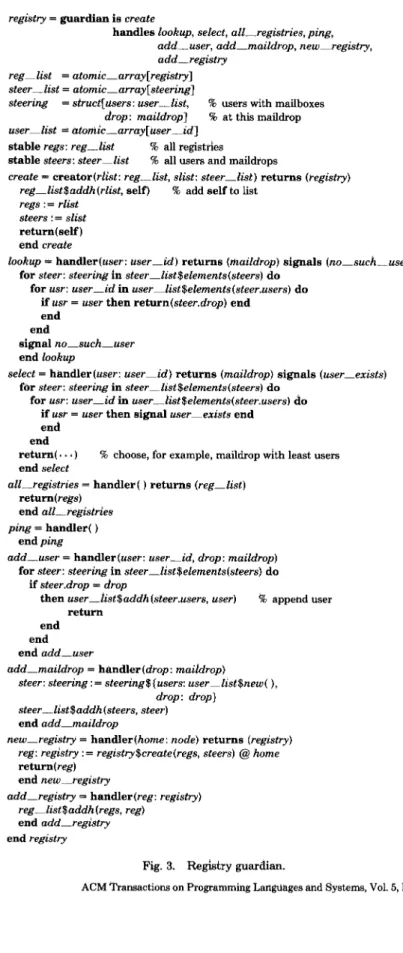
Figure 3 shows the registry guardian. T h e state of a registry consists of an atomic array of registries together with a steering list associating an array of users with each maildrop. W h e n a registry is created, it is given the current steering list and an array of all other registries, to which array it adds itself. T h e
lookup handler uses linear search to find the given user's maildrop, T h e select
handler uses linear search to check if a user already exists, and then chooses some existing maildrop. T h e a d d user handler uses linear search to find the specified maildrop and then appends the user to the associated user list. T h e
add user, a d d ~ m a i l d r o p , and a d d ~ r e g i s t r y handlers perform no error check- ing because correctness is guaranteed by the mailer guardian.
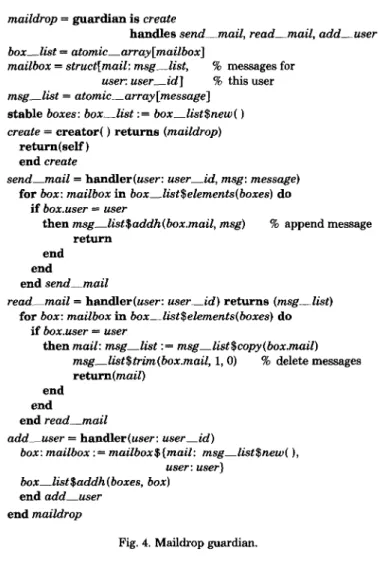
T h e maildrop guardian is given in Figure 4. T h e state of a maildrop consists of an atomic array of mailboxes; a mailbox is represented by a struct containing a u s e r _ i d and an atomic array of messages. A maildrop is created with no mailboxes. T h e a d d _ u s e r handler is used to add a mailbox. Note that this handler does not check to see if the user already exists since the mailer will have already performed this check. T h e s e n d ~ r n a i l and read__mail handlers use linear search to find the correct mailbox. When the mailbox is found, send__mail appends a message to the end of the message array; read m a i l first copies the array, then deletes all messages, and, finally, returns the copy. Both handlers assume the user exists; again, the mailer guarantees this.
Now that we have all of the pieces of the mail system, we can show how the initial configuration of the mail system is created:
reg: registry :-- registry$create(reg list$new( ), steer~list$new( )) @ homel m: mailer :ffi mailer$create(reg) @ home2
where reg list and s t e e r ~ l i s t are defined as in the registry. T h e resulting mailer can then be placed in the catalog and used to add maildrops and users, as well as more registries and mailers.
Finally, we show a simple use of the mail system, namely, sending a message to a group of users, with the constraint t h a t the message be delivered either to all of the users or to none of them:
enter action coenter
action foreach user: user__id in user~group("net") m. send__mail(user, msg)
end except w h e n no__such__user, failure(*): % ignore failure string abort leave
end end
G u a r d i a n s a n d A c t i o n s • 3 9 9
registry = g u a r d i a n is create
h a n d l e s lookup, select, all__registries, ping, a d d user, add__maildrop, new registry, add__registry
reg list = atomic__array[registry] s t e e r _ l i s t = atomic__array[steering]
steering = struct[Users: user__list, % users with mailboxes
drop: maildrop] % at this mafldrop
user list -- atomic__array[user__id]
stable regs: reg list % all registries
s t a b l e steers: steer list % all users and maildrops
create ffi creator(rlist: reg__list, slist: s t e e r _ l i s t ) r e t u r n s (registry) reg_list$addh(rlist, self) % add self to list
regs := rlist steers '.= Mist
r e t u r n ( s e l f )
end create
lookup = handier(user: u s e r _ i d ) r e t u r n s (maildrop) s i g n a l s (no__such_user)
for steer: steering in steer__list$elernents(steers) do for usr: u s e r _ i d in user list$elements(steer.users) do
if usr = user t h e n return(steer.drop) e n d end
e n d
s i g n a l n o _ s u c h _ _ u s e r
end lookup
select = handier(user: u s e r _ i d ) r e t u r n s (rnaildrop) s i g n a l s (user__exists)
for steer: steering in steer list$elernents(steers) do for usr: User__id in user__list$elernents(steer.users) do
if usr = user t h e n s i g n a l user exists e n d e n d
e n d
r e t u r n ( . . , ) % choose, for example, maildrop with least users
e n d select
all_registries = h a n d l e r ( ) r e t u r n s (reg list) return(regs)
end all__registries ping = h a n d l e r ( )
end ping
add__user = handler(user: user__id, drop: maildrop)
for steer: steering in steer__list$elernents(steers) do if steer.drop = drop
t h e n user__iist$addh(steer.users, user) % append user r e t u r n
e n d end end a d d _ u s e r
a d d _ r n a i l d r o p = h a n d l e r ( d r o p : rnaiMrop)
steer: steering := steering$ {users: user list$new( ), drop: drop}
steer__list$addh(steers, steer)
end a d d _ m a i l d r o p
n e w _ r e g i s t r y = h a n d l e r ( h o m e : node) r e t u r n s (registry) reg: registry := registry$create(regs, steers) @ home return(reg) end n e w _ r e g i s t r y a d d _ r e g i s t r y = handier(reg: registry) reg_list$addh(regs, reg) e n d add registry end registry
Fig. 3. Registry guardian.
4 0 0 • B. Liskov and R. Scheifler m a i l d r o p = g u a r d i a n is create h a n d l e s s e n d _ m a i l , r e a d _mail, a d d u s e r b o x _ l i s t = a t o m i c _ _ a r r a y [ m a i l b o x ] m a i l b o x = struct[mail: m s g _ l i s t , % m e s s a g e s for user. u s e r _ _ i d ] % t h i s u s e r m s g list = a t o m i c _ _ a r r a y [ m e s s a g e ]
stable boxes: box__list : = b o x _ _ l i s t $ n e w ( )
create = creator( ) r e t u r n s ( m a i l d r o p ) r e t u r n ( s e l f ) e n d create s e n d _ m a i l = h a n d l e r ( u s e r : user__id, msg: m e s s a g e ) for box: m a i l b o x i n b o x _ _ l i s t $ e l e m e n t s ( b o x e s ) do i f box.user = u s e r t h e n m s g _ l i s t $ a d d h ( b o x . m a i l , msg) % append message r e t u r n e n d e n d e n d s e n d _ m a i l r e a d _ _ m a i l ffi h a n d l e r ( u s e r : u s e r _ _ i d ) r e t u r n s (msg list) for box: m a i l b o x in b o x _ _ l i s t $ e l e m e n t s ( b o x e s ) do f f box.user = u s e r t h e n mail: m s g list :-- m s g _ l i s t $ c o p y ( b o x . m a i l ) m s g l i s t $ t r i m ( b o x . m a i l , 1, O) % delete m e s s a g e s r e t u r n ( m a i l ) e n d e n d e n d r e a d _ _ m a i l a d d _ _ u s e r = h a n d l e r ( u s e r : u s e r _ _ i d ) box: m a i l b o x : = m a i l b o x $ ( m a i l : m s g _ _ l i s t $ n e w (), user: user] b o x _ _ l i s t $ a d d h ( b o x e s , box) e n d a d d u s e r e n d m a i l d r o p
Fig. 4. Maildrop guardian.
The message is sent to all users simultaneously. A nonexistent user or a failure to send a message transfers control outside the c o e n t e r , forcing termination of all active coarms; the outer action is then aborted, guaranteeing that none of the messages is actually delivered.
4.1 Remarks
One obvious problem with the mailers as implemented is that, if the best registry for a mailer goes down, the mailer effectively goes down as well, since every task the mailer performs (including choosing a new best registry) requires communi- cation with that registry. A better implementation might be for each mailer to have stable and volatile references to multiple registries, and for mailer handlers to try several registries (sequentially) before giving up.
Close examination of the mail system reveals places where the particular choice of data representation leads to less concurrency than might be expected. For example, in the maildrop guardian, since both send__mail and read__mail
modify the message array in a mailbox, either operation will lock out all other ACM Transactions on Programming Languages and Systems, Vol. 5, No. 3, July 1983.