Technologists for the southern African Mining
Industry through Contact Offering and Alignment
with Polytechnic* Objectives.
* University of Science and Technology
A.W. Dougall and S.M. Rupprecht, University of Johannesburg (UJ), South Africa
Regional Meeting & Conference – SOMP 2015 Windhoek Namibia.
Abstract
The Higher Education offerings dealing with the development of technicians and technologists are in a state of flux. Change is immanent and by 2017 the current Technician / Technologist qualification dispensation will evolve to the Bachelor of Engineering Technology and Bachelor of Engineering Technology Honours programmes.
Professional Engineering development will take place at Science programme based institutions such as the traditional universities and also at the institution deemed to be a comprehensive university in the South African Higher Education arena. A comprehensive university may be seen as a mix between the University of Technology and the traditional academic programmes offered by traditional Universities.
The University of Johannesburg mining department has the mission to instil competence and confidence in young mining technicians, technologists, engineers and managers. The current programmes consist of the three year National Diploma in Mining Engineering (339-1) and the post diploma one year Bachelor of Technology in Mining Engineering (619-1). In reality the focus is and should be on developing Technologists.
The paper looks at the qualifications mix of the UJ Mining Department and its required niche in the southern African mining environment and educational pathways in the next era commencing 2017. It takes a route
different to the other three mining offerings in South Africa and focuses on largely attaining professional registration of the technologist with the Engineering Council of South Africa (ECSA) and if it continues, the Government Certificate of Competency.
Research and course work combination offerings or purely research offerings become more important to UJ Mining and these will be accommodated in the new dispensation through Honours, M Phil and D Phil post graduate offerings, in mining operations and its sub disciplines of rock engineering, ventilation, risk management, and mine planning in the areas of metalliferous, coal and surface mining including quarrying specialisations. The change could well deliver desired effectiveness and efficiency and not just be a function of political objectives.
Keywords: Educational pathways, Higher Education Qualifications Sub Framework (HEQSF), Professional registration, Mining programme and qualification mix (PQM).
Introduction
The existing programmes offered by the mining department at the University of Johannesburg (namely the ND Mining and the BTech (Mining Engineering)) has been stable for many years and have served the southern African mining industry with distinction. As is expected by other authors once a programme has been introduced, it may be offered for many years if it is properly resourced and continues to fulfil its purpose. Each programme may consist of a number of theoretical, practical/laboratory, and work-integrated learning (WIL) or experiential learning modules to ensure a purposeful and structured set of learning experiences that lead to a qualification.
At the University of Johannesburg (UJ) this is achieved through contact learning face to face instruction following a traditional pedagogy.
The content of such modules may, be updated and adjusted as a result of changing industry and student needs, government perceptions and objectives and evolving bodies of knowledge. Sometimes certain modules may be replaced by others. There is even significant agreement and collaboration between the four major mining universities in South Africa and indeed Southern Africa which allows niche offering focus. The needs of the South African Mining Industry and its strategists are almost paramount.
Nel (2014) rightly remarked, “Programmes are therefore updated from time to time in an incremental way; one programme seldom replaces another completely. The planning, development, implementation, and phasing out of educational programmes are often done over a time frame measured in years and may be triggered by evolving political ideologies”.
UJ and its founding member institution, Technikon Witwatersrand (TWR) has evolved the programmes over many decades. This is further illustrated by McGrath and Nicola (2008, p. 108) who provided a brief overview of the evolution of ‘T’ and ‘S’ level courses at South African technikons*, starting in the 1970s and may be considered the generic
model.
A technikon is paralleled to a polytechnic institute*. The National Diploma for Technicians (NDT Coal, NDT Metalliferous) and later National Higher Diploma (NHD Metalliferous, NHD Coal, NHD Surface Mine Management, NHD Rock Mechanics) served industry well under the former political dispensation prior to full democracy of the new South Africa post 1994. The South African government merged its founding institutions, the 80 year old TWR and the fifty year old Rand Africans University (RAU) along with a much younger Vista University (VISTA) to form the current University of Johannesburg in 2005.
Its original mining offerings were in the form of the ND Mining (339-1) and the B Tech Mining Engineering (619-1). It should be known that these are still the current offerings probably until 2017 and the pipeline phasing out until 2021. “BTech” is an acronym for Bachelor of Technology. Now 10 years after the merger UJ is adopting the latest proposals of ECSA to present the Bachelor of Engineering Technology (BEngTech) which is a 3 year offering but with the nearly the same (slightly recurriculised) module content on the remaining twenty two modules of the ND and the eight modules of the BTech . The “experiential component” , P1 and P2, which in the current ND and BTech combination had a two semester duration during the ND stage, and is now eliminated in the new BTechEng structure and passed to the stage two post academic qualification phase. Currently the BTech is completed with a further year contact tuition and eight module assessments but falls away with the new dispensation.
The BEngTech (BET) is undergoing curriculisation with modules being rationalised from that of the BTech and ND combination. This is a definite improvement but the author is still concerned about the potential pedagogical impact of the eliminated WIL i.e. work integrated learning in the BEngTech. WIL or Experiential modules are removed from the stage one qualification (academic phase) for various valid reasons such as increased student numbers who desire to study mining engineering qualifications in South Africa, risk assurance by the
companies, and altered industry entrance or employment philosophy based on supply and demand, and student aspirations for their future careers, completion on student quality and numerous other factors.
Access requirements are filtered by matriculation APS scores which for UJ mining is set at 25 and needed minimum matric symbols in Mathematics and Physical Science of 60% (South African Structure of symbol 5 and more) and English of 50% (symbol 4) and or mining company support, whose students should meet minimum access requirements.
The Higher Education Qualifications
Framework
Nel noted that “The introduction of the Higher Education Qualifications Framework (HEQF) and the updated Higher Education Qualifications Sub-Framework (HEQSF) calls for a strategic response on the part of South African university departments, especially those whose status has changed following mergers. In some cases the HEQSF provides for qualifications similar to the existing ones, but excludes the existing BTech degree, which is currently offered only by universities of technology (UoTs) and comprehensive universities (CUs)” Nel (2014) and this author agrees with this analysis.
The four year B Tech is replaced by the three year BEngTech as the experiential learning is transferred to the intern stage two post academic phase. A seed for much debate in the South African education environment.
Other authors, including Nel and also Van Niekerk also Knottenbelt, have correctly noted firstly, that “the BEngTech is a new qualification that did not exist previously. These changes have implications for the PQMs of universities, especially CUs and UoTs. It raises the important question of how the different South African universities must
respond appropriately to the HEQSF and possibly rethink and adjust their pre-HEQSF PQMs so that they are aligned with the HEQSF. The problem of how to decide on a new mining engineering PQM at a university is related to the more general problem that all businesses and most other (non-profit) organisations face as well, namely that of deciding which products and services to offer and how to adjust these from time to time in order to stay relevant in a changing business environment. A number of factors have to be considered when this problem is analysed and universities have to make a number of informed strategic choices in order to get to the answer. It is argued that a fairly structured methodology can be followed to decide on a university department’s PQM”. In South Africa there are four universities that are well established in the offering of mining-related programmes, namely the University of the Witwatersrand (Wits), the University of Pretoria (UP), the University of Johannesburg (UJ), and the University of South Africa (UNISA). The last two are comprehensive universities. Of the four universities mentioned, three are contact institutions, of which UJ forms part and UNISA is currently the only dedicated distance learning institution.
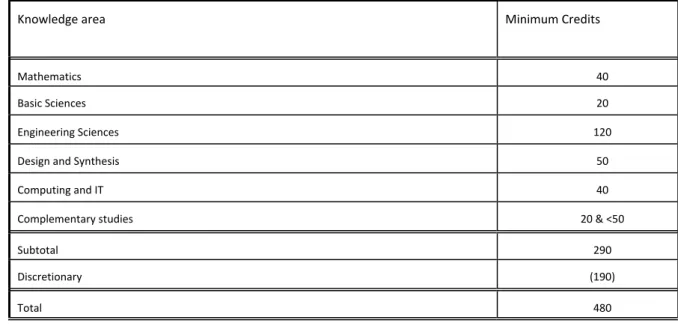
Table 1 BTech including ND minimum credits as per ECSA standard
Knowledge area Minimum Credits
Mathematics 40
Basic Sciences 20
Engineering Sciences 120
Design and Synthesis 50
Computing and IT 40
Complementary studies 20 & <50
Subtotal 290
Discretionary (190)
Total 480
Table 2 Qualification exit level outcomes
The ten exit level outcomes for diploma-type programmes are listed below for information only. The outcomes are similar for the other programmes but differ in the crux of complex, broadly-defined (B Tech) and well-defined (ND) problems.
Exit Level Outcome
ELO1: Problem solving: Apply engineering principles to systematically diagnose and solve well-defined or broadly defined engineering problems.
ELO2: Application of scientific and engineering knowledge: Demonstrate competence to apply knowledge of mathematics, natural science and engineering sciences to defined and applied engineering procedures, processes, systems and methodologies to solve well-defined/broadly defined engineering problems.
ELO3: Engineering Design: Demonstrate competence to perform procedural and non-procedural design of well-defined /broadly well-defined components, systems, works, products or processes to meet desired needs within applicable standards, codes of practice and legislation. .
ELO4: Investigations, experiments and data analysis: Conduct investigations of well-defined problems; locate and search relevant data from codes, catalogues, data bases and literature to conduct tests and measurements and design and conduct experiments to provide valid conclusions. .
ELO5: Engineering methods, skills and tools, including Information Technology: Demonstrate competence to use appropriate techniques, resources, and modern engineering tools, including basic information technology and prediction methodologies for the solution of well-defined engineering problems, with an understanding of the limitations, restrictions, premises, assumptions and constraints
ELO6: Professional and technical communication: Demonstrate competence to communicate effectively, both orally and in writing, with engineering audiences.
ELO7: Impact of Engineering activity: Demonstrate knowledge and under-standing of the impact of engineering activity on the society, economy, industrial and physical environment, and address issues by defined procedures.
ELO8: Individual and team work: Demonstrate knowledge and understanding of engineering management principles and apply these to one’s own work, as a member and leader in a technical team to and manage projects.
ELO 9: Independent learning ability: Demonstrate competence to engage in independent and life-long learning through well-developed learning skills.
ELO10: Engineering Professionalism: Understand and commit to professional ethics, responsibilities and norms of engineering technical practice.
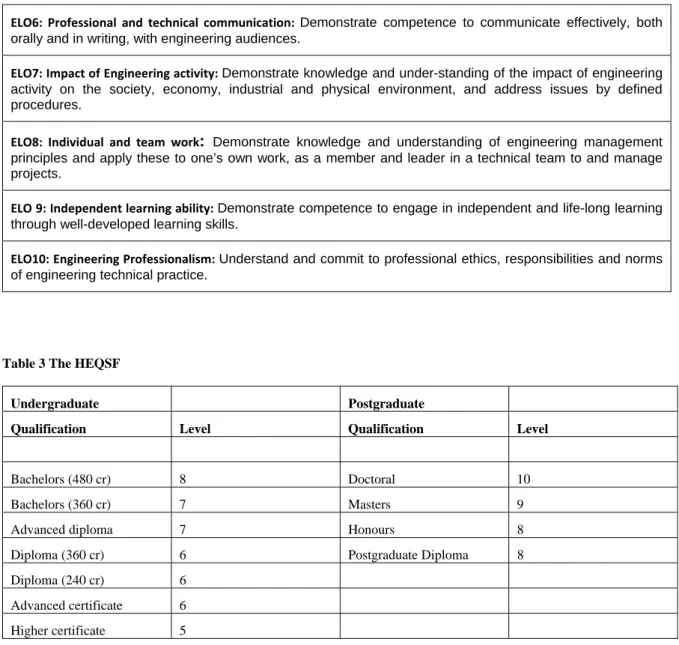
Table 3 The HEQSF
Undergraduate Postgraduate
Qualification Level Qualification Level
Bachelors (480 cr) 8 Doctoral 10
Bachelors (360 cr) 7 Masters 9
Advanced diploma 7 Honours 8
Diploma (360 cr) 6 Postgraduate Diploma 8 Diploma (240 cr) 6
Advanced certificate 6 Higher certificate 5
Former Minister of Education, Kadar Asmal introduced a restructuring process in South African higher education in the early 2000s, the implementation and consequences of which continued for many years thereafter. Prior to 2004, Universities of Technology (UoTs) were called Technikons*, whereas Comprehensive Universities (CUs) are merged institutions that consist of at least one former Technikon and a traditional, academic University. Due to already established capabilities, CUs may therefore be in a position to offer both traditional academic and vocation-based, UoT-type programmes and in all likeliness Quality Council for Trades and
Occupations (QCTO) type qualifications. In the higher education framework these should be at level 5 or higher but a need exists to accommodate appropriate level 4 qualifications at certificate level. This is the topic of another needed paper.
The mergers were followed by the introduction of the Higher Education Qualifications Framework (HEQF) in 2007 and its recently updated version, the Higher Education Qualifications Sub-Framework (HEQSF) in 2013. It was soon clear that this would have a significant impact on the types of programmes offered by UoTs and CUs.
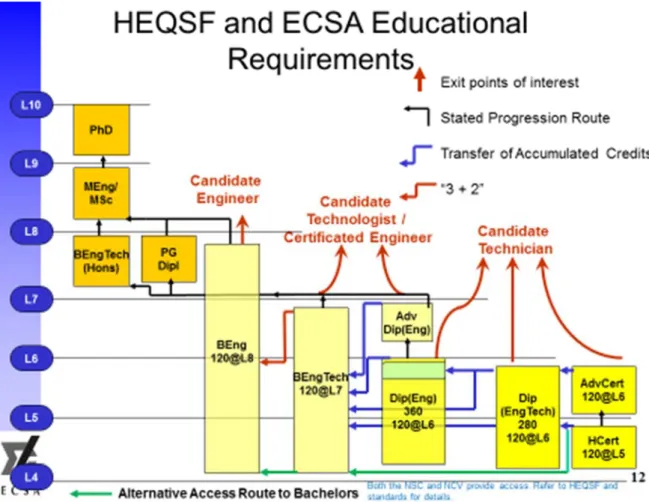
Figure 1 The HEQSF and ECSA educational requirements and progression (after ECSA)
The South African Education
Restructuring
The former Technikons offered cooperative education, meaning that the educational institution and industry cooperated to provide a joint educational programme or the educational institution at least consulted with industry when syllabuses were developed and updated. Many of these programmes are still in place – they now have to be replaced by programmes that will be aligned with the new HEQSF. Some of the learning programmes (LPs) include workplace-based work integrated learning (WIL), which means that students have to be employed by industry or placed in industry for some part of the duration of their studies. It is UJs opinion that such programmes are more likely to produce students who are employable. The collaboration between industry and
universities may be continued by some UoTs and CUs for certain programmes, especially for vocation-based and QCTO programmes. The HEQF was gazetted by the South African Minister of Education in 2007 and is an integral part of the National Qualifications Framework (NQF). The updated version was published in 2013 and is now called the HEQSF. There are thirteen types of qualifications that form part of the HEQSF. Nel (2014) lists the total range of qualifications for which universities could develop programmes. The authors concur that the following questions can be raised regarding these qualifications:
“What are the relationships between the different qualifications? Are some prerequisites for others, thus making them complementary? Is there any articulation between them? Are some substitutes for others?
Must all of these be offered by a university for each field of study? For example, must all thirteen of these be offered in the rock engineering field of study?
What are the characteristics and purpose of each type of qualification? Which of these are required for registration with the Engineering Council of South Africa (ECSA) for the categories of professional engineer, technologist, certificated engineer, and technician?” (Nel. W.J. 2014).
Most of the questions are answered by the HEQSF. It indicates, for example, that the higher certificate is a prerequisite for the advanced certificate (HEQSF, 2013, p. 23). The second question is to explain a method for deciding which mining-engineering programmes are to be maintained, modified or implemented at UJ.
The HEQSF is one of three sub-frameworks. The other two are the General and Further Education and Training Sub-Framework (GFETSF) and the Occupational Qualifications Sub-Framework (OQSF) managed by the Quality Council for Trades and Occupations (QCTO). The HEQSF provides for 13 qualifications at NQF levels 5 to 10 while the GFETSF does so for levels 1 to 4 and some overlap at level 5 only. The OQSF spans NQF levels 1 to 10 (Van Niekerk, 2013, pp. 3–4). This paper does not consider how the PQM (the product offering) of a university department may be impacted on in future as a result of the NQF level overlap between the GFETSF and the HEQSF and the OQSF and the HEQSF. This author and his colleagues at UJ believe that needs to be addressed.
A PQM of a university, or university department for that matter, is a list, menu, or mix of approved programmes and qualifications that will be subsidised by the Department of Higher Education and Training (DHET). This implies that a university should be able to motivate its PQM decision to the DHET. PQM decision-making by a university include decisions to increase or decrease the list of learning programmes (LPs). The teaching-out of LPs may sometimes be necessary due to economic reasons and
reduced demand.
The University of Johannesburg mining department has the mission to instil competence and confidence in young mining technicians, technologists, engineers and managers. The programmes consisted of the three year National Diploma in Mining Engineering (339-1) and the post diploma one year Bachelor of Technology in Mining Engineering (619-1). In reality the focus is and should be on developing Technologists. The debate and consideration has been given to the need to compete at the level of professional engineer provision, however the strategy has been adopted to focus on the specific niche of technologist development in the new PQM mix for the mining department.
The UJ Mining tactic
Decisions regarding the PQM offered by a university department are strategic in nature and directly linked to the mission or the reason for the existence of such a department. The introduction of a new PQM has a long-term influence on teaching and research activities and provides direction to such activities was noted by Nel and rightfully the mission of a university is teaching and research. These are the basic functions and tasks assigned to them by society (Weihrich and Kroontz, 1993, pp. 67, 122).
Universities may emphasise one of the two activities more than the other. Most of the old technikons emphasised tuition and produced relatively few students with postgraduate qualifications. There is currently a greater focus on research at UJ than previously.
The history of the development (or evolution) of universities will probably shed some light on why some universities focus on both teaching and research. ‘Economy of scope’, a concept from the subject of economics, can however also be used to explain it. Economy of scope can be defined as the situation that arises when the cost of performing multiple business functions simultaneously prove more efficient than individually
my_of_scope.html). If the same staff and infrastructure, for example laboratories, at universities can be used for both teaching and research, then economy of scope will be achieved. This is not always the case, however, because research laboratories are often more advanced than the laboratories required to support undergraduate teaching. Some researchers may also not be optimally utilized when they have to offer vocational-based programmes if they did not follow such programmes themselves and if they had no exposure to industry (Nel, 2014).
The “White Paper for Post-school Education and Training” expresses the need for a greater focus on research and innovation, the building of research capacity, and the creation of more Master’s (NQF level 9) and PhD (NQF level 10) learners (DHET, 2013, pp. xiv, 33, 35). It is for this reason that UJ plans to adopt the ‘NQF L5-10’ pathway tool for PQM decision making. It will focus on The BEngTech and BEngTech (Honours) Masters and Doctorate pathway. And this differs from the pathway at the other main mining universities in South Africa or southern Africa.
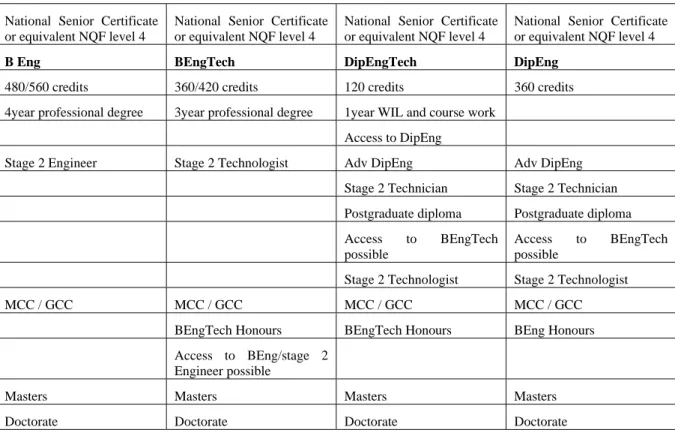
Table 4 illustrates four different pathways from the National Senior Certificate (NSC), the matriculation qualification, to PhD. The questions have been asked “Does this mean that a university should offer only one of the four pathways? If so, which one? What factors play a role in such a decision? These questions could be answered through attaining a niche offering in the different pathways in terms of meeting ECSA’s requirements for different types of professional registration and industry needs. In the authors opinion the progression listed in table 4 is possible. The differences will resort around internship periods and mentor assessments. Some debate around progression will result. A technologist should have a route to grow into engineer if so desired.
In the authors opinion the progression listed in table 4 is possible. The differences will resort around internship periods and mentor assessments. Some debate around progression will result. A technologist should have a route to grow into professional engineer if so desired.
Table 4 Probable Professional and GCC progression
National Senior Certificate or equivalent NQF level 4
National Senior Certificate or equivalent NQF level 4
National Senior Certificate or equivalent NQF level 4
National Senior Certificate or equivalent NQF level 4
B Eng BEngTech DipEngTech DipEng
480/560 credits 360/420 credits 120 credits 360 credits 4year professional degree 3year professional degree 1year WIL and course work
Access to DipEng
Stage 2 Engineer Stage 2 Technologist Adv DipEng Adv DipEng Stage 2 Technician Stage 2 Technician Postgraduate diploma Postgraduate diploma Access to BEngTech
possible
Access to BEngTech possible
Stage 2 Technologist Stage 2 Technologist
MCC / GCC MCC / GCC MCC / GCC MCC / GCC
BEngTech Honours BEngTech Honours BEng Honours Access to BEng/stage 2
Engineer possible
Masters Masters Masters Masters Doctorate Doctorate Doctorate Doctorate
PQM decision-making
In addition to the requirements stated in the HEQSF, many other factors, such as standards generated by the Engineering Standards Generating Body (ESGB) and subsequently approved by ECSA and the need to prepare students for various categories of professional registration with ECSA, preparing students for government certificates of competency (GCCs), market requirements, economic viability, path dependency, articulation between programmes, university type (e.g. comprehensive, research-intensive, or technology-focused), and the nature of the external environment also have to be considered when analysing and redesigning the PQMs of engineering-related programmes and or qualifications offered by universities. Many of the factors impacting on PQM decision-making can be identified and understood from well-documented literature on the strategic planning process, which includes components such as the analysis of the present internal and external environments
of an organisation; forecasting of, and scenarios regarding the future environment; and identification of external threats and opportunities and internal weaknesses and strengths (Weihrich and Kroontz, 1993, p. 171).
Nel has identified two fundamentally different views on PQM decision-making are briefly described next.
Natural Selection of programme design and choice, seven examples of qualifiers that may be used in mining-related qualification names to indicate fields of study are mining engineering, mine ventilation engineering, mine surveying, rock engineering, mineral economics, mining geology, and extraction metallurgy. This list is by no means comprehensive. In essence the client or industry decided which mix is needed as some qualifications may be oversubscribed and others starve economically and hence do not warrant independent existence. More information regarding the natural
selection view on the interaction between an organization and its environment is available in the literature – see, for example, Kast and Rosenzweig (1985, pp. 144-145). This approach would be extremely wasteful and the resources to implement such a diversity of qualifications are simply not available.
Implement programmes that
have proved feasible,
i
t is not necessary for a department to offer all thirteen programmes in a specific field of study to educate and develop students with a National Senior Certificate (NSC) to a level where they can make a significant contribution to research and new knowledge at PhD level (NQF level 10). It is illustrated in another paper (Nel, 2014a) that any one of four main pathways can be used to develop a person to NQF level 10 (Figure 1). At the same time persons can also be developed to meet ECSA’s academic requirement for at least one category of registration. Collectively, the four South African universities previously mentioned may offer a wide variety of programmes in specific mining-related fields.The UJ strategy
The PQM of each university must be accredited by the Council for Higher Education (CHE). This means that CHE criteria for programme accreditation must be considered when compiling a PQM.
Programme development at UJ should require that a feasibility study be undertaken before a new programme is introduced. When undertaking such a feasibility study, the following questions should be answered to determine viability:
Is there a social and/or economic need for the qualification?
Will there be sufficient students?
Will the institution have sufficient resources to offer the qualification to the envisaged number of students, including any special services that might have to be offered?
However, all the factors that may affect programmes may not allow the addressing of unique needs of a specific industry.
The following factors impact on the PQM decision making process:
The demand and supply of programmes
Economics
Path dependence
Type of university
Contact learning.
The Demand
Decisions about which products and services to offer are very important for success in the private sector. For a university it is, however, just as important to make the right decision regarding the products and services to offer. Some of the questions that a university department should ask themselves are as follows (adapted from Weihrich and Kroontz, 1993, p. 179):
What does society, specifically students and industry, want from universities and UJ specifically?
What advantages does UJ have in servicing societal needs?
What segment of the market should UJ focus on? (Relative to other universities also offering programmes in mining engineering).
“The need for mining education is driven by a complex work environment that requires the input of various types of supervisors, foremen, managers, technicians, technologists, and engineers. This ensures a productive, safe, and viable mining operation that achieves the triple-P bottom line, namely profit (economic feasibility), people (a healthy and motivated workforce), and planet (environmental sustainability)” (Nel 2014).
The consumers of mining programmes are students who wish to pursue a career in mining, as well as mining companies who want to send people with potential and talent to universities. The demand for such programmes and qualifications depends on how useful they are to the minerals industry and the availability or scarcity of qualified people.
The Supply
The current PQMs of the four established university providers of mining programmes are published in their yearbooks, calendars, and brochures. At undergraduate level the universities of the Witwatersrand and Pretoria focus predominantly on the BSc (Eng.) and BEng degrees respectively. The PQM-related question is: ’Should UJ offer such a four-year Bachelor’s degree in Mining Engineering?’ UJ needs to focus on a specific niche such as technologist development. This author concurs with Nel in that “It is important to consider the programmes offered by other universities because unnecessary duplication will affect economic viability”.
Economics
Economic viability is one of the most important factors to be considered when a new business, project or programme is planned. Many educational products and services can be classified as ‘merit goods’ and in South Africa are therefore subsidised by government. Having adequate human resources to engage in a university’s main activities of tuition, research, community engagement, and academic citizenship is critical to ensure success and quality. However, other resources such as offices, equipment, and laboratories are also important. Lecturers should preferably have had a minimum amount of workplace experience when they become involved with vocation-based programmes. This will ensure
that they can communicate with industry, determine industry’s educational needs, and implement programmes that will produce employable graduates.
Student numbers and research outputs play an important role in the number of ‘Full Time Equivalent’ staff members allocated to a department. If an undergraduate programme is approved and introduced, but attracts only low student numbers, it will severely affect staffing numbers, staff workload, quality, and the continued existence of such a programme. Therefore, the ‘staffing efficiency referred to as a staffing credit at some universities is likely to generate from the new PQM must be considered, because this is a measure of economic viability. In reality the department needs to consider it contribution account to the institution.
In 2003 an attempt was made to ensure greater economy of scale and scope in tertiary mining education. A proposal for the creation of one national school of mines was investigated and a business plan was formulated. The plan was, however, not implemented (Knottenbelt et al., 2003). A holistic evaluation of a number of programmes and factors is required when deciding on a PQM. Such an approach can also be described as a ‘general equilibrium approach’ in the language of the economist. General equilibrium analysis states that the price or quantity adjustment in one market is influenced by price and quantity adjustments in related markets
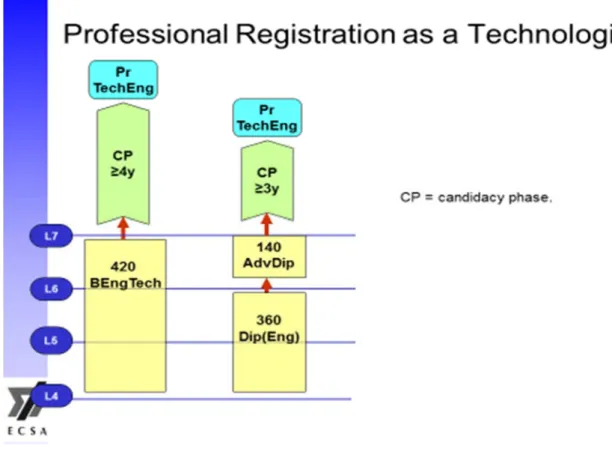
Figure 2 Professional Technologist registration (After ECSA)
History
One of the factors that play a role when deciding on a future programme mix is the history of the institution that is offering the PQM. Each institution’s strengths and niches were developed over long periods of time. It usually takes a number of years to develop research capacity and also the focus on Mine Manager’s Competency issues. For this and a number of other reasons, the future programme offering and mode of delivery is path-dependent to a large degree. Path dependence limits the potential activities of an organisation and this can be used to predict, to some extent, the path that it may remain on in future (Bruggeman, 2002, p. 416). History does matter, and to break away from historic pathways may require great investments. The “new” UJ is a comprehensive university, a merger of an academic university and a technikon. The “old” TWR operated as Faculty of Mining and Metallurgy and not necessarily as part of a Faculty of Engineering. This influence accreditation requirements and standards such as Exit Level Outcomes. For UJ Mining to break away from a past where it offered vocational, technikon-type programmes
only to become one where it offers a range of programmes that may be expected of a comprehensive university requires investment in human and physical capital (e.g. laboratories). Experienced Mine Managers now need to become more academic and higher degree focused something that is considered counter-productive in some circles.
To introduce programmes at NQF levels 8 and higher and in fields such as mine ventilation and rock mechanics will require more resources and effort.
At UJ, the Department of Mining Engineering’s path dependency is also entrenched to some extent due to its existing student body. A route for what may be lower qualifying entrance criteria or historically disadvantaged candidates also needs to be considered.
Research-intensive universities tend to focus on higher NQF-level qualifications, often associated with research because that helps them to maximize research outputs such as the number of papers published in journals. Consequently, such universities may not be interested in offering mining-related 3-year
bachelor’s degrees, diplomas, higher certificates, and advanced certificates (Nel 2014) and this author concurs.
Miscellaneous: various other factors
affecting the PQM decision
Numerous other factors may impact on the Mining Engineering PQM decision, a few of which are briefly mentioned:
Legislative and policy environment: the HEQSF; legal appointments in terms of the Mine Health and Safety Act and ensuring that enough qualified people are available for such
appointments; ECSA requirements and skills required to do engineering work
Technological environment: open educational resources (OERs); various technologies that facilitate e-learning and distance learning
The strengths and weaknesses of a specific university department or school and the opportunities and threats in the external environment brought about by, for example, changes in legislation and technology
The collective capacity of mining companies to provide students with opportunities to do WIL.
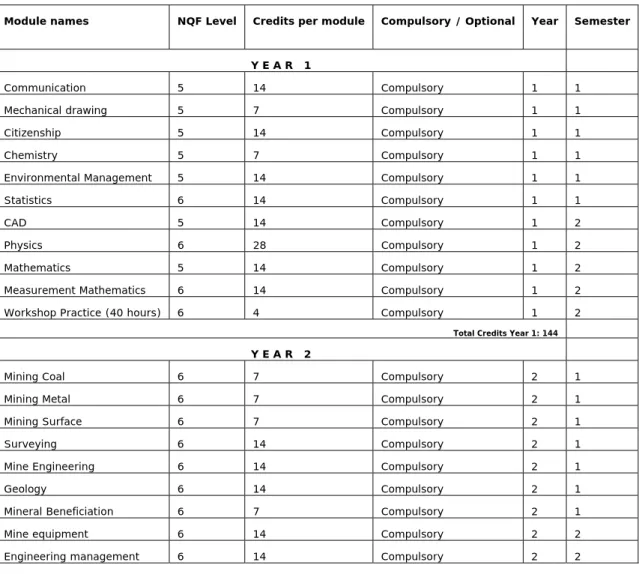
Table 5 Bachelor of Engineering Technology Programme Design
Module names NQF Level Credits per module Compulsory / Optional Year Semester
Y E A R 1
Communication 5 14 Compulsory 1 1
Mechanical drawing 5 7 Compulsory 1 1
Citizenship 5 14 Compulsory 1 1
Chemistry 5 7 Compulsory 1 1
Environmental Management 5 14 Compulsory 1 1
Statistics 6 14 Compulsory 1 1
CAD 5 14 Compulsory 1 2
Physics 6 28 Compulsory 1 2
Mathematics 5 14 Compulsory 1 2
Measurement Mathematics 6 14 Compulsory 1 2
Workshop Practice (40 hours) 6 4 Compulsory 1 2
Total Credits Year 1: 144 Y E A R 2
Mining Coal 6 7 Compulsory 2 1
Mining Metal 6 7 Compulsory 2 1
Mining Surface 6 7 Compulsory 2 1
Surveying 6 14 Compulsory 2 1
Mine Engineering 6 14 Compulsory 2 1
Geology 6 14 Compulsory 2 1
Mineral Beneficiation 6 7 Compulsory 2 1
Mine equipment 6 14 Compulsory 2 2
Conclusion and the way forward
Decision-makers in mining departments at universities have to consider many factors when deciding on a PQM. Path dependency, limited resources (especially human resources), and the likely future student numbers per programme as a reasonable indication of (or proxy for) the economic viability of such programmes are some of the important factors to be considered.
The pathway of the BTechEng to PhD is proposed as the PQM in the field of Mining Engineering at UJ. The needs of Industry should be addressed. Implementing all the programmes that form part of this pathway will be a challenge given the current level of resources available.
PQM decision-making is a dynamic process. The product offering of a university department has to be revisited from time to time as the business environment in which it operates, changes.
Change is immanent and by 2017 the current Technician / Technologist qualification dispensation will evolve to the Bachelor of Engineering Technology and Bachelor of Engineering Technology Honours programmes.
Professional Engineering development will take place at Science programme based institutions such as the traditional universities
and also at the institution deemed to be a comprehensive university in the South African Higher Education arena. The implied change in the Engineering Faculty of the University of Johannesburg, could possibly see a drift from the intent to develop professional registerable candidates of the Technicians, Technologists and Engineers groups to only Technologists (Pr Tech Eng.) and (Pr Cert Eng.) for Certificated Engineers and Engineers (Pr. Eng).
The University of Johannesburg mining department has the mission to instil competence and confidence in young mining technicians, technologists, engineers and managers. In reality the focus is and should be on developing Technologists.
The challenges presented by offering experiential or work place learning to increased student numbers entering the higher education environment is one of the major drivers affecting the old programme qualifications at the University of Johannesburg.
Research and course work combination offerings or purely research offerings become more important to UJ Mining and these will be accommodated in the new dispensation through Honours, M Phil and D Phil post graduate offerings.
The change could well deliver desired effectiveness and efficiency and not just be a function of political objectives. UJ Mining is
Mining economics valuation 6 14 Compulsory 2 2
Structural Geology 6 14 Compulsory 2 2
Rock Mechanics 6 7 Compulsory 2 2
Ventilation 6 7 Compulsory 2 2
Total Credits Year 2: 140 Y E A R 3
Rock Mechanics 7 14 Compulsory 3 1
Ventilation 7 7 Compulsory 3 1
Mining 7 14 Compulsory 3 1
Engineering Management 7 7 Compulsory 3 1
Mine Planning and Design 7 14 Compulsory 3 1
Mining Legislation 7 14 Compulsory 3 1
Project (700 hours) 7 70 Compulsory 3 2
Total Credits Year 3: 140 TOTAL CREDITS = 424
aware of certain challenges with the new dispensation but believe it the way forward.
References
Bruggeman, D. 2002. NASA: a path-dependent organization. Technology in Society, vol. 24, no. 4. pp. 415–431.
Department of Education (ZAR). 2007. The Higher Education Qualifications Framework. Government Gazette 30353. 5 October 2007. Department of Higher Education and Training (ZAR) (DHET). 2013. White Paper for Post-school Education and Training: Building an Expanded, Effective and Integrated Post-School System. Government Printing Works, Pretoria.
Dougall, A.W. 2010 A Review of the Current and Expected Underground Coal Mining Methods and Profiles and an Evaluation of the Best Practices Associated with These. University of the Witwatersrand, Johannesburg, pp 13-27.
Higher Education Data Analyser (ZAR) (HEDA), 28 Sep 2011. IDSC, Potchefstroom, South Africa. Kamal, R. 2014.
Kast, F.E. and Rosenzweig, J.E. 1985. Organisation and Management: A Systems and Contingency Approach. 4th ed. McGraw-Hill, New York.
Knottenbelt, P., Lilford G., McKee D., Nel, W.P., Philips, H. and Wilson, D. 2003. Business plan for the formation of the South African School of Mines.
Lourens, J. 2012. Business and technology strategy. Management for Engineers, Technologists and Scientists, 3rd ed. Nel, W.P. (editor.). Juta, Cape Town.
McGrath, P. and Nicola, G. 2008. A new education framework and the impact on vocational qualifications offered by South African comprehensive universities and universities of technology. 2nd Ed.
Nel, W.P. 2014b. Tertiary mining-related education in open distance E-learning. Young Professionals 2014 Conference, Sandton, Gauteng, 26–30 June 2014. Extended abstracts, pp. 63-66.
Nel, W.P. 2014a. Universities and decision-making: programme and qualification mix – four learning pathways. Journal of the Southern African Institute of Mining and Metallurgy, May 2014.
Nel, W.P. 2014. Towards a Structured PQM decision-making approach: Rethinking the Mining Engineering PQM at an Open, Distance e-learning University. Society of Mining Professors Conference Proceedings 2014. Rupprecht, S.M. Dougall. A.W. 2015. The Young Engineer in a Recessive Economy, University of Johannesburg, South Africa.
The Higher Education Qualifications Framework (ZAR) (HEQF). Higher Education Act, No. 101 of 1997. Government Gazette 303533, Notice 928. 6 October 2007. Government Printing Works, Pretoria.
The Higher Education Qualifications Sub framework (ZAR) (HEQSF). 2013 (As Revised).
Van Niekerk, D. 2013. Engineering Qualifications and the Higher Education Qualifications Sub-Framework (HEQSF). Presentation at MQA SGB.
Weinrich, H. and Koontz, H. 1993. Management: A Global Perspective. 10th ed. McGraw-Hill, New York.