
Video Decoder and RGB Graphics Digitizer
Data Sheet
ADV7181C
Rev. E
Information furnished by Analog Devices is believed to be accurate and reliable. However, no
responsibility is assumed by Analog Devices for its use, nor for any infringements of patents or other One Technology Way, P.O. Box 9106, Norwood, MA 02062-9106, U.S.A.
FEATURES
Four 10-bit ADCs sampling up to 110 MHz 6 analog input channels
SCART fast blank support Internal antialias filters
NTSC, PAL, and SECAM color standards support 525p/625p component progressive scan support 720p/1080i component HDTV support
Digitizes RGB graphics up to 1024 × 768 at 70 Hz (XGA) 3 × 3 color space conversion matrix
Industrial temperature range: −40°C to +85°C
12-bit 4:4:4 DDR, 8-/10-/16-/20-bit SDR pixel output interface Programmable interrupt request output pin
Small package Low pin count
Single front end for video and graphics VBI data slicer (including teletext) Qualified for automotive applications
APPLICATIONS
Automotive entertainment HDTVs
LCD/DLP projectors HDTV STBs with PVR
DVD recorders with progressive scan input support AVR receivers
GENERAL DESCRIPTION
The ADV7181C is a high quality, single-chip, multiformat video decoder and graphics digitizer. This multiformat decoder supports the conversion of PAL, NTSC, and SECAM standards in the form of composite or S-Video into a digital ITU-R BT.656 format. The ADV7181C also supports the decoding of a component RGB/YPrPb video signal into a digital YCrCb or RGB pixel output stream. The support for component video includes standards such as 525i, 625i, 525p, 625p, 720p, 1080i, and many other HD and SMPTE standards. Graphics digitization is also supported by the ADV7181C; it is capable of digitizing RGB graphics signals from VGA to XGA rates and converting them into a digital DDR RGB or YCrCb pixel output stream. SCART and overlay functionality are enabled by the ability of the ADV7181C to process simultaneously CVBS and standard definition RGB signals. The mixing of these signals is controlled by the fast blank pin.
The ADV7181C contains two main processing sections. The first section is the standard definition processor (SDP), which processes all PAL, NTSC, and SECAM signal types. The second section is the component processor (CP), which processes YPrPb and RGB component formats, including RGB graphics. Note that the ADV7181C has unique software and hardware configuration requirements. See Page 19 of this data sheet for more information.
TABLE OF CONTENTS
Features ... 1
Applications ... 1
General Description ... 1
Revision History ... 2
Functional Block Diagram ... 3
Specifications ... 4
Electrical Characteristics ... 4
Video Specifications ... 5
Timing Characteristics ... 6
Analog Specifications ... 8
Absolute Maximum Ratings ... 9
Package Thermal Performance ... 9
Thermal Specifications ... 9
ESD Caution ... 9
Pin Configuration and Function Descriptions ... 10
Detailed Functionality ... 12
Analog Front End ... 12
SDP Pixel Data Output Modes ... 12
CP Pixel Data Output Modes ... 12
Composite and S-Video Processing ... 12
Component Video Processing ... 13
RGB Graphics Processing ... 13
General Features ... 13
Detailed Description ... 14
Analog Front End ... 14
Standard Definition Processor (SDP) ... 14
Component Processor (CP) ... 14
Analog Input Muxing ... 15
Pixel Output Formatting... 17
Recommended External Loop Filter Components ... 18
Typical Connection Diagram... 19
Outline Dimensions ... 20 Ordering Guide ... 20 Automotive Products ... 20
REVISION HISTORY
8/12—Rev. D to Rev. E Changes to Table 3 ... 6 Change to Figure 6 ... 10 5/12—Rev. C to Rev. D Changes to Features and General Description Sections ... 1Added Text to Typical Connection Diagram Section ... 19
Added Automotive Products Section... 20
12/09—Rev. B to Rev. C Changes to Product Title, Features Section, and General Description Section ... 1
Changes to Figure 1 ... 3
Changes to Power Requirements Parameter, Table 1 ... 4
Changes to System Clock and Crystal Parameter and Note 3, Table 3 ... 6
Deleted Note 3, Table 3; Renumbered Sequentially ... 6
Added Timing Diagrams Section ... 7
Changed AVDD = 3.1.5 V to 3.45 V to AVDD = 3.15 V to 3.45 V ... 8
Changes to Package Thermal Performance ... 9
Added Thermal Specifications Section... 9
Changes to SDP Pixel Data Output Modes Section ... 12
Changes to RGB Graphics Processing Section ... 13
Changes to Component Processor (CP) Section ... 14
Changes to Analog Input Muxing Section ... 15
4/09—Rev. A to Rev. B Changes to Package Thermal Performance Section ... 8
Changes to the Pin Configuration and Function Descriptions Section ... 9
Removed LFCSP_VQ Package ... 19
Changes to Ordering Guide ... 19
1/09—Rev. 0 to Rev. A Changes to Analog Supply Current Parameter, Table 1 ... 4
Changes to Package Thermal Performance Section ... 8
Deleted Thermal Specifications Section... 8
Added Pin 65 (EPAD) ... 10
Changes to Analog Input Muxing Section ... 15
Changes to Ordering Guide ... 20
FUNCTIONAL BLOCK DIAGRAM
INP UT M UX D AT A PR EPR O C ESSO R DE CI M A TION AND DO W NS AM P L ING FI L T E RS S T ANDARD DE F INI T IO N P RO CE S S O R L UM A FILTE R OUTP UT FIFO A ND FORM ATTE R AIN1 TO AIN 6 A D V 7181C SER IA L IN TE R F ACE CO NT RO L AND V BI D AT A S CL K SD AT A AL S B SYN C E X T RACT 20 HS /CS 10 10 PI XE L D AT A P 19 T O P 10 P9 T O P0 VS FIE LD /D E LLC SFL/ SY NCO UT CV BS S-VI D EO YPr Pb S CART – (RG B + CV BS ) G RAP HI CS RG B 6 CHRO M A FILTE R CHRO M A D EMO D FSC RE CO V E R Y INT L UM A R ESA MPL E L UM A 2D CO M B (5H M AX ) R ESA MPL E CO NT RO L CHRO M A R ESA MPL E CHRO M A 2D CO M B (4H M AX ) F AS T BL ANK O VER L A Y CO NT RO L AND A V CO DE IN S E R TION FB Y Cr Cb V BI D AT A RE CO V E R Y M A C R OV IS ION D E TE C TION S T ANDARD AU T OD E TE C TION CV BS /Y C Cb Cr Cb Y C OLOR S P ACE CO NV E RS IO N CV BS Cr C O MPO N EN T PR O C ESSO R SSPD S T DI SYN C PR O C ESSI N G AND CL O CK G E NE R A TION HS _I N/ CS _I N VS_ IN S OG/S O Y X T A L X T AL 1 D IGITA L FIN E CL AM P GA IN CO NT RO L OFFS E T CO NT RO L A V CO DE IN S E R TION 20 10 10 10 10 10 10 10 A C T IVE PEA K AND AG C M A C R OV IS ION D E TE C TION CG M S DAT A E X TR A C TION 10 ADC0 CL AM P ANT I-AL IAS FILTE R 10 ADC3 CL AM P ANT I-AL IAS FILTE R 10 ADC2 CL AM P ANT I-AL IAS FILTE R 10 ADC1 CL AM P ANT I-AL IAS FILTE R 07513-001 Figure 1.SPECIFICATIONS
ELECTRICAL CHARACTERISTICS
AVDD = 3.15 V to 3.45 V, DVDD = 1.65 V to 2.0 V, DVDDIO = 3.0 V to 3.6 V, PVDD = 1.71 V to 1.89 V, nominal input range 1.6 V. TMIN to TMAX = −40°C to +85°C, unless otherwise noted.
Table 1.
Parameter1, 2 Symbol Test Conditions Min Typ Max Unit
STATIC PERFORMANCE3, 4
Resolution (Each ADC) N 10 Bits
Integral Nonlinearity INL BSL at 27 MHz (10-bit level) ±0.6 ±2.5 LSB
BSL at 54 MHz (10-bit level) −0.6/+0.7 LSB
BSL at 74 MHz (10-bit level) ±1.4 LSB
BSL at 110 MHz (8-bit level) ±0.9 LSB
Differential Nonlinearity DNL At 27 MHz (10-bit level) −0.2/+0.25 −0.99/+2.5 LSB
At 54 MHz (10-bit level) −0.2/+0.25 LSB
At 74 MHz (10-bit level) ±0.9 LSB
At 110 MHz (8-bit level) −0.2/+1.5 LSB
DIGITAL INPUTS5
Input High Voltage6 VIH 2 V
HS_IN, VS_IN low trigger mode 0.7 V
Input Low Voltage7 VIL 0.8 V
HS_IN, VS_IN low trigger mode 0.3 V
Input Current IIN −10 +10 µA
Input Capacitance5 CIN 10 pF
DIGITAL OUTPUTS
Output High Voltage8 V
OH ISOURCE = 0.4 mA 2.4 V
Output Low Voltage8 VOL ISINK = 3.2 mA 0.4 V
High Impedance Leakage Current ILEAK Pin 1 60 µA
All other output pins 10 µA
Output Capacitance5 COUT 20 pF
POWER REQUIREMENTS5
Digital Core Power Supply DVDD 1.65 1.8 2 V
Digital I/O Power Supply DVDDIO 3.0 3.3 3.6 V
PLL Power Supply PVDD 1.71 1.8 1.89 V
Analog Power Supply AVDD 3.15 3.3 3.45 V
Digital Core Supply Current IDVDD CVBS input sampling at 54 MHz 105 mA
Graphics RGB sampling at 75 MHz 90 mA
SCART RGB FB sampling at 54 MHz 106 mA
Digital I/O Supply Current IDVDDIO CVBS input sampling at 54 MHz 4 mA
Graphics RGB sampling at 75 MHz 38 mA
PLL Supply Current IPVDD CVBS input sampling at 54 MHz 11 mA
Graphics RGB sampling at 75 MHz 12 mA
Analog Supply Current9 IAVDD CVBS input sampling at 54 MHz 99 mA
Graphics RGB sampling at 75 MHz 166 mA
SCART RGB FB sampling at 54 MHz 200 mA
Power-Down Current IPWRDN 2.25 mA
Green Mode Power-Down IPWRDNG Synchronization bypass function 16 mA
Power-Up Time TPWRUP 20 ms
1 The minimum/maximum specifications are guaranteed over this range.
2 All specifications are obtained using the Analog Devices, Inc., recommended programming scripts. 3 All ADC linearity tests performed at input range of full scale – 12.5%, and at zero scale + 12.5%. 4 Maximum INL and DNL specifications obtained with part configured for component video input. 5 Guaranteed by characterization.
6 To obtain specified V
IH level on Pin 22, program Register 0x13 (WO) with a value of 0x04. If Register 0x13 is programmed with a value of 0x00, then VIH on Pin 22 is 1.2 V. 7 To obtain specified V
IL level on Pin 22, program Register 0x13 (WO) with a value of 0x04. If Register 0x13 is programmed with a value of 0x00, then VIL on Pin 22 is 0.4 V.
8 V
OH and VOL levels obtained using default drive strength value (0xD5) in Register Subaddress 0xF4.
9 For CVBS current measurement only, ADC0 is powered up. For RGB current measurements only, ADC0, ADC1, and ADC2 are powered up. For SCART FB current
VIDEO SPECIFICATIONS
AVDD = 3.15 V to 3.45 V, DVDD = 1.65 V to 2.0 V, DVDDIO = 3.0 V to 3.6 V, PVDD = 1.71 V to 1.89 V. TMIN to TMAX = −40°C to +85°C,
unless otherwise noted.
Table 2.
Parameter1, 2 Symbol Test Conditions Min Typ Max Unit
NONLINEAR SPECIFICATIONS
Differential Phase DP CVBS input, modulated 5 step 0.5 Degrees
Differential Gain DG CVBS input, modulated 5 step 0.5 %
Luma Nonlinearity LNL CVBS input, 5 step 0.5 %
NOISE SPECIFICATIONS
SNR Unweighted Luma ramp 54 56 dB
SNR Unweighted Luma flat field 58 60 dB
Analog Front-End Crosstalk 60 dB
LOCK TIME SPECIFICATIONS
Horizontal Lock Range −5 +5 %
Vertical Lock Range 40 70 Hz
fSC Subcarrier Lock Range ±1.3 kHz
Color Lock in Time 60 Lines
Sync Depth Range3 20 200 %
Color Burst Range 5 200 %
Vertical Lock Time 2 Fields
Horizontal Lock Time 100 Lines
CHROMA SPECIFICATIONS
Hue Accuracy HUE 1 Degrees
Color Saturation Accuracy CL_AC 1 %
Color AGC Range 5 400 %
Chroma Amplitude Error 0.5 %
Chroma Phase Error 0.4 Degrees
Chroma Luma Intermodulation 0.2 %
LUMA SPECIFICATIONS
Luma Brightness Accuracy CVBS, 1 V input 1 %
Luma Contrast Accuracy CVBS, 1 V input 1 %
1 The minimum/maximum specifications are guaranteed over this range. 2 Guaranteed by characterization.
TIMING CHARACTERISTICS
AVDD = 3.15 V to 3.45 V, DVDD = 1.65 V to 2.0 V, DVDDIO = 3.0 V to 3.6 V, PVDD = 1.71 V to 1.89 V. TMIN to TMAX = −40°C to +85°C,
unless otherwise noted.
Table 3.
Parameter1, 2 Symbol Test Conditions Min Typ Max Unit
SYSTEM CLOCK AND CRYSTAL
Crystal Nominal Frequency 28.63636 MHz
Crystal Frequency Stability ±50 ppm
Horizontal Sync Input Frequency 14.8 110 kHz
LLC Frequency Range 12.825 110 MHz
I2C PORT3
SCLK Frequency 400 kHz
SCLK Minimum Pulse Width High t1 0.6 µs
SCLK Minimum Pulse Width Low t2 1.3 µs
Hold Time (Start Condition) t3 0.6 µs
Setup Time (Start Condition) t4 0.6 µs
SDA Setup Time t5 100 ns
SCLK and SDA Rise Time t6 300 ns
SCLK and SDA Fall Time t7 300 ns
Setup Time for Stop Condition t8 0.6 µs
RESET FEATURE
Reset Pulse Width 5 ms
CLOCK OUTPUTS
LLC Mark Space Ratio t9:t10 45:55 55:45 % duty cycle
DATA AND CONTROL OUTPUTS
Data Output Transition Time SDR (SDP)4 t
11 Negative clock edge
to start of valid data 3.6 ns
Data Output Transition Time SDR (SDP)4 t
12 End of valid data to
negative clock edge
2.4 ns
Data Output Transition Time SDR (CP)5 t
13 End of valid data to
negative clock edge 2.8 ns
Data Output Transition Time SDR (CP)5 t
14 Negative clock edge
to start of valid data
0.1 ns
Data Output Transition Time DDR (CP)5, 6 t
15 Positive clock edge
to end of valid data 1.9 ns
Data Output Transition Time DDR (CP)5, 6 t
16 Start of valid data to
positive clock edge
1.7 ns
Data Output Transition Time DDR (CP)5, 6 t
17 Negative clock edge
to end of valid data 1.4 ns
Data Output Transition Time DDR (CP)5, 6 t
18 Start of valid data to
negative clock edge
1.7 ns
1 The minimum/maximum specifications are guaranteed over this range. 2 Guaranteed by characterization.
3 TTL input values are 0 V to 3 V, with rise/fall times of ≤3 ns, measured between the 10% and 90% points. 4 SDP timing figures obtained using default drive strength value (0xD5) in Register Subaddress 0xF4. 5 CP timing figures obtained using maximum drive strength value (0x3F) in Register Subaddress 0xF4. 6 Guaranteed by characterization up to 75 MHz pixel clock.
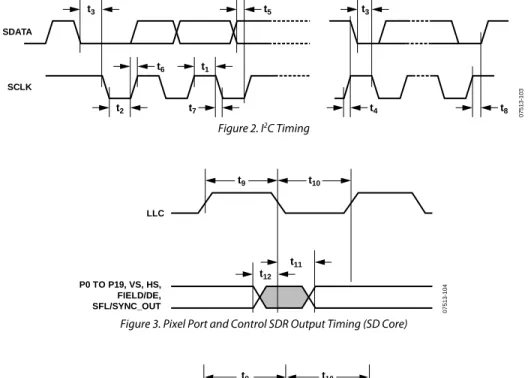
Timing Diagrams 07 51 3-10 3 SDATA SCLK t5 t3 t4 t8 t6 t7 t2 t1 t3 Figure 2. I2C Timing 0 75 13 -10 4 LLC P0 TO P19, VS, HS, FIELD/DE, SFL/SYNC_OUT t9 t10 t12 t11
Figure 3. Pixel Port and Control SDR Output Timing (SD Core)
07 51 3-10 5 t9 LLC P0 TO P19 t13 t14 t10
Figure 4. Pixel Port and Control SDR Output Timing (CP Core)
LLC P0 TO P19 t16 t18 t15 t17 05 34 0-0 06
ANALOG SPECIFICATIONS
AVDD = 3.15 V to 3.45 V, DVDD = 1.65 V to 2.0 V, DVDDIO = 3.0 V to 3.6 V, PVDD = 1.71 V to 1.89 V. TMIN to TMAX = −40°C to +85°C,
unless otherwise noted. Recommended analog input video signal range: 0.5 V to 1.6 V, typically 1 V p-p.
Table 4.
Parameter1, 2 Test Conditions Min Typ Max Unit
CLAMP CIRCUITRY
External Clamp Capacitor 0.1 µF
Input Impedance; Except Pin 34 (FB) Clamps switched off 10 MΩ
Input Impedance of Pin 34 (FB) 20 kΩ
CML 1.86 V
ADC Full-Scale Level CML + 0.8 V
ADC Zero-Scale level CML − 0.8 V
ADC Dynamic Range 1.6 V
Clamp Level (When Locked) CVBS input CML – 0.292 V
SCART RGB input (R, G, B signals) CML – 0.4 V
S-Video input (Y signal) CML – 0.292 V
S-Video input (C signal) CML – 0 V
Component input (Y, Pr, Pb signals) CML – 0.3 V
PC RGB input (R, G, B signals) CML – 0.3 V
Large Clamp Source Current SDP only 0.75 mA
Large Clamp Sink Current SDP only 0.9 mA
Fine Clamp Source Current SDP only 17 µA
Fine Clamp Sink Current SDP only 17 µA
1 The minimum/maximum specifications are guaranteed over this range. 2 Guaranteed by characterization.
ABSOLUTE MAXIMUM RATINGS
Table 5. Parameter Rating AVDD to AGND 4 V DVDD to DGND 2.2 V PVDD to AGND 2.2 V DVDDIO to DGND 4 V DVDDIO to AVDD −0.3 V to +0.3 V PVDD to DVDD −0.3 V to +0.3 V DVDDIO to PVDD −0.3 V to +2 V DVDDIO to DVDD −0.3 V to +2 V AVDD to PVDD −0.3 V to +2 V AVDD to DVDD −0.3 V to +2 VDigital Inputs Voltage to DGND DGND − 0.3 V to
DVDDIO + 0.3 V
Digital Outputs Voltage to DGND DGND − 0.3 V to
DVDDIO + 0.3 V
Analog Inputs to AGND AGND − 0.3 V to
AVDD + 0.3 V
Operating Temperature Range −40°C to +85°C
Maximum Junction Temperature (TJ MAX) 125°C
Storage Temperature Range −65°C to +150°C
Infrared Reflow, Soldering (20 sec) 260°C
Stresses above those listed under Absolute Maximum Ratings may cause permanent damage to the device. This is a stress rating only; functional operation of the device at these or any other conditions above those indicated in the operational section of this specification is not implied. Exposure to absolute maximum rating conditions for extended periods may affect device reliability.
PACKAGE THERMAL PERFORMANCE
To reduce power consumption when using the part, turn off any unused ADCs.
It is imperative that the recommended scripts be used for the following high current modes: SCART, 720p, 1080i, and all RGB graphic standards. Using the recommended scripts ensures correct thermal performance. These scripts are available from a local FAE.
The junction temperature must always stay below the maximum junction temperature (TJMAX) of 125°C. The junction temperature
can be calculated by
TJ = TA MAX + (θJA × WMAX)
where:
TA MAX = 85°C.
θJA = 45.5°C/W.
WMAX = ((AVDD × IAVDD) + (DVDD × IDVDD) +
(DVDDIO × IDVDDIO) + (PVDD × IPVDD)).
THERMAL SPECIFICATIONS
Table 6.
Parameter Test Conditions Value
Junction-to-Case Thermal Resistance, θJC
4-layer PCB with solid
ground plane 9.2°C/W typical Junction-to-Ambient
Thermal Resistance, θJA
4-layer PCB with solid ground plane (still air)
45.5°C/W typical
PIN CONFIGURATION AND FUNCTION DESCRIPTIONS
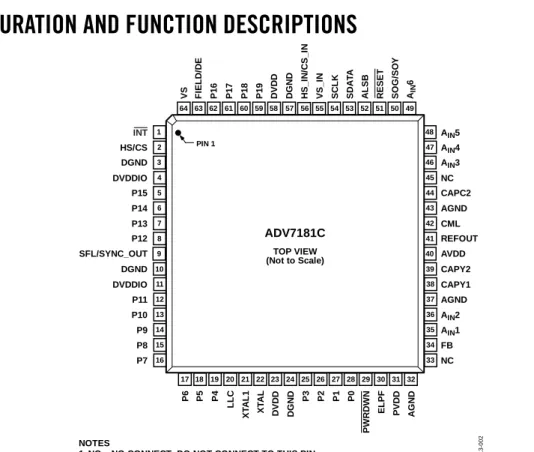
64 VS 63 FIE LD /D E 62 P 16 61 P 17 60 P 18 59 P 19 58 DV DD 57 DG ND 56 HS _I N/ CS _I N 55 VS_ IN 54 S CL K 53 SD AT A 52 AL S B 51 R ESET 50 S OG/S O Y 49 AIN 6 47 AIN4 46 AIN3 45 NC 42 CML 43 AGND 44 CAPC2 48 AIN5 41 REFOUT 40 AVDD 39 CAPY2 37 AGND 36 AIN2 35 AIN1 34 FB 33 NC 38 CAPY1 2 HS/CS 3 DGND 4 DVDDIO 7 P13 6 P14 5 P15 1 INT 8 P12 9 SFL/SYNC_OUT 10 DGND 12 P11 13 P10 14 P9 15 P8 16 P7 11 DVDDIO 17 P6 18 P5 19 P4 20 LLC 21 X T AL 1 22 X T A L 23 DV DD 24 DG ND 25 P3 26 P2 27 P1 28 P0 29 P W RDW N 30 EL PF 31 PVD D 32 AG ND PIN 1 ADV7181C TOP VIEW (Not to Scale) 07513-002 NOTES1. NC = NO CONNECT. DO NOT CONNECT TO THIS PIN.
Figure 6. Pin Configuration
Table 7. Pin Function Descriptions
Pin No. Mnemonic Type1 Description
1 INT O Interrupt. This pin can be active low or active high. When SDP/CP status bits
change, this pin is triggered. The set of events that triggers an interrupt is under user control.
2 HS/CS O HS: Horizontal Synchronization Output Signal (SDP and CP Modes).
CS: Digital Composite Synchronization Signal (CP Mode).
3, 10, 24, 57 DGND G Digital Ground.
4, 11 DVDDIO P Digital I/O Supply Voltage (3.3 V).
28 to 25, 19 to 12, 8 to 5,
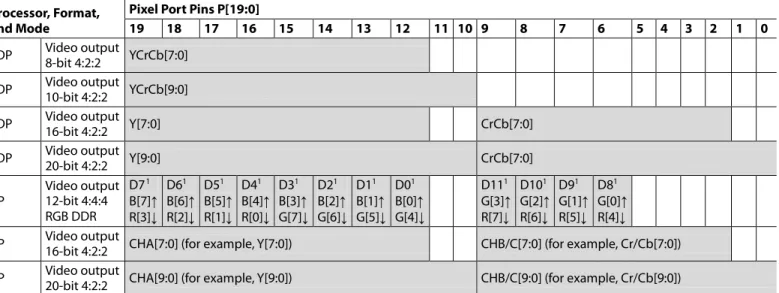
62 to 59 P0 to P19 O Video Pixel Output Port. Refer to Table 10 for output configuration modes.
9 SFL/SYNC_OUT O SFL: Subcarrier Frequency Lock. This pin contains a serial output stream that
can be used to lock the subcarrier frequency when this decoder is connected to any Analog Devices digital video encoder.
SYNC_OUT: Sliced Synchronization Output Signal Available Only in CP Mode.
20 LLC O Line-Locked Output Clock. This pin is for the pixel data (the range is
12.825 MHz to 110 MHz).
21 XTAL1 O This pin should be connected to the 28.63636 MHz crystal or left as a no connect
if an external 3.3 V, 28.63636 MHz clock oscillator source is used to clock the ADV7181C. In crystal mode, the crystal must be a fundamental crystal.
22 XTAL I Input pin for 28.63636 MHz crystal, or can be overdriven by an external 3.3 V,
28.63636 MHz clock oscillator source to clock the ADV7181C.
23, 58 DVDD P Digital Core Supply Voltage (1.8 V).
29 PWRDWN I A Logic 0 on this pin places the ADV7181C in a power-down mode.
30 ELPF O The recommended external loop filter must be connected to this ELPF pin.
31 PVDD P PLL Supply Voltage (1.8 V).
Pin No. Mnemonic Type1 Description
33, 45 NC No Connect. These pins are not connected internally.
34 FB I Fast Switch Overlay Input. This pin switches between CVBS and RGB analog signals.
35, 36, 46, 47, 48, 49 AIN1 to AIN6 I Analog Video Input Channels.
38, 39 CAPY1, CAPY2 I ADC Capacitor Network. See Figure 9 for a recommended capacitor network
for this pin.
40 AVDD P Analog Supply Voltage (3.3 V).
41 REFOUT O Internal Voltage Reference Output. See Figure 9 for a recommended capacitor
network for this pin.
42 CML O Common-Mode Level Pin (CML) for the Internal ADCs. See Figure 9 for a
recommended capacitor network for this pin.
44 CAPC2 I ADC Capacitor Network. See Figure 9 for a recommended capacitor network
for this pin.
50 SOG/SOY I Sync on Green/Sync on Luma Input. Used in embedded synchronization mode.
51 RESET I System Reset Input, Active Low. A minimum low reset pulse width of 5 ms
is required to reset the ADV7181C circuitry.
52 ALSB I This pin selects the I2C address for the ADV7181C control and VBI readback
ports. ALSB set to Logic 0 sets the address for a write to Control Port 0x40 and the readback address for VBI Port 0x21. ALSB set to a Logic 1 sets the address for a write to Control Port 0x42 and the readback address for VBI Port 0x23.
53 SDATA I/O I2C Port Serial Data Input/Output Pin.
54 SCLK I I2C Port Serial Clock Input. Maximum clock rate of 400 kHz.
55 VS_IN I VS Input Signal. Used in CP mode for 5-wire timing mode.
56 HS_IN/CS_IN I This pin can be configured in CP mode to be either a digital HS input signal or
a digital CS input signal used to extract timing in a 5-wire or 4-wire RGB mode.
63 FIELD/DE O Field Synchronization Output Signal (All Interlaced Video Modes). This pin
also can be enabled as a data enable signal (DE) in CP mode to allow direct connection to a HDMI/DVI Tx IC.
64 VS O Vertical Synchronization Output Signal (SDP and CP Modes).
DETAILED FUNCTIONALITY
ANALOG FRONT END
The analog front-end section contains four high quality 10-bit ADCs, and the six analog input channel mux enables multisource connection without the requirement of an external mux. It also contains
• Four current and voltage clamp control loops to ensure that any dc offsets are removed from the video signal
• SCART functionality and SD RGB overlay on CVBS that
are controlled by fast blank input
• Four internal antialias filters to remove out-of-band noise on standard definition input video signals
SDP PIXEL DATA OUTPUT MODES
The SDP pixel data output modes are the following:
• 8-/10-bit ITU-R BT.656 4:2:2 YCrCb with embedded time codes and/or HS, VS, and FIELD
• 16-/20-bit YCrCb with embedded time codes and/or HS, VS, and FIELD
CP PIXEL DATA OUTPUT MODES
CP pixel data output modes include single data rate (SDR) and double data rate (DDR) as follows:
• SDR 8-/10-bit 4:2:2 YCrCb for 525i, 625i
• SDR 16-/20-bit 4:2:2 YCrCb for all standards
• DDR 8-/10-bit 4:2:2 YCrCb for all standards • DDR 12-bit 4:4:4 RGB for graphics inputs
COMPOSITE AND S-VIDEO PROCESSING
Composite and S-Video processing features offer support for NTSC M/J, NTSC 4.43, PAL B/D/I/G/H, PAL60, PAL M, PAL N, and SECAM (B, D, G, K, and L) standards in the form of CVBS and S-Video as well as super-adaptive, 2D, 5-line comb filters for NTSC and PAL give superior chrominance and luminance separation for composite video. They also include full automatic detection and autoswitching of all worldwide standards (PAL, NTSC, and SECAM) and automatic gain control with white peak mode to ensure the video is always processed without loss of the video processing range. Other features are
• Adaptive Digital Line Length Tracking (ADLLT™)
• Proprietary architecture for locking to weak, noisy, and
unstable sources from VCRs and tuners
• IF filter block to compensate for high frequency luma attenuation due to tuner SAW filter
• Chroma transient improvement (CTI)
• Luminance digital noise reduction (DNR)
• Color controls including hue, brightness, saturation, contrast, and Cr and Cb offset controls
• Certified Macrovision® copy protection detection on composite and S-Video for all worldwide formats (PAL/NTSC/SECAM)
• 4× oversampling (54 MHz) for CVBS, S-Video, and YUV modes
• Line-locked clock output (LLC)
• Letterbox detection support
• Free-run output mode to provide stable timing when no video input is present
• Vertical blanking interval data processor, including teletext,
video programming system (VPS), vertical interval time codes (VITC), closed captioning (CC) and extended data service (EDS), wide screen signaling (WSS), copy generation management system (CGMS), and compatibility with GemStar™ 1×/2× electronic program guide
• Clocked from a single 28.63636 MHz crystal
• Subcarrier frequency lock (SFL) output for downstream video encoder
• Differential gain typically 0.5%
COMPONENT VIDEO PROCESSING
Component video processing supports formats including 525i, 625i, 525p, 625p, 720p, 1080i, and many other HDTV formats, as well as automatic adjustments that include gain (contrast) and offset (brightness), and manual adjustment controls. Other features supported by component video processing are
• Analog component YPrPb/RGB video formats with
embedded synchronization or with separate HS, VS, or CS
• Color space conversion matrix to support YCrCb-to-DDR RGB and RGB-to-YCrCb conversions
• Standard identification (STDI) enables system level component format detection
• Synchronization source polarity detector (SSPD) to determine
the source and polarity of the synchronization signals that accompany the input video
• Certified Macrovision copy protection detection on component formats (525i, 625i, 525p, and 625p)
• Free-run output mode to provide stable timing when no video input is present
• Arbitrary pixel sampling support for nonstandard video
sources
RGB GRAPHICS PROCESSING
RGB graphics processing offers a 110 MSPS conversion rate that supports RGB input resolutions up to 1024 × 768 at 70 Hz (XGA), automatic or manual clamp and gain controls for graphics modes, and contrast and brightness controls. Other features include
• 32-phase DLL to allow optimum pixel clock sampling
• Automatic detection of synchronization source and polarity by SSPD block
• Standard identification enabled by the STDI block
• RGB that can be color space converted to YCrCb and decimated to a 4:2:2 format for video centric back-end IC interfacing
• Data enable (DE) output signal supplied for direct connection to HDMI/DVI Tx IC
• Arbitrary pixel sampling support for nonstandard video sources
• RGB graphics supported on 12-bit DDR format
GENERAL FEATURES
General features of the ADV7181C include HS/CS, VS, and FIELD/DE output signals with programmable position, polarity, and width as well as a programmable interrupt request output pin, INT, that signals SDP/CP status changes. Other features are
• Low power consumption: 1.8 V digital core, 3.3 V analog and digital I/O, low power, power-down mode, and green PC mode
• Industrial temperature range of −40°C to +85°C
• 64-lead, 10 mm × 10 mm, Pb-free LQFP
• 3.3 V ADCs giving enhanced dynamic range and performance
DETAILED DESCRIPTION
ANALOG FRONT END
The ADV7181C analog front end comprises four 10-bit ADCs that digitize the analog video signal before applying it to the SDP or CP. The analog front end uses differential channels to each ADC to ensure high performance in a mixed-signal application. The front end also includes a 6-channel input mux that enables multiple video signals to be applied to the ADV7181C. Current and voltage clamps are positioned in front of each ADC to ensure that the video signal remains within the range of the converter. Fine clamping of the video signals is performed downstream by digital fine clamping in either the CP or SDP.
Optional antialiasing filters are positioned in front of each ADC. These filters can be used to band-limit standard definition video signals, removing spurious out-of-band noise. The ADCs are configured to run in 4× oversampling mode when decoding composite and S-Video inputs; 2× oversampling is performed for component 525i, 625i, 525p, and 625p sources. All other video standards are 1× oversampled. Oversampling the video signals reduces the cost and complexity of external antialiasing filters with the benefit of an increased signal-to-noise ratio (SNR).
The ADV7181C can support simultaneous processing of CVBS and RGB standard definition signals to enable SCART compati-bility and overlay functionality. A combination of CVBS and RGB inputs can be mixed and output under the control of the I2C registers and the fast blank pin.
STANDARD DEFINITION PROCESSOR (SDP)
The SDP section is capable of decoding a large selection of baseband video signals in composite, S-Video, and YUV formats. The video standards supported by the SDP include PAL B/D/I/G/H, PAL60, PAL M, PAL N, NTSC M/J, NTSC 4.43, and SECAM B/D/G/K/L. The ADV7181C automatically detects the video standard and processes it accordingly.
The SDP has a 5-line super adaptive 2D comb filter that gives superior chrominance and luminance separation when decoding a composite video signal. This highly adaptive filter automatically adjusts its processing mode according to video standards and signal quality with no user intervention required. The SDP has an IF filter block that compensates for attenuation in the high frequency luma spectrum due to the tuner SAW filter. The SDP has specific luminance and chrominance parameter control for brightness, contrast, saturation, and hue.
The ADV7181C implements a patented ADLLT algorithm to track varying video line lengths from sources such as a VCR. ADLLT enables the ADV7181C to track and decode poor quality video sources such as VCRs, noisy sources from tuner
outputs, VCD players, and camcorders. The SDP also contains a chroma transient improvement (CTI) processor. This processor increases the edge rate on chroma transitions, resulting in a sharper video image.
The SDP can process a variety of VBI data services, such as teletext, closed captioning (CC), wide screen signaling (WSS), video programming system (VPS), vertical interval time codes (VITC), copy generation management system (CGMS), GemStar 1×/2×, and extended data service (XDS). The ADV7181C SDP section has a Macrovision 7.1 detection circuit that allows it to detect Type I, Type II, and Type III protection levels. The decoder is also fully robust to all Macrovision signal inputs.
COMPONENT PROCESSOR (CP)
The CP section is capable of decoding/digitizing a wide range of component video formats in any color space. Component video standards supported by the CP are 525i, 625i, 525p, 625p, 720p, 1080i, graphics up to XGA at 70 Hz, and many other standards. The CP section of the ADV7181C contains an AGC block. When no embedded synchronization is present, the video gain can be set manually. The AGC section is followed by a digital clamp circuit that ensures the video signal is clamped to the correct blanking level. Automatic adjustments within the CP include gain (contrast) and offset (brightness); manual adjustment controls are also supported.
A fixed mode graphics RGB to component output is available. A color space conversion matrix is placed between the analog front end and the CP section. This enables YPrPb-to-DDR RGB and RGB-to-YCrCb conversions. Many other standards of color space can be implemented using the color space converter. The output section of the CP is highly flexible. It can be confi-gured in SDR mode with one data packet per clock cycle or in a DDR mode where data is presented on the rising and falling edges of the clock. In SDR mode, a 20-bit 4:2:2 is possible. In these modes, HS/CS, VS, and FIELD/DE (where applicable) timing reference signals are provided. In DDR mode, the ADV7181C can be configured in an 8-bit 4:2:2 YCrCb or 12-bit 4:4:4 RGB pixel output interface with corresponding timing signals.
The CP section contains circuitry to enable the detection of Macrovision encoded YPrPb signals for 525i, 625i, 525p, and 625p. It is designed to be fully robust when decoding these types of signals.
VBI extraction of component data is performed by the CP section of the ADV7181C for interlaced, progressive, and high definition scanning rates. The data extracted can be read back over the I2C interface.
ANALOG INPUT MUXING
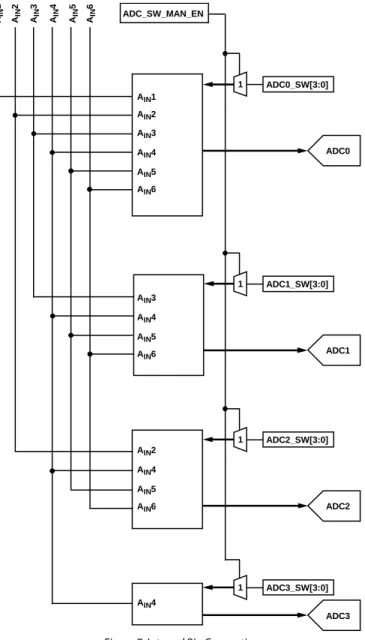
The ADV7181C has an integrated analog muxing section that allows more than one source of video signal to be connected to the decoder. Figure 7 outlines the overall structure of the input muxing provided in the ADV7181C.
ADC0_SW[3:0] ADC_SW_MAN_EN ADC0 AIN 6 AIN 5 AIN 4 AIN 3 AIN 2 AIN 1 AIN6 AIN5 AIN4 AIN3 AIN6 AIN5 AIN4 AIN3 AIN2 AIN6 AIN5 AIN4 AIN4 AIN2 AIN1 1 ADC1_SW[3:0] ADC1 1 ADC2_SW[3:0] ADC2 1 ADC3_SW[3:0] ADC3 1 07513-003
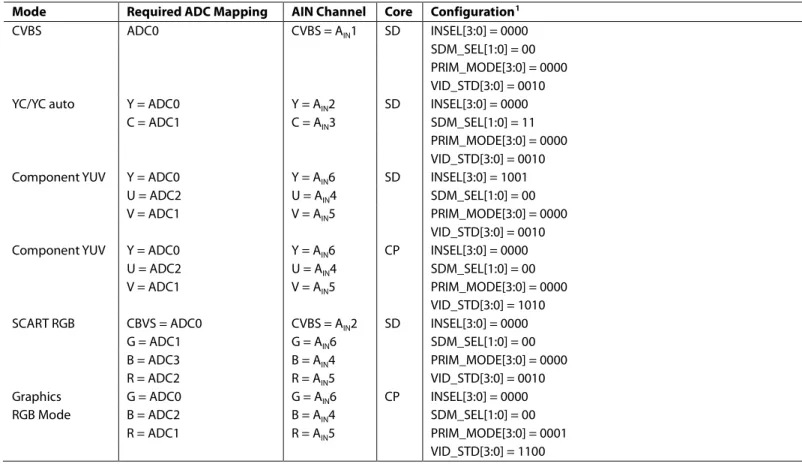
On the ADV7181C, it is recommended to use the ADC mapping shown in Table 8.
Table 8. Recommended ADC Mapping
Mode Required ADC Mapping AIN Channel Core Configuration1
CVBS ADC0 CVBS = AIN1 SD INSEL[3:0] = 0000
SDM_SEL[1:0] = 00 PRIM_MODE[3:0] = 0000 VID_STD[3:0] = 0010
YC/YC auto Y = ADC0 Y = AIN2 SD INSEL[3:0] = 0000
C = ADC1 C = AIN3 SDM_SEL[1:0] = 11
PRIM_MODE[3:0] = 0000 VID_STD[3:0] = 0010
Component YUV Y = ADC0 Y = AIN6 SD INSEL[3:0] = 1001
U = ADC2 U = AIN4 SDM_SEL[1:0] = 00
V = ADC1 V = AIN5 PRIM_MODE[3:0] = 0000
VID_STD[3:0] = 0010
Component YUV Y = ADC0 Y = AIN6 CP INSEL[3:0] = 0000
U = ADC2 U = AIN4 SDM_SEL[1:0] = 00
V = ADC1 V = AIN5 PRIM_MODE[3:0] = 0000
VID_STD[3:0] = 1010
SCART RGB CBVS = ADC0 CVBS = AIN2 SD INSEL[3:0] = 0000
G = ADC1 G = AIN6 SDM_SEL[1:0] = 00
B = ADC3 B = AIN4 PRIM_MODE[3:0] = 0000
R = ADC2 R = AIN5 VID_STD[3:0] = 0010
Graphics G = ADC0 G = AIN6 CP INSEL[3:0] = 0000
RGB Mode B = ADC2 B = AIN4 SDM_SEL[1:0] = 00
R = ADC1 R = AIN5 PRIM_MODE[3:0] = 0001
VID_STD[3:0] = 1100
1 Configuration to format follow-on blocks in correct format.
Table 9. Manual MUX Settings for All ADCs
ADC_SWITCH_MAN to 1 ADC0_SW_SEL[3:0] ADC0 Connection ADC1_SW_SEL[3:0] ADC1 Connection ADC2_SW_SEL[3:0] ADC2 Connection ADC3_SW_SEL[3:0] ADC3 Connection
0001 AIN1 0001 N/A 0001 N/A 0001 N/A
0010 AIN2 0010 N/A 0010 AIN2 0010 N/A
0100 AIN4 0100 AIN4 0100 AIN4 0100 AIN4
0101 AIN5 0101 AIN5 0101 AIN5 0101 N/A
0110 AIN6 0110 AIN6 0110 AIN6 0110 N/A
1100 AIN3 1100 AIN3 1100 N/A 1100 N/A
The analog input muxes of the ADV7181C must be controlled directly. This is referred to as manual input muxing. The manual muxing is activated by setting the ADC_SWITCH_MAN bit (see Table 9). It affects only the analog switches in front of the ADCs. INSEL, SDM_SEL, PRIM_MODE, and VID_STD still have to be set so that the follow-on blocks process the video data in the correct format.
Not every input pin can be routed to any ADC. There are restrictions in the channel routing imposed by the analog signal routing inside the IC. See Table 9 for an overview of the routing capabilities inside the chip. The four mux sections can be controlled by the reserved control signal buses ADC0_SW[3:0]/ ADC1_SW[3:0]/ADC2_SW[3:0]/ADC3_SW[3:0].
Table 9 explains the ADC mapping configuration for the following:
• ADC_SW_MAN_EN, manual input muxing enable, IO map, Address C4[7]
• ADC0_SW[3:0], ADC0 mux configuration, IO map, Address C3[3:0]
• ADC1_SW[3:0], ADC1 mux configuration, IO map,
Address C3[7:4]
• ADC2_SW[3:0], ADC2 mux configuration, IO map, Address C4[3:0]
• ADC3_SW[3:0], ADC3 mux configuration, IO map, Address F3[7:4]
PIXEL OUTPUT FORMATTING
Table 10. Pixel Output FormatsProcessor, Format, and Mode
Pixel Port Pins P[19:0]
19 18 17 16 15 14 13 12 11 10 9 8 7 6 5 4 3 2 1 0
SDP Video output 8-bit 4:2:2 YCrCb[7:0] SDP Video output 10-bit 4:2:2 YCrCb[9:0]
SDP Video output 16-bit 4:2:2 Y[7:0] CrCb[7:0]
SDP Video output 20-bit 4:2:2 Y[9:0] CrCb[7:0]
CP Video output 12-bit 4:4:4 RGB DDR D71 B[7]↑ R[3]↓ D61 B[6]↑ R[2]↓ D51 B[5]↑ R[1]↓ D41 B[4]↑ R[0]↓ D31 B[3]↑ G[7]↓ D21 B[2]↑ G[6]↓ D11 B[1]↑ G[5]↓ D01 B[0]↑ G[4]↓ D111 G[3]↑ R[7]↓ D101 G[2]↑ R[6]↓ D91 G[1]↑ R[5]↓ D81 G[0]↑ R[4]↓
CP Video output 16-bit 4:2:2 CHA[7:0] (for example, Y[7:0]) CHB/C[7:0] (for example, Cr/Cb[7:0])
CP Video output 20-bit 4:2:2 CHA[9:0] (for example, Y[9:0]) CHB/C[9:0] (for example, Cr/Cb[9:0])
RECOMMENDED EXTERNAL LOOP FILTER COMPONENTS
The external loop filter components for the ELPF pin should beplaced as close as possible to the respective pins. Figure 8 shows the recommended component values.
07513-004 1.69kΩ 82nF 10nF PVDD = 1.8V ELPF30
TYPICAL CONNECTION DIAGRAM
07513-005
Figure 9. Typical Connection
OUTLINE DIMENSIONS
COMPLIANT TO JEDEC STANDARDS MS-026-BCD
051706-A TOP VIEW (PINS DOWN) 1 16 17 33 32 48 49 64 0.27 0.22 0.17 0.50 BSC LEAD PITCH 12.20 12.00 SQ 11.80 PIN 1 1.60 MAX 0.75 0.60 0.45 10.20 10.00 SQ 9.80 VIEW A 0.20 0.09 1.45 1.40 1.35 0.08 COPLANARITY VIEW A ROTATED 90° CCW SEATING PLANE 0.15 0.05 7° 3.5° 0°
Figure 10. 64-Lead Low Profile Quad Flat Package [LQFP] (ST-64-2)
Dimensions shown in millimeters
ORDERING GUIDE
Model1, 2 Temperature Range Package Description Package Option
ADV7181CBSTZ −40°C to +85°C 64-Lead LQFP ST-64-2
ADV7181CBSTZ-REEL −40°C to +85°C 64-Lead LQFP ST-64-2
ADV7181CWBSTZ −40°C to +85°C 64-Lead LQFP ST-64-2
ADV7181CWBSTZ-REEL −40°C to +85°C 64-Lead LQFP ST-64-2
EVAL-ADV7181CLQEBZ Evaluation Board for the LQFP
1 Z = RoHS Compliant Part.
2 W = Qualified for Automotive Applications.
AUTOMOTIVE PRODUCTS
The ADV7181CW models are available with controlled manufacturing to support the quality and reliability requirements of automotive applications. Note that these automotive models may have specifications that differ from the commercial models; therefore designers should review the Specifications section of this data sheet carefully. Only the automotive grade products shown are available for use in automotive applications. Contact your local Analog Devices account representative for specific product ordering information and to obtain the specific Automotive Reliability reports for these models.
I2C refers to a communications protocol originally developed by Philips Semiconductors (now NXP Semiconductors).
©2008–2012 Analog Devices, Inc. All rights reserved. Trademarks and registered trademarks are the property of their respective owners.

![Figure 10. 64-Lead Low Profile Quad Flat Package [LQFP]](https://thumb-us.123doks.com/thumbv2/123dok_us/48193.2506038/20.918.190.688.183.448/figure-lead-low-profile-quad-flat-package-lqfp.webp)