E-commerce impacts on service and network o
perations
and management
Overview of e-commerce impacts on telecommunications management
Editors: Dave Milham, BT exact, Andrea Laganà, Telecom Italia Lab, Bernard Quarré, Telenor
R&D
Suggested readers
Executives in telecommunications, IT, network management and OSS development departments. Shareholders participating in the project.
Product managers delivering wholesale and/or regulated interconnect products. Product managers using e-commerce.
Technical experts in charge of producing B2B specifications and solutions.
Managers responsible for procurement and development of e-commerce B2B applications. E-commerce vendors interested in telecoms sector (including gateways, hubs, market makers, brokers).
EDIN
0211-1106
Project
P1106
For full publication
December 2001
Abstract
The objective of the EURESCOM project on “E-commerce impacts on service and network operations and management” is to allow architects and business managers to understand how e-business technologies and products should be best applied to their operations support systems (OSS) to serve their B2B and communications supply chain needs through the implementation of an e2-OSS framework.
This document summarises the results of the Phase 1 study on the relationship between e-commerce methods and technologies on OSSs and their evolution.
It also identifies the main gaps that need to be addressed in the development of an e2-OSS framework.
• BT exact, British Telecommunications plc
• Telecom Italia Lab, Telecom Italia S.p.a.
• Telenor R&D, Telenor A/S
• Hellenic Telecommunications Organization S.A. (OTE)
[Project title] E-commerce Impacts on Service and Network Operations and Management [Document title] Overview of e-commerce impacts on Telecommunications Management
Editors: Andrea Dave Milham, BT exact, Andrea Laganà, Telecom Italia Lab, Bernard Quarré, Telenor R&D
Project leader: Dave Milham, BT exact
Project supervisor: Anastasius Gavras, EURESCOM GmbH EURESCOM published project result; EDIN 0211-1106
2001 EURESCOM Participants in Project P1106
Disclaimer
This document contains material which is the copyright of certain EURESCOM PARTICIPANTS, and may not be reproduced or copied without permission.
All PARTICIPANTS have agreed to full publication of this document.
The commercial use of any information contained in this document may require a license from the proprietor of that information.
Neither the PARTICIPANTS nor EURESCOM warrant that the information contained in the report is capable of use, or that use of the information is free from risk, and accept no liability for loss or damage suffered by any person using this information.
Preface
EURESCOM project P1106 on “e-commerce impacts on service and network operations and management” addresses the big changes in business-to-business (B2B) relations (interconnection / wholesale market), core processes, organisational issues and OSS architecture emerging from the introduction of standardised B2B platforms in the telecommunications operators.
The project covers the following different kinds of activities:
• Definition and assessment of network and service management processes and architecture ("framework") of an e-Telco, covering also organisational and operational issues;
• Validation of this new framework through the development and the assessment of some business case studies, concerning innovative services and e-commerce solutions in new wave networks, especially investigating the implications on provisioning process and SLA management activities;
• Analysis and benchmarking of enabling internet software COTS products, with support and participation of leading vendors;
• Laboratory experiments and prototyping on the case studies, with active support and participation of selected vendors.
Project participants are British Telecommunications plc, Telecom Italia S.p.a., Telenor A/S and Hellenic Telecommunications Organisation S.A. (OTE). The project leader is Dave Milham from BT. The overall budget for the project is 137 person months and other costs of 50 Keuro.
This project report summarises the main conclusions of project P1106 at the end of phase 1. Comprehensive technical information resulting from phase 1 studies is further available in:
• EDIN 0212-1006 Telecommunications B2B Problem Statement and Requirements.
Executive Summary
Why you should read this project report
The information in this report will give the reader a quick and easy way to gain an appreciation of the main issues that have to be addressed by service providers in automating the vommunications service supply chain1.
It also provides a summary of the main industry issues that have to be solved collectively in order that these e-commerce technologies can be effectively integrated with the Operations Support Systems (OSS) of service providers.
The benefits for your company
E-commerce methods and technologies are of increasing interest to a range of industries. Communications service providers are under both regulatory and competitive pressures to provide wholesale services. Competitive pressures are increasing the demand for interconnect services, which are simultaneously under downward price pressure.
Automation of the communication service supply chain using e-commerce technologies offers the opportunity to lower costs, and to improve the quality and speed of processes amongst service providers.
Aspects addressed by this project report
This report provides a summary of the main issues that need to be addressed by service providers wishing to provide e-commerce interfaces between operators to support the provisioning, assurance, and billing of wholesale communication services.
Mostly this is focused on providing the bridge between intra company Enterprise Application Integration (EAI) methods, together with e-commerce supply chains solutions such as those being developed by ebXML and other consortia.
Conclusions
The project provides a summary of the main industry actions that need be addressed by project P1106 in the development of the e2-OSS Framework. These are:
• Support for assurance process, especially SLA management of communications networks,
• Support for the service provisioning processes,
• Security of the supply chain against fraud, and inappropriate disclosure of information.
1 The term Communication Service Supply Chain is used to differentiate from supply chain which is commonly associated with direct and indirect good in a manufacturing context. The TMF has recently proposed the use of the term ‘Value Chain’ as it is addressing media and content as well as communications.
List of Authors
Nancy Alexopoulou University of Athens / Hellenic Telecommunications Organization S.A. (OTE)
Giuseppe Cassone Telecom Italia Lab Domenico Enrico Bena Telecom Italia Lab Derrick Evans BT exact
Vangelis Floros University of Athens / Hellenic Telecommunications Organization S.A. (OTE)
Simon Griffiths BT exact Svein Tore Johnsen Telenor R&D Paul Kearney BT exact
Harold Korte Intracom S.A. / Hellenic Telecommunications Organization S.A. (OTE)
Andrea Laganà Telecom Italia Lab David Milham BT exact
Jonathan Mitchener BT exact Bernard Quarré Telenor R&D Enrico Ronco Telecom Italias Lab
George Skikos Hellenic Telecommunications Organization S.A. (OTE) Anna Zoura Hellenic Telecommunications Organization S.A. (OTE)
Table of Contents
Preface... ...3 Executive Summary... ...4 List of Authors...5 Table of Contents...6 Abbreviations...7 Glossary...8 1 Introduction...91.1 Telecomm industry trends...9
1.2 Other Industry trends...9
1.3 Relationship to Quality Management Systems (QMS)...9
1.4 This document...9
1.5 Project background...10
2 e-Commerce drivers on Communications Service Providers...11
2.1 Business Drivers...11
2.2 Network Provider Wholesale Services – The commodity...11
2.3 The Problem...13
2.3.1 Technology assumptions...14
3 Requirements for e-commerce B2B solutions for Communications...15
4 The Technical Point of View...17
4.1 Review of e-commerce state of the art...17
4.2 Roadmap for OSS evolution...17
4.3 Security needs...19
4.3.1 Information Security Management Systems (ISMS) in B2B e-Commerce...19
4.3.2 Trusted Third Parties (TTP)...19
4.3.3 The use of a Public Key Infrastructure (PKI)...19
4.3.4 Directory Centric Security...19
5 Communications B2B development areas...20
6 Conclusions & Goals for e2-OSS Framework...23
Abbreviations
3GPP 3rd Generation Participating Partners B2B Business to Business
B2Bi Business to Business integration software B2C Business to Consumer
BSS Business Support Systems
EAI Enterprise Application Integration KPI Key Performance Indicator
ebXML electronic business eXtensible Mark-up Language e2-OSS European e-commerce OSS
e-TOM E-business Telecommunication Operations Map
NGOSS™ New Generation Operations Support and Service (TMF)
OASIS Organisation for the Advancement of Structured Information Standards OSS Operations Support System
OSS/J OSS through Java: java.sun.org/products/oss
PARLAY an open forum organised to create open Application Programming Interfaces (APIs) which enable third parties e.g. ASPs, ISPs, etc to develop applications across multiple networks run by different network operator www.parlay.org
QoS Quality of Service
S&NM Service and Network Management SLA Service Level Agreement
SOAP Simple Object Access Protocol SP Service Provider
TMF TeleManagement Forum
UN/CEFACT United Nations Centre for Trade Facilitation and Electronic Trade XML eXtensible Mark-up Language
Glossary
e-TOM www.tmforum.org
The e-business Telecom Operations Map (e-TOM) provides a view of the processes required for the fulfilment, quality assurance and billing of telecom services. The emphasis is on service management and network management processes, including customer care processes, service and network development and operations processes. The TOM was developed to drive a consensus around the processes required for service provider operations and operations management.
The e-TOM is an enhancement to the TOM that addresses the increased complexity in SP business relationships and processes. It specifically adds: processes to address the needs of Supply Chain Lifecycle Management, Supplier/Partner Relationship Management, Product Lifecycle Management, and Infra-structure Lifecycle Management.
NGOSS™ New Generation Operation Systems and Services www.tmforum.org
This initiative is focussed on developing an OSS componentisation strategy that is based upon the following principles:
• Technology Neutral Architecture framework with multiple physical realisations;
• Separation of business processes from software functions;
• Shared Information Environment e.g. data transformation and mediation;
• Common ‘Software Bus’;
• Contract based interfaces;
• Framework services e.g. registration of contract & components, security, …
ebXML www.ebXML.org
This is a completed collaborative project between UN/CEFACT and OASIS 2.
The vision of ebXML is to create a single global electronic marketplace where enterprises of any size and in any geographical location can meet and conduct business with each other through the exchange of XML based messages. ebXML enables anyone, anywhere, to do business with anyone else over the internet.
ebXML is a set of specifications that together enable a modular, complete electronic business framework. If the Internet is the information highway for electronic business, then ebXML can be thought of as providing the on ramps, off ramps, and the rules of the road.
RosettaNet www.rosettanet.org
This is an organisation whose work on e-commerce XML interface has been the source of the main technical contributions into ebXML The objectives of RosettaNet and ebXML are largely complementary. RosettaNet aims to standardise the content of business documents and process models within industry sectors. ebXML, on the other hand, aims to standardise the technologies used to express and exchange these documents and models. There is considerable interchange of ideas between the two initiatives.
2 Although the initial 18-month project is now completed, the two organisations have issued a memorandum of understanding covering continuance of the work.
1
Introduction
1.1
Telecom industry trends
Regulation, globalisation, the growth of the Internet, and the services supplied over it, are driving the disaggregation of traditional vertically integrated Telcos. Their telecom activities have been reorganised into many, more or less, independent domains and business entities some of which have been formed outside the traditional Telco regulated business. This has stimulated the creation of a wide range of new competitive communications service providers.
In order to deliver integrated communications services to end customers, supply chains will re-emerge between and within the new organisations’ structures and entities.
The unbundling and componentisation of service elements, including Operation Support Systems (OSS), combined with the falling cost of OSS and e-commerce technology, are resulting in lower entry costs for smaller trading partners (particularly niche service providers and resellers). Many wish to become members of these supply chains, thus widening the range of players involved and possible service propositions. New relationships between the business entities must be established. As a consequence, Telco OSS interconnection, which was once the subject of regulatory driven projects to meet equal access requirements for network products, such as number portability, is now evolving from that narrow regulated “electronic bonding3” focus towards wider B2B (business-to-business) initiatives. These are aimed at improving the integration of processes between communications service providers and their trading partners, extending the global reach of providers; and reaching new customers via other third party retailers, service and network providers in communication service supply chains.
1.2
Other industry trends
The trend toward e-commerce based B2B integration of trading partners is not unique to the telecom industry and the opportunity presents itself to lower the cost of OSS interconnection technology by leveraging broader industry initiatives such as ebXML.
1.3
Relationship to Quality Management Systems (QMS)
There is a relationship between supply chain needs and the requirements of Quality Management Systems (QMS), such as those certified under ISO 9001. These QMSs requires “mutually beneficial supplier relationships” (ISO 9000:2000) covering purchasing processes, purchasing information and verification of purchased product” (ISO 9001:2000
The development of automated supply chains needs to address the requirements to establish effective and efficient processes, to identify potential sources for purchased materials, to develop existing suppliers or partners, and to evaluate their ability to supply the required products in order to ensure the effectiveness and efficiency of overall purchasing processes.” (ISO 9004:2000 art. 7.4.2).
1.4
This document
The intention of this document is to provide an overview of the main requirements, the state of the art for e-commerce and the gaps that need to be addressed by the second phase of the project.
3 Electronic Bonding a term popular in the US in the late 1990s to describe a rage of electronic interfaces between incumbent and new operators
1.5
Project background
The traditional rigid separation between business management and OSS is obsolete: The collaboration between or the integration of business processes must follow rules based on the emerging e-Business technology: for instance B2B supply chain integration replaces OSS interconnection.
Several Telcos have experimented with web based front ends (B2C) to deliver services to their customers. However there is a realisation that the new Telco business models require more complex supply chains (B2B), and that the benefits of e-commerce cannot be realised without major changes to the technology operation of Service and Network Management (S&NM) systems themselves.
It is important to define the broad requirements of an e-business OSS framework that allows the integration of communication service providers and their partners.
These changes are needed for business, technology and organisational reasons – for example
• To meet the business need to improve customer service by achieving and improving the QoS of service provisioning processes, sometimes referred to as Key Performance Indicators (KPI)
• To exploit pervasive, economical and flexible e-commerce technologies that can be integrated with legacy applications
• To move from organisational reliance on people to validate and vet incoming service requests. Organisations need to be able to mange the rules and policy used to manage automated processes and authorise service requests.
This probably needs the progressive adoption, and use of e-commerce principles for internal systems interfaces within a Telco, and amongst its businesses. In turn, this implies the need for intelligent automation and assistance.
2
E-commerce drivers on communications service
providers
2.1
Business drivers
Deregulation, globalisation and increased competition is driving network providers to:
• Increase global reach through acquisition and strategic partnerships,
• Reach new customers through affinity resellers,
• Add value to their network services through service partnerships,
• Leverage network and licence investments through support of virtual network operators.
Incumbent network providers are further required by regulation to support:
• Service portability,
• Unbundling of network elements,
• Network interconnection,
• Service resale,
thus providing the basic commodity services to extend the reach and capability of new entrant providers.
New entrant providers are seeking to use this open access to network providers as a platform to
offer a wide range of value added applications.
Trusted third parties also see business opportunities to facilitate trading between these providers.
These drivers are accelerating the creation of complex extended communication supply chains, and the need for implementing wholesale style trading relationships between network and service providers.
Furthermore, downward pressure on wholesale pricing models and customer expectation of maintained service quality are driving:
• Radical re-engineering of communications business processes to support these new trading relationships in a cost effective manner,
• OSS interconnection between providers in support of flow-through and perfect touch.
2.2
Network provider wholesale services – The commodity
The principal commodity component of communications services supply chains is network transport offered by network providers.
Major sources of these services are the various national and regional incumbent network providers. As retail market share declines and the number of competing providers increases, revenue from wholesale services will be increasingly relevant for these incumbent providers.
Many of today’s wholesale services are transport oriented unbundled elements of incumbent retail services offered as “intermediate” products to other competing providers and retailers. Intermediate products are designed to make it possible for these other parties to offer consumers equivalent retail services in competition to retail business units in the incumbent’s organisation off its own network often adding their own service elements and management surround.
In addition incumbent providers will seek to use their market position and legacy infrastructure to offer a range of newer services.
Whilst these examples focus on wire-line services very similar trends are seen in the mobile industry, specifically the emergence of virtual mobile operators that add value, such as through information services, to commodity voice services that are purchased on a wholesale basis from mobile operators.
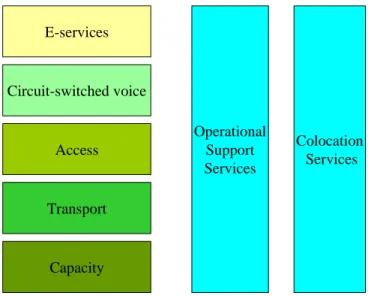
The range of possible wholesale services is illustrated in Figure 1.
E-services Circuit-switched voice Access Transport Capacity Operational Support Services Colocation Services
Source: Ovum (Wholesale: New Markets for Communications Carriers and Service Providers Figure 1 Communications wholesale services
Note: in the OVUM study Capacity is the physical infrastructure over which telecommunications transmission and transport protocols are carried.
Generally, there is a downward pressure on the price of wholesale services, sometimes driven by regulators to enhance competition.
Furthermore, there is an expectation that the prices for unbundled intermediate services should be lower than the prices for equivalent retail services (based on the expectation that operators have less to do when they are intermediated by third parties and do not bear the costs of marketing sales and service). Sometimes the regulators impose the principle that prices for intermediate services must be cost based.
Therefore, there is a general need to improve the cost base of wholesale products through more efficient operations including the B2B trading of these services.
Also, telecomm companies, in order to retain value for their services, will provide value added enhancements such as an enhanced service surround based on B2B access to OSS.
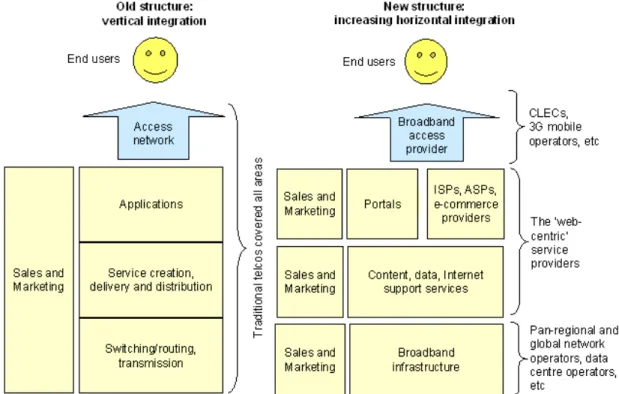
In creating intermediate services from within traditionally vertically integrated providers (see Figure 2), there is the burden of disengaging the retail elements of OSS from internally integrated OSS stack and adding wholesale service management elements instead.
For incumbents, this often presents a legacy OSS issue that is tactically dealt with by adding B2B components to their existing vertically integrated OSS, and making expensive and complex modifications to legacy, to cope with adding intermediate services.
In the longer term, to overcome legacy issues, reduce integration costs and make space for OSS developments to suit their retail and wholesale propositions, incumbents will re-engineer their organisation and OSS to separate wholesale from value added and retail services.
Figure 2 Disaggregation of vertically integrated providers (Source: Ovum 2000)
In addition OSS interconnection solutions will evolve from those electronic bonding solutions designed to retrofit B2B to vertically integrated OSS for a narrow range of unbundling and service portability propositions to more e-Business oriented solutions for a wider range of products and services.
2.3
The Problem
Unbundling
On the one hand regulators are driving incumbent Operators to un-bundle their traditional retail services into a number of parts each of which can be delivered as Wholesale Network Services to competitive Operators and Service Providers. This is also resulting in de-merging of companies into a number of more focussed subsidiaries.
On the other hand, the technical development of a component based network architecture such as PARLAY, or the equivalent 3GPP Open Services Architecture is defining open industry network interfaces. These allow the retail end customer service to be delivered dynamically by service providers who select use and configure components from many operators.
Integration
Paradoxically there is also commercial pressure to integrate the services from multiple operators:
• To achieve global reach by peering with partners and
• To add value by for example augmenting networking with content. One of the more pressing problems is:
How do I (re)-integrate a communications services global supply chain?
The development of supply chain integration solutions in other industries such as automotive and aerospace give some clues as to how this might be achieved. However Communication Services make different demands on supply chains from those that focus on supply of Direct and Indirect Physical Goods.
For example the range of processes and functions that have to be operated along the supply chain are more diverse covering:
• Fulfilment process for services requires more complex product definitions c.f. goods
• Assurance processes require automated configuration using provisioning information
• Billing, which is a continuous process unlike invoicing for goods, and has stringent demands on accuracy, security of billing information, fraud management, …
• Supply chain management where demands for Services provided have to be mapped to forecasts for input services and direct materials used for network build.
Whilst Service Providers can use mainstream e-commerce solutions to address part of the needs of Communications Service Supply Chain Solution they need to be augmented with Communications specific enhancements based upon the need to support services rather than Goods.
2.3.1 Technology assumptions
These trends coincide with B2B (business to business) e-commerce software evolving from web portals, for selling to businesses as “big customers”, to a more document centric collaborative form of service negotiation, fulfilment and service care.
The catalyst for this is enterprise-to-enterprise process integration over the Internet through B2Bi (B2B integration) technologies such as XML and SOAP and e-commerce frameworks such as Rosettanet, ebXML and BizTalk.
Communications service providers and their partners will increasingly look to this B2Bi software to integrate their enterprise OSS and processes with end-to-end communication supply chain processes. These technologies are expected to replace the OSS Interconnection technologies that have been developed in the Communications industry in response to the demand for OSS interface to support regulated Services.
3
Requirements for e-commerce B2B solutions for
communications
The project has investigated the requirements that e-commerce solutions place on the Service and Network Operation Management of Service Providers.
The main areas where there are special Communications industry requirements are listed in the following section and are derived from the Problem Statement and Requirements document EDIN0212-1106 [2]. This identifies the logical steps in analysis the problem domain and the requirements that flow from them. This section re-groups those requirements into the principle technical areas where gaps exist in applying e-commerce to Telecomm service provision.
Complexity and scope of supply chain
• Need to deal with a wider range of partners.
• Not just one to one relationships;
• Longer supply chains, necessary to provide more complex and advanced services;
• Includes non-Telecomm companies, such as Content Providers and Third Parties;
• More dynamic supply chains, to face the need for quickly introducing new services, or to change suppliers for existing services.
• Specialist communications supply chain collaborations.
• Supply chain facilitation
• market making;
• horizontal services;
• End to end visibility of the process status;
• Securing the supply chain
• To ensure mutual Trust;
• And to manage secure information flow;
Trading partners
• Support and management of trading partner agreements
• Product & Partner Management
Service and products
• Manage a wider range of communications services
• Trading unbundled service components
• Integrating services between partners via the supply chain
Processes
• Wider range of interactions
• Full lifecycle management
• Fulfilment, Assurance and Billing Processes
• Assuring service delivery in the supply chain
• Performance of the communication service supply chain itself
Technology requirements
• Support for a wide range of interactions
• Message oriented B2Bi
• Portals
• Channel enabling applications
• Web services
• Bridging enterprise integration and B2B
• Technology mismatch
• Specification mismatch
• Patterns for wrapping enterprise information within commercial collaborations Many of these requirements, but not all, can be satisfied by mainstream e-commerce methods and technology. Addressing the requirements that are not satisfied by mainstream e-commerce is the primary rationale for the development of the e2-OSS framework in this project.
4
The technical point of view
4.1
Review of e-commerce state of the art
EURESCOM EDIN 0213-1106 [3] has carried out a review of e-commerce technologies and methods.
The principal activities relevant to this study are:
• ebXML which is an completed industry activity concerned with standardising the methods and technologies used for B2B integration amongst enterprises. It is continuing as part of a UN/CEFACT, ITU-T, ISO, & IEC Memorandum of Understanding.
• TMF NGOSS that is concerned with providing a software component based architecture for developing next generation OSS solutions. The main characteristics are:
• Technology neutral with multiple technology realisations (CORBA, JAVA, …)
• Software bus for integration components
• Published contractual interfaces for component
• Repository for registering and supporting trading between components
• Common shared data model used by components and their contractual interfaces
• TMF e-TOM that provides a high level process framework for a telecommunication service providers
4.2
Roadmap for OSS evolution
Based upon the results reported in [2] and [3], the project has concluded that a hypothetical Roadmap for the evolution of OSS towards the support of B2B e-commerce for Communications Service Providers might be:
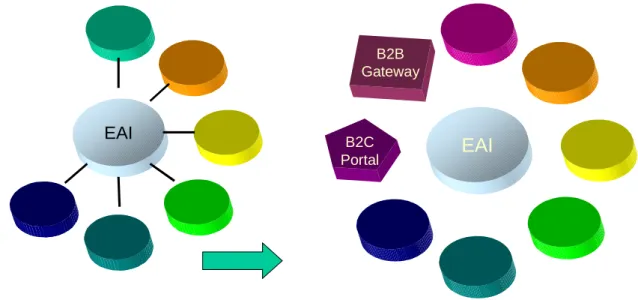
Stage 1 Integrate the Systems then integrate to the outside world
EAI
EAI
B2C Portal B2B GatewayFigure 3 Evolving through EAI to B2B
The proposition is that the first step is to integrate legacy OSS applications onto a common information framework through the use of Enterprise Application Integration technology. This allows the creation of consistent enterprise wide data that is an essential precursor to efficient B2B operations.
Then, B2B gateways and B2C portals can be introduced as a relatively small incremental development as compared to integration with a wide range of disparate legacy application.
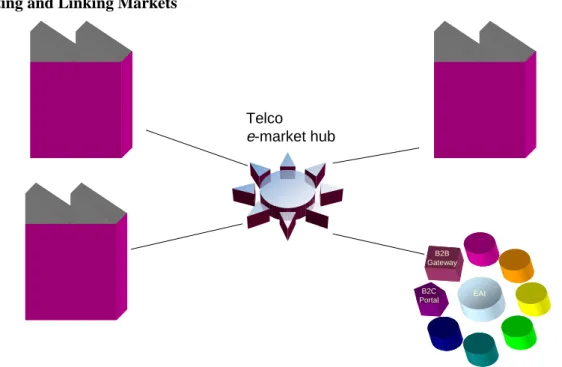
Creating and Linking Markets
EAI B2C Portal B2B Gateway EAI B2C Portal B2B Gateway Telco e-market hub
Figure 4 B2B Gateway facilitating emergence of a marketplace
Marketplaces are formed to facilitate trading between Buyers and Sellers of Services, and their success depends on liquidity of the market and some volatility of prices.
B2B e-commerce Gateways facilitate the emergence of automated marketplaces (e-trading) leading to lower costs, and great efficiency
These markets, when supported by appropriate financial instruments, could support e-trading of advanced connectivity services with prices reflecting the true market conditions of supply and demand.
Market places allow the emergence of a number of trading mechanisms such as
• Auctions. – A method for selling goods in the presence of competition, where the seller sets the rules while the potential buyers set the prices. Auctions are useful for selling items of uncertain quality, and/or subject to uncertain demand, and where the value of items fluctuates frequently.
• Forwards and Options A forward is a transaction for a commodity that will be bought in the future at a price fixed in advance; an option is a right to buy a commodity at a given price within a certain amount of time or at a specified time. Used together these financial instruments can manage risk amongst buyers and sellers. From the buyer’s point of view, being able of defining in advance the costs involved in the purchase of a network service lowers the risks, and reduces deviations from the budgets. From the network provider’s point of view on the other hand, it will enable offering better prices to those who buy services in advance, hence reducing the running costs for the buyer, providing a clearer view of the anticipated revenue and increasing demand by being more attractive to consumers. It is reasonable to expect their usage to extend to the telecommunications services market.
Examples of marketplaces include: RateXchange, Arbinet, and Band-X, who have mostly specialised in international switched minutes throughout the world; Enron and Williams Communications own large networks and also do trading, moving quickly toward commodities models. Various large energy companies, including El Paso Global Networks, Dynegy, Aquila Energy, and American Electric Power have also begun trading bandwidth, mostly private lines between a half dozen or dozen large cities.
• Although electronic bandwidth markets are already operating commercially, there are several important issues related to trading of telecom services (and particularly of more advanced ones) that are still open such as how to represent commodities in a formal way,
• Usage of both auctions and bilateral negotiations as trading mechanisms,
• Which auction or negotiation mechanism is appropriate for selling a given service. Solutions to these matters lie outside the scope of the current project and may be a suitable area for future EURESCOM studies. Nevertheless the development of e-commerce capabilities on Service and Network Management systems is one of the prerequisite capabilities for marketplaces to emerge.
4.3
Security needs
The successful growth of e-Commerce to accommodate a wide range of business entities depends to some extent on what security solutions are required by inter-operating e-Businesses, regulators, international law etc. How to satisfy these security requirements, needs to be addressed in the B2B e-Commerce supply chain framework for the telecommunications industry.
4.3.1 Information Security Management Systems (ISMS) in B2B e-commerce
The security requirements of e-Commerce trading partners need to be satisfied by managed solutions. Security controls, implemented by strong security technologies, may count for nothing if they are not managed. Therefore there must be an emphasis on security management within the B2B e-Commerce environment. To this end, the Information Security Management System (ISMS) international standard ISO17799 has been recognised as the best guide to practices that should be adhered to in the B2B e-Commerce framework. The ISO17799 standard is also becoming a requirement for trading in some industry and government sectors and it is established within the context of the Quality Management System standard: ISO9000. Using the same approach to ISMS implementation is important to the overall effectiveness of B2B security measures and the ability to communicate security policies between trading partners.
4.3.2 Trusted Third Parties (TTP)
The use of Trusted Third Parties has been identified as inevitable in the e-Commerce framework. An example of the use of TTPs is in the provision of non-repudiation functions. At some point, some reference to a third party is required when there is a dispute between two parties. This leads to the existence of third parties that are recognised by both sides, which can mediate in disputes. Other TTPs include identity management, time stamping, certification authorities, auditors etc.
4.3.3 The use of a Public Key Infrastructure (PKI)
It is assumed that the individual companies will have to protect themselves from some security threats by using public key cryptography. Hence a PKI will be an important area for standardisation for e-Commerce to function efficiently. There are many issues regarding the PKI concept and how it is implemented so the emphasis must be on what works and is generally accepted.
4.3.4 Directory Centric Security
The use of directory technologies to enable e-Commerce and the internal functions of e-Businesses are currently being developed. The directory enabled e-Business security management approach could provide networked organisations with the facilities to carry out nearly all of their functions securely and efficiently. Directory enabled e-Business technology based security infrastructure can also meet the requirements of the ISO17799 standard.
5
Communications B2B development areas
Based upon the studies in this project the following conclusions have been reached about the areas where additional development work is needed to apply e-commerce to Communications Service Supply Chains and to integrate these with Operations Support Systems (OSS).
Communications service definition and catalogues
Communication services are more complex to define than physical goods that are the basis of most current e-commerce solutions. Industry agreements are needed for the structure and content of templates used to define communication services. Service templates are necessary to facilitate the creation of on-line catalogues in support of marketplaces.
Business operational viewpoint
The current results from ebXML are limited to a simple Buyer-Seller models and further specification work is need to model the roles and actors active in the telecommunication service industry.
Functional/process viewpoint
The Common Core components from ebXML cover basic process/functional capabilities such as ordering, invoicing, etc. They partially cover the Telecomm Service Supply chain requirements, but need to be enhanced to cover:
• Assurance processes including repair and SLA/QoS Reporting
• Security processes covering authentication, access control and fraud management
• Continuous billing Processes
Technology
There is a very large amount of B2Bi technology available with many new products arriving. It is clear that there is an opportunity for Service Providers to exploit these technologies. However the main issue is the maturity of some of these technologies.
Operational
Organisations are used to establishing their own policy and propagating it hierarchically within their organisation. Two specific areas where e-commerce impacts OSS and operational policy are design policy and security policy. Design policy implications are also discussed in the Organisational Section below.
Security policy in an organisation is usually based upon setting authorities for individuals and roles. Implicitly the sanction for not complying with the policy is dismissal of the individual. When processes are shared between organisations there is an implicit set of policy decisions to be made and agreed to maintain security policies and trust between them.
Organisational
E-commerce methods imply the use of a set of co-operative process design patterns to establish collaborations between organisations. These patterns include the concept of using a library of reusable process components – Common Core Process components in ebXML parlance. Current practice in developing OSS interfaces within an organisation is usually based upon incremental development of existing internal processes. Interfaces between organisations, particularly to an incumbent operator often reflect either an adaptation of an internal process, or a new process developed from scratch.
None of these approaches is optimal in the integration of e-commerce technologies or EAI technologies since process designs are essentially proprietary to each organisation and may not be able to exploit industry e-commerce solutions. It is therefore essential that Organisations establish a different design model for Processes, based upon use of industry design patterns and components, especially as disaggregation means that what is internal today may be an open interface tomorrow.
Current industry coverage of e-commerce and OSS integration
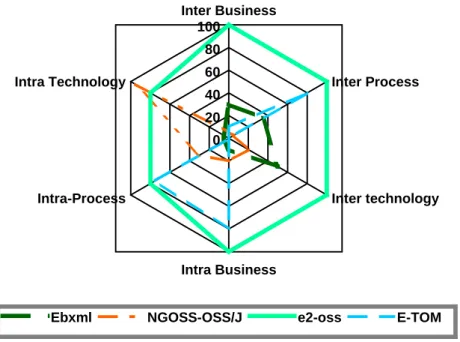
The following diagram summarises at a high level the depth and scope of various industry activities related to intra Enterprise Application Integration and Inter Enterprise Business Collaborations. Evidence is given to what is the actual status of these activities.
It basically focuses on scope and coverage from two perspectives:
• Firstly, the extent to which the initiative covers inter organisation aspects,
• Secondly, the treatment of Business models (Roles), Processes and Functions and Technology.
It presumes that the required Project P1106 e-OSS scope is as shown by the solid green line below.
0 20 40 60 80 100 Inter Business Inter Process Inter technology Intra Business Intra-Process Intra Technology
Ebxml NGOSS-OSS/J e2-oss E-TOM
Figure 5 Assessment of current industry coverage of e-commerce – e2-OSS requirements
NOTE that not all aspects of the intra organisation needs can be covered by the collaboratively defined P1106 e2-OSS Framework since integration with legacy processes, functions and technology is likely to involve some internal company specification work.
• ebXML
It has a strong bias towards inter-company aspects and is relatively weak, on intra company aspects. It also focussed most on establishing trading relationships, exchange of purchase orders and invoicing/payments. It does not currently address the security/fraud requirements of Service Supply Chains nor the Service Assurance aspects.
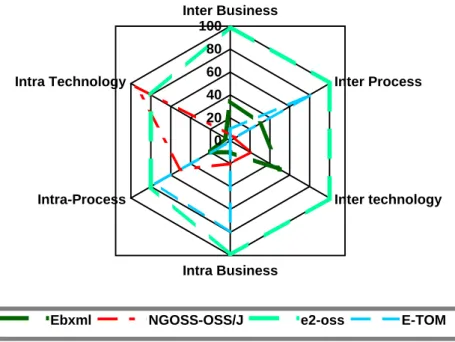
The expectations are for the ebXML continuation work in the UN CEFACT and other groups, such as the ITU-T tML group to include more complex business models (not only one-to-one) and a wider variety of inter processes (e.g. including assurance)..
• NGOSS – OSS/J
It is assumed that OSS/J will be one of the technology implementation realisations of NGOSS. As such it is strong biased towards intra Enterprise Application Integration. Nevertheless some aspects of the design patterns and some of the technology may be suitable for inter-organisation Business Collaborations, especially where synchronous remote procedure call based interfaces are an optimum solution.
It is expected that OSS/J will evolve both towards a wider technology analysis, and towards a wider understanding of Intra Enterprise Processes and Inter Enterprise Technology.
• e-TOM
Currently this is heavily focussed on process design. The work on Supply Chains and inter-company interfaces is focussed on the internal process needs of an organisation rather than the definition of inter-company processes.
The expected evolution of e-TOM is towards a deeper and more complete analysis of the internal business/processes/activities. It will however address the integration of these internal processes with telecom supply chains.
Expected industry coverage of e-commerce and OSS integration
According to the evolutions explained above, the following diagram shows the expected coverage in 12/15 months time. 0 20 40 60 80 100 Inter Business Inter Process Inter technology Intra Business Intra-Process Intra Technology
Ebxml NGOSS-OSS/J e2-oss E-TOM
Figure 6 Assessment of expected industry coverage of e-commerce – e2-OSS requirements What is needed is an e2-OSS Framework
It is clear from the comparative analysis above that the integration of e-commerce with OSS is not completely addressed by current Industry initiatives.
The diagram above shows that the industry initiatives are broadly complementary and there is an opportunity for work on an integrating framework to cover the full scope of the requirements identified in the companion Technical Information in EDIN 0212-1106. Such a framework is needed to lead to common solutions amongst co-operating Service Providers and to create common technology procurement requirements for vendors.
Such a framework should be verified practically by application to a case study and selective demonstration of key principals on commerce products.
6
Conclusions & goals for e
2-OSS framework
The main consequences of the market and business changes are:
1. Equivalent treatment of a Telco’s own retail business units and those of other trading partners needs to be addressed throughout the OSS architecture.
2. Within Telco enterprises, both retail and wholesale concerns need to be met, but in a separable fashion.
3. Operators will be providing “management” services and not only infrastructure/transmission services, i.e. billing services, etc. Often these services will be provided via B2B interfaces. As a consequence, from a technical point of view:
1. Telco OSS interconnection for supply chains must evolve from “electronic bonding” for regulated services to a broader based B2B interconnection in support of wider wholesale services offered to other operators, service providers and resellers.
2. The entire Telco OSS architecture needs to evolve to support e-business, wholesale relationships and vertical integration of trading partners.
3. For intermediate (wholesale) services, there is the added burden on incumbents to disengage the retail elements of their OSS from their internal vertically integrated OSS stack and add wholesale service management elements instead. This often presents a legacy OSS issue tactically dealt with by adding B2B components to their vertically integrated OSSs, and making necessary expensive modifications to legacy, to cope with intermediate services; thus adding cost and complexity.
4. Vertical integration of telco trading partners will require broader more collaborative B2B interactions than initial transaction oriented order management style interfaces.
The key goals for the e2-OSS Framework are:
• Telecomm B2B Supply Chains Focus on Telecomms Service Provider Supply Chain
management processes (establishing trading relationships, Community of interest (capacity forecast), end to end security, and Marketplaces)
• End to end telecommunication supply chain security Trusted Third parties for security
credentials / certificates Fraud management down the whole supply chain
• Telecom Service Definitions Definition of Telecom Services and Catalogues (both complex
and simple products) Tools for efficient specification and realisation of telecom products.
• Integration of Telecommunication Assurance and Billing Processes with e-commerce
Assurance Processes (Repair and SLA/QoS management) Billing Processes (Fraud Management and Integrity, Bill on Behalf of Other’s -BOBO)
References
[1] http://www.EURESCOM.de
[2] EDIN 0212-1106 Telecommunications B2B Problem Statement and Requirements [3] EDIN 0213-1106 State of the Art’ in e-Commerce Technology