Author’s Accepted Manuscript
Robust
Spatial-Temporal
Deep
Model
for
Multimedia Event Detection
Litao Yu, Xiaoshuai Sun, Zi Huang
PII:
S0925-2312(16)30727-5
DOI:
http://dx.doi.org/10.1016/j.neucom.2016.03.102
Reference:
NEUCOM17339
To appear in:
Neurocomputing
Received date: 8 December 2015
Revised date:
25 February 2016
Accepted date: 3 March 2016
Cite this article as: Litao Yu, Xiaoshuai Sun and Zi Huang, Robust
Spatial-Temporal Deep Model for Multimedia Event Detection,
Neurocomputing,
http://dx.doi.org/10.1016/j.neucom.2016.03.102
This is a PDF file of an unedited manuscript that has been accepted for
publication. As a service to our customers we are providing this early version of
the manuscript. The manuscript will undergo copyediting, typesetting, and
review of the resulting galley proof before it is published in its final citable form.
Please note that during the production process errors may be discovered which
could affect the content, and all legal disclaimers that apply to the journal pertain.
Robust Spatial-Temporal Deep Model for Multimedia
Event Detection
Litao Yu, Xiaoshuai Sun, Zi Huang
The University of Queensland
Abstract
The task of multimedia event detection (MED) aims at training a set of models that can automatically detect the most event-relevant videos from large datasets. In this paper, we attempt to build a robust spatial-temporal deep neural network for large-scale video event detection. In our setting, each video follows a multiple instance assumption, where its visual segments contain both spatial and temporal properties of events. Regarding to these properties, we try to implement the MED system by a two-step training phase: unsupervised recurrent video reconstruction and supervised fine-tuning. We conduct extensive experiments on the challenging TRECVID MED14 dataset, which indicate that with the consideration of both spatial and temporal information, the detection performance can be further boosted compared with the state-of-the-art MED models.
Keywords: Multimedia Event Detection, Deep Learning, GRU
1. Introduction and related work
Multimedia event detection (MED) is attracting an increasing research in-terest in multimedia content analysis and computer vision, and it has many practical applications such as video search and indexing. Video representation is one of the most important aspects for MED systems, and the most usual way
5
is to aggregate the visual features into a flat vector. For example, we can first extract the SIFT interest points from the video frames, and then quantize them as a global vector representation based on a pre-learned codebook. Needless to
say, video feature extraction plays a key role in not only MED but also most of other multimedia content analysis tasks.
10
Basically, there are two main factors contributing the effectiveness of an MED system: first, how to design a powerful feature that can reveal the most descriptive information contained in the videos; second, how to build an effective model that can accurately detect the pre-defined events with potential variances in both visual appearance and lengths in unconstrained videos.
15
In the last few years, many approaches for MED were proposed from both feature and model perspectives. For example, Chang et al. proposed a unified model for multimedia event recounting and detection [1]. Nikolaos proposed a two-phase approach using the non-linear discriminant analysis to identify the event-related subspace then applying a linear SVM to learn the event in the
20
derived subspace [2]. Although in MED tasks, the occurrence of static pat-terns are considered as evidence to discriminate for whether a video contains a
pre-defined event(e.g.,Bee Keeping), some events are still temporally sensitive
(e.g.,Felling a tree). Based on this fact, some temporal-based models have also
been proposed. For example, In Lai et al.’s work, the consideration of temporal
25
information has been proved to achieve a better detection performance com-pared with the flat vector representation [3]. Similarly, Vignesh et al. also tried to learn the temporal embeddings [4], and Remi et al. built the temporal par-titioning model for video analysis [5]. In the competition of NIST TRECVID MED 2014, the CMU team achieved the best detection performance by
incor-30
porating a set of visual and audio features, as well as the fusion and re-ranking methods [6].
Regarding the visual representation, the Improved Dense Trajectories (IDT) [7] show a very satisfactory performance in video content analysis especially in ac-tion recogniac-tion. To sketch both static and dynamic properties of the videos, the
35
interest points are densely sampled from the frames, and each point of interest is represented as a vector of the concatenation of trajectory, HOG/HOF, and MBH features. Till now, IDT is still one of the best visual features for video motion analysis. However, the calculation of IDT is extremely time-consuming,
which needs unaffordable computational resources in real-world scenarios. In
40
addition, Wang et al. proposed a motion feature named Expanded Relative Motion Histogram of BoW (ERMH-BoW), to encode both motion and the in-teractions between different objects/scenes [8].
Recently, the learned visual features from the pre-trained convolutional neu-ral network (CNN) have been shown to have a far superior performance than
45
hand-crafted features, and this has been used in different visual tasks such as pedestrian detection [9] and video classification [10, 11]. Specifically in the task of video event detection, Xu et al. proposed an effective video representation method based on a pre-trained CNN model [12]. Applying the VLAD quanti-zation method [13] on the last pooling layer and two fully-connected layers, the
50
detection performance is outstanding on the TRECVID MED dataset, which is even better than IDT. However, this video representation is unsequenced, so it loses all the temporal information. Another issue is that it cannot make use of a large number of unlabelled videos to acquire the prior knowledge, which can help improve the detection performance of the MED models. Based on these
55
reasons, we set ourselves two goals: 1) we aim to learn the joint models that can sketch both static and dynamic properties; 2) we aim to find the hidden spatial-temporal patterns in both labelled and unlabelled videos, as prior knowledge, before we obtain the final MED models.
In this paper, we propose a novel deep learning framework for MED tasks.
60
First we extracted the frame-level visual features and applied the temporal seg-mentation techniques to represent each video as a sequence of feature vectors. After that, we used the recurrent neural network to learn the intrinsic temporal properties of the videos in an unsupervised way. Finally, we aggregated the feature vectors and used an activation layer that is connected to the labels. In
65
this way we have conducted the fine-tuning procedure to obtain the final detec-tion model. We undertook extensive experiments on the challenging TRECVID MED 2014 dataset, and demonstrated that our proposed system can achieve very promising performance in video event detection tasks.
2. Our approach 70
In this section, we introduce our proposed spatial-temporal deep learning framework specifically designed for MED tasks in detail. The main idea of this framework is to utilize both unsupervised recurrent video reconstruction and supervised fine-tuning, to construct a model that simultaneously captures the spatial and the temporal properties of the videos.
75
2.1. Video temporal segmentation
Our framework starts with the video representation. In order to sketch the temporal properties of the videos, a common way is to put a large number of frame sequences into the training process. However, we found it unnecessary to do so, because unlike video motion analysis tasks such as action recognition,
80
the temporal granularity for MED is much larger. Instead, a better option is to split each video into several short segments to describe the coarse temporal information. Another advantage of aggregating the video frames into segments is that it can greatly reduce the computational complexity in the learning pro-cedure, especially in deep neural networks. Due to these facts, we applied the
85
Kernel Temporal Segmentation (KTS) proposed by [9] to segment the videos. Using this approach, the visual features of a video at the frame level were ex-tracted and the kernel matrix computed to represent the affinities of the frames. Then dynamic programming was applied to discover the changing points, which represent the jumps of the signal. As a result, each video is represented as a
90
sequence of non-overlapping segments. This kernel temporal segmentation has originally been used for video summarization, but in our proposed framework, we have only used it as a pre-processing procedure for the videos, to reduce computational complexities.
Representing a video as a sequence of frame feature vectors or segments
95
for the MED task can be considered as a kind of multiple-instance learning. However, the detection accuracy reported in [3] shows that both mi-SVM and MI-SVM have far more inferior performances compared to the SVM trained on
the flat vector representation of the videos. This implies we need to build the model carefully, in order to avoid the negative effect brought by the overly-loose
100
assumption of multiple-instance learning. In addition, the temporal information should also be incorporated into the model to improve detection accuracy.
2.2. Video re-construction using the GRU auto-encoder
A key step of our proposed framework is to reconstruct the video represen-tation in an unsupervised way using a recurrent auto-encoder.
105
The traditional auto-encoder [14] aims to reproduce the input data as a compressed and similarly distributed representation. Since in the hidden layer the dimensionality is lower than that of the input layer, the auto-encoder can be considered to make a non-linear dimensionality reduction. Normally the auto-encoder is used in the deep multi-layer perceptron (MLP) by pre-training
110
the weights of the neural networks in a greedy layer-wise approach, which is an unsupervised procedure.
Unlike a conventional auto-encoder which is mainly used in image processing, we use a recurrent neural network (RNN) to reconstruct the video representa-tions. An MLP can only map from input to output vectors, while an RNN can
115
in principle map from the history of previous inputs to each output, so it is able to deal with sequential prediction problems, especially for sentence under-standing in natural language processing [15]. In multimedia content analysis, RNNs have also been used in acoustic novelty detection [16] and video highlight extraction [17]. Among different RNN models, the Long Short-Term Memory
120
(LSTM) [18] and the Gated Recurrent Unit (GRU) [19, 20, 21] are the most
frequently used ones, both can overcome the difficulty of thevanished gradient
problem [22]. Although there are a number of structural differences between LSTM and GRU, it is generally unclear which type of gating unit has a better performance.
125
In this paper we chose the GRU to reconstruct video representations, the reason being that it has fewer parameters for optimization, thus the computa-tional complexity is comparably lower than for the LSTM.
After the kernel video segmentation introduced in the previous subsection, assume a videoxis represented as a sequence of feature segmentsx= (x1, . . . , xT),
130
where xt ∈ Rd is the visual feature vector of thet-th segment of the videox,
t = 1, . . . , T, and T is the number of the video segments. An RNN based auto-encoder first computes the hidden vector sequenceh= (h1, . . . , hT),ht∈
Rd0, d0< d, then it computes the output sequence ˜x= (˜x
1, . . . ,x˜T), which is an
approximation ofx, i. e, ˜x≈x.
135
The GRU has gating units that model the flow of information inside the
unit without separate memory cells. Lethjt be thej-th activation at the time
t, which is a linear interpolation between the previous activation hjt−1 and the candidate activation ˜hjt: hjt= (1−z j t)h j t−1+z j t˜h j t (1)
wherezjt is the update gate that decides how much the unit updates its
activa-140
tion. ztj is computed by:
ztj=σ(Wzxt+Uzht−1)j (2)
where σ is the sigmoid activation function. Wz is the weight matrix for the
update gate, and Uz is the self-connected weight matrix for the hidden layer.
The candidate activation ˜hjt is computed by:
˜
hjt = tanh(W xt+U(rtht−1))j (3)
whereW andU are weight matrices for the candidate activation. rtis a set of
145
reset gates andis an element-wise multiplication. Whenrtj is close to 0, the
reset gate can make the unit act as if it is reading the first symbol of an input sequence, allowing it to forget the previous state. rjt is computed as:
rjt=σ(Wrxt+Urht−1)j (4)
where Wr and Ur are the matrices for the reset gate. Similar to other
feed-forward neural network models, the optimization of the GRU can be achieved
𝑥1 𝑥2 𝑥𝑇 … GRU Dropout FC 𝑥�1 … 𝑥�2 𝑥�𝑇
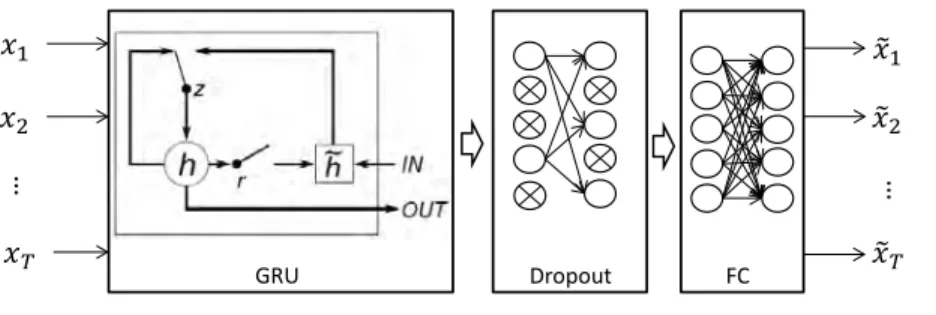
Figure 1: The GRU based recurrent auto-encoder. The model is used for video reconstruction, which contains a GRU recurrent layer, a dropout layer and a fully-connected layer. Given a video represented as a sequence x1, . . . , xT, the model can reconstruct the video as an approximation of itself.
by gradient descent methods. For further details of the GRU, please refer to [19].
Our GRU based video reconstruction model is illustrated in Figure 1. The input of the neural network is a 3D tensor, where the first dimension is the number of training videos, the second dimension is the temporal video segments,
155
and the last one is the dimensionality of the visual feature vector (d). The GRU
recurrent layer is connected to the input layer, followed by a dropout layer. The dropout layer is a simple yet effective way to reduce the over-fitting and give major improvements over other regularization methods [23]. After the dropout layer, we apply the fully-connected layer (FC) with linear activation that is
160
connected to the output. The output is exactly the same as the input video
segments. As a result, we can just apply theL2loss to optimize the parameters
in the model:
Lu=kx˜−xk2 (5)
The advantages of utilizing unsupervised recurrent learning are many: first of all, it can make a much better initialization of the neural network; second, it
165
can well reflect the temporal information between video segments; last but not least, a large number of videos without any label information can be used to
GRU GRU GRU … 𝑥1 𝑥2 𝑥𝑇
Mean pooling Dropout
… FC 𝑦1 𝑦2 𝑦𝐶 … FC …
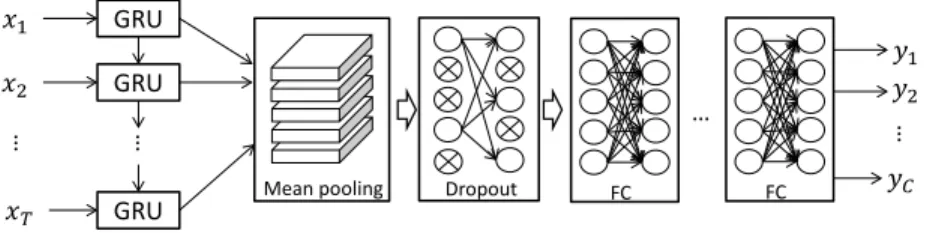
Figure 2: The prediction model for event detection, which contains a GRU layer, a dropout layer and a set of fully-connected layers. The GRU layer is initialized by the pre-trained recurrent auto-encoder in Figure 1. In the testing phase, all segments of a video first go through the GRU layer then aggregate as a vector by mean pooling. After that, the video goes through the rest of the layers to calculate the final decision value.
enhance the robustness of the model and avoid the over-fitting problem.
2.3. Supervised fine-tuning for event detection models
After the unsupervised recurrent learning, the output from the GRU layer
170
is the reconstruction of the original video segments. In the supervised learning phase, we just kept the GRU layer, removed the dropout layer and FC layer as introduced above, and added several new layers: a mean pooling layer, a new dropout layer and one or more new FC layers. The last FC layer was connected to the labels of the event categoriesy= (y1, . . . , yC) with a softmax
175
activation, andCis the number of event categories. In our experiment, we used
cross-entropy as the loss function:
Ls=−ylogf(x)−(1−y) log(1−f(x)) (6)
wheref is the final prediction function of the model. The supervised learning
model is illustrated in Figure 2.
During the supervised training phase, the weight matrix that connects the
180
dropout layer and label layer was randomly initialized and optimized, while the GRU layer only needed to be fine-tuned without dramatic fluctuations.
ID Event name ID Event name
E21 Attempting a bike trick E31 Beekeeping
E22 Cleaning an appliance E32 Wedding shower
E23 Dog show E33 Non-motorized vehicle repair
E24 Giving directions to a location E34 Fixing musical instrument
E25 Marriage proposal E35 Horse riding competition
E26 Renovating a home E36 Felling a tree
E27 Rock climbing E37 Parking a vehicle
E28 Town hall meeting E38 Playing fetch
E29 Winning a race without a vehicle E39 Tailgating
E30 Working on a metal crafts project E40 Tuning musical instrument
Table 1: Event definition
3. Experiments and discussions
3.1. Dataset and data pre-processing
We have conducted the event detection experiment on the TRECVID MED
185
Test 2014 dataset [24]. This dataset contains 8,030 training videos, and 23,953 testing videos over 20 complex events under unconstrained cases, and we have
followed the NIST official data split 100Ex to train and evaluate our model.
In the training phase there are approximately 100 positive videos for each event, while the rest are irrelevant to any pre-defined events. As our proposed
190
framework is able to deal with a large number of unlabelled videos in a “semi-supervised” way, besides all the labelled training videos, we randomly select 4,000 videos from the testing set in the procedure of recurrent video reconstruc-tion described in Secreconstruc-tion 2.2. The event names of the dataset are displayed in Table 1.
195
Recently the Convolutional Neural Network (CNN) has given a very high accuracy in image classification. With a GPU device, the deep features can be quickly extracted from the raw images, based on a pre-trained CNN model.
In our experiment we adopted the VGG ILSVRC model [25] to obtain the
visual features from the videos. In the VGG-net, the first 13 layers are 2D
convolutional and max-pooling layers, followed by 3 fully-connected layers. In
Xu et al.’s work, the descriptors from thepool5 layer can be considered as the
latent concepts [12]. The output dimension of this layer is a 7×7×512 data
cubic, thus each layer can be decomposed into 49 vectors with 512 dimensions. Applying the VLAD pooling method, the video can be finally represented as
205
a high-dimensional vector, and such video representation has been proved to outperform the same feature aggregation of 6th and 7th fully-connected layers. The reason for this is that the fully-connected layers are highly influenced by the label information of ImageNet, so they have a slight inability to be generalizable. Following Xu et al.’s work, we extracted the feature from the 5th pooling layer,
210
and applied the VLAD method to aggregate the latent concepts. As a result, each video segment is represented as a 65,536 dimensional vector.
3.2. Experimental settings
We set different output dimensions of the GRU layer: 256, 512, and 1,024 respectively. In the dropout layers in both unsupervised and supervised phases,
215
we set the dropout rate to 0.5 without any change. In the optimization proce-dure, we applied the AdaDelta algorithm [26] to optimize the parameters in the neural network.
We used the Mean Average Precision (MAP) to evaluate the detection per-formance, which is a single-valued measurement that reflects the ranking of the
220
model on testing data. The model with the higher MAP value is in favour. Our experiment was conducted on a workstation equipped with the Ubuntu operating system and a GeForce GTS Titan GPU device. We implemented the
system based on the Theano package1, which supports GPU acceleration and
automatic gradient calculation. The error threshold of the model was set to
225
10−5, and the program ran for about 3 days until convergence.
Dgru 128 256 512 1024
MAP 0.2856 0.3112 0.3283 0.3282
Table 2: The effect of the dimensions in the GRU layer
3.3. Baselines
We them compared the event detection performance of our proposed two-step neural network model with three baseline models: 1)Multiple instance SVM
(MI-SVM) [27]; 2) Inferring Temporal Instance Labels (ITIL) [3]; and 3)
230
VLAD aggregation of the pool5 feature, combined with SVM as a classifier (LCD+VLAD) [12]. In addition, we also reported the experiment results using the GRU+FC model in a purely supervised way (GRU+FC+S), i.e., without the unsupervised video reconstruction step proposed in Section 2.2. Our proposed method of applying the unsupervised GRU auto-encoder and supervised
fine-235
tuning is marked as GRU+FC+US.
3.4. Results
3.4.1. Analysis of the impact of parameters
There are two parameters to be pre-set for our proposed framework: the mapping dimension of the GRU layer in the unsupervised video reconstruction,
240
and the number of fully-connected layers in the supervised fine-tuning phase. The dimension in the GRU layer is much smaller than the input data, so the recurrent auto-encoder is considered as a non-linear dimensionality reduction with the consideration of temporal information. We set the reduced dimensions
Dgru to 128, 256, 512 and 1,024 respectively, and used a single fully-connected
245
layer for the label. The MAP performance is displayed in Table 2. The table shows when the dimension of the GRU layer is set to 256 or 512, the model can ensure similar detection performance.
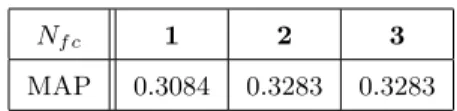
In the popular deep neural network models, there are generally two or more FC layers that are connected to the label layer. For example, the VGG net has 3
250
FC layers. The explanations are illustrated as follows: first, more FC layers can approximate more complex non-linear structures in the high-dimensional data
Nf c 1 2 3
MAP 0.3084 0.3283 0.3283
Table 3: The effect of the FC layer numbers
Model MI-SVM LCD+VLAD ITIL GRU+FC+S GRU+FC+US
MAP 0.1624 0.2805 0.2241 0.3012 0.3283
Table 4: The overall MAP comparisons of different models
space; second, the weights in the “shallower” layers that may reflect the input data structure are less affected, so this can alleviate the over-fitting problem.
We set the number of FC layers (Nf c) to 1, 2 and 3, and the resulting detection
255
performance of our model is displayed in Table 3.
From the table we can see that when there are more than two FC layers in our network model during the fine-tuning phase, the detection achieves better performance.
3.4.2. Comparisons with other MED models 260
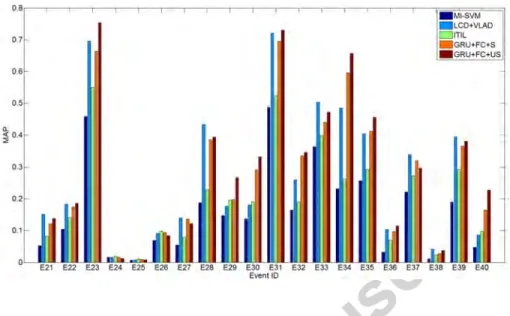
We conducted the MED experiment using all the baseline models: MI-SVM [27], LCD+VLAD [12], ITIL [3], GRU+FC+S and GRU+FC+US, and the experiment results are displayed in Figure 3 and Table 4. We can see our proposed two-step learning model outperforms others, so we can conclude that by simultaneously considering the spatial and temporal information of the
265
video segments, the data representation of the recurrent auto-encoder can bet-ter reflect the intrinsic structure of the discriminative patbet-terns. Thus our model leads to superior results, and the accuracy is very close to the MED system implemented by CMU [6].
Figure 4 shows the key frames in videos of classes E31 - E35 that are
top-270
ranked by our proposed model. We can see that our framework can successfully detect important visual cues for the events.
Figure 3: The MAP comparisons of different models (per class).
3.5. Discussions
The success of our proposed two-step learning model for the MED task can be attributed to a number of factors. First of all, the promise of the video recurrent
275
auto-encoding is that by exploiting the massive amount of unlabelled video data, we can learn a superior initial value for the weights in the GRU layer. The self-taught learning step has been proved to result in much better classifiers in the later supervised learning procedure. Second, after this unsupervised learning to reconstruct the videos, the weights in the GRU layer start at a better location
280
in the parameter space than if they are initialized at random. As a result, the gradient from such a location is more likely to yield a better minimum in the neural network, because the unlabelled videos have already provided a significant amount of prior information about the hidden patterns of the input videos. Third, applying recurrent video reconstruction may help discover some
285
temporal properties of the videos, which can boost the descriptive power of the learned video representations.
E31 E32
E34 E33
E35
Figure 4: The top 10 ranked videos for events E31 - E35 (best viewed in colour). The red boxes are misclassified videos, i.e., they are irrelevant to the pre-defined events. Our proposed deep model can successfully detect the important visual cues for these events.
4. Conclusion
In this paper we have proposed a novel framework for the MED task by conducting a two-step learning model. First we used the GRU model as an
290
unsupervised procedure for the recurrent video reconstruction, and then we used the better initialized GRU layer and mean pooling, to generate visual features for the lateral detection model. Our proposed framework simultaneously considers the spatial and temporal properties of videos, so it can effectively boost the performance of state-of-the-art MED models.
295
In the future, we aim to incorporate the deep learning techniques to a broader range of multimedia applications such as semantic video retrieval. Inspired by the recent retrieval techniques [28, 29, 30], the spatial-temporal models should also be effective in training the hash functions to facilitate the fast computations in the binary space.
300
References
[1] X. Chang, Y.-L. Yu, Y. Yang, A. G. Hauptmann, Searching persuasively: Joint event detection and evidence recounting with limited supervision, in: ACM MM, 2015, pp. 581–590.
[2] N. Gkalelis, V. Mezaris, Video event detection using generalized subclass
305
discriminant analysis and linear support vector machines, in: ACM ICMR, 2014, pp. 25–32.
[3] K.-T. Lai, F. X. Yu, M.-S. Chen, S.-F. Chang, Video event detection by inferring temporal instance labels, in: IEEE CVPR, 2014, pp. 2251–2258. [4] V. Ramanathan, K. Tang, G. Mori, L. Fei-Fei, Learning temporal
embed-310
dings for complex video analysis, arXiv:1505.00315.
[5] R. Trichet, R. Nevatia, B. Burns, Video event classification with temporal partitioning, in: IEEE AVSS, 2015, pp. 1–6.
[6] S.-I. Yu, L. Jiang, Z. Mao, X. Chang, X. Du, C. Gan, Z. Lan, Z. Xu, X. Li, Y. Cai, et al., Informedia@ trecvid 2014 med and mer, in: NIST TRECVID
315
Video Retrieval Evaluation Workshop, 2014.
[7] H. Wang, C. Schmid, Action recognition with improved trajectories, in: IEEE ICCV, 2013, pp. 3551–3558.
[8] F. Wang, Z. Sun, Y.-G. Jiang, C.-W. Ngo, Video event detection using motion relativity and feature selection, IEEE Trans. on Multimedia 16 (5)
320
(2014) 1303–1315.
[9] D. Potapov, M. Douze, Z. Harchaoui, C. Schmid, Category-specific video summarization, in: ECCV, 2014, pp. 540–555.
[10] A. Karpathy, G. Toderici, S. Shetty, T. Leung, R. Sukthankar, L. Fei-Fei, Large-scale video classification with convolutional neural networks, in:
325
IEEE CVPR, 2014, pp. 1725–1732.
[11] D. Tran, L. Bourdev, R. Fergus, L. Torresani, M. Paluri, Learning spa-tiotemporal features with 3d convolutional networks (2015) 4489–4497. [12] Z. Xu, Y. Yang, A. G. Hauptmann, A discriminative cnn video
representa-tion for event detecrepresenta-tion, in: IEEE CVPR, 2015, pp. 1798–1807.
[13] H. J´egou, M. Douze, C. Schmid, P. P´erez, Aggregating local descriptors into a compact image representation, in: IEEE CVPR, 2010, pp. 3304–3311. [14] G. E. Hinton, R. R. Salakhutdinov, Reducing the dimensionality of data
with neural networks, Science 313 (5786) (2006) 504–507.
[15] A. Graves, S. Fern´andez, F. Gomez, J. Schmidhuber, Connectionist
tem-335
poral classification: labelling unsegmented sequence data with recurrent neural networks, in: ICML, 2006, pp. 369–376.
[16] E. Marchi, F. Vesperini, F. Eyben, S. Squartini, B. Schuller, A novel ap-proach for automatic acoustic novelty detection using a denoising autoen-coder with bidirectional lstm neural networks (2015) 1996–2000.
340
[17] H. Yang, B. Wang, S. Lin, D. Wipf, M. Guo, B. Guo, Unsuper-vised extraction of video highlights via robust recurrent auto-encoders, arXiv:1510.01442.
[18] S. Hochreiter, J. Schmidhuber, Long short-term memory, Neural computa-tion 9 (8) (1997) 1735–1780.
345
[19] K. Cho, B. van Merri¨enboer, D. Bahdanau, Y. Bengio, On the properties of
neural machine translation: Encoder-decoder approaches, arXiv:1409.1259. [20] J. Chung, C. Gulcehre, K. Cho, Y. Bengio, Empirical evaluation of gated
recurrent neural networks on sequence modeling, arXiv:1412.3555.
[21] R. Jozefowicz, W. Zaremba, I. Sutskever, An empirical exploration of
re-350
current network architectures, in: ICML, 2015, pp. 2342–2350.
[22] Y. Bengio, P. Simard, P. Frasconi, Learning long-term dependencies with gradient descent is difficult, IEEE Trans. on Neural Networks 5 (2) (1994) 157–166.
[23] N. Srivastava, G. Hinton, A. Krizhevsky, I. Sutskever, R. Salakhutdinov,
355
Dropout: A simple way to prevent neural networks from overfitting, The Journal of Machine Learning Research 15 (1) (2014) 1929–1958.
[24] Trecvid med 14, http://www.nist.gov/itl/iad/mig/med14.cfm (2014). [25] K. Simonyan, A. Zisserman, Very deep convolutional networks for
large-scale image recognition, arXiv:1409.1556.
360
[26] M. D. Zeiler, Adadelta: An adaptive learning rate method,
arXiv:1212.5701.
[27] G. Doran, S. Ray, A theoretical and empirical analysis of support vector ma-chine methods for multiple-instance classification, Mama-chine Learning 97 (1) (2013) 79–102.
365
[28] F. Shen, W. Liu, S. Zhang, Y. Yang, H. Tao Shen, Learning binary codes for maximum inner product search, in: IEEE ICCV, 2015.
[29] F. Shen, C. Shen, W. Liu, H. Tao Shen, Supervised discrete hashing, in: IEEE CVPR, 2015.
[30] Y. Yang, H. Zhang, M. Zhang, F. Shen, X. Li, Visual coding in a semantic
370