TITLE: PSYCHOMETRIC VALIDATION OF THE GENERALIZED PROBLEMATIC INTERNET USE SCALE 2 IN A PORTUGUESE SAMPLE
SHORT TITLE: PORTUGUESE VALIDATION OF THE GPIUS2
Authors
Halley M. Pontes1,2 Scott E. Caplan 3 Mark D. Griffiths1,2
1Psychology Division, Nottingham Trent University, Nottingham, United Kingdom. 2
International Gaming Research Unit, Nottingham Trent University, Nottingham, United Kingdom. 3Department of Communication, University of Delaware, USA
Corresponding Author Halley M. Pontes Nottingham Trent University
Graduate School, Burton Street, NG14BU, Nottingham, United Kingdom. email: [email protected]
Highlights
A validation study of the GPIUS2 in a Portuguese-speaking sample was conducted. Participants’ potential risk of PIU was assessed using Latent Profile Analysis. The Portuguese GPIUS2 showed satisfactory psychometric properties.
Participants potential risk of PIU could be classed as low, medium, and high. The GPIUS2 is suitable for assessing PIU among Portuguese-speaking samples.
Abstract
The Generalized Problematic Internet Use Scale (GPIUS2) assesses individuals’ generalized problematic Internet use (PIU) cognitions, behaviors, and negative outcomes. To date, the GPIUS2 has only been validated in English, Spanish, German, and Italian language. Therefore, the aim of this study was to validate a Portuguese version of the GPIUS2 and provide a taxonomy of the potential risk of PIU among participants. A sample of 641 Portuguese-speaking Internet users was recruited online after a process of translation and back-translation of the original GPIUS2. In-depth validity and reliability analyses were conducted alongside latent profile analysis (LPA) to identify the potential risk of PIU of participants. The validity and reliability analyses revealed adequate results concerning the psychometric properties of the Portuguese GPIUS2. According to the LPA results, participants were classed as “low risk” (n = 289, 46.7%), “medium risk” (n = 256, 40.7%), and “high risk” (n = 77, 12.6%) of PIU with key differences emerging among the three classes. The present findings support the overall validity and usefulness of the Portuguese GPIUS2 and the results from the LPA may be potentially useful in informing practitioners currently working with clients struggling with PIU.
Key-words: Problematic Internet use; Internet addiction; Compulsive use; GPIUS2; Portuguese samples;
1. Introduction
1.1. Background
Ever since the first reports of excessive and unhealthy Internet use were published almost two decades ago (e.g., Griffiths, 1996; Young, 1996), research in this area has grown rapidly, particularly over the last decade (Pontes, Kuss, & Griffiths, 2015). Some scholars conceptualize problematic Internet use (PIU) as a disease (i.e., the pathology paradigm) while others view PIU as a problem with habits and self-regulation (i.e., the cognitive-behavioral paradigm). According to Tokunaga (2015), the term problematic Internet use (PIU) has been adopted by a majority of researchers who employ the cognitive-behavioral model (i.e., Caplan, 2002, 2010; Davis, 2001) and the social-cognitive model of unregulated Internet use developed by LaRose and colleagues (i.e., Kim, LaRose, & Peng, 2009; LaRose, Eastin, & Gregg, 2001; LaRose, Lin, & Eastin, 2003; LaRose, Mastro, & Eastin, 2001). From these perspectives, PIU is not conceptualized as a disease, pathology, or clinical disorder. Rather, the term captures a more common and relatively less severe problem than is suggested by the Internet addiction (IA) paradigm. Accordingly, PIU is usually situated by cognitive-behavioral researchers in the middle range of the continuum [of problem severity] and emphasizes the mild, benign nature of related negative outcomes (e.g., truancy, foregoing a social event). Conversely, addiction researchers place IA at the upper end of the continuum, requiring the experience of serious negative life consequences (e.g., divorce, dropping out of school, dismissal from a job, etc.) (Tokunaga, 2015).
The theoretical framework for understanding PIU initially drew upon the cognitive-behavioral theory of pathological Internet use (Davis, 2001; Davis, Flett, & Besser, 2002), which attempted to model the etiology, development, and outcomes associated with PIU. Moreover, the cognitive-behavioral model (i.e., Caplan, 2002,
2003; Davis, 2001) does not conceptualize PIU as an addiction but rather as “a distinct pattern of Internet-related cognitions and behaviors that result in negative life outcomes.” (Caplan, 2002, p. 556). Generalized PIU, which is the focus of the current study, refers to “maladaptive cognitions and behaviors related to Internet use that are not linked to any specific content as individuals may develop problems due to the unique communicative context of the Internet.” (Caplan, 2002, p. 557). Conversely, specific PIU refers to the condition in which an individual uses the Internet problematically for a particular purpose (e.g., online sex, online gambling, online gaming, etc.) (Davis, 2001). From the cognitive-behavioral perspective, PIU involves a specific cycle of innate dysfunction leading to Internet use that in turn exacerbates the dysfunction (Caplan, 2003).
When specifying the nature of maladaptive Internet behaviors, it is imperative to distinguish between PIU and excessive use. According to Caplan (2003, 2006), excessive Internet use involves a quantity or degree of online activity that exceeds what a person thinks of as normal, usual, or planned, whereas PIU involves difficulty with impulse control that plays a key role in the development of negative outcomes from Internet use. As a result, the quantity or amount of time online is not necessarily indicative of a problem because many functional Internet behaviors require excessive time online (Caplan, 2003, 2006; Caplan & High, 2006).
Many studies have found PIU to be associated with a variety of psychosocial problems. For example, researchers have identified associations between PIU and increased social anxiety (Weinstein, Dorani, Elhadif, Bukovza, & Yarmulnik, 2015), higher levels of depression (Pontes, Patrão, & Griffiths, 2014), a higher incidence of attention deficit and hyperactivity disorder (Sariyska, Reuter, Lachmann, & Montag, 2015), lower levels of family functioning and life satisfaction (Wartberg, Kriston,
Kammerl, Petersen, & Thomasius, 2015), increased loneliness in the educational context (Pontes, Griffiths, & Patrão, 2014), poorer emotional well-being (Piguet, Berchtold, Akre, & Suris, 2015), and increased substance use behaviors (Kuss, van Rooij, Shorter, Griffiths, & van de Mheen, 2013; Rücker, Akre, Berchtold, & Suris, 2015).
Although there are ongoing debates regarding the best way to conceptualize PIU (see Pies, 2009; Shaffer, Hall, & Vander Bilt, 2000; Van Rooij & Prause, 2014; Tokunaga, 2015), longitudinal evidence may help shed light on the issue. A recent longitudinal study conducted by Tokunaga (2014) of 139 undergraduate students in the US found that PIU predicted later difficulties in familial relationships, friendships, and academic or occupational responsibilities, even when underlying psychological problems (i.e., social anxiety, loneliness, and depression) were controlled for. Despite the study’s limitations (e.g., small sample size, use of self-report data, etc.), the longitudinal design provided preliminary evidence that PIU may be a unique construct that can be distinguished from underlying psychiatric disorders and that may be associated with psychosocial problems.
As an attempt to move forward the conceptualization and measurement of PIU, Caplan’s work (Caplan, 2002, 2003, 2005, 2010; Caplan & High, 2006, 2010) sought to clarify and expand the main constructs of the cognitive-behavioral theory of PIU (Davis, 2001) by developing two theory-driven instruments to assess generalized PIU and also empirically test the underlying relationships between the main PIU constructs (Caplan, 2002, 2003, 2010). The first of these two instruments, the Generalized Problematic Internet Use Scale (GPIUS), assesses the prevalence of cognitions, behaviors, and the negative outcomes associated with generalized PIU (Caplan, 2002). The GPIUS originally had seven factors, six of which were related to generalized PIU
cognitions (i.e., mood alteration, social benefits, compulsivity, excessive time, withdrawal, and interpersonal control) and one representing the negative consequences or outcomes resulting from unhealthy Internet use (i.e., negative outcomes) (Caplan, 2002).
After showing that generalized PIU was a multidimensional phenomenon, Caplan (2002) noted that two of the seven original factors of the GPIUS (i.e., social benefits and perceived social control) were of particular relevance in that they could help operationally distinguish generalized PIU from specific PIU. In addition to developing the GPIUS, Caplan also found in his initial GPIUS study that negative outcomes occurring due to PIU were predicted by psychosocial health (i.e., loneliness) and PIU-related cognitions and behaviors (i.e., social benefits, compulsive use, excessive time, withdrawal, and social control) (Caplan, 2002).
More recently, Caplan developed the Generalized Problematic Internet Use Scale 2 (GPIUS2) (Caplan, 2010), a revised version of the GPIUS (Caplan, 2002) grounded upon Davis’ cognitive-behavioral theory of pathological Internet use (Davis, 2001), Caplan’s own works with preference for online social interaction (Caplan, 2003, 2005), and the socio-cognitive model of unregulated Internet use (i.e., Kim et al., 2009; LaRose, Eastin, et al., 2001; LaRose et al., 2003; LaRose, Mastro, et al., 2001). The GPIUS2 operationalizes four main constructs: preference for online social interaction, mood regulation, deficient self-regulation, and negative outcomes. Preference for online social interaction is an important cognitive symptom of generalized PIU characterized by beliefs that one is safer, more efficacious, more confident, and more comfortable with online interpersonal interactions and relationships than with traditional face-to-face social activities (Caplan, 2003, 2010).
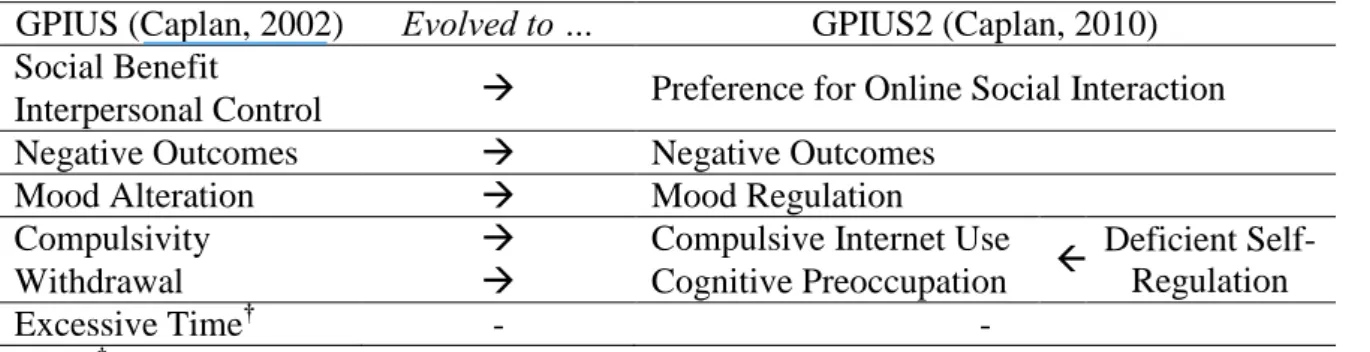
Additionally, mood regulation is as a cognitive symptom of generalized PIU reflecting individuals’ motivation to use the Internet in order to enhance their mood states. Deficient self-regulation refers to the failure experienced by individuals when they attempt to adequately monitor and judge their Internet usage when trying to adjust their pattern of Internet use (Caplan, 2010). Deficient self-regulation is operationalized as a higher-order construct in the GPIUS2 model reflecting the interplay between cognitive preoccupation (i.e., obsessive thought patterns involving the use of the Internet) and compulsive Internet use symptoms (i.e., behavioral and compulsive nature of poorly regulated Internet use) of generalized PIU (Caplan, 2010). Table 1 depicts the conceptual evolution of the GPIUS to the current GPIUS2 model.
[Insert Table 1 about here.]
1.2. Internet use and PIU findings in Portugal
Internet use is widespread and has grown steadily over time in Portugal and yet, with the exception of a few published peer-reviewed studies (e.g., Patrão, Rita, & Pontes, 2013; Pontes, Griffiths, et al., 2014; Pontes & Patrão, 2014; Pontes, Patrão, et al., 2014), research into Portuguese Internet use is sparse. The latest official report from the Portuguese government on the use of the Internet in Portugal (i.e., Instituto Nacional de Estatística, 2014) estimated that about 65% of the entire Portuguese population aged between 16 and 74 years old now use the Internet on a regular basis. Furthermore, Internet use in Portugal is more widespread amongst the younger population as the highest proportion of Internet users are those between the ages of 16 and 24 years (Instituto Nacional de Estatística, 2014).
A recent study conducted by Pontes and Patrão (2014) with a sample of 144 Portuguese Internet users found that 77% of the participants reported using the Internet on their cell phones while the most frequently used channel for accessing the Internet was via laptop computers (43.1%), followed by desktop computers (34%). Additionally, participants reported spending an average of 28 hours a week for leisure purposes on the Internet, and had been Internet users for an average of 13 years. Additionally, a recent pilot study conducted by Pontes, Griffiths, et al. (2014) found that a relatively high percentage (13%) of the sample were potentially struggling with IA. However, a larger study in Portugal found a more conservative prevalence rate of IA that was around 1.2% (Pontes, Patrão, et al., 2014). Although these figures may seem incongruent due to their discrepancy, they provide some preliminary evidence that a small minority of Portuguese Internet users suffer from IA (Pontes, Griffiths, et al., 2014; Pontes, Patrão, et al., 2014). Such findings also suggest a need for further research and better screening and assessment tools that can be used in the Portuguese cultural context.
1.3. Study Aims and Objectives
Because most of the existing research on Portuguese samples is limited by the use of the IAT (Young, 1998), developing an alternative measure that is able to capture variables from the cognitive-behavioral model (i.e., GPIUS2) has become paramount due to the existing conceptual shortcomings present in the addiction paradigm (see Tokunaga, 2015). Consequently, several potential benefits could arguably emerge from validating a measure to assess PIU in Portugal. First, Portuguese researchers will have a well validated PIU instrument that captures different aspects of PIU than the IAT measure. Second, the GPIUS2 may be a more useful tool for building and testing theory since it does not suffer from well-known shortcomings present in the IAT, such as
limited utility (Kim, Park, Ryu, Yu, & Ha, 2013) and within the IA paradigm (see Starcevic, 2016; Starcevic & Aboujaoude, 2016).
In light of the aforementioned rationale, the main aim of the present study was twofold: (i) to evaluate the validity and reliability of the GPIUS2 in a sample of Portuguese Internet users and (iii) to examine the GPIUS2 in relation to another similar and yet conceptually different instrument (i.e., the IAT) and other comorbid conditions (i.e., depression, stress, and anxiety).
2. Method
2.1. Participants and procedures
A heterogeneous sample of 641 Portuguese-speaking Internet users was recruited online using convenience sampling (i.e., nonprobability sampling) over a period of 10 months (August 2014 to May 2015). Data collection was carried out online with the help of social networks websites such as Facebook, LinkedIn, and Twitter
where invitations to participate in the study were sent out at different time points to recruit participants via online posts. Participants were encouraged to disseminate the survey’s link amongst their online peers. The final sample had a relatively even gender split (52.1% male) and a mean age of 25 years (SD = 9.64; range = 10-74) (see Table 2). In order to develop the Portuguese version of the GPIUS2 (see Appendix A), standard back-translation protocols were adopted (i.e., Harkness, Pennell, & Schoua-Glusberg, 2004). All 15 items were subjected to a preliminary English to Portuguese translation by the first author of this study, and then back-translated from Portuguese to English by an experienced bilingual psychologist for comparison purposes. After comparing the translated and back-translated versions of the Portuguese GPIUS2, a final Portuguese version of the instrument was achieved by matching both versions. The
items were further refined via feedback from ten Internet users that piloted the Portuguese GPIUS2. This further helped in strengthening the face validity of the newly translated instrument.
2.2. Measures
2.2.1. Socio-demographics and Internet Usage
The survey included questions related to participants’ main socio-demographic characteristics and Internet-related usage patterns (e.g., age, gender, preference of Internet access, frequency and intensity of Internet use, etc.).
2.2.2. Generalized Problematic Internet Use Scale - 2 (GPIUS2)
The GPIUS2 (Caplan, 2010) is a multidimensional psychometric tool that comprises 15 items assessing the degree of generalized PIU cognitions, behaviors, and negative outcomes experienced by individuals. The scale’s factor structure (Caplan, 2010) operationalizes PIU by measuring five constructs: (i) preference for online social interaction; (ii) mood regulation; (iii) cognitive preoccupation; (iv) compulsive Internet use; and (v) negative outcomes. Each construct is measured with a 3-item subscale. The GPIUS2 includes a sixth second-order factor (i.e., “deficient self-regulation”) comprising the compulsive Internet use and cognitive preoccupation subscales. The GPIUS2 is rated on a 7-point Likert scale (i.e., 1 = “Strongly disagree”; 2 = “Disagree”; 3 = “Slightly disagree”; 4 = “Neutral”; 5 = “Slightly agree”; 6 = “Agree”; and 7 = “Strongly agree”) and an overall GPIUS2 index score may be computed by summing the 15 items of the scale, which will result in scores ranging from 15 to 105. Alternatively, a composite score can be created by averaging participants’ scores on all 15 items, resulting in possible scores ranging from 1 to 7, with higher scores indicating
greater intensity of generalized PIU cognitions, behaviors, and negative outcomes (Caplan, 2010).
2.2.3. Internet Addiction Test (IAT)
The IAT (Young, 1998) includes 20 items that are rated on a 6-point Likert (i.e., 0 = “Does not apply”; 1 = “Rarely”; 2 = “Occasionally”; 3 = “Frequently”; 4 = “Often”; 5 = “Always”). The IAT can be used to assess the extent of a person’s involvement with the Internet and classify Internet-related addictive behaviors in terms of mild, moderate, and severe impairment based on participant’s total score (Young, 2011). Although there are currently two different ad hoc cut-off points (i.e., cut-offs not based on empirical nor clinical analyses) that were proposed for the IAT (see Young, 1998, 2011), participants’ total scores can be obtained by summing up the responses provided to all items of the IAT and can range from 0 to 100, with higher scores being indicative of greater levels of IA symptoms. In the present study, the Portuguese version of the IAT was administered as it has been previously shown to be valid and reliable in this population (Pontes, Patrão, et al., 2014). The Cronbach’s alpha of the IAT in the present study was .91.
2.2.4. Depression Anxiety and Stress Scale - 21 (DASS-21)
The DASS-21 (Lovibond & Lovibond, 1995) was employed to assess participants’ levels of depression, anxiety, and stress (e.g., “I found it hard to wind down.”). The DASS-21 comprises three 7-item subscales covering depression, anxiety,
and stress symptoms using a response format on a 4-point Likert scale (i.e., 0 = “Did not apply to me at all”; 1 = “Applied to me to some degree or some of the time”, 2 = “Applied to me a considerable degree, or a good part of the time; and 3 = “Applied to
me very much, or most of the time”). Scores for each scale are obtained by summing the items of each subscale and may be converted to the full scale scores by multiplying by 2, thus the total scores for each subscale can range from 0 to 42, with higher scores indicating greater levels of psychological distress. The version of the DASS-21 used in the present study has been previously shown to be valid and reliable in the Portuguese context (Pais-Ribeiro, Honrado, & Leal, 2004). The Cronbach’s alpha of the DASS-21 subscales in the present study were .89 (depression), .82 (anxiety), and .87 (stress).
2.3. Data analytic strategy and statistical analysis
Prior to the statistical analyses, the data were cleaned across two stages. In the first stage, the data were cleaned via a thorough analysis of each case presenting with missing values above the threshold of 10% in all relevant instruments of the study. As a result, 18 cases were excluded due to severe incompleteness. The second stage of the data management process involved the analysis of the (i) univariate normality of all 15 items of the GPIUS2, (ii) univariate outliers, and (iii) multivariate outliers among the dataset. As for the univariate normality, no item of the GPIUS2 had absolute values of Skewness > 3.0 and Kurtosis > 8.0 (Kline, 2011), thus warranting univariate normality of the study’s main measure. In order to screen for univariate outliers, a standardized composite sum score of the GPIUS2 using all 15 items was created and participants were deemed univariate outliers if they scored ± 3.29 standard deviations from the GPIUS2 z-scores. This threshold was chosen because it includes around 99.9% of the normally distributed GPIUS2 z-scores (Field, 2013). As a result, one additional case was excluded. Finally, the data were also screened for multivariate outliers using Mahalanobis distances and the critical value for each case based on the chi-square distribution values, which resulted in no further exclusion of participants. Thus, the final
sample size for all subsequent analyses was N = 622. All the analyses were performed using MPLUS 7.2 (Muthén & Muthén, 2012) and SPSS Statistics v.20 (IBM Corp, 2011).
The statistical analysis comprised (i) descriptive statistics of the main sample’s characteristics (i.e., frequencies and percentages), (ii) assessment of the dimensionality and factorial structure of the GPIUS2 with confirmatory factor analysis (CFA), (iii) validity analysis by investigating convergent and discriminant validity of the GPIUS2 based on the average variance extracted [AVE] coefficients of each latent variable and further examination of the bootstrapped Pearson’s correlation coefficients with 95% Bias-corrected and accelerated (BCa) confidence intervals between the GPIUS2 and other relevant measures (i.e., IAT, depression, anxiety, stress, and daily and weekly hours spent on the Internet), (iv) analysis of the reliability of the GPIUS2 using different coefficients and indicators of internal consistency (i.e., Cronbach’s alpha, composite reliability, and factor determinacies), and (v) a latent profile analysis (LPA) to identify and describe the latent profiles of the sample in terms of their potential risk of PIU. The LPA was based on participants’ responses to the four subscales of the GPIUS2, with the resulting final classes being subjected to Wald’s chi-square test using several socio-demographic and Internet-related variables alongside the psychological distress subscales to further explore the validity of the GPIUS2. This provided additional information on the characteristics and specificities of each identified latent class.
To test the dimensionality of the GPIUS2, two main models were examined via CFA: a six-factor solution model (i.e., Model A) as originally suggested by Caplan (2010), which included preference for online social interaction, mood regulation, and negative outcomes as first-order factors and deficient self-regulation as a second-order factor comprised by the cognitive preoccupation and compulsive Internet use subscales,
and a model previously validated by Fioravanti, Primi, and Casale (2013) with preference for online social interaction, mood regulation, negative outcomes, and deficient regulation as first-order factors (i.e., Model B), in which deficient self-regulation was operationally defined and modeled as a first-order factor as opposed to a second-order factor as in Model A.
3. Results
3.1. Descriptive Statistics
Participants’ main socio-demographic characteristics and Internet use patterns are presented in Table 2. In terms of relationship status, half of the participants were in a relationship (n = 310, 50%). Additionally, most participants were students (n = 328, 52.8%) and spent an average of 4 hours (SD = 3.4 hours) per day and 29 hours (SD = 21.3 hours) per week on the Internet for leisure purposes. Participants reported initiating the use of the Internet around at the age of 14 years (SD = 7.7 years) while the most preferred channel for accessing the Internet was via laptop computer (n = 260, 48.8%) followed by cell phone (n = 143, 26.8%). Finally, participants’ most preferred location for accessing the Internet was at home (n = 433, 76.6%) and the least preferred place was at the school/university (n = 20, 3.5%).
[Insert Table 2 about here.]
3.2. Dimensionality and Factorial Validity
A CFA was performed on the 15 items of the GPIUS2 using maximum likelihood estimation method with robust standard errors (MLR) on the whole sample (N = 622) in order to test the two main competing models (i.e., Model A vs. Model B)
of the GPIUS2 as suggested by previous studies (i.e., Caplan, 2010; Fioravanti et al., 2013). The following fit indices and thresholds were adopted to examine the goodness of fit of the models being tested: χ2/df [1;4], Root Mean Square Error of Approximation (RMSEA) [0.05;0.08], RMSEA 90% confidence interval with its lower limit close to 0 and the upper limit below .08, p-close > .05, Standardized Root Mean Square Residual (SRMR) [0.05;0.08], Comparative Fit Index (CFI) and Tucker-Lewis Fit Index (TLI) [.90;.95] (see Bentler, 1990; Bentler & Bonnet, 1980; Hooper, Coughlan, & Mullen, 2008; Hu & Bentler, 1999).
The results obtained when testing the original six-factor solution (i.e., Model A) showed a poor overall fit (χ2 [82] = 374.2, χ2/df = 4.6; RMSEA = 0.076 [90% CI: 0.068–0.084], p-close = < .001; SRMR = 0.051, CFI = .89; TLI = .86). Additionally, the results of the CFA performed on Model B also yielded poor fit (χ2 [84] = 377.7, χ2/df = 4.5; RMSEA = 0.075 [90% CI: 0.067–0.083], p-close < .001; SRMR = 0.051, CFI = .89; TLI = .86). However, an inspection of the modification indices, suggested covarying three error terms of items pertaining to the same factor (i.e., 13 and 14, 4 and 9, and 11 and 1). This may be a result of the relatively similar wording and underlying latent construct being assessed by these indicators. After adding these constraints, a third nested model of the GPIUS2 was tested (i.e., Model Bmodified) and the goodness of
fit improved considerably in comparison to the previous two models (χ2 [81] = 242.9,
χ2/df = 2.9; RMSEA = 0.057 [90% CI: 0.049–0.065], p-close = .09; SRMR = 0.045, CFI = .94; TLI = .93). This latter model resulted in overall better fit indices and acceptable standardized item loadings (i.e., λij ≥ .50) (see Figure 1) and thus, the model
fit the data well.
In order to assess which model had a statistically significant better fit, information theory fit indices such as the Akaike Information Criteria [AIC], Bayesian Information Criteria [BIC], and Sample-size Adjusted Bayesian Information Criteria [SSABIC] were examined to compare the two non-nested models of the GPIUS2 (i.e., Model A vs. Model B). Additionally, a Satorra-Bentler scaled chi-square different test (i.e., S-BΔχ2) was computed to ascertain the degree of fit of the nested models being tested against each other (i.e., Model B vs. Model Bmodified). As shown in Table 3, Model
Bmodified fitted the data significantly better than Model B.
[Insert Table 3 about here.]
3.3. Validity and Reliability Analysis
Convergent and discriminant validity were analyzed using the approach suggested by Fornell and Larcker (1981). Accordingly, convergent validity is achieved if a given latent construct presents an AVE ≥ .50 whereas discriminant validity can be demonstrated when the square root of the AVE for each latent construct is higher than the correlations between it and the rest of the latent constructs (Fornell & Larcker, 1981; Hair, Black, Babin, & Anderson, 2010). As shown in Table 4, the values obtained for the AVE of each latent construct fell between .50 (Deficient Self-Regulation) and .68 (Mood Regulation). With regard to the discriminant validity of the GPIUS2, the square root of the AVE for each latent construct is also presented in Table 4 and is located in bold on the diagonal of the table. Results demonstrated that the value for each latent construct was higher than the correlations between it and the other constructs, further warranting the discriminant validity of each latent construct of the GPIUS2.
[Insert Table 4 about here.]
In order to further examine the validity of the GPIUS2 as an overall construct reflecting the degree of generalized PIU cognitions, behaviors, and negative outcomes experienced by participants, a correlational analysis using bootstrapped Pearson’s correlation coefficients with 95% BCa confidence intervals tested its associations to other relevant measures (i.e., IAT, depression, anxiety, stress, daily and weekly Internet use), that have been previously shown to be associated with PIU (see Barke, Nyenhuis, & Kröner-Herwig, 2014; Fioravanti et al., 2013; Gámez-Guadix, Villa-George, & Calvete, 2012; Laconi, Tricard, & Chabrol, 2015; Meerkerk, Van den Eijnden, Franken, & Garretsen, 2010; Özdemir, Kuzucu, & Ak, 2014; Pontes & Griffiths, 2015; Tokunaga, 2014). As shown in Table 5, the associations between the overall GPIUS2 score and the main variables of interest ranged from medium to large effects. Most notably, GPIUS2 was positively associated with the IAT (r = .75, p < .01) to a higher degree and positively associated with daily Internet use (r = .30, p < .01) to a lower degree. These findings lend further empirical support to the overall convergent, concurrent, and criterion-related validity of the GPIUS2.
[Insert Table 5 about here.]
Finally, the reliability of the GPIUS2 as assessed by the Cronbach’s alpha, ranged from .78 (Negative Outcomes) to .86 (Deficient Self-Regulation) (see Table 4). Additionally, factor determinacies were all well above the conventional threshold of ≥ .80 (Mónok et al., 2012; Muthén & Muthén, 2012; Schembre & Geller, 2011) while all
composite reliability coefficients also exceeded the desired threshold of ≥ .70 (Fornell & Larcker, 1981; Hair et al., 2010). Overall, these results illustrate that the GPIUS2 demonstrated adequate validity and reliability at several levels.
3.4. Latent Profile Analysis (LPA)
An LPA was carried out in order to characterize participants’ potential risk of PIU based on their class membership. The LPA procedure is a mixture modeling statistical procedure used to identify groups of individuals (categorical latent variables) that give similar responses to specific continuous variables (Collins & Lanza, 2010), which in the context of the present study were participants’ responses to the four latent constructs comprising the GPIUS2 (i.e., preference for online social interaction, mood regulation, negative outcomes, and deficient self-regulation). The LPA was conducted with two to four classes and multiple fit indices were used to help establish the optimal number of latent classes, such as (i) the AIC, BIC, and SSABIC with lower values indicating more parsimonious models, (ii) the entropy criterion which is used in order ascertain the accuracy of classifying participants into their respective profiles (i.e., higher values suggesting better fit), and (iii) the Lo-Mendell-Rubin Adjusted Likelihood Ration Test (L-M-R Test) to help determining the final number of classes, where a significant p value (i.e., < .05) indicates that the tested model fits better than the previous one (Muthén & Muthén, 2012).
Table 6 summarizes the results obtained from the LPA, with two to four classes, that was performed on the four dimensions of the GPIUS2. Using the aforementioned criteria, the three-class solution was chosen as it was deemed the optimal solution for the data collected. Although the values of the information theory fit indices (i.e., AIC, BIC, and SSABIC) did not decrease convincingly and the entropy values obtained
suggested that the two-class solution had the best value for this statistic while the four-class solution the worst, a further inspection of the L-M-R test values and their levels of significance clearly indicated that the four-class solution should be rejected in favor of the preceding three-class solution, even though the decrease in the information criteria fit indices were not too consistent across the three class solutions as one would have expected.
[Please insert Table 6 about here.]
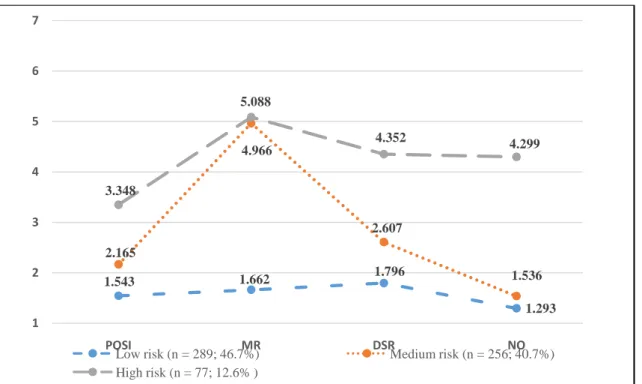
The final three latent classes and their characteristics are presented in Figure 2. The first identified class (i.e., “low risk”) features Internet users presenting a low risk of PIU (n = 289, 46.7%) as they scored generally low on all four dimensions of the GPIUS2, and thus exhibited lower levels of PIU. Additionally, participants belonging to this class had an average score of 24.68 on the GPIUS2 (SD = 7.28, 95% CI [23.84-25.52]). Moreover, the second identified class (i.e., “medium risk”) included Internet users exhibiting a relatively medium risk of PIU (n = 256, 40.7%). The main feature of Internet users in this class is that they scored markedly high on the “Mood Regulation” dimension and low on the remaining dimensions of the GPIUS2. Furthermore, the mean score for these participants on the GPIUS2 was 43.06 (SD = 9.90, 95% CI [41.84-44.28]). Finally, the third class (i.e., “high risk”) included a smaller proportion of users presenting the highest risk for developing PIU (n = 77, 12.6%) as their scores on all four dimensions of the GPIUS2 were generally higher than the other two classes. Although participants in this class are not considered to be problematic Internet users per se, they scored particularly high on the “Mood Regulation”, “Deficient Self-Regulation”, and “Negative Outcomes” dimensions. Participants belonging to this class had an observed
mean score of 65.16 on the GPIUS2 (SD = 9.75, 95% CI [62.95-67.37]), which was significantly greater than the other two classes.
In order to help characterize the final three classes obtained in the LPA while also providing further evidence of the GPIUS2’s validity (i.e., convergent, concurrent, and criterion-related validity), Wald’s square tests were computed. The Wald’s chi-square test of mean equality is used for latent class predictors in mixture modeling as it takes into account the probabilistic nature of the LPA classes (see www.statmodel.com/download/meaantest2.pdf for further information). Therefore, the three classes were compared across a relevant set of variables related to PIU such as gender, age, relationship status, age of Internet use initiation, daily and weekly Internet usage, GPIUS2, IAT, depression, anxiety, and stress total scores.
[Please insert Table 7 about here.]
As shown in Table 7, age, relationship status, and age of Internet use initiation were not significantly different across the three classes. However, the gender variable differed significantly between the “medium risk” and “high risk” classes (χ2
= 4.5, p = .03), with the “high risk” group containing a greater proportion of males. In terms of daily and weekly hours spent on the Internet, differences were relatively consistent and steady across the three classes with participants showing increased risk of PIU spending generally more hours on the Internet during their leisure time. Finally, all three classes differed significantly in terms of participants’ overall scores on the GPIUS2, IAT, depression, anxiety, and stress scales, with participants with membership to the “high risk” class exhibiting higher levels of PIU and psychological distress in general in
comparison to the “low risk” and “medium risk” classes. These findings provide preliminary support for the validity of the Portuguese GPIUS2.
4. Discussion
The main aims of the present study were to further investigate the psychometric properties of the GPIUS2 and validate it in the Portuguese cultural context using a heterogeneous sample of Portuguese-speaking Internet users. To achieve these goals, several statistical analyses examined and compared competing models of the GPIUS2 that had been previously established in the literature. The analyses also assessed the validity and reliability of the Portuguese GPIUS2 at several levels using different statistical indicators. Finally, but importantly, LPA and Wald’s chi-square tests were performed on the data to ascertain participants’ latent profiles and establish their potential risk of PIU based on the GPIUS2 scores.
As suggested by the results of the CFA, the best fitting factor solution found for the GPIUS2 in the present study included preference for online social interaction, mood regulation, negative outcomes, and deficient self-regulation as first-orders factors. Thus, deficient self-regulation was operationally defined in this model as a single latent factor comprising the indicators pertaining to the compulsive Internet use and cognitive preoccupation factors and not as a second-order latent factor that includes compulsive Internet use and cognitive preoccupation separately. Furthermore, the factor structure of the GPIUS2 found in the present study replicates the one reported in a similar Italian study (Fioravanti et al., 2013).
There may be two possible, non-mutually exclusive, explanations for this finding. At the sampling level, the main characteristics of both the Italian and Portuguese samples are more similar in nature (i.e., Latin) than the sample included in
Caplan’s (2010) study (i.e., US students). Furthermore, at the methodological level, several validation studies of the GPIUS2 (see Barke et al., 2014; Caplan, 2010; Gámez-Guadix, Orue, & Calvete, 2013; Gámez-Guadix et al., 2012) found very high correlations (i.e., close to 1) between the deficient self-regulation factor and compulsive Internet use and cognitive factors when deficient self-regulation was operationalized as second-order factor. This suggests that deficient self-regulation may be best conceptualized as combination of compulsive behavior and cognitive preoccupation. For instance, Gámez-Guadix et al. (2013) found in a CFA that the regression path from deficient self-regulation leading to cognitive preoccupation was .99. Moreover, Barke et al. (2014) found that deficient self-regulation had an association of .90 with cognitive preoccupation and .99 with compulsive Internet use respectively. These could also be potentially indicative of multicollinearity between these factors due to the overlap between them, thus, operationalizing deficient self-regulation as a first-order factor might not only be best from a statistical point of view, but also from a conceptual standpoint as this factor structure appears to reflect a simpler and less complicated structure of the GPIUS2. This finding both adds to and extends the existing literature on PIU by providing empirical evidence concerning questions that recent studies have raised about how to best conceptualize deficient self-regulation (e.g., Barke et al., 2014; Gámez-Guadix et al., 2013).
Regarding the validity of the GPIUS2, the results provided highly robust evidence in terms of convergent, discriminant, concurrent, and criterion-related validity. Specifically, convergent validity was warranted both at the subscale (i.e., each latent construct of the GPIUS2 had an AVE ≥ .50) and overall construct level (i.e., as per the positive association between the GPIUS2 and the IAT). Moreover, discriminant validity was demonstrated at the subscale level (i.e., the square root of the AVE for each latent
construct of the GPIUS2 was higher than the correlations between it and the other constructs). Additionally, the results demonstrated concurrent validity with the positive associations found between the GPIUS2 and the other scales (i.e., depression, anxiety, and stress scales). Finally, the scale demonstrated criterion-related validity with a positive association found between the GPIUS2 and daily and weekly Internet use (as presented in Tables 5 and 7). Taken as a whole, these results are in line with recent studies that found the GPIUS2 to be correlated with the IAT (Barke et al., 2014; Fioravanti et al., 2013), as well as several other studies showing that PIU is positively associated with depression (Barke et al., 2014; Gámez-Guadix et al., 2012), anxiety (Akin & Iskender, 2011; Gámez-Guadix et al., 2012), stress (Akin & Iskender, 2011; Jun & Choi, 2015; Orosová, Benka, Sebena, & Gajdošová, 2014), and time spent online (Gámez-Guadix et al., 2012; Siciliano et al., 2015). The results also indicate the GPIUS2 is reliable and internally consistent, as assessed by several indicators such as the Cronbach’s alpha, composite reliabilities, and factor determinacies.
In order to characterize participants’ potential risk of PIU, an LPA analysis was conducted. Interestingly, the results revealed three latent classes according to participants’ risk of PIU and their responses to the GPIUS2. Participants in the “low risk” class accounted for almost half of the sample (i.e., 46.7%) and were characterized as experiencing very few PIU cognitions, behaviors, and/or negative outcomes. Participants with “medium risk” of PIU represented 40.7% of the total sample and tended to use the Internet more often as a way of enhancing their mood as demonstrated by the markedly high scores on the mood regulation subscale of the GPIUS2. The third and final class comprised 12.6% of the total sample and featured participants showing “high risk” of PIU cognitions, behaviors, and negative outcomes due to Internet use.
Overall, these results illustrate distinct underlying patterns and differences of Internet use among participants with varying degrees of PIU severity.
The current paper advances the literature on PIU by employing LPA analysis to shed further light on how the GPIUS2 captures varying degrees of PIU severity and how the scale may be used to identify the latent profiles of problematic Internet users. Procedures such as Latent Class Analysis (LCA) and LPA are gaining popularity in the gaming studies field. For instance, Wartberg et al. (2015) conducted a large study in a representative quota sample of 1,723 young adolescents from Germany in order to characterize the sample based on their latent profiles and establish the prevalence rate of PIU among German adolescents. In their study, five latent profiles of adolescents Internet users were found and a class of “high risk” Internet users comprising 3.2% of the total sample (57.1% male) was used to establish the prevalence rate of PIU. The authors further reported that Internet users classed as “high risk” scored significantly higher in the Compulsive Internet Use Scale (CIUS) (Meerkerk, Van Den Eijnden, Vermulst, & Garretsen, 2009) in comparison to the other profiles identified in the LPA, and showed that length of time spent using the Internet as well as the highest frequency of difficulties were associated with PIU.
In another recent study using LCA and the CIUS to establish the prevalence of PIU in a large representative sample in Germany (i.e., Rumpf et al., 2014), the authors found six latent classes of Internet users. Furthermore, Rumpf and colleagues found that the small proportion of participants belonging to the sixth class scored significantly higher on the CIUS and spent more hours on the Internet during the week in comparison to the remaining classes. These findings are similar to those in the present study in which the overall score on the GPIUS2 increased in the “high risk” group in comparison to the other two groups. Moreover, future studies could expand on these findings by
further examining how well the GPIUS2 identifies and replicates the classes found here in other samples and cultural contexts. However, more studies, including Portuguese samples, should be carried out in order to better characterize how PIU may be impacting on the Portuguese society as a whole since little is known about PIU in this context. The present study makes an important contribution to advancing research on the cognitive-behavioral model of problematic Internet use by validating a measure to be used on Portuguese populations as an alternative to IA measures, which has been criticized for failing to fully operationalize the construct (see Tokunaga & Rains, 2016).
Although the present study provides preliminary evidence for the validity and reliability of the Portuguese GPIUS2 as well as offering a number of important contributions to the literature, it is not without its limitations. The current study used a convenience sample of Portuguese-speaking Internet users that was not necessarily representative of all Internet users in Portugal. Therefore, the present findings should be cautiously interpreted and not generalized to a broader population. Additionally, the use of self-report questionnaires may have resulted in biases such as social desirability biases and short-term recall biases.
Despite these limitations, the findings of this study provide robust evidence of validity and reliability of the Portuguese GPIUS2. The results suggest that the GPIUS2 is a valid alternative measure of PIU that can be used in the Portuguese cultural context. Furthermore, practitioners working with clients struggling with PIU may benefit from the findings of the present study as they can be potentially useful in providing further information regarding clients’ patterns of Internet use and the implicit factors associated with their motivation and/or consequences for using the Internet excessively. Put simply, while some people engage in maladaptive Internet use because they use it extensively as a means to cope with negative mood states or as a result of their
overwhelming preference for socializing online, other types of Internet users may experience negative outcomes due to their preference for online social interaction, cognitive preoccupation, and compulsive use. Overall, the present study provides further evidence that PIU is both a cognitive and behavioral phenomenon, and that it warrants further study in Portugal. An additional contribution of the study is that it tested the relationships hypothesized by the cognitive-behavioral model of PIU among a population that has not previously been examined, and the results also provide further support to previous studies that have examined some of these relationships.
References
Akin, A., & Iskender, M. (2011). Internet addiction and depression, anxiety and stress.
International Online Journal of Educational Sciences, 3, 138-148.
Barke, A., Nyenhuis, N., & Kröner-Herwig, B. (2014). The German version of the Generalized Problematic Internet Use Scale 2 (GPUIS2): a validation study.
Cyberpsychology, Behavior, and Social Networking, 17(7), 474-482. doi: 10.1089/cyber.2013.0706
Bentler, P. M. (1990). Comparative Fit indexes in structural models. Psychological Bulletin, 107(2), 238-246. doi: 10.1037/0033-2909.107.2.238
Bentler, P. M., & Bonnet, D. G. (1980). Significance tests and goodness of fit in the analysis of covariance structures. Psychological Bulletin, 88(3), 588-606. doi: 10.1037/0033-2909.88.3.588
Caplan, S. E. (2002). Problematic internet use and psychosocial well-being: development of a theory-based cognitive–behavioral measurement instrument.
Computers in Human Behavior, 18(5), 553-575. doi: 10.1016/S0747-5632(02)00004-3
Caplan, S. E. (2003). Preference for online social interaction a theory of problematic internet use and psychosocial well-being. Communication Research, 30(6), 625-648. doi: 10.1177/0093650203257842
Caplan, S. E. (2005). A social skill account of problematic internet use. Journal of Communication, 55(4), 721-736.
Caplan, S. E. (2006). Problematic Internet use in the workplace. In M. Anandarajan, T.S.H. Teo, & C. A. Simmers (Eds.), The Internet and workplace transformation
(pp. 63-79). Armonk, NY: M. E. Sharpe.
Caplan, S. E. (2010). Theory and measurement of generalized problematic internet use: a two-step approach. Computers in Human Behavior, 26(5), 1089-1097. doi: 10.1016/j.chb.2010.03.012
Caplan, S. E., & High, A. C. (2006). Beyond excessive use: the interaction between cognitive and behavioral symptoms of problematic internet use. Communication Research Reports, 23(4), 265-271. doi: 10.1080/08824090600962516
Caplan, S. E., & High, A. C. (2010). Online social interaction, psychosocial well-being, and problematic internet use. In K. Young & C. Nabuco de Abreu (Eds.),
Internet Addiction: A Handbook and Guide to Evaluation and Treatment (pp. 35-53). Hoboken, NJ: John Wiley & Sons, Inc.
Collins, L. M., & Lanza, S. T. (2010). Latent class and latent transition analysis: With applications in the social, behavioral, and health sciences. Hoboken, NJ: John Wiley & Sons.
Davis, R. A. (2001). A cognitive-behavioral model of pathological internet use.
Computers in Human Behavior, 17(2), 187-195. doi: 10.1016/S0747-5632(00)00041-8
Davis, R. A., Flett, G. L., & Besser, A. (2002). Validation of a new scale for measuring problematic internet use: implications for pre-employment screening.
CyberPsychology & Behavior, 5(4), 331-345. doi:
10.1089/109493102760275581
Field, A. (2013). Discovering statistics using ibm spss statistics (4th edition). London: SAGE Publications Ltd.
Fioravanti, G., & Casale, S. (2015). Evaluation of the psychometric properties of the italian Internet Addiction Test. Cyberpsychology, Behavior, and Social
Fioravanti, G., Primi, C., & Casale, S. (2013). Psychometric evaluation of the generalized problematic internet use scale 2 in an italian sample.
Cyberpsychology, Behavior, and Social Networking, 16(10), 761-766. doi: 10.1089/cyber.2012.0429
Fornell, C., & Larcker, D. F. (1981). Evaluating structural equation models with unobservable variables and measurement error. Journal of Marketing Research, 18(1), 39-50. doi: 10.2307/3151312
Gámez-Guadix, M., Orue, I., & Calvete, E. (2013). Evaluation of the cognitive-behavioral model of generalized and problematic internet use in Spanish adolescents. Psicothema, 25(3), 299-306. doi: 10.7334/psicothema2012.274 Gámez-Guadix, M., Villa-George, F. I., & Calvete, E. (2012). Measurement and
analysis of the cognitive-behavioral model of generalized problematic internet use among Mexican adolescents. Journal of Adolescence, 35(6), 1581-1591. doi: 10.1016/j.adolescence.2012.06.005
Griffiths, M. D. (1996). Internet "addiction": an issue for clinical psychology? Clinical Psychology Forum, 97, 32-36.
Hair, J. F., Black, W. C., Babin, B. J., & Anderson, R. E. (2010). Multivariate data analysis. A global perspective (7th ed.). New Jersey: Pearson Prentice Hall. Harkness, J., Pennell, B. E., & Schoua-Glusberg, A. (2004). Survey questionnaire
translation and assessment. In S. Presser, J.M. Rothgeb, M.P. Couper, J.T. Lessler, E. Martin, J. Martin & E. Singer (Eds.), Methods for Testing and Evaluating Survey Questionnaires (pp. 453-473). Hoboken, NJ: John Wiley & Sons.
Hooper, D., Coughlan, J., & Mullen, M. R. (2008). Structural equation modelling: guidelines for determining model fit. Electronic Journal of Business Research Methods, 6(1), 53-60.
Hu, L. T., & Bentler, P. M. (1999). Cutoff criteria for fit indexes in covariance structure analysis: conventional criteria versus new alternatives. Structural Equation Modeling: A Multidisciplinary Journal, 6(1), 1-55. doi: 10.1080/10705519909540118
IBM Corp. (2011). IBM SPSS Statistics for windows, version 20.0. New York: IBM Corp.
Instituto Nacional de Estatística. (2012). 60% das pessoas dos 16 aos 74 anos utilizam Internet e 35% destas efetuam o acesso em mobilidade. Lisbon. Retrieved from: https://www.ine.pt/xportal/xmain?xpid=INE&xpgid=ine_destaques&DESTAQ UESdest_boui=133548413&DESTAQUESmodo=2&xlang=pt.
Instituto Nacional de Estatística. (2014). Mais de metade dos utilizadores da internet fazem-no em mobilidade. Lisbon. Retrieved from: https://www.ine.pt/xportal/xmain?xpid=INE&xpgid=ine_destaques&DESTAQ UESdest_boui=211422849&DESTAQUESmodo=2&xlang=pt.
Jun, S., & Choi, E. (2015). Academic stress and internet addiction from general strain theory framework. Computers in Human Behavior, 49, 282-287. doi: 10.1016/j.chb.2015.03.001
Kim, J., LaRose, R., & Peng, W. (2009). Loneliness as the cause and the effect of problematic internet use: the relationship between internet use and psychological well-being. CyberPsychology & Behavior, 12(4), 451-455. doi: 10.1089/cpb.2008.0327
Kim, S. J., Park, D-H., Ryu, S-H., Yu, J., & Ha, J. H. (2013). Usefulness of Young's Internet Addiction Test for clinical populations. Nordic Journal of Psychiatry,
Kline, R. B. (2011). Principles and practice of structural equation modeling (3rd edition). New York: Guildford Press.
Kuss, D. J., van Rooij, A. J., Shorter, G. W., Griffiths, M. D., & van de Mheen, D. (2013). Internet addiction in adolescents: prevalence and risk factors. Computers in Human Behavior, 29(5), 1987-1996. doi: 10.1016/j.chb.2013.04.002
Laconi, S., Tricard, N., & Chabrol, H. (2015). Differences between specific and generalized problematic internet uses according to gender, age, time spent online and psychopathological symptoms. Computers in Human Behavior, 48, 236-244. doi: 10.1016/j.chb.2015.02.006
LaRose, R., Eastin, M. S., & Gregg, J. (2001). Reformulating the internet paradox: social cognitive explanations of internet use and depression. Journal of Online Behavior, 1(2), No Pagination Specified.
LaRose, R., Lin, C. A., & Eastin, M. S. (2003). Unregulated internet usage: addiction, habit, or deficient self-regulation? Media Psychology, 5(3), 225-253. doi: 10.1207/S1532785XMEP0503_01
LaRose, R., Mastro, D., & Eastin, M. S. (2001). Understanding internet usage: a social-cognitive approach to uses and gratifications. Social Science Computer Review, 19(4), 395-413. doi: 10.1177/089443930101900401
Lovibond, P. F., & Lovibond, S. H. (1995). The structure of negative emotional states: comparison of the depression anxiety stress scales (DASS) with the Beck depression and anxiety inventories. Behaviour Research and Therapy, 33(3), 335-343. doi: 10.1016/0005-7967(94)00075-U
Meerkerk, G. J., Van den Eijnden, R. J. J. M., Franken, I. H. A., & Garretsen, H. F. L. (2010). Is compulsive internet use related to sensitivity to reward and punishment, and impulsivity? Computers in Human Behavior, 26(4), 729-735. doi: 10.1016/j.chb.2010.01.009
Meerkerk, G. J., Van Den Eijnden, R. J. J. M., Vermulst, A. A., & Garretsen, H. F. L. (2009). The compulsive internet use scale (cius): some psychometric properties.
CyberPsychology & Behavior, 12(1), 1-6. doi: 10.1089/cpb.2008.0181
Mónok, K., Berczik, K., Urbán, R., Szabo, A., Griffiths, M. D., Farkas, J., Magi, A., Eisinger, A., Kurimay, T., Kökönyei, G., Kun, B., Paksi, B., & Demetrovics, Z. (2012). Psychometric properties and concurrent validity of two exercise addiction measures: a population wide study. Psychology of Sport and Exercise, 13(6), 739-746. doi: 10.1016/j.psychsport.2012.06.003
Muthén, L. K., & Muthén, B. O. (2012). Mplus user’s guide seventh edition. Los Angeles: Muthén & Muthén.
Orosová, O., Benka, J., Sebena, R., & Gajdošová, B. (2014). Gender, optimism, perceived stress on problematic internet use among Slovak university students. In C. Pracana (Ed.), Psychology Applications & Developments (pp. 306-315). Lisbon: Science Press.
Özdemir, Y., Kuzucu, Y., & Ak, Ş. (2014). Depression, loneliness and internet addiction: how important is low self-control? Computers in Human Behavior, 34, 284-290. doi: 10.1016/j.chb.2014.02.009
Pais-Ribeiro, J., Honrado, A., & Leal, I. (2004). Contribuição para o estudo da adaptação portuguesa das escalas de ansiedade, depressão e stress (EADS) de 21 itens de Lovibond e Lovibond [Contribution to the Portuguese validation study of Lovibond and Lovibond's short version of the depression anxiety and stress scale (DASS)]. Psicologia, Saúde & Doenças, 5(2), 229-239
Patrão, I. M., Rita, J. S., & Pontes, H. M. (2013). Internet addiction and loneliness among portuguese elementary school students: an exploratory quantitative study.
Atencion Primaria, 45(Supplment 2), 132–188. doi: 10.1016/S0212-6567(13)70034-9
Pies, R. (2009). Should DSM-V designate “internet addiction” a mental disorder?
Psychiatry (Edgmont), 6(2), 31-37.
Piguet, C., Berchtold, A., Akre, C., & Suris, J-C. (2015). What keeps female problematic internet users busy online? European Journal of Pediatrics, 1-7. doi: 10.1007/s00431-015-2503-y
Pontes, H. M., & Griffiths, M. D. (2015). The role of age, age of internet access initiation, and time spent online in the etiology of internet addiction. Journal of Behavioral Addictions, 4(Suppl. 1), 30-31. doi: 10.1556/JBA.4.2015.Suppl.1 Pontes, H. M., Griffiths, M. D., & Patrão, I. M. (2014). Internet addiction and loneliness
among children and adolescents in the education setting: an empirical pilot study. Aloma: Revista de Psicologia, Ciències de l'Educació i de l'Esport, 32(1), 91-98.
Pontes, H. M., Kuss, D. J., & Griffiths, M. D. (2015). Clinical psychology of internet addiction: a review of its conceptualization, prevalence, neuronal processes, and implications for treatment. Neuroscience and Neuroeconomics, 4, 11-23. doi: 10.2147/NAN.S60982
Pontes, H. M., & Patrão, I. M. (2014). Estudo exploratório sobre as motivações percebidas no uso excessivo da internet em adolescentes e jovens adultos [An exploratory study on the perceived motivations underpinning excessive internet use among adolescents and young adults]. Psychology, Community & Health, 3(2), 90-102. doi: 10.5964/pch.v3i2.93
Pontes, H. M., Patrão, I. M., & Griffiths, M. D. (2014). Portuguese validation of the Internet Addiction Test: an empirical study. Journal of Behavioral Addictions, 3(2), 107-114. doi: 10.1556/JBA.3.2014.2.4
Rücker, J., Akre, C., Berchtold, A., & Suris, J-C. (2015). Problematic internet use is associated with substance use in young adolescents. Acta Paediatrica. doi: 10.1111/apa.12971
Rumpf, H. J., Vermulst, A. A., Bischof, A., Kastirke, N., Gürtler, D., Bischof, G., Meerkerk, G.J., John, U., & Meyer, C. (2014). Occurence of internet addiction in a general population sample: a latent class analysis. European Addiction Research, 20(4), 159-166. doi: 10.1159/000354321
Sariyska, R., Reuter, M., Lachmann, B., & Montag, C. (2015). Attention deficit/hyperactivity disorder is a better predictor for problematic internet use than depression: evidence from Germany. Journal of Addiction Research & Therapy, 6(209). doi: 10.4172/2155-6105.1000209
Schembre, S. M., & Geller, K. S. (2011). psychometric properties and construct validity of the weight-related eating questionnaire in a diverse population. Obesity, 19(12), 2336-2344. doi: 10.1038/oby.2011.96
Shaffer, H. J., Hall, M. N., & Vander Bilt, J. (2000). "Computer addiction": a critical consideration. American Journal of Orthopsychiatry, 70(2), 162-168. doi: 10.1037/h0087741
Siciliano, V., Bastiani, L., Mezzasalma, L., Thanki, D., Curzio, O., & Molinaro, S. (2015). Validation of a new short problematic internet use test in a nationally representative sample of adolescents. Computers in Human Behavior, 45, 177-184. doi: 10.1016/j.chb.2014.11.097
Starcevic, V. (2016). Internet addiction: Rarely an addiction and not the Internet that one is addicted to. Paper presented at the 3rd International Conference on Behavioral Addictions, Geneva.
Starcevic, V., & Aboujaoude, E. (2016). Internet addiction: reappraisal of an increasingly inadequate concept. CNS Spectrums, 1-7. doi:10.1017/S1092852915000863
Tokunaga, R. S. (2014). A unique problem or the manifestation of a preexisting disorder? the mediating role of problematic internet use in the relationships between psychosocial problems and functional impairment. Communication Research, 41(4), 531-560. doi: 10.1177/0093650212450910
Tokunaga, R. S. (2015). Perspectives on internet addiction, problematic internet use, and deficient self-regulation: contributions of communication research. In E.L. Cohen (Ed.), Communication Yearbook 30 (pp. 131-161). New York: Routledge.
Van Rooij, A., & Prause, N. (2014). A critical review of “internet addiction” criteria with suggestions for the future. Journal of Behavioral Addictions, 3(4), 203-213. doi: 10.1556/JBA.3.2014.4.1
Wartberg, L., Kriston, L., Kammerl, R., Petersen, K. U., & Thomasius, R. (2015). Prevalence of pathological internet use in a representative German sample of adolescents: results of a latent profile analysis. Psychopathology, 48(1), 25-30. doi: 10.1159/000365095
Weinstein, A., Dorani, D., Elhadif, R., Bukovza, Y., & Yarmulnik, A. (2015). Internet addiction is associated with social anxiety in young adults. Annals of Clinical Psychiatry, 27(1), 2-7.
Young, K. S. (1996). Psychology of computer use: xl. addictive use of the internet: a case that breaks the stereotype. Psychological Reports, 79(3), 899-902. doi: 10.2466/pr0.1996.79.3.899
Young, K. S. (1998). Caught in the net: how to recognize the signs of internet addiction - and a winning strategy for recovering. New York: John Wiley & Sons, Inc. Young, K. S. (2011). Clinical assessment of internet-addicted clients. In K.S. Young &
C. Abreu (Eds.), Internet Addiction: A Handbook and Guide to Evaluation and Treatment (pp. 19-34). New Jersey: John Wiley & Sons.
Acknowledgements
This work was supported by the Portuguese Foundation for Science and Technology (Fundação para a Ciência e Tecnologia [FCT]) with a grant (number: SFRH/BD/112857/2015) that was awarded to Halley M. Pontes. The
supporting agency had no role in the design and conduct of the study; collection, management, analysis, and interpretation of the data; and preparation, review, or approval of the article.
Table 1.The Evolving Model of the Generalized Problematic Internet Use Scales. GPIUS (Caplan, 2002) Evolved to … GPIUS2 (Caplan, 2010) Social Benefit
Preference for Online Social Interaction Interpersonal Control
Negative Outcomes Negative Outcomes
Mood Alteration Mood Regulation
Compulsivity Compulsive Internet Use
Deficient
Self-Regulation
Withdrawal Cognitive Preoccupation
Excessive Time† - -
Note: † Factor omitted from the GPIUS2 on the basis of new empirical evidence showing that excessive amounts of time does not necessarily translated into problematic Internet use.
Table 2.Sample’s Main Socio-Demographic Characteristics and Internet use Patterns.
N 622
Gender (male, %) 323 (52.1)
Age (years) (mean, SD) 25.17 (9.6)
Relationship status (In a relationship, %) 310 (50) Occupational Status† (n, %)
Working 192 (30.9)
Studying 328 (52.8)
Working and Studying 58 (9.3)
Unemployed 43 (6.9)
Daily Internet usage (hours) (mean, SD) 4.7 (3.4)
Weekly Internet usage 29.9 (21.3)
Age of Internet use initiation (years) (mean, SD) 14.68 (7.7) Preferred channel of Internet access (n, %)
Cell phone 143 (26.8)
Tablet 32 (6)
Desktop computer 94 (17.6)
Laptop 260 (48.8)
Other 4 (.8)
Preferred location for accessing the Internet (n, %)
Home 433 (76.6)
Workplace 55 (9.7)
School/University 20 (3.5)
No specific place (e.g., mobile phone) 53 (9.4)
Other 4 (.7)
Table 3. Summary of the goodness of fit statistics for the various nested and non-nested model comparisons of the Generalized Problematic Internet Use Scale 2.
Model AIC BIC SSABIC S-BΔχ2 Δdf p CFI TLI RMSEA p-close
Model A 30677 30912 30744 - - - .89 .86 0.076 < .001
Model B 30689 30915 30753 - - - .89 .86 0.075 < .001
Model Bmodified 30514 30753 30582 767.23 1 < .001 .94 .93 0.057 .09 Note: Model A: initially proposed model for the Generalized Problematic Internet Use Scale 2 scale as in Caplan (2010);Model B: the four first-order factors model with deficient self-regulation as a first-first-order factor as suggested by Fioravanti, Primi and Casale (2013); Model Bmodified: Model B with the inclusion of covariances between the three residuals of the items 13 and 14, 4 and 9, and 11 and 1.
Abbreviations: AIC:Akaike Information Criteria; BIC: Bayesian Information Criteria; SSABIC: Sample-size Adjusted Bayesian Information Criteria; S-BΔχ2: Satorra-Bentler scaled Chi-square difference test; Δdf: difference in degrees of freedom between nested models; p:p-value of the S-BΔχ2; CFI: Comparative Fit Index; TLI: Tucker-Lewis Index; RMSEA: Root Mean Square Error of Approximation; p-close: Close fitting model probability.
Table 4. Reliability, Convergent, and Discriminant Validity of the Generalized Problematic Internet Use Scale 2. Construct Cronbach’s alpha Factor determinacies Composite reliability AVE Correlation Matrix POSI MR NO DSR POSI .80 .91 .77 .54 .73 MR .84 .96 .86 .68 .42 .82 NO .78 .91 .78 .54 .55 .39 .74 DSR .86 .93 .85 .50 .51 .47 .67 .71
Abbreviations: AVE: Average Variance Extracted; POSI: Preference for Online Social Interaction; MR: Mood Regulation;
NO: Negative Outcomes; DSR:Deficient Self-Regulation.
Table 5. Bootstrapped1 correlation matrix with 95% Bias-corrected and accelerated confidence interval between the GPIUS2 and relevant study variables.
Measure GPIUS2 BCa 95% CI R2
IAT .75* .71;.77 .56
Depression .42* .34;.50 .18
Anxiety .32* .23;.40 .10
Stress .37* .30;.47 .14
Daily Internet use .30* .20;.39 .10
Weekly Internet use .32* .23;.40 .10
Abbreviations: GPIUS2: Generalized Problematic Internet Use Scale 2;IAT: Young’s Internet Addiction Test;
Table 6. Summary of the Goodness of Fit Obtained from the Latent Profile Analysis (LPA)a.
Number of
Latent Classes AIC BIC SSABIC Entropy
L-M-R
Test P
2 7968 8025 7984 0.959 708 < .001
3 7702 7782 7724 0.893 267 < .001
4 7609 7711 7638 0.864 99 .27
Note:a: The best loglikelihood value has been successfully replicated across all analyses even after a twofold increasing of the random starts.
Abbreviations: AIC: Akaike Information Criteria; BIC: Bayesian Information Criteria; SSABIC: Sample-size Adjusted Bayesian Information Criteria; L-M-R Test: Lo-Mendell-Rubin Adjusted Likelihood Ratio Test Value; P: p value associated with the L-M-R Test.