Generalized Latent Factor Models for Social Network Analysis
Wu-Jun Li
†, Dit-Yan Yeung
‡, Zhihua Zhang
]†
Shanghai Key Laboratory of Scalable Computing and Systems
Department of Computer Science and Engineering, Shanghai Jiao Tong University, China
‡
Department of Computer Science and Engineering
Hong Kong University of Science and Technology, Hong Kong, China
]
College of Computer Science and Technology, Zhejiang University, China
[email protected], [email protected], [email protected]
Abstract
Homophily and stochastic equivalence are two primary features of interest in social networks. Recently, themultiplicative latent factor model
(MLFM) is proposed to model social net-works with directed links. Although MLFM can capture stochastic equivalence, it cannot model well homophily in networks. However, many real-world networks exhibit homophily or both homophily and stochastic equivalence, and hence the network structure of these net-works cannot be modeled well by MLFM. In this paper, we propose a novel model, called
generalized latent factor model (GLFM), for so-cial network analysis by enhancing homophily modeling in MLFM. We devise a minorization-maximization(MM) algorithm with linear-time complexity and convergence guarantee to learn the model parameters. Extensive experiments on some real-world networks show that GLFM can effectively model homophily to dramati-cally outperform state-of-the-art methods.
1
Introduction
A social network1[Wasserman and Faust, 1994] is often
represented as a graph in which the nodes represent the objects and the edges (or called links) represent the bi-nary relations between objects. The edges in a graph can be directed or undirected. If the edges are directed, we call the graph a directed graph. Otherwise, the graph is an undirected graph. Unless otherwise stated, we focus on directed graphs in this paper because an undirected edge can be represented by two directed edges with oppo-site directions. Some typical networks include friendship networks among people, web graphs, and paper citation networks.
As pointed out by [Hoff, 2008],homophilyand stochas-tic equivalence are two primary features of interest in social networks. If an edge is more likely to exist tween two nodes with similar characteristics than
be-1
In this paper, we use the terms ‘network’, ‘social network’ and ‘graph’ interchangeably.
tween those nodes having different characteristics, we say the graph exhibits homophily. For example, two individuals are more likely to be friends if they share common interests. Hence, a friendship graph has the feature of homophily. On the other hand, if the nodes of a graph can be divided into groups where members within a group have similar patterns of links, we say this graph exhibits stochastic equivalence. The web graph has such a feature because some nodes can be described as hubs which are connected to many other nodes called authorities but the hubs or authorities are seldom con-nected among themselves. For stochastic equivalence, the property that members within a group have similar patterns of links also implies that if two nodes link to or are linked by one common node, the two nodes most likely belong to the same group.
Examples of homophily and stochastic equivalence in directed graphs are illustrated in Figure 1, where the locations in the 2-dimensional space denote the charac-teristics of the points (nodes). From Figure 1(a), we can see that a link is more likely to exist between two points close to each other, which is the property of homophily. In Figure 1(b), the points form three groups associated with different colors, and the nodes in each group share similar patterns of links to nodes in other groups, but the nodes in the same group are not necessarily con-nected to each other. This is the property of stochastic equivalence. Note that in a graph exhibiting stochastic equivalence, two points close to each other are not nec-essarily connected to each other and connected points are not necessarily close to each other, which is different from the property of homophily.
(a) homophily (b) stochastic equivalence Figure 1: Homophily and stochastic equivalence in net-works.
As social network analysis (SNA) is becoming more and more important in a wide range of applications, many SNA models have been proposed [Goldenberg et al., 2009]. In this paper, we focus on latent variable models[Bartholomew and Knott, 1999] which have been successfully applied to model social networks [Hoff, 2008; Nowicki and Snijders, 2001; Hoff et al., 2002; Kemp
et al., 2006; Airoldi et al., 2008; Hoff, 2009]. These models include: the latent class model [Nowicki and Snijders, 2001] and its extensions [Kemp et al., 2006; Airoldi et al., 2008], the latent distance model [Hoff et al., 2002], the latent eigenmodel [Hoff, 2008], and the multiplicative latent factor model (MLFM) [Hoff, 2009]. Among all these models, the recently proposed latent eigenmodel, which includes both the latent class model and the latent distance model as special cases, can cap-ture both homophily and stochastic equivalence in net-works. However, it can only model undirected graphs. MLFM [Hoff, 2009] adapts the latent eigenmodel for di-rected graphs. However, as to be shown in our experi-ments, in fact it cannot model well homophily.
In this paper, we propose a novel model, called gen-eralized latent factor model (GLFM), for social network analysis by enhancing homophily modeling in MLFM. The learning algorithm of GLFM is guaranteed to con-verge to a local optimum and has linear-time complexity. Hence, GLFM can be used to model large-scale graphs. Extensive experiments on community detection in some real-world networks show that GLFM dramatically out-performs existing methods.
2
Notation and Definition
We use boldface uppercase letters, such asK, to denote matrices, and boldface lowercase letters, such as x, to denote vectors. The ith row and the jth column of a matrixKare denoted asKi∗ andK∗j, respectively. Kij
denotes the element at theith row andjth column inK. xidenotes theith element inx. We use tr(K) to denote
its trace, KT for its transpose andK−1 for its inverse.
k · k is used to denote the length of a vector. | · |
de-notes the cardinality of a set. Idenotes the identity ma-trix whose dimensionality depends on the context. For a matrixK,K0 means thatKis positive semi-definite (psd) andK0 means thatKis positive definite (pd).
K M means K−M 0. N(·) denotes the normal distribution, either for scalars or vectors. ◦denotes the Hadamard product (element-wise product).
Let N denote the number of nodes in a graph. Ais the adjacency (link) matrix for the N nodes. Aij = 1
if there exists a link from node ito node j. Otherwise, Aij = 0. D denotes the number of latent factors. In
real-world networks, if Aij = 1, we can say that there
is a relation from i to j. However, Aij = 0 does not
necessarily mean that there is no relation from i to j. In most cases,Aij = 0 means that the relationship from
i to j is missing. Hence, we use an indicator matrix Z
to indicate whether or not an element is missing. More specifically, Zij = 1 means that Aij is observed while
Zij= 0 means that Aij is missing.
3
Multiplicative Latent Factor Models
The latent eigenmodel is formulated as follows2:
Θik= log odds(Aik= 1|Xi∗,Xk∗, µ) =µ+Xi∗ΛXTk∗,
whereXis anN×Dmatrix withXi∗denoting the latent
representation of nodeiandµ is a parameter reflecting the overall density of the links in the network,Λis aD×
Ddiagonal matrix with the diagonal entries being either positive or negative. The latent eigenmodel generalizes both latent class models and latent distance models. It can model both homophily and stochastic equivalence in
undirected graphs [Hoff, 2008].
To adapt the latent eigenmodel for directed graphs, MLFM defines
Θik=µ+Xi∗ΛWTk∗, (1)
whereXand Whave orthonormal columns. Note that the key difference between the latent eigenmodel and MLFM lies in the fact that MLFM adopts a different
receiverfactor matrixWwhich enables MLFM to model directed (asymmetric) graphs. As we will show in our experiments, this modification in MLFM makes it fail to model homophily in networks.
LettingΘ= [Θik]Ni,k=1, we can rewrite MLFM as
fol-lows:
Θ=µE+XΛWT, (2)
whereEis anN×N matrix with all entries being 1. We can find that MLFM is a special case of the fol-lowing model:
Θ=µE+UVT. (3)
For example, we can get MLFM by settingU=Xand
V =WΛ. Furthermore, it is easy to compute the X,
Wand Λin (2) based on the learned Uand V in (3). Hence, in the sequel, MLFM refers to the model in (3).
4
Generalized Latent Factor Models
As discussed above, MLFM can capture stochastic equiv-alence but cannot model well homophily in directed graphs. Here, we propose our GLFM to enhance ho-mophily modeling in MLFM.
4.1
Model
In GLFM, Θik is defined as follows: Θik=µ+ 1 2Ui∗U T k∗+ 1 2Ui∗V T k∗. (4)Comparing (4) to (3), we can find that GLFM gener-alizes MLFM by adding an extra termUi∗UTk∗.3 It is
2
Note that in this paper, we assume for simplicity that there is no attribute information for the links. It is straight-forward to integrate attribute information into the existing latent variable models as well as our proposed model.
3
Note that the coefficient 12 in (4) makes no essential dif-ference between (4) and (3). It is only for convenience of computation.
this extra term that enables GLFM to model homophily in networks, which will be detailed in Section 4.2 when we analyze the objective function in (7). This will also be demonstrated empirically later in our experiments.
Based on (4), the likelihood of the observations can be defined as follows: p(A|U,V, µ) =Y i6=k [SAik ik (1−Sik)1−Aik]Zik, (5) where Sik= exp (Θik) 1 + exp(Θik) . (6)
Note that as in the conventional SNA model, we ignore the diagonal elements of A. That is, in this paper, we setAii=Zii= 0 by default.
Furthermore, we put normal priors on the param-eters µ, U and V: p(µ) = N(µ|0, τ−1), p(U) = QD d=1N(U∗d|0, βI), p(V) = QD d=1N(V∗d|0, γI).
4.2
Learning
Although the Markov chain Monte Carlo (MCMC) al-gorithms designed for other latent variable models can easily be adapted for GLFM, we do not adopt MCMC here for GLFM because MCMC methods typically incur very high computational cost. In this paper, we adopt themaximum a posteriori(MAP) estimation strategy to learn the parameters. The log posterior probability can be computed as follows: L=X i6=k n1 2AikUi∗U T k∗+ 1 2AikUi∗V T k∗+Aikµ −Ziklog 1 + exp(Θik) o − 1 2βtr(UU T)− 1 2γtr(VV T)−τ 2µ 2+c, (7)
where c is a constant independent of the parameters. Note that in (7) we assume that all existing links should be observed. That is to say, ifAik= 1, thenZik= 1.
The term AikUi∗UTk∗ in (7) results from the extra
term Ui∗UTk∗ in (4). In (7), to maximize the objective
function L, we have to make Ui∗UTk∗ as large as
pos-sible if there exists a link between nodes i and k (i.e., Aik = 1). This conforms to the property of homophily,
i.e., a link is more likely to exist between two nodes with similar characteristics than between those nodes having different characteristics. Note that here the latent fac-torUi∗ reflects the characteristics of nodei. Therefore,
the extra term Ui∗UTk∗ in (4) enables GLFM to model
homophily in networks.
If we directly optimize all the parameters U, V and µjointly, the computational cost will be very high. For example, if we want to use the second-order information, generally we need to invert the Hessian matrix where the time complexity is cubic in the number of parameters.
Here, we adopt an alternating projection strategy to maximize L. More specifically, each time we optimize one parameter, such as U, with the other parameters fixed.
Learning U
To learn U, we optimize each row of it with all other rows fixed. The gradient vector and Hessian matrix can be computed as follows: ∂L ∂UT i∗ =−1 βU T i∗+ 1 2V ThAT i∗−(Zi∗◦Si∗)T i +1 2U ThAT i∗+A∗i−(Zi∗◦Si∗)T −Z∗i◦S∗i i , ∂2L ∂UT i∗∂Ui∗ =−1 βI− 1 4 X k,k6=i n ZkiSki(1−Ski)UTk∗Uk∗ o −1 4 X k,k6=i n ZikSik(1−Sik)[Uk∗+Vk∗]T[Uk∗+Vk∗] o .
Because both the gradient vector and Hessian matrix depend on Si∗ which is a function of Ui∗, we have to
resort to iterative methods to find the optimal values. Here, we devise aminorization-maximization (MM) al-gorithm [Langet al., 2000] to learn it. MM is a so-called expectation-maximization (EM) algorithm [Dempsteret al., 1977] without missing data, alternating between con-structing a concave lower bound of the objective function and maximizing that bound.
Because 0< Sik<12, we can get Sik(1−Sik)<14.
Let us define: Hi=− 1 βI− 1 16 X k,k6=i n Zik[Uk∗+Vk∗]T[Uk∗+Vk∗] o − 1 16 X k,k6=i n ZkiUTk∗Uk∗ o .
It is easy to prove that ∂U∂T2L
i∗∂Ui∗ Hi. Let f(Ui∗) =L(Ui∗(t)) + [Ui∗−Ui∗(t)]× ∂L ∂UT i∗ (t) +1 2[Ui∗−Ui∗(t)]Hi(t)[Ui∗−Ui∗(t)] T,
where Ui∗(t) denotes the value of the former iteration
and Hi(t) is computed with the updated U except for
Ui∗.
Then we have the following theorem:
Theorem 1 L(Ui∗) ≥ f(Ui∗), which means that
f(Ui∗)is a lower bound ofL(Ui∗).
The proof of Theorem 1 is simple and we omit it here. We can see thatf(Ui∗) has a quadratic form of Ui∗.
By setting the gradient off(Ui∗) with respect toUi∗ to
0, we have the update rule forUi∗:
Ui∗(t+ 1) =Ui∗(t)− h ∂L ∂UT i∗ (t)i T ×Hi(t)−1.
Learning V
The gradient vector and Hessian matrix of Vi∗ can be
computed as follows: ∂L ∂VTi∗ =− 1 γV T i∗+ 1 2U ThA ∗i−(Z∗i◦S∗i) i ∂2L ∂VT i∗∂Vi∗ =−1 γI− 1 4 X k,k6=i n ZkiSki(1−Ski)UTk∗Uk∗ o . Let Gi = −γ1I− 161 Pk,k6=i n ZkiUTk∗Uk∗ o , we can prove that ∂V∂T2L i∗∂Vi∗ Gi.
Similar to the update rule forUi∗, we can obtain the
update rule forVi∗ as follows:
Vi∗(t+ 1) =Vi∗(t)− h ∂L ∂VT i∗ (t)i T ×Gi(t)−1,
where Vi∗(t) denotes the value of the former iteration
andGi(t) is computed with the updated parameters
ex-cept forVi∗.
Learning µ
Using similar learning techniques as those forUandV, we can get the update rule forµ:
µ(t+ 1) =µ(t) +4[ P k6=i(Aik−ZikSik)−τ µ(t)] 4τ+P k6=iZik .
4.3
Convergence and Computational
Complexity
With the MM algorithm, the learning procedure of GLFM is guaranteed to converge to a local maximum.
The time complexity to compute the gradient and Hes-sian for node i is linear to the total number of ones in both Z∗i and Zi∗. In general, this number is O(1)
be-cause the observations in real networks are always very sparse. Furthermore, since Hi and Gi are D×D, the
computational complexity to invert the Hessian matrices isO(D3). Typically,D is a very small number. Hence,
to update the wholeUandV, onlyO(N) time is needed.
5
Experiment
There exist many different SNA tasks such as social po-sition and role estimation [Wasserman and Faust, 1994], link prediction [Hoff, 2009], node classification [Liet al., 2009a; Li and Yeung, 2009; Liet al., 2009b], community detection [Yanget al., 2009a], and so on. In this paper, we adopt the same evaluation strategy as that in [Yang
et al., 2009a; 2009b] for social community detection. The main reason for choosing this task is that from our model formulation we can clearly see the difference between GLFM and other latent factor models. However, many other models from different research communities have also been proposed for SNA. It is difficult to figure out the connection and difference between those models and GLFM from the formulation perspective. Hence, we use empirical evaluation to compare them. Most mainstream models have been compared in [Yang et al., 2009a;
2009b] for community detection, which provides a good platform for our empirical comparison.
For MLFM and GLFM, we adoptk-means to perform clustering based on the normalized latent representation
U. Here normalization means that the latent represen-tation of each node is divided by its length. Because the magnitude ofUi∗reflects the activity of i, we select the
most active user as the first seed of the k-means, and then choose a point as the seed of the next community if summation of the distances between this point and all the existing seeds is the largest one. Hence, the initial-ization of k-means is fixed. We set Z = A. For fair comparison, the hyper-parameters in GLFM and all the baselines to be compared, such as theτ in (7), are cho-sen from a wide range and the best results are reported. More specifically, for GLFM, theτ is fixed to 106,β and γare set to 2, andD= 20.
5.1
Data Sets and Evaluation Metric
As in [Yang et al., 2009a], we use two paper citation networks, Cora and Citeseer data sets4, for evaluation.
Both data sets contain content information in addition to the directed links.
The Cora data set contains 2708 research papers from the 7 subfields of machine learning: case-based reason-ing, genetic algorithms, neural networks, probabilistic methods, reinforcement learning, rule learning, and the-ory. Each paper is described by a 0/1-valued word vec-tor indicating the absence/presence of the corresponding word from a dictionary of 1433 unique words. There are overall 5429 citations (links) between the papers.
The Citeseer data set contains 3312 papers which can be classified into 6 categories. Each paper is de-scribed by a 0/1-valued word vector indicating the ab-sence/presence of the corresponding word from a dic-tionary of 3703 unique words. There are overall 4732 citations (links) between the papers. After deleting the self-links, we obtain 4715 links for our evaluation.
As in [Yang et al., 2009a], we useNormalized Mutual Information (NMI), Pairwise F-Measure (PWF) and
Modularity (Modu) as metrics to measure the clustering accuracy of our model. For all the algorithms, we set the number of communities to the ground-truth number of class labels in the data.
5.2
Baselines
We compare GLFM with the closely related method MLFM [Hoff, 2009]. TheUand Vin both MLFM and GLFM are initialized by principal component analysis (PCA) on the content information. In addition, we also adopt the methods introduced in [Yang et al., 2009a] and [Yanget al., 2009b] for comparison. Those methods can be divided into three groups: link-based methods, content-based methods, link+content based methods.
The link-based methods include: PHITS [Cohn and Chang, 2000], LDA-Link [Eroshevaet al., 2004]–an ex-tension of latent Dirichlet allocation (LDA) for link
4
The two data sets can be downloaded fromhttp://www. cs.umd.edu/projects/linqs/projects/lbc/index.html.
analysis, the popularity-based conditional link model (PCL) [Yang et al., 2009b], and the normalized cut (NCUT) for spectral clustering [Shi and Malik, 2000].
The content-based methods include: the probabilistic latent semantic analysis (PLSA) [Hofmann, 1999], LDA-Word, and NCUT respectively with the Gaussian RBF kernel and the probabilistic product (PP) kernel [Jebara
et al., 2004].
The link+content based methods include: PHITS-PLSA [Cohn and Hofmann, 2000], LDA-Link-Word [Ero-sheva et al., 2004], Link-Content-Factorization (LCF) [Zhu et al., 2007], NCUT, PCL-PLSA, PHITS-DC, PCL-DC and C-PLDC [Yang et al., 2009a]. Here PCL-PLSA represents the combination of PCL and PLSA, PHITS-DC represents the PHITS model com-bined with the discriminative content (DC) model in [Yanget al., 2009a] , PCL-DC represents the PCL model combined with DC, and C-PLDC refers to the combined popularity-driven link model and DC model [Yang et al., 2009a]. Moreover, the setting for t in C-PLDC follows that in [Yang et al., 2009a]. More specifically, C-PLDC(t = 1) denotes a special case of C-PLDC without popularity modeling [Yanget al., 2009a].
5.3
Illustration
We sample a subset from Cora for illustration. The sam-pled data set contains two classes. The learned latent representationsU for the data instances are illustrated in Figure 2, where the blue circle and red cross are used to denote the data instances from two different classes respectively, and the (directed) black edges are the ci-tation relationships between the data points. In Figure 2, (a) and (c) show the original learned latent factors of MLFM and GLFM, respectively, (b) and (d) show the corresponding normalized latent factors of MLFM and GLFM, respectively. Here normalization means that we divide the latent factor of each node by its length. Hence, it is clear to see that all the points in (b) and (d) have unit length. Note that for fair comparison all the differ-ent subfigures from (a) to (d) are generated automati-cally by our program with the same parameter settings and initial values.
In (a) and (b) of Figure 2, two instances are more likely to be close if they are connected by or connect to the same instance, which is just the feature of stochastic equivalence. However, there exist many links across the inner part of the circle in (b), which means that two instances linked with each other are not necessarily close in the latent space. This just violates the feature of homophily. Hence, we can conclude that MLFM cannot effectively model homophily in networks.
In (c) and (d) of Figure 2, homophily is obvious since two nodes are close to each other in general if there exists a link between them.
5.4
Convergence Speed
When D = 20, the objective function values of GLFM against the iteration numberT are plotted in Figure 3, from which we can see that our learning procedure with
−1.5 −1 −0.5 0 0.5 1 −0.6 −0.4 −0.2 0 0.2 0.4 0.6 0.8 1 1.2 1.4 (a) MLFM −1 −0.5 0 0.5 1 −1 −0.8 −0.6 −0.4 −0.2 0 0.2 0.4 0.6 0.8 1 (b) MLFM (normalized) −1.5 −1 −0.5 0 0.5 1 1.5 2 −1 −0.5 0 0.5 1 1.5 (c) GLFM −1 −0.5 0 0.5 1 −1 −0.8 −0.6 −0.4 −0.2 0 0.2 0.4 0.6 0.8 1 (d) GLFM (normalized) Figure 2: Illustration of the homophily and stochastic equivalence modeling in networks.
the MM method for GLFM converges very fast. We set the maximum number of iterationsT asT = 5 in all our following experiments. 0 5 10 15 20 −7000 −6000 −5000 −4000 −3000 −2000 T
Objective Function Value
0 5 10 15 20 −8000 −7000 −6000 −5000 −4000 −3000 −2000 T
Objective Function Value
(a)Cora (b)Citeseer Figure 3: Convergence speed of GLFM.
5.5
Accuracy
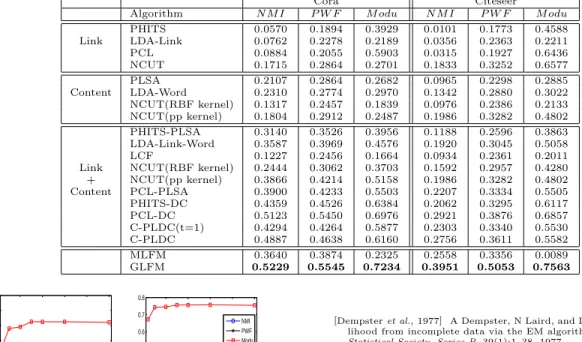
We compare GLFM with all the baselines introduced in Section 5.2 in terms ofN M I,P W F andM odu[Yanget al., 2009a; 2009b]. The results are reported in Table 1, from which we can see that GLFM achieves the best per-formance on all the data sets for the three criteria. Espe-cially for the Citeseer data set, GLFM dramatically out-performs the second best model. According to the prior knowledge, the paper citation networks are more likely to exhibit homophily because the citations often exist among papers from the same community. This can ex-plain why GLFM can achieve such good performance on these data sets. Hence, GLFM provides a way to model networks which cannot be modeled well by MLFM.
Figure 4 shows the performance of GLFM when D takes different values. We see that GLFM is not sensitive toD as long asDis not too small.
Table 1: Community detection performance on Cora and Citeseer data sets (the best performance is shown in bold
face). Cora Citeseer
Algorithm N M I P W F M odu N M I P W F M odu
PHITS 0.0570 0.1894 0.3929 0.0101 0.1773 0.4588 Link LDA-Link 0.0762 0.2278 0.2189 0.0356 0.2363 0.2211 PCL 0.0884 0.2055 0.5903 0.0315 0.1927 0.6436 NCUT 0.1715 0.2864 0.2701 0.1833 0.3252 0.6577 PLSA 0.2107 0.2864 0.2682 0.0965 0.2298 0.2885 Content LDA-Word 0.2310 0.2774 0.2970 0.1342 0.2880 0.3022 NCUT(RBF kernel) 0.1317 0.2457 0.1839 0.0976 0.2386 0.2133 NCUT(pp kernel) 0.1804 0.2912 0.2487 0.1986 0.3282 0.4802 PHITS-PLSA 0.3140 0.3526 0.3956 0.1188 0.2596 0.3863 LDA-Link-Word 0.3587 0.3969 0.4576 0.1920 0.3045 0.5058 LCF 0.1227 0.2456 0.1664 0.0934 0.2361 0.2011 Link NCUT(RBF kernel) 0.2444 0.3062 0.3703 0.1592 0.2957 0.4280 + NCUT(pp kernel) 0.3866 0.4214 0.5158 0.1986 0.3282 0.4802 Content PCL-PLSA 0.3900 0.4233 0.5503 0.2207 0.3334 0.5505 PHITS-DC 0.4359 0.4526 0.6384 0.2062 0.3295 0.6117 PCL-DC 0.5123 0.5450 0.6976 0.2921 0.3876 0.6857 C-PLDC(t=1) 0.4294 0.4264 0.5877 0.2303 0.3340 0.5530 C-PLDC 0.4887 0.4638 0.6160 0.2756 0.3611 0.5582 MLFM 0.3640 0.3874 0.2325 0.2558 0.3356 0.0089 GLFM 0.5229 0.5545 0.7234 0.3951 0.5053 0.7563 10 20 30 40 50 0.2 0.3 0.4 0.5 0.6 0.7 0.8 0.9 D NMI PWF Modu 10 20 30 40 50 0.2 0.3 0.4 0.5 0.6 0.7 0.8 D NMI PWF Modu
(a)Cora (b)Citeseer Figure 4: Sensitivity to the parameterDof GLFM.
6
Conclusion
In this paper, a generalized latent factor model is pro-posed to model homophily in social networks. A linear-time learning algorithm with convergence guarantee is proposed to learn the parameters. Experimental results on community detection in real-world networks show that our model can effectively model homophily to out-perform state-of-the-art methods.
Acknowledgments
Li is supported by a grant from the “project of Arts & Sci-ence” of Shanghai Jiao Tong University (No. 10JCY09). Ye-ung is supported by General Research Fund 622209 from the Research Grants Council of Hong Kong. Zhang is supported by the NSFC (No. 61070239), the 973 Program of China (No. 2010CB327903), the Doctoral Program of Specialized Re-search Fund of Chinese Universities (No. 20090101120066), and the Fundamental Research Funds for the Central Uni-versities.
References
[Airoldiet al., 2008] Edoardo M. Airoldi, David M. Blei, Stephen E. Fien-berg, and Eric P. Xing. Mixed membership stochastic blockmodels. Jour-nal of Machine Learning Research, 9:1981–2014, 2008.
[Bartholomew and Knott, 1999] David J. Bartholomew and Martin Knott. Latent Variable Models and Factor Analysis. Kendall’s Library of Statis-tics,7, second edition, 1999.
[Cohn and Chang, 2000] David Cohn and Huan Chang. Learning to proba-bilistically identify authoritative documents. InICML, 2000.
[Cohn and Hofmann, 2000] David A. Cohn and Thomas Hofmann. The missing link - a probabilistic model of document content and hypertext connectivity. InNIPS, 2000.
[Dempsteret al., 1977] A Dempster, N Laird, and D Rubin. Maximum like-lihood from incomplete data via the EM algorithm. Journal of the Royal Statistical Society, Series B, 39(1):1–38, 1977.
[Eroshevaet al., 2004] Elena Erosheva, Stephen Fienberg, and John Laf-ferty. Mixed membership models of scientific publications. InProceedings of the National Academy of Sciences, volume 101, pages 5220–5227, 2004. [Goldenberget al., 2009] Anna Goldenberg, Alice X. Zheng, Stephen E. Fienberg, and Edoardo M. Airoldi. A survey of statistical network models. Foundations and Trends in Machine Learning, 2:129–233, 2009.
[Hoffet al., 2002] Peter D. Hoff, Adrian E. Raftery, and Mark S. Handcock. Latent space approaches to social network analysis.Journal of the Amer-ican Statistical Association, 97(460):1090–1098, 2002.
[Hoff, 2008] Peter D. Hoff. Modeling homophily and stochastic equivalence in symmetric relational data. InNIPS, 2008.
[Hoff, 2009] Peter D. Hoff. Multiplicative latent factor models for descrip-tion and predicdescrip-tion of social networks. Computational and Mathematical Organization Theory, 15:261–272, 2009.
[Hofmann, 1999] Thomas Hofmann. Probabilistic latent semantic indexing. InSIGIR, 1999.
[Jebaraet al., 2004] Tony Jebara, Risi Imre Kondor, and Andrew Howard. Probability product kernels.Journal of Machine Learning Research, 5:819– 844, 2004.
[Kempet al., 2006] Charles Kemp, Joshua B. Tenenbaum, Thomas L. Grif-fiths, Takeshi Yamada, and Naonori Ueda. Learning systems of concepts with an infinite relational model. InAAAI, 2006.
[Langet al., 2000] Kenneth Lang, David R. Hunter, and Ilsoon Yang. Op-timization transfer using surrogate objective functions. Journal of Com-putational and Graphical Statistics, 9, 2000.
[Li and Yeung, 2009] Wu-Jun Li and Dit-Yan Yeung. Relation regularized matrix factorization. InIJCAI, 2009.
[Liet al., 2009a] Wu-Jun Li, Dit-Yan Yeung, and Zhihua Zhang. Probabilis-tic relational PCA. InNIPS, 2009.
[Liet al., 2009b] Wu-Jun Li, Zhihua Zhang, and Dit-Yan Yeung. Latent Wishart processes for relational kernel learning. InAISTATS, 2009. [Nowicki and Snijders, 2001] Krzysztof Nowicki and Tom A. B. Snijders.
Es-timation and prediction for stochastic blockstructures. Journal of the American Statistical Association, 96:1077–1087, 2001.
[Shi and Malik, 2000] Jianbo Shi and Jitendra Malik. Normalized cuts and image segmentation.IEEE Trans. Pattern Anal. Mach. Intell., 22(8):888– 905, 2000.
[Wasserman and Faust, 1994] Stanley Wasserman and Katherine Faust. So-cial Network Analysis: Methods and Applications. Cambridge University Press, 1994.
[Yanget al., 2009a] Tianbao Yang, Rong Jin, Yun Chi, and Shenghuo Zhu. A Bayesian framework for community detedtion integrating content and link. InUAI, 2009.
[Yanget al., 2009b] Tianbao Yang, Rong Jin, Yun Chi, and Shenghuo Zhu. Combining link and content for community detection: a discriminative approach. InKDD, 2009.
[Zhuet al., 2007] Shenghuo Zhu, Kai Yu, Yun Chi, and Yihong Gong. Com-bining content and link for classification using matrix factorization. In SIGIR, 2007.