Global land cover classi cation at 1 km spatial resolution using a
classi cation tree approach
M. C. HANSEN*, R. S. DEFRIES†, J. R. G. TOWNSHEND‡ and R. SOHLBERG
Department of Geography, University of Maryland, College Park, MD 20742, USA
Abstract. This paper on reports the production of a 1 km spatial resolution land cover classi cation using data for 1992–1993 from the Advanced Very High Resolution Radiometer (AVHRR). This map will be included as an at-launch product of the Moderate Resolution Imaging Spectroradiometer (MODIS) to serve as an input for several algorithms requiring knowledge of land cover type. The methodology was derived from a similar eort to create a product at 8 km spatial resolution, where high resolution data sets were interpreted in order to derive a coarse-resolution training data set. A set of 37 294Ö 1 km pixels was used within a hierarchical tree structure to classify the AVHRR data into 12 classes. The approach taken involved a hierarchy of pair-wise class trees where a logic based on vegetation form was applied until all classes were depicted. Multi-temporal AVHRR metrics were used to predict class memberships. Minimum annual red re ectance, peak annual Normalized Dierence Vegetation Index (NDVI), and minimum channel three brightness temperature were among the most used metrics. Depictions of forests and woodlands, and areas of mechanized agriculture are in general agreement with other sources of information, while classes such as low biomass agriculture and high-latitude broadleaf forest are not. Comparisons of the nal product with regional digital land cover maps derived from high-resolution remotely sensed data reveal general agreement, except for apparently poor depictions of temperate pastures within areas of agriculture. Distinguishing between forest and non-forest was achieved with agreements ran-ging from 81 to 92% for these regional subsets. The agreements for all classes varied from an average of 65% when viewing all pixels to an average of 82% when viewing only those 1 km pixels consisting of greater than 90% one class within the high-resolution data sets.
1. Introduction
Vegetative land cover is an important variable in many Earth system processes. Many general circulation and carbon exchange models require vegetative cover as a boundary layer necessary to run the model (Sellers et al. 1997). Vegetation also represents an important natural resource for humans and other species, and
*E-mail address: [email protected]
†Also at Earth System Science Interdisciplinary Center, University of Maryland, College Park, MD 20742, USA.
‡Also at Institute for Advanced Computer Studies, University of Maryland, College Park, MD 20742, USA.
International Journal of Remote Sensing
ISSN 0143-1161 print/ISSN 1366-5901 online © 2000 Taylor & Francis Ltd
quantifying the types and extent of vegetation is important to resource management and issues regarding land cover change (Townshend 1992).
With increasing frequency, remotely sensed data sets have been used to classify global vegetative land cover. The primary goals in developing these products are to meet the needs of the modelling community and to attempt to better understand the role of human impacts on Earth systems through land cover conversions. Recent work in classifying regional, continental and global land cover has seen the applica-tion of multi-temporal remotely sensed data sets, which describe vegetaapplica-tion dynamics by viewing their phenological variation throughout the course of a year (Verhoef
et al. 1996). Tucker et al.(1985), Townshend et al. (1987) and Stone et al. (1990)
have produced continental-scale classi cations of land cover using this approach. For global land cover products, DeFries and Townshend (1994 b) derived a one-by-one degree map and more recently an 8 km map (DeFrieset al.1998) using AVHRR data. The current global land cover products are much ner in resolution than traditional climate modellers require, although there are some who have begun to take advantage of the additional information in the depiction of landscape heterogen-eity provided by ner resolutions (Dickinson 1995). As the resolutions of global data sets become ner, the ability to monitor short-term anthropogenically induced land cover changes has increased. Sensors such as the Moderate Resolution Imaging Spectroradiometer (MODIS) have resolutions su cient for global depictions of land cover change. Establishing a global baseline for land cover at 1 km is an important step in understanding how change can be depicted with newer sensors such as MODIS.
A 1 km data set employing AVHRR data has been developed based on the recommendations from the International Geosphere–Biosphere Programme (IGBP) for use in global change research (Townshend 1992). Loveland et al. (1999) have produced a 1 km resolution global land cover layer, named the IGBP DISCover product, in which each continent is classi ed separately and then stitched together. They used 12-monthly Normalized Dierence Vegetation Index (NDVI ) values in an unsupervised clustering algorithm that was supplemented with ancillary data analysis. The DISCover product has also been included as an at-launch land cover product for the MODIS sensor.
This paper describes the development of another 1 km data product to be included as another layer within the MODIS at-launch product. Building on the 8 km map and methodology of DeFrieset al.(1998), this product provides an alternative 1 km land cover data set based on the individual spectral bands as well as NDVI values. The approach involves a supervised method where the entire globe is classi ed using a classi cation tree algorithm. The tree predicts class memberships from metrics derived from the same AVHRR data employed by Loveland et al. (2000), except here all ve spectral bands as well as NDVI values are used. The application of the tree classi er utilizes an imposed hierarchy of vegetation form similar to that pro-posed and implemented by Runninget al.(1994, 1995), except that the relationships between multi-spectral data and vegetation type are empirically derived.
Maps produced using satellite data have advantages over traditional ground-based maps due to the continuous coverage and internal consistency of remotely sensed data sets. A primary reason for attempting to create maps from these data sets is the potential for creating more accurate products, where the areas of disagree-ment between products are less than past eorts compiled from ground-based maps (DeFries and Townshend 1994a). Classifying the entire globe at once allows for the
consistent extrapolation of spectral signatures in order to improve the consistency of global land cover characterization. In the end, a limited amount of regional relabelling of pixels is required and this re ects the limitations of the present method while pointing the way for improved iterations. In the absence of independent validation data, a comparison between the University of Maryland (UMd) land cover layer with other digital land cover maps is made at the end of this paper, as well as with forest statistics produced by the United Nations Food and Agriculture Organization. These comparisons help identify potential strengths and weaknesses of the UMd product and also raise a number of issues which may help future eorts in creating improved products.
2. Data
2.1. T raining data
The majority of the training data were derived via the method described by DeFries et al.(1998), using an overlay of co-registered coarse-resolution and inter-preted high-resolution data sets. Previous work for the 1984 8 km product consisted of interpreting 156 images, the great majority of which were Landsat Multi-spectral Scanner System (MSS) data sets. Interpretations were aided using ancillary data sets, a list of which can be obtained, along with the 8 km data plane, from the University of Maryland website (http://www.geog.umd.edu/landcover/
global-cover.html ).
After overlaying the 1 km global data grid with high-resolution data, only those 1 km grid cells which were interpreted from the MSS as consisting of 100% of the cover type of interest were included in this training set. However, manipulating and analysing the 1 km data set at full resolution proved to be beyond the available computing resources, so a subset of the entire data set, including the training data, was then derived. Roughly every fth pixel was sampled across each row and line of the data set in order to create a much reduced, but viewable and usable subset of 7205 pixels by 3122 lines. From this subset, 27 031 pixels were taken from the high-resolution scenes as training sites.
Additional MSS scenes outside of the 156 original images were needed to address some shortcomings seen in the 8 km land cover product. The original scenes were selected from areas where three largely ground-based global land cover characteriza-tions agreed (Matthews 1983, Olsonet al.1983, Wilson and Henderson-Sellers 1985). For some classes, this greatly limited the successful depiction of land cover across all latitudes. For example, the wooded grassland class, better described by its de ni-tion of 10–40% tall woody canopy cover, had training sites only within the tropical regions of the globe. Thus, the depiction of areas with 10–40% tall woody canopy within temperate and boreal zones was limited. Clearly, there are large areas outside of the tropics which have land cover tting the description of this class. To address this issue and others like it, MSS thumbnail images were downloaded using the Global Land Information System (GLIS) from the EROS Data Center ( http://edcwww.cr.usgs.gov/webglis/)and physical features were identi ed using the same ancillary data as were used to create the original training sites. This procedure added 10 218 pixels to the database, yielding a total of 37 249 training pixels.
The entire exercise of augmenting the training data was based on interpretative analysis of the 8 km product as well as some preliminary work with 1 km data. The goal of adding to the training sites was to improve upon the limitations of the 8 km map. No quantitative sampling procedure was available in order to guide the
acquisition of the training data, as no reliable a priori knowledge of their global distributions exists.
2.2. AVHRR data
The data used in this classi cation were from the AVHRR 1 km data set processed at the EROS Data Center under the guidance of the IGBP (Eidenshink and Faudeen 1994, Townshendet al.1994). For this project, data were radiometrically calibrated, geo-registered to the 1 km Goode’s Interrupted Homolosine equal area projection, composited over a 10-day period using maximum NDVI values, and then atmospher-ically corrected for ozone and Rayleigh scattering and solar zenith angle to yield surface re ectances. From a set of twelve data layers, the following were included in this study: Channel 1 (visible red re ectance, 0.58–0.68mm), Channel 2 (near-infrared re ectance, 0.725–1.1mm), Channel 3 (thermal infrared, 3.55–3.93mm), Channel 4 (thermal, 10.3–11.3mm), Channel 5 (thermal, 11.5–12.5mm) and the NDVI (Channel 2Õ Channel 1)/(Channel 2+Channel 1). The rst twelve months produced for this data set, beginning 1 April 1992 and ending 31 March 1993, were used in this classi cation.
To reduce data volumes and cloud contamination, a maximum NDVI composite was created for every month, along with all ve associated channel values. This, however, did not remove all noise from the data set, and a ltering of the data was performed in the context of a time series by identifying and removing data spikes (DeFries et al. 1998). Since there is no quality control ag for the 1 km data, each monthly value of each band was viewed in isolation and compared to the standard deviation of the remaining monthly values. Those monthly values which were greater than seven standard deviations away from the mean of the remaining eleven months were removed. The value of seven standard deviations was chosen through visual inspection of the data and found to be a conservative level which removed the most obvious spikes. The metrics calculated from the AVHRR time series are very sensitive to noisy data, including maximum and minimum annual metrics (see § 3.3), and the removal of inordinately extreme values preserves their utility. Other AVHRR pro-cessing techniques note the presence of digital counts of extreme low and high values which are not readily detectable, even in a data set production mode (Agbu and James 1994). The attempt here was to nd a simple remedy which reduced the problem of noise without removing useful data.
Preliminary work on the 1 km data revealed a number of characteristics which dictated some modi cations to the classi cation methodology used for the 8 km product. In general, the 1 km data set appears to have more artifacts and cloud contamination than the 8 km Path nder data set. The 8 km data set is derived from Global Area Coverage (GAC) 4 km data (James and Kalluri 1994), which are continuously recorded onboard the National Oceanic and Atmospheric Administration (NOAA) platforms, while the 1 km data set uses Local Area Coverage (LAC) 1 km data, which must be recorded by regional receiving stations. The result for the 1 km data set is a less continuous product temporally, as receiving stations are not always operating. This yields a composite more heavily contaminated by cloud. Also, the geo-referencing for the 8 km uses onboard navigation to bin pixels, while the 1 km uses ground control points (GCPs). For any data scan at 1 km, the swath was divided into areas corresponding to the sections in the Goode projection. Any section not having a minimum number of GCPs was excluded, unlike the 8 km product, which retained all data. This also results in a less clean composite as the
number of samples entered into the compositing scheme is substantially reduced. Both compositing schemes used maximum NDVI, and then applied an atmospheric correction. Binning on the basis of NDVI results in composites being biased in the forward scatter direction due to bidirectional re ectance distribution function (BRDF) eects (Holben 1986, Cihlaret al.1994), resulting in less clean time series, particularly for Channels 1 and 2. This also increases the presence of pixels with distorted view geometries. Misplaced scans are also present due to poor header information on the input data (Eidenshink 1998 Personal communication). While both the 8 km and 1 km data sets have many common problems, such as no BRDF correction, the aforementioned dierences can have a signi cant eect on the produc-tion of like products, and lead to a need for somewhat dierent treatments of the data in producing land cover maps.
3. Classi cation scheme
3.1. Algorithm
A decision tree was used to classify the dependent variable of class membership using the independent variables of AVHRR metrics. Decision tree theory (Breiman
et al. 1984, Quinlan 1993, Venables and Ripley 1994) has previously been used to
classify remotely sensed data sets (Hansen et al. 1996, Freidl and Brodley 1997, DeFries et al.1998), and oers some advantages over other classi cation methods. Trees are a non-parametric, hierarchical classi er which predicts class membership by recursively partitioning a data set into more homogeneous subsets. This procedure is followed until a perfect tree (one in which every pixel is discriminated from pixels of other classes, if possible) is created with all pure terminal nodes or until preset conditions are met for terminating the tree’s growth. The method used here is that of the S-plus statistical package (Clark and Pergibon 1992), which employs a deviance measure to split data into nodes which are more homogeneous with respect to class membership than the parent node. The reduction in deviance (D) is calculated as:
D=D
sÕ DtÕ Du (1)
where s represents the parent node, and t and u are the splits from s.Right and left splits along the digital counts for all metrics are examined. When Dis maximized, the best split is found, and the data are divided at that digital count and the process is repeated on the two new nodes of the tree. The deviance for nodes is calculated from the equation
Di= Õ 2Sniklogpik (2)
wherenis the number of pixels in classkin nodeiandpis the probability distribution of classk in nodei.
Trees usually over t the training data and a pruning procedure is needed to better generalize the relationships between the dependent and independent variables. In other words, the tree can t the training data too well by growing on noise and errors. To avoid this, a pruning procedure is employed to better generalize the predictive ability of the tree. Pruning is performed by splitting the data into two sets and using one to grow the tree and the other to prune it by eliminating nodes which increase errors within the pruning data set. In this study, pruning was performed by visual interpretation due to problems inherent in both the training and the AVHRR data, as will be discussed shortly.
created for classes which have multi-modal distributions in spectral space. This allows for the clearer depiction of the intraclass variability which exists at the global scale. Trees are also useful for identifying classes which represent subsets of a continuous parameter, such as tree canopy for wooded grasslands, woodlands and forests. Trees operate not on statistics of central tendency, but along the thresholds in multi-spectral space which best characterize boundaries between classes. Hansen
et al. (1996) found that a single classi cation tree threshold was superior to a
maximum likelihood classi er in identifying tall from short global vegetation. However, since the training pixel counts are used to estimate probabilities, larger classes can be overemphasized in optimizing the splits and in the assignments of terminal nodes. Smaller classes are easily identi ed within trees if they are dominant in any part of the multi-spectral space. But, if smaller classes are mixed with larger classes, the smaller class can be lost via the assignment of terminal nodes to the classes with a dominant proportional representation.
The hierarchical nature of trees yields explicit relationships between the dependent variable, class membership, and the independent variables of multi-temporal metrics. In so doing, it allows for a readier biophysical interpretation through the description of vegetation characteristics such as height of vegetation and canopy closure. This ease of interpretation is unique among popular remote sensing classi ers and allows for the input of an expert analyst in correcting splits associated with faulty or contradictory training data.
3.2. Classes
The IGBP has developed a list of classes for use within global change research and to which the 1 km MODIS at-launch product and post-launch products will conform (Rasool 1992). The UMd class de nitions closely t this scheme and are listed along with corresponding IGBP classes in table 1. The 1 km training areas were derived from 156 high-resolution scenes. These were originally interpreted for the 8 km map which employed a classi cation scheme for use with the Simple Biosphere (SiB) general circulation model (Sellerset al.1997). The SiB scheme does not have agricultural mosaic, wetlands or snow and ice classes. As a result, the mosaic and wetlands classes are absent from this classi cation, while the IGBP snow and ice cover class is included in the bare ground class. The urban and built-up class was taken directly from the EROS Data Center (EDC) 1 km IGBP classi cation by Lovelandet al.(2000), which was in turn obtained from the Digital Chart of the World (Danko 1992). The water layer was taken from a preliminary water mask made for the MODIS sensor in a sinusiodal projection and reprojected into the Interrupted Goode Homolosine projection for use with this project. The SiB mosses and lichens class does not exist within the IGBP scheme, and scenes from this class were reinterpreted to extract other covers where possible. More subtle dierences between the UMd and the IGBP schemes, such as height of trees, are irreconcilable and dier largely because of the de nitions used by the ancillary sources in interpreting the high-resolution data.
3.3. AVHRR metrics
A set of 41 metrics was created for input into the decision tree. The rst 29 metrics were created from values associated with the eight greenest months of the year. These metrics dier from those used to derive the 8 km map. The 8 km metrics used all twelve months of 1984 Path nder 8 km data in the classi cation, and this
T ab le 1. C o m p a ri so n o f U n iv er si ty o f M a ry la n d cl a ss d e n it io n s to th e IG B P -D IS d e n it io n s. U ni ve rs it y of M ar yl an d ve ge ta ti on cl as se s IG B P -D IS L an d C ov er W or k in g G ro up ve ge ta ti on cl as se s C o v er ty p es in co m m o n w it h IG B P C o v er ty p es in co m m o n w it h U M d E ve rg re en N ee dl el ea f F or es ts : la n d s d o m in a te d b y tr ee s w it h a p er ce n t E ve rg re en N ee dl el ea f F or es ts : la n d s d o m in a te d b y tr ee s w it h a p er ce n t ca n o p y co ve r > 60 % an d h ei gh t ex ce ed in g 5 m . A lm o st al l tr ee s re m a in ca n o p y co ve r > 60 % an d h ei gh t ex ce ed in g 2 m . A lm o st al l tr ee s re m a in gr ee n al l ye ar . C a n o p y is n ev er w it h o u t gr ee n fo li a g e. gr ee n al l ye ar . C a n o p y is n ev er w it h o u t gr ee n fo li a g e. E ve rg re en B ro ad le af F or es ts : la n d s d o m in a te d b y tr ee s w it h a p er ce n t E ve rg re en B ro ad le af F or es ts : la n d s d o m in a te d b y tr ee s w it h a p er ce n t ca n o p y co ve r >60 % an d h ei gh t ex ce ed in g 5 m . A lm o st al l tr ee s re m a in ca n o p y co ve r >60 % an d h ei gh t ex ce ed in g 2 m . A lm o st al l tr ee s re m a in gr ee n al l ye ar . C a n o p y is n ev er w it h o u t gr ee n fo li a g e. gr ee n al l ye ar . C a n o p y is n ev er w it h o u t gr ee n fo li a g e. D ec id uo us N ee dl el ea f F or es ts : la n d s d o m in a te d b y tr ee s w it h a p er ce n t D ec id uo us N ee dl el ea f F or es ts : la n d s d o m in a te d b y tr ee s w it h a p er ce n t ca n o p y co ve r >60 % an d h ei gh t ex ce ed in g 5 m . T re es sh ed th ei r le a ve s ca n o p y co ve r >60 % an d h ei gh t ex ce ed in g 2 m . C o n si st s o f se a so n a l si m u lt an eo u sl y in re sp o n se to co ld se a so n s. n ee d le le a f tr ee co m m u n it ie s w it h an an n u al cy cl e o f le a f-o n an d le a f-o p er io d s. D ec id uo us B ro ad le af F or es ts : la n d s d o m in a te d b y tr ee s w it h a p er ce n t D ec id uo us B ro ad le af F or es ts : la n d s d o m in a te d b y tr ee s w it h a p er ce n t ca n o p y co ve r >60 % an d h ei gh t ex ce ed in g 5 m . T re es sh ed th ei r le a ve s ca n o p y co ve r >60 % an d h ei gh t ex ce ed in g 2 m .C o n si st s o f se a so n a l b ro a d -si m u lt an eo u sl y in re sp o n se to d ry o r co ld se a so n s. le a f tr ee co m m u n it ie s w it h an an n u al cy cl e o f le a f-o n an d le a f-o p er io d s. M ix ed F or es ts : la n d s d o m in a te d b y tr ee s w it h a p er ce n t ca n o p y co ve r M ix ed F or es ts : la n d s d o m in a te d b y tr ee s w it h a p er ce n t ca n o p y co ve r >60 % an d h ei gh t ex ce ed in g 5 m . C o n si st s o f tr ee co m m u n it ie s w it h in te r->60 % an d h ei gh t ex ce ed in g 2 m . C o n si st s o f tr ee co m m u n it ie s w it h in te r-sp er se d m ix tu re s o r m o sa ic s o f n ee d le le a f an d b ro a d le af fo re st ty p es . sp er se d m ix tu re s o r m o sa ic s o f th e o th er fo u r fo re st co ve r ty p es . N o n e o f N ei th er ty p e h a s <25 % o r >75 % la n d sc a p e co ve ra g e. th e fo re st ty p es ex ce ed s 60 % o f th e la n d sc a p e. W oo dl an ds : la n d s w it h h er b a ce o u s o r w o o d y u n d er st o ri es an d tr ee ca n o p y W oo dy sa va nn as : la n d s w it h h er b a ce o u s an d o th er u n d er st o re y sy st em s, co ve r o f >40 % an d <60 % . T re es ex ce ed 5 m in h ei gh t an d ca n b e ei th er an d w it h fo re st ca n o p y b et w ee n 30 – 60 % . T h e fo re st co ve r h ei gh t ex ce ed s ev er g re en o r d ec id u o u s. 2 m . W oo de d G ra ss la nd s / S hr ub la nd s: la n d s w it h h er b a ce o u s o r w o o d y u n d er st o -S av an na s: la n d s w it h h er b a ce o u s an d o th er u n d er st o re y sy st em s, an d w it h ri es an d tr ee ca n o p y co ve r o f >10 % an d <40 % . T re es ex ce ed 5 m in fo re st ca n o p y b et w ee n 10 – 30 % . T h e fo re st co ve r h ei gh t ex ce ed s 2 m . h ei gh t an d ca n b e ei th er ev er g re en o r d ec id u o u s.
T ab le 1. ( C on ti nu ed ). U ni ve rs it y of M ar yl an d ve ge ta ti on cl as se s IG B P -D IS L an d C ov er W or k in g G ro up ve ge ta ti on cl as se s C o v er ty p es in co m m o n w it h IG B P C o v er ty p es in co m m o n w it h U M d C lo se d B us hl an ds or S hr ub la nd s: la n d s d o m in a te d b y b u sh es o r sh ru b s. C lo se d S hr ub la nd s: la n d s w it h w o o d y ve ge ta ti o n le ss th an 2 m ta ll an d w it h B u sh an d sh ru b p er ce n t ca n o p y co ve r is >40 % . B u sh es d o n o t ex ce ed sh ru b -c an o p y co ve r >60 % . T h e sh ru b fo li a g e ca n b e ei th er ev er g re en o r 5 m in h ei gh t. S h ru b s o r b u sh es ca n b e ei th er ev er g re en o r d ec id u o u s. T re e d ec id u o u s. ca n o p y co ve r is <10 % .T h e re m a in in g co ve r is ei th er b a rr en o r h er b a ce o u s. O pe n S hr ub la nd s: la n d s d o m in a te d b y sh ru b s. S h ru b ca n o p y co ve r is O pe n S hr ub la nd s: la n d s w it h w o o d y ve ge ta ti o n le ss th an 2 m ta ll an d w it h >10 % an d <40 % . S h ru b s d o n o t ex ce ed 2 m in h ei gh t an d ca n b e ei th er sh ru b ca n o p y co ve r b et w ee n 10 – 60 % . T h e sh ru b fo li a g e ca n b e ei th er ev er g re en o r d ec id u o u s. T h e re m a in in g co ve r is ei th er b a rr en o r o f an n u al ev er g re en o r d ec id u o u s. h er b a ce o u s ty p e. G ra ss la nd s: la n d s w it h co n ti n u o u s h er b a ce o u s co ve r an d <10 % tr ee o r G ra ss la nd s: la n d s w it h h er b a ce o u s ty p es o f co ve r. T re e an d sh ru b co ve r is sh ru b ca n o p y co ve r. le ss th an 10 % . C ro pl an ds : la n d s w it h >80 % o f th e la n d sc a p e co ve re d in cr o p -p ro d u ci n g C ro pl an ds : la n d s co ve re d w it h te m p o ra ry cr o p s fo ll o w ed b y h a rv es t an d a el d s. N o te th at p er en n ia l w o o d y cr o p s w il l b e cl a ss i ed as th e ap p ro p ri a te b a re so il p er io d (e .g . si n gl e an d m u lt ip le cr o p p in g sy st em s) . N o te th at fo re st o r sh ru b s la n d co ve r ty p e. p er en n ia l w o o d y cr o p s w il l b e cl a ss i ed as th e ap p ro p ri a te fo re st o r sh ru b s la n d co ve r ty p e. B ar re n: la n d s o f ex p o se d so il , sa n d , ro ck s, sn o w o r ic e w h ic h n ev er h a ve B ar re n: la n d s o f ex p o se d so il , sa n d , ro ck s o r sn o w an d n ev er h a s m o re m o re th an 10 % ve ge ta te d co ve r d u ri n g an y ti m e o f th e ye ar . th an 10 % ve ge ta te d co ve r d u ri n g an y ti m e o f th e ye ar . U rb an an d B ui lt -u p: la n d co ve re d b y b u il d in g s an d o th er m a n -m a d e st ru c-U rb an an d B ui lt -u p: la n d co ve re d b y b u il d in g s an d o th er m a n -m a d e st ru c-tu re s. N o te th at th is cl a ss w il l n o t b e m a p p ed fr o m th e A V H R R im a g er y tu re s. N o te th at th is cl a ss w il l n o t b e m a p p ed fr o m th e A V H R R im a g er y b u t w il l b e d ev el o p ed fr o m th e p o p u la te d p la ce s la y er th at is p a rt o f th e b u t w il l b e d ev el o p ed fr o m th e p o p u la te d p la ce s la y er th at is p a rt o f th e D ig it a l C h a rt o f th e W o rl d (D a n k o 19 9 2 ). D ig it a l C h a rt o f th e W o rl d (D a n k o 19 9 2 ). W at er bo di es : o ce an s, se a s, la k es ,r es er v o ir s, an d ri v er s. C a n b e ei th er fr es h W at er bo di es : o ce an s, se a s, la k es , re se rv o ir s, an d ri v er s. C a n b e ei th er fr es h o r sa lt w a te r. o r sa lt w a te r. C ov er s no t in co m m on w it h U M d P er m an en t W et la nd s: L an d s w it h a p er m a n en t m ix tu re o f w a te r an d h er -b a ce o u s o r w o o d y ve ge ta ti o n th at co ve r ex te n si v e ar ea s. T h e ve ge ta ti o n ca n b e p re se n t in ei th er sa lt , b ra ck is h , o r fr es h w a te r. C ro pl an d / N at ur al V eg et at io n M os ai cs : la n d s w it h a m o sa ic o f cr o p la n d s, fo re st , sh ru b la n d s, an d gr as sl a n d s in w h ic h n o o n e co m p o n en t co m p ri se s m o re th an 60 % o f th e la n d sc a p e. S no w an d Ic e: la n d s u n d er sn o w an d /or ic e co ve r th ro u g h o u t th e ye ar .
produced a number of nodes associated with snow cover. Snow cover, especially relating to the distribution and number of training pixels within and without the snow area, can produce undesired results. By binning all metrics on only the eight greenest months, snow eects are largely limited to those places with perpetual snow and ice cover and very high-latitudes, while still retaining most of the seasonal variability associated with vegetation phenology. The eight greenest months are not necessarily consecutive, but represent the eight months with the clearest view of green vegetation. In this manner, globally applicable, timing-insensitive metrics with minimized cloud presence are created. The metrics used included maximum, min-imum, mean and amplitudes for all bands associated with the eight greenest months. Individual band values associated with peak greenness were also derived.
Using only eight months of data means that for areas like the tropics and much of the temperate zone, four months of useful data were thrown away. To try and recapture some of this information, metrics were binned on the four warmest months, as measured by Channel 4, and two additional metrics per band and for NDVI were calculated. These were means associated with the four warmest months and individual values occurring at maximum Channel 4 temperature. The four warmest months were found to be associated with the dry season, or senescent phase of much tropical vegetation. By compositing on these values, data not used in the eight greenest months can be included for some areas without introducing snow values at high latitudes and elevations. The metrics derived from the 1992–1993 year for bands 1–5 and NDVI are listed in table 2.
3.4. Procedure
The classi cation procedure followed that of the 8 km product except for the use of a cascading two-class hierarchy of trees in implementing the classi cation tree algorithm. An initial attempt at using the previous methodology revealed the inability to create a single simpli ed tree such as the 8 km tree which described the globe in 57 nodes. One potential reason for this is the increased heterogeneity of the Earth’s surface at 1 km which precludes the creation of a single, simple global tree. Secondly, as mentioned previously, 1 km data are more cloud-contaminated than the 8 km data due to dierent recording procedures, geo-registering and compositing tech-niques. This results in a more complex tree structure than that derived for the relatively cleaner 8 km data. Thus, the decision was taken to create an imposed tree hierarchy, shown in gure 1, somewhat similar to that used by Runninget al.(1995). In this manner, only two classes are depicted within any single tree, allowing for a simpli ed, structured approach and easier interpretation of the results. The original training pixels were run through the successive trees and a preliminary result was obtained. Pruning based on visual interpretation of this preliminary global map was then applied where nodes were accepted or rejected based on their global geographic distributions. From this, a subset of pixels associated with approved nodes was created. These pixels were then re-run through the tree structure and a nal tree was derived. These trees were again pruned based on visual interpretation to produce the nal map.
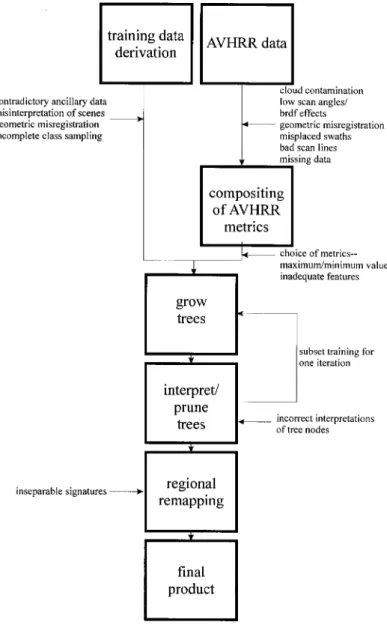
For both the UMd 1 km and 8 km maps, an automated classi cation algorithm is employed to depict land cover, but obvious errors in the product make it necessary to apply an interpretive step. Figure 2 outlines the steps in the procedure along with some of the sources of error within this product which mandate that an interpretative pruning be applied. Cloud contamination, bad scan lines, missing data, geometric
Table 2. Metrics employed in the production of the University of Maryland 1 km product using AVHRR data from April 1992 to March 1993.
1) maximum NDVI value
2) minimum NDVI value of 8 greenest months 3) mean NDVI value of 8 greenest months 4) amplitude of NDVI over 8 greenest months 5) mean NDVI value of 4 warmest months 6) NDVI value of warmest month
7) maximum channel 1 value of 8 greenest months 8) minimum channel 1 value of 8 greenest months 9) mean channel 1 value of 8 greenest months 10) amplitude of channel 1 over 8 greenest months 11) channel 1 value from month of maximum NDVI 12) mean channel 1 value of 4 warmest months 13) channel 1 value of warmest month
14) maximum channel 2 value of 8 greenest months 15) minimum channel 2 value of 8 greenest months 16) mean channel 2 value of 8 greenest months 17) amplitude of channel 2 over 8 greenest months 18) channel 2 value from month of maximum NDVI 19) mean channel 2 value of 4 warmest months 20) channel 2 value of warmest month
21) maximum channel 3 value of 8 greenest months 22) minimum channel 3 value of 8 greenest months 23) mean channel 3 value of 8 greenest months 24) amplitude of channel 3 over 8 greenest months 25) channel 3 value from month of maximum NDVI 26) mean channel 3 value of 4 warmest months 27) channel 3 value of warmest month
28) maximum channel 4 value of 8 greenest months 29) minimum channel 4 value of 8 greenest months 30) mean channel 4 value of 8 greenest months 31) amplitude of channel 4 over 8 greenest months 32) channel 4 value from month of maximum NDVI 33) mean channel 4 value of 4 warmest months 34) channel 4 value of warmest month
35) maximum channel 5 value of 8 greenest months 36) minimum channel 5 value of 8 greenest months 37) mean channel 5 value of 8 greenest months 38) amplitude of channel 5 over 8 greenest months 39) channel 5 value from month of maximum NDVI 40) mean channel 5 value of 4 warmest months 41) channel 5 value of warmest month
misregistration and incorrect ancillary data can lead to the production of anomalous nodes which cannot be eliminated except by a subjective step. For this study, pruning was performed through manually clipping nodes, relabelling nodes and nding alternative splits for nodes which yielded depictions of land cover not consistent with known global distributions. Although the derivation of the trees cannot be duplicated, the application of these trees will result in the same map product. In this sense, the procedure is reproducible given the metrics and the trees, but the product reproduced represents a mix of objectively and subjectively derived relationships.
Figure 1. Two-class hierarchical tree used in the generation of the University of Maryland 1 km product.
Eorts are underway to improve the ability to derive land cover products more objectively by applying more sophisticated algorithms for growing and pruning trees (Quinlan 1993). Upon application of the nal trees, a regional relabelling is performed on pixels which do not agree with known global geographic distributions.
4. Results
After the initial run of the training data through the tree hierarchy and pruning procedure, a subset of 26 208 pixels was taken to create the nal classi cation tree structure. All trees were created using the 7205 by 3122 pixel subset of the 1 km data. The nal trees were then run on the entire 1 km data set. No sieve was applied. Among the most frequently used metrics for all trees were minimum annual red re ectance and maximum annual NDVI. Figure 3 shows subsets of boreal, temperate and tropical areas for these metrics with the same spectral enhancements. These subset windows will be used to illustrate certain qualities of the product as the discussion of the tree hierarchy is developed.
4.1. Hierarchical classi cation tree
4.1.1. Vegetated/bare ground tree
The rst tree was a vegetated/non-vegetated tree used to classify bare ground ( gure 4). For all trees depicted, only the dominant nodes accounting for over 5% of the respective class land areas are shown. A simple maximum annual NDVI threshold provides greatest initial discrimination for the vegetated/non-vegetated tree. In gure 5(a), the land areas associated with the dominant nodes for the tree are highlighted. Areas such as volcanic features in the Sahara Desert are not easily discriminated with a single split (shown in black as lesser nodes), and extra nodes
Figure 2. Procedure ow diagram, with sources of uncertainty/errors mandating the need for an interpretative step to create nal product.
were required that largely accounted for these barren ground subtypes. Barren areas with a maximum NDVI greater than 0.155 are associated with a misplaced AVHRR 1 km data set swath in the Atacama desert. The rest of the black area is associated with areas having a peak NDVI less than 0.155. Outcrops in the Sahara and other places are confused with sparse grasslands in China, and additional splits are needed to depict them. Volcanic outcrops of the Sahara have been analysed before in eorts to account for background soil re ectances which make certain areas spectrally similar to sparsely vegetated ones (Huete and Tucker 1991). The results here re ect
Figure 3. Subsets for (a) boreal Russia, (b) temperate United States and (c) tropical West Africa. On the left-hand side, red is maximum annual NDVI and cyan is minimum annual red re ectance. All three images had the same linear stretch applied to both bands. On the right-hand side: 1=needleleaf evergreen forest; 2=broadleaf evergreen forest; 3=needleleaf deciduous forest; 4=broadleaf deciduous forest; 5=mixed forest; 6=woodland; 7=wooded grassland; 8=closed shrubland; 9=open shrubland; 10= grassland; 11=cropland; 12=bare ground; 14=urban/built-up areas. The scale bar represents 300 km.
Figure 4. Vegetated/non-vegetated classi cation tree. Only those nodes which account for 5% or more of the respective class totals are shown. Paths to lesser nodes are shown by the symbol~. The text in the ellipses gives the metrics used for the split, with the left-hand side less than the value indicated and the right-hand side greater. Metrics beginning with t, such as tmeanch1 are metrics derived from the four warmest months. Other metrics, such as maxndvi, are derived from the eight greenest months. For example, tmeanch1 stands for the mean Channel 1 value of the four warmest months. Maxndvi stands for the maximum NDVI value of the eight greenest months. Values for Channels 1 and 2 are in per cent re ectance. Values for Channels 3, 4 and 5 are in degrees Kelvin.
the di culty in separating these areas using NDVI alone, and dierent spectral information through the use of additional splits is needed to characterize them. 4.1.2. T all/short vegetation tree
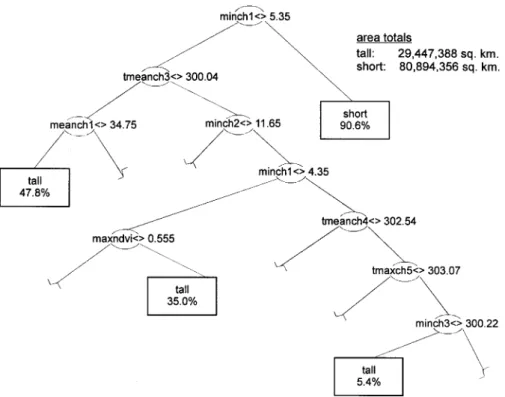
Use of this tree was intended to separate woodlands and forests with nearly closed tall canopies from open parklands, shrublands, croplands and herbaceous covers. Figure 6 shows the tree’s structure and gure 5(b) where the dominant nodes map globally. In general, low minimum annual visible red values (<5.3% re ectance) successfully discriminated woodlands and forests. Exceptions to this relationship included non-woody areas with water present, such as inundated grasslands, areas of rice production and other wetland formations. Commission errors of woody classes are associated with some non-woody areas for these types of land cover. Many tropical inundated grasslands were confused with needleleaf evergreen stands in the visible and near-infrared, and temperature values were used to separate the two. This, however, did not resolve the characterization of similar wetlands at higher latitudes.
Some croplands, particularly in the midwest of the United States, also had very dark minimum red values and this created confusion between croplands and wood-lands. Part of this problem may be due to bad data in the 1 km data set. For example, gure 3 (b) shows the minimum annual Channel 1 metric for the Midwest USA. The line in the image is the Mollweide/Sinusoidal boundary of the Goode projection. The dark northern portion creates a node in the woody/non-woody tree speci c to itself, indicating a possible problem with the data set. Figure 5(b) shows this area in black as one of the lesser nodes not easily discriminated along with the rest of the woody and non-woody types. This type of problem is hard to isolate in a global approach and can create undesirable results.
Figure 5. (a) Results of the vegetated/non-vegetated classi cation tree. Red=largest node for vegetated class; cyan=largest node for non-vegetated class; black=lesser nodes in the tree. (b) Results of tall/short vegetation tree. Red=largest node for tall vegetation, orange=second largest, yellow=third largest; cyan=largest node for short vegetation; black=lesser nodes in the tree; grey=bare ground class from previous tree. (c) Results of forest/woodland tree. Red=largest node for forest, orange=second largest, yellow= third largest; cyan=largest node for woodland, green=second largest; black=lesser nodes; dark grey=bare ground class; light grey=short vegetation from previous tree. Refer to gures 4, 6 and 7 to view node paths.
Figure 6. Tall/short vegetation classi cation tree. Only those nodes which account for 5% or more of the respective class totals are shown. Paths to lesser nodes are shown with ~. The text in the ellipses gives the metrics used for the split, with the left-hand side less than the value indicated and the right-hand side greater. Metrics beginning with t, such as tmeanch5 are metrics derived from the four warmest months. Other metrics, such as minch1, are derived from the eight greenest months. For example, tmeanch5 stands for the mean Channel 5 value of the four warmest months. Minch1 stands for the minimum Channel 1 value of the eight greenest months. Values for Channels 1 and 2 are in per cent re ectance. Values for Channels 3, 4 and 5 are in degrees Kelvin.
forest stands is exaggerated. For example, clearings of grasslands within the Amazon basin are reduced in size as if a buer of forest were added to the boundary. This is the result of binning on maximum NDVI, retaining data from low scan angles and georegistration inaccuracies. When combining these eects, the greener class along any class boundary is usually overemphasized. This loss of heterogeneity and bias of dominant classes has been discussed by others (Cushnie 1987, Moody and Woodcock 1994) and users should be aware of this problem.
One noticeable area lacking in woodlands in this product is west Africa. While woodlands are mapped, they are not present in this product as much as ancillary data indicate they should be (http://www.geog.umd.edu/landcover/global-cover/
global-resources.html ). Figure 3(c) shows a two-band composite of an area in west Africa. In general, west African woodlands are considerably brighter than other woody areas, such as the miombo woodlands of southern Africa, or the Gran Chaco of Argentina, possibly re ecting a longer history of anthropogenic disturbance in the region. Low minimum annual red re ectance for tall woody areas represents the combined eects of canopy shadowing and chlorophyll absorption. For most of west Africa, high minimum annual red re ectance values limit the areal extent of forests
and woodlands. Figure 3(c) also shows the problem of persistent cloud cover along the coast of West Africa in aecting the minimum Channel 1 metric. The classi cation of grasslands along the western coast of the image is suspected of being largely the cause of cloud presence in all monthly composites. This area, according to ancillary information, has considerably more forested land.
It is of interest that the rst woody/non-woody split of minimum annual red re ectance was nearly the same as that derived for our 8 km land cover classi cation using 1984 Path nder data (5.35% compared to 5.38%). The potential reproducibility of tree splits between data sets and over time has implications not only for land cover mapping, but also for change detection. A reproducible tree structure over time would allow for the depiction of spectral migration and change.
4.1.3. Forest/woodland tree
Woodlands were also distinguished from forests based on minimum visible red values. Figure 7 shows the forest, woodland classi cation tree while gure 5(c) shows the spatial extent of the dominant nodes. Some tropical woodlands were as dark
Figure 7. Forest/woodland classi cation tree. Only those nodes which account for 5% or more of the respective class totals are shown. Paths to lesser nodes are shown with ~. The text in the ellipses gives the metrics used for the split, with the left-hand side less than the value indicated and the right-hand side greater. Metrics beginning with t, such as tmeanch3 are metrics derived from the four warmest months. Other metrics, such as meanch1, are derived from the eight greenest months. For example, tmeanch3 stands for the mean Channel 3 value of the four warmest months. Meanch1 stands for the mean Channel 1 value of the eight greenest months. Values for Channels 1 and 2 are in per cent re ectance. Values for Channels 3, 4 and 5 are in degrees Kelvin.
and green as tropical forests, and temperature bands such as the mean of the four Channel 5 values associated with the warmest four months of the year were used to stratify these areas. This metric helped to create a fairly clear forest/woodland boundary in central Africa, but may have increased confusion between some more seasonal tropical forests and adjacent woodlands. Ancillary data from Asia referring to deciduous forests and African sources for miombo woodlands are not reconciled in the metrics used here and errors between tropical seasonal forest and woodlands are suspected to exist in areas such as Asia and west Africa. The depiction of woodlands revealed the heterogeneity of areas such as the boreal forest, and within fragmented forest/agricultural mosaics such as the south-eastern United States. The global approach of applying a set of universal splits revealed a lack of true forest in a number of areas such as the Atlas Mountains and the hills of east-central India in contradiction to ancillary sources which depict extensive forest stands.
4.1.4. Remaining classi cation trees
Descriptions of the remaining trees can be found in the metadata of the 1 km product at the website cited above. Important aspects include the following.
(1) Mixed/pure leaf type forest classi cation tree:
E mixed forests de ned within 45–60 degrees latitude are separated largely by the mean Channel 4 of the eight greenest months metric and maximum NDVI;
E maximum NDVI is repeatedly used;
E many high-latitude broadleaf forests are classi ed as mixed forest due to lower maximum NDVI values;
E broadleaf forests mixed with non-forest covers are often labelled mixed forest, creating a buering aect around core broadleaf areas (see gure 3(a)).
(2) Broadleaf/needleleaf forest classi cation tree:
E minimum Channel 3 separates tropical broadleaf from extratropical needleleaf forest;
E maximum NDVI separates temperate broadleaf from needleleaf forest; E lush evergreen needleleaf areas, such as that found in the Paci c Northwest, and Araucaria forests in South America, are confused with broadleaf evergreen forest;
E Eucalyptus forests in Australia and elsewhere map as needleleaf evergreen forests.
(3) Needleleaf evergreen/deciduous forest classi cation tree: E amplitude of NDVI largely separates these leaf types; E needleleaf deciduous forests confused with mixed forests. (4) Broadleaf evergreen/deciduous forest classi cation tree:
E minimum Channel 3 separates temperate from tropical broadleaf forests;
E mean of the four Channel 5 values associated with the four warmest months separates tropical deciduous from tropical broadleaf forests; E amplitude of NDVI separates temperate deciduous forests from other
(5) Sparse trees (wooded grassland)/croplands, grass or shrubs classi cation tree: E high intraclass spectral variability, largest wooded grassland node
accounts for only 17% of class total;
E minimum red re ectance, infrared re ectance at peak greenness and minimum Channel 3 are the metrics of the rst three splits;
E most di cult class to map since it represents a wide range of partial woody covers, for example, scrub savannas, boreal transitional woodlands and crop/forest mosaics.
(6) Croplands/shrubs and grass classi cation tree:
E NDVI and near-infrared metrics are the rst two used in this tree; E mechanized agriculture is in general agreement with ancillary data; E agriculture in developing nations poorly depicted, as is all low biomass
agriculture, due to the di culty in separating cropping from natural background phenologies and errors of omission and commission exist for many areas.
(7) Grass/shrubs classi cation tree:
E mean red re ectance and Channel 5 and NDVI means for the warmest four months are used in the rst three splits;
E pastures within temperate cropping areas are not depicted; E semi-arid and very high-latitude grasslands not well depicted. (8) Open/closed shrubs classi cation tree:
E temperature and NDVI metrics separate shrub classes;
E confusion between these two classes and grasslands suspected to exist as background soil re ectances make discrimination di cult (Huete and Tucker 1991).
5. Regional relabelling
The last step was a regionally based reassignment of obvious inaccuracies which was performed to remove clearly erroneous results. This modi cation of the product changed only 0.67% of the total land area, and represents areas spectrally inseparable within the present training data signatures. The following is a summary of classes which were remapped for this purpose: above boreal zone agriculture mapped to grassland; exterior to Siberia deciduous needleleaf forest mapped to mixed forest; needleleaf evergreen forest in Australia mapped to broadleaf evergreen forest; needleleaf forest in humid tropical basins such as the Amazon and the Congo mapped to woodland; shrub classes on volcanic outcrops in the Sahara mapped to bare ground; evergreen broadleaf forest in temperate latitudes mapped to evergreen needleleaf forest; extensive agriculture on the Tibetan plateau mapped to grassland; broadleaf evergreen forest in the miombo belt of southern Africa mapped to wood-land; and two reassignments of classes due to misplaced AVHRR swaths. Table 3 shows the number of pixels per class changed in this manner. Needleleaf deciduous forest is by far the most aected class. Most of the pixels changed for this class represent mixed forest pixels. One possible explanation for the inability of this approach to cleanly delineate needleleaf deciduous forest may be the possible presence of broadleaf forest within the needleleaf deciduous training sites. When viewing maximum NDVI values for the deciduous versus evergreen needleleaf forests, decidu-ous forest has a median value of 0.64 compared with an evergreen value of 0.61.
Table 3. Remapping of likely misclassi cations based on application of regional rules. Shown are remapped area and remapped area as a per cent of total class area as predicted by the classi cation tree.
Class Remapped area ( km2) % remapped/class total
Needleleaf Evergreen Forest 309 747 5.54
Broadleaf Evergreen Forest 121 271 1.08
Needleleaf Deciduous Forest 174 047 23.41
Broadleaf Deciduous Forest 51 238 2.84
Mixed Forest 53 988 1.62 Woodland 27 240 0.16 Wooded Grassland 31 993 0.14 Closed Shrublands 0 0.00 Open Shrublands 37 400 0.21 Grassland 224 0.00 Cropland 150 404 1.33 Bare Ground 11 747 0.04
Urban and Built-up 0 0.00
Global Totals 969 299 0.67
Table 4. Total class areas for the University of Maryland 1 km product.
Class Area ( km2) Per cent area
Needleleaf Evergreen Forest 5 277 925 3.67
Broadleaf Evergreen Forest 11 138 639 7.74
Needleleaf Deciduous Forest 569 299 0.40
Broadleaf Deciduous Forest 1 752 105 1.22
Mixed Forest 3 272 545 2.28 Woodland 16 533 042 11.50 Wooded Grassland 22 653 618 15.75 Closed Shrublands 7 436 875 5.17 Open Shrublands 17 938 741 12.47 Grassland 12 382 238 8.61 Cropland 11 126 625 7.74 Bare Ground 33 483 362 23.28
Urban and Built-up 260 092 0.18
Total 143 825 106 100.00
Higher peak greenness may be an indicator of the presence of broadleaf types within this class.
6. Final global land cover classi cation
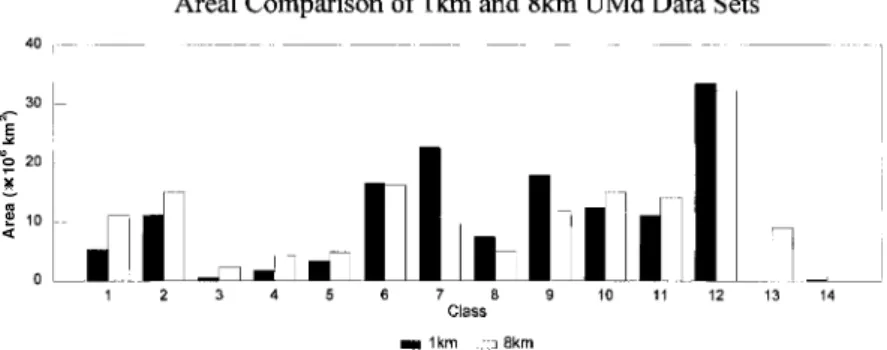
The areal extent of each class is shown in table 4 and the nal product in gure 8. The comparison of these totals to the 1984 8 km product can be seen in gure 9. Note the marked increase in wooded grassland in the 1 km product and the corres-ponding decrease in more forests and woodlands. Beyond the addition of more intermediate woody training sites, the nature of the resampling in producing the GAC and 8 km Path nder data would also make an 8 km product more forested. Resampling of GAC data has been studied and shown to be biased towards the greenest covers and reducing spatial heterogeneity (Justice et al.1989). This would tend to smooth mosaic areas and reduce the expression of intermediate woody
F ig u re 8. F in a l cl a ss i ed p ro d u ct :1 =n ee d le le a f ev er g re en fo re st ;2 =b ro a d le af ev er g re en fo re st ;3 =n ee d le le a f d ec id u o u s fo re st ;4 =b ro a d le af d ec id u o u s fo re st ; 5 =m ix ed fo re st ; 6 =w o o d la n d ; 7 =w o o d ed gr as sl a n d ; 8 =cl o se d sh ru b la n d ; 9 =o p en sh ru b la n d ; 10 =gr as sl a n d ; 11 =cr o p la n d ; 12 =b a re gr o u n d ; 14 =u rb a n an d b u il t-u p .
A re a ( ´ 10 6km 2)
Figure 9. Areal comparison of 1 km and 8 km University of Maryland data sets: 1=needleleaf evergreen forest; 2=broadleaf evergreen forest; 3=needleleaf deciduous forest; 4= broadleaf deciduous forest; 5=mixed forest; 6=woodland; 7=wooded grassland; 8= closed shrubland; 9=open shrubland; 10=grassland; 11=cropland; 12=bare ground; 13=mosses and lichens; 14=urban and built-up.
covers. The most greatly reduced forest in terms of area is the needleleaf evergreen class. This is the result of the addition of more open canopy needleleaf training areas delineated in order to reduce the dominance of this class in certain regions of the 8 km product. The shrub classes appear to disagree because the 8 km product includes a class for mosses and lichens (tundra), and this area is mapped mostly as shrublands in the 1 km map.
7. Reproduction of training data
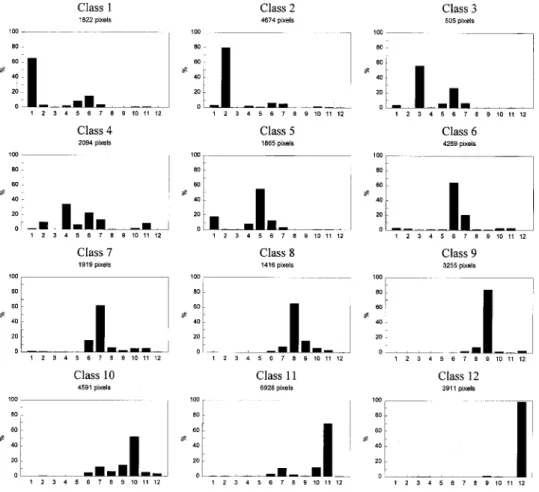
All of the training data were used in the production of the trees. Since no independent data yet exist for validating global data sets, it is useful to examine the results of the product compared to the training pixels. The majority of the confusion within the training data relates to physiognomically similar class types and classes representing mixed assemblages. There is relatively little confusion between core classes representing dominant vegetation forms and forest types. For example, the training agreement when viewing the confusion between only the classes of evergreen needleleaf and broadleaf forests, deciduous needleleaf and broadleaf forests, shrub-land, grassshrub-land, cropland and bare ground is 88% (positively identi ed pixels of these classes/(positively identi ed pixels of these classes+errors only across these classes)). By adding the mixed forest class, woodlands, wooded grasslands, and open and closed shrublands, signi cant additional confusion results. The total training accuracy for all classes is reduced to 69% (total positively identi ed pixels for all classes/total number of training pixels). The accuracies for all classes are shown in gure 10. The best training accuracies are for the most homogeneous cover types such as bare ground (99%=positively identi ed bare ground pixels/total number of bare ground training pixels), open shrubs (84%) and broadleaf evergreen forest (80%). However, nearly one-third (32%) of mislabelled pixels are errors of commis-sion or omiscommis-sion for the woodland class. Over one-half (55%) of training errors are associated with either woodland or wooded grassland pixels. Only one-third (33%) of all errors represent confusion between the aforementioned core classes.
The mixed class types are particularly problematic due to the reliance on ancillary data sets in delineating training sites. An example of forest/woodland confusion can be taken from a set of pixels interpreted from an MSS scene covering part of eastern
Figure 10. Training accuracies of each class. Graphs show the percentage of training pixels for each class as portrayed in the nal map product. Over 50% of the errors involve the intermediate mixed assemblage woodland and wooded grassland classes. Class codes are those listed in the caption of gure 9.
India. All of the pixels from the Chota Nagpur Plateau area were characterized as broadleaf deciduous forest but were classi ed as woodland in the nal product due to the fact that within the metrics they are spectrally most similar to other woodland training sites. The original interpretation of the MSS scene was based on ancillary map data depicting the area as forest, but pixels from this scene have a mean minimum annual red re ectance of 5.1% compared to 3.8% for other global forest training pixels. Thus, within the tree structures, these pixels were labelled as woodland and not forest. A single misclassi ed scene such as this one can greatly reduce training accuracies. The pixels from this Indian scene represent 17% of all deciduous broadleaf forest training pixels and are counted as training errors.
The training accuracy numbers are less than that achieved in our 8 km eort, which had an overall training accuracy, for a set-aside data set, of 81%. This re ects the increased heterogeneity of the Earth’s surface at 1 km, the greater presence of noise and other data problems within the 1 km data set, and a proportional increase of mixed classes within the 1 km training pixels.
8. Evaluation
A global validation data set against which to measure the accuracy of this land cover product does not exist, although an eort is underway to develop such a database at 1 km (Belward 1996). Many researchers have stressed the need for statistically rigorous validation eorts for maps being used for scienti c investigations and policy decisions (Stehman and Czaplewski 1998). However, the validation of this 1 km data product is beyond available resources at this time. In order to evaluate this map, a few comparisons were made with other existing regional data sets which employed high-resolution data sources. Although these cannot be used as validation data, they do help characterize the map by yielding a measure of concurrency between products that were derived entirely independently from one another.
8.1. Environmental Protection Agency Region 3 characterization
The United States Environmental Protection Agency (EPA) has begun an eort to classify the ten Federal Standard Regions as part of an eort called the Multi-Resolution Land Characteristics Consortium National Land Cover Data Base (MRLC) ( Vogelmanet al.1998). To date only region three, consisting of Delaware, the District of Columbia, Maryland, Pennsylvania, Virginia and West Virginia, has been nished. It is a 30 m map product derived from Landsat Thematic Mapper (TM) data and characterizes some classes in common with the UMd product. By reprojecting and resampling the classes to their proportional representation at 1 km, an evaluation of the agreement between the two can be undertaken.
Much of this area is taken up by the Appalachian chain of mountains, which are largely forested, while the valley bottoms and the eastern coastal plain consist of a mosaic of remnant forests and agriculture. By taking the most frequently occurring land cover at the 30 m spatial resolution within geo-registered 1 km squares, a map of the EPA product aggregated to 1 km was produced. Both land cover products, as aggregated to the UMd scheme, are shown in gures 11(a) and 11(b). This study area is dominated by broadleaf deciduous forest, and many valleys present at ne resolutions are not captured at 1 km resolution. The overall agreement per pixel is 65%. When examining homogeneous, or core area, 1 km pixels which consist of greater than 90% one cover type within the high-resolution map layer, the agreement increases to 81%. The corresponding forest/non-forest numbers are 83% and 92%. In all comparisons, forest includes all ve forest types and non-forest includes the remaining eight classes.
The per cent agreement numbers should not be confused with accuracies, but are reported only in order to aid in the visual interpretation of the graphics and to re ect a measure of general thematic agreement. Although viewing core areas can yield overly optimistic results (Hammond and Verbyla 1996), it is worth doing here for a number of reasons. First, some mosaicked areas for the MRLC data do not have a single cover which is dominant at 1 km. For EPA Region 3, these areas are most likely to be represented in the 1 km map as a partial tree cover class such as woodlands or wooded grassland. These intermediate classes were not included in the MRLC classi cation scheme and a straightforward comparison cannot be made. Also, the use of AVHRR data reduces the heterogeneity present in mosaicked areas while this spatial complexity remains even in the resampled MRLC data. Evaluating core areas yields a measure of thematic agreement while minimizing problems associated with this inherent incompatability.
Figure 11. (a) UMd map for EPA Region 3. (b) EPA MRLC Region 3 map. (c) UMd map for Germany. (d) CORINE map for Germany. 1=needleleaf evergreen forest; 2= broadleaf evergreen forest; 3=needleleaf deciduous forest; 4=broadleaf deciduous forest; 5=mixed forest; 6=woodland; 7=wooded grassland; 8=closed shrubland; 9= open shrubland; 10=grassland; 11=cropland; 12=bare ground; 14=urban and built-up. Black areas are for classes which do not aggregate into the UMd scheme such as wetlands for the EPA map and vineyards for the CORINE map. The scale bar represents 300 km.
in the UMd map. Pastures occurring within intensive agricultural areas were not trained on for the 1 km data set and this could lead to errors of omission for the grassland class. Areal comparisons of all regional data sets with the UMd map are shown in gure 12.
A re a ( ´1 0 3k m 2) A re a ( ´10 3km 2) A re a ( ´1 0 3k m 2) A re a ( ´10 3km 2)
Figure 12. Areal comparisons of UMd map product and other regional land cover maps derived from high-resolution data. Class codes are those listed in the caption of gure 9.
8.2. European Coordination of Information on the Environment data
Digital maps for much of western Europe are now available in the European Coordination of Information on the Environment (CORINE) data set produced by the European Topic Center on Land Cover (CEC 1993). Germany was used for comparison as a large country for which the classes aggregated reasonably well to the UMd scheme. A graphic comparison of the UMd and CORINE products for Germany can be seen in gures 11(c) and 11(d). The agreement between the maps at 1 km, using a resampling of dominant cover type for the CORINE data into the 1 km grid, is 65% for all pixels and 83% for those 1 km grid cells with greater than 90% of one land cover type, showing that the core areas for the respective cover types have good agreement. Forest/non-forest comparisons agree at a level of 81% for the entire country and 92% when viewing only the 90%-pure CORINE pixels. The agreement of needleleaf forests increases from 56% to 80% going from all pixels to just the 90%-pure ones, while there is great confusion between mixed and broadleaf forests. Grasslands are poorly depicted in the north, revealing once again the limited ability to depict pasture within areas of intensive cropping. However, one-quarter of the CORINE grassland is labelled wooded grassland, mostly within areas of forest/grasslands mosaics in the south and west of the country.
8.3. NASA L andsat Humid T ropical Deforestation Path nder Project data at the
University of Maryland
The UMd Path nder (Townshend et al. 1995) data sets for Colombia, Peru, Bolivia and the Democratic Republic of the Congo were examined in order to test the success of the UMd product in mapping tropical forest boundaries. The NASA Landsat Humid Tropical Deforestation Project depicts only a forest and non-forest layer, where forest represents humid tropical closed canopy forest and all other land covers are grouped as non-forest. The results for the South American data are shown in gure 13(a). The UMd product misses small clearings within the forest boundary and some montane forests, possibly due to the presence of clouds. One area of
Figure 13. (a) Comparison of UMd and NASA Path nder Humid Tropical Deforestation Project maps for Colombia, Peru and Bolivia. (b) Comparison of UMd and NASA Path nder Humid Tropical Deforestation Project map for the Democratic Republic of the Congo. The scale bar scale equals 300 km.
interest is south-east Bolivia where extensive tropical deciduous woodlands and forests are found. The UMd product has signi cant areas of this forest to the south trending into the Gran Chaco, where the Path nder product shows none as these woodlands/forest are no longer a humid type formation. The agreements of 89.0%, 91.8% and 82.0% for Colombia, Peru and Bolivia respectively show the general success of the UMd product for this area in classifying tropical forest.
The Landsat Path nder data for the Democratic Republic of the Congo (Townshend et al.1995) was examined in a similar fashion. Figure 13(b) shows this comparison. The overall agreement is 85.7%. The largest source of error is found within the forest boundary and in the eastern highlands. As stated earlier, depicting
areas with persistence haze was found to be problematic. Training data from Equatorial Guinea and the Republic of the Congo created splits associated with cloud cover. However, these splits created problems in other areas of the globe, where cloudy signals were being mapped as broadleaf evergreen forest. As such, these splits were dropped from the trees, as the signals are not representative of a characteristic land cover. The result is a spotty depiction of forest cover within the central forest with problems increasing towards the Atlantic coast and Gabon. Within the context of central Africa, these cloudy splits could be used for delineating likely forest in the central basin, along the Atlantic coast, and in the eastern highlands abutting the western rift valley.
8.4. Evaluation summary
A number of conclusions can be drawn based on the comparisons made between the regional databases and the UMd product. The basic distinction between forest and non-forest shows good agreement with other sources, ranging from 81% to 92%. One area of possible improvement for the UMd map is the mapping of pastures within heavily agricultural areas. Future iterations of this product must include better training for this cover subtype. Atmospheric degradation of the remote sensing signal in central Africa is di cult to handle in the global context and suggests the possible value of fusing other data sources such as radar in these areas.
Landscape heterogeneity found in high-resolution data sets is reduced in the 1 km multi-temporal UMd product. Favouring the dominant classes when using coarser resolution data, especially the greener classes due to multi-temporal NDVI compositing, is in agreement with other ndings (Moody and Woodcock 1994) and possible ways to reduce the loss of information for coarse-scale maps are needed (Moody 1998). Using high-resolution data as a surrogate for ground truth may be a cost-eective way to characterize errors present in coarse-scale maps (Kloditz
et al.1998).
9. Comparison with Food and Agriculture Organization forest statistics
United Nations Food and Agricultural Organization (FAO) country forest statist-ics were compared with the UMd country totals for the three levels of canopy closure mapped in the classi cation system. The FAO statistics are provided by individual countries and date from dierent years. An adjustment function was then used to estimate 1995 totals for all countries (FAO 1997). For developed countries, the FAO de nition of forest describes areas with a minimum of 20% tree crown cover and for developing countries, a minimum of 10% tree crown cover. Although the de ni-tions of forest for FAO and the UMd data dier slightly, some conclusions can be made by comparing the global 1 km UMd product to statistics generated by indi-vidual countries.
Figure 14 shows plots of FAO forest versus UMd aggregate classes of forest (>60% canopy cover), forest plus woodland (>40%), and forest plus woodland plus
Figure 14. Plot of FAO total forest cover country statistics versus predicted woody cover of UMd product in millions of square kilometres. (a) UMd forest (>60% tree canopy cover) versus FAO forest. (b) UMd forest plus woodland (>40% tree canopy cover) versus FAO forest. (c) UMd forest plus woodland plus wooded grassland (>10% tree canopy cover) versus FAO forest. (d) best agreeing of the three UMd canopy closure gures versus FAO forest.