The Role of Loan Commitment Terms in Credit Allocation
on the UK Small Firms Loan Guarantee Scheme
Abstract
In this paper we provide empirical evidence concerning the nature of loan commitment contracts as reflected by individual loan contract parameters in influencing the size of bank commitments. Specifically, we consider how the quantitative allocation of credit, the loan amount, is affected or altered by changes to other components of the total loan package. By doing so we shed some more light on the types of real world trade-offs that credit
constrained firms might face when approaching banks for funds, using the UK
governments loan guarantee programme. Our results point at the importance of relationship lending in the UK.
JEL Classifications: G21, L14, D45
Keywords: loan commitment contracts, credit allocation, loan amount, relationship lending
1
Introduction
The limited ability of small firms to gain access to sufficient capital on favourable terms has prompted policy-makers throughout the developed and developing world to intervene in capital markets (Honohan, 2010; Cowling and Mitchell, 2003; Beck and Demirguc-Kunt, 2006). Honohan (2010: p. 2) supports the motivation for government involvement by stating that, “lack of credit is a binding constraint on enterprise and SME investment, most strikingly illustrated by the increased enterprise and very high returns achieved by persons endowed or gifted with additional capital sums.” This is supported by empirical evidence from Abor and Biekpe (2006), who find that new firms depend more on more formal sources of finance, particularly loans, and by implication are more likely to be constrained by access to debt issues, or cash-flow problems (Crespi and Scellato, 2010). It is also supported by Michaelas et al. (1999), Fraser (2014), Van der Zwan (2016), and Mach (2014) who all argue that economic downturns fundamentally change the behaviour of banks and their willingness to supply credit to smaller firms and Chatelain (1998) who argues that credit rationing acts as a financial brake during recessions. More general
evidence shows wide regional disparities in access to finance (Xiao and Ritchie, 2009), and a lack of provision and use of softer advice to support loan applications (Scott and Irwin, 2009).
In this paper we take the theoretical model of Melnik and Plaut (1986) as our starting point and empirically test the model’s empirical implications concerning loan commitments using a sample of UK Small Firms Loan Guarantee Scheme (SFLGS) supported loan contracts. A loan commitment contract (termed overdraft in the UK) refers to a
commitment by a lending bank to make available for drawdown a specified cash amount to a firm for a fixed period of time. The firm may draw down this cash, up to the total agreed
commitment at any time during the entire duration of the commitment. Importantly, the firm only pays interest on the amounts drawn down. This differs from a term loan which is drawn down by the firm in full at the beginning of the loan contract and incurs interest payments (and capital repayment) until the loan term is complete when the balance is zero. Loan commitments are the dominant source of debt financing across the world followed by term loans, thus highlighting the key role that banks play in the external financing of smaller businesses. Thus the paper’s focus is very specifically upon credit allocation (defined as micro rationing by Ghosh et al., 2000) to small firms who would otherwise be perfectly rationed in the credit market, and hence more likely to either not start at all or go out of business (Montgomery et al., 2005). This contrasts with the more common approach adopted in earlier studies which have tended to take the price of loan funds as the
analytical point of departure (see for example, Goldfeld, 1966; Jaffee, 1971; Slovin and Sushka, 1983; King, 1986; Sofianos et al., 1990; Berger and Udell, 1992; Cowling, 2010), although the Berger and Udell study also addressed quantity of credit issues.
For this study we confine our analysis to issues surrounding credit allocation from a quantitative perspective. Thus we are seeking to explain how much credit is available to small firms, not simply how much it costs. Implicit in the model is that a loan commitment contract represents the final outcome of a process of negotiation between borrower and lender over the various parameters of the total contract, or at least the ultimate choice made by the borrower between an array of potential contracts offered by the lender. In this respect we hope to empirically identify two key features of commercial lending. Firstly, we consider how different firm and loan characteristics influence the supply of loan funds under commitment. Secondly, we consider the nature of any trade-offs between loan contract terms. Whilst this study explicitly refers to the UK Small Firms Loan Guarantee Scheme, the findings have much wider relevance given the existence of similar
programmes throughout the EU, the US and Canada and in other countries (see for example SOFARIS in France or Burgschaftsbanken in Germany).
The role of commitment lending has been central to the theoretical development and empirical testing of credit rationing theories for at least a decade. This is perhaps unsurprising given the numerical importance of loan commitments in the US and UK markets for debt finance. In the US, for example, Mach and Wolken (2006), using the 2003 National Survey of Small Business Finances, find that 41.1% of loans were under
commitment which is less than the 53% reported in Berger and Udell (1992). For the UK, Williams and Cowling (2009) give a figure of 37% down from the figure of 43% reported in Cowling (2010), and a substantial decrease from the 1980s when around 2/3rds of all loan contracts were under commitment. For this study loan commitments have two key roles, one which operates at the micro level and one which is a macro issue. On the latter, commitments can be used to insulate borrowers from the effects of tight monetary policy. This occurs as borrowers are contractually insured against credit rationing in a way that non-commitment borrowers are not.
At the micro level commitment contracts can alter the nature and scope of information based problems between borrower and lender. For example, borrowers choosing between a different set of potential commitment contracts reveal more information to the bank about their type, thus reducing information asymmetries. Yet commitment loans, by their very nature as a forward looking contract, mean that there is less information available to the lender than is the case when spot contracts are negotiated as and when funds are needed. In this case the borrower effectively transfers risk to the lender (Avery and Berger, 1991).
A body of research which has direct implications vis a vis the use of commitment loans is that of relationship lending (see for example, De Bodt et al., 2005, Lummer and
McConnell,1989, Petersen and Rajan,1994, Berger and Udell,1995; Berger et al., 2011). Here we refer to the process whereby lenders gather information about borrowers throughout the course of their banking relationship. This allows lenders to make increasingly informed decisions over time about loan contract terms. As to the tangible benefits which might derive from relationship lending, perhaps the most obvious are that more credit becomes available at lower cost. This can occur through reduced information problems or through the greater willingness of lenders to support existing customers in periods of temporary financial distress, although Jiminez et al. (2009) find that use of collateral is higher for loans made at the local level where relationships are perhaps stronger. Avery et al. (1998) find that personal guarantees are widespread on commitment loans to small businesses, and Huang (2003) and Bougheas et al. (2006) both show that rationing is more severe for small firms in periods of monetary tightness.
Clearly a loan commitment, as a vehicle for insuring borrowers from credit crunches, is a very efficient means of achieving these benefits. Yet there exists the potential for
relationship lending to act to the detriment of borrowers. In this case loan commitments are a contractual mechanism by which banks (lenders) can lock-in new borrowers by initially offering them cheap credit (Sharpe, 1990). In addition, the increasingly private information available to the lender throughout an extended relationship makes it more difficult for borrowers to obtain further credit on comparable terms by switching lenders. Empirically, Berger and Udell (1995) found that borrowing costs and collateral requirements on commitment loans tend to decline with the length of the banking relationship. This sort of evidence offers support for the theory that commitment loans are used as a means of protecting favoured customers from unfavourable circumstance, although Niinimäki (2009) points out how fluctuating collateral values can increase moral hazard, and Berger et al. (2011) find that unlimited liability reduces access to credit.
Thus far we have outlined how loan commitments might operate through the credit market at the micro level. We now focus on the monetary policy transmission mechanism at the macro level. For example, standard money theory suggests that interest rate changes, the primary monetary policy instrument, alter consumption patterns by increasing the
opportunity cost of current consumption over future consumption. Financial market theory, by contrast, tends to focus on the role of interest rates in reducing credit allocation, the supply of loanable funds (Blinder, 1987). The use of commitment loan contracts should obviate the effects of tight monetary policy through the credit channel and in doing so may also relieve the downward pressure on real consumption.
To this extent the empirical point of focus is well grounded in previous literature which has often viewed loan contracts as being multi-dimensional in the sense that they represent a bundle of terms or parameters over which the principals and agents negotiate (Melnik and Plaut, 1986, Chan and Thakor,1987, Martinelli,1997). Yet with the exception of the former most studies have singularly focused on the impact of changing various contract
parameters on loan price. Chan and Thakor, for example, see price and collateral as a pair that act in opposing ways, i.e. the more collateral the borrower is willing to supply, the cheaper the loan price.
Given our theoretical point of reference and the nature of the data available to us, the explicit focus is on the concept of loan commitment contracts as a bundle of loan terms, only one of which is price. With this in mind, the rest of the paper is organised as follows. In Section 2 we present a brief discussion of the UK credit market with particular reference to the Small Firms Loan Guarantee Scheme (SFLGS), the source of our data. Section 3 develops a simple model drawn from that presented by Melnik and Plaut (1986). The empirical results are presented and discussed in Section 4. We end in Section 5 with concluding comments.
2
Loan Commitments in the Context of the UK SFLGS
Historically, the majority of commercial loans in the UK and US were issued under commitment, although this has diminished over time. As is the case in the US, a typical commitment contract will specify a maximum amount of funds that are available to a borrower for a given period of time. For this facility the borrower is charged a loan
arrangement fee, which is either a fixed percentage of the amount borrowed (as is the case in the SFLGS) or alternatively a fixed fee, typically in the region of £100 to £200. In the latter case there are clearly economies of scale in borrowing larger amounts. There is considerable cross-country variation in arrangement fees too. For example, the French (SOFARIS) scheme charges no fee but the German (Burgschaftsbanken) scheme charges 0.75% commission on the amount guaranteed with a minimum fee of £175.
For credit that is drawn down, the borrower pays the lender an interest rate which can be either variable or fixed. For variable lending the interest rate is linked to the base rate (prime rate in the US). For fixed rate lending the interest rate is fixed at the point of
contract and remains at this level for the contract’s specified duration. In the UK, the use of fixed rate loans in the commercial loan market is still in its infancy, despite a long history in the UK mortgage market. On loan term, the maximum term available under the SFLGS is 10 years, although the typical loan is considerably shorter than this. In the normal course of lending, loan contracts will include other parameters such as collateral requirements and restrictive covenants. The role of collateral in the case of the SFLGS is crucial in the sense that one of the schemes’ key objectives is to support smaller firms with viable lending proposals who are debt constrained by a lack of collateralisable assets. In actuality we observe that in a substantial number of cases the borrower will have a collateralised loan running alongside an SFLGS loan.
Thus loan commitment contracts involve negotiation on a number of parameters between the lender and borrower. Whilst the firm specific risk premium, the bank margin over base, is a key component of the loan contract, it is by no means the only parameter. A further key feature of this type of contract is that the individual parameters of the loan contract cannot be split and traded. As such the individual parameters can only be considered with reference to the other parameters as changing one will have compensating effects on the others (see Cowling, 1995, for earlier evidence on the nature of trade-offs between SFLGS parameters). We now focus on the loan commitment model that will be subsequently tested by empirical analysis of the data.
3
Modelling the Loan Contract Bundle
We begin by specifying a loan commitment contract as appropriating the vector B{L*, T, m, k, C}. Here L* represents a firm’s maximum credit limit which’s upper bound in the case of the SFLGS is £250,000 for established firms and £100,000 for new firms. For comparison, the French and German schemes both have substantially larger limits (in excess of £520,000). T is the loan duration which’s upper bound under SFLGS rules is set at 10 years, and m is the risk premium or bank margin over base. k is the loan arrangement fee, which is fixed at 1.5% of the total loan amount (L*), and C is the amount of collateral provided as security to the lender. In our framework, where the base rate is exogenously determined (set by the Bank of England Monetary Policy Committee to ensure inflation remains at some pre-specified target level) and contracts take the form of a single
transaction, we exclude the base rate from our model specification. The risk premium, the bank margin, is firm specific in the sense that it represents the lender’s judgement on the firm’s likelihood of loan repayment.
For each contract the borrower decides the extent of his liability to the bank in each sub-period of the total loan duration. By implication this must be between zero and the
maximum loan amount. In each sub-period the borrower repays it +m on Lt (the amount of
credit that is drawn down), where it is the prevailing base rate. The actual determination of
Lt is dependent upon prevailing macroeconomic conditions at the time, or at least
conditions relevant to the firm. Further, we assume that the higher the maximum loan amount, L*, the lower the probability that this represents a binding credit constraint. In an abstract world in which no borrowers default on their loans the lender’s profit function can be expressed as:
kL* + ∫0T Lt emtdt (1)
In a real world characterised by default, in our sample default is 28%, we can specify the probability that a given borrower will repay as π. If we define the state of the world as Φ, then we can identify two possible sources of uncertainty for the lender which might result in loan default at the point of maximum loan term denoted T where default occurs with probability (1-π). This probability then becomes a function of Φ in time periods before T
and Φ at time T. An example of this might be for a borrower who takes out a loan as the economy slipped into a prolonged recession. The cumulative effects of recession might take its toll on the firm over a number of time periods, t, as might the effects of recession at the point of loan completion, T.
Regarding default explicitly, the model assumes that in unfavourable states of the world (1-π) is higher for larger loans, L*, and for borrowers with higher premiums, m, implicitly riskier borrowers. This assumption rests on the fact that borrowers with a large L* and higher premiums, m, have greater outstanding liabilities at time T. By contrast borrowers who pledge collateral have a reduced probability of default, as they are reluctant to forfeit
their assets. Default probability is also increasing in T as longer duration loans accumulate more interest and there is an increased likelihood that the loan contract term will extend into a period of unfavourable macroeconomic circumstances.
In a formal sense we can write the repayment probability, π, as a function of all the loan contract parameters with the exception of those, such as the arrangement fee k, which are pre-paid at the point of loan issue. Thus:
π = π{L*, T, m, C} (2)
where π is allowed to vary across individual borrowers. In each case though π is increasing in C and decreasing in L*, T and m. In the case of default the case of the SFLGS is slightly different from that in the course of normal lending contracts. Here the lender retains the collateral pledged by the borrower and receives the government guaranteed percentage of the remaining loan amount. This is 85% for existing firm borrowers and 70% for new firm borrowers. On absolute collateral levels pledged by third parties, in this case the UK
treasury, Chen (2006) argues that this can alleviate potential problems of inefficient project liquidation associated with high personal (or firm) level guarantees.
For the lender, the utility gained from lending £1 increases with the proportion of the total loan amount that is represented by the loan arrangement fee k. In a similar vein the higher the proportion of the loan covered by the borrower’s collateral the greater the utility. A higher risk premium, m, increases lender utility and a larger loan amount L* reduces it. Thus we can begin to establish the nature of potential trade-offs between the individual loan contract terms. For example, more collateral can be traded-off for more credit and/or a lower risk premium. Given that the explicit focus of this study is on credit allocation in a quantitative sense, the a priori predictions from the model are that a higher allocation of credit, L*, will be associated with higher risk premia, m, and more collateral, C.
4
Empirical Tests
From the model presented in Section 3 we assumed that borrowers select from various contract bundles containing a number of loan specific parameters. In making their selection they implicitly trade-off more of certain parameters for less of others. For example, a borrower with substantial assets could trade them off for a reduction in borrowing costs. In the real world there are a number of other factors, not considered thus far, which might be considered by banks when evaluating creditworthiness of individual borrowers, for example legal form, age of firm etc. In a similar vein there are a number of bank specific factors which might influence the nature of the contract sets they offer borrowers with identical characteristics.
At the empirical level we are seeking to explain what determined the loan amount specified in the commitment contract offered to, and accepted by, the borrower firm. In doing so a particular point of interest is on the identification of any trade-offs between the individual loan contract parameters. The data we use is derived from the loan contract records of a total of 30,744 SFLGS borrowers over the period 2000 to 2005. These loans are spread over some 35 banks and financial institutions throughout the UK, although the vast majority (of the order of 80%) are issued by the four major clearing banks. Of the total loans issued, some 17,946 were issued under commitment. It is this subset of loans that we analyse.
In terms of the data available, we have information on the specific loan contract terms, a bank identifier, and some firm specific information, for example age, size and legal form. The data covers all loan contracts issued under the auspices of the SFLGS over the
and Skills as the scheme requires that each borrower completes a standard form at the point of loan issue. The set of loan commitment contracts is reported in Table 1.
Table 1: Summary Statistics
Variable Mean S.D Min Max
Loan Size, L* (£s) 63,996.20 52,242.44 1,063 250,000
Contract Term, T (months) 77.17 31.43 3 132
Risk premium, m (%) 3.12 1.46 0.01 31.00
Collateral [1,0] 0.30 0.45 0 1
New Firm [1,0] 0.28 0.46 0 1
Ltd Liability [1,0] 0.76 0.43 0 1
Variable rate loan [1,0] 0.89 0.31 0 1
Defaulter [1,0] 0.28 0.44 0 1
From the table we observe that the average loan size is £64,000. The average risk premium is only 3.12%, although the range of margins is quite large, varying from virtually risk-free to the rather onerous rate of 31% over base.1 Only three in every ten loans have borrower collateral attached and the majority are made to firms with limited liability legal status. Nearly one in three borrowers are new firms and out of the total of 17,946 loans issued 28% ended in default. Information on firm size was available for all loans issued and we
1 We cross-referenced the margins data with Bank of England SME data and took a view
that any reported margins that were below the lower margin spread boundary were potentially incorrectly reported and removed them from our analysis.
note that the average firm employed 8 workers and had a turnover of £425,224. We can a priori predict what the signs on the key contract variables are. These are identified below:
L* = f {T (-), m (+), C (+), Size (+), Age (+), Legal Status LTD (+), Default (-), Bank (?)} We exclude k from our analysis as it is a fixed and pre-specified proportion of all SFLGS loans. In addition we allow for non-linearity in firm size effects on the assumption that the effect of doubling in size when at the lower end of the firm size distribution might be considered a greater risk decrease than doubling the size of a large firm. Further we use the two size measures available to us, employment and sales, in otherwise identical model specifications. One key innovation is that we have information on which individual loan contracts resulted in ex post default (risk), as well as our ex ante measure of risk, the loan interest rate, m. Defaulted loans are coded 1 in our default dummy variable and have the expected negative sign in that they represent the purest measure of risk. This variable in particular is extremely interesting in that it provides information concerning the ability of lenders to correctly evaluate borrower risk at the point of issue. This type of variable has been adopted in previous empirical work, particularly in insurance contracting (Puelz and Snow, 1994, Chiappori and Salanié, 1997, Dionne et al., 1997) to proxy for risk type. In the bank contracting literature, Cressy and Toivanen (2001) use loan repayment success to proxy for risk type in the presence of adverse selection. Shen (2002) also uses a toxic firm (loan) dummy variable in his empirical study of bad loans in bad years. However, in the context of the theoretical model we could argue that if the other contract parameters are specified in such a way that default is compensated for then this is rational or efficient contracting by the lender. Full collateralisation might be a case in point.
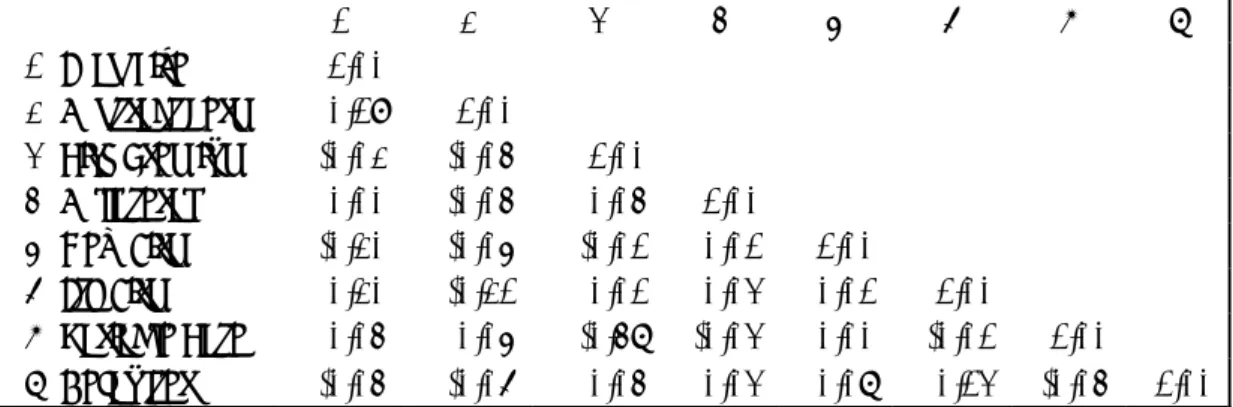
14 First, we consider the basic correlations (Table 2). We find that loan amount is most highly correlated with loan term (+0.19), new firms (-0.20), and limited companies (+0.20). Interest rate margins are very highly correlated with variable rate lending, but in a negative way (-0.48). A particularly interesting feature was that our two risk measures, bank interest margin (m) which is our ex ante measure, and default, our ex post risk measure, are
significantly, and positively correlated, but the absolute magnitude of the correlation is low at 0.04.
Table 2: Correlation Matrix
(1) (2) (3) (4) (5) (6) (7) (8) (1) Loan Size 1.00 (2) Contract Term 0.19 1.00 (3) Risk Premium -0.02 -0.04 1.00 (4) Collateral 0.00 -0.04 0.04 1.00 (5) New Firm -0.20 -0.05 -0.01 0.01 1.00 (6) Ltd Firm 0.20 -0.21 0.01 0.03 0.01 1.00 (7) Variable Rate 0.04 0.05 -0.48 -0.03 0.00 -0.01 1.00 (8) Defaulter -0.04 -0.06 0.04 0.03 0.08 0.13 -0.04 1.00
Note: Bold indicates significant at 5% level.
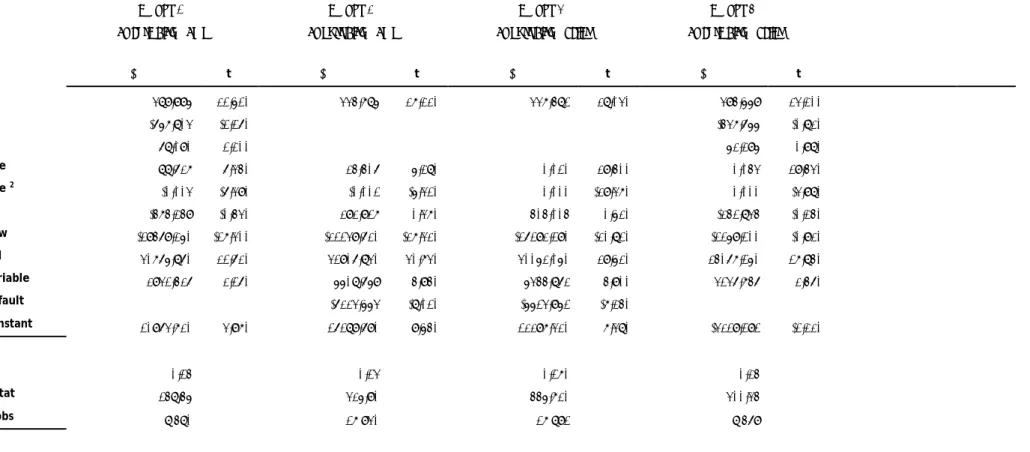
The results of different specifications of the basic model are presented in Table 3. The dependent variable in each case is the loan commitment size in £’s. Models were estimated by OLS but with robust standard errors. The first point of note in model (1) is that loan size is not related to our ex ante risk premiums variable even though we allow for non-linearity in the relationship. The non-significance could be due to the lower repayment probability associated with a higher m, cancelling out the positive effect on lender utility via higher received interest payments. The length of contract, T, was found to act in a positive, and significant, way on loan size across all equations. Here an increase of one year (12 months) in the contract terms is associated with an increase in the commitment of between £4,000
and £4,700, which represents between 6.3% and 7.4% of the average loan size issued. This goes against the expected sign but it implies that banks value the customer relationship much more than the potential for greater uncertainty associated with longer duration loans.
The collateral variable was found to be insignificant in all equations. On firm size we note that there is a non-linear and concave relationship. Here the loan amount increases sharply as firm size increases at the lower end of the distribution, but tails off for very large firms. Ignoring the squared term for the moment, a £1,000 increase in turnover increases loan amount by between £10 and £40 (Models (3) and (4)). For employment an additional 10 workers raises loan size by £886 (Model (1)).
Turning to the default variable, our ex post risk measure, we initially observe that it is negative and significant in all equations where it is included. Here a defaulting firm receives between £5,500 and £6,200 less loan than a firm who repays. On legal status we observe that limited liability firms get substantially larger loans than either partnerships or sole traders. The scale of this limited liability effect ranges from £24,000 - £32,000. One interpretation is that limited liability firms have greater credibility and legitimacy than other legal forms of business and consequently are viewed as less risky by lending institutions.
We also observe that variable rate loans, those dependent upon the prime rate, attract higher loan amounts than fixed rate loans. This is consistent with the theoretical model to the extent that variable rate borrowers’ pay more in total than fixed rate borrowers and are thus rewarded by larger loans. The predictions from our models show that variable rate borrowers get loans of the order of £2,900 - £5,500 larger than fixed rate borrowers. There is also some evidence of quantity rationing against new firms who, on average, are
16
(model 4) this significance disappeared.2 Finally we note that there is substantial variation across lending institutions. Unfortunately we are not permitted to name them as the
Department views this as a breach of confidentiality. What we can say is that the estimates show that two otherwise identical borrowers each taking out the same type of contract can have loan amounts that differ by up to £44,000. This is a very substantial difference and highlights the considerable heterogeneity of lenders, even in a highly concentrated banking sector such as the UK.
What remains unexplained are likely to be other factors that banks use to assess risk such as the personal characteristics of the entrepreneur, the management team and suchlike. In addition we note that in the real world a bank relationship involves more than just one-off loan decisions made in splendid isolation. Such concerns may influence any one or all of the loan commitment parameters.
5
Conclusion
In this paper we drew inspiration from an earlier model and empirical test of credit
allocation developed by Melnik and Plaut (1986). The basic thrust of their work was that a loan contract has many parameters that are interlinked and can be traded-off against each other. It is the preference of the individual borrower that determines which of the various competing contract bundles he or she chooses given the lender’s offer set.
We then proceeded to empirically test the model using a unique dataset for the UK comprised of borrowers who were perfectly credit constrained prior to successfully applying for SFLGS funds. Where our results proved to be significant we find some
2 An alternative explanation is that, relative to established firms, new firms have lower
differences with those identified in the US. In particular, only our ex post risk variable was significant whereas Melnik and Plaut’s ex ante risk was highly significant in most models. Further, their contract duration variable only had weak significance compared to a strong and positive effect across all our models, indicating the importance of relationship lending in the UK. But we also found strong similarity in our positive firm size effect. We did not identify an explicit trade-off between bank risk premia and loan amounts, although the results concerning variable rate lending is consistent with higher premia on larger loans.
Taken as a whole the results are supportive of two basic conclusions. Firstly, for lending institutions the desire to facilitate the development of long-term relationships with
customers is an overriding aim and one that spills over into the loan market. Secondly, this also has important implications, and broadly supportive ones, for the role of corrective schemes such as the SFLGS in allowing certain types of borrowers’ access to funds and hence the potential to build a relationship with a bank. It is likely that, in the absence of loan guarantee schemes, entrepreneurs with little wealth would be more likely to face binding credit constraints.
18
References
Abor, J. and Biekpe, N. (2006), “How Are SMEs Financed? Evidence from the Ghanaian Nontraditional Export Sector”, Environment and Planning C: Government and Policy
24(1), 71-81.
Avery R. and Berger, A. (1991), “Loan Commitments and Bank Risk Exposure”, Journal of Banking & Finance 15, 173-192.
Avery, R., Bostic, R. and Samolyk, K. (1998), “The role of personal wealth in small business finance”, Journal of Banking & Finance 22(8), 1019-1061.
Beck T. and Demirguc-Kunt, A. (2006), “Small and Medium-Size Enterprises: Access to Finance as a Growth Constraint”, Journal of Banking & Finance 30(11), 2931-2943. Berger, A.N. and Udell, G.F. (1992), “Some Evidence on the Empirical Significance of Credit Rationing”, Journal of Political Economy 100(5), 1047-1077.
Berger A.N. and Udell, G.F. (1995), “Relationship Lending and Lines of Credit in Small Firm Finance”, Journal of Business 68,351-382.
Berger, A.N., Espinosa-Vega, M., Frame, A., Scott, W., and Miller, N.H. (2011), “Why do borrowers pledge collateral? New empirical evidence on the role of asymmetric
information”,Journal of Financial Intermediation 20(1), 55-70.
Blinder A. (1987), “Credit Rationing and Effective Supply Failures”, Economic Journal 97 (396), 327-352.
Bougheas, S., Mizen P., and Yalcin, C. (2006), “Access to external finance: Theory and evidence on the impact of monetary policy and firm-specific characteristics”, Journal of Banking & Finance 30(1), 199-227.
Chan Y. and Thakor, A. (1987), “Collateral and Competitive Equilibria with Moral Hazard and Private Information”, Journal of Finance 42(2), 345-363.
Chatelain, J.-B. (1998), “Investment Facing Credit Rationing”, Manchester School 66(S), 102-115.
Chen, Y. (2006), “Collateral, Loan Guarantees, and the Lenders’ Incentives to Resolve Financial Distress”, Quarterly Review of Economics and Finance 46(1), 1-15.
Chiappori, P. and Salanié, B. (1997), “Empirical Contract Theory: The Case of Insurance Data”, European Economic Review 41(3-5), 943-950.
Cowling, M. (1995), “Initial Tests on the Sensitivity of the Parameters of the Loan Guarantee Scheme”, Public Finance 50(3), 111-124.
Cowling, M., (2010), “The Role of Loan Guarantee Schemes in Alleviating Credit Rationing in the UK”, Journal of Financial Stability 6(1), 36-44.
Cowling, M. and Mitchell, P. (2003), “Is the Small Firms Loan Guarantee Scheme Hazardous for Banks?”, Small Business Economics 21(1), 63-71.
Crespi, F. and Scellato, G. (2010), “Ownership Structure, Internal Financing and Investment Dynamics”, Manchester School 78(3), 242-258.
Cressy, R. and Toivanen, O. (2001), “Is There Adverse Selection in the Credit Market?”,
20
De Bodt, E., Lobez, F. and Statnik, J.-C. (2005), “Credit rationing, customer relationship and the number of banks”, European Financial Management 11(2), 195-228.
Dionne, G., Gourieroux, C. and Vanasse, C. (1997), “The Informational Content of Household Decisions with Application to Insurance Under Adverse Selection”, working paper. Montreal: Université de Montreal.
Fraser, S. (2014), “International perspectives on small businesses, bank credit, and the Global Financial Crisis”, International Review of Entrepreneurship, 12(4), 133-140. Ghosh, P., Mookherjee, D. and Ray, D. (2000), “Credit rationing in developing countries: An overview of the theory”, In: Mookherjee, D. and Ray, D. (eds.), A Reader in
Development Economics. London: Blackwell.
Goldfeld S.M. (1966), Commercial Bank Behavior and Economic Activity, Amsterdam: North-Holland Publishing Company.
Honohan, P. (2010), “Partial Credit Guarantees: Principles and Practice”, Journal of Financial Stability 6(1), 1-9.
Huang, Z. (2003), “Evidence of a Bank Lending Channel in the UK”, Journal of Banking and Finance 27(3), 491-510.
Jaffee D.M. (1971), Credit Rationing and the Commercial Loan Market. New York: Wiley.
Jiminez, G., Salas, V. and Saurina, J. (2009), “Organizational Distance and Use of Collateral for Business Loans”, Journal of Banking & Finance 33(2), 234-243.
King, S.R. (1986), “Monetary Transmission: Through Bank Loans or Bank Liabilities?”,
Lummer S.L. and McConnell, J.J. (1989), “Further Evidence on the Bank Lending Process and the Capital Market Response to Bank Loan Agreements”, Journal of Financial
Economics 25, 99-122.
Mach, T.L. (2014), “The role of credit access in firm sustainability: A comparison of the 1998 and 2003 Surveys of Small Business Finances”, International Review of
Entrepreneurship, 12(4), 141-162.
Mach, T.L. and Wolken, J. (2006), “Financial Services Used by Small Businesses: Evidence from the 2003 Survey of Small Business Finances”, Federal Reserve Bulletin, October.
Martinelli C. (1997), “Small Firms, Borrowing Constraints, and Reputation”, Journal of Economic Behavior & Organization 33, 91-105.
Melnik, A. and Plaut, S. (1986), “Loan Commitment Contracts, Terms of Lending, and Credit Allocation”, Journal of Finance 41(2), 425-435.
Michaelas, N., Chittenden, F. and Poutziaris, P. (1999), “Policy Implications Arising from the Impact of the Last Recession on the Capital Structure of SMEs”, Environment and Planning C: Government and Policy 17, 411-430.
Montgomery, M., Johnson, T. and Faisal, S. (2005), “What Kind of Capital Do You Need to Start a Business?”, Quarterly Review of Economics and Finance, 45(1), 103-122. Niinimäki, J.-P. (2009), “Does Collateral Fuel Moral Hazard in Banking?”, Journal of Banking & Finance 33(3), 514-521.
Petersen M. and Rajan, G. (1994), “The Benefits of Lending Relationships: Evidence from Small Business Data”, The Journal of Finance 44(1), 3-37.
22
Puelz, R. and Snow, A. (1994), “Evidence on Adverse Selection: Equilibrium Signalling and Cross-Subsidization in the Insurance Market”, Journal of Political Economy 102, 236-257.
Scott, J. and Irwin, D. (2009), “Discouraged Advisees? The Influence of Gender, Ethnicity, and Education in the Use of Advice and Finance by UK SMEs”, Environment and
Planning C: Government and Policy 27, 230-245.
Sharpe S.A. (1990), “Asymmetric Information, Bank Lending, and Implicit Contracts: A stylized model of customer relationships”, Journal of Finance 45, 1069-1087.
Shen, C.H. (2002), “Credit Rationing for Bad Companies in Bad Years: Evidence from Bank Loan Transaction Data”, InternationalJournal of Finance and Economics 7, 261-278.
Slovin, M.B. and Sushka, M.E. (1983), “A Model of the Commercial Loan Rate”, Journal of Finance 38(5), 1583-1596.
Sofianos, G., Wachtel, P. and Melnik, A. (1990), “Loan Commitments and Monetary Policy”, Journal of Banking & Finance 14(4), 677-689.
Van der Zwan, P. (2016), “Bank loan application success of innovative and non-innovative SMEs”, International Review of Entrepreneurship, 14(4), 483-502.
Williams, M., and Cowling, M. (2009), “Annual Small Business Survey, 2007/08”, London: Department for Business Enterprise & Regulatory Reform.
Xiao, L. and Ritchie, B. (2009), “Access to Finance for High-Tech SMEs: Regional
Table 3: Loan Commitment Equation: Dependent variable = Loan Amount
Model (1) Model (2) Model (3) Model (4)
Ex ante Risk + Emp Ex post Risk + Emp Ex post Risk + Sales Ex ante Risk + Sales
β t β t β t β t T 389.995 21.510 334.785 27.220 337.481 28.030 394.559 23.200 m -657.803 -1.160 -437.655 -0.820 m2 68.090 1.200 52.295 0.980 Size 88.627 6.340 24.406 5.280 0.010 29.400 0.043 19.430 Size 2 -0.003 -6.390 -0.001 -5.310 0.000 -29.370 0.000 -3.980 C -474.249 -0.430 292.917 0.370 404.004 0.520 -241.834 -0.240 New -19469.250 -17.300 -21139.620 -27.320 -16192.190 -20.810 -1159.100 -0.920 Ltd 30765.860 21.620 31906.830 30.730 30052.050 29.520 24067.150 17.840 Variable 2931.426 2.160 5508.659 4.940 5344.862 4.900 3136.746 2.460 Default -6223.553 -8.010 -5513.951 -7.240 Constant 10963.720 3.970 16189.690 9.540 12297.320 7.380 -3219.191 -1.220 R2 0.14 0.13 0.170 0.24 F stat 148.45 325.90 445.720 300.34 N obs 8,480 17,930 17,891 8,469