WORKING PAPER I-2006-02
Charles Møller
The Conceptual Framework for Business Process
Innovation -
Towards a Research Program on Global
Supply Chain Intelligence
Informatics
Research Group
The Conceptual Framework for Business Process Innovation
Towards a Research Program on Global Supply Chain Intelligence
Charles Møller, Department of Business Studies, Aarhus School of Business, Denmark, e-mail: [email protected]
Introduction
This paper proposes a research program on Business Process Innovation: Towards Global Supply Chain Intelligence. Few words are more ubiquitous in business or society today than “innovation”. This reflects that businesses are striving for ways to survive and thrive in an increasingly complex and connected world (IBM 2006).
Most industrial supply chains today are globally scattered and nearly all organizations rely on their Enterprise Information Systems (ES) for integration and coordination of their activities. In this context innovation inevitably is driven by advanced information technology.
Organizations today are required not only to operate effective business processes but they also need to accommodate to changing business conditions at an increasing rate. Consequently the ability to develop and implement new processes driven by the Enterprise Information Systems is a central competence in most industries, and furthermore it is a critical practice for a global enterprise.
The next practice in Global Supply Chain Management is Business Process Innovation. Business Process Innovation is the transformation of a global supply chain driven by a new advanced Enterprise Information Systems technology. This technology holds the potential to “close the control loop”, but until now few organizations have managed to unleash the full potential of global supply chain intelligence. Thus, there is an emerging need for managing the transformation and for new approaches that will lead to robust global supply chains.
Practices for
Global Supply Chains
Supply
Chain
Management
Innovation
Mediation
Enterprise
Systems
Management
This paper presents a conceptual framework for Business Process Innovation. A research proposal based on five interrelated topics is derived from the framework. The research program is intended to establish and to develop the conceptual framework for business process innovation and to apply this framework in a global supply chain context. These topics are presented in the following sections, but first the background for the program is discussed.
Background
In a hyper-competitive environment companies must continually improve their people, processes, and technologies to create a competitive advantage. The ability to accurately predict consumer demand coupled with the capability to rapidly react and readjust to environmental changes and supply and demand fluctuations separates the winners from the losers (Rai et al. 2005).
The emergent challenge and opportunity for an organization is to architect, design and orchestrate adaptive global supply chain networks. Adaptive supply chain networks exploit innovations to improve efficiency and responsiveness and consistently achieve these objectives. Furthermore most global supply chains are vulnerable to disruptions like natural disasters, accidents and terrorism. Consequently not only sense and response, but also robustness and resilience are emerging concerns to most enterprises(Sheffi 2005).
Innovation is inevitably tied into technology and especially IT. Modern Enterprise Information Systems (ES) from the major vendors such as SAP, Oracle and Microsoft contain vast amounts of new concepts and tools, but let’s face it: quite often these wonderful tools are used (and sometimes misused) to create trivial solutions. Why is that? Maybe because we as users and as organizations are not able to grasp the enormous complexity of the task of changing inter-organizational processes spanning global supply chains, numerous organizational boundaries and countless IT-systems. This program is fueled by the idea that there is a huge potential contribution in using advanced ES to transform an organization and create a better alignment between business and processes. This is a practice that can be described as business process innovation (BPI). Davenport, Prusak and Wilson (Davenport et al. 2003) simplify the innovation process into four steps: 1) scanning and identifying ideas; 2) packaging the idea; 3) advocating the idea; and 4) making it happen. They come up with two extreme roles: the “guru” packagers and the creative “idea practitioners”. This outlines a playground for an innovator as a mediator who transforms the big ideas into practice and makes it work.
Although innovation theories often emphasize the innovator´s role in the process Christensen, Anthony and Roth (2004), others take a completely different stance. Michael Schrage argues that the innovative prototype creates innovations, not the innovator (Schrage 1999). His point is simply that the process of working (and playing) with the prototype models is more important than the design process. His work illustrates how leading enterprises master this modeling process and are able to transform the learning into innovative products on the market. His message is simple: you need to be able to model your ideas, play with the models and learn by doing (Schrage 2004).
Research approach
The fundamental theoretical lens on this problem is the system´s perspective, i.e. the business process is considered as a work system (Alter 2006) and business process innovation is considered a systems engineering process.
System Development and in particular IS development is a well-known and mature perspective. This perspective is mainly focused on software development which is not the main issue here.
However, this perspective can inform the model architect about modeling in an organizational context. These fields are very rich - for more details see (Møller 2006a).
Enterprise Information Systems are the technical and the organizational context for integrated process development. The ES and the process models are the new components of an information system. The ES has also changed from static systems towards a new generation of ES driven by process models (Møller 2005). It is equally important to understand the old architecture and the new architecture of the systems. We need to consider the vendors, how they relate and also the adoption of new technologies.
The global supply chain is the business and organizational context for developing integrated processes. The arena for process innovation has changed from the internal processes towards the external processes in the supply chain. This has many implications, including the fact that the roles of the information systems are becoming more prominent. Many of the modern inter-organizational issues are only touched upon to some extend, and they need to be provided using various real life cases.
The theoretical foundation for Business Processes is rooted in the industrial engineering tradition. Many adjacent theories, tools and techniques like “Lean” or “Six-sigma” should be identified in order to establish a comprehensive framework.
In the computer sciences tradition there is an emerging process modeling community based on mainly process model standards and workflow systems. Today the workflow community is very engaged into standards, general models and modeling and design techniques.
The Process Innovation Laboratory (Π-Lab) has been proposed as a comprehensive framework and a collaborative workspace for experimenting with process models. The Π-Lab is using a combination of integrated action learning and concept development approach to facilitate innovation. This methodology is called innovation mediation (Møller 2006a).
This paper establishes the conceptual framework for a new methodology for developing business processes in a global supply chain based on advanced Enterprise Information Systems. The proposed research program evolves around the conceptual framework and has five interrelated activities:
1) to establish the theoretical foundation for Business Process Innovation in the supply chain. The objective is to identify, capture and to categorize the general process theory in a supply chain context.
2) to set up the conceptual context for developing global supply chains. The objective is to identify and enhance new concepts and the methods for developing global supply chain intelligence.
3) to create the conceptual basis for managing advanced Enterprise Information Systems. The objective is to identify and transform the new concepts and the technology management perspective based on new advanced Enterprise Information Systems.
4) to develop innovation mediation as a methodology for Business Process Innovation. The Π -Lab is proposed as a comprehensive framework and a collaborative workspace for
experimenting with process models. The Π-Lab is using an integrated action learning and concept development approach to facilitate innovation.
5) to execute a number of industry driven action research projects on Business Process Innovation. These projects serve as the shared empirical basis and furthermore a national and international network of researchers and industries on Business Process Innovation will be established.
The conceptual framework is based on previous research on operations management and information systems, and this particular research contributes to each of the topics with the Π-Lab and Innovation Mediation as the main contribution.
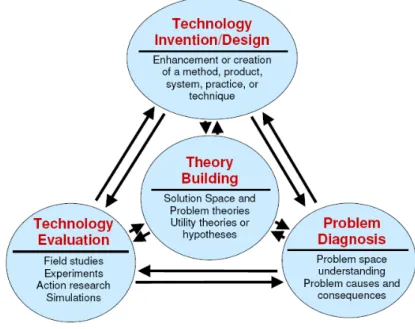
Thus the research approach of this program is a combination of theoretical studies, conceptual development of methods and tools and explorative action research. The research we embark on is based on engineering and computer science, and it is called design science. This study uses Design Research in Information Systems in an emerging “lens” or set of analytical techniques and perspectives complementing the positivistic and interpretive perspective in IS (Hevener et al. 2004; Vaishnavi et al. 2004/5). The design research involves the analysis of the use and performance of designed artifacts to understand, explain and very frequenty to improve the behavior of aspects of Information Systems. Design science ultimately is theorizing on business process design or innovation, and the research activity framework is illustrated in figure 2 below. In the following sections the elements of the framework are elaborated on.
Figure 2. An activity framework for Design Science Research (Venable 2006)
Conceptual framework for Business Processes Innovation
Process Improvement (Davenport 1992) is business-oriented of nature and consistently focused on hard facts and value. The first wave of process improvement used continuous improvement (kaizen) techniques to empower people to solve problems. This proved to be a very successful approach and today we see the lean movement which is based on this thinking with tools such as the 6-sigma and others.
Since the beginning of the 90´s there has been an enormous focus on business processes and business processes as a source of innovation. This marks the second wave and the understanding
was that the business processes were inhibited by organizational and cultural boundaries. Consequently techniques like Business Process Re-engineering (BPR) emerged using a clean slate approach was attempted and new IT was applied as a silver bullet (Hammer et al. 1993).
New IT was often embodied in the first generation ERP systems (or more general ES) and after the ES technology was widely adopted, new problems emerged. First of all the implementation issues were considerably but the most prominent problem was the claimed inflexibility of the ES (Davenport 1998).
All together business models require processes to be integrated across the supply chain in order to accommodate for transparency demand, and the ES technology naturally is the major component in this architecture. Consequently the information technology has become a barrier for process improvement.
These issues are also addressed by the major ERP vendors that compete to provide the next-generation ES technology as well. Recently we have seen, how they approached these challenges (Møller 2005), and we conclude that we are facing an emerging disruptive change that will allow for future ES to be driven by process models. This is also called process aware IS (Dumas et al. 2005).
Process models and enterprise modeling have been around for a while, e.g. several reference model architectures (ESPRIT Consortium AMICE 1993; Scheer 2000) have been developed aimed at one-of-a-kind enterprises, requiring a high level of flexibility and agility, like shipyards and aerospace. Extended Enterprises and integration have been a major issue for industry and research, and here we use the concept of an integrated business process model to frame these enterprise models.
Meanwhile the trends and tendencies in logistics and supply chain management have reinforced the need for process integration leaving the supply chain scattered and distributed from globalization and outsourcing. Most important the need for customer driven supply chains requires new approaches to process integration across enterprises, and we use the concept of process innovation to frame these approaches.
Consequently, we need to explore and understand the implications of this new situation - there are several research opportunities in this context.
Supply Chain Management
Supply Chain Management (SCM) has become one of the most important new business concepts. Global competition and outsourcing have caused the fragmentation of the supply chain, and supply chain excellence is now a prerequisite for competitive advantage (Christopher 2005). Theoretically SCM emphasizes the management of the entire supply chain as one entity, and the practice of SCM is to extend the internal business processes into the supply chain thus developing an integrated supply chain (Fox 1999).
The concept of Supply Chain Management (SCM) dates back to the late 50´s where research on system dynamics explored the systemic properties of enterprises collaborating in chains. Business dynamics (Forrester 1958) dealt with delays and information flow and addressed contemporary problems like the “Bullwhip effect” which is still a significant issue (Lee et al. 2001).
There was no business implication of this research due to the immaturity of the available computers, but also the success of the emerging MRP systems postponed interest in this approach for decades. The concepts re-emerged in the beginning of the 80´s initially in operations and logistics research, and by the 90´s many businesses were implementing major structural changes in their supply chain.
SCM took a systems approach when planning and controlling the material and information flow from the raw material to the final customer, and therefore SCM was defined as “The management of upstream and downstream relationships with suppliers and customers to deliver superior customer value at less cost to the supply chain as a whole” (Christopher 2005).
The strategic management discussions dominated the initial research agenda (Scott and Westbrook 1991), but the software industry responded to the new business requirement by producing a new breed of add-on or “bolt-on” software to ERP called Advanced Planning and Scheduling (APS) systems (Calloway 2000).
APS was enabled by refining the mathematical programming models and in particular the genetic algorithms applied to solve the network problems of an entire supply chain. The APS systems facilitate the central management of the supply chain activities and processes in real time, essentially by extending the MRP/II planning concepts to encompass the entire supply chain, and as a result the systems in effect are Supply Chain Management systems (Møller 2006c).
Although the SCM concept deals with the entire supply chain, the perspective of the upstream SCM and the downstream SCM differs. Downstream, SCM primarily deals with demand management, order fulfillment, replenishment and collaborative relations with customers, e.g. Collaborative Planning, Forecast and Replenishment (CPFR). Some researchers even proposed Demand Chain Management (DCM) as a new perspective (Hoover et al. 2001). The management of market information became important and the software vendors targeted these new requirements with the Customer Relationship Management (CRM) systems.
Upstream, SCM primarily deals with issues of managing the supplier networks. Issues like supplier relations, partnerships, competence development and technology transfer are barriers for developing the supply chain. Practices based in the JIT philosophies were implemented in the supply chain and new concepts like Vendor Managed Inventories (VMI) emerged. The traditional purchasing task became strategic sourcing, and the new tools required were gathered under the Supplier Relation Management (SRM) hat.
Managing information in an inter-organizational context has become critical and the emergence of the Internet and the range of related e-business technologies created new opportunities and threats to supply chain managers. Lee and Whang (Lee et al. 2001) define e-business in a SCM context as “The term ’e-business’— as distinct from ‘e-commerce’ — can be used to describe this exciting adoption of the Internet to accelerate the goal of supply chain integration. In this context, e-business specifically refers to “the planning and execution of the front-end and back-end operations in a supply chain using the Internet”(Lee et al. 2001). In fact they argue that e-business already has enabled supply chain integration and that focus therefore should be redirected towards managing the demand chain.
European supply chain executives identified five key SCM issues (Akkermans et al. 2003): (i) further integration of activities between suppliers and customers; (ii) on-going changes in supply chain needs and required IT flexibility; (iii) more mass customization of products and services leading to increasing assortments while decreasing cycle times and inventories; (iv) the locus of the driver’s seat of the entire supply chain; and (v) the supply chain consisting of several independent enterprises. The same executives saw only a modest role for ERP improvements in future supply chain effectiveness and a clear risk of ERP actually limiting progress in SCM.
A recent study of the perceived benefits from implementing ERP Davenport, Harris and Cantrell, (2004b) shows that the key factors driving ES benefits are: (i) integration of processes; (ii) optimization of processes; and (iii) informate, or the transformation of the company based on ES
data. On the other hand, Davenport and Brooks (Davenport et al. 2004a) argue that early ERP was not primarily focused on the supply chain, but the businesses that were able to extend their Enterprise Information Systems into the supply chain with “bolt on” SCM systems have experienced substantial benefits.
The challenge is to transform new ideas and advanced technology into business value. In other words: How can we effectively apply new advanced Enterprise Information Systems in a global supply chain in order to create process integration? The key to these benefits goes through the development of infrastructural and strategic capabilities embodied in ERP combined with the SCM systems - the next generation of ERP (Møller 2005).
Enterprise Systems Management
Few IT innovations have had as much impact on business organizations in the past years as Enterprise Information Systems. ES are a standardized software package designed to integrate the data used throughout an entire organization (Davenport 1998). According to Nah (Nah 2002) the American Production and Inventory Control Society (APICS) defines ES or ERP as “a method for the effective planning and controlling of all the resources needed to take, make, ship and account for customer orders in a manufacturing, distribution or service company”. The APICS definition extends the concept of ES from an IT system towards a technology to manage and to organize the processes of an enterprise. It should be noted that there is no agreement on terms and definitions regarding ES. This is a rapidly evolving concept, and like Davenport (Davenport 1998) we prefer to use the term Enterprise Information Systems to emphasize the generics of the concept rather than to use a term like ERP, which would indicate a narrower scope. Moreover, we wish to focus on planning and coordination.
Many large enterprises have implemented ES and have now taken their next step on the ES journey. This journey is often described in terms of waves (Shanks et al. 2003). The first ES wave includes the acquisition, configuration and implementation along with resulting changes in the organization after going live with the system for the first time. The second wave includes making continuous improvements and maximizing the benefits from ES.
The ES have changed fundamentally over the last ten years(Møller 2005), and companies are now taking advantage of the web-based technologies and advanced functions in order to establish an integrated extended enterprise (Davenport et al. 2004a). Second wave ES projects are spurred on as a result of some of the questions managers are asking themselves after having gone through first wave ES projects. These include: How can we gain greater benefits from our ES investments? How can we manage and enhance our ES to continuously align the system with the strategy and structures of the organization? How will ES impact on the business and create new work procedures (Kræmmergaard et al. 2002)? This means that implementation issues are no longer the primary concern and that focus has shifted to utilization, development and business value enhancement. We have a good picture of the research into the first wave (Esteves et al. 2001). First wave ES implementations have been explored through case studies which have focused on for instance ES strategic options, how to avoid failures, how to identify issues of alignment, and business process reengineering issues. Only recently we have seen research aimed at ES beyond the cost-intensive implementation phase. However, the work we have seen on the actual application and impacts of ES has a clear message: These systems have the capability to transform a business, but only if the organization is able to integrate the activities – not only internally, but also across the external value chain (Davenport et al. 2004a; Markus et al. 2000; Ross et al. 2003). This requires the enterprise system to be managed as an independent area in the organization to fully exploit its potential and
ensure that it continues to produce business benefits. We believe that this calls for a new management competence or function: Enterprise Information Systems Management (Møller 2006b). Simultaneously the ES have evolved tremendously, driven by: the changing business requirements, the new technologies, and software vendors´ innovations (Markus et al. 2000; Wortmann 1998). In the recent years the ERP systems evolved into what is often summarized as ERP II systems (Bond et al. 2000; Calloway 2000; Møller 2005), and the organizations are now taking advantage of new web-based technologies and advanced functions in order to establish an integrated extended enterprise (Davenport et al. 2004a). These issues are also addressed by the major ERP vendors who compete to provide the next-generation ES technology as well. Recently we have seen how they approached these challenges (Møller 2005), and we conclude that we are facing an emerging disruptive change that will allow for future ES to be driven by process models (Dumas et al. 2005). Contemporary Enterprise Information Systems (ES) from the major vendors such as SAP, Oracle and Microsoft offer vast amounts of new tools and concepts based on the best practices. However, changing inter-organizational processes spanning global supply chains, numerous organizational boundaries and countless IT-systems are a complex task challenging research and education (Møller et al. 2006).
Innovation Mediation
The central research question is therefore: how can we establish a methodology for business process innovation in a supply chain based on new advanced Enterprise Information Systems technology? The relationship between a business process and the organizational context is widely debated. This program is leveraging on the idea of an integrated business processes as an identifiable concrete model represented in an enterprise system, and applied in practice in a supply chain. Consequently, the research tasks are narrowed down to the need to create: 1) A method to innovate business processes; and 2) a tool to facilitate business process innovation. This idea has previously been proposed as the Process Innovation laboratory, or the Π-Lab (Møller 2006a).
Innovation Mediation is an explorative approach to study integrated business process modeling in a controlled environment embodied in the Process Innovation Laboratory. The process innovation laboratory is a collaborative workspace for experimenting with process models. The Π-Lab is a comprehensive framework for studying, for teaching and for learning practical problem solving and system design using integrated process models. The Π-Lab facilitates innovation by using an integrated action learning approach to process modeling, which includes contemporary technological, organizational and business perspectives.
Innovation Mediation in this context consists of five central elements: Innovation Mediation is a method to develop integrated process models in a (1) process innovation laboratory using based on (2) the theoretical framework for process innovation. Models are established in a controlled environment using two principles: (3) conceptual modeling and (4) experimental learning. This is assumed to lead to (5) the process innovation.
We can distinguish between “in-vivo models” which mean “live models” or “in-vitro models” which means models in a controlled environment. In an area where models are more significant and established, the notion of a laboratory is often central to experiment with “in-vitro” models. In business and in particular in a supply chain context, a laboratory is less familiar. However we have seen cases with simulation and role playing games like Forrester’s Beer game. They are in many aspects examples of a process lab. The models we are interested in are architectural concept types
of models with many aspects and the representation is closely related to new IT and finally, the models span organizational boundaries.
In architectural patterns have been successfully applied as overall abstraction of designs. Patterns were originally conceived by Christopher Alexander (Alexander 2003), a Berkeley Professor of Architecture with a background within mathematics, physics and chemistry. Alexander’s work is based on the idea that nature is organized into a limited number of structures which repeat themselves. He describes architectures using fifteen properties. To understand and to describe these repeating structures is a new way of generalizing design knowledge that is labeled patterns. A pattern language is just a precise way of describing someone’s experience. These ideas have spread to the object oriented development world, were patterns are used as an abstraction of a solution in a given context. Recently patterns lead to the development of a catalogue of processes (Malone et al. 2003).
The pattern is a reference design and the idea of reference models has cached on in several modeling related areas, such as enterprise modeling, information systems architecture (Zachman 1999). In this context a pattern is expressed as: the issues concerning a solution to a problem in a certain context. Examples of models that may be considered patterns are: SCOR/CPFR models (Bolstorff et al. 2003), SAP/ARIS reference models, (Scheer 2000) or oracle accelerators, Process Handbook (Malone et al. 2003) or the CIMOSA Enterprise Architectures (ESPRIT Consortium AMICE 1993).
The use of patterns is a learning approach. The complementary idea to learning is the idea of conceptual modeling or modeling in the large. Conceptual modeling is an overall approach to develop complex systems in a holistic organizational context. The research elaborates on a PhD project: “Logistics Concept Development - Toward a theory for designing effective systems” (Møller 1995). In this work we develop a theoretical framework and a methodology for developing logistics concepts.
Conceptual modeling integrates concepts and concept modeling develops links from detailed aspect models to overall holistic models and links from the current situation to the future situation. Concept modeling can also be understood in a learning perspective and the effect is based on sharing mental models that sometimes are referred to as boundary objects.
At the Center for Industrial Production at Aalborg University several projects based on conceptual modeling have taken place. An experimental laboratory for systems design has also been established there (Riis et al. 1996). This laboratory is a more general instance of the Π –Lab. Furthermore, at Helsinki University of Technology a multidisciplinary research laboratory at the Computer Science and Engineering has been based on these ideas (Smeds et al. 2003).
The pivotal point of this methodology is based on the idea that the future systems are model driven. Consequently there are two ways in which the integrated models may be studied: 1) “in-vitro”, that is in a controlled environment like in the lab, or 1) “in-vivo” where the process is embedded in the organizational and business context.
Practices for Global Supply Chains
Innovation Mediation and modeling is mainly about gaining insight. A central idea to explore is the idea of integrated action learning. Innovation means getting new ideas, and consequently business process innovation needs to be based on generating new knowledge on the process models. Therefore we apply a learning perspective on modeling. The ideas are often framed by Kolb’s models on experiential learning (Kolb 1984). Kolb’s model explains learning as a circle with four
elements: concrete experience, reflective observations, abstract conceptualization and active experimentation and testing in new situations. Kolb's model of experiential learning can be found in many discussions of the theory and practice of adult education, informal education and lifelong learning, and it has been criticized and debated (Jarvis et al. 2003). In this framework the activities are taken as a checklist for activities leading to learning. Consequently Innovation Mediation needs to include: 1) Intervention: Planning and executing test on the models; 2) Experience: Observation of result of the interventions; 3) Reflection: Explain deviations from expected results; and 4) Conceptualization: Make the experiences general.
The theory of learning is often connected to the action research paradigm, e.g. explained by Greenwood & Levin (Greenwood et al. 1998). Here we will assume that the inclusion of many different perspectives can emulate aspects of reality to a certain extend.
The shared empirical basis of this program will be based on a smaller number of industry driven action research projects on Business Process Innovation. These cases provide the program with a “live” laboratory for changing processes.
Conclusions
This paper has now outlined the conceptual framework for a research program on Business Process Innovation based on advanced Enterprise Information Systems in a global supply chain context. The paper has argued that most industrial supply chains are globally scattered and nearly every business relies on their Enterprise Information Systems (ES) for process integration. In this context innovation is inevitable driven by advanced information technology. Consequently there is a need for new approaches to business process innovation based on advanced Enterprise Information Systems. This is the central research question for the proposed program. The program is established in an applied research framework aiming at changing practices towards global supply chain intelligence.
The global supply chain intelligence research program is basically dealing with the issues of how to design and implement effective and robust (resilient) supply chains, and the program is focused on learning and theorizing based on theoretical concepts and practice.
The main research contribution of this program is to develop and to test the Innovation Mediation methodology. However, there is also a significant contribution to the supply chain and Enterprise Information Systems theories.
The program is based on previous research on Enterprise Information Systems Management and Innovation which is an emerging field in the boundary between Operations Management (OM) and Information Systems (IS). The research methodology is based on design science.
References
Akkermans, H.A., Bogerd, P., Yücesan, E., and van Wassenhove, L.N. "The impact of ERP on supply chain management: Exploratory findings from a European Delphi study.," European Journal of Operational Research (146:2), 2003/04// 2003, pp 284-310.
Alexander, C. "New Concepts in Complexity: Arising from studies in the fields of architecture," 2003.
Alter, S. The Work System Method: Connecting People, Processes, and IT for Business Results First
draft, 2006.
Bolstorff, P., and Rosenbaum, R. Supply Chain Excellence: A Handbook for Dramatic Improvement Using the SCOR Model AMACOM, 2003.
Bond, B., Genovese, Y., Miklovic, D., Wood, N., Zrimsek, B., and Rayner, N. "ERP is dead - Long Live ERP II," Strategic Planning SPA-12-0420, GartnerGroup.
Calloway, E. "ERP-The Next Generation: ERP is WEB Enabled for E-business," Computer Technology Research Corporation, South Carolina.
Christensen, C.M., Anthony, S.D., and Roth, E.A. Seeing What's Next: Using the Theories of Innovation to Predict Industry Change Harvard Business School Press, Boston, 2004.
Christopher, M. Logistics and Supply Chain Management - Creating Value - Adding Networks (3.rd. ed.), (3 ed.) Prentice Hall, London, 2005.
Davenport, T.H. Process Innovation : Reengineering Work Through Information Technology
Harvard Business School Press, Boston, 1992.
Davenport, T.H. "Putting the Enterprise Into The Enterprise System," Harvard Business Review
(July/August) 1998, pp 121-131.
Davenport, T.H., and Brooks, J.D. "Enterprise systems and the supply chain," Journal of Enterprise Information management (17:1) 2004a, pp 8-19.
Davenport, T.H., Harris, J.G., and Cantrell, S. "Enterprise systems and ongoing process change,"
Business Process Management Journal (10:1) 2004b, pp 16-26.
Davenport, T.H., Prusak, L., and Wilson, H.J. What's the Big Idea? Creating and Capitalizing on the Best New Management Thinking Harvard Business School Press, 2003, p. 256.
Dumas, M., Aalst, W.M.P.v.d., and Hofstede, A.H.M.t. Process-Aware Information Systems: Bridging People and Software through Process Technology John Wiley & Sons Inc., 2005.
ESPRIT Consortium AMICE (ed.) CIMOSA: Open System Architecture for CIM. Springer, 1993.
Esteves, J., and Pastor, J. "Enterprise Resource Planning Systems Research: An Annotated Bibliography," Communications of the AIS (7:8) 2001, pp 1-52.
Forrester, J. "Industrial Dynamics: A Major Breakthrough for Decision Makers," Harvard Business Review (July-August:36) 1958, pp 37-66.
Fox, M.L. (ed.) Charting the Course to Successful Supply Chain Management. Montgomery
Research Inc., 1999.
Greenwood, D.J., and Levin, M. Introduction to action research Sage Publications, Thousand Oaks,
CA, 1998.
Hammer, M., and Champy, J. Reengineering the Corporation: A Manifesto for Business Revolution
HarperCollins, New York, 1993.
Hevener, A.R., March, S.T., and Park, J. "Design Science in Information Systems Research," MIS Quarterly (28:1) 2004, pp 75-105.
Hoover, W.E., Eloranta, E., Holmstöm, J., and Huttunen, K. Managing the Demand Chain John
Wiley & Sons, 2001.
IBM Global Innovation Outlook 2.0 International Business Machines Corporation, Armonk, NY,
2006, p. 50.
Jarvis, P., Holford, J., and Griffin, C. (eds.) The Theory & Practice of Learning. Routeledge, 2003.
Kolb, D.A. Experiential Learning Prentice Hall, Englewood Cliffs, NJ, 1984, p. 256.
Kræmmergaard, P., and Koch, C. "Managing ERP after going-live," in: Proceedings of the 9th International Conference European Operations Management Association, Copenhagen,
2002.
Lee, H.L., and Whang, S. "E-business and Supply Chain Integration," SGSCMF-W2-2001, Stanford Global Supply Chain.
Malone, T.W., Crowston, K., and Herman, G.A. Organizing Business Knowledge: The MIT Process Handbook The MIT Press, 2003, p. 619.
Markus, M.L., and Tanis, C. "The Enterprise Systems Experience-From Adoption to Success," in:
Framing the Domains of IT Research: Glimpsing the Future Through the Past, R.W. Zmud
(ed.), Pinnaflex Educational Resources, Inc, Cincinnati, OH, 2000, pp. 173-207.
Møller, C. "Logistics Concept Development - Towards a Theory for Designing Effective Systems," in: Department of Production, Aalborg University, Aalborg, Denmark, 1995.
Møller, C. "ERP II: a conceptual framework for next-generation enterprise systems?," Journal of Enterprise Information Management (18:4) 2005, pp 483-497.
Møller, C. "Business Process Innovation using the Process Innovation Laboratory," in: SAP Curriculum Conference 2006, SAP, Dallas, TX, 2006a.
Møller, C. "On Managing the Enterprise Information Systems Transformation: Lessons Learned and Research Challenges," in: The IFIP International Conference on Research and Practical Issues of Enterprise Information Systems, Vienna, Austria, 2006b.
Møller, C. "The Role of Enterprise Systems in Supply Chain Networks: A Taxonomy of Supply Chain Strategies," International Journal of Networking and Virtual Organizations (3:2)
2006c, pp 156-171.
Møller, C., Kræmmergaard, P., and Rikhardsson, P. "The Emergence of Enterprise Systems
Management - A Challenge to the IS curriculum," International Journal of Information and Operations Management Education (Forthcoming) 2006.
Nah, F.F.-H. (ed.) Enterprise Resource Planning Solutions and Management. IRM Press, Hershey,
PA, 2002.
Rai, A., Ruppel, C., and Lewis, M. "Sense and Respond," Georgia State University, Rollins College, Atlanta, Georgia, p. 17.
Riis, J.O., Drejer, A., Haas, H.d., and Møller, B.T. "An Experimental Production Systems Design Lab for Increasing Creativity in Manufacturing Systems Education," in: Manufacturing Education for the 21st Century, Preparing World Class Manufacturing Professionals, San
Diego, California, USA, 1996.
Ross, J., Vitale, M.R., and Willcocks, L.P. "The continuing ERP revolution: Sustainable lessons, new modes of delivery," in: Second-Wave Enterprise Resource Planning Systems: Implementing for Effectiveness, G. Shanks, P.B. Seddon and L.P. Willcocks (eds.),
Cambridge University Press, 2003.
Scheer, A.-W. ARIS - Business Process Modeling Springer, 2000.
Schrage, M. Serious Play: How the World's Best Companies Simulate to Innovate, 1999.
Schrage, M. "Never go to a client meeting without a prototype," IEEE Software:March/April) 2004,
pp 42-45.
Shanks, G., Seddon, P.B., and Willcocks, L.P. (eds.) Second-Wave Enterprise Resource Planning Systems: Implementing for Effectiveness. Cambridge University Press, Cambridge, 2003.
Sheffi, Y. "Building a Resilient Supply Chain," Harvard Business Review Supply Chain Strategy
(1:5) 2005.
Smeds, R., and Alvesalo, J. "Global business process development in a virtual community of practice," Production Planning and Control (14:4) 2003, pp 361-371.
Vaishnavi, V., and Kuechler, W. "Design Research in Information Systems," 2004/5.
Venable, J.R. "The Role of Theory and Theorising in Design Science Research," in: Design Science Research in Information Systems and Technology, Claremont, California, 2006.
Wortmann, J.C. "Evolution of ERP systems," in: Strategic Management of the Manufacturing Value Chain, U.S. Bititchi and A.S. Carrie (eds.), Kluwer Academic Publishers, Amsterdam, 1998.
Zachman, J.A. "A framework for information systems architecture," IBM Systems Journal (38:2/3)
Working Papers from Informatics Research Group
I-2006-02 Charles Møller: The Conceptual Framework for Business Process
Innova-tion - Towards a Research Program on Global Supply Chain Intelligence. I-2006-01 Charles Møller: Business Process Innovation using the Process Innovation
Laboratory.
I-2005-03 Charles Møller, Pernille Kræmmergaard & Pall Rikhardsson: The Emer-gence of Enterprise Systems Management – A Challenge to the IS Curricu-lum.
I-2005-02 Pernille Kræmmergaard & Jeremy Rose: Managing the ERP implemention journey – change in discourse from classical IT project to technology-driven organisational change initiative.
WP 05-1 Tina Blegind Jensen: Nurses’ Perception of an ERP Implementation Process
– Based on a Means-End Chain Approach.
ISBN 87-7882-139-8
Department of Business Studies
Aarhus School of Business Fuglesangs Allé 4
DK-8210 Aarhus V - Denmark
Tel. +45 89 48 66 88 Fax +45 86 15 01 88