European Research Studies Journal Volume XX, Issue 2B, 2017
pp. 98-110
Improvement of Innovative Forms as a Tool for Effective
Development of Small Business
Kamil R. Bibarsov
1, Natalia V. Kretova
2, Elena Yu. Popova
3Abstract:
The article deals with the improvement of innovative forms as a tool for effective development of small business and as integral part of innovation in any enterprise, which strives to become market leader. Thus, the article aims at improving innovative forms of small business development based on the presented methodology. In the framework of set goal, it is necessary to consider the concept of small business innovation activity based on scientific approaches. This requires solving the following tasks:
Presenting conceptual studies and publications in the innovation field;
Considering the dynamics of small business innovation in the national economy as well as innovative activity of small business entities;
Studying the dynamics of the global innovation index as well as the strengths and weaknesses of innovations in small business in Russia for 2016;
By giving the recommendations for practical application and further improvement of innovative forms as a tool for effective development of small business, by involving the use of innovative state institutions.
Key Words: innovative form, small business, innovations, innovative activity, state institutions.
JEL Classification: O10, O31
1 Irkutsk National Research Technical University, 664074, Russia, Irkutsk, Lermontov Str., 83
2
Irkutsk State University of Railway Transport, 664017, Russia, Irkutsk, Chernyshevsky Str., 15
Introduction
The ability to perceive and implement innovative forms of small business development is the key to survival in acute competition that is an urgent strategic task of the national economy (McConnell and Brue, 2003). The potential to solve this problem is focused on the efforts of research and development teams. An innovation form of economy provides a systemic use of scientific achievements in industry. This tool assumes that during the development of new technologies and innovative products, the enterprise is concentrated not only on its internal forces, that is, corporate units that provide knowledge-intensive technologies, but also vigorously attracts ideas and experts from the macro environment (Drucker, 1955). Methods
The problem of creating effective forms of innovative activity in the national economy using the small business potential lies in the fact that the best practices of industrialized and postindustrial countries, which are focused on the development of market relations, certainly confirms that small business is essential requirement for economic success since it represents the main engine of innovative development. As for the Russian state, here small business is weakly developed because of lack of funding and poorly developed innovation economy that create the problem of commercialization of innovative entrepreneurship.
Innovative activity is understood as activity that is aimed at brainstorming to generate new ideas and their further commercialization in order to achieve product-line expansion and quality improvement as well as technology and production modernization (Popova and Kretova, 2016; Firescu and Popescu, 2015; Kosinova et al., 2016). Innovation activity assumes identification of problems at enterprise, the implementation of the innovation process, and its organization. Feature of innovative activities at enterprises is that all developed ideas are gradually growing obsolete. It follows that innovation involves changes in the economy, industry, human behavior, and therefore it must be market-oriented, satisfying its needs. But in spite of all peculiarities of innovation activities today the issue of innovation in small business remains open (Burov and Gonin, 2010).
The development of this sector is of interest to all ventures because small business serves the foundation on which the whole economic pyramid is created that will provide jobs for a significant part of the population and form middle-class society. It follows there from that the faster our state creates a significant stratum of small business entities, the more active will be the formation of an effective market economy model, including the implementation of structural adjustment of the economy and its transition to new waves of innovation. The innovation form involves a scheme in which small companies obtain promising ideas and developments from external market that is funded by established state innovation institutions. In turn, small business enterprises produce results in the form of new
products and technologies that contribute to increase of the middle class, as well as jobs that business is ready to offer to the market.
Up to date, no unified theoretical position is formed in the development of comprehensive measures for advancement of innovative entrepreneurship. This makes the continuation of the research in this area highly desirable (Khokhlova, 2014). The problem of assessing the innovative development of small enterprises was researched by many scientists. Among them we emphasize M. Afanas'ev (2012), N. Anderson, R.L. Ackoff, C. Block, V. Burov (2016), R. Wiles, F. Damannura, A. Downs, G. Saltman, A.G. Zagorodny, P. Zeyler, R. Canter, D. Campbell, A.V. Kozachenko, M.N. Kreinin, O.E. Kuzmin, V. Kupshin, G. McMillan, Ya.S. Melnumov, R.H., Manley, N. Nicholson, R.D. Okladnikov (2014), I.M. Petrovich, Ya.D. Plotkin, P. Polovinkin, A. Porshev, E. Roger, N.N. Ushakova, R.A. Fatkhutdinova, M.T. Chumachenko, V.V. Sheremet, A. Yakovlev, and others. In European countries small business is considered as special type of economy management, which forms the foundation for the search of innovations and opportunities for innovation based production of goods and services. According to the American scientist K. McConnell and S. Brue (McConnell and Brue, 2003), who treat small business as a particular activity, innovations require basic prerequisites and requirements in consequence of which the project founder takes the initiative to link resources, capital and labor into a single production process of goods or services. Besides, the entrepreneur takes over the responsibility to make important decisions in the course of product output which define the direction of his business development in future. Also, according to (McConnell and Brue, 2003), the entrepreneur is understood to be an innovator, willing to implement new technologies, products and services on a commercial basis, as well as introduce new forms of business organization, where the project founder takes some risk (he runs the risk not only of his time, labor, business reputation, but also the invested money).
We must agree with P. Drucker, who distinguishes the entrepreneurial function, which, in our opinion, highlights the special characteristics of entrepreneurship: it is referred to innovation (Drucker, 1955). The scientist asserts that business is different from all human organizations by the fact that it provides the distribution of goods and services, that is, any organization which uses innovation in the product development or sale, can be called business. According to Ducker, innovation is the provision of better quality and cheaper goods and services (i.e. it is not enough just to produce cheap goods and services, the business must provide better and cheaper products). Thus, we can say that the diffusion of innovation in the economy is a direct purpose and function of entrepreneurship. The issue of the successful development and implementation of innovative projects in the context of economic reforms in Russia is of overriding importance. Unfortunately, under current conditions the innovative potential of small business in Russia is underutilized. As an example, let try analyzing the innovation potential in the domestic market,
determining its innovative susceptibility and the role of small business in the development of the domestic economy.
Certainly, the views of the aforementioned authors can be used to understand innovative activities of small business. However, we believe it is appropriate to pay attention to the following. Plotnikov A.P. and Vlasov A.E. in their article rightly pointed out that innovative activity is characterized by intensity, that is, by the rate of distribution of a certain phenomenon in the environment of other phenomenon (Vlasova and Plotnikova, 2011). It should be noted that in general these indicators reflect the change in the effective quantitative indicator of the organization's activity relative to the amount of resources available at the organization. Thus, for example, we can calculate the ratio of advantageous effect to the amount of resources used to achieve this effect, or to the costs incurred by the organization to produce this effect. Therefore, while complementing and developing existing approaches, we propose a new approach to the definition of small business at a macro and meso-levels based on a comparison of the rates of change in innovation performance indicators of concerned companies (the volume of shipped innovative products, the volume of exported innovative products, the reduction in energy, material and labor consumption, etc.) with the rate of change in innovation cost indicators (cost of technology innovation, the number of employees involved in research and development, the number of innovatively active organizations, etc.). In addition to the above, we can consider indicator such as payback from expenditure on small businesses innovation, which is calculated by the formula:
PBE = RIP / RTI (1) where RIP and RTI – are the rates of change in the innovative production output and technology innovation cost in small business, respectively, % (Sanzheeva, 2015). Payback from the innovatively active organizations is calculated as the ratio between the rate of change in the innovative production output and the rate of change in the number of innovatively active small and medium-sized enterprises.
RBO = RIP / RNE (2) where RNE – is the rate of change in the number of innovatively active small and medium-sized enterprises,%. Conditions for innovative activity require calculated indicators to be greater than unity (Vlasova and Plotnikova, 2011).
Research Results
Attempts to modernize at the state level the development of special institutions, such as technological innovation zones, innovation centers, and techno-parks, are necessary to a certain extent, though they do not provide final solution to the problem of transition to innovative way of development. The development and commercialization of advanced scientific and technical achievements must be
balanced as a consequence of economic advancement, therefore, the demand for innovations should increase, which is quite weak for the current period of economic advancement because of the overwhelming raw-material paradigm.
According to Rosstat, the proportion of innovative products in a small business, as well as innovative works and services in total volume of shipped goods, performed work and rendered services in the domestic economy in general is 8.5% according to the summary results of 2015 (8.6% by the end of 2014). According to Eurostat, in Russia, the proportion of enterprises dealing with technology innovations, do not exceed 10.1%, whereas in advanced European countries this figure exceeds 30% (The National Research University "Higher School of Economics). Thus, the potential for further development in this area is far from exhausted.
In the global ranking of innovation potential of small and medium-sized enterprises, high position is still occupied by Switzerland. It is followed by UK, Sweden, the Netherlands, Finland, United States, Singapore, Luxembourg, Denmark, and Hong Kong. Though despite all of the above, in terms of the global innovation index (GII), Russia has risen by 5 positions compared to the previous period, and for 2016 took the 43rd place between Thailand (48) and Greece (50) in the overall ranking, rising up by 13 positions. At the same time, innovation is hampered by imperfect institutions (88th place), low indicators of creative activity (72nd place) and internal market development (Economy and Innovation).
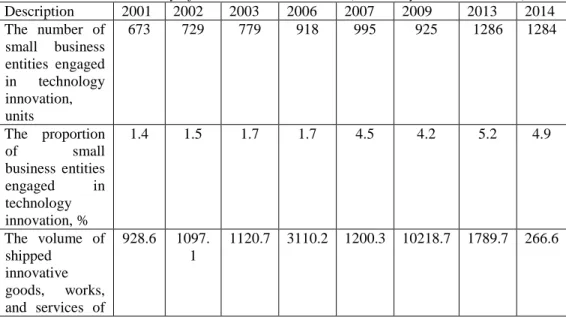
The global innovative index of small business for 2016 equals to 39.1, which is average figure for innovation. Innovative activity of small business entities in industrial production can be seen in Table 1.
Table 1. Innovative activity of small business entities (Economy and Innovation)
Description 2001 2002 2003 2006 2007 2009 2013 2014 The number of small business entities engaged in technology innovation, units 673 729 779 918 995 925 1286 1284 The proportion of small business entities engaged in technology innovation, % 1.4 1.5 1.7 1.7 4.5 4.2 5.2 4.9 The volume of shipped innovative goods, works, and services of 928.6 1097. 1 1120.7 3110.2 1200.3 10218.7 1789.7 266.6
small business, mln rubles at current prices The volume of shipped innovative goods, works, and services per one ruble of expenditure on technology innovations, rubles 1.2 1.2 0.9 1.7 1.5 1.5 1.8 2.1
From the data presented in Table 1 it is clearly seen that the volume of goods shipped by small business is increasing, though not significantly, whereas costs tend to increase essentially. The dynamics of shipped innovative products of small business can be considered in Fig.1, which shows that the total volume of shipped products made up 0.7% in 2009, 1.2% in 2010, 1.9% in 2011, 2.8% in 2012, 1% in 2013, 1.1% in 2014, and 3.1% in 2015 (Economy and Innovation).
Figure 1: Innovation activity dynamics of small business on the Russian market, % (Economy and Innovation)
The recent period shows the positive dynamics of basic innovation activity indicators. The main indicator - the proportion of innovations in total volume of shipped products of innovative enterprises has increased and reached 3.1%. Nevertheless, despite the distinct competitive advantages with regard to individual indicators, comparison with leading countries demonstrates in general Russia's lagging behind in many respects. The GII dynamics with regard to small business in Russia is presented in Table 2 for 2014-2016.
Table 2. The dynamics of the global innovation index (GII) of Russia for 2014-2016 (The National Research University "Higher School of Economics)
Period GII Innovation
resources Innovation results Innovation effectiveness 2016 44 44 47 69 2015 47 51 48 61 2014 49 55 44 50
Presented data on the global innovation index for 2016 indicates that Russia gradually promotes its positions in terms of innovation resources sub index (45th place) rather than in terms of small business. At the same time, the efficiency of innovative activity of the country in general is much weaker (68th place). According to the experts, the figures in Table 2 show that the implementation of existing innovation capabilities is not entirely positive. Nevertheless, there are certain achievements in the national innovation system, and they are mostly concentrated in areas such as science and human capital (24th place), business development (37th place), as well as development of technology and economic knowledge (40th place). In the context of the drawbacks, they are mainly concerned the integral indicators of institutions development (74th place), domestic market (63rd place), and business (37th place). Table 3 presents information on the advantages and disadvantages of the innovation system of small business in the domestic economy based on the global innovation index for 2016.
Table 3. Strengths and weaknesses of innovation in small business of Russia according to the global innovation index for 2016 (The National Research University "Higher School of Economics)
Advantages Disadvantages
The employment of women with higher education (2nd place out of 128 countries)
GDP per unit of energy use (114)
The size of the domestic market (6) Innovative communications (112) The number of patent applications for
utility models, which are filed by national applicants in the patent offices of the country (7)
Investments (107)
University graduates with science and engineering specialties (11)
Legislation (104) Exports of cultural and creative services
(11)
Political stability and absence of terrorism (103)
Employees, working in the field of knowledge-intensive services (14)
The level of cluster development (101) Payments for the use of intellectual
property assets (14)
Quality of regulation (97) The students/teachers ratio in secondary
education (16)
Gross enrolment ratio (18) Information and communication technologies, and the creation of business models (94)
The number of patent applications for inventions which are filed by national applicants in the patent offices of the country (18)
Research and development financed from foreign sources (76)
Deals with the use of venture capital (67)
Among the competitive strengths we should mention the employment of women with higher education. According to this indicator Russia took the second place. In terms of the university graduates with science and engineering specialties, the country ranked 11.
To the disadvantages of Russian innovation activity we should include innovative communications (113th place out of 128 available positions), legislation (103), quality of regulation (97), and gross capital accumulation (94). The structure of the global innovation index of small business for 2016 is shown in Fig. 2.
Figure 2: Global innovation index of small business for 2016 (The National Research University "Higher School of Economics)
Small innovative business (hereafter SIB) means enterprises that have in balance the applicable industrial property (patents, useful models, and industrial samples) as well as those that protect intellectual property assets as a commercial secret. The SIB formation process in the domestic economy, in our opinion, is sluggish. However, the modernization of the Russian economy requires a comprehensive solution to all existing problems.
Over the recent three years period, the indicators of resources and innovative activity of small business in the Russian economy increased, though just slightly. For the period from 2012 to 2014, there was slight variation in resources, while in 2013 and 2015 - variation was noted in performance. Since 2000 up to 2014, the cost of innovation has doubled and today amounts to 850.1 bln rubles. This figure brings
Russia to the top 10 leaders in terms of total expenditure on innovative activity of small and medium-sized businesses. During 2010, domestic authorities have shown special attention to innovation, adopting more than fifty documents in scientific-technical and innovative policy of the small and medium-sized enterprises.
For the current period of economic advancement, the innovation development in small business of Russia is restrained by extremely low engagement of scientists in advanced research. According to the experts, in 2015, the domestic publications were presented only in 3.3% of highly cited articles in more than 10,000 global research areas, represented in the Web of Science database. These data can be compared with similar data of other countries. For example, the USA is presented in the 75.1% of all research areas, Germany – in 31.1%, and China – in 24.5% (Economy and Innovation, 2015).
The advantage of domestic science is gradually growing in the global innovations market. This concerns, first of all, traditional areas of expertise, such as physics, aerospace technology, Earth science, mathematics, chemistry, and materials science. However, topics associated with the new industrial revolution and the development of the life sciences, are poorly developed.
Researchers paid particular attention to the fact that the involvement of domestic small business enterprises in the innovative environment, even at the national level, is not considered as the most popular business strategy. In turn, this circumstance reduces the experience of companies in collaboration and cooperation. Exploring the problems of innovative activities of small and medium-sized enterprises, we can conclude that the most significant factor is the problem of unavailability of financial investments to advance the innovation process that takes place at both the project initiation stages, and innovative products commercialization stages.
In addition, the main problems of innovative activity development include high cost, hidden risks of innovative projects, and long payback of innovations. At the same time, innovative activity of small enterprises, as noted by the experts, cannot be activated "according to instructions" in contrast to social sector of research and development. This requires more than just financing. It is, in particular, on creation of innovative forms as a tool to improve the efficiency of small business development with the availability of basic conditions for creation of innovations, their positioning, promotion, and extension the horizons of strategic planning, as well as the involvement of public innovation institutions entities (Breckova, 2016; Bashmakov, et al., 2015; Papanastasiou et al., 2016; Hani El-Chaarani, 2014; Thalassinos et al., 2013; Theriou et al., 2014; Theriou and Aggelidis, 2014; Dasanayaka and Sardana, 2015; Epifanova et al., 2015).
Financial instruments, which are used for state regulation of innovative activity of the economy on foreign and domestic markets, rely largely on the attraction of significant financial resources. Adherence to the priorities in the field of public
innovation management, improvement of the competitiveness of small and medium-sized businesses, support of scientific research and R&D works, as well as development of the education system will become a key to the success in the commercialization of innovations.
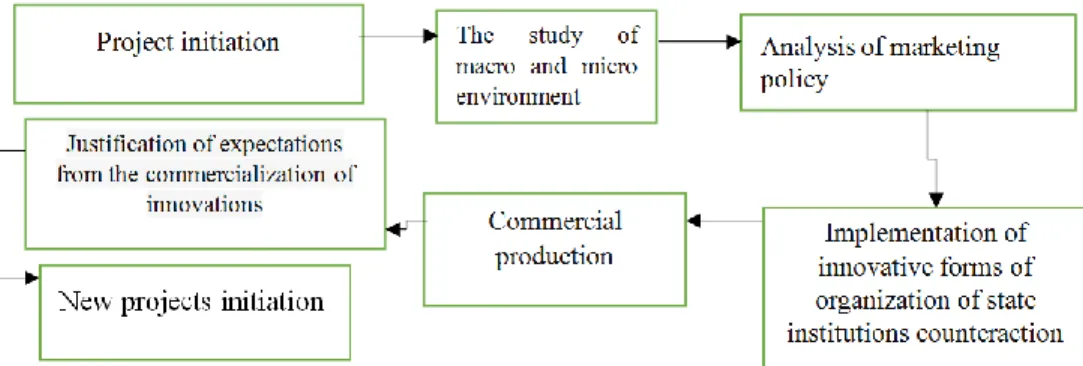
In order to improve resource provision of scientific-technical and innovation activities of small innovative business (SIB) and problem solving, the authors propose to implement state support through the innovation form as a tool for effective development of small business. This form will be represented by state innovative institutions organized as funds. State financing of the scientific sphere will be carried out in accordance with program-target planning and will be directly related to the capabilities of the budget.
Figure 3: Algorithm to improve innovation form as a tool for effective development of small business (Composed by the authors)
The proposed algorithm of innovation form as a tool for effective development of small business with the use of state support is based on the development of Academician V.Yu. Burov (2015). This development of the state institutions organization is aimed at improving the system of state counteraction against shadow economic of small business entities with the aim of its minimization to ensure socio-economic growth. In this regard, the efficacy of innovative forms in organization of state institutions to combat the shadow economy of small business entities is based on the developed conceptual provisions on formation of a model of state support of small business sector development, which are based on innovative forms of organization of small business economic activities. The represented forms of state institutions include the following:
1. Recognizing shadow economy of small enterprises as a dominant factor.
2. Considering the balance of interests and needs between small businesses entities on the one hand and the state on the other hand.
3. Developing a system of measures for state regulation of small business, which aggregates the funds of resource and material support, property and investments
protection, insurance protection, lending, improvement of tax, information and legal framework of small business entities.
4.Revising the existing regulatory and legal framework.
5. Monitoring the state of the economy in the particular entity of the Russian Federation, defining the leading industry which will involve small business entities to the fullest extent.
6. Considering mechanisms to upswing demand for the proposed products and services aimed at increasing the purchasing power of the population and organizations.
7. Creating regional investment and innovation fund for development of the small business sector with involvement of the RF entity.
Regarding the latter, today the Russian economy has guarantee funds to support small and medium-sized enterprises, which assist in the implementation of innovative projects aimed at the development of entrepreneurship in the region. Discussion
Along with stated in the presented algorithm, despite the existing developments, the authors offer the improvement methodology in the form of creation of the innovation fund, which should be targeted to small business as the backbone of the economy. It will contribute to generation of new innovative ideas, increase in employment, and transition of the shady business into the real sector of economy.
To insure effective operation of innovative form, it is necessary to be guided by the innovative development strategy of the Russian Federation for the period up to 2020, comprised of five key tasks: expanding a class of innovative entrepreneurs, increasing innovation activity of business and the state, forming a balanced sector of research, enhancing the openness of the innovation system. The strategy assumes increasing the proportion of innovative enterprises by 2020 up to 40-50%, the proportion of Russian high-tech exports in the global exports – up to 20%, the proportion of innovative products in the overall volume of industrial products – up to 25-35% (Bibarsov, 2016).
Conclusion
In this article the authors consider the methodology which includes the concept of science based approaches to the innovation activity of small business. The authors consider more in detail and present the innovation dynamics of small enterprises in the domestic economy, as well as innovative activity of small business entities. At the same time, the article presents investigated dynamics of the global innovation index, as well as the strengths and weaknesses of small business innovations in Russia for 2016. Based on the presented investigation methods, the authors give recommendations for practical application and further improvement of innovative forms as a tool for effective development of small business with the use of
innovative state institutions. The authors present research results in form of statistical data, proposing algorithm to improve innovative ways as a tool for effective development of small business.
In conclusion, we should note that the use of improvement methodology of small enterprises innovation form is a necessary direction for the efficient advancement of the domestic economy, which allows entering the global innovative way of development.
References
Afanaseva, M.P. 2012. Programmnyj byudzhet [Program budget]. Moscow, INFRA-M, pp. 384.
Bashmakov, A.I., Popov, V.V., Zhedyaevskii, N.D., Chikichev, N.D., Voyakin, A.E. 2015. Generic Heurorithm of Innovation Management from Generating Ideas to
Commercialization. European Research Studies Journal, 18(4), 47 -56. Bibarsov, K.R. 2016. Riski i ih vliyanie na realizaciyu mekhanizma strategicheskogo
upravleniya innovacionnymi proektami [Risks and their impact on the implementation of the strategic management mechanism of innovative projects]. Economics and Entrepreneurship, 11(3), 12.
Breckova, P. 2016. Family Business in the Czech Republic. European Research Studies Journal, 19(4), 3-16
Burov, V.Yu. and Gonin, N.V. 2010. Innovacionnoe razvitie: sistema menedzhmenta kachestva v ehnergetike [Innovative development: quality management system in the energy sector]. Proceedings of Irkutsk State Economic Academy, 3(71), 45-49. Burov, V.Yu. 2015. Teoriya i metodologiya razvitiya sistemy gosudarstvennogo
protivodejstviya tenevoj ehkonomicheskoj deyatel'nosti sub"ektov malogo predprinimatel'stva, [Theory and methodology to develop system of state
counteraction against shadow economic of small business entities]. PhD thesis, St. Petersburg State Economic University, Saint-Petersburg, pp. 189.
Dasanayaka, S.W.S.B. and Sardana, D.G. 2015. Development of Small and Medium Enterprises through Clusters and Networking: A Comparative Study of India, Pakistan and Sri Lanka. International Journal of Economics and Business Administration, 3(2), 84-108.
Drucker, P. 1955. The practice of management. London: William Heinemann, pp. 398. Economy and Innovation. 2015. Life Science Journal, LGDJ, pp. 144.
Epifanova, T., Romanenko, N., Mosienko, T., Skvortsova, T. and Kupchinskiy, A. 2015. Modernization of Institutional Environment of Entrepreneurship in Russia for Development of Innovation Initiative in Small Business Structures. European Research Studies Journal, 18(3), 137-148.
Federal'noj sluzhby gosudarstvennoj statistiki [Federal'noj sluzhby gosudarstvennoj statistiki]. Retrieved 20.12.2016 from www.gks.ru.
Firescu, V., Popescu, J. 2015. The Costs of Quality: An Important Decision Tool. International Journal of Economics and Business Administration, 3(4), 44-52. Hani El-C. 2014. The Impact of Financial Structure on the Performance of European Listed
Khokhlova, G.I. 2014. Konceptual'nye podhody k postroeniyu nacional'noj innovacionnoj sistemy [Conceptual approaches to the construction of a national innovation system]. Bulletin of the Buryat State University, 3, 10-19.
Kosinova, N.N., Tolstel, S.M., Sazonov, P.S. and Vaysbeyn, D.K. 2016. Development of Methodological Approach to Enterprise’s Financial Strategy Based on
Comprehensive Evaluation of Its Strategic Potential. European Research Studies Journal, 19(2), 21-33.
McConnell, C.R. and Brue, L.S. 2003. Economics. Moscow: INFRA-M, pp. 236. Nacional'nyj issledovatel'skij universitet “Vysshaya shkola ehkonomiki” [The National
Research University "Higher School of Economics "]. Retrieved 02.12.2016 from www. hse.ru.
Okladnikova, D.R. 2014. Model' ball'no-rejtingovoj ocenki innovacionno-investicionnogo potenciala predpriyatij malogo i srednego biznesa [Point-rating estimation model of innovative-investment potential of the small and medium-sized business enterprises]. Bulletin of Irkutsk State Technical University, 7, 147.
Papanastasiou, I. and Fourlas, V. 2016. Online Sports Betting in Greece: An Empirical Investigation. European Research Studies Journal, 19(1), 3-17.
Popova, E.Yu., and Kretova, V.N. 2016. Riski innovacionnyh proektov i metody ih upravleniya na stadii vnedreniya innovacii [Innovative projects risks and methods of their management at the stage of implementation of an innovation]. Economy and Entrepreneurship, 11(3), 657.
Sanzheeva, D.D. 2015. Innovacii v malom biznese: problemy i perspektivy [Innovation in small business: problems and prospects]. Bulletin of the Buryat State University, 2(2), 10-19.
Thalassinos, I. E., Venediktova, B., Staneva-Petkova, D. 2013. Way of Banking
Development Abroad: Branches or Subsidiaries. International Journal of Economics and Business Administration, 1(3), 69-78.
Theriou, G.N., Aggelidis, V. and Theriou, N.G. 2014. The Mediating Effect of the Knowledge Management Process to the Firm’s Performance: A Resource-Based View. International Journal of Economics and Business Administration, 2(1), 87-114. Theriou, G.N. and Aggelidis V. 2014. Management Accounting Systems, Top Management
Team’s Risk Characteristics and their Effect on Strategic Change. International Journal of Economics and Business Administration, 2(2), 3-38.
Vlasova, E.A. and Plotnikova, P.A. 2011. Problema ocenki innovacionnoj deyatel'nosti predpriyatij torgovli [Problem on estimating innovative activity of trade enterprises]. Bulletin of Saratov State Technical University, 3(57), 341.