An episodic memory-based solution for the
acoustic-to-articulatory inversion problem
Sebastien Demange and Slim Ouni! a)
Universit!e de Lorraine, Laboratoire Lorrain de Recherche en Informatique et ses Applications, Unit!e de Recherche Mixte 7503, Vandœuvre-le`s-Nancy, F-54506, France
(Received 20 February 2012; revised 8 March 2013; accepted 11 March 2013)
This paper presents an acoustic-to-articulatory inversion method based on an episodic memory. An episodic memory is an interesting model for two reasons. First, it does not rely on any assumptions about the mapping function but rather it relies on real synchronized acoustic and articulatory data streams. Second, the memory inherently represents the real articulatory dynamics as observed. It is argued that the computational models of episodic memory, as they are usually designed, cannot provide a satisfying solution for the acoustic-to-articulatory inversion problem due to the insufficient quantity of training data. Therefore, an episodic memory is proposed, called generative episodic memory (G-Mem), which is able to produce articulatory trajectories that do not belong to the set of episodes the memory is based on. The generative episodic memory is evaluated using two electromagnetic articulography corpora: one for English and one for French. Comparisons with a codebook-based method and with a classical episodic memory (which is termed concatenative episodic memory) are presented in order to evaluate the proposed generative episodic memory in terms of both its modeling of articulatory dynamics and its generalization capabilities. The results show the effectiveness of the method where an overall root-mean-square error of 1.65 mm and a correlation of 0.71 are obtained for the G-Mem method. They are comparable to those of methods recently proposed. VC 2013 Acoustical Society of America. [http://dx.doi.org/10.1121/1.4798665]
PACS number(s): 43.70.Bk, 43.70.Jt, 43.70.Aj [AL] Pages: 2921–2930
I. INTRODUCTION
Recovering the vocal tract shape from speech acoustics could allow a number of breakthroughs in automatic speech processing. For instance, the location of critical articulators1 could be exploited to better characterize a given phoneme, which may improve speech synthesis2 and recognition.3–6 Indeed, articulatory features vary much more slowly than speech acoustic features, and thus they should be more ro-bust than acoustic parameterizations, especially in noisy environments.7
Recently, databases of synchronized acoustic and articu-latory data streams, using electromagnetic articulography (EMA), for instance, have become available. These corpora enable machine learning algorithms to perform acoustic-to-ar-ticulatory regression. The main techniques use support vector machines,8Gaussian mixture models,9hidden Markov models (HMMs),10,11or artificial neural networks.12,13These methods try to learn the acoustic-to- articulatory mapping function, which is known to be highly non-linear, non-unique (i.e., dif-ferent vocal tract shapes producing the same acoustics), and thus difficult to model.14–18 As an alternative, codebook-based approaches14,17,19–21make very few assumptions about the mapping function, but rather rely on a collection of pairs of acoustic-articulatory data.
We believe that the main difficulty of inversion is the lack of a good representation of the dynamics. The non-uniqueness problem22will very likely vanish if the dynamics are fully integrated within the inversion methods. In fact,
Qin and Carreira-Perpi~n!an,23 and to some extent Neiberg
et al.,18argued that natural human speech is produced with a unique vocal tract configuration and there are few cases of non-uniqueness. Phonetic context naturally imposes con-straints on the vocal tract related to coarticulation. Effective modeling of articulatory dynamics seems essential to solving the inversion problem. These dynamics can be modeled with HMMs10,11and neural networks;12they can also be inferred from time derivative features.9 For the codebook-based methods the dynamics are not modeled at all. Instead, conti-nuity constraints are used during inversion. However, despite these constraints, the recovered articulatory trajectories show many discontinuities and need to be smoothed with signal processing techniques.
In this paper, we present a new data-driven approach based on the concept of episodic memory.24 An episodic memory can be considered to be a codebook that includes a temporal dimension. While a codebook models the relation-ship between two static observations, an episodic memory can model the relationship between two sequences of observa-tions. The main advantage of episodic memory is that it keeps track of the order of the observations and thus preserves the acoustic and articulatory dynamics of each episode.
An episodic memory can deal with the non-linearity of the mapping function by using the one-to-one correspon-dence between the synchronized acoustic and articulatory observations. It can deal with the non-uniqueness of the mapping by exploiting the articulatory dynamics encoded through the time ordering of both the episodes and the obser-vations they are comprised of. In addition, the need to smooth inferred articulator trajectories is greatly reduced compared to current codebook-based inversion methods.
a)
Author to whom correspondence should be addressed. Electronic mail: [email protected]
Copyright (2013) Acoustical Society of America. This article may be downloaded for personal use only. Any other use requires prior permission of the author and the Acoustical Society of America. The following article appeared in (JASA, May 2013, V133 (5), pp. 2921-2930) and may be found at (http:// asadl.org/jasa/resource/1/jasman/v133/i5/p2921_s1).
In the following sections, we first present our motiva-tions for developing a generative as opposed to a concatena-tive episodic memory. Then, we present our inversion method based on the generative memory model. Finally, inversion results are presented and compared to other meth-ods that have been reported previously.
II. EPISODIC MODELING FOR SPEECH INVERSION In speech processing, the episodes, which are the units of an episodic memory, are individual acoustic realizations of predefined linguistic units (e.g., phones, diphones, sylla-bles, or words). A similar approach has been used in speech recognition,25 referred to as template-based or exemplar-based speech recognition, and in unit selection speech syn-thesis.26,27 The memories used for these two problems are concatenative (C-Mem) because the episodes are indivisible and the recognized or synthesized sentences are always com-prised of a concatenation of episodes.
We apply an episodic memory model to the acoustic-to-articulatory mapping problem, whereby episodes comprise the synchronized acoustic and articulatory feature sequences for each linguistic unit. Then, for inversion, the memory could exploit precisely the acoustic-articulatory relationship, as well as real acoustic and articulatory dynamics.
Speech inversion differs from speech synthesis and rec-ognition because the mapping is between two continuous spaces, while for speech recognition and synthesis, the target or the source space, respectively, is discrete. This is an impor-tant issue for an episodic memory model because the memo-ries need to contain many episodes of each linguistic unit in order to achieve adequate coverage of the variability present in speech. Usually, several hours of acoustic speech are required to reach acceptable performance when episodic memory is used for synthesis or recognition. Furthermore, keeping in mind that the articulators can compensate for one another during speech (a phenomenon which introduces non-uniqueness to the solution), an episodic memory intended for speech inversion should be even larger to ensure good cover-age of both the acoustic and articulatory variability. This requirement cannot be fulfilled, as almost all articulatory cor-pora currently available contain less than an hour of speech, usually much less. The biggest corpus, the EMA part of the
mngu0dataset,28made available very recently and containing 1263 sentences (1 h 27 min of speech) is still probably too small. We think that this lack of data is the main reason why episodic modeling has not yet been used for this problem.
To address this problem, we propose to provide the memory with a mechanism to simulate many more episodes than the ones it contains. We define an episode as synchron-ized acoustic and articulatory realizations of a linguistic unit (LU). Let us consider two episodesXandYof a given LU.X
and Y are almost identical, differing only at the beginning and end, due to coarticulation effects. A C-Mem which does not contain any episode of LU whose left and right contexts are those of X and Y, respectively, will invariably fail to invert acoustic realizations of LU in this context. However, the memory could perform better if it were allowed to go through the first part of X, then to switch toY at any time
during the central, nearly identical part, and finally to go through the final part ofY.
Even though all episodes of a given LU are not identical, they can exhibit local articulatory similarities. Therefore, we propose to allow the memory to switch between any two epi-sodesX andY of the same LU during the inversion at times when observations ofXandYare similar. Care will be taken to produce realistic articulatory dynamics by considering simi-larities with regard to temporal alignments and with regard to the positions of the articulators. As the proposed memory will be able to generate episodes other than the ones in the data-base, we will refer to this memory as a generative memory (G-Mem).
III. GENERATIVE MEMORY BASED INVERSION
As before, we define an episode as synchronized acous-tic and aracous-ticulatory realizations of a paracous-ticular LU, in this case, phonemes. The phoneme identity will be referred to as the class of the episode. In the following, we consider two given episodes X and Y. X is a particular realization of a given phoneme expressed as a sequence of K articulatory-acoustic observations X¼(x1,…,xK). Each observation xi¼ ðxarti ;xaci Þ, wherei2½1% % %N&, is a synchronized pair
com-posed of an articulatory observationxart
i and its
correspond-ing acoustic observation xac
i . The scalar articulatory
observationxart
i can be a given articulator description or even
thex- ory-coordinate of a sensor glued onto an articulator as used in our work. Similarly, Y is another realization of the same phoneme expressed as a sequence of N observations:
Y ¼ ðy1;…;yNÞ, whereyi¼ ðyarti ;yaci Þ.
A. Local articulatory similarity
Dynamic time warping (DTW)29is a general algorithm to find the shortest distanceD(X, Y) between two episodesX
and Y,which may vary in length. The episodes are warped non-linearly in order to minimize the effects of their tempo-ral variability. Any given mapping leads to a particular alignment pathU¼ ðU1;…;UMÞ, whereMis the number of
alignments.Ui¼ ðUx;i;…;Uy;iÞis theith observation pairing
along U withUx;i andUy;i as the indices inXand Yof the
aligned observations. The distance betweenXandYgivenU is the sum of the local distances d(.,.) between the aligned observations alongU. The choice of this local distanced(.,.) depends on the nature of the observations used to perform the mapping. Here, the articulatory observations are used because we are focusing on producing realistic articulatory trajectories. In our work, the articulatory observations are thex- andy-coordinates of sensors glued onto articulators in the midsagittal plane. Thus, Euclidean distance is used.
D(X, Y) is the shortest distance over allU:
DðX;YÞ ¼arg min
U
XM
i¼1
dðxUx;i;yUy;iÞ: (1)
Many variations of the algorithm have been proposed29 in order to prevent degenerate paths from occurring. In this work, we applied Itakura’s constraints.30 These constraints
Copyright (2013) Acoustical Society of America. This article may be downloaded for personal use only. Any other use requires prior permission of the author and the Acoustical Society of America. The following article appeared in (JASA, May 2013, V133 (5), pp. 2921-2930) and may be found at (http://asadl.org/ jasa/resource/1/jasman/v133/i5/p2921_s1).
make the DTW asymmetric, such that each observation in sequenceXis aligned with exactly one observation inY.The mappings of many episodes ontoXresult in many alignment paths of the same length (equal to the length ofX). Therefore, the distances from these episodes toXcan be fairly compared and ranked. The other Itakura constraints impose bounds on the temporal deformation, in order to preserve a certain tem-poral consistency of the aligned observations.
Let Xart be an articulatory trajectory of an episode X
expressed as a sequence of K articulatory positions ðxart
1 ;xart2 ;…;xartKÞ. We define each articulatory observation xart
iþ1 as the natural articulatory target (local target) of xarti
since it has been observed to followxart
i . In fact,xartiþ1is a spe-cific articulatory position, but we can suppose it could have been slightly different. Indeed, starting from xart
i at time i,
the articulators could have reached a different position at timeiþ1 close toxart
iþ1 with no significant consequences to the acoustics. Then, for eachxiwe define an articulatory
tar-get interval ATIxias
ATIxi ¼ ½x
art
iþ1(d;xartiþ1þd& (2) wheredis a given positive value.
We consider any articulatory position yart
j to be similar
to any articulatory positionxart
i , ifyjis aligned withxiwhen
mappingYontoX,and ifyart
j belongs to the articulatory
tar-get interval ofxart
i(1.
B. Building the generative episodic memory
We model a G-Mem as an oriented graph GG-Mem. The nodes are the pairs of synchronized acoustic and articulatory observations comprising the episodes. The oriented edges indicate the allowed transitions between the articulatory positions the memory can follow during the inversion pro-cess. They are created according to algorithm 1.
Require: LetCbe the set of all episodes
for allX¼ ðx1;…;xKÞandY¼ ðy1;…;yNÞinC,
classðYÞ ¼classðXÞdo ifDðX;YÞ )D*lengthðXÞthen for alli¼1 toK(1do ifyart Uy;iþ12½x art
iþ1(d;xartiþ1þd&then Add an edge fromxitoyUy;iþ1
end if end for end if end for
Algorithm 1. Building the graphGG-Mem
For any pair of episodes XandY of the same class we create an oriented edge from a givenxito a givenyjif yjis
similar toxiþ1from an articulatory point of view (i.e.,yartj is
similar toxart
iþ1) as defined previously:
Uy;iþ1¼j; (3)
yartj 2ATIxi¼ ½xartiþ1(d;xartiþ1þd&: (4) In addition we impose that the asymmetric distance D(X, Y) falls below a given threshold (proportional to the length ofX):
DðX;YÞ )D*lengthðXÞ: (5)
The goal is to prohibit the memory from switching between episodes, which are globally very different (from an articula-tory point of view) because it could lead the memory to pro-duce unrealistic articulatory trajectories. As an example, consider the movements of the tongue tip, which might rise or fall during the production of a given phoneme. Although these trajectories are very different, it is likely that the tongue tip can reach similar positions midway through the fall and rise. Combining the fall and rise could possibly lead to a degenerate trajectory.
At the episode boundaries the memory is only subject to the articulatory continuity requirement expressed by Eq.(4). LetZ¼(z1,z2,…,zP) be the episode, which was observed
af-ter X. Then, an edge fromxK to the first observation w1of any episode W of any class is created if wart
1 2ATIxK
¼ ½zart
1 (d;zart1 þd&. If the episode Xis the last of a record, its natural articulatory target is unknown and Eq.(4)cannot be satisfied; thus no edge to any other episode is possible. Note that a C-Mem only accounts for these transitions between episode boundaries. So, a C-Mem can be seen as a particular case of G-Mem for whichDis set to zero.
C. An example
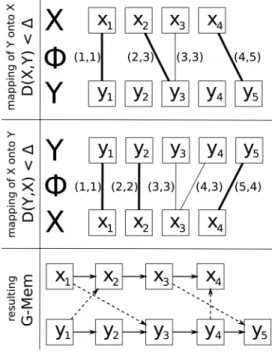
Figure1shows an example of a G-Mem built from a set of two episodesXandYof the same class. The top two graphs illustrate the DTW mapping of Y onto X, and ofX onto Y.
Lines are drawn between aligned observations ofXandY.A thick line indicates the aligned observations are within dof each other, i.e., they are similar from an articulatory point of view, while a thin line indicates that the articulatory positions are very different. The bottom graph shows the resulting epi-sodic memory with all possible transitions from X toY and
FIG. 1. Illustration of a G-Mem built from two episodesXandY.The top two graphs illustrate the DTW mappings ofYontoXandXontoY.The thick lines indicate that the local distance between the aligned observations ofX andYis smaller thand. The bottom graph show the resulting G-Mem.
Copyright (2013) Acoustical Society of America. This article may be downloaded for personal use only. Any other use requires prior permission of the author and the Acoustical Society of America. The following article appeared in (JASA, May 2013, V133 (5), pp. 2921-2930) and may be found at (http://asadl.org/jasa/ resource/1/jasman/v133/i5/p2921_s1).
fromYtoX.The resulting transitions within the memory are represented by the plain arrows from anyxitoxiþ1and from any yjtoyjþ1resulting from the mappings ofX andYonto themselves (not shown in the figure). The dotted arrows from any xitoyjresult from the mapping ofYontoX while those
from anyyjtoxiresult from the mapping ofXontoY.
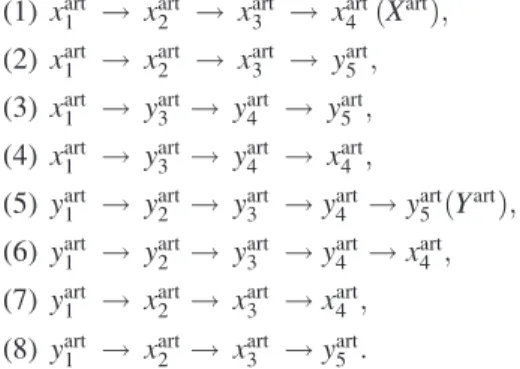
While a C-Mem would have contained only two articu-latory trajectoriesXartandYart, the resulting G-Mem can sim-ulate six additional trajectories combiningXandY.Thus, the G-Mem is able to produce the following eight articulatory trajectories according to a given input acoustic signal to be inverted:
(1) xart
1 ! xart2 ! xart3 ! xart4 ðXartÞ; (2) xart
1 ! xart2 ! xart3 ! yart5 ; (3) xart
1 ! yart3 ! yart4 ! yart5 ; (4) xart
1 ! yart3 ! yart4 ! xart4 ; (5) yart
1 ! yart2 ! yart3 !yart4 !yart5 ðYartÞ; (6) yart
1 ! yart2 ! yart3 !yart4 !xart4 ; (7) yart
1 ! xart2 ! xart3 !xart4 ; (8) yart
1 ! xart2 ! xart3 !yart5 :
As explained in Sec. III B, note that when using the G-Mem, all the inverted trajectories start from the beginning of an episode and finish at the end of an episode.
D. Recovering the articulatory trajectories
As the nodes of the oriented graph GG-Mem are bimodal (composed of an acoustic and an articulatory observation), each path within the graph corresponds to a particular articulatory tra-jectory and also to the acoustics that would have been produced by the articulatory trajectory. Thus, acoustic-to-articulatory inversion is performed by searching the path withinGG-Memthat best matches the acoustic speech signal to be inverted. The esti-mated articulatory trajectory is extracted from the articulatory observations of the visited nodes along this path.
All search paths can start only at nodes that represent the first observation of an episode. During inversion a breadth-first search is performed, applying the Viterbi algorithm. That is, at each step, theK-best paths obtained at the previous step are propagated through the GG-Mem along the oriented edges defining allowed articulatory movements. The K-best propa-gated paths are kept while the others are discarded and the process is repeated up to the end of the speech signal.
The winning path is the one with the best acoustic score selected from all paths ending at a node that corresponds to the final observation of an episode. The score of each path is expressed as the sum of acoustic distances between the speech frames and the acoustic observations of the visited nodes along the path, computed on a predefined acoustic windowW. IV. DATA AND INVERSION EXPERIMENTS A. Corpora
All the experiments presented in this work were carried out on the following two corpora of synchronized acoustic speech signal and articulatory trajectories.
a. MOCHA. We used the EMA corpus of MOCHA.31
Two speakers of British English, one female (fsew) and one male (msak), were recorded reading 460 short phonetically balanced.
British-TIMIT sentences. The audio is provided as waveforms sampled at 16 kHz, and each EMA receiver posi-tion is given as 2D coordinates in the mid-sagittal plane. We used seven sensors located at the lower incisors (li), upper lip (ul), lower lip (ll), tongue tip (tt), tongue body (tb), tongue dorsum (td), and velum (vl). The phonetic segmenta-tion provided with the audio stream was used.
b. mdem. We have recorded a French EMA corpus using an articulograph (AG500, Carstens Medizinelektronik). A male French speaker (mdem) was recorded uttering 400 pho-netically balanced sentences. The audio is provided as wave-forms sampled at 16 kHz, and the EMA data consist of 2D coordinates in the mid-sagittal plane. We used six sensors fixed in the midsagittal plane on the lower lip (ll), upper lip (ul), tongue tip (tt), tongue body (tb), tongue dorsum (td), and tongue back dorsum (tbd). The phonetic segmentation was obtained from a word-level transcription of the senten-ces, a dictionary containing several pronunciation variants for each word and a set of French monophone HMMs trained on several hours of speech and adapted to mdem’s voice. The segmentation was obtained by force aligning the phone HMMs onto the acoustics given the sentence word transcrip-tion and the pronunciatranscrip-tion dictranscrip-tionary.
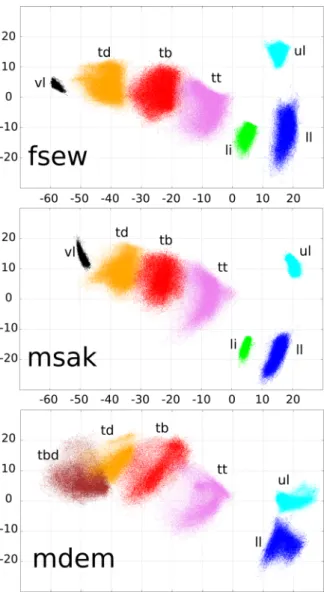
Each corpus was split into training, development and test sets. For MOCHA, care was taken that the selected utter-ances for each set corresponded exactly to the ones used by Richmond,12 as this split was also used in Toutios and Margaritis8and Zhang and Renals.11 Information about the different sets are given in Table I. Note that the durations only account for usable speech (without the start and end silences). Figure2shows the distributions of the articulatory samples for each speaker and coil.
B. Feature extraction
The silences occurring at the beginning and end of each recording were first discarded, as the articulators can move unpredictably during such intervals. A linear predictive anal-ysis32was performed on the speech signal using theHTK tool-kit.33 12 cepliftered MF-PLPs34 and the logarithmic energy of the signal comprised the acoustic feature vector extracted from every 25 ms speech frame shifted by 10 ms.
TABLE I. Overview of the corpora.
Corpora Sets Durations Sentences Phones
fsew train 16 min 35 s 368 11 179
dev 1 min 57 s 46 1324
test 2 min 5 s 46 1457
msak train 13 min 59 s 368 11 179
dev 1 min 41 s 46 1324
test 1 min 45 s 46 1457
mdem train 8 min 24 s 319 6355
dev 1 min 2 s 40 817
test 1 min 3 s 40 814
Copyright (2013) Acoustical Society of America. This article may be downloaded for personal use only. Any other use requires prior permission of the author and the Acoustical Society of America. The following article appeared in (JASA, May 2013, V133 (5), pp. 2921-2930) and may be found at (http://asadl.org/jasa/resource/ 1/jasman/v133/i5/p2921_s1).
The articulatory data were first down-sampled from 500 to 100 Hz (for MOCHA) and from 200 to 100 Hz (formdem) to match the acoustic frame-shift. Then, all trajectories were low-pass filtered, in order to remove the recording noise, using a cut-off frequency of 20 Hz. A final data adjustment was performed in order to take into account the observed drift in the global trajectories throughout the recording sessions (see Richmond12 for details). According to Richmond,12these variations can reflect speaker compensa-tion/adaptation to the presence of the coils within the mouth, or may be due to measurement errors. We should note that the true underlying cause of these apparent long-term incon-sistencies has not been properly and deeply investigated. In our study, we applied the same procedure proposed by Richmond12 to remove these very long-term variations by subtracting a low-pass filtered version of the trajectory means from the EMA data.
C. Quality measurements
The quality of the recovered articulatory trajectories was evaluated using root-mean square error (RMSE) that
quantifies the difference between the measuredxart
i and esti-matedfðxac i Þarticulatory coordinates: RMSE¼ ffiffiffiffiffiffiffiffiffiffiffiffiffiffiffiffiffiffiffiffiffiffiffiffiffiffiffiffiffiffiffiffiffiffiffiffiffiffiffiffiffiffiffi 1 N XN i¼1 " fðxac i Þ (xarti #2 v u u t (6)
as well as Pearson’s correlation between the values in the two trajectories. This is obtained by dividing the covariance of the two trajectories by the product of their standard deviations: Cor¼ XN i¼1 " fðxaci Þ (fðxacÞ # ðxart i (xartÞ ffiffiffiffiffiffiffiffiffiffiffiffiffiffiffiffiffiffiffiffiffiffiffiffiffiffiffiffiffiffiffiffiffiffiffiffiffiffiffiffiffiffiffiffiffiffiffiffiffiffiffiffiffiffiffiffiffiffiffiffiffiffiffiffiffiffiffiffiffiffiffiffiffiffiffi XN i¼1 " fðxaci Þ (fðxacÞ #2 XN i¼1 ðxarti (xartÞ 2 v u u t : (7) D. Experiment design
We have implemented three different inversion meth-ods: a codebook-based approach, as described in Suzuki
et al.,20and two memory-based approaches (C-Mem and G-Mem) as described above. We have chosen to compare the memory-based approaches to this codebook-based approach, as they differ only in the manner of inferring the dynamics of the recovered articulatory trajectories. While the memo-ries can model and use observed trajectomemo-ries, the codebook only relies on continuity constraints.
In fact, this codebook method consists in looking up a set Ciof theNbest entries in the codebook for each given
acous-tic signal sampleYi. The best entries are the ones, which
mini-mize the acoustic distance to Yi. In fact, this distance is the
average acoustic distance computed over a window of a pre-defined length W. The articulatory trajectory is obtained by looking for the path throughCi that minimizes the weighted
sum of the acoustic distances and squared distances between subsequent articulatory parameters. The reader may refer to Suzukiet al.20for details of the implementation.
We consider the recovery of the articulatory trajectories for each coil, and along both thexandyaxes, as independent inversion problems. Thus, the experiments presented here consist of fourteen (for fsew and msak) and twelve (for
mdem) distinct inversion problems. For each inversion prob-lem, a dedicated codebook, C-Mem and G-Mem are built and optimized.
The parameters of the codebook are the length of the spectral window, and the weight of the articulatory constraints with regard to the acoustic distances. During the inversion, the 1000 best codebook entries are considered at any given time. For G-Mem, the parameters to be set ared,the half ATI length, and D, the maximum allowed articulatory distance between two episodes X and Y for allowing the memory to switch from one to the other. Note that the parameter D is equal to zero for a C-Mem, so that each episode can only be combined with itself. An acoustic window was used to com-pute the acoustic distances. The length of this window is a pa-rameter to be optimized. Euclidean distance is used for both acoustic and articulatory distance calculation.
FIG. 2. (Color online) EMA data distribution. The three graphs represent the articulatory data distributions for the three speakers:fsew, msak,and mdem.The coordinates are expressed in millimeters.
Copyright (2013) Acoustical Society of America. This article may be downloaded for personal use only. Any other use requires prior permission of the author and the Acoustical Society of America. The following article appeared in (JASA, May 2013, V133 (5), pp. 2921-2930) and may be found at (http://asadl.org/jasa/resource/1/ jasman/v133/i5/p2921_s1).
Two types of experiment have been carried out: with and without phonetic constraints. Note that the G-Mem used phonetic segmentation only for building the memory, and the segmentation is not needed for inversion. The purpose of adding experiments with phonetic constraints is to ascertain what extra information is added for use of the phonetic knowledge to the different inversion methods. The reference phonetic segmentation is obtained by force aligning HMM acoustic models onto the speech signal according to the tran-scription of the uttered words. In the phonetically con-strained mode, the estimated articulatory position at time
t has to come from a codebook entry or an episode of the same phoneme as the one indicated by the segmentation at timet.
For the three systems, the parameters have been jointly optimized through a grid search optimizing RMSE on the de-velopment set. Since the articulators move in different ranges, different sets of parameters were obtained for all inversion problems. Globally, the length of the acoustic win-dowWis approximately 150 ms for the codebook and 90 ms for the memories.dranges from a few hundredths of a milli-meter (for the velum) to at most one millimilli-meter, and D ranges from a tenth of a millimeter to two millimeters for different articulators. Finally, the memory search beam width is set to 10 000 for the memories and 1000 for the codebook.
V. INVERSION RESULTS AND ANALYSIS A. Results
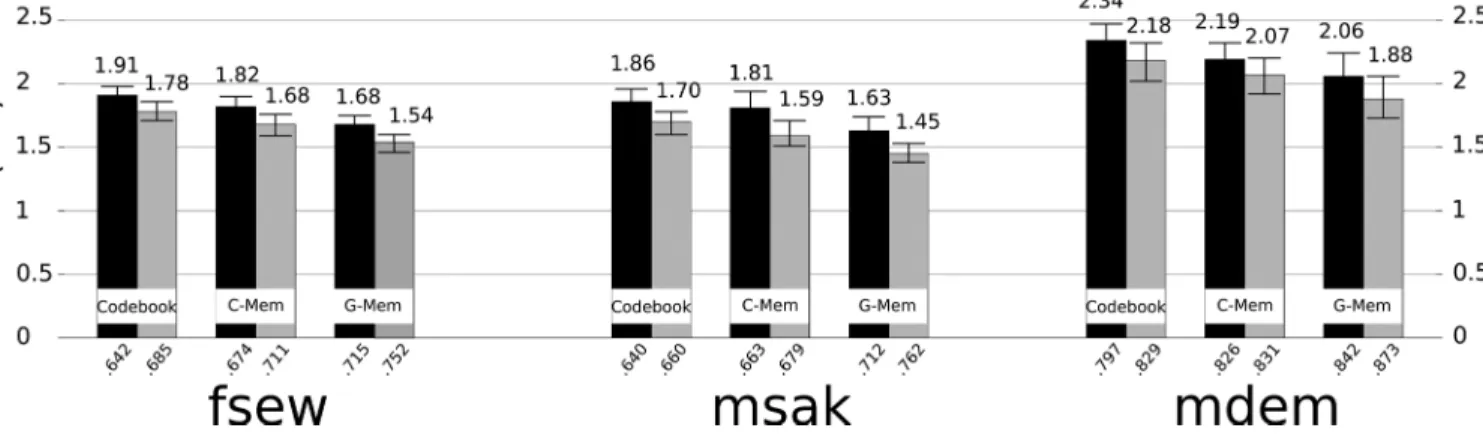
Figure 3shows the results of the three inversion meth-ods, with (gray) and without (black) phonetic constraints. The bars show the overall RMSE (means over the coils and
x- and y-coordinates) in millimeters for each corpus; the RMSE values are indicated above the bars. The respective Pearson’s correlations are given below the bars. The figure shows that the memory-based approaches always outperform the codebook-based method. This suggests the articulatory dynamics are modeled more effectively in the memory-based systems than by continuity constraints used by the codebook for speech inversion. It also illustrates how much an episodic memory can benefit from the generalization
capability of the G-Mem, as it always outperforms the C-Mem. The best Pearson’s correlation scores were obtained using a G-Mem. Without any phonetic knowledge, an over-all RMSE of 1.65 mm and a correlation of 0.714 were obtained on MOCHA with the proposed G-Mem, while an RMSE of 1.81 and 1.88 mm, and a correlation of 0.668 and 0.641 were obtained with the C-Mem and codebook, respec-tively. Using the phonetic segmentation of the test record-ings, the RMSE decreased to 1.50 mm and the correlation increased to 0.757 for the G-Mem. The relative improve-ments due to the phonetic segmentation of the acoustic sig-nal was roughly the same across the three inversion methods and across the three speakers.
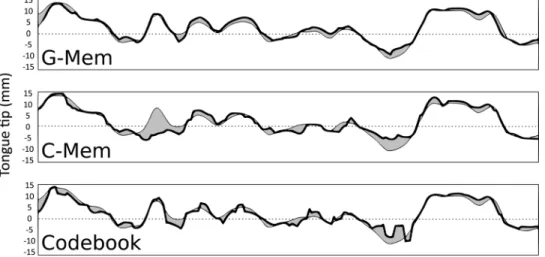
Figure4shows the tongue tip movements (thick curves) along the vertical (up/down) axis recovered by each of the three approaches from a two second long speech signal corre-sponding to the French sentence “juste quelques extr!emit!es de branches gel!ees” (only a few frozen branch tips). For each of the three graphs, the reference trajectory is provided as the thin curve and the estimation errors are emphasized as filled areas between the estimated and reference trajectories. Though optimized, the dynamic articulatory constraints of the codebook-based approach do not prevent discontinuities, as the recovered articulatory trajectory is very jerky compared to the smooth and continuously varying reference trajectory. The results obtained by both the C-Mem and G-Mem are visibly better. One might have expected smoother trajectories using the C-Mem, as the result is expressed as a concatenation of natural articulatory episodes. Through deeper analysis of the decoding paths within the C-Mem, we have noticed that most of the time the C-Mem does not contain episodes, which acoustically match the test signal well enough. In order to counteract this lack of good episodes, the C-Mem tends to select many short episodes. Indeed, the sum of the acoustic distances of short episodes, which locally match the test signal well, is usually smaller than the acoustic distance of a longer episode with partial acoustic mismatches. Finally, the G-Mem succeeds in estimating the articulatory movements accurately. The combination of episodes significantly reduces the estima-tion error. Furthermore, the articulatory dynamics embodied in the G-Mem transition graph contribute to the naturalness of the resulting articulatory movements.
FIG. 3. Overall RMSE (in millimeters) for each corpus using the Codebook, C-Mem, and G-Mem based methods with (gray) and without (black) the reference phonetic segmentations. The error bars represent the 99% confidence intervals. The RMSE values are indicated above the bars. For each experiment, Pearson’s correlations are provided below the bars.
Copyright (2013) Acoustical Society of America. This article may be downloaded for personal use only. Any other use requires prior permission of the author and the Acoustical Society of America. The following article appeared in (JASA, May 2013, V133 (5), pp. 2921-2930) and may be found at (http://asadl.org/jasa/ resource/1/jasman/v133/i5/p2921_s1).
B. Statistical significance
We have conducted a statistical analysis in order to quantify the confidence in our results and also in the improvements. We have applied a bootstrap method pro-posed in Bisani and Ney35 that was originally designed for speech recognition performance evaluation, but which is equally applicable here. This method relies on a bootstrap replication by creatingNpseudo data setsXifrom the
origi-nal data setXwith replacements.
A pseudo data set can thus contain several or no samples of the original data set. The statistics Statiare then calculated
over each pseudo data setXi. For a largeNthe distribution of
the statistics is approximately Gaussian and thus, the true statistic lies with 99% confidence within the interval Stati63r, where Stati andrare the mean and standard
devi-ation of the statistics distribution, respectively. See Bisani and Ney35for more details on this statistical analysis.
We have computed the 99% confidence intervals of the RMSE, generating 100 000 pseudo data sets for each experi-ment. These intervals are reported in Fig.3as error bars on each bar. These confidence intervals only represent the range of performance we would obtain when applying one of the three methods on a new data set of one of the three speakers. In addition, TableIIgives the probabilities of improve-ment, as well as the 99% confidence intervals of the expected improvement of each method over the others, for
the three corpora. Each cell contains an integer, which is the probability that the method corresponding to the row outper-forms the method corresponding to the column, as well as the 99% confidence interval of the expected improvements, expressed in percent. These numbers confirm the perform-ance boost of the memory-based approaches over the codebook-based method and the superiority of the G-Mem over the C-Mem.
C. Smoothness and naturalness of articulatory trajectories
We argued in the introduction that the episodic memories are well-suited models for articulatory inversion, as they are able to preserve the dynamics of the episodes. We offer here an analysis that gives more insight on this point. Many pro-posed solutions to the inversion problem include low-pass filtering the recovered articulatory trajectories. This filtering aims to remove rapid changes (usually of low amplitude) that come from errors during the acoustic-to-articulatory mapping, and that can be considered noise. Indeed, all articulators have their proper velocity and can move more or less quickly, but they all move continuously. Comparing the recovered trajec-tories with their smoothed version is therefore one possible way of assessing how well the articulatory dynamics have been approximated.
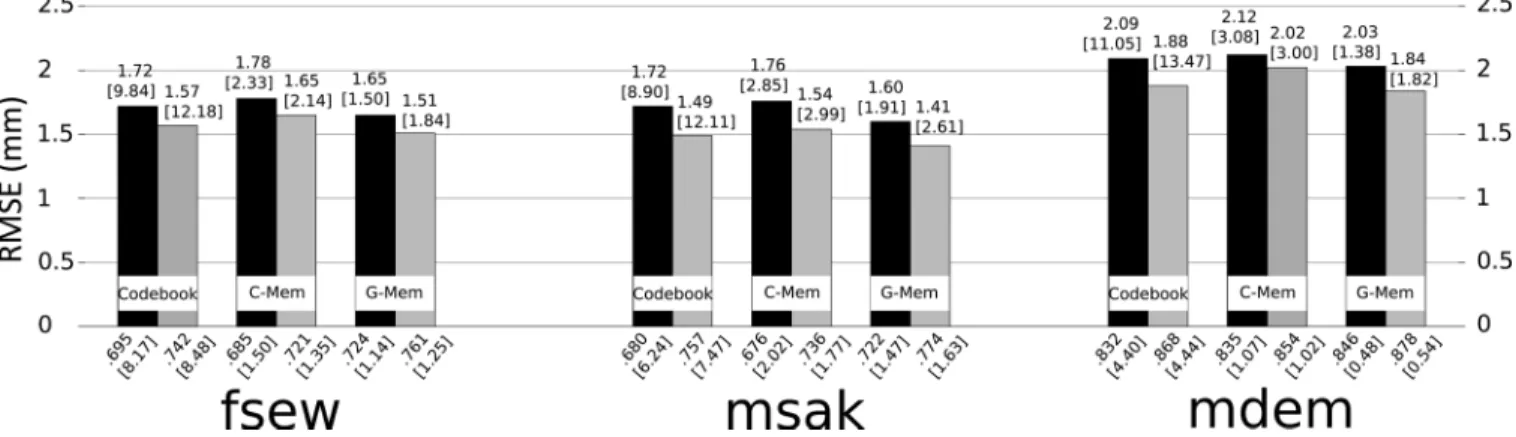
For each coil, in both directions, we have determined the best cut-off frequency minimizing the RMSE on the test set. Figure 5summarizes the best case scenario smoothing results. As in Fig. 3, the bars represent the RMSE, and Pearson’s correlations are provided below the bars. The numbers in square brackets are the relative percentage improvements over the non-smoothed trajectories.
The most obvious effect is that the codebook-based method significantly benefits from this filtering. Its RMSE improves by approximately 10%, while the improvements for the memory-based approaches do not exceed 3%. The same trend can be observed for the Pearson’s correlations. This indicates that the memory-based approaches really do take advantage of the observed dynamics of the episodes. Applying articulatory continuity constraints during the inver-sion does not yield the same benefits. Note that similar observations have been reported in Toda et al.9Indeed, the
TABLE II. Probabilities of improvement and 99% confidence intervals of expected improvements (both expressed in percentage). Each cell contains the probability that the method corresponding to the row outperforms the method corresponding to the column, as well as the 99% confidence interval of the expected improvements.
Codebook C-Mem G-Mem
Codebook — fsew: 0 [(7;(3] fsew: 0 [(14;(10]
— msak: 0 [(7;(1] msak: 0 [(15;(11] — mdem: 0 [(7;(1] mdem: 0 [(16;(9]
C-Mem fsew: 100 [3;7] — fsew: 0 [(10;(6]
msak: 100 [1;7] — msak: 0 [(12;(7]
mdem: 100 [1;7] — mdem: 0 [(10;(2]
G-Mem fsew: 100 [10;14] fsew: 100 [6;10] —
msak: 100 [11;15] msak: 100 [7;12] —
mdem: 100 [9;16] mdem: 100 [2;10] —
FIG. 4. Tongue tip movements (thick curves) along the vertical (up/down) axis recovered by each of the three approaches from the two second long French utterance “juste quelques extr!emit!es de branches gel!ees” (only a few frozen branch tips) uttered by the speaker mdem.For each of the three graphs the reference trajectory is provided as the thin curve and the estimation errors are emphasized with the filled areas between the esti-mated and reference trajectories.
Copyright (2013) Acoustical Society of America. This article may be downloaded for personal use only. Any other use requires prior permission of the author and the Acoustical Society of America. The following article appeared in (JASA, May 2013, V133 (5), pp. 2921-2930) and may be found at (http://asadl.org/jasa/ resource/1/jasman/v133/i5/p2921_s1).
authors proposed an MLE-based mapping that accounts for correlation between frames. They reported significant improvements over their baseline GMM-based mapping, but also showed that the low-pass filtering effect became negli-gible. A relative improvement of 9.36% for RMSE was obtained over the baseline GMM-based mapping with a low-pass filter, but only 0.72% over the MLE-based mapping.
D. Computational resource requirement
LetNsbe the number of samples contained in the
train-ing set,Ks be the search beam width, andB be the average
branching factor of the G-Mem, i.e., the average number of transitions allowed from any sample.
At any timet, the codebook method needs to compute the acoustic distance between the current test sample and all the Ns training samples. Then, theKs best training samples
are selected and the dynamic articulatory constraints are computed between each of them and each of the Ks best
hypotheses computed at timet(1. The complexityOcodebook is then
Ocodebook¼Nsþ ðKs+KsÞ ,Ks2: (8)
Using a beam width of 1000 leads to one million dynamic articulatory constraints computed for each test sample.
At any timet,the G-Mem needs to propagate all of the
Ksbest hypotheses computed at timet(1. Setting the
aver-age branching factor toB,the complexityOG-Memis
OG-Mem¼Ks+B: (9)
The average branching factorB is about 250 for the G-Mem. Using a beam width ofKs¼10 000 leads to 2 500 000
paths to be investigated. Actually, these paths end in a subset of all the Ns acoustic/articulatory frames contained in the
memory. Thus, the maximum number of acoustic distances to be computed each time is Ns. Unlike the codebook
approach, propagating the path here does not require any dis-tance computation.
So, the two different beam widths used for the codebook-based and G-Mem-based methods roughly lead to the same computational resource requirements.
Figure 6 shows the evolution of the running time for both the codebook-based and G-Mem-based methods on the
msak test set as a function of the search beam width. The plot is logarithmically scaled along both axes. As stated in Eqs. (8)and(9), we can verify that the complexity is expo-nential for the codebook and linear for the G-Mem with respect to the search beam width.
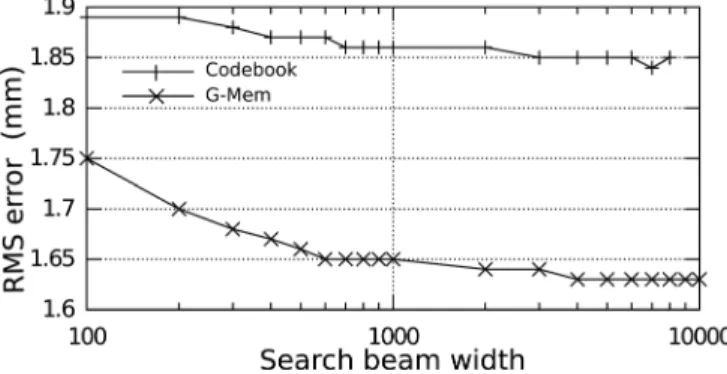
Figures7shows the evolution of the overall RMSE for both the codebook based and G-Mem based methods on the test set of msak as a function of the search beam width. Varying the beam width from 1000 to 8000 does not lead to a significant RMSE improvement. Therefore, a beam width of 1000 appears to be a good compromise between perform-ance and execution time.
VI. DISCUSSION
We have proposed an episodic memory solution for acoustic-to-articulatory inversion. This model has some simi-larities with a codebook; in particular, it relies on a one-to-one correspondence between articulatory and acoustic obser-vations. However, unlike a codebook, an episodic memory accounts for the temporal dimension and is thereby able to preserve the articulatory dynamics of the episodes. We have also proposed an algorithm, which allows the memory to combine different episodes during the inversion to simulate many other episodes than the ones in the database. Through the presented experiments we have shown that the trajectories
FIG. 5. Overall RMSE (in millimeters) for each corpus using the Codebook, C-Mem, and G-Mem based methods with (gray) and without (black) the reference phonetic segmentations (as in Fig.3) after optimal smoothing of the recovered articulatory trajectories. The RMSE values are indicated above the bars. For each experiment, Pearson’s correlations are provided below the bars. The numbers in square brackets are the relative percentage improvements over the non-smoothed trajectories
FIG. 6. Average processing time over all coils and x and y-coordinates as a function of the search beam width. Obtained on the test set ofmsak.
Copyright (2013) Acoustical Society of America. This article may be downloaded for personal use only. Any other use requires prior permission of the author and the Acoustical Society of America. The following article appeared in (JASA, May 2013, V133 (5), pp. 2921-2930) and may be found at (http://asadl.org/jasa/resource/1/ jasman/v133/i5/p2921_s1).
produced by the memory-based models are better than those produced by the codebook.
In addition, the estimation errors using a G-Mem are very encouraging compared with the state of the art. Hiroya and Honda10reported RMSEs of 1.50 and 1.73 mm with and without phonetic segmentations, respectively, using a HMM-based production model. However, we cannot directly compare our results with theirs, as they used a Japanese data-base. On MOCHA, Todaet al.9used Gaussian mixture mod-els to map the acoustic space onto the articulatory space. They reduced the RMSE from 1.58 to 1.40 mm by applying a maximum likelihood estimation (MLE) of the dynamic features. Zhang and Renals11obtained an RMSE of 1.71 mm using a trajectory HMM. They included velocity features in their acoustic front end and performed speech recognition prior to inversion to provide their system with a phonetic segmentation. Even without phonetic segmentation, the G-Mem performs slightly better. Moubayed and Ananthakrishnan36proposed a memory-based method. They used a linear regression on the local neighborhood of the codebook entries to map the acoustic input frames onto the articulatory space. They also used MLE of the dynamic fea-tures to improve the results. An RMSE of 1.52 mm was reported using this method. Finally, Richmond13reported an RMSE of 1.40 mm using trajectory mixture density neural networks. We share with Zhang and Renals,11 Richmond13 and Moubayed and Ananthakrishnan36 the same train, dev and test sets and all reported RMS errors range from 1.40 to 1.73 mm on this corpus. We can claim that the proposed G-Mem, with an RMSE of 1.65 mm, performs as well as the machine learning based approaches.
The proposed G-Mem can be improved in the following direction. A local linear regression as proposed by Moubayed and Ananthakrishnan36could further improve our results, as the G-Mem can produce unseen trajectories but it is unable to precisely map an acoustic frame onto the articu-latory space if this acoustic frame does not belong to the memory.
Many studies have shown significant improvements using the reference phonetic segmentation of the acoustic signal to be inverted. This suggests that the inversion takes advantage of phonetic knowledge: if the phonetic content of the speech signal to be inverted is available, the articulatory movements can be recovered more precisely. As for the HMM-based method,10 a first phone recognition pass could
be performed with well-trained acoustic HMMs in order to provide the G-Mem with an accurate phonetic segmentation. As an alternative, a language model could be used to rescore the paths within the memory during the inversion. A diction-ary could further constrain the search paths and decrease the RMSE to reach results similar to the ones we have obtained using the reference phonetic segmentation.
Finally, we define the episodes as the acoustic and artic-ulatory realizations of particular phonemes. That is, we im-plicitly hypothesize that the articulatory trajectories can be segmented into nonoverlapping elementary units that are phones, and that this segmentation is the same for all studied articulators. However, Ananthakrishnan and Engwall37 recently proposed an automatic method for segmenting the articulatory movements into articulatory gestures. This method accounts for the notion of critical articulators. That is, the production of a particular phoneme depends mainly on the movements of few articulators (the critical articulators), which have to reach precise articulatory target positions. The other articulators can move more freely and thus can antici-pate the production of the next phoneme to be uttered. Then, the movements of our articulators overlap with each other and contribute to coarticulate all the uttered sounds. We believe that such an articulatory based segmentation might lead to better inversion results than those presented in our study, which used a purely acoustic segmentation.
VII. CONCLUSION
In this paper, we have shown that the concept of episodic memory can help to enhance the articulatory-to-acoustic mapping. It has not been our aim to provide an inversion method that beats the state of the art. Instead, we have focused on the added value of this approach to address the inversion problem. Both C-Mem and G-Mem integrate the articulatory dynamics in the memory structure, which is essential to fully resolve the inversion problem. Indeed the articulatory dynamics reflect the articulatory strategy, which is chosen by a speaker to utter a sequence of phones. Regarding the physical constraints of each articulator as well as the phonetic content of the sentence, the speaker deter-mines the best manner, among many, to articulate and coarti-culate each sound. Thus, the articulatory dynamics help to resolve the non-uniqueness of the acoustic-to-articulatory inversion problem. The dynamics are actually those naturally produced by the speaker and not the result of ana posteriori
computational smoothing process. Moreover, as the size of the corpus is very limited and does not include all possible articulatory transitions, the G-Mem was provided with a gen-eralization mechanism. The G-Mem is able to combine dif-ferent observed articulatory strategies according to the speech signal to be inverted. Then, even if a particular phone sequence has never been observed, the memory can predict how the speaker would utter this phone sequence based on experienced and stored episodes.
ACKNOWLEDGMENTS
The authors would like to thank Yves Laprie for fruitful discussions.
FIG. 7. Overall RMSE as a function of the search beam width. Obtained on the test set ofmask.
Copyright (2013) Acoustical Society of America. This article may be downloaded for personal use only. Any other use requires prior permission of the author and the Acoustical Society of America. The following article appeared in (JASA, May 2013, V133 (5), pp. 2921-2930) and may be found at (http://asadl.org/jasa/resource/1/ jasman/v133/i5/p2921_s1).
1
V. D. Singampalli and P. J. Jackson, “Statistical identification of critical, dependent and redundant articulators,” in Proceedings of Interspeech, Antwerp, Belgium (2007), pp. 70–73.
2
M. M. Sondhi, “Articulatory modeling: A possible role in concatenative text-to-speech synthesis,” in Proceedings of the IEEE Workshop on Speech Synthesis(2002), pp. 73–78.
3K. Erler and L. Deng, “Hidden Markov model representation of quantized
articulatory features for speech recognition,” Comput. Speech Lang. 7, 265–282 (1993).
4M. Richardson, J. Bilmes, and C. Diorio, “Hidden-articulator Markov
models for speech recognition,” Speech Commun.41, 511–529 (2003).
5
Z. Al Bawab, B. Raj, and R. Stern, “Analysis-by-synthesis features for speech recognition,” inProceedings of the IEEE International Conference on Acoustics, Speech, and Signal Processing (ICASSP) (2008), pp. 4185–4188.
6
F. Rudzicz, “Correcting errors in speech recognition with articulatory dynamics,” inProceedings of the 48th Annual Meeting of the Association for Computational Linguistics, ACL’10, Association for Computational Linguistics, Stroudsburg, PA (2010), pp. 60–68.
7
K. Kirchhoff, “Combining articulatory and acoustic information for speech recognition in noisy and reverberant environments,” in Proceedings of the International Conference on Spoken Language Processing (ICSLP), Sydney, Australia (1998), pp. 145–148.
8
A. Toutios and K. Margaritis, “Contribution to statistical acoustic-to-EMA mapping,” in16th European Signal Processing Conference (EUSIPCO), Lausanne, Switzerland (2008).
9T. Toda, W. Black, and K. Tokuda, “Statistical mapping between
articula-tory movements and acoustic spectrum using a Gaussian mixture model,” Speech Commun.50, 215–227 (2008).
10S. Hiroya and M. Honda, “Estimation of articulatory movements from
speech acoustics using an HMM-based speech production model,” IEEE Trans. Speech Audio Process.12, 175–185 (2004).
11
L. Zhang and S. Renals, “Acoustic-articulatory modeling with the trajec-tory HMM,” IEEE Signal Process. Lett.15, 245–248 (2008).
12K. Richmond, “Estimating articulatory parameters from the speech
sig-nal,” Ph.D. thesis, Centre for Speech Technology Research, Edinburgh, UK, 2002.
13K. Richmond, “A trajectory mixture density neural network for the
acoustic-articulatory inversion mapping,” inProceedings of Interspeech, Pittsburgh, PA (2006), pp. 577–580.
14B. S. Atal, J. J. Chang, M. V. Mathews, and J. W. Tukey, “Inversion of
articulatory-to-acoustic transformation in the vocal tract by a computer-sorting technique,” J. Acoust. Soc. Am.63, 1535–1555 (1978).
15
F. Charpentier, “Determination of the vocal tract shape from the formants by analysis of the articulatory-to-acoustic nonlinearities,” Speech Commun.3, 291–308 (1984).
16K. N. Stevens, “On the quantal nature of speech,” J. Phonetics
17, 3–45 (1989).
17
S. Ouni and Y. Laprie, “Modeling the articulatory space using a hypercube codebook for acoustic-to-articulatory inversion,” J. Acoust. Soc. Am.118, 444–460 (2005).
18
D. Neiberg, G. Ananthakrishnan, and O. Engwall, “The acoustic to articu-latory mapping: Non-linear or non-unique?,” in Proceedings of Interspeech, Brisbane, Australia (2008), pp. 1485–1488.
19J. Schroeter and M. M. Sondhi, “Techniques for estimating vocal-tract
shapes from the speech signal,” IEEE Trans. Speech Audio Process. 2, 133–150 (1994).
20
S. Suzuki, T. Okadome, and M. Honda, “Determination of articulatory positions from speech acoustics by applying dynamic articulatory con-straints,” in Proceedings of the International Conference on Spoken Language Processing (ICSLP), Sydney, Australia (1998), pp. 2251–2254.
21
J. Hogden, A. Lofqvist, V. Gracco, I. Zlokarnik, P. Rubin, and E. Saltzman, “Accurate recovery of articulator positions from acoustics: New conclusions based on human data,” J. Acoust. Soc. Am.100, 1819–1834 (1996).
22
G. Ananthakrishnan, “From acoustics to articulation: Study of the acoustic-articulatory relationship along with methods to normalize and adapt to var-iations in production across different speakers,” Ph.D. thesis, KTH, School of Computer Science and Communication, Stockholm, Sweden, 2011.
23
C. Qin and M. Carreira-Perpi~n!an, “An empirical investigation of the non-uniqueness in the acoustic-to-articulatory mapping,” in Proceedings of Interspeech, Antwerp, Belgium (2007), pp. 74–77.
24E. Tulving, “Episodic and semantic memory,” in
Organization of Memory, edited by E. Tulving and W. Donaldson (Academic Press, New York, 1972), pp. 381–403.
25M. DeWachter, “Example based continuous speech recognition,” Ph.D.
thesis, Katholieke Universiteit Leuven, ESAT, 2007.
26
A. J. Hunt and A. W. Black, “Unit selection in a concatenative speech syn-thesis system using a large speech database,” inProceedings of the IEEE International Conference on Acoustics, Speech, and Signal Processing (ICASSP), IEEE Computer Society, Washington, DC (1996), Vol. 1, pp. 373–376.
27V. Colotte and R. Beaufort, “Linguistic features weighting for a
text-to-speech system without prosody model,” in Proceedings of Interspeech, Lisbon, Portugal (2005), pp. 2549–2552.
28
K. Richmond, “Announcing the electromagnetic articulography (day 1) subset of the mngu0 articulatory corpus,” inProceedings of Interspeech, Florence, Italy (2011), pp. 1505–1508.
29H. Sakoe and S. Chiba, “Dynamic programming algorithm optimization
for spoken word recognition,” IEEE Trans. Acoustics, Speech Signal Process.26, 43–49 (1978).
30F. Itakura, “Minimum prediction residual principle applied to speech
rec-ognition,” IEEE Trans. Acoust., Speech Signal Process.23, 67–72 (1975).
31
A. Wrench and W. Hardcastle, “A multichannel articulatory database and its application for automatic speech recognition,” inProceedings of the 5th International Seminar on Speech Production, Kloster Seeon, Bavaria (2000), pp. 205–308.
32
H. Hermansky, “Perceptual linear predictive (PLP) analysis of speech,” J. Acoust. Soc. Am.87, 1738–1752 (1990).
33S. Young, D. Ollason, V. Valtchev, and P. Woodland, “The HTK Book
(for HTK version 3.3),” Cambridge University Engineering Department (2005).
34
P. Woodland, M. Gales, M. J. Francis, D. Pye, and S. J. Young, “Broadcast news transcription using HTK,” in Proceedings of the IEEE International Conference on Acoustics, Speech, and Signal Processing (ICASSP), IEEE, Washington, DC (1997).
35
M. Bisani and H. Ney, “Bootstrap estimates for confidence intervals in ASR performance evaluation,” inProceedings of the IEEE International Conference on Acoustics, Speech, and Signal Processing (ICASSP), Montreal, Canada (2004), pp. 409–412.
36S. Al Moubayed and G. Ananthakrishnan, “Acoustic-to-articulatory
inver-sion based on local regresinver-sion,” inProceedings of Interspeech, Makuhari, Chiba, Japan (2010), pp. 937–940.
37
G. Ananthakrishnan and O. Engwall, “Mapping between acoustic and articulatory gestures,” Speech Commun.53, 567–589 (2011).
Copyright (2013) Acoustical Society of America. This article may be downloaded for personal use only. Any other use requires prior permission of the author and the Acoustical Society of America. The following article appeared in (JASA, May 2013, V133 (5), pp. 2921-2930) and may be found at (http://asadl.org/jasa/ resource/1/jasman/v133/i5/p2921_s1).
Copyright (2013) Acoustical Society of America. This article may be downloaded for personal use only. Any other use requires prior permission of the author and the Acoustical Society of America. The following article appeared in (JASA, May 2013, V133 (5), pp. 2921-2930) and may be found at (http://asadl.org/ jasa/resource/1/jasman/v133/i5/p2921_s1).