CONCEPTUAL MASTER PLAN
Final – July 2013
Adopted by Council: 23 July 2013
G
G
E
E
R
R
A
A
L
L
D
D
T
T
O
O
N
N
H
H
E
E
A
A
L
L
T
T
H
H
E
E
D
D
U
U
C
C
A
A
T
T
I
I
O
O
N
N
a
a
n
n
d
d
T
T
R
R
A
A
I
I
N
N
I
I
N
N
G
G
P
P
R
R
E
E
C
C
I
I
N
N
C
C
T
T
DOCUMENT CONTROL
Revision Description Date
0 Draft February 2013
1 Final – Modified as per Council resolution 23 July 2013 26 July 2013
ACKNOWLEDGEMENT: The City of Greater Geraldton acknowledges the work undertaken by Hassell in the preparation of this Master Plan.
CONTENTS
1 INTRODUCTION ... 1
1.1 PURPOSE 1
1.2 THE PROJECT AREA 1
1.3 THE CHALLENGE 2
1.4 BACKGROUND 2
1.5 STAKEHOLDERS 3
1.6 WORKSHOPS 4
2 GERALDTON’S CONTEXT ... 5
2.1 A CITY OF MANY CENTRES 5
2.2 CHANGING CENTRE OF GRAVITY 5
2.3 ACCESSIBILITY 5
2.4 INTENSITY & DIVERSITY 6
3 NEEDS AND DRIVERS ... 8
3.1 NEEDS OF THE COMMUNITY 8
3.2 SERVICE NEEDS 8
3.3 GROWTH DRIVERS 9
4 OPPORTUNITIES & CHALLENGES ... 11
4.1 EXISTING DEVELOPMENT 11
4.2 IMMEDIATE GROWTH NEEDS 11
4.3 ACCESSIBILITY & CONNECTIVITY 12
4.4 GREEN SPACES & LINKS 14
4.5 TOPOGRAPHY 14
4.6 INTENSITY & ACTIVITY 14
4.7 NATIONAL BROADBAND NETWORK 15
5 VISION ... 16
5.1 ASPIRATIONS 16
6 SECURING THE FUTURE ... 17
6.1 A ‘PLACE’ STRATEGY 17
6.2 PREDOMINANT USE STRATEGY 18
6.3 DESIGN ELEMENTS 19
7 CONCEPTUAL MASTER PLAN ... 20
7.1 EARLY CONCEPTS 20
7.2 THE FINAL MASTER PLAN 22
8 IMPLEMENTATION ... 23
8.1 STATUTORY 23
8.2 LAND TENURE 23
8.3 COMMON USE INFRASTRUCTURE 23
8.4 FUNDING 23
FIGURES
Figure 1: The HETP area.
Figure 2: The changing centre of gravity.
Figure 3: The QEII Medical Centre (Perth) in comparison to the HETP. Figure 4: Existing development and areas of planned growth. Figure 5: Existing road network and entries.
Figure 6: Main east-west links.
Figure 7: Existing vegetation and major green linkages. Figure 8: Topography and the views to ocean.
Figure 9: Predominant use strategy. Figure 10: Early concept, scenario 1. Figure 11: Early concept, scenario 2. APPENDICES
Appendix A: Workshop 1 – Summary.
Appendix B: Workshop 2 - Presentation made by Hassell. CONCEPTUAL MASTER PLAN
GERALDTON HEALTH EDUCATION & TRAINING PRECINCT CONCEPTUAL MASTER PLAN P a g e | 1
1
INTRODUCTION
Health, education and training precincts throughout Australia are emerging as important centres for employment and services. Through their functions, these precincts can generate significant growth for local economies. There are synergies that can be borne of these centres through an improved urban design framework such that services are better provided, economic generation is greater and the urban realm is of a higher quality.
1.1
PURPOSE
The purpose of this study is to create a vision for the Geraldton Health, Education and Training Precinct (HETP) and define the urban framework that will generate future growth potential. This will facilitate the co-ordinated planning and development of the precinct into the future.
This document is provided as a high level, conceptual framework within which future planning and design decisions can be made. The document will assist the City of Greater Geraldton and other agencies in terms of the spatial arrangement of the HETP. It is not intended to be an exhaustive planning exercise resolving all potential stakeholder matters.
1.2
THE PROJECT AREA
Geraldton’s HETP is located to the south of the CBD. It is easily accessible being located near to Cathedral Avenue – a key artery leading to the CBD, and the bypass road which provides access to the port and to the eastern parts of Geraldton.
The project area is large, being 5.75 hectares in area. There is sufficient land to provide for ongoing growth needs of the existing functions, though this will require some rearrangement of internal functions within each of the institutions.
The Geraldton HETP comprises many institutional functions, including the Geraldton Health Campus which consists of the Geraldton Hospital (GH), population health, aged and community care and mental health, the Durack Institute of Technology (Durack), the Geraldton University Centre (GUC), St John of God Hospital (SJOG) and Combined Universities Centres for Rural Health(CUCRH).
Also located within the precinct are; aged care centre (Hillcrest Lodge), a lawn bowls club and low density residential areas that frame the precinct. Adjacent to the precinct is the Geraldton Residential College (providing student accommodation), the Geraldton Senior High School, Nagle Catholic College from K-12 and the Batavia Coast Maritime Institute.
The precinct boundary has been defined as the area accommodating the primary health and tertiary education institutions within Geraldton along with other related functions. Some of the facilities within the project area are not related to health, education or training, such as the lawn bowls club, whilst others provide a support role, such as the short stay accommodation. The precinct boundary is not intended to be a definitive edge within which all health, education or training functions must be accommodated, and the HETP recognises the importance of surrounding complementary institutions.
GERALDTON HEALTH EDUCATION & TRAINING PRECINCT CONCEPTUAL MASTER PLAN P a g e | 2
Figure 1: The HETP area, demonstrating the general land holdings of major stakeholders.
1.3
THE CHALLENGE
These functions, whilst having a common purpose to serve the local and regional community, have little by way of synergistic functions at present. The urban framework reflects this; as the functions are dispersed throughout the precinct with little cohesion.
The urban framework for the HETP needs to accommodate both immediate and long term needs of the existing and future functions. In this regard, the urban framework must set a series of objectives that provide for growth and improved cohesion, whilst also promoting a higher quality urban realm through connectivity, coordination of services and creating a defined centre/identity.
Importantly, the HETP will not be a typical retail or service centre, will be a centre based on health, education and training. Whilst it will have some convenience services for employees and residents, the focus will be on employment, on training and on the provision of regional services.
Highlighting the changing nature of the precinct, the HETP will be the site of the Fusion Australia Accommodation project. Although previous discussions have alluded to the possible colocation of the St John of God Hospital within the Geraldton Hospital, at this point in time co-location is no longer being considered by either establishment.
1.4
BACKGROUND
A steering committee and workshop was conducted by the then Department of Planning and Infrastructure in September 2005 and was attended by key regional education and health representatives, as well as technical experts. A draft “Precent Establishment Plan” was completed in December 2007 but never formalised.
GERALDTON HEALTH EDUCATION & TRAINING PRECINCT CONCEPTUAL MASTER PLAN P a g e | 3
1.5
STAKEHOLDERS
1.5.1 Major StakeholdersThe main stakeholders involved within the workshopping and collaboration as part of the creation of the master plan are as follows:
Geraldton Health Campus (GHC)
The GHC part of the WA Country Health Service - Midwest and is the State Government agency responsible for the provision of the majority of public, primary and secondary health services to the people of Geraldton and the wider Mid West region. In situ at Geraldton Health Campus are the WACHS Midwest directorates of Geraldton Hospital (GH), Population Health, Aged and Community Care and Mental Health.
Durack Institute of Technology (Durack)
Durack is the major provider of vocational education and training in the Midwest and Gascoyne regions of WA and continues to respond to the challenges of meeting the education and training needs or a diverse regional area.
Geraldton Universities Centre (GUC)
The GUC was established in 2002 and allows the people in the Midwest of WA to live, work and study locally. The GUC is neither a university nor a campus of a university, instead is an independent, not-for-profit, incorporated body, supporting and delivering university coursers in Geraldton on behalf of metropolitan based universities.
Combined Universities Centre for Rural Health (CUCRH)
CUCRH is the Western Australian University Department of Rural Health funded by the Australian Government Department of Health and Ageing. CUCRH is an academic centre for all five WA universities.
St John of God Hospital Geraldton (SJOGG)
SJOGG is a 60 bed hospital established in 1935. It provides a combination of on-site consulting suites, operating theatres, special care nursery and local and visiting medical and surgical specialists for the people of Geraldton and surrounding communities in the Mid West.
1.5.2 Other Stakeholders
Other stakeholders have been identified as part of the master planning process and played a smaller role in collaborating with the City being:
Department of Planning
Department of Education
Mid West Development Commission
CSIRO
Fusion Australia
Geraldton Senior College
Geraldton Residential College
Mid West GP Network
GERALDTON HEALTH EDUCATION & TRAINING PRECINCT CONCEPTUAL MASTER PLAN P a g e | 4
1.6
WORKSHOPS
Two workshops were held by Hassell with various stakeholder representatives attending.
1.6.1 Workshop 1
The first workshop was held on 9 and 10 December 2010 at the GUC. The workshop included stakeholder presentations and opportunities, challenges and synergies brainstorming.
Hassell held preliminary one on one meetings with representatives from GHC, GUC, Durack and CUCRH on 8 December 2012. During these meetings the following questions were discussed:
Provide an outline of the functions and role of their facilities the precinct.
Outline the longer term (say 20 year) aspirations for the site.
Outline any more immediate projects they have on the horizon (say next 5 years).
Outline any potential synergies with other users of the precinct.
Outline any short term issues and opportunities.
A summary of workshop 1 is provided in Appendix A.
1.6.2 Workshop 2
Workshop 2 was held on 11 March 2011 and involved focussed discussion on the implementation of the HETP Master Plan and revision of the plan options provided by Hassell. The presentation made by Hassell at this workshop is included as Appendix B.
GERALDTON HEALTH EDUCATION & TRAINING PRECINCT CONCEPTUAL MASTER PLAN P a g e | 5
2
GERALDTON’S CONTEXT
Geraldton is the premier town within Western Australia’s Midwest region. Accommodating some 39,000 people within the immediate area (ABS, 2010), it has grown significantly over recent years, fuelled by WA’s broader economic success and in particular, the resources boom. Geraldton’s economy is also underpinned by the agriculture, finishing and tourism sectors.
The Greater Geraldton area has the capacity to accommodate in excess of 100,000 people (WAPC, 2011), however the likely population growth over the next twenty years is as yet undetermined. As such, the HETP will need to expand in such a way that the service needs of this population is met, and employment functions are provided to sustain population growth.
The following describes how the HETP is well placed to help sustain Geraldton’s future and how it can help to improve the urban design framework of the town.
2.1
A CITY OF MANY CENTRES
Geraldton is a dispersed town and as such, there are a number of points for activity in and around Geraldton. The Geraldton CBD is the largest multi-functional centre of activity, providing the most intensely concentrated development in the region. There are a number of other activity centres ranging in hierarchy throughout the locality.
The HETP will not compete with other centres around Geraldton in that it will not provide substantial retail, hospitality or service functions. Its primary focus is as a specialised centre – one focused on health, education, training and employment. The location of the HETP is such that its improved intensity will benefit the function of the CBD through an increased catchment population.
2.2
CHANGING CENTRE OF GRAVITY
In recent times, Geraldton’s CBD has undergone rejuvenation through the reorganisation of major infrastructure such that train lines separating it from the beach have been rerouted to the south. This led to investment in the CBD and adjacent foreshore land with improvements being made to the streets and public areas. A new marina has been created to the north of the CBD, which has pulled activity in a northward direction, along the coast (see Figure 2).
By improving the urban design framework within the HETP, the growth around Geraldton’s CBD can be balanced and improved catchments provided for.
2.3
ACCESSIBILITY
The HETP, is located central to broader Geraldton area and to the south of the CBD. The HETP is easily accessible from the region, being located close to major distributor roads. This high level of accessibility may be improved in future years through commencement of a frequent public transport route, running north to south through Geraldton and through the HETP.
GERALDTON HEALTH EDUCATION & TRAINING PRECINCT CONCEPTUAL MASTER PLAN P a g e | 6
Figure 2: The changing centre of gravity.
2.4
INTENSITY & DIVERSITY
The HETP is currently low in density and intensity. Figure 3 shows how an area similar in size has a greater intensity of employment and service provision, and is therefore a greater asset to the community.
The blue line outlines the area of the HETP and is laid over the QEII Medical Centre in Perth. QEII accommodates the Sir Charles Gardner Hospital, Hollywood Private Hospital, housing and is near to the University of Western Australia. The functions are tied together through legible movement systems and supported by a range of complementary functions that service the needs of surrounding residents and employees. Increasing the intensity of the HETP will allow it to be a more sustainable precinct for service provision and job creation.
GERALDTON HEALTH EDUCATION & TRAINING PRECINCT CONCEPTUAL MASTER PLAN P a g e | 7
GERALDTON HEALTH EDUCATION & TRAINING PRECINCT CONCEPTUAL MASTER PLAN P a g e | 8
3
NEEDS AND DRIVERS
3.1
NEEDS OF THE COMMUNITY
The HETP and the functions within it are existent to serve the population of Geraldton and the wider region. These functions are able to deliver important health, education and training services, but they can also act as anchors to attract new employment opportunities. In this regard, it is incumbent on these functions (from a whole of government perspective) to work in a manner that allows economic synergies to be realised and job creation to occur. As Geraldton and the region grow in population, and the demographic characteristics of the population change, there will be a need to improve and modify the services of the existing functions within the HETP. Critical for the broader stability of the Geraldton economy will be the need to create jobs and to engender economic growth. Health, education and training precincts help to create economic growth by providing for strategic employment (through creative and higher order industries). This requires high quality education (in particular, universities), ready access to services and a high quality environment where exchange between businesses and people occurs frequently and readily.
3.2
SERVICE NEEDS
3.2.1 Stakeholders Needs
In order to create a successful precinct that is suitably flexible for future growth, it is important to understand the needs and growth requirements of the existing functions. These needs are described below.
Geraldton Health Campus
Hospital expansion (beds), cancer centre, consolidated administration, larger emergency department over the medium term.
Geraldton Universities Centre
Expansion plans for four to six new buildings and accommodation of CSIRO, student accommodation.
Durack Institute of Technology
Student accommodation, additional training facilities potential in the future to move large format buildings to a new site near to Geraldton Airport.
Combined Universities Centre for Rural Health Minor office expansion on site.
St John of God Geraldton
Growth needs accommodated on site. There is a possibility of relocation to Geraldton Hospital to obtain greater efficiencies and synergies in sharing key infrastructure and services.
GERALDTON HEALTH EDUCATION & TRAINING PRECINCT CONCEPTUAL MASTER PLAN P a g e | 9
3.2.2 Needs in Summary
Whilst longer term employment and economic growth is a key output for the HETP, its core service functions will also need to grow and modify with Geraldton’s population. Important service functions which will continue in the precinct are:
More hospital beds: As the population increases, the capacity of Geraldton’s hospitals
will need to increase. Improved technology and health delivery will need to be incorporated into the health fabric over time.
High quality education and training facilities: To deliver sustainable communities,
education is a critical component. To improve the education of the population, access to high quality facilities is required.
Student accommodation: The tertiary education facilities within the HETP have a
regional focus and on site student accommodation is required. The existing student accommodation within the precinct is at capacity. Student accommodation has been identified as a short term need within Geraldton.
Short term accommodation: A new facility is required in Geraldton to support tertiary
and vocational education and training, block delivery of professional development, and to replace the existing health accommodation.
3.2.3 Student/Staff Accommodation Village Proposal
The major stakeholders have previously embarked on providing for additional student accommodation within the HETP. As part of a study completed in September 2010 this accommodation was identified as being located on land near to the existing Durack student housing and straddling the southern part of the hospital land holding. This study recognises the need for more student accommodation within Geraldton, and there is a place for that function in the HETP.
The Mid West Development Commission (MWDC), on behalf of the Geraldton Health, Education and Training Accommodation Project (GHETAP) partners, engaged SIS to develop a Business Case (Stage 1) and Concept Master Plan (Stage2) for a proposed short stay student / staff accommodation village. The Business Case and Master Plan outlined current and future accommodation demands (at 5 years and 10 years) and identified opportunities and strategies to ensure that the accommodation demands of key stakeholders are met.
In summary, the overall incremental demand created by all potential users is estimated to be in the order of 136 beds for the five year horizon. The facility should be sited within “heart” of the Precinct and used to actually make the Precinct, as at present the “precinct” is more akin to the stakeholder institutions’ buildings being near each other rather than an integrated Precinct. The development of the facility will cater for existing demand (from out dated facilities) and growing demand for the next five to ten years.
3.3
GROWTH DRIVERS
A successful HETP will in itself drive growth for Geraldton’s future prosperity. Its particular benefits include:
Attractors to retain youth (and broader population) in Geraldton: high quality
education facilities offering vocational and other higher education opportunities will attract and retain younger people in Geraldton. By retaining youth, Geraldton’s economic foundation is more sustainable.
GERALDTON HEALTH EDUCATION & TRAINING PRECINCT CONCEPTUAL MASTER PLAN P a g e | 10
Employment opportunities: A ready source of highly educated people will help to
attract and retain businesses within Geraldton.
Service oriented positions: These employment types are critical for the continued
function of facilities within the HETP. Whilst not necessarily creating economic growth, these employment types facilitate growth by providing a foundation for economic opportunity.
Other ways to promote growth within Geraldton include:
Healthy Centre Characteristics: Successful centres are characterized by the IDEA
principle (intensity, diversity, employment and accessibility). These principles are espoused in State Government policy on activity centres and are promoted through contemporary economic theory. Centres need levels of intensity in order to promote exchange between businesses. This intensity also provides the required density of functions and people, which drive growth. A diverse range of functions and employment types improves the sustainability of centres; this is achieved by catering for the full range of functions required by the population and businesses.
Employment is critical for the success of a centre; a range of employment types is also
necessary – from key worker through to strategic employment that drives growth. Finally, access to and through centres is critical.
Ready movement that is convenient and equitable allows people to access jobs, services and functions within centres and allows economic exchange to occur.
Amenity: Centres that are of a high quality are more successful because they
encourage people and businesses. A higher quality public realm will attract investment and promote people to spend time (and thus money) within centres. People are attracted to work in attractive centres, and businesses are thus attracted to locate in them. Amenity refers not only to the visual attractiveness of a centre, but the range of services and functions it provides.
Knowledge Economy: Health, education and training precincts are key to driving the
knowledge economy. The knowledge economy provides a range of creative services and functions and helps to promote exports through improved productivity. A highly trained population is required for a sustainable knowledge economy to develop in Geraldton.
GERALDTON HEALTH EDUCATION & TRAINING PRECINCT CONCEPTUAL MASTER PLAN P a g e | 11
4
OPPORTUNITIES & CHALLENGES
This section describes opportunities and challenges for the HETP, which have informed the urban framework.
4.1
EXISTING DEVELOPMENT
Figure 4 shows the area of the precinct currently developed (shown in yellow). A large portion of the HETP is undeveloped which provides opportunity to expand current services, improve connections and create a more cohesive centre.
4.2
IMMEDIATE GROWTH NEEDS
Figure 4 also shows the areas required by existing functions for future growth (in red). Taking into account these growth needs is important for the viability of the functions within the HETP. Even by accommodating these growth needs, there is substantial room to create an urban framework that better serves the regional population.
Figure 4: Areas shown in yellow demonstrate existing development. Red areas indicate planned growth of major stakeholders.
GERALDTON HEALTH EDUCATION & TRAINING PRECINCT CONCEPTUAL MASTER PLAN P a g e | 12
4.3
ACCESSIBILITY & CONNECTIVITY
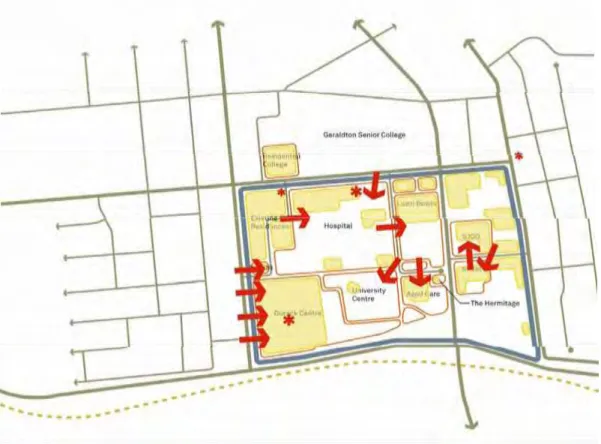
4.3.1 Road NetworkFigure 5 describes the road system within and around the HETP.
Tellingly, there are few roads through the project area, which compromises the connectivity, permeability and legibility of the precinct. There is potential to improve the
situation through creation of new roads and maximising the benefits of existing connections
to the CBD. In particular there is opportunity to create a dominate east-west entry to the precinct off Cathedral Avenue, connecting into Onslow Street.
4.3.2 Car parking
Car parking currently forms a dominant feature of the HETP landscape. Car parking is generally provided individually by each site/user as a separate car park. Not only does this separate provision of parking lose efficiency with land area required, the area loses connectivity by road and pedestrian means.
There is opportunity to locate parking to the rear of future development and to share car parking between users or within smaller ‘precincts’ which may provide a critical mass in users and financially for the establishment of larger decked parking facilities.
4.3.3 Entry Impressions
The impression people have of the HETP will affect its success as a centre and its cohesion as a mix of important functions. At present, each entry into the precinct is poorly defined. Wayfinding is compromised and where there are entries, people are met by substantial areas of car parking (see Figure 5).
There is significant potential to improve the entry thresholds into the precinct through landmark buildings, use of landscaping, definition of the precincts edges and clearly defined road networks.
GERALDTON HEALTH EDUCATION & TRAINING PRECINCT CONCEPTUAL MASTER PLAN P a g e | 13
4.3.4 Potential to Maximise Benefits of Regional Links
The HETP is well placed to benefit from regional links. Good access is available from the HETP to; the CBD, Geraldton Airport and to Geraldton port area. New functions that may locate within the HETP can therefore benefit from high quality regional links and the adjacent health, education and training facilities.
There is significant land available for future development within the HETP. This should be made available for functions that provide higher order and strategic jobs. Such jobs are export focused therefore good accessibility to external markets can be maximised.
4.3.5 Opportunity to Forge Links
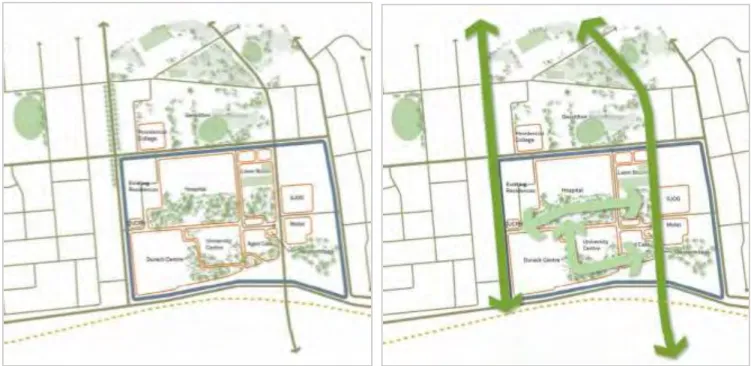
There is significant opportunity to forge new links through the precinct, for vehicles, pedestrians and cyclists. These movement links will form one arm of the urban framework and help to create a more legible and identifiable precinct. By forging these links, growth potential can be maximised and an address for each of the functions in the precinct provided (see Figure 6).
GERALDTON HEALTH EDUCATION & TRAINING PRECINCT CONCEPTUAL MASTER PLAN P a g e | 14
4.4
GREEN SPACES & LINKS
Aerials of the HETP demonstrate that there is already existing green areas and vegetation. Figure 7 below shows how the parkland / vegetation system throughout the HETP can form another important arm of the urban framework. Bush parkland systems can be used to provide a distinct character and amenity within the precinct, improved avenues and boulevards can forge links to the CBD and create improved thresholds, whilst water sensitive urban design principles can be employed to maximise sustainability credentials.
Not all of the vacant land is appropriate for development, given topographical and accessibility constraints. In this regard, some of this land can be used to create internal amenity through provision of parkland and an improved bush setting.
The extent of existing vegetation, parkland and playing fields in and around the project area is shown in Figure 7. There is potential to formalise connection of these areas thus improving the sustainability of Geraldton’s vegetation network and creating “green infrastructure corridors”.
Figure 7: Demonstration of current extent of vegetation in the broader HETP area, and indicating the potential green linkages within the precinct.
4.5
TOPOGRAPHY
The coastal location of the precinct means a series of dune ridges run through it. This presents challenges in terms of the location of new roads and buildings, but also creates a distinct character and opportunity for views to the ocean (see Figure 8).
4.6
INTENSITY & ACTIVITY
Notwithstanding the existing functions within the precinct, their institutional nature means they tend to be internalised. There is little activity visible from the edges of the precinct or around the edges of the respective functions. Where there are points of activity, they are dispersed. As such, the intensity of the precinct is currently low. By providing a new common point of focus for the precinct, in an area accessible to all, the amenity and function of the HETP can be improved.
GERALDTON HEALTH EDUCATION & TRAINING PRECINCT CONCEPTUAL MASTER PLAN P a g e | 15
Figure 8: Demonstrating the topography of the HETP and views to ocean.
4.7
NATIONAL BROADBAND NETWORK
It is acknowledged that the hub for the Mid West component of the national broadband network is centrally located within the HETP. At present, the infrastructure is located in a transportable building to the north of the GUC. However, overtime, it is likely this position will become more exposed. New buildings and activities will need to shield the NBN infrastructure.
The NBN infrastructure offers excellent opportunity for high quality communications to be established within the health, education and training functions of the HETP. This will provide a positive leverage point from which to market and develop the precinct.
GERALDTON HEALTH EDUCATION & TRAINING PRECINCT CONCEPTUAL MASTER PLAN P a g e | 16
5
VISION
Through workshops with key stakeholders, a preliminary vision statement was prepared for the HETP. A vision statement should be the inspiration and guide the framework for strategic planning around the HETP. While a vision statement does not establish a framework, it does set the direction for planning. In this regard, a vision statement should capture the aspirational targets for the HETP.
The Geraldton Health, Education and Training Precinct is a multipurpose campus that showcases collaboration and coordination to ensure quality, innovative delivery of health, education and social services for the regional community it serves. It encourages community connections and integrated services within a vibrant urban environment that is respectful of its natural setting. The precinct is characterised by convenient public transport that connects to a modern village containing a mix of recreational activities, flexible accommodation, markets, shops and cafes servicing health, education and training.
5.1
ASPIRATIONS
Through discussion with key stakeholders, this vision statement does not fully capture the aspirational targets for the HETP. Comments around the precinct offering world class health services, world class education and training and attracting world class research companies that are synergistic with health and education were thought to be appropriate for the HETP. In this regard, the vision statement for the HETP should be refined with key partners to include these aspirational targets.
The elements that should be considered in the growth and development of the HETP are based on the regional specialities of Geraldton and the Mid West. By targeting these specialities, the HETP can develop in a more sustainable and effective manner.
Utilise the emerging resource industry as a growth tool: the resources sector is an
emerging industry in the Mid West and offers real potential for strategic and export oriented positions to be established. Importantly for the HETP, resources companies require populations that are highly educated, be that through universities, or through the vocational education sector, such as that provided by Durack.
Marine Science: the Mid West region benefits from a rich fishing industry, comprising
36% of the State’s catch in 2004/05 (Mid West Development Commission, 2010). The rich marine life has potential to anchor marine science and research industries. The Durack Institute of Technology’s Maritime Institute and the Abrolhos Islands Research Institute are co-located near to the HETP. Other marine research foundations can benefit from agglomeration by locating within the HETP.
Agricultural Science: Agriculture is also a significant industry for the Mid West. In
2003/04 the region’s agricultural gross value was $792.2 million a substantial 12.6 precent of the states total. More than half of all agricultural income is derived from wheat production with the 2003/04 harvest valued at $432.7 million. Other agricultural industries include various cereal and legume crops, livestock predominantly sheep and cattle, horticulture and aquiculture both on the coast and inland (Mid West Development Commission, 2010). Companies associated with the agriculture sector could benefit from the nearby education facilities.
Importantly, these functions complement the health, education and training focus of the HETP. These industries would particularly rely on the education institutions through programmes that target industry requirements.
GERALDTON HEALTH EDUCATION & TRAINING PRECINCT CONCEPTUAL MASTER PLAN P a g e | 17
6
SECURING THE FUTURE
6.1
A ‘PLACE’ STRATEGY
Building on the vision and aspiration statements for the HETP, a place strategy has been developed that acknowledges the precinct’s role for health, education and training. The place strategy recognizes that the HETP is not a general centre, but a specialized centre that has a focus on providing services and employment to the region. In this regard, its major functions will be complemented by residential and commercial activities, but these activities will be supplementary to the various institutions in the HETP.
6.1.1 A Place for Training and Learning
The HETP will continue to have a major focus towards training and learning. This will be provided through Durack, the GUC and CUCRH. The programmes provided by these institutions are geared towards the regional specialities of Geraldton and the Mid West and should continue to do so. Over time, the education institutions will grow to better service the population, particularly the university sector.
6.1.2 A Place for Healing
The Geraldton Hospital is one of the larger hospitals in Western Australia outside of the Perth metropolitan region. It provides an important service to Geraldton residents, but can also maximize its focus to the region by being an alternative health location to Perth for northern WA. In this regard, the growth aspirations of the hospital to provide more beds, an enlarged emergency department and a cancer centre should be supported. Where possible, links between the education and health functions should be supported.
6.1.3 A Place of Research
The HETP does not currently contain significant research foundations. However, as the minerals and resources industries grow in importance, and the need to improve efficiencies in the agriculture and fishing sectors grow, a place for research foundations in Geraldton will emerge. The location of the existing education institutions should be leveraged to encourage research functions within the HETP.
6.1.4 A Place of Employment
In order to support the economic sustainability of Geraldton, the HETP will become a recognized place of employment, particularly for strategic and export oriented jobs. These higher order jobs need to be harnessed through dedicated programmes at the local and State level.
6.1.5 A Place that Nurtures Growth
To nurture growth in the HETP and promote its significance within the region, it needs to have a clear and legible urban design framework. Appropriate urban form that allows free exchange between businesses and can contain their growth is required. Therefore, buildings must be of a reasonable size and density whilst also promoting a comfortable and attractive urban environment.
To nurture growth, each function should promote a ready exchange of ideas. In this regard, the design of each building and the various institutions should promote movement through permeable edges as well as a mixing of functions. The HETP should be thought of as a village, where functions mix together. The HETP will become a true precinct and not just a collection of health, education and training functions.
GERALDTON HEALTH EDUCATION & TRAINING PRECINCT CONCEPTUAL MASTER PLAN P a g e | 18
6.2
PREDOMINANT USE STRATEGY
Figure 9 demonstrates the use strategy for the Geraldton HETP, which complements the place strategy elements. The elements of the use strategy will contain the following: Knowledge Centre:
Greatest point of intensity
Equitably located between the major functions of the hospital, GUC and Durack
Contain a mix of uses, with some convenience retail, cafes and similar functions
Support the introduction of residential functions into the HETP
Be an attractive and vibrant centre
Health:
Geraldton Hospital
St John of God Hospital
Medical consulting rooms
Education and Training:
Durack Institute of Technology
Geraldton Universities Centre
Combined Universities Centre for Rural Health
Research companies and institutes
Local schools
Potential for an Indigenous training and cultural centre
Open Space:
Passive and active recreation opportunities
Water sensitive urban design
Local vegetation protection
Landscape amenity
Mixed Use / Living:
Temporary worker and visiting professional accommodation
Student accommodation
Permanent accommodation
Apartment and terrace house forms
Commercial businesses that support and supplement the health, education and
GERALDTON HEALTH EDUCATION & TRAINING PRECINCT CONCEPTUAL MASTER PLAN P a g e | 19
Figure 9: Conceptual representation of the predominant use strategy.
6.3
DESIGN ELEMENTS
To meet the vision and aspirations for the HETP, the master plan should provide for the following fundamental design elements, thus ensuring a robust public realm from which businesses and institutions can develop.
Maximise points of amenity: amenity is to be maximised through creation of a high
quality public realm and provision of convenience services such as cafes and small retail outlets that cater for nearby employees and residents.
Consolidate growth centres to promote intensity: the intensity of activity and
functions needs to increase in the HETP so that agglomeration benefits can be realised. Providing a point of focus within the HETP will help it grow as defined centre of a distinct quality and purpose.
Improve accessibility: Access to the HETP and its various functions must be improved
so that their regional benefits are maximised. Roads and movement systems through the HETP need to be legible and allow for ease of access. Access must also be equitable and so a range of movement types need to be provided for – private vehicle, public transport, pedestrian and cyclists.
Green links: Identification of key green spaces and links will provide amenity and
connectivity to the HETP. Such areas can also be designed and located at key views and vistas on the site, taking advantage of the topography and providing the precinct with clam streetscapes and identity.
Car parking: A current issue with the existing HETP with regard to sufficient provision,
the efficient use of land and infrastructure and the visual impact on the precinct. Car parking should be shared amongst uses or within broader precincts and specifically designed to not impact the amenity of the HETP. Opportunities for decked car parking facilities should be followed.
GERALDTON HEALTH EDUCATION & TRAINING PRECINCT CONCEPTUAL MASTER PLAN P a g e | 20
7
CONCEPTUAL MASTER PLAN
7.1
EARLY CONCEPTS
7.1.1 Scenario 1Scenarios 1 and 2 are very similar in nature, the main point of difference being the location of the ‘village heart’, which is dependent on future public transport links and should be nearby the main health and education institutions.
The scenarios take account of the existing functions and their growth patterns. Importantly, these functions are tied together by a legible movement network. New roads are provided between Cathedral Avenue and Fitzgerald Street, as well as from George Street to the ‘village heart’.
The village heart is located between Geraldton Hospital, Durack Institute of Technology and Geraldton University Centre. It is located here to benefit each institution and drives the route for public transport.
A system of open space is created to link the surrounding areas of open space and to create internal amenity for the HETP. This parkland can accommodate a range of passive and active recreation, retain vegetation and topography and contain water sensitive urban design elements. To help tie together the institutional functions, a central open space spine is created. This will improve the address of each institution and particularly St John of God and give each a defined presence.
A mixed use spine is provided for which can contain new urban form that complements the main health and education institutions. The mixed use spine will contain residential accommodation, convenience retail and cafes within the village heart, medical suites and consulting rooms and office space for research institutions.
7.1.2 Scenario 2
Scenario 2 is similar to Scenario 1 but for the location of the village heart. Here, a new road is not inserted through the hospital land, and so the existing north-south road is utilized for internal public transport access. The village heart is thus located between the GUC and the hospital, but away from Durack’s sizeable student population.
The location of the village heart was seen by workshop participants to be better located between the three major institutions of the HETP.
GERALDTON HEALTH EDUCATION & TRAINING PRECINCT CONCEPTUAL MASTER PLAN P a g e | 21
Figure 10: Early concept, scenario 1.
GERALDTON HEALTH EDUCATION & TRAINING PRECINCT CONCEPTUAL MASTER PLAN P a g e | 22
7.2
THE FINAL MASTER PLAN
The final conceptual master plan was developed following a second workshop with key stakeholders and further feedback/review. Given that the purpose of the Master Plan is to provide a high level, conceptual framework within which future planning and design decisions can be made, much of the detail contained in the early concepts was removed, with only the key principles remaining.
7.2.1 Transport Network
A major east west spine is located through the HETP, extending Onslow Street east to intersect with Cathedral Avenue. This intersection will form the major entrance to the precinct and as such, any buildings fronting this area should appropriately face and activate the street. Intensity of built form is imperative along with appropriate signage, and landscaping to provide amenity and identity to the HETP.
Due to the current location of a number of existing structures, including the Onslow Street mental health units and the NBN base site, combined with the topography of the area, detailed engineering designs will be necessary to locate the exact road alignment. Despite these constraints, this east-west entry spine is the most important road to create permeability through the site and as such, should be secured (as a public road) and protected from development that could undermine it.
Other potential private roads (or internal driveways) are shown and provide the basic connectivity, permeability and legibility for the precinct.
7.2.2 Car Parking
Car parking for the precinct should not form a dominant feature of the landscape. It is to generally be provided on each site, but shielded from public view. Ideally it will be located at the rear of buildings or decked and sleeved with active functions. Car parking may also be provided on a precinct basis or in a larger decked parking style. In these instances, the ground floor of these facilities will contain active functions, and the upper facades of the car park screened with attractive and high quality facades.
The precinct car parks should not be located on the main streets, but should be appropriately placed to allow ease of access for vehicles as well as convenient and safe pedestrian movement to the various functions of the precinct.
It is recognized that open car parks may act as a transitional land function until such time as a building is constructed on site. In this situation, the open car parks are to be landscaped, incorporate clear pedestrian paths and well lit so that they are safe, attractive and provide shade for vehicles and pedestrians.
7.2.3 Green Space and Links
Whilst the actual location of the green spaces has not been shown, the principle to retain key green spaces and links to provide amenity and connectivity to the HETP is still promoted. It is envisaged that through the detailed design phase that there will be land that is not appropriate for development, given topographical and accessibility constraints. Such areas can be designed and located at key views and vistas on the site, taking advantage of the topography and providing the precinct with clam streetscapes and identity (as shown in Figure 7).
7.2.4 Village Heart
The ‘village heart’ will contain functions that enhance the amenity of the HETP. Convenience retail, cafes and restaurants will be complemented by residential and office functions.
GERALDTON HEALTH EDUCATION & TRAINING PRECINCT CONCEPTUAL MASTER PLAN P a g e | 23
8
IMPLEMENTATION
The steps to take to implement the HETP strategy are:
8.1
STATUTORY
Formal adoption by the City of Greater Geraldton as a Local Planning Policy.
Acceptance of the document by the major stakeholders. This would likely be through
a memorandum of understanding that establishes the core principals and approach.
Preparation of design guidelines incorporating character statements, statutory
developments standards and the public realm. The urban framework in this document needs to guide development throughout the HETP. The design guidelines should also provide for an agreed framework for decision making.
8.2
LAND TENURE
The strategy requires land subdivision to create new parcels and provide for new
public roads.
8.3
COMMON USE INFRASTRUCTURE
Infrastructure to support the HETP will need to be identified and provided at
appropriate times.
Identifying and securing the east-west road alignment and intersection.
8.4
FUNDING
To initiate works for the HETP, funding will need to be gained, most likely from the
O:\PLANNER\PROJECTS\HEALTH EDUCATION & TRAINING PRECINCT (LP-0131)\WORKSHOP 1\GERALDTON_WORSHOP NOTES.DOCX 1
DISTILLED NOTES FROM WORKSHOP
SESSION 1
Q1:
Thinking about the city….
How is your organisation contributing to Geraldton's future? 1. Providing services relevant to each organisation 2. Contributing to community development by
a. Retaining youth and families b. Supporting local business
c. Aboriginal development health and education 3. Attracting people to the region
a. Students and professionals 4. A sense of positive community 5. Contribute to workforce development 6. Providing leadership
Q2:
Thinking about the city….
What are the challenges you face in delivering your services? 1. Attracting, retaining and training staff (and students) 2. Community expectations and aspirations
3. Cost of infrastructure provision 4. Sufficient funding
5. Coordination/communication across agencies 6. Population growth
a. Expanding services b. Critical mass c. Sustainability 7. Legislation / red tape 8. Prioritising activities Q3:
Thinking about the precinct….
What opportunities exist by working together? What are the synergies?
1. Sharing
a. Resources
b. Workforce development c. Cost savings and efficiencies
d. Networking of knowledge and information e. Infrastructure
f. Joint funding and lobbying powers 2. Maximising and enhancing services
a. Specialising b. Choice
O:\PLANNER\PROJECTS\HEALTH EDUCATION & TRAINING PRECINCT (LP-0131)\WORKSHOP 1\GERALDTON_WORSHOP NOTES.DOCX 2
d. Access to services
3. Future growth and innovation research and sustainability a. Future proofing
b. Optimising opportunities Q4:
Thinking about the precinct….
What barriers need to be overcome to be able to work together? 1. Funding
a. Responsibility b. Competitiveness
2. Vision / Agreement – Agreed Goads and plans 3. Public Private Partnerships – Ideology / Perception 4. Communication
a. No silos
b. Sharing knowledge and positivity 5. Prioritisation and workloads
a. Plans to action b. Commitment Q5:
Thinking about the precinct….
What physical features are required to make the precinct function at its best? 1. Transport
a. Parking b. Bikes c. Shuttles d. Paths
e. Pick up / drop off nodes 2. Environment
a. Public Opens Space / Greenways b. Flora and Fauna
c. Informal Space 3. Alternative Energy a. Solar b. Wind c. Water conservation 4. Lighting a. Trees b. Lights c. Security 5. Community Squares a. Food outlets b. Public Art
c. Theatre / conference centre d. Sporting
e. Meeting Rooms Q6:
Thinking about the precinct….
O:\PLANNER\PROJECTS\HEALTH EDUCATION & TRAINING PRECINCT (LP-0131)\WORKSHOP 1\GERALDTON_WORSHOP NOTES.DOCX 3
Where should it connect? 1. Spatial Connections
a. GUC to Durack
b. Connections to St John of God Precinct c. Connections to high schools
d. Landscape Connections
e. Use of natural vegetation between connections f. Safety 2. Transport a. Public Transport b. Cycle c. Pedestrian d. Underpasses / bridges 3. Utilities, Infrastructure and services
a. Power b. Water
c. Broadband / data / wireless Q7:
Thinking about the precinct….
What non institutional activities are suited to the precinct? 1. Cafes a. Restaurants b. Taverns 2. Accommodation a. Short Stay b. Professional Staff c. Student 3. Aboriginal Centre a. Heritage b. Education 4. Recreation
a. Gym / open air b. Squash c. Skate Park d. Theatre e. Bike Hire f. Family Areas g. Park 5. Services a. Medical Practice b. Supermarket c. Transit Hub d. Childcare e. Bookshop 6. IT
a. Data centre network hub b. IT businesses
c. Holographic Centre d. Video Conferencing
O:\PLANNER\PROJECTS\HEALTH EDUCATION & TRAINING PRECINCT (LP-0131)\WORKSHOP 1\GERALDTON_WORSHOP NOTES.DOCX 4
Q8:
Thinking about the precinct….
How intensely developed should the precinct become? How high? How much open space?
1. Height – no agreement
a. Range between 2-8, suggestion for higher rise at strategic points 2. Open Space
a. As much open space as possible (30-50%) b. Develop strategically
c. Avoid concrete jungle 3. Parking
a. Underground or high rise parking b. Avoid urban sprawl
c. Preference for developing fabulous public transport d. Position strategically e.g. edge of precinct
Vision
A vision for the Geraldton Health and education precinct
The Geraldton Health and Education Precinct is Governed by a coordination body that shows leadership in the delivery and growth of social and community services within the region. It does this by promoting community aspirations and services within an integrated and vibrant urban environment that is respectful of its natural setting.
The urban environment is characterised by convenient public transport that connects to a precinct village containing a mix of recreational activities, flexible accommodation, markets, shops and cafes servicing health and education.
Architecture Australia Interior Design PR China
Landscape Architecture Hong Kong SAR Planning Singapore Urban Design Thailand
11 March 2011
GERALDTON HEALTH,
EDUCATION AND TRAINING
EDUCATION AND TRAINING
PRECINCT
PRECINCT_
CONCEPT PLAN WORKSHOP
Presented by:
Chris Melsom, Principal Scott Davies, Associate