PACIS 2018 Proceedings
Pacific Asia Conference on Information Systems
(PACIS)
6-26-2018
Exploring Mobile Peer-to-Peer Payment Adoption:
The Effects of SNS and Native Mobile Banking
Apps Usage
Jun Feng Clement Lim
Korea University, [email protected]
Byungwan Koh
Korea University, [email protected]
Dongwon Lee
Korea University, [email protected]
Follow this and additional works at:
https://aisel.aisnet.org/pacis2018
This material is brought to you by the Pacific Asia Conference on Information Systems (PACIS) at AIS Electronic Library (AISeL). It has been accepted for inclusion in PACIS 2018 Proceedings by an authorized administrator of AIS Electronic Library (AISeL). For more information, please [email protected].
Recommended Citation
Lim, Jun Feng Clement; Koh, Byungwan; and Lee, Dongwon, "Exploring Mobile Peer-to-Peer Payment Adoption: The Effects of SNS and Native Mobile Banking Apps Usage" (2018).PACIS 2018 Proceedings. 109.
Exploring Mobile Peer-to-Peer Payment Adoption:
The Effects of SNS and Native Mobile Banking Apps
Usage
Research-in-Progress
Clement Jun Feng Lim
Korea University Business School,
Korea University
[email protected]
Byungwan Koh
Korea University Business School,
Korea University
[email protected]
Dongwon Lee
Korea University Business School,
Korea University
[email protected]
Abstract
Mobile payments have been adopted as an essential payment channel due to the proliferation of mobile phones and mobile e-commerce. Mobile peer-to-peer (P2P) payment applications, on the other hand, is still in its infancy and have yet to see mass adoption. This study aims to explore the factors that influence the adoption of such mobile P2P payment applications by using a large scale data set based on users’ mobile application usage behaviors. The main initial findings reveal that the length of the session of traditional bank application usage significantly influences the adoption of mobile P2P payment applications. In addition, the amount of social network service applications used positively impacted one’s adoption of mobile P2P payment applications. These findings have important theoretical and practical implications for stakeholders of mobile P2P payment solution providers as well as intermediaries/banks who provide their own payment applications to their customers.
Keywords: Mobile Payments, Mobile Peer-to-Peer Payments, Mobile Money Transfer, Adoption
Introduction
Mobile payment provides a platform for users to conduct payment services via the use of applications (apps) installed on mobile devices such as mobile phones (Au and Kauffman 2006). Mobile payment has been increasingly adopted as an essential payment channel for online e-commerce transactions and there is a growing demand for mobile e-commerce services. In 2014, mobile e-commerce generated over $35 billion and this figure is expected to reach up to $284 billion by 2020. This signals that there is still room for significant growth for mobile payment (Meola 2016). New advances in technologies such as near-field communication (NFC) and contactless payment systems are opening up new opportunities for mobile payment growth. These systems enable mobile devices to serve as payment solutions replacing traditional credit cards and cash.
In recent years, a new category of mobile payment solution has been gaining popularity. Mobile peer to peer (P2P) payment is a category of mobile payment solutions which enable users to complete money
transfer services via the use of an application installed on the mobile device of the user (Nath 2017). This category of apps is poised to reach a transaction volume of $86 billion by 2018, with tech giants such as Google and Facebook entering this space by offering their own mobile apps (Heggestuen 2014). Currently, market leaders in this category of mobile payment solutions are PayPal and Venmo. Previously, before the advent of such mobile P2P payment solutions, money transfer services were offered as a part of the services provided on traditional mobile banking apps. A key difference between the two is that users have to download the banking app of their bank, and, in order to transfer money to another individual, the users have to know the specific bank account number of the intended recipient as opposed to simply knowing the recipients’ email address or phone number (Venmo 2018).
Conceptually, mobile P2P payment consists of the intermediary, users, and participating financial institutions. However, as the transactions occur between users on only one side of the platform, there is a greater same-side network impact between users rather than cross-side network effects (Kazan and Damsgaard 2013). As more users adopt the P2P payment platform, we should see greater adoption and usage of the particular P2P payment app. Mobile P2P payment has also gone through significant changes since its inception in 2002. In its early days, P2P payment was led by initiatives from banks. However, there was a lack of interest from banks to develop such solutions. Mobile P2P payment took off with Venmo entering the market in 2012. Since then, there is a resurgence of interest from banks to develop mobile P2P payment services as can be seen from new payment solutions such as Zelle (Black et al. 2016; Koren 2017).
Currently, we have yet to see widespread adoption of mobile P2P payment in the P2P payment market. Despite the large volume of P2P payments, mobile P2P payment, only consists of a tiny fraction of total volume of P2P payments (Green 2017). On the other hand, in developing countries such as Kenya, the adoption rate of M-PESA, a mobile P2P payment solution, was reported to be as high as up to 92 percent of all Kenyans. This signals the huge success of the mobile P2P payment platform in such emerging markets (Heggestuen 2014). Overall, we can expect that mobile P2P payment will consider to grow further with new entrants entering the market vying for a piece of the mobile P2P payment market. Furthermore, the impact of the usage of traditional mobile banking solutions and apps on such mobile P2P solutions are still unclear. There are certain functions of mobile P2P payment apps which overlap with the functions inherent in mobile banking apps. Therefore, the relationship between mobile P2P payment usage and traditional banking apps usage, if any, would serve as an interesting research question to be examined. Also, the expected growth of the mobile P2P market, serve to highlight the important practical implications for research in this space. In the subsequent section, we highlight that research in field of mobile payments lacks the systematic differentiation between the different types of mobile payment systems (e.g. mobile P2P payments vs mobile person-to-merchant payments) and largely focuses on mobile person-to-merchant mobile payment solutions. Driven by the motivation to fill this literature gap, as well as the growing potential of such solutions, we attempt to conduct an exploratory study to identify the factors affecting adoption of such mobile P2P payment apps.
Theoretical Background
Prior research on mobile payment have focused on two streams of research, the technologies behind mobile payments as well as consumer adoption of mobile payments (Dahlberg et al. 2015). Research on the technologies behind mobile payments focus on the growth of key technologies such as NFC and contactless payment systems and how they can be used to support mobile payments. One study assessed the impact of NFC on future mobile payment services and found that NFC will further aid the development of mobile payment services (Ondrus and Pigneur 2009). In addition, research in this stream also focused on the technologies behind security and privacy issues such as the protocols and encryption across the different types of mobile payment services (Konidala et al. 2011; Ou and Ou 2007).
The second stream of research focuses on mobile payment consumer adoption and attempt to understand the underlying reasons which can explain adoption behavior based on factors such as the preferences of consumers. Many studies have attempted to adopt information system theories such as the technology acceptance model (TAM), and the unified theory of acceptance and use of technology (UTAUT) to explain why consumers adopt mobile payment services (Bigne et al. 2007; Chen 2006; Slade et al. 2015). Other researchers have also considered other factors such as security and cost, and have found that they have an influence on the adoption of mobile payment services (Dahlberg et al. 2003). In terms of mobile P2P payment adoption specifically, there are some research that document the successful use case of such payment services in developing countries in Africa. These research report the widespread adoption of mobile P2P payment services in emerging markets such as Kenya and other African countries (Jain 2014; Kshetri and Acharya 2012). These studies also explore the economic and social impact of such mobile P2P payment and found that that mobile P2P payment adoption leads to the increase of money transfer activities (Mbiti and Weil 2011; Morawczynski 2009; Morawczynski and Pickens 2009). However, these research are limited in they do not focus on examining and explaining the factors that would lead to the adoption of such mobile P2P payment solutions.
Furthermore, we also observe that most of the research on mobile payments do not differentiate the systematic differences between the different types of mobile payment systems and define mobile payment services loosely. The result of this is that much the extent literature focused on person-to-merchant type mobile payment services rather than P2P mobile payment services.
Theoretical Model
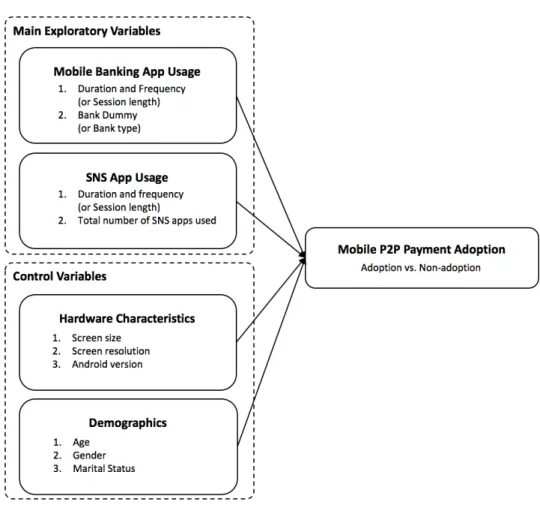
Figure 1 illustrates our research model for mobile P2P payment adoption. In our model, there are two main constructs which we explore to identify if a relationship exists with the adoption of mobile P2P payment. Traditionally, although banking apps allow the transfer of money to peers and share the functions of mobile P2P payment apps, banking apps require users to go through a more tedious process in order for the money transfer to be facilitated and banking apps may have limitations and restrictions for money transfers to peers with accounts at other financial institutions (Koren 2017; Russell 2017). This tedious and cumbersome process in order to access the functions within the banking apps could mean that users may opt to use mobile P2P payments apps to facilitate simple transactions where the process is much simplified. Therefore, we empirically test if there is a relationship between the usage behavior of banking app and one’s choice to adopt the use of mobile P2P payment apps.
The business model of many of the mobile P2P payment apps available on the market was built on the assumption that users would use the app to send money to friends and family rather than strangers (Molinda 2017). Users of SNS apps mainly use the platform to connect, communicate, and keep in touch with friends and family. Research on social media usage behavior revealed that the more time spent on interacting with others on SNS platforms and apps, the more likely that that person is more sociable. Furthermore, users who are more extroverted tend to use SNS apps more frequently and for longer durations (Correa et al. 2010; Seidman 2013). Furthermore, one study used network externalities and motivation theory to study why people use SNS and found that apart from enjoyment, the number of peers one had has a significant influence on their usage behavior on SNS (Lin and Lu 2011). Hence, we posit that the more peers a person has as well as the more time one spends with these people (i.e. high levels of sociability), the more likely he or she would adopt mobile P2P payment apps to send money to friends or family. Apart from the two constructs mentioned before, we also explore the effects of mobile hardware characteristics, including the operating system software, and demographics on mobile P2P payment adoption and have included them as control variables in our research model. We formally state our research model as follows:
𝑇𝑜𝑠𝑠𝐴𝑑𝑜𝑝𝑡𝑖𝑜𝑛 = 𝛽-+ 𝛽/𝐵𝑎𝑛𝑘𝐷𝑢𝑟𝑎𝑡𝑖𝑜𝑛 + 𝛽6𝐵𝑎𝑛𝑘𝐶𝑛𝑡 + 𝛽8𝑀𝑎𝑗𝑜𝑟𝐵𝑎𝑛𝑘 + 𝛽;𝑆𝑜𝑐𝑖𝑎𝑙𝐷𝑢𝑟𝑎𝑡𝑖𝑜𝑛 + 𝛽?𝑆𝑜𝑐𝑖𝑎𝑙𝐶𝑛𝑡 + 𝛽@𝑆𝑜𝑐𝑖𝑎𝑙𝐴𝑝𝑝𝑠 + 𝛽A𝑆𝑐𝑟𝑒𝑒𝑛𝑆𝑖𝑧𝑒 + 𝛽D𝑆𝑐𝑟𝑒𝑒𝑛𝑅𝑒𝑠𝑜𝑙𝑢𝑡𝑖𝑜𝑛 + 𝛽F𝑆𝐷𝐾 + 𝛽/-𝐺𝑒𝑛𝑑𝑒𝑟 + 𝛽//𝐴𝑔𝑒𝐺𝑟𝑜𝑢𝑝 + 𝛽/6𝑀𝑎𝑟𝑖𝑡𝑎𝑙𝑆𝑡𝑎𝑡𝑢𝑠 + 𝜖/ (1) 𝑇𝑜𝑠𝑠𝐴𝑑𝑜𝑝𝑡𝑖𝑜𝑛 = 𝛽-+ 𝛽/𝐵𝑎𝑛𝑘𝑆𝑒𝑠𝑠𝑖𝑜𝑛 + 𝛽6𝑀𝑎𝑗𝑜𝑟𝐵𝑎𝑛𝑘 + 𝛽8𝑆𝑜𝑐𝑖𝑎𝑙𝑆𝑒𝑠𝑠𝑖𝑜𝑛 + 𝛽;𝑆𝑜𝑐𝑖𝑎𝑙𝐴𝑝𝑝𝑠 + 𝛽?𝑆𝑐𝑟𝑒𝑒𝑛𝑆𝑖𝑧𝑒 + 𝛽@𝑆𝑐𝑟𝑒𝑒𝑛𝑅𝑒𝑠𝑜𝑙𝑢𝑡𝑖𝑜𝑛 + 𝛽A𝑆𝐷𝐾 + 𝛽D𝐺𝑒𝑛𝑑𝑒𝑟 + 𝛽F𝐴𝑔𝑒𝐺𝑟𝑜𝑢𝑝 + 𝛽/-𝑀𝑎𝑟𝑖𝑡𝑎𝑙𝑆𝑡𝑎𝑡𝑢𝑠 + 𝜖6 (2) 𝑇𝑜𝑠𝑠𝐴𝑑𝑜𝑝𝑡𝑖𝑜𝑛 = 𝛽-+ 𝛽/𝐵𝑎𝑛𝑘𝐷𝑢𝑟𝑎𝑡𝑖𝑜𝑛 + 𝛽6𝐵𝑎𝑛𝑘𝐶𝑛𝑡 + 𝛽8𝐵𝑎𝑛𝑘K+ 𝛽;𝑆𝑜𝑐𝑖𝑎𝑙𝐷𝑢𝑟𝑎𝑡𝑖𝑜𝑛 + 𝛽?𝑆𝑜𝑐𝑖𝑎𝑙𝐶𝑛𝑡 + 𝛽@𝑆𝑜𝑐𝑖𝑎𝑙𝐴𝑝𝑝𝑠 + 𝛽A𝑆𝑐𝑟𝑒𝑒𝑛𝑆𝑖𝑧𝑒 + 𝛽D𝑆𝑐𝑟𝑒𝑒𝑛𝑅𝑒𝑠𝑜𝑙𝑢𝑡𝑖𝑜𝑛 + 𝛽F𝑆𝐷𝐾 + 𝛽/-𝐺𝑒𝑛𝑑𝑒𝑟 + 𝛽//𝐴𝑔𝑒𝐺𝑟𝑜𝑢𝑝 + 𝛽/6𝑀𝑎𝑟𝑖𝑡𝑎𝑙𝑆𝑡𝑎𝑡𝑢𝑠 + 𝜖8 (3) 𝑇𝑜𝑠𝑠𝐴𝑑𝑜𝑝𝑡𝑖𝑜𝑛 = 𝛽-+ 𝛽/𝐵𝑎𝑛𝑘𝑆𝑒𝑠𝑠𝑖𝑜𝑛 + 𝛽6𝐵𝑎𝑛𝑘K+ 𝛽8𝑆𝑜𝑐𝑖𝑎𝑙𝑆𝑒𝑠𝑠𝑖𝑜𝑛 + 𝛽;𝑆𝑜𝑐𝑖𝑎𝑙𝐴𝑝𝑝𝑠 + 𝛽?𝑆𝑐𝑟𝑒𝑒𝑛𝑆𝑖𝑧𝑒 + 𝛽@𝑆𝑐𝑟𝑒𝑒𝑛𝑅𝑒𝑠𝑜𝑙𝑢𝑡𝑖𝑜𝑛 + 𝛽A𝑆𝐷𝐾 + 𝛽D𝐺𝑒𝑛𝑑𝑒𝑟 + 𝛽F𝐴𝑔𝑒𝐺𝑟𝑜𝑢𝑝 + 𝛽/-𝑀𝑎𝑟𝑖𝑡𝑎𝑙𝑆𝑡𝑎𝑡𝑢𝑠 + 𝜖; (4) The subject of our study is Toss, a mobile P2P payment app (similar to Venmo), which was first launched in Korea in February 2015. The dependent variable, 𝑇𝑜𝑠𝑠𝐴𝑑𝑜𝑝𝑡𝑖𝑜𝑛, is a binary variable that represents whether each individual adopts Toss app. In equations (1) and (3), we examine whether the relationship between mobile banking app usage behavior and mobile P2P payment app adoption exists using 𝐵𝑎𝑛𝑘𝐷𝑢𝑟𝑎𝑡𝑖𝑜𝑛 and 𝐵𝑎𝑛𝑘𝐶𝑛𝑡. 𝐵𝑎𝑛𝑘𝐷𝑢𝑟𝑎𝑡𝑖𝑜𝑛 is a variable that represents the total duration the mobile banking app was utilized and 𝐵𝑎𝑛𝑘𝐶𝑛𝑡 is a variable that represents the total number of times the mobile banking app was launched by a user. Similarly, to examine the relationship between SNS app usage behavior and mobile P2P payment adoption, 𝑆𝑜𝑐𝑖𝑎𝑙𝐷𝑢𝑟𝑎𝑡𝑖𝑜𝑛, 𝑆𝑜𝑐𝑖𝑎𝑙𝐶𝑛𝑡, and 𝑆𝑜𝑐𝑖𝑎𝑙𝐴𝑝𝑝𝑠
are used. 𝑆𝑜𝑐𝑖𝑎𝑙𝐷𝑢𝑟𝑎𝑡𝑖𝑜𝑛, 𝑆𝑜𝑐𝑖𝑎𝑙𝐶𝑛𝑡, and 𝑆𝑜𝑐𝑖𝑎𝑙𝐴𝑝𝑝𝑠 represent, respectively, the total duration of all SNS apps used, the total number of times SNS apps were launched, and the total number of SNS apps used by a user. In equations (2) and (4), we use 𝐵𝑎𝑛𝑘𝑆𝑒𝑠𝑠𝑖𝑜𝑛 that we derived from 𝐵𝑎𝑛𝑘𝐷𝑢𝑟𝑎𝑡𝑖𝑜𝑛 and 𝐵𝑎𝑛𝑘𝐶𝑛𝑡 (i.e., 𝐵𝑎𝑛𝑘𝑆𝑒𝑠𝑠𝑖𝑜𝑛 = 𝐵𝑎𝑛𝑘𝐷𝑢𝑟𝑎𝑡𝑖𝑜𝑛/𝐵𝑎𝑛𝑘𝐶𝑛𝑡) and 𝑆𝑜𝑐𝑖𝑎𝑙𝑆𝑒𝑠𝑠𝑖𝑜𝑛 that we derived from 𝑆𝑜𝑐𝑖𝑎𝑙𝐷𝑢𝑟𝑎𝑡𝑖𝑜𝑛 and 𝑆𝑜𝑐𝑖𝑎𝑙𝐶𝑛𝑡 (i.e., 𝑆𝑜𝑐𝑖𝑎𝑙𝑆𝑒𝑠𝑠𝑖𝑜𝑛 = 𝑆𝑜𝑐𝑖𝑎𝑙𝐷𝑢𝑟𝑎𝑡𝑖𝑜𝑛/ 𝑆𝑜𝑐𝑖𝑎𝑙𝐶𝑛𝑡). To control for the bank fixed effect, we include 𝑀𝑎𝑗𝑜𝑟𝐵𝑎𝑛𝑘 in equations (1) and (2), and 𝐵𝑎𝑛𝑘K, 𝑖 ∈ 1,2, … ,10 in equations (3) and (4). 𝐵𝑎𝑛𝑘K are 10 dummy variables that represent the bank
that each individual uses and 𝑀𝑎𝑗𝑜𝑟𝐵𝑎𝑛𝑘 is a dummy variable which is 1 if the bank that one uses is one of four major banks; and 0 otherwise. Lastly, we control for the hardware differences between the panel members based on their mobile phone screen size ( 𝑆𝑐𝑟𝑒𝑒𝑛𝑆𝑖𝑧𝑒 ), screen resolution (𝑆𝑐𝑟𝑒𝑒𝑛𝑅𝑒𝑠𝑜𝑙𝑢𝑡𝑖𝑜𝑛), and Android operating system software version (𝑆𝐷𝐾) as well as the demographic differences using their gender (𝐺𝑒𝑛𝑑𝑒𝑟), age (𝐴𝑔𝑒), and marital status (𝑀𝑎𝑟𝑖𝑡𝑎𝑙𝑆𝑡𝑎𝑡𝑢𝑠).
Data
The data in this study was collected through Nielsen Korean Click - a global market research company which collects Internet measurements such as Internet usage and attitude data on platforms such as PC and mobile. The panel study ran for a duration of 39 weeks from November 2015 to July 2016. The panel comprises of a large scale sample of more than 14,000 mobile phone users. The panel was methodically selected by using stratified random sampling using an appropriate proportion allocation strategy using demographic information, such as age, and gender, in order to more accurately represent the population of mobile phone users. To track and measure the participants’ mobile phone usage behavior, a tracking application was installed on the participants’ mobile phones. Specifically, the tracking application was able to identify the mobile applications that were used, as well as the usage duration, and the total number of times each application was launched. From the data collected, we were able to track the usage behavior of users who used apps in the financial category. Furthermore, the richness of the data allowed us to explore app usage in other categories such as SNS providing us the opportunity to build app usage behavior in the SNS app category into our theoretical model and explore if there is a relationship between SNS app usage on adoption of mobile P2P payment apps in the finance category.
For our analysis, we selected panel members who used exactly one mobile banking app from the 11 banks in Korea in order to control for the differences among the various banks. The basis of selection of the banks for our study was based on the top 50 apps, based on popularity, in the financial category. Overall, about 5 percent of banking app users used the Toss app at least once during the time period of our study.
Preliminary Results
As the dependent variable of our models are binary variables, we estimate our models (i.e., equations (1) – (4)) using the logistic regression. We also use the skewed logistic regression because the distribution of Toss users is skewed. The estimation results that obtained from the skewed logistic regression are qualitatively identical to the one that we obtained from the logistic regression.
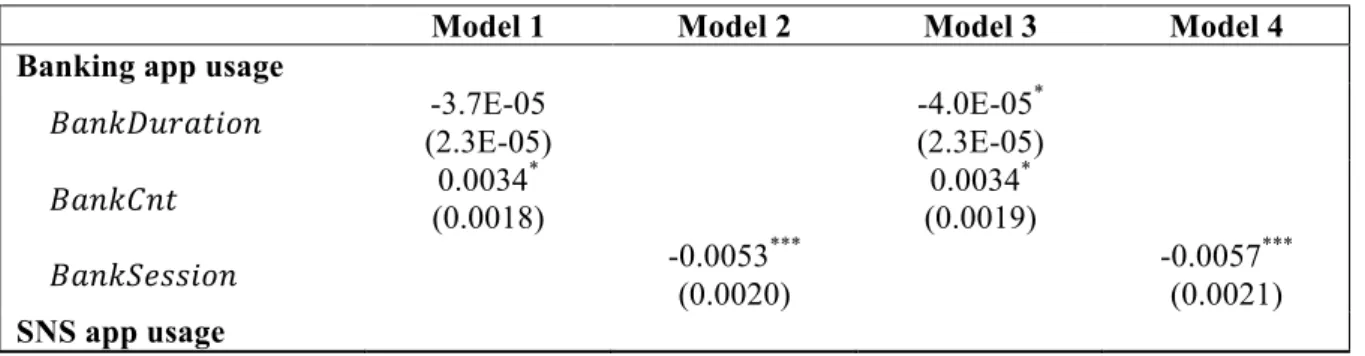
Table 2. Estimation Results
Model 1 Model 2 Model 3 Model 4
Banking app usage
𝐵𝑎𝑛𝑘𝐷𝑢𝑟𝑎𝑡𝑖𝑜𝑛 -3.7E-05 (2.3E-05) -4.0E-05* (2.3E-05) 𝐵𝑎𝑛𝑘𝐶𝑛𝑡 (0.0018) 0.0034* (0.0019) 0.0034* 𝐵𝑎𝑛𝑘𝑆𝑒𝑠𝑠𝑖𝑜𝑛 -0.0053*** (0.0020) -0.0057*** (0.0021) SNS app usage
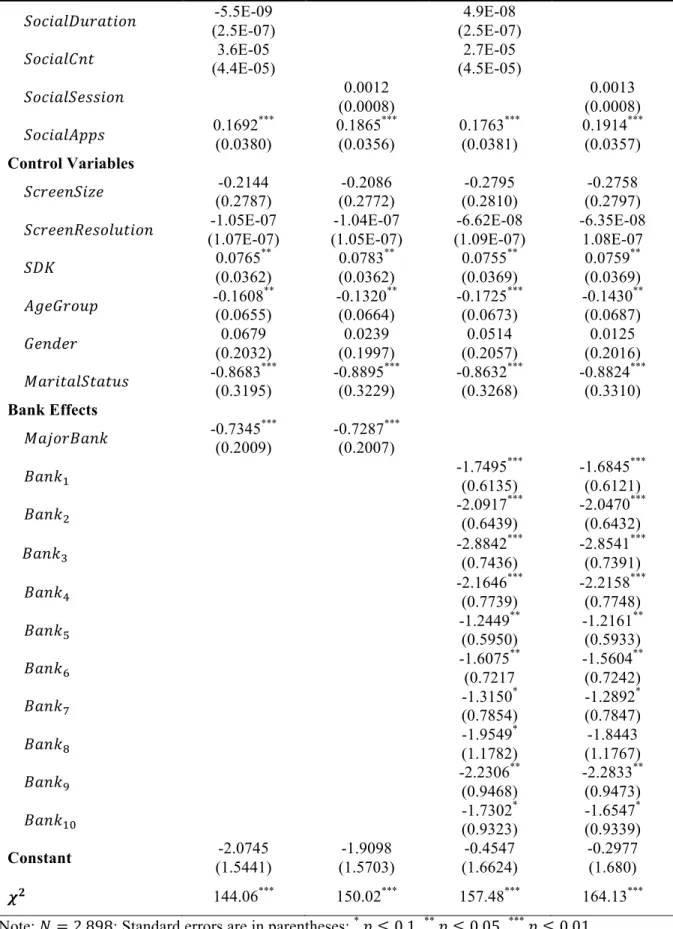
𝑆𝑜𝑐𝑖𝑎𝑙𝐷𝑢𝑟𝑎𝑡𝑖𝑜𝑛 (2.5E-07) -5.5E-09 (2.5E-07) 4.9E-08 𝑆𝑜𝑐𝑖𝑎𝑙𝐶𝑛𝑡 (4.4E-05) 3.6E-05 (4.5E-05) 2.7E-05
𝑆𝑜𝑐𝑖𝑎𝑙𝑆𝑒𝑠𝑠𝑖𝑜𝑛 (0.0008) 0.0012 (0.0008) 0.0013 𝑆𝑜𝑐𝑖𝑎𝑙𝐴𝑝𝑝𝑠 0.1692(0.0380) *** 0.1865(0.0356) *** 0.1763(0.0381) *** 0.1914(0.0357) ***
Control Variables
𝑆𝑐𝑟𝑒𝑒𝑛𝑆𝑖𝑧𝑒 (0.2787) -0.2144 (0.2772) -0.2086 (0.2810) -0.2795 (0.2797) -0.2758 𝑆𝑐𝑟𝑒𝑒𝑛𝑅𝑒𝑠𝑜𝑙𝑢𝑡𝑖𝑜𝑛 (1.07E-07) -1.05E-07 (1.05E-07) -1.04E-07 (1.09E-07) -6.62E-08 -6.35E-08 1.08E-07
𝑆𝐷𝐾 0.0765** (0.0362) 0.0783** (0.0362) 0.0755** (0.0369) 0.0759** (0.0369) 𝐴𝑔𝑒𝐺𝑟𝑜𝑢𝑝 -0.1608(0.0655) ** -0.1320(0.0664) ** -0.1725(0.0673) *** -0.1430(0.0687) ** 𝐺𝑒𝑛𝑑𝑒𝑟 0.0679 (0.2032) 0.0239 (0.1997) 0.0514 (0.2057) 0.0125 (0.2016) 𝑀𝑎𝑟𝑖𝑡𝑎𝑙𝑆𝑡𝑎𝑡𝑢𝑠 -0.8683*** (0.3195) -0.8895*** (0.3229) -0.8632*** (0.3268) -0.8824*** (0.3310) Bank Effects 𝑀𝑎𝑗𝑜𝑟𝐵𝑎𝑛𝑘 -0.7345(0.2009) *** -0.7287(0.2007) *** 𝐵𝑎𝑛𝑘/ -1.7495*** (0.6135) -1.6845*** (0.6121) 𝐵𝑎𝑛𝑘6 -2.0917(0.6439) *** -2.0470(0.6432) *** 𝐵𝑎𝑛𝑘8 -2.8842*** (0.7436) -2.8541*** (0.7391) 𝐵𝑎𝑛𝑘; -2.1646*** (0.7739) -2.2158*** (0.7748) 𝐵𝑎𝑛𝑘? -1.2449(0.5950) ** -1.2161(0.5933) ** 𝐵𝑎𝑛𝑘@ -1.6075(0.7217 ** -1.5604(0.7242) ** 𝐵𝑎𝑛𝑘A -1.3150 * (0.7854) -1.2892 * (0.7847) 𝐵𝑎𝑛𝑘D -1.9549(1.1782) * (1.1767) -1.8443 𝐵𝑎𝑛𝑘F -2.2306 ** (0.9468) -2.2833** (0.9473) 𝐵𝑎𝑛𝑘/- -1.7302(0.9323) * (0.9339) -1.6547* Constant (1.5441) -2.0745 (1.5703) -1.9098 (1.6624) -0.4547 -0.2977 (1.680) 𝝌𝟐 144.06*** 150.02*** 157.48*** 164.13***
Note: 𝑁 = 2,898; Standard errors are in parentheses; *𝑝 ≤ 0.1, **𝑝 ≤ 0.05, ***𝑝 ≤ 0.01
Table 2 reports the estimation results. The effect of 𝐵𝑎𝑛𝑘𝑆𝑒𝑠𝑠𝑠𝑖𝑜𝑛 is negative and significant in Models 2 and 4, indicating that users who are using mobile banking apps for a shorter session time (i.e. more frequently and for a shorter duration) are more likely to adopt mobile P2P payment apps. So, Toss users are likely to use mobile banking apps for tasks which are less complex and require less time to
complete. Users of traditional banking apps require a more tedious and cumbersome process in order to access the functions within the banking apps meanwhile the process is much simpler and quicker for Toss (Russell 2017). Thus, users who wish to carry out simpler tasks could opt to adopt Toss instead because of the simplicity of the authentication procedure. In addition, this is in line with another study which found that duration and frequency of mobile use for are the key predictors of adoption behaviors for mobile commerce (Bigne et al. 2007). Furthermore, there are significant bank effects and bank type effects across all our estimation results. Users who use banking apps from non-major banks are more likely to adopt and use Toss while users who use banking apps from major banks are less likely to adopt and utilize Toss for mobile P2P payment. This finding also suggests that there are inherent characteristics within the banks themselves which influence their customers’ adoption of mobile P2P payment apps.
Our results show that 𝑆𝑜𝑐𝑖𝑎𝑙𝐷𝑢𝑟𝑎𝑡𝑖𝑜𝑛 and 𝑆𝑜𝑐𝑖𝑎𝑙𝐶𝑛𝑡 as well as 𝑆𝑜𝑐𝑖𝑎𝑙𝑆𝑒𝑠𝑠𝑖𝑜𝑛 are not significant. Instead, we find that 𝑆𝑜𝑐𝑖𝑎𝑙𝐴𝑝𝑝𝑠 are positive and significant from all our four models. The estimation results from our control variables also show some interesting results. It shows that younger and single users and the ones that use more updated Android operating systems (OS) are more likely to adopt Toss app. This result is somewhat consistent with the one found in Hwong (2017) and Mbiti and Weil (2011). They show that the demographics of mobile P2P payment apps tend to be younger and the majority of the users of these apps tend to be concentrated below the age of 35.
Discussion
While mobile P2P payment apps gain popularity and greater demand, the factors influencing the adoption of these types of apps remain unclear. In this paper, we have explored the factors influencing the adoption of mobile P2P payment apps and seek to find out the impact of app usage behavior of both traditional mobile banking apps and SNS apps has any influence on one’s adoption of mobile P2P payment apps by examining four models to describe the factors affecting adoption. Our preliminary analysis results indicate that usage behavior of both two types of mobile apps have an impact on the adoption of mobile P2P payment apps—specifically, the average session duration of banking app, the type of bank, the number of SNS apps used, and other factors such as age and the version of Android OS used.
However, as an exploratory study, our work has several limitations. Firstly, we only included 11 banks from the top 50 apps in the finance category in our preliminary analysis. To improve our model further, we should include more banks in order to control for the bank specific effects. In future research, we will include all the banks in Korea including those outside of the top 50 apps in the finance category. Secondly, the data is skewed as there were significantly more non-Toss users than Toss users and the sample for Toss users are small. Hence, our model may also suffer from small-sample bias. To overcome this limitation, we checked the robustness of our results using skewed logistic regression. However, there are alternative estimation methods to reduce the biasness of our results such as penalized likelihood and rare events logistic regression described by (King and Zeng 2001) which we will consider and utilize to test the robustness of our results in all our future work.
References
Bigne, E., Ruiz, C., and Sanz-Balz, S. 2007. "Key Drivers of Mobile Commerce Adoption. An Exploratory Study of Spanish Mobile Users," Journal of Theoretical and Applied Electronic Commerce Research (2:2), pp. 48-60.
Black, T., Brodsky, L., and Mole, K. 2016. "Cooperation and Competition in the Us P2p Market." McKinsey&Company.
Chen, L.-D. 2006. "A Theoretical Model of Consumer Acceptance of Mpayment," Proceedings of the 12th Americas Conference on Information Systems, Acapulco, Mexico, p. 247.
Correa, T., Hinsley, A. W., and Zuniga, H. G. d. 2010. "Who Interacts on the Web?: The Intersection of Users’ Personality and Social Media Use," Computers in Human Behavior (26:2), pp. 247-253.
Dahlberg, T., Guo, J., and Ondrus, J. 2015. "A Critical Review of Mobile Payment Research," Electronic Commerce Research and Applications (14:5), pp. 265-284.
Dahlberg, T., Mallat, N., and Oorni, A. 2003. "Consumer Acceptance of Mobile Payment Solutions - Ease of Use, Usefulness and Trust," Proceedings of the Second International Conference on Mobile Business, Vienna, Austria.
Green, R. 2017. "Digital P2p Payments Are the New Norm," in: Business Insider.
Heggestuen, J. 2014. "The Peer-to-Peer Payments Report: The Exploding Market for Smartphone Apps That Transfer Money," in: Business Insider.
Jain, G. 2014. "Shifting the Spotlight on Mobile Payments in Emerging Markets," Journal of Payments Strategy & Systems (8:3), pp. 246-253.
Kazan, E., and Damsgaard, J. 2013. "A Framework for Analyzing Digital Payment as a Multi-Sided Platform: A Study of Three European Nfc Solutions," European Conference on Information Systems, Utrecht, Netherlands, p. Paper 155.
King, G., and Zeng, L. 2001. "Logistic Regression in Rare Events Data," Political Analysis (9), pp. 137-163.
Konidala, D. M., Dwijaksara, M. H., Kim, K., Lee, D., Lee, B., and Kim, D. 2011. "Resuscitating Privacy-Preserving Mobile Payment with Customer in Complete Control," Personal and Ubiquitous Computing (16:6), pp. 643-654.
Koren, J. R. 2017. "As Millennials ‘Venmo’ Each Other Money, Banks Fight Back with Their Own Mobile Apps," in: Los Angeles Times. Los Angeles Times.
Kshetri, N., and Acharya, S. 2012. "Mobile Payments in Emerging Markets," IT Professional (14:4), pp. 9-13.
Lin, K.-Y., and Lu, H.-P. 2011. "Why People Use Social Networking Sites: An Empirical Study Integrating Network Externalities and Motivation Theory," Computers in Human Behavior (27:3), pp. 1152-1161.
Mbiti, I., and Weil, D. N. 2011. "Mobile Banking: The Impact of M-Pesa in Kenya," NBER Working Paper), p. w17129.
Molinda, B. 2017. "No More Ious: These Apps Let You Pay Your Friends," in: USA Today.
Morawczynski, O. 2009. "Exploring the Usage and Impact of “Transformational” Mobile Financial Services: The Case of M-Pesa in Kenya," Journal of Eastern African Studies (3:3), pp. 509-525.
Morawczynski, O., and Pickens, M. 2009. "Poor People Using Mobile Financial Services: Observations on Customer Usage and Impact from M-Pesa."
Ondrus, J., and Pigneur, Y. 2009. "Near Field Communication: An Assessment for Future Payment Systems," Information Systems & E-business Management (7:3), pp. 347-361.
Ou, C.-M., and Ou, C. R. 2007. "Adaptation of Proxy Certificates to Non-Repudiation Protocol of Agent-Based Mobile Payment Systems," Applied Intelligence (30:3), pp. 233-243. Russell, J. 2017. "Korea’s Top Financial Services Startup Lands $48m from Paypal and Others."
Retrieved 2/1/17, 2018, from https://techcrunch.com/2017/03/09/viva-republica-toss-korea-paypal-goodwater-capital-48-million/
Seidman, G. 2013. "Self-Presentation and Belonging on Facebook: How Personality Influences Social Media Use and Motivations," Personality and Individual Differences (54:3), pp. 402-407. Slade, E. L., Dwivedi, Y. K., Piercy, N. C., and Williams, M. D. 2015. "Modeling Consumers’
Adoption Intentions of Remote Mobile Payments in the United Kingdom: Extending Utaut with Innovativeness, Risk, and Trust," Psychology & Marketing (32:8), pp. 860-873. Venmo. 2018. "How It Works." Retrieved 2/15/18, 2018, from https://venmo.com/about/product/